A Muslim pluralist

One of the great frustrations I’ve faced when dealing with dialogue here is that some people aren’t pluralists.  Being a pluralist, as I see it, is about saying “I have one way of doing things, you have another, let’s co-exist.”  It means legally allowing people to do things you don’t agree with.  It’s not about getting into a war of whose tradition is better, it’s just accepting that we’re all in this together with some right to autonomy.

In the Jewish World, this is a frequent dilemma.  There are Orthodox Jews who see Reform Jews as inadequately Jewish (hence why my movement is not recognized by the Israeli government).  There are secular Jews who think Orthodox Jews are overly superstitious, conservative, and backwards and should just modernize with the times.  While in the U.S. Jewish pluralism is stronger than Israel (perhaps because it’s not tied up with a government), there are still issues in places like Hillel and Hillel and Hillel.

That being said, you can’t even being to compare American pluralism with what goes on in Israel.  Here, there is no separation of Church/Synagogue/Mosque and State.  Which means progressive Jewish movements are put at a disadvantage financially, legally, and politically.  The same could be said for people who feel Jewish and aren’t recognized as such and also people who just aren’t religious at all.  Of any background.

I find that communities here struggle- on all sides- with the idea of letting someone else do something you disagree with.  You’ll find militant vegans protesting Hasidic kapores rituals but not protesting the hamburger joint on their block.  You’ll find Reform Jews railing against Hasidic intolerance, while making fun of their clothes, their language, and their religiosity.  If you replace Hasidic with Hispanic, I doubt my fellow Reform Jews would make fun of their culture.  Of course you also have the more well-known bigotry of Haredim who throw stones at cars and “immodest” women, etc etc.

These circles of intolerance extend to other religions here.  I’ve met Greek Orthodox Christians who claim they came before the Catholics.  I’ve met Catholics who railed against Evangelicals.  I’ve met Evangelicals who told me I’m not being a good Jew.  I’ve met Muslims who said Arabic was the world’s first language, as uttered by God.  And couldn’t believe I didn’t convert to Islam after reading the Quran.  I’ve met Arab Christians who don’t particularly like Muslims.  And Arab Muslims who don’t believe Jews have any connection to this place- and told me this to my face.  And I’ve met Arab Muslims who get ridiculed by other Arab Muslims for being half-Romanian or immodest or even for being Bedouin.

And of course, you have the Palestinians who want to wipe Israeli Jews off “their land”.  And the Israeli Jews who don’t recognize Palestinians even exist.

It’s enough to make your head spin.  Probably like yours is now.

So at times like these, when people here just fill you with sadness and anger, I like to think of strong counterexamples.  At a time when Islam is turning increasingly fundamentalist- or at least its fundamentalist elements are growing in prominence- I met the most unlikely Muslim pluralist.

I visited the Arab village of Tira, which you can read about here.  I briefly mentioned my interaction with Jamila.  Jamila is a high school student.  She works at a toy store.  I had never been to an Arab toy store, so I wanted to see what it looked like.

She was super sweet.  While I came in trying to show my deference to her culture, all she wanted to talk about was Israeli and American culture.  She really wants to visit Tel Aviv more.  She loves American movies.  Hebrew is her favorite subject, Harry Potter- not the Quran- her favorite book.  Nothing wrong with liking the Quran- I personally love parts of it.  Just that Jamila is not who you might expect to say this.

Because Jamila wears a hijab.  A headscarf.  Generally a sign of religious conservatism or perhaps devotion to tradition.  And a bone of serious contention in Western Europe.

When she kept talking about how much she liked Jewish culture here, I asked why.  Her answer contains a grain of truth we all should pay attention to.

She said: “what I really like is that when you go to the beach here, the Jewish women can wear whatever they want.”

Before you launch into a Western-style approbation of hijabs, that’s not what’s going on here.

I asked her: “so you mean you wish you didn’t have to wear a hijab?”  After all, I have met Arab girls here who have told me that.

She said: “no, I wear a hijab because that’s my tradition.  I’m Muslim.  What I like is that they don’t have to.  The Jewish women have the choice.  I like riding my bike, but some people here don’t approve because I’m a woman.”

In other words, Jamila is a pretty awesome example of a pluralist.  She wears a hijab- and would continue to do so- she just likes that Jews here tend to have more choice.  That she could wear a hijab but maybe her sister wouldn’t.  Or would change her mind according to her views over time.

Jamila, surprisingly, is a good example for all of us.  We do not have to agree on many things.  I admire the Hasidic community for keeping Yiddish alive, for preserving certain customs, and for their birthrate to be honest.  I see other things in the community, such as homophobia or gender politics, as quite problematic.  And people ask me: “well Matt, you’re a queer Reform Jew, how could you possibly like Hasidim?  They won’t accept you.”

To which I say: “I’m a pluralist.”  I can like what I like about certain communities and not like what I don’t like.  I can accept that both aspects exist.  And I’m entitled to my feelings on them.  Unlike some of the more militant secularists here, I don’t want Haredim to abandon their traditions because they’re “backwards”.  I do want more of a separation of religion and state.  And there are things I like about their community.  The things I don’t- well, sometimes you have to find other avenues for making your case rather than imposing laws.  And- this is the tough one for many people- sometimes you just acknowledge that it’s there, whether you agree or not.  And that it’s maybe not my role to change everything about how someone else lives.

Like Jamila and her hijab, I don’t want everyone to be like me.  I want people to be free to choose their own path, even when I don’t want to follow it.  It’s important to remember coercion can flow in all directions, left and right.  Muslim and Christian.  Orthodox, Reform, and Secular.  Israeli and Palestinian.  My respect for conservative traditions is not necessarily at the expense of my progressive values.

Lehefech, as we say in Hebrew.  “To the contrary”.  It is because of them.

Gaza, Indian Christians, and Passover

A whole lot more happened today, but that’s what I could fit in a title.

Last night was Passover.  Passover in Tel Aviv was amazing.  It was my first time celebrating it in the Holy Land and I loved it.  As a child, Passover was my favorite holiday (though this year’s Purim in Tel Aviv is giving it a run for its money).  It’s a holiday about freedom and especially growing up with abusive relatives, it always had a special meaning for me.  About my own potential for freedom one day and all the other oppressed people in the world who I would make that journey with.

Here in Tel Aviv, I went to two seders: one Reform and one LGBTQ.  Perhaps one of the few places in the world where you can genuinely “Seder hop”, I walked from one to the other in 10 minutes.

At the first Seder, I met a fellow gay Jew, Oscar, who was Spanish and Swiss and spoke French, Spanish, Gallego, English, and some Hebrew.  Pretty amazing to kind of meet a European me!  We agreed to meet the next day for lunch in my neighborhood, the “other side” of Tel Aviv.

I had planned on walking him through the refugee and foreign worker neighborhood of Neve Sha’anan, which we started to do.  Then we looked at the Central Bus Station, arguably one of the grittier buildings in the world, and he said “ugh, it’s so ugly!  I hate that place.”

I quickly changed our itinerary to show him the hidden beauty of this chaotic space.  Since it was Passover and Shabbat, most things were closed.  The most interesting things were still open.  An entire area of Filipino restaurants, cafes, and grocery stores was open.  Homemade food filled the air with delicious smells.  We sat and got some food, including my first-ever Halo Halo, a delightful dessert drink with a million types of toppings and fruit.  The woman behind the counter, like most Filipinos here, speaks amazing English and opened her Halo Halo machine just for us 🙂

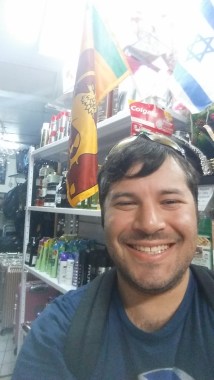
Passing by a store, I noticed something curious.  Inside was a Sri Lankan flag!!!  I know this flag because in Washington, D.C., once a year, they open all the embassies for visitors.  I had been to the Sri Lankan one and eaten this delicious coconut rice with spicy red sauce.  Turns out the woman inside was indeed Sri Lankan!  And she told me the name of this delicious dish was Miris and Hal Bat, a name I’d been searching for for years!

The woman was so kind.  She’s thinking of opening her own Sri Lankan restaurant in Tel Aviv (friends- keep your eyes pealed!).  She grew up Buddhist and then converted to Christianity in Israel.  Her husband is from Darfur and I presume Christian (perhaps explaining her conversion).  He was super nice and we talked about my favorite Sudanese music.

20180331_150222

Heading out, I let Oscar go on his way and I strolled towards Yaffo.  There, I bumped into some lost tourists from Belgium.  One of whom was exceedingly gorgeous.  I gave them a free tour of Florentin and we decided to sit down to coffee.   They have two weeks in Israel so I chatted with them for a couple hours and helped them plan their trip.  We spoke in a mixture of French and English.

After being so kind as to treat me to my tea, they headed to their hostel and I walked home.  On my way home, I saw women…dressed in saris.  While this might not be such a strange sight in Suburban Maryland where I grew up (with a lot of Indian friends), it felt kind of random in Tel Aviv.  I’ve met Indian Jews here, but there aren’t many in Tel Aviv and I haven’t seen many in traditional clothing.

Because it’s not weird to talk to random people here (like it is in much of America), I went up and asked where they were from.  They said they were Indian Christians.  They were in Yaffo celebrating Easter.  I wished them a Hag Sameach, definitely the first time I’ve used that phrase to wish someone a blessed Easter.

Arriving back in my neighborhood, I saw something strange.  A clean store.  For those of you who’ve spent time near Hatikvah, you’ll know that my neighborhood has many virtues.  Delicious ethnic food, cultural diversity, rare Jewish languages, and a certain warmth to the people.  But nobody would say the virtue of my neighborhood is its cleanliness.  When I come back from a trip abroad, it takes me a day or two just to get used to the smell again.

I walked up to the store and saw beautifully arranged fruits and vegetables.  Seeing as how I was hungry and most restaurants were closed for Passover, I decided to buy some produce.

Turns out it’s a brand new store.  Owned by Sudanese Muslims- from Darfur.  It’s probably rare for someone in the U.S. (or pretty much anywhere outside of Darfur) to bump into both a Darfuri Christian and a Darfuri Muslim in the same day, blocks apart.  Unless they happened to be working with refugees.

I was blessed with the chance to speak Arabic with them, for a few reasons.  One, because I love languages and the chance to hear Sudanese Arabic outside of Sudan is pretty rare.  It’s a really neat dialect.  Also, I wanted to share a message.

I told him: “batmanna inno al-pesakh al-jay, ra7 itkoon 3ankoon 7urriyeh.  3eid al-fisi7 huwwe 3eid al-7urriyeh.”  That I hope that next Passover, they will have freedom, because Passover is the Holiday of Freedom.  We talked about how I’m working with other olim here to support refugees.  And you could see his smile grow by the second.  I know where I’ll be shopping more- and it’s a 5 minute walk down the street.

On my way home, I couldn’t help but think about my fantastic Pesach experience.  This was undoubtedly the most diverse Passover I’ve ever had.  And I grew up in a county that has 4 of the 10 most diverse cities in America.  I’m starting to wonder if in some ways, my corner of Tel Aviv is even more diverse.

I’m incredibly grateful for the opportunity to celebrate this Passover in freedom.  Freedom to do it how I want, with whom I want, and where I want.  Freedom is a blessing every day you can enjoy it.

I pray and will work for the freedom of the Darfuri men I met today and all refugees.  Here and around the world.  There are few causes more dear to my heart or so morally clear.  Whether these refugees continue to live in Israel, are blessed with a secure country to return to, or move elsewhere, I pray that they are able to live in safety.  Nobody- nobody- should be sent to their death.  I hope that next year I won’t need to write this blog again because refugees will be given what they need: refuge.

And now to return to the title of this blog.  As you may have noticed in the news, many thousands of Gazans, along with some Palestinians in Israel, the West Bank, and Lebanon are protesting.  Are they doing it to coincide with Passover, due to its message of freedom?  I don’t know, though it would represent perhaps a welcome recognition of our shared existence, even if the timing might serve to stiffen Israelis’ spines rather than inspire empathy.  Even if the cause is just, I’m not sure I would choose Ramadan as a time to protest Islamic anti-Semitism.  Just like if I’m angry at a friend, I wouldn’t yell at him while he’s studying for a stressful test.  Part of communicating is understand when the other person is ready to listen.

I’m not suggesting there’s a particularly ideal time to make the powers that be listen.  I’m just saying that if any part of your goal is to reach the Israeli heart, making a Jewish religious holiday a time for protest is going to backfire.  Especially when I remember as a teenager, a Palestinian terrorist blew up a Passover seder killing 30 people and injuring 140 more.  Even I felt angry about the timing of these protests and I’m rather empathetic to the cause.

I have little doubt that it is miserable to live in Gaza.  Unemployment in Gaza, as of 2016, was 42%.  For youth, 58%.  Child labor is on the rise.  The Hamas government is an abysmal filth pit of extreme religious conservatism.  At various times, it has banned Palestinian women from dancing, from riding behind men on motor scooters, from smoking in public, from getting haircuts from male barbers, from running in marathons.  It even banned New Year’s Eve celebrations in the name of Islam.  It has banned Palestinians from reading certain books, from holding hip-hop concerts, and from going to the water park.  Already feeling geographically penned-in on both the Israeli and Egyptian borders, I have to imagine that Hamas’s extremist steps only escalate the tension that Gazans feel on a daily basis.

What’s the solution?  I’m not honestly sure.  Marching to the border with names of their former villages and demanding to “liberate Palestine” is only going to make most Israelis angry.  And scared.  I’m personally scared for what is happening and what may yet happen.  The loss of life, which has already begun, will likely continue on both sides.

I empathize with the anger of many Gazans.  Their life sounds suffocating and if we’re totally honest, no government in the region is totally innocent here.  People, including children, are suffering.

I also feel that the Palestinians striving for their own freedom need to remember that I, along with my fellow Israelis, have worked hard for our own.  We’re not going anywhere.  You can come back to Salameh, the Arab village I live on top of, and maybe we can build a life together.  That’d be a miracle and maybe it’s not possible due to the hatred all around.

What you cannot do- or at least what I will stop you from doing- is kicking me out.  The Palestine of 1947 doesn’t exist anymore.  Pieces of it, perhaps.  Just like the many Jewish communities around the world destroyed or cleansed by both Muslims and Christians.  Which is why we’re here.  Just this week, a Muslim man in France stabbed an 85 year old Holocaust survivor to death while shouting “Allahu Akbar”.  Stabbed 11 times.

Does this man represent all Muslims?  Of course not- and to suggest so is bigoted.  But the thing it doesn’t need to be all Muslims for Jews to feel scared.  We’re scared.

You’re scared.  You don’t like it when Israeli jets bomb your houses.  To get terrorists, but ultimately killing innocent Gazans along the way.  Inevitable.  And sad.  And how does the average Palestinian, who only knows Israelis in an army uniform, build a relationship with our culture beyond warfare?

And for Israeli Jews, while we’re blessed with having Arab neighbors in our own country (who frankly we should get to know better), the only image we have these days of a Palestinian is of a terrorist.  Or of a more “peaceful” person waving a flag, storming the border fence, claiming to liberate Palestine.  From us.  Presumably, to kick us out.  Back to the world that murdered us over and over and over again.

This blog could continue endlessly.  The torment of people here, on all sides, is so, so sad.  My friend Hekmet teaches me dabke, a Palestinian and Levantine folk dance.  The other day I told him how sad it was to learn about how some Zionist militias destroyed Arab villages.  He told me something that both eased my conscience and gave me hope: “Matt, it is sad.  And it’s also sad that Jews were kicked out of Middle Eastern countries.  In the end, we just have to live together.  We can’t only focus on the past.”

The past matters.  And so does the present.  My sincerest hope is that while knowing our past- as Jews, as refugees, as Israelis, as Arabs, as Palestinians- we can live together in peace.  Because re-litigating or liberating or invalidating or denying on any side will just kill and kill.

I don’t want a war here this summer.  I’ve come to a point where I like living in Israel.  And I want to meet Palestinians who want to build a future of hope together.

If I can take away one message from my Passover today, it’s that it’s possible.  Today I spent my holiday with Muslims, Christians, and Jews.  And I had a blast.

And not the kind that kills innocent people.

My cover photo is me eating Filipino chicken wings.  One day maybe me, refugees, and Palestinians can all eat them together and make a delicious mess 🙂


The day I learned to love Israeli security guards…and police

My experiences with security in Israel have not always been fun.  I’ve been racially profiled as an Arab.  Just last week on a trip up North, an American friend and I got pulled over at night by cops in Karmiel who interrogated me about my smoking habits (I have none) while perusing a bunch of data about me on a computer.  I’ve gotten ridiculed by security guards for being American.  I’ve gotten patted down many times, sometimes a little heavier than might be needed.  And I find it stressful and a constant reminder of the state of warfare in this region to have to get checked at every bus station, every mall, every public place.  It feels invasive and as an American who didn’t grow up here, it just feels overwhelming and harassing.

In the back of my head, I always knew there’s a reason for all of it.  Perhaps some of the excesses like racial profiling aren’t necessary, but that there were real genuine security reasons for this heavy duty security surrounding me.  I grew up reading the news about terrorism here and visiting the country itself.  So as much as I didn’t like it, I learned to adapt and accept it.  And to empathize with the low-income guards digging through my bags.

Today, I learned to love Israeli security guards and even the police.  As a broadly left-wing person, I’m not generally a fan of police nor of state interference in my life.  And sometimes maybe it can save your life.

I was at Beit Ariela, the main library in Tel Aviv.  I specifically go there because it’s one of the quietest, most peaceful places in the city.  In a place where people scream just to say “hello”, Beit Ariela is a tranquil island.  A place where the tiniest whisper will get you American-style death glares.  Where it’s clean and you can really focus and block out the noise and stress.

Today that changed.

Getting ready to take a work call from the States, I headed towards the exit.  Only to find it blocked off.  The entire square in front of my building was filled with police tape, a cop car, and police officers.

In a state of shock, I asked the librarian what was going on.  She said a phrase, later confirmed to me by an Israeli friend: “chafetz chashud”.  A suspicious object.  She tried to explain it to me in broken English because- thank God- I didn’t know the phrase.  Let’s just say you don’t learn that in Hebrew class as a 13 year old in the U.S.

The building was under lock down.  Nobody could enter or exit.  I felt suffocated.  I started to pray, not knowing what else to do.  Oddly, the Israelis around me were fairly unphased.  One woman even complained saying she just needed to get to an appointment.  I was scared shitless.  I couldn’t help but think back to when I heard an air raid siren go off a week after I moved into my apartment.  Life here can go from normal to scary in the course of seconds.

Not knowing what to do, I did perhaps the most Israeli thing of all, and just moved forward as I could.  I called my colleague in the U.S., told her what was going on, and then in the lobby of the library just had my business call.

Midway through the call, we were told all was clear and I took the brave step of going outside.  Brave because as well as these things can be cleared, you never know if there’s a second package waiting for you somewhere.  It’s a common terror technique to plant multiple objects or suicide bombers near each other.  So you get the maximum effect of piling one attack upon the clean-up of another.

Shivering inside and trying to stay functional on the outside, I walked across the street to Sarona Market while talking to my colleague.  I then recalled how when an Israeli friend living in D.C. visited me, she told me there was a terror attack there just two years ago.  Right in front of the Max Brenner store where I was supposed to meet a friend.

While I would never let it actually turn me into a hateful person, I finally understood why some Israelis hate Palestinians.  When you have the fear of death struck into your heart, when you wonder if it’s going to be your final moments, when every car or backpack or bus becomes a potential threat, how are you supposed to be empathic towards others?  I imagine many Israelis, like me, know that it sucks to be a Palestinian.  Occupied by Israeli troops, neglected and discriminated against by other Arab countries, impoverished, and governed by a corrupt Palestinian Authority- it must be hard to even breathe.

And I think most Israelis are just tired of it all.  What other people on the planet- even the most oppressed- slap on a belt of explosives and jump into a crowd of civilians?  Obviously most Palestinians don’t.  And more than a few do.  More than 40% of Palestinians support suicide bombings- more than any other Muslim country.  Until the past couple of years when terrorists started spreading to Western countries and other Muslim countries, I can’t think of another culture where this phenomenon happens so prominently.  I could be wrong.  I just can’t think of anything off hand.

Palestinian leaders have a culture of celebrating violence.  I’m familiar with the danger of cherry picking examples and that every NGO will have its slant, but here are some examples.  I wouldn’t remotely suggest that you couldn’t find incitement (or violence) on the Israeli side, just that it almost never ends with someone strapping a belt on, screaming Allahu Akbar, and exploding in a crowd of innocent people.

I suppose my point is this: I’m one of the most peace-oriented, fluently Arabic-speaking Israelis you’re going to find.  And if today is any indication, if I continue to experience the fear that is Palestinian terrorism, you’re going to find me changing my politics bit by bit.  Resisting at first, and then wondering what we’re supposed to do.  I hope we can find another way and I also deserve the right to live.  Like my Palestinian neighbors.

I hope I can manage to keep my heart open to the peace-loving Palestinians who just want to live side-by-side with me and make this place the best region in the world.  And it’s going to be hard if I’m scared to live my life for fear of being burst into pieces.  And to what degree can each of us, Palestinian or Israeli, influence the situation?  All it takes is a few seriously ill people to sink the ship and ultimately we can’t control what everyone will do on either side.

In conclusion, I’m glad I’m alive.  I hate being searched invasively day-in and day-out and I’m sure Palestinians hate it too in the West Bank.  I hope for the day when we can live like we’re in Minnesota, lie in the grass, have a picnic, and pretend all this killing was just a bad dream.

In the meantime, I’d like to thank the brave security guards and police officers who kept me safe today.  I’m not endorsing state policies nor am I saying the police are perfect.  I’m saying that I find it a miracle that these people can go home after neutralizing a suspicious object and feed their kids, read them a story, and tuck them in to bed.  I am in awe of your courage and your willingness to put your life on the line so I and other Israelis- both Jewish and Arab- can live to see another day.

After I decided to head into the market to meet my friend, I looked at the security guard.  I gently handed him my bag, looked him in the face, and said: “todah rabah chaver, sheyihyeh lecha yom tov.”  Thank you my friend, may you have a good day.

A good day indeed.  Because he’s going home to his family.  And I’m alive writing this blog to you tonight.

A family reunion with Haredim in a cave in Tsfat

I just got back from an absolutely fascinating and fantastic trip up North.  The North is truly the most beautiful part of this Land.  A place where mountains and hills, covered in green, soothe the city dweller’s soul.  A place where mysticism, hospitality, and quiet evenings can almost make you feel like you’re living in different country.

My friend and I were visiting the city of Tsfat.  Tsfat has been a center of Jewish mysticism and kabbalistic learning for 500 years.  And its Jewish community has both Biblical and Medieval roots.

It’s a place where you can just feel spirit.  Not because of any particularly grandiose buildings, but rather because of the air itself.  Tsfat is a place you can’t see- it’s a place you feel.

As we were walking on top of a Crusader castle, we heard singing.  Coming from below.  We approached some sort of round opening in the ground and could hear it very clearly.  It was niggunim- word-less Jewish melodies carried through the ages.  And they were coming from inside the hill.  I could make out the white shirts of men walking in a circle and singing.

I found a Haredi man and his family and asked if it was a synagogue in the mountain.  He said no, it was a cave.  And, being the consummate Israeli, ushered me over to him and took me to it.  Something I truly love about this place.

We headed down the hill and I entered the dark cave with the old man.  I found a circle of teenage boys holding hands, belting out the songs of my ancestors.  I came to Tsfat seeking some respite from the city and some calm.  And instead, I found God.

At a time when I had been feeling distant from Judaism and the concept of spirituality, I found something extraordinary.  Without hesitation, the old man and I stepped into the circle and started singing.

The cave magnified our song as each yai dai dai bounced off the walls and meshed with the others.

Before I had started dancing, I asked the man if the kids were Hasidic.  After all, Hasidim are known for their niggunim.  The man said, “no, they are Litvaks”.  Misnagdim.  Lithuanians.  Lithuanians- like me.

Suddenly I was no longer just singing beautiful Jewish melodies.  I was holding the hands of my cousins.  My family.  Separated by oceans and traumas and the Holocaust, reunited in a cave in Tsfat.  And just like the niggunim themselves, no words needed.  You just feel the power and the love.

What’s so extraordinary is that even though the Misnagdim and I come from pretty radically different Jewish traditions, the power of Jewish music brought us together.  Ashkenazi Jewish music has particular modes.  It’s not by accident that many of our songs sound similar.  So that even over a hundred years after our relatives were separated, we can reunite to the same sounds in a cave in the Land of Israel.

Feeling so moved that my face couldn’t help but smile non-stop for minutes afterwards, I headed out.  As my friend and I and the Haredi family walked out of the cave, the old man did the appropriately Jewish thing and asked me a bunch of questions.  Which, to his great pleasure, I answered in Yiddish.  Who was I?  Where was I from?  Where were my ancestors from?  What was my last name?  And, as is the case in many places I visit here, “are you married?”  When I told some Reform friends here I get asked that a lot, they laughed and couldn’t believe it.  And it also shows that there are a lot more traditional people here that I manage to spend time with.  Because I think I manage to get asked that question 3-4 times a day when I travel here, from Arabs and Jews alike.

When I told the man my last name was Adler, his eyes lit up.  “Adler!  You have a famous rabbi in your family!  You don’t know?  Oy, come to my house in Bnei Brak anytime- you are most welcome.”  And he gave me his address.  Because when people here invite you to something, they really mean it.

In Kabbalah, the Jewish mystical tradition, there is a concept of elevating sparks of holiness.  For Jewish mystics, tikkun olam, or repairing the world, is not just about social justice (as it is usually seen in Reform Judaism), but rather about taking the profane, the mundane and making it whole again.

I’ve traditionally associated Hasidim, rather than Lithuanians, with Kabbalah and a kind of anarchic and unbridled mysticism.  Yet Litvaks too have a relationship with this famous book.  Long have I wondered if they sang niggunim and what they sounded like.

And now, at a 130-year-old delayed family reunion in the most mystical city of all, I now know.

Nice to meet you fam.

p.s. I was humming this Hasidic-inspired song all the way down the hill, if you want to take a listen.

29513276_10101732530372072_6027841628819591344_n

When you bump into a high school friend in your neighborhood

For those of you who’ve been reading my blog, you’ll know my neighborhood is a bit off the beaten path for American immigrants to Israel.  It’s off the beaten path for most Israelis.  My particular street is quite quiet, kind of like a Mizrachi kibbutz, but a two minute walk away finds you in the poorest neighborhood of Tel Aviv.  And one of the most interesting.  Filled with Moroccans and Iraqis and Eritreans and Bedouin (still figuring that one out) and Yemenites and Russians.  And me.

The first reason I moved to my neighborhood was financial.  The rest of Tel Aviv was too expensive for me to find a place by myself.  Tired of living with roommates and not willing to spend exorbitant amounts of money, I looked where less people “like me” look.

I happened upon a great apartment and snatched it up.  The price was right, it came mostly furnished, it included most utilities, and I was able to negotiate a good lease.  A lot of hard work went into that- I saw easily 40 different apartments in person before finding this one.  You can read about my process here.

One of the downsides to my neighborhood is it’s far from…everyone.  Well, not everyone.  Certainly not my Iraqi neighbor downstairs who likes to “role play” Abu Mazen in Arabic yelling at Israel (my neighborhood is many things but boring is not one of them).  But it is far from other young professionals- some of whom flat out told me they’d be scared to visit me.  Fortunately, I have many friends who feel otherwise and have come to my park for picnics.  But as we say in Jewish English “it’s a schlep“.

That can make me feel lonely sometimes.  Especially on Shabbat when there is no public transit and people are even less willing to make the trek.  And it also becomes hard for me to visit them.  I’ve spent more than a few Shabbat afternoons alone and bored.

My neighborhood has a lot of amazing things.  It’s amazingly diverse, it has great food, it’s cheaper, it’s authentic.  The owner of the Mizrachi music store around the corner was Zohar Argov‘s producer.  It’s a place where almost all aspects of the conflict in this country come together and somehow things manage to stick together.

At night, better than anywhere in North Tel Aviv, you can truly see the stars.  The moon calls out to you.  It calms me to look towards the heavens after a hectic day, no skyscrapers around, and to just breathe.

Tonight, the most unexpected thing happened: I bumped into a friend.  Feeling kind of lonely, I left my apartment and headed towards “the city”.  “The city” because my neighborhood doesn’t feel like the rest of Tel Aviv.  You wouldn’t know it was the same city if you visited here.

On my way there, I saw a group of young people.  I was a bit surprised.  I knew there were a few in the neighborhood, often living with their families, but rarely in large groups.  As I got closer, a bearded man gave me a huge hug.

I was in shock.  Who was this guy??

After a look at his sheyne punim, I knew: it was Omer!  Holy crap!  Omer is an Israeli friend from Beit Shemesh, a suburb of Jerusalem.  We met in high school because his city was paired with my hometown of Washington, D.C. for an exchange program.  We hung out in D.C., I believe I saw him when I came several years later to visit Beit Shemesh, and then reconnected on Facebook.  Once I made aliyah, we got to see each other again in person.

Omer is an avid board games player.  Turns out, so is someone in my neighborhood who was hosting a board games event!  Delighted to bump into someone who knew me, someone who hugged me- spontaneously- in my neighborhood, I immediately asked him to invite me to the next event.

Living alone in a foreign country can be hard.  And I don’t just live here, I immigrated here.  I’m a citizen.  I have no particular plans to move back to the U.S. although as a dual citizen I legally can.  And since my work happens to be done remotely, I can bounce between countries, which is great.  It’s also true that it feels different to live here as opposed to visiting or being on a program.  Washington, D.C. will always be one of my homes.  And what I’m starting to realize, to whatever extent I choose to stay here short or long term, Israel has become one of my homes too.

A place where I bump into an old friend on an unexpected street who cheers me up.  A place where, just twenty minutes later, I bumped into another friend I met outside a nightclub weeks ago.

A place where for all its insanity and its toughness, I guess I just don’t feel like as much of a stranger as when I stepped off the plane on the Fourth of July almost a year ago.  Hopeful, confused, anxious, and inspired.  Jet-lagged and later coping with food poisoning and being stalked by toxic relatives and being yelled at daily by Sabras for no particular reason and being racially profiled as Arab and waking up to 3 A.M. air raid sirens and all sorts of traumas big and small.

Israel is whack.  That’s how I’d say it in American.  And Israel, I’m just not sure I can entirely live without you.  And if you don’t think that’s the most Israeli way of saying “I love you”, then you’re probably not one of us 🙂

p.s.- my cover photo is a picture of teddy bears from the Arab village of Tira because this is a feel good story 🙂

Why Israel doesn’t always suck (and is sometimes good at things)

This is perhaps my most Israeli blog title yet.

I’m writing you from a hostel in Barcelona, an absolutely stunning city.  It’s my first visit back in Catalonia in 10 years, and unlike my last visit, I also speak Catalan in addition to Spanish.

My experience here has been fantastic.  I visited the medieval city of Girona, the absolutely phenomenal and peaceful gem of Perpignan in southern France, and am now in the throbbing yet relaxed metropolis.

The best parts of my visit here have been the nature, the serenity, the smiles at strangers, the cleanliness, the general respect for boundaries, and not having to answer millions of deeply personal questions only to be judged for your answers.  Speaking languages I love.  And the delicious food on every corner.

It’s also nice to take my air raid and terrorism alert apps off my phone for a while and not see 18 year old soldiers carrying guns in the street.  It’s just more peaceful.

For the first time in a while, I found myself missing things about Israel.  If you’ve read my recent blogs, you might find that as surprising as I did.  Israel is pretty awful when it comes to human rights, to respecting diversity, to preserving Jewish culture, to living up to Jewish values, to treating people with respect, and to pursuing peace both within society and with our neighbors.

And there are some things Israel does well.  One is helping each other.  Today I found myself sick in Barcelona.  Both physically sick and feeling lonely.  I messaged a few Israeli friends and within seconds they were helping me figure out my insurance, cheering me up, and taking care of me.  Thankfully I didn’t need a full hospital visit, but if I had, my travel insurance would have covered every expense above $50.  Which brings me to something else.  Israeli healthcare is leaps and bounds better than anything I experienced in America.  Health is not just wealth- it’s survival.  Everything else is details if you can’t live.  Israel is a super stressful place to live and one stress I don’t have is that I’ll go bankrupt because I’m sick.

It speaks to a certain social(ist) value in Israel.  And when I say Israel, I mean both Jews and Arabs.  In Israel, anywhere you go you can charge your phone or refill your water bottle.  For free- you often don’t even need to buy anything.  In the places I’ve visited in Spain and France (and much of the U.S.) you need to buy something to charge up or you need to buy actual (expensive and wasteful) bottles of water.  These examples are not anecdotal- when combined with Israeli willingness to host guests (and sometimes strangers) for long periods of time, you sense a pattern.  When it comes to certain things, Israelis display a generosity found in few places.

While in Spain/Catalonia/France, I’ve met some people who reminded me why some Israelis are so nationalistic and racist.  There’s the Dutch guy who told me he could probably understand Yiddish because “it’s just fucked up German.”  There’s the researcher in France studying medieval Jewry who, instead of dialoguing with me, started lecturing me about my own people’s history.  I appreciate his work and would prefer someone not pin me in a corner and try to teach me about…myself.  There are also the formerly Jewish houses in Girona where you can see where the mezuzahs once hung.  And the historic synagogue that now houses an architectural firm.  I think I can understand how Palestinian refugees must feel about the remnants of their village in my neighborhood.

This is not to say that most people here are bigoted.  Most people when I say I’m Jewish or live in Tel Aviv are either neutral, polite, or even show great interest.  I’m grateful to cities like Girona that are preserving my heritage.  And to their archives for preserving Judeo-Catalan documents I got to see first hand.  And many of them were improperly labeled.  To the archivist’s credit, I submitted some corrections and she gladly marked them down.  It’s just an apt metaphor that even when some people are trying to get Jewish history right, it can feel uncomfortable.  I don’t want to impose or discourage them and I also find it irritating that most of their archived documents are upside down.  The documents of the people they expelled.  Some of whom live in their veins.

That’s the complexity of Judaism in Europe.  For 2000 years, we’ve called it home.  To this day.  And not just during the Holocaust, but over and over again throughout that time, we’ve been mercilessly expelled, burned, and murdered.  Property robbed and now turned into moneymaking tourist attractions.  That keep bits of our heritage on the map.  When I visit the Jewish quarter of Girona, I’m not just visiting a tourist attraction, I’m a Cherokee visiting the Trail of Tears.  It’s complicated, to recall the words of a Palestinian friend I talked with before moving to Israel.

Which brings me to what else Israel does well- it gives me a place where if people are ignorant about my tradition, they can learn on my terms.  It gives me a place where I’m in a position of power- as fraught as that is.  A place where if people want to expel us or lecture us or deride us, we don’t have to grit our teeth and put up with it.  Some people take this power a bit too far- and spending a bit of time outside of Israel reminded me why they do so.  Even if it’s not justified.

While in Barcelona, I went to Reform services.  I’ve been pretty fed up with God lately, tired of Zionism, and not even really sure if I feel Jewish anymore.  So I decided to see if maybe Diaspora Judaism, the Judaism I grew up with, still fit.  The services were wonderful.  They were in Catalan, Spanish, Hebrew, and English- a polyglot like me couldn’t be happier.  And it adds a spiritual dimension to share our hopes in different languages.  Hebrew alone bores me.  The people of all ages were warm and welcoming and treated me to a free meal.  As good Jews, there was tons of food.

I can’t say every part of the service spoke to me.  There are problems with Jewish liturgy I’ve only fully understood while living in Israel.  The idea that we’re the “Chosen People” or asking God to bless “His people”- that doesn’t work for me any more.  It feels racist.  I’m tired of the idea that religion should be supremacist- as pretty much every Western religion is in some sense or another.  Our prophet is the best.  Only our people go to heaven.  God chose us above all other peoples.  Try reading the words of your Friday night Kiddush in English.

And it’s my capacity to read Hebrew and my living in Israel that has shed light on these problems.  Judaism is due for a new reformation.  It has beautiful sparks as evidenced by the parts of the service and the dinner that lit my spirit again.  The music, the poetry, the community, the evolving tradition.

Much like Israel, Judaism needs a revamp.  No need to throw everything out, but the way it’s going isn’t working- at least not for me.  As I watched two Israelis living in Barcelona learn the Reform liturgy Friday night- and engage in gentler, more peaceful ways than I usually see in Israel- I see a bit of light.  Jews outside of Israel need Israel.  Yes, it’s a deeply f*cked place and I would rather the world not have states at all.  And I’ll keep fighting for that.  And the reality is we don’t know the next time anti-Semitism will strike.  Israel is the only state on earth, for better or worse, that cares about my healthcare- about my ability to live- simply because I’m a Jew.  That formula is problematic and perhaps sometimes necessary.  While we can’t live in paranoia that everyone is out to get us, the fact is some people are.  And because we’re a minority easy to scapegoat, some people always will be.

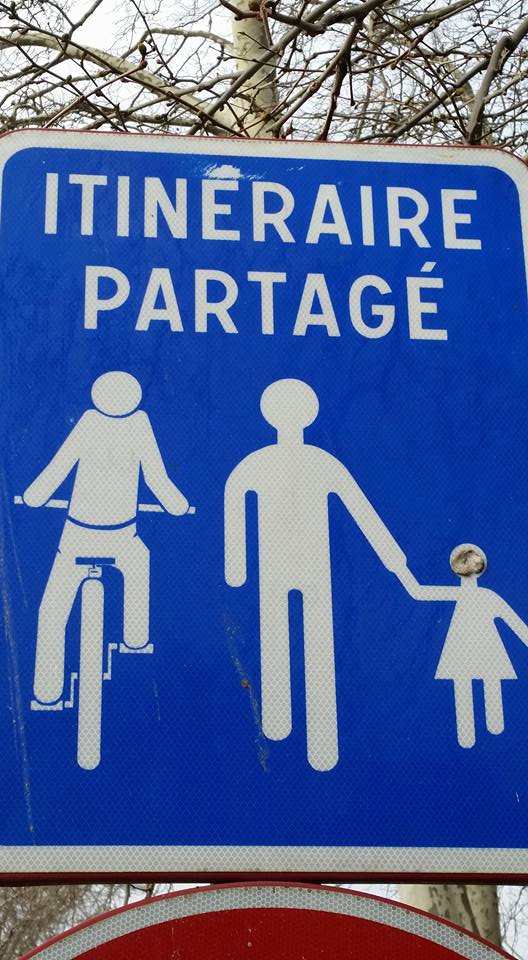
At the same time, to return to the Israelis I met in Barcelona, Israel needs Jews (and non-Jews) outside of Israel.  Judaism outside Israel is gentler.  It’s more spiritual than secular Israelis and softer than much of the religiosity I see there.  It can offer Israelis an escape valve.  A reminder than life in the Diaspora can be hard due to prejudice and it can be enriching when it engages with the society surrounding it.  It can remind us of our roots and the need to be sensitive and compassionate towards minorities.  Including in Israel itself.  As my cover photo says in French: “shared route”.  Let’s lift each other up, Jew and non-Jew, Israeli or not.

When you go on a trip, you can buy one of those souvenirs that says “I went to Barcelona and all I got was this shirt”.  I went to Barcelona and all I got was a complex textured view of the pluses and minuses of having a Jewish state- and Diaspora life.

More than I expected on a birthday trip abroad?  You bet.  But don’t worry, I’ll be having some chicken paella too 😉

An amazing day that can only happen here

Today, I had the most fascinating and fabulous day.

I started the morning in Shefa’mr (Shefaram) in Hebrew.  Shefa’mr is the most pluralistic city in Israel.  A community with Druze, Muslims, and Christians, it is one of the rare places in Israel where people of different faiths live next door to each other.  As a matter of practice.  Not like Jerusalem, where there are different groups largely in different neighborhoods.  Literally side by side.

It’s one of the reasons I wanted to visit.  The other reason is it, like the North, is absolutely gorgeous.  Take a look at a slideshow of some of my pictures:

This slideshow requires JavaScript.

Before walking around town, I needed some breakfast and got delicious hummus and pita and falafel from a Druze restaurant.  According to the owner, apparently the town loves Argentina’s soccer team.  Someone even went to the World Cup in Brazil to cheer them on.  You’ll see from the pictures below I took today that he’s telling the truth, although you’ll also see there seems to be a (rival?) Brazilian fan club:

Not what I expected to find when I came to live in the Middle East.  Which makes it all the more interesting and fun to discover!  I love finding things that challenge my assumptions.

In the village, I visited churches, mosques, and a Druze holy site.  There’s even a synagogue.  There’s even an ice cream shop that sells KNAFE ICE CREAM!  If you don’t know what knafe is, it’s this.  And it’s delicious, even as ice cream.

I was the only tourist in town today.  Not sure how many come on other days, but I definitely didn’t meet another outsider- not even another Israeli Jew.  And by and large, people were really nice.  It’s important to remember there are toxic and kind people everywhere (and a whole lot of people somewhere in between).  I’ve learned that people of all backgrounds live in gray space and nuance- it has frankly allowed me to see Arabs as people.  Rather than exoticizing them as all good or all bad or “Christian ones are good and Muslims are bad” (as many, many Israeli Jews say)- I’ve worked really hard to get to the point where I just see them as people.  Complex, like me.  It has added a softness to my Arabic that makes the language gentler and even more fun to speak.

I met with all sorts of fascinating people today- the Muslim woman who keeps the keys to the synagogue, the zany ice cream store owner who couldn’t believe a Jew could speak Arabic like me, the Druze women who wanted me to explain Donald Trump to them.

There’s a gentleness to Shefa’mr.  It’s kind of a preview of how this place could look with more peace and harmony.  More mixing and less hatred.  Or perhaps a view into a past here that once was.  Like my cover photo of a Greek Catholic Cross in front of the mosque, Shefa’mr is about living together.  In the words of a Druze woman: “one of our neighbors is Christian, the other Muslim.  Yes there is racism like anywhere else.  But we share in our sorrows and we share in our joys together.”

Before I visited Shefa’mr, when I was deciding whether to go, a Jewish Israeli told me: “why would you go there?  What is there to see?”  When you meet someone like this, ignore them.  She’s missing out and it’s truly sad to live in such ignorance of the beauty at your doorstep.  Shefa’mr is gorgeous and I did some amazing peaceful thinking there today.

After a thoughtful and inspirational morning in Shefa’mr, I hopped on a bus and then a train back to Tel Aviv.  I hate coming back home to Tel Aviv these days.  The city is loud, the people are often rude, there is an intensity to life here that just sucks sometimes.

Luckily a friend had invited me out for Purim, today’s Jewish holiday.  In the U.S., we tend to eat hamantaschen, read the megillah, have carnivals for kids, dress up in costumes, and if you’re a young professional maybe go to a party.  It’s fun and it’s decidedly low-key compared to what I experienced today.

Tel Aviv Purim is Jewish Mardi Gras.  It’s Carnaval.  It’s Jewish Sao Paolo going nuts- and it’s amazing.  I don’t drink.  I do dance.  I do love to talk to random people, including shirtless Jewish boys who are feeling friendly.  Purim is party after party- in the street, in the club.  Everyone is happy.  I have never, ever seen so many Israeli Jews smile and laugh at once.  And it goes on for several days- today was just day one.

I’ve never been to a cooler Jewish party in my life.  It’s huge.  And fun.  And for this one moment in time, Israeli Jews let go of the stress and basically don’t give a f*ck.  They just relax and have fun.

I had such a great time.  I suppose the intensity I hate in Tel Aviv has its occasional advantages.  I can’t imagine a small town in Israel- Jewish or otherwise- putting together this level of festivity.  It’s amazing.

I haven’t yet experienced all the holidays in Israel.  I have experienced most of them.  Purim is now my favorite Israeli holiday.  It’s like New Orleans filled with cute Jewish boys, dance music, and silly (sometimes racist) costumes.

If I had it my way, every month, maybe even every week would be Purim.  Israeli Jews need release.  And perhaps if they had more of it, more of them would be nicer and relaxed.

My day started with Druze, Christians, and Muslims and ended with a street fair in Tel Aviv.  Few people here live like I do.  And I encourage more to do so in the way that they can.  Cross boundaries.  Speak Arabic in the morning in the hillsides and rock out to Britney Spears at night.  Discover the secret Argentinean fan club in an Arab village and then flirt with half naked men in Hebrew as the sun rises.

I’m happy I found my way today.  My way to a good day, a fantastic day.  A day that even ended with flirting with a non-Jewish German I met while walking home to my apartment- he’s a nurse at the hospital around the corner!

This place where I live is both terrible and full of magic.  As I drift to sleep after an incredible day, I’m glad I lived today the way I did.

May it inspire us to find the stars shining where we least expect them.

A Tale of Two Orthodox

Ok it’s really four Orthodox Jews, but you’ll get my point.

Last night, I was at a rally for refugee lives in Tel Aviv.  It was exhilarating- over 20,000 people.  Some estimate 30,000.  Considering Israel has only 8 million people, it’s quite sizable.  Although being from Washington, D.C., the capital of rallies, it still feels small 🙂 .

On my way home, I wore my yarmulke (head covering).  Foremost, because last time I walked home from a rally I got shouted down and followed by hateful people in my neighborhood, which was scary.  I have met neighbors for refugee rights and it’s probably a minority position where I live.  Since Judaism is a source of privilege here, I felt wearing a yarmulke might afford me a sense of safety from some people who might otherwise be angry at me.  People who can’t imagine why a religious Jew would even be at a refugee rally.  I suppose once I decided to put it on, I was glad to do so because it made me feel a little bit connected to a religion I increasingly feel distant from.  To put my yarmulke to good use for human and Jewish values.

Before I get to what happened on the way home, I’d like to share what happened the other day.

On my way to get kebabs, I heard English in my neighborhood.  I was so astounded- I am definitely the only American for several blocks around my house- that I asked the people in Hebrew what language they were speaking.

Turns out, they were Americans from nearby neighborhoods coming for food.  Both of them Orthodox Jews.  We bantered a bit, they made some uncouth remark about refugees, but honestly nothing too grave considering what I hear in Israel.  And other than that, it was fine.  I told them I was gay and a Reform Jew, which aroused curiosity- but really nothing beyond that.  When I said I was a religious Reform Jew- they simply pondered, asked a few questions, and said “OK cool, do you want to join us for dinner?”

Which brings us back to yesterday.  On the way back from the rally, wearing my yarmulke, two Orthodox men approached me to say they didn’t like my signs.  They said it was great there was a rally because finally there were enough police to keep the streets safe.  They told me: “it’s so hard to raise children here with these Eritreans around.”  Right in front of the Eritreans standing next to me.

I told them this: “I grew up with Eritreans in the U.S. and we get along fine.  Unlike in Israel, where everyone lives in their little bubble, I’m glad I have friends of different backgrounds.  That we learn and play together.  Here you have four separate school systems based on religion and race.  How many Reform Jews do you even know?”

And the man closest to me says: “None- thank God.”

My heart sunk- and I can’t say I was the least bit surprised because in Israel, I’ve heard this a lot.  I said “well you’re talking to one now.  I am disappointed by your hatred.  In the U.S. I have friends who are secular, Reform, Conservative, Orthodox, and Hasidic.”

He said: “I’m not hateful.  Anyways, all of your mixing in the U.S. is why American Jewry is disappearing.”

At this point, I felt the discussion was useless and went to talk to some absolutely lovely Eritreans who exchanged numbers with me.  We live down the street from each other and are going to hang out.  Our values are infinitely more intertwined than those of the Israeli I just finished speaking with.

If you want to understand in one anecdote the major difference between American and Israeli Jewry- it’s this.  Are there open-minded Israeli Orthodox Jews (or Israeli Jews in general)- yes.  I regularly do Shabbat with a gay Orthodox Israeli Jew who loves to learn about Reform Judaism.

And are there bigoted American Orthodox Jews (or American Jews in general)?  For sure.

Do I believe there is a substantial difference between the two groups’ attitudes?  Yes.

In America, by and large, Jews get along.  Perhaps better than American Jews even realize.  Only by being here in Israel have I realized the degree to which Judaism is different here- and far more divisive.  And far too often hateful.

Where two American Orthodox Jews saw my queer and Reform identities as nothing more than curiosity and an entree to a dinner invite, two Israeli Orthodox Jews couldn’t even stand the thought of befriending me.  To thank God for not knowing a Reform Jew (let alone an Eritrean)- that’s a true perversion of religion.

It’s important to remember people come in all shapes and sizes, both here and in Israel.  I could have turned this blog into an opportunity to hate Orthodox Jews.  And believe me, I was very angry last night and felt some of that hatred.  Instead, my cover photo is my picture of a Hasidic kids book- based on Elsa from the Disney movie “Frozen“.  Because I like to look for the unexpected and to try to speak with nuance and understanding.

For many American Jews, pluralism, diversity, and respect are key values- regardless of religious affiliation.  And for many Israeli Jews, the idea of a school where an Eritrean, a Reform Jew, and an Orthodox Jew could learn together is so out of the norm, it can barely be imagined.  Even if they agree with it.

And that’s exactly the kind of school I grew up at.  Eastern Middle School is where I spent my teenage years in Silver Spring, MD.  To this day, I remember an Eritrean friend of mine there teaching me about Tigre.  And I remember an Orthodox friend who was one of the popular girls bouncing to Backstreet Boys- and who now lives in a Haredi community in London.

And it’s not only “not a big deal”- it’s cool.  Living together is nice.  It can be challenging and mostly, it’s just interesting.  And fun.  And enriching.  And I personally pray for the day when God will soften the hearts of the two Orthodox men who berated me.  So that instead of complaining about their Eritrean neighbors, they might see they have something in common with them.  Or even to learn from them.

May it be so.  May it be soon.

When you’ve sat at every table at the Eritrean restaurant

Tonight, I tried to make plans to go out.  Thursday is the start of the weekend in Israel, but unfortunately my friends were busy.  After talking with an American friend on the phone, I headed home.

As I walked around Shchunat Hatikva, I heard something strange: English.  I literally did a double take and was so unsure what language they were speaking, I asked the two young men – in Hebrew – what they were speaking.  Sure enough, they were American-Israelis!

You have to understand my neighborhood is nothing like the glitzy boulevards of North Tel Aviv.  And it’s really not much like the hipster neighborhood of Florentin in South Tel Aviv.  My Tel Aviv is a low-income cultural melting pot.  Sometimes a bit too loud and always interesting.  Very very rarely do I hear English.  The only other languages I hear besides Hebrew are Russian, varying dialects of Judeo-Arabic and Palestinian Arabic, Tigre, Tigrinya, Amharic, and Bukharan.

I got excited and talked to the two young men.  It was strange speaking English in my neighborhood and quite fun.  Unfortunately, the guys were not my cup of tea.  They made some rude remarks about refugees and were rather brusque with the nice guys at my shwarma stand.  I didn’t want to spend my night with them.  So I politely bid them adieu and walked down the street.

On Etzel Street, there’s an amazing Eritrean restaurant.  I’m giving a tour of my neighborhood tomorrow so I wanted to see what time they’d be open.

After I talked with the owner, I saw another man eating.  Woldu invites me to sit with him.  I grab a chair and we start talking.  Turns out he met me the other day when I brought an American friend there for dinner.  We talked about the refugee crisis, demonstrations, the importance of humanity, racism, and of course Eritrean music and dance.  Of which I’m a fan 🙂 .  He showed me his favorite artists, Helen Meles and Tesfalem Arefaine.

I want to highlight one very specific and important thing that happened tonight.  When I sat with Woldu, he insisted I eat with him.  As in, eat his food.  I felt a little awkward- I know people in this part of the world are very hospitable, but Woldu is a very low-income refugee and I had already just stuffed my face with kebabs.  I didn’t want to take advantage of him and frankly, I wasn’t that hungry.  I was very moved by the gesture.  Doesn’t get much more humble and loving than that.

What I came to realize, however, was this wasn’t just a gesture.  It was an order.  Like a top-notch Jewish mother, he gently scolded me for not eating enough.  Over and over again.  And even though I wasn’t that hungry, I gave in because frankly tibs are delicious.

Besides being utterly hospitable and kind, Woldu said something very important to me: “I’m not just asking you to eat- when I come here after a long day and have to eat alone, I want to eat with someone.  A friend.  So sit and eat with me.”

Wow.  I’m at a loss for words.  We weren’t just chatting or breaking bread together.  We were keeping each other company.  Because I like him.  And he likes me.  And I like this restaurant.  Not just because of the delicious food, but because of the beautiful people that work and eat there.  I identified with Woldu’s statement because I’m alone here too.  Thank God I have more legal protections than him and I hope he gets the justice he deserves.  When it comes down to it, we’re just two human beings, from opposite sides of the earth who met halfway in Tel Aviv.  And now are friends.  That is love.

Demonstrations are important.  I’ll be protesting Saturday night- please join me.  Supporting refugees is the right thing to do.

If Israel deports Woldu, I’ll be sad to see his pain, I’ll be furious at my government.  And I’ll feel lonely.  I’ll have one less friend here.  Refugees aren’t a news item for me.  I hang out with them.  They make me happy.  And in their struggle, I see a piece of mine too.  Newcomers in a faraway land.  Who don’t want to eat alone.

You know you love your Eritrean friends when you laugh with them because you realize you’ve sat at every table in their restaurant.

Cover photo: Daniele Bora

Yiddish softens the heart?

Two weeks ago, I approached my friends at FluenTLV about starting a Yiddish table.  FluenTLV is a fabulous event (my favorite in Tel Aviv) where people get together to exchange languages.  I offered to represent the language and they were thrilled.

Last week, the first week we did Yiddish, probably 3 or 4 people came and it went well.  One German guy, a couple Jewish Americans, and an Israeli.  Given how stigmatized my heritage language is in Israel, I was pretty happy.

Last night, Yiddish came to life.  At the beginning of the night, an Israeli came in and tried to take one of the three chairs at my tiny table.  I said: “actually that chair is for Yiddish.”  He said “well, nobody is going to come anyways, so I’ll take it.”  I said: “nope, this chair belongs here, you can leave now.”  I asked him if he wanted to learn something and he said “sure, teach me a word.”  I did, he laughed, gave me one of those “everything is OK dude” Israeli high fives and left.  Probably without a further thought about what he had said.

The best part of the evening is that this guy was totally wrong.  Group after group came over to my table.  We didn’t have enough chairs.  When all was said and done, about 15-20 people had visited my table.  A German guy and two Dutch men explained how Yiddish had made its way into their languages!  A Brazilian Jew talked about Yiddish in her family.  I met Israelis whose parents or grandparents spoke the language and remembered some phrases.  Together, we read my copy of “Der Blat”, a Satmar Hasidic newspaper.  And I could see the glow in their eyes when they realized they could understand some of it.

What was also astonishing was how willing people were to learn.  I often find Israeli culture frustrating because of the bravado.  So many people here feel the need to be right trumps all.  Hence often endless debate, even when the facts used are minimal.  I’ve even had Israelis try to correct my English- knowing I’m American.  We often laugh that off, but after a while it wears on you.  It’s tiring having to constantly defend yourself.  Humility is not an Israeli value.

Yet at the Yiddish table, Israelis came to learn from me.  And subsequently shared about themselves.  Their families, their stories, their grandparents’ Yiddish phrases.  For the first time, I actually felt in dialogue with Israeli Jews rather than a lecture.  Or an argument.  There was a softness to our conversation that made me happy.  It warmed my heart and it gave me hope.

In a society where, as I see it, traumatized Jews faced 2,000 years of violent persecution with few options for safety and survival.  Sadly, some of these Jews ended up traumatizing and displacing Palestinian Arabs in a bid for a homeland.  Some of these traumatized Palestinians subsequently re-traumatized the Israelis.  And now we’re stuck in a seemingly endless cycle of violence.

That’s how I see it on regel aches- or “one on leg” as we say in Yiddish.  My Tweet-length version of the conflict here.  The saddest part is the trauma on both sides continues.  Anti-Semitism is not just the Holocaust.  It’s a two-millennia phenomenon that continues to this day from America to France to Iran.  I’ve personally experienced it in the liberal suburbs of Washington, D.C.  When Jews are persecuted, we often have nowhere to go, which is why some people believe in a Jewish state.  I’m not sure it’s the best solution and I completely understand why people feel we need it.  It’s not by accident that there’s a lot of French people in Israel- they’re Jews fleeing violence and bigotry.  Palestinian terrorist attacks on pizza shops and buses and schools only feed this narrative as we feel under attack yet again.  Trauma piled upon trauma.

And for the Palestinians, you have those who are citizens of Israel yet continue to face discrimination, racism, and often poverty.  Whose lands were robbed of them- and are still in the hands of the Israeli state 70 years later.  You have those in the West Bank and Gaza Strip who live in immense poverty, have little right to travel, have few if any civil liberties, and often face violence from the Israeli military.  And even some settlers who burn their trees, deface their houses of worship, and physically assault them.  And you have Palestinian refugees in Lebanon, Syria, Jordan, and elsewhere who can’t even come back to the land they once called home.  Who have no rights in the villages they come from and whose host states often extensively discriminate against them.

Sometimes its enough to just make you cry and cry and weep for humanity.  With no end in sight.  Ya Allah, God please send us all healing.

So in the face of all this sadness, what gives me hope?  Yiddish.  Because tonight, I saw the softer side of Israeli Jews.  When they don’t have to be “tough”- not against Arabs, not against other Jews, not against their own heritage.  Rather, by connecting to their roots- roots violently uprooted both by European anti-Semites and the Israeli state– they felt warmth.

I hope politicians can figure out a solution to this problem.  Given their proclivity for narcissism and greed, I’m not sure what they’ll do.  In the meantime, perhaps part of the solution is culture.  When you feel connected to something bigger- especially something a part of your heritage- it puts things in perspective.  Rather than having to show how “Israeli” you are, you can be the multifaceted Jew beneath the uniform.  The Jew whose family was persecuted by Polish Nazi collaborators, the Jew whose family escaped to Israel, the Jew who lives on Palestinian land, the Jew who wishes to reconnect with his heritage.  A complex one, of persecution and co-existence.  Of perseverance and of trauma.

A little less prickly sabra and a little more soft kneydlach.  Those fluffy yet durable matzah balls that comfort you when you feel sick.

Cover photo by Jonathunder – Own work, GFDL 1.2, https://commons.wikimedia.org/w/index.php?curid=31812266