Why do so many Israelis know nothing about each other?

This is a question that confounds and deeply frustrates me.  If we’re going to live together and thrive and appreciate each other, we certainly can’t do it living in silos.

I’d like to share a few examples from people who I think are well-intentioned:

Yaniv is a Jewish doctor (every mom’s dream!).  Growing up in a secular Persian and Moroccan family, he’s now partnered with an openly gay Ashkenazi Orthodox man- already showing he’s pretty open-minded.  I was telling him about my trip up north last week, where I visited many Arab villages, including some Christian communities.  He actually lived for several years in Haifa as well so he has spent time in this part of the country.  I started talking about the different groups in Israel- Greek Orthodox, Greek Catholics, Maronites, etc.  And I noticed he didn’t really react.  I asked him if he had learned about Christianity in school.  He and his partner basically explained that in their schools, they learned only very basic information and didn’t get any exposure to the different types of Christianity.  In the country where the religion was born!  They were surprised, for instance, to learn that in the U.S. there are hundreds of different types of Protestantism alone.

Ahmed is an Arab Muslim cab driver.  We were talking about our backgrounds and he asked about my origins.  I explained that I’m Ashkenazi from Romania, Austria, Lithuania, Russia, and Belarus.  He asked why my family came to America.  I explained that in the late 1800’s and early 1900’s, there were massive pogroms in Eastern Europe along with crushing poverty that motivated Jews to move to America.  Ahmed asked me: “They killed Jews in Russia too?  I thought they just did that in Germany during the Holocaust.”  I was shocked, although I had heard similar things from European Christians in whose countries anti-Semitic violence took place, which is all the more problematic.  There is 2,000 years worth of anti-Semitic massacres and discrimination which you can read about a bit here.  Ahmed was sorry to hear about the anti-Semitic killings and genuinely surprised.

Yoav is a 26 year old Jewish guy from a moshav near Jerusalem.  An open-minded guy, he told me about how he thought it was important for Jews to get to know Arabs and vice-versa.  I told him how I visit all parts of the country, including nearby Bnei Brak, a Haredi city you can read about here and here.  He said he’s never been there (he lives 20 minutes away) and was considering a trip sometime, but he’d need time to think about whether he was up for it.  As an aside, I met an 18 year old from Ramat Gan, a 5 minute walk from Bnei Brak, who had never even stepped foot there, even to buy a bottle of water.  Yoav said he had seen on the news that someone paraded around Bnei Brak with an Israeli flag and got negative reactions from people, so he was afraid to go (a number of Haredim are not Zionist for religious reasons).  I told him that first of all, I’ve been a number of times and never had any issues- in fact, I found a lot of interesting food, music, and people.  I also told him that if your first interaction with someone is to delve into several-hundred-year-old political debates, you’re not going to have a very good discussion.  Rather than getting your information about your neighbors from the news, I said, just go and meet people for yourself.  He nodded in agreement.

Yair is a 20-something man from Jerusalem.  I believe he either is or was Modern Orthodox.  I had told him I was Reform and he and his Haredi friend asked me a bunch of (sometimes provocative) questions about the movement.  I do think that they were well-intentioned and curious but had not met many Reform people before.  Again- their sources were the news.  I did ask Yair: “What personal experiences have you had with Reform Judaism?”  He said: “Oh well I went to a Reform synagogue in London once and it did nothing for me.  Sorry, but Reform Judaism is kind of hollow.”  I then said to him: “There are millions of Reform Jews in the world and over 1,000 synagogues.  If I ate one bad schwarma in Jerusalem, would that be fair to say all Jerusalem food sucks?”  He said I made a good point and listened as I explained a bit about my community.

I could write a whole separate blog about ignorance I hear from tourists here (I met a Christian American tonight here for business who was absolutely shocked that Sunday is a day of work here and he wondered what Christians do here.  My answer: “they adapt”.  I had to spend a solid 15 minutes explaining how Jews in the U.S. adapt to a calendar that doesn’t reflect our holidays and traditions- he had no idea).  But I’d like to focus on my neighbors for a moment.

The examples I gave above are of Israelis who I truly believe have good hearts and are open-minded people.  These are not people who are hardcore bigots or full of hate (although those exist in every society).  These are people who know almost nothing about their neighbors, but who I believe have some curiosity about them.

I don’t have an easy answer to this problem.  Unlike in the U.S. where people go to school together with kids of all different races and religions, here there are separate schools for each sector of society.  Setting up a genuinely pluralistic multilingual public school system could take quite a bit of energy and time (although it’s perhaps an interesting outside-the-box idea to explore).

In the meantime, I do have a suggestion.  We need to step outside our bubbles and find one way each week in which we reach out to someone new.  Someone from a background we know little or nothing about- or are even afraid of.  It could be as simple as asking your Orthodox co-worker how the holidays were and what her family did.  Or asking the secular guy in your office what music he likes.  It could be opening up Wikipedia and reading about Arab Christians in Israel.  It could be watching this amazing dabke dance from Nazareth or asking your favorite Arab falafel guy to teach you a few words of Arabic.

The point is if we wait for the government or politicians or the media or NGO’s to do this work for us, it’ll be too late.  If we’re really going to make Israeli society work, we need to get to know each other.  You don’t need a program.  You don’t need a tour guide.  Gently step outside your bubble (knowing it’s still there when you need to reflect and regroup) and embrace the possibilities.

No law can make someone like you.  That only comes from an opening of the heart.

Everything is Better in America

Israelis love, love, love to tell me how much better and easier things are in America.  Aside from several seriously well-informed Sabras who understand the challenges of American healthcare, college education, crime, gun violence, public transportation (or lack thereof), and anti-Semitism, a lot of people here just don’t get it.  On the other hand, a lot of Israelis (including some who say America is better, in an act of serious cognitive dissonance) like to tell me how awful the food is, how naive the people are, and how fake everyone is in the U.S.

In the spirit of shedding light and dispelling myths, here’s my take on what’s better in America and what’s better in Israel.

AMERICA THE BEAUTIFUL

  • America is the most diverse country on the planet.  430 languages are spoken in the U.S.  There are hundreds of Protestant denominations alone- not to mention Catholics, Jews, Orthodox Christians of all varieties, Muslims, Buddhists, Hindus, Jains, Sikhs, Bahai, Rastafarians, Mormons, and Native American religions.  It’s extremely racially diverse- there are twice as many Asians in the U.S. as there are Israelis in the world.  And seven times as many Latinos.
  • Much more so than in Israel, Americans of different backgrounds work, play, pray, and learn together.  On my high school soccer team, white Christian kids were a minority (and somehow almost all of them were blond!).  Just on one team, off the top of my head 13 years later, we had kids from El Salvador, Korea, Iran, Israel (!), Georgia, Bulgaria, Peru, Cameroon, Brazil, Uruguay, Bolivia, Turkey, Russia, and a bunch of Jews.  There were no organized co-existence activities- this was just our normal life!
  • Pluralism.  In the U.S., thanks to the separation of church and state, religion is a personal rather than a legal matter.  This even benefits the Jewish community, where over the course of my life I became friends with Reform, Reconstructionist, Conservative, Modern Orthodox, and even Haredi Jews.  Are there debates between Jews?  For sure.  But the relationships between communities are much deeper in the U.S. than here and there is far, far less vitriol.
  • Ethnic food.  Yes, thanks to the tens of millions of immigrants from around the world, American food is amazing.  I’m really sorry (not sorry) for my Israeli friend who posted about her office in Denver not providing her with suitable vegetables for breakfast (side note- nowhere I’ve been outside of Israel eats vegetables for breakfast).  But the fact is, American food IS international food because we’re an international society.  Don’t come to America expecting your (albeit delicious) Israeli cheeses, yogurts, and tomatoes for breakfast- that’s not what we do.  But we do have immensely better, fresher, and cheaper Thai, Burmese, Indian (southern and northern), Vietnamese, Chinese, Mexican, Salvadoran, Cuban, Laotian, Korean, Nepali, Japanese, etc etc.  Not to mention the best Jewish deli food in the world.  The point is that unlike in Israel, where I grew up, these are not seen as exotic tastes of foreign lands.  They become part of our diet and become American food.  When I spent a summer in Spain, I didn’t miss hamburgers.  I missed Chinese food.

ERETZ YISRAEL YAFFA – THE BEAUTIFUL LAND OF ISRAEL

  • Healthcare – I’ve already written a blog about this which I recommend reading.  Israeli health spending per capita is $2910 and in the U.S. it’s $9403.  The number one reason for bankruptcy in the U.S. is medical expenses.  Just two years ago, I had to spend $20,000 on medical care in one year- in addition to the $500/month I spent on medical and dental insurance.  Israel’s healthcare system is ranked 4th for efficiency- the U.S. is ranked 46th.  My friend Dave is battling a brain tumor and has to raise $68,000 for treatment, something unthinkable in Israel.  Please consider donating (and stop whining about Israel’s healthcare).
  • College education – in the U.S., college education ranges from about $9410-$32,410 a year.  And that doesn’t include thousands more dollars for housing or food.  Some schools like Bates are charging over $60,000.  The better the school, the better the job prospects.  Israeli tuition is about…$3000 a year.  Pretty sweet.
  • Fresh produce – yes I just touted American food, which is amazing.  Truth be told, the fruits and veggies here are better.  Perhaps because Israel is small and doesn’t ship grapes from California to New York, the produce is super fresh and extremely tasty.  Other than farmers markets, fruit in America tastes watery.  In Israel, it is full of flavor, inexpensive, and delicious.
  • Weather – this depends on where you are in the U.S. (I’m looking at you beautiful San Diego), but at least compared to D.C., the weather in Israel is much nicer.  Yes it can get very hot, but there is a beach.  There are beautiful rural places to escape to with nice breezes.  When there is three feet of snow on the ground during a D.C. blizzard, Tel Aviv is 60 degrees Fahrenheit on a February day.
  • Caring for one another – this might surprise Israelis, but I find Israelis to be much more willing to trust one another and to help one another than Americans.  I regularly see people step up and help people who are sick, lost, in need of a place to stay, etc- even if they’ve never met them.  These are things that would usually be met with suspicion in America, but here are totally normal.  If you have nowhere to go on Friday night for Shabbat, just tell someone and you’ll be eating a warm meal before you can remember their name.
  • Judaism – yes, the U.S. is pluralistic with a much bigger Reform community than Israel, but the fact remains that the entire country here is a synagogue.  When I walked down the street today, my friend and I heard a shofar.  There is biblical graffiti everywhere- done by hipsters.  My favorite Israeli dancing songs play on juice bar stereos.  All of my holidays are government holidays.  I can go to the Western Wall in Jerusalem in the morning and a gay Orthodox Torah study in Tel Aviv at night.  There is also unparalleled Jewish cultural diversity (and food!) here- with Jews from dozens of countries represented.  My identity is validated over and over and over again even in ways Sabras don’t recognize.  Here, I am normal.

We won’t even get into the economics of things, because while Israelis decry how much more Americans make, the fact is things are a bit more complicated.  The average Israeli household earns a net income of $56,892 a year.  In the U.S., the figure is $55,775.  For sure, there’s variation by region and industry, and there are different tax burdens.  But the point is- not all Americans are rich (most aren’t) and especially when you consider that significant sectors within Haredi and Arab societies here don’t work, there’s not as much of a gap between Americans and Israelis as some people here think.

In the end, I’m not writing this blog to declare victory or to engage in endless debate.  That feels a waste.  There are beautiful things in America and beautiful things here.  And shitty things in both places.  And I could give many more examples of both.

I chose to be here not because it would be easy, although in some ways it is easier than America.  I made aliyah because it would be meaningful, it would be validating, and it would be inspiring.  In short, because I think it’ll make me happy.  Much like this famous scene from Monty Python, let’s not bicker about who’s right.  Let’s just respect each other’s choices, including mine to become an Israeli.  Because in the end, I’m not asking for your approval or your advice.  I’m here.

What America can learn from Israel

Tonight, in the span of 5 minutes, I saw what Israel has to teach the world about tolerance and diversity.

Walking back from an outdoor movie in Yafo (which overlapped with the Islamic call to prayer halfway through), I heard a man on a microphone.

The man was talking to a crowd at a restaurant on the roof of a building.  He started to sing.  I figured it was just a guy playing music for tourists.

Then I started to recognize traditional Jewish wedding music, saw a chuppah, and realized it was My Big Fat Jewish Wedding.  People started to dance and shimmy as the music blared.  Definitely the only time I’ve ever walked by a rooftop restaurant and discovered it was a Jewish wedding- on a Wednesday!

Then I headed to a great spot where you can look out at the sea, just meters away.  And there I saw a group of Korean Christian tourists with a guitar singing their songs of praise.  A crowd of secular Jews, Orthodox Jews, and Muslims watched with great interest.  Women in hijabs swayed back and forth as the Koreans sang their hymns.  Everyone applauded at the end while the song leader said “God bless you” to all of us.  It was beautiful.

As I headed over to a dessert shop, I could hear the ululating (in Hebrew “kululu”, in Arabic “zaghrada”) from the Jewish wedding.

The dessert shop is run by Arabs.  For the first time, I tried malabi, a creamy Israeli pudding dessert likely of Turkish origin.  It was de-licious.

As I chowed down, I noticed the shopkeeper, Zidan, was blasting “Shav El Admati” (I return to my land), a famous Zionist Mizrachi music song about Jews returning to Israel.  So this was an Arab man singing at the top of his lungs a Jewish song about returning to Israel.  While I, an oleh chadash (new immigrant), am singing all the words with him because I learned them while pining for Israel in America.

As the song ended, Zidan gave a Haredi (ultra-Orthodox) Jew directions to the nearest Kosher restaurant.  When the man didn’t understand, the gay Reform Jew (me) showed him the restaurant.

All of this happened in a one-block radius in 5 minutes.  It was the best part of my day.

At a time when America is suffering, I can’t help but think that perhaps my former country has something to learn from Israel.  I’ve often spoken of ways Israel can learn from America, but I think it’s time to turn the tables for a moment.

Tolerance and coexistence don’t just happen at big elaborate ceremonies or through proclamations.

They happen in our day-to-day lives, when people least notice or expect it.  Organically, not by way of grandiose announcements or gestures.  If you put yourself out there in your own surroundings, you’d be surprised what you can find.

In some ways, Israelis are much better at this than Americans, probably better than Israelis even realize.  I’d love to see my fellow Israelis appreciate the miracle we’re living in.

At a time when Americans are struggling, understandably, to figure out how to repair their society, my advice from Israel is this: living your values in your day-to-day life is the best way to make change.  Forget the speeches and the rallies- there may be a time and a place for them, but their impact is temporary and can’t sustain long-term change.

Be the Korean Christian singing for Israelis.  Be the Muslim woman swaying to their music.  Be the Haredi guy asking directions from an Arab shopkeeper.  Be the new immigrant exploring new foods and new cultures.

There’s a lot you can’t control in life, but what you can- enjoy the hell out of it.  Look around you, there’s miracles happening everywhere.  Just look.

American Nazis, Syrian refugees, and baklava

Today on many levels was just a normal Israeli day.  I ran around doing errands, dealing with Israeli bureaucracy, hearing my favorite songs blasted from cars on the streets, and walked down the beach to Yafo.

That is exactly what made today so weird.  In America, today was not a normal day.  As I could tell from post upon post from my friends in the States, something big was happening.  Neo-nazis and the Ku Klux Klan (KKK) held a rally in Charlottesville, VA, a beautiful, musical college town which I have fond memories of.  I’ve been there twice, heard great live bluegrass music, and hiked in the nearby mountains.

One of the Nazis literally drove their car over a counter-protestor, killing the woman.

On the one hand, this was shocking.  I lived in the U.S. almost my whole life and I’ve never heard of a massive Nazi rally, even in the most conservative parts of the country.  Estimates are that 1,000 people came.  For something that’s supposed to be fringe, that’s a shockingly large number of people to come to a random town in rural Virginia.  For any Israelis shaking their heads saying this is “overblown” (מוגזם), you are naïve and literally know nothing about America other than Britney Spears and Times Square in New York.  You complain all the time how Americans are so “polite” and never say what they think.  So if that’s true that we keep our opinions to ourselves, then 1,000 Nazis showing up at a public rally (not approved by the police) is a very big deal.  Get your heads out of the sand and realize that if this phenomenon grows in the U.S., it’s going to affect Israel and the rest of the world big time.

While this rally was shocking, it was not surprising.  I’ve experienced a lot of bigotry in the United States.  I went to a sleep away camp in North Carolina for many years and I actually met a camper who told me he was in the KKK youth group.  I told him I was Jewish and he said “I don’t mind the Jews as much, I just hate those n*ggers”.  While riding the Metro in D.C. I’ve been called a spic.  At my progressive liberal arts college, Wash U, my roommates once had to defend me from a fellow student who was homophobic and trying to attack me- in my dorm.  At the same school, I wanted to go with another gay guy to a dance and the people there told me “it’d be better if you didn’t, they won’t like it.”  At my diverse suburban high school, a girl once told me “you’re cool, you’re not like the other Jews who are all loudmouths and stingy.”  I was holding hands with a guy once in the D.C. area and a man followed us yelling “faggot” until we snuck into a restaurant.  As recently as a year ago, I was literally thrown out of a taxi cab by an evangelical pastor for being a gay Jew.  To this day, I still find it hard to wear the rainbow yarmulke I wore on my head in that car.   And that makes me sad.

The examples I gave above- I could give many dozens more.  I think every minority in America can.

That’s because Nazism and bigotry are not new to America.  There was a pretty strong Nazi Party in America in the lead-up to World War II, to such an extent that many believe it caused Franklin Roosevelt to reject Jewish refugees who were later sent to death camps.  Of course the Ku Klux Klan has been murdering minorities for 150 years- African Americans, Jews, Catholics, Latinos, you name it.

My point is this- while in some ways we’re witnessing a new and scary phenomenon, in other ways, it is a revival of long-standing American social movements.  What this means is this is not about any one person alone, it is about a movement.  You can’t extinguish a movement with an impeachment or an election.  You have to solve deep-rooted societal issues (I think many of which are economic and addressed by neither political party) and ultimately extinguish the hatred.

To my friends in the U.S.- my heart is with you.  Remember that with all the anger, it can be easy to misdirect it towards people who might otherwise be open to your message.  Practice self-care and keep an open heart as you try to build a better society.  Focus on what you can control and accept that there are things you can’t.

I found it strange today.  I couldn’t figure out why I was so upset.  I knew I was upset about what was going on in America- that I was worried for my friends.  But things were great here.  The sun was shining, I was eating a delicious chicken shnitzel, and I felt safe.  Everywhere around me were Jewish songs, Jewish signs, Jewish policemen, Jewish everything.  While Nazis marched in America, I couldn’t have felt safer.

I felt all sorts of conflicting feelings.  The pride for having predicted this would happen.  The relief and happiness that come with having made a good choice to make aliyah to escape these problems.  Deep sadness for the state of America.  Fear for my friends’ safety and well-being.  Anxiety for my non-Jewish friends who can’t make aliyah and hoping they’ll find a sense of security.

Overwhelmed with emotion, the 103 degree heat index, and the LOUDNESS of every Tel Aviv street, I raced towards the beach.

The beach at night is perhaps the only (fairly) quiet place in Tel Aviv.  Tel Aviv is a city smaller than D.C but with the energy of three New Yorks.  Sometimes, I just want some friggin’ peace and quiet.

I hopped on the phone with my friend Shadi, a Syrian refugee living in Erbil, Kurdistan in Iraq.  Shadi is my Arabic conversation partner, even going back to when I lived in the States.  Through the organization Natakallam, I pay to practice my Arabic and Shadi earns a living.

Shadi is awesome- he’s Kurdish, so we love talking about our minority experiences.  He’s also extremely open to my Judaism and my gay identity.  Whenever I’m in need of some positive energy and affirmation, I hop on Skype.

Today, I told Shadi all about what was going on in America.  How I felt happy in Israel and how I felt scared for my friends.  How I felt guilty for feeling happy with my life here while my friends suffered.  I compared notes with how his experience was as a refugee.

And then he opened up.  Turns out, Shadi’s mom and dad still live in Qamishli, Syria where he grew up.  Four years ago, he fled to Erbil, a Kurdish city in Iraq, both because of the civil war and because his wife has leukemia.  Apparently, treatment is much less expensive in Iraq.  So as to allow him to focus on helping his wife with chemo, his daughter stayed seven months with his parents in Syria- in the midst of a civil war.  Thankfully his daughter is reunited with him and his wife now and he is learning coding so he can be a computer programmer.  One day he hopes to return to Syria.

Interestingly, Shadi and I both chose to escape bigotry (there is intense persecution of Kurds in Syria) by going to places where our peoples are the majority.  There’s something about living in a place where you’re normal that’s healing and gives you a great sense of security and validation.

I don’t share Shadi’s moving story to try to minimize my own pain or that of my friends in the U.S.  Rather, I share it to put things in perspective.  Things are bad in America right now.  Fortunately not yet to the extent that they are in Syria, which makes me count my blessings and helped calm my anxiety.

Yet things in America will get worse.  Several years ago, when I told my friends Donald Trump would become President, they thought I was nuts.  Putting aside the question of whether you support him or not, my prediction was correct.  All the babbling idiots on CNN and MSNBC and the pompous writers in the Washington Post didn’t see it coming because they live in a bubble.

Now they ponder how the courts or the elections or this and that will help.  It won’t.  Time to accept reality- American democracy is unraveling.  Either it will be stitched back together by an engaged and powerful citizen movement.  Or it will die.

To my American friends- I’m praying for you.  Even as I write this.  I love you and I want you to be safe.  You have to decide how to move forward.  Want to stay and fight for a better America?  Absolutely your right and your choice and I applaud you.  Want to get the hell out and build a life elsewhere like I did?  I totally support you.  Just understand what’s going on so you can make an informed decision.  I think there is a substantial possibility that the U.S. is headed for a civil war or intense civil strife.  I hope to G-d almighty I’m wrong, but just be prepared that this is a real possibility and plan accordingly.  If there’s any way I can help, in particular for those considering aliyah, I’m here.

To my Israeli friends- wake up and smell the coffee.  I’ve talked to several sabras (native-born Israelis) today and nobody seemed to get why this was a big deal.  Even on the website of Yediot Achronot there was no mention on the front page, although there was an article about a woman who became a Jewish food guru.  What happens in America affects us- our foreign aid, our diplomatic support, aliyah (I’d bet there was a spike in applications today), etc.  An America where Nazis are gaining power is bad for Israel and bad for American Jews.  Start paying attention and realize that listening to Rihanna and having a cousin in L.A. doesn’t mean you understand America.  Read JTA, Huffington Post, even the radical left-wing Socialist Worker and the right-wing Washington Times.  You could even go further off the deep end and look for extreme right-wing blogs, but I won’t recommend that on my blog 🙂  The point is be informed because this affects our friends, ourselves, and the world.  I’m always happy to suggest resources or chat.

After my conversation with Shadi I made my way to Yafo, enjoying the summer breeze as it hit my face.  I made my way to my favorite baklava spot, hung out with my friend Sager who works there, and bit into a delicious slice of heaven.  I could’ve sat for two hours telling him all about America, but I just relaxed and soaked in the fun.  The tension in my body faded and I felt safe.

Something I hope my friends in America will feel soon too.

Anti-Semites who visit Israel

Tonight, I went to an English-Hebrew practice group.  Not because I particularly need to practice my Hebrew, since I’m surrounded by it all day and I speak it at every opportunity.  But because I wanted to make friends.

There was an interesting cast of characters, including a guy who claimed for 20 minutes he was a porn producer, only to say later he was not.  I spoke some Hebrew, others spoke English, all was fine.

Then I met an exceedingly handsome French guy whose Hebrew accent was to die for.  Even after he revealed he had a girlfriend, I couldn’t stop looking at his beautiful skin and face and smile.  Oulala!

Let’s call him Pierre.  Pierre has a very cushy job at a pharmaceutical company who has asked him to work in Israel for four months before moving him to London.  Not a bad life.  Pierre is actually not Jewish!  This surprised me, because actually there are a ton of French Jews here, many of whom are escaping rabid anti-Semitism in France.  He asked some thoughtful questions about Israeli politics, religious identity, and had an impressive command of Hebrew for someone who’s been here for a few weeks.

I decided he might make a good friend, so we walked for a while together after the event.  Sadly, it didn’t take long for the garbage to come out.  Perhaps feeling liberated from being away from a larger group, he started to tell me all. about. the. settlements.  Please don’t get me wrong- talking about the Jewish presence in the West Bank is a very legitimate political issue and one that is far more complex than the Western media makes it out to be.  I can understand why there are people critical of the settlements (their word) and- just as critically- I can understand why Jews choose to make their home in Judea and Samaria (their words).  There are genuine concerns about human rights violations and there are very real religious and historical reasons why Jews want to live in these places.  I’ll save the political debate for a future blog- the point is I try to have empathy towards different types of people.

Pierre was not so interested in empathy, but more in lecturing me.  The truth is I found it shocking, but not too shocking.  I’ve had many non-Jews, especially those visiting Israel, jump into long-winded speeches about their political beliefs.  Before really even knowing much about me or frankly, Israel.  Unfortunately, so many people around the world view this place solely through the prism of news articles and not through their own personal experiences and relationships here- both with Israelis (Jewish and Arab) and Palestinians.

I often feel like the world expects Israelis and Palestinians to entertain them, like a circus.  One person dies here (doesn’t matter the religion or nationality), and the BBC cameras race to the scene.  It’s front page news.

Yet when a black kid is shot on the streets of D.C. or when hundreds of thousands of Syrians are butchered or when Tibetans are colonized by the Chinese government, the world barely blinks.  The conflicts go on, untended and unresolved.

It’s not that I’m arguing we shouldn’t pay attention to what happens here- we should.  It’s just that the amount of attention that the world puts on this tiny little place is absolutely out of proportion and exacerbates the problem rather than solving it.

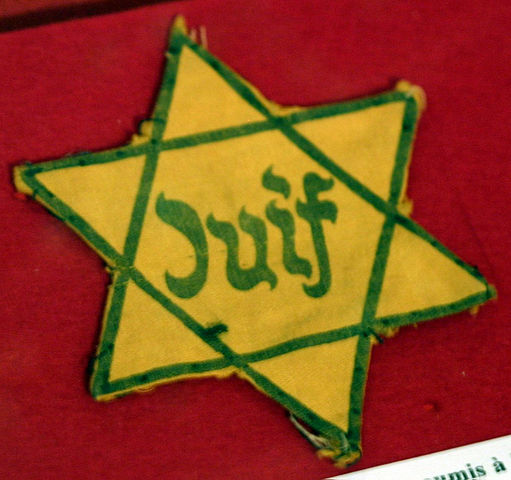
In the end, non-Jews who visit here from Western countries should treat this place with respect- including the Jews who live here.  If you want to understand why Jews return to their homeland, you need to learn something about Jewish history.  Plenty of American Christians know what Chanukah is (vaguely), but most couldn’t tell you about the pogroms that brought my ancestors to the U.S.  Or Martin Luther’s antisemitism.  Or the laws that prohibited Jews from owning land in Europe.  Or forced conversions of Jews to Islam in Iran.  Or the myriad blood libels, burnings, discriminatory clothing, or expulsions you can read about here.  And before my American friends chime in with “oh well this is foreign to the U.S.”, you can read this.

My point is this- before you rush to judge another culture (because yes, Jews are both a culture/people and a religion), learn something about it and show some humility.  When I met Pierre, I didn’t rush to ask him to condemn France’s myriad expulsions and massacres of Jews over the course of 2,000 years.  Nor did I ask him to condemn the extensive French collaboration with Adolf Hitler (as an aside, I had a highly educated French teacher who thought the first time French people did something antisemitic was the Holocaust).

Why?  Because I don’t even know him!  If I met a Chinese person, would I launch into a tirade about Tibet?  Is that socially acceptable?  Is that kind?

No.  Because everyone is a human being first and foremost.  If you really want to get to know Israel, you have to get to know Israelis.  Just like anywhere else on the planet.  You have to accept that things aren’t always black and white and that there are reasons why things are the way they are- even if you don’t always agree.  Empathy isn’t about morally approving of everything another person or another culture does- it’s simply understanding where it comes from and acknowledging that all behavior is caused.

There’s a reason why if I hear a Jewish Israeli criticizing settlements it bothers me less than if a French Christian does it.  There are historical reasons for that.  Jews have had to band together over the course of two millennia to survive oppression without a state.  Now that we have a state, we still find our situation fragile as we’ve endured war after war for our existence.  This is a place with eons of trauma that we’re trying to heal from- even as we try to make peace with our neighbors, who have their own issues they’re sorting out.

Let’s say you have a zany uncle.  You laugh about your uncle with your mom, with your cousin, even with your aunt.  But the second some random person at a gas station laughs at him, your back straightens and you’re ready to defend him.  Because you’re family.

For Jews and especially for Israelis, we are a family.  If I’m gay and I use the word queer, it feels safe.  If a straight person uses it, I start to worry that it might be an insult.  I think the same concept applies.

You don’t have to dance around things all the time- let’s talk.  But you do have to be sensitive to my people’s historical experience if you want to talk with me.  Try to understand where we’re coming from.  The fact that you have a Jewish friend and like challah does not mean you understand my history and my identity.  I’d in particular recommend the book “A Short History of The Jewish People” as a great place to start learning.

A while after my conversation with Pierre, I looked at his Facebook profile.  Hoping to find some sign of nuance or interest in Judaism that would abate my anger, I instead found a homophobic quote, a picture of Hitler, and an article posted that mocked Jews who were concerned about antisemitism.  I blocked him.

All goes to show that yes, you can ask good questions about Israeli identity, you can speak some Hebrew, you can be intellectually curious about Judaism, and even visit Israel.  And be an anti-Semite.


Dancing on Roman ruins

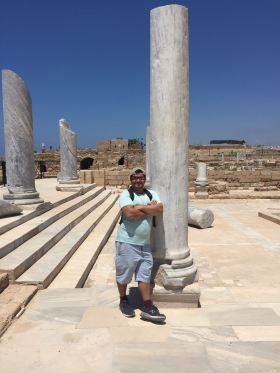
Wednesday I went to Caesarea, a beautiful seaside town of fourth century Roman ruins.

On my flight to Israel, I met a fellow oleh chadash (new immigrant) named Ari. We’ve become fast friends and recently he made the wise observation that I’ve spent almost all of my time in Tel Aviv and that we should go explore other parts of the country. Since he has a British accent and all things sound wiser that way, I obliged him.

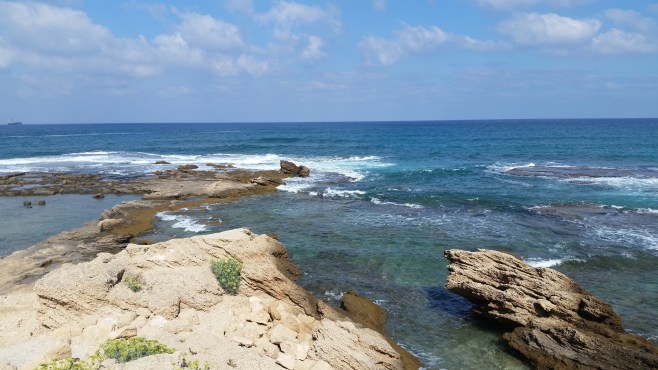
I could spend this blog telling you about the amazing Roman, Byzantine, and Ottoman ruins. Or the crystal blue sea. Or the snorkeling Ari and I did.

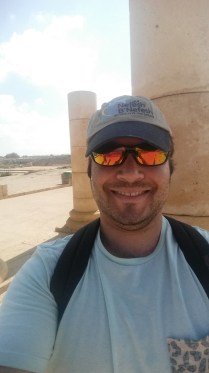
Instead, I’d like to tell you about our cab driver, Akiva. Before I get to that, look at the cool pictures below of our trip!

20170802_09160220170802_092206.jpgIMG-20170803-WA000120170802_092233

When Ari and I got off the train, we had trouble finding the right bus. Caesarea is the opposite of Tel Aviv- it is completely in the middle of nowhere, so it is hard to get around.

Instead of waiting for buses, I ran and hailed a cab dropping someone off and we got in.

The driver’s name was Akiva. Akiva is a Persian Kurdish Jew. He speaks some Farsi and fluent Kurdish. His mom made such good Kurdish food that he said he’d pay $500 just to taste her food again (she passed away at 82).

Before dropping us off at Caesarea, Akiva tells us he can show us the graves of ancient rabbis if we call him for a ride back.

After a day of fun and exploring and a little bit of sunburn, I called Akiva.

Twenty minutes later, Akiva comes walking down the street and tells us to follow him. He said the guards wouldn’t let him bring in his car.

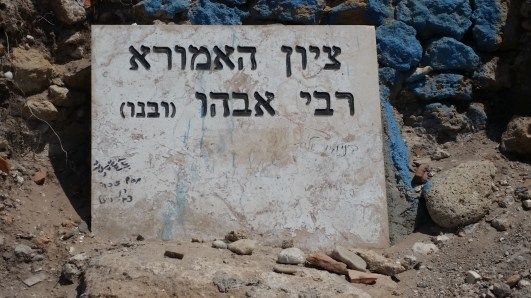
We walk 10 minutes down the road and he motions for us to literally climb with him down a cliff. We make our way down and there is the grave of Rabbi Abahu, one of the Amoraim (great scholars of old- and by old I mean 1700 years old). Rabbi Abahu was actually from 3rd century Caesarea- something people who deny Jewish history in this land would be wise to remember. Our cab driver was not bullshitting us- there’s an actual sign and little books of Psalms that you’re supposed to recite. We leave stones on the grave in the rabbi’s memory.

20170802_141808.jpg

It’s customary to pray for something when visiting the grave of a great rabbi. I prayed for our driver Akiva, my friend Ari, for me, for the Jewish people, for the whole region, for the victims of the war in Syria, and for the soul of the rabbi himself. I’ve never prayed at the grave of a rabbi- it was quite a moving experience, especially with the beautiful sea breeze and sound of the waves crashing behind us. Could Rabbi Abahu have ever imagined that his people would return to their homeland 2,000 years after the Romans brutally forced them into exile? I wonder if he prayed that one day his descendants (us) would visit his tomb.

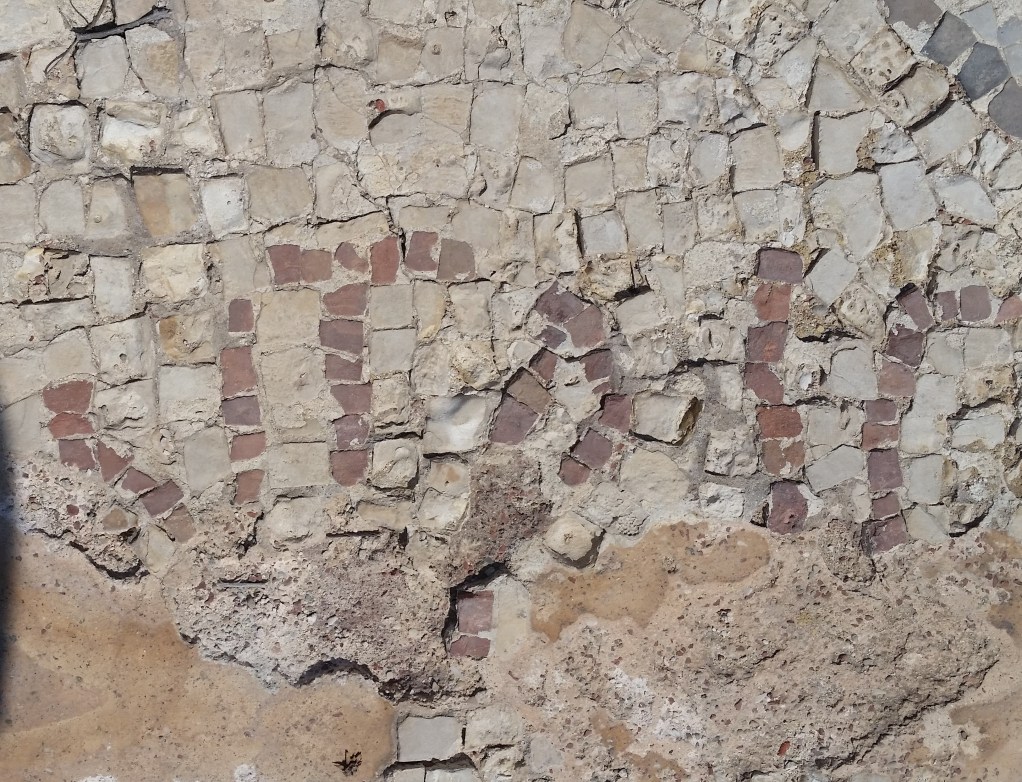
Akiva walked us back up the cliff (it’s worth pointing out that Akiva is probably 70 years old and there’s no cab meter running- this is just out of the generosity of his heart). Then he walked us to another site- an ancient synagogue mosaic. You could even see some Hebrew writing among the tiles. According to (our) Akiva, the famed Rabbi Akiva (1st century C.E.) was buried there as well after he was mercilessly tortured by Roman soldiers.

20170802_143842-e1501711832736.jpg

First off, I’ve never felt more connected to the land of Israel. Not just because of the stunning scenery that constantly keeps me in awe that I actually live here. But also because my ancestors walked this land. They defended our faith and kept our culture alive so that I can reap the benefits today and pass on that tradition to future generations.

Akiva, our wonderful cab driver, is the epitome of the best of Israeli society. After spending a good 20-30 minutes with us exploring these historic sites, he asks us to follow him again. This time, we headed towards the car. It was another 15 minutes down the road.

This 70-year-old man took an hour out of his day in pummeling heat to show us our heritage. Not because he had to, just because he is kind and he is proud of his people. There is a depth of generosity here- true, unrewarded, and authentic- towards strangers that I have never seen in any other place in the world.

Perhaps that is because we’re not strangers. Akiva, Ari, and I- as different as we might be- our stories are intertwined. We are not strangers. We’re more like long lost family getting reacquainted after a long and painful absence.

There is nothing sweeter in the world than for three Jews to dance on Roman ruins.

Alabaman Arabs and the Western Wall

Yes, that is what happened to me today.

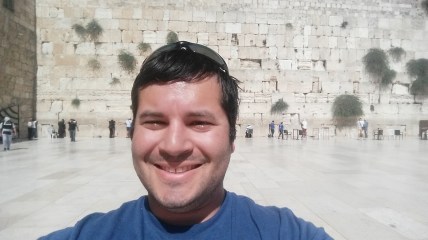
Today, I took my first trip outside of Tel Aviv since making aliyah and went to Jerusalem.  I decided to go to the Kotel, known in English as the “Western Wall” or the “Wailing Wall”.  It’s the last remaining wall of the Second Temple built in Jerusalem for the purposes of Jewish worship.  Basically, it’s the most sacred site on the planet for Jews.

It’s been at least 12 years since I was at the Wall and I was very excited to go back.  My anticipation was building as I made my way through the markets of the Old City.  This was the place my ancestors came from, the site that informs all Jewish spirituality.  Even today’s Jewish rituals and prayers are modeled after the Temple rituals.  The cruelty of the Roman Empire that destroyed the Temple couldn’t defeat our faith.

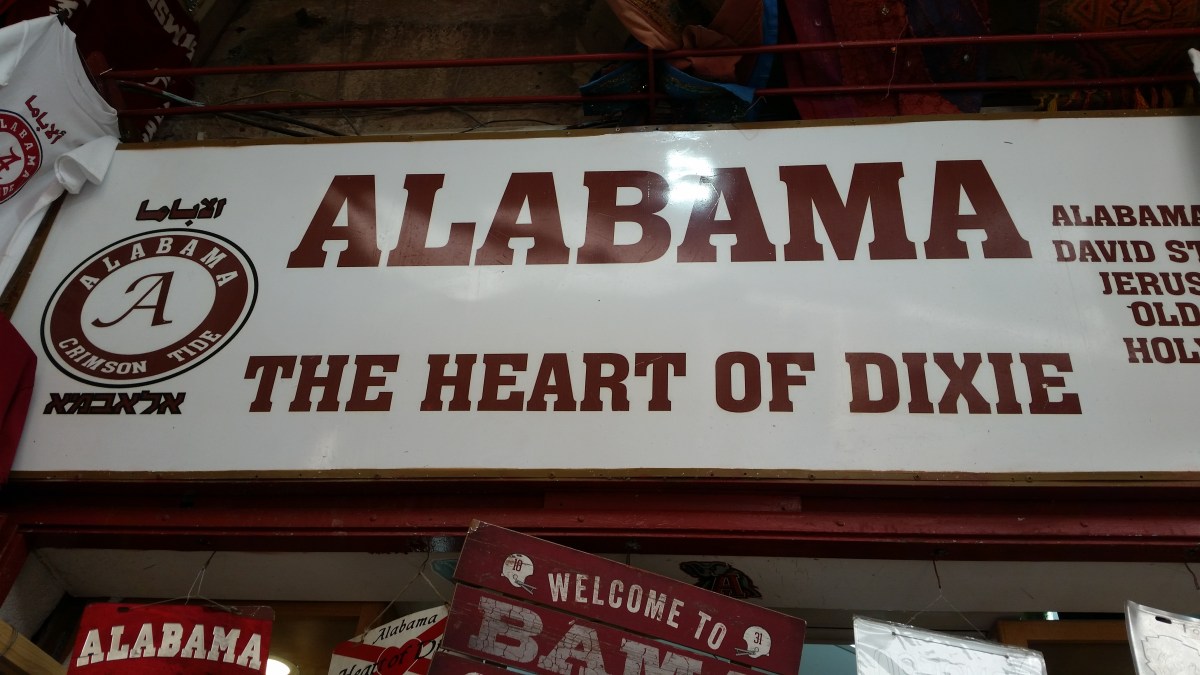
As I thought these powerful thoughts and felt these deep emotions, I came upon a sign that said “Alabama, the heart of Dixie”.  I had to re-read the sign a good two or three times before I realized yes, I was staring at a trilingual sign that said “Alabama” in English, Hebrew, and Arabic.  I felt like I was in some dystopian novel.  On what planet is there a University of Alabama store in the middle of the holiest city on earth?

Sure enough, it was an entire store dedicated to the University of Alabama owned by Arabs.  I met the kids running the store, who were sweet.  I spoke with them in Arabic and it turns out one of the kids’ dads studied at University of Alabama and became a huge fan.  I asked who exactly comes to their store, given the small number of Alabamans in Jerusalem, and they said lots of people came by.  I have to give them props for marketing because it obviously drew me in!

They had mugs and signs that said “Roll Tide” in Hebrew and Arabic.  For especially my Israeli friends who don’t understand this, watch this video.  Alabaman fans are particularly fanatical (about their team) and unabashedly southern, so even as an American it was a total curiosity to see a Palestinian store dedicated to probably the most Republican place in the country.

20170730_15123920170730_151050

And there it was.  I had a great conversation with the kids and their uncle- they’re very funny and friendly.  And then I walked to the Western Wall.

When I got to the wall, I tried praying once and it was pretty good but didn’t feel super powerful.  It ended up being a warm up.

I chatted with some German tourists and then went back for round two.  I grabbed a tallit from some Chabad guys (I was smart enough to tell them from the get-go that I didn’t want to lay tefillin, but of course they tried anyways, and of course I said “no thank you” and did what I wanted).

I then headed back to myself and enshrouded myself in the tallit, giving me a sense of privacy and direct connection to God and my inner spirit.  It was like my own personal synagogue.  I now started to open up.  I noticed a kid next to me.  He was probably in high school.  I had talked to his group earlier- they were Reform students from the U.K., from the same Jewish movement I belong to.  It felt powerful for us to pray next to each other given the Israeli government’s recent rejection of Reform prayer spaces at the Western Wall.

After a few moments, he stood there by myself and just started crying.  It’s one of the most beautiful things I’ve ever seen.  And one of the most sincere.

As I peered through the hole in my tallit at him and heard him wailing, I started to well up with emotion and sob.  I thought of all my ancestors who walked this land.  That their hands built this Temple and this very city.  That it’s because of the sacrifices of millions upon millions of Jews who were butchered mercilessly for over 2,000 years by Babylonians and Greeks and Romans and Catholics and Klansmen and Spaniards and Portuguese and Germans and Poles and Russians and Protestants and Arabs and Muslims and on and on and on.  They laid down their lives for me.  Most of them could only dream and pray for the day when they would be able to return to our homeland and pray at our holiest site.  And I carry their prayers in my heart.

When I decided to make aliyah, some of my friends asked me questions like “do you 20170730_154705.jpgknow anyone there?” and “have you ever been there?”.  Yes I do and yes I have.  If you’re a very active Jew, you almost certainly know people in Israel and you’ve visited.  Totally innocent questions, but ones you might typically ask someone moving somewhere far and exotic like Vietnam or Zimbabwe.
Israel may be Zimbabwe for you, but it is not for me.  Even though before making aliyah I had only been here twice, it is not a strange and foreign place.  While there are for sure cultural differences that I continue to learn about, this is not a colony.  This is not a destination.  This is not a stint abroad.

This is my homeland.  It is the source of my religious beliefs and my cultural heritage.  It is my people whose traditions gave rise to both Christianity and Islam many generations later.  Its stones cry out with the tears and laughter of my forefathers and foremothers.

It is a place that belongs to me as a right that my people have fought long and hard for.  The right to pray at our ancient holy sites free of violence or discrimination.  As recently as 1967, I could not have prayed at the Western Wall because Jordanian troops wouldn’t allow it.

The point is this: I am a Zionist because I believe I am not “moving to a new place” but rather because I am returning to the place I come from.  A place that has room for me to pray in peace at the Western Wall, for my Christians friends to visit the Church of the Holy Sepulchre, and for my Muslim friends to pray at the Al-Aqsa mosque.  And even to own an Alabaman t-shirt shop.

Amen.

20170730_153233.jpg


My New Minority Identity: American

When I decided to make Aliyah and come live in Israel, one of my main reasons was to live with my people- the Jewish people.  As a minority in the U.S., I’ve been subject to a great deal of antisemitism throughout my life and while there are some beautiful things about being a minority, it can also be extremely hard.  I often felt, even in good circumstances with good people, like I had to explain who I was and what I believed in.  Having talked to other minorities in the U.S.- Muslims, African Americans, Latinos, etc.- I know that my struggles were shared by many people.

Part of the reason I came to Israel was to not be a minority anymore.  To live in a Jewish-majority state and in Tel Aviv, where the LGBT community is so numerous that even if it’s not a majority of the city, it’s a very high percentage.  Where my identities would be validated.

This has been true for these identities in many ways.  I am constantly surrounded by hot Jewish men who I glance at- and often glance back!  I am surrounded by street signs with the names of Jewish leaders on them and I hear my favorite Israeli music blasting out of the windows of cars passing by.  In many ways, I couldn’t ask for a more validating space to live in.

At the same time, I’ve discovered I have a new minority identity that I didn’t fully expect when I moved here: American.  It never seemed particularly noteworthy or clear to me in the U.S. that, even as a double minority, I was also part of the majority as an American.  Never has that been more clear to me than in Israel.

The other day, I was talking to a gay guy who noticed all my pictures on Facebook of me going around Israel.  He knew I was an American oleh chadash (new immigrant).  He told me I looked like a “tourist” and laughed.  I told him I didn’t find it funny- that there are many other ways I could’ve visited Israel, but I made a very tough decision to uproot my life and live here as a citizen.  He told me “not to take it that way” and thought it was funny how I was “such a new immigrant”.

Last night, I was at a board games night and this guy told me that in English, “peaches” means “boobs”.  I told him I was American and that’s not a thing.  He told me he was in front of the White House two weeks ago yelling at Trump so he “emmmm, reeeeeally knowwwwz Eeeeenglish fluent”.  Just to clarify this for everyone- I had an Israeli correct me on my English- after I told him I was American.

I was sitting in a cafe with a new friend talking about Israelis’ favorite complaint about Americans- that we were too “PC”.  I asked him to explain exactly what he meant by that.  The friend, a well-intentioned and left-wing guy, told me “you guys have this whole debate about using the word n*gger and I don’t understand it”.  I proceeded to summarize the 400 year history of this racist term after which, to his credit, he finally admitted there are legitimate reasons why people don’t like this word.

Today, however, may just take the cake.  I was at a gay Torah study and this older man, seemingly out of nowhere, starts telling the group how all the “kushim” (an Israeli word somewhere between “colored” and “n*gger”) in the U.S. are homophobic bigots even though gay people always supported them.  My blood pressure shot sky high.  When I wanted to respond, the young rabbi in the room told me I could do so in “one sentence”.  I said “sorry I’m going to take a few”.  I tried to explain that not only is this a gross overgeneralization and racist, but that there are a ton of LGBT black people too and “black” and “gay” aren’t mutually exclusive categories.  I also mentioned that the NAACP, among other groups, actively supported the LGBT community’s fight for marriage rights.  Instead of any sort of acknowledgement of my much needed nuance, I was shouted down by younger participants who told me, the only American in the room, that black people in my country are homophobes.  Because I suppose when watching rap videos on YouTube is your only reference point for actual African Americans, you’ll come to such thoughtful conclusions.

I could channel my legitimate anger, sadness, hurt, and loneliness into a bunch of sweeping generalizations about Israelis, but then I’d be just like people who stereotype me and my (other) country.  Instead, I’ll say this: some Israelis are raging racist anti-American bigots.  Others are open-minded, eager to learn, and sweet.  And many fall somewhere in the middle.  People, in the end, are people.  You can find good and bad ones (and mediocre ones) any and everywhere.  It takes some filtering, but I hope I get to the point where I’ve built a really solid social circle here that validates all my identities: gay, Jewish, Reform, progressive, and yes, American.

To Israelis’ credit, even if their main point of reference about American culture is a trip to New York, Lady Gaga, and Game of Thrones, at least many are trying to learn about my other culture.  Most Americans know much less about Israel than Israelis know about America.  That being said, I’d encourage Israeli to dig a little deeper about my country.  It’s one thing to know the pop culture of another place and quite another to understand its social intricacies.  Ask me questions, dive in- don’t be afraid.  I’m open to talk, just like I was with my friend who didn’t understand the word n*gger and was open to listening to me.  That’s dialogue.  I’m eager to learn about you and eager to share about me.

In the end, I came to this country to be changed- to grow, to experience, to live in a new part of the world that is deeply connected to my identity.  I thank the Israelis who are making this journey possible.  At the same time, I am an oleh chutzpani – an outspoken new immigrant.  I didn’t just come to be changed- I came to change.  There are things about this society that must evolve, and that includes the way it treats its minorities- Arabs, Druze, Russians, French, and yes, Americans.

You can count on me to raise my American-Israeli voice.  I’m just getting started.

Listening to bluegrass in Tel Aviv

I had a rough time sleeping last night.  Lots of pent-up emotions that I’ve felt over the past week came pouring out.  It has been really hard- meeting dozens of new people, escaping an abusive AirBnB host, finding new housing (then finding housing after that housing), hours of bureaucracy, jet lag, adjusting to the heat, and so much more.

There have of course been amazing and life-changing moments as well.  Even those have the potential to stress you out as much as you enjoy them.  When even the street art in Tel Aviv plays on biblical motifs, it is hard to escape Judaism even in Israel’s most secular city.  It’s part of what makes it so cool to be here.

And so hard.  In America, if I wanted to engage my Jewish identity, I could prepare myself.  I could go to a synagogue or a Jewish Community Center, to Moishe House or a friend’s Shabbat dinner- and I could tap into my Jewishness.  I knew what to expect and how to behave, even if I had never met the people.  Because it was my American Jewish culture.  And as soon as I stepped outside the event, I was back in American non-Jewish society.  Sometimes that made me sad, as I felt I needed to check part of my self at the door.  And sometimes it was refreshing as I could recharge myself in the broader society.

Here, everything is Jewish.  When I say everything, I’m not exaggerating.  Israelis might not see it this way.  For me, as an American-Israeli, it feels that way.  All the signs are in Hebrew.  For instance, next to a parking garage, there’s a sign that says “Boachem Leshalom” which means “come in peace”.  To a religious American Jew, however, this reads differently.  It’s the beginning of a famous verse of the prayer Shalom Aleychem, something we sing on Shabbat.  Next to a parking garage!!!  I can’t think of an equivalent in the U.S. but perhaps it’d be like seeing “He is Risen” on an elevator.

It’s awesome and totally exhausting.  I’m not used to having Judaism everywhere in my life.  And such heavy duty politics mixed into casual conversations (and this is coming from someone who grew up in Washington, D.C.).

Sometimes, you just need a break from it all.  This morning, I put on some bluegrass music from one of my favorite bands that I saw in Charlottesville, VA years ago.  Something you will never, ever hear in Israel.  Something thoroughly American and beautiful.  I called an American-Israeli friend and made plans to talk about light, apolitical, non-religious things.  I don’t know- football, college stories, old flames, who knows!  The point is nothing serious!

As I sat down to eat breakfast (boy am I missing my shredded wheat, trying to find some in Israel), I went to Google Advanced Image Search and googled “pictures of hamburgers”.  And I felt a wave of relief and comfort come over me as I scrolled through picture after picture of hamburgers, cheeseburgers, bacon burgers, you name it.  Some of which I don’t eat.  And to be honest, I didn’t really eat hamburgers much in the U.S.

But it just felt like home.  Where I don’t have to extend myself, to explain myself, to go into the depths of politics and religion, where I could just be.  I felt out of place often in America.  And I also miss it.  It took moving to Israel to make me feel truly American.

Talking about the Holocaust over Indian food

Israel, as I’ve discovered, is a place where absolutely extraordinary life-changing conversations happen every single day in the most mundane places.  On the bus, in a restaurant, even with your taxi driver.  You don’t need to go to a synagogue to learn here, you just need to open your mouth and ears.

For example, the other day I met a friend’s friend.  She’s a sabra (native Israeli).  We’re eating at an Indian restaurant and as we’re chatting, just casually mentions she’s a third-generation Holocaust survivor from Poland.

I can’t really remember anyone saying something so profound, personal, and shocking over naan and chana masala in the U.S.  And she didn’t look visibly upset- more just like she was sharing a fact about herself.  I’m from Washington, D.C. and like sushi and she’s a third generation Holocaust survivor.

She told me how her grandparents, even after years in Israel, would eat every last scrap of food off their plates at every single meal.  Even when they weren’t hungry anymore.  She told me how she and her siblings would “sneak” food off their grandparents’ plates so they wouldn’t over-eat.

She told me how her parents didn’t want her to go on her school trip to the concentration camps in Poland (because yes, that is something every Israeli teenager does as part of the national curriculum).  Her parents were angry that their tourist dollars were going to a country that sadly still is home to many anti-Semites.

She told me how her grandmother could forgive the Germans for the Holocaust- they were from a foreign land killing foreigners.  But she couldn’t forgive the Poles who aided them- because they betrayed their neighbors and many did so willingly and joyfully.

We continued the conversation for a while, but then slipped into other topics like her job, the Reform Movement (incidentally she studied with a Reform rabbi I know here in Israel!), the food, and other things.  We laughed, we joked, we ate.

She rode the bus home with me and got off at her stop.  On her way to her boyfriend.  To chat, to watch TV, to drink tea, to go to bed.

Just another Israeli day.