The Bi-curious Druze Boy

For starters, to protect the young person involved, no names or identifying information is used in this story, but all the essential facts are true.

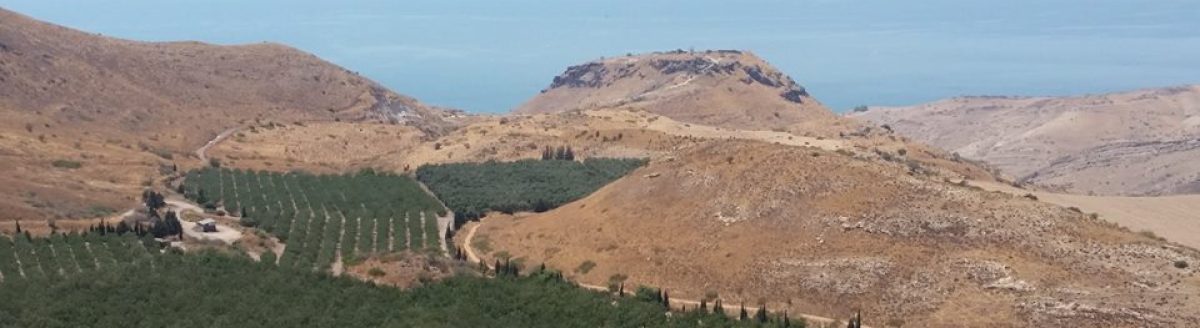
The past few days, I went on a trip to what I call the Druze Galilee.  There’s an area largely north of Karmiel where there’s Druze village after Druze village and they’re all absolutely gorgeous.  Here’s a map and some pretty pictures:

Screen Shot 2018-05-01 at 10.49.32 PM.png

It’s a beautiful, peaceful place where I enjoyed practicing my Arabic.  I love speaking Arabic, but due to fanaticism among some sectors of society, I can’t speak it comfortably everywhere especially as a Jew and as an Israeli (and sometimes even an American).  What’s great about Druze villages is they, by and large, wholeheartedly accept me as a Jewish Israeli and are thrilled to see a Jew taking interest in their language and culture.

Early in my trip, I was walking up a hill and a young man, 17 almost 18 years old, pulled over his moped and said hi.  As with all my stories from this trip, pretty much everything was in Arabic with a sprinkling of Hebrew.  He asked where I was going and offered to get me in the right direction.  So I hopped on with him and he drove.

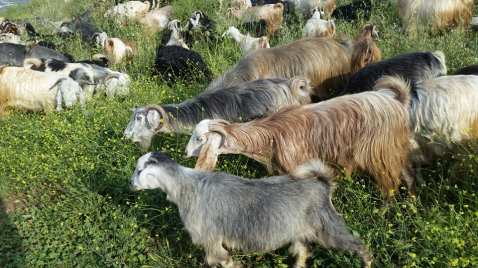
I felt free, riding around in the countryside, babbling in Arabic as the wind swept across my face.  A young Druze boy showing me around his beautiful neck of the woods.  Couldn’t get better.  I asked him to pull over to take some pictures.  He begged me not to get off- “we could go for a trip!”.  I asked him to wait a second as I took some pictures.  Because suddenly there were goats in the way!  Tons and tons of goats!  I was so excited- having spent most of my life in cities, it was pretty exciting to see goats on the road!
31641871_10101761611433392_5290224149952349447_n

While I took pictures of the goats, the young man started asking me questions- questions I often get from young Arab kids here.  “Do you have a girlfriend or boyfriend in Tel Aviv?”  I said no.  “But if you had one, would it be a boyfriend or girlfriend?” he said with hesitation.  “Boyfriend,” I said.  “Boyfriend?  Like male or female?  Or like the ones who change their gender?”  “Nope, just a boyfriend.  A man and a man together.”

I waited for the reaction.  It was a gamble on my part.  We were pretty much alone on a wooded path at least 100 meters from a main street.  I know absolutely nobody in the area.  He has a moped and I have…a cellphone?  In the end, you don’t know how people will react.  Druze, while extraordinarily accepting of my Judaism, are known for being quite socially conservative including on gay issues.  Not like certain right-wing Christians in the U.S. who try to influence the law because of it.  But conservative nonetheless.  And I was the only Israeli Jew for several miles around.  I had never been to this part of Israel.

Trusting my good instincts and what seemed to be his good nature, I stood there with him, next to his moped.  And it turns out, I not only made a good choice, I may have done a mitzvah.  A good deed.  He continued to ask me all sorts of questions about gay people and my life.  Dating, romance, sex, even the wild world of the internet.  Of course some things I just wasn’t comfortable sharing- to respect my privacy and to remember that he’s 17 years old.  But I did share what I thought was relevant and helpful and appropriate.

After the 20th question, I asked him: “are you asking me these questions because you yourself are curious?”  And he said: “maybe…could we do something?”

I smiled.  On some level, I was flattered.  Also intrigued that this guy knew I was gay simply by meeting me on the street.  And that he had a comfort level to ask me these (sometimes invasive but well-intentioned) questions.  We had a nice moment.  It makes me smile to think a Druze teenager propositioned me.  17 year old me would’ve loved such a moment.  If I weren’t being abused by my family and subjected to rabid homophobia at school, in sports, even sometimes in synagogue- I would’ve come out sooner and maybe I could’ve had more high school romances.  Maybe even with a Druze guy!

And the reality was that I was 32 and he was a minor.  I wanted to be supportive of his desire to learn more and also had to draw some clear limits.  I explained to him why we couldn’t have sex and he was disappointed.  He asked me: “there are other guys in the village- they have sex with men, but I’m not sure they’re gay.  If I have sex with a man, does it mean I’m gay?”

I told him: “you have to discover that for yourself.  Some people try things and it’s more of an experience.  Some people feel it fits them.  It’s up to you.”

I thought back to an earlier part of our conversation when he asked me how I knew I was gay.  I’ve gotten this question millions of times from liberal Americans and it frustrates the hell out of me.  Nobody asks them when they figured out when they were straight.  Because it’s something you feel, it’s not something you wake up in the morning and decide.  The only reason we have to discover it is because society assumes we’re not gay from the day we’re born.  And we have to uncover an identity hidden from us, that nobody will bestow upon us.  After often years of estrangement, many (though not all) of us come to realize who we are and what we like.  It can be exhausting and quite hard.

Before I realized this young man was curious about his own identity, I had told him: “well, I know I’m gay just like you know you’re straight.  You just are.  How did you know you were straight?”

And then I realized: he didn’t know.  He doesn’t.  And he may never know.

This young man was not any old Druze.  He’s a religious Druze.  There are secular and religious Druze- the latter take on many more responsibilities along with special dress and customs.  He’s dated girls some and seems to like it- I’m not sure to what extent.  If he lived in a more liberal society, perhaps he’d be out by now.  I don’t know.  Maybe he’s bi.  Maybe he’s gay.  Maybe he’s straight and just trying things out.  I don’t know.  And I hope, even with the pressures of the society around him- a society I love dearly- that he can figure out the best path forward for him.

If that’s coming out and risking family disapproval or being cut off- I wish him well.  He did mention one family in the village that had a gay son living elsewhere in Israel with a boyfriend- who accepted him.  That’s pretty awesome.  Maybe he’ll get married and have trysts (or maybe not)- I hope he’s happy.  I’m not here to judge him.  It’s hard to straddle multiple identities- and in the case of being Druze and (maybe) gay- it must be difficult.  You shouldn’t have to give up one part of yourself to be another.  And the reality is negotiating that balance, as hard as it is, might be worth it.  I pray for his well-being and his happiness.

I saw the disappointment on his face when I said no to a romantic tryst in the woods (but readers- I am single, so if you’re of age, I do like the idea of kissing under a cedar 😉 ).  I bid him goodbye with this blessing: “good luck habibi, bnjaa7!  find someone your age 😉  It’ll be OK”.

He smiled as he went down the mountain on his moped. Teenage Matt and Matah were smiling.  I hope I did for him what I wish more people had done for me at his age.

My milkshake brings all the Druze to the yard.  Now if only I can find one my own age… 😉

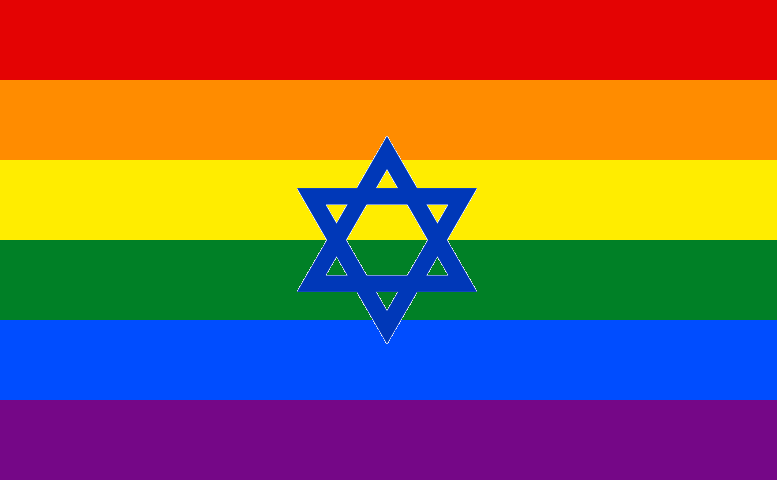
P.S.- the cover photo isn’t a pride flag, it’s a Druze one!  Now tell me that beautiful rainbow flag wouldn’t look fabulous in a pride parade some day carried by some exceedingly hot Druze guys? 🙂

My Yemenite-West Bank-Nepali-Darfuri-Mizrachi kind of day

This morning, I knew I wanted to go on trip.  After my doctor’s appointment, I wasn’t sure where to go.  So I noticed the nearby bus stop went to Rosh Ha’ayin and I hopped on a bus.

I’ve long been fascinated with the city, which was founded largely by Yemenite Jews.  They have a heritage center there, which I’d love to visit another time- it was about to close when I arrived.

Not sure what to do, I simply walked upwards.  I noticed that I was very, very close to the Green Line, the line that separates pre-1967 Israel from the West Bank/Judea and Samaria.  I caught some absolutely gorgeous views of the hills on the other side- just stunning.  The nature was stunning and also the mystery of what’s over there intrigues me.  Yes the hatred and also the forbidden nature of it.  It’s so, so close and it’s legally quite far.  The anger and animosity that forbids me from visiting is overwhelmingly sad.  Also because I know it’s not a simple thing to fix.  There are reasons why Israel needs a security fence and there are reasons why Palestinians are angry about it.

Rather than get into the politics, I want to share an odd observation.  The fence itself in this particular place- it was pretty.  It struck me.  Fences anywhere usually aren’t so pretty.  I’ve seen our border fence with Syria.  It’s pretty much just a fence.  I’ve seen from afar the concrete parts of Israel’s security fence in Jerusalem and they look pretty concrete-y and gray.  For whatever reason, the part of the Green Line that is a wall here is oddly…attractive.  Its yellow stones strangely complemented the gorgeous hills I viewed on the other side.  While not being able to go there frustrated me, I felt oddly at peace.  This is what it is now.  To protect me, this wall needs to be here.  And I hope one day we’ll be in a place where me and the Palestinians on the other side can live next to each other with normality.  We’re pretty different in a lot of ways, but maybe one day I’ll find a friend there.  In the meantime, I’ll enjoy the view and the hope.

After almost making it to a Yemenite restaurant in Rosh Ha’ayin before a downpour, I decided to take a bus to a mall in Petach Tikvah.  I was in need of a new backpack and since it was raining (torrentially- 9 children were killed in flash floods, z”l), I headed indoors.

I had never been to Petach Tikvah and, to its credit, I have not yet explored there.  I’m sure I will.  The view from the bus wasn’t fantastic- it’s a kind of concrete jungle that reminds me a lot of Northern Virginia.  And like Northern Virginia has the beauty of Old Town Alexandria and the ethnic food of Annandale, I imagine Petach Tikvah has its charm too.  It just wasn’t where my bus was driving.

I got off and went into what has to be the largest, cleanest mall I’ve seen in Israel.  Orderly, calm, and at least when I was there, relatively quiet.  A kind of reminder of what America was like sometimes, just in Hebrew 😉 .  I got a new backpack- I’ve traveled so much that the bottom of my backpack has come unsewn.  I have a great relationship with my backpack- one of my steadiest- and I’ll miss it.  I started to say kaddish for it and haven’t quite yet let it go.  But I do have a new friend to carry with me and it looks snazzy and sturdy.  May it bring me to great adventures and fun.

Leaving Petach Tikvah, I thought to drop my stuff off and go to Bnei Brak for gefilte fish.  I called my friend Yisrael to get the address for his restaurant.  Then, my monit sherut cab dropped me off by Neve Sha’anan, a neighborhood of mostly refugees and non-Jewish foreign workers.  Instead of going to eat gefilte fish, I went to my favorite Nepali restaurant here, ordered chicken momos (a whole plate for 20 shekels!), and chatted with a bunch of friendly Nepali guys.  And debated American politics with the Tibetan chef.  There were moments of discomfort when I explained how I immigrated here and have dual citizenship- something most of them could only dream of.  The tension of feeling bad for them and the tension of feeling like there’s not always an easy solution to these kinds of things.  Because I want them to have equal rights and I also think that in order to have the only Jewish state on the planet, how do we draw a line in a humane way that allows us to continue that miracle?  Not so easy.  On the upside, one of the guys, Diwass, happily agreed to exchange his Nepali for my Hebrew, so we traded numbers 🙂 .  Always good to stay grounded in a place where the “what if-ing” could occupy your whole life.

On my way home, I realized I wanted some produce.  There’s a beautiful new store opened by a Darfuri guy from Sudan.  He recognized me from my last visit and we talked fruits and veggies in Arabic.  I asked him about his former city in Darfur, Kutum.  I told him I’d look it up and learn about it.  We talked about the languages of Darfur and my work and me being a dual American-Israeli citizen.

We wished each other ma3 asalaameh and I walked home.  One of the (many) Mizrachi synagogues on my neighborhood had a huge gathering of people on its porch.  Because in Israel, we treat each other as family more than strangers, I went up to a guy and asked him: “what’s going on here?”  And he said: “It’s a hazkarah.”  Or what Ashkenazi Jews might know as a yahrtzeit, the anniversary of one’s death.  I said: “but everyone is so happy!”  His response is one of the most beautiful I’ve ever heard: “it’s been a year.”  He smiled and we went our separate ways.

Why is this man’s response one of the most beautiful things I’ve ever heard?  Because it represents the absolute best of this country and of Judaism.  But a Judaism so concentrated and radically accepting of the present that I’ve never seen such a thing in another country.  We were sad a year ago.  Someone passed.  And now, we come together in a spirit of joy.  Not the joy of pretending it didn’t happen, but the joy that we’re here together.  To remember someone we loved and to thank God for being alive.

Want to know why I live in this Land?  A land threatened by terrorists and missiles and theocrats from every side and all across the region?  A place where your bags are searched in every mall and theater and where soldiers carry guns on the train?  A place where the landlords and real estate agents won’t hesitate twice before screwing you?  A place where the salaries are lower than America?  A place where I sometimes miss the cleanliness and rules and museums and delicious Asian food of America?

Because we know how to live life to the fullest.  And we have the amazing landscapes and people and cultures and kindness to do so.  In America, I often felt distant from my neighbors.  You don’t invite yourself to someone’s home- you ask them for permission.  And don’t want to “impose”.  Here, there’s a deep appreciation for the value of every second you have on this planet.  And there’s an incredible generosity of spirit that allows me to sit with Nepalese workers and Darfuri refugees and my Syrian Jewish neighbors for hours on end.  With no “transactional” expectations of our relationship.  Just because we’re human beings.  And friends.

The other day, when I told my American friend how in Israel you can go from a Bedouin town to a Hasidic synagogue to a gay club in just one day, he said: “but how many people actually do that?”

I’m not sure.  More should.  The point is here you can.  And I definitely do.  So if you’re getting bored on your commute from Rockville to Washington or Evanston to Chicago or Westchester to New York, open up Skyscanner.  Find yourself reaching for your wallet to buy a ticket.  And click “yes”.

Because you might just find yourself having a Yemenite-West Bank-Nepali-Darfuri-Mizrachi Jewish kind of day.

Or as I call it: “Thursday” 😉

p.s.- my cover photo is of Libyan soup I had yesterday.  Because no image could possibly capture such a mix of cultures better than a delicious stew 😉

Why reading the news is a waste of time here

Ok, first things first- yes, sometimes you do need to read the news.  I, for instance, when planning my trips, search the name of the town I’m visiting to check for safety.  When I heard air raid sirens in my apartment, I lit up my WhatsApp but I also checked news sites.  News has a purpose when used effectively.

And most people do not use it effectively.  For many years (and once in a while now), I just get caught up in the news.  Reading- whether on Facebook or on the news sites themselves- just depresses me.  I get that the media needs to make money so they focus on the most dramatic and often sad or offensive things.  Today, I glanced through articles about anti-Semites boycotting Israel, anti-Semites attacking Germans wearing yarmulkes, Jeremy Corbyn being anti-Semitic, Natalie Portman’s mess, and the likelihood of war with Iran and Syria.  I literally just cried.

It’s not because the words being written are untrue (although sometimes they are), it’s because they are true.  And they suck.  And they’re selective.

Because I’ll tell you what I did the past few days and was not in the news.  I took a bus from my low-income stereotyped neighborhood to three beautiful rural communities just around the bend.  I met an archivist who sat with me for an hour and a half to explain to me the history of his town.  I hiked through a forest in northern Israel to the Druze village of Daliat Al-Karmel.  When I asked some Druze women for directions, they sat me down, plied me with tea and coffee and salads and sweets.  They gave me a huge container of leftovers.  Drove me to the village and added me on Facebook and WhatsApp.  Today, I went to Zichron Yaakov, discovered a beautiful hidden trail, hitchhiked down the mountain to Maagan Michael’s gorgeous Caribbean-like empty beach.  Then, I walked on the sand to Jisr Al-Zarqa, a Bedouin village, where I was the only tourist visible.  I got to hear some pretty cool Bedouin Arabic, talked with a guy about Arabic music, and spent a peaceful bus ride hanging with some friendly Bedouin women.

In the course of about three days, I had been to national parks, a kibbutz, a moshav, a suburb of Tel Aviv, a Druze village, and a Bedouin Muslim one.  The main reason I write this blog is for me- it’s a record of my journeys, it’s therapeutic, and it’s fun.  I like writing, I enjoy it.  The other reason is because these kinds of stories- real and authentic- don’t make their way into the news.  The nuanced, the complicated, the fun, the moving, the heart-warming, the sad.  The full spectrum of the human experience.  Instead of reading like a laundry list of everything bad in the world, I prefer to share something a bit more real.

Because the sad stuff- the anger, the extremism both left and right, the aggression- those all exist.  And sometimes I touch on them.  And I feel that the media, perhaps in the quest for eyeballs and ad dollars, only focuses on the negative.  The things that make you click even though you (and I) don’t want to.  We’re hooked.

Living in a country plagued by terrorism and war, I’ve learned something from my fellow Israelis.  And I want to remind them of it- and teach my friends abroad.  Faced with crazy shit, you have two options.  One is to live in chaos.  Either a constant state of panic or burying your head in the sand and pretending nothing is happening.  The other option is to live in the here and now.  To be present, to enjoy what you can, to be grounded and live your life with gratitude for every moment you have.

That second path is the one I choose and strive for.  It’s the one many Israelis, both Arab and Jewish, manage to pursue much, much better than Americans during these difficult times.  Perhaps because we’re a more communal society.  Perhaps because we’ve been dealing with trauma for longer and know how to better cope with it.  Either way, my gift to Americans reading this blog right now is that spirit of embracing the present.  It’s not to completely detach yourself from worries nor to pretend that shit isn’t going down.  Sometimes, it is.

It’s just that on a day when everyone was talking about Natalie Portman and Iran, a Druze kid was practicing English with me.  I was taking selfies with cows.  I was taking selfies with sheep!  I was listening to the waves of the ocean as I walked towards a Bedouin village.

We all have choices about how we spend our time and energy.  We all have a right to our feelings and we make choices about how we live our lives.

I have opinions about all the “news” items I shared.  And I have a right to them, and maybe I’ll share them- and maybe I won’t.  Because maybe, like tonight, I’ll be too busy meeting other young people in my neighborhood at our first block party.  Organized by a friend I met in a sushi joint around the corner.

Shoot this, boycott that, yell this, scream that.  I don’t really care.  Because the music is blaring so loud around me that I just hope one day you’ll open your ears to listen.

What do you call people in Israel who speak Arabic?

No, there’s no racist punchline 😉

This is a question I get a lot.  Sometimes “well meaning” American progressives come here and start calling every Arab they meet a “Palestinian”.  Perhaps out of a desire to validate their identity, but without considering that it’s a bit more complicated than that.

For starters, there are Palestinians who live in the West Bank and Gaza Strip.  There are also Palestinians in other countries like Lebanon, Syria, Jordan, and elsewhere.  Those in the West Bank are largely governed by the Palestinian Authority and those in Gaza by Hamas.  Israel exerts partial military control within the West Bank/Judea and Samaria and at border crossings.  Gaza is entirely independently governed by Hamas and entry to Israel or Egypt is strictly controlled by the respective governments.  All of those people are pretty clearly Palestinian.  Maybe a few Samaritans in Hebron would identify otherwise- not entirely sure.  But almost to a T, regardless of religion (almost all Palestinians there are Muslim, there is a small Christian minority), these people are Palestinian.

Now, moving westward from the West Bank, there is East Jerusalem.  East Jerusalem came under Israeli control after the Six Day War in 1967.  Because of the sacredness of this city for Jews, Israel treats it differently for legal purposes.  While West Jerusalem was already part of Israel in 1948, East Jerusalem, which was primarily Arab, became officially annexed to the city in 1967.  Meaning, its Arab population has Israeli residency cards.  This allows them greater job opportunities, freedom of travel both within Israel and abroad, and more contact with Jewish Israelis.  There is still discrimination and it’s not on a level that you can compare with the West Bank, for example.  The vast majority of East Jerusalem Arabs would probably identify as Palestinian.  I’ve noticed this anecdotally through my travels there and I believe polls would back this up.  That being said, since East Jerusalem Arabs are eligible to work in Israel, some actually end up working for the government and even volunteering for national service.  Or the Israeli military.  So I think the layers of identity for them would be a bit less straightforward than someone in Ramallah.

Now, on to pre-1967 Israel.  There are several groups of Arabic-speakers in Israel.  First, there are Jews.  Jews have lived in predominantly Arab countries for two millennia.  They lived there, by and large, before the Arabs even arrived.  They then mixed their Hebrew and Aramaic with Arabic to create their own unique Judeo-Arabic languages.  From Morocco to Iraq to Yemen.  Often written in the Hebrew alphabet, like Yiddish.  Sometimes intelligible to their Muslim and Christian neighbors- and sometimes not.  In recent decades, the number of Judeo-Arabic speakers has declined.  And there still are many Jews in Israel who speak Arabic.  Not just those who learn it at school.  But also those, like my Syrian and Iraqi neighbors, who grew up with the language.  The vast, vast, vast majority of these Jews do not identify as Arab.  While some of that is tied to the stigma of being Arab, discrimination against Mizrachim, and the conflict with the Palestinians, there are other factors at work too.  First, there is the fact that Arabs committed massacres against their indigenous Jewish communities in the 1950s and 1960s, which forced Jews to come to Israel.  Most Jews lost their Iraqi, Egyptian, Yemeni citizenship and all their property.  It’d be hard for them not to come to Israel angry and wanting some distance from the people who were supposed to protect them.  Only to find their new Arab neighbors here blowing themselves up in pizzerias.  The other factor is that the Middle East wasn’t always Arab.  Arabs are from Arabia and conquered the region to spread Islam.  Jews have been living in Iraq, for example, since the Babylonian Exile, 600 years before Christianity.  Over a thousand years before Islam.  So to call an Iraqi Jew Arab- that could be a real invalidation of their identity and history.  A small minority of Mizrachim do identify as Arab Jews, often as a way of contrasting with the European elite.  But I would strongly recommend not calling Mizrachi Arabic-speakers Arab and certainly not Palestinian.

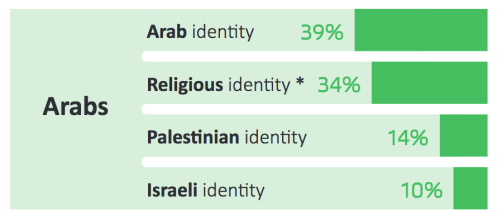
Notice we haven’t even gotten to the Christians, Muslims, and Druze.  In general, Arabs who are citizens of Israel do not define themselves as Palestinians.  Here is some polling data:

Screen Shot 2018-04-21 at 10.49.38 PM

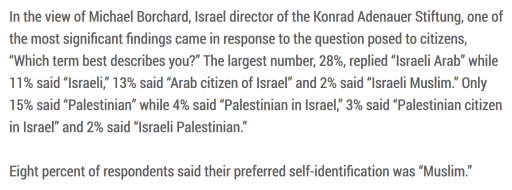
Here’s another poll with similar but sometimes contradictory data (perhaps depending on the phrasing of the question- also the first poll doesn’t include East Jerusalem):

Screen Shot 2018-04-21 at 10.56.02 PM.png

What overlaps is that about 15-20% of Arabs who have Israeli residency identify as Palestinian.  Sometimes hyphenated or attached to the word “Israeli”.  A larger portion identify as some variation of Arab, again sometimes hyphenated as Arab-Israeli or Arab citizen of Israel.  And a significant number just identify as Israeli.  For what it’s worth, there are also Arabs here who primarily identify by their religion, not their language or ethnicity.  Food for thought for people who are looking for a simple black-and-white breakdown.

Druze, Christians, Circassian Muslims, and Bedouin Muslims tend to identify more with Israel and less with Palestinian identity.  There is also a strong contingent of Christians who feel strongly about their Arab or Palestinian identity.  And other Arabic-speaking Christians who don’t even identify as Arab.  Many Druze, contrary to Israeli popular belief, feel they are both Druze and Arab.  I believe I got that info from a Pew survey, but am having trouble tracking it down (feel free to send it!).  Very, very, very few Druze would call themselves Palestinian (though a few do like Maher Halabi).  And many would be quite offended at the statement.  And they are native Arabic speakers.

Among these groups, Druze and Circassians crafted agreements with the Israeli government for their sons to be drafted into the military.  By agreement.  An increasing number of Bedouins and Christians- and even Arab Muslims- are choosing to volunteer or do national service, even though they are not legally obligated.  There are even Arab Christian priests encouraging it.

It’s worth noting the Druze mentioned here are the ones in pre-1967 Israel.  The ones in the Golan Heights were formerly citizens of Syria- and some now are taking Israeli citizenship in light of the brutal civil war.  They are not obligated to serve in the military and would almost certainly identify themselves as Syrian rather than Palestinian.  My friend’s dad says he’s a “Syrian now living in Israel”.  And I imagine people in his community have a variety of ways of describing their multifaceted identities.

If you’d assume that Israeli Muslims would be the most likely to identify as Arab or Palestinian and less so as Israeli, you’d be correct.  With some very important qualifications.  As mentioned, Bedouins and Circassians- both Muslims, are much less likely to identify as Palestinian in any form.  In the Bedouins’ case, Islam is generally much more important than nationalism and they’ve often been discriminated against by their sedentary Arab neighbors.  Circassians are quite fully integrated into the society and while many speak Arabic as a second language, they tend to be much more Israeli.

It’s also worth noting that if someone identifies as Arab or Palestinian here, there is a difference.  When someone says “Arab-Israeli” or “Arab citizen of Israel”, there are a few potential reasons why.  First off, there are Arab nationalists here who are against Palestinian identity.  Pan-Arab nationalism, which believes in an Arab identity stretching from Morocco to Saudi Arabia, is less a fan of state-based nationalism (e.g. Syrian, Palestinian, Egyptian nationalism).  There is the concept of bilad al-sham- the Levant.  Some Arabs here prefer to think of themselves as part of the greater Arab culture rather than the particularistic Palestinian identity.  Palestinian identity- like every other country in the region- is a modern concept.  Not because the people didn’t exist here (before anyone goes there), but rather because this area didn’t have borders before colonialism. Which is why the Arabic spoken in northern Israel is almost identical to Syrian or Lebanese and the Bedouin Arabic in the Negev has a Saudi or Jordanian tint to it.

Another reason why people here might prefer Arab over Palestinian is because there is pressure here to dissociate themselves from the conflict.  Someone might even choose one label in one context and another in another.  Identity can be relative.

A final, and important reason, is that some Arabs here just don’t identify with Palestinian nationalism.  And not because, in the case I described, they are pan-Arab nationalists, but because they simply want to live a good life here.  They don’t like politics.  They don’t like violence.  Some may even feel that if they took on the label Palestinian, it does a disservice to the real suffering of people in the West Bank and Gaza.  That basically if you have Israeli citizenship, things might be rough sometimes, but overall the quality of living is quite good.  And to compare yourself to someone living in abject poverty and misery- that’s not quite so fair.

Sometimes when American and European progressives come here, they try to correct me when I call someone Arab.  “Don’t you mean Palestinian?”  or they’ll just work the word “Palestinian” into their response- even though I just said Arab.  Maybe it’s not their intention, but I feel there’s a kind of “let me educate you” haughtiness.  That somehow if I’m calling someone Arab instead of Palestinian- someone who’s a citizen of Israel- it must be because I’m a hyper nationalist intent on denying their identity.  And thank God for the Western Liberal who can come teach me civilization.

And they’re wrong.  Because I have a basic rule- I identify you the way you want to be identified.  If I meet an Arabic-speaker here in Israel who prefers to be called Palestinian, Palestinian-Israeli, Palestinian citizen of Israel- I will call them that.  Or Arab.  Or Arab-Israeli.  Whatever they choose I validate that.  And I’m not going to impose my New York Times Huffington Post NPR podcast understanding of the Middle East on them.  Because newspapers are printed in black and white.  Which is about the depth that they can offer of a society thousands of years old halfway around the world.

So I encourage you- don’t put me or my Arab/Palestinian/Arab-Israeli/Arab citizens of Israel/Christian/Muslim/Druze/Bedouin friends in a box.  Because boxes are for shoes.  And unless you’re willing to walk in ours, you should probably return them to the store.

What do you call people in Israel who speak Arabic?  Ahmed, Maryam, Ovadia.  Even Matt or Matah.

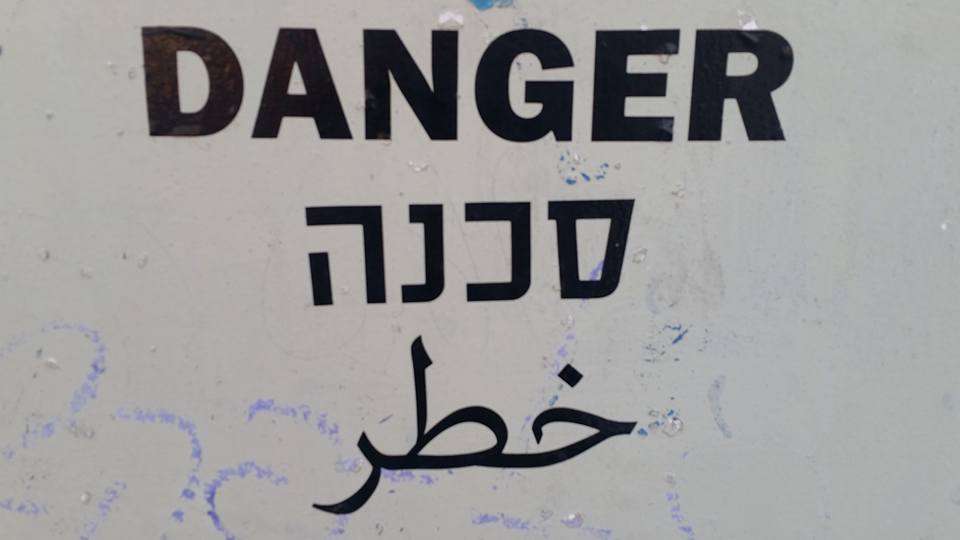
Or as the cover photo says: friend.


Independence from black-and-white thinking

Today concluded my first Independence Day as an Israeli.  And the first one I’ve celebrated on my homeland’s soil.  It was an independence day for me, a chance to declare my freedom from my own oppressors.  To celebrate my progress.  It was a day to rejoice.

Rejoice I did- I danced to Mizrachi music in the streets, I hung out with friends, I wore my Israeli flag as a cape, I got congratulated for becoming Israeli many, many times.  There were goofy people dressed up as Israel’s founding mothers and fathers.  There was fun.  We deserve a day to just have fun and be proud of our accomplishments.  In 70 years, we’ve managed to do more than some countries do in 200- and under the near constant threat of destruction.  Just today, I was grocery shopping and read a newspaper article while in line.  About Iran wanting to attack us from Syria.  Welcome to life in Israel, where every day we’re alive is a victory.

At some points, I felt I should be happy but wasn’t quite as happy as I thought.  Maybe it was when the tour guide at Independence Hall said: “we’re all Jews here, so feel free to interrupt.”  I totally get the sense of humor and I had to wonder how the Filipina woman and her child behind me felt.  Or perhaps a Druze man sitting in the back.  I think growing up in the Diaspora made me more sensitive to including others- we have some work to do here.  Because most of us are Jews- and not all of us are.  And we all deserve a seat at the table.

It got me thinking.  I really wanted this day to just be about celebrating Israel.  All year long we talk politics and people around the world hammer us for problems both real and imagined.  It can be hard to tell whether some foreigners are criticizing us out of a desire to make this a better place or because they single us out and want us to fail.  Trust me- I’ve met both kinds of people.

So I wanted to just enjoy.  And at some point, I realized nothing is 100% happy or sad in life.  In the Passover Seder, we dip our fingers in our joyful wine 10 times- once for each plague.  We put that wine or grape juice on our plates to symbolize our empathy for innocent Egyptians who suffered on our way to liberation.  No Jewish holiday is black-and-white, we’re a people who knows how to meld the bitter and sweet to the extent that it can be hard to even untwine the two.

The most obvious elephant in the room on Yom Ha’atzmaut, our Independence Day, is the Palestinians.  We are neighbors and the people right across the border have no independence day.  The reasons are complex- and it would be incorrect and even prejudiced to suggest that all of the blame falls on one side of the fence.  And it’s sad that while I’m celebrating today, some Palestinians are mourning what they see as a catastrophe.  The creation of my state.  While they still don’t have one.

I can empathize with why this day is hard for Palestinians (and Arab-Israelis/Arab citizens of Israel).  For someone whose village was destroyed in 1948, sometimes purposefully sometimes not, this day must be rough.  And the wound is still unhealed as our region has been in a near constant state of war for the past 70 years.  With bloodshed all around, including 37 soldiers from my neighborhood alone.

I also wish my neighbors across the border would try to understand why we’re celebrating.  I’ll tell you personally- I’m not celebrating the destruction of any village.  I’m celebrating the fact that I feel free here as a Jew.  Even in America, I’d feel scared or embarrassed to walk around with a big Israeli flag on my back.  In America, I felt self-conscious as a Jew.  Laughed at, picked on, discriminated against.  I felt my Judaism belonged in synagogue or a community center, not on the streets.  The idea of praying in public or being visibly Jewish was scary and anathema to what I felt we were supposed to do to be “respectable” and “cool”.

In Israel, we also have Jews who survived the Holocaust, with no family members, only to build new families here.  Some of whom then lost their children to terrorism or war.  We have Jews here from Egypt whose government stole their property, robbed them of citizenship, and kicked them out.  Just for being Jews.  And now they’ve managed to build themselves a new life and home here.  The place that would offer them refuge, no questions asked.  A miracle.

You can go through this story with just about any Jew here.  This is the only place on the planet where I feel safe being a Jew.  An out-of-the-closet Jew.  For 2,000 years we’ve been at the mercy of whatever ruler we lived under.  And all too often, turned into scapegoats like Roma/Gypsies or African-Americans- and suffered the violent consequences.  Here, we are empowered to choose our own fate for the first time in millennia.  And we’re not going to give it up.  Our greatest threat is our greatest strategic advantage- we have no other place to go.

As Israelis like to say, living here is “lo pashut”- it’s not simple.  And they’re right.  When I saw a person dressed up as Ben Gurion today, I was laughing and also thinking back to when he derided Yiddish.  When I celebrated by dancing to Mizrachi music in my neighborhood last night, one of the women said: “I want to go to America, it’s terrible here.  Well, it’s not the Jews who are terrible…”.  I empathize with her- there are a lot of reasons why a Mizrachi Jew might be prejudiced against refugees or Arabs, as I’ve written about.  And I also hate it.

I am proud to be Israeli.  I love my country and its people.  I’m blessed to be a Jew and I think we have contributed so much to the world and this region.

I’m also sad that many of my Palestinian neighbors live in deep poverty, are ruled by the corrupt Palestinian Authority and Hamas, and are subject to a largely unaccountable and undemocratic Israeli control over their lives.

And I’m sad that Arab-Israelis are basically caught between the two worlds because to a degree they identify with both.

I’m sad that refugees are discriminated against and might be deported.  And I’m sad that their neighbors- my neighbors- have been utterly neglected by the government for 70 years, fomenting their anger.

I’m sad that as a Reform Jew I have no religious rights here.  I have more rights in the States.  I’m sad that as a gay person, I can’t adopt children.  And I’m grateful to live in the only place in the Middle East where being gay is not only legal, it is accepted by a large part of the population.  According to one poll, 40%+ of Israelis say we should accept homosexuality.  The next closest Arab country is Lebanon at 18%.  Palestinians come in at 3%.  Those numbers also obscure a lot of gray space (including among Palestinians).  My city, Tel Aviv, is one of the gayest places on the planet and has a city-funded LGBTQ center.  Almost 80% of Israelis support gay marriage or civil unions.

In the end, living here is complex.  I’ve learned to become a more empathetic and textured thinker by living here.  If you want to come here and try to break things down into good and evil, right and wrong, black and white- you’re coming to the wrong place.  Like the Bedouin man married to a Jew who converted to Islam and are raising their kids in a Jewish school.  We are awesome and diverse and not easy to fit into a box.  So put down your placards and get to know us before boycotting us or telling us we’re all fascists.  While you sit on Native American land or, in the case of Europeans and some Arabs- on our Jewish property.  Life is not so simple when you start to empathize with everyone.

And it makes it much richer.  So on the 70th anniversary of Israel’s founding, let’s declare our independence from black-and-white thinking.  When you start to live in the gray space, you start to realize it’s not gray at all.  It’s the many, many colors of the rainbow.  Each with is unique shade.  Sometimes too bright to stare at, and often too beautiful to gaze away.

In a note to my American friends struggling with a difficult time in history, join me in embracing the complexity.  Get to know your Appalachian neighbors, gun owners, evangelicals- people you don’t agree with.  Not to convince each other or approve of toxic behavior.  Rather, simply to understand what might cause someone to think that way.

Embracing complexity can bring with it a lot of emotions- sadness, fear, joy, anger, hope.  It is eye-opening and sometimes even overwhelming to see the full spectrum of humanity.  The easy solutions don’t look so easy and sometimes, I feel as helpless as I do empowered.  At that point, I invite you to learn from Israelis.  Because what Israelis are astoundingly good at is just letting go.  Give yourself a chance to celebrate- anything.  Because all people- no matter the race, religion, or country- we all deserve time to celebrate.

Happy birthday Israel.  May year 71 bring us, our friends, and our neighbors peace, prosperity, hope, and strength.

I love you Israel.  When I criticize you, it’s because I want to make you better.  I’m glad to be home in your arms.

Am Yisrael Chai.

30704776_10101754173733602_4239613470407884629_n

How to stay sane while living in the Holy Land

Recently, I was talking to an Arab friend in Arabic.  He said there are three groups of people here.  One, Arabs who think this whole land only belongs to them.  Two, Jews who think the same thing about themselves.  And three, Arabs and Jews in the “mushy middle” who want to live together.

I think I agree.

Today, I saw a good demonstration of how this plays out.

After lazing around on the beach on a gorgeous day, I had some extra time on my hands.  Because I live in by far the most fascinating country on the planet, I simply slipped my sandals on (and then off) and walked into a mosque.  The Hassan Bek Mosque is a historic building located in the middle of Tel Aviv.  It was built in 1916 and to this day is an active mosque.

According to what seems to be a pretty well-sourced Wikipedia article, the mosque was built on land that the Muslim governor of Yaffo confiscated from Arab Christians.  Later, it was used for Arab snipers shooting at Jews.  During the 1948 War of Independence, Israel captured the area.  The houses were largely razed and some troops wanted to demolish the mosque itself, which was vetoed by future Prime Minister Menachem Begin.

At various times it was going to be turned into real estate development (stopped by protests) and may have housed a suicide bomber, which led to some Jews throwing firebombs and some Arabs hurling rocks at the Jews from the mosque.  Arabs then threw rocks at Jewish motorists and some Jews threw a pig’s head into the mosque.

In short, a microcosm of the region’s conflict, some of which I didn’t know about until writing this blog.  Depressing and important to be aware of so you know where everyone is coming from.

If you go to the mosque itself, it’s just gorgeous.  You wouldn’t know any of that crap if you just enjoyed the beauty of the building itself.  Here are some pics:

After some peaceful reflection, perusing the beautiful books (including Qurans from Egypt and…Saudi Arabia!), I talked with a man inside.  We chatted in Arabic because I wanted to know what a sign meant.  It said (in Arabic) “Tasu is in danger”.  I knew “is in danger” but didn’t know what the word “Tasu” was.

He explained it was the name of a cemetery in Yaffo (Yafa in Arabic).  A Muslim cemetery which, incidentally I had visited in previous adventures, that is now possibly going to be turned into…a hotel.  When you consider the long history of conquest and re-conquest and desecration this land has known, it’s just so, so sad.  I patiently listened as he explained the situation and I shared my sympathy.  It’s hard to imagine a Jewish cemetery becoming a hotel here- the government is excruciatingly diligent about not building on Jewish graves due to prohibitions in Jewish law.  So much so that even Secular Jews get peeved by it.

The man pointed me to pictures of the neighborhood (called Manshiyya before 1948) on one of the columns.  The pictures were sad and the descriptions in English were pretty brutal.  Here is a slideshow:

This slideshow requires JavaScript.

Occupation, nakba, bombing, demolition, ethnic cleansing- these are their words in English.  The sad part is there is some truth to what they’re saying.  As I’ve written about extensively on this blog, some Zionist militias forcibly expelled Arabs in 1948.  That’s not a theory, it’s a fact.  It’s also true that few things are black and white and the language used on these signs, in English for tourists, was as bombastic as possible.  Their existence perhaps evidence that Israel’s freedom of speech is a bit healthier than some expect.

No mention was made of the Christians whose land the mosque is built on nor the Jews who were shot at from its property.  I understand the anger of the worshipers especially in light of the recent cemetery controversy.  I also wonder if these signs are presented in a way that fosters knowledge of the past for the sake of building a better future.

Feeling sad and angry (both at the interjection of the painful past into my present and at the real estate developers who are about to turn a Muslim cemetery into a hotel), I walked back to the man.  I told him in Arabic: “I’m sorry for what’s happening.  I’ll pray that they don’t turn your cemetery into a hotel.  In the end, we must live together.”  He gave me a big smile and a handshake.

This man knew I was Jewish.  I can’t change the past- not the fact that this neighborhood was destroyed, nor the hateful acts committed on all sides in this place, nor the cemetery issue itself.  Although I plan on speaking out about it now.  What I did was just try to warm someone’s heart.  In a place where I feel quite helpless about convincing politicians, I just tried to be a human and reduce the hate in the world.

Feeling extremely tense, I walked towards Yaffo, where later I’d be celebrating the Moroccan Jewish holiday of Mimouna.  I stopped for some food at an Arab-owned restaurant.

The owner was hot.  Physically, for sure, and also just really nice.  Khalid had a beautiful smile and an infectious and kind personality.  We chatted on and off for hours.

An American woman walked in totally confused.  I helped her order and translate between her and Khalid.

Khalid noticed how I helped her and several other customers with the menu and I made some corrections to the English on their fliers.  He asked me if I would work with him.  I was surprised.  He basically said I had a nice connection with the customers, I knew public relations, and he needed help.

As I considered what had to be one of the kindest and most interesting job offers I’ve ever gotten, the American woman asked me about Gaza, about refugees, about pretty much everything that makes me cry a lot.  When the complexity and the sadness just overwhelm.

So instead of policy solutions (which Americans love), I gave a different answer.  I said: “If you want to live here, you need to know the past.  Insofar as the past helps you make a better future.  If you fixate only on the past, you’ll never see your way out and we’ll be stuck in a never-ending blame game.  We have to also live in the here and now and a better life together.”

Khalid then looked at me while the woman grabbed her purse.  He said: “Don’t pay for your food- we’re business partners.  You have to come work here.  I don’t see religion.  I see that when someone looks me in the eyes, I trust him.”

With a true feeling of gratitude, I headed to Mimouna.

What I wish for the Middle East and for my beloved country of Israel and the Palestinian people is this.  Know our past- and know the past of the other peoples of this land.  And don’t get stuck in the swamp of never-ending hatred, sadness, and guilt.  We don’t have time for it- we only get one life.  Know the past to learn from it and make a better future.  Let’s build it together.  Let’s live in the complicated space that is the Hassan Bek Mosque next to the serene park built on its neighborhood’s ruins next to the gorgeous beach we all enjoy.  Let’s live in the Mimouna party of Moroccan Jews who are my friends and whose families were expelled by Muslims in North Africa.  And who continue to celebrate the customs they once shared with them.

This place is messy.  It needs healing.  Put down the megaphones, put down the guns, and most importantly put down the sense of ultimate righteousness and purity.  Because we’re all a little dirty and wouldn’t it be better if we had someone to scrub our back and clean those hard-to-reach spots?

The first pro-refugee sign in my neighborhood

As some of you may have heard, just last night I was celebrating with refugee friends the defeat of Bibi Netanyahu’s deportation plan.  They would be given refuge in Western countries or in Israel.  Their lives, in short, would be saved.

After many, many sleepless nights and demonstrating and activism and awareness, I was so delighted to finally feel victorious.  To have literally saved lives.  And all in partnership with the refugees themselves, who were ecstatic.

We had this brief moment of love and joy in the streets of Neve Sha’anan where we pumped up the music and paraded with the news.  Refugees learned of the news from us as we walked down the street.  You could see them smiling from ear to ear.

It was, for a brief moment, perhaps the single most positive step the progressive moment had made in either Israel or the U.S. in the past year.  And against great odds.

I came home feeling happy and relieved.  Perhaps one of my best moments in this country.  Only to find that Netanyahu had paused (and later cancelled) the agreement.  Specifically after meeting with “activists” in my part of town.  Including a woman pictured kissing Bibi’s hand.  They wanted every last black person gone.  No deal with the U.N., no “half-assed” measures.  They don’t want to incentivize other “infiltrators” to come.

I can empathize with their frustration- their (our) neighborhood is frankly smelly, neglected, and poor.  And they are taking it out on the wrong people.  The refugees didn’t cause these problems- they’ve been here for years.  In the early years of Tel Aviv, the municipality didn’t even provide social services to Hatikvah.  The hard-scrabble people here did it themselves, which is amazing.  And also has literally nothing to do with African refugees.  This neighborhood, my neighbors, will continue to neglected as most poor people are.   Whether we live amongst Sudanese people or not.  Neighborhood investment can’t come at the expense of human lives- regardless of their race or religion.  It’s wrong.

Now Netanyahu is preparing to reopen the detention center, circumvent the Supreme Court ruling barring deportation, and ship my friends to their deaths.  I’m sad, I’m furious, I’m tired of this back-and-forth game.

It also frankly makes it hard to live in my neighborhood.  I wonder how many of my neighbors support the deportation.  Sometimes I’m afraid to ask.  I’ve been yelled at before walking home from rallies.  I did discover two neighbors who support the refugees, which was reassuring and also a reminder not to stereotype an entire part of the city based on a bunch of wacked-out media personalities and corrupt officials.  Because if I don’t have some counterexamples to the hatred, I just start hating my own Jewish neighbors.

So tonight, fed up with the bullshit, I decided to take a rather brave step.  I live in a neighborhood where there is no- and I repeat no- pro-refugee signage.  No leaflets, no posters, no banners.  You will see those things in other areas of South Tel Aviv, but there are no hipsters on my street.  I am “the American”.  The most common sign in my neighborhood is for a rabbinic study session or pictures of Shas Rabbi Ovadia Yosef.  In my part of town, the Likud is the left wing.  The other voters are often going for Shas.  It’s certainly a complex place, not black-and-white, and it’s also a rather right-wing part of town.  The most right-wing part of Tel Aviv by far.

In this context, I recalled an Arabic word I learned the other day.  Some Sudanese guys from Darfur opened up a brand new produce shop.  Beautiful, clean, friendly.  I bought some fruit and talked to them in Arabic.  Of course, also about the deportation.  They asked if I was a “naashit”.  I couldn’t place the word, but with the help of some explanation and Google Translate, I learned it was “activist”.  And I said “yes!”

My refugee friends taught me the word activist.  In Arabic.  And tonight, it was time to put it into action closer to home.  Closer than a rally, a Facebook post, or even a blog.  Having no idea how my neighbors will react (I still don’t know while writing this post), I hung a huge- I mean huge- banner that says “South Tel Aviv Against the Deportation”.  Right beneath my windows.

Seeing as how it’s on the rear side of my house, I’m not sure how many people will see it.  But people will- because it’s huge and I can see people’s windows from my own.  So somebody, at least one person, will notice.

And that is a good thing.  Because I’m not just hanging this sign for the refugees.  I’m hanging it for my two neighbors who agree with me.  And perhaps others who are too afraid to speak out due to our own community’s aggression.

I may not be originally from Yad Eliyahu or Shchunat Hatikvah or Israel.  But I am a human being, I’m an Israeli citizen, and I live here now.

The merchants of hatred say they represent my neighborhood and I say “no”.  You represent yourselves.  I am going to speak my voice.  I’m going to stand up as a member of the Hatikvah community, of South Tel Aviv and say “not. in. my. name.”

If you want to send innocent people to their deaths, God help your conscience.  I will not be silent.  And even when I’m not talking, I will still be speaking with every glance you take at my big motherf*cking sign.

Love your neighbor as yourself.  Damn straight- my refugee neighbors deserve all the love they can get.

A Muslim pluralist

One of the great frustrations I’ve faced when dealing with dialogue here is that some people aren’t pluralists.  Being a pluralist, as I see it, is about saying “I have one way of doing things, you have another, let’s co-exist.”  It means legally allowing people to do things you don’t agree with.  It’s not about getting into a war of whose tradition is better, it’s just accepting that we’re all in this together with some right to autonomy.

In the Jewish World, this is a frequent dilemma.  There are Orthodox Jews who see Reform Jews as inadequately Jewish (hence why my movement is not recognized by the Israeli government).  There are secular Jews who think Orthodox Jews are overly superstitious, conservative, and backwards and should just modernize with the times.  While in the U.S. Jewish pluralism is stronger than Israel (perhaps because it’s not tied up with a government), there are still issues in places like Hillel and Hillel and Hillel.

That being said, you can’t even being to compare American pluralism with what goes on in Israel.  Here, there is no separation of Church/Synagogue/Mosque and State.  Which means progressive Jewish movements are put at a disadvantage financially, legally, and politically.  The same could be said for people who feel Jewish and aren’t recognized as such and also people who just aren’t religious at all.  Of any background.

I find that communities here struggle- on all sides- with the idea of letting someone else do something you disagree with.  You’ll find militant vegans protesting Hasidic kapores rituals but not protesting the hamburger joint on their block.  You’ll find Reform Jews railing against Hasidic intolerance, while making fun of their clothes, their language, and their religiosity.  If you replace Hasidic with Hispanic, I doubt my fellow Reform Jews would make fun of their culture.  Of course you also have the more well-known bigotry of Haredim who throw stones at cars and “immodest” women, etc etc.

These circles of intolerance extend to other religions here.  I’ve met Greek Orthodox Christians who claim they came before the Catholics.  I’ve met Catholics who railed against Evangelicals.  I’ve met Evangelicals who told me I’m not being a good Jew.  I’ve met Muslims who said Arabic was the world’s first language, as uttered by God.  And couldn’t believe I didn’t convert to Islam after reading the Quran.  I’ve met Arab Christians who don’t particularly like Muslims.  And Arab Muslims who don’t believe Jews have any connection to this place- and told me this to my face.  And I’ve met Arab Muslims who get ridiculed by other Arab Muslims for being half-Romanian or immodest or even for being Bedouin.

And of course, you have the Palestinians who want to wipe Israeli Jews off “their land”.  And the Israeli Jews who don’t recognize Palestinians even exist.

It’s enough to make your head spin.  Probably like yours is now.

So at times like these, when people here just fill you with sadness and anger, I like to think of strong counterexamples.  At a time when Islam is turning increasingly fundamentalist- or at least its fundamentalist elements are growing in prominence- I met the most unlikely Muslim pluralist.

I visited the Arab village of Tira, which you can read about here.  I briefly mentioned my interaction with Jamila.  Jamila is a high school student.  She works at a toy store.  I had never been to an Arab toy store, so I wanted to see what it looked like.

She was super sweet.  While I came in trying to show my deference to her culture, all she wanted to talk about was Israeli and American culture.  She really wants to visit Tel Aviv more.  She loves American movies.  Hebrew is her favorite subject, Harry Potter- not the Quran- her favorite book.  Nothing wrong with liking the Quran- I personally love parts of it.  Just that Jamila is not who you might expect to say this.

Because Jamila wears a hijab.  A headscarf.  Generally a sign of religious conservatism or perhaps devotion to tradition.  And a bone of serious contention in Western Europe.

When she kept talking about how much she liked Jewish culture here, I asked why.  Her answer contains a grain of truth we all should pay attention to.

She said: “what I really like is that when you go to the beach here, the Jewish women can wear whatever they want.”

Before you launch into a Western-style approbation of hijabs, that’s not what’s going on here.

I asked her: “so you mean you wish you didn’t have to wear a hijab?”  After all, I have met Arab girls here who have told me that.

She said: “no, I wear a hijab because that’s my tradition.  I’m Muslim.  What I like is that they don’t have to.  The Jewish women have the choice.  I like riding my bike, but some people here don’t approve because I’m a woman.”

In other words, Jamila is a pretty awesome example of a pluralist.  She wears a hijab- and would continue to do so- she just likes that Jews here tend to have more choice.  That she could wear a hijab but maybe her sister wouldn’t.  Or would change her mind according to her views over time.

Jamila, surprisingly, is a good example for all of us.  We do not have to agree on many things.  I admire the Hasidic community for keeping Yiddish alive, for preserving certain customs, and for their birthrate to be honest.  I see other things in the community, such as homophobia or gender politics, as quite problematic.  And people ask me: “well Matt, you’re a queer Reform Jew, how could you possibly like Hasidim?  They won’t accept you.”

To which I say: “I’m a pluralist.”  I can like what I like about certain communities and not like what I don’t like.  I can accept that both aspects exist.  And I’m entitled to my feelings on them.  Unlike some of the more militant secularists here, I don’t want Haredim to abandon their traditions because they’re “backwards”.  I do want more of a separation of religion and state.  And there are things I like about their community.  The things I don’t- well, sometimes you have to find other avenues for making your case rather than imposing laws.  And- this is the tough one for many people- sometimes you just acknowledge that it’s there, whether you agree or not.  And that it’s maybe not my role to change everything about how someone else lives.

Like Jamila and her hijab, I don’t want everyone to be like me.  I want people to be free to choose their own path, even when I don’t want to follow it.  It’s important to remember coercion can flow in all directions, left and right.  Muslim and Christian.  Orthodox, Reform, and Secular.  Israeli and Palestinian.  My respect for conservative traditions is not necessarily at the expense of my progressive values.

Lehefech, as we say in Hebrew.  “To the contrary”.  It is because of them.

Gaza, Indian Christians, and Passover

A whole lot more happened today, but that’s what I could fit in a title.

Last night was Passover.  Passover in Tel Aviv was amazing.  It was my first time celebrating it in the Holy Land and I loved it.  As a child, Passover was my favorite holiday (though this year’s Purim in Tel Aviv is giving it a run for its money).  It’s a holiday about freedom and especially growing up with abusive relatives, it always had a special meaning for me.  About my own potential for freedom one day and all the other oppressed people in the world who I would make that journey with.

Here in Tel Aviv, I went to two seders: one Reform and one LGBTQ.  Perhaps one of the few places in the world where you can genuinely “Seder hop”, I walked from one to the other in 10 minutes.

At the first Seder, I met a fellow gay Jew, Oscar, who was Spanish and Swiss and spoke French, Spanish, Gallego, English, and some Hebrew.  Pretty amazing to kind of meet a European me!  We agreed to meet the next day for lunch in my neighborhood, the “other side” of Tel Aviv.

I had planned on walking him through the refugee and foreign worker neighborhood of Neve Sha’anan, which we started to do.  Then we looked at the Central Bus Station, arguably one of the grittier buildings in the world, and he said “ugh, it’s so ugly!  I hate that place.”

I quickly changed our itinerary to show him the hidden beauty of this chaotic space.  Since it was Passover and Shabbat, most things were closed.  The most interesting things were still open.  An entire area of Filipino restaurants, cafes, and grocery stores was open.  Homemade food filled the air with delicious smells.  We sat and got some food, including my first-ever Halo Halo, a delightful dessert drink with a million types of toppings and fruit.  The woman behind the counter, like most Filipinos here, speaks amazing English and opened her Halo Halo machine just for us 🙂

Passing by a store, I noticed something curious.  Inside was a Sri Lankan flag!!!  I know this flag because in Washington, D.C., once a year, they open all the embassies for visitors.  I had been to the Sri Lankan one and eaten this delicious coconut rice with spicy red sauce.  Turns out the woman inside was indeed Sri Lankan!  And she told me the name of this delicious dish was Miris and Hal Bat, a name I’d been searching for for years!

The woman was so kind.  She’s thinking of opening her own Sri Lankan restaurant in Tel Aviv (friends- keep your eyes pealed!).  She grew up Buddhist and then converted to Christianity in Israel.  Her husband is from Darfur and I presume Christian (perhaps explaining her conversion).  He was super nice and we talked about my favorite Sudanese music.

20180331_150222

Heading out, I let Oscar go on his way and I strolled towards Yaffo.  There, I bumped into some lost tourists from Belgium.  One of whom was exceedingly gorgeous.  I gave them a free tour of Florentin and we decided to sit down to coffee.   They have two weeks in Israel so I chatted with them for a couple hours and helped them plan their trip.  We spoke in a mixture of French and English.

After being so kind as to treat me to my tea, they headed to their hostel and I walked home.  On my way home, I saw women…dressed in saris.  While this might not be such a strange sight in Suburban Maryland where I grew up (with a lot of Indian friends), it felt kind of random in Tel Aviv.  I’ve met Indian Jews here, but there aren’t many in Tel Aviv and I haven’t seen many in traditional clothing.

Because it’s not weird to talk to random people here (like it is in much of America), I went up and asked where they were from.  They said they were Indian Christians.  They were in Yaffo celebrating Easter.  I wished them a Hag Sameach, definitely the first time I’ve used that phrase to wish someone a blessed Easter.

Arriving back in my neighborhood, I saw something strange.  A clean store.  For those of you who’ve spent time near Hatikvah, you’ll know that my neighborhood has many virtues.  Delicious ethnic food, cultural diversity, rare Jewish languages, and a certain warmth to the people.  But nobody would say the virtue of my neighborhood is its cleanliness.  When I come back from a trip abroad, it takes me a day or two just to get used to the smell again.

I walked up to the store and saw beautifully arranged fruits and vegetables.  Seeing as how I was hungry and most restaurants were closed for Passover, I decided to buy some produce.

Turns out it’s a brand new store.  Owned by Sudanese Muslims- from Darfur.  It’s probably rare for someone in the U.S. (or pretty much anywhere outside of Darfur) to bump into both a Darfuri Christian and a Darfuri Muslim in the same day, blocks apart.  Unless they happened to be working with refugees.

I was blessed with the chance to speak Arabic with them, for a few reasons.  One, because I love languages and the chance to hear Sudanese Arabic outside of Sudan is pretty rare.  It’s a really neat dialect.  Also, I wanted to share a message.

I told him: “batmanna inno al-pesakh al-jay, ra7 itkoon 3ankoon 7urriyeh.  3eid al-fisi7 huwwe 3eid al-7urriyeh.”  That I hope that next Passover, they will have freedom, because Passover is the Holiday of Freedom.  We talked about how I’m working with other olim here to support refugees.  And you could see his smile grow by the second.  I know where I’ll be shopping more- and it’s a 5 minute walk down the street.

On my way home, I couldn’t help but think about my fantastic Pesach experience.  This was undoubtedly the most diverse Passover I’ve ever had.  And I grew up in a county that has 4 of the 10 most diverse cities in America.  I’m starting to wonder if in some ways, my corner of Tel Aviv is even more diverse.

I’m incredibly grateful for the opportunity to celebrate this Passover in freedom.  Freedom to do it how I want, with whom I want, and where I want.  Freedom is a blessing every day you can enjoy it.

I pray and will work for the freedom of the Darfuri men I met today and all refugees.  Here and around the world.  There are few causes more dear to my heart or so morally clear.  Whether these refugees continue to live in Israel, are blessed with a secure country to return to, or move elsewhere, I pray that they are able to live in safety.  Nobody- nobody- should be sent to their death.  I hope that next year I won’t need to write this blog again because refugees will be given what they need: refuge.

And now to return to the title of this blog.  As you may have noticed in the news, many thousands of Gazans, along with some Palestinians in Israel, the West Bank, and Lebanon are protesting.  Are they doing it to coincide with Passover, due to its message of freedom?  I don’t know, though it would represent perhaps a welcome recognition of our shared existence, even if the timing might serve to stiffen Israelis’ spines rather than inspire empathy.  Even if the cause is just, I’m not sure I would choose Ramadan as a time to protest Islamic anti-Semitism.  Just like if I’m angry at a friend, I wouldn’t yell at him while he’s studying for a stressful test.  Part of communicating is understand when the other person is ready to listen.

I’m not suggesting there’s a particularly ideal time to make the powers that be listen.  I’m just saying that if any part of your goal is to reach the Israeli heart, making a Jewish religious holiday a time for protest is going to backfire.  Especially when I remember as a teenager, a Palestinian terrorist blew up a Passover seder killing 30 people and injuring 140 more.  Even I felt angry about the timing of these protests and I’m rather empathetic to the cause.

I have little doubt that it is miserable to live in Gaza.  Unemployment in Gaza, as of 2016, was 42%.  For youth, 58%.  Child labor is on the rise.  The Hamas government is an abysmal filth pit of extreme religious conservatism.  At various times, it has banned Palestinian women from dancing, from riding behind men on motor scooters, from smoking in public, from getting haircuts from male barbers, from running in marathons.  It even banned New Year’s Eve celebrations in the name of Islam.  It has banned Palestinians from reading certain books, from holding hip-hop concerts, and from going to the water park.  Already feeling geographically penned-in on both the Israeli and Egyptian borders, I have to imagine that Hamas’s extremist steps only escalate the tension that Gazans feel on a daily basis.

What’s the solution?  I’m not honestly sure.  Marching to the border with names of their former villages and demanding to “liberate Palestine” is only going to make most Israelis angry.  And scared.  I’m personally scared for what is happening and what may yet happen.  The loss of life, which has already begun, will likely continue on both sides.

I empathize with the anger of many Gazans.  Their life sounds suffocating and if we’re totally honest, no government in the region is totally innocent here.  People, including children, are suffering.

I also feel that the Palestinians striving for their own freedom need to remember that I, along with my fellow Israelis, have worked hard for our own.  We’re not going anywhere.  You can come back to Salameh, the Arab village I live on top of, and maybe we can build a life together.  That’d be a miracle and maybe it’s not possible due to the hatred all around.

What you cannot do- or at least what I will stop you from doing- is kicking me out.  The Palestine of 1947 doesn’t exist anymore.  Pieces of it, perhaps.  Just like the many Jewish communities around the world destroyed or cleansed by both Muslims and Christians.  Which is why we’re here.  Just this week, a Muslim man in France stabbed an 85 year old Holocaust survivor to death while shouting “Allahu Akbar”.  Stabbed 11 times.

Does this man represent all Muslims?  Of course not- and to suggest so is bigoted.  But the thing it doesn’t need to be all Muslims for Jews to feel scared.  We’re scared.

You’re scared.  You don’t like it when Israeli jets bomb your houses.  To get terrorists, but ultimately killing innocent Gazans along the way.  Inevitable.  And sad.  And how does the average Palestinian, who only knows Israelis in an army uniform, build a relationship with our culture beyond warfare?

And for Israeli Jews, while we’re blessed with having Arab neighbors in our own country (who frankly we should get to know better), the only image we have these days of a Palestinian is of a terrorist.  Or of a more “peaceful” person waving a flag, storming the border fence, claiming to liberate Palestine.  From us.  Presumably, to kick us out.  Back to the world that murdered us over and over and over again.

This blog could continue endlessly.  The torment of people here, on all sides, is so, so sad.  My friend Hekmet teaches me dabke, a Palestinian and Levantine folk dance.  The other day I told him how sad it was to learn about how some Zionist militias destroyed Arab villages.  He told me something that both eased my conscience and gave me hope: “Matt, it is sad.  And it’s also sad that Jews were kicked out of Middle Eastern countries.  In the end, we just have to live together.  We can’t only focus on the past.”

The past matters.  And so does the present.  My sincerest hope is that while knowing our past- as Jews, as refugees, as Israelis, as Arabs, as Palestinians- we can live together in peace.  Because re-litigating or liberating or invalidating or denying on any side will just kill and kill.

I don’t want a war here this summer.  I’ve come to a point where I like living in Israel.  And I want to meet Palestinians who want to build a future of hope together.

If I can take away one message from my Passover today, it’s that it’s possible.  Today I spent my holiday with Muslims, Christians, and Jews.  And I had a blast.

And not the kind that kills innocent people.

My cover photo is me eating Filipino chicken wings.  One day maybe me, refugees, and Palestinians can all eat them together and make a delicious mess 🙂


Why Israel doesn’t always suck (and is sometimes good at things)

This is perhaps my most Israeli blog title yet.

I’m writing you from a hostel in Barcelona, an absolutely stunning city.  It’s my first visit back in Catalonia in 10 years, and unlike my last visit, I also speak Catalan in addition to Spanish.

My experience here has been fantastic.  I visited the medieval city of Girona, the absolutely phenomenal and peaceful gem of Perpignan in southern France, and am now in the throbbing yet relaxed metropolis.

The best parts of my visit here have been the nature, the serenity, the smiles at strangers, the cleanliness, the general respect for boundaries, and not having to answer millions of deeply personal questions only to be judged for your answers.  Speaking languages I love.  And the delicious food on every corner.

It’s also nice to take my air raid and terrorism alert apps off my phone for a while and not see 18 year old soldiers carrying guns in the street.  It’s just more peaceful.

For the first time in a while, I found myself missing things about Israel.  If you’ve read my recent blogs, you might find that as surprising as I did.  Israel is pretty awful when it comes to human rights, to respecting diversity, to preserving Jewish culture, to living up to Jewish values, to treating people with respect, and to pursuing peace both within society and with our neighbors.

And there are some things Israel does well.  One is helping each other.  Today I found myself sick in Barcelona.  Both physically sick and feeling lonely.  I messaged a few Israeli friends and within seconds they were helping me figure out my insurance, cheering me up, and taking care of me.  Thankfully I didn’t need a full hospital visit, but if I had, my travel insurance would have covered every expense above $50.  Which brings me to something else.  Israeli healthcare is leaps and bounds better than anything I experienced in America.  Health is not just wealth- it’s survival.  Everything else is details if you can’t live.  Israel is a super stressful place to live and one stress I don’t have is that I’ll go bankrupt because I’m sick.

It speaks to a certain social(ist) value in Israel.  And when I say Israel, I mean both Jews and Arabs.  In Israel, anywhere you go you can charge your phone or refill your water bottle.  For free- you often don’t even need to buy anything.  In the places I’ve visited in Spain and France (and much of the U.S.) you need to buy something to charge up or you need to buy actual (expensive and wasteful) bottles of water.  These examples are not anecdotal- when combined with Israeli willingness to host guests (and sometimes strangers) for long periods of time, you sense a pattern.  When it comes to certain things, Israelis display a generosity found in few places.

While in Spain/Catalonia/France, I’ve met some people who reminded me why some Israelis are so nationalistic and racist.  There’s the Dutch guy who told me he could probably understand Yiddish because “it’s just fucked up German.”  There’s the researcher in France studying medieval Jewry who, instead of dialoguing with me, started lecturing me about my own people’s history.  I appreciate his work and would prefer someone not pin me in a corner and try to teach me about…myself.  There are also the formerly Jewish houses in Girona where you can see where the mezuzahs once hung.  And the historic synagogue that now houses an architectural firm.  I think I can understand how Palestinian refugees must feel about the remnants of their village in my neighborhood.

This is not to say that most people here are bigoted.  Most people when I say I’m Jewish or live in Tel Aviv are either neutral, polite, or even show great interest.  I’m grateful to cities like Girona that are preserving my heritage.  And to their archives for preserving Judeo-Catalan documents I got to see first hand.  And many of them were improperly labeled.  To the archivist’s credit, I submitted some corrections and she gladly marked them down.  It’s just an apt metaphor that even when some people are trying to get Jewish history right, it can feel uncomfortable.  I don’t want to impose or discourage them and I also find it irritating that most of their archived documents are upside down.  The documents of the people they expelled.  Some of whom live in their veins.

That’s the complexity of Judaism in Europe.  For 2000 years, we’ve called it home.  To this day.  And not just during the Holocaust, but over and over again throughout that time, we’ve been mercilessly expelled, burned, and murdered.  Property robbed and now turned into moneymaking tourist attractions.  That keep bits of our heritage on the map.  When I visit the Jewish quarter of Girona, I’m not just visiting a tourist attraction, I’m a Cherokee visiting the Trail of Tears.  It’s complicated, to recall the words of a Palestinian friend I talked with before moving to Israel.

Which brings me to what else Israel does well- it gives me a place where if people are ignorant about my tradition, they can learn on my terms.  It gives me a place where I’m in a position of power- as fraught as that is.  A place where if people want to expel us or lecture us or deride us, we don’t have to grit our teeth and put up with it.  Some people take this power a bit too far- and spending a bit of time outside of Israel reminded me why they do so.  Even if it’s not justified.

While in Barcelona, I went to Reform services.  I’ve been pretty fed up with God lately, tired of Zionism, and not even really sure if I feel Jewish anymore.  So I decided to see if maybe Diaspora Judaism, the Judaism I grew up with, still fit.  The services were wonderful.  They were in Catalan, Spanish, Hebrew, and English- a polyglot like me couldn’t be happier.  And it adds a spiritual dimension to share our hopes in different languages.  Hebrew alone bores me.  The people of all ages were warm and welcoming and treated me to a free meal.  As good Jews, there was tons of food.

I can’t say every part of the service spoke to me.  There are problems with Jewish liturgy I’ve only fully understood while living in Israel.  The idea that we’re the “Chosen People” or asking God to bless “His people”- that doesn’t work for me any more.  It feels racist.  I’m tired of the idea that religion should be supremacist- as pretty much every Western religion is in some sense or another.  Our prophet is the best.  Only our people go to heaven.  God chose us above all other peoples.  Try reading the words of your Friday night Kiddush in English.

And it’s my capacity to read Hebrew and my living in Israel that has shed light on these problems.  Judaism is due for a new reformation.  It has beautiful sparks as evidenced by the parts of the service and the dinner that lit my spirit again.  The music, the poetry, the community, the evolving tradition.

Much like Israel, Judaism needs a revamp.  No need to throw everything out, but the way it’s going isn’t working- at least not for me.  As I watched two Israelis living in Barcelona learn the Reform liturgy Friday night- and engage in gentler, more peaceful ways than I usually see in Israel- I see a bit of light.  Jews outside of Israel need Israel.  Yes, it’s a deeply f*cked place and I would rather the world not have states at all.  And I’ll keep fighting for that.  And the reality is we don’t know the next time anti-Semitism will strike.  Israel is the only state on earth, for better or worse, that cares about my healthcare- about my ability to live- simply because I’m a Jew.  That formula is problematic and perhaps sometimes necessary.  While we can’t live in paranoia that everyone is out to get us, the fact is some people are.  And because we’re a minority easy to scapegoat, some people always will be.

At the same time, to return to the Israelis I met in Barcelona, Israel needs Jews (and non-Jews) outside of Israel.  Judaism outside Israel is gentler.  It’s more spiritual than secular Israelis and softer than much of the religiosity I see there.  It can offer Israelis an escape valve.  A reminder than life in the Diaspora can be hard due to prejudice and it can be enriching when it engages with the society surrounding it.  It can remind us of our roots and the need to be sensitive and compassionate towards minorities.  Including in Israel itself.  As my cover photo says in French: “shared route”.  Let’s lift each other up, Jew and non-Jew, Israeli or not.

When you go on a trip, you can buy one of those souvenirs that says “I went to Barcelona and all I got was this shirt”.  I went to Barcelona and all I got was a complex textured view of the pluses and minuses of having a Jewish state- and Diaspora life.

More than I expected on a birthday trip abroad?  You bet.  But don’t worry, I’ll be having some chicken paella too 😉