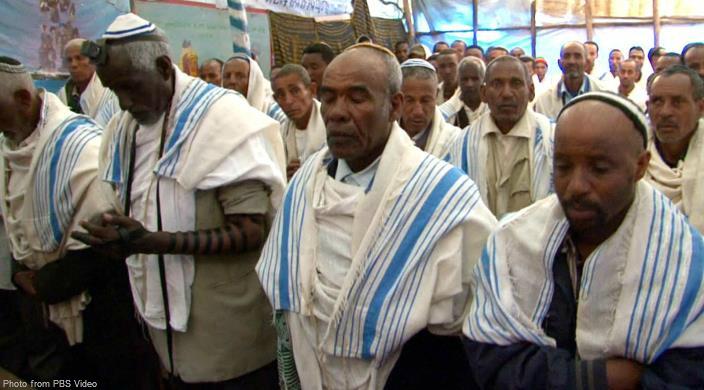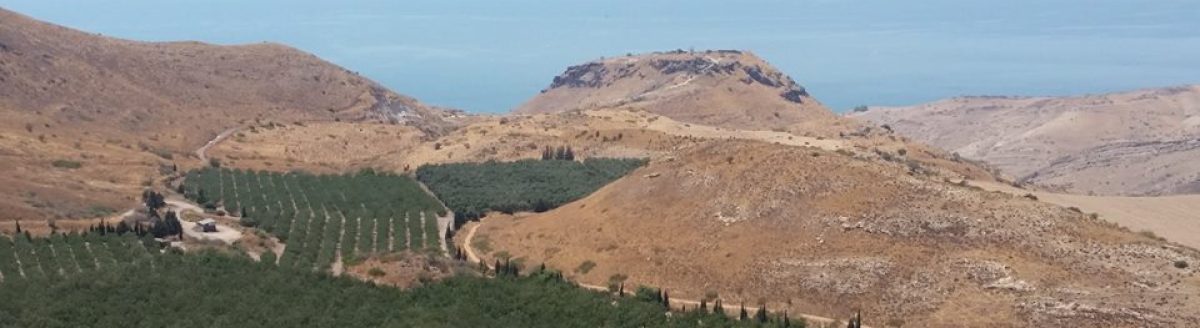
Yiddish lives

One might be surprised to hear this, but Yiddish lives in Israel- and not just among Hasidim.  Yiddish is the traditional language of Ashkenazi Jews like me.  Before someone says something stupid, let me clarify something- Yiddish is NOT a “mixture of German and Hebrew”.  It is also not only a Hasidic language- it has existed for at least a thousand years as a distinct language, whereas Hasidism has been around for about 400.  On the eve of the Holocaust, 13 million Jews- socialists, communists, Zionists, anti-Zionists, Hasidim, secularists- spoke the language.

Yiddish is an archaeology of the Jewish people and linguistic proof of our ties to the Land of Israel.  About 2000 years ago, Romans expelled Jews from Israel and destroyed the Temple in Jerusalem.  The Jews who weren’t executed were expelled or enslaved.  Many eventually made their way to other parts of the Roman Empire, where their Aramaic and Hebrew vocabulary became enriched with Latin words.  For instance, a famous Yiddish word (still said today even in Jewish American English) is “bentsch”.  To bentsch is to say the special prayer after eating a meal, coming from the Yiddish word “bentschn”.  This word comes from the Latin root “benedicere” meaning “to bless” like “bendecir” in Spanish.

As was the custom of European Christians for the 2,000 years of Jewish existence on their continent, time after time Jews were expelled as we were scapegoated for various social problems.  Other minorities today can probably relate.  And so with each expulsion and migration, Yiddish was enriched with new vocabulary- Italian, French, and eventually Germanic languages.  To be clear- at the time Jews started settling in present-day German speaking areas like Switzerland, Germany, and Austria, there was no such thing as the German language.  There were a variety of Germanic dialects (some of which are still spoken), but no unified language.

Yiddish borrowed heavily from their neighbors’ lexicon, although in some cases developing new meanings particular to their community.  For instance, while in German “shul” means “school”, in Yiddish, it can mean “synagogue”.  Hebrew and Aramaic also interplayed with the Germanic words.  For instance, “froynd” in Yiddish is a “casual friend” or “acquaintance”, similar to the Modern German meaning.  But in Yiddish, there is another level of friendship- a “chaver” (or “chaverteh” for a woman- that’s a Hebrew word with an Aramaic suffix).  That’s a real close friend.  And it says something about the value still placed on Hebrew (known often as “loshn koydesh- holy tongue”) even in the Diaspora.

As German-speaking peoples decided to butcher Jews during the Crusades and expel them from their cities, Jews went eastward.  Believe it or not, initially Polish and Lithuanian rulers (these countries today are more well known among Jews as places we were massacred) welcomed Jews.  Jews became merchants and built communities in Poland- and then all across Eastern Europe, down to Romania and Ukraine.  Name a country in Eastern Europe and we made our way there.

Of course the Slavic vocabulary lent a new angle to the language.  While the Jews that remained in Germany, Holland, and France continued speaking Yiddish- a new dialect developed: Eastern Yiddish.  Bubbe, Zayde, Tate, Mame- grandma, grandpa, mom, and dad- are all derived from Slavic roots.  The first two are to this day used by many American Jews to talk to their grandparents.

Meanwhile, Hebrew and Aramaic maintained a strong presence- perhaps also due to the fact that these languages were used extensively in prayer and in study.  They maintained such a strong presence that when Zionists aimed to revive Hebrew as the main spoken language of Jews, they looked to Yiddish for both Hebraic words and for Yiddish expressions to translate.  The modern Hebrew words B’seder, mamash, b’tachlis, chutzpah, and so many more are of Yiddish origin.  Which is to say- they are Hebrew (“holy tongue”) words that made their way into specific usages in Yiddish- and these usages were copied into Modern Hebrew in a way they didn’t necessarily exist in the Torah or other Jewish languages.

Speaking of translated phrases, did you know the Hebrew greeting “mah nishma?” is literally a translation of the Yiddish phrase “vos hert zach?”, meaning “what is heard?”  Even the famous “mah pitom?” is a translation (calque) from Yiddish.  If you speak Modern Hebrew, you speak more Yiddish than you thought!

Which brings us back to the language.  After the Nazi Germans and their anti-Semitic collaborators murdered 6 million Jews, most of them Yiddish speaking, the language was devastated.  Ashkenazi Eastern European civilization was brutally brought to an end after 2,000 years of life on the continent.  The language itself was feared extinct as the only remaining centers- the U.S. and Israel- were encouraging linguistic assimilation into English and Hebrew respectively.

In particular, in Israel, the government actually forbade non-Hebrew newspapers and theater performances.  Feeling Yiddish (and languages such as Ladino and Judeo-Arabic) was a threat, there was an actual “brigade” of volunteers who would go around shutting down Yiddish events.  I can’t think of something more horrifying to experience than for a Holocaust survivor to have a fellow Jew attack them for speaking the mamaloshn- their mother tongue.

Over the years, the remnants of Yiddish faded both in America and in Israel as Jews were told (either by Christians in America or fellow Jews in Israel) that their language was “lame”, “ignorant”, “backwards”, and (in Israel) “Diasporic”.  For all of Israel’s renewed interest in multilingualism and greater tolerance for diversity, I experienced this attitude myself when I posted my English blog in an LGBT Israeli group (with a description in Hebrew) and someone berated me saying I needed to write my blog in “the holy tongue”.

In particular, people have called Yiddish a “dialect” or “jargon” over the years.  This goes back hundreds of years in Europe- it was a deliberate effort by ruling Christians to demean Jews by insulting their language.  And sadly, some Jews internalize(d) this thought even though Yiddish published its first dictionary before German and tens of thousands of books, 12,000 of which are preserved digitally here.  Yiddish is a language with many influences, just like English.  It is a storied and beautiful language.  As a famous Yiddish linguist Max Weinreich said: “a language is a dialect with an army and a navy”.

When my ancestors moved to America in the late 1800s and early 1900s to escape anti-Semitic violence in Eastern Europe, they spoke Yiddish (one of them also spoke Romanian!).  I even found the Census records to prove it.  With each subsequent generation, a bit more of the language was lost, but it is still present today in my dialect of English, where words like “schlep”, “shlemiel”, “shmear”, and “oy gevalt” are omnipresent.  And sometimes need to be explained to non-Jews!

Yiddish has always acted as a storage device for Jewish culture.  There are certain things that just can’t be expressed in other languages.  And while Germans can understand much of it- there’s a lot they can’t.  And Jews can change their register (by adding more Hebrew and Aramaic, e.g.) to make it harder for them to understand- which is the point.  It was a clever way for Jews to understand their neighbors but speak more secretively if needed to protect the community.

Yiddish, as we saw, also stored a lot of Hebrew.  In some ways it kept the language alive over the course of 2,000 years.  I dare anyone who says Jews aren’t tied to this land to explain to me why Lithuanian Jews were speaking a language 20% made of Hebrew words.

In the end, Yiddish shows that Judaism is not just a religion, it is also a culture- a people.  It’s not coincidental that a few hundred years ago, a Jew in Poland could communicate better with a Dutch Jew than with a non-Jewish Pole.  Jews’ primary relationship was with other Jews.  There is no such thing as Presbyterian cuisine, literature, and language- because that’s a religion.  The word religion is a foreign concept to Judaism- we are a tribe.  You cannot fully separate the culture and the spiritual nature of our people- although many a secularist (and Haredi) have tried.  They are inextricably tied together just like natives living in the Amazon.  Where one starts and one ends is unclear- and there’s no need to clarify it.

Growing up speaking Jewish American English, I was always exposed to Yiddish.  All of my grandparents spoke it or understood it to varying degrees.  And it peppered my conversations.  It’s a very expressive and fun language with a soft side to it.  Despite some of the efforts of Hebrew purists to rid the language of Yiddish, I actually see a lot of it reflected in Israeli culture and language.  It feels comfortable.

A few years ago, I found a private tutor to start learning the language in earnest.  I then was blessed with the opportunity to go to the Workmen’s Circle “Yiddishland” program in New York.  There I learned not only the language, but also the culture- the music, the traditional dancing, so much.

When I made aliyah and moved to Israel, I wasn’t sure how much yiddishkayt- Yiddishness- I would find.  I’ve been pleasantly surprised at how vigorously Hasidic communities here are preserving the language- my cover photo is a bunch of newly printed Yiddish books for children in Bnei Brak.  With Hasidic Jews’ high birthrate, the language is about to make the comeback of a lifetime.  At the same time, I personally wanted to find a more progressive setting for my Yiddish too.

I’ve been pleased to connected with organizations in Tel Aviv like Yung Yidish (a library and concert venue in the Central Bus Station), Arbeiter Ring, Yiddishpiel Theater, and so much more.  I even got the chance to see a Yiddish musical based on the Barry Sisters last night!  The subtitles (which I was proud that I only needed occasionally) were in Hebrew and Russian.  Not a small number of Russians here also speak the mamaloshn- tribute to how international and cosmopolitan this language is.

To conclude, I’d like to share a story about how Yiddish lebt- how Yiddish lives.  I went to the library here to try to find Yiddish books.  I was disappointed when the librarian said their branch had none.  Feeling despondent about the future of the language, I asked what other languages they had.  She mentioned French, which I also speak.

I headed back to the French section only to find something curious.  A French book- almost a hundred years old- by famed Yiddish writer Sholem Asch!  In other words, a Yiddish book…translated into French!  I shared my excitement with the librarian, who was astonished.  I may very well have been the only person to discover this.

This is how Hebrew survived in Yiddish- and how Yiddish now survives in Israel.  Little fragments of a prior world integrated into a new form.  An immaculate metaphor for Judaism itself.  And I’m telling you- don’t count Yiddish out.  Because those sparks of Yiddishkayt are being rekindled- in Bnei Brak, in Mea Shearim, and right here in the most secular place of all- my home, Tel Aviv.
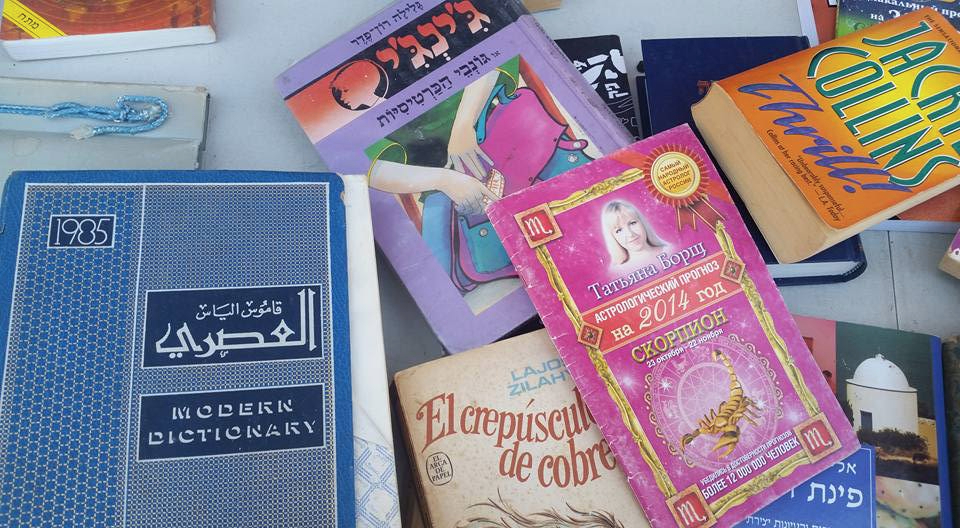
The most diverse Israeli day ever

Today, I did too many things to write a story.  So I’m going to list them:

-I spent a train ride talking in French with an Orthodox Jew of Moroccan origins who immigrated from France.

-I hung out in an underground pool with arches built in 789 by the Abbasid Caliphate in a boat.  And then I wrote an Arabic poem while inside!

-I met Peruvian (Jews?) and talked in Spanish about my friend Claudia who did Peace Corps in Peru.

-I visited a church from the 1200’s with a super hot Arab security guard whose smile and kindness melted my heart.  Can you say “return visit”?

-I bought a CD of Iraqi music in Arabic sung by an Iraqi-Israeli Jew back in the day who was born in Iraq- for 10 shekels!

-I talked about Ethiopian music and Sigd in a store covered in Amharic and Hebrew signs.

-I watched Karaite Jews pray Ma’ariv evening prayers.  Most of them are of Egyptian origin, so I chatted with them in Syrian and they responded in Egyptian Arabic.

-I made friends with an Israeli soldier when our trains got messed up and delayed and we had to switch lines.

-I did dinner in a mixture of Hebrew, English, and French with a Sabra and a French non-Jewish PhD student…whose family is from Guadeloupe!   We talked about our shared love of Zouk.

-I danced dabke for easily three hours with young Arab students.  A German exchange student came and I helped a talented dancer in a hijab translate dabke instructions into English (and a little Yiddish, which he can largely understand!).

-I then hung out with said wonderful German exchange student for another three hours walking around Tel Aviv and talking about life here.  He is one of the most open-minded, non-judgmental, kind people I’ve met here.  He’s not Jewish and I couldn’t imagine that a non-Jewish German would make my night…in Tel Aviv!

-Thinking no more cultural richness was possible, I hopped into a cab.  The Israeli man turned on the music (without lyrics) and asked me to guess where it was from.  Within 5 seconds I said “Thailand!”  I love Thai music and used to buy it at the Thai grocery store back home.  He was shocked.  His wife is Thai and he lives in Thailand with his children, only coming back to Israel to care for his parents.  He speaks fluent Thai- as do his biracial children.  He was mightily impressed that my favorite Thai dish is Pad See Ew- he says everyone says Pad Thai!

This is what I have to say- today I spoke English, Hebrew, Arabic, Spanish, French, and Yiddish.  Just last week I also spoke Catalan, Portuguese, and Farsi (with both Persians and Bukharans).  If you have the curiosity, the passion, and the will- you can experience more cultures here than you can count.  I live in a neighborhood where I regularly meet Iraqis and Moroccans and Syrians (Jews) and Burmese and Sudanese and Eritreans (non-Jews)- I even had someone tell me her friend is half Ghanaian half Filipina.

When people find out I’m a polyglot, they often tell me “what do you do with your languages?”  Sometimes it feels accusatory- “why aren’t you making a ton of money off of them?  Why aren’t you working for the government or the military or the CIA?”

You know what?  What I do with my languages is what I did today.  I explored ancient civilizations, made new friends, learned about other cultures, danced, sang, wrote poetry, and built bridges of peace.  I felt happy 🙂

If you can show me something more valuable or enriching than that, be my guest.

In the meantime, I’m just happy to live in one of the most diverse countries on the planet.  Where the combination of things I did today is only possible here.  One person today said to me “but honestly what is there to see in Ramle?”- one of today’s destinations.

The answer: “everything, if you’d just open your mind.”

The biggest threat to Israel

There are many threats to Israel- terrorism, nuclear weapons, earthquakes, poverty, diminishing water resources.  You name it.  But for me, the biggest threat facing Israel is one word: invalidation.

First, let’s start with what the word validation means.  Validation does not mean agreement and it doesn’t mean love.  Validation means showing empathy and understanding where someone else is coming from.  How the conditions of their life have informed their views and even if you see the world differently, you can get a glimpse of why they are the way they are.  Even if, in the end, they may be too difficult for you to be friends with.  It’s a difficult skill and an extremely useful one for living an effective life.

Validation is useful for building healthy relationships.  And its opposite, invalidation, is how you destroy them.  All of us invalidate sometimes- we judge, we mock, we belittle.  Maybe other than Buddha himself, I don’t think there’s a single human being who never judges.  However, there are degrees of invalidation.  Invalidation is when we say harmful, hurtful things to (or about) people.  She’s ugly.  I’m fat.  My neighbor’s a dumb ars.  That Orthodox woman is frumpy.  That gay guy must be a pill-popping slut.  That Haredi man is a fanatical homophobe.  That Arab is only good for making falafel- he probably wants to throw us into the sea.

Israelis have a serious problem when it comes to judging both themselves and others.  Judging has been a part of Jewish culture since the Torah- the Bible isn’t exactly Zen Buddhism.  But I remain fairly convinced that the sometimes mind-numbingly intense judgments that I hear here are also a product of trauma.  When someone is traumatized or experiences intense pain, unless and until that person heals, it is common for people to pass that trauma onto others.  That is why it is so common to see families- generation after generation- experiencing abuse.  It’s also why I distanced myself from toxic relatives and broke a chain of toxicity to build a better life.

If you think of the Jews who’ve come to this land, it hasn’t usually been for happy reasons.  Ashkenazim escaping pogroms.  More Ashkenazim escaping the Holocaust.  Holocaust survivors escaping post-war pogroms (yes, you read that right- Europeans continued butchering Holocaust survivors after the war).  A huge percentage of Ashkenazim here are descendants of Holocaust survivors- including almost every Hasidic Jew.

Mizrachim escaped their own pogroms from Morocco to Yemen- only to find their property confiscated by Arab governments.  And then, upon arriving in Israel, they were put into impoverished refugee camps.  Russian Jews fled the Soviet Union (where their religion was banned) and its chaotic aftermath.  The U.S.S.R. was a government so antisemitic it literally has its own Wikipedia article about how antisemitic it was.  Persian Jews fled the Ayatollah, French Jews fled (and still flee) antisemitic terror and discrimination, and even today there are American Jews like me escaping rising antisemitism and white supremacy in the United States.  The list goes on and on and on and on.  And it has a 2,000 year old antisemitic backstory.

And when these Jews arrived in Israel, while many were grateful for a safe haven, their cultures were often decimated in the name of Jewish cohesion in the nascent state.  Ashkenazim were told to stop speaking Yiddish (police even raided Yiddish theaters- an unforgivable thought when you think that the spectators were likely Holocaust survivors).  I even remember a survivor telling me that when she arrived to Israel from Poland after the Holocaust, Sabras would call her and her mom “sabonim”- “soap”.  That was to make fun of the “weak” Diaspora Jews who the Nazis reportedly turned into bars of soap.  Mizrachim were also pressured to give up their languages, their music, their culture- which to many Sabras seemed a bit too much like the (Arab) enemy.  To this day, they continue to have significantly lower average incomes than Ashkenazim.  And every single Israeli Prime Minister has been Ashkenazi, unless you count some recently discovered Sephardic genes in Bibi’s DNA.

With these examples, we’re literally just scratching the surface with Jews.  And it’s worth saying that the Arab population here has suffered its own traumas- of wars, of discrimination, of terrorism (yes, Israeli Arabs are also attacked by terrorists), of families divided across borders, and more.

Add to this 70 years of on-and-off warfare, and you can understand why Israel has three times the rate of PTSD as the United States.

So when a fellow Israeli is harsh to me.  When they say something mean and judgmental- about me, about another community, about themselves- I understand.  I don’t by any means justify it- I think it’s harmful and if we’re going to thrive as a society, this must change.  And sometimes I frankly have to protect myself by distancing myself from their toxicity.  And I get it.  Israelis have been through a lot.  And not everyone is healing.  It took me a while to get to this understanding- but this is the ultimate validation.  I don’t personally agree with being racist or hateful- I just know that if someone got to that point, there’s something causing it and I hope they choose a different path.

Many Israelis complain to me about American “politeness”.  They think Americans are fake- when they smile, when they say thank you, when they do a whole variety of quotidian acts that make up American culture.  On the one hand, I get it- there are times when Americans can be exceedingly formal.  It can be hard to gauge if someone really likes you- or what they think.

At the same time, I remember what one Israeli friend said to me: “I don’t like that in America they’re all the time worried about whether they’re hurting you.”  To this I say- you’re not talking about politeness anymore.  You’re talking about consideration.  You’re talking about kindness.  You’re talking about someone caring how you feel- and trying to respect your boundaries.  In a way that you never got growing up in a society filled with people whose boundaries have been crossed over and over again against their will.  Who have endured but in many cases, not healed.  And who all too often pass their hurt along to others.

To this I say- enough.  All Israelis, in fact all people, deserve the right to heal from their traumas.  And to not have new pain heaped upon them.  As a society, we can still keep our bluntness and our assertiveness without the spite and without the cruelty.  Find one way to heal yourself this week- and find one way to encourage a friend.  I’m not a psychiatrist or a PTSD expert, nor do I have the power to stop violence.  But I think that if we each find a way to bring some healing into our society, it will do us all a lot of good.

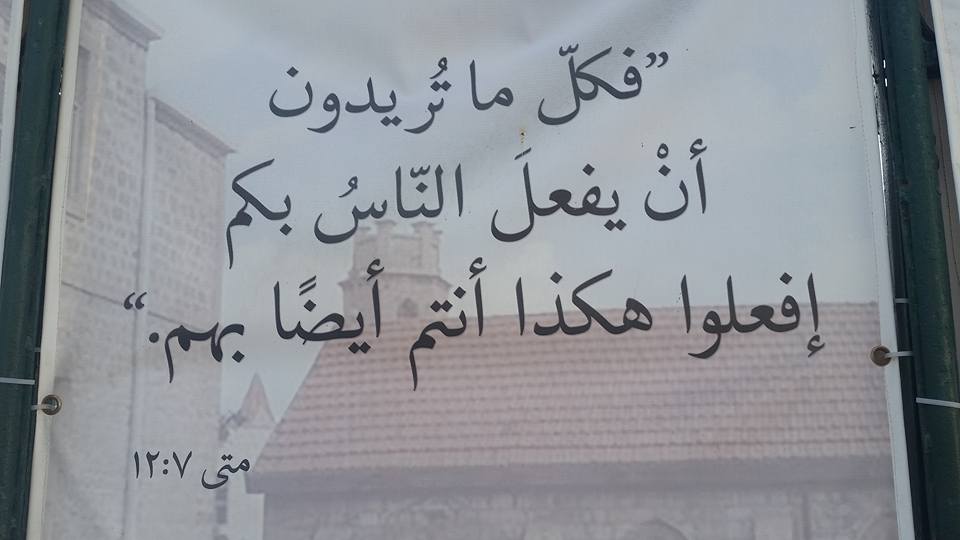
To borrow a bit from our Christian neighbors, my cover photo is from an Arab church in Haifa.  It says: “Do unto others as you would have them do unto you“.  Amen.

Every sector of Israeli society in one day

Today, my day started with terrorism and ending with me and some Mizrachim singing Umm Kulthum.

I’m in the (very stressful) process of finding an apartment in Tel Aviv.  I’ve never had such a difficult time finding a place to live in any other city.  The loosely-regulated rental market here is super competitive with sketchy offers abounding.  I’ll find something, it’s just exhausting.

In need of a break, I did something most Tel Avivim would not do when in need of relaxation, and went to Jerusalem.

Having gotten a bit turned around, instead of taking a bus from the Central Bus Station, I actually ended up taking a bus to Kfar Chabad and then a second bus to Jerusalem.  I could detour here and tell you about the adventures of making a highly-improvised bathroom stop between bus rides, but I’ll save that for one-on-one conversations 😉  Israel constantly challenges your definitions of “gross”.

I hopped on the second bus, which incidentally took us partially through the West Bank/Samaria.

This particular route was gorgeous.  Unlike the main bus lines to Jerusalem, this was totally rural with no traffic whatsoever.  The scenes were idyllic.

I felt a bit nervous going through this area today as there was a terrorist attack this morning.  Three young men – an Ethiopian Jew, one (I believe) Mizrachi Jew, and one Israeli-Arab – were ruthlessly murdered as they did their job providing security for the community of Har Hadar.  Solomon, Yossef, and Or – may their memory be for a blessing.  I’m praying for their families.  And I was so sad this morning I was frankly at a loss for words- and I still am.

I almost didn’t go to Jerusalem, but in the end- fuck terrorism.  There’s only so much you can control in life and after taking reasonable precautions, I just want to live my life.  Just like these young people would’ve liked to.

Incidentally, we passed by a sign to Har Hadar on the way to Jerusalem.  It’s that small of a country.

I get to Jerusalem, a bit frazzled, and hop off the bus.  To my right is a sign with bunch of Hasidic posters, one of which was in Yiddish.  I approached two twenty-something Hasidim and asked in Yiddish for them to explain one of the signs.  Turns out, there is a Yiddish-language theater production being broadcast out of Brooklyn into movie-style screens in Jerusalem and Bnei Brak, which they invited me to.

The two young men were Belz Hasidim and for an hour and a half, we spoke in a mixture of Yiddish, Hebrew, and English.  One, Dovid, was born in London and the other, Yankev, grew up in Montreal, another one of my favorite cities.  Yankev was a bit shy, though we spoke a little French together since he learned some in Montreal (and so did I!).  Dovid was a real shmoozer and a sweet guy.  He told me all about yeshiva and how he lamented the lack of Kosher steak in Jerusalem.  He made a point of telling me he doesn’t go to political demonstrations, which reminded me of how I often felt in America having to show I wasn’t one of “those” people in my minority group.  We talked about our favorite Jewish texts.  They love the halachos of Shabbes and I shared with them my favorite Jewish teaching – which, much to my surprise, they didn’t know.  In fact, they asked me to translate it for them into Yiddish, which remarkably I did!

Before leaving, as some people are wont to do here, Dovid shared with me a little bit of prejudice.  He told me, in light of today’s attack, that Arabs aren’t very bright.  I of course challenged him on this and his response, while bigoted, was quintessentially Jewish and kind of funny: “The Arabs aren’t very good at terrorism.  Jews don’t do terrorist attacks but if we did, we’d be better at it.”  So basically, in a phrase that would make the alt-Right twist and squirm and vomit, he said that Jews would make better terrorists than Arabs.  As the father in My Big Greek Wedding would say “the Greeks invented everything.”  I couldn’t help but chuckle.

I headed towards the Old City as two Arab women stopped me.  They asked me in Arabic for directions (how cool is that??) – and surprisingly, thanks to my Arabic and the glory of modern transit apps, I helped them find their way!  In fact, I was headed in the same direction.

We hopped on the train and I froze.  I had walked with them 10 minutes speaking in Arabic but when I got on the train, I was scared to keep talking.  I looked around, and thinking about today’s terrorist attack, I was worried how people might react.  There are legitimate reasons I felt that way, as you can read about here.

As I got off the train, I walked towards the Old City.  I saw an Arab man selling sunglasses.  I approached him and I said I didn’t need any glasses, but I told him he was making me happy so I wanted to give him a gift and handed him some money.  He invited me to sit with him.  We spoke in Arabic (I felt more comfortable out in the open air instead of cramped public transit where, frankly, attacks are more likely so I can understand people’s fear).  Turns out he’s from Hebron in the West Bank/Samaria.  He comes to work in Jerusalem each day.  He doesn’t know any English, so I taught him some English words to help with his marketing.  The poor guy is 60, 70 years old with 10 kids and a two-hour commute each way.  I can’t imagine what today’s terror attack is going to do to his livelihood as transit will slow and work permits may be frozen.  I suppose the terrorist wasn’t thinking of his fellow Palestinians who need to make a living when he shot three people.

The man gave me a big smile and a warm handshake as I headed off to meet my friend Sarah, a Modern Orthodox/Traditional Jew from America.  We ate Kosher pizza and then wandered through the Armenian Quarter, where I had never been.  I love Armenians.  When I was in high school, a friend gave me an Armenian CD which I still have on my computer.  Armenians are so, so similar to Jews.  They are a Diaspora community that survived a genocide and manages to preserve their language and religion.  And they’re pretty cute!

We talked with several Armenian men about their visits to the homeland, their life in Jerusalem, the Armenian Church (they had strong opinions- and not positive ones!), and the Armenian-language schools down the street.  I even got to hear their Armenian-accented Arabic!  One man votes Meretz and his wife votes Likud.  I went to an Armenian restaurant and got a fascinating dessert made out of crushed grapes and walnuts with a string inside.  And, because this is how I roll, I got info on some Armenian tutors- because at some point, that would be fun.

On my bus back to Tel Aviv, I befriended a handsome American tourist named Nicolai.  Non-Jewish and from Wisconsin, we talked the entire hour-long trip about Israel, Judaism, America, Bernie Sanders (we’re fans), and so much more.  A truly open-minded fellow- which is not something to take for granted.  Too many people arrive to Israel with preconceived notions of what it is and isn’t.  He was pretty much an open book.

His phone didn’t have internet, so I walked him 20 minutes to his bus stop and got him on his way home.  Because that’s what we do in Israel- we go out of our way to help others.  I find the generosity that surrounds me here encourages me to be even kinder to people.

I hopped in a monit sherut cab and headed home.  What a day!  Hasidim, Modern Orthodox, Arab-Israelis, Palestinians, tourists, Reform Jews (that’s me!).  What else was missing?

As our Russian driver helped us wind through (largely) secular Tel Aviv, two Mizrachi guys up front started singing.  Koby Peretz, Sarit Hadad, Shimon Buskila- you name it.  Then, to their surprise, I made a request.

“Inta omri,” I said.

Pleasantly surprised that an Ashkenazi would request an Egyptian classic, they started to sing.  And to their delight- I joined in.

On a day when a deranged man tried to break the place I call home, I started the day with his hatred and I ended it by singing with Jews in Arabic.

And in-between, I hung out with every sector of Israeli society.

Want to write public policy papers about how to solve the Middle East conflict?  Go for it- maybe they could help.  Honestly, I don’t know.

What I do know is I probably won’t have time for your conference.  Because I’m going to be speaking Yiddish with Hasidim, training a Palestinian in marketing, and singing Mizrachi music in a cab.  I’ll be getting to know my neighbors.  Just like Solomon, Yossef, and Or would’ve wanted.

Norwegian-Persian Jews

I didn’t fully appreciate the diversity of Israeli Jews until I made aliyah.  Yes, I had visited on trips, but you don’t get to know people with the same degree of depth.  One of the things I love about American Jewry is the cultural cohesion and unity.  And one of the things I love about Israeli Judaism is how incredibly diverse it is.

Last week, I was in Jerusalem.  My friend and I went to a Thai restaurant.  We were joking around with the guy behind the counter.  Turns out, he’s a half Kurdish half Moroccan Jew.  We joked about him finding us a fourth person so we could all go on a double date.  He said he’d be happy to take us to a Kurdish restaurant down the street and then taught me some Kurdish.  Right, my Jewish Thai restaurant waiter offered to teach me the Kurdish his grandparents say around the dinner table.  Chew on that one for a while.

This past weekend, I hung out with a bunch of vegan hippie Jews at a commune in Tel Aviv.  As they munched on lentils and drank home-brewed Kombucha with shouts of “lechaim”, I met a half Norwegian half Persian Jewish filmmaker.  Yes, both halves are Jewish.  Apparently, her grandparents on either side only spoke their native language (Norwegian and Judeo-Persian), so they couldn’t communicate with each other!  Luckily, this talented young woman speaks both Norwegian and Farsi and even spent two years living in Norway.

Today I hung out in Bnei Brak.  While I was buying some books and music, I befriended the two salesmen.  One, who looked quite clearly Ashkenazi, was a Vizhnitzer Hasid and a Yiddish speaker.  We had fun shmoozing a bisl in the mamaloshn.  Turns out, he also understands Dutch- his mother’s family is from the Netherlands.  Oh and his father was born in Switzerland, where his parents were working for the Jewish Agency.  For people who know the politics of Hasidim and Zionism, take a moment to digest that one for a bit.

The other Hasid in the store looked more tan skinned, so I mistakenly assumed he was Mizrachi (there are Mizrachi Hasidim).  Turns out, he’s just like me- an Ashkenazi Jew who kept his Middle Eastern complexion even in the Diaspora 😉 .  Guess there isn’t just one “Ashkenazi look” after all.  Now brace yourselves for a real kicker.  His family made aliyah…from Mauritius.  Right, so basically his family escaped the Nazis but the British refused to let them into Mandatory Palestine.  So they sent them to a bunch of islands in the Indian Ocean.  To this day, his family likes to tell stories of what it was like there.

I could literally go on and on with examples- my friend who is half Serbian half Moroccan and works at a Kosher Georgian restaurant, my half Iraqi half Ashkenazi female rabbi, my half Italian half Ashkenazi friend married to a Cherokee Jew!  The diversity here is endless.  If your image of Israel is that everyone looks like Andy Samberg, you’re in for a major shock.  And I’m saying this as someone who would very much like a country of Andy Sambergs- what a cute Jewish boy!!

Israel is an incredible fusion of hundreds of Jewish cultures from around the world, preserved for 2,000 years and reuniting and reconfiguring meaning.  I definitely miss my American Yiddishkeit, a force that unites the 90% of American Jews who are Ashkenazi with a shared humor, cuisine, and dialect.  The good part about Israel is that in the absence of a unifying Judaism, there is the freedom to mix and match.  It’s truly a place where no one can say, as someone told me on a temple trip in 5th grade: “you don’t look Jewish.”


Hasidic Game of Thrones

No this blog isn’t about feuding Hasidic dynasties.  Rather, it’s about my dinner in Bnei Brak and a Hasidic man who likes Game of Thrones.

Last night, I was hungry.  I had a busy day and hadn’t eaten enough.  I reasoned that this justified eating a calorie-rich Ashkenazi meal and kugel.  So I hopped on a bus to Bnei Brak.

The restaurant was supposed to close at 10 so I hustled from the bus stop because it was 9:45.  Of course, this is Israel, so actually the place stayed open till past 11, so I was fine 🙂  Nice to know Jewish Standard Time really is an international thing.

I ordered grilled salmon, a potato blintz, apple kugel, and chicken soup.  Mmmmm.  Foods of my people and of my childhood.

I struck up conversation with Moti, the guy behind the counter.  Moti is a Belz Hasid, though it sounded like his family also had strong connections to the Vizhnitz community.

Much to the surprise of some people reading this blog, Moti speaks both Hebrew and Yiddish fluently.  Many people assume Hasidim only speak Yiddish in Israel.  I think he prefers Yiddish as he told me in the mamaloshn “Yiddish iz mayn shprakh” which means “Yiddish is my tongue”.  Also he called Hebrew “loshn koydesh” (the holy tongue), which is cool because I haven’t heard that phrase since I was at Yiddish camp last summer.  It’s the traditional way of saying “Hebrew” and could also be tied to Hasidic concepts of how to use the languages (Hebrew=holy tongue, Yiddish=daily tongue).  Yet here he was floating effortlessly between Yiddish and Hebrew with me.

Interestingly, he can only read and write in Hebrew.  He said Hasidim in Bnei Brak, with the exception of Satmarers, read and write in Hebrew even if they often speak in Yiddish.  Maybe next time I’ll offer to teach him how to read and write in Yiddish 🙂 .  If a queer Reform Jew teaching his new Hasidic friend how to write in Yiddish isn’t an incredibly rich and unexpected act of Jewish solidarity and continuity, then I don’t know what is.

As I was asking Moti about Thursdays (apparently that’s the day when the best food comes out, including homemade gefilte fish mmmm), another Hasid named Kivi approached me.  He needed help translating English on an appliance he bought.  He then told me he loves English and that even though he doesn’t get to speak it much, he loves reading it and watching…YouTube.

YouTube.  Hasidim watching YouTube.  What does Kivi watch on YouTube?  What’s his favorite show?  Game of Thrones.  The blood-soaked, sex-filled show that’s too gruesome for me to even watch.  He then asked me if I had seen the last “fight”.  I didn’t understand.  But then he explained that he’s a boxing fan and loves to watch the fights online.

Still processing everything I just heard, a Yemenite man invited me to synagogue to davven Ma’ariv.  Because there’s a synagogue around the corner, like around every corner in Bnei Brak.

Scared shitless and super excited, I said yes.  Keep in mind that I have never prayed at an Orthodox synagogue, much less a Hasidic one (yes, this was a Hasidic shtiebel).  I have also never prayed in a single-gender environment (Reform Jews sit with men and women together).  And this was a step beyond that- there were no women anywhere, just men davvening together.  Also, it should be said that as a gay person, I felt scared.  Clearly if nobody knew I was gay, nobody would do anything.  But having read stories of Haredim stabbing people at pride parades, pushing conversion therapy, and protesting against gays in the military, I felt nervous.  And I understood for a moment the pressure gay people must face in this community.  To be fair, I didn’t know exactly how they’d react (perhaps people wouldn’t harm me or might even be more open than I’d expect).  And I didn’t want to risk my safety or well-being by coming out.

My experience was really interesting.  First off, there is a beautiful rhythm and musicality to Hasidic prayer.  It is not just mumbling.  There is a beautiful entropy within the framework of fixed prayers, with people improvising and singing whatever words speak to them.  And I joined in.

Second, all the prayers were said by the chazzan (cantor) and the other men in the room in an Ashkenazi accent.  Even though the vast majority of American Reform Jews are Ashkenazi, under pressure from the Israeli pronunciation in the 1950s and 60s, we abandoned it.  It was perceived as “old world” and “backwards”.  And so we lost touch with a beautiful part of our heritage, much like Mizrachim in Israel were pressured to abandon their fascinating accents.  Here in this shul, the accent lives.  I felt like I was transported back to the shtetl where my ancestors came from.  The culture murderously ripped apart by Nazis.  The culture that lives to this day despite them.

I did miss the voices of women (and I did make a point of including the matriarchs in my prayers as well as sometimes using the female gender for God – bruchah at yah…).  At the same time, it was intriguing to pray with men.  When I came out of the closet at 18, I felt like my masculinity was ripped away from me by society.  I distinctly remember a moment in college where a female friend said “when are we going shopping?”  To which I said “I didn’t know we had plans.”  She responded: “oh we didn’t, I just know gay people like to shop all the time.”  I could literally give hundreds of examples like this.  I wasn’t allowed to define my gender as I wanted.  Just as hyper masculinity was thrust on me as a child, an invasive femininity was imposed on me as a queer person.  Here, in this shul, I actually felt like I could be a man.  No questions asked.  With my fellow Hebrew bros.

There were also moments when I felt like the prayer structure was rigid.  The man next to me kept pointing me to this page or that.  At first, I found this irritating because I wanted to go at my own pace and to speak the words in my heart.  I then came to realize that in this setting, prayer was very much a team effort even if there’s room for improvisation.  And secondly, that I think his intention was to help me participate more than to tell me what to do.  As a Reform Jew used to extensive independence and autonomy in prayer, I found this confusing at first.  I then just kind of observed it around me as I found new ways of expressing the prayer in my heart.  A different style, for sure, but not without its own merits.

The prayer concluded and the Yemenite man, who I was kind of concerned was going to proselytize me, simply came up and said: “it was nice to meet you, I hope to see you again.”  With that, I walked down the street and picked up a call from one of my rabbis in the States- a woman.  We laughed about my experiences in Israel and I told her how I was getting involved with the Reform community here.  And then I realized- I was practically shouting the word Reform over and over again in the middle of a Haredi city.  And literally nobody batted an eye.

Not because there aren’t conflicts here or prejudice.  But because perhaps there’s a more fluid co-existence than you might expect.  It’s a place where queer Jews speak Yiddish to Hasidim.  Where I can talk to my female rabbi on the phone after davvening with a bunch of men.  Where a Hasidic man loves English, and even watches Game of Thrones.