My Queer Sarit Hadad Party

First off, who is Sarit Hadad?  Sarit Hadad is the queen of Mizrachi music, one of my favorite styles of music.  Perhaps my very favorite.

When I was 13 years old, as a typical American Jewish teenager, I had a Bar Mitzvah.  At this point, many a kid drops out of Hebrew school and doesn’t return to synagogue except for maybe Rosh Hashanah and Yom Kippur.

I, on the other hand, loved Hebrew school.  I had several truly awesome teachers and I think my energy and passion for my tradition made me a favorite student.  Especially since so many kids hated it!

When I finished my Bar Mitzvah, I knew I wanted to keep learning at synagogue.  But I wanted something more- I wanted to learn the language of my people: Hebrew.

I approached an Israeli teacher and asked if she’d give me private lessons.  She did- and that’s why I speak pretty baller Hebrew for someone who’s lived in Israel for 6 months.  Because at age 13, I knew that’s what I wanted and I went for it.  It’s a unique and brave decision that changed my life.  Without it, I doubt I would’ve made aliyah.

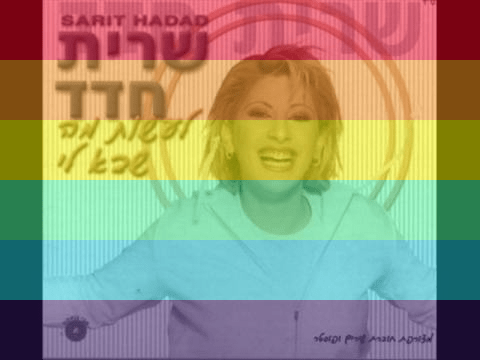
I remember that my Hebrew teacher gave me a gift- I forget for what.  Maybe her sister had been in Israel or something.  In any case, she gave me a CD- one of Sarit Hadad’s first albums (the one in the cover photo- the rainbow is my addition 😉 ).  She herself wasn’t a fan (of the music or Mizrachim), but it didn’t matter- I loved it.

The CD moved.  It moved me physically- the rhythms were infectious.  I danced all over my room and blasted it in my discman.  It moved me emotionally- her songs were about empowerment and love and doing what you feel like.  Growing up with an inescapable bunch of toxic relatives, it was just the medicine I needed.  And it powered me through many hard times and gave me hope and happiness.

A couple years into my Hebrew lessons, I found out Sarit Hadad was coming to Rockville, Maryland- where I grew up.  She was performing at Montgomery College in a small auditorium.  And at age 14 or 15- I went.  Alone.

And I had the time of my life.  Me and mostly a bunch of Israeli expats shimmied and danced and sang.  It was freedom, it was love, it was my newfound identity.

Over the years as I learned more Hebrew, saw more Israeli films, traveled to Israel, made Israeli friends, ate the food, and embraced the culture- the Mizrachi music Sarit inspired me to love was there.  Every step of the way.

As Sarit became more popular, her songs got more and more poppy (and less and less Georgian/Arabic/Mizrachi).  Personally, I love her old stuff the most- the CD of her live show in France is one that I played over and over again in my living room as a teenager.  I also used to (and still do!) belt out her old version of Inta Omri.  It’s incredible- I watched it with my Syrian neighbors last Shabbat.

In addition, as I explored other Mizrachi singers (and I more and more associated Sarit with some of the tougher times in my life), I drifted a bit from her music, although it was never far.  Her songs were particularly popular at Israeli dancing, which I’ve done for some 15 years.

Which brings us to tonight.  On Facebook, I found a party that was entirely dedicated to songs by Sarit Hadad.  While not an explicitly gay party, it definitely had that vibe (both by featuring a female singer and the way it was advertised).  In Tel Aviv, many parties are mixed queer and straight.

I was ecstatic but unsure of what to expect.  I went alone- which is hard in any country, especially a new one.

And boy did it pay off.  Once the music started booming, I found fun people to dance with.  Over the course of about 3-4 hours of Sarit’s songs (and some other singers), I think there were 2 or 3 songs I didn’t know the words to.  It brought me back to the earliest days of my Israeli identity and to my teenage passion for it.  It brushed the dust off and brought them back into my heart.

And yes, there were a shitton of queer people, which only made it more awesome.

I shimmied, I swiveled my hips, I shook my bootay, I waved my hands, I shouted every single lyric.  And it was fabulous.

As I headed home, I thought about this amazing transformation.  How music I listened to 18 years ago helped sustain me, build me an Israeli identity, and bring me to this very country to enjoy it, against all odds.

Like Mizrachi music, like Sarit herself- I am a survivor.  I’ve done the unthinkable in making aliyah and building my Israeli identity from the 7th grade- pretty much on my own (and often with the opposition of toxic relatives).  And despite the cries of the loads of Israelis who hate Mizrachi music- often for prejudiced reasons- I love it to death.

Because sometimes Israel sucks.  Air raid sirens, bureaucracy, terrorism, racism, and not a small amount of difficult people.

But you know what?  Israel is also tonight.  Israel is the free-spirited fun of Mizrachi culture.  Israel is me looking back at 13 year old Matt Adler and saying- it’s going to be okay.  Because no matter how bad things seem now, you’re going to power through, you’re going to pray, you’re going to dance, you’re going to listen to beautiful music.

And you’re going to make it like Moses to the Promised Land.  To spend the night of your life dancing to your teenage tunes- the ones you chose to listen to.  Among queer people.  Among your people.

And nothing, my friends, is sweeter than that.  I’m here, I’m queer, kululu!

Dugri: Lost in Translation

There has always been a yawning communication gap between Israelis and Americans- and between Israelis and the world.  Every country and culture has a unique communication style, and in my case, this often leads to challenging interactions with Sabras.  Sabras are Jews who were born and raised in Israel, whereas I’m an oleh- I chose to live here.

The sabra communication style most well known is “dugri”.  Dugri, from an Arabic word (itself of Turkish origin), means “straight talk”.  The word in Arabic means “straight” (like when giving directions), “fair” (like an arbiter not choosing sides), or “honest” (truthful words).  In Hebrew, the word means “direct”- but not in the sense of “honest” in Arabic (which is focused on presenting correct objective facts), but rather directly expressing your subjective emotions and opinions, regardless of how they are perceived.

In Israel, this means less pleasantries, less consideration, less politeness, more tough love, more controversial statements, and more blunt judgments.

There are ideological roots to this communication style that have been well-researched.  I highly encourage reading Professor Tamar Katriel’s study, which I’m still working through.  Going back to the early Zionist pioneer days, ideological olim wanted to rid themselves of what they perceived as a “Diaspora mentality” of formality, nuance, and passivity.  Again- this is their perception, not necessarily the facts.  The answer, especially for their sabra children, was to be found in a new, astoundingly direct and informal communication style, itself ironically rooted in German enlightenment philosophy.  I can empathize that building a new national identity was hard and I also think their attitude towards the Diaspora was pretty hateful.

This style, before I deconstruct the hell out of it, has its advantages.  For instance, I’m a very informal person so I like that dugriyut- or speaking dugri- allows me to speculate, to dream, to ponder.  I don’t have to cross my i’s and dot my t’s- I can just roll with it.  It fosters creativity in me.  I also like that I don’t have to think through every word I say for fear of literally losing friendships.  Here, an occasional offensive comment is not going to lose you anything.  When used properly, speaking dugri can reduce some of the feeling of “walking on broken glass” we face in America when communicating.  Also, hearing people’s deep-seated personal prejudices, while valued in Israeli society, for me actually serves as a defense mechanism so I can avoid someone who is actually toxic.  I rarely have to guess what people here think.

Now the flip side.  First things first- I’m a proud Israeli and I’m an American.  My family has lived in the Diaspora for 2,000 years and while I’m glad to be back, I’m not ready to give up the wisdom gained over centuries.  I’m a firm believer that it is not only possible, it is desirable to have more than one culture.  This is an issue Israel has struggled with from the beginning– as do many countries.  I understand- and will continue to learn about- dugri communication but that doesn’t mean I’m going to “negate” my other cultures.

In Hebrew, the ministry that deals with olim is called the “Ministry of Absorption”.  I can’t even imagine a more Orwellian phrase, but let’s work with it.  Yes, to a degree, I came to be absorbed into Israeli society.  But a funny thing happens when your body absorbs something- it changes your composition.  And so much in the same way, I intend not just to be changed, but to change this place.

So what does this mean for dugri talk?  First off, we need to see some of the negative aspects this style can present.  For example, when sabras interact with foreign cultures, including Americans, they often struggle to perceive cultural differences.  Just this week alone, on three separate occasions, Jews here made (what I consider) offensive remarks to me about Americans being “fake” etc.  This is a common sabra complaint- Americans are polite, but insincere when they compliment you.  All the while, I’m sitting there talking with them as an American with ten times better Hebrew than their rrrrresh infected mouths can mumble in my language.

This is endemic of the problem.  Because Israelis are sparse- but quite genuine- with their compliments (as befits dugri talk), anything other than that is seen as insincere.  What they don’t realize is that it’s simply a cultural difference.  When Israelis move abroad and don’t know how to say “please” or “thank you”- or try to say something unacceptably blunt- they lose friends and often struggle to make non-Israeli friends.  This is well-documented by a study done among Israeli migrants to Canada.  Boy if they think Americans are polite, wait till they meet Canadians haha.

The truth is there are fake people and genuine people in every society.  For me, for instance, I encounter some Israeli communication as incredibly insincere- even though it’s just likely just a cultural difference.  For instance, especially in Tel Aviv, when people promote upcoming events (or compliment someone for leading an event), a whole litany of “mehamems” and “madhims” and “nehedars” and “merageshs” come out.  Basically, just a list of how everything is the most amazing awesome best coolest most wonderful thing ever.  It’s enough to make me, as an American, nauseous because it sounds like they’re lying.  But what I’ve come to realize is that there’s probably a cultural component to it.  Rather than calling all sabras fake, I chose to read hours of academic articles and confront the issue meaningfully.

For me, besides the nuisance of Israelis telling me my country (and implicitly perhaps me and my friends there too?) is fake, I have to wonder if there’s a broader cultural problem at work.

Israelis, unlike almost any civilized society I’ve lived in or visited, have completely separate school systems based not only on race/religion, but also what type of religiosity.  There are Arab schools, secular Jewish schools, Modern Orthodox schools, and Haredi schools.  These schools operate completely separately in state-sanctioned (and largely publicly supported) segregation.  There are social reasons for this- I’m not pretending it came out of nowhere.  But the end result is that Israelis rarely if ever interact meaningfully with people from drastically different backgrounds.  And they don’t learn how to understand intercultural communication.  Nor the value that sometimes, just because you think a thought doesn’t mean it’s best to say it out loud.

In 6 months in Israel, I have become a regular in Bnei Brak speaking Yiddish, I have visited half a dozen Arab villages in Arabic, I hung out with Samaritans, I watched Karaites pray, I talked with Armenians (in Arabic!), I blasted Eritrean music with refugees at a juice bar, I tutored a Darfur survivor in English.  And on and on and on.  I know this country much, much better than most of the sabras who’ve lived here their whole lives.  And it’s not because they’re bad people.  I have learned much from my sabra friends.  And they have much to learn from me about their own country.  This is one of the most diverse and exciting places on the planet.  A place I enjoy even more because of my diverse American upbringing.

Now it’s time for me to dish out some dugri talk (see I do like it sometimes!).  Sabras- you’re mostly racist or at best, unappreciative of the diversity that surrounds you.  Your difficulty in communicating across the cultures in your own country reinforces your prejudices- including towards olim.  I’ve lived all over the world, including spending lots of time in the Deep South in the U.S., and this is by far- by far- the most openly hateful society I’ve lived in.  Not just in terms of race, but also in terms of prejudice between different sectors of society (Secular vs. Orthodox, Ashkenazi vs. Mizrachi, etc.).  There are some of the most incredibly kind and hospitable people here too.  It’s just that the level of judgmental speech and behavior is mind boggling and frankly makes me appreciate my American upbringing- and question whether I want to raise my kids here.

In particular, there are times when the secular Ashkenazi liberal elite here sounds like a bunch of American tea partiers who long for the 1950s.  An era in which the government was basically run by a bunch of white men (them), when Holocaust survivors were told they went like “sheep to the slaughter”, when Arabs were under military rule, and Mizrachi Jews lived in impoverished camps.  But at least in the “good old days”, the government was more secular i.e. more like them.  Perhaps not coincidentally it is this same demographic that coined “dugri talk” generations ago.  Language is power.

The key is that every culture has its communication style.  It was hard for me to write a blog that was in English but appropriately non-judgmental for an American and appropriately dugri for an Israeli.  And I’m still learning about Israel even though I speak the language fluently.  I will always be learning.  I recommend all olim- indeed all tourists- learn about Israeli dugri talk.  And sabras- if you care at all about the millions of people living here born in other countries (or your own ability to travel abroad without offending people)- learn about yourselves.  You don’t have to give up your directness but you do need to learn how other cultures work.  Because it’s not that all Americans are fake.  It’s that you’re not self-aware.

Do your homework.  That’s my dugri talk for the day 🙂

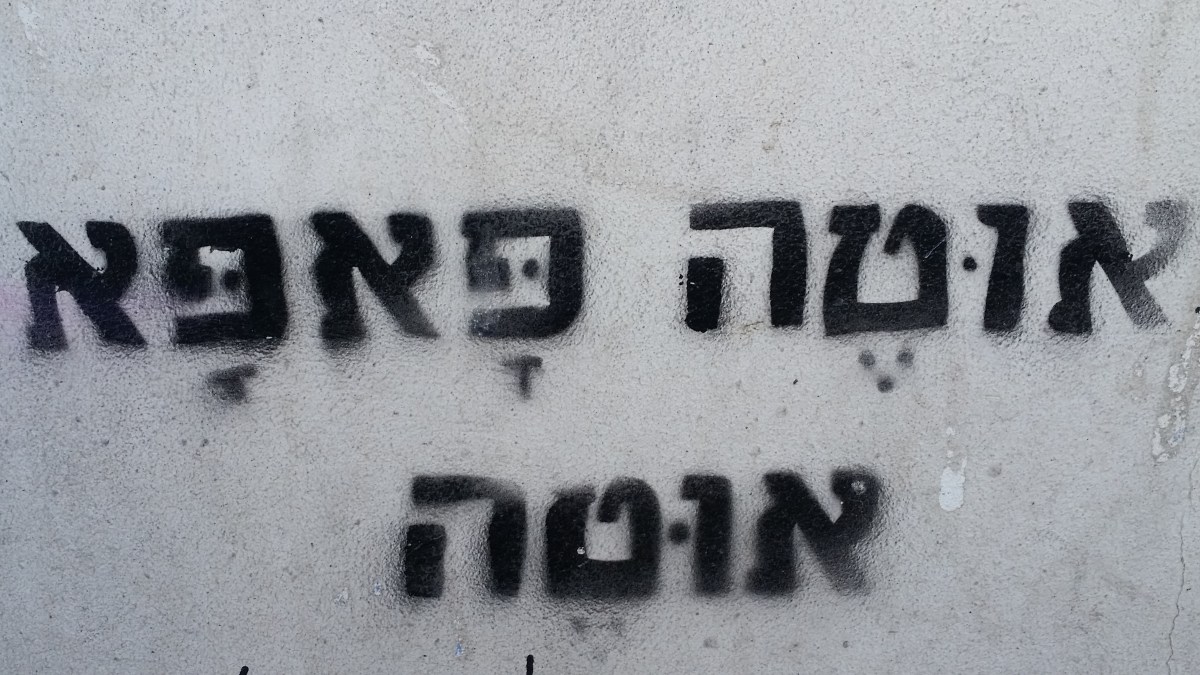
p.s.- my cover photo is a paper I used to teach a Swahili-speaking Tanzanian in Holon about Hebrew vowels…via Arabic because she’s an Arabic teacher.  Intercultural communication isn’t a hobby- it’s a lifestyle.  Open your eyes and join the miracle 🙂

Yiddish and Farsi: Kissing Cousins

About two years ago, I decided to take some Farsi lessons.  Having grown up with Persian friends and gone to their plethora of grocery stores and restaurants, I always had a curiosity for the culture.  I also frankly just think the language sounds musical and peaceful.

I found a private tutor but, for a variety of reasons, stopped after a couple months.  The language lay dormant in me (other than talking to lots of cab drivers and some friends).  I kept listening to the infectious music though.

Now that I’m in Israel, I pulled out the textbook I had bought in the States (anticipating I was continuing with the teacher).  I wanted to refresh the language- I have a lot of opportunities to speak it here.  There’s an entire market near my house where store after store is owned by Persians and I like chatting with them.

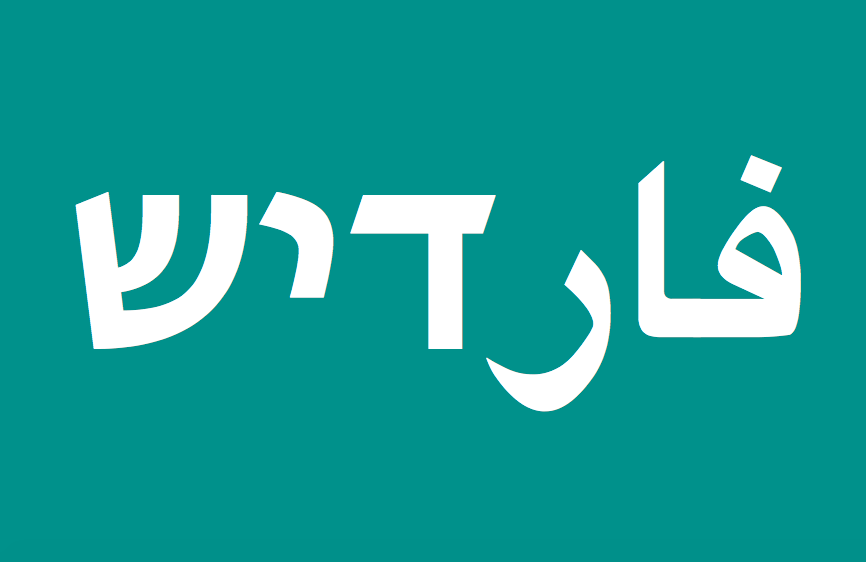
In my book, I came across something interesting.  The Farsi word for “homework” is “mashgh” spelled مشق.

To me, the root looked Arabic- and I was right.  A high percentage of Farsi words are of Arabic origin, which has helped me learn the language.  Although the language itself is categorized as Indo-European, meaning it is more closely related grammatically to German or English than to Arabic.  As an example, the word “isn’t” in Farsi is “nist”, eerily similar to the German (and Yiddish!) “nisht”.

Back to the word.  So I looked up words from the same root in Arabic and found مشقة.  “Mashaqqah” means “hardship”.  Hmm…this word sounded very familiar to me.

But you’ll be surprised to hear that the word it reminded of was in Yiddish.  “Máshke” משקה is the Yiddish word for drink, but more specifically often used for alcohol.  I know it because I once learned a Yiddish folksong about it!

Lo and behold, this Yiddish word comes from a Hebrew word.  “Mashkéh”, spelled the same way as the Yiddish word, more generally means beverage.  Its plural form even adorns the liquor store near my apartment.

Do all these words come from the same root?  I’m not actually entirely sure, though it seems so.  When words move from one language to the other, pronunciation can change and letters once essential in the original language may disappear.  For example, “Mashaqqah” has two “qafs” (q), whereas in Farsi, mashgh, does not.  I’m not sure why, but that’s how it is with many Arabic words as they migrate into other languages.

And so to from Hebrew to Yiddish (and in some cases back to Hebrew).  The Hebrew word “tachlith” תכלית migrated into Yiddish as “tachlis” (same spelling) and back into Modern Hebrew as “tachles” but spelled how you pronounce it in Yiddish תכל’ס.

So here’s what I find amazing.  First, that my learning of languages helped me explore this fascinating adventure.  Second, that I may have found a word (besides Shalom/Salaam) that in various forms appears in Yiddish, Hebrew, Arabic, and Farsi.  And third, that we are all are far more connected than you might think.

Because while many know Arabic and Hebrew are closely related (about 60% from the same roots), so too are Yiddish and Farsi.  Meaning there are two Jewish and two predominantly Muslim languages that are related!

How so?  First, both Yiddish and Farsi are unique- they are Indo-European languages with strong Semitic overlays.  For Yiddish, that means tons of words from Hebrew and Aramaic.  And for Farsi, that means Arabic influence.

For instance, the English word “is” is “hast” in Farsi and “iz” in Yiddish- all three of which are related.  None of which are close to the non-existent present tense “to be” in Arabic and Hebrew.

Not only that, but the ways in which Semitic words are incorporated into the languages are often identical.  For instance, when making compound verbs, the noun comes from the Semitic language and the verb comes from the Indo-European root to make a new verb.

For instance, in Yiddish “khasene hobn” חתונה האבן means “to get married”.  Khasene, pronounced in Modern Hebrew “chatunah” means wedding.  And it is paired with the Germanic element “hobn” meaning “to have”.  To have a wedding, there you go.

Now in Farsi, the same thing happens.  The verb “harf zadan” حرف زدن means “to speak”.  The first word, harf, is from the Arabic word for “letter”.  The second word, the verb of the verb, is the Persian word “to slap”.  To slap a letter?  To speak!  There you go.

Similar processes happen with regards to phonetics, to pronunciation.  Words from the Semitic languages often are pronounced differently in Yiddish and Farsi than how they’d be pronounced in Hebrew and Arabic- even when they’re written identically.  Shalom in Yiddish is sholem (or shulem) and salaam in Arabic is salam in Farsi.

Understanding how this process happens in Farsi later made it easier for me to learn Yiddish.  That’s right- Farsi helped me learn Yiddish.  And having the foundation in Hebrew and Arabic made it easier for me to learn both languages.

Bottom line?  While Farsi and Yiddish seem worlds apart, they are perhaps more closely related to each other in some ways than to other languages you might expect.  They share unique characteristics, and do so in style 🙂 .  While the world sees Iran and Israel as enemies and while in Israel, Mizrachim and Ashkenazim never miss an opportunity to demean each other’s cultures- the truth is we’re all related.

Don’t take my word for it- pick up a dictionary, find a teacher, and unlock the secrets that language has to teach you.  Even about yourself.

The Satmar part of town

I’d like to tell you a story about nothing.  It’s kind of refreshing in a place where shit is constantly hitting the fan (although much less than someone from abroad might think).  As I write this blog piece, an Israeli plane bombed some military facility in Syria and air raid sirens went off in southern Israel.  I heard some loud noise in my neighborhood and so I checked the news and found out about these events- I have no idea what the connection is but it can be scary here sometimes.

And then life continues.

So right, the other day I went to Bnei Brak.  At this point, we can say that Bnei Brak- and Hasidic Judaism– is a part of my identity.  I don’t just go as a “tourist”- I go because it’s part of my heritage and my people and it’s absolutely fascinating to see a living, breathing Yiddish community.

After eating delightful gefilte fish and kugel and buying loads of Hasidic music, I headed to the Satmar part of town.  The Satmar part of town?  Yes.  In Bnei Brak, each Hasidic group has a yeshiva where people study and it’s kind of their neighborhood.  In a small way, it’s a way of bringing back their former towns in Europe destroyed in the Holocaust.  Because the way you get around Bnei Brak is to say: “where is Vizhnitz?  Where is Belz?  Where is Satmar?”  These are all Hasidic groups- all named after the towns in Eastern Europe where they were founded.  And there’s an eerie and beautiful ring to being able to ask where they are- still- as if you’re heading to the village itself.

So why did I go to the Satmar part of town?  First of all, what is Satmar?  Satmar Hasidim are one of the largest Hasidic groups in the world, with members in multiple countries.  This still makes them a small minority of Jews, but they are influential and growing.  While most Hasidim are not Zionists, they are very much in favor of the Jewish people, love the Land of Israel, and have varying degrees of affinity for the Jewish state itself.

For instance, there are Haredi parties in the Knesset- the Israeli parliament.  These parties are dominated by Hasidim and participate in the lively (and often chaotic) Israeli political process.  Secular Israelis often bemoan these parties’ political influence and that their voters sometimes get government stipends to learn Torah.  I’m not interested in the politics here, just setting the stage.

On the contrary, Satmar are much more insistent on maintaining separation from the Israeli government.  To the surprise of some reading this blog, Satmar Hasidim do not accept any stipends from the Israeli government and do not even vote in national elections.  Say what you will about their politics, at least they’re consistent.  To those secular Israelis bemoaning Haredi “leeches” stealing our tax dollars- that simply doesn’t apply to Satmar.  You might wish they were Zionist, but they aren’t hypocrites.

Anyways, I don’t want to get sidetracked into messy political and ideological debates.  I’m clearly not a Satmar Hasid- I’m a queer Reform Jew- but I find the community interesting, especially since they are often a target for secular disdain.

One of the cool things about Satmar Hasidim is their love of Yiddish.  Most Hasidim in the U.S. both speak and read/write Yiddish.  I’ve discovered that most Hasidim in Israel speak Yiddish as a native tongue but write in “loshn koydesh”- or what we call Hebrew.  That in and of itself is a fascinating linguistic dichotomy worth a separate blog entry.

But Satmar, they speak and read and write and live and breathe Yiddish.  So, wanting some books in Yiddish, I headed to their part of town.  I found a bookstore (one of the cool things about Bnei Brak is the plethora of Jewish bookstores) and immediately noticed there were more Yiddish books than elsewhere in Bnei Brak.  I then asked the shop owner (in Yiddish) where I could buy a Yiddish newspaper.  Seeing I was wearing jeans and a sweatshirt, he knew I wasn’t Hasidic even though I wore a yarmulke.  So he told me I could talk to him in Hebrew.  But when I told him “ober ikh hob lib yiddish” – but I loooove Yiddish – he grinned from ear to ear. And told me to go to the grocery store around the corner.

At the grocery store, I talked to a bunch of people to get help finding a paper.  Because the new papers come in on Friday morning before shabbes, there weren’t any left.  Although there were some interesting looking magazines.  Because I’m a creative person and an Israeli, I then asked if they had last week’s papers.  And sure enough, there were some.  I got a copy of Der Blatt, a Satmar newspaper printed in the U.S. and read around the world.

The two guys behind the counter shmoozed with me.  It was so fun!  One of them, when I couldn’t find the word in Yiddish, would revert to Hebrew.  But the other guy- he was a real mensch.  He would answer me- in Yiddish.  THIS is how you know a language is strong.  When the speakers stick to their guns- either out of ideology or monolingualism- those are the people to talk to.  Because that’s ultimately how I learn best.

They were really impressed that I came to buy a Yiddish newspaper to practice the mamaloshn- the smiles, the kind words- they were real.  Before leaving, I thanked the guy who answered me in Yiddish, saying I appreciated him helping me learn.  He gave me a wink and I was on my way.

On my way out, I noticed a sign (in the cover photo): “Satmar Market: a homey supermarket”.  For my fellow linguists, there’s something interesting here.  While Satmar Hasidim stick to Yiddish out of a desire not to use Hebrew (the holy tongue for prayer), the sign is actually bilingual.  The words “market” and “supermarket” are written like you would in Hebrew and the other words in Yiddish spelling.  Guess things are a bit more complex than meets the eye.  I love it.

A few days later, I sat and started reading the paper.  And I noticed the most fascinating headline.  On the front page was an article about the Zimbabwean dictator Robert Mugabe being deposed.  Based on my own preconceptions about Satmar- their opposition to the Israeli government, their intense and strict Judaism, and their focus on study- I expected a bunch of articles about Torah.

20171205_020630

But lo and behold, in a residential neighborhood of Bnei Brak, people are reading in Yiddish about Zimbabwe.  And Saudi Arabia.  And tax reform.  And the Warsaw Ghetto.  Just in this week’s edition.

So what’s my story?  I have absolutely no story.  During a stressful week, I took a bus to Bnei Brak, ate delicious food, bought good music, and found an interesting newspaper in the language my ancestors spoke for 1,000 years.  I felt at ease, I hopped on a bus, and met a gay Reform friend for ice cream in Tel Aviv.

Want to live in a bubble where you know more about trekking in Cambodia than about your Hasidic neighbors?  Your loss.  There’s a fascinating civilization down the road begging to be discovered.  Begging for you to rediscover it inside you.

It’s not about agreeing on everything- or much at all.  It’s just about being a curious, open-minded human being and finding sparks of light to illuminate your path- wherever you might find them.

How to fall in love with a language

Hey everyone!  So I’m a polyglot- a multilingual guy.  I speak English, Spanish, Hebrew, Arabic, Portuguese, French, Catalan, Yiddish- all well enough to hold multi-hour conversations and I can read and write.  I’m not putzing around- I wrote my 50 page senior thesis in Spanish and have been interviewed on Catalan TV, and have similar examples for all my languages.  In addition, I speak intermediate Farsi which I’m refreshing here in Israel and have taken some initial courses in Basque, Hindi, Chinese, Japanese, Irish, and Greek.

I learn quickly.  Although I’ve taken some group classes, I much prefer private tutors (I also am one if you’re looking to learn!).  I can go at my pace, with my questions, and don’t have to slow down my learning.  To give you an idea, my entire coursework in Modern Hebrew consisted of about 150 hours of private lessons and two college classes (90 hours total).  So, all in all, I formally studied Hebrew for 240 hours and I never did ulpan.

Before making aliyah, I had only been to Israel twice- once on Birthright and a second time as a camp counselor for the Israeli Reform Movement.  I have no Israeli relatives and grew up in an English-speaking household- none of my relatives have ever even been to Israel.

And I speak the language fluently enough that the times where I don’t understand something, Sabras yell at me because they think I’m being obstinate.  They assume I’m one of them or have lived here for many years rather than five months.

So how did I learn the language?  And how did I learn my other languages?

I get this question a lot.  Sometimes, it’s frustrating to talk about.  I really just enjoy learning and using my languages without explaining myself or being asked to do party tricks like “how do you say ____ in _____?”  Sometimes this is even followed up with attempts to correct me- even when they barely (if at all) speak the language in question.  I once had an American Jew correct me on my “Palestinian Arabic”…only for me to tell him that I was speaking Syrian.   The point is I never wanted to participate in this game show in the first place.  I’m not here to entertain you- I’m a human being.

Then there are the real assholes who want to know why I’d learn a minority language like Catalan or Yiddish.  I think in this case it’s fair to say the issue is not with the language- it’s with the people who speak it.  And the people asking me this question don’t much care for them.  I’ve even had people tell me (after they ask me to list my 8 languages) that I need to broaden my horizons and learn Chinese or Russian.  Without even acknowledging the eight I speak- or that they only speak two.

Then there are the people who want to know why I’ve studied languages (a strange question- kind of like asking someone why they studied the violin).  I usually just say because I love them and because they enrich my life.  But for some people, that’s not an acceptable answer.  They want to know why I don’t work for the CIA or FBI or army or somewhere else they wish I worked.

All of us have talents- one of mine is languages.  But let’s just try to respect each other’s gifts rather than finding a way to “take people down a notch” or tell them how to live their lives.  It makes you look small, not me.

So here’s the truth: I love languages because they make me happy.  As my Catalan teacher once told me: “cada llengua és una riquesa” – every language is a source of richness.  When I learn a new language, I embrace new music, food, culture, history, sociology, and- perhaps most importantly- friends.  I also learn about myself and my identity.  I can’t tell you how much richer my Judaism is because I can read about it in French and Spanish and Arabic and Yiddish etc etc.  And I can learn from the experiences of other minority communities like Catalans and Quebecois.

I overcome my own (and other people’s) prejudices and I add a whole new dimension to my identity.  When you speak to someone in their language, their heart opens up.  It’s a completely different experience.  So again, fellow Jewish Israelis, stop resting on your (Hebrew) laurels and learn Arabic and you’ll see that your relationship with your Arab neighbors will change.  For the better.  It’s respect, it’s honor, it’s love, it’s kindness- it’s great.

So here’s the real key to learning languages: fall in love with them.  When you love something, you do it all the time.  Every chance I get to speak any of my languages- I take it.  Could be my Bedouin cab driver, a French Jewish tourist, Israeli friends back in the U.S., my Syrian Jewish neighbors, the Christian Arab photographer I met up north, a bunch of Latino Jews I met at a pub- you name it.  I love love love my languages so when I’m not in a classroom, I’m finding tons of ways to practice- while smiling and having a good time and always learning.

The best way to be great at something is to enjoy it.  Personally, I’m not a big fan of gyms.  So I don’t really go now.  But I love to dance- and it’s also great healthy movement.  So I do more of it and soon enough, you find yourself in a positive feedback loop and taking care of your body.  That’s how I feel with language- the more I speak, the better I get, the more fun I have, the more I want to learn.

Do I “have an ear for language”?  Probably- when I’m really “in the zone” speaking Arabic up north, Arabs ask me if I’m Lebanese or Syrian.  And I only took six semesters of Arabic.  BUT.  But speaking a language is not just some innate gene.  Just like a musician, even if they have a “knack” for music, must study and practice, so too must someone learning a language.  It’s just that I happen to like learning and practicing so it has become an essential part of my life- thank God!

So long story short- you want to learn a new language?  You want to explore new cultures and really connect with people as equals?  Awesome!  Find the things that attract you to that language and learn.  Pick up a history book (even in your own language).  Scroll through music on Youtube- even if you don’t understand.  Find something that animates you and run with it.

And seriously- stop asking me if you can learn a language on DuoLingo, it is an app not a teacher.  I suppose if you want to learn some new vocabulary words to supplement your study it could be helpful, but otherwise stop kidding yourself.  If you don’t think you can learn to play the cello on a free mobile app, then the same goes for languages.  DuoLingo is a tool- not a human being.  Human beings speak languages and if people aren’t somehow a part of your language learning, then you won’t learn.  You’ll make mistakes (as I have- and continue to do and laugh at and learn from).  The point is not to get everything “perfect”- the point is to communicate!

As Pablo Neruda said: “Conocer el amor de los que amamos es el fuego que alimenta la vida.”  To know the love of those we love is the fire that fuels life.

Love your language.  Love the people that speak it.  And let them love you.  And soon enough, you’ll find yourself like I did- speaking Catalan, Spanish, English, and Hebrew to a Russian Israeli Jew.  In a cafe at Orthodox college.  Aren’t you curious? 🙂