The wonderful melancholy of Portugal

Portugal, for those who have never visited, is an awesome place.  But don’t hype it too much or you’ll sound like you don’t get the vibe.

One of the interesting things about Portugal, something I connect with, is the deep friendliness paired with an honest relationship with hardship.  Fado, the traditional music of this country, is exactly that.  Unlike the vibrant Flamenco of its Spanish neighbors, Fado is a slowly melding pot.  It doesn’t force you to separate the happy from the sad, it lets you feel where the two intersect.  And none of this prevents Portuguese people from smiling, giving you directions, and making conversation with you.  They kind of remind me of me.  To be “happy” is not to be joyous all the time.  It’s to treat others with kindness and warmth and compassion- and also to protect yourself and realize the pain too.  Rather than hiding it or gritting your teeth and smiling, pretending it’s not there.

While for me personally, I find a lot of Lisbon’s tourist attractions crowded and kind of dirty, other parts of the country (and even the city) are magical.  Just take a look:

Portugal is a land that has known both great sorrow and joy.  It was once home to one of the largest empires in the world.  Despite Romance language learners gravitating towards Spanish and French, Portuguese has 260 million speakers on four continents.  With a sound that just makes my ears feel at ease.  It’s kind of a sexy tongue.

It’s one that I learned in a semester in undergrad in a course “Portuguese for Spanish speakers”.  And this is my first time getting to speak it in a Lusophone country.  That’s the cool word for “Portuguese-speaking”.  What’s interesting is that although I learned Brazilian Portuguese and there are differences between the two dialects, I actually sometimes find myself understanding people here even better.  The pronunciation is a bit more similar to the Castilian Spanish I learned first.  And interestingly enough, it shares both grammatical features and phonology with Catalan.  For example, while some Spanish verbs have stem changes, i.e. dormir becomes duermo, in Catalan it’s dormo and in Portuguese it is also dormo.  In fact, in both Catalan and Portuguese the final “o” becomes a “u” sound.  And what’s more, in the continental variety of Portuguese, the “l” carries a particular weight to it that sounds kind of like Russian…or Catalan!  Geographic distance is not the only factor in linguistic similarity, and Portuguese and Catalan are proof of this, despite sharing no borders.

Portugal has known good and bad, both in its imperial endeavors as well as its domestic politics.  While I am far from an expert on Portuguese history (I really didn’t come here to be sad, there’s enough of that in the Middle East), I do know they had a modern dictatorship.  And much prior to that, they had the violence of the Inquisition.

After having enjoyed some of the delicious pastries, the nature, and some art, I decided to wander through some local neighborhoods to an archive.  I love archives- I’ve written about this before.  I’ve visited them in Girona, Salerno, and Tortosa.  They are always a source of inspiration and an opportunity to hold history in your hands, to connect physically to the past.  And they’re always free.

There’s not a lot of visible Jewish sites left in Lisbon.  There are some elsewhere in the country, but kind of far for a relatively short trip, so I’m not sure how much I’ll be able to see.  I tried wandering the Alfama, the former Jewish quarter, and while there are apparently walking tours, there’s not a lot of Jewish things left to see.  Although you will notice the sign for the Jewish museum being constructed, apparently against the wishes of some neighbors.  Who are slowing down the process and whose motives aren’t entirely clear.  Some suspect anti-Semitism.  I am not an expert on Portuguese architecture, but the claim that the museum will disrupt the neighborhood vibe seems specious at first glance.  The neighborhood is dirty and a new building could probably do them some good.  Here’s the construction sign:

20181218_180937

In the Alfama, I asked a shop keeper for any advice about Jewish sites.  And to my great pleasure, he was kind enough to tell me his friend runs tours.  And he looked visibly pleased to be speaking with a Jew.  He was proud to tell me his friends visited Tel Aviv recently and loved it.  And irrespective of my own feelings about Tel Aviv (it’s not my favorite place in Israel), what was awesome is that he clearly liked Jews.  And I showed my warmth in kind.  He also said I spoke really good Portuguese 🙂

I’m an out-of-the-closet Jew and so while it doesn’t come up in every conversation I have (and sometimes I purposely say I’m American to avoid prejudice), it comes up often.  Naturally.  So I tend to get a good feel for the attitude of a culture towards Jews pretty easily.  And what I can say is that at least up until now, I haven’t felt any noticeable animosity.  While that might sound understated, it’s actually incredibly positive for today’s Europe.  A place where anti-Semitism is spreading like wildfire and a third of people don’t know what the Holocaust is.  What’s so interesting about Portugal, then, is how little of this animosity I feel.  Something reflected in the fact that polls show it having relatively low levels of anti-Semitism, despite the global trends in the opposite direction.  Even its next door neighbor Spain was rated the society with the highest levels of anti-Semitism in all of Europe.

When I visited the public library in Sintra, a city outside Lisbon, I asked about what Jewish books they had.  While it’s not a scientific study, it’s often instructive to see if local libraries have books on X or Y topics as a sense of their communal importance.  And it’s just as interesting to see what books they are and how they’re categorized.

In the case of Sintra, the librarian patiently wrote down the information of several books.  While at first, I had been disappointed at the two lonely Jewish books smushed between tons about Christianity and Islam in the religion section, I soon learned something else was at work.

In the Sintra public library, most Jewish books were found alongside (or within) books about Portuguese history.  The National Library in Budapest told me they didn’t have books about Jews because, “we only have books about Hungarians here”.  But the Sintra public library had Jewish knowledge integrated into their sections about Portugal itself.  A kind of anecdotal example that has so far paralleled my experience in both countries.  I found Hungary quite anti-Semitic and xenophobic.  And here, not as much.  Even though in both countries, Jews have played an outsize role in their history.  Well, in Portuguese history.  Because apparently in Hungary, Jews aren’t Hungarian.

So today, feeling an itch to look at some old documents and see if I could find some Jewish ruins, in the metaphorical sense, I headed to an archive.

At the archive, I managed to find archivists’ notes on the Inquisition.  According to the staff member, these notes were pretty old- and they were what the archivists saw in original Inquisition documents.  Everything was beautifully handwritten, even if the contents themselves were saddening.  A kind of writing Portuguese were made for.

For those who don’t know much about the Inquisition, when the Catholic kings conquered the Iberian peninsula from the Moors, they sought to unify disparate lands and consolidate power.  While initially they had tolerated and even co-existed with the Jewish communities- some of which dated back to Roman times- this changed.  In 1492, the Spanish conquered the last Moorish outpost and Catholicism was made the only state religion.  Jews who had lived on this land for thousands of years were forced to flee their homes, and many did- to Turkey, Morocco, Greece, Serbia, and elsewhere.  Leading to today’s Sephardic Jews.  Some of whom still speak Judeo-Spanish.  I even have a friend who teaches it in America- so if you find yourself at Binghamton, look up Prof. Kirschen.

The remaining Jews were tortured into converting to Catholicism.  Those who didn’t, were murdered, sometimes en masse.  And others converted to Catholicism, sometimes secretly practicing their ancient faith.

Spain imposed the Inquisition first, leading many of its remaining Jews to flee to Portugal.  Where unfortunately, a few years later, the country followed in Spain’s footsteps.

With brutal consequences I saw first hand today.

I found 5 shelves full of beautifully bound books.  I peered closer and found they were Inquisition records from the city of Évora.  The shelves contained no less than 113 separate volumes.  From a city that today has 56,000 people in a country of 10.3 million.  So it hardly represents the entirety of the Inquisition.  I’m not even sure it represents all of this records from this one city.

I opened one up.

WhatsApp Image 2018-12-20 at 9.26.15 PM

I couldn’t have imagined me using my Portuguese to read Inquisition documents when I learned it back in St. Louis, but this is how I roll.  And it’s always eye opening and fulfilling to see things first hand.

It didn’t take long to find the first person accused of the “crime of Judaism”.  That’s a direct quote.  For today’s anti-Semites like Linda Sarsour who claim hatred of Jews “isn’t systemic”, all they have to do is go to a library to realize they’re wrong.  It’s absurd to have to even say that.  The Inquisition documents were so brutally detailed and organized they seemed no different than the Nazis years later.  Perhaps even an inspiration.

The stories were heartbreaking.  I felt my emotions rising, unhindered by my American stiff upper lip nor my Israeli “who gives a shit”.  It was my inner Portuguese saudade mixed with a lot of sadness.  I felt connected to these people from ages ago, I wallowed in their pain, I held my hand to the text as I lifted their message into my life today.

The first condemned Jew I met was Alfonso Álvares.  He was 55 years old from Évora, the son of Lourenço and Constança.  Married to Inés de Miranda.  His crime: “judaísmo”.  He was arrested on November 12, 1654.  A full 118 after the arrival of this torturous regime to Portugal.  162 years after it’s initiation in Spain, where some of the Jews fled from.  The Inquisition was not a one year event- it lasted centuries to expunge the Jewishness from the entire peninsula- and its colonies in America.

What was Alfonso’s punishment for being a Jew?  He was imprisoned, all of his property was confiscated, and he was burned as a heretic 10 days later.  I wonder if this qualifies for Ms. Sarsour’s definition of “systemic”.  It only involved the state, the Catholic church, the prison system, and the organized confiscation of property.  You know, totally spontaneous.

Page after page was filled with people burned alive, imprisoned, and tortured for the “crime of Judaism”.

There was even a man, oddly enough, who wasn’t persecuted for being Jewish, but rather for making a “silver Jesus with the face of John, the Negro”.  A weird story that the archivist on staff didn’t even understand.  But clearly an example of how persecution of Jews is often the precursor to even more acts of hatred.  As senseless as the ones that started it.WhatsApp Image 2018-12-20 at 9.26.17 PM(1)

Then there was Branca Alvares, a Jew arrested on January 21, 1586, burned alive August 2, 1587.  In the intervening time, sentenced to prison, stripped of her clothes and her dignity.  A martyr for our faith, a defender of our right to be who we are.  I never met you, Branca, but I admire your bravery in the face of stupid hatred.  Our people persist because of people who resist, like you.  May your memory and those of all our people burned at the stake be for a blessing.  I dedicate this blog to you.  I hope that my work in the world does honor to your courage.

It’s worth noting here that many of the victims had their property confiscated by the Church, acting in concert with the state.  A common theme in Jewish migrations (and expulsions) is that we are often invited to countries for our trade networks and knowledge.  And subsequently expelled when the state decides it needs our property.  Portugal and Spain are no exception- their imperialism in the Americas was funded by persecuting Jews and stealing their money.  Which is why the Inquisition couldn’t end even with the conversion of the remaining Jews.  Denunciations of New Christians, or “conversos”, continued for centuries, allowing the state to intimidate people into conformity and compliance.  And simultaneously, rob Jews of their money to finance conquest around the world.

This aspect of anti-Semitism is one that confounds liberals to this day.  An overly simplistic understanding of rich=abuser, poor=victim does not help them understand the nature of anti-Semitism, which doesn’t fit this model.  Jews historically have been placed in the position of middle men.  Almost never in the history of Western civilization have we been allowed to lead a nation, but we are often invited to partake in slightly lesser but well remunerated jobs like lawyers, doctors, or in olden times, court advisors.  But never the king himself.  Which is why today in America, you have a strong representation of Jews in Congress, in entertainment, and in any number of prestigious professions.  Yet never has there been a Jewish president- nor do I think there will be.  Western civilization has not reckoned with anti-Semitism yet, and until it does, we will not be allowed at the top.

What are the implications?  Jews are stereotyped as rich.  I’ve heard this trope from Brazilians, Argentinians, Belgians, and even people I went to high school with.  Part of the reason for that is rulers could put certain Jews in these kind of prominent positions and divert the disgruntled populace’s anger towards them.  Rather than the ruler himself.  All the while, maintaining Jews’ inferiority by denying them access to the top of the system.  Often reinforced by discriminatory clothing, restricted living quarters, brutal violence, and more.  Christmas was traditionally a time to persecute Jews.

It’s a lesson progressives today need to learn if they want to understand the nature of anti-Semitism, because it operates in a different fashion from racism.  But with no less destructive results, as we’ve seen lately in Pittsburgh, across Europe, and elsewhere.

In other words, while some Jews are poor, the success of other Jews economically is used by rulers to eventually rally the populace to execute their genocide and expulsion.  Giving the ruler access to Jewish capital to finance his latest endeavor, and of course never actually helping the angry pitchfork-bearers themselves.

What’s curious about Portugal is the Jews are back.  In fact, while I’m not sure exactly why, Jews were back here sooner than in Spain.  Already in the early 1800s, after a thorough cleansing of anything Jewish here, Jews were allowed to return to the land they once called home.  It’s a brave and risky act I can’t even imagine.  You can still find today in Lisbon Shaare Tikva, a synagogue built by these returning Portuguese Jews.  In a twist of history few would have expected when Branca and Alfonso were being burned at the stake for the crime of Judaism.

I’m not sure what brought them back.  It’s a crazy thought- how could you trust the Portuguese people after all that hurt?  Maybe Portugal wanted Jewish capital again.  After all, today with its economy facing issues, it’s inviting descendants of expelled Jews to re-apply for citizenship.  An Orwellian, if perhaps well-intentioned, process.  In which Jews are having to collect documents 500 years later to get citizenship to a country their ancestors were expelled from.  An odd and uniquely Jewish scenario, but one that is leading quite a number of people to apply.  I hope the law is applied fairly and liberally if it is truly meant to make recompense for the past.  And that if the country wants us back this time, I hope it ends better today.

What’s truly amazing about the whole thing is how normal Portugal is today.

I’ve visited a lot of countries in Europe over time.  Slovenia, Belgium, Luxembourg, Cyprus, Switzerland, Italy (twice), Hungary (twice), France (twice), Spain (four times), Romania (three times).  And now Portugal.

And what I can say is, as of today, I can’t think of a single country where I’ve felt more at ease as a Jew.  Italy comes close.  Perhaps their Mediterranean cultures, where my DNA and my gentle curls flowing over my olive skin help me feel at home among my distant cousins.  Indeed, a third of Portuguese are estimated to have Jewish blood, in addition to us being from the same part of the world.  It’s certainly more comfortable than the sometimes awkward stares I’d get in pastier countries like Romania or Switzerland, where a border guard thought I was an illegal Mexican immigrant because I spoke Spanish.

But there’s a little extra something here too.  The Portuguese, perhaps having slogged through the Inquisition, imperialism, and a dictatorship, have found a way to let their sadness mingle with their joy.  To let their emotions become a part of who they are, rather than something to suppress.

So that when these barriers eventually fell, Portuguese often found themselves researching their own Jewish history.  In fact, the town of Belmonte is full of Portuguese with Jewish roots- who have re-embraced their faith and built a synagogue.

There is ignorance everywhere, and Portugal is no exception.  Sometimes curiosity about us is naïvely, though sometimes innocently, mentioned in the same breath as masons or the capitalist system.  Like we’re some sort of curious phenomenon worth exploring or perhaps an exoticism.  A less textured way to see us.  But honestly I don’t know enough about it to fully understand.  All I can say is that even the ignorant comments here have stung less than in other places and so far seem to be said with less malice.

Yet Portugal is one of the few European countries that I feel is headed in the right direction with regards to its Jewish past- and present.  And hopefully future.  While supposedly enlightened nations like France and Germany and Sweden experience an ever-increasing amount of anti-Semitism, Portugal is not joining the crowd.

Hanging out in the far west of Europe gazing towards America, Portugal is doing what it has always done.  Mixing its pain with its joy.  Creating that unique blend where it doesn’t need to deny its faults, nor deny itself pleasure.  Here, you can’t isolate one from the other.  It’s a psychologically healthy phenomenon that perhaps explains why this country, even with hundreds of years of anti-Semitic persecutions, is able to reconcile this with welcoming Jews back.  Much better so than their Spanish neighbors next door.

So as I dedicate this post to all the brave Jews here who persisted and resisted in the face of anti-Semitic hatred, to their descendants living out their Judaism- or returning to it- I’d like to offer a hope.

Portugal is evidence of the wily and often surprising twists of history.  The proverbial arc that bends towards justice is a messianic lie that is put to rest by the rollercoaster that is the Portuguese Jewish experience.  An experience filled with pain and with surprising hope.  Could a Portuguese Jew 400 years ago have ever imagined me reading his death sentence in an archive- alive?  The inspiring quirks of history are as noteworthy as the failures.

So as I watch the world spin in unexpected and sometimes scary directions, hope accompanies my fear.

A hope that Europe becomes more like the Portugal of today than the Portugal of four centuries ago.

A picture is worth a thousand words

I love to write.  As all of you who follow my blog know.  I often share pictures in the middle of my posts, but usually the focus is on my words and my stories.  One of the things I enjoy most on my travels is finding unexpected views.  I love taking pictures.  Of gorgeous sunsets, of nature, of landscapes.  Of funny street signs, museum paintings, street art, products in different languages.  Of people and places that make me go “wow” or think about the place I’m in a bit differently.

So before I end up writing another word-based blog post, I’d like to share some of my favorite photos.  I hope they make you “ooh” and “wow” and “huh?” as much they as they did for me.  I’ll occasionally add some backstory or captions, and sometimes will let them stand on their own.  I hope you enjoy!

20181219_162617

This picture is from Colares, Portugal.  A town you’ve probably never been to- but should if you want to get to…

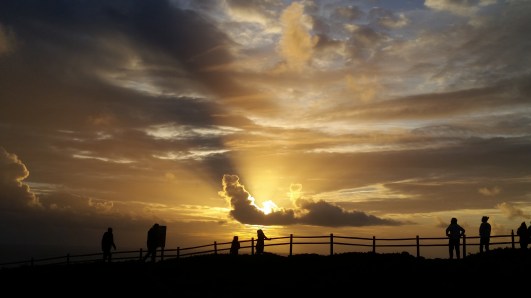
20181219_170244

Cabo de Roca, Portugal.  And one of the most beautiful sunsets I’ve ever seen.

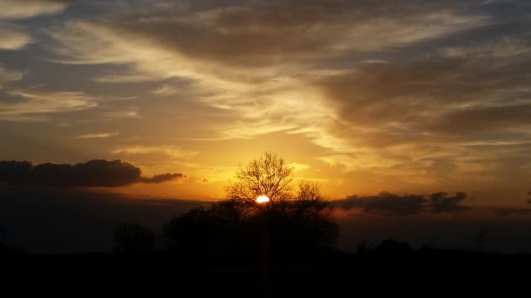
Speaking of sunsets, one of my favorite is from Stroumpi, Cyprus, where I spontaneously decided to climb a mountain.  With nothing but my jeans, sneakers, some water, and a boatload of motivation.  I took these pictures from the very top, watching the sky illuminate as I waited for my bus back home:

26165603_10101646978872962_6757401931522007275_n

This picture doesn’t even come close to doing this sunset justice.  And if I’m honest, Cyprus is filled with gorgeous sunsets.  Like this one in Polis:

25994770_10101645987878922_3082874506983697163_n

I took this picture while walking along the side of a road (with no sidewalk) for about an hour and a half to get back to the bus stop.  And I just had to pause for a moment (while making sure no cars would hit me) and soak in this view.  To me, it looks like the sky is a giant glob of cotton candy.

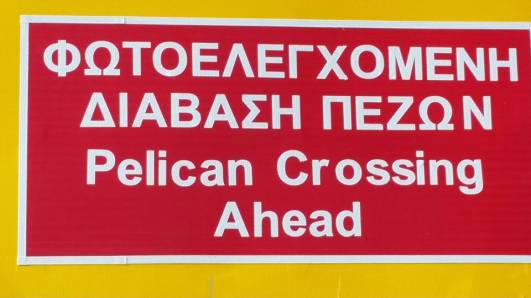
Cyprus, like many other countries, has some funny signs.  This is one of the cutest warning signs I’ve ever seen:

26046978_10101645988387902_3553760977977644203_n

There can’t be a cuter hazard than a crossing pelican.  I’ve dreamed of visiting Greece since I fell in love with My Big Fat Greek Wedding as a kid.  I’ve watched the movie at least 15 or 20 times.  Which is why this street sign in Paphos cracked me up:

26112160_10101645989336002_1891651019850474025_n

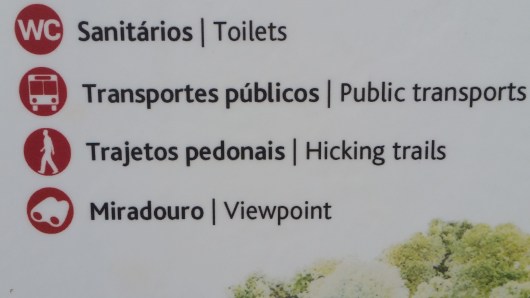
But Cyprus is not the only country with funny signs.  I learned Portuguese for a semester in college and I’m now having my first chance to visit a country that speaks it- Portugal!  I’ve long listened to the sounds of Fado music and devoured the beautiful sounds of the language itself.  Personally, I think it’s one of the world’s sexiest.

I found myself reading a sign in a park that said: “trajetos pedonais”.  Which was unfortunately translated as:

20181219_154905.jpg

Who knew the Portuguese could be so country?

Now I try to not to make fun of other country’s English.  After all, at least they’re bothering to speak my language.  Less than half as many Americans as Europeans are bilingual.  Although we’re not the only ones who expect everything as we like it.  I met a British tourist in southern Spain who was astonished at the low level of English.  It would be astonishing if not for the fact that you were in another country…

Now sometimes I do get a little chuckle.  Usually no one around me knows why I’m laughing.  But I found this restaurant in Italy and had to take a picture:

1529497191229.jpg

Italians are an amorous folk.  But who knows what you’ll get on your pizza here…

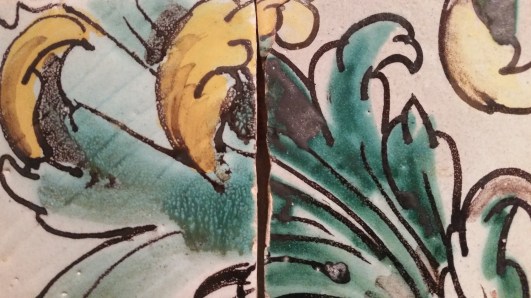
Before I get all hot and heavy, I’ll move to a more cultured topic: art.  My favorite color ever since I was a kid was teal.  So it was to my great pleasure that I discovered a Portuguese art form called “azulejo”, which comes from the word azul, meaning blue.  Based on Moorish forms, the tiles are ornately patterned and gorgeous.  And frequently, accompanied by streaks of teal.  It was like an entire museum dedicated to my favorite color.  Here are some pics:

20181218_164717

20181218_170023

20181218_164213

As frantic tour groups rush by, I often find myself lurking in a room alone.  Staring at the mesmerizing patterns, feeling a sense of calm.  There are few things better than a quiet space with something inspiring to look at.

Which is why I often find myself at libraries and archives.  One day, when I have the money, a benefactor, or a university to donate to, I will collect my books together and start a library.  Books are the physical possession most valuable to me- they are the only thing I ship when I move.

So when I discovered you could go to city archives in Europe and after filling out a one page form, touch 1000 year old documents, I said “yes please!”  One of the first archives I visited was in Girona, Spain/Catalonia.  I simply walked in, said I wanted to see stuff, and they set me up.  Other than the two archivists, I don’t think a single other person was there that day.  I had the whole place to myself.

I ended up reading Judeo-Catalan documents like this one from the 1200s.  I even helped the archivists fix the digital imaging of the documents, which had them upside-down.  But once I found the digital images I wanted, I got to sit down with the originals.  To put my finger on history itself:

28950868_10101714342695322_8195280813907166034_n

I’ve learned that while people pay a lot of money and wait a long time to enter super-crowded museums, you can simply walk into the city archives and have thousands of years of history to yourself.  You don’t need a press pass or a reason- just go and say you want to learn about a certain topic.  It’s worth it 🙂

I have a lot more stories to tell, but it’s getting late here in Lisbon.  So before I share some gratuitously beautiful images (and some funny ones), I want to share a message.  I live off the beaten path.  I’ve dreamed of going to the places I’ve visited the past year and a half all my life.  I downloaded my first Romanian manele music 11 years ago.  My first Portuguese song 13 years ago.  My first Mizrachi song 19 years ago.

I don’t know what’s next.  I have a lot of challenges on the horizon and I’m not sure how I will carve my path forward.

What I do know is I can look myself in the mirror and say I’ve lived my dreams.  I’ve danced dabke with Druze kids, I’ve visited my ancestral homeland of Romania, I’ve seen the largest synagogue in Europe, I’ve met Roma, I’ve hiked through rural Italy- and learned enough Italian to speak for a few hours with a guy at a pizza place in Salerno.

None of this was handed to me on a silver platter.  I’ve spent the past year and a half healing from years of physical, emotional, and sexual abuse.  And travel, exploration, language, culture, and trying new things has been a part of that healing process.  And I’ve realized that I am capable of so much.  That once these barriers that held me back begin to crumble, I am capable of even more than I’ve done so far.  And I have done a lot already.

I discovered how much I love to travel, to explore cultures, to spend time by myself, to reach out to new people I’ve never met before, to find the quiet types, to bask in nature, to learn new languages by visiting new countries, to rely on my English when I need to show I’m a foreigner and want a break from learning, to feel grateful when I see the tombs of my people across Europe, to feel inspired when I see Jews and Arabs who live outside society’s expectations.

In short, as much as I’ve gotten to know the societies around me, I’ve gotten to know myself.  To realize certain things have been and will probably always be a part of who I am.  And some things kind of shifted.  I got a new lens that allowed for increasing nuance, expression of feeling, and an openness that allowed me to make some important decisions.  And sometimes, to change them.

May your journey bring you awareness, comfort, and growth.  Mine continues to evolve.  And I hope that even if the next step in my journey is to spend most of the day in an office, that I still find time to adventure and wander and explore and find the unexpected to open me to new ways of thinking.  And I have a feeling that even if I end up a little more geographically “put” to tend to my bank account, I’ll be meandering again soon.  To Thailand, to Vietnam, to Australia, to Jordan, to Tunisia, to Eilat (I still haven’t made it there), to the Jordan Valley, to Lithuania, maybe even Ethiopia.  And probably places I haven’t thought of yet- which is the magic of being willing to change course when the moment seems opportune.

And Lord knows, I have enough stories from the past year and a half, including many I haven’t told you yet, to last a lifetime.  I tried to make this post about the pictures, but ended up telling a story in any case!  Because stories are what I do and an open mind is always ready to adventure.

Pack your bags…

How to learn a language

One of the many questions I get asked is “how did you learn so many languages?”  I speak native English; fluent Hebrew, Spanish, Arabic, French, and Catalan; proficient Portuguese, Yiddish, and Italian.  And I’ve also studied, to varying degrees, Persian, Basque, Mandarin Chinese, Japanese, Irish, Hindi, and Welsh.

This question is an important one, but one I often find I don’t have the time to answer adequately at a party on a Friday night.  Learning so many languages takes time, effort, and passion.  And whatever answer I could give in 30 seconds won’t suffice to actually help you learn a language.

Which is why I’m offering a virtual course: “How to learn a language”.  In addition to learning all these languages (and more to come, I’m sure!), I have also been teaching them for over 15 years.  As a private tutor and as a classroom teacher.  I know how to learn a language in part because I didn’t grow up with any of these languages.  I had to learn them, which means I know some tricks that can help you learn.  This is why I’ve been an effective tutor for all ages- from the 6 year old son of a Congressman to a 65 year old man taking Spanish at my university.

This new course will teach you the secret to learning any language.  So even if your target is Korean and I don’t teach it, I will help you discover how to learn it.  And any other language you want afterwards.  It’s a lifelong investment with a return so awesome you can’t put a price tag on it.

The class will take place over Skype once a week for an hour over the course of eight weeks.  We will talk as a group about our shared hopes and goals and I will teach you the skills you need to move forward.  I will follow up with each individual student to help create a customized learning plan.  So that by the end of the course, you haven’t just learned how to learn a language, you’ll come away with a concrete road map for what to do next.  So you can start bargaining in the shuk in Hebrew, jamming to Arabic pop songs, or traveling to Latin America.

Here are the details:

Start date depends on enrollment, but aiming for February 3** (revised from original post)

Sundays 1pm-2pm ET/8pm-9pm Israel Time (we’ll do a group poll to finalize scheduling and if need be, I may open alternate sessions)

You will learn how:

-to pick a language and set realistic goals

-to choose learning methods

-to build a psychological connection

-to find time to practice

-to build confidence and get over the fear of making mistakes

-to approach native speakers (and not be embarrassed!)

You’ll leave with your own customized learning plan so none of this stays theoretical, and you can start speaking!

Cost: $229

Payment accepted via PayPal (ask me for account info) or my GoFundMe.

Stop fiddling on DuoLingo or spending hours upon hours frustrated, afraid to talk to that cute waiter in Portuguese.  Or wishing you could work abroad in France.  Learn how to learn a language, and have a lifetime of culture, of business opportunities, and adventure at your fingertips.

Because nothing sounds as good in translation.  Just ask the Catalans who watched me talking about Judaism in their language– after just one semester of learning it in America.  Or the thousands of people who’ve heard me in Yiddish, in Hebrew, in Arabic, or in Spanish.

Are you ready to learn my tricks of the trade and get speaking?  Join me!

The Primary Axis is Empathy

Ok so one of the most confusing aspects of living here, perhaps of life itself, is understanding the context for what people say.  And what it reveals about their intentions.

Most of our public discourse is focused on quotes- and not just here in Israel.  “Gotcha” moments dominate our news cycles and rarely do we consider the surrounding environment.  Critical thinking is not a skill valued by the news media these days- nor by many of its consumers.

So rather than talking public policy or the latest headlines, I’d like to delve into a less-discussed aspect of the conflict here- and its implications for politics everywhere: the axis of empathy.

For most people, the Arab-Israeli/Palestinian-Israeli conflict is broken down into pro-Arab/Palestinian and pro-Israel.  To be one is not to be the other- or at least a lot less.

What I’ve come to realize, both through living here, through spending lots of time in Arab villages in Israel and meeting Palestinians, is that this breakdown is a distraction from the real conflict.

It’s not meaningless, but it obscures the most important dividing line.

When I’m abroad- Europe, America- my primary orientation is to be wary of hardcore pro-Palestinian activists and to feel more empathy for Israel.  For two reasons.  One is that generally speaking, if someone is pro-Palestinian and anti-Israel outside of this land, they are an anti-Semite.  And if someone is pro-Israel and pro-Jewish outside of Israel, they are empathetic towards Jews.  And generally, though not always, empathetic in general.  The exception to this rule would be people who are pro-Israel and anti-Jewish or pro-Israel and extremely anti-Arab, to the point of being an extremist.  There are people who are pro-Israel and anti-Jewish- Hungarian Prime Minister Viktor Orban would be a prime example of one.  And there are certainly people who are pro-Israel and hate all Arabs- I met a Dutch guy on CouchSurfing who liked Israel (and gay rights, interestingly enough) because he hated Arab immigrants.  But when it came down to it, he was actually kind of homophobic.  The flowery gay rights rhetoric was merely a convenient tool to oppose (indeed, sometimes homophobic) Arab immigrants in his own country.  Not out of genuine concern.

What is important to note is that this dynamic flips on its head while living here.  In Israel, the least empathetic Jews are unquestioningly pro-Israel and anti-Arab.  And I have more empathy for Arabs here who oppose Israeli government policy than the Algerian man I met in Spain who claimed Israel and America started the Syrian civil war.  And claimed Russia and Iran hadn’t killed anyone.

In other words, the very same sentence in two different contexts can mean two completely different things.  Making identifying toxic people a challenge for someone like me who straddles multiple cultures- often in the same day.

For example, I’ve met Americans and Europeans visiting Israel who only want to visit Palestinian areas and show no interest in Israeli history and narratives.  I once met a German exchange student at Tel Aviv University who came to dance dabke with Arab students- and me.  While I was there out of empathy and a desire to learn more about my neighbors, he was there because he hates Israel and Jews.  But I didn’t catch this at first, which ended up really hurting me.  I figured that because we’re both in the same place and we both have empathy for Arabs, therefore we must both be empathetic people.  The problem is that when we sat in a cafe after dancing, he asked me: “why do Israelis talk so much about the Holocaust?  It’s old history.”  When I tried to explain that in the same city he was sitting, there were actual Holocaust survivors, his response was to defer: “but that happened so long ago”.  In his country.

So here’s the rub.  We’re going to the same event.  We would both probably agree with the sentence: “I’m concerned about the human rights of the Palestinian people”.  But I’m doing it as an Israeli concerned about my neighbors’ well being.  And he’s doing it because he doesn’t like Jews.  My words are out of empathy, and his out of antipathy.

The same can go for Arabs themselves.  Many people throw around the word “Arabs” as if 300 million people were the same.  Yet the experience and positioning of Arabs can be radically different.  When a Moroccan immigrant to Belgium says “Israel is a racist state”, it is without a doubt coming from anti-Semitism.  It is rather unlikely he’d say Morocco is racist for having persecuted its Jewish citizens whose quarters now lie largely empty.  Nor for oppressing its 30% Berber minority.

Yet when an Arab citizen of Israel complains about racist discrimination, it is usually based on first-hand experience.  And unlike the Moroccan in Belgium, who has almost certainly never even been here, the Arab Israeli has felt this in her own life.  So again, the very same sentence, two completely opposite meanings.  In the case of the Moroccan immigrant, anti-Semitism.  And the Arab living here, concern for his well-being and the state of society.  Antipathy and empathy.

Of course there are nuances.  There are Arabs here who care a lot of about racism and injustice, but ask them about gay rights, and sometimes you get a deep silence.  Or in the case of one Palestinian: “I think we should throw them off of buildings like ISIS”.  So the question is whether their concern about racism is because they are concerned about people being hurt, or whether it is only because it affects them.  All other suffering be screwed.  Whether it’s from a place of empathy and solidarity or narcissism.

Which is why I’ve met Americans who care a lot about Palestinians, but know literally nothing about Jewish history.  Whose only experience with Judaism is maybe eating challah at a friend’s house.  But knows nothing about why or how their Jewish friends ended up in Minnesota.  Or why there are more Polish, Romanian, and Iraqi Jews in Israel than in any of those countries.  Whose combined Jewish communities numbered 4,1326,000 before the Holocaust.  Today, standing at 25,000 according to the most generous estimates.  Meanwhile, 4.5 million of their descendants live in Israel, where they found refuge.  While the rest lie buried in foreign soil, millions upon millions in overgrown cemeteries.  That’s if they’re lucky- sometimes our burial grounds are turned into soccer fields.

It’s also important to remember our own positioning.  In other words, when I’m in Israel I feel differently than I do in America or Europe.  Both because of the surrounding environment, my own political interests, and of course, which direction empathy flows.

In other words, when I’m in Israel, again depending on circumstance, but I’m at my most empathetic when I’m able to find concern for Arab Israelis and for Palestinians.  Not an easy thing- it’s not as if these communities don’t have their own extremism.  As I sit in a Palestinian bookstore in East Jerusalem, I am staring at a book entitled: “Victory for us is to see you suffer”.  Whose WiFi code is “JerusalemIsOurs”.  Just miles away from where a Palestinian shot six Israeli civilians two days ago.  Just last month I lived through a terrifying air raid siren in Beersheva, as Hamas rockets rained down on Israeli towns.

I can’t say I felt terribly empathetic to Palestinians then.  Though I imagine life is excruciating for them under Hamas rule and faced with harsh conditions imposed by basically every government in the region- their own, the Palestinian Authority, Israel, and Egypt.  Suffocating.  Palestinian extremists storm the Israeli border, some of whom have been quoted as saying they want to get to the other side to rape and murder.  And in the meantime, ordinary Gazans who just want to put food on the table are caught in the crossfire, as are their Israeli counterparts on the other side.  Some of whom are concerned for their Palestinian neighbors as well.

Basically, what it comes down to is empathy.  When someone is an anti-Semite, I’m going to defend Israel and talk about what’s good with the country.  When someone is anti-Arab, I’m going to share why its complex and we can’t generalize about millions of people.  And because the context for identifying these people is extremely hard to pinpoint, it is not so easy.  Because words that have the potential to sound empathetic coming out of the mouth of an Arab citizen of Israel sound horrifying coming out of a far-left European or a Tunisian living in Paris.

And the same goes for pro-Israel.  When I hear someone passionately defend the Jewish people’s right to a refuge and homeland outside this country, it touches my heart.  And when an Israeli rages about anti-Semitism and how the world hates us, but has never left this country, it’s usually indicative of a deep narcissism.  Because someone who has grown up in the Diaspora or has spent significant time abroad experiencing anti-Semitism has a basis for their anger.  But the man I met who has never left Kiryat Gat is raging about anti-Semitism, it is because he is repeating what he read in the newspaper or what he learned in school.  Because he is a fervent, unquestioning nationalist.

So when I hear an American Jew frustrated with his right-wing relatives who shut his progressive Israel views down, I feel empathy.  But when a British non-Jew tells me that “British Jews are ridiculous, why do they care about Israel without ever having been there?”, I know she’s an anti-Semite.  It’s the positioning.

Therefore, to return to the original point, the positioning of “pro-Israel” and “pro-Palestinian” obscures the most important axis of this conflict.  Indeed, of human society in general.  The axis of empathy.  Of kindness.  Of care.

Because when you re-orient the conflict this way, you see that the potential allies are much different than what the news media and politicians on all sides would prefer for us to see.  That the Muslim girl in Tira who appreciates Jewish women’s freedom to choose their clothing is as much my ally as the Jewish kid in Tel Aviv of Syrian ancestry blasting Arabic music in his coffee shop on Ibn Gvirol.  He doesn’t understand a word- but he told me he wants to learn and he loves the music.

What unites them is not a nationalistic goal, nor is it a sense of fidelity to a tribe.  It is their desire to see humanity in the other.  To show compassion, empathy, and openness.

It’s the tribe I love the most.  It’s the tribe that no matter where I find myself in the world I want to belong to.  That I strive to strengthen and be a good member of.  The empaths.  Like Marko, the young Slovenian cell phone salesman who was excited to discover a Jewish museum in his city.  And as soon as I told him about it, he scribbled the name on a piece of paper.  We shared about our cultures and our personal experiences with discrimination and overcoming it.

He told me at the time, a moment that was quite hard for me after seeing a Nazi salute in his town’s square: “Grab your heritage and explore! Go for it!”

This is what it means to be a person.  At the time I wrote:

“Then it really hit me. What Marko and I shared in common was not a religion, not a nationality, not much in terms of the typical labels we hear each day. On Tinder, in our passport, when people introduce themselves.

What we shared in common is that we’re members of a tribe I’ll call the ’empaths’. People who care about other people. And not just those who fit their worldview. The people who, instead of spewing hatred at a cafe or boxing people in, encourage others. Growing, changing, and living mostly in those colorful shades between black and white.

While national and cultural labels matter- and to some degree protect and connect us- I’ve discovered that the degree of a person’s empathy is the biggest predictor of whether I will like her. That your warmth and kindness is at least as important to me as how you vote for or to whom (or if) you pray.”

This tribe is the most important one in the world.  More than Israel, Jews, Arabs, Americans, left and right.  And it is the hardest to organize.  Because even after you’ve identified them, there are so many forces pulling us apart.  Telling us the colors of our flag matter more than those of our heart.

But if we are to have a future on this planet, it is a must.  It’s necessary to be like the liberal Washingtonian I read about who visited a gun store in Virginia- just to talk to people.  It’s necessary to be like the Arab from East Jerusalem I met who studied Hebrew on his own to get to know his neighbors.  It’s necessary to be like me, an American Israeli Jew who studied Arabic for years and years because it’s the best way to understand Arab people.  To build bridges in the impossibility that is the conflict which embroils us.  Because my deepest hope is for a day when I can hop on a train from Tel Aviv to Damascus.  And maybe stop over for a night of partying in Beirut.  And then sit sipping tea in the Lebanese mountains overlooking the Jewish towns of the Galilee.  As if the past 70 years have been just a bad dream.

It is not easy.  There are times when I am afraid- and sometimes justifiably so.  There are extremists on every side here and abroad.  There are people who’d rather us- all of humanity- sit in silos.  Easy to market to, easier to divide and conquer.  While both “progressive” and right-wing billionaires continue to rake in our resources.  Palestinians and Israelis fight for crumbs, but who really gains?  Why are there 30 Israeli billionaires but the average New Yorker, in one of the most expensive cities on earth, has 17% more purchasing power than a Tel Avivi?  Why is there a Palestinian billionaire while 32% of his countrymen sit in abject poverty, unemployed?

In the end, the people at the top care very little for the people at the bottom.  If I wanted to indulge my most cynical side, I’d say that’s how they got there.  But I’m really not sure.  What I can say that what interests me less are peace declarations, foundations, donations, and projects.  What interests me more is the well being of the average human being.  And while people here- indeed around the world- rally around the ethnic group or religious community or political party they are supposed to defend- who is really winning?

I’m not suggesting billionaires are necessarily bad people, though.  I’m not sure life is so simple.  There are really mean poor people and generous wealthy ones.

But what I am suggesting is it’s not fair.  And that efforts to focus us exclusively on identities at the expense of our shared human empathy are driving us into a hole.  So while liberal billionaire Tom Steyer has been held up as an exemplary clean energy enthusiast, how often do the organizations who receive his donations wonder where he got his money?  Goldman Sachs, Morgan Stanley, and eventually his own investment firm which invested millions in private prison companies.

But let’s join Alexandria Ocasio-Cortez in storming the office of Nancy Pelosi about climate change and rail against Republicans who receive coal money.  While The Latino Victory Fund which supported her partners with Tom Steyer’s SuperPAC.

To what extent this is purposeful, I don’t know.  I do appreciate Ms. Cortez’s critique of money in politics, but I fear the judgmental fire in her belly may scorch us as a society.  Maybe Tom Steyer and other donors’ views are situational.  Some people earn a lot of money to then try to do a lot of good.  People’s motivations are hard to discern.  And I don’t want to support a witch hunt or class warfare, or to suggest people are purely good or evil.

But I do think the result is a game of smoke and mirrors.  Where I should spend my time hating Palestinians or Republicans or Muslims or right-wingers or left-wingers, when in the end most people can’t make ends meet.  Around the world.

So I’ll say this.  If there is a solution to this problem, it’s the empaths.  Whether it’s Alexandria Ocasio-Cortez, Benjamin Netanyahu, the BDS movement, or anyone else dominating the headlines these days, let’s focus our attention elsewhere.  Maybe they can join us later, but in the meantime, instead of gazing up at them, let’s look sideways.  Ahead- at the people in front of us.

Those are our allies.  Our potential friends are the people who don’t buy into this warfare.  They’re the Republican willing to buck the party on gay rights.  They’re the Democrat who who dialogues with her anti-abortion neighbors.  They’re the Tunisian who writes about the Jewish history of his land– in collaboration with a Jewish historian.  And the Israelis like me who empathize with the challenges facing our Arab countrymen and our Palestinian neighbors.  Who rather than tearing up at every Ben Gurion quote and saluting the flag, would prefer to talk with the Arab man who cleans their school.  They’re the American Christian who visits this land to understand both Israelis and Palestinians, rather than coming with a pre-set agenda.  Who is willing to confront anti-Semitism with as much vigor as racism or Islamophobia.  To confront their own prejudices.

Because we all have them.  And if we’re honest, if we’re empathetic, we can acknowledge that.  I, for one, have been learning more about transgender experiences.  I don’t know much- and it’s a deeply stigmatized identity and community I don’t know much about.  But I’m putting myself out there and realizing I have a lack of knowledge.  And that doesn’t make me weak, it’s makes me kind.  Because to acknowledge our own gaps in knowledge is to point us in the direction of what we need to learn.

So in the end, I’m not interested in whether you’re pro-Israel or pro-Palestinian.  I’m not interested in whether you’re pro-life or pro-choice.  I’m not interested whether you’re a Republican or a Democrat, a left winger or right winger.

What I’m not interested in is “or”.  What I’m interested in is “and”.  Because an empath lives in the and.  The ability to see that the identities we are supposed to defend are only part of the story.  That the words we use aren’t as important as what they indicate- given our position.  That the sentiment behind them, the context is much more important than the vocabulary itself.

So give me pro-Israel Europeans and Israeli Jews who rail against racism.  Give me Americans who fight against BDS and anti-Semitism and give me Israelis who fight against an unquestioning Zionism.  Give me Palestinians learning Hebrew and Israeli Jews learning Arabic.

Give me the and.  Because the real way forward, as I see it, is to step outside our silos.  And find the people whose orientation is towards compassion, who are willing to question orthodoxies, and are struggling to live in the gray space at a time when polarization would make it so much easier not to.

Who are willing to give up the simplicity of living enclosed in the safety of a walled-in tribe.  Whether that tribe be NPR listeners, secular North Tel Aviv, a gun show, or a West Bank settlement.

Because where things get a porous is where life gets dangerous.  And when boundaries become frontiers, they can become markers for progress more than barriers separating us from each other.

Don’t tell me what you think, show me how you care.  Don’t tell me where you’re from, show me where you’re going.  Because perhaps what I’ve learned is it’s not so much where you are so much as how you’re oriented.

The bad news about today’s world is that we’re increasingly divided along national, political, and religious lines.  Which can make it incredibly hard for a double minority gay Jew like me to find a safe and welcoming home.  When I look at a map, my heart wishes I could live everywhere and my mind knows that I can’t.  It’s a force that pulls me apart and forces me to choose between the well being of my identities and my curiosity about the world.  Although as I write this article I wonder if perhaps the most important identity of all, someone’s kindness, may lead me in different directions than I’m “supposed” to pursue.  Maybe it already has.

The strain of trying to find a home, a career, a place where you feel safe, fulfilled, and stable is real and intense.  It’s a lot to handle at once and can feel excruciating.  Especially when your primary communities are targets for so much antipathy and hate.  What I’m discovering is there’s a way to view things a bit differently that can help me find a way forward.  Because when you understand the most important (if not only) characteristic of someone you’ll like is their compassion, you realize that exists in every corner of the planet.  And while it requires some sifting, some risk taking, some potential hurt, you can find people everywhere who will treat you with dignity and compassion.

Israeli identity is not so portable.  Tied to this land, there is nowhere else on the planet that feels exactly like this.  Where Jews live in the majority.  Where Hebrew signs dot the skyline, where Hatikvah is blasted at every sports game.  Where Judaism isn’t something to be hidden at home or behind synagogue security guard.  Where it carries both the power and responsibility of running things.  It exists like this nowhere else on the planet, which is why so many Israelis have trouble adapting to life, including Jewish life, elsewhere.  Perhaps this will change- groups like the IAC are trying to help Israelis build a Diaspora identity, as strange as that sounds.  I can understand why it’s necessary for their well being.

Jewish identity, on the other hand, is the most portable identity in the history of mankind.  It changes and mutates everywhere we go, adapting in extraordinary and creative ways to both fulfilling and extremely scary circumstances.  Sometimes it’s snuffed out- it can’t plant its roots everywhere due to the cruelty of some people.  But it does show an incredible adaptivity that few cultures have managed to replicate.

It is challenging to be an Israeli or Jew in much of the world.  But there are some things you can uncover anywhere.  And can bring to any society.  What you can carry with you to every corner of the globe is a desire to help, to understand, to bring hope and kindness.  And to find people willing to share that warmth with you and to join you in the task of building a gentler, more caring human society.

Because when we understand the meaning of the words others say, we realize that it’s the intent behind them that matters most.  That help us sift through the distractions to see the direction their heart points in.

May we all find the words to bring us peace.  In our own lives and in the lives of the people around us, to the extent we can.  This Christmas, this Chanukah, this Kwanzaa, is the season when the sun sets early, the darkness sets in, and the contrasting blackness surrounds us.  Which presents us with the challenge of finding warmth.  And if we manage to kindle a flame, also gives us the chance to make our little bit of light shine even brighter.  Not as bright as the sun, but brighter than if we try to be a lamppost at noontime.  We can’t choose when the sun sets- nor can we choose when it rises to cover us and glow.  When you find yourself in darkness, you can’t expel all of it.   So rather than struggle against its very existence, perhaps the key is to find someone else willing to light a candle with you.  To make some space for warmth.  Until the morning breaks again.

What kind of Jewish State?

Lately, as some of you have noticed, I’ve felt rather down.  Job hunting is stressful- and job hunting in Israel is even more so.  Sending resume after resume, LinkedIn after LinkedIn, call after call.  It’s exhausting.  And knowing that the salaries here are so much lower than the U.S. doesn’t help.  As I’ve written about, Israel is one of the most expensive countries in the world.  Tel Aviv is the 9th most expensive city.  Yet the salaries don’t keep pace.  Out of the 34 OECD countries, Israel is ranked 23rd in purchasing powerAccording to Numbeo.com, an average meal at a low-cost restaurant is $14.78 in Tel Aviv and $20 in New York.  New York rent is also more expensive, although Tel Aviv is actually more expensive than the Big Apple if you want to buy an apartment outside the city center.

In that spirit, let’s compare apples to apples.  While most indices for New York are more expensive than Tel Aviv (although milk is 33% more expensive in Tel Aviv!), you have to remember the salary gap.  The average net salary, after taxes, is $4,505.72 per month in New York and just $2,294.76 in Tel Aviv.  And Tel Aviv is where most of the high paying jobs are in Israel.

All of which is to say that although New York is known for being one of the most expensive cities in the world, a place where most Americans couldn’t dream to live, Tel Aviv is actually worse off economically.  The average Tel Avivi has 14.96% less purchasing power than a New Yorker.

It’s an economic desperation you see on the streets here.  Today alone I noticed two different grown men rummaging in trash bins in the middle of the city.  Looking for food, I presume.  A degrading experience for them, and a deeply sad and disturbing one for me to see.  It makes me read signs like this one, which I saw at a bike store, with a bit of irony:

WhatsApp Image 2018-12-02 at 1.09.17 AM

Of course, these problems are not only happening in Israel.  Around the world, the gap between wealthy and poor has become a pressing issue.  When I was in San Francisco last month, I saw more homeless people than possibly any other city I’ve visited.  Rural Romania, where I spent some time hiking and backpacking, has largely been hollowed out by migration to London and Spain and Italy in search of work.  Village economy has dried up after joining the EU.

The thing is not everyone is suffering here.  In 2018, Israel counted over 30 billionaires.  In dollars.  High-tech firms here are some of the most successful in the world, with some of the highest salaries in Israel.  If you work in the start-up scene, Israel is the place to be and you could probably build a comfortable life here if you choose to make aliyah.

On the other hand, with the cost of living continuing to increase and other industries’ salaries failing to keep pace, Israelis are being left behind.  Including olim like me.  Who came here with a Master’s degree from Georgetown university, 8 fluent languages (including Hebrew), and 10 years of public relations experience.

I have some more meetings in the next few days.  I have been sending out my resume left and right, networking like a maniac.  Those of you who know me personally know I am an extremely proactive person.  Root for me, encourage me, I need it.

I want to share some stories from this journey.

Last week, I went from bookstore to bookstore in Jerusalem.  Calling, showing up in person, filling out forms.  I figured it’d be good to earn some money while searching for a job with a real salary.  No call backs.  I was even told by one bookstore that I was “overqualified”, even after explaining I was just looking for part-time work.  I also spoke to an employee of an Israeli travel company I was trying to network with.  With the hopes of collaborating on my blog, to hopefully earn some revenue and bring them business.  After I sent some English and Hebrew writing samples, the employee wrote to me: “it is hard to impressed by your writing.”  It was like a gut punch.  I know I’m a good writer- and the 50,000 people who read my blog are proof.  As are the wonderful comments you all share with me.  But it’s just demeaning.  How long should I fight for an underpaid job here?

Needing a break from the stress of job hunting- a hunt which at this point is extending to both Israel and the U.S. out of necessity- I headed to a museum.  Knowledge, history, learning- these things always light me up and give me hope.  Seeing the long spectrum of Jewish history and the beauty of art helps put my current struggles into perspective.  And fills the soul with light when people around you are swallowing your hope alive.

When I visited Italy last march, I learned about the unique history of Italian Jews.  A 2,000 year old community, they predate both Sephardic and Ashkenazi Jews and have their own rite.  At the Jewish Museum of Rome (which I highly recommend visiting), I learned there was another place in the world where the Italian rite was used: Israel.

In one of the most miraculous stories I’ve ever heard, Italian Jews transported an entire historic synagogue to Israel in the 1950s.  In a bid to preserve this ancient Jewish heritage- seen as endangered even after the Holocaust- the building made its way to Jerusalem where it is now housed in the U. Nahon Museum of Italian Jewish Art.  It’s a small but absolutely stunning museum.  With ancient and medieval Italian Jewish artifacts, and the synagogue itself.  It is used to this day- and has extremely rare Italian-rite prayer books which I got to hold and read up close.

The museum is a testament to Jewish history and the power and nature of Israel itself.  In the museum, I read from the Sereni Haggadah, a 15th century Italian book illustrated with Ashkenazi motifs and written according to their rites.  I read about how some Italian Jews even spoke and published in Yiddish.  A reminder of how all Jews are connected- that Ashkenazi, Sephardic, and Italian flow into one other.  In the sun-soaked land of Italy, where all three communities have co-existed for centuries.

The synagogue and the museum are a reminder of the power of the Zionist ideal.  Without Israel, who knows what would have happened to these treasures, to the synagogue itself.  While some synagogues in Europe are preserved, the vast majority have been destroyed or lay in decay.  I saw some turned into restaurants and casinos and there is even one that was turned into a strip club.  But more than anything, they are usually locked and empty.  To prevent continuing theft and anti-Semitic attacks, an eerie testament to their largely emptied communities.

Israel was the logical place to send this synagogue.  It’s a place where the history of the Jewish people can sit safely, far out of the reach of anti-Semites.  It’s a place where the National Library of Israel preserves 5 million Jewish books, audio files, and other treasures.  An unmatched collection spanning continents and centuries.  A gold mine I got to explore this past week.  The only library of its kind.  I perused Judeo-Arabic versions of the Torah, Catalan-language books about Jewish history, dialect maps of Yiddish, and a book about the xuetes of Mallorca, Jews forced to convert to Christianity.  Who manage to maintain a separate, often persecuted, identity to this day.  Check out the library’s website and discover a digital collection that can transport you from your home to almost any Jewish community- past or present.  If you’re in Jerusalem, go visit!  There are real gems right under your nose- and it’s free!

While visiting the Italian museum, I met some foreigners, who were intrigued by the exhibit.  Including Jews.  I spoke with a British Jew whose parents are Israeli.  He only speaks a few words of Hebrew, but he connects to his Judaism by studying Italian Jewry.  The museum staffer himself had Mexican parents and we spoke in Spanish about the siddurim.

I also made a point of talking to several sabras, or native-born Israeli Jews.  This segment of the population tends to have the least appreciation of Jewish heritage.  Israeli schools teach a lot of biblical history and a lot about modern Zionism.  But Diaspora communities of 2,000+ years are often relegated to discussions about the Holocaust.  Undoubtedly a painful watershed event for world Jewry that a third of Europeans don’t know about.  But hardly the only thing worth mentioning in two millennia of history.  Marked by both persecutions and amazing perseverance and creation.  It leaves the average sabra deeply ignorant of Jewish communities outside of Israel, something I see reflected in the growing gap between American and Israeli Jewry.  Clearly a gap that has origins on both continents, but which I see little effort to tend to here in Israel.

More than this, it also leaves Israelis ignorant of where they come from.  Here our history dots the landscape.  Ancient Jewish archaeological sites sit in every corner of the country.  Ritual baths, or mikvahs, built two thousand years ago- the kind I have personally used at my synagogue in Washington, D.C.  I have even done a genetic test- and my DNA is closest to Syrians, Lebanese, Greeks, Sicilians, and Palestinians.  Our guttural Semitic language was birthed in this land.  Yet we also were enriched- at times oppressed- by the cultures we have engaged with since our expulsion from here.  And without understanding the intermediate 2,000 years, the average sabra doesn’t really know a lot about how he or she came to be.  And what it means for the Jewish people- or our state- today.

Two sabra women I met had Iraqi parents.  I think being the children of olim, especially ones so ruthlessly expelled from Iraq, made them more open to learning about Diaspora history.  Perhaps just as importantly, they knew about their own rich heritage, so it might have made them more appreciative of other Jewish cultures.  I sensed their awe as they looked at the synagogue, admired its beauty, and stood in wonder at its journey from Italy to the capital of the State of Israel.  A journey Italian Jewish slaves in Rome 2,000 years ago never could have imagined.  Yet worked and prayed for- and whose descendants made a reality.

There was one young sabra in the museum, otherwise the latest generation was nowhere to be seen.  It’s a stark reminder that once you are cut off from your roots, and as you grow new ones, it is hard to inspire people to reconnect.  It’s a phenomenon I struggled with almost a year ago to the day.  My journey to learning Yiddish as an adult proves that reconnecting with the breadth of Jewish history is possible.  And some young Israelis, like the phenomenal Yemenite singers of A-WA, are joining me on that journey.  As they go around the world singing traditional Judeo-Arabic songs to sold-out clubs.  I personally have seen them three times on two continents- go experience the magic of Yemenite song!  They are keeping their chain of tradition alive while innovating along the way.  A fitting testament to two millennia of Yemenite Jewish heritage and to the fact that it has survived at all.  Thanks to Israel, where almost all Yemenite Jews live today after being expelled in the 1950s.

There is a certain push and pull, perhaps even an intertwined irony to having a Jewish state.  The state has saved the lives of hundreds of thousands, maybe even millions of Jews.  Jews whose countries senselessly butchered them or confiscated their property and expelled them.  From the U.S.S.R. to Morocco, from Algeria to Poland, from Germany to Iraq.  While some Jews have come here voluntarily, the vast majority have come under major duress.  I couldn’t help but notice an Italian and Hebrew prayer in the museum this week dedicated to saving Alfred Dreyfus.  The French Jewish army captain ruthlessly persecuted by his countrymen, by anti-Semites just over a hundred years ago.  Reading that prayer in a museum in Israel reminded me of the importance of having the ability to protect ourself.  That while we work with allies wherever we can find them, we have just as much a right to defend our people as anyone else.  Which is why we have put our lives on the line to make sure the State of Israel exists for all of us.

At the same time, it’s clear that nationl-building has come at a price.  As it does in all states.  Where minority cultures, where immigrant cultures, where the “other” is often ruthlessly assimilated until it is almost unrecognizable.  To this day, France won’t sign a European treaty recognizing its minority languages.  Arab governments such as Morocco and Algeria have forcibly assimilated their native Berber populations linguistically and ethnically.  A deep marginalization that continues to this day.  Turkey for years claimed that Kurds were simply “mountain Turks” despite their completely different languages.

For Jews, the curious thing is we did it to ourselves.  While for sure in Diaspora communities, Russians, Americans, French, and others have pushed us to assimilate into their cultures, in Israel, Jews did it to other Jews.  In other words, the sabras already living in Israel identified as the “new” Jews- strong, masculine, assertive.  And the old “effeminate” and “bookish” Jews of the Diaspora arriving here had to be reformed.  Which is why ancient Jewish languages like Yiddish and Iraqi Judeo-Arabic and Ladino were basically thrown out the window.  Hollowed out.  Jews were forced to take on a new, uniform Israeli identity.  To be more sabra and less Shmuly.  In some sense, more Israeli and less Jewish.  At least as how Judaism had been conceived of until then.  An odd statement to digest.

Some of this is the price you pay for building a nation.  Without a certain degree of cohesion, could Israel have successfully resisted Arab invasion after Arab invasion?  Could a Yiddish-speaking commander have successfully (and quickly) communicated with a Moroccan Jew who spoke Arabic?  If Israelis had had the luxury of being the Switzerland of the Middle East (not coincidentally, a country with four official languages), maybe it would have been seen as more feasible.  To allow a bit more room for diversity.  But our nation was not given an easy start.  So practicality took precedence over preservation, and entire Jewish civilizations were wiped out or cannibalized.  A couple weeks ago, I entered a Persian restaurant in Jerusalem (Baba Joon by the Centra Bus Station- the best Persian food I have ever eaten) and the really friendly waiter was clearly proud of his heritage.  But he didn’t know how to say “you’re welcome” in the language his ancestors spoke for 2,500 years.  I taught him, which made him smile.  There are people who want to connect to their heritage here, but it is hard and there are those who resist.  Partially to avoid painful memories of persecution, but partially because they’ve been taught that that “Diaspora stuff” is worthless.  It’s the dustbin of history.

But that’s wrong.  To wander is to be Jewish.  Whether physically, as in the case of Jews across the centuries.  Or intellectually, by visiting the National Library, by learning your ancestors’ language, by going on an unexpected hike or to a new museum.  To explore, to devour knowledge, to take the untrod path- that is Judaism.  We’ve been wandering since Abraham and our legendary trek in the desert.  On our way to the Promised Land.  Just because we have a state now doesn’t mean we should stop our inquiry, our curiosity, our search for the unexpected connections that bind us together and enlighten our selves.

At the end of the day, I stood in line at the grocery store.  Feeling disillusioned, stressed, in need of a smile, I struck up a conversation with the friendly Russian Jewish clerk.  In Slavic-accented Hebrew, she asked me how I was doing and what I was up to.  Our conversation roamed.  We talked about aliyah, the struggles.  She told me how she was Russian but her parents were Polish.  And how she only thought there was sweet gefilte fish until she moved to Israel, unexposed to the salty southern varieties of Ukraine.  A country that in her own words, she inexplicably detests.  Israelis are full of contradictions like all people, but we have a bit more courage to say them out loud.

We laughed as I told her my great-grandparents used to make this food by hand.  Putting entire carp in their bathtub and making the delightful fish balls one by one.

She then asked the best question. “Redstu yiddish?”  Do you speak Yiddish?

And I said “yo!  Ikh ken Yiddish!”  I do speak Yiddish!

And right there, in the line at the grocery store, as an impatient sabra waited behind us, we chatted in mamaloshn, the mother tongue.  A tongue our ancestors have shared for generations.  Filled with warmth and love and the smell of rich chicken broth bathing kneydlakh in the Passover kitchen.  Not to mention a literary tradition that has produced thousands upon thousands of books filled with wisdom, now available for free digitally at the Yiddish Book Center.

In the end, my Yiddish and my Hebrew co-exist, if at times uneasily.  I am no less fluent in one because I speak the other.  In fact, one helps me understand the other, as the languages overlap and have enriched each other throughout Jewish history.

It’s a symbiosis I hope sabras can achieve.  That while building a state does require new models and sacrifice and adaptation, it doesn’t have to completely erase our rich and complicated Jewish past.  To relegate it to nothing but our Shabbat foods, to museums, to archives.

Judaism is alive and kicking.  Despite all the people and peoples who have stood in our way.

The question we face now is what kind of Judaism?  Having built the first Jewish state in 2,000 years, one that continues to require our vigilance to protect, perhaps we need to shift our focus.

Our focus was once state building.  But now the question is what kind of state we want to live in, or have as a safe haven?

Do we want a state where a few people earn millions of shekels in high tech while middle aged men scrounge for food in trash bins?  A state where Jews live disconnected from their own rich heritage, on whose very land Jews mostly spoke Yiddish and Ladino until the 1920s?

Or do we want a state where people can earn a living.  Where, if not rich, people can survive, can build a career.  Can contribute to our people and our economy and connect with the world no matter how wealthy they are.  Where the Russian grocery store clerks who have PhD’s in chemistry can practice the profession of their training.  Instead of giving preference to sabras, who are in some cases far less qualified.

Do we want a state where you can be both Israeli and Moroccan, the kind of hyphenated, hybrid identities that hold so much potential.  That have enriched Jewish history for millennia.  That might even enhance empathy and understanding among Jews of all backgrounds.  And now offer us the rare opportunity to fuse our past to present, without erasing where we’ve been.

My answer is I hope so.  I won’t say yes because most things are out of my control and if there’s one thing I’ve learned from Jewish history and from living in Israel, it’s that things are complicated.

But I believe, at the end of the day, that it’s better to strive for something better than to sit stationary, stewing in malaise.

I don’t know where my journey will take me.  I don’t control the Israeli economy, but I do care about contributing to its society.  And I will do so wherever I find myself, even if for economic reasons I find myself longing for a warm plate of jachnoon from the other side of the Atlantic.

One day, I hope to sit in the Museum of Italian Art in Jerusalem.  To guide tours for hundreds of bright young Israelis eager to learn about their heritage.  To connect them with Jews and non-Jews visiting the same museum from around the world, who value them as Jews and as human beings.  Who see their past and their present as intertwined with their own and worthy of their care.

I hope to sit in that museum with a budget.  A budget the government will dedicate not just to security, not just to elaborate national ceremonies, not just to the hundreds of rabbis it employs.

But also to our culture.  To our institutions.  To the humanities, to our humanity that has persisted over generations.  To educators, to social workers, to artists, to after-school programs, to scholars, and to social innovators.  Not just social media.

So that one day, a well-educated, passionately-Jewish oleh like me can find a well-paid job.  Preserving our heritage, educating for tomorrow, and not just running pay-per-click campaigns from the 9th most expensive city on the planet.

Im tirtzu, if you believe it, it is not a dream.  This is the next frontier.  May we be the pioneers.

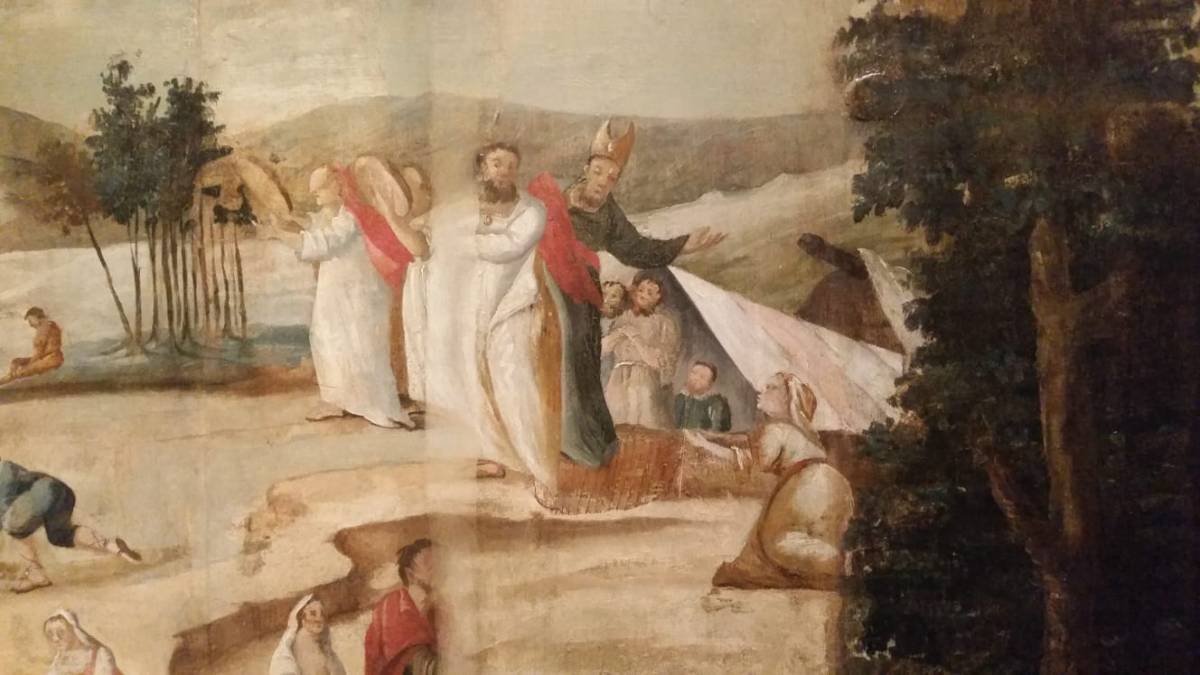
My cover photo is a medieval Italian Jewish painting.  Proof that our creativity extends not only to high tech, but also to high art.