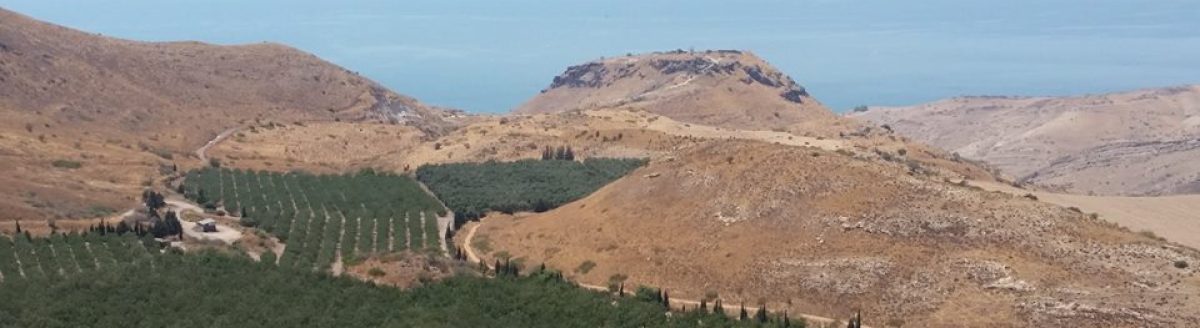
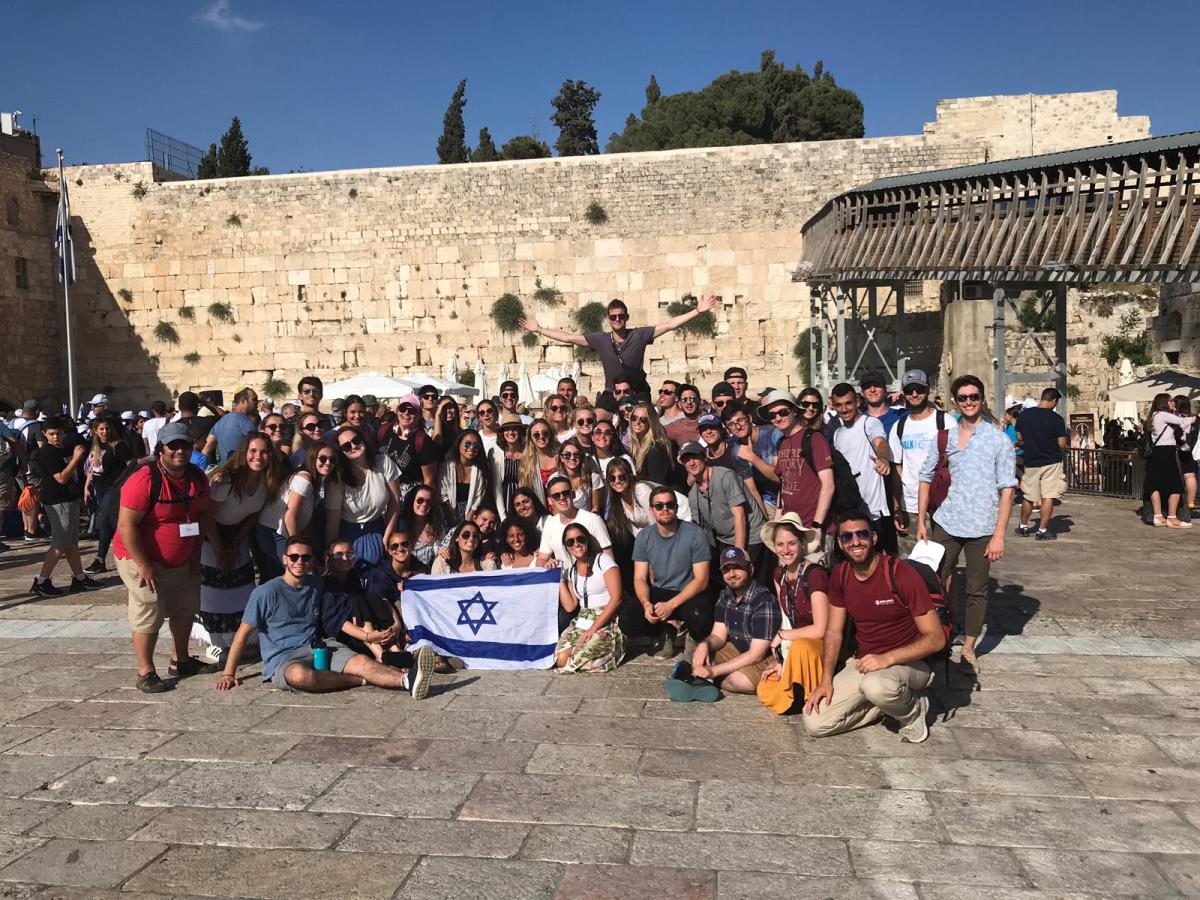
Recently I had the blessing to lead a Birthright trip. When I was 18, I went on my first trip to Israel. At age 13, after my Bar Mitzvah, I decided to learn Modern Hebrew with a private tutor. It’s not a step most teenagers take, let alone on their own initiative.
I fell in love with the country. A country I had not yet been to, but a culture so alluring, so filled with life that I went by myself to a Sarit Hadad concert in suburban Maryland as a high schooler. And loved it.
My own Birthright experience as a participant was mixed. My tour guide was pretty right-wing and the group of people on my trip were so wild that they hooked up in front of the rest of the group…multiple times. It was not my scene.
What I did love was Israel itself. The landscapes, the history, the smells, the food, the Judaism, the curious nature of a country halfway around the planet somehow tied to those Hebrew lessons I took every week for three years in Maryland.
This time, the tables were flipped. Whereas once I was an engaged participant, this time I was a leader. While as a teenager and college student I had been an avid community organizer and counselor at various summer camps and activist institutes, it had been a long time since I had led a group of people. I work in communications and public relations, but corralling a group of 50 college students with only two other staffers is a challenge. At age 33.
The first few days were exhausting. Between the jet lag, the hectic pace, being in a completely new social structure with nobody I knew, and the heavy responsibility of watching out for dozens of people’s lives, I was exhausted. And frankly, not having a very good time.
All that changed with Shabbat. The trip came to a slow, gentle pause as we joined the country in resting and reflecting. As I had many times before in other places, I led the group in Kabbalat Shabbat services, a challenging and exciting opportunity given the very diverse backgrounds of the participants. Some of them had never observed Shabbat before.
But what was so amazing, and indeed is the magic of Jewish wisdom and tradition, is how it completely transformed both the group and the trip for me. Physically, we had a chance to practice the self care our bodies desperately needed. No hikes, no bus rides, no planes. Just rest.
Spiritually, we had a chance to come together as a new community.
One thing I mentioned to my participants at the end of our trip (by which time we really had become a loving, kind, tight-knit group of people who I really miss) was the difference between an experience and a community. An experience is something that ignites, that binds people together in a moment. Birthright is definitely that and I highly recommend going if you haven’t had the chance to yet.

A community, however, is something deeper and more long-term. It is a valley filled with overlapping emotions, care, and responsibility.
It’s something that only happened for me once we had a chance to celebrate Shabbat.
Because Shabbat is not a place, is not an attraction, is not a sight to see. It is a time to behold the spirit and to feel its presence in our selves and in those around us.
That is what I saw happen on Shabbat. A group of 50 thoughtful college students started to share their inner feelings and ideas with each other. They started to look more at each other than at their phones. And I started to feel more connected to them as they made themselves vulnerable talking about their families, the complexity of intermarriage, their Jewish values, and so much more.
What started as a moment in time became the seed of a growing community. A community that initially I felt I was responsible for. But eventually stood in awe as it became responsible for itself. For each other. Even for me.
This is the magic of Judaism. Judaism is not a thing you can touch nor buy. It is something you can practice anywhere at any time. Even just by sharing an act of kindness.
It is something you have to do to make real.
At least if you live outside Israel.
What is so special about Israel is that by experiencing life in a majority-Jewish country, you don’t have to do Jewish. You can simply be Jewish. The nature of the place is that the street signs carry the names of famous rabbis, the boulevards of Jewish heroes. The Hebrew language is plastered on every pizzeria and we hold our fate in our own hands with the ability and responsibility of having an army to protect ourselves.
That is the nature of Judaism in Israel. You don’t need to do anything to feel Jewish- it’s just around you all the time. The degree to which you engage it is up to you, but the holidays and culture will happen whether you participate or not. It’s a miracle of the complicated and sometimes fraught ideology we call Zionism. That for all its varying shades, victories, and failures is ultimately the only ideology that successfully found a way for people to simply exist as a Jew by virtue of being one. And to succeed to passing that unique state of being on to future generations.
If my words are unclear, think about it this way. If you want to be Jewish in America, you can certainly choose to identify as a Jew and do nothing to actively pursue that identity. However, that identity will ultimately not find any manifestation in your day-to-day life unless you act on it. Lighting Shabbat candles, learning about the Holocaust, studying Jewish texts, having Jewish friends- these are some of a myriad of ways in which you can “do Jewish” in the Diaspora. And if you don’t find some way to do so, Judaism as a faith, tradition, and culture will not be a visible part of your life.
So the gift (and challenge) of Israel (and of Birthright) is the uniqueness of Judaism in this place. Israel allows Jews to exist as Jews while doing nothing (consciously) Jewish. It is the only place on the planet where all schools shut down for Jewish holidays and you feel the presence of Shabbat by the absence of buses on the roads every Friday night. Whether you like it or not, or whether you pray or not. You’re a Jew.
So I want to share a special message with my Birthright participants (Bus 354 woo woo olé!) and with the secular Israelis who move to the States and with Jews in America looking for a way to engage.
My message is you have to do Jewish to be Jewish. Unless you live in Israel, Judaism won’t happen for us the way it did on Birthright. It’s something I’m sure you’ll miss when you go back home and it’s truly a special experience to walk the streets of Jerusalem emptied of cars on a Saturday afternoon.
The good news is your Judaism doesn’t have to stop there. Obviously it’s great to go back to Israel and there are many ways to do so, including subsidized programs through MASA. Explore in more depth. Learn about the complexity of Israel, including its diverse non-Jewish communities such as the Druze, Arab Christians, Arab Muslims, Circassians, Bedouin, and more. The tent we stayed at in the desert is only a meager taste of what these amazing communities have to offer.
But also take Judaism with you in your own way. It could be choosing to put your phone on airplane mode for a few hours on Shabbat to get that feeling of mindfulness you got during our trip. It could be taking a stroll with a friend in nature. It could be finding time to catch up with friends from the trip, keeping our newfound community alive. It could be learning about Jewish history or music or news or visiting a museum.
It also could mean plugging into your local Jewish community. Places like Hillel on campus, Moishe House after you graduate, or the dozens of organizations and synagogues in your local Jewish Federation– these are places where you can find fellow Jews to connect with wherever you are. And get that feeling of togetherness we had on our trip.
My greatest hope for you and for all Jews outside Israel is to see that the magic of Judaism doesn’t have to stop at Israel’s borders. Although it will never be exactly the same and there is something so unique and special about the spontaneous Judaism that happens there.
The spirit of Shabbat and of Jewish life that you experienced is all around us if you access it.
Take the moment, take the experience, and build it into a community. A community of our bus, of our friends, of our people. And let it nourish you now and for many years to come.
Amen. Miss you guys 🙂





 Planting Roots Bearing Fruits
You must be logged in to post a comment.