What’s right with America

Recently, I took a trip to Berkeley.  Known as a hotbed of far-left activism and anti-Israel hatred, I wanted to see what was up.

While a friend of a friend had suggested there was no such thing as campus anti-Semitism there, I wanted to see what it was like first hand.

Going in with rather low expectations, I found a lot to like there.  Berkeley is a cute town.  I found my way to a delicious little restaurant that sold onigiri, or Japanese rice balls.  As a kid who lived in Japan (and then stayed connected to the culture back in the States), I grew up with this as comfort food.

In the restaurant, I chatted with a nice young man behind the counter.  I made a point of mentioning I was from Tel Aviv- a risky proposition in a city where not a small number of people boycott our existence.

Turns out, he was a Jew!  His father had volunteered on a kibbutz near Tel Aviv years ago.  And he told me he might go on Birthright!  I told him to check out my blog and contact me if he visits- if you’re reading this please message me!  I will hook you up 😉  It was a refreshing reminder of vibrant Jewish life here- a life that both as an American and an Israeli I support.  That I urge the Israeli government to back with full force- not just rhetoric.  Bibi- recognize progressive Judaism in Israel and abroad- as a living community which strengthens our state and our people.  If we’re Jewish enough to be shot by anti-Semites, we’re Jewish enough for the Jewish State.

As I headed to campus, I decided to visit Hillel, the Jewish campus organization.  I met some wonderful young students, who told me about the active Jewish life on campus.  About their trips to Israel- and their desire to return.  And unfortunately, some of the rabid anti-Israel and anti-Semitic students they have to deal with.  As they noshed on some pretty tasty looking shakshuka.

Frankly, I felt lucky to have graduated from college 10 years ago, where anti-Semitism was unheard of at my Hillel and where the scary rhetoric of today’s campus extremists was barely in its infant stages.

One particular story stood out to me.  Speaking with an Israeli, she told me about a non-Jewish student who came to a discussion about the various types of Zionism.  And, apparently innocently and sincerely, asked “but what does Zionism have to go with genocide?”

The Israeli thought she meant the Holocaust.  But apparently the student, having heard all sorts of inflated rhetoric on campus, thought Zionism was a form of genocide.  A blatant lie and a sad reflection on the rhetoric of the anti-Israel movement.  That does a disservice to Jewish and Israeli history, the complexity of the conflict, and to Palestinians themselves as these “activists” push our peoples further and further apart.

I stand in admiration of Israel educators and Jewish students who patiently answer such questions.  I have to say if someone asked me this question in earnest, I’d assume they were simply attacking me.  Because in some cases, they are.  But when you see someone so earnestly manipulated, it breaks the heart.  And I’m so proud of our Jewish activists and non-Jewish allies who are standing up for truth, for nuance, and for engagement in today’s increasingly toxic environment.

One student named Judith particularly stood out to me (hi Judith, if you’re reading!).  She is a Berkeley native so she is used to the screaming, often irrationally hateful activists who populate her campus.  Like the Christian minister I saw on a street corner shouting in a megaphone that “Jesus wasn’t afraid of the Jewish culture.”  As people walked by completely indifferent.

Her bravery and her ability to ignore such people remind me of Israelis.  She is used to it, and she lives her life despite it.  It reminds me of young Jews I met in Belgium who were used to having their synagogues under armed guard.  Where you submit your passports a week in advance to visit.  To get a background check.  A reality unthinkable in European cathedrals, open to the public without even a cursory glance.  It’s a reality American Jews will have to get used to.  After Pittsburgh, you can expect enhanced security at American synagogues.  Where, sadly, I think they will one day resemble the fortress-like congregations that dot the European continent my family once called home.

The age of American Jewish innocence- where we lived in security and prosperity- is evolving.  What was once the safest and most prosperous Diaspora community since medieval Spain is in the midst of a monumental change and I fear for its future.  I will not be surprised to see armed guards outside American synagogues next visit- and it will make me a bit sad.  One Jewish community advocate estimates it could cost $1 billion to secure American synagogues.

We once thought we were exceptional, that our bagels were as American as apple pie.  But as is often the case in Jewish history, if we ever forget who we are, the anti-Semites arise to remind us.  If you are a non-Jewish ally reading this, the hour is late and if you don’t mobilize with us now, American Jewry is at tremendous risk.  Speak up, show your solidarity, stand with us- lest we become the next France.  Where Jews fear to walk around with yarmulkes on and Jewish centers are regularly attacked.  Where Holocaust survivors are burned to death in their homes.  If you think this is alarmist, you don’t know much about Jewish history.  The ethnocentric view places this recent attack only in the context of American hate crimes like heinous attacks on black churches or immigrants.  But if you read Jewish history, you’ll realize this analogy is relevant but incomplete.  Violent anti-Semitism isn’t new- and it didn’t start with Donald Trump.  Although I’d invite him to stop complaining how attacks against us “slow” his political momentum.  We’ve been dealing with this for 2,000 years and counting and across dozens of countries.  I’m not a huge fan of the (seemingly endless) privilege discourse, but as a non-Jew, it’d benefit you to consider the ways you’re fortunate to not be one of us.  And to find ways to help.

As I wandered around Berkeley’s campus, I felt more comfortable than I expected.  There is something about coming in with low expectations that gives you the freedom to be pleasantly surprised.  To have your preconceptions splendidly upended.  Like when I met pro-Israel libertarians with buttons that said “BDS=BS”!  So thankful to have you advocating for us in the belly of the beast 🙂 .

20181102_153142

Yet some expectations are based in reality.  I met a man tabling for a Muslim Student Association volunteer program- run in conjunction with an anti-Semitic professor.  Berkeley is about to host a Marxism conference.  With speakers on Palestinian liberation- likely predicated on the destruction of Israel.  A terrible false dichotomy that speaks more to their black-and-white destructive thinking than any sort of genuine attempt at dialogue or peacemaking.  Signs abounded about the “Trump-Pence Regime” and “resistance.”  As if our President, as narcissistic and callous as he may be, was somehow installed by a putsch.  As opposed to the democratic elections he won.  Someone you oppose becomes an illegitimate enemy of humanity rather than a candidate or ideology you want to defeat.  The former requires nothing but anger.  The latter requires organizing, analysis, and persuasion- real work that requires you to engage with people you disagree with.  You can tell what I think is more productive.

This kind of black-and-white thinking is something I’ve dabbled in, especially in college.  There’s something about this time in your life, free from obligations, where you can experiment with radical ideas.  And on some level it’s healthy.  Some ideas accepted as normal in our society need to be challenged and changed.  I also feel that my at times abusive chilhood pushed me into defensive and judgmental thinking as a way to protect myself and to make sense of inexplicable hatred.

And I’m proud to have worked hard to grow out of this mentality, as befits my age and my process of healing from abuse.  And my engagement with a wide range of cultures and political views.  So that when I meet an American-born Cambodian student whose parents fled the Khmer Rouge, but who is excited about the Marxism conference, I feel a mixture of emotions.  Anger, sadness, and pity.  It takes a lot of mental acrobatics to justify the way she thinks, but all I can say is that I hope she can one day escape the ideological labyrinth in which she wanders.

Because for me, resistance is not about slogans or yelling at people who disagree with you.  It’s about standing for your values while resisting the urge to do evil when it has been done to you.

As I prepared to leave Berkeley, I told Judith that I thought she was brave for having adjusted to life in her town.  As a proud Jew and a lover of Israel, to be surrounded by such political extremism can’t be easy.  And like Jews have done for centuries, she got used to it and lives her life.

And I left her with a warning: “Jews in Europe are now used to armed guards and soldiers protecting their synagogues.  Like fortresses.  They’ve gotten used to it to- it’s necessary and it’s sad.  So be careful- don’t get too used to it.  Because you deserve better.”

She nodded in agreement as she boarded the bus to a fun date with her boyfriend.  The kind of care-free evening that makes America so fun.  And makes Americans so lucky.  With all your problems, remember this is the wealthiest and one of the most stable countries on the planet.  And don’t forget it.  It’s a blessing.  Hamas fired 30 rockets on Southern Israel last week and Catalan political leaders sit in Spanish prison.  Even as you push for change, count your lucky stars and remember there are problems outside this country too.

At night, I headed into San Francisco.  Having seen the good, bad, and neutral of Berkeley (including some amazing burritos made by Asian students), I wanted Shabbat.

Shabbat is not something to take for granted.  It’s only a feeling that happens if you make it happen, especially outside of Israel.  On my travels, I found myself gravitating towards Jews when I wanted that feeling of community.  It wasn’t really about religion in the traditional sense of the word.  It was about being a Jew with people who understood me.  And sharing in our customs, food, and talk.

One organization that has brought this to life for me is Moishe House.  They organize communal houses for Jews across the world, which then hold programs for both Jews and non-Jews.  A pluralistic cultural space, it is a great complement or alternative to synagogue, as it doesn’t require a particular belief and all are welcome.

I’ve written before about how I visited Moishe Houses in Brussels and Barcelona.  And now it was San Francisco’s turn.

The folks at Moishe House Nob Hill put on an amazing Shabbat dinner.  There’s a special feeling when you’re with Jews.  To put it in the words of a man named Ben I met- it’s intangible.  You just feel at home.  You know something links you even if you’ve never met.

When I walked in the house, I was greeted with the smell of chicken shnitzel, of hummus, and I even made my own challah.  For the first time!

Turns out one of the housemates’ friends even read my blog about San Francisco!  It’s an amazing feeling of connection when you see just how small of a people we really are.  And I’m grateful to both Moishe House and its energetic residents for building this safe, vibrant space.

A space where for just one night, I can worry a little less about saying I’m Israeli.  Where I talk about Judaism without worrying about sounding “too Jewish”.  Where I can count on empathy after this week’s Pittsburgh terror attack.  An empathy I sometimes found lacking among non-Jewish folks I met in San Francisco.

It was interesting- I had actually forgotten about the attacks until the dinner.  The dinner was advertised as a Pittsburgh solidarity dinner, a great idea.  It’s just that as an Israeli, I had mourned, been angry, and moved on to the next thing.  A zen-like way of living in the moment that I learned to do more and more in the Jewish State, where hundreds of Pittsburghs have happened.

So where I expected just a Shabbat dinner, I got a lore more.  It was nice to see the tender side of American Jews.  Israelis, so accustomed to terror attacks, move on rather quickly out of necessity.  It was both heartbreaking and moving to see how the attacks affected the young Jews here.  The softness of American Jews is a real treasure- unique in Jewish history for having enjoyed so much freedom and safety.  And it’s something I fear will have to change.  As the country and the world increasingly scapegoats us, American Jewry would be wise to connect more with European Jews and Israel to learn coping skills.  It’s not easy- but the good (and bad) thing is we have a lot of experience dealing with terror.  And we can be there to support each other during this transition.  What I fear may be a new normal.

A curious thing happened at dinner.  A young man requested we do kiddush, the traditional blessing over wine or grape juice.

The Moishe House residents looked around, looking for volunteers.  Having led Reform services my whole life (including in Tel Aviv), I know the blessing by heart.

When I left Tel Aviv two months ago, I could barely utter it.  So disenchanted with both Judaism and Israel itself in such a tense region of the world, I wasn’t even sure if I was a Jew.  Although, as you’ll see with my previous blogs, Europe reminded me I was.

So I found myself with a choice.  Having gone from religious to atheist, to agnostic, to spiritual.  Where did I stand now?

I wasn’t sure.  But I sang.

And I sang with love.

And people joined in.

I hadn’t sung a kiddush in two months.  And it felt great.

As I write this blog, I think I do believe in God.  Maybe not the way others do, but who cares?  It’s my belief, and while I can’t find myself obsessing over details of Jewish law or ignoring the problems of literalism or religious tribalism, I believe.  I don’t know- I believe.  That’s why we use that word.  Because someone with perfect faith is a liar- and a demagogue.  Leaving room for doubt is the most Jewish thing in the world- and allows us to till the fertile gray space our minds can thrive in.

What inspired my faith this Friday?  A lot of things.  The human spirit, the need for connection, nature, change, my accomplishments, gratitude, and just a feeling.  A spiritual connection that complements, even creatively contradicts, my rational thought.  To make me who I am.

And what also inspired it are the great people I’ve met along the way.  Judith, Moishe House, Hillel, Israel educators, the young Jew making Japanese food.  Korean burritos, amazing taco chips, and the people who accept me as the Israeli I am.

This morning, I met a 70-something year old hippie at my hostel.  When she asked where I was from, I was nervous at first.  I’ve had some bad experiences with anti-Semites when I said I was Israeli.

But much to my surprise, like the young man making Japanese food, Lynn was Jewish.  A Reform Jew, like me 🙂 .  I don’t go to services as much now, but the synagogue I don’t go to is definitely Reform 😉 .  Lynn had been to Israel in 2006 and loved it.

We had a great conversation as I made delicious pancakes drenched in the kind of authentic maple syrup you only really find here.  It’s America’s hummus- something I just won’t eat in my other homeland.  It doesn’t taste right.

I gave Lynn my email and told her to come visit.  And I mean it- I hope she comes and I will set her up with whatever she needs.

Because I won’t give up on Jews anywhere.  And no matter who my Prime Minister is, no matter who attacks our people, no matter what- I believe in us.  And I want to be the progressive, open-minded Israeli who gives you pride in the Jewish State.  Who works tirelessly on the other side of the world to make space for people like us.  For a Jewish vision that supports LGBT rights, Arab empowerment, consideration for minorities, inclusion for refugees, and equality for progressive Judaism.  For a strong homeland that welcomes all of us.  Because there are Israelis like me who are your allies.  Forget the headlines and stand with us.  Because together we can strengthen the Israel and Diaspora community that makes us feel at home.  That lives out values we identify with.  And yes, that empathizes with people who disagree with us.

And in the meantime, I ask you to stand with us.  When you’re in Berkeley and people spout irrational, inaccurate hatred against Israel, to fight back.  To educate.  To realize that your fate depends as much on me as mine does on yours.  That Israel is your insurance policy- just as it has been for Moroccan and Polish and Ethiopian Jews forced from their homes for decades upon decades.

I need a strong America for a safe Israel.  And you need a strong Israel when you don’t have a safe America.

The world is changing, and who knows what will happen.  Enjoy this moment- who knows what tomorrow holds.  That’s the Jewish way.  And whether you’re Jewish or not, it can enrich your life to realize this basic fact.

Whatever you want to do, don’t wait.  There are no guarantees.  Dance in the streets, speak your mind, smile, cry, hug.  Like Lynn hugged me before she left- a precious gift for someone traveling alone.  Both on this trip, and in life.

What I’ve discovered is that what makes me feel less alone is finding empathetic people along the way who take you in.  Who make you feel loved and warmed.  Who feel your humanity.  Who share with you.

At a time when empathy is faltering, challenge yourself to show it.  And to find it where it appears to have disappeared.

Because next time I visit America, I want it strong.  This week, try to find a moment to talk to someone different, as hard as it might be.  Because Twitter and Facebook are great, but they won’t smile at a woman on the train.  And a news feed can’t feed a heart’s desire for acceptance.

America is a great country.  I hope its residents embrace the beautiful privilege of living there.  Despite it all, still one of the calmest and most prosperous places on the planet.

We are.  Black white, Jewish Muslim, gay bisexual, Republican Democrat, conservative centrist, straight and working class.  Christian, Native American.  Vegan and wealthy.

The next time your hand reaches for the screen.  Ready to type a comment on Facebook.  To agitate, to vent, to express.  Flip it like a pancake, fingers pointing ahead, thumb towards the sky.

Reach out and meet your neighbor.  Try.  It won’t always go well, but it’s worth it and it’s what we need.

This hand was made for you and me.

WhatsApp Image 2018-11-03 at 9.01.35 PMWhatsApp Image 2018-11-03 at 9.03.23 PM(1)

Evangelical Gay Jewish San Francisco

I’d like to share with you some stories from a recent visit to San Francisco.

After making aliyah a year and a half ago, I came back to the States for the first time.

What I’ve liked most is speaking English.  Everywhere the signs are in my language.  I can pick up on nuance and norms that I just can’t in another language, no matter how fluent I am.

I like the delicious fortune cookies I tasted at a factory in Chinatown and the wonderful Chinese-American woman I met who really wants to go to Israel.  She just wants to travel in general and see “what’s the big deal about the Eiffel Tower”.

I like the Latina saleswoman at T-Mobile who, when I mentioned I was from Israel, was so excited.  She was really proud of me for moving halfway around the world and pursuing my dreams.  And she told me what it was like for her to visit Mexico, how friendly people were.

20181101_172454

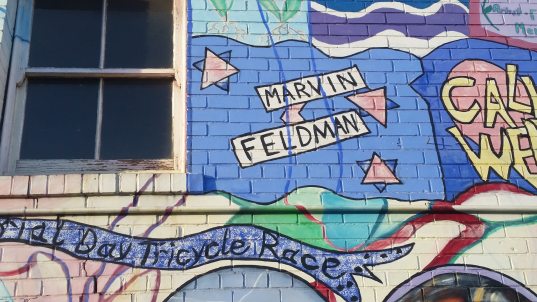
I like the rainbow flags that adorn the Castro, a kind of mini gay state.  I even found street art honoring a Jewish victim of AIDS.  Having lived in the Jewish Holy Land, I wanted to visit the gay one.  And it was really interesting.  While a rather small area (I suppose I envisioned it being half the city), it was so colorful, so gay.  Sometimes a bit risqué for my tastes (I saw naked men strolling down the street…), but I enjoyed the occasional sexual pun.  Including the absolutely hilarious tank top that said “can you host?” and the funny Planned Parenthood bag.  If you don’t get the hosting joke, ask a gay friend 😉

The Bay Area is filled with tremendous wildlife.  Scenery out of a movie.  The waves of the Pacific lapping against the shoreline but with an ease that matches the calm of this city.  I’ve never been in such a large city with such a relaxed pace of life.  It’s kind of the Tel Aviv of North America, as one person put it.

I like the personal space, the quiet, the lack of rockets, the feeling of sexual freedom that I wish Israel had more often.  A place so inundated with religion and nationalism that sexual shame, even in “sin city” Tel Aviv, often feels so much stronger than I wish it would be.

Now I’ll tell you what’s wrong with this progressive paradise.

First off, I’ve never seen so many homeless people.  In a city that prides itself (almost to a fault) on being so liberal, it’s hard for me to understand why there are so many people without a roof over their heads.  For sure, it’s not as if the ordinary citizen can fix this problem.  Nor is homelessness an easy problem to fix- mental healthcare, economics, and so many other factors go into it.

But I can’t help but feel confused, at times disturbed, to see so many people walking by on their headsets, talking about the latest computer program or software, while people sit suffering right by their feet.  I’m not expecting people to fix the problem, but it feels quite different from Israel.  We have lots of homeless people too, but both I personally and lots of people around me gave them food and water and money.  I even talked with a homeless man in Tel Aviv who told me all the books he has read recently.  I just haven’t witnessed that kind of spontaneous interaction or generosity here.

This kind of distance or callousness is something I’ve noticed a few times.  The other day, I was in Chinatown.  An elderly Chinese woman had fallen, hitting her head on the sidewalk, with blood spilling everywhere.  Person after person after person just walked by.  Me being both who I am and an Israeli, jumped into help.  I bought her water and brought napkins to help stem the bleeding.  A wonderfully generous African-American woman came over and held the napkins against the woman’s head.  An Asian-American man translated for the woman as he tried to talk to the 911 operator.  It was a kind of generosity-filled melting pot that I love about this country.

The disturbing part was watching the people walk by.  The people on their phones or who didn’t want to get dirty (I personally got blood all over my sandals…yeah, it’s gross and risky, but was I going to let a woman die to keep my feet clean?).  The people who, after helping for a second, just walked away.  The woman still dazed and confused, babbling in incoherent Chinese (not that I’d know the difference).

I stayed with her until she got into the ambulance.  That’s how you behave like a human being.  Your meeting is not more important than a person’s life.

Walking around the Castro, I entered a gay book store.  Boy do I love to see gay book stores, the world needs more of them.  And more book stores in general.  A place I truly feel warm and inspired and at ease.  A place of learning and discovery where you don’t have to “look” for anything- you can just look 😉

A lot of the books were really, really left wing.  I grew up with these kinds of book stores in D.C.  Once they made me excited, now they make me nervous.  I think I’ve grown out of this mindset and I think the mindset here has solidified since I left.  While some of the material is interesting, it’s often steeped in the black-and-white thinking that plagues both extremes in this country.  And usually involves hating Israel.

I noticed some rainbow buttons that said “Proud Queer Muslim” and “Queers Against Islamophobia”.  Frankly, they’re pretty neat.  Just days after the Pittsburgh massacre (one which personally touched me), I wanted to know if they had any against anti-Semitism.

The store clerk said: “oh you know, I don’t think we do.  Somebody must have them.  We don’t have any timely buttons.”  As if anti-Semitism was a new issue.

To his credit, the store owner paused and said he’d look into it.  And steered towards his computer to search.  I hope he finds some and puts them out.  Anti-Semitism isn’t new and I hope we can count on his solidarity.  The moment showed both the deep ignorance that can pervade this country and that sometimes we can puncture it.  I hope I moved things in the right direction.

During my visit here, I’ve had a lot of conversations about Israel.  The difference between an American Jew and an Israeli is we can’t hide our Jewishness.  We’re out-of-the-closet Jews.  And as soon as you say you’re from Israel, the conversation begins.

The cool part is when you get awesome people.  One man, Nick, is someone who I actually befriended in Tel Aviv helping him buy a sandwich.  In town on a business trip, he was struggling to deal with the hectic line, so I stepped in and helped him order.  I sat with him and his coworker and had a great time.  We kept in touch and he invited me to stay with him for several days here in the Bay Area.  Since making aliyah, I often feel Americans are more distant.  This is the country where self realization is priority one, where the individual is the greatest unit of meaning.

But Nick shows that some Americans buck that trend and are capable of the spontaneous generosity I’ve come to love in Israel.  He’s a new American friend, and I’m happy to have met him and am grateful for his kindness.

Curiously enough (or perhaps not!), Nick and I did some genealogy together and discovered he’s a quarter Jewish.  Maybe one day he’ll make aliyah 😉  But in the meantime, I was really happy to help someone discover their roots and connect to our people.  I’m proud to have generous people like him as part of our tribe.

Other people are not so fond of the Jewish State.  At various moments here, I’ve met people who can’t say the word Israel without following it with the word Palestine (as if I wasn’t aware who my neighbors were).  I’ve met people (including Jews!) who said that Israel’s very existence is a fair question.  And that someone who doesn’t believe Israel should exist because of our “illegal occupation” is not an anti-Semite.  Telling Israelis how to live their lives while sitting in the richest city in the United States.  While ironically living in a state whose very name is Spanish and whose territory once was filled with Native Americans.  Who now live in abject poverty like the city’s homeless.

I talked to one person who, knowing full well I was Jewish and mourning the Pittsburgh terror attack, said: “I rarely see the Jewish community condemn actions when it isn’t a Jewish person.”  That we didn’t care about People of Color.  A statement profoundly callous and absurd.  Callous because this is our moment to mourn, not for you to politicize our tragedy, rant about Trump, or talk about other (equally heinous) hate crimes.  But just to let us be sad for one moment and yes, to make it about us.  And absurd because the Jewish community is at the forefront of human rights, civil rights, and immigrants rights in a way few members of these communities do so for us.  I can’t recall an LGBT, African-American, or immigrant march against anti-Semitism.  I suppose I’m a gay person marching against anti-Semitism, but I think my point about the rallies still stands.  I could be wrong, I just literally can’t think of one.  And I’m someone who in both the States and Israel has marched countless times for every minority group under the sun.  And will continue to do so.

I’ve met people (even left-wing Jews) who claim campus anti-Semitism is right wing propaganda.  That it doesn’t really exist.  Who believe this and this and this and this and this and this are “fake news”.

When you meet so much ignorance, it’s sometimes hard to feel safe, let loose, and enjoy yourself.  I’m a person who likes to talk to people, so when people around me are mean, I don’t have much fun.

I did flirt with a really cute guy in a bagel shop, so San Francisco has its good parts too 😉  If there are any sweet, reserved guys out there who like an ambivert who’s outgoing but also likes a long stroll and deep conversation, hit me up 😉

As evening came, I headed back on the BART train to where I was staying.  My Uber app wasn’t working, so I asked a bus driver where the next bus was to my destination.  The wonderful middle-aged Latina woman pulled me aside and showed me exactly what to do.  She, much like the Israelis I love, wouldn’t let me go until she showed me every step of the process.  And got my app running again.

She asked me: “where are you from?”

“Washington, D.C. and now I live in Israel.”

“But you speak Spanish, where are your parents from?”

“Also American.”

“So how do you speak such good Spanish?”

“I used to be a Spanish teacher.”

And in the most Israeli response ever: “used to be?”

It was that loving gnaw of guilt.  I miss it.  And I’m looking forward to feeling it again when I go home to the state I call my own.

The woman sent me on my way: “cuídate m’ijo”.  Take care my son.

I miss Latinos and I miss America.  I used to work for immigrant rights nonprofits and the best part of this country is its incredible diversity.  I miss the people who upend your prejudices and expectations, the random acts of kindness by Americans of every background.  The understated people who help, rather than the self-righteous who think doing you a favor indebts you to them.  If you want help, ask someone who has less.  Who knows what it’s like to struggle.  Because chances are that very lack is the pain that makes them more tender.  Find the heart bursting at the seams- it’s worth more than a wallet overflowing with cash.

On the train back home, tired of anti-Israel bullshit, I noticed the woman sitting next to me reading Fox News.  Just a year and a half ago, that would’ve scared me.  And to be honest, it’s not someone I’d probably talk gay marriage and immigrant rights with.  But I wanted to test a theory.

I pretended I didn’t know where I was going.  I told the woman I was from Israel and asked for directions.

“Israel?!  Israel!  Wow I was there just a few years ago!  What a beautiful place!  I saw…”

And then she named every biblical site imaginable.  And told me how gorgeous the Golan was.  And how she, as a Christian, stood by my country.

My heart is pulled in many directions.  As a gay person, I’m concerned about the rightward tilt of this country.  As someone who cares about women’s rights, immigrants rights, diversity, and equality, I’m concerned by voices who deny these freedoms.  Who justify punishing children stopped at the border.  Children who could be very well related to the wonderful bus driver who helped me tonight.  Fleeing chaos and violence in El Salvador, a country ridden with gangs and whose drug violence is partially fueled by American consumption.  And some of our own failed policies.  Whose own government cares so little for its own people.  Where the gap between rich and poor is extraordinary- and growing.

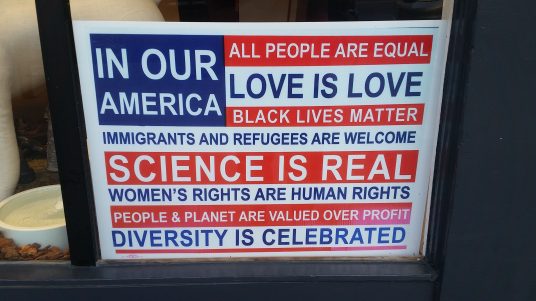
And as a Jewish Israeli, I’m concerned about the callousness some American progressives show towards my people.  Of course, the same callousness shown by neo-Nazis.  For some reason, Jews don’t deserve the compassion of the far left.  What drives millions of Americans to march for women, for refugees, for black lives- all of which I support- somehow doesn’t materialize for us.  Protesting against Donald Trump is not the same as protesting for Jews.  Maybe you don’t think we’re feeble enough for you to take care of us as you purport to do for other minorities.  But trust me- while we’re not feeble, our existence is at your behest.  As 2% of the population, we don’t live without your tolerance.  And if you’re not willing to fight for it, you’ll find more of your neighbors becoming mine in Israel.  If you don’t get why we spilled our blood to build a Jewish state now, you never will.  Although I’ll keep trying to explain.  And hope one day we’ll find ourselves on this sign too:

20181101_165004

So when it comes down to it, who should I count on?  I’m not just a blogger, I’m a person.  Should I go after the university-educated progressives- even some Jews- who think our very existence is up for debate?  Should I give up on progressives- knowing open-minded people like Nick are out there eager to learn?  Who don’t hate us?  Should I accept the support of evangelicals, who give it so freely?  Who make my train ride enjoyable, a conversation rather than a debate?  Even if it means their victory could put my other identities and values in jeopardy?

I’m not sure.  My instinct is to accept support wherever we can get it because frankly, we don’t have a lot.  If masses of progressive Americans stood with Israel, we wouldn’t need to rely on other groups’ support.  But as a matter of principle, should I reject anyone’s support?  The person who made me feel most loved as an Israeli was an Asian-American Christian, not a Jew and not an NPR listener.

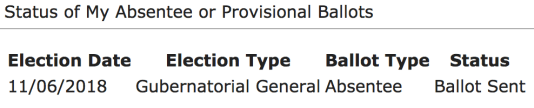
November 6th is Election Day.  I’ll have you know I requested my absentee ballot from Maryland- but it has not yet arrived.  What’s going on Maryland?  I might not be able to vote because you’re not doing your job.  Here’s my request below:

Screen Shot 2018-11-01 at 11.32.01 PM.png

I hope my ballot does arrive but I’ll tell you what I’m thinking anyways.

My ballot is secret- so I won’t share all.  I will tell you this- I’m a registered Democrat and have been almost my whole life.  I’ve voted Democratic 95% of the time, with an occasional Libertarian and Green foray.  I worked on the Obama Campaign in 2008.  Was a Pledged Delegate for him to the Democratic National Convention in Denver.  I served in his Administration at U.S. Citizenship and Immigration Services.

This year is going to be different.  I’m going to vote mostly Democratic.  I can’t look that Salvadoran woman in the face and punch a whole next to a bunch of R’s who’d like to see her deported.  Or her family suffer.  In some cases, even if they’re legal residents.  And I care about my own civil liberties and those of all Americans.  I’m disturbed by the state of healthcare, the arts, public transit, higher education, poverty, and so much more.

And I’m going to choose at least one, reasonable-sounding Republican (I am from Maryland- we have a few of those left) and I’m going to vote for them.  It’s a protest vote and a warning.  Democrats- stop taking me for granted.  I like a lot of what you have to say but your most radical members are starting to sound as black-and-white as the people they purport to oppose.

I care about myself as an American-Israeli Jew.  And if some of the people I met in San Francisco are at all representative of your party’s direction, you can count on my support going elsewhere.

Where, I don’t know.  In the perpetual Jewish conundrum of being squeezed between a rock and a hard place, I’m not sure where home is.  Other than perhaps the other side of the Mediterranean.

But I will say this- I’m an American citizen.  I pay taxes.  I was born here.  And I will continue to vote here, even if next election I have to request a thousand absentee ballots a year in advance to be heard.

And I want you to hear me clearly: I’m a swing voter.  And I’m not afraid to push the lever for a Republican once in a while if I feel the party I once called home doesn’t care about my safety and my well-being.

I’m Israeli and I’m American.  You might not want to rally for my rights, but you should want my vote.  It’s the only weapon I have.  Because just like a Latino voter or an African-American or a gay person- I’m going to ask you a question:

“Why is your party better for the Jewish community and Israel?”

Because in addition to all the other issues I care about, I care about myself.  That’s the basis of democracy.  Those are my interests.

20181030_124011

I miss you America, and I can taste the sweet fortune cookies on my lips.  The delicious dumplings and sushi and Thai food I sorely miss.  The Halloween outfits and pumpkins I never see in the Jewish State.  The interracial couples, the potpourri of cultures, the Chinese-language books in your storefront windows.  Teaching immigrants how to adapt to life here.  Just like my ancestors did, to give me life today.

I want you strong and I hope to be back soon.

In the meantime, give me some hope you’re going to pull through.  Because outside of Israel, the Jewish people has no better home.  And I’m still your son even if my heart beats seven hours ahead.

I don’t want to live torn in two.

My mouth closed in apprehension, afraid of how you’ll react when I say: “I’m Israeli.”

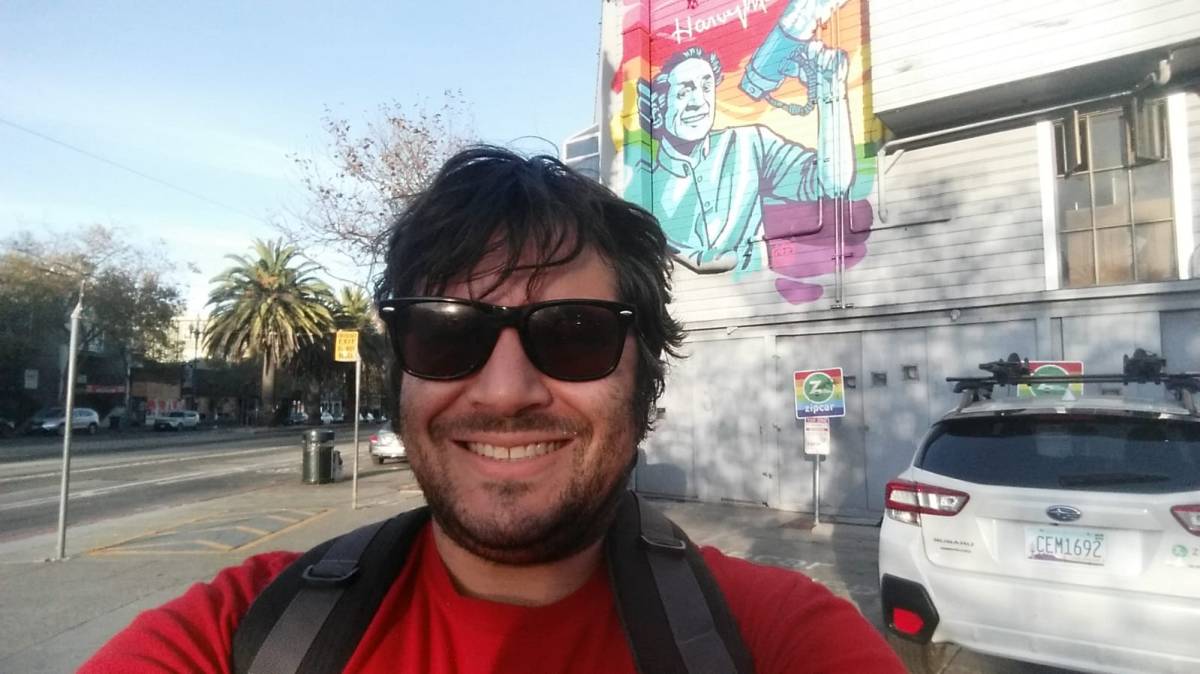
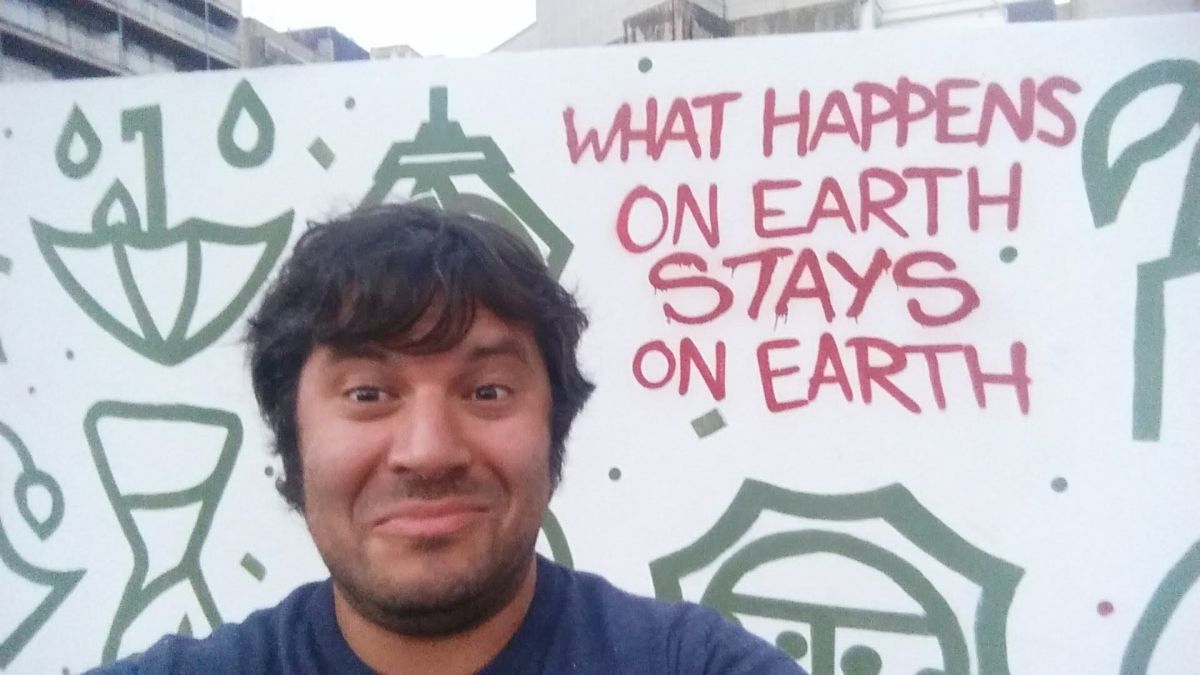
p.s.- my cover photo is me and Harvey Milk, a true gay rights hero.  What a great feeling to see my gay self represented in bright colors on city walls.


I’m from Pittsburgh

This blog is hard to write.

I sit writing in America, a place I haven’t visited in 1.5 years since I made aliyah and became an Israeli citizen.

This trip, hard-earned, is something I’ve waited for for a long time.  A chance to reconnect to my American-ness, to eat delicious affordable Asian food, to see signs in English, to feel at home.  Israel is my home, and America, even if I’m not here most of the year, is also my home.  And it always will be in some sense.  It is a part of who I am no matter where I go.

So it was to my great shock that just a few days after landing, I heard about the anti-Semitic terrorist attack in Pittsburgh.

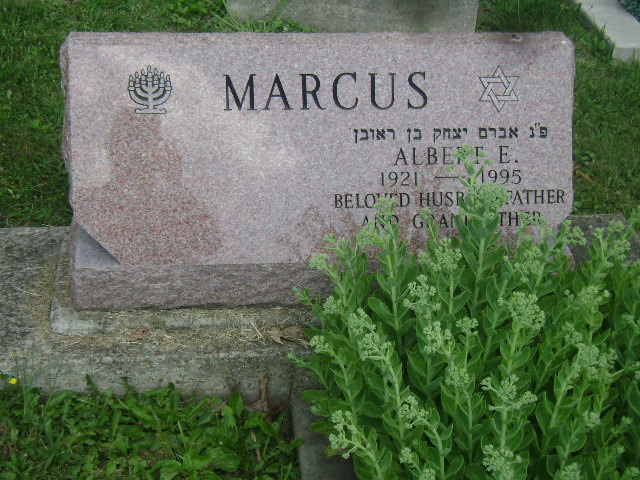
Pittsburgh is not any city for me- it’s where half of my family is from.  It’s a place I’ve visited since I was a little kid.  One that is distinctly a part of my life experience.  My cover photo is a picture of my grandfather’s grave in Adath Jeshurun Cemetery, right outside Pittsburgh.

Squirrel Hill, the neighborhood where the attack took place, is a place I’ve visited and heard about many times.  A place I’ve eaten good Jewish deli food.  A place where I still know people.  One friend I spoke to stayed locked in her home for the day with her kids, afraid to go outside.  And in all likelihood, some of the terror victims are probably related to me in this tight-knit community.  A community shattered by a never-ending hatred increasingly rearing its head in the Land of the Free.

This is America in 2018.

When my family, on both sides, came to America, it was to escape persecution.  Anti-Semitism is not new- and to the chagrin of some folks turning this into a political spectacle- it is not something miraculously awakened by Donald Trump.  I do think Trump and his most extreme supporters have made things worse by normalizing bombastic, hateful speech.  With little care for the consequences.  Words matter- and can inspire crazed people to harm others.  But I think we must be careful to remember this tragedy is first and foremost about Jews.  Indeed, the psychotic animal who killed 12 people this Shabbat actually hated Trump for being “controlled” by Jews.  Anti-Semitic attacks by both neo-Nazis and Islamic extremists have been happening all across Europe and indeed America.  For generation after generation.

The mainstream media rarely covers these stories.  Or gives them the attention they deserve.  Just this past year, an elderly Holocaust survivor was murdered in her Paris apartment for being a Jew.  The Belgian Jewish Museum was attacked by Islamic terrorists just a couple years ago, killing several people.  And, perhaps to your surprise, Jews are the single largest target for hate crimes in the United States.  And in the United Kingdom.  And not just the past two years.  For what it’s worth, two UK politicians have blamed Israel for the attack in Pittsburgh.  As they stand on the precipice of electing the most anti-Semitic leader in the Western World- Jeremy Corbyn.

Of course, the debate right after the attack turned to gun control, to Trump, to elections, to the never-ending arguments plaguing this country that I so love.  For what it’s worth, I support gun control and think it’s patently absurd how easy it is to get guns in this country.  It is immoral, it is dangerous, it is stupid.  I don’t care if you want to go hunt a deer- do whatever you want.  But you don’t need 20 semi-automatic weapons without a background check.  America- grow up.  This isn’t the 1700s and you don’t need a militia- your government has nuclear weapons.  If things get so bad, your rifle won’t really help.  I’m frankly more scared of you.

But I think it’s worth pointing out that gun control is only one piece of the picture.  And frankly, I think starting the debate about this terror attack in this fashion is demeaning.  This attack is about one thing and one thing only: Jews being killed for being Jewish.  This isn’t a school shooting- it’s a synagogue.  Both are heart-wrenching, but this was done with a different intent.  It targeted Jews for being Jews, purposefully.  And even if we have (necessary) gun control, it won’t stop anti-Semitic terror.  Just ask European Jews who have to have armed guards and soldiers protect their synagogues.  When I visited synagogues across the continent, I often had to provide my passport info a week in advance, provide Jewish references, and be screened for entry.

It’s a reality Jewish institutions across Europe have sadly become accustomed to as they try to preserve life on the continent my family called home for 2,000 years.  With the highest levels of anti-Semitism since the Holocaust.  What a short memory this continent has.

It’s a reality that American Jews are about to face themselves.  They- we- are already facing it.

My synagogue growing up had huge boulders outside the sanctuary to prevent Islamic terrorists from driving car bombs into our prayers.  But you could always come visit for services without background checks- just as open as any church around the corner.

Now, that is over.  American Jewish innocence is gone.  Whereas we were once the envy of European Jews under siege by far-left anti-Semites calling for the destruction of Israel and far-right neo-Nazis smashing Kosher restaurants to bits.  Today, we are no different.  Today, we remembered that in the end, we’re Jews.  Sometimes the world forces this identity on us.  We might wish to be accepted, to be welcomed, to be tolerated.  And sometimes and by some people, we truly are.  But in the end, we are at the mercy of the majority.  And while a majority of Americans might not hate us, they also don’t care enough to protect us.

That’s blunt talk for you.  And I’ll explain what I mean.

I don’t think most Americans are anti-Semites.  I grew up with anti-Semitism- yes even in liberal suburban Maryland- but it was mild compared to what we saw in Pittsburgh and certainly compared to the violent attacks plaguing Europe.  I think America, perhaps due to our founding principles and our large Jewish community, is still a better place to be a Jew than Europe.  Something I’m thankful for.  I’m glad my great-grandparents didn’t stay in Romania to become nothing but dust in desecrated cemeteries.  It is thanks to their bravery I am alive and American and now living in our homeland.

But I do want to know where are the Americans today?  At a time when you see thousands upon thousands of Americans- rightly in my opinion- rallying for immigrants, for refugees, for Muslims, for women.  Where are the massive protests for Jews?  Not a couple thousand people.  Masses.  Not framed as gun control, or mental healthcare, or election rallies.  But for Jews as Jews.  And fellow Americans.

I don’t want vigils.  I want protests.  I want action.  I want justice.  And your sympathy doesn’t interest me.  I want to know what you’re going to do to help us.  Because we’re 2% of the population and we can’t protect ourselves without your support.  Republican and Democratic, liberal and conservative, Christian and Muslim, everyone.

Jews put our lives on the line to defend others.  I, along with many Jews, are active in supportive refugees’ rights.  HIAS, the Jewish refugee rights group attacked in the shooters’ social media posts, is a group I’ve been involved with for years.  When I lived in Washington, I used to tutor Latino immigrants for their citizenship exams.  With HIAS and other young Jewish professionals.  Dedicating our time and energy to help people who remind us of our great-grandparents who made this country our home.  Who HIAS brought here, to safety.

The question is- where are these communities when we need support?  Some of them are rallying, and I appreciate it.  Muslims have raised tens of thousands of dollars for Tree of Life synagogue.  No doubt, Latinos, African-Americans, White Americans, and others have spoken out for our rights.

But I do not see the kind of mass movement necessary to stop this phenomenon.  That puts Jews at the center of this conversation as opposed to a convenient political tool to smash your ideological opponents in either direction.

So I want to hear more.  I want to see more refugees demonstrating as refugees thanking us for our support.  Support that cost us lives to save theirs.  Something I still believe in.

I want to see mosques raising Israeli flags in solidarity.  Money is great- but I also want to see that you understand why we have Israel now.  That when we face these kinds of attacks on a massive scale, Israel is the refuge we can go to.  Which is why there are 4,000 Jews left in Morocco and 300,000 Moroccan Jews in Israel.  Who lost everything they own to a corrupt and anti-Semitic regime, no less brutal than the shooter in Pittsburgh.

I want to see more non-Jews studying Judaism.  Not just the Holocaust, but 2,000 years of persecution.  And not only that, but our civilization, our culture, our life.  To understand us.  Jews know so much more about our Christian neighbors than most of them bother to learn about us.  We are not just a Bible verse- we are your neighbors.  Your countrymen.  And you owe it to us to take some time out of your today to learn something about us beyond what a Menorah looks like.  Our history is valuable, our culture meaningful, and you could stand to learn something from our persistence and our worldview.  We are not just to be tolerated- we have something to teach you.

The people who gather to rally against Israeli “apartheid”, who decry Jewish “privilege”- where are you now?  Where are your protests?  Where is your anger?  I don’t want your sadness, I want your passion.  I want you to care as much about us as you do about people you’ve never met in a news story from halfway around the world.

If I’m honest with you, I sometimes think about moving back to America.  I’m enjoying visiting now and although I’m not in Pittsburgh, I feel the aches and pains of this country no matter where I am.  Even sitting on the shores of the Mediterranean.  Because I care about the place where I spent 30 years of my life living.  Where my ancestors found refuge.  Where we built the greatest Jewish civilization since 1500s Spain.  One that, much like the latter, is showing signs of fragility in a way that scares me.

One thing I’ve learned from this trip, these two months of exploration, is that anti-Semitism will follow you whether you like it or not.  When I needed a break from Judaism and Israel, I soon found myself defending my people as I roamed Europe.  Relentlessly stereotyped and aggressively attacked by anti-Semites.

It’s not because all Europeans (or Americans) are anti-Semitic.  I met wonderful, open-minded people curious about our culture.  And I appreciate them more than you can imagine.

It’s just that this ancient hatred is everywhere.  And you can’t avoid it.  That’s not the time we live in.  I’m not sure we have ever been able to avoid it, but the fantasy we lived in is over.  The fantasy that America was immune, was different- it’s gone.  It may have never been the paradise we dreamed of- anti-Semitism has a not-so-subtle past here too.  But if we’re honest, we thought that those times were mostly over.  And our country had progressed beyond these wild sentiments to become a place where Jews are leaders in commerce, in law, in politics, in media, in academia- in all the places anti-Semites claim we control.  Fueling the world’s conflicts, crashing economies, manipulating and conspiring.  Although oddly we can’t manage to prevent people from shooting up our synagogues or blowing up pizzerias in Tel Aviv.
In the end, I’m from Pittsburgh.  Three generations of my family have lived there and it is a part of my life.  I remember the special smiley cookies I used to get there as a kid, I remember the incline you can take up the cliffs to see the three rivers converge, I remember the white chocolate cheesecake I loved at the train station-turned-restaurant on the waterside.  I remember the botanical gardens.  I remember the Church Brew Works.

I remember the deli where I ate delicious whitefish salad in Squirrel Hill.  A neighborhood now missing a dozen souls.  Whose lives were crushed by anti-Semitic hatred, a fiery malevolence we can never truly understand.

I implore my fellow Americans to stand with us- and not silently.  To act with the same urgency that you do when a school is shot, when a mosque is defaced, when women are demeaned by our public discourse and our legislation.  Rally.  March.  Speak up.

I don’t want your Facebook posts, I want your heart.  And your feet pounding the pavement demanding answers from ideological firebrands attacking us from both extremes.

This shooting was about Jews- first and foremost.  Put aside your ballot for just one moment.  Mourn with us, march with us.  We’ll get to the other issues- I promise.  We care about them too.

But today isn’t about you.  It’s about us.

I can hardly pretend that seeing a terror attack against Jews in America is surprising as an Israeli (we’re used to anti-Semitic terror- I had an almost eerily calm reaction when I first heard about it).  But it did shock me as an American.  This is the worst anti-Semitic attack on American soil, in our entire history.

I feel blessed to be heading on an airplane in a few days back home.  From home to home.  From past to present.

Because while I will continue to advocate for my American Jewish brothers and sisters, for me there is only one place on the planet where I feel empowered to protect myself.  Where I don’t have to rely on the good will of the people around me to survive and thrive and be my Jewish self.

It’s a place that’s complicated, that’s difficult to live in, but at the end of the day, when someone points a gun at my Jewish soul, we can point a gun right back.

It’s called Israel.  And if you don’t support its existence, you’re no better than the man bludgeoning my people to death for daring to pray in Hebrew in a city my family called home.

America- if you didn’t understand why we need such a state before this massacre, I hope you get it now.  But in the end, even if you don’t, that’s why I live there and not here.  Because my existence there isn’t dependent on your understanding, however much I still want it.
It’s dependent on us.

May the memories of the dead be for a blessing.  And may it inspire the Jewish people everywhere to live, to come together, to grow.  And for our non-Jewish neighbors to stand up for us before they find our once-thriving communities turned into the history exhibits that fill the European continent with tourist attractions.  Rather than living beings.

Two forks

Reflecting on the past two months of traveling in Europe, I want to share some lessons I’ve learned.

First, look for the generous people.  They are often in the places you least expect it.

I was in Tortosa, a beautiful medieval Catalan town.  It was pouring rain outside- I walked with a piece of cardboard over my head until I could buy a Mickey Mouse umbrella.  It was a funny moment, least until I was soaked from head to toe.

I headed to a market to buy some food- if I didn’t get some then to eat in my hotel, I could be stuck for the night.  There were flash flood warnings.

I ran inside, new Mickey Mouse umbrella in hand.

I went to one stall to buy cheese.  I asked if they sold bread- they were all out.  After paying four euros for cheese, the shop owner handed me a small piece of bread, no bigger than a roll.  I thought wow- how generous.  And then charged me 30 cents.  I walked away a bit discouraged.  I missed the spontaneous generosity of Israelis.  In this town, where I found myself in the rain, people were also quite willing to give me directions in the downpour.  As they hopped in their cars.  I felt alone.

I headed to another stall in the market.  A young woman, 23 years old, helped me find some delicious pre-cooked cod pasta (yes that’s a food- and it’s delicious!).  I told her I was looking for bread and she said she’d heat up my food real good while directing me to a bakery across the street.

I walked through the rain again, only to find the bakery was out!

I came back and the woman was bummed- she heated up my food again to make sure it was extra hot.  Then she did the kindest thing.  First of all, she grabs a hand full of croutons and puts them in a bag for me.

“They’re not bread, but maybe they’ll help.”

I smiled.  I don’t think I ate a single one, but I felt loved.  Cared about- which is worth more than all the bread in the world.

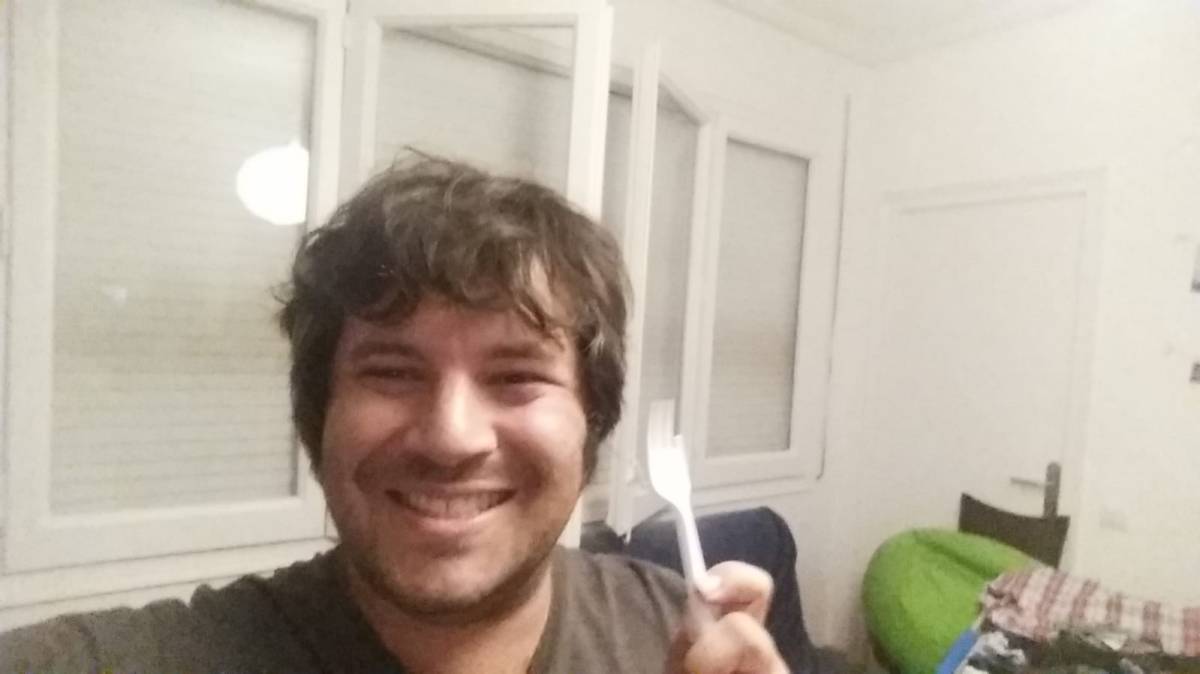
As I headed out, she packed my bag.  She gave me two forks- I asked why.  And she said “just in case.”  I’ve kept the second one in my bag since.  It’s in my cover photo.  A reminder of her kindness.  Of good people.

She was so excited for my trip.  Rather than some people who get caught in jealousy or assumptions about my wealth (I have about $200 in my bank account now), she was just pumped.  I loved it.

I told her to travel one day.  And most of all, thanked her for caring about me.  I said something I truly meant:

“Necessitem més gent com tu al món”.

We need more people like you in the world.

You could feel her smile from meters away.  (Yes, I think in meters now- and I even kind of understand Celsius…and write my dates with the day first!  I even messed up an American form once by putting it the international way!)

I headed out feeling great.  It wasn’t what she gave- it was that she did.

On my way home, I found another bakery open.  What a relief!

I got some whole grain bread and a yummy donut.

The woman behind the counter didn’t quite have a Catalan accent when I spoke to her in Spanish.  I love accents- I have an ear for detecting them.  So do Andalusians- some of them thought I was Catalan when I spoke Spanish because I pronounce my “s’s”.  Although I’ve gotten pretty good at breezing by them after some time in Almería. 😉

Turns out she moved to Spain when she was 12.  From Romania!  She’s from Oradea- a city I actually visited!

It was surreal.  What are the odds?  I don’t think I’ve met another Israeli or American who has been to Oradea. (Correction- I met my friend Aryeh there.  Props, Aryeh)  It is not a major tourist destination by any stretch of the imagination.

We spoke about Romania- how she wants to travel there.  It doesn’t sound like she has been back much since she was a kid.
In fact, she asked me what it was like.
It’s at moments like these where I feel privileged.  I shared with her my travels, the beautiful views.

She loved it.  You could feel how excited she was to travel there.

And what’s so astonishing is there wasn’t one bit of jealousy, nor shaming, nor anger.  She was so excited I was on a journey- and I encouraged her to find even a week to do the same.

She agreed.  She wanted to see her homeland.  And I hope one day she does.

It kind of brought things full circle.

I started my journey, at least this one, in Romania.  I suppose we’re always on a journey, but this leg started there- in one of my ancestral homelands.  The land my great-grandmother was born in, whose language she spoke, where she escaped from in the midst of intense anti-Semitism 130 years ago.

Thanks to her intuition and bravery, I am an American.  I’m an Israeli.  And I’m alive, unlike the hundreds of thousands of Romanian Jews murdered in the Holocaust.

Just 80 years ago, there were 750,000 Romanian Jews.  Today, 3,271.

It reminds me of a lesson I learned in Romania.

I was in a rural village outside Cluj Napoca.  The only tourist for miles around.

And like in many parts of Romania, I encountered aggressive, wild dogs.

The first man I met while encountering these dogs laughed at me and told me not to be scared.  As the dogs followed me.  Only after I protested did he help me shoo them away.

Later that day, I encountered more dogs.  Quite scary- Romania has a serious wild dog problem dating back to Communism.  And there are also quite a number of aggressive guard dogs.  Frankly it has made me concerned at times to see how people treat animals.  I’ve seen people beating dogs in several countries.  It’s horrifying.  I’m not exactly a PETA activist, but after seeing cute cows and how people treated dogs, I’m not eating much red meat anymore.  It’s different when you get to know the animals we share this planet with.  Who deserve as much kindness as any other living being.  We are animals, something we often forget.  And some people mistreat each other as much as they do their dogs.

The second time I encountered the dogs, a nice man came out and taught me how to handle them.  After having gotten lost in a forest earlier that day, I was pretty tired and scared.  And grateful for a little help.

He taught me to never turn my back, or I’d look like a victim.  And become one.

Stare the dogs straight in the face.  Turn your body if necessary.  But never turn around.

This is how I live life.

I’m a survivor.  I have overcome incredible obstacles.  Escaping a family that abused me for 30 years day and night.  Healing from PTSD.  Immigrating to Israel and starting a completely new life.  In Hebrew and Arabic and Yiddish.  Learning there that I loved to explore and travel.  Starting a new blog.  With tens of thousands of readers now- from Saudi Arabia to Salt Lake City.  Which I’m trying to turn into a career- and it’s hard.  Please consider contributing here to give me the same energy the woman gave me with her croutons.  The amount is not nearly as important as whether you give.  Like the airy croutons that barely filled my stomach, it was the thought that counts.  Show me you care.

The past two months, I’ve traveled completely on my own.  In Romania, Hungary, Slovenia, Belgium, Luxembourg, Andalucía, Valencia, and Catalonia.  I planned everything myself, I paid for it myself, I escaped a wolf, a viper, and a crazy woman in Belgium who put me on the streets of a village at 9pm.

I made it.  As I sit at my computer, I can’t say I’m surprised, although I am filled with a certain amazement.

I have carried nothing but a small backpack- and occasionally a plastic grocery bag.

I realized I don’t need much.  I kind of miss my books, but I actually find having three t-shirts kind of refreshing.  It helps me focus my energy on the choices that really matter.

I’ve been without the capacity to make phone calls for about four weeks.  I have some data from a Belgian SIM card.  While it can be beneficial to be able to call sometimes, it’s also kind of a relief.  I’ve discovered I like turning my phone off entirely occasionally.

This, in addition to the fact that I’ve barely used Facebook in two months, has helped me connect to what’s around me.  When I’m having a great time, it encourages me to talk to people I’m standing next, to gaze a bit longer at the sunset.  To ask for directions instead of staring at a screen.  Sometimes resulting in really nice conversations that made me feel less alone.  How else would I have met an Albanian grocer in Slovenia?

When I found myself in bad situations, being present helped me realize I didn’t really want to be where I was.  I cut my Romania leg short because I realized try as I might, I wasn’t going to make Romania more fun for me.  Instead of escaping to the temporarily comforting world of social media, I hopped on a bus to Hungary which I booked at 3am.  And got on at 1pm the same day.

Which took me to Budapest, where I connected with Hungarian Jews who taught me about my own heritage.

The only reason this happened when it did (I had no plans to visit Budapest at all) is because I wasn’t using technology.

Sometimes when I missed my friends, I found it useful to use WhatsApp or Facebook messenger.  I’m not orthodox about my technology- it can be useful sometimes.  But even when I used it, I was able to build deeper relationships with people by contacting them directly.  Instead of passively posting things on a mysterious wall, not knowing who might see it.  And assuming everyone had.

Even people I felt geographically far from, I managed to build closer relationships with.  If you ever doubt it, turn off your social media and see how you feel.  It’ll change your life and reorganize your priorities.  I feel different today because of it- and I don’t miss it often.

Occasionally, though, it really lights me up.  The other day, I was interviewed on Catalan radio by a producer who found me in a Facebook group.  By coincidence, I happened to be in Catalonia.  Felip wanted to talk about Israel- and I gave him 30 minutes of nuanced, pro-Israel information in Catalan.  You can test your comprehension here 😉  Episode from October 23rd, about 11:20 in.

Felip told me Catalans have a thirst for learning about Israel.  So I then made a 30 second video about Israel’s diversity on Twitter.  Catalans, like a lot of minorities who can’t get fair visibility off screen, love Twitter.  Within 2 days, it has gotten 10,894 impressions.  The video- 2,732 views.  And countless beautiful thank you’s from Catalans- including in Hebrew!  Catalonia- you can count on me to be in touch.  I’m moved by your interest in my people.  And you already know how I feel about yours 😉

Screen Shot 2018-10-25 at 6.49.53 PM.png

This is how I live.  When I see the anti-Semites on the far left and far right coming for my people, I stare them in the eyes.  Like the wild dogs of Romania.  And like the nice man did for me, I empower others with knowledge.  To protect themselves and fight for truth and kindness.

And when you can’t stare them in the eyes, and you need to survive, give them an arm, give them a leg.  But never give them your life.

I’ve found a real deep connection and appreciation for people like the Catalan woman who gave me two forks and some croutons.  When she really didn’t have anything to give me, she gave me her heart.

You don’t need money to be nice.  It doesn’t cost a cent.

As I reach the next stage of my journey, I find myself at a fork.

And I think of and thank the people who’ve helped me along the way.  Giving me directions, hitch hikes, a couch to crash on, food.  And most of all, love.

I can’t say my journey has always been easy or fun, although I have gotten some really relaxing moments in between the figuring out what I wanted in life, reconnecting to Judaism, trip planning, dealing with Bank of America stealing my money, and healing from trauma.

20180911_125307.jpg

The best thing I got from this trip is a better understanding of myself.  A feeling of increasing integration within, of healing, and of growth.  Of knowing who I truly am when no one is around me to force me to do as they please.

Whether you have two months or two hours, make time for that.  No matter how hard people push against you or tell you what the right path is.

Because the only person who can choose the right fork is you.

Or a nice woman in Tortosa packing your warm spaghetti with an even warmer heart.

==

P.S.- as I write this blog, I’m jamming to my favorite music, Manele.  To bring things truly full circle, it’s the fourth topic I’ve ever blogged about.  Four years ago.  I brought my passion for Romania to life, by visiting!  Pursue your dreams relentlessly 🙂  I hope your next “I wish” sounds less like a sigh, and more like a desire.

Bediavad – in retrospect

Bediavad is one of my favorite Hebrew words.  Possibly because it’s the name of one of my favorite songs– a song I’ve been listening to on my iTunes for over a decade.

It means “in retrospect”.  Looking back.

After traveling in Europe for almost two months, I have some thoughts on Israel I didn’t have when I left.

When I left Israel, I was pretty angry.  After seeing my hopes for gay rights shrivel in the face of self-righteous rabbis, after seeing my government go after refugees and Druze and Arabs for being non-Jewish minorities, after seeing some particularly egregious and abusive behavior, I had had it.  I had had two different landlords try to steal money from me.  Israel sucked.  And it was time to get out.

I expected Europe to be much easier.  And I was wrong.  That’s Israeli humility- acknowledging when things aren’t what you expected.  When a new perspective helps you change course.

20181021_192244.jpg

Europe is a really, really hard place to a Jew.  An ever harder place to be an Israeli.  While it is certainly relaxing to enjoy gorgeous nature, to reconnect with the concept of personal space, and to take the rocket alert apps off your phone, it is not as easy here as I expected.  Take a quick look at my posts from here and you’ll see there is a lot of hardship for Jews here.  A lot of irrational hatred of all things Israel.  Especially by people with fancy degrees, fashionable clothes, hipster attitude- far leftists.  Like the ones yesterday who chastised me for wanting to take a photo of leftist graffiti on their house.  I apologized, I didn’t understand it was their home.  And I said I wouldn’t take a picture.  One woman then told me it was “more radical” to graffiti churches, town hall, and banks.  Their fancy historic home in the Barcelona suburbs didn’t mean they were “rich”, it was the fruits of their hard work, and it was “rude” to desecrate it.  But to do so to other people’s property was totally acceptable- and encouraged.

When I suggested that damaging property is generally a bad thing all around, the woman grabbed my arm, twice.  Completely unprovoked.  After telling her not to after the first time.  She then laughed at me for asking not to be touched.  I doubt she’d feel the same if I violated her space.  As I walked away, they shouted things about me being American.  It’s a good thing I didn’t tell them I was Israeli.  To be an Israeli in Europe is to often live a closeted identity.

The psychology of the far left is the same as the far right in that they are abusive.  The only difference I can tell is the people they hate.  The far right hates gays, immigrants, Muslims, diversity.  The far left hates Israelis, banks, corporations, rich people, and quite often the religious.  And they both hate Jews.  Perhaps the only group they hold in common.  Both groups demand extreme sensitivity to their issues and evade empathy for anyone outside the purview of what they deem as morally acceptable.  It’s a childlike black-and-white thinking perhaps in some ways is meant to protect.  On some level, I understand it- certain groups of people are more likely to be a source of pain than others.

But this thinking alone is ineffective as it immediately renders millions of people off limits and condemned, creating more pain and suffering.  People who boycott Israel have this mentality- lumping together 8 million different people under the category of “wrong”.  While never bothering to consider whether their own countries are worthy of boycotts- or whether boycotting an entire country is ever really fair to the diverse people and perspectives residing within it.  Privilege can be a useful concept in understanding people’s power relative to one another.  But when it becomes weaponized as an entire ethical system, it falls short because nobody is wholly privileged or unprivileged.  And it just creates a lot of guilt instead of progress.  Perhaps not coincidentally, it is often wielded by ultra-wealthy highly educated people who are unwilling to acknowledge or grapple with the benefits they themselves enjoy.

So I’d like to return a moment to the story I shared above about the psychotic left-wing woman grabbing my arm at night in a suburb of Barcelona.  Ranting about how great it is to desecrate other people’s property, complaining about it being done to her, and invading my own space in the process.  This is all true- and important to share.  If you’re a Jew, if frankly you’re any kind of “undesirable” traveling through Europe, you need to be aware that certain types of people are more likely to hate you.  The far left is one of them.

At the same time, I’ve been looking over my writings from when I left Israel for this trip.  It’s clear to me the writings were therapeutic- my blog always is.  Which is why I love it.  And after seeing the depth of anti-Semitism camouflaged as anti-Zionism, I realize it’d be quite easy for someone to weaponize my words against me and my people.  I didn’t understand the intellectual vacuum some people on this continent live within- and how my genuine, heartfelt critiques of Israel could be used against the country as a whole.  Rather than seeing them for what I intended them to be- thoughtful, emotional, personal critiques of a place I love and want to make better.

So in that spirit, first off, I’m going to say that I’m going to try to keep in mind my experiences here when writing about Israel in the future.  Not because I intend to shy away from critiquing my government or society- I think it’s important to do so.  I’m not a voice for conformity or silence in the face of barbarity, nor is outside hatred an excuse to paper over real problems.  What I will say is I’m worried about people taking my words out of context.  I do not under any circumstances want them to be construed as supporting boycotts- which are definitionally anti-Semitic in only targeting the Jewish State.  While dozens of other states do the same or far worse- even in Europe.  Where Jewish cemeteries are regularly desecrated, where synagogues have been turned into casinos, and anti-Semitism is at levels not seen since the Holocaust.  With little public outcry.

If you are only boycotting Israel, you are engaging in anti-Semitism, whether you realize it or not.  And after seeing the psychology of boycotters here in Europe, I understand that better than I did while in Israel.  A stressful place where it can be hard to remember the very real problems occurring outside the country.  The bigotry and hatred that lives in other corners of the planet.  Sometimes shrouded in a soft-spoken “please” and “thank you”, but at its core, sometimes as vicious as anything I’ve seen in the Middle East.

At the same time, I want to take this lesson and apply it to this very post.  I’ve shared with you my experiences with anti-Semitism here in Europe.  It is very difficult to be a Jew or Israeli here and my posts these two months show that.  It’s also important to remember not to deny and not to feed the flames.

In other words, it is equally abusive to deny the existence of hatred as it is to suggest it is the only thing out there.  So I’m concerned about extremist Israeli Jews targeting minorities.  And about Europeans hating, boycotting, and attacking Israelis and Jews.  And I’m inspired by Israeli Jews who show compassion and kindness.  Who care about their neighbors of all backgrounds.  Jews who learn Arabic, who see nuance in spite of conflict.  Who have their own pain to digest.  And I’m inspired by European non-Jews who preserve our heritage and care about us.  I also like people like Greg, the Polish neuroscientist who wants to visit Israel and made my bus ride to Slovenia one of the best conversations of my life.  Like Marko, the Slovenian cell phone salesman who now wants to visit his city’s Jewish museum after chatting with me.  Like Amira, the queer Jordanian girl who went to her first gay club with me, knowing I was Israeli.  I even met a Romanian girl who wants to learn Yiddish!

In the end, I will not claim, as some do, that most people are good people.  And not to fear.  Because there are scary people out there and anti-Semitism dressed as anti-Zionism is very much a real thing.  There is also Arab anti-Semitism here in Europe that has nothing to do with Israeli policy.

I will also not fuel the flames that suggest everyone hates us.  Because not everyone does.  There are non-Jews I’ve met here who are open-minded, who are even actively engaged in keeping our heritage alive.  A heritage sometimes painful for us Jews to connect to, but one that has deeply enlightened me as to my place in the world.  A tough trip at times, but well worth it.

I would wish this same nuance for my friends on the far left.  To see that Israelis are not as simple as black and white.  That we come in all shapes and sizes, with different ideologies and identities.  Some perhaps to be feared or condemned.  And others not.  And a whole lot of people in-between.  Perhaps what I wish more than anything is for Europeans to understand us.  And to understand the Jewish history under their very feet.  Not to necessarily love or hate us, just to actually know something that might prevent them from jumping on us, from thumping us.  To be less like Jeremy Corbyn and more like Josep, the gay Valencian left-winger with a Hebrew tattoo and a nuanced passion for Israel.

As an Israeli, I’m offering you my ideas.  Not to wholly agree or disagree with them, but simply to share my perspective and hope you’ll consider my experiences.  That my stories will give you insight and inspire kindness and understanding.

Because when you live in the middle space, you realize that it’s detrimental to always categorize people.  And that sometimes, to protect yourself, it’s wise to.

An eerie and scary space where reality can be as hard to manage as the rigid ideologies that separate us from it.  In a time of increasing polarization, a space I believe is worth fighting for.

==

My cover photo is a picture I took in Blanes, Catalonia.  A surprising pro-Israel graffiti that says “am yisrael chai”, the people Israel lives.  In a place where no living Jewish community exists.  Our hope sprouts even in the most arid soil 🙂

What it means to be Israeli

It was a Friday night in Barcelona.  Just hours before, I had spontaneously decided to board a train from Tortosa to Barcelona.  At 4:30pm, to be precise.  I had thought about visiting other medieval cities and Jewish quarters, but I felt that this Friday night, I wanted to be with living Jews.  Much how I felt in Belgium.

So I went to services.  Like I’ve mentioned recently, I don’t really feel religious.  I started my journey to Israel weeks away from starting Reform rabbinical school, only to pursue my exploring and blogging instead.  But I remained an active Reform Jew, even leading services regularly in Tel Aviv.  And to this day, even if I’m not religious in the textbook definition of the word, if I’m going to a synagogue, it’s going to be Reform.  It’s my flavor of religious Judaism.

While for a while I came pretty close to being an out-and-out atheist, I’d say at this point I’m secular and spiritual.  I have issues with organized religion (although I sometimes see its benefits both in motivating people to do good and in building community) and I don’t believe in the God of reward and punishment as written in the Torah or any religious text.

But I do believe in spirit, and while I value science and logic, I think some things are a bit beyond our comprehension.  And that feelings are also valid.  And sometimes hard to explain.  Perhaps representing bits of truth beyond our conscious recognition.  It is impossible to truly know everything, so with humility I bow to the unknown even as we pursue it.  In the meantime, I’ll be singing in the forest, poring through inspiring archival documents, and trying to cross cultural barriers to bring kindness into the world.  For me, culture, history, art, music, nature, dance, hope, the unexpected- these are all spirit.  And they ignite me in a way that gives life purpose.  As a Jew and generally, as a human being.

With this in mind, I headed to synagogue.  The prayers generally didn’t speak to me.  I don’t really like the idea of standing together, singing the exact same words, the choreography or the conformity of organized prayer.  Even so, I found myself sometimes bursting into song and some of the texts do speak to me.  Occasionally, I even tried to sing some of the prayers, replacing the word God with something that rhymed.  Sometimes the word God didn’t bother me.  I sometimes sang harmony- a way for me to retain my difference while being part of a community.  I can’t say it made me want to pray in the traditional way.  I even stepped outside for some of the prayers that I really don’t connect with.  I’m kind of a hippie and would rather be singing wordless melodies while strolling the beach.  Like I was in these photos.  But what’s clear now, after traveling in Europe, is that where I found myself questioning if I even felt Jewish two months ago, now I feel quite Jewish.  And have either rediscovered or found new ways of connecting to my spiritual, cultural, and political identities.

I came to Barcelona without any hotel reservation.  In Hebrew, I call myself “ben adam zorem”.  A guy who goes with the flow, who improvises, who’s in touch with his spirit, confident and willing to try new things.  Some of this confidence stems from my own skills and intuition.  Some of it comes from counting on others to help me along the way- being brave enough to reach out to them.  And being grateful for their support.

After services, there was a wonderful dinner and I found myself talking to the other community members.  Everyone was so kind- it really felt like a family meal.  The kind I never really got to have, where I felt respected and included.  Big hugs that made me feel loved and welcomed.

One person in particular made my night.  There was one other Israeli at services.  A young woman named Reut from Hod Hasharon, a city decidedly not on anyone’s tourist map, but I of course had visited 😉 .  We got to talking.  There’s something about being Jewish- especially being Israeli- where you just trust someone.  Maybe it’s a shared heritage, understood customs, experienced persecution.  Maybe it’s a feeling in your kishkes, as I shared with a wonderful, spirit-filled American named Anne sitting next to me.  Anne if you’re reading this your email didn’t go through, send it again! 🙂  We had so much in common yet had never met.  It’s a great feeling.  I even got to play Jewish geography- I met a Hungarian woman who knows a Hungarian friend of mine in Tel Aviv!  And I’m a quarter Hungarian.  How’s that for full circle?

So back to Reut.  We found ourselves outside in the rain.  I told her I didn’t have a hotel booked for the night, so without even prompting, she got to helping me.  That’s how Israelis are.

We walked around asking at hostels- everything was full or over 100 Euros.  After some funny moments (including this odd Moldovan guy working the front desk who seemed to be hitting on me but then didn’t want to go out with us the next night- wherever you are Iulian, you’re really cute and I hope you come to Israel!), we headed to the Metro.

It was very simple- Reut said I could stay with her.  Reut isn’t even from Barcelona- she’s just here doing some Israel education.  It needs to be said again for the benefit of my friends in other countries- we had never, ever met before.  No known friends in common.  Although we both happen to be Polish, Romanian, and Hungarian- so in all likelihood, we’re probably related several times over.

We stayed up all night talking, having a blast.  We had so much in common.  Sharing love stories, stories of loss, making our way through the Barcelona rain, trying not to slip.

When I got to her apartment, Reut got to setting up my bed.  Putting on a new sheet, feeding me, taking care of whatever I needed.  And because I’m a fellow Israeli, I understood that this is how we do things.  I’ve hosted people I’ve met the same day several times in Israel.  It’s something I rarely see in other countries (although it has happened to me in Barcelona incidentally).  There’s just a sort of trust and bond.  A deep generosity, hospitality, a sense that wherever you find one of your own, you’re home.

It’s not because all Israelis are great.  Some are pretty awful.  Every country has its good and bad, every culture too.

But there are certain overall cultural differences that really stand out.

Israelis, as a whole, are kind of lone travelers like me.  Or once were.  Holocaust survivors who sometimes lost their whole families only to start anew in a completely new country.  And build once again.  Jews kicked out from Arab lands thrown into the tumult of conflict, cultural loss, and war.  We’re survivors, we’re scrappy, and we use whatever we can to move forward and to make the best out of life.  In that sense, I’ve always been Israeli, even when I was across the ocean.  It’s just that moving to Israel, I found millions of other people like me who had overcome (or are striving to overcome) deep hardship and using every last skill to squeeze the sweetness out of life.

In this sense, I feel my personal story as an individual and a Jew parallels the experience of the Jewish people.  In particular, of Israel itself.  A scrappy start-up nation where, for the most part, people understand that a Shabbat meal with people you love is more important than the size of the home it takes place in.

Today I enjoyed a street fair with Reut and some of her friends from synagogue.  An Argentinian Jew and a Turkish Jew- themselves wanderers like me.  Here we were- at face value, nothing in common.  But in reality, everything.  Our Jewishness brought us together and if I’m honest with you, made us instant friends in a way no other identity can for me.  Although some come close.  It’s not that we’ll necessarily be best friends- thought we might.  It’s just that there’s a certain baseline comfort that’s beyond words that you can just feel with another Jew.  It’s in your kishkes.

My experience with Reut’s generosity- even as I write this, I don’t even know her last name- got me thinking.  This trip and my experience in Israel has tested my original thesis.  My first thought when coming to Israel, when starting this blog, was that one needs roots.  That’s why my chosen Hebrew name, Matah, means orchard.

Yet what I discovered is no single place, no single culture, can fully satisfy me.  In fact, I discovered I have roots all over the place.  Directly, in 8 different European countries.  Indirectly, basically all over Europe and the Mediterranean.  Renewed, in my appreciation of my American identity.  And kindled and rekindled in my Israeli one.  In addition to all these roots, my linguistic communities and my passions for art and music and nature and kindness connect me to all sorts of people, Jewish and not.  And I look forward to developing those connections as well.

So perhaps, in the end, I don’t need to be rooted in one place.  By virtue of my identities, my diversity, my curiosity, my past, my intellect, and my sense of adventure, I don’t think I ever will be.  Although we can never be quite sure what the future holds.

This thirst for a multifaceted life is my strength and my challenge.  I’m a wanderer, an explorer- as Jews have been for over 2,000 years.  This is who I am.

While I might not need roots, what I did discover is I need a home.  Traveling is amazing- I’ve been carrying only a small backpack (not even one of those big ones you buy for Nepal) for 2 months.  I have three t-shirts.  A sweater.  One pair of shorts.  A pair of shoresh sandals which an Israeli can spot from a mile away.  No sneakers.  One pair of socks.  My jeans got torn up, so I threw them out.  This is how I travel.  I love it.  It’s what I need, and I’d rather have a lighter backpack to explore more places.  I’m rugged, flexible, and I think I have my priorities straight.  For me, it’s about the journey, not the froufrou.  Although I will say I’ve learned to appreciate the value of a a once-in-a-while well-timed stay in a 3 star hotel.  Quiet is something frankly you have to buy.

Traveling this way has taught me a lot.  And the most stressful thing about traveling without a home to recharge in is the constant movement.  Adapting to new languages and cultures and emotional norms.  But also the transit, the not knowing what the city will be like, the not knowing how quiet your sleep will be- if you’ll be able to sleep at all.  The motion.  It’s sometimes exhilarating, sometimes exhausting, occasionally really stunning when you look out the window and see a gorgeous view of the Mediterranean on a 10 Euro bus ride taking you through the mountains.

So in the end, I’m sure I will keep traveling.  To be honest, each day is a bit of an adventure to me.  Whether it’s physically going to another city or chatting with people at the library, I find ways to engage in new and exciting directions.  Sometimes my friends ask me how these stories happen to me.  But they don’t- I am the kind of person who these stories were made for.  Sometimes I seek them out, sometimes they find me.  And I connect with people in a way, I reach for the kind of people and places that fill me with joy.  I search for understanding.  It can bring the unexpected, both good and bad.  I was made to discover.  Myself, others, and the world.  And I love sharing it with you.  And am inspired by what you share with me.

I hope you’ll continue to join me on my journey as I turn my blog into my career.  As my cover photo says, “what happens on Earth stays on Earth”, so I intend to make my mark.  By donating $20 now, you will get your first year’s subscription free.  Soon, the starting rate will go up to $36.

So I may not need roots that stick me to the ground and restrict my movement.  Some Zionist thinkers might not like this- that I choose not to give up my other identities, my Diasporic features.  But I’d rather be like Israeli poetess and fellow olah Leah Goldberg who speaks of the pain and joy of having two homelands.  I’m grateful to my friend Leora for sending me that poem when I needed it.

By understanding my varied roots around the world, I better understand myself, my people, my countries.  Israel itself.  An ongoing process and one in which I feel I’ve made great progress.

What does it mean to be Israeli?  That’s the title of this blog.  For me, after going several months without seeing another Israeli, Reut embodies what it means to be one.  In the best way.  It’s someone who after a short conversation, helps you find a hotel.  When you realize there is none, invites you to stay.  Who feeds you, who hugs you, who makes a bed for you.  And invites you out to hang with her friends the next day.

Roots can be tangled, messy.  But a home- you need one.  To venture out from, to explore from, to come back to at the end of the day or after a long and exciting trip.

The world is my oyster.  Who doesn’t like to taste a little treyf?  But most of the time, I don’t eat shellfish.  Which is why more and more, I feel Israel is my home.

Let’s talk about occupation

I want to share an experience I had in Tortosa, Catalonia.  Some call it Spain, for now I’ll stick with Tortosa 😉 .

Tortosa is a city that used to have a sizable Jewish population.  Before the Inquisition and related persecutions, Tortosa had a “call”.  That’s pronounced “caly” (for lack of a better way to write it in English)- and it means “Jewish quarter”.

I decided I wanted to go for a hike.  Tortosa is surrounded by gorgeous mountains, take a look:

20181018_14195620181018_142125

I love nature, but I found myself increasingly drawn to the signs around me that said “call”.  They’re everywhere.  Something I love about Catalonia is that quite a number of cities make preserving their Jewish heritage a priority.  Unlike the mostly derelict synagogues of my great-grandmother’s Romania, Catalans seem generally proud of their Jewish heritage.  Because quite a number of them are Jews themselves- or were hundreds of years ago.  And they know it.

I wandered the call, finding where the synagogue once stood, the kosher butcher shop, even a plaza named after a rabbi, Menahem Ben Saruq.

I found myself humming Jewish tunes, including one of my own creation, and being stared at by some Moroccan men.  Almost the entire neighborhood now is filled with Moroccan Muslim immigrants.

I then headed to the town archives.  I love, love, love archives.  And I want to give a huge shout-out to archivists everywhere.  You keep heritage alive.  Science is amazing and can heal and grow our planet- but without humanities and a sense of morality, it is useless.  Ben Carson is a great example of why science is not a religion, it does not have all the answers any more than any other field of study.  Scientists need ethical systems just as much as humanists need biology and medicine.

The best thing about town archives, other than the ancient documents they contain, is that they are free!  So here’s my travel tip: if you find yourself itching to see unique, cool texts and really learn about where you’re traveling, head to an archive.  If it’s a rainy day (as it was for me), even better.  I walked around Tortosa with a piece of generously donated cardboard over my head until I could find a 9 buck Mickey Mouse umbrella. 🙂  Archives are my refuge.  And unlike museums, you won’t be shelling out tons of cash to wait in line and crowds.  Archives are often quite empty- sad for the state of humanity, but great for someone like me who likes a little peace and quiet.  All you need to do is fill out a form, show your passport, and next thing you know you’re looking at a hand-written 900 year old document.

That’s where I found myself.  The archivist brought me the “Carta de Poblament”.  It’s a Catalan document that the Count of Barcelona had offered the town during the medieval Christian conquest of Spain.  It basically offers new settlers various land privileges and natural resources for settling the territory.  Until then, it had had Jews, Christians, and Muslims.  But with the eventual imposition of the Inquisition, both Jews and Muslims had to convert, leave, or face torture and death.  Their empty houses became the Christian settlers’ homes we see today.  Occasionally, as in Granada, you can still see where the mezuzah was once hanging.

20181012_1344151

I then looked at the next documents I had requested.  I wanted to see Jewish documents.  And in some cases, you can still find them in Catalonia.  I once visited the Girona Jewish archive (the city has a particularly well-preserved call) and got to see documents in Judeo-Catalan!  Catalan written in Hebrew letters- and in some cases, with Hebrew phrases.  For a Jewish speaker of Catalan like me, there is nothing cooler.

The first document was in medieval Catalan (did I say archives were cool??) and was about the Jewish community of the city.  The next document was from 1323 and detailed how the local rulers had imposed a tax on the Jewish community to repair a broken wall.  I’m not sure exactly what happened, but Christian rulers (and Muslim ones) often imposed discriminatory taxes on Jews either as “protection money” or simply to raise cash.

The third document is the one that stirred my soul.  It was called “Població de convertits”.  A list of the Jews who had converted to Christianity.  Often under penalty of death.  From the early 1400s.  I have to say that seeing the hand-scribed names really moved me.  I felt deep sadness as my finger scrolled through the names of Jewish souls lost to an ever-encroaching Christian hegemony.  I wish I could say this was only a Christian problem, but it’s not.  Even the relatively tolerant Muslims of Al-Andalus engaged in pogroms, massacring the Jews of Granada in 1066.  A thousand years before the State of Israel, for people who think Muslim anti-Semitism is a recent phenomenon, purely a product of colonialism.

As I flipped through the pages, I wanted to find a specifically Jewish name.  It’s almost as if part of me couldn’t actually believe this document was real.  That maybe I had been given the wrong one.  Persecutions of Jews are often invalidated, ignored.  This must be just history books, it doesn’t feel totally real.  I couldn’t believe I was holding an ancient text of suffering, of my people, for free in a municipal library.

And there it was- Abram.  Abram and his son converted to Christianity.  I paused looking at the name.  I thought about how awful it must have been to be a Jew at that time.  What must have been going through his head and he decided between expulsion, death, and embracing a faith that so hated his identity.

And there it was, his conversion.  I felt sorry for him- and kind of angry.  How could he give up on our tradition so easily?  I’m sure it wasn’t easy.  But I felt torn.  And I felt furious at the authorities who forced him to give up who he was.  His soul, and those of his ancestors, are forever lost to the Jewish people.  Like so many others.  So when quite a number of Latinos or Spaniards I’ve met say that Jews are “racist” or “closed off” for only marrying “their own”, this document is my bold counterargument.  We only exist because we preserve ourselves.  Your people have been nothing but obstacles in our way for hundreds of years and I won’t apologize for keeping my identity alive.  I’m grateful to the non-Jews I’ve met here in Catalonia and Spain who are working to keep our heritage visible.  Thanks to them I can connect to my past- and they connect to me, as you’ll see in my recent post about a gay Valencian man I met with a Hebrew tattoo.  Who changed my life.

Before I left the archive, I thought if there was something creative I could do to bridge the past.  To make my Jewish ancestors proud.  To connect to Abram and to show the vitality to Judaism to this day, despite all of the hatred placed in our way.

When I left Israel for my travels two months ago, I could barely utter a Hebrew (or Arabic) word.  I was so tired of the region, the hatred, the intense pressure to assimilate into Israeli society.  I had chosen a name, Matah, when I made aliyah.  It means orchard.  It sounds like Matt, but is different- it’s about planting roots.  The name of this blog.

In Europe, I’ve been going by Matt.  Occasionally, Mateo.  But this day, I was going to reconnect.  I took a piece of paper, and added a nice touch to the 600 year old remnant of my civilization:

20181018_170003

Right next to Abram’s name, the second line from the top, I wrote my names.

מטע אדלר

Matt Adler

Jew. Jueu. יהודי.

I think Abram would have been proud.  I certainly was.  Half a millennia since the expulsion of Jews from this land, I was here, a proud Israeli visiting from the land of our ancestors.  Living with self-determination after two millennia.  Something Abram could have never even imagined.  And here I was alive in his home of Tortosa.

It’s a reminder that the impossible is sometimes possible.  History changes.  And each one of us can make a difference.

As I left the archives (still with the cardboard box over my head- one of the funnier moments of my trip until my feet were soaked in rainwater), I headed to the cathedral.  There I found a 1300-year-old Jewish gravestone in Hebrew, Latin, and Greek.  With a Menorah and, interestingly, a *5* pointed star:

20181018_174936

What’s so amazing is I could mouth out some of the words.  “Kever”- grave.  “Shalom”- peace”.  And “livrachah”- for a blessing.  The last word something we say to this day as we remember loved ones in synagogue.  A stunning reminder that even when the most hateful among Christians and Muslims stole our land, expelled us, and killed us- we held on to the one thing that kept us alive: words.  Evidence of our continuous presence on this continent, one that has tortured us.  But where we have ultimately persevered in existing.  Even if our current existence there is tenuous.  How many people can see a 6th century tombstone and recognize the words from today’s liturgy?    We’re a truly special people with an incredible historical memory.

As I headed home, I felt hungry.  I stopped into a kebab place.  As with many stores here, it was run by Muslim immigrants.  In this case, from Pakistan.  I have had some difficult experiences with Muslims in Europe.  I was curious before going on this trip what it would be like- both figuring that Europe was kind of a neutral space for potential dialogue and aware that there were many reports of anti-Semitism.  I was also keenly aware that I had to be careful in saying where I was from.  While an American Jew can hide behind their red, white, and blue passport, when you say you’re Israeli, people know you’re a Jew (even if you’re not!).

I’ll start by saying I’ve had some incredible experiences with Muslims in Europe.  I went clubbing with a queer Jordanian girl, who had never been to a gay club.  And she knew I was from Tel Aviv- and we’re still in touch.  Our sexy curves swerving on the dance floors of Budapest.  I also met a Syrian refugee there, who lifted my spirits as we chatted in Damascene Arabic late at night over shwarma.  And who I told I was from Tel Aviv.  And had a great time.

I’ll also say I’ve had a difficult time here.  More often than not, I don’t reveal I’m Jewish or Israeli to Muslims here.  By the decoration of their stores and their clothes, I can tell they are quite often devout.  And just the other day, a woman 10 minutes down the road from where I stayed in Belgium was threatened at gunpoint by a “bearded man” for being Jewish.  I wish I could say this was the only incident of Muslim anti-Semitism here, but it’s not.  Just a few years ago, the Belgian Jewish Museum I strolled by was attacked by Islamic terrorists, killing several civilians.  Anti-Semitism is on the rise in Europe (including from neo-Nazis), and many Muslims’ pointed questions about where I was from didn’t make it any easier.  More than a few times, they didn’t believe me when I said I was American- I didn’t “look” American.  Sometimes they think I’m Arab, other times they ask me what my religion is.  Repeatedly.  Which is incredibly uncomfortable and invasive.

Just the other day, an Algerian immigrant told me Israel and America *started* the Syrian Civil War and he didn’t believe Iran or Russia was killing civilians.  Needless to say, I’m glad I didn’t tell him I was Israeli in his kebab shop at 11pm.

I’ll add that I find it doubtful that many of these immigrants know the Jewish history of the land they live on today.  Despite the many signs covering their neighborhood explaining it.  Quite a number of Christian Europeans don’t either.  It struck me as bizarre and sad to see hundreds of Moroccan men walking around the Jewish quarter of Girona.  Seeing them wasn’t bizarre- what was more bizarre was the fear I felt in even singing a Jewish song there.  I couldn’t even get out the melody as two men stared.  Maybe they didn’t know what I was singing- but if they did, would I even feel safe?  Do they care that they live on this land bathed in the stains of our blood?  In fact, both of our blood?

It’s times like these where I feel distant from Muslims, from Arabs.  I’m someone who has invested a lot of time and energy in dialogue and exploring this civilization, as you can see from my previous blogs.  Sometimes it is fruitful and lot of times, it is painful.  We’re like two conjoined siblings who wish they could get away from each other, but can’t escape our shared past- and present.  I sometimes wonder whether learning Arabic was a waste of time, even as I miss the sounds of the language, the beats of its music, even fighting for the rights of Arab-Israelis and my Palestinian neighbors.  Some of whom would rather see me dead.  Who some extremist Jews wouldn’t mind dead.  It’s an odd yin-yang of hope, fear, love, and hatred.

So it was timely that my friend Muhammad called.  Muhammad is a 20-something kid from Rahat, a Bedouin city in southern Israel.  I met Muhammad while asking for directions in his town- I was trying to find a restaurant.  A delicious, delicious restaurant.  Bedouin food is quite different from other Arab food- if you’re in Israel, go to Mansaf restaurant at the entrance to Rahat.  Your life will be changed and your taste buds will thank you.  As will the friendly people there who wanted to take selfies with me.

Muhammad and I have kept in touch over the past 6 months or so.  We even met up again in person.  I knew he was studying for his college entrance exams- he wanted to study accounting.  A few months ago, he got in!  I’m so proud of him.  He just moved to Ramat Gan and starts school this week.  Love you man!

To say this is a culture shock and a brave move is a deep understatement.  Rahat is extremely traditional and entirely Bedouin.  Despite living in the same country as Jews, Muhammad has had limited interaction with them.  So moving to Ramat Gan, perhaps one of the cities with the highest percentage of Jews in the country, will be quite a shock.  Some ways good, but a huge change nonetheless.

Muhammad has managed to get an apartment (something that took me months in Tel Aviv) and find two jobs!  On his own.  I helped him along the way- on WhatsApp.  From my AirBnB in Oradea, Romania, from Hungary, from Almería, and from Tortosa.  I’m so proud of him.

Which is why it was a punch to my gut to hear what he had to say on the phone.  Muhammad went for a job interview in Ramat Gan.  He was offered the job, but the boss said: “our establishment has a lot of religious people, so we need to give you another name.”  Muhammad was a name some people just can’t bear to hear as they’re munching on their hummus and falafel.

Heartbroken, he almost decided to change his name.  He asked me what to do.  I first offered my sympathies.  This is one of the saddest things I can hear- that a young, aspiring young man is being told to cut off his identity.  I’m with you Muhammad.

Secondly, I shared some stories of discrimination I had faced as a Jew and a gay man- in America and in Europe.  The Lyft driver who threw me out of his car for being a gay Jew.  The Muslim man and the Belgian Christian who said I was an apartheid occupier, an ethnic cleanser.  The Argentinian who said Jews control the world.  The Algerian who said Israel did.

He was shocked.  And I think somewhat comforted to feel he wasn’t alone.  See while the reasons we were discriminated against were different, in the end they were the same.  People who hate difference.  People who refuse to see nuance or to empathize with others.

I told him that I love him as Muhammad.  As whatever he chooses to call himself.  And nobody has the right to decide that for him.  He has the right to choose to fight racism, to call a lawyer, to speak with an NGO.  And he has the right to put his energy towards finding a better job where people will appreciate him.  And choosing between the two strategies is not always easy.  I know- I never got a dime from Lyft despite a huge public relations campaign, but I was featured in an amicus brief to the Supreme Court for gay rights.  For a case we lost.  I support Muhammad in being himself, however he chooses to find his way forward.

So you have to ask yourself after all this, what’s in a name?  Abram converted to Christianity- and seeing his name hundreds of years later I spotted him as my landsman.  Matah was a sign of hope for me when I made aliyah, then became a grating sound on my ears.  Until I saw Abram and realized how lucky I was in certain ways to be a Jew at this time, in this place.  With a homeland we can call our own.  And Muhammad- how a brave young Muslim Bedouin man is forging his path forward in Ramat Gan.  Weighing his past identity with his present as he pursues a new future and faces racism.  Holding on to his name even as he wrestles with how to live as a minority.  Something I try to help him manage as someone who can draw on the rich reservoir of Jewish history and gay identity.  Minority persistence.

Muhammad gives me hope that despite my experiences in Europe, there are Muslims out there who like me.  As I am.  A gay Israeli American Jew.  I can’t pretend there are masses of them, but even knowing someone like Muhammad is out there, striving for more, caring about me, relying on me- that gives me a bit of hope.  And warms my soul.

There is a place on this planet where Jews and Arabs live together.  It’s not Spain of 500 years ago.  It’s Israel.  For all its problems, Israel is a place where Arabs know Jews as people.  Not caricatures or cartoons or characters on a soap opera.  Nor memories of 70 years ago, when they used to inhabit the same quarters in Morocco and Damascus.  No, in Israel we live together.  Not always in harmony, but knowing each other.  In a way that, perhaps better than anywhere else in the world, allows me to find people like Muhammad who I can breathe my breathy “habibis” and my deep s “sadeeqs” with.  Where I feel my Arabic is sometimes quite worthwhile.

In the end, what’s in a name?  Occupation is the word you’ll hear most in the news about Israel.  And I’m not going to evade and suggest that Palestinians are not real (that’s a thing), that they aren’t facing human rights abuses (they are), or that some of them weren’t expelled from their lands (some were).  What I will say is that occupation is complex.  As I travel around Europe, I notice all the Jewish lands occupied.  The Jewish bodies and souls emptied.  The synagogues turned into casinos and strip clubs and Italian restaurants.  The Muslim immigrants occupying our former quarters- either oblivious to our former past or some outright hostile to our current existence.

At a time when Catalans feel Spain occupies them (and Spain denies their difference), just how objectively clear is this word?  The far left would have you believe things are black and white, that Israel is an occupier, Palestinians are natives.  But rarely in life are things so clear.  When you visit Peki’in and meet Jews who have been there continuously since the Second Temple.  When you meet Arabs from Ramle who migrated from Libya a hundred years ago.  It’s not to suggest the current situation is good- but it is to suggest it is not entirely one-sided and it does not present simple solutions.

In the end, I also think about this word.  As I travel, one of the great questions on my mind is my own occupation.  How I occupy my time, what I like to do, what I want to do going forward.

Perhaps it’s telling that I recently found this cute sign in Catalan that says: “what do you want to be when you grow up?”

20181018_125345

And I’ve come to what I feel is the next step.  As I write this blog, it strikes me that when I left Israel, I wasn’t sure if I’d continue writing it.  Yet I found myself over and over again enjoying the therapy of sharing my experiences, of writing things down so for years on end I’ll be able to remember my adventures.  To share my thoughts, to bring a little understanding to the world, and hopefully to engage you with exciting, unexpected stories from cultures and languages you want to explore.

Which brings me to today.  I’ve written about 140 blog posts, hundreds of thousands of words.  I’ve received the most wonderful, heart-warming comments from readers in San Francisco, Saudi Arabia, Barcelona, and Bethlehem.

And I’ve shared it for free, out of love and a desire to make the world better.

This is how I occupy myself.  I love exploring and want to keep sharing meaningful stories and thoughts with you.

The way I do that is by asking you to contribute to making it possible.  Thousands of miles crossed doesn’t happen for free.  I’ve invested so much of my own time and money, and to keep things going, to be a member of my community, you now have the opportunity to contribute.

Soon, I’ll be making my blog a subscription site.  The format is being determined, but in one fashion or another, you’re going to have to pay to access this well of hope.  It’s fair and I can’t wait to connect with you on an even deeper level as we use this blog to connect open-minded people around the world.

If you’d like to join now, you have a chance to subscribe at a one-time, more affordable rate.  If you go to my GoFundMe page and contribute $20 or more, you will get your first year subscription free.  Everyone who has donated up until now will be grandfathered in and given a free subscription as well.  If you wait until I transition the site, the price will start at $36.

I want to keep you along for the journey.  I want to show you amazing archives and diverse people.  The unexpected twists and turns.  In 8 languages.  With a queer angle, an open-minded lens.  Proud of Judaism and Israel and willing to engage in nuance.  To make my communities better, kinder.  Understood and understanding.

I invite you to join me.  Or you can always find another gay Jewish blogger who speaks Hebrew, Arabic, and Yiddish and read his blog instead 😉

Let’s explore together. 🙂

הפריווילגיה הישראלית

שלום לכם ושנה טובה.  אני פונה לחבריי הישראלים בפוסט הראשון שלי בעברית.  למי שמנסה לתרגם את זה דרך גוגל טרנסלייט, יהיה לו קשה ולא יתפוס את המשמעות העיקרית.  אז מומלץ יותר לקרוא בלוג דומה (אבל כן, קצת שונה) באנגדלית פה.  או, אפילו יותר טוב, תלמדו עברית

😉

אז בואו נתחיל מזה שאני לא גדלתי בכלל עם עברית בבית.  ההורים שלי הם לא ישראלים.  הייתי בארץ רק פעמיים לפני שעליתי.  ולמדתי עברית בוושינגטון עם מורה פרטית ישראלית כי דווקא אני רציתי.  בעצם היו אנשים במשפחה שלי שלא אהבו את זה שלמדתי עברית וגם התנגדו לעובדה שאהבתי ללכת לבית כנסת.  מי שחושב שזה לא הגיוני שיהודים יתנהגו ככה, הוא צודק.  אבל אין שום דבר הגיוני בהתעללות.

זה בדיוק הנושא שאני רוצה לדבר עליו עכשיו.  אני שורד התעללות מינית, רגשית, ופיזית.  והאנשים הראשונים שהתעללו בי היו במשפחה שלי.  ולצערי לא רק אחד או שתיים.  לא פעם אחת, לא “בטעות”, וכן מתוך רוע.

סיבה אחת גדולה שעליתי לארץ היה כדי לברוח מהאנשים שהתעללו בי.  מגיל 6 אני יכול לזכור טוב טוב את מה שעשו לי.  אני יכול לזכור כשאנסו אותי במשפחה שלי.  חברי המשפחה שלי.  ובוודאי היה נמאס לי.  תמיד היה לי חלום ציוני שרציתי להגשים אותו, אז שתי הסיבות האלה בנוסף להרבה סיבות אחרות הספיקו.  בגיל 31, לבד, עליתי לארץ לפני שנה וחצי. כמעט בלי להכיר שם אף אחד.  אני בנאדם אמיץ.

היו לי חוויות נהדרות בארץ.  אם עוד לא קראתם את הפוסטים שלי בבלוג, אני ממליץ בחום.  דיברתי עם צעירים דרוזים בערבית על הזהות ההומואית שלי.  התפללתי בבית כנסת חסידי בבני ברק- ואני יהודי רפורמי כל החיים שלי.  הלכתי למסיבות גייז עם מוזיקה מזרחית- מוזיקה שנתנה לי כוח לחיות בארה”ב.  כשרקדתי לבד לצלילי שרית חדד בחדר שלי במקום להקשיב לצעקות מהסלון.

ישראל זה מקום מיוחד מאוד ואני מעריך אותה אפילו יותר עכשיו, כשאני מטייל באירופה וחוויתי פה אנטישמיות ברמה שאף פעם לא ראיתי.  נגיד שמאוד נהניתי כאן אבל ממש לא פשוט להיות יהודי או ישראלי (לדעתי, ישראלי זה מן יהודי חוץ לארון כי יודעים מיד שאתה יהודי כששואלים מאיפה אתה).  היה לי ממש מעניין כאן- אתה יכולים לקרוא על כל מה שגיליתי בפוסטים שלי באנגלית.  אבל בואו נגיד שעכשיו הבנתי למה ישראלים מעדיפים לטייל בנפאל.  לא מעט אנשים פה יודעים על ה”אפרטייד הישראלי” אבל בכלל לא יודעים על היהודים שהיו פעם גרים במדינות שלהם.  שעכשיו יש יותר בתי קברות יהודים מאשר יהודים חיים.

אבל גם נכון שאני מטייל באירפה ולא נמצא בארץ.  כי הבנתי שהחיים כל כך קשים שם- במיוחד בשביל מישהו שסבל התעללות משפחתית.  אתם אך ורק מדברים על משפחה.  ואתם ממש אוהבים לשאול שאלות.  בלי סוף.

מצד אחד זה נחמד.  אני מעריך שבארץ יש חום- גם במשפחה וגם בין חברים.  והאמת שאחרי שהתרגלתי לחיים שם, אני כן קצת נמאס לי מהנימוס האירופאי-האמריקאי.  דוגריות לפעמים עושה לי טוב.

מצד שני, זה נורא.  כל הזמן אומרים לי שאני מטומטם כי עליתי לארץ.  שיותר טוב באמריקה.  ואיפה המשפחה?  ווואי אתה ממש מתגעגע אליהם, נכון?  קשה קשה.

לפעמים זה בא ממקום טוב, אפילו אם זה כן תמים.  אם זה שעליתי מארץ 1000 פעם יותר עשירה ומוצלחת ויש לי שני תוארים ואני דובר 8 שפות, כנראה ש*שי* סיבה שבאתי למדבר שלנו.  כן, להגשים את החלום הציוני (שהוא לפעמים יותר חלום ולפעמים יותר סיוט- זה משתנה אפילו משעה לשעה).  אבל הרבה פעמים, לא יצא לכם לחשוב למה דווקא הייתי עושה דבר כזה “מטומטם”.  שאולי דווקא כן יותר טוב לי בארץ מסיבות די טובות.  סיבות שגורמות לי לחשוב עכשיו שאולי אני אמור לחזור.

אז אולי ברגע הזה אתה רוצה לשאול אותי “אבל למה לא אמרת משהו?”  אבל כמה פעמים אני כן שיתפתי.  ורוב הזמן אנשים היו אומרים *לדבר* עם האנשים שאנסו אותי, לסלוח, לשכוח.  או שקשה אבל מה לעשות.  אפילו כזה צחוק מוזר מדי.  מישהו אמר פעם “אםםםם יאללה אז מי רוצה לדבר על אונס?”  אולי מן הומור שחור אבל ממש לא מתאים למי ששרד התעללות.

ולמי שלא מבין- זה מפני שאני כבר לא בקשר עם המשפחה שהצלחתי לא להפוך להיות כמוהם.  להיות בן אדם מכבד ואוהב.

היו כמה אנשים שכן הבינו אבל הגיע כזה רגע שהבנתי שזה כבר לא הגיוני להמשיך לספר אם זה יותר יכאיב לי מאשר יעזור לי להרפא.  אז יצאתי.

ולמרות שקשה כמו יהודי באירופה, אני כן למדתי הרבה על עצמי והצלחתי להבין למה אני איך שאני.  אפילו השתניתי מכמה בחינות. זה עזר לי להרפא.  להתקדם.  וימשיך להיות תהליך.

אז אם אפשר לשאול למה לא אמרתי, גם אפשר לשאול למה לא חשבתם?  האם זה באמת מורכב לחשוב שלבנאדם אחר יש סיבות שמסבירות את ההתנהגות שלו, את הבחירות שלו?  שעולים אמריקאים אנחנו לא *כל כך* תמימים ושאולי יש עוד סיפורים כמו הסיפור שלי (יש- אני מכיר)?

בזכות שיש לישראל כל כך הרבה דברים שהבנתי שאני כן אוהב, אני כותב את הבלוג הזה.  כי יש גם אנשים שהם לא מתנהגים כמו אלה שכתבתי עליהם פה.  כי יש אנשים אוהבים שמשתדלים להבין.  כי אני לא מוותר על המדינה שלי ועל החיים החדשים שביניתי.  וברור, כי אני כבר לא רוצה לספר את הסיפור שוב פעם ושוב פעם.  אז פשוט אשלח לכם את הלינק.  אתם אנשים חמים ואוהבים אבל לדבר איתכם לפעמים מעייף.  אני לא צריך להצדיק את החיים שלי אז יאללה, תמשיכו לקרוא ותבינו.

עכשיו אני מטייל באירופה.  כמה חברים שלי בארץ ממש מבינים ומעריכים את הבחירה שלי. לעזוב דירה ולצאת לבד.  בלי לדעת לאן ולכמה זמן ואיפה אני אשאר בסוף.  אין בית של אמא לחזור אליו בסוף.  סליחה, אבל זה לא הטיול שלכם להודו.  זה מאמץ כדי להרפא מ30 שנה של התעללות.  וכן, להינות קצת.

וזה לא שאני עשיר- להיפך.  אין לי שום תמיכה משפחתית ורק נותר לי כזה 2000 דולר בחשבון שלי.  בנוסף ל40000 דולר שאני צריך להחזיר לממשלה האמקריקאית על התואר השני שלי.  שם ללמוד זה לא זול כמו בארץ- ואני משמלם על זה לבד.

כמה חברים שלי בארץ אמרו לי “איזה פריווילגיה יש לך לטייל בחו”ל”.  ואם אתה אחת מהחברים האלה, אל תדאג, לא אקח את זה אישית ולא היית היחיד שחשב ככה.

אבל זה כן חרא של הבנה.  לכל אחד יש פריווילגיות.  העובדה שיכולתי לעלות לארץ זה מן פריווילגיה.  וגם העובדה שאני אמריקאי.  וגם שיש לכם משפחה (למרות שאני מניח שיש עוד ישראלים כמוני).  שיש לכם את שפת העברית מגיל 0.  ולצברים- שלא הייתם צריכים לעלות לארץ.  שיש לכם חבר’ה מהצבא ואפילי חברים מהגן שאתם עדיין יוצאים איתם למסיבות.  זה לא כולכם- אבל זה קיים.  אני אישית מודע ומודה על זה שלא גדלתי עם פיגועים ומלחמות.  ואני ממליץ לכם להודות על הפריווילגיות שלכם.  כי הזמנה לארוחת שבת לעולה בודד זה ממש לא דבר כמובן מאילו.  גם לכם יש מזל לפעמים.  תודה לכל מי שאירח אותי בשמחה ובאהבה.  בזכותכם הרגשתי פחות לבד.

אז בסופו של דבר, אני לא כל כך אוהב את השיח על “פריווילגיה” כי זה דבר די רלטיבי.  למרות שלפעמים עוזר לחשוב עליו.

אז בואו נגיד את זה ככה.  יש לי את הפריווילגיה להיות ישראלי ולתרום לחברה חדשה.  תודה לכל מי שנלחם על החלום והבית שלי.  עד עכשיו.

ויש לכם את הפריווילגיה לגור במדינה שגדלתם בה.  עם התמיכה של שכונות, משפחות, וחבר’ה.  לדבר את שפת המדינה מגיל אפס, להרגיש בבית ולא להתבלבל כל פעם שמישהו משתמש במילה חדשה שלא למדתם באולפן.

קשה להיות ישראלי.  אני יודע- פשוט מנקודת מבט אחרת.  אז בואו נעריך את הפריווילגיה להכיר אחד את השני.  כי למרות מה למדתם בבית הספר, לא באתי לארץ כדי להיות כמוכם, אלא להיות איתכם.

ליבי מזרח ואנוכי בסוך מערב.

אני מוסר לכם ד”ש, לרחוב יהודה הלוי מהארץ שבה הוא גדל.  איש גלותי מוכשר ומוכר. מתגעגע.


What I’ve learned from my travels

September 1st, 2018 I left my apartment in Tel Aviv, ended my lease, and packed a single backpack.  This backpack would be my luggage for the entirety of my 2+ month backpacking trip throughout Europe and the U.S.

I had traveled a lot in Israel the past year and a half- and in extremely adventurous ways.  More than ever before.  I had amazing experiences like talking with Druze teens about what it’s like to be gay.  Stunning new experiences like davvening in a Hasidic synagogue in Bnei Brak.  Awe-inspiring experiences like dancing with Litvak Jews in a cave in Tsfat.  Empowering experiences like dancing to Mizrachi music at a Tel Aviv gay party.  Scary experiences like being chased by a violent Arab man in the village of Tira.  Scarier experiences when I found myself lost on the wrong side of the West Bank border area as the sun was setting.  Scariest experience when I heard air raid sirens on the first night in my new apartment.

So when I set off to Europe, I figured this would be a piece of cake.  And in some ways, it is much easier than traveling in Israel.  Nowhere I went in Europe has active violent conflict.  There are no air raid sirens, nor suspicious packages, nor soldiers walking around- a constant reminder of the state of the region.  You also can’t watch or hear the Syrian Civil War.  You just meet Algerian men who are convinced that the whole thing was started by Israel and America.  And you meet left-wing Belgians and Romanians convinced Israel is an apartheid state- but who have never been there.  Europe- a great place to be ignorant but be really convinced you’re right.  Maybe they’d make great Israelis 😉  Though they might not be so happy to hear that…

So what are the challenges of traveling in Europe?  First off, Europe is not all the same.  That’s like saying “what’s it like traveling in Asia?”  I started my trip in Romania.  Traveling in Romania is in some ways probably more similar to traveling in a relatively safe third world country.  This is not a place where you can buy your train tickets in English.  Maybe in Bucharest, but in hardcore Transylvania, you kind of mouth some words and they nod along and it works.  But this is no Paris.  It’s what makes it special, authentic, at times lonely, and challenging.

What’s cool about going to a place like Romania is not the wild dogs who chased me.  (that’s a thing- one of the many natural threats I survived)  But it is cool to see the unexpected.  I always enjoy this.  Cluj Napoca, for instance, is in the middle of Transylvania, a region with a rich Hungarian, Saxon (there are German settlers in Romania!), Romanian, Roma, and Jewish history.  And today, unlike most of the largely decaying country, it is a high tech hub.  Filled with young computer programmers.  Many of whom are the avant-garde progressives of the country.  There are even vegan restaurants.  And some of these programmers are deeply religious Christians (like most Romanians).  Who smile, say thank you, offer you rides, and then tell you you’re sinning for being gay.  One of the hardest parts about traveling is the cues you’re used to for protecting yourself might not match up with the local culture.  And so while I wouldn’t expect the average Silicon Valley computer programmer to be a fundamentalist Orthodox Christian homophobe, in Romania, that’s a real possibility.

Having escaped the wild dogs of Romania, I headed to Hungary, another of my ancestral homelands.  Budapest is a strange place.  Gorgeous architecture, amazing Jewish history, sweet views of the Danube.  Gay clubs (I went to one with a Jordanian girl I met on CouchSurfing!).  Something severely lacking in rural Romania.  On the other hand, Hungary is really intense.  Not the pace of life- Budapest is actually one of the quietest, most easy-going cities I’ve visited for its size.  But the people.  Boy!  This is a place, quite unlike Israel, where following the rules is religion.  It’s a bit hard to describe, but the incident where I was scolded for taking water from a water cooler- in an office where I was paying for genealogical research- might demonstrate the point.  After I paused and asked permission to take the water, I was granted some drops with a scowl.  I left Israel missing politeness, but Hungary showed me that when it’s imposed with fascist efficiency, it can be just as stifling.  Thank God for the woman at a sandwich shop who helped me call a cab while I carried my heavy backpack.  She was a bit nicer than the cashiers who repeatedly threw my change at me!

Slovenia.  In Slovenia, in some ways I got the best of both worlds.  Friendlier than Hungary and more modern than Romania, it was a step forward.  And the mountains, wow.  I have to say, I think I’ll be back here and I’ll head straight to the hills.  Stunning.  It takes your breath away.  It was in Slovenia I realized how brown I am.  You see, some Romanians and certainly some Hungarians can look kind of olive skinned at times.  Or at least a bit less Aryan.  Brown hair, brown eyes.  Maybe a bit different from me, but not drastic.

Slovenians look (and consider themselves) some sort of Slavic Austrians.  Having Austria on their northern border and being the wealthiest of the post-Yugoslav Republics, Slovenians definitely have a sense of difference.  And if you take a look at them, you quickly realize how much you stand out as a Mediterranean-looking Jew.  Their skin so fair, I was often considered to be a foreign worker.  Frankly, it made me more empathetic to Arabs and other immigrants from post-Yugoslav republics that come here.  Slovenians even have a slur for the latter.  Because physically, you stand out right away.  And while I enjoyed the amazing dairy vending machines and the cute cows and horses, I knew my stay would be temporary because I just didn’t fit in.  In case there was any doubt, I saw a young man give a Hitler salute in broad daylight in the capital during my walking tour.  I much prefer the wonderful young man selling cell phones- half British half Slovenian- who was excited to learn about the small Jewish museum.  Who, when I told him about it, grabbed a pen and paper and wrote down the address to visit.  One of the hardest things about travel- especially as a minority- is protecting yourself.  Staying away from the neo-Nazis (because yes, that’s still a thing), and trying to meet more of those wonderful young cell phone salesmen who tell you “grab your heritage and go forward with it!”  Thanks Thomas 🙂

Belgium.  Belgium is, unlike most of Eastern Europe, a place with living Jews.  Other than the fact that small countries fascinate me and that I like speaking French, I came to Belgium to hang with real Jews.  Not just the ones in abundant abandoned cemeteries all over Romania and Hungary.  Often physically blocked off and locked to prevent desecration- vandalism that happens to this day.  Despite the brave Jews and non-Jews who help us keep our heritage alive.  Or at least preserved.

Belgium is where I discovered that I look Arab.  Well, in Israel sometimes Arabs thought I was Arab, especially when I spoke the language.  But in Belgium, let’s say Belgians know even less about the differences between Semites, so I was quite often assumed to be Algerian, Moroccan, Syrian- you name it.  Even often by Arabs, who sometimes just as ignorant, couldn’t fathom a Jew who looked like them.  Although one night, it got me delicious Halal food recommended by a Tunisian man concerned for my Islamic diet.  The meal was followed by a free delicious dessert and a Kurdish man giving me PKK terrorist literature.  I took some pictures then threw it out- an interesting memento, but not worth long conversations in airport security.  I’ll have you know it was written in 6 languages- can’t say I approve of killing civilians, but I do like a nice multilingual brochure.

Belgium is also home to a lot of different languages.  While in the news, you might hear about French vs. Flemish tensions (indeed, Belgium is a country almost constantly on the verge of dissolving, having set a record for the longest time without a government), there are lots of others as well.  Before French arrived, southern Belgium had (and in some cases still has) a ton of Romance languages.  Walloon, for instance.  Even Brussels has its very own language- Bruxellois!  I went to an adorable antique bookstore and bought a book about the history of the language from an older couple who still speak it!  They even had Tintin translated into various Belgian languages- indeed “languages” because if you just know French you won’t even understand half of them!  Travel guides portray Brussels as a veritable gangsters paradise, but I actually found the city rather quaint, with the absolute best, gooey waffles I’ve ever eaten.  Step aside, IHOP.

In Belgium, I also learned the value of sitting put for a while.  Traveling is exhausting.  Even when you’re learning so much about yourself, it’s just overwhelming to be recovering from PTSD and abuse, thinking about big life decisions, making travel plans, and adjusting to local culture and language.  Also, the random people who think you’re a millionaire because you’re traveling alone.  Or a weirdo.  I’m neither- my bank account is quite low, but I view travel as a strategic investment in me.  And I’ve learned so much about myself in the process.  Maybe these people will when they’re 60 and retire- but I’d rather not wait to experience the world.  Also, traveling alone forces you to really think about what you want and gave me ample time to reflect without distraction.  I’ve gone nearly two months barely using social media at all, and while occasionally I miss it, I find myself building deeper connections with friends- even from afar.  By sharing with them directly rather than passively assuming everyone sees something I posted to my Facebook page.  Even when it’s hard- like when don’t like where I ended up- not relying on social media helps me realize I need to go somewhere new.  If you’ve never thought to pause your social media, I have to say it’s one of the wisest and healthiest things I’ve done.  Give it a try 😉

So the benefit of sitting put in Belgium was that I had ended up in Antwerp.  I was supposed to go to the Netherlands but I realized this city was better for me and I was tired.  Indeed, I ended up spending several days in Antwerp.  Slowing down, enjoying the abundance of East Asian food.  Fixing my SIM card.  Hanging with Hasidic Jews (and reconnecting with why I like them- something exorcised from my system due to tensions in Israel).  Realizing that Jews really do stick together more in the Diaspora and the intense sectarian battles of Israel don’t really flare up as much in Belgium.  When your whole community is 30,000 strong and a lot of the people around you hate you for just being different.  I stayed with a wonderful Rwandan family in Jumet, a part of Charleroi.  Just this week, a Jewish woman was threatened at gunpoint 10 minutes down the road in an anti-Semitic attack.  It makes you appreciate just how special it is to be an American and Israeli Jew when you see how hard it is in other countries.  And it certainly scares you into questioning when, if ever, you really reveal who you are.  A kind of Jewish closet.

Luxembourg.  The tiniest country I’ve ever visited.  I’m so hipster that I didn’t even visit Luxembourg City.  Instead, I hopped on a bus from Bastogne, Belgium and went to Ettelbruck.  Passing through pristine forests along the way.  I expected to see limos and fancy homes, but instead realized that it’s basically a foreign worker city.  While you could tell the ethnic Luxembourgers by their luxury cars, almost everyone else was Portuguese, Chinese, African, or Cape Verdean.  I was definitely the only tourist there- probably the only tourist ever.  I got the most stares of my life.  I did manage to meet an ethnic Luxembourger, who mostly laughed at me being Jewish.  I did make friends with Cape Verdean women who loved my Portuguese and my passion for Kompass and Cesaria Evora.  A reminder that while Judaism and being American and gay are my primary identities, my languages are also a sense of pride.  And of connecting with people.  A kind of safety, a tribe of sorts.  One that helped me laugh and smile while waiting for the bus back to Belgium.  I still haven’t been to Portugal, but I did use the language in Luxembourg!

Now onto Spain.  While I enjoyed the beautiful historic sights of Belgium (not to mention discovering my great uncle was an American soldier killed in World War II liberating the country- while I was there!), I was ready for some sunshine.  Belgium, although filled with delightful treats, is a rather rainy place.  And Spain is warm and delightful- the people and the weather.

Spain is a place I’ve been many times, whose language- indeed languages- I speak.  Spanish, Catalan, even some Basque 😉  Andalusia, the South, is filled with warmth.  And also, a shitton of invernaderos.  Greenhouses.  Hardly a word you learn in Spanish class!  Almería, where I spent a lot of my time, is home to thousands of them.  Hundreds of thousands of Andalusians were forced to migrate to Catalonia and Germany and indeed Latin America during colonialism.  Explaining why Cubans and Puerto Ricans sound a lot like people in Granada.  The economy, frankly, sucked.  And still sucks.  While I still consider myself deeply empathetic to Catalan concerns for cultural continuity, I can see why Andalusians have their own pain.  You don’t leave a region of the country this pretty because things are going well.  Also, some people here live in caves, but I’ll come back to that in a future blog.

It is thanks to these invernaderos that some Andalusians could stay put.  I learned this from a nice man who I hitchhiked with out of a beautiful rural village (people told me there were buses back- there aren’t- a reminder that travel is full of the unpredictable, even if you read every guide book.  And I don’t.)  He even called his family and offered to give me a tour of the bell peppers and tomatoes.  I politely declined- he seemed nice but it was getting late and you have to understand that while most people are quite generous, some people are looking to make a buck or worse.  And you need to protect yourself.  Hitchhiking is a delicate art, I’ve done it some.  At its best, you’re riding through Romania with a really cool entomologist.  At worst, you’re riding through Slovenia with an anti-Semite.  It can be a real time saver, even a life saver.  And it can be quite scary to be stuck in someone’s car.  Frankly, I’m not sure how black people survive on this continent.  I’ve faced enough prejudice for being a Jew.  I can’t imagine the average Spaniard letting a Senegalese man hitchhike.  When I told a woman from Jerez that I studied immigration to Spain, she told me (as if I would agree with her): “wow, did you predict just how bad it would get?”  Like the thought had never entered her mind that I was studying the topic out of empathy.

Indeed, Andalusia is naturally beautiful and filled with friendly people.  Frankly, some of the hottest guys I’ve ever seen.  With smiles as sweet as their thighs.  But for a moment, I’d like to validate other Spaniards’ stereotypes about the region.  It is not the most cosmopolitan.  People yell really loud, talk constantly, and quite a number of them have never stepped outside Spain.  The friendliness was certainly a welcome change after Belgium, but I have to say I discovered that actually I don’t mind a little distance.  Having people repeat directions three or four times is at first charming, and later gets kind of annoying or patronizing.  Probably not the intent, but even warmth has its limits when you’re trying to go somewhere or get something done.  I can’t say I’ll validate one Andalusian woman’s comment that people there don’t like to work, but it’s hardly Germany either.

In Alicante, in the province of Valencia, I was reminded why I love minority languages.  When I left Israel, I felt rather dejected about languages.  I’ve spent my whole life studying them and I saw in the Middle East that they alone will not bring peace.  Morals, values, ideologies, personalities- are at least as important as knowing language.  I once had a Hebrew professor suggest that if all Jews and Arabs spoke each other’s languages, there’d be peace.  But now I’m fairly convinced this is not the case.  Even if I believe it would sincerely help.

But when I came to Valencia and met a gay Zionist and bonded with him in Catalan, I knew languages were magic.  I had a reason for falling in love with them- and for choosing to learn not only global languages like Spanish, Portuguese, Arabic, and French.  But also Yiddish and Catalan.  Yiddish surprisingly useful in Luxembourg and with German tourists.  And Catalan in melting the heart of a wonderful Valencian bookstore owner who frankly made my day.  Maybe even my month.

After hearing British leftists say that Israelis deserved to die in terror attacks, to being berated by a Belgian man on an airplane for living in an “apartheid state”, to being strangely followed by an Iraqi man insistent on finding out where I was from- it’s not been easy being a Jew here.  Certainly not being Israeli.  So to find a Valencian man with a Hebrew tattoo was one of the most refreshing things to ever happen.  Thank you Josep- visca Valencia, visca la llengua catalana!

One of the things I’ve learned on this trip (and noticed in Israel too) is that whenever someone says “I have nothing against…” or “I don’t see color”, it means they’re a bigot.  It’s odd- but actually the need to articulate this is usually, if not always, a sign of deep hatred.  I’ve seen this with comments against Jews, against Arabs, against gays.  Consider this my travel tip 😉

My travels have revealed something very deep for me.  When I left Israel, I left rather bitter.  That’s putting it lightly.  If I’m honest with you, I’ve thought more than once that I’d never return.  But my experiences in Europe have shown me that indeed, every country has its problems.  And frankly, there are reasons why 2,000 year old Jewish communities in Belgium and France are emigrating to Israel.  And why almost no Jews remain in Romania- where 750,000 lived in 1939.  Europe has a Jewish problem- and it’s not the Jews.  This is a terrible place to be a Jew.  I met wonderful young Belgian Jews who were accustomed to the fact that their synagogues are under lock and key and heavily guarded, inaccessible to the public except for prayers.  In Europe, to visit a cathedral you just walk in.  To go to synagogue, you need to provide your passport.  Often a week in advance.

Anti-Semitism, along with other problems (Belgium’s teetering existence, Romania’s massive killings of wild dogs, poverty in Wallonia Belgium, discrimination against Roma almost everywhere), makes you realize that everywhere is a trade-off.  And while Israel certainly has its unique problems, I think I underestimated the challenge of being a gay Jew in Europe.  A place where the people who like gay people often hate Jews.  A place where the people who like Israel often hate gays.

It’s for this reason I had one of my core beliefs in Israel validated: it’s always better to see things with your own eyes.  If I had gone on an organized tour (or not traveled at all), I would’ve wondered in the back of my head if Europe would really be a better place for me to live.  A lingering doubt that would’ve eaten me alive- especially because I could pay a few thousand dollars, learn Magyar, and become a Hungarian citizen.  Gaining an EU passport through the suffering of my ancestors- and the intense nationalism of the Hungarian government.

But what I discovered is that there is no future for me in Europe.  Visiting, engaging in activism, supporting Jewish communities, exploring- oh yes.  I will be back.  But living?  I suppose that what I’ve realized is that while I’d feel suffocated to spend 365 days a year in Israel, I can’t live without it either.

Israel is imperfect.  Sometimes awful.  But it’s really a lot more normal than I thought.  And despite the claims of boycotters, every country has issues.  While one Belgian man said Israel should be boycotted because Arabs don’t have equal rights (a point I conceded- and fight against in Israel)- you could say the same about every country.  Roma don’t have equal rights anywhere in Europe.  Jews are being persecuted for wanting kosher food.  Many governments, including France and Spain, give millions of dollars in tax money to the Church.  The same church that covers up sexual abuse to this day and in the case of Spain, actually supported a dictatorship.  For decades.  And while I’d hardly suggest the issue of Muslim integration or Syrian refugees in Europe is easy (not a small number of Muslims in Europe are polled as saying Sharia law is superior to civil law), it is quite apparent that they suffer intense discrimination.  But I’m hardly going to boycott Britain because the UKIP party wants to kick out immigrants.  It’s counterproductive, it scapegoats the entire British public for a portion of the society’s thoughts, and I think it’s childish.

As childish as saying an Israeli scientist can’t come share life-saving research in Britain.

Whatever problems Israel has, I try to be part of the solution.  And I’d encourage high falutin’ British leftists to start at home before judging my country so harshly.  After all, 40% of your country’s Jews are thinking of leaving home because the Labor Party is led by an anti-Semite.  It’d do you well to worry as much about your own country’s human rights abuses as you do about my own.  Because believe me, it’s the definition of privilege for a powerful country built on colonialism to boycott a small country of Holocaust survivors.  Who you actually detained in prison camps when they reached Israel’s shores.  I’ll be just as thrilled when European leftists protest for the rights of Jews expelled from Arab lands with half as much enthusiasm as they do for Palestinian refugees.  Empathy can’t be selective for it to effective- or just.

Tonight reading about the challenges solo travelers face, I saw a lot of myself in the commentary.  And I felt proud.  While some people have called my trip a “privilege” or that I must be “rich”, the truth is it was a bold move.  With little money in my bank account, I left my apartment and carried only a small backpack for two months.  I escaped an actual wolf in Belgium, a viper in Romania, and a psychotic AirBnB host who put me on the streets at 9pm because I complained about animals crawling around my room.  I managed to make it to 6 countries.  Some places where I spoke the languages, others where I didn’t.  Some I had visited, some I hadn’t.  I made new connections, I protected myself from scary people.  I saw nuance.  I met anti-Semites, Arab and European, and met wonderful Syrian refugees and curious Polish neuroscientists who welcomed me as a Jew.

I left Israel with the sounds of Hebrew and Arabic grating to my ear.  And now I use them to talk to friends, a sometimes warm reminder of my past life.

If you wish you could travel, just do it.  Unless you live in a slum in India, you can make it happen- even just for a week or two.  There are inexpensive ways to do it and you don’t *have* to have a lease.  You don’t *have* to have an office job.  You don’t *have* to study.  You make choices.  We all do.  With pluses and minuses.  I decided to drop everything and go.  Not knowing where I’ll end up.  Still not really knowing what’s next.

Truth be told, reading the articles tonight about solo travelers, I realize I’ve always been one.  Surrounded by hostile family, I’ve always been on my own.  So the only real difference between this trip and the rest of my life is now I realize it.  That while most people miss home and yearn for their family’s hugs or can’t wait to get back, I realize I have nowhere to go back to.  Not if I want to live my life the way I want and to feel respected.  I can only go forward.

That’s why I made aliyah.  That’s why I built a new life.  And for all its imperfections, Israel is one of my homes.  Maybe my only real one right now.  I’d like to build more of a connection to my American identity without the baggage of people telling me how to feel it.  As an independent adult.  I’m just as American as I am Israeli and I feel the pain and gain of having two homelands.  Something people on both sides might want me to choose between but which I refuse to do so.  They are both mine, they shape me, and I contribute to them.  I’ll have my falafel and pumpkin pie, thank you very much.

When I’m in Europe, I miss two things.  The delicious fresh rice noodles of Pad See Ew from my favorite Thai restaurant in Washington.  And the slow quiet of a Tel Aviv street on Shabbat.

Sometimes it takes seeing what you don’t have to realize what you do.

As my cover photo says in Spanish: “shoot for the moon, if you fail, at least you’ll be among the stars”.  In the village of Vícar, a white town covered in poetry that I never knew existed until a week ago.  Go explore 😉


The single best moment of my entire trip

Today, I visited Vila Joiosa, a village in Valencia, Spain.  I went there because they speak Valencian (or as most people call it, Catalan).  I studied Catalan in America at Georgetown University.  I fought my way into the class, which had nothing to do with my Master’s program, because I love Catalan.  I did my undergraduate thesis in Spanish on the Madrid and Barcelona educational systems’ approaches to immigration.  And in Barcelona, I fell in love with Catalan.  A beautiful Romance language filled with x’s and mysterious accent marks.  To me, it looked like a sophisticated, intriguing, sexy Spanish.

So nearly 10 years after my undergraduate education, I found myself at Georgetown studying communication.  And they have a wonderful Catalan program funded by the Ramon Llull Foundation, to promote their culture and language abroad.  And the professor generously let me into the class 😉

I’ve been visiting Alicante, a major city in the province of Valencia.  What’s so striking about Alicante is that it is in the heart of an area that has spoken Catalan for generations (some locals distinguish it as Valencian, but they are essentially varieties of the same language, whatever you wish to call it).  Yet today, almost nobody speaks the language.  The street signs are in Valencian, but you hear nothing but Spanish on the streets.  As if the words are a formality, a reminder of the past, but more of a museum than a living heritage.

So I went searching online to find a village that spoke Valencian, to this day.  I love Valencian Catalan.  I love dialects and accents.  And when I lived in America, I used to watch Valencian-language public TV.  It’s a beautiful variety of Catalan.  And despite what some Catalanists claim, many of its differences can be traced to historical settlement patterns, not just hispanification of the language.  Indeed, I learned today that parts of Valencia use the same unique definite articles as the Balearic Islands.  The only place in the former Roman Empire to keep this unique variety of Latin grammar alive.  Just like one of my favorite bands, Antònia Font.

So it was with great sadness when I saw Spanish nationalists shut down the Valencian-language TV station a few years ago and also stopped broadcasts of TV3 from Barcelona.  I love TV3- I was interviewed on it about my connection to Judaism and Catalan and my gay identity.  You can watch it here and here and test how much Catalan you can understand 😉 .

Every year, I’d check Wikipedia to see whether Valencian activists had succeeded in getting the station up and running again.  Desperately wanting to hear the beautiful Valencian dialect from far away- my only way to engage with it.

Well the station is back up and running.  And it’s thanks to people like City Councilor Josep Castiñeira of Vila Joiosa that it survived.  Along with the Valencian dialect of Catalan.

Vila Joiosa means “joyful town”, and today I had a most joyous experience there.

Walking around town, I noticed a bookstore.  Its name was in Catalan: “Vila Llibres”.  I got excited- this was just why I came to this seaside village.

Upon entering, I noticed a sign that says “here, we’ll serve you in Valencian”.  Whew!  Unfortunately some Spaniards can get prickly when you address them in a minority language, but here I knew I was safe to speak Valencian.

I did get a bit nervous at first.  I noticed a rainbow flag.  As a gay person, you might think this would make me feel at ease.  But in fact, a large portion of the European left, who is generally pro-gay rights has become anti-Semitic.  Quite a number of them, as Josep pointed out later, are quite content to be interviewed on Russian and Iranian TV, but can’t fathom the existence of Israel.  As if our state is somehow less legitimate than the haphazard mess of Middle Eastern states randomly carved out by colonialism.  If you believe your country should exist but Israel shouldn’t (I’ll give a pass to equal opportunity anarchists), you’re an anti-Semite and I don’t like you.

So when I saw this was essentially a left-wing Valencian nationalist bookstore, I got nervous.  Indeed, on the tram on the way to Vila Joiosa, I saw large graffiti calling Israel a murderous state.  Needless to say, there was no accompanying graffiti suggesting Saudi Arabia, Syria, or Spain were similarly murderous despite both past and current colonialism, murder of LGBT people and minorities, and ethnic cleansing (including of Jews).

My conversation with Josep, the bookstore owner, started about Valencian.  I told him I was an American who had studied Catalan and I was excited to see his bookstore.  Stunned that I spoke Catalan without an accent, he welcomed me in and showed me a map of Catalan dialects.  I stood in wonder as he taught me dialectal differences.  I can’t imagine a more exciting experience than chatting in Valencian while learning about the amazing map of Catalan varieties.  Phonetics, grammar, cultural diversity- this is what I love.

20181015_174947

Turns out, it wouldn’t be the only thing I loved about Josep.

I asked about buying a book specifically written the way Valencians speak Catalan.  He pointed me to some, and I went exploring.  Then I noticed a book about the dybbuk, the mythical Jewish spirit creature, in Catalan!  As I brought the book to his attention, he said it wasn’t specifically in the Valencian dialect.  And then I came out as a Jew- not an easy thing here if you’ve read my previous blogs, including from here in Alicante.

20181015_1757441

I told him how cool it was to see a Jewish book in Catalan.  And as I spoke with him, I started to notice Jewish books everywhere.  About Jewish history and culture.  I noticed a little sign that even said “shalom”- something I was so used to that I hardly recognized how unique it was in Valencia!

Josep then did the most amazing thing.  He pulled up his sleeve to show me a tattoo that said: “leshanah haba’ah beyerushalayim”.  Next year in Jerusalem.  A phrase we sing at the end of our Passover Seders dreaming of returning to our Holy Land.  A phrase we’ve sung for thousands of years.  Zionism is not a new concept, it is built into our very prayers.  Now is no longer a dream, but a delicate reality we strive to preserve for ourselves and future generations.

I was in the most glorious shock.  Turns out Josep, in his own words, is a Zionist.  And like me, is gay.  And left wing.  And a progressive Valencian nationalist.  In fact, he is a city councilor for the Compromís political party.

After a trip filled with so much anti-Semitism that I often feel afraid to reveal my Jewish Israeli identity here, I can’t tell you how relieved and thrilled I was.  To feel accepted.  Not only because, as some right-wing Europeans feel, that they like Israel because they hate Arabs.  Which puts me in an awkward position as who believes in human rights for all, including Israel’s Arab citizens and Palestinian neighbors.  Something I fight for- as an Israeli.  Even when significant elements of those societies hate me for being gay and Jewish.  It’s simply my value system, regardless of whether all the people I fight for support my own human rights.  Though some of them do.  What’s great about Josep is that we share progressive values.  And support Israel for this reason, and promote the people within it, like me, who are working to make it more and more a reality.

Josep is a hero.  Several years ago, I remember seeing headlines that Valencians were boycotting American Jewish singer Matisyahu purportedly because of Israel.  Where he doesn’t even live.  It’s pure anti-Semitism and it left me feeling distant from this culture that I spent so much time and love connecting to from across an ocean.  It’s beyond hypocritical for Spaniards to boycott Israel when their entire country is built on the bloodshed and expulsion of Jews and Muslims.  And it’s classic anti-Semitism when this hypocrisy is used to target someone who isn’t even Israeli!

Josep told me that he worked with his allies in Compromís to counter this boycott.  Even educating ignorant people in his own party.  He is against the BDS movement which seeks to destroy the State of Israel.  Not alter policies, not debate nuance, but to eliminate an entire country because it is Jewish.  A group of people so delusional that they have no problem traveling to China, meeting Russian academics, or enjoying the fruits of their own colonialism.  But somehow Israel is worthy of the utmost and disproportional criticism.  A 2,000 year old hatred rooted in the New Testament itself is hard to get out of your bones.  Fortunately some Christians today, like Josep’s priest friend in Vila Joiosa who loves Israel, are working as allies of our community to rid their culture of this hatred.

While I was across the ocean learning Catalan and embracing Valencian culture, Josep was here defending my heritage.  We honor each other.  And it is through the grace of our spirit that we met today.  Recently, I’ve felt I don’t believe in God.  And I still feel that the way God is portrayed in religious texts is erroneous and even dangerous.  But perhaps for the first time in months, I felt a connection to my inner God.  Because it’s by following my inner compass that I made my way to Josep’s bookstore today.  And made a new friend, hopefully for life.

Josep made me feel accepted.  He warmed my heart and put a huge smile on my face.  And so I took a piece of paper and wrote him a poem.  In Hebrew and in Catalan.  Here it is:


Josep and I are bibliophiles.  Lovers of the written word.  So perhaps it’s no surprise given our many shared passions that we really clicked.  People who love kindness, who seek to learn, who reject black-and-white thinking, that’s my kind of people.  That’s who Josep is, that’s who I am, that’s my life aspiration.  The fuel that keeps me going and pointed in the right direction.

As I read my poem out loud, I could feel his smile.  I live for moments like these.  Faced with so many challenges, these experiences give me a reason to live.

I want to feel accepted.  I’m an unorthodox thinker, but at my heart I’m basically a moderate left libertarian.  Unfortunately, some of the people who claim to carry this banner are anti-Semites.  Jeremy Corbyn, for instance.

It has made me feel isolated from my own natural community.  People who believe in human rights, individual freedom, less imposition of the state, economic fairness, LGBT rights, and compassion.  Something the extremes of our community have twisted so much they’ve ended up allied with authoritarians like Vladimir Putin and Hugo Chavez.

What’s so great about Josep is that with him, I can be myself.  While right-wing Jews and Zionists often demand I put my gayness aside and the far left demands I put my Jewish identity aside, Josep lets me be both.  A gay Jewish progressive.  And a lover of Catalan, unfortunately a language community where some speakers are anti-Semitic as well.  And Josep stands as a brave counterexample to their ignorance.  Proudly carrying the banner of a long Catalan philosemitic tradition.

Like most people, I just want to feel accepted.  And people like Josep make me more convinced than ever about how important it is for Jews to engage open-minded people like him.  To support his efforts against anti-Semitism and to empower his own fight for cultural rights.  So that his village won’t end up like Alicante.  A place with Valencian signs but no Valencian speech.

The Spanish state has waged relentless war on cultural minorities.  First, Jews and Muslims during the Inquisition.  But later groups like Catalans, Valencians, Basques, and Galicians.  Certainly nationalism is a delicate question.  If you read my blog, more often than not I’m against it.  Because in its most extreme forms it leads to division and violation of human rights.

What I’ll say, since I am an unorthodox thinker, is that sometimes nationalism is necessary.  As a minority group in the age of globalization, I have yet to find a better solution to preserving our identity than to have our own state.  It’s imperfect, it can lead to abusing other minorities when left unchecked, but it’s the only solution I’ve seen work.

I’m not interested in Jewish museums nor is Josep interested in a museum of Valencian history.  Indeed, when they start making museums about you, like the Museum of the American Indian in Washington (which I love), you better start worrying.  Because you’ve become mundane and weak enough that it’s OK to stop persecuting you and just remember you.  As if you’re a gentle reminder of the past.  We can weep together, but deny you the right to live differently.

Josep and I, while lovers of learning and certainly of museums, that’s not what we want.  We’re interested in being living communities.  It might be inconvenient for your ideology to recognize that nationalism is the only way for us to continue to be who we are.  Indeed, it’s somewhat inconvenient for my own ideology at times.

But it’s a solid fact.  And until you can show me a better way to ensure a Jewish and Valencian future, a little nationalism is what keeps us alive.  As the socialist hymn goes, I want bread and roses.  I don’t just want bread to survive, I want roses.  The beauty, the higher-level fulfillment of cultural identity and passing down my heritage.  As a part of my existence.  Not to go the way of the Shakers, but to be imperfect but real.

If you’re Spanish or American or Chinese or Russian or Arab, you’re not worried for the survival of your culture.  You’re global superpowers with hundreds of millions of adherents.  But Catalans and Jews and Basques and Tibetans- we’re not so lucky.  And we’re not content to rely on your goodwill to survive.  Because we’ve seen that even though there have been periods where you’ve granted us tolerance, there are others where you extinguish us.  And we want the self-determination to protect ourselves when you decide to scapegoat us.  We want self-empowerment.

It’s messy, but it’s sometimes necessary.  Of course, we must be mindful that our own self-empowerment doesn’t turn into the same hatred we’ve experienced.  A delicate balancing act, but one which I’m willing to engage in to ensure my people’s future.

All of my life decisions led to this sweet moment today.  My decision to study Spanish- which led to my decision to study Catalan.  My decision to pursue an active progressive Jewish life in America and Israel.  My decision to move to Israel, and then travel the world exploring myself and discovering new aspects of Jewish identity.  My decision to come out of the closet as gay.

None of today would have happened without me making these powerful life choices.  Nor without Josep making similarly brave decisions that led him to connect with me.  Standing up for his beliefs, for my people, for his own sense of self, even when it was inconvenient or led to threats.  He recently was attacked by fascists, as vicious in their black-and-white prejudice as the far left.  Like me, he remains squeezed between extremes but pursues his identity with vigor.  And I am grateful for his resilient pursuit of purpose.

I have never, ever recommended a specific restaurant or store on this blog as far as I can remember.  I’m not Trip Advisor, I’m here to share my experiences, not plug businesses- nor have I accepted ad revenue from them.  But I’m going to recommend Josep’s bookstore, because it is an oasis of wisdom and kindness.  Whether you speak Catalan or not, go visit.  Tell him I sent you.  And enjoy wonderful conversation and buy something to support such a kind heart who supports us.

At a time when the world is increasingly polarized and anti-Semitic, I have never been more convinced of the need to engage open-minded people like Josep.  I often feel like giving up on the Left, but there are people like him who bravely stand with us.  Or are curious to learn.  This is why I’ve started my new initiative Nuance Israel to empower them.  If you’ve liked this blog and my other writing, contribute to my new project to make my ideas a reality.  To bring together moderate, open-minded people to support a textured engagement with Israel and the Jewish people.  To put a stop to anti-Semitic boycotts which seek to shut down conversation and destroy my country.  Engagement is the way forward for a progressive Israel and to defeat anti-Semitism abroad.

On the bus back to Alicante, some Arab kids in front of me were listening to loud YouTube videos of Arabic music.  I told them: “ana kamaan ba7ibb al-musiqaa al-3arabiyeh, bas biddi naam.  Min fadlak.”

I also love Arabic music, but I wanna sleep.  Please 🙂

They smiled and turned the volume down.

I can see multilingual Maimonides and the other greats of Spanish Jewish history smiling down on me.

A day in Catalan, Spanish, Arabic, and Hebrew.  A moment of connection to a great Iberian past.  That Josep and I brought to life again today.

Vila Joiosa, a joyful village indeed.