Wherever I stand, I stand with refugees

As some of my long-time friends know, I’ve always been an advocate for refugees.  My very first internship in college was with Jews United for Justice, a DC organization promoting economic and civil rights.  I personally lobbied my boss to make our Summer “Labor on the Bimah” workers rights event about immigrants rights.  The year was 2006 and Republican Congressmen were pushing a horrific law that would’ve even punished Americans who helped undocumented immigrants.  Even pastors that fed them.

My boss agreed and we organized 30 events around the D.C. area on Labor Day to mobilize Jews- alongside Christians and Muslims- to support immigrants rights.

Part of my job was to find Jewish texts to explain why our tradition asks us to speak out on this issue.  This is what I compiled.

You may be familiar with the verse from Exodus 12:49: “There shall be one law for the citizen and the stranger who dwells among you.”  Or “you shall not abuse a needy and destitute laborer, whether a fellow Israelite or a stranger.” (Deut. 24:14)  Or any of dozens of similar commandments.

I spent much of my career in the U.S. fighting for immigrant and refugee rights.  In the government, at NGO’s, and as a private citizen.  The struggle there continues.  Even this month hundreds of thousands of immigrants and refugees may be deported if the DREAM Act isn’t passed and TPS isn’t renewed.  When I left for Israel, Donald Trump was pushing to ban refugees (and even entire countries’ citizens from visiting).  Not by coincidence, these countries were largely Muslim and the refugees increasingly Syrian.

I rallied and rallied for humanity.  I screamed till my voice was lost.  I was invigorated but also scared and exhausted.  In my favorite moment from one of the rallies by the White House, I met up with a Syrian refugee friend Remi who I had met on Facebook months before and we fought for justice together.

rally pic

This picture is what I believe.  All of us have suffered.  Few peoples more than the Jews.  Having been banished from country after country for over 2,000 years- and butchered along the way- we should be the most compassionate towards those fleeing suffering.  It’s a biblical mandate and it’s rooted in our history.

Many of the Jews living in Israel are refugees themselves- from the Holocaust, from Arab governments who expelled them, from the Soviet Union, from war and famine and anti-Semitism.  Sometimes when people experience trauma, it can be hard to empathize with others.  And there are some people who, after putting in a great deal of effort to heal, are able to see the humanity of the other.  To realize that the Jewish story, while unique, is not the only story of suffering.  And that our own pain must become a source of compassion towards others.

One of the reasons I made aliyah frankly was to get away from the refugee rights struggle.  I was tired.  It’s painful and the American government is eagerly attacking both the foundations of our democracy and of my friends’ human rights.  Since making aliyah, I’ve continued to talk to Syrian refugees in Arabic via Skype through a fantastic program called Natakallam.  Since moving to Israel, it’s now easier to schedule since I’m in the same time zone as my Skype partner Shadi in Iraq 🙂 .  One day, inshallah, we’ll be able to visit each other in peace, as we both want to do.

In the meantime, I thought I had escaped.  And then I met Sadiq.  Sadiq is a Darfur refugee living in Tel Aviv.  I had signed up to tutor refugees in English, but as a newly arrived oleh with my own stress, I didn’t realize just how hard it would be.  Sadiq was sweet and wanted to party at the beach and improve his English.  He worked twelve hour days every day of the week.  And he hadn’t seen his family in 20 years.  I heard about the relatives killed, the homes abandoned, and the pain.  He had survived a genocide.

Yet somehow he had a positive attitude and a beautiful smile.  And a willingness to learn.  I enjoyed learning some Sudanese Arabic from him.  I was just too overwhelmed to continue tutoring.  So I explained to him why I needed to pause our work together and I took some time to reflect and get my life in order.  He understood and I focused on finding an apartment and adjusting to life here.

About two months ago, I found some more stability when I got my own apartment.  I took advantage of some cheap flights and took my first post-aliyah vacation to Cyprus.  Cyprus is amazing and for all its historical problems, the area I was in was peaceful and relaxing.  I was away from the Middle East, from loud Israelis, and from conflict.

Then I saw a woman in a hijab trying to ask a Greek-speaker something.  I went up and talked to her in Arabic.  She was looking for a grocery store.  With my Arabic and my nascent Greek, I helped her communicate with some locals to find it.

We then started chatting.  She asked where I was from, I said Israel.  Turns out Fatima and her family are from Idlib.  They were excited to hear my Syrian accent.  She had a son Muhammad and I chatted with him for a bit.  And another woman, Jamilah, stood beside them.

After they thanked me for directing them to the grocery store, I asked if they were all family.  That’s when Jamilah started crying.  She told me, as she bawled, that she had lost all her family in a bombing in Idlib.  She came to Cyprus from Syria with Fatima and her son, family friends.  And they arrived two weeks ago.

Then everyone started crying.  And telling me about their injuries.  I didn’t know what to do.  I was sad for these people- my neighbors.  And angry at the people who had harmed them.

I did my best to offer words of comfort and gave them information for aid organizations.  Then I handed them a bunch of Euros and got their contact info to pass on to my friends in the field.

In an astonishing act of gratitude, they asked for my phone number because they wanted to invite me to dinner.  Refugees fleeing war, only 2 weeks in Cyprus.  From Syria.  Inviting an Israeli to their house for a meal.  I tear up when I think of the incredible kindness.  What utterly generous human beings, an example for us all.

If our interaction brings some peace and understanding between our peoples, I’m all the happier for it.  And I hope with all my heart they get the help they deserve.  And a future their boy Muhammad can enjoy.

Because in the end, we are all people.  I was recently at a Shabbat dinner and I told a Sabra that I was upset when someone here made a racist comment about African Americans.  She said: “aval zeh lo pogea becha.”  But it doesn’t hurt you.  To which I said: “of course it does.  African Americans are my friends, my classmates, my neighbors.  We are all Americans.”

Which is the point.  We’re all Americans and we’re all humans.  It davka does pogea bi.  The question shouldn’t be “why does this offend you?” it should be “why doesn’t it?”

I live in South Tel Aviv.  Not Florentin, Real South Tel Aviv.  And in my neighborhood, there are a lot of refugees.  From Eritrea, from Sudan, from all over the world.  And despite the hubbub you hear in the news, not only is this neighborhood safer than any major city I’ve lived in in the U.S., but a lot of local residents get along fine.

I’ve met a Sabra girl who only hangs out with African friends.  I’ve met Filipino and Eritrean kids who speak Hebrew fluently- and to my dismay, not their families’ languages.  My elderly neighbors with pictures of Rav Ovadia all over there house love their non-Jewish caretaker.  I’ve met Sudanese Christians who could quote the Torah better than most Jews (in a know-it-all kind of way that suits them as Israelis).

So whether it’s Donald Trump or Benjamin Netanyahu trying to oppress refugees and migrants.  When they’re ignoring our Torah and abusing people fleeing tyranny.  And when the Prime Minister, in the name of my country and my people, is prepared to spend 504 million shekels* to deport refugees.

There is only one answer: no.  Refugees are the world’s problem.  I can’t explain human suffering.  I just know that when someone in is pain, when someone is fleeing death, we should open our hearts and help them.

Your Judaism may be only about helping Jews.  If someone insults or harms another group, you may not see it as your problem.  But my Judaism and my Israeli identity is about helping my people and helping my non-Jewish neighbors.

My own suffering and the suffering of my people is part of why I care so deeply about helping vulnerable people in need.  My Judaism doesn’t stop at the doors of my synagogue nor the borders of my country.


*The government announced a budget that will allot $3,500 dollars to each refugee deported.  And it’s about 3.6 shekels to the dollar.  There are about 40,000 refugees.


A New Year’s Resolution for Israel

Today is the secular new year.  In Israel, fittingly but quite strange for me, they say “shanah tovah”, the typical Jewish greeting for Rosh Hashanah- the Jewish New Year.  It’s a fun night of celebration and also a chance to think of what’s ahead.

For me, this week marks my 6 month anniversary of arriving in Israel.  I’ve learned so much in such a little amount of time.  I’ve visited over 35 cities.  I’ve been to Hasidic dance parties, Mizrachi concerts, dabke dancing, Israeli folk dancing, Yiddish theater, a Russian puppet show, and a Yemenite concert.  I’ve eaten Bukharian, Moroccan, Persian, Ashkenazi, Romanian, Druze, Arab, Kavkazi, Georgian, Indian, Iraqi, Lebanese, Eritrean, Filipino, and so many other types of food.  I’ve davvened with Haredim, Reform Jews, Chabad, and hippie vegan Jews.  I visited a Druze shrine and a Karaite synagogue.  I got to watch Islamic prayer up close and personal in a mosque and I went to an LGBT Orthodox Torah study group.

Not bad for the half year mark!  I’m quite proud of all my accomplishments- moving across the ocean alone, making friends, finding an apartment, adjusting to a new culture, and using all nine of my languages and starting to add Greek!

There has been a lot of stress along the way.  Israel is an extraordinarily hard place to live- or so say Sabras who grew up here.  And while sometimes they exaggerate because whining here is kind of a national sport (and they don’t know much about the challenges faced by people elsewhere), the truth is in many ways they’re right.  And it’s all the more difficult for someone like me who moved here at 31 without an extensive support network.

What’s hardest about life in Israel is also the source of my New Year’s resolution.  The hardest part of life in Israel is the people.  More specifically, the intense and mean-spirited prejudice I experience on almost a daily basis.  Towards me as an American and towards other cultures- especially within Israel.  Don’t get me wrong- there are some fantastic people here, who mostly join me in complaining about the awful ones.  But boy- there is a mean streak to Israeli culture that I haven’t seen elsewhere in the world.  It’s not because I haven’t seen prejudice elsewhere- I’ve experienced it in places like Spain (anti-Semitism), Argentina (homophobia), and the U.S. (all of the above).

The difference in Israel is the intensity and the degree to which many people here celebrate judging others.  I’m someone who deeply values multiculturalism.  I’m well aware that there are limits to it and questions about how far it should extend.  But the basic principle of respecting- at times embracing- parts of every culture to me is second nature and a fundamental way I live in the world.  The good news is Israel is chock full of interesting cultures.  Sadly, that most Israelis know nothing about- and don’t care to appreciate.  While some Israelis are curious about Berlin or America, few are particularly curious about their neighbors who look or talk differently from them.  Let alone their own roots.

The truth is when the State of Israel was being built, its founders despised (and that is not too strong a word) multiculturalism.  Yiddish, Ladino, Judeo-Arabic- these languages were vigorously and shamefully repressed by the state.  Kids grew up with shame about their roots.  And sadly some 2,000 year old beautiful Jewish cultures are going extinct as a result.

The un-rootedness of many Sabras fosters insecurity and prejudice towards those who maintain their heritage.  Just ask many a Sabra what they think of French Jews or Russians who continue to speak their languages here.

There has been somewhat of a resurgence in interest in cultural diversity, but it needs to be nourished.  And that’s where I- and you- come in.  There are Israelis like me who are proud of our origins.  There are Israelis- I’ve met them- who realize you can speak fluent Hebrew and still maintain (or re-learn) your French or Russian or Arabic or Romanian.  There are many who don’t realize that because they’ve been trained to revile the Diaspora.  And that’s very sad.

But in the end, I believe in multiculturalism and I’m convinced there are some people here who are ready to join me in this movement.  I want to celebrate the incredible cultural richness here- of Jews, of Arabs, of refugees, of everyone.  It is a gift that must be cherished to be protected.

It is no longer acceptable to me that when I tell my Sabra friends that I met Aramaic-speaking Christians or Samaritans who speak Ancient Hebrew or Eritreans with an awesome juice bar that their reaction is: “wow I didn’t know that was there- you’ve seen more here in 6 months than I’ve seen in a lifetime!”

Bullshit.  Time to get off your hummus-filled tuchus and get to know the richness of your country.  No- not the high-tech.  The cultural treasures right underneath your nose waiting to be discovered.

It’s time to leave behind the old-fashioned Zionist concept of the “effeminate”, “decadent”, “overly pious”, “cosmopolitan”, “weak” Diaspora Jew.  It’s 2018, time for a change.  It’s time to realize the “Diaspora” is The World.  And lucky for us, a whole bunch of people from all over the world have made this country their home.

Now it’s time to realize that if we understand where we came from, our cultures, our heritage- it doesn’t negate our Israeli identity.  It thoroughly enriches it.  Just like my delicious cover photo of Pringles, Russian sweets, Korean seaweed, and Israeli Bissli that co-exist at my neighborhood store.  Pluralism that begins with culture can increase respect between all sectors of society.  And instead of Jew hating Arab hating Zionist Orthodox hating Haredi hating Secular hating Mizrachi hating Ashkenazi- maybe, just maybe, we build just a little bit more understanding and a lot less hate.

Ken yehi ratzon – may it be God’s will.  Inshallah.  Ojalá.  Mirtsashem.

Let’s do this y’all. 🙂

My Queer Sarit Hadad Party

First off, who is Sarit Hadad?  Sarit Hadad is the queen of Mizrachi music, one of my favorite styles of music.  Perhaps my very favorite.

When I was 13 years old, as a typical American Jewish teenager, I had a Bar Mitzvah.  At this point, many a kid drops out of Hebrew school and doesn’t return to synagogue except for maybe Rosh Hashanah and Yom Kippur.

I, on the other hand, loved Hebrew school.  I had several truly awesome teachers and I think my energy and passion for my tradition made me a favorite student.  Especially since so many kids hated it!

When I finished my Bar Mitzvah, I knew I wanted to keep learning at synagogue.  But I wanted something more- I wanted to learn the language of my people: Hebrew.

I approached an Israeli teacher and asked if she’d give me private lessons.  She did- and that’s why I speak pretty baller Hebrew for someone who’s lived in Israel for 6 months.  Because at age 13, I knew that’s what I wanted and I went for it.  It’s a unique and brave decision that changed my life.  Without it, I doubt I would’ve made aliyah.

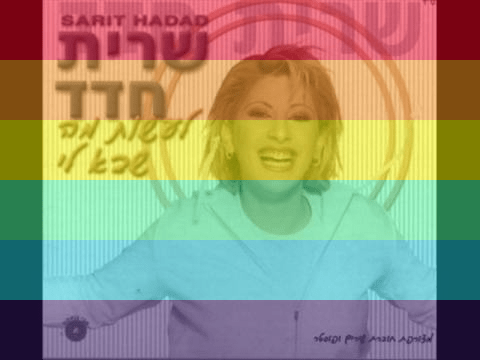
I remember that my Hebrew teacher gave me a gift- I forget for what.  Maybe her sister had been in Israel or something.  In any case, she gave me a CD- one of Sarit Hadad’s first albums (the one in the cover photo- the rainbow is my addition 😉 ).  She herself wasn’t a fan (of the music or Mizrachim), but it didn’t matter- I loved it.

The CD moved.  It moved me physically- the rhythms were infectious.  I danced all over my room and blasted it in my discman.  It moved me emotionally- her songs were about empowerment and love and doing what you feel like.  Growing up with an inescapable bunch of toxic relatives, it was just the medicine I needed.  And it powered me through many hard times and gave me hope and happiness.

A couple years into my Hebrew lessons, I found out Sarit Hadad was coming to Rockville, Maryland- where I grew up.  She was performing at Montgomery College in a small auditorium.  And at age 14 or 15- I went.  Alone.

And I had the time of my life.  Me and mostly a bunch of Israeli expats shimmied and danced and sang.  It was freedom, it was love, it was my newfound identity.

Over the years as I learned more Hebrew, saw more Israeli films, traveled to Israel, made Israeli friends, ate the food, and embraced the culture- the Mizrachi music Sarit inspired me to love was there.  Every step of the way.

As Sarit became more popular, her songs got more and more poppy (and less and less Georgian/Arabic/Mizrachi).  Personally, I love her old stuff the most- the CD of her live show in France is one that I played over and over again in my living room as a teenager.  I also used to (and still do!) belt out her old version of Inta Omri.  It’s incredible- I watched it with my Syrian neighbors last Shabbat.

In addition, as I explored other Mizrachi singers (and I more and more associated Sarit with some of the tougher times in my life), I drifted a bit from her music, although it was never far.  Her songs were particularly popular at Israeli dancing, which I’ve done for some 15 years.

Which brings us to tonight.  On Facebook, I found a party that was entirely dedicated to songs by Sarit Hadad.  While not an explicitly gay party, it definitely had that vibe (both by featuring a female singer and the way it was advertised).  In Tel Aviv, many parties are mixed queer and straight.

I was ecstatic but unsure of what to expect.  I went alone- which is hard in any country, especially a new one.

And boy did it pay off.  Once the music started booming, I found fun people to dance with.  Over the course of about 3-4 hours of Sarit’s songs (and some other singers), I think there were 2 or 3 songs I didn’t know the words to.  It brought me back to the earliest days of my Israeli identity and to my teenage passion for it.  It brushed the dust off and brought them back into my heart.

And yes, there were a shitton of queer people, which only made it more awesome.

I shimmied, I swiveled my hips, I shook my bootay, I waved my hands, I shouted every single lyric.  And it was fabulous.

As I headed home, I thought about this amazing transformation.  How music I listened to 18 years ago helped sustain me, build me an Israeli identity, and bring me to this very country to enjoy it, against all odds.

Like Mizrachi music, like Sarit herself- I am a survivor.  I’ve done the unthinkable in making aliyah and building my Israeli identity from the 7th grade- pretty much on my own (and often with the opposition of toxic relatives).  And despite the cries of the loads of Israelis who hate Mizrachi music- often for prejudiced reasons- I love it to death.

Because sometimes Israel sucks.  Air raid sirens, bureaucracy, terrorism, racism, and not a small amount of difficult people.

But you know what?  Israel is also tonight.  Israel is the free-spirited fun of Mizrachi culture.  Israel is me looking back at 13 year old Matt Adler and saying- it’s going to be okay.  Because no matter how bad things seem now, you’re going to power through, you’re going to pray, you’re going to dance, you’re going to listen to beautiful music.

And you’re going to make it like Moses to the Promised Land.  To spend the night of your life dancing to your teenage tunes- the ones you chose to listen to.  Among queer people.  Among your people.

And nothing, my friends, is sweeter than that.  I’m here, I’m queer, kululu!

Dugri: Lost in Translation

There has always been a yawning communication gap between Israelis and Americans- and between Israelis and the world.  Every country and culture has a unique communication style, and in my case, this often leads to challenging interactions with Sabras.  Sabras are Jews who were born and raised in Israel, whereas I’m an oleh- I chose to live here.

The sabra communication style most well known is “dugri”.  Dugri, from an Arabic word (itself of Turkish origin), means “straight talk”.  The word in Arabic means “straight” (like when giving directions), “fair” (like an arbiter not choosing sides), or “honest” (truthful words).  In Hebrew, the word means “direct”- but not in the sense of “honest” in Arabic (which is focused on presenting correct objective facts), but rather directly expressing your subjective emotions and opinions, regardless of how they are perceived.

In Israel, this means less pleasantries, less consideration, less politeness, more tough love, more controversial statements, and more blunt judgments.

There are ideological roots to this communication style that have been well-researched.  I highly encourage reading Professor Tamar Katriel’s study, which I’m still working through.  Going back to the early Zionist pioneer days, ideological olim wanted to rid themselves of what they perceived as a “Diaspora mentality” of formality, nuance, and passivity.  Again- this is their perception, not necessarily the facts.  The answer, especially for their sabra children, was to be found in a new, astoundingly direct and informal communication style, itself ironically rooted in German enlightenment philosophy.  I can empathize that building a new national identity was hard and I also think their attitude towards the Diaspora was pretty hateful.

This style, before I deconstruct the hell out of it, has its advantages.  For instance, I’m a very informal person so I like that dugriyut- or speaking dugri- allows me to speculate, to dream, to ponder.  I don’t have to cross my i’s and dot my t’s- I can just roll with it.  It fosters creativity in me.  I also like that I don’t have to think through every word I say for fear of literally losing friendships.  Here, an occasional offensive comment is not going to lose you anything.  When used properly, speaking dugri can reduce some of the feeling of “walking on broken glass” we face in America when communicating.  Also, hearing people’s deep-seated personal prejudices, while valued in Israeli society, for me actually serves as a defense mechanism so I can avoid someone who is actually toxic.  I rarely have to guess what people here think.

Now the flip side.  First things first- I’m a proud Israeli and I’m an American.  My family has lived in the Diaspora for 2,000 years and while I’m glad to be back, I’m not ready to give up the wisdom gained over centuries.  I’m a firm believer that it is not only possible, it is desirable to have more than one culture.  This is an issue Israel has struggled with from the beginning– as do many countries.  I understand- and will continue to learn about- dugri communication but that doesn’t mean I’m going to “negate” my other cultures.

In Hebrew, the ministry that deals with olim is called the “Ministry of Absorption”.  I can’t even imagine a more Orwellian phrase, but let’s work with it.  Yes, to a degree, I came to be absorbed into Israeli society.  But a funny thing happens when your body absorbs something- it changes your composition.  And so much in the same way, I intend not just to be changed, but to change this place.

So what does this mean for dugri talk?  First off, we need to see some of the negative aspects this style can present.  For example, when sabras interact with foreign cultures, including Americans, they often struggle to perceive cultural differences.  Just this week alone, on three separate occasions, Jews here made (what I consider) offensive remarks to me about Americans being “fake” etc.  This is a common sabra complaint- Americans are polite, but insincere when they compliment you.  All the while, I’m sitting there talking with them as an American with ten times better Hebrew than their rrrrresh infected mouths can mumble in my language.

This is endemic of the problem.  Because Israelis are sparse- but quite genuine- with their compliments (as befits dugri talk), anything other than that is seen as insincere.  What they don’t realize is that it’s simply a cultural difference.  When Israelis move abroad and don’t know how to say “please” or “thank you”- or try to say something unacceptably blunt- they lose friends and often struggle to make non-Israeli friends.  This is well-documented by a study done among Israeli migrants to Canada.  Boy if they think Americans are polite, wait till they meet Canadians haha.

The truth is there are fake people and genuine people in every society.  For me, for instance, I encounter some Israeli communication as incredibly insincere- even though it’s just likely just a cultural difference.  For instance, especially in Tel Aviv, when people promote upcoming events (or compliment someone for leading an event), a whole litany of “mehamems” and “madhims” and “nehedars” and “merageshs” come out.  Basically, just a list of how everything is the most amazing awesome best coolest most wonderful thing ever.  It’s enough to make me, as an American, nauseous because it sounds like they’re lying.  But what I’ve come to realize is that there’s probably a cultural component to it.  Rather than calling all sabras fake, I chose to read hours of academic articles and confront the issue meaningfully.

For me, besides the nuisance of Israelis telling me my country (and implicitly perhaps me and my friends there too?) is fake, I have to wonder if there’s a broader cultural problem at work.

Israelis, unlike almost any civilized society I’ve lived in or visited, have completely separate school systems based not only on race/religion, but also what type of religiosity.  There are Arab schools, secular Jewish schools, Modern Orthodox schools, and Haredi schools.  These schools operate completely separately in state-sanctioned (and largely publicly supported) segregation.  There are social reasons for this- I’m not pretending it came out of nowhere.  But the end result is that Israelis rarely if ever interact meaningfully with people from drastically different backgrounds.  And they don’t learn how to understand intercultural communication.  Nor the value that sometimes, just because you think a thought doesn’t mean it’s best to say it out loud.

In 6 months in Israel, I have become a regular in Bnei Brak speaking Yiddish, I have visited half a dozen Arab villages in Arabic, I hung out with Samaritans, I watched Karaites pray, I talked with Armenians (in Arabic!), I blasted Eritrean music with refugees at a juice bar, I tutored a Darfur survivor in English.  And on and on and on.  I know this country much, much better than most of the sabras who’ve lived here their whole lives.  And it’s not because they’re bad people.  I have learned much from my sabra friends.  And they have much to learn from me about their own country.  This is one of the most diverse and exciting places on the planet.  A place I enjoy even more because of my diverse American upbringing.

Now it’s time for me to dish out some dugri talk (see I do like it sometimes!).  Sabras- you’re mostly racist or at best, unappreciative of the diversity that surrounds you.  Your difficulty in communicating across the cultures in your own country reinforces your prejudices- including towards olim.  I’ve lived all over the world, including spending lots of time in the Deep South in the U.S., and this is by far- by far- the most openly hateful society I’ve lived in.  Not just in terms of race, but also in terms of prejudice between different sectors of society (Secular vs. Orthodox, Ashkenazi vs. Mizrachi, etc.).  There are some of the most incredibly kind and hospitable people here too.  It’s just that the level of judgmental speech and behavior is mind boggling and frankly makes me appreciate my American upbringing- and question whether I want to raise my kids here.

In particular, there are times when the secular Ashkenazi liberal elite here sounds like a bunch of American tea partiers who long for the 1950s.  An era in which the government was basically run by a bunch of white men (them), when Holocaust survivors were told they went like “sheep to the slaughter”, when Arabs were under military rule, and Mizrachi Jews lived in impoverished camps.  But at least in the “good old days”, the government was more secular i.e. more like them.  Perhaps not coincidentally it is this same demographic that coined “dugri talk” generations ago.  Language is power.

The key is that every culture has its communication style.  It was hard for me to write a blog that was in English but appropriately non-judgmental for an American and appropriately dugri for an Israeli.  And I’m still learning about Israel even though I speak the language fluently.  I will always be learning.  I recommend all olim- indeed all tourists- learn about Israeli dugri talk.  And sabras- if you care at all about the millions of people living here born in other countries (or your own ability to travel abroad without offending people)- learn about yourselves.  You don’t have to give up your directness but you do need to learn how other cultures work.  Because it’s not that all Americans are fake.  It’s that you’re not self-aware.

Do your homework.  That’s my dugri talk for the day 🙂

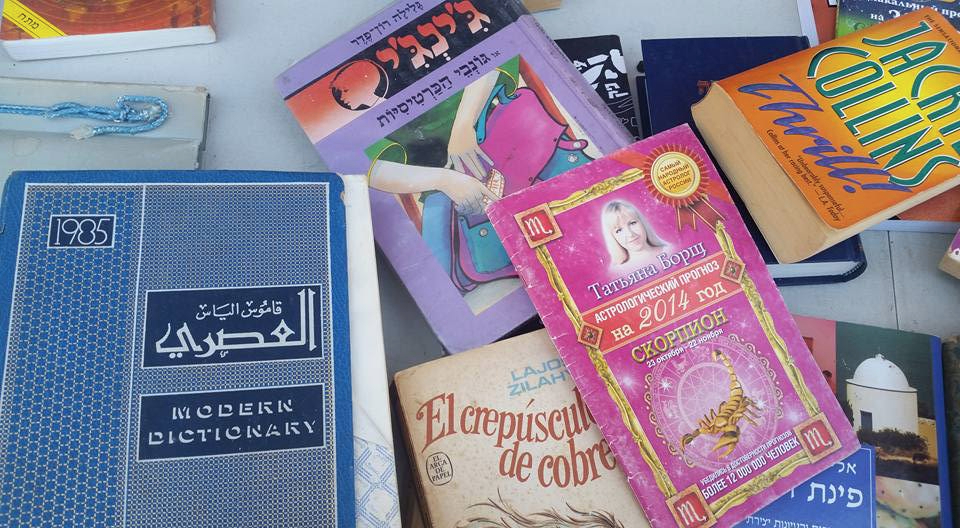
p.s.- my cover photo is a paper I used to teach a Swahili-speaking Tanzanian in Holon about Hebrew vowels…via Arabic because she’s an Arabic teacher.  Intercultural communication isn’t a hobby- it’s a lifestyle.  Open your eyes and join the miracle 🙂

Yiddish lives

One might be surprised to hear this, but Yiddish lives in Israel- and not just among Hasidim.  Yiddish is the traditional language of Ashkenazi Jews like me.  Before someone says something stupid, let me clarify something- Yiddish is NOT a “mixture of German and Hebrew”.  It is also not only a Hasidic language- it has existed for at least a thousand years as a distinct language, whereas Hasidism has been around for about 400.  On the eve of the Holocaust, 13 million Jews- socialists, communists, Zionists, anti-Zionists, Hasidim, secularists- spoke the language.

Yiddish is an archaeology of the Jewish people and linguistic proof of our ties to the Land of Israel.  About 2000 years ago, Romans expelled Jews from Israel and destroyed the Temple in Jerusalem.  The Jews who weren’t executed were expelled or enslaved.  Many eventually made their way to other parts of the Roman Empire, where their Aramaic and Hebrew vocabulary became enriched with Latin words.  For instance, a famous Yiddish word (still said today even in Jewish American English) is “bentsch”.  To bentsch is to say the special prayer after eating a meal, coming from the Yiddish word “bentschn”.  This word comes from the Latin root “benedicere” meaning “to bless” like “bendecir” in Spanish.

As was the custom of European Christians for the 2,000 years of Jewish existence on their continent, time after time Jews were expelled as we were scapegoated for various social problems.  Other minorities today can probably relate.  And so with each expulsion and migration, Yiddish was enriched with new vocabulary- Italian, French, and eventually Germanic languages.  To be clear- at the time Jews started settling in present-day German speaking areas like Switzerland, Germany, and Austria, there was no such thing as the German language.  There were a variety of Germanic dialects (some of which are still spoken), but no unified language.

Yiddish borrowed heavily from their neighbors’ lexicon, although in some cases developing new meanings particular to their community.  For instance, while in German “shul” means “school”, in Yiddish, it can mean “synagogue”.  Hebrew and Aramaic also interplayed with the Germanic words.  For instance, “froynd” in Yiddish is a “casual friend” or “acquaintance”, similar to the Modern German meaning.  But in Yiddish, there is another level of friendship- a “chaver” (or “chaverteh” for a woman- that’s a Hebrew word with an Aramaic suffix).  That’s a real close friend.  And it says something about the value still placed on Hebrew (known often as “loshn koydesh- holy tongue”) even in the Diaspora.

As German-speaking peoples decided to butcher Jews during the Crusades and expel them from their cities, Jews went eastward.  Believe it or not, initially Polish and Lithuanian rulers (these countries today are more well known among Jews as places we were massacred) welcomed Jews.  Jews became merchants and built communities in Poland- and then all across Eastern Europe, down to Romania and Ukraine.  Name a country in Eastern Europe and we made our way there.

Of course the Slavic vocabulary lent a new angle to the language.  While the Jews that remained in Germany, Holland, and France continued speaking Yiddish- a new dialect developed: Eastern Yiddish.  Bubbe, Zayde, Tate, Mame- grandma, grandpa, mom, and dad- are all derived from Slavic roots.  The first two are to this day used by many American Jews to talk to their grandparents.

Meanwhile, Hebrew and Aramaic maintained a strong presence- perhaps also due to the fact that these languages were used extensively in prayer and in study.  They maintained such a strong presence that when Zionists aimed to revive Hebrew as the main spoken language of Jews, they looked to Yiddish for both Hebraic words and for Yiddish expressions to translate.  The modern Hebrew words B’seder, mamash, b’tachlis, chutzpah, and so many more are of Yiddish origin.  Which is to say- they are Hebrew (“holy tongue”) words that made their way into specific usages in Yiddish- and these usages were copied into Modern Hebrew in a way they didn’t necessarily exist in the Torah or other Jewish languages.

Speaking of translated phrases, did you know the Hebrew greeting “mah nishma?” is literally a translation of the Yiddish phrase “vos hert zach?”, meaning “what is heard?”  Even the famous “mah pitom?” is a translation (calque) from Yiddish.  If you speak Modern Hebrew, you speak more Yiddish than you thought!

Which brings us back to the language.  After the Nazi Germans and their anti-Semitic collaborators murdered 6 million Jews, most of them Yiddish speaking, the language was devastated.  Ashkenazi Eastern European civilization was brutally brought to an end after 2,000 years of life on the continent.  The language itself was feared extinct as the only remaining centers- the U.S. and Israel- were encouraging linguistic assimilation into English and Hebrew respectively.

In particular, in Israel, the government actually forbade non-Hebrew newspapers and theater performances.  Feeling Yiddish (and languages such as Ladino and Judeo-Arabic) was a threat, there was an actual “brigade” of volunteers who would go around shutting down Yiddish events.  I can’t think of something more horrifying to experience than for a Holocaust survivor to have a fellow Jew attack them for speaking the mamaloshn- their mother tongue.

Over the years, the remnants of Yiddish faded both in America and in Israel as Jews were told (either by Christians in America or fellow Jews in Israel) that their language was “lame”, “ignorant”, “backwards”, and (in Israel) “Diasporic”.  For all of Israel’s renewed interest in multilingualism and greater tolerance for diversity, I experienced this attitude myself when I posted my English blog in an LGBT Israeli group (with a description in Hebrew) and someone berated me saying I needed to write my blog in “the holy tongue”.

In particular, people have called Yiddish a “dialect” or “jargon” over the years.  This goes back hundreds of years in Europe- it was a deliberate effort by ruling Christians to demean Jews by insulting their language.  And sadly, some Jews internalize(d) this thought even though Yiddish published its first dictionary before German and tens of thousands of books, 12,000 of which are preserved digitally here.  Yiddish is a language with many influences, just like English.  It is a storied and beautiful language.  As a famous Yiddish linguist Max Weinreich said: “a language is a dialect with an army and a navy”.

When my ancestors moved to America in the late 1800s and early 1900s to escape anti-Semitic violence in Eastern Europe, they spoke Yiddish (one of them also spoke Romanian!).  I even found the Census records to prove it.  With each subsequent generation, a bit more of the language was lost, but it is still present today in my dialect of English, where words like “schlep”, “shlemiel”, “shmear”, and “oy gevalt” are omnipresent.  And sometimes need to be explained to non-Jews!

Yiddish has always acted as a storage device for Jewish culture.  There are certain things that just can’t be expressed in other languages.  And while Germans can understand much of it- there’s a lot they can’t.  And Jews can change their register (by adding more Hebrew and Aramaic, e.g.) to make it harder for them to understand- which is the point.  It was a clever way for Jews to understand their neighbors but speak more secretively if needed to protect the community.

Yiddish, as we saw, also stored a lot of Hebrew.  In some ways it kept the language alive over the course of 2,000 years.  I dare anyone who says Jews aren’t tied to this land to explain to me why Lithuanian Jews were speaking a language 20% made of Hebrew words.

In the end, Yiddish shows that Judaism is not just a religion, it is also a culture- a people.  It’s not coincidental that a few hundred years ago, a Jew in Poland could communicate better with a Dutch Jew than with a non-Jewish Pole.  Jews’ primary relationship was with other Jews.  There is no such thing as Presbyterian cuisine, literature, and language- because that’s a religion.  The word religion is a foreign concept to Judaism- we are a tribe.  You cannot fully separate the culture and the spiritual nature of our people- although many a secularist (and Haredi) have tried.  They are inextricably tied together just like natives living in the Amazon.  Where one starts and one ends is unclear- and there’s no need to clarify it.

Growing up speaking Jewish American English, I was always exposed to Yiddish.  All of my grandparents spoke it or understood it to varying degrees.  And it peppered my conversations.  It’s a very expressive and fun language with a soft side to it.  Despite some of the efforts of Hebrew purists to rid the language of Yiddish, I actually see a lot of it reflected in Israeli culture and language.  It feels comfortable.

A few years ago, I found a private tutor to start learning the language in earnest.  I then was blessed with the opportunity to go to the Workmen’s Circle “Yiddishland” program in New York.  There I learned not only the language, but also the culture- the music, the traditional dancing, so much.

When I made aliyah and moved to Israel, I wasn’t sure how much yiddishkayt- Yiddishness- I would find.  I’ve been pleasantly surprised at how vigorously Hasidic communities here are preserving the language- my cover photo is a bunch of newly printed Yiddish books for children in Bnei Brak.  With Hasidic Jews’ high birthrate, the language is about to make the comeback of a lifetime.  At the same time, I personally wanted to find a more progressive setting for my Yiddish too.

I’ve been pleased to connected with organizations in Tel Aviv like Yung Yidish (a library and concert venue in the Central Bus Station), Arbeiter Ring, Yiddishpiel Theater, and so much more.  I even got the chance to see a Yiddish musical based on the Barry Sisters last night!  The subtitles (which I was proud that I only needed occasionally) were in Hebrew and Russian.  Not a small number of Russians here also speak the mamaloshn- tribute to how international and cosmopolitan this language is.

To conclude, I’d like to share a story about how Yiddish lebt- how Yiddish lives.  I went to the library here to try to find Yiddish books.  I was disappointed when the librarian said their branch had none.  Feeling despondent about the future of the language, I asked what other languages they had.  She mentioned French, which I also speak.

I headed back to the French section only to find something curious.  A French book- almost a hundred years old- by famed Yiddish writer Sholem Asch!  In other words, a Yiddish book…translated into French!  I shared my excitement with the librarian, who was astonished.  I may very well have been the only person to discover this.

This is how Hebrew survived in Yiddish- and how Yiddish now survives in Israel.  Little fragments of a prior world integrated into a new form.  An immaculate metaphor for Judaism itself.  And I’m telling you- don’t count Yiddish out.  Because those sparks of Yiddishkayt are being rekindled- in Bnei Brak, in Mea Shearim, and right here in the most secular place of all- my home, Tel Aviv.

The most diverse Israeli day ever

Today, I did too many things to write a story.  So I’m going to list them:

-I spent a train ride talking in French with an Orthodox Jew of Moroccan origins who immigrated from France.

-I hung out in an underground pool with arches built in 789 by the Abbasid Caliphate in a boat.  And then I wrote an Arabic poem while inside!

-I met Peruvian (Jews?) and talked in Spanish about my friend Claudia who did Peace Corps in Peru.

-I visited a church from the 1200’s with a super hot Arab security guard whose smile and kindness melted my heart.  Can you say “return visit”?

-I bought a CD of Iraqi music in Arabic sung by an Iraqi-Israeli Jew back in the day who was born in Iraq- for 10 shekels!

-I talked about Ethiopian music and Sigd in a store covered in Amharic and Hebrew signs.

-I watched Karaite Jews pray Ma’ariv evening prayers.  Most of them are of Egyptian origin, so I chatted with them in Syrian and they responded in Egyptian Arabic.

-I made friends with an Israeli soldier when our trains got messed up and delayed and we had to switch lines.

-I did dinner in a mixture of Hebrew, English, and French with a Sabra and a French non-Jewish PhD student…whose family is from Guadeloupe!   We talked about our shared love of Zouk.

-I danced dabke for easily three hours with young Arab students.  A German exchange student came and I helped a talented dancer in a hijab translate dabke instructions into English (and a little Yiddish, which he can largely understand!).

-I then hung out with said wonderful German exchange student for another three hours walking around Tel Aviv and talking about life here.  He is one of the most open-minded, non-judgmental, kind people I’ve met here.  He’s not Jewish and I couldn’t imagine that a non-Jewish German would make my night…in Tel Aviv!

-Thinking no more cultural richness was possible, I hopped into a cab.  The Israeli man turned on the music (without lyrics) and asked me to guess where it was from.  Within 5 seconds I said “Thailand!”  I love Thai music and used to buy it at the Thai grocery store back home.  He was shocked.  His wife is Thai and he lives in Thailand with his children, only coming back to Israel to care for his parents.  He speaks fluent Thai- as do his biracial children.  He was mightily impressed that my favorite Thai dish is Pad See Ew- he says everyone says Pad Thai!

This is what I have to say- today I spoke English, Hebrew, Arabic, Spanish, French, and Yiddish.  Just last week I also spoke Catalan, Portuguese, and Farsi (with both Persians and Bukharans).  If you have the curiosity, the passion, and the will- you can experience more cultures here than you can count.  I live in a neighborhood where I regularly meet Iraqis and Moroccans and Syrians (Jews) and Burmese and Sudanese and Eritreans (non-Jews)- I even had someone tell me her friend is half Ghanaian half Filipina.

When people find out I’m a polyglot, they often tell me “what do you do with your languages?”  Sometimes it feels accusatory- “why aren’t you making a ton of money off of them?  Why aren’t you working for the government or the military or the CIA?”

You know what?  What I do with my languages is what I did today.  I explored ancient civilizations, made new friends, learned about other cultures, danced, sang, wrote poetry, and built bridges of peace.  I felt happy 🙂

If you can show me something more valuable or enriching than that, be my guest.

In the meantime, I’m just happy to live in one of the most diverse countries on the planet.  Where the combination of things I did today is only possible here.  One person today said to me “but honestly what is there to see in Ramle?”- one of today’s destinations.

The answer: “everything, if you’d just open your mind.”

South Tel Aviv is the Best Tel Aviv

Some of you may know that a couple weeks ago, I finally found a long-term apartment.  Everything about my identity- being Reform, being American, being progressive, and being queer- should lead me to live in the more secular center and north of the city.  But I feel utterly blessed that I ended up in the south.

When I first moved to my neighborhood (whose name I won’t reveal over the internet), I was apprehensive.  I knew absolutely no one there and there were posters advertising Shas concerts everywhere.  There are almost no young secular/Reform Ashkenazi people and I have yet to see a pride flag.  There are no pubs, nightclubs, cafes with WiFi- it is quiet.  Part of that is the beauty of the place and why I chose to live there.  Though at times, it was so quiet I felt lonely.

Today, I had no plans for Shabbat.  I had plans Saturday night, but during the day I figured I’d wander around and get to know my neighborhood.  And then I heard a boom.  And a tap tap.  Boom. And a tap tap…it was a darbuka!  I stepped outside and heard loud clapping and drumming and singing coming from across the street.  Not the utterly depressing slow moan of westernized Israeli rock (sorry guys- I do like some of it, but mostly it makes me want to cry!).  But rather the boom boom and ululating of Middle Eastern music.

I’m an outgoing guy, so I simply stood outside and listened- and as seems to be the Israeli custom, they immediately invited me inside.  When I say invited- I don’t mean a polite “how do you do?” and offering a cup of tea.  No- I was ushered into a room of 20 people, given a Mexican sombrero, plied with food and drink- all while I danced with people I just met to beautiful, soul-stirring Mizrachi music.

It was amazing and overwhelming all at the same time.  While I danced, the uncle tried to get me to drink whiskey (I don’t drink), then the cousin handed me pitas with hot dogs in them (which I shook while I danced), then the grandfather told me over and over again to keep eating!  I was living my dream of being in My Big Fat Greek Wedding.

Then, the most amazing thing happened.  The family asked me what song I’d like to sing.  I am an avid Mizrachi music fan.  This music is, hands down, the most unique cultural product to ever come out of Israel, although many (sometimes racist) Israelis wouldn’t realize that.  This music was born out of a fusion of the traditional Arabic, Turkish, Greek, Ladino, and Persian music brought by Jews to Israel in the 40s and 50s.  It then used the best of the West- drum sets, synthesizers, and electric guitars to imitate traditional instruments.  Add in a dose of Israeli folk tunes along with elements of Ashkenazi melodies and voila, you have the first “world music” before “world music” even existed!

So as I stood there, the first song that came to mind was “Mabruk aleek”.  It’s an Arabic-language wedding song.  And there I was dancing, having an absolute blast.  As with most things in Israel, life can go from quiet and lonely to exciting and heart-warming in the matter of seconds.

I was told I could sit and eat now- as relative after relative brought me food and water and food and water.  But things only got better- I discovered my new adoptive family is half Syrian and half Iraqi.  And with the exception of the youngest generation- everyone in the room speaks Arabic!  I specifically studied Syrian Arabic in college in the U.S. with a professor from Damascus- and now with Syrian refugees on Skype.  It was a dream come true!  Everyone’s smiling with each Arabic word I say.  And I’m spending Shabbat with Jews- in Arabic!!  For an American Ashkenazi Jew, this is a surreal experience, and one I’ll never forget (though I’ve been invited to come again over and over- so I doubt it’ll be the last!).

Then we moved to another room so I could meet the other 15 relatives.  I was asked at least three or four times if I was married, but the final time it was because they wanted to set me up with someone’s daughter.  The first few times I laughed off the question, but now I had a choice to make.  In the living room where we were banging on darbukas and recording videos on cell phones (things Orthodox Ashkenazi Jews don’t do on Shabbat), there were also at least half a dozen pictures of a rabbi who I presume was Rav Ovadia, who founded the Haredi Shas party.  Let’s just say the party isn’t generally a big fan of gays, Reform Jews, or really most of the things that people in the north of Tel Aviv support.

So I debated internally and did something brave: “you can set me up with her daughter, but it won’t work because I’m gay.”  I looked around and asked: “are you in shock?”  And without skipping a beat, one of the aunts says to me: “oh no, we have that in our family too.”  I started to smile as relative after relative starts thinking of men to set me up with.  One of the younger relatives actually pulls out her phone, calls her friend, and gets me the number of a gay guy to help me make friends in the community.

After helping one of the men download an app on his phone to turn YouTube videos into Mp3’s (he loves everything from Eyal Golan to Umm Kulthum), I hung out with the youngest kids- two 10-year-old girls.  We danced to Justin Bieber on the street and made funny videos.

Before I left, I was of course given a full container of homemade Iraqi kubbeh and rice.  They told me to come by whenever and one of the little girls even said, “come every Shabbat!” at least three times.  They took my number and said they’d introduce me to the neighbors, show me where I can volunteer, and feed me a lot.

My neighborhood is a lot browner, a lot more Middle Eastern, a lot more Arabic-speaking, and a lot more working-class than North Tel Aviv.  And you know what?  That’s not only “OK” by me- it’s fucking amazing.  Because the 14-year-old me who went by himself to a Sarit Hadad concert in Maryland is smiling from ear to ear.  Mizrachi music- Mizrachi culture- isn’t something new for me.  It’s something that, from the first days of when I learned Modern Hebrew after my Bar Mitzvah, gave me hope in dark times and energy and smiles.  It connected me to my Judaism and to Israel itself.

Unfortunately, there are many Israelis now and back in the early days of the State who are avidly racist against Mizrachim.  Even Mizrachi music was banned from the radio by the government in its early days.  And to the surprise perhaps of some of my fellow progressive American Jewish friends- this racism largely comes from secularized “progressive” Jews of Ashkenazi origin.  The kind who write for Haaretz or sit on the Supreme Court- two of our favorite institutions.

But let’s move beyond the politics.  What I’m trying to say is my neighborhood- this is not where the tourists are.  This is not where the wealthy people are.  This is not “trendy” and it’s not French-Vietnamese vegan fusion food.  These are people who have fought for their cultural and economic existence- and are here to tell the tale.  These are people whose Sephardic Judaism has a remarkable fluidity- even queerness- to it.

God bless them.  Because when a lonely newly-minted Israeli stumbled outside his house today, he didn’t just meet his neighbors.  He met family.

Because for all the beautiful luxury penthouses in North Tel Aviv, there’s one thing money can’t buy.

Warmth.

Be a good Israeli and learn Arabic

Today I had some phenomenal experiences in Israel- only because I speak Arabic. Rather than write a post with facts and figures about why my fellow Israelis should learn the language, I’m going to simply share my story.

This afternoon, I stopped by a sandwich shop.  While the chef made me a chicken in pita sandwich, I asked him where in the neighborhood I could buy a notebook.  He said he was new to the area so he didn’t know.  I told him I was new too.  He lives in North Tel Aviv but happens to work at this restaurant a couple days a week, only as of recently.

After explaining I was an oleh chadash, a newly-minted Israeli, he welcomed me and asked where I was from.  I then asked him what his family’s origin was.  Turns out he’s Moroccan and moved to Israel when he was very young.  Not looking more than 35 years old, I was stunned.  Most Moroccan Jews in Israel moved during the 1950s.  He even grew up speaking Moroccan at home- something rare among young Israelis.  We switched to Arabic.  I told him how cool it was to talk to a Jew in Arabic.  In America, where 90% of Jews are Ashkenazi, it’s almost unthinkable to find a native Arabic speaker in your synagogue.  And yet here I was talking with a 35 year old Moroccan Jew in Arabic.

Wrong.  Amir (pseudonym) is Moroccan but, to the surprise of probably everyone reading this, is Muslim.  And not a convert- a Muslim by birth.

How did we get here?  So first off, Amir tells me he grew up in Tira.  I’ve heard of Tira before and I did some googling to double check- yes, in fact, it is an Arab town.  It’d be quite out of the ordinary to find Moroccan Jews living in the middle of an Arab village here.  In addition, while many Moroccans can get by in Levantine Arabic (the dialect I speak along with Arab-Israelis/Palestinians), he had a strong facility with the language and didn’t revert to any Moroccan-isms.  I’m familiar with some because several of my college Arabic professors were Moroccan.

So finally I asked him: “Tira is an Arab village- are you Jewish?”  I figured maybe, working in the neighborhood we were in, he might be afraid to reveal his identity.  He then told me he wasn’t Jewish but was most certainly Moroccan.  So then the obvious question- how on earth did he get here?  For those of you unfamiliar, Israel and Morocco don’t even have mutual embassies, let alone coordinated immigration policies.

At this point, there’s a Jewish Israeli sitting in the cafe too.  Moshe is of Moroccan descent, but barely speaks the language.  But of course, even though Amir had told me over and over how great my Arabic was, this other shmo had to tell me I don’t speak like an Arab- which is bullshit because I have a great accent.  Like most insecure people, he chose to take his own identity issues out on me (look for a future blog on Mizrachi identity).

Noticing the other patron, Amir turns away from him and leans in to tell me: “It’s a secret, but my family worked with the Israeli government and that’s why we were able to come.”

Wow.  First of all, I have absolutely no way to verify it.  But in the interest of protecting his privacy, I did use a pseudonym and will not reveal the restaurant.  I do have to say though that after having talked for about an hour, he seemed like a legit guy and I don’t have any reason to question what he said.

As I headed out from the restaurant, we gave each other a smile and a hearty “ma3 asalaameh”.  Nice to make a new friend!

Still in shock and full of adrenaline, I walked through Tel Aviv until I found myself hungry again.  This time, I popped into a Cofix, a cafe here, and no joke, I hear my favorite Egyptian pop song.  It’s something that’s literally on my phone right now.

Seeing as how almost no Arabs live in the center of Tel Aviv, I was pleasantly surprised.  I went in and addressed the young man in Arabic: “hey, is this your music?”  He looked a bit confused.  So I switched to Hebrew.  And it turns out, yes this is his music.

I switched back to Arabic but found he only understood about half of what I was saying.  And not because, like Moshe thought, I “can’t speak like an Arab”.  Rather, it’s because he’s not Arab- he’s Jewish!

What?!?  Ok so this kid, Nir, his family is Syrian.  His parents speak Syrian Arabic at home- the exact dialect I speak.  He grew up with it and in his own words “is in love with Arabic”.  Which is why he blares the music in his cafe in the middle of Tel Aviv.

I asked him if he understood the song.  He said his Arabic isn’t so strong but he wants to learn.  I told him I could teach him.  He was confused- how does an American Jew become Israeli know Syrian Arabic?  And why not just Modern Standard Arabic?  I explained that I studied with a Syrian professor from Damascus in college- in the United States.  He thought I was kidding but then I started speaking to him in Syrian again and he realized I was the real deal.  He took my number- I hope he calls and I can connect him to his heritage.  You could digest that sentence for a lifetime.

Before I left I asked the second barista if he understood the song.  He could pass for Arab, but it turns out he was Jewish.  He said he thought it was about peace.  What a beautiful sentiment.  In a day and age when many Israelis and Americans would assume the worst of a song in Arabic, this young kid, smack in the middle of Tel Aviv, assumes it’s about peace.  It just touched my heart.

I told the kids the song was actually about encouraging people to vote in the Egyptian elections.  I explained some of the verses and they were eager to learn.

So here we were- three Jews, one Ashkenazi American, one Syrian, and one from who knows where.  Sitting in Israel, listening to Egyptian music, babbling in a mixture of Hebrew and Arabic.

If there’s one thing I can take from today it’s that where Jewish starts and Arab ends isn’t so clear.  Just like the bilingual script in my cover photo.  When coming to Israel, the absolute best thing you can do is to leave your assumptions at the door.  And the second best thing you can do is to learn a language so filled with love and art and history that you’ll be bursting at the seems making new friends from every race and religion.  And that language, my friends, is Arabic.

Saudi Country Music

Yes, that’s right- tonight, I heard country music on a Saudi radio station.  It took me by total surprise.  It just goes to show that the Middle East is a whole lot more diverse than you might think- and a whole lot more interesting that you’ll find out by reading the news!

Today I had a very productive day.  On my way back from the mall (man is it cool to see a mall all in Hebrew!  Never had that as a kid!), I switched on an app on my phone and started listening to Arabic music.  Last night, I listened to Syrian radio- to an entire evening of the majestic Fairouz.  The host’s greeting in Arabic was adorable: “Masa’ Fairouz, Masa’ al kheyr” – A Fairouz evening, A good evening!  Listeners even called in from all corners of Syria.  It was surreal to be listening to the radio station just north of the border- of a country in the midst of a horrifying civil war and a country I cannot legally visit.

Tonight, I decided to give the Saudi stations a try.  At first, there were the typical and beautiful rhythms of khaleeji music– music from the Persian Gulf.  Gulf Arabic music sounds quite different from Egyptian, Lebanese, or Moroccan music.  Each one has its beautiful elements.

Then I started to get nervous.  The announcer said in a grave tone in the Saudi dialect: “once upon a time, we were great.  We were revered and respected.  Now what?”  Holy shit, I thought, this is going to be a depressing news story about the latest political intrigue in Saudi Arabia.  But instead the next sentence shocked me and made me giggle: “a few days ago we were defeated by Portugal 3-0.  What are we going to do about our soccer team?”

Just goes to show that things aren’t always what we expect 😉

Speaking of which, I switched to another Saudi station.  Expecting more Arabic jazz, I instead got some American country song filled with y’alls and drawls.  In complete shock, I continued listening as pop songs followed rap songs followed, both male and female artists singing.

Curious what else I’d find, I hopped on another station (found an angry preacher) then another (beautiful Quranic chanting) and two Indian music stations from Dubai and then I visited Jordan.  The Jordanian radio station was playing something oddly familiar.  The beat- it wasn’t Arabic- it was…reggaeton.  That’s cool, I thought, it’s not just Israel that 20 years after the fact discovered reggaeton music I grew up on.  Our neighbors like it too.

In fact, they like it so much, they’re now mixing it with Arabic music!  A quick YouTube search for “Arabic reggaeton” will reveal a boatload of songs.  It is catchy and fun and I highly recommend trying it out.

People love to hate on technology.  It’s ruining society.  Young people don’t know how to socialize.  It’s no replacement for human interaction.  Yada, yada, yada.

Some of the critiques are valid, others are the same stupid stuff people said when the printing press was invented.  The point is technology is like anything else in life- it’s about how you use it.

For me, I’d love to be able to go to Syria and Saudi Arabia.  And I hope to visit Jordan sometime soon, although if we’re totally honest it can be challenging both as a queer person and an Israeli.  I’m sad that for political reasons I can’t- and I’m sad in particular for the people of Syria who are suffering.  I’m also sad because Saudi Arabia doesn’t look like it’s headed for a lot of long-term stability either.  I’m sad because in every country in the world there are good people I’d like to meet- and who’d like to meet me.  Of course there are fire and brimstone clerics (we have a few in Israel) and mean people and bigots, but there are good people out there too.  Complicated people.  People I can learn from- and teach.

So this is what I have to say: I’m not going to wait until the borders open between Israel and countries like Syria and Saudi Arabia.  I’m going to use technology to get to know my neighbors as best I can.  Why shouldn’t I enrich my life with the treasures their cultures have to offer?  I’m sure somewhere in Riyadh there’s a kid secretly listening to pirated Mizrachi music.  If you think that’s naive, you need to do your homework.  As the phrase goes, “we’re all in the gutter, but some of us are looking up at the stars”.

As I walked down the streets of South Tel Aviv, I’m sure there are people I passed by who would utterly disapprove of me listening to Saudi Quranic chanting or Syrian pop.  That’s the music of Arabs, of the enemy.  Those people hate us.

But I bet there are more than a few people who have held on to their Middle Eastern roots.  Who if I pumped up the volume loud enough, might join in and even dance.  Because the beauty of South Tel Aviv is that the people who live here- the music they blare every morning when I wake up.  It’s so utterly and deeply Middle Eastern that you don’t know where the Umm Kulthum starts and the Omer Adam ends.

All Middle Eastern countries are more diverse than you might suspect.   I speak Arabic so I actually know what my neighbors are saying- and it’s interesting.

I live in a country built on a miracle, on a 2,000 year old pipe dream that came true.  And while people are reading and re-reading Ha’aretz and Yisrael Hayom and the New York Times, I’m practicing my southern drawl.  Because one day, by the grace of God, I’m going to hop on a plane, get my passport stamped, and listen to Kenny Chesney play Riyadh.

Ken yehi ratzon.  May it be so. 🙂

The hardest part of making aliyah

When I moved to Israel, I anticipated many challenges.  Israeli culture is very different from even American Jewish culture.  The directness, the sometimes harshness of people’s words can really catch an American off guard.  As can the practically non-existent social boundaries.  I knew I’d have to make adjustments to my career and make new friends.  I’d also sorely miss some of my favorite foods and cultures that are omnipresent in the diverse area I grew up in.  I’d be far from my existing support network and would have to build a new one- practically from scratch.  All this in a country I hadn’t visited for 12 years.

But the single hardest part of my journey, by far, was finding a home.  Not a metaphorical home, but an actual house.

Before arriving, I had reserved an AirBnB for a month to give me time to search for an apartment.  Little did I know that even though the woman advertised having air conditioning, she claimed that she was “allergic” to the machine so she wouldn’t turn it on.  As my Sabra friends told me, she was allergic to the electricity bill.  So there I was, a freshly minted Israeli arriving after 15 hours of travel (with only 1 hour of sleep on the plane) and a bedroom at 87 degrees Fahrenheit.  The final straw for this apartment was when I got food poisoning at four in the morning and rather than offering some words of consolation, the host complained about me waking her up.

After having received a refund for the remaining three weeks from AirBnB, I scrambled to find a place.  Still hung up on jet lag, I managed to find a generous lesbian couple who had also made aliyah from the States a year ago.  I slept in their office for a while while I searched for an apartment.  But as I think we all discovered, having three people, a dog, and multiple cats in a small apartment just doesn’t work.  And from the beginning, this was going to be a temporary place.

So I ran around trying to find a new place.  I found a sublet in the middle of the city.  I had a roommate- not ideal, but fine for a temporary stay.  My landlord, on the other hand, stole money from me that required endless hours of mediation and legal threats to be returned.  It’s not worth going into a ton of detail, but let’s just say that that’s one among many examples.

Needless to say, I was tired of hopping around apartments.  I wanted my own place- no roommates, no pets, no thieving landlords.  With a long term lease.  A home.

This is when I really discovered why Israelis protested en masse in 2011.  In particular in Tel Aviv, there is a massive housing shortage.  Most Israelis want to live in the Center of the country but the building hasn’t kept up.  As a result, demand is high and so are the prices.  Although prices are significantly lower in Tel Aviv than in places like Washington, D.C., San Francisco, and New York (which Israelis should realize- this is not a uniquely Israeli problem), there is a unique competitiveness to the market here.  When you show up to view an apartment, there are often multiple people viewing at the same time.  I can’t think of anything more awkward.  Everyone is trying to woo the all-powerful landlord while somehow pretending to like each other.  It’s super uncomfortable.

Then, the landlord will tell you there’s an extensive waiting list.  And to be honest, there usually is (although of course some lie).  The landlord can ask you any friggin question he wants.  In the U.S., there are extensive rental protections.  Where I lived in Maryland before aliyah, there was even a free service offered by the local government to investigate unscrupulous landlords.  Of course there were still bad apples, but at least there was legal recourse.

Here, the legal system is basically a load of crap.  When it comes to housing, the landlords know they run the show.  I was asked invasive questions about my salary, my family’s salary, my job, my religion, my national origin, my sexuality, my politics, and more.  What Israelis need to understand is that while this is par for the course in Tel Aviv, it is illegal in the U.S. and most civilized countries.  If you have the money and pass a background check, you can legally rent wherever you want in the U.S.

Could I have chosen not to answer these questions?  Sure.  But why would the landlord choose me, then, when she can simply pick someone else from a list of 30 people?  One guy, after grilling me for 30 minutes, ended by saying “you seem like a nice guy, but I have a whole list of people who work for the army and get great bonuses and benefits, so I’m just not sure we’ll choose you.”  With a smile.

I had landlords ask me to pay 6 months rent- up front.  I had landlords ask me to pay rent- in cash.  Leaving me with no paper trail of having paid the rent at all in an almost non-existent legal system.  I was offered one apartment that I’m pretty sure was tied to some sort of mafia.  I was told over and over again that the apartments were quiet- only to find construction projects (both existing and planned- there is a database) all around.

Trying to fix this situation, a new law was passed in the Knesset this past year to provide more rental protections.  What I then encountered were multiple landlords (illegally) inserting clauses into the leases stating that the new law did not apply.  Of course a lease doesn’t supplant the law of the land, but it certainly spoke to what kind of landlord they’d be.  One woman, when I asked her to revise the lease, said “but I’d never hurt anyone!”  And she refused to change it.

At the end of my rope and having seen literally dozens of apartments in person, I turned to the hated real estate agents here.  Real estate agents in Israel are nothing like real estate agents in the U.S.  Here, I don’t hate Arabs, I don’t hate Haredim (these are the usual targets).  No, who I absolutely detest in this country are real estate agents.

I had real estate agents (who I told I wanted a quiet place) try to sell me on illegal apartments inside a carpentry factory.  I had real estate agents tell me a place was too small for me only to call me frantically the next day and say we should go see it because it’s great.

I had a particular apartment I was ready to sign on.  I had had my lawyer review the lease in Hebrew twice.  I had prepared my checks (you have to pre-sign a year’s worth of checks here).  I had prepared my 5000 shekel deposit and my 4000 shekel pre-payment of the last month’s rent in addition to the 4000 shekels for the first month.  In addition to all that, I’d have to pay several thousand shekels to the real estate agent.  But two hours before the lease was supposed to be signed (the day before moving day), the real estate agent told me the landlord wanted to add a clause.  A clause that stated that if I left early, I needed to find a replacement (no problem, this was already in the lease), but also to give up 4000 additional shekels.

Of course I didn’t sign.  Adding a last minute clause is already a huge red flag.  Adding one that would rob me of 4000 shekels if, God forbid, I had a life emergency and needed to find a new renter- now that’s depraved.  The real estate agent yelled at me, a lot.  I told her I had to go.  And she called- I counted- 6 times in 10 minutes and texted over and over.  I wish I could say this was the only time, but I was also berated over the phone by at least two other real estate agents who felt this was somehow acceptable behavior.

The worst part of all of this is that based on the comments I heard from landlords and real estate agents alike, I knew I was being taken advantage of because I was an oleh chadash, a new Israeli.  Even though I have fluent Hebrew.  Nothing about this process is more revolting than that.  I made the sacrifice to make Israel my new home and to see fellow Jews manipulating me made me sick to my stomach.  And exhausted.

Tired of all the games, I decided that I’d look in South Tel Aviv.  It’s cheaper and more importantly, less competitive to find a place.  And when I say South Tel Aviv, I don’t mean the hipsters of Florentin- it’s also a mess to find an apartment there.  And I don’t mean Yafo- it’s in such high demand (and gentrification) that I found it quite hard too.

No, I live where the music is Mizrachi.  Which I love.  Where the streets are filled with diverse refugees from all over the world.  Where there are real, honest-to-God neighborhoods, not some sort of revolving door of young people trying to pay astronomically high rent.  Is my community super queer-friendly and packed with Reform synagogues?  No- although I haven’t gotten to know my neighbors yet and I know Israel can always surprise you.  I do know there are Shas posters nearby, which I find both amusing and frightening.  I’m thrilled that the food is cheap and absolutely delicious.  I even found a sushi place- and the maki rolls cost 9 shekels!  Try finding that in Dizengoff Center!

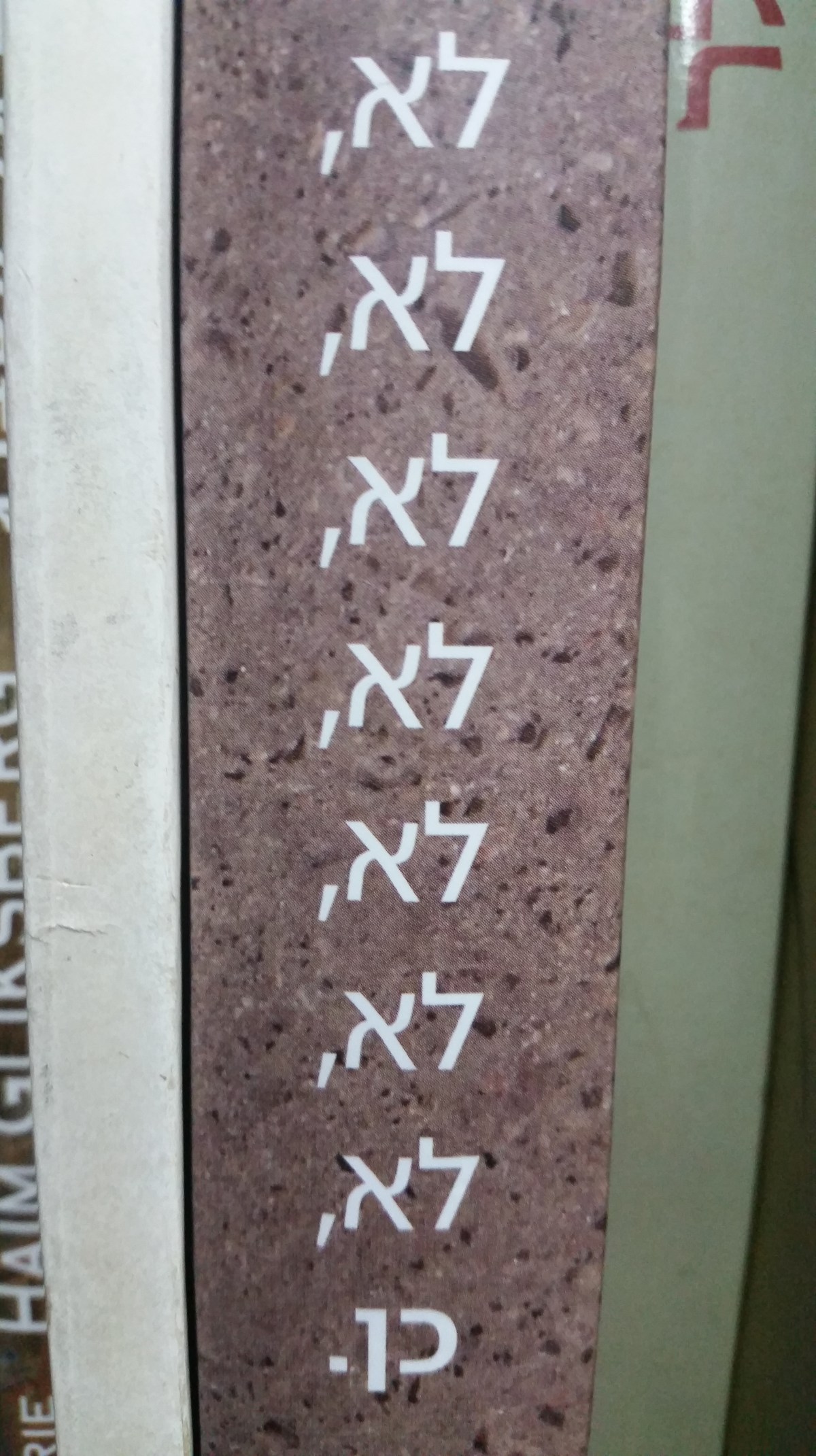
In the end, I come back to my name, Matah מטע.  It means orchard and I chose it because I’m planting roots to bear fruits, to blossom.  And what I realized is this- I was tired of the “no, no, no, no” I was hearing and wanted to get to the “yes”, like in my cover photo.  More than being in a central location packed with young people, what I needed was a home.  And what I started to realize is that having gone through so much in the States, this wasn’t really a new home so much as a first home.  I needed some soil so I could ease my bark into the ground and find some stability.  After four months here, I just needed a quiet, safe place to come home to at night and sleep.

And that is what I found.  I’m grateful for the help of friends and my lawyer, who supported me emotionally and with advice.  Was it easy?  Absolutely not.  If you’re making aliyah because you think it’s a piece of cake, you should immigrate to Ireland.  Or Belgium.  Or Japan.  Because Israel can be really friggin tough.  Not always for the reasons Sabras think, but it is hard.  I have to admit my faith and my hope were tested repeatedly while finding a home.  And I hope I can find some peace of mind by reconnecting to the Israelis who give me spirit, rather than the people who drained me of it.

On my way home Friday, I heard a song wafting through the air in my new neighborhood.  I recognized the melody.  And as I got closer, I sang along: “lecha dodi likrat kalah, pnei shabbat nekablah.”  The traditional Jewish song for welcoming Shabbat, the Sabbath bride.

I couldn’t help but think that for all the challenges I’ve been through- and the unknown ones that may lie ahead- that I made the right choice.  Because rather than hearing the boom boom boom of the middle of Tel Aviv, I’m hearing the songs of my people.  Prayers I’ve said since childhood.

There may not be a lot of Reform synagogues in South Tel Aviv, but you don’t always need one when your prayers fill the air of the market and you’re singing along.  With your new key in hand.  When you move to a new home, you’re praying with your feet.