Talking gay with a Breslover Hasid

Today, as you might have seen in the news, was a tense one for Israel.  Hamas organized 50,000 Palestinians in Gaza to charge the border fence with Israel, in some cases burning tires, hurling rocks, and even setting Israeli farmland on fire with kites laden with fuel.  The army even stopped men planting a bomb.  Peaceful protests these were not.  They were specifically timed to counter the American Embassy dedication in Jerusalem.  No doubt taking advantage of Gazans’ misery and poverty, Hamas chose to direct their attention towards Israel as the source of their problems.  While I couldn’t and wouldn’t argue that Israel bears no responsibility for the problems in Gaza, so does Hamas and so does the Palestinian Authority (which is in a feud with Hamas), and so does Egypt which also closes its border to Palestinians.  Yet not a single Gazan is charging the Egyptian border.  While Hamas feeds people fantastical notions that they will redeem and liberate Palestine (i.e. present-day Israel)- a Palestine that hasn’t existed for 70 years.  Its traces here and there but mostly gone.  Memory.  Sad and true.  And complex- because they might still be there if Arabs had agreed to a two-state solution in 1948.  And definite gray space because some Arabs were kicked out against their will, even after agreeing to live as Israelis.  My heart goes out to my friends living in the villages near Gaza, including my friend at Nahal Oz, just on the border, trying to study for exams with the stench of burning tires surrounding her.  I try to mourn the loss of all human life, even those humans who angered me and tried to harm me.  I empathize with the families of those Palestinians whose lives were lost today- and hope this sad moment inspires more to seek peace and not violence.  So we can all live in safety and tranquility.

In the face of this tense day, I wasn’t sure where to travel.  I kind of wanted to go to Jerusalem to see the opening of the new American embassy.  As an American-Israeli, it gave me great pride to see my other homeland offering such strength to my country.  Jerusalem is the capital of Israel and has been in the prayers of Jews for thousands of years.  It is also holy to Muslims and Christians.  The new embassy is in the western part of the city, Israeli territory since 1948 and not a part of the contested West Bank or East Jerusalem, site of a probably Palestinian capital in a future peace agreement.  I’m not a fan of Donald Trump on so, so many issues and I did not vote for him.  But I’m grateful to him for his courage on this issue because, whatever his motivations- he is right.  We can’t have honest peace negotiations until we recognize that Israel is here- and here to stay.  Hopefully alongside a brighter and freer future for Palestinians.

It was late in the afternoon so I couldn’t make it to Jerusalem.  Instead, I took the bus to possibly the least touristy place in Israel- Modiin Illit.  The city is almost entirely Haredi, or ultra-Orthodox, and is located east of the Green Line that demarcates the boundary between pre-1967 Israel and the West Bank/Judea and Samaria.

Other than checking with a friend to see if it was safe to visit and reading the Wikipedia article, I had no idea what to expect.  Turns out, it’s really cool.  First off, the Haredim who live are almost entirely Litvaks, or Lithuanian Jews- like me!  Religiously speaking, they are ultra-Orthodox but different from Hasidim in that they focus more on intellectual learning rather than feeling.  Part of my ancestry is Lithuanian so it was kind of like a belated coming home.  We both made our way to Israel to reunite 🙂

I’ve spent time in Haredi communities here before, including Bnei Brak (many times) and briefly in Mea Shearim and Tsfat.  What was so unique about this community was how green and calm and almost suburban it was.  The bus driver was Haredi.  The people driving cars were Haredi.  There were huge green parks, well-kept and clean.  The air was fresh.  While the housing was clearly dense due to the large families, there was never a sense of congestion or pressure.  It was quite tranquil on an otherwise tense day in my country.

I stopped into a bakery to get some food.  While the friendly young man made me a sandwich, a goofy (and really cute) guy was making silly noises.  “Artikim 10 shekel, leShabbaaaaAAAT!”  Making fun of some guy who sells 10 shekel popsicles on Fridays.  He had all these silly voices and everyone was just laughing.  I joked with the employees that he should do PR for the restaurant.  Incidentally, one of the employees told me he put their bakery on Google Maps- which, to his delight, is exactly how I found it.

When I told one of the guys I was American, to my great surprise he said: “what are you doing here?  Why wouldn’t you stay in America?”  This is a response I’ve gotten from many, many (mostly secular) Israelis.  A kind of envy of America’s wealth and opportunity.  At no point had I heard this from an Orthodox Jew here, who view this as the Promised Land.  An obvious choice for a Jew.

He was quite serious about it- he wanted me to find him a job as a mashgiach, or a Kosher certifier.  I told him I didn’t know of anything, but that I’d look into giving him my passport.  We laughed.

As I headed out, I noticed a sign: “Matityahu”.  This was really cool for me to see because my name in English- Matthew- that’s from Matityahu in Hebrew.  So all of a sudden I started seeing signs with my name everywhere- in Hebrew!  Turns out there is a village next to Modiin Illit by my very name.

I walked up the hill and found it to be stunning.  Apparently a lot of Americans live there, so if I can’t be in Jerusalem for the opening, at least I could be with my kin 😉

I noticed a very attractive 20-something Orthodox guy.  A woman was taking pictures of her daughters, he said he was jealous because nobody took pictures of him!  I laughed and said I’d take one.  And I did.  And it turned out really cute and he agreed.

Because this is Israel, we then talked for about two hours.  He grew up Orthodox and now identifies as a Breslover Hasid.  He went through periods of intense doubt approaching atheism and has many secular friends.  He says at this point, more than Orthodox.  He serves in the army.  And he’s trying to open his own business.

One of the things that alarmed me about Israelis at first, but now I love as one, is that we get down to the point.  No lame chit-chat- tell me who you are, what you’re about, what you believe, what you want.  You get to the meat of a person very quickly and can figure out how to relate to them and connect.

In this case, Shmuel (pseudonym) and I talked about everything.  I came out as a gay Reform Jew (not a trivial thing in the middle of an Orthodox settlement alone).  He said he had never met an openly gay person before, but didn’t show the slightest bit of phobia or aggression.  Mostly curiosity.  As a Haredi Jew, he had ideological issues with both Reform Judaism and homosexuality- but was utterly open to hearing what I had to say about them.  And I really felt listened to- and I listened to him.  There wasn’t the slightest bit of disrespect nor hatred.  We laughed, we debated, we walked- it was nice.  He looks good in a kippah, it’s a shame he’s not gay 😉

We talked about his shidduch dates (he’s too busy for them, plus he has the army, and he doesn’t want to feel pressured).  We talked marijuana (he smokes but says a lot of people don’t approve).  He reads a lot of modern literature about business and how to grow your intellect.  The most important thing for him in a partner is someone who wants to grow, something I found really admirable.

He gave me a ride to the gate so I could catch the bus.  I encouraged him to read Orthodox rabbis’ opinions on homosexuality because there are some that are increasingly accepting.  He said he didn’t know about it but he’d check it out.  Without any resistance to my suggestion.

Shmuel has had trouble praying.  He goes to synagogue but he just can’t read the words, it feels forced to him and he wants it to feel real again when he’s ready.  I offered him a suggestion: “praying isn’t just what you do in a synagogue.  Praying is what we’re doing now.  Two Jews, two people from very different backgrounds talking together, learning from each other, growing together.  Realizing we have a lot more in common than we thought.  And choosing to listen and debate rather than rip apart each other’s differences.”

He nodded and then he asked: “I forgot to ask, what’s your name?”

I said: “Matt in English, Matah in Hebrew”.

“Pleasure to meet you”

“You too man!”

On a day when the world sat fixated on CNN sated with blood and terror, a Hasidic Jewish settler and a gay Reform Tel Avivi had a really nice chat.

Now you know the news they don’t report.  Don’t give up hope 😉

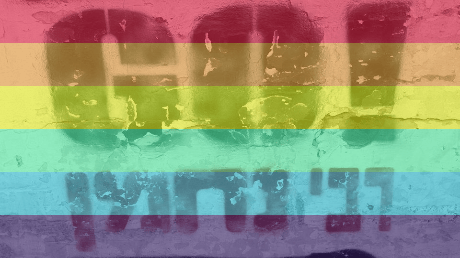
p.s.- my cover photo is of Breslover graffiti I found in Bnei Brak.  The rainbow filter is my addition 😉

The Holocaust

For lack of a better title, that’s what I’m calling this blog.

Today is Yom Hashoah, Holocaust Remembrance Day.  It is my first time spending this remembrance in Israel.

I knew in the back of my head it was coming tonight, but I was surprised with the speed.  I was going shopping in the Shuk and as early as 4pm everything started to shut down.  With no food at home, I scrambled and even convinced the mini-mart to sell me a milk carton as the tarp was being pulled down.

Living alone here, I wasn’t sure quite what to do.  I’ve been to Holocaust remembrance ceremonies in synagogues and Jewish Community Centers in the States, but you don’t get the feeling that the whole country is coming to a stop.  Quite the opposite, the average non-Jewish American wouldn’t even notice.

After deciding to cook some lentils I had lying around from the Eritrean corner store, I got to thinking.

This past year, I started doing genealogy of my family.  It’s not easy- I come from a deeply toxic and abusive family across several generations so to “reconnect” with long-lost relatives is hard.  I don’t know how they were as people and if they gifted me the torture I survived as a child.  What I hope, on some level, is that someone up the family tree was brave and hopeful like me.  Someone who aspired, who made it to America, who overcame obstacles.  Whose courage runs through my blood and brought me to my homeland.  Their very distance from me and my not knowing them allows me to imagine such a scenario.  To enjoy that several of them were Yiddish teachers.  That one was a rabbi.  That they spoke Yiddish and English and Romanian and Hungarian and Russian.    It gives me a little sense of rootedness when I sometimes experience loneliness and a sense of detachment.

It also helps me understand where I come from when Nazi Germans and their Polish, Hungarian, Russian, etc collaborators murdered my family.  Because while some of my Palestinian neighbors want us to just “go home”, it’s not quite so simple.  The truth is the homes we had before the Holocaust no longer exist.  There were 17,000 synagogues in Europe on the eve of the Holocaust and now there are 850.  European Jews numbered 9.5 million in 1933- and today barely 1.4 million- 85 years later.  You cannot find an Ashkenazi Jew who didn’t lose relatives in the Holocaust- whether they know their names or not.

And in Israel, they know their names.  Because about 90% of the State’s initial population was either Holocaust survivors or their relatives.  While the vast majority were Ashkenazi, a number of Sephardic communities were annihilated by the Germans, including the beloved Salonika which is now basically empty of Jews.

Some people do not get the Holocaust.  Many, many, many non-Jews I’ve met, including people I grew up with in the U.S., think the Holocaust is the only major act of anti-Semitism to befall the Jewish people.  I even had a French teacher in the States who genuinely thought no anti-Semitic violence happened before the Holocaust.  Wrong.  The Holocaust is the climax.  It’s the climax of 2,000 years of Christian anti-Semitism, which later morphed into race-based anti-Semitism.  The reason Yiddish has Hebrew, Aramaic, Italian, French, German, Polish, and Russian in it is because we’ve been expelled from all those lands (and others) over and over again.

Something few Americans I know want to acknowledge is their privilege as Christians.  Or as descendants of Christians even if they don’t practice the religion.  My point here, by the way, is not to suggest Christianity is inherently anti-Semitic nor to blame individuals today for the acts of other people.  Rather, I want to suggest that people need to understand the way being not Jewish gives them privilege over Jews everywhere in the world except Israel.

There are the basic things like when public holidays take place to the likelihood that a Jew will be elected President (in America- I’m not holding my breath).  Then there are the country clubs that wouldn’t admit Jews, the universities that had quotas, the lynchings, the job discrimination, the Hollywood surnames that lost their “skys” and “mans” and “bergs”.

I’ve personally been discriminated against- classmates calling me a rich Jew, people telling me Jews were loudmouths, having bomb threats called into the Jewish Community Center, even being thrown out of a taxi by an anti-Semitic driver yelling rants.  Being called “similar to an Islamic extremist” for keeping kosher.  A guy I was dating once even broke up with me after he found out that I didn’t eat pork.  Read between the lines.

It should be said that American anti-Semitism, even with its recent scary rise in cemetery desecrations, is relatively mild compared to other countries like France and Russia, from where Jews continue to flee.  It should be said, though, that there was a 57% increase in American anti-Semitic acts in 2017.  Something I believe American Jews should keep in mind and at least consider taking a glance at the Nefesh B’Nefesh website as an option.

The fact that American Jews, as a whole, have achieved great success- much like our German counterparts prior to Adolf Hitler- is not primarily to your credit, America.  It’s to ours for overcoming the obstacles you often put in our way.  The fact that my family was excluded from institutions didn’t just give you an advantage- it gave us a disadvantage which we bravely overcame.  And still overcome.  Discrimination is never neutral.

As I continued to do genealogy, I mapped out where my ancestors lived in Europe before coming to America starting 130 years ago.  I’m still working on it, but here’s my map so far:

Screen Shot 2018-04-11 at 11.50.07 PM

As I found my relatives’ birthplaces, I came across other databases.  The Nazis, to their credit, were diligent Germans.  The kind who keep good notes.  Who keep the trains running on time and the logs well-written.  There are entire databases, I discovered, of the names of Jews who Germans murdered.  And what I found, to my shock, was people with the same surnames as my relatives from the very same towns- killed by the Nazis.  In some cases, they were the only people in the town with the same surname.  My family.

While for many Israelis, Holocaust remembrance day is very direct- they remember their immediate relatives.  In some cases, they remember themselves in concentration camps.  American Jews, with the exception of post-war refugees, are another generation separated from the pogroms we escaped.  And we don’t necessarily know the names of our lost relatives, even if we realize they must have died.  With the help of the internet and Nazi record-keeping, I can now say I do.  It makes it much more personal and makes me a whole lot angrier.  And sad.

A while back, I met a young German man here studying for a semester.  I took him under my wing, showed him Tel Aviv, talked about Jewish history, and even brought him to a Yiddish Klezmer performance.

I think he was well-intentioned but supremely ignorant.  We talked about the Holocaust, which I welcomed.  I’ve struggled to find non-Jewish Germans willing to dialogue (partially because I don’t know many) and I think we both need it.  The young man asked me: “Why do Israelis keep talking about the Holocaust?  It happened so long ago.  It’s old history.”

My heart sunk.

If this is the kind of German that makes his way to Tel Aviv- which initially gave me hope- I started to wonder what the German back home thought of me.  I know rationally that it’s not wise to judge an entire people based on a few interactions (I’ve had some other problematic ones with Germans here- including one who complained about our holidays and our “weird-looking language”).  And emotionally I just get so angry.

In the end, Europeans, white people, Christians, whatever you want to call them.  The people across the pond who aren’t Jews.  They- not all of them- but they caused our trauma.  And, to a certain extent in recent years, you could say the same of Muslim-majority countries, though historically they treated us better relatively speaking.

So when Europeans – because it was not just Nazis, it was also millions of their collaborators – caused us trauma, it has become a generational problem.  Especially here, when combined with the wars and terrorism that followed.

So when French activists or Swiss protestors lament our aggressiveness or “disproportional force”, it’s hard for me to take them seriously.  Not because they don’t have a point- sometimes the trauma heaped on us has gotten passed on to Palestinians and our Arab neighbors.  But rather, because it’s the pot calling the kettle black.  When Europe is ready to compensate us and restore the property – and, impossibly, the lives – of our people, I’ll be ready to talk.  I just can’t really handle a German lecturing me about disproportionate force.  Who doesn’t even know about the tortured Jewish history of his town.  And if that’s hard for you to hear, good.  Because at least we’re being honest now.  And you have to take our feelings into consideration if we’re going to build something better here.

On our side, we haven’t gotten a moment to breathe.  Israelis, in particular those who have lived here many years, haven’t gotten a respite since the Holocaust.  Nearly non-stop warfare and violence.  We deserve a rest.

We also need to remember that because of all the traumas our people has been through, we must be extra cautious not to harm others.  As I’ve written about before, there have been times when Israelis, in particular in 1948, passed their trauma on to Palestinian civilians.  For the first time in 2,000 years, we have the power to abuse others.  Including refugees.  Few things are black-and-white, we just must remember that with power comes great responsibility.  The kind of responsibility and sensitivity that Europeans rarely showed us.  Such as the Polish politician who called Jews “animals” on social media.  Last week.

On many levels, I identify with Holocaust survivors.  Of course as a Jew and as a human being, but also as a survivor of torture and abuse by my relatives.  I’m an only child and I pulled my way out of that swamp with every last bit of my energy until I made it to the Holy Land.  Where those survivors and this survivor now live together, building a new life of hope, health, and joy.

Israel is an imperfect place, like every other country.  If you want to know why, despite all our very loud and vociferous differences, Jews here feel we need a homeland, all you need to do is count the number of Jews in Poland.  Or to try to find the synagogue where my great-grandfather prayed in Latvia.  Or to find the Jewish community of Pacsa, Hungary where my great-grandfather Adolf Adler lived.

Guess what?  You’re going to be in for a lot of tears.  Because our heritage there was erased.  And it’s because we have a new homeland, a complicated and blessed place, that we are still alive.  Israel struggles with many things- preserving Jewish culture, guarding human rights, and even sometimes pursuing peace.

One thing we’re good at is saving Jewish lives.  Something Europeans never really could figure out.

Have a meaningful Yom Hashoah.  May this remembrance find the existing survivors treated with more dignity.  May it find all victims of genocide treated with respect.  May it find us living in a world where while I remember my people being gassed, I don’t have to think about my neighbors across the border in Syria suffering the same fate.

One Holocaust, many genocides.  Never, ever again.

p.s.- if you’re wondering what the cover photo is, it’s the flag of the German-American Bund.  The American Nazi party.  Because Nazism wasn’t just Hitler.  We all must stand up for what’s right.

*Image by Paloeser

A family reunion with Haredim in a cave in Tsfat

I just got back from an absolutely fascinating and fantastic trip up North.  The North is truly the most beautiful part of this Land.  A place where mountains and hills, covered in green, soothe the city dweller’s soul.  A place where mysticism, hospitality, and quiet evenings can almost make you feel like you’re living in different country.

My friend and I were visiting the city of Tsfat.  Tsfat has been a center of Jewish mysticism and kabbalistic learning for 500 years.  And its Jewish community has both Biblical and Medieval roots.

It’s a place where you can just feel spirit.  Not because of any particularly grandiose buildings, but rather because of the air itself.  Tsfat is a place you can’t see- it’s a place you feel.

As we were walking on top of a Crusader castle, we heard singing.  Coming from below.  We approached some sort of round opening in the ground and could hear it very clearly.  It was niggunim- word-less Jewish melodies carried through the ages.  And they were coming from inside the hill.  I could make out the white shirts of men walking in a circle and singing.

I found a Haredi man and his family and asked if it was a synagogue in the mountain.  He said no, it was a cave.  And, being the consummate Israeli, ushered me over to him and took me to it.  Something I truly love about this place.

We headed down the hill and I entered the dark cave with the old man.  I found a circle of teenage boys holding hands, belting out the songs of my ancestors.  I came to Tsfat seeking some respite from the city and some calm.  And instead, I found God.

At a time when I had been feeling distant from Judaism and the concept of spirituality, I found something extraordinary.  Without hesitation, the old man and I stepped into the circle and started singing.

The cave magnified our song as each yai dai dai bounced off the walls and meshed with the others.

Before I had started dancing, I asked the man if the kids were Hasidic.  After all, Hasidim are known for their niggunim.  The man said, “no, they are Litvaks”.  Misnagdim.  Lithuanians.  Lithuanians- like me.

Suddenly I was no longer just singing beautiful Jewish melodies.  I was holding the hands of my cousins.  My family.  Separated by oceans and traumas and the Holocaust, reunited in a cave in Tsfat.  And just like the niggunim themselves, no words needed.  You just feel the power and the love.

What’s so extraordinary is that even though the Misnagdim and I come from pretty radically different Jewish traditions, the power of Jewish music brought us together.  Ashkenazi Jewish music has particular modes.  It’s not by accident that many of our songs sound similar.  So that even over a hundred years after our relatives were separated, we can reunite to the same sounds in a cave in the Land of Israel.

Feeling so moved that my face couldn’t help but smile non-stop for minutes afterwards, I headed out.  As my friend and I and the Haredi family walked out of the cave, the old man did the appropriately Jewish thing and asked me a bunch of questions.  Which, to his great pleasure, I answered in Yiddish.  Who was I?  Where was I from?  Where were my ancestors from?  What was my last name?  And, as is the case in many places I visit here, “are you married?”  When I told some Reform friends here I get asked that a lot, they laughed and couldn’t believe it.  And it also shows that there are a lot more traditional people here that I manage to spend time with.  Because I think I manage to get asked that question 3-4 times a day when I travel here, from Arabs and Jews alike.

When I told the man my last name was Adler, his eyes lit up.  “Adler!  You have a famous rabbi in your family!  You don’t know?  Oy, come to my house in Bnei Brak anytime- you are most welcome.”  And he gave me his address.  Because when people here invite you to something, they really mean it.

In Kabbalah, the Jewish mystical tradition, there is a concept of elevating sparks of holiness.  For Jewish mystics, tikkun olam, or repairing the world, is not just about social justice (as it is usually seen in Reform Judaism), but rather about taking the profane, the mundane and making it whole again.

I’ve traditionally associated Hasidim, rather than Lithuanians, with Kabbalah and a kind of anarchic and unbridled mysticism.  Yet Litvaks too have a relationship with this famous book.  Long have I wondered if they sang niggunim and what they sounded like.

And now, at a 130-year-old delayed family reunion in the most mystical city of all, I now know.

Nice to meet you fam.

p.s. I was humming this Hasidic-inspired song all the way down the hill, if you want to take a listen.

29513276_10101732530372072_6027841628819591344_n

Yiddish softens the heart?

Two weeks ago, I approached my friends at FluenTLV about starting a Yiddish table.  FluenTLV is a fabulous event (my favorite in Tel Aviv) where people get together to exchange languages.  I offered to represent the language and they were thrilled.

Last week, the first week we did Yiddish, probably 3 or 4 people came and it went well.  One German guy, a couple Jewish Americans, and an Israeli.  Given how stigmatized my heritage language is in Israel, I was pretty happy.

Last night, Yiddish came to life.  At the beginning of the night, an Israeli came in and tried to take one of the three chairs at my tiny table.  I said: “actually that chair is for Yiddish.”  He said “well, nobody is going to come anyways, so I’ll take it.”  I said: “nope, this chair belongs here, you can leave now.”  I asked him if he wanted to learn something and he said “sure, teach me a word.”  I did, he laughed, gave me one of those “everything is OK dude” Israeli high fives and left.  Probably without a further thought about what he had said.

The best part of the evening is that this guy was totally wrong.  Group after group came over to my table.  We didn’t have enough chairs.  When all was said and done, about 15-20 people had visited my table.  A German guy and two Dutch men explained how Yiddish had made its way into their languages!  A Brazilian Jew talked about Yiddish in her family.  I met Israelis whose parents or grandparents spoke the language and remembered some phrases.  Together, we read my copy of “Der Blat”, a Satmar Hasidic newspaper.  And I could see the glow in their eyes when they realized they could understand some of it.

What was also astonishing was how willing people were to learn.  I often find Israeli culture frustrating because of the bravado.  So many people here feel the need to be right trumps all.  Hence often endless debate, even when the facts used are minimal.  I’ve even had Israelis try to correct my English- knowing I’m American.  We often laugh that off, but after a while it wears on you.  It’s tiring having to constantly defend yourself.  Humility is not an Israeli value.

Yet at the Yiddish table, Israelis came to learn from me.  And subsequently shared about themselves.  Their families, their stories, their grandparents’ Yiddish phrases.  For the first time, I actually felt in dialogue with Israeli Jews rather than a lecture.  Or an argument.  There was a softness to our conversation that made me happy.  It warmed my heart and it gave me hope.

In a society where, as I see it, traumatized Jews faced 2,000 years of violent persecution with few options for safety and survival.  Sadly, some of these Jews ended up traumatizing and displacing Palestinian Arabs in a bid for a homeland.  Some of these traumatized Palestinians subsequently re-traumatized the Israelis.  And now we’re stuck in a seemingly endless cycle of violence.

That’s how I see it on regel aches- or “one on leg” as we say in Yiddish.  My Tweet-length version of the conflict here.  The saddest part is the trauma on both sides continues.  Anti-Semitism is not just the Holocaust.  It’s a two-millennia phenomenon that continues to this day from America to France to Iran.  I’ve personally experienced it in the liberal suburbs of Washington, D.C.  When Jews are persecuted, we often have nowhere to go, which is why some people believe in a Jewish state.  I’m not sure it’s the best solution and I completely understand why people feel we need it.  It’s not by accident that there’s a lot of French people in Israel- they’re Jews fleeing violence and bigotry.  Palestinian terrorist attacks on pizza shops and buses and schools only feed this narrative as we feel under attack yet again.  Trauma piled upon trauma.

And for the Palestinians, you have those who are citizens of Israel yet continue to face discrimination, racism, and often poverty.  Whose lands were robbed of them- and are still in the hands of the Israeli state 70 years later.  You have those in the West Bank and Gaza Strip who live in immense poverty, have little right to travel, have few if any civil liberties, and often face violence from the Israeli military.  And even some settlers who burn their trees, deface their houses of worship, and physically assault them.  And you have Palestinian refugees in Lebanon, Syria, Jordan, and elsewhere who can’t even come back to the land they once called home.  Who have no rights in the villages they come from and whose host states often extensively discriminate against them.

Sometimes its enough to just make you cry and cry and weep for humanity.  With no end in sight.  Ya Allah, God please send us all healing.

So in the face of all this sadness, what gives me hope?  Yiddish.  Because tonight, I saw the softer side of Israeli Jews.  When they don’t have to be “tough”- not against Arabs, not against other Jews, not against their own heritage.  Rather, by connecting to their roots- roots violently uprooted both by European anti-Semites and the Israeli state– they felt warmth.

I hope politicians can figure out a solution to this problem.  Given their proclivity for narcissism and greed, I’m not sure what they’ll do.  In the meantime, perhaps part of the solution is culture.  When you feel connected to something bigger- especially something a part of your heritage- it puts things in perspective.  Rather than having to show how “Israeli” you are, you can be the multifaceted Jew beneath the uniform.  The Jew whose family was persecuted by Polish Nazi collaborators, the Jew whose family escaped to Israel, the Jew who lives on Palestinian land, the Jew who wishes to reconnect with his heritage.  A complex one, of persecution and co-existence.  Of perseverance and of trauma.

A little less prickly sabra and a little more soft kneydlach.  Those fluffy yet durable matzah balls that comfort you when you feel sick.

Cover photo by Jonathunder – Own work, GFDL 1.2, https://commons.wikimedia.org/w/index.php?curid=31812266

A bisl Hassidus a bisl queerus – a gay Hasidic day

In a playful way, my title means “A little Hasidism a little queerness”.  And that’s exactly what I did today.

My day started with a trip to Bnei Brak.  A Haredi city of about 200,000 people just a bus ride away from my house in Tel Aviv.  I’ve been many times and now know my way around, which is pretty cool.

I started my day by buying a 5 shekel siddur (prayer book) from Gur Hasidim.  In Bnei Brak I’ve seen on multiple occasions dozens of beautiful books left outside with nothing but a collection tin where you put in some very token amount of money and get delightful books.  I happened to choose an old little siddur because I thought it was neat.  For the same price (about $1.50) I could gotten an almost mint-condition book of the Talmud or the writings of Rabbi Elimelech.  Jews are truly people of the book 🙂  And I’m adding some amazing volumes to an already killer library.

I needed some change so I walked across the street and talked to Shlomo.  Shlomo was excited that I was American.  He was born in Israel and used to live in New York where he was a mashgiach– a kosher certifier.  I learned from him about how he apprenticed and then got into the profession.  He had been to my hometown of DC several times which is awesome.  I asked him what he really misses about America and he said: “sesame chicken- I can’t find it good and cheap anywhere in Israel!”  Amen brother!

I then popped into the Ponevezh yeshiva.  What I didn’t realize until writing this article is that Ponevezh is actually a Litvish yeshiva.  In other words, they are Haredi (ultra-Orthodox) but not Hasidic.  In fact, back in the day the groups were intense rivals, but now there’s more overlap.

There I found something interesting amongst all the religious books and pamphlets- an ad for American e-cigarettes haha.

I then headed to the Breslov yeshiva around the corner.  I asked a man if I could take photos and, as is often the case in Israel, he said sure and then invited me in to learn with him.  For those who need some context- I have studied Torah as a Reform Jew.  I have never studied Torah in a Hasidic yeshiva.  Such a thing doesn’t exist in Washington, D.C. and even if it did, most people from my background probably wouldn’t step inside.  So basically, I’m brave and I strive to be open-minded.

Shlomo (a different Shlomo from Shlomo #1) sat with me and we studied Gemara.  Basically a foundational text of rabbinic commentary and part of the Talmud.

This is far outside the wheelhouse of even the most educated Reform Jews unless you’re studying to become a rabbi.  I’ve grown up in the movement and participated in almost every program imaginable and I can’t say I’ve ever taken an in-depth look at this aspect of Judaism.  We tend to focus on other very important aspects like social justice and the personal spiritual experience.  I do wonder if we lose something by not engaging some with these texts too.

Shlomo was a funny guy.  First off, he asked about my Jewish background.  Keep in mind I’m in the middle of a Hasidic yeshiva in Bnei Brak with hundreds of men around me I don’t know.  The image of Hasidim in the media here is anything but positive.  Violence and extremism are pretty much all secular Israelis know about their Hasidic neighbors.

So how did I answer his question?  I said: “I come from a somewhat traditional Reform home.”  BOOM.  Please re-read that absolutely everyone who tells me that if only Hasidim in Bnei Brak knew more about me, they wouldn’t accept me.  For sure I’ve had difficult experiences here and heard negative remarks about Reform Jews.  And I’ve also had moments like today when this guy didn’t bat an eye.  In fact, his follow up question was hilarious.  Trying to connect with me via the ancient tradition of Jewish geography, he asked if I knew his cousin in Monsey, NY!  This carries an extra level of funniness because Monsey Jews are very Hasidic and I can’t imagine many Reform Jews have ever stepped foot there.  But I appreciated his effort to connect with me- even after I said I was Reform.

As we’re studying Gemara, an old man came up and asked for money.  I forget exactly how it came up, but at some point he said about me in Yiddish, “he’s not a Vizhnitz Hasid!”  To which I responded in Yiddish: “that’s right, I’m not a Vizhnitz Hasid, but here take some change!”  He nearly fell on the floor in shock.  His smile grew and he starts telling everyone that I speak Yiddish with a look of intense naches- of pride 🙂  You have to keep in mind everyone there knows I’m not from the community- I’m wearing jeans and a green sweatshirt.  We had a good laugh together and shmoozed a bisl.

He then puts his hand on my head and blesses me.  Wow.  It gives me shivers and made me feel so loved.  I don’t know the last time someone blessed me.

Walking around Bnei Brak, I got hungry.  I stopped for some cookies and found a delicious bakery that even had shockingly good whole wheat cookies.

Still hungry, I continue walking and even helped some cute kids cross the street.  Each one wanted me to tell him that he did a good job crossing 🙂

Then something bashert happened.  Bashert is a word Hebrew wished it had.  In Yiddish (and Jewish English) it means something predestined, meant to be.  Either a person you fall in love with or connect with.  Or an event.

Some of you might remember Yisrael.  He’s my friend who gave me my first Haredi hug.  By chance, I happened upon his restaurant.  The past few times I was in Bnei Brak I tried to find it but I forgot where it was.  And this time my tummy- and perhaps a greater force- led me to him.

He instantly recognized me, even though it had been months.  He gave me a huge hug, told me I looked great, and asked me how I was doing.  We caught up, he of course gave me extra food for free, and I sat down to delicious gefilte fish and kugel.  Heimish, delicious Jewish food.

While I was sitting, I heard an interesting- and incredibly respectful- debate between a Chabad guy who claimed the Lubavitch rabbi was the messiah and the other Hasidim who disagreed.  This was absolutely fascinating.  And what is more- no blood was shed.  No blows were thrown.  In fact, Yisrael ended the debate by calling the rabbi a tzadik, or saint, and everyone went back to eating and asking me about America (they love to practice their English with me).

Hardly a story you’ll read in Haaretz or see on CNN, but it was real.  And it’s how many people live their lives here.

Heading out the door, I thought to myself that sometimes I wish I could be a part of this community.  Due to my queerness and my Reform identity and progressive values, I don’t know to what degree I could find acceptance as my full self.  It can make exploring Bnei Brak hard at times.

And yet it’s precisely because of these identities that I’m intrigued by this community.  And truth be told- I’m a part of it.  Just in a way that works for me.  Where I can participate in a way where I am learning the best this place has to offer and staying true to who I am.

Due to the Holocaust, Soviet anti-Semitism, American pressure to assimilate, and the Israeli government’s repression of Jewish cultures, my heritage suffered greatly the past 100 years.  An entire civilization, Ashkenazi Judaism, was nearly wiped out.  Yiddish almost forgotten.

When I made aliyah to Israel, I hoped to reconnect with my roots.  Sadly, this state doesn’t believe in Jewish culture.  Whatever remnants of my roots that are here exist in spite of a state that has shamed people for being Jewishly different.

The one group that more than any other has held on to their yiddishkayt- their Jewish roots- is Hasidim.  These Jews continue to speak the language of my ancestors for the past 2,000 years- Yiddish.  A language I now speak as well.  They maintain customs and wear clothing that are anathema to the society that surrounds them- to the state that wishes they’d just forget the Diaspora.

As I headed to a bar to meet a bunch of LGBTQ olim like me in Tel Aviv, I couldn’t help but think of what we have in common.  To hold onto your identity is a daily challenge.  When people around you ridicule you for your difference, for standing out, for being “out of the norm”- you have to find ways to cope.  So perhaps to the chagrin of some homophobic Haredim (not all) and some anti-religious gay people (not all)- we’re dealing with a much more similar problem than they’d like to believe.

Recently I saw a post in a Facebook group about Ramat Gan, a suburb that is squished between Tel Aviv and Bnei Brak.  There are political and religious tensions there between secular and Haredi Jews.  One particularly harsh post by a secular gay guy said: “Ramat Gan- we need to choose between Bnei Brak or Tel Aviv.”

That’s how he chooses to live his life.  Black and white.  Yes or no.  Secular or Orthodox.  Tel Aviv or Bnei Brak.

I have no doubt something caused this mentality and I hope he finds healing.

Because given the choice between Bnei Brak and Tel Aviv- I choose both.

The Bnei Brak of free Gemara lessons, kugel, sesame chicken fans, e-cigarettes, and whole wheat cookies.  The Tel Aviv of queer olim parties, hot guys on the beach, Reform synagogues, and Arab college students.

In short- gam vegam.  Both this and that.


Straight talk about Israel

This may be my most dugri blog ever.  We need to talk about Israel and Jewish culture.

After 2,000 years of exile, idealistic pioneers started to resettle the land.  There had already been some Jews here – even some with continuous presence since the destruction of the Temple – but they were a small percentage of world Jewry.

The new pioneers, eventually called Zionists, set up all sort of agriculture and economic development and cultural enterprises.  For the latter, one of their best known accomplishments was the revival of spoken Hebrew.  It is an enterprise unmatched by any other linguistic revival movement.

A great deal of the pioneers’ energy was motivated by a desire to escape the “Diaspora” i.e. Jewish life anywhere outside of the Land of Israel.  It wasn’t just a physical escape (which is quite understandable- life was pretty rough for Jews being butchered across the world for 2,000 years).  It was also a psychological and cultural one.

In their minds, especially the Sabras (i.e. the pioneers’ Israeli-born children), the Diaspora Jew was weak, effeminate, overly polite, wordy, deferential, and too religious.  All words which if said by a non-Jew would probably be considered anti-Semitic.

Clearly they had been through trauma across generations and perhaps instead of resolving their pain, they passed it on to others.  In this case, other Jews (although perhaps in another blog I’ll explore how this affected relations with Arabs).

Sabras were largely of Ashkenazi extraction (i.e. their families immigrated from Europe), but their culture was not.  Over time, they rejected Yiddish, the Jewish religion, even changing their Ashkenazi pronunciation of Hebrew.  These were the blunt, masculine, secular pioneers building a state.

When it comes to meeting their goals, one cannot deny their effectiveness.  They established a safe haven for Jews for the first time in 2,000 years.  They won war after war after war- at great cost.  They changed Jewish culture not only in Israel, but also across the world.

The question is at what expense?

When Jews came to Israel from across the world (and continue to do so), they were often escaping anti-Semitism, economic devastation, and war.  From Morocco to Yemen, from Poland to India.

Jews in most of the world are quite accustomed to being persecuted by non-Jews.  Coming to Israel, we thought, would finally protect our Jewish identity.

But the sad truth of it is that when many Jews arrived (and indeed, arrive) to Israel, Sabras greeted them with hatred.  Iraqi Jews were shamed for speaking Judeo-Arabic.  Ashkenazi Holocaust survivors were not only attacked for speaking Yiddish, they were also called “sabonim” or “soap”…because of the rumor that Hitler made soap out of their families’ bodies.  To many Sabras, Ashkenazi Holocaust survivors were weak Diaspora Jews who went “like sheep to the slaughter“.  Religious Jews arrived to Israel and some Sabras even cut off their peyos– their side locks.  I’ve seen videos of this from the 1930s…in Germany.  Did not expect that to have happened here.

While respect for diversity has certainly increased since the early years of the State, it is still an enormous problem.

For example, I live in a largely Mizrachi neighborhood- Jews who came to Israel from the Middle East.  There’s an Iraqi bakery and the Jewish woman there and I speak in Arabic.  Which is pretty friggin awesome.

A young man comes up, also presumably Mizrachi, and talks to the woman because they know each other.  She tells him: “look he’s American and he speaks Arabic better than me!”.  He gets a puzzled and angry look on his face and says: “What do you mean Arabic?  You’re Iraqi.”  The woman then explains to him that when her parents moved to Israel, they spoke Judeo-Arabic.  He wasn’t interested in the details: “Iraqis aren’t Arab.”  He bought his pitas and he left.

This is a guy who presumably has a similar story in his family.  With Judeo-Arabic, with Persian, with Bukharian- with something.  With his roots.  That he doesn’t understand.

When a person becomes un-rooted- as the Sabras did- they lose their sense of self.  One need only look to many million of Americans whose ancestors were shamed for speaking Irish, German, etc.- and now have no cultural bearings.  And take that hatred out on immigrants who keep them.

Culture evolves- that’s fine.  In fact, it can be good.  Not all of the Sabras’ ideas were bad.  God, YHVH, in Hebrew is a verb.  Spirituality and culture need to change but they also need a starting point.  You don’t need to throw the baby out with the bathwater.

The sad thing is that the Sabras’ initial behaviors have became Israeli cultural norms.  While Sabra once meant the first generation of Jewish pioneers born here, it now applies to any Jew born in Israel.  The ideology of the first generation of Sabras has now became fairly mainstream and so with each passing generation, the new cohort of Sabras passes the pain along.  And the pressure to conform.

I can’t tell you how many times I’ve heard “French olim are so annoying with their ‘hon hon hon’, in my neighborhood you’d think we’re in France!  Why do they come here?”  Or “Russians are lazy and don’t learn Hebrew.  Most of them aren’t Jewish anyways.”  Or “You speak Hebrew great!  Not like those Americans who live here 20 years with their terrible accents and can’t get a word out in our language.”

Are all Sabras like this?  No.  I’ve met some people here with a great respect for cultural diversity and a curiosity about the world.  Even their own roots, despite what they’ve been taught about them.

But is it more prevalent here?  It is more rooted in the ideology?  It is in fact a cultural value?

Yes.

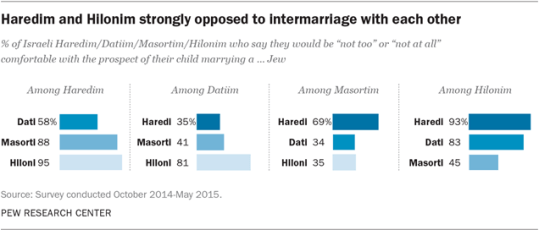
And it’s not only from my observations.  As a barometer, let’s talk intermarriage.  Not because you have to marry someone from a different background to not be prejudiced, bur rather it’s a question of whether it’s accepted.  It’s a reasonable point of data for understanding tolerance for diversity.

In the U.S., which has its own extensive history of racism (which sadly continues), only 9% of the public disapproves of interracial marriage.  To the folks who say this is simply a product of American “PC” culture and unwillingness to tell the truth, they’re wrong.  Three times as many elderly Americans are against interracial marriage as young Americans.  There is a definitive positive trend as time goes on.  Thank God.

Now let’s look at Israel.  Let’s put aside interracial marriage- upwards of 80% of both Arabs and Jews disapprove.   Every single sector of Jewish society here disapproves- by alarmingly high margins- of their children marrying someone from at least one other Jewish community.  Secular Jews, Hilonim, have almost identically high opposition to the phenomenon as their “menace”- Haredim.

pew

How does this connect?  Diversity.  The predominant Sabra ideology (which by the way is not uniform and there are many alternate visions of Zionism- I’ve personally taken a recent interest in Judah Magnes) is vehemently against it- at least when it comes to Jews.  This helps explain both Israel’s struggle to accept cultural/linguistic diversity and to accept religious pluralism (or religion at all).

The sad thing is that Israel is one of the most diverse places on the planet.  Just in my neighborhood, I hear (or speak) Arabic, Tagalog, Cameroonian French, Turkish, Tigre, Amharic, Chinese, Bukharian, Russian, and so much more.  In the right neighborhood, Israel is a polyglot’s paradise.  Which is part of what I love about it.

It’s hard because what I love most about Israel is what the system itself tries to annihilate.  While I’m accustomed to Jews being diminished by non-Jews, I’m alarmed by Jews doing it to our own people.

Jews have arrived to Israel with the riches of thousands of years of civilization.  Culture, music, traditions, languages, religion.  So much unique richness- some of which cannot be found anywhere else.

And I’m glad that Sabras built a place to save Jewish lives.  Because no one else has.

The question is what does it mean to save a Jewish life if you can’t live Jewishly?  Why can’t someone be Israeli and speak fluent Hebrew and also insist on teaching their kids Yiddish or Kavkazi or Haketia?  And their grand kids.  And insisting these languages be taught in the public schools we fund?  And preserving multiple identities in addition to being Israeli?

I’m grateful Israel has amazing archives which I plow to learn about these ancient and precious communities.  But I’m not interested in being archived.  I’m interested in living as a free Jew in my land.  According to my traditions- evolving and ancient.

Because every time an Israeli sings Hatikvah, they’re singing a Romanian folk song in the Hebrew cadence of my forefathers in Poland.

That’s the thing about roots- they’re hard to undo.


A New Year’s Resolution for Israel

Today is the secular new year.  In Israel, fittingly but quite strange for me, they say “shanah tovah”, the typical Jewish greeting for Rosh Hashanah- the Jewish New Year.  It’s a fun night of celebration and also a chance to think of what’s ahead.

For me, this week marks my 6 month anniversary of arriving in Israel.  I’ve learned so much in such a little amount of time.  I’ve visited over 35 cities.  I’ve been to Hasidic dance parties, Mizrachi concerts, dabke dancing, Israeli folk dancing, Yiddish theater, a Russian puppet show, and a Yemenite concert.  I’ve eaten Bukharian, Moroccan, Persian, Ashkenazi, Romanian, Druze, Arab, Kavkazi, Georgian, Indian, Iraqi, Lebanese, Eritrean, Filipino, and so many other types of food.  I’ve davvened with Haredim, Reform Jews, Chabad, and hippie vegan Jews.  I visited a Druze shrine and a Karaite synagogue.  I got to watch Islamic prayer up close and personal in a mosque and I went to an LGBT Orthodox Torah study group.

Not bad for the half year mark!  I’m quite proud of all my accomplishments- moving across the ocean alone, making friends, finding an apartment, adjusting to a new culture, and using all nine of my languages and starting to add Greek!

There has been a lot of stress along the way.  Israel is an extraordinarily hard place to live- or so say Sabras who grew up here.  And while sometimes they exaggerate because whining here is kind of a national sport (and they don’t know much about the challenges faced by people elsewhere), the truth is in many ways they’re right.  And it’s all the more difficult for someone like me who moved here at 31 without an extensive support network.

What’s hardest about life in Israel is also the source of my New Year’s resolution.  The hardest part of life in Israel is the people.  More specifically, the intense and mean-spirited prejudice I experience on almost a daily basis.  Towards me as an American and towards other cultures- especially within Israel.  Don’t get me wrong- there are some fantastic people here, who mostly join me in complaining about the awful ones.  But boy- there is a mean streak to Israeli culture that I haven’t seen elsewhere in the world.  It’s not because I haven’t seen prejudice elsewhere- I’ve experienced it in places like Spain (anti-Semitism), Argentina (homophobia), and the U.S. (all of the above).

The difference in Israel is the intensity and the degree to which many people here celebrate judging others.  I’m someone who deeply values multiculturalism.  I’m well aware that there are limits to it and questions about how far it should extend.  But the basic principle of respecting- at times embracing- parts of every culture to me is second nature and a fundamental way I live in the world.  The good news is Israel is chock full of interesting cultures.  Sadly, that most Israelis know nothing about- and don’t care to appreciate.  While some Israelis are curious about Berlin or America, few are particularly curious about their neighbors who look or talk differently from them.  Let alone their own roots.

The truth is when the State of Israel was being built, its founders despised (and that is not too strong a word) multiculturalism.  Yiddish, Ladino, Judeo-Arabic- these languages were vigorously and shamefully repressed by the state.  Kids grew up with shame about their roots.  And sadly some 2,000 year old beautiful Jewish cultures are going extinct as a result.

The un-rootedness of many Sabras fosters insecurity and prejudice towards those who maintain their heritage.  Just ask many a Sabra what they think of French Jews or Russians who continue to speak their languages here.

There has been somewhat of a resurgence in interest in cultural diversity, but it needs to be nourished.  And that’s where I- and you- come in.  There are Israelis like me who are proud of our origins.  There are Israelis- I’ve met them- who realize you can speak fluent Hebrew and still maintain (or re-learn) your French or Russian or Arabic or Romanian.  There are many who don’t realize that because they’ve been trained to revile the Diaspora.  And that’s very sad.

But in the end, I believe in multiculturalism and I’m convinced there are some people here who are ready to join me in this movement.  I want to celebrate the incredible cultural richness here- of Jews, of Arabs, of refugees, of everyone.  It is a gift that must be cherished to be protected.

It is no longer acceptable to me that when I tell my Sabra friends that I met Aramaic-speaking Christians or Samaritans who speak Ancient Hebrew or Eritreans with an awesome juice bar that their reaction is: “wow I didn’t know that was there- you’ve seen more here in 6 months than I’ve seen in a lifetime!”

Bullshit.  Time to get off your hummus-filled tuchus and get to know the richness of your country.  No- not the high-tech.  The cultural treasures right underneath your nose waiting to be discovered.

It’s time to leave behind the old-fashioned Zionist concept of the “effeminate”, “decadent”, “overly pious”, “cosmopolitan”, “weak” Diaspora Jew.  It’s 2018, time for a change.  It’s time to realize the “Diaspora” is The World.  And lucky for us, a whole bunch of people from all over the world have made this country their home.

Now it’s time to realize that if we understand where we came from, our cultures, our heritage- it doesn’t negate our Israeli identity.  It thoroughly enriches it.  Just like my delicious cover photo of Pringles, Russian sweets, Korean seaweed, and Israeli Bissli that co-exist at my neighborhood store.  Pluralism that begins with culture can increase respect between all sectors of society.  And instead of Jew hating Arab hating Zionist Orthodox hating Haredi hating Secular hating Mizrachi hating Ashkenazi- maybe, just maybe, we build just a little bit more understanding and a lot less hate.

Ken yehi ratzon – may it be God’s will.  Inshallah.  Ojalá.  Mirtsashem.

Let’s do this y’all. 🙂

Dugri: Lost in Translation

There has always been a yawning communication gap between Israelis and Americans- and between Israelis and the world.  Every country and culture has a unique communication style, and in my case, this often leads to challenging interactions with Sabras.  Sabras are Jews who were born and raised in Israel, whereas I’m an oleh- I chose to live here.

The sabra communication style most well known is “dugri”.  Dugri, from an Arabic word (itself of Turkish origin), means “straight talk”.  The word in Arabic means “straight” (like when giving directions), “fair” (like an arbiter not choosing sides), or “honest” (truthful words).  In Hebrew, the word means “direct”- but not in the sense of “honest” in Arabic (which is focused on presenting correct objective facts), but rather directly expressing your subjective emotions and opinions, regardless of how they are perceived.

In Israel, this means less pleasantries, less consideration, less politeness, more tough love, more controversial statements, and more blunt judgments.

There are ideological roots to this communication style that have been well-researched.  I highly encourage reading Professor Tamar Katriel’s study, which I’m still working through.  Going back to the early Zionist pioneer days, ideological olim wanted to rid themselves of what they perceived as a “Diaspora mentality” of formality, nuance, and passivity.  Again- this is their perception, not necessarily the facts.  The answer, especially for their sabra children, was to be found in a new, astoundingly direct and informal communication style, itself ironically rooted in German enlightenment philosophy.  I can empathize that building a new national identity was hard and I also think their attitude towards the Diaspora was pretty hateful.

This style, before I deconstruct the hell out of it, has its advantages.  For instance, I’m a very informal person so I like that dugriyut- or speaking dugri- allows me to speculate, to dream, to ponder.  I don’t have to cross my i’s and dot my t’s- I can just roll with it.  It fosters creativity in me.  I also like that I don’t have to think through every word I say for fear of literally losing friendships.  Here, an occasional offensive comment is not going to lose you anything.  When used properly, speaking dugri can reduce some of the feeling of “walking on broken glass” we face in America when communicating.  Also, hearing people’s deep-seated personal prejudices, while valued in Israeli society, for me actually serves as a defense mechanism so I can avoid someone who is actually toxic.  I rarely have to guess what people here think.

Now the flip side.  First things first- I’m a proud Israeli and I’m an American.  My family has lived in the Diaspora for 2,000 years and while I’m glad to be back, I’m not ready to give up the wisdom gained over centuries.  I’m a firm believer that it is not only possible, it is desirable to have more than one culture.  This is an issue Israel has struggled with from the beginning– as do many countries.  I understand- and will continue to learn about- dugri communication but that doesn’t mean I’m going to “negate” my other cultures.

In Hebrew, the ministry that deals with olim is called the “Ministry of Absorption”.  I can’t even imagine a more Orwellian phrase, but let’s work with it.  Yes, to a degree, I came to be absorbed into Israeli society.  But a funny thing happens when your body absorbs something- it changes your composition.  And so much in the same way, I intend not just to be changed, but to change this place.

So what does this mean for dugri talk?  First off, we need to see some of the negative aspects this style can present.  For example, when sabras interact with foreign cultures, including Americans, they often struggle to perceive cultural differences.  Just this week alone, on three separate occasions, Jews here made (what I consider) offensive remarks to me about Americans being “fake” etc.  This is a common sabra complaint- Americans are polite, but insincere when they compliment you.  All the while, I’m sitting there talking with them as an American with ten times better Hebrew than their rrrrresh infected mouths can mumble in my language.

This is endemic of the problem.  Because Israelis are sparse- but quite genuine- with their compliments (as befits dugri talk), anything other than that is seen as insincere.  What they don’t realize is that it’s simply a cultural difference.  When Israelis move abroad and don’t know how to say “please” or “thank you”- or try to say something unacceptably blunt- they lose friends and often struggle to make non-Israeli friends.  This is well-documented by a study done among Israeli migrants to Canada.  Boy if they think Americans are polite, wait till they meet Canadians haha.

The truth is there are fake people and genuine people in every society.  For me, for instance, I encounter some Israeli communication as incredibly insincere- even though it’s just likely just a cultural difference.  For instance, especially in Tel Aviv, when people promote upcoming events (or compliment someone for leading an event), a whole litany of “mehamems” and “madhims” and “nehedars” and “merageshs” come out.  Basically, just a list of how everything is the most amazing awesome best coolest most wonderful thing ever.  It’s enough to make me, as an American, nauseous because it sounds like they’re lying.  But what I’ve come to realize is that there’s probably a cultural component to it.  Rather than calling all sabras fake, I chose to read hours of academic articles and confront the issue meaningfully.

For me, besides the nuisance of Israelis telling me my country (and implicitly perhaps me and my friends there too?) is fake, I have to wonder if there’s a broader cultural problem at work.

Israelis, unlike almost any civilized society I’ve lived in or visited, have completely separate school systems based not only on race/religion, but also what type of religiosity.  There are Arab schools, secular Jewish schools, Modern Orthodox schools, and Haredi schools.  These schools operate completely separately in state-sanctioned (and largely publicly supported) segregation.  There are social reasons for this- I’m not pretending it came out of nowhere.  But the end result is that Israelis rarely if ever interact meaningfully with people from drastically different backgrounds.  And they don’t learn how to understand intercultural communication.  Nor the value that sometimes, just because you think a thought doesn’t mean it’s best to say it out loud.

In 6 months in Israel, I have become a regular in Bnei Brak speaking Yiddish, I have visited half a dozen Arab villages in Arabic, I hung out with Samaritans, I watched Karaites pray, I talked with Armenians (in Arabic!), I blasted Eritrean music with refugees at a juice bar, I tutored a Darfur survivor in English.  And on and on and on.  I know this country much, much better than most of the sabras who’ve lived here their whole lives.  And it’s not because they’re bad people.  I have learned much from my sabra friends.  And they have much to learn from me about their own country.  This is one of the most diverse and exciting places on the planet.  A place I enjoy even more because of my diverse American upbringing.

Now it’s time for me to dish out some dugri talk (see I do like it sometimes!).  Sabras- you’re mostly racist or at best, unappreciative of the diversity that surrounds you.  Your difficulty in communicating across the cultures in your own country reinforces your prejudices- including towards olim.  I’ve lived all over the world, including spending lots of time in the Deep South in the U.S., and this is by far- by far- the most openly hateful society I’ve lived in.  Not just in terms of race, but also in terms of prejudice between different sectors of society (Secular vs. Orthodox, Ashkenazi vs. Mizrachi, etc.).  There are some of the most incredibly kind and hospitable people here too.  It’s just that the level of judgmental speech and behavior is mind boggling and frankly makes me appreciate my American upbringing- and question whether I want to raise my kids here.

In particular, there are times when the secular Ashkenazi liberal elite here sounds like a bunch of American tea partiers who long for the 1950s.  An era in which the government was basically run by a bunch of white men (them), when Holocaust survivors were told they went like “sheep to the slaughter”, when Arabs were under military rule, and Mizrachi Jews lived in impoverished camps.  But at least in the “good old days”, the government was more secular i.e. more like them.  Perhaps not coincidentally it is this same demographic that coined “dugri talk” generations ago.  Language is power.

The key is that every culture has its communication style.  It was hard for me to write a blog that was in English but appropriately non-judgmental for an American and appropriately dugri for an Israeli.  And I’m still learning about Israel even though I speak the language fluently.  I will always be learning.  I recommend all olim- indeed all tourists- learn about Israeli dugri talk.  And sabras- if you care at all about the millions of people living here born in other countries (or your own ability to travel abroad without offending people)- learn about yourselves.  You don’t have to give up your directness but you do need to learn how other cultures work.  Because it’s not that all Americans are fake.  It’s that you’re not self-aware.

Do your homework.  That’s my dugri talk for the day 🙂

p.s.- my cover photo is a paper I used to teach a Swahili-speaking Tanzanian in Holon about Hebrew vowels…via Arabic because she’s an Arabic teacher.  Intercultural communication isn’t a hobby- it’s a lifestyle.  Open your eyes and join the miracle 🙂

The Satmar part of town

I’d like to tell you a story about nothing.  It’s kind of refreshing in a place where shit is constantly hitting the fan (although much less than someone from abroad might think).  As I write this blog piece, an Israeli plane bombed some military facility in Syria and air raid sirens went off in southern Israel.  I heard some loud noise in my neighborhood and so I checked the news and found out about these events- I have no idea what the connection is but it can be scary here sometimes.

And then life continues.

So right, the other day I went to Bnei Brak.  At this point, we can say that Bnei Brak- and Hasidic Judaism– is a part of my identity.  I don’t just go as a “tourist”- I go because it’s part of my heritage and my people and it’s absolutely fascinating to see a living, breathing Yiddish community.

After eating delightful gefilte fish and kugel and buying loads of Hasidic music, I headed to the Satmar part of town.  The Satmar part of town?  Yes.  In Bnei Brak, each Hasidic group has a yeshiva where people study and it’s kind of their neighborhood.  In a small way, it’s a way of bringing back their former towns in Europe destroyed in the Holocaust.  Because the way you get around Bnei Brak is to say: “where is Vizhnitz?  Where is Belz?  Where is Satmar?”  These are all Hasidic groups- all named after the towns in Eastern Europe where they were founded.  And there’s an eerie and beautiful ring to being able to ask where they are- still- as if you’re heading to the village itself.

So why did I go to the Satmar part of town?  First of all, what is Satmar?  Satmar Hasidim are one of the largest Hasidic groups in the world, with members in multiple countries.  This still makes them a small minority of Jews, but they are influential and growing.  While most Hasidim are not Zionists, they are very much in favor of the Jewish people, love the Land of Israel, and have varying degrees of affinity for the Jewish state itself.

For instance, there are Haredi parties in the Knesset- the Israeli parliament.  These parties are dominated by Hasidim and participate in the lively (and often chaotic) Israeli political process.  Secular Israelis often bemoan these parties’ political influence and that their voters sometimes get government stipends to learn Torah.  I’m not interested in the politics here, just setting the stage.

On the contrary, Satmar are much more insistent on maintaining separation from the Israeli government.  To the surprise of some reading this blog, Satmar Hasidim do not accept any stipends from the Israeli government and do not even vote in national elections.  Say what you will about their politics, at least they’re consistent.  To those secular Israelis bemoaning Haredi “leeches” stealing our tax dollars- that simply doesn’t apply to Satmar.  You might wish they were Zionist, but they aren’t hypocrites.

Anyways, I don’t want to get sidetracked into messy political and ideological debates.  I’m clearly not a Satmar Hasid- I’m a queer Reform Jew- but I find the community interesting, especially since they are often a target for secular disdain.

One of the cool things about Satmar Hasidim is their love of Yiddish.  Most Hasidim in the U.S. both speak and read/write Yiddish.  I’ve discovered that most Hasidim in Israel speak Yiddish as a native tongue but write in “loshn koydesh”- or what we call Hebrew.  That in and of itself is a fascinating linguistic dichotomy worth a separate blog entry.

But Satmar, they speak and read and write and live and breathe Yiddish.  So, wanting some books in Yiddish, I headed to their part of town.  I found a bookstore (one of the cool things about Bnei Brak is the plethora of Jewish bookstores) and immediately noticed there were more Yiddish books than elsewhere in Bnei Brak.  I then asked the shop owner (in Yiddish) where I could buy a Yiddish newspaper.  Seeing I was wearing jeans and a sweatshirt, he knew I wasn’t Hasidic even though I wore a yarmulke.  So he told me I could talk to him in Hebrew.  But when I told him “ober ikh hob lib yiddish” – but I loooove Yiddish – he grinned from ear to ear. And told me to go to the grocery store around the corner.

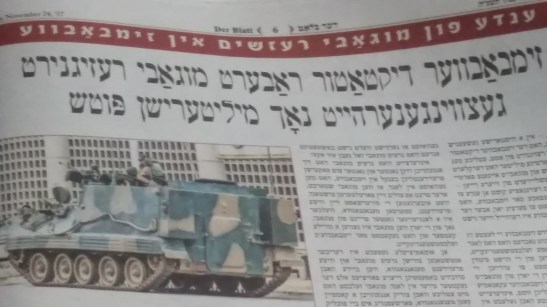
At the grocery store, I talked to a bunch of people to get help finding a paper.  Because the new papers come in on Friday morning before shabbes, there weren’t any left.  Although there were some interesting looking magazines.  Because I’m a creative person and an Israeli, I then asked if they had last week’s papers.  And sure enough, there were some.  I got a copy of Der Blatt, a Satmar newspaper printed in the U.S. and read around the world.

The two guys behind the counter shmoozed with me.  It was so fun!  One of them, when I couldn’t find the word in Yiddish, would revert to Hebrew.  But the other guy- he was a real mensch.  He would answer me- in Yiddish.  THIS is how you know a language is strong.  When the speakers stick to their guns- either out of ideology or monolingualism- those are the people to talk to.  Because that’s ultimately how I learn best.

They were really impressed that I came to buy a Yiddish newspaper to practice the mamaloshn- the smiles, the kind words- they were real.  Before leaving, I thanked the guy who answered me in Yiddish, saying I appreciated him helping me learn.  He gave me a wink and I was on my way.

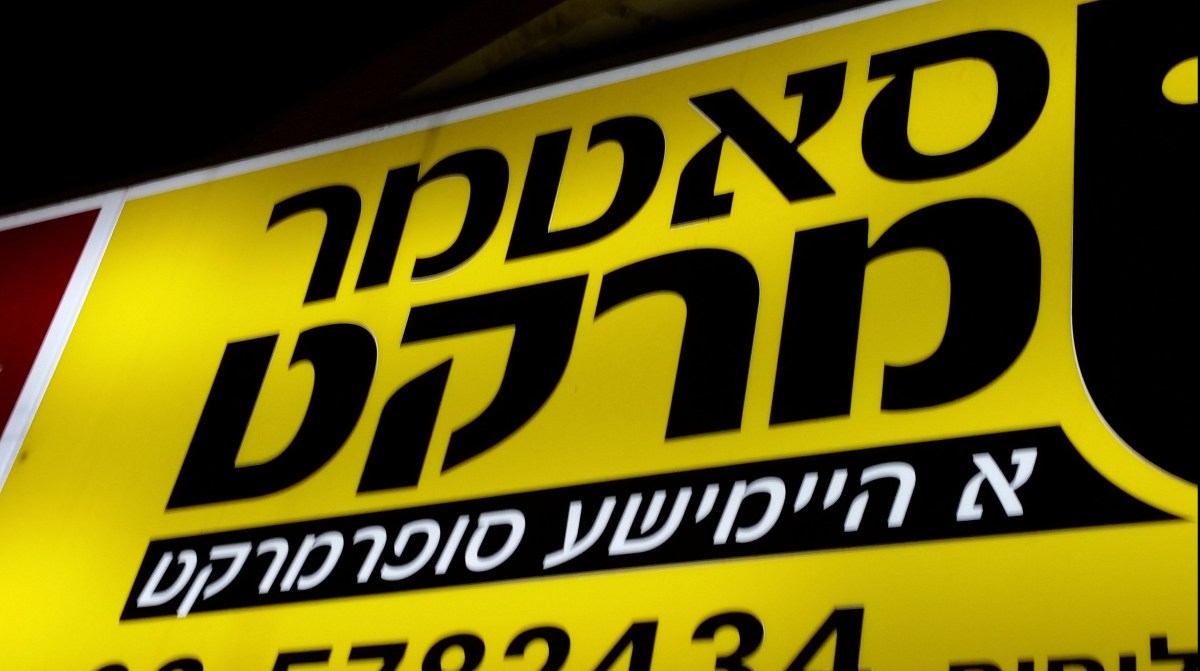
On my way out, I noticed a sign (in the cover photo): “Satmar Market: a homey supermarket”.  For my fellow linguists, there’s something interesting here.  While Satmar Hasidim stick to Yiddish out of a desire not to use Hebrew (the holy tongue for prayer), the sign is actually bilingual.  The words “market” and “supermarket” are written like you would in Hebrew and the other words in Yiddish spelling.  Guess things are a bit more complex than meets the eye.  I love it.

A few days later, I sat and started reading the paper.  And I noticed the most fascinating headline.  On the front page was an article about the Zimbabwean dictator Robert Mugabe being deposed.  Based on my own preconceptions about Satmar- their opposition to the Israeli government, their intense and strict Judaism, and their focus on study- I expected a bunch of articles about Torah.

20171205_020630

But lo and behold, in a residential neighborhood of Bnei Brak, people are reading in Yiddish about Zimbabwe.  And Saudi Arabia.  And tax reform.  And the Warsaw Ghetto.  Just in this week’s edition.

So what’s my story?  I have absolutely no story.  During a stressful week, I took a bus to Bnei Brak, ate delicious food, bought good music, and found an interesting newspaper in the language my ancestors spoke for 1,000 years.  I felt at ease, I hopped on a bus, and met a gay Reform friend for ice cream in Tel Aviv.

Want to live in a bubble where you know more about trekking in Cambodia than about your Hasidic neighbors?  Your loss.  There’s a fascinating civilization down the road begging to be discovered.  Begging for you to rediscover it inside you.

It’s not about agreeing on everything- or much at all.  It’s just about being a curious, open-minded human being and finding sparks of light to illuminate your path- wherever you might find them.

Yiddish lives

One might be surprised to hear this, but Yiddish lives in Israel- and not just among Hasidim.  Yiddish is the traditional language of Ashkenazi Jews like me.  Before someone says something stupid, let me clarify something- Yiddish is NOT a “mixture of German and Hebrew”.  It is also not only a Hasidic language- it has existed for at least a thousand years as a distinct language, whereas Hasidism has been around for about 400.  On the eve of the Holocaust, 13 million Jews- socialists, communists, Zionists, anti-Zionists, Hasidim, secularists- spoke the language.

Yiddish is an archaeology of the Jewish people and linguistic proof of our ties to the Land of Israel.  About 2000 years ago, Romans expelled Jews from Israel and destroyed the Temple in Jerusalem.  The Jews who weren’t executed were expelled or enslaved.  Many eventually made their way to other parts of the Roman Empire, where their Aramaic and Hebrew vocabulary became enriched with Latin words.  For instance, a famous Yiddish word (still said today even in Jewish American English) is “bentsch”.  To bentsch is to say the special prayer after eating a meal, coming from the Yiddish word “bentschn”.  This word comes from the Latin root “benedicere” meaning “to bless” like “bendecir” in Spanish.

As was the custom of European Christians for the 2,000 years of Jewish existence on their continent, time after time Jews were expelled as we were scapegoated for various social problems.  Other minorities today can probably relate.  And so with each expulsion and migration, Yiddish was enriched with new vocabulary- Italian, French, and eventually Germanic languages.  To be clear- at the time Jews started settling in present-day German speaking areas like Switzerland, Germany, and Austria, there was no such thing as the German language.  There were a variety of Germanic dialects (some of which are still spoken), but no unified language.

Yiddish borrowed heavily from their neighbors’ lexicon, although in some cases developing new meanings particular to their community.  For instance, while in German “shul” means “school”, in Yiddish, it can mean “synagogue”.  Hebrew and Aramaic also interplayed with the Germanic words.  For instance, “froynd” in Yiddish is a “casual friend” or “acquaintance”, similar to the Modern German meaning.  But in Yiddish, there is another level of friendship- a “chaver” (or “chaverteh” for a woman- that’s a Hebrew word with an Aramaic suffix).  That’s a real close friend.  And it says something about the value still placed on Hebrew (known often as “loshn koydesh- holy tongue”) even in the Diaspora.

As German-speaking peoples decided to butcher Jews during the Crusades and expel them from their cities, Jews went eastward.  Believe it or not, initially Polish and Lithuanian rulers (these countries today are more well known among Jews as places we were massacred) welcomed Jews.  Jews became merchants and built communities in Poland- and then all across Eastern Europe, down to Romania and Ukraine.  Name a country in Eastern Europe and we made our way there.

Of course the Slavic vocabulary lent a new angle to the language.  While the Jews that remained in Germany, Holland, and France continued speaking Yiddish- a new dialect developed: Eastern Yiddish.  Bubbe, Zayde, Tate, Mame- grandma, grandpa, mom, and dad- are all derived from Slavic roots.  The first two are to this day used by many American Jews to talk to their grandparents.

Meanwhile, Hebrew and Aramaic maintained a strong presence- perhaps also due to the fact that these languages were used extensively in prayer and in study.  They maintained such a strong presence that when Zionists aimed to revive Hebrew as the main spoken language of Jews, they looked to Yiddish for both Hebraic words and for Yiddish expressions to translate.  The modern Hebrew words B’seder, mamash, b’tachlis, chutzpah, and so many more are of Yiddish origin.  Which is to say- they are Hebrew (“holy tongue”) words that made their way into specific usages in Yiddish- and these usages were copied into Modern Hebrew in a way they didn’t necessarily exist in the Torah or other Jewish languages.

Speaking of translated phrases, did you know the Hebrew greeting “mah nishma?” is literally a translation of the Yiddish phrase “vos hert zach?”, meaning “what is heard?”  Even the famous “mah pitom?” is a translation (calque) from Yiddish.  If you speak Modern Hebrew, you speak more Yiddish than you thought!

Which brings us back to the language.  After the Nazi Germans and their anti-Semitic collaborators murdered 6 million Jews, most of them Yiddish speaking, the language was devastated.  Ashkenazi Eastern European civilization was brutally brought to an end after 2,000 years of life on the continent.  The language itself was feared extinct as the only remaining centers- the U.S. and Israel- were encouraging linguistic assimilation into English and Hebrew respectively.

In particular, in Israel, the government actually forbade non-Hebrew newspapers and theater performances.  Feeling Yiddish (and languages such as Ladino and Judeo-Arabic) was a threat, there was an actual “brigade” of volunteers who would go around shutting down Yiddish events.  I can’t think of something more horrifying to experience than for a Holocaust survivor to have a fellow Jew attack them for speaking the mamaloshn- their mother tongue.

Over the years, the remnants of Yiddish faded both in America and in Israel as Jews were told (either by Christians in America or fellow Jews in Israel) that their language was “lame”, “ignorant”, “backwards”, and (in Israel) “Diasporic”.  For all of Israel’s renewed interest in multilingualism and greater tolerance for diversity, I experienced this attitude myself when I posted my English blog in an LGBT Israeli group (with a description in Hebrew) and someone berated me saying I needed to write my blog in “the holy tongue”.

In particular, people have called Yiddish a “dialect” or “jargon” over the years.  This goes back hundreds of years in Europe- it was a deliberate effort by ruling Christians to demean Jews by insulting their language.  And sadly, some Jews internalize(d) this thought even though Yiddish published its first dictionary before German and tens of thousands of books, 12,000 of which are preserved digitally here.  Yiddish is a language with many influences, just like English.  It is a storied and beautiful language.  As a famous Yiddish linguist Max Weinreich said: “a language is a dialect with an army and a navy”.

When my ancestors moved to America in the late 1800s and early 1900s to escape anti-Semitic violence in Eastern Europe, they spoke Yiddish (one of them also spoke Romanian!).  I even found the Census records to prove it.  With each subsequent generation, a bit more of the language was lost, but it is still present today in my dialect of English, where words like “schlep”, “shlemiel”, “shmear”, and “oy gevalt” are omnipresent.  And sometimes need to be explained to non-Jews!

Yiddish has always acted as a storage device for Jewish culture.  There are certain things that just can’t be expressed in other languages.  And while Germans can understand much of it- there’s a lot they can’t.  And Jews can change their register (by adding more Hebrew and Aramaic, e.g.) to make it harder for them to understand- which is the point.  It was a clever way for Jews to understand their neighbors but speak more secretively if needed to protect the community.

Yiddish, as we saw, also stored a lot of Hebrew.  In some ways it kept the language alive over the course of 2,000 years.  I dare anyone who says Jews aren’t tied to this land to explain to me why Lithuanian Jews were speaking a language 20% made of Hebrew words.

In the end, Yiddish shows that Judaism is not just a religion, it is also a culture- a people.  It’s not coincidental that a few hundred years ago, a Jew in Poland could communicate better with a Dutch Jew than with a non-Jewish Pole.  Jews’ primary relationship was with other Jews.  There is no such thing as Presbyterian cuisine, literature, and language- because that’s a religion.  The word religion is a foreign concept to Judaism- we are a tribe.  You cannot fully separate the culture and the spiritual nature of our people- although many a secularist (and Haredi) have tried.  They are inextricably tied together just like natives living in the Amazon.  Where one starts and one ends is unclear- and there’s no need to clarify it.

Growing up speaking Jewish American English, I was always exposed to Yiddish.  All of my grandparents spoke it or understood it to varying degrees.  And it peppered my conversations.  It’s a very expressive and fun language with a soft side to it.  Despite some of the efforts of Hebrew purists to rid the language of Yiddish, I actually see a lot of it reflected in Israeli culture and language.  It feels comfortable.

A few years ago, I found a private tutor to start learning the language in earnest.  I then was blessed with the opportunity to go to the Workmen’s Circle “Yiddishland” program in New York.  There I learned not only the language, but also the culture- the music, the traditional dancing, so much.

When I made aliyah and moved to Israel, I wasn’t sure how much yiddishkayt- Yiddishness- I would find.  I’ve been pleasantly surprised at how vigorously Hasidic communities here are preserving the language- my cover photo is a bunch of newly printed Yiddish books for children in Bnei Brak.  With Hasidic Jews’ high birthrate, the language is about to make the comeback of a lifetime.  At the same time, I personally wanted to find a more progressive setting for my Yiddish too.

I’ve been pleased to connected with organizations in Tel Aviv like Yung Yidish (a library and concert venue in the Central Bus Station), Arbeiter Ring, Yiddishpiel Theater, and so much more.  I even got the chance to see a Yiddish musical based on the Barry Sisters last night!  The subtitles (which I was proud that I only needed occasionally) were in Hebrew and Russian.  Not a small number of Russians here also speak the mamaloshn- tribute to how international and cosmopolitan this language is.

To conclude, I’d like to share a story about how Yiddish lebt- how Yiddish lives.  I went to the library here to try to find Yiddish books.  I was disappointed when the librarian said their branch had none.  Feeling despondent about the future of the language, I asked what other languages they had.  She mentioned French, which I also speak.

I headed back to the French section only to find something curious.  A French book- almost a hundred years old- by famed Yiddish writer Sholem Asch!  In other words, a Yiddish book…translated into French!  I shared my excitement with the librarian, who was astonished.  I may very well have been the only person to discover this.

This is how Hebrew survived in Yiddish- and how Yiddish now survives in Israel.  Little fragments of a prior world integrated into a new form.  An immaculate metaphor for Judaism itself.  And I’m telling you- don’t count Yiddish out.  Because those sparks of Yiddishkayt are being rekindled- in Bnei Brak, in Mea Shearim, and right here in the most secular place of all- my home, Tel Aviv.