A gay Reform Jew goes to Bnei Brak

Today, I went to Bnei Brak and had a good time.

Bnei Brak is an almost entirely Haredi (ultra-Orthodox) city of nearly 200,000 people right on the footsteps of Tel Aviv.  It is the sixth most densely populated city in the world.  Door-to-door, it was a half hour ride.  Culturally, it’s a million miles away from the bikinis, hip-hop street performers, and pride flags of Tel Aviv.  Inhabited by a variety of Hasidic and misnagdic sects, with a smattering of Modern Orthodox, there are a lot of black hats, swaying peyos, and tons and tons of children.

To many of my more secular friends, the idea of a day trip to Bnei Brak is at best a waste of time and at worst, nauseating.  Please allow me to share what I, a gay Reform Jew, actually found to enjoy in this fascinating city:

Delicious Ashkenazi food – I sorely miss American Jewish food, which is almost entirely Ashkenazi.  I love me some jachnoon and falafel, but it is not what I grew up on.  I had delicious matzah ball soup tonight and it hit the spot.  Ashkenazi culture for secular Israelis has become nearly invisible.  This is due to repression from more hard line Zionists in the early years of the state, when Yiddish theaters and newspapers were shut down by protestors, and due to a desire to fit in in Israeli society.  For the majority of American Jews, Ashkenazi-ness is an essential part of our Judaism and I was happy to see people keeping it alive here.

ChocolateRugelach.jpeg

Hot guys – perhaps it’s from growing up in a more religious Jewish community (progressive American Jews as a whole are more religious than left-wing Jews in Israel), but I find a cute non-bearded guy dressed in 17th century Hasidic garb and a kippah…hot!  I love that he’s boldly Jewish, that he loves Torah, and that he has a certain softness to him.  Don’t get me wrong, I love me some strong Zionist men, but seeing a Hasid here reminds me a bit more of the Jews I know from home in the Diaspora.  Which is perhaps why they bug the h*ll out of secular Jews who don’t want much to do with the “old Jew” of the shtetl.

Good music – I love me some Hasidic music.  I bought a compilation of Vizhnitz niggunim sung by artists from Bnei Brak.  I found a really cool music store which has hundreds of different artists, mostly in Hebrew, but some in Yiddish.  Some of the artists were American Hasidim like Lipa Shmelzer who I knew from the U.S.  Quite a number of Mizrachi artists were popular in the store, like Zion Golan and the Revivo Project, which is interesting and shows there’s more cultural fusion going on here than meets the eye.  In general, I noticed more Mizrachi Jews in Bnei Brak than I expected to see and quite a number of shwarma joints, something you’d never find in Williamsburg.

It’s a city – I’ve visited Hasidic Brooklyn (Borough Park, Crown Heights, Williamsburg).  You can read some of my thoughts about that community and my visit there in this blog.  One of the big differences between Hasidim there and in Bnei Brak is that the former is a community intertwined with its neighbors.  There are Jamaicans and hipsters wandering through.  It is a neighborhood, not a city.  Bnei Brak is an entire Haredi city and it is really cool to see.  I saw boys and girls playing together.  Both men and women were friendly and willing to talk to me (and I was wearing jeans and a t-shirt).  I had found it a bit more difficult to get people to open up in New York, especially women (even though I also speak Yiddish).  I couldn’t help but think that maybe if Hitler hadn’t succeeded, there would be cities like this all over Eastern Europe.  And I’m grateful that Bnei Brak is a living testament to our fearlessness and our willpower to survive despite antisemitism.

Are there problems in Bnei Brak?  Sure.  I saw a sign today with pictures of hellfire admonishing women to avoid evil and wear headscarves instead of wigs.  I also saw a sign lamenting secular education.  And there are almost no pictures of women anywhere for reasons of modesty.

20170821_181544

At the same time, I saw tons of Haredi women wearing the wigs despite the signs.  I also saw secular people and foreign workers wearing short sleeves without anyone batting an eye.  I actually saw a Chinese guy completely shirtless in the middle of the street.  And yes, I saw a young woman in a sleeveless shirt and shorts walking down the street with no harassment.

I’m not here to tell you Bnei Brak is a bastion of progressive thought.  Or that there aren’t problems or that there aren’t Haredi people who are radical or violent.  These things exist (and not just among Haredim).  At the same time, I am concerned because I think the rest of the world tends to paint this community with a broad brush.  I am concerned that some of the anger towards Haredim in Israel isn’t about policies (like Shabbat laws, which are a real issue), but rather about longstanding ideological feuds among the Jewish people and, frankly, prejudice.

Just like any other group of people, there are Haredim who are more friendly, who are more open-minded.  And there are others posting signs admonishing women about their hair styles.  And many people who are somewhere in between.  In the end, we are people and when we start generalizing about hundreds of thousands of people, we are bound to foment prejudice rather than understanding.

I went to Bnei Brak today so that I could observe and I could learn.  Because I believe that if my only source of information about people is the news, then I’ve already lost.  Because my day ended not with stones being thrown at me for immodesty, but rather with a Hasidic guy winking at me and walking into a wedding where the band played beautiful Yiddish music.  Music I understood.  Because Israel is a 2,000 year old delayed family reunion.  We’re just getting to know each other.  Step outside your comfort zone and meet your relatives.  If a gay Reform Jew could find something to like in Bnei Brak, I bet you could too.

20170821_183204.jpg

What America can learn from Israel

Tonight, in the span of 5 minutes, I saw what Israel has to teach the world about tolerance and diversity.

Walking back from an outdoor movie in Yafo (which overlapped with the Islamic call to prayer halfway through), I heard a man on a microphone.

The man was talking to a crowd at a restaurant on the roof of a building.  He started to sing.  I figured it was just a guy playing music for tourists.

Then I started to recognize traditional Jewish wedding music, saw a chuppah, and realized it was My Big Fat Jewish Wedding.  People started to dance and shimmy as the music blared.  Definitely the only time I’ve ever walked by a rooftop restaurant and discovered it was a Jewish wedding- on a Wednesday!

Then I headed to a great spot where you can look out at the sea, just meters away.  And there I saw a group of Korean Christian tourists with a guitar singing their songs of praise.  A crowd of secular Jews, Orthodox Jews, and Muslims watched with great interest.  Women in hijabs swayed back and forth as the Koreans sang their hymns.  Everyone applauded at the end while the song leader said “God bless you” to all of us.  It was beautiful.

As I headed over to a dessert shop, I could hear the ululating (in Hebrew “kululu”, in Arabic “zaghrada”) from the Jewish wedding.

The dessert shop is run by Arabs.  For the first time, I tried malabi, a creamy Israeli pudding dessert likely of Turkish origin.  It was de-licious.

As I chowed down, I noticed the shopkeeper, Zidan, was blasting “Shav El Admati” (I return to my land), a famous Zionist Mizrachi music song about Jews returning to Israel.  So this was an Arab man singing at the top of his lungs a Jewish song about returning to Israel.  While I, an oleh chadash (new immigrant), am singing all the words with him because I learned them while pining for Israel in America.

As the song ended, Zidan gave a Haredi (ultra-Orthodox) Jew directions to the nearest Kosher restaurant.  When the man didn’t understand, the gay Reform Jew (me) showed him the restaurant.

All of this happened in a one-block radius in 5 minutes.  It was the best part of my day.

At a time when America is suffering, I can’t help but think that perhaps my former country has something to learn from Israel.  I’ve often spoken of ways Israel can learn from America, but I think it’s time to turn the tables for a moment.

Tolerance and coexistence don’t just happen at big elaborate ceremonies or through proclamations.

They happen in our day-to-day lives, when people least notice or expect it.  Organically, not by way of grandiose announcements or gestures.  If you put yourself out there in your own surroundings, you’d be surprised what you can find.

In some ways, Israelis are much better at this than Americans, probably better than Israelis even realize.  I’d love to see my fellow Israelis appreciate the miracle we’re living in.

At a time when Americans are struggling, understandably, to figure out how to repair their society, my advice from Israel is this: living your values in your day-to-day life is the best way to make change.  Forget the speeches and the rallies- there may be a time and a place for them, but their impact is temporary and can’t sustain long-term change.

Be the Korean Christian singing for Israelis.  Be the Muslim woman swaying to their music.  Be the Haredi guy asking directions from an Arab shopkeeper.  Be the new immigrant exploring new foods and new cultures.

There’s a lot you can’t control in life, but what you can- enjoy the hell out of it.  Look around you, there’s miracles happening everywhere.  Just look.

Hebrew, Yiddish, and Arabic in “occupied” Akko?

Thursday I had a fun, frustrating, and complex experience in Akko.

Akko is a 4000+ year old city continuously inhabited since the Bronze Age.  It has been home to Canaanites, Phoenicians, Jews, Greeks, Byzantines, Arabs (Christian and Muslim), Crusaders, Ottomans, Brits, and most recently, Israelis of all stripes.  It also has a Druze and Baha’i population, being home to the resting place of the founder of the Baha’i religion.  So basically it’s diverse and historic as f*ck.

My initial intent was to write about my experience on a boat.  I was exploring the historic city and noticed something curious- almost everywhere around me, people were either Arab or ultra-Orthodox (Haredi).  From now on, I’ll use the term Haredi since that’s preferred by people in that community.

It was interesting to see women in hijabs flowing by men in black hats.  Very Jerusalem-esque, but at least in this part of town, absent any other secular or traditional Jewish communities that you’d find in the capital.

Honestly, I didn’t feel particularly uncomfortable.  You might expect a gay Reform Jew to head for the hills at this point, but frankly I found it more interesting than threatening.

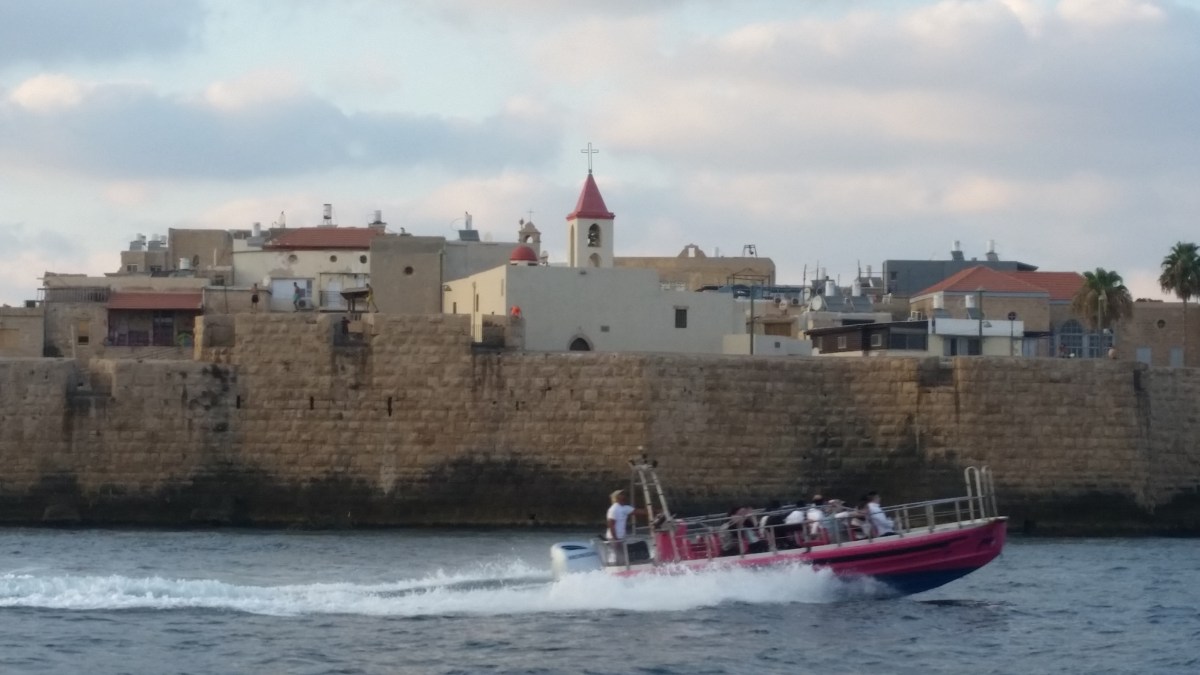
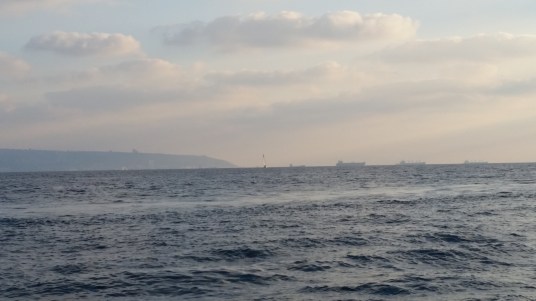
Then, I found a boat.  It was a 10 shekel ($3) boat tour.  The boat was being driven by an Arab man and was blaring Hasidic pop music (which I happen to like).  On board were two Haredi families…and me!  The scenery was exquisite.  Here are some pictures from the ride:

20170810_18395120170810_18524520170810_184855

I started talking with Haredi family #1 in Hebrew.  They were super sweet and congratulated me on my aliyah.  They live in Bnei Brak, a Haredi city right next to Tel Aviv.  When I said I lived in Tel Aviv, they said “oh we’re neighbors!”.  They also helped me find a legit Ashkenazi restaurant in their city so I can get my fill of the foods I grew up on.  He even said I could just come to their house some time for a home cooked meal!  Falafel is great, but I miss my whitefish salad and kugel.

Then I overheard Haredi family #2 but they weren’t speaking Hebrew- their girls were laughing and taking selfies…in Yiddish!  Whoa!!  This got me very excited!  I started talking to them in Yiddish and it turns out they’re Vizhnitzer Hasidim from Borough Park in Brooklyn and were in town for a wedding.

They were polite but a little less warm than the other family.  I think it’s because they thought I might be ex-Hasidic (seeing as so few non-Hasidic American Jews speak Yiddish anymore).  The father kept asking me for my Hasidic lineage, to which I kept replying that I don’t have any (that I know of).  At first, I was kind of annoyed for having to repeat this over and over again.  Then, I realized he was playing the timeless game of Jewish geography.  Turns out, he knows some Adlers and was trying to see if we were related.

Before I got off the boat, I made some chit chat with the Arab driver in Arabic.  But he was too busy taking pictures of the other boats (should you be doing while driving?) for anything too in-depth.  But a friendly guy.

So there I was, on a boat, speaking Hebrew, Arabic, and Yiddish.  The progressive gay Jew hanging out with Haredim and Arabs.  While to a number of secular Israelis and even some Modern Orthodox Jews, a city teeming with Arabs and Haredim is their worst nightmare for Israel’s demographic future, I actually found the experience fascinating and rather benign.  I’m not saying there aren’t legitimate concerns for Israel’s future, but in the end we’re all people.  Among groups that, at least if all you do is read The New York Times, you’d think would be ripping each other’s throats out, there was a pretty basic coexistence that was refreshing.

Then, I made the mistake of the internet.  On my way home from Akko (Israel has a pretty clean, efficient, and cheap inter-city train system, something America might get around to one day), I opened Youtube to find dabke music from Akko.  Dabke is an Arab folk dance found in Lebanese, Syrian, Palestinian, and Jordanian culture.  It sometimes has nationalist overtones.  Overall, it is fun.

There are videos of dabke in Akko on Youtube, but several of them had (in my opinion) inflammatory titles like “Dabke in occupied Palestinian Akko”.  There was even a video from neighboring Haifa, which has a recorded Jewish history going back to 200 C.E., about 450 years before Arabs conquered the area.  The Haifa video was entitled “Palestinian dabke in ‘Haifa’ in the heart of Israel”.  I’m not sure exactly why Haifa was in quotes, but if the angry back and forth in the comments section was an indication, the title was meant to be provocative.  Side note: never read the comments section of anything ever.

I then read an article that said an Arab man in Akko claimed Jews were pushing his people out so they would go live in Europe instead of Akko.  He said Jews were given preference for new housing.  The first sentence seems specious because if Jews are trying to push Arabs out of Akko, they’re not doing a very good job because there are a lot of Arabs everywhere.  Unlike in everywhere else I’ve seen in Israel, I even saw signs with Arabic on top and Hebrew on the bottom.  That being said, it’s true that during Israel’s War of Independence, many Arab communities including Akko were displaced- sometimes voluntarily and sometimes under pressure from Israeli troops.  It’s also true that there has been discriminatory housing policy, so even if this man was exaggerating, there may be truth to what he is saying.

Then, for things to get more depressing, apparently there used to be a larger Jewish population in Old Akko, going back a long time.  However, due to demographic changes they moved to other parts of the city.  Then, apparently the Islamic Movement, an Islamist organization, removed the signs to historic synagogues and replaced them with quotes from the Quran.  If this is true, this is truly depressing.

I began to feel deflated.  Was the coexistence I was seeing everywhere just a facade?  Do Israeli Arabs really just see me as an occupier like the videos on Youtube indicated?  Do they know nothing about Jewish history in this land (or elsewhere)?  Were Jews really pushing Arabs out of Akko or discriminating against Arabs in housing?

These are all complex questions that deserve sophisticated and well-researched answers.  I don’t have the expertise at this moment to answer them all right now.  I do believe people are entitled to different narratives so long as they respect each other and empathize.

What I can say is this: Arab identity in Israel is diverse.  Half of Arab citizens of Israel recognize the right to a Jewish state.  Half don’t.  26% identify as Palestinian, 36% percent as Palestinians in Israel, and the plurality (37%) as Israeli-Arabs.  Another survey found 64% believe Israel is a good place to live and 43% favor their Israeli-Arab identity over a Palestinian one.  Perhaps surprising to the Western ear is that 24% of Arab Muslims in Israel vote for Zionist parties.

Do some of those numbers sound contradictory or confusing?  Welcome to the complexity that is Arab-Israeli identity.  There are anti-Semites, there are Islamists, there are people who volunteer to serve in Israel’s military, there are Zionists, there are secularists, there are communists, there are feminists, there are nationalists, there are pragmatists.  And some people fit into multiple categories.

So in the end, is the coexistence I saw on that boat a facade?  Are my conversations with Arab-Israelis merely window dressing to deeper prejudices?

Sure, I think that there are some prejudices here that are merely beneath the surface.  When you read about Arabs throwing rocks at Jewish worshipers in Jerusalem or that between 32-48% of Jewish citizens would favor expelling or “encouraging emigration” of their Arab neighbors, you know there is prejudice here.

Was that Haredi man who invited me to his house really just a bigot against secular or Reform Jews?  Was the Yiddish-speaking family that joked around with the Arab driver just faking it?  Are my secular friends reading this blog rolling their eyes and thanking God they weren’t on that boat with me?

Perhaps- we’ll never know.  But rather than stew in cynicism, I’d like to enjoy the moment I had in Akko.  A moment where people pretty much got along.  A gay Reform Jew, two Haredi families, and an Arab boat driver.  Hebrew, Yiddish, and Arabic in Akko.

One Night in Jerusalem

Tonight in Jerusalem was the most jam-packed, exciting night I’ve had in Israel.

It all started with an act of startling generosity.  I was checking out some artists’ studios in Jerusalem and found this particularly beautiful one.  I talked with the artist about her work- including this amazing painting where at first you don’t notice there are people built into the painting and then as soon as she pointed them out, it became obvious.  She said she was inspired by the Exodus from Egypt.  When I told her I was an oleh chadash (new immigrant), she congratulated me and told me “you’ve already made your Exodus”, perhaps the nicest thing anyone has said to me about my aliyah.  She told me she made aliyah from Russia when she was six years old and I felt an instant bond.

We talked about art- I told her I was a poet and a singer and we connected on Facebook so she can see my work.  She asked if I drew and I said I have done a little bit but nothing serious because I hadn’t been taught the techniques.  She said one of the most beautiful things I’ve ever heard.  She said when you’re looking for an art teacher, don’t look for technique.  Look for someone who can help you deliver a child.  That sounds strange in English but beautiful in Hebrew.   “Leyaled” in Hebrew means “to midwife”.  Her point was that the person who teaches you art is supposed to help bring something out that already lies within you and needs to be discovered and nourished.  To help you give birth to a new sense of creativity.  I love it!

On my way out, she gave me a free handmade notebook she had created so I could write my poetry.  I made a new friend in the course of 20 minutes in a way that could take literally years in the U.S.  If you’re reading this Dina, thanks for making my night great 🙂

Then, I asked for directions to the central bus station, but I noticed there were lots of police cars.  I asked the security woman what was going on and she said there was a concert.  I asked who and she said “Shlomi Shabat“, one of my all-time favorite Mizrachi singers.  I bought a ticket immediately and headed to the concert with a new sense of energy and excitement.  Also, the concert was held in a stadium inside a 2,000 year old pool called Breychat Hasultan (The Sultan’s Pool).  So it pretty much doesn’t get any better than that.

Except it does.  On the way to the concert, you have to walk downhill.  On the way, I discovered there was some sort of international festival going on.  There were vendors from all over the world- just off the top of my head, I saw artisans from Panama, Uzbekistan, Zimbabwe, Mexico, the Czech Republic, and so much more.  I made a special point of stopping at the Spanish-speaking countries’ booths because I miss speaking Spanish and Latin culture.

I spent a good 15 minutes speaking with a Chilean woman who was really amazed at the cohesiveness of Israeli society.  This is interesting because a lot of Israelis feel we have a very divided society.  She pointed out that a lot of countries in Latin America feel unstable and on the brink of civil war.  She talked about Venezuela and how she feared the country would descend into further chaos (a conflict Americans know little about even though it’s in their own hemisphere).  That she felt there wasn’t any glue that bound that society together.  It’s an interesting thought- that for all the conflict here, there is most definitely a strong social connection here that keeps things together despite the tensions.  I think the United States would benefit from such a glue right now, because I had the distinct feeling when I lived there that there wasn’t really anything that united us.  There are sociological reasons for it, but I hope that Americans can learn something from Israel which is that a sense of social solidarity- even with people you don’t always agree with- can help you overcome difficult moments in history.

Then, I headed to the concert.  It was amazing!  Thousands of people singing and cheering.  Israeli flags waving.  Song after song that I’ve sung- some of which I remember listening to on a CD in my living room as a 13-year-old- 18 years ago!  Some Israelis like to hate on Mizrachi music.  I can understand that everyone has different tastes, but for me it is literally the best music on the planet.  It’s danceable, it’s full of religious imagery, it’s fun, it’s upbeat, and it’s full of emotion.  Here’s a song I like by the artist I saw tonight to give you an idea of what it sounds like.

After the concert, I grabbed a cab to the Central Bus Station.  The driver was Arab, so I spoke to him in Arabic, which made him very happy.  Ahmed and I talked about dialect differences between Yafo and Jerusalem, his relationship with Jews (pleasant but not very deep because their neighborhoods are so separate in the city), and the importance of language in building relationships (he decided to learn Hebrew to learn about his neighbors).  We talked about how crappy politicians are and that the real key to building peace is what we were doing- talking to each other.  I tried to give him a tip but he wouldn’t let me.  A truly kind and open-minded person.

Before getting on the bus to Tel Aviv, I heard loud music.  Sure enough, behind me were a bunch of Breslover Hasidim dancing to techno music about their patron rabbi, Nachman of Uman.  I started filming them and then just joined in.  Because life is fun if you jump in!

I then headed to the bus.  Now this part sucked at first.  The ticket people oversold the bus- and this ride is over an hour long- so some people were standing or sitting in the aisle.  I was one of those unlucky people.  The bus was bumpy and it felt really unsafe.  Frankly, it was the most unsafe I’ve felt in Israel.  Which is interesting consider how the news media obsessively cover the Israeli-Palestinian conflict when really bad drivers are a way bigger threat to security.

Things in Israel often rapidly shift from amazing to awful and back to amazing again.  My evening had been going great and then BOOM this was my plummet downwards.  Once I got tired of my head banging against the seats as I sat, I stood up and started talking to the people in front of me.  I chatted with one woman who, when I told her I was an oleh, told me her niece just moved here from New York.  She said she is a soccer player and doesn’t know anyone here.  Turns out she lives around the corner from me and I offered to show her around.  A new potential friend.  The woman also told me I had great Hebrew, which helped lift my spirits.  Meanwhile, the young woman next to her was worried about missing her train back to Haifa at 1am, so the woman I was speaking with simply offered her a place to stay.  They literally just met on the bus.

And just like that, my spirits began to lift as we approached the bus station.  Any time I feel down in Israel (which, to be honest, happens almost every day at some point), I remember that things here turn on a dime.  And that if I’m feeling sad or angry, things will turn for the better quickly and suddenly.  And it works.  It really happens.

This is a place with some serious sense of social solidarity, generosity, and kindness.  Not words you’d typically associate with the Middle East, but they are absolutely true so please stop reading the New York Times and just come and experience it yourself.

A free notebook.  A Mizrachi concert.  Chileans.  An Arab cab driver learning Hebrew.  Dancing Hasidim.  And new friends on a bumpy bus.

One night in Jerusalem.

Alabaman Arabs and the Western Wall

Yes, that is what happened to me today.

Today, I took my first trip outside of Tel Aviv since making aliyah and went to Jerusalem.  I decided to go to the Kotel, known in English as the “Western Wall” or the “Wailing Wall”.  It’s the last remaining wall of the Second Temple built in Jerusalem for the purposes of Jewish worship.  Basically, it’s the most sacred site on the planet for Jews.

It’s been at least 12 years since I was at the Wall and I was very excited to go back.  My anticipation was building as I made my way through the markets of the Old City.  This was the place my ancestors came from, the site that informs all Jewish spirituality.  Even today’s Jewish rituals and prayers are modeled after the Temple rituals.  The cruelty of the Roman Empire that destroyed the Temple couldn’t defeat our faith.

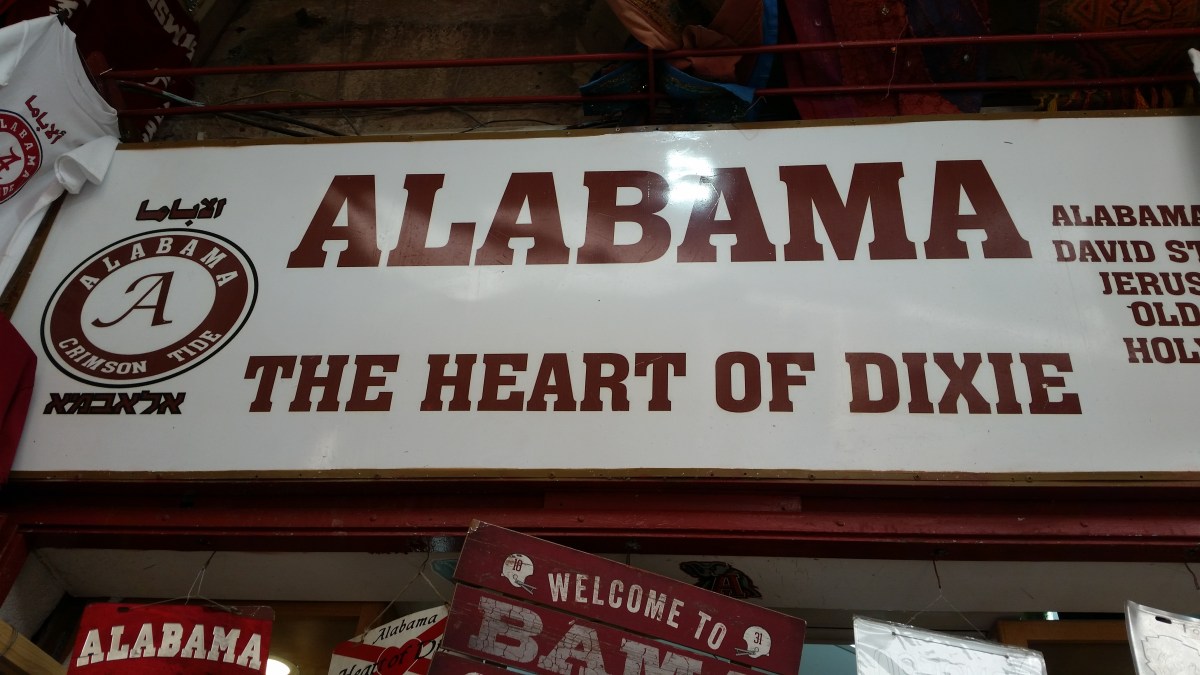
As I thought these powerful thoughts and felt these deep emotions, I came upon a sign that said “Alabama, the heart of Dixie”.  I had to re-read the sign a good two or three times before I realized yes, I was staring at a trilingual sign that said “Alabama” in English, Hebrew, and Arabic.  I felt like I was in some dystopian novel.  On what planet is there a University of Alabama store in the middle of the holiest city on earth?

Sure enough, it was an entire store dedicated to the University of Alabama owned by Arabs.  I met the kids running the store, who were sweet.  I spoke with them in Arabic and it turns out one of the kids’ dads studied at University of Alabama and became a huge fan.  I asked who exactly comes to their store, given the small number of Alabamans in Jerusalem, and they said lots of people came by.  I have to give them props for marketing because it obviously drew me in!

They had mugs and signs that said “Roll Tide” in Hebrew and Arabic.  For especially my Israeli friends who don’t understand this, watch this video.  Alabaman fans are particularly fanatical (about their team) and unabashedly southern, so even as an American it was a total curiosity to see a Palestinian store dedicated to probably the most Republican place in the country.

20170730_15123920170730_151050

And there it was.  I had a great conversation with the kids and their uncle- they’re very funny and friendly.  And then I walked to the Western Wall.

When I got to the wall, I tried praying once and it was pretty good but didn’t feel super powerful.  It ended up being a warm up.

I chatted with some German tourists and then went back for round two.  I grabbed a tallit from some Chabad guys (I was smart enough to tell them from the get-go that I didn’t want to lay tefillin, but of course they tried anyways, and of course I said “no thank you” and did what I wanted).

I then headed back to myself and enshrouded myself in the tallit, giving me a sense of privacy and direct connection to God and my inner spirit.  It was like my own personal synagogue.  I now started to open up.  I noticed a kid next to me.  He was probably in high school.  I had talked to his group earlier- they were Reform students from the U.K., from the same Jewish movement I belong to.  It felt powerful for us to pray next to each other given the Israeli government’s recent rejection of Reform prayer spaces at the Western Wall.

After a few moments, he stood there by myself and just started crying.  It’s one of the most beautiful things I’ve ever seen.  And one of the most sincere.

As I peered through the hole in my tallit at him and heard him wailing, I started to well up with emotion and sob.  I thought of all my ancestors who walked this land.  That their hands built this Temple and this very city.  That it’s because of the sacrifices of millions upon millions of Jews who were butchered mercilessly for over 2,000 years by Babylonians and Greeks and Romans and Catholics and Klansmen and Spaniards and Portuguese and Germans and Poles and Russians and Protestants and Arabs and Muslims and on and on and on.  They laid down their lives for me.  Most of them could only dream and pray for the day when they would be able to return to our homeland and pray at our holiest site.  And I carry their prayers in my heart.

When I decided to make aliyah, some of my friends asked me questions like “do you 20170730_154705.jpgknow anyone there?” and “have you ever been there?”.  Yes I do and yes I have.  If you’re a very active Jew, you almost certainly know people in Israel and you’ve visited.  Totally innocent questions, but ones you might typically ask someone moving somewhere far and exotic like Vietnam or Zimbabwe.
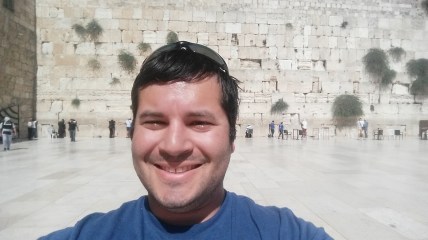
Israel may be Zimbabwe for you, but it is not for me.  Even though before making aliyah I had only been here twice, it is not a strange and foreign place.  While there are for sure cultural differences that I continue to learn about, this is not a colony.  This is not a destination.  This is not a stint abroad.

This is my homeland.  It is the source of my religious beliefs and my cultural heritage.  It is my people whose traditions gave rise to both Christianity and Islam many generations later.  Its stones cry out with the tears and laughter of my forefathers and foremothers.

It is a place that belongs to me as a right that my people have fought long and hard for.  The right to pray at our ancient holy sites free of violence or discrimination.  As recently as 1967, I could not have prayed at the Western Wall because Jordanian troops wouldn’t allow it.

The point is this: I am a Zionist because I believe I am not “moving to a new place” but rather because I am returning to the place I come from.  A place that has room for me to pray in peace at the Western Wall, for my Christians friends to visit the Church of the Holy Sepulchre, and for my Muslim friends to pray at the Al-Aqsa mosque.  And even to own an Alabaman t-shirt shop.

Amen.

20170730_153233.jpg


My first Israeli protest

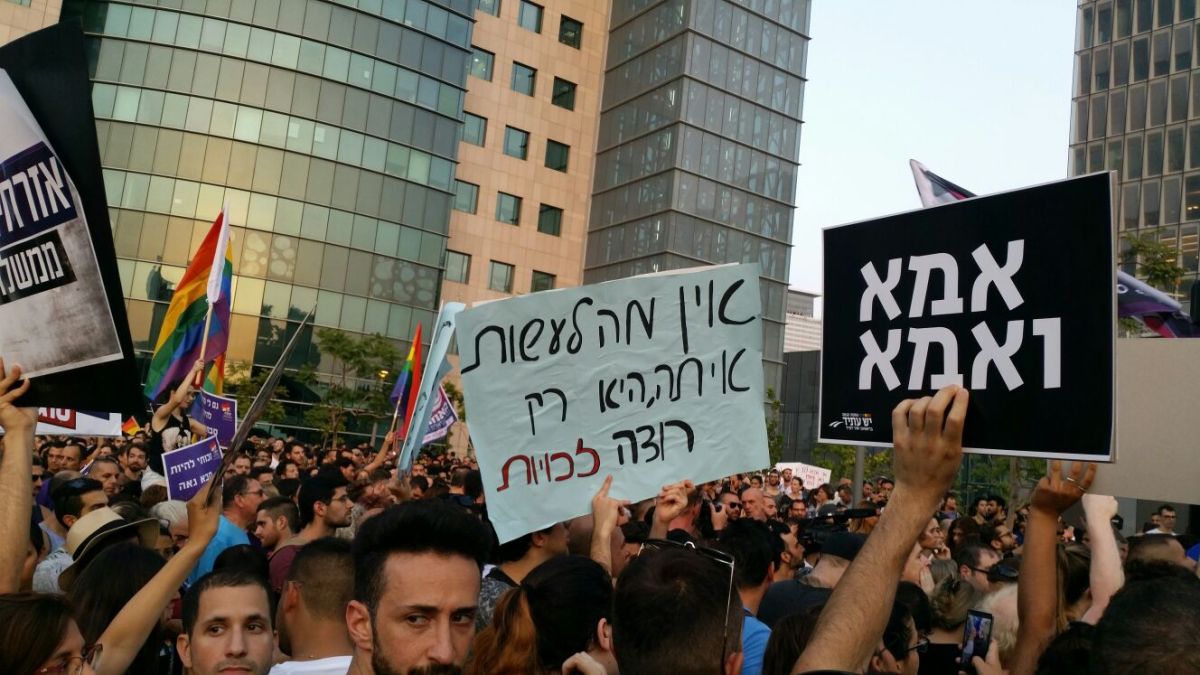
Today I went to my first Israeli protest.  Not a pro-Israel protest, but an actual protest inside Israel.

Recently, the Israeli government announced that it recommended to the Supreme Court that gay couples not be able to adopt.  In twisted circular logic, they claimed it was because of the prejudice kids would face because of people who were anti-gay.  Just like the current government and this very policy they’re promoting.

Needless to say, LGBT Israelis and allies were really pissed off.  Including me, because I’m now one of those people.  Thousands of people protested with colorful signs, shouting chants, and cheering with speakers who affirmed their identities and criticized Benjamin Netanyahu’s backward government.

One thing that was interesting was that, being from DC, the crowd seemed small to me.  If I had to guesstimate, there were 5-10,000 people there maximum.  I’ve been in many, many rallies in D.C. that were over 200,000 people- on issues ranging from immigrants rights to pro-Israel to gay rights and beyond.  And I was at Obama’s first inauguration which had approximately 1.8 million attendees.  So my perspective is influenced by my personal experiences at much larger rallies.  That being said, Israel is a very small country compared to the U.S. (8.5 million vs. 323 million), so according to my Israeli friends, this was a sizeable protest.  Always good to consider how someone who grew up here might view things to put it in a new light.

What was very clear was this crowd was fired up.  People were angry and enthusiastic.  And there was a real sense of community and common purpose.  Their rally chants could be improved (some were really long and hard for people to follow)- but I feel confident that I can help with that.  Rally chanting is one of my favorite things to do, as some of my protestor friends in D.C. know.

The crowd was fairly diverse too- you had people from several different youth movements and political parties (although not a single coalition-member party was represented, which is shameful).  I was particularly proud that the rally was co-sponsored by the Reform Movement- my movement.  Not a single other religious organization was represented.  I was never prouder to be a Reform Jew.  You had all the colors of the LGBT spectrum present- and mentioned quite clearly in the speeches.  I’ve definitely been to some protests in the U.S. where the emphasis was quite clearly on the G in LGBT and not so much on the other letters.  Not here- everyone was welcome.

After I started feeling tired and hungry, I went to meet a friend for a happy hour.  There was this group of olim (new immigrants) and I started talking to one woman who was French.  I was really excited because I love speaking French so we got to talking.  She told me she was Modern Orthodox and that while people were more traditional in France, she preferred the more modern streams of Orthodoxy she had encountered in Israel.  She saw a gay rights sticker on my shirt and asked what it was about.  I explained that the government was against me adopting children because I was gay.  And she had the gall to actually say, to my face, that she didn’t think gay couples should be allowed to adopt either.  To put this in perspective, she was probably 25-30 years old, was finishing her Master’s thesis, and was looking for jobs in high tech.  Not exactly the stereotypical profile of a bigot.  But a bigot nonetheless.

She proceeded to tell me that actually she preferred gay couples to single people.  She thought single people absolutely shouldn’t be able to adopt.  She would rather a gay couple adopt than a single person.  And, in her opinion, straight couples should get preference over both because that’s what’s best.

I was in utter shock.  I thought Tel Aviv was this diverse, international, progressive Jewish paradise where people loved gays.  The prejudiced people live in the “other Israel” (read: everywhere outside of Tel Aviv- the periphery, Jerusalem, etc.).  And while there is a lot of truth to that (it’s an extremely gay city with a lot of progressive people and other parts of the country can be more conservative), there are also people who don’t fit that mold.  There are clearly people in Tel Aviv who are bigots.  There were also some Modern Orthodox people at the rally protesting for my rights (and in some cases, their own because they were gay themselves).

The point is Israel is not black and white.  There are confusing gray spaces that require careful navigating.  I thought I could count on a highly-educated young French Jew to support me and I was wrong.  I also saw Orthodox people at this rally wearing yarmulkes.

Israelis like to tell me that life in Israel is “lo pashut” – not simple, not easy.  Well no shit!  Life isn’t easy in America either, which is part of why I’m here.  We have our own insane politics, our expensive healthcare, our gun violence, our poverty.  We have our issues too.  And so does Israel.  And one of them is gay rights.  Israel is by far the most progressive country in the Middle East on gay rights and it also is not a place where I feel equal.  It has a lot of work to do and I intend to be a part of the community that makes it happen.  Join me, here or abroad, in fighting for my right to equality.  I was part of the movement to pass marriage equality in America and I intend to win here too.  “Yes we can” is not a dream- it’s a statement.

IMG-20170720-WA0001.jpg