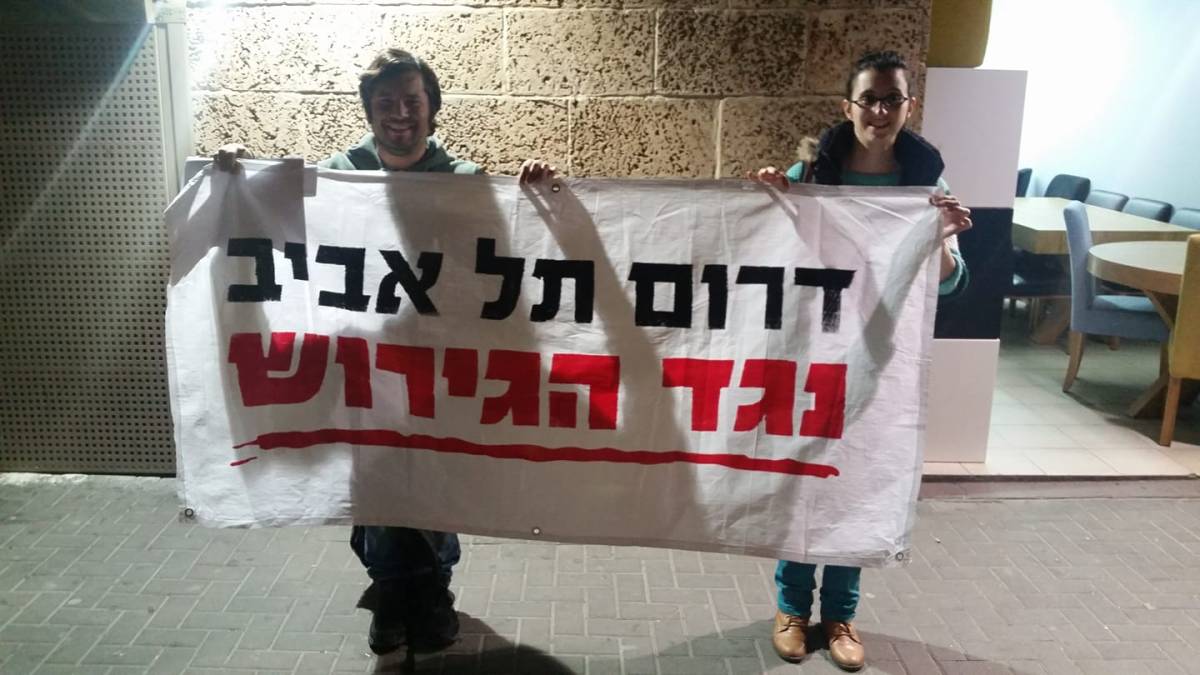
The first pro-refugee sign in my neighborhood

As some of you may have heard, just last night I was celebrating with refugee friends the defeat of Bibi Netanyahu’s deportation plan.  They would be given refuge in Western countries or in Israel.  Their lives, in short, would be saved.

After many, many sleepless nights and demonstrating and activism and awareness, I was so delighted to finally feel victorious.  To have literally saved lives.  And all in partnership with the refugees themselves, who were ecstatic.

We had this brief moment of love and joy in the streets of Neve Sha’anan where we pumped up the music and paraded with the news.  Refugees learned of the news from us as we walked down the street.  You could see them smiling from ear to ear.

It was, for a brief moment, perhaps the single most positive step the progressive moment had made in either Israel or the U.S. in the past year.  And against great odds.

I came home feeling happy and relieved.  Perhaps one of my best moments in this country.  Only to find that Netanyahu had paused (and later cancelled) the agreement.  Specifically after meeting with “activists” in my part of town.  Including a woman pictured kissing Bibi’s hand.  They wanted every last black person gone.  No deal with the U.N., no “half-assed” measures.  They don’t want to incentivize other “infiltrators” to come.

I can empathize with their frustration- their (our) neighborhood is frankly smelly, neglected, and poor.  And they are taking it out on the wrong people.  The refugees didn’t cause these problems- they’ve been here for years.  In the early years of Tel Aviv, the municipality didn’t even provide social services to Hatikvah.  The hard-scrabble people here did it themselves, which is amazing.  And also has literally nothing to do with African refugees.  This neighborhood, my neighbors, will continue to neglected as most poor people are.   Whether we live amongst Sudanese people or not.  Neighborhood investment can’t come at the expense of human lives- regardless of their race or religion.  It’s wrong.

Now Netanyahu is preparing to reopen the detention center, circumvent the Supreme Court ruling barring deportation, and ship my friends to their deaths.  I’m sad, I’m furious, I’m tired of this back-and-forth game.

It also frankly makes it hard to live in my neighborhood.  I wonder how many of my neighbors support the deportation.  Sometimes I’m afraid to ask.  I’ve been yelled at before walking home from rallies.  I did discover two neighbors who support the refugees, which was reassuring and also a reminder not to stereotype an entire part of the city based on a bunch of wacked-out media personalities and corrupt officials.  Because if I don’t have some counterexamples to the hatred, I just start hating my own Jewish neighbors.

So tonight, fed up with the bullshit, I decided to take a rather brave step.  I live in a neighborhood where there is no- and I repeat no- pro-refugee signage.  No leaflets, no posters, no banners.  You will see those things in other areas of South Tel Aviv, but there are no hipsters on my street.  I am “the American”.  The most common sign in my neighborhood is for a rabbinic study session or pictures of Shas Rabbi Ovadia Yosef.  In my part of town, the Likud is the left wing.  The other voters are often going for Shas.  It’s certainly a complex place, not black-and-white, and it’s also a rather right-wing part of town.  The most right-wing part of Tel Aviv by far.

In this context, I recalled an Arabic word I learned the other day.  Some Sudanese guys from Darfur opened up a brand new produce shop.  Beautiful, clean, friendly.  I bought some fruit and talked to them in Arabic.  Of course, also about the deportation.  They asked if I was a “naashit”.  I couldn’t place the word, but with the help of some explanation and Google Translate, I learned it was “activist”.  And I said “yes!”

My refugee friends taught me the word activist.  In Arabic.  And tonight, it was time to put it into action closer to home.  Closer than a rally, a Facebook post, or even a blog.  Having no idea how my neighbors will react (I still don’t know while writing this post), I hung a huge- I mean huge- banner that says “South Tel Aviv Against the Deportation”.  Right beneath my windows.

Seeing as how it’s on the rear side of my house, I’m not sure how many people will see it.  But people will- because it’s huge and I can see people’s windows from my own.  So somebody, at least one person, will notice.

And that is a good thing.  Because I’m not just hanging this sign for the refugees.  I’m hanging it for my two neighbors who agree with me.  And perhaps others who are too afraid to speak out due to our own community’s aggression.

I may not be originally from Yad Eliyahu or Shchunat Hatikvah or Israel.  But I am a human being, I’m an Israeli citizen, and I live here now.

The merchants of hatred say they represent my neighborhood and I say “no”.  You represent yourselves.  I am going to speak my voice.  I’m going to stand up as a member of the Hatikvah community, of South Tel Aviv and say “not. in. my. name.”

If you want to send innocent people to their deaths, God help your conscience.  I will not be silent.  And even when I’m not talking, I will still be speaking with every glance you take at my big motherf*cking sign.

Love your neighbor as yourself.  Damn straight- my refugee neighbors deserve all the love they can get.

When you bump into a high school friend in your neighborhood

For those of you who’ve been reading my blog, you’ll know my neighborhood is a bit off the beaten path for American immigrants to Israel.  It’s off the beaten path for most Israelis.  My particular street is quite quiet, kind of like a Mizrachi kibbutz, but a two minute walk away finds you in the poorest neighborhood of Tel Aviv.  And one of the most interesting.  Filled with Moroccans and Iraqis and Eritreans and Bedouin (still figuring that one out) and Yemenites and Russians.  And me.

The first reason I moved to my neighborhood was financial.  The rest of Tel Aviv was too expensive for me to find a place by myself.  Tired of living with roommates and not willing to spend exorbitant amounts of money, I looked where less people “like me” look.

I happened upon a great apartment and snatched it up.  The price was right, it came mostly furnished, it included most utilities, and I was able to negotiate a good lease.  A lot of hard work went into that- I saw easily 40 different apartments in person before finding this one.  You can read about my process here.

One of the downsides to my neighborhood is it’s far from…everyone.  Well, not everyone.  Certainly not my Iraqi neighbor downstairs who likes to “role play” Abu Mazen in Arabic yelling at Israel (my neighborhood is many things but boring is not one of them).  But it is far from other young professionals- some of whom flat out told me they’d be scared to visit me.  Fortunately, I have many friends who feel otherwise and have come to my park for picnics.  But as we say in Jewish English “it’s a schlep“.

That can make me feel lonely sometimes.  Especially on Shabbat when there is no public transit and people are even less willing to make the trek.  And it also becomes hard for me to visit them.  I’ve spent more than a few Shabbat afternoons alone and bored.

My neighborhood has a lot of amazing things.  It’s amazingly diverse, it has great food, it’s cheaper, it’s authentic.  The owner of the Mizrachi music store around the corner was Zohar Argov‘s producer.  It’s a place where almost all aspects of the conflict in this country come together and somehow things manage to stick together.

At night, better than anywhere in North Tel Aviv, you can truly see the stars.  The moon calls out to you.  It calms me to look towards the heavens after a hectic day, no skyscrapers around, and to just breathe.

Tonight, the most unexpected thing happened: I bumped into a friend.  Feeling kind of lonely, I left my apartment and headed towards “the city”.  “The city” because my neighborhood doesn’t feel like the rest of Tel Aviv.  You wouldn’t know it was the same city if you visited here.

On my way there, I saw a group of young people.  I was a bit surprised.  I knew there were a few in the neighborhood, often living with their families, but rarely in large groups.  As I got closer, a bearded man gave me a huge hug.

I was in shock.  Who was this guy??

After a look at his sheyne punim, I knew: it was Omer!  Holy crap!  Omer is an Israeli friend from Beit Shemesh, a suburb of Jerusalem.  We met in high school because his city was paired with my hometown of Washington, D.C. for an exchange program.  We hung out in D.C., I believe I saw him when I came several years later to visit Beit Shemesh, and then reconnected on Facebook.  Once I made aliyah, we got to see each other again in person.

Omer is an avid board games player.  Turns out, so is someone in my neighborhood who was hosting a board games event!  Delighted to bump into someone who knew me, someone who hugged me- spontaneously- in my neighborhood, I immediately asked him to invite me to the next event.

Living alone in a foreign country can be hard.  And I don’t just live here, I immigrated here.  I’m a citizen.  I have no particular plans to move back to the U.S. although as a dual citizen I legally can.  And since my work happens to be done remotely, I can bounce between countries, which is great.  It’s also true that it feels different to live here as opposed to visiting or being on a program.  Washington, D.C. will always be one of my homes.  And what I’m starting to realize, to whatever extent I choose to stay here short or long term, Israel has become one of my homes too.

A place where I bump into an old friend on an unexpected street who cheers me up.  A place where, just twenty minutes later, I bumped into another friend I met outside a nightclub weeks ago.

A place where for all its insanity and its toughness, I guess I just don’t feel like as much of a stranger as when I stepped off the plane on the Fourth of July almost a year ago.  Hopeful, confused, anxious, and inspired.  Jet-lagged and later coping with food poisoning and being stalked by toxic relatives and being yelled at daily by Sabras for no particular reason and being racially profiled as Arab and waking up to 3 A.M. air raid sirens and all sorts of traumas big and small.

Israel is whack.  That’s how I’d say it in American.  And Israel, I’m just not sure I can entirely live without you.  And if you don’t think that’s the most Israeli way of saying “I love you”, then you’re probably not one of us 🙂

p.s.- my cover photo is a picture of teddy bears from the Arab village of Tira because this is a feel good story 🙂

What I (still) like about Israel

Lately I’ve been writing some pretty critical posts about Israel.  I think they are necessary and true.

It’s been making me reflect on what I still like about Israel.  To be honest, I like a lot less about Israel than I did when I first came here.  The racism, aggression, sectarian hatred, and ignorance make my daily life here quite hard.  And hard for pretty much everyone here.  Not everyone embodies these problems and a lot of people do- more than I expected.  In every religious, political, and ethnic group here.  It’s sad to see the Holy Land so filled with hate.

So it got me thinking- what do I like about Israel?

I like the healthcare system.  Israeli healthcare is light years ahead of America, something I noticed when first arriving here.  Treatment is almost always cheaper and more often than not, free.  Even for going to specialists like allergists, sleep labs, and psychiatrists who are part of your kupah, or health network.  Dental work costs a miniscule amount of what it does in the States and there are no deductibles.  You don’t have to guess whether you’ll be covered.  All your records are digitized and you can make appointments on an app.  The system has varying degrees of access in Hebrew, Arabic, Russian, English, and French.

I like that you can talk to random people here and it’s not “weird”.  At least in Washington, D.C., where I lived before making aliyah, when I tried to help someone or make small talk, I often felt like I was imposing.  Or that the other person wanted to know what I wanted out of them.  As if a conversation itself wasn’t sufficient- there must be some other motive.  Here, you can talk with almost anyone, Jewish or Arab, sometimes for hours without having met before.  Things are a lot less formal.

The produce is absolutely fantastic and cheap.  And unlike in Washington, D.C., you don’t need to go to an expensive farmers’ market to get delicious vegetables.  In D.C., the veggies at the grocery store are kind of watery- most of them probably sent from warmer climes like California.  According to my friends in Cali the produce is great there.  But if you live in D.C., by the time they get to you, they don’t taste so great.  Unless you’re willing to shell out money to go to Whole Foods.  The market and shops near my house in Tel Aviv have affordable delicious produce all year round.  It keeps you feeling healthful and biting into one of those yummy carrots just makes me happier.

If you need help here, you just ask for it.  There’s no shame in asking for help and people- both Jewish and Arab- more often than not are willing to help.  I’ve been given a free room to stay in a number of times- sometimes by people I had just met- or never met.  In the U.S., I of course have crashed with friends but it felt like a much bigger “ask” than here.  I once saw a woman on the bus from Jerusalem to Tel Aviv offer to host someone who was worried she wouldn’t be able to catch the train home to Haifa.  They had just met 20 minutes beforehand.

There are also a series of things I both like and dislike depending on how they’re used.  For instance, I’m less worried about offending someone here when I say something that doesn’t come out right or they disagree with.  At times, I don’t feel like I have to “walk on eggshells”, which can be a relief- we all say things that we regret.  The downside is that I find Israelis much less empathetic than Americans.  So when you are actually offended, people more often than not tell you to stop being upset, rather than acknowledging your pain.

The same goes for rules and formality.  In Israel, I have never worn a dress shirt, tie, or suit.  Thank God- other than an occasional celebration, I hate these clothes!  Here jeans and a t-shirt are totally fine most of the time, even in synagogue.  Israelis generally don’t like rules- this is a place where you ask for forgiveness rather than permission.  That can be helpful in working out creative solutions for business, plans, or even activism.  D.C. often felt rigid to me and stifled my creativity at times.  The flip side is that Israelis’ lack of rules often results in less protections.  Renters here are regularly scammed by landlords- much more than anything I saw in the States.  I’ve been taken advantage of many times here- and it’s even a societal value.  Rather than be the “freier” or “sucker”, Israelis often prefer to strike first and take advantage of you before you them.  It’s a vicious cycle that explains a lot of the problems here.  Israelis often struggle when I say the word “no”.  Rules often have a purpose- boundaries need to be respected to treat each other with dignity.  So the informality and lack of rules that I like can also a problem.

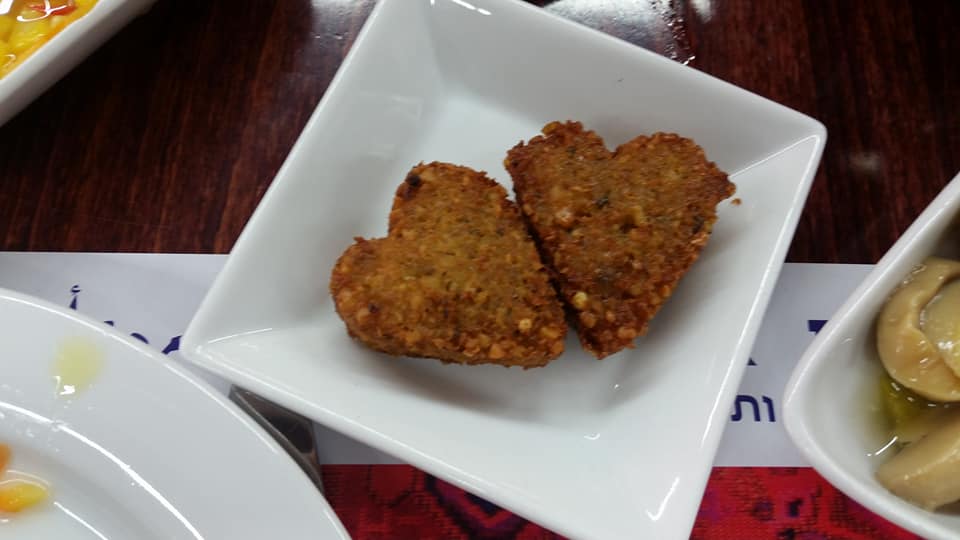
The cultural diversity is amazing here and threatened.  I’ve met Jews from places I never expected- India, Norway, Switzerland, Morocco, Tunisia, Turkey, Ethiopia- and so many other places.  With unique languages, traditions, and cuisine.  And non-Jews such as Druze (whose heart shaped falafel is in my cover photo), Arab Catholics, Arab Greek Orthodox, Arab Greek Catholics, Maronites, Alawites, Muslims, Armenian Orthodox, Armenian Catholics, and Circassians.  Darfuris, Ertireans, Sudanese, Nepalis, and Chinese.  I speak all eight of my languages here- regularly.  This beauty that I love is what the government threatens by shaming Jews for speaking other languages, by discriminating against Arabs, and by expelling refugees.  It pains to me to see such a beautiful gift under attack.

In short, it’s complicated.  There are good things in Israel.  The nature is also gorgeous, the weather is better than anywhere in the Northeast U.S. or most of Europe.  The location is ideal for traveling the world.

Once the Israeli people do the hard work of pulling themselves away from the toxic ideologies that gave birth to their country, they might find themselves feeling freer.  Freer for a secular Jew to be friends with a Hasidic Jew.  For an Orthodox Jew to acknowledge Palestinian Arab history.  For a Mizrachi Jew to dance to Eritrean refugees’ music.  For a secular Ashkenazi to raise his kids in Yiddish.  Or an Iraqi Jew to do so in Judeo-Arabic.  For a Haredi Jew to see the good in Reform Judaism.  For a Palestinian refugee in Lebanon to return home to my neighborhood and for me to help renovate her mosque.  For a Christian to marry a Jew.  For a Jew to convert to Islam.  In short, to be the complex beautiful human beings hiding beneath the divisiveness.

For Hasidic Jews, tikkun olam or “repairing the world” begins within.  I couldn’t agree more.  To make the world a better place, we must start with ourselves.  So see the good things I wrote?  Grow them.  And where we find barriers in our souls towards our fellow human beings, join me in tearing them down.  Inside and radiating out towards the heavens.

Israelis often like to think of themselves as a “light unto the nations”.  The thing is to see a candle best, you must first turn off the lights.  Scary and necessary.  Flip the switch.  It’s time for a reset.  Let the flame illuminate our path.

Bedouin Yiddish

Yes, you read that right.  We’ll get to it- read the whole way through 🙂

Today I went South.  I’ve explored a lot of Israel’s Center and North- with plenty more to discover.  And I’ve ventured a little south since making Aliyah to Ashdod.  Now was the time to learn about another region.

I hopped on the train and headed to Be’er Sheva.  It is a city actually mentioned in the Torah and there is a well there that according to tradition was dug by Abraham himself.  I wanted to visit but it’s one of the very few places in Israel you need to call in advance!

I visited the city market which was cool.  An amazing diversity of cultures that reminded me a lot of my neighborhood in Tel Aviv.  Just with less traffic and yelling 🙂

I went into an electronics store and asked in Arabic where I could buy Bedouin music.  For those who are wondering, Bedouin are substantially different in culture, language, and religiosity from many other Arabs in Israel.  Therefore, their music is different as well.

The young man made me a deal and custom burned me a CD with MP3’s of dahiyye music.  It’s basically happy Bedouin dance music- take a look.  Somewhat reminiscent of the dabke I’ve learned- but in the words of the Bedouin man: “that’s fellahi music”.  Fellahin were the villagers and farmers of the region- as opposed to the nomadic Bedouin.  Most Arabs in Israel today are descendants of Fellahin and have distinct dialects from the Bedouin, who speak a bit more like Fusha, the standard Arabic which was likely modeled after them.

I was then peppered with questions about why I wasn’t married.  Lest you think this is only a Bedouin phenomenon, it has been a frequent first question amongst Jews, other Arabs, even Samaritans here.  It is extremely difficult for me- as a queer person, as an American (where this is considered invasive), and a survivor of partner abuse.

Eventually I shrugged it off by saying I was new to the country and needed time to settle in.  Having gotten my Bedouin music, I decided to keep exploring.

I then came upon a bona fide music shack.  A shack because it looks like one.  And bona fide because this man knew his music.  No CD burning here.  He had hundreds of CDs.

I felt much more at ease here- Ahmed, also Bedouin, was gentle and friendly.  And never asked me about my marital status.  We bonded over Arabic music as he showed me tons of options.  Eventually I bought an Israeli Bedouin CD (with songs from both the North and the South), Syrian dialect music (that’s the one I speak!), and another Bedouin CD from a town near Be’er Sheva.  I personally find it miraculous to find Syrian-dialect music in a Bedouin shop in Be’er Sheva.  First off, most Arabic music is not recorded in Syrian, even when the artists are from there.  Egyptian tends to dominate.  In addition, ten years ago when I took my Syrian dialect class, I could never have imagined this scenario.  And I love it.  When the stars align, language and culture bring me closer to good people like Ahmed.

Be’er Sheva’s Jewish community is also very diverse.  Walking around, I found several Indian and Ethiopian Jewish stores.  There were tons of Russian signs.  I even found a sign publicizing a concert at a Tunisian synagogue from the famed isle of Djerba.  Around the corner from the beautiful mural in my cover photo- showing how the ancient and modern co-exist and feed off each other in this beautiful land.

I toured a bit of the Old City, which I hope to return to- in particular to see the Grand Mosque/Museum of Islamic and Near Eastern Cultures.  Like nearly everything in Israel, this place is not without its controversy.  An Ottoman-era building, the mosque is no longer used for prayer, although local Muslims would like to do so.  Instead, the city of Be’er Sheva wanted to turn it into a general museum.  The Israeli Supreme Court, perhaps weaving between the two, decided it could be a museum but it had to be dedicated to Islamic history.  I’m looking forward to visiting, being a fan of Islamic art and history, and would be happy to see it peacefully resume its role as a house of prayer.

Having the desire to see more Bedouin culture, I hopped on a bus and went to Rahat.  An entirely Bedouin city, it is a fantastic place to go to experience their culture.  Since it was already dark and my transportation options were dwindling to go back home (this can be a stressful part of spontaneous travel), I focused on my goal: food.  Before I sat down to eat, though, I met a wonderful young man named Mohammed who is studying English.  I had asked him for directions, one thing led to another, and we decided to stay in touch and exchange languages.  In particular, I’m dying to learn his Bedouin dialect.  And I can help him with English 🙂

I sat down to eat a feast.  This is not an exaggeration.  For 25 shekels, approximately $7.30, I got to eat this:

26230280_10101661718958712_5056984918498805516_n

The picture doesn’t really do it justice- it’s huge.  I didn’t finish half the rice (chicken is buried in it)- and I was very hungry.  The bread is delightful- kind of like Druze pita i.e. nothing like the pita you’d find in a grocery store.  The full bowl of soup that came with it was tomato-ey, a little spicy, and delicious.  The rice kind of tasted like Biryani, for any of my fellow South Asian food fans.  And it was covered in peanuts, peas, veggies, and delicious sauce.  My doggy bag was enormous.

The people there were so kind.  I have to paint this picture for you- there are 0 Jews anywhere.  I can’t imagine many Jews come to Rahat to dine in one of the Arab restaurants that often sit at the footsteps of their villages for Jews to eat at without going “too far in”.  I could be wrong, maybe some come.  All I can say for sure is that when I was there, I was the only one around.  And a totally novel figure.

People were so curious to talk to me.  I was asked a million questions (fortunately nothing about marriage).  All of them kind and welcoming.  We mostly spoke in Arabic.  I asked them to teach me some Bedouin- they said I spoke fellahi! 🙂  We used a few Hebrew words but they truly loved to practice their English 🙂  People knew I was American, Jewish, and Israeli.  And I have to say, and this repeatedly shocks me, being American has been a huge plus to my travels in the Middle East.  Despite the fact that the American government has a very long history of bullying other countries, so many people here still love America.  Jews, Arabs- doesn’t matter.  It’s fascinating and frankly really encouraging.  It’s also a great way to disarm the people who are, in fact, suspicious of you, because I can play the innocent stranger.  To be fair, I pretty much am one 🙂

Before my sated self headed to the bus (and then an exceedingly long train ride because I missed the more direct train- note to self for next trip), a man grabs my phone and insists we take a selfie.  Apparently some concepts are universal:

26230795_10101661718878872_1056055190934410030_n

As I headed to the bus, a man asked me what languages I spoke.  One of them is Yiddish.  And in a moment that you couldn’t even dream of in the wildest of scenarios, the Bedouin man tells me there’s a guy in their town…who speaks Yiddish.  In shock and amazement, I asked why.  He said that the man, back in the day when Yiddish was more widely spoken here, learned it just as he did every common tongue in the area.  My grin, inside and out, could not have been bigger.

In pure cultural ecstasy, I headed home on a very slow train.  With a lot of time to digest a rich and exciting day.

Intercultural exploration and communication can be very challenging.  One does not come out of the womb with the skills necessary to make it happen- even if you may have some characteristics that help.  I’ve spent my whole life communicating across cultures.  From the my early years in Japan to my schooling in Maryland with so many immigrant friends to my work for refugee rights to the dozen or so languages I’ve studied (8 or 9 of which I can currently speak).  None of this happened by osmosis nor just because I have “an ear” for it.  I do have an ear for it- but just like a concert violinist doesn’t magically pick up a bow and play a concerto, I have honed these skills over years of practice and joy.

Today is the kind of day I’m proud to call myself a cultural explorer.  One who learns, who tries new things, who makes people smile, who grows, who creates, who makes the world a better place.

If you’re looking for new adventure, the world is your backyard.  And your backyard just may have a Bedouin Yiddish speaker.

Straight talk about Israel

This may be my most dugri blog ever.  We need to talk about Israel and Jewish culture.

After 2,000 years of exile, idealistic pioneers started to resettle the land.  There had already been some Jews here – even some with continuous presence since the destruction of the Temple – but they were a small percentage of world Jewry.

The new pioneers, eventually called Zionists, set up all sort of agriculture and economic development and cultural enterprises.  For the latter, one of their best known accomplishments was the revival of spoken Hebrew.  It is an enterprise unmatched by any other linguistic revival movement.

A great deal of the pioneers’ energy was motivated by a desire to escape the “Diaspora” i.e. Jewish life anywhere outside of the Land of Israel.  It wasn’t just a physical escape (which is quite understandable- life was pretty rough for Jews being butchered across the world for 2,000 years).  It was also a psychological and cultural one.

In their minds, especially the Sabras (i.e. the pioneers’ Israeli-born children), the Diaspora Jew was weak, effeminate, overly polite, wordy, deferential, and too religious.  All words which if said by a non-Jew would probably be considered anti-Semitic.

Clearly they had been through trauma across generations and perhaps instead of resolving their pain, they passed it on to others.  In this case, other Jews (although perhaps in another blog I’ll explore how this affected relations with Arabs).

Sabras were largely of Ashkenazi extraction (i.e. their families immigrated from Europe), but their culture was not.  Over time, they rejected Yiddish, the Jewish religion, even changing their Ashkenazi pronunciation of Hebrew.  These were the blunt, masculine, secular pioneers building a state.

When it comes to meeting their goals, one cannot deny their effectiveness.  They established a safe haven for Jews for the first time in 2,000 years.  They won war after war after war- at great cost.  They changed Jewish culture not only in Israel, but also across the world.

The question is at what expense?

When Jews came to Israel from across the world (and continue to do so), they were often escaping anti-Semitism, economic devastation, and war.  From Morocco to Yemen, from Poland to India.

Jews in most of the world are quite accustomed to being persecuted by non-Jews.  Coming to Israel, we thought, would finally protect our Jewish identity.

But the sad truth of it is that when many Jews arrived (and indeed, arrive) to Israel, Sabras greeted them with hatred.  Iraqi Jews were shamed for speaking Judeo-Arabic.  Ashkenazi Holocaust survivors were not only attacked for speaking Yiddish, they were also called “sabonim” or “soap”…because of the rumor that Hitler made soap out of their families’ bodies.  To many Sabras, Ashkenazi Holocaust survivors were weak Diaspora Jews who went “like sheep to the slaughter“.  Religious Jews arrived to Israel and some Sabras even cut off their peyos– their side locks.  I’ve seen videos of this from the 1930s…in Germany.  Did not expect that to have happened here.

While respect for diversity has certainly increased since the early years of the State, it is still an enormous problem.

For example, I live in a largely Mizrachi neighborhood- Jews who came to Israel from the Middle East.  There’s an Iraqi bakery and the Jewish woman there and I speak in Arabic.  Which is pretty friggin awesome.

A young man comes up, also presumably Mizrachi, and talks to the woman because they know each other.  She tells him: “look he’s American and he speaks Arabic better than me!”.  He gets a puzzled and angry look on his face and says: “What do you mean Arabic?  You’re Iraqi.”  The woman then explains to him that when her parents moved to Israel, they spoke Judeo-Arabic.  He wasn’t interested in the details: “Iraqis aren’t Arab.”  He bought his pitas and he left.

This is a guy who presumably has a similar story in his family.  With Judeo-Arabic, with Persian, with Bukharian- with something.  With his roots.  That he doesn’t understand.

When a person becomes un-rooted- as the Sabras did- they lose their sense of self.  One need only look to many million of Americans whose ancestors were shamed for speaking Irish, German, etc.- and now have no cultural bearings.  And take that hatred out on immigrants who keep them.

Culture evolves- that’s fine.  In fact, it can be good.  Not all of the Sabras’ ideas were bad.  God, YHVH, in Hebrew is a verb.  Spirituality and culture need to change but they also need a starting point.  You don’t need to throw the baby out with the bathwater.

The sad thing is that the Sabras’ initial behaviors have became Israeli cultural norms.  While Sabra once meant the first generation of Jewish pioneers born here, it now applies to any Jew born in Israel.  The ideology of the first generation of Sabras has now became fairly mainstream and so with each passing generation, the new cohort of Sabras passes the pain along.  And the pressure to conform.

I can’t tell you how many times I’ve heard “French olim are so annoying with their ‘hon hon hon’, in my neighborhood you’d think we’re in France!  Why do they come here?”  Or “Russians are lazy and don’t learn Hebrew.  Most of them aren’t Jewish anyways.”  Or “You speak Hebrew great!  Not like those Americans who live here 20 years with their terrible accents and can’t get a word out in our language.”

Are all Sabras like this?  No.  I’ve met some people here with a great respect for cultural diversity and a curiosity about the world.  Even their own roots, despite what they’ve been taught about them.

But is it more prevalent here?  It is more rooted in the ideology?  It is in fact a cultural value?

Yes.

And it’s not only from my observations.  As a barometer, let’s talk intermarriage.  Not because you have to marry someone from a different background to not be prejudiced, bur rather it’s a question of whether it’s accepted.  It’s a reasonable point of data for understanding tolerance for diversity.

In the U.S., which has its own extensive history of racism (which sadly continues), only 9% of the public disapproves of interracial marriage.  To the folks who say this is simply a product of American “PC” culture and unwillingness to tell the truth, they’re wrong.  Three times as many elderly Americans are against interracial marriage as young Americans.  There is a definitive positive trend as time goes on.  Thank God.

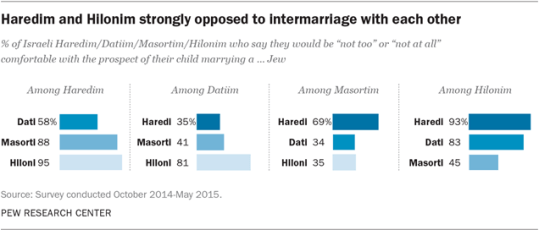
Now let’s look at Israel.  Let’s put aside interracial marriage- upwards of 80% of both Arabs and Jews disapprove.   Every single sector of Jewish society here disapproves- by alarmingly high margins- of their children marrying someone from at least one other Jewish community.  Secular Jews, Hilonim, have almost identically high opposition to the phenomenon as their “menace”- Haredim.

pew

How does this connect?  Diversity.  The predominant Sabra ideology (which by the way is not uniform and there are many alternate visions of Zionism- I’ve personally taken a recent interest in Judah Magnes) is vehemently against it- at least when it comes to Jews.  This helps explain both Israel’s struggle to accept cultural/linguistic diversity and to accept religious pluralism (or religion at all).

The sad thing is that Israel is one of the most diverse places on the planet.  Just in my neighborhood, I hear (or speak) Arabic, Tagalog, Cameroonian French, Turkish, Tigre, Amharic, Chinese, Bukharian, Russian, and so much more.  In the right neighborhood, Israel is a polyglot’s paradise.  Which is part of what I love about it.

It’s hard because what I love most about Israel is what the system itself tries to annihilate.  While I’m accustomed to Jews being diminished by non-Jews, I’m alarmed by Jews doing it to our own people.

Jews have arrived to Israel with the riches of thousands of years of civilization.  Culture, music, traditions, languages, religion.  So much unique richness- some of which cannot be found anywhere else.

And I’m glad that Sabras built a place to save Jewish lives.  Because no one else has.

The question is what does it mean to save a Jewish life if you can’t live Jewishly?  Why can’t someone be Israeli and speak fluent Hebrew and also insist on teaching their kids Yiddish or Kavkazi or Haketia?  And their grand kids.  And insisting these languages be taught in the public schools we fund?  And preserving multiple identities in addition to being Israeli?

I’m grateful Israel has amazing archives which I plow to learn about these ancient and precious communities.  But I’m not interested in being archived.  I’m interested in living as a free Jew in my land.  According to my traditions- evolving and ancient.

Because every time an Israeli sings Hatikvah, they’re singing a Romanian folk song in the Hebrew cadence of my forefathers in Poland.

That’s the thing about roots- they’re hard to undo.


Wherever I stand, I stand with refugees

As some of my long-time friends know, I’ve always been an advocate for refugees.  My very first internship in college was with Jews United for Justice, a DC organization promoting economic and civil rights.  I personally lobbied my boss to make our Summer “Labor on the Bimah” workers rights event about immigrants rights.  The year was 2006 and Republican Congressmen were pushing a horrific law that would’ve even punished Americans who helped undocumented immigrants.  Even pastors that fed them.

My boss agreed and we organized 30 events around the D.C. area on Labor Day to mobilize Jews- alongside Christians and Muslims- to support immigrants rights.

Part of my job was to find Jewish texts to explain why our tradition asks us to speak out on this issue.  This is what I compiled.

You may be familiar with the verse from Exodus 12:49: “There shall be one law for the citizen and the stranger who dwells among you.”  Or “you shall not abuse a needy and destitute laborer, whether a fellow Israelite or a stranger.” (Deut. 24:14)  Or any of dozens of similar commandments.

I spent much of my career in the U.S. fighting for immigrant and refugee rights.  In the government, at NGO’s, and as a private citizen.  The struggle there continues.  Even this month hundreds of thousands of immigrants and refugees may be deported if the DREAM Act isn’t passed and TPS isn’t renewed.  When I left for Israel, Donald Trump was pushing to ban refugees (and even entire countries’ citizens from visiting).  Not by coincidence, these countries were largely Muslim and the refugees increasingly Syrian.

I rallied and rallied for humanity.  I screamed till my voice was lost.  I was invigorated but also scared and exhausted.  In my favorite moment from one of the rallies by the White House, I met up with a Syrian refugee friend Remi who I had met on Facebook months before and we fought for justice together.

rally pic

This picture is what I believe.  All of us have suffered.  Few peoples more than the Jews.  Having been banished from country after country for over 2,000 years- and butchered along the way- we should be the most compassionate towards those fleeing suffering.  It’s a biblical mandate and it’s rooted in our history.

Many of the Jews living in Israel are refugees themselves- from the Holocaust, from Arab governments who expelled them, from the Soviet Union, from war and famine and anti-Semitism.  Sometimes when people experience trauma, it can be hard to empathize with others.  And there are some people who, after putting in a great deal of effort to heal, are able to see the humanity of the other.  To realize that the Jewish story, while unique, is not the only story of suffering.  And that our own pain must become a source of compassion towards others.

One of the reasons I made aliyah frankly was to get away from the refugee rights struggle.  I was tired.  It’s painful and the American government is eagerly attacking both the foundations of our democracy and of my friends’ human rights.  Since making aliyah, I’ve continued to talk to Syrian refugees in Arabic via Skype through a fantastic program called Natakallam.  Since moving to Israel, it’s now easier to schedule since I’m in the same time zone as my Skype partner Shadi in Iraq 🙂 .  One day, inshallah, we’ll be able to visit each other in peace, as we both want to do.

In the meantime, I thought I had escaped.  And then I met Sadiq.  Sadiq is a Darfur refugee living in Tel Aviv.  I had signed up to tutor refugees in English, but as a newly arrived oleh with my own stress, I didn’t realize just how hard it would be.  Sadiq was sweet and wanted to party at the beach and improve his English.  He worked twelve hour days every day of the week.  And he hadn’t seen his family in 20 years.  I heard about the relatives killed, the homes abandoned, and the pain.  He had survived a genocide.

Yet somehow he had a positive attitude and a beautiful smile.  And a willingness to learn.  I enjoyed learning some Sudanese Arabic from him.  I was just too overwhelmed to continue tutoring.  So I explained to him why I needed to pause our work together and I took some time to reflect and get my life in order.  He understood and I focused on finding an apartment and adjusting to life here.

About two months ago, I found some more stability when I got my own apartment.  I took advantage of some cheap flights and took my first post-aliyah vacation to Cyprus.  Cyprus is amazing and for all its historical problems, the area I was in was peaceful and relaxing.  I was away from the Middle East, from loud Israelis, and from conflict.

Then I saw a woman in a hijab trying to ask a Greek-speaker something.  I went up and talked to her in Arabic.  She was looking for a grocery store.  With my Arabic and my nascent Greek, I helped her communicate with some locals to find it.

We then started chatting.  She asked where I was from, I said Israel.  Turns out Fatima and her family are from Idlib.  They were excited to hear my Syrian accent.  She had a son Muhammad and I chatted with him for a bit.  And another woman, Jamilah, stood beside them.

After they thanked me for directing them to the grocery store, I asked if they were all family.  That’s when Jamilah started crying.  She told me, as she bawled, that she had lost all her family in a bombing in Idlib.  She came to Cyprus from Syria with Fatima and her son, family friends.  And they arrived two weeks ago.

Then everyone started crying.  And telling me about their injuries.  I didn’t know what to do.  I was sad for these people- my neighbors.  And angry at the people who had harmed them.

I did my best to offer words of comfort and gave them information for aid organizations.  Then I handed them a bunch of Euros and got their contact info to pass on to my friends in the field.

In an astonishing act of gratitude, they asked for my phone number because they wanted to invite me to dinner.  Refugees fleeing war, only 2 weeks in Cyprus.  From Syria.  Inviting an Israeli to their house for a meal.  I tear up when I think of the incredible kindness.  What utterly generous human beings, an example for us all.

If our interaction brings some peace and understanding between our peoples, I’m all the happier for it.  And I hope with all my heart they get the help they deserve.  And a future their boy Muhammad can enjoy.

Because in the end, we are all people.  I was recently at a Shabbat dinner and I told a Sabra that I was upset when someone here made a racist comment about African Americans.  She said: “aval zeh lo pogea becha.”  But it doesn’t hurt you.  To which I said: “of course it does.  African Americans are my friends, my classmates, my neighbors.  We are all Americans.”

Which is the point.  We’re all Americans and we’re all humans.  It davka does pogea bi.  The question shouldn’t be “why does this offend you?” it should be “why doesn’t it?”

I live in South Tel Aviv.  Not Florentin, Real South Tel Aviv.  And in my neighborhood, there are a lot of refugees.  From Eritrea, from Sudan, from all over the world.  And despite the hubbub you hear in the news, not only is this neighborhood safer than any major city I’ve lived in in the U.S., but a lot of local residents get along fine.

I’ve met a Sabra girl who only hangs out with African friends.  I’ve met Filipino and Eritrean kids who speak Hebrew fluently- and to my dismay, not their families’ languages.  My elderly neighbors with pictures of Rav Ovadia all over there house love their non-Jewish caretaker.  I’ve met Sudanese Christians who could quote the Torah better than most Jews (in a know-it-all kind of way that suits them as Israelis).

So whether it’s Donald Trump or Benjamin Netanyahu trying to oppress refugees and migrants.  When they’re ignoring our Torah and abusing people fleeing tyranny.  And when the Prime Minister, in the name of my country and my people, is prepared to spend 504 million shekels* to deport refugees.

There is only one answer: no.  Refugees are the world’s problem.  I can’t explain human suffering.  I just know that when someone in is pain, when someone is fleeing death, we should open our hearts and help them.

Your Judaism may be only about helping Jews.  If someone insults or harms another group, you may not see it as your problem.  But my Judaism and my Israeli identity is about helping my people and helping my non-Jewish neighbors.

My own suffering and the suffering of my people is part of why I care so deeply about helping vulnerable people in need.  My Judaism doesn’t stop at the doors of my synagogue nor the borders of my country.


*The government announced a budget that will allot $3,500 dollars to each refugee deported.  And it’s about 3.6 shekels to the dollar.  There are about 40,000 refugees.


A New Year’s Resolution for Israel

Today is the secular new year.  In Israel, fittingly but quite strange for me, they say “shanah tovah”, the typical Jewish greeting for Rosh Hashanah- the Jewish New Year.  It’s a fun night of celebration and also a chance to think of what’s ahead.

For me, this week marks my 6 month anniversary of arriving in Israel.  I’ve learned so much in such a little amount of time.  I’ve visited over 35 cities.  I’ve been to Hasidic dance parties, Mizrachi concerts, dabke dancing, Israeli folk dancing, Yiddish theater, a Russian puppet show, and a Yemenite concert.  I’ve eaten Bukharian, Moroccan, Persian, Ashkenazi, Romanian, Druze, Arab, Kavkazi, Georgian, Indian, Iraqi, Lebanese, Eritrean, Filipino, and so many other types of food.  I’ve davvened with Haredim, Reform Jews, Chabad, and hippie vegan Jews.  I visited a Druze shrine and a Karaite synagogue.  I got to watch Islamic prayer up close and personal in a mosque and I went to an LGBT Orthodox Torah study group.

Not bad for the half year mark!  I’m quite proud of all my accomplishments- moving across the ocean alone, making friends, finding an apartment, adjusting to a new culture, and using all nine of my languages and starting to add Greek!

There has been a lot of stress along the way.  Israel is an extraordinarily hard place to live- or so say Sabras who grew up here.  And while sometimes they exaggerate because whining here is kind of a national sport (and they don’t know much about the challenges faced by people elsewhere), the truth is in many ways they’re right.  And it’s all the more difficult for someone like me who moved here at 31 without an extensive support network.

What’s hardest about life in Israel is also the source of my New Year’s resolution.  The hardest part of life in Israel is the people.  More specifically, the intense and mean-spirited prejudice I experience on almost a daily basis.  Towards me as an American and towards other cultures- especially within Israel.  Don’t get me wrong- there are some fantastic people here, who mostly join me in complaining about the awful ones.  But boy- there is a mean streak to Israeli culture that I haven’t seen elsewhere in the world.  It’s not because I haven’t seen prejudice elsewhere- I’ve experienced it in places like Spain (anti-Semitism), Argentina (homophobia), and the U.S. (all of the above).

The difference in Israel is the intensity and the degree to which many people here celebrate judging others.  I’m someone who deeply values multiculturalism.  I’m well aware that there are limits to it and questions about how far it should extend.  But the basic principle of respecting- at times embracing- parts of every culture to me is second nature and a fundamental way I live in the world.  The good news is Israel is chock full of interesting cultures.  Sadly, that most Israelis know nothing about- and don’t care to appreciate.  While some Israelis are curious about Berlin or America, few are particularly curious about their neighbors who look or talk differently from them.  Let alone their own roots.

The truth is when the State of Israel was being built, its founders despised (and that is not too strong a word) multiculturalism.  Yiddish, Ladino, Judeo-Arabic- these languages were vigorously and shamefully repressed by the state.  Kids grew up with shame about their roots.  And sadly some 2,000 year old beautiful Jewish cultures are going extinct as a result.

The un-rootedness of many Sabras fosters insecurity and prejudice towards those who maintain their heritage.  Just ask many a Sabra what they think of French Jews or Russians who continue to speak their languages here.

There has been somewhat of a resurgence in interest in cultural diversity, but it needs to be nourished.  And that’s where I- and you- come in.  There are Israelis like me who are proud of our origins.  There are Israelis- I’ve met them- who realize you can speak fluent Hebrew and still maintain (or re-learn) your French or Russian or Arabic or Romanian.  There are many who don’t realize that because they’ve been trained to revile the Diaspora.  And that’s very sad.

But in the end, I believe in multiculturalism and I’m convinced there are some people here who are ready to join me in this movement.  I want to celebrate the incredible cultural richness here- of Jews, of Arabs, of refugees, of everyone.  It is a gift that must be cherished to be protected.

It is no longer acceptable to me that when I tell my Sabra friends that I met Aramaic-speaking Christians or Samaritans who speak Ancient Hebrew or Eritreans with an awesome juice bar that their reaction is: “wow I didn’t know that was there- you’ve seen more here in 6 months than I’ve seen in a lifetime!”

Bullshit.  Time to get off your hummus-filled tuchus and get to know the richness of your country.  No- not the high-tech.  The cultural treasures right underneath your nose waiting to be discovered.

It’s time to leave behind the old-fashioned Zionist concept of the “effeminate”, “decadent”, “overly pious”, “cosmopolitan”, “weak” Diaspora Jew.  It’s 2018, time for a change.  It’s time to realize the “Diaspora” is The World.  And lucky for us, a whole bunch of people from all over the world have made this country their home.

Now it’s time to realize that if we understand where we came from, our cultures, our heritage- it doesn’t negate our Israeli identity.  It thoroughly enriches it.  Just like my delicious cover photo of Pringles, Russian sweets, Korean seaweed, and Israeli Bissli that co-exist at my neighborhood store.  Pluralism that begins with culture can increase respect between all sectors of society.  And instead of Jew hating Arab hating Zionist Orthodox hating Haredi hating Secular hating Mizrachi hating Ashkenazi- maybe, just maybe, we build just a little bit more understanding and a lot less hate.

Ken yehi ratzon – may it be God’s will.  Inshallah.  Ojalá.  Mirtsashem.

Let’s do this y’all. 🙂

My Queer Sarit Hadad Party

First off, who is Sarit Hadad?  Sarit Hadad is the queen of Mizrachi music, one of my favorite styles of music.  Perhaps my very favorite.

When I was 13 years old, as a typical American Jewish teenager, I had a Bar Mitzvah.  At this point, many a kid drops out of Hebrew school and doesn’t return to synagogue except for maybe Rosh Hashanah and Yom Kippur.

I, on the other hand, loved Hebrew school.  I had several truly awesome teachers and I think my energy and passion for my tradition made me a favorite student.  Especially since so many kids hated it!

When I finished my Bar Mitzvah, I knew I wanted to keep learning at synagogue.  But I wanted something more- I wanted to learn the language of my people: Hebrew.

I approached an Israeli teacher and asked if she’d give me private lessons.  She did- and that’s why I speak pretty baller Hebrew for someone who’s lived in Israel for 6 months.  Because at age 13, I knew that’s what I wanted and I went for it.  It’s a unique and brave decision that changed my life.  Without it, I doubt I would’ve made aliyah.

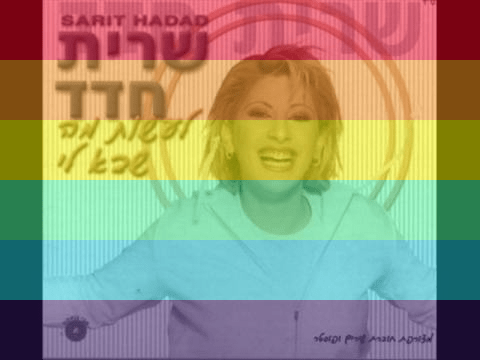
I remember that my Hebrew teacher gave me a gift- I forget for what.  Maybe her sister had been in Israel or something.  In any case, she gave me a CD- one of Sarit Hadad’s first albums (the one in the cover photo- the rainbow is my addition 😉 ).  She herself wasn’t a fan (of the music or Mizrachim), but it didn’t matter- I loved it.

The CD moved.  It moved me physically- the rhythms were infectious.  I danced all over my room and blasted it in my discman.  It moved me emotionally- her songs were about empowerment and love and doing what you feel like.  Growing up with an inescapable bunch of toxic relatives, it was just the medicine I needed.  And it powered me through many hard times and gave me hope and happiness.

A couple years into my Hebrew lessons, I found out Sarit Hadad was coming to Rockville, Maryland- where I grew up.  She was performing at Montgomery College in a small auditorium.  And at age 14 or 15- I went.  Alone.

And I had the time of my life.  Me and mostly a bunch of Israeli expats shimmied and danced and sang.  It was freedom, it was love, it was my newfound identity.

Over the years as I learned more Hebrew, saw more Israeli films, traveled to Israel, made Israeli friends, ate the food, and embraced the culture- the Mizrachi music Sarit inspired me to love was there.  Every step of the way.

As Sarit became more popular, her songs got more and more poppy (and less and less Georgian/Arabic/Mizrachi).  Personally, I love her old stuff the most- the CD of her live show in France is one that I played over and over again in my living room as a teenager.  I also used to (and still do!) belt out her old version of Inta Omri.  It’s incredible- I watched it with my Syrian neighbors last Shabbat.

In addition, as I explored other Mizrachi singers (and I more and more associated Sarit with some of the tougher times in my life), I drifted a bit from her music, although it was never far.  Her songs were particularly popular at Israeli dancing, which I’ve done for some 15 years.

Which brings us to tonight.  On Facebook, I found a party that was entirely dedicated to songs by Sarit Hadad.  While not an explicitly gay party, it definitely had that vibe (both by featuring a female singer and the way it was advertised).  In Tel Aviv, many parties are mixed queer and straight.

I was ecstatic but unsure of what to expect.  I went alone- which is hard in any country, especially a new one.

And boy did it pay off.  Once the music started booming, I found fun people to dance with.  Over the course of about 3-4 hours of Sarit’s songs (and some other singers), I think there were 2 or 3 songs I didn’t know the words to.  It brought me back to the earliest days of my Israeli identity and to my teenage passion for it.  It brushed the dust off and brought them back into my heart.

And yes, there were a shitton of queer people, which only made it more awesome.

I shimmied, I swiveled my hips, I shook my bootay, I waved my hands, I shouted every single lyric.  And it was fabulous.

As I headed home, I thought about this amazing transformation.  How music I listened to 18 years ago helped sustain me, build me an Israeli identity, and bring me to this very country to enjoy it, against all odds.

Like Mizrachi music, like Sarit herself- I am a survivor.  I’ve done the unthinkable in making aliyah and building my Israeli identity from the 7th grade- pretty much on my own (and often with the opposition of toxic relatives).  And despite the cries of the loads of Israelis who hate Mizrachi music- often for prejudiced reasons- I love it to death.

Because sometimes Israel sucks.  Air raid sirens, bureaucracy, terrorism, racism, and not a small amount of difficult people.

But you know what?  Israel is also tonight.  Israel is the free-spirited fun of Mizrachi culture.  Israel is me looking back at 13 year old Matt Adler and saying- it’s going to be okay.  Because no matter how bad things seem now, you’re going to power through, you’re going to pray, you’re going to dance, you’re going to listen to beautiful music.

And you’re going to make it like Moses to the Promised Land.  To spend the night of your life dancing to your teenage tunes- the ones you chose to listen to.  Among queer people.  Among your people.

And nothing, my friends, is sweeter than that.  I’m here, I’m queer, kululu!

Dugri: Lost in Translation

There has always been a yawning communication gap between Israelis and Americans- and between Israelis and the world.  Every country and culture has a unique communication style, and in my case, this often leads to challenging interactions with Sabras.  Sabras are Jews who were born and raised in Israel, whereas I’m an oleh- I chose to live here.

The sabra communication style most well known is “dugri”.  Dugri, from an Arabic word (itself of Turkish origin), means “straight talk”.  The word in Arabic means “straight” (like when giving directions), “fair” (like an arbiter not choosing sides), or “honest” (truthful words).  In Hebrew, the word means “direct”- but not in the sense of “honest” in Arabic (which is focused on presenting correct objective facts), but rather directly expressing your subjective emotions and opinions, regardless of how they are perceived.

In Israel, this means less pleasantries, less consideration, less politeness, more tough love, more controversial statements, and more blunt judgments.

There are ideological roots to this communication style that have been well-researched.  I highly encourage reading Professor Tamar Katriel’s study, which I’m still working through.  Going back to the early Zionist pioneer days, ideological olim wanted to rid themselves of what they perceived as a “Diaspora mentality” of formality, nuance, and passivity.  Again- this is their perception, not necessarily the facts.  The answer, especially for their sabra children, was to be found in a new, astoundingly direct and informal communication style, itself ironically rooted in German enlightenment philosophy.  I can empathize that building a new national identity was hard and I also think their attitude towards the Diaspora was pretty hateful.

This style, before I deconstruct the hell out of it, has its advantages.  For instance, I’m a very informal person so I like that dugriyut- or speaking dugri- allows me to speculate, to dream, to ponder.  I don’t have to cross my i’s and dot my t’s- I can just roll with it.  It fosters creativity in me.  I also like that I don’t have to think through every word I say for fear of literally losing friendships.  Here, an occasional offensive comment is not going to lose you anything.  When used properly, speaking dugri can reduce some of the feeling of “walking on broken glass” we face in America when communicating.  Also, hearing people’s deep-seated personal prejudices, while valued in Israeli society, for me actually serves as a defense mechanism so I can avoid someone who is actually toxic.  I rarely have to guess what people here think.

Now the flip side.  First things first- I’m a proud Israeli and I’m an American.  My family has lived in the Diaspora for 2,000 years and while I’m glad to be back, I’m not ready to give up the wisdom gained over centuries.  I’m a firm believer that it is not only possible, it is desirable to have more than one culture.  This is an issue Israel has struggled with from the beginning– as do many countries.  I understand- and will continue to learn about- dugri communication but that doesn’t mean I’m going to “negate” my other cultures.

In Hebrew, the ministry that deals with olim is called the “Ministry of Absorption”.  I can’t even imagine a more Orwellian phrase, but let’s work with it.  Yes, to a degree, I came to be absorbed into Israeli society.  But a funny thing happens when your body absorbs something- it changes your composition.  And so much in the same way, I intend not just to be changed, but to change this place.

So what does this mean for dugri talk?  First off, we need to see some of the negative aspects this style can present.  For example, when sabras interact with foreign cultures, including Americans, they often struggle to perceive cultural differences.  Just this week alone, on three separate occasions, Jews here made (what I consider) offensive remarks to me about Americans being “fake” etc.  This is a common sabra complaint- Americans are polite, but insincere when they compliment you.  All the while, I’m sitting there talking with them as an American with ten times better Hebrew than their rrrrresh infected mouths can mumble in my language.

This is endemic of the problem.  Because Israelis are sparse- but quite genuine- with their compliments (as befits dugri talk), anything other than that is seen as insincere.  What they don’t realize is that it’s simply a cultural difference.  When Israelis move abroad and don’t know how to say “please” or “thank you”- or try to say something unacceptably blunt- they lose friends and often struggle to make non-Israeli friends.  This is well-documented by a study done among Israeli migrants to Canada.  Boy if they think Americans are polite, wait till they meet Canadians haha.

The truth is there are fake people and genuine people in every society.  For me, for instance, I encounter some Israeli communication as incredibly insincere- even though it’s just likely just a cultural difference.  For instance, especially in Tel Aviv, when people promote upcoming events (or compliment someone for leading an event), a whole litany of “mehamems” and “madhims” and “nehedars” and “merageshs” come out.  Basically, just a list of how everything is the most amazing awesome best coolest most wonderful thing ever.  It’s enough to make me, as an American, nauseous because it sounds like they’re lying.  But what I’ve come to realize is that there’s probably a cultural component to it.  Rather than calling all sabras fake, I chose to read hours of academic articles and confront the issue meaningfully.

For me, besides the nuisance of Israelis telling me my country (and implicitly perhaps me and my friends there too?) is fake, I have to wonder if there’s a broader cultural problem at work.

Israelis, unlike almost any civilized society I’ve lived in or visited, have completely separate school systems based not only on race/religion, but also what type of religiosity.  There are Arab schools, secular Jewish schools, Modern Orthodox schools, and Haredi schools.  These schools operate completely separately in state-sanctioned (and largely publicly supported) segregation.  There are social reasons for this- I’m not pretending it came out of nowhere.  But the end result is that Israelis rarely if ever interact meaningfully with people from drastically different backgrounds.  And they don’t learn how to understand intercultural communication.  Nor the value that sometimes, just because you think a thought doesn’t mean it’s best to say it out loud.

In 6 months in Israel, I have become a regular in Bnei Brak speaking Yiddish, I have visited half a dozen Arab villages in Arabic, I hung out with Samaritans, I watched Karaites pray, I talked with Armenians (in Arabic!), I blasted Eritrean music with refugees at a juice bar, I tutored a Darfur survivor in English.  And on and on and on.  I know this country much, much better than most of the sabras who’ve lived here their whole lives.  And it’s not because they’re bad people.  I have learned much from my sabra friends.  And they have much to learn from me about their own country.  This is one of the most diverse and exciting places on the planet.  A place I enjoy even more because of my diverse American upbringing.

Now it’s time for me to dish out some dugri talk (see I do like it sometimes!).  Sabras- you’re mostly racist or at best, unappreciative of the diversity that surrounds you.  Your difficulty in communicating across the cultures in your own country reinforces your prejudices- including towards olim.  I’ve lived all over the world, including spending lots of time in the Deep South in the U.S., and this is by far- by far- the most openly hateful society I’ve lived in.  Not just in terms of race, but also in terms of prejudice between different sectors of society (Secular vs. Orthodox, Ashkenazi vs. Mizrachi, etc.).  There are some of the most incredibly kind and hospitable people here too.  It’s just that the level of judgmental speech and behavior is mind boggling and frankly makes me appreciate my American upbringing- and question whether I want to raise my kids here.

In particular, there are times when the secular Ashkenazi liberal elite here sounds like a bunch of American tea partiers who long for the 1950s.  An era in which the government was basically run by a bunch of white men (them), when Holocaust survivors were told they went like “sheep to the slaughter”, when Arabs were under military rule, and Mizrachi Jews lived in impoverished camps.  But at least in the “good old days”, the government was more secular i.e. more like them.  Perhaps not coincidentally it is this same demographic that coined “dugri talk” generations ago.  Language is power.

The key is that every culture has its communication style.  It was hard for me to write a blog that was in English but appropriately non-judgmental for an American and appropriately dugri for an Israeli.  And I’m still learning about Israel even though I speak the language fluently.  I will always be learning.  I recommend all olim- indeed all tourists- learn about Israeli dugri talk.  And sabras- if you care at all about the millions of people living here born in other countries (or your own ability to travel abroad without offending people)- learn about yourselves.  You don’t have to give up your directness but you do need to learn how other cultures work.  Because it’s not that all Americans are fake.  It’s that you’re not self-aware.

Do your homework.  That’s my dugri talk for the day 🙂

p.s.- my cover photo is a paper I used to teach a Swahili-speaking Tanzanian in Holon about Hebrew vowels…via Arabic because she’s an Arabic teacher.  Intercultural communication isn’t a hobby- it’s a lifestyle.  Open your eyes and join the miracle 🙂

Yiddish and Farsi: Kissing Cousins

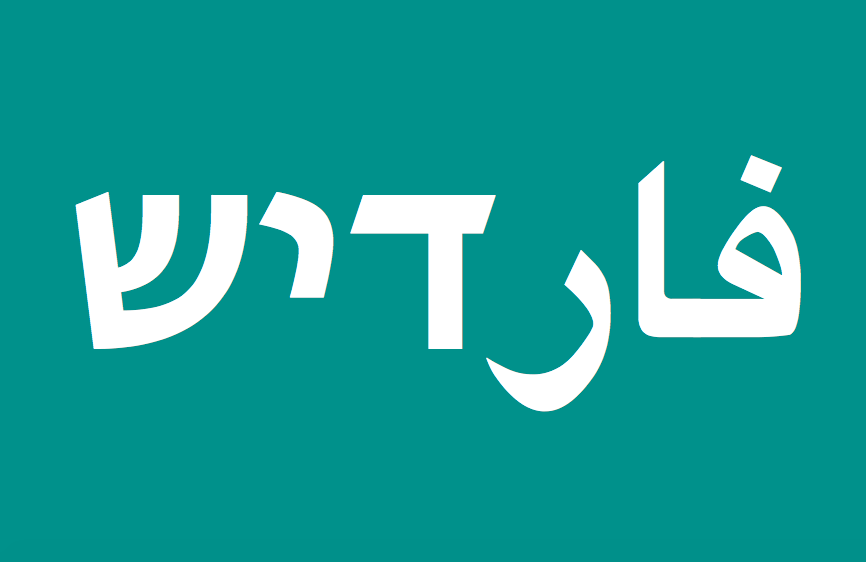
About two years ago, I decided to take some Farsi lessons.  Having grown up with Persian friends and gone to their plethora of grocery stores and restaurants, I always had a curiosity for the culture.  I also frankly just think the language sounds musical and peaceful.

I found a private tutor but, for a variety of reasons, stopped after a couple months.  The language lay dormant in me (other than talking to lots of cab drivers and some friends).  I kept listening to the infectious music though.

Now that I’m in Israel, I pulled out the textbook I had bought in the States (anticipating I was continuing with the teacher).  I wanted to refresh the language- I have a lot of opportunities to speak it here.  There’s an entire market near my house where store after store is owned by Persians and I like chatting with them.

In my book, I came across something interesting.  The Farsi word for “homework” is “mashgh” spelled مشق.

To me, the root looked Arabic- and I was right.  A high percentage of Farsi words are of Arabic origin, which has helped me learn the language.  Although the language itself is categorized as Indo-European, meaning it is more closely related grammatically to German or English than to Arabic.  As an example, the word “isn’t” in Farsi is “nist”, eerily similar to the German (and Yiddish!) “nisht”.

Back to the word.  So I looked up words from the same root in Arabic and found مشقة.  “Mashaqqah” means “hardship”.  Hmm…this word sounded very familiar to me.

But you’ll be surprised to hear that the word it reminded of was in Yiddish.  “Máshke” משקה is the Yiddish word for drink, but more specifically often used for alcohol.  I know it because I once learned a Yiddish folksong about it!

Lo and behold, this Yiddish word comes from a Hebrew word.  “Mashkéh”, spelled the same way as the Yiddish word, more generally means beverage.  Its plural form even adorns the liquor store near my apartment.

Do all these words come from the same root?  I’m not actually entirely sure, though it seems so.  When words move from one language to the other, pronunciation can change and letters once essential in the original language may disappear.  For example, “Mashaqqah” has two “qafs” (q), whereas in Farsi, mashgh, does not.  I’m not sure why, but that’s how it is with many Arabic words as they migrate into other languages.

And so to from Hebrew to Yiddish (and in some cases back to Hebrew).  The Hebrew word “tachlith” תכלית migrated into Yiddish as “tachlis” (same spelling) and back into Modern Hebrew as “tachles” but spelled how you pronounce it in Yiddish תכל’ס.

So here’s what I find amazing.  First, that my learning of languages helped me explore this fascinating adventure.  Second, that I may have found a word (besides Shalom/Salaam) that in various forms appears in Yiddish, Hebrew, Arabic, and Farsi.  And third, that we are all are far more connected than you might think.

Because while many know Arabic and Hebrew are closely related (about 60% from the same roots), so too are Yiddish and Farsi.  Meaning there are two Jewish and two predominantly Muslim languages that are related!

How so?  First, both Yiddish and Farsi are unique- they are Indo-European languages with strong Semitic overlays.  For Yiddish, that means tons of words from Hebrew and Aramaic.  And for Farsi, that means Arabic influence.

For instance, the English word “is” is “hast” in Farsi and “iz” in Yiddish- all three of which are related.  None of which are close to the non-existent present tense “to be” in Arabic and Hebrew.

Not only that, but the ways in which Semitic words are incorporated into the languages are often identical.  For instance, when making compound verbs, the noun comes from the Semitic language and the verb comes from the Indo-European root to make a new verb.

For instance, in Yiddish “khasene hobn” חתונה האבן means “to get married”.  Khasene, pronounced in Modern Hebrew “chatunah” means wedding.  And it is paired with the Germanic element “hobn” meaning “to have”.  To have a wedding, there you go.

Now in Farsi, the same thing happens.  The verb “harf zadan” حرف زدن means “to speak”.  The first word, harf, is from the Arabic word for “letter”.  The second word, the verb of the verb, is the Persian word “to slap”.  To slap a letter?  To speak!  There you go.

Similar processes happen with regards to phonetics, to pronunciation.  Words from the Semitic languages often are pronounced differently in Yiddish and Farsi than how they’d be pronounced in Hebrew and Arabic- even when they’re written identically.  Shalom in Yiddish is sholem (or shulem) and salaam in Arabic is salam in Farsi.

Understanding how this process happens in Farsi later made it easier for me to learn Yiddish.  That’s right- Farsi helped me learn Yiddish.  And having the foundation in Hebrew and Arabic made it easier for me to learn both languages.

Bottom line?  While Farsi and Yiddish seem worlds apart, they are perhaps more closely related to each other in some ways than to other languages you might expect.  They share unique characteristics, and do so in style 🙂 .  While the world sees Iran and Israel as enemies and while in Israel, Mizrachim and Ashkenazim never miss an opportunity to demean each other’s cultures- the truth is we’re all related.

Don’t take my word for it- pick up a dictionary, find a teacher, and unlock the secrets that language has to teach you.  Even about yourself.