Two forks

Reflecting on the past two months of traveling in Europe, I want to share some lessons I’ve learned.

First, look for the generous people.  They are often in the places you least expect it.

I was in Tortosa, a beautiful medieval Catalan town.  It was pouring rain outside- I walked with a piece of cardboard over my head until I could buy a Mickey Mouse umbrella.  It was a funny moment, least until I was soaked from head to toe.

I headed to a market to buy some food- if I didn’t get some then to eat in my hotel, I could be stuck for the night.  There were flash flood warnings.

I ran inside, new Mickey Mouse umbrella in hand.

I went to one stall to buy cheese.  I asked if they sold bread- they were all out.  After paying four euros for cheese, the shop owner handed me a small piece of bread, no bigger than a roll.  I thought wow- how generous.  And then charged me 30 cents.  I walked away a bit discouraged.  I missed the spontaneous generosity of Israelis.  In this town, where I found myself in the rain, people were also quite willing to give me directions in the downpour.  As they hopped in their cars.  I felt alone.

I headed to another stall in the market.  A young woman, 23 years old, helped me find some delicious pre-cooked cod pasta (yes that’s a food- and it’s delicious!).  I told her I was looking for bread and she said she’d heat up my food real good while directing me to a bakery across the street.

I walked through the rain again, only to find the bakery was out!

I came back and the woman was bummed- she heated up my food again to make sure it was extra hot.  Then she did the kindest thing.  First of all, she grabs a hand full of croutons and puts them in a bag for me.

“They’re not bread, but maybe they’ll help.”

I smiled.  I don’t think I ate a single one, but I felt loved.  Cared about- which is worth more than all the bread in the world.

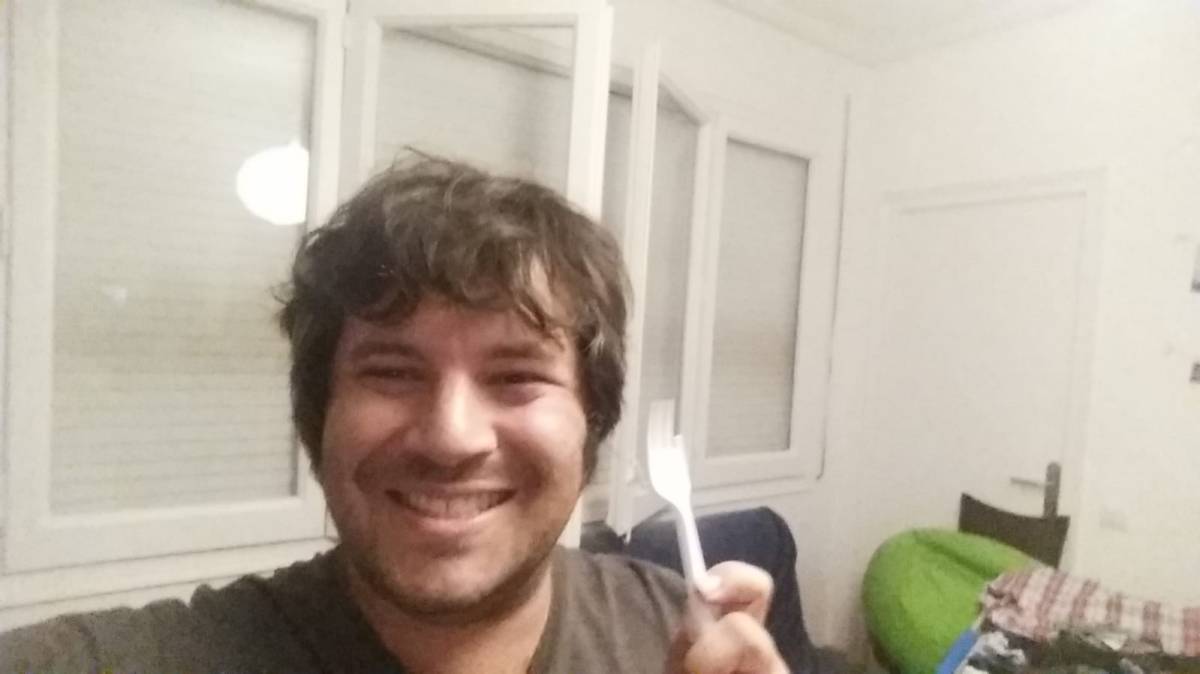
As I headed out, she packed my bag.  She gave me two forks- I asked why.  And she said “just in case.”  I’ve kept the second one in my bag since.  It’s in my cover photo.  A reminder of her kindness.  Of good people.

She was so excited for my trip.  Rather than some people who get caught in jealousy or assumptions about my wealth (I have about $200 in my bank account now), she was just pumped.  I loved it.

I told her to travel one day.  And most of all, thanked her for caring about me.  I said something I truly meant:

“Necessitem més gent com tu al món”.

We need more people like you in the world.

You could feel her smile from meters away.  (Yes, I think in meters now- and I even kind of understand Celsius…and write my dates with the day first!  I even messed up an American form once by putting it the international way!)

I headed out feeling great.  It wasn’t what she gave- it was that she did.

On my way home, I found another bakery open.  What a relief!

I got some whole grain bread and a yummy donut.

The woman behind the counter didn’t quite have a Catalan accent when I spoke to her in Spanish.  I love accents- I have an ear for detecting them.  So do Andalusians- some of them thought I was Catalan when I spoke Spanish because I pronounce my “s’s”.  Although I’ve gotten pretty good at breezing by them after some time in Almería. 😉

Turns out she moved to Spain when she was 12.  From Romania!  She’s from Oradea- a city I actually visited!

It was surreal.  What are the odds?  I don’t think I’ve met another Israeli or American who has been to Oradea. (Correction- I met my friend Aryeh there.  Props, Aryeh)  It is not a major tourist destination by any stretch of the imagination.

We spoke about Romania- how she wants to travel there.  It doesn’t sound like she has been back much since she was a kid.

In fact, she asked me what it was like.

It’s at moments like these where I feel privileged.  I shared with her my travels, the beautiful views.

She loved it.  You could feel how excited she was to travel there.

And what’s so astonishing is there wasn’t one bit of jealousy, nor shaming, nor anger.  She was so excited I was on a journey- and I encouraged her to find even a week to do the same.

She agreed.  She wanted to see her homeland.  And I hope one day she does.

It kind of brought things full circle.

I started my journey, at least this one, in Romania.  I suppose we’re always on a journey, but this leg started there- in one of my ancestral homelands.  The land my great-grandmother was born in, whose language she spoke, where she escaped from in the midst of intense anti-Semitism 130 years ago.

Thanks to her intuition and bravery, I am an American.  I’m an Israeli.  And I’m alive, unlike the hundreds of thousands of Romanian Jews murdered in the Holocaust.

Just 80 years ago, there were 750,000 Romanian Jews.  Today, 3,271.

It reminds me of a lesson I learned in Romania.

I was in a rural village outside Cluj Napoca.  The only tourist for miles around.

And like in many parts of Romania, I encountered aggressive, wild dogs.

The first man I met while encountering these dogs laughed at me and told me not to be scared.  As the dogs followed me.  Only after I protested did he help me shoo them away.

Later that day, I encountered more dogs.  Quite scary- Romania has a serious wild dog problem dating back to Communism.  And there are also quite a number of aggressive guard dogs.  Frankly it has made me concerned at times to see how people treat animals.  I’ve seen people beating dogs in several countries.  It’s horrifying.  I’m not exactly a PETA activist, but after seeing cute cows and how people treated dogs, I’m not eating much red meat anymore.  It’s different when you get to know the animals we share this planet with.  Who deserve as much kindness as any other living being.  We are animals, something we often forget.  And some people mistreat each other as much as they do their dogs.

The second time I encountered the dogs, a nice man came out and taught me how to handle them.  After having gotten lost in a forest earlier that day, I was pretty tired and scared.  And grateful for a little help.

He taught me to never turn my back, or I’d look like a victim.  And become one.

Stare the dogs straight in the face.  Turn your body if necessary.  But never turn around.

This is how I live life.

I’m a survivor.  I have overcome incredible obstacles.  Escaping a family that abused me for 30 years day and night.  Healing from PTSD.  Immigrating to Israel and starting a completely new life.  In Hebrew and Arabic and Yiddish.  Learning there that I loved to explore and travel.  Starting a new blog.  With tens of thousands of readers now- from Saudi Arabia to Salt Lake City.  Which I’m trying to turn into a career- and it’s hard.  Please consider contributing here to give me the same energy the woman gave me with her croutons.  The amount is not nearly as important as whether you give.  Like the airy croutons that barely filled my stomach, it was the thought that counts.  Show me you care.

The past two months, I’ve traveled completely on my own.  In Romania, Hungary, Slovenia, Belgium, Luxembourg, Andalucía, Valencia, and Catalonia.  I planned everything myself, I paid for it myself, I escaped a wolf, a viper, and a crazy woman in Belgium who put me on the streets of a village at 9pm.

I made it.  As I sit at my computer, I can’t say I’m surprised, although I am filled with a certain amazement.

I have carried nothing but a small backpack- and occasionally a plastic grocery bag.

I realized I don’t need much.  I kind of miss my books, but I actually find having three t-shirts kind of refreshing.  It helps me focus my energy on the choices that really matter.

I’ve been without the capacity to make phone calls for about four weeks.  I have some data from a Belgian SIM card.  While it can be beneficial to be able to call sometimes, it’s also kind of a relief.  I’ve discovered I like turning my phone off entirely occasionally.

This, in addition to the fact that I’ve barely used Facebook in two months, has helped me connect to what’s around me.  When I’m having a great time, it encourages me to talk to people I’m standing next, to gaze a bit longer at the sunset.  To ask for directions instead of staring at a screen.  Sometimes resulting in really nice conversations that made me feel less alone.  How else would I have met an Albanian grocer in Slovenia?

When I found myself in bad situations, being present helped me realize I didn’t really want to be where I was.  I cut my Romania leg short because I realized try as I might, I wasn’t going to make Romania more fun for me.  Instead of escaping to the temporarily comforting world of social media, I hopped on a bus to Hungary which I booked at 3am.  And got on at 1pm the same day.

Which took me to Budapest, where I connected with Hungarian Jews who taught me about my own heritage.

The only reason this happened when it did (I had no plans to visit Budapest at all) is because I wasn’t using technology.

Sometimes when I missed my friends, I found it useful to use WhatsApp or Facebook messenger.  I’m not orthodox about my technology- it can be useful sometimes.  But even when I used it, I was able to build deeper relationships with people by contacting them directly.  Instead of passively posting things on a mysterious wall, not knowing who might see it.  And assuming everyone had.

Even people I felt geographically far from, I managed to build closer relationships with.  If you ever doubt it, turn off your social media and see how you feel.  It’ll change your life and reorganize your priorities.  I feel different today because of it- and I don’t miss it often.

Occasionally, though, it really lights me up.  The other day, I was interviewed on Catalan radio by a producer who found me in a Facebook group.  By coincidence, I happened to be in Catalonia.  Felip wanted to talk about Israel- and I gave him 30 minutes of nuanced, pro-Israel information in Catalan.  You can test your comprehension here 😉  Episode from October 23rd, about 11:20 in.

Felip told me Catalans have a thirst for learning about Israel.  So I then made a 30 second video about Israel’s diversity on Twitter.  Catalans, like a lot of minorities who can’t get fair visibility off screen, love Twitter.  Within 2 days, it has gotten 10,894 impressions.  The video- 2,732 views.  And countless beautiful thank you’s from Catalans- including in Hebrew!  Catalonia- you can count on me to be in touch.  I’m moved by your interest in my people.  And you already know how I feel about yours 😉

Screen Shot 2018-10-25 at 6.49.53 PM.png

This is how I live.  When I see the anti-Semites on the far left and far right coming for my people, I stare them in the eyes.  Like the wild dogs of Romania.  And like the nice man did for me, I empower others with knowledge.  To protect themselves and fight for truth and kindness.

And when you can’t stare them in the eyes, and you need to survive, give them an arm, give them a leg.  But never give them your life.

I’ve found a real deep connection and appreciation for people like the Catalan woman who gave me two forks and some croutons.  When she really didn’t have anything to give me, she gave me her heart.

You don’t need money to be nice.  It doesn’t cost a cent.

As I reach the next stage of my journey, I find myself at a fork.

And I think of and thank the people who’ve helped me along the way.  Giving me directions, hitch hikes, a couch to crash on, food.  And most of all, love.

I can’t say my journey has always been easy or fun, although I have gotten some really relaxing moments in between the figuring out what I wanted in life, reconnecting to Judaism, trip planning, dealing with Bank of America stealing my money, and healing from trauma.

20180911_125307.jpg

The best thing I got from this trip is a better understanding of myself.  A feeling of increasing integration within, of healing, and of growth.  Of knowing who I truly am when no one is around me to force me to do as they please.

Whether you have two months or two hours, make time for that.  No matter how hard people push against you or tell you what the right path is.

Because the only person who can choose the right fork is you.

Or a nice woman in Tortosa packing your warm spaghetti with an even warmer heart.

==

P.S.- as I write this blog, I’m jamming to my favorite music, Manele.  To bring things truly full circle, it’s the fourth topic I’ve ever blogged about.  Four years ago.  I brought my passion for Romania to life, by visiting!  Pursue your dreams relentlessly 🙂  I hope your next “I wish” sounds less like a sigh, and more like a desire.

Bediavad – in retrospect

Bediavad is one of my favorite Hebrew words.  Possibly because it’s the name of one of my favorite songs– a song I’ve been listening to on my iTunes for over a decade.

It means “in retrospect”.  Looking back.

After traveling in Europe for almost two months, I have some thoughts on Israel I didn’t have when I left.

When I left Israel, I was pretty angry.  After seeing my hopes for gay rights shrivel in the face of self-righteous rabbis, after seeing my government go after refugees and Druze and Arabs for being non-Jewish minorities, after seeing some particularly egregious and abusive behavior, I had had it.  I had had two different landlords try to steal money from me.  Israel sucked.  And it was time to get out.

I expected Europe to be much easier.  And I was wrong.  That’s Israeli humility- acknowledging when things aren’t what you expected.  When a new perspective helps you change course.

20181021_192244.jpg

Europe is a really, really hard place to a Jew.  An ever harder place to be an Israeli.  While it is certainly relaxing to enjoy gorgeous nature, to reconnect with the concept of personal space, and to take the rocket alert apps off your phone, it is not as easy here as I expected.  Take a quick look at my posts from here and you’ll see there is a lot of hardship for Jews here.  A lot of irrational hatred of all things Israel.  Especially by people with fancy degrees, fashionable clothes, hipster attitude- far leftists.  Like the ones yesterday who chastised me for wanting to take a photo of leftist graffiti on their house.  I apologized, I didn’t understand it was their home.  And I said I wouldn’t take a picture.  One woman then told me it was “more radical” to graffiti churches, town hall, and banks.  Their fancy historic home in the Barcelona suburbs didn’t mean they were “rich”, it was the fruits of their hard work, and it was “rude” to desecrate it.  But to do so to other people’s property was totally acceptable- and encouraged.

When I suggested that damaging property is generally a bad thing all around, the woman grabbed my arm, twice.  Completely unprovoked.  After telling her not to after the first time.  She then laughed at me for asking not to be touched.  I doubt she’d feel the same if I violated her space.  As I walked away, they shouted things about me being American.  It’s a good thing I didn’t tell them I was Israeli.  To be an Israeli in Europe is to often live a closeted identity.

The psychology of the far left is the same as the far right in that they are abusive.  The only difference I can tell is the people they hate.  The far right hates gays, immigrants, Muslims, diversity.  The far left hates Israelis, banks, corporations, rich people, and quite often the religious.  And they both hate Jews.  Perhaps the only group they hold in common.  Both groups demand extreme sensitivity to their issues and evade empathy for anyone outside the purview of what they deem as morally acceptable.  It’s a childlike black-and-white thinking perhaps in some ways is meant to protect.  On some level, I understand it- certain groups of people are more likely to be a source of pain than others.

But this thinking alone is ineffective as it immediately renders millions of people off limits and condemned, creating more pain and suffering.  People who boycott Israel have this mentality- lumping together 8 million different people under the category of “wrong”.  While never bothering to consider whether their own countries are worthy of boycotts- or whether boycotting an entire country is ever really fair to the diverse people and perspectives residing within it.  Privilege can be a useful concept in understanding people’s power relative to one another.  But when it becomes weaponized as an entire ethical system, it falls short because nobody is wholly privileged or unprivileged.  And it just creates a lot of guilt instead of progress.  Perhaps not coincidentally, it is often wielded by ultra-wealthy highly educated people who are unwilling to acknowledge or grapple with the benefits they themselves enjoy.

So I’d like to return a moment to the story I shared above about the psychotic left-wing woman grabbing my arm at night in a suburb of Barcelona.  Ranting about how great it is to desecrate other people’s property, complaining about it being done to her, and invading my own space in the process.  This is all true- and important to share.  If you’re a Jew, if frankly you’re any kind of “undesirable” traveling through Europe, you need to be aware that certain types of people are more likely to hate you.  The far left is one of them.

At the same time, I’ve been looking over my writings from when I left Israel for this trip.  It’s clear to me the writings were therapeutic- my blog always is.  Which is why I love it.  And after seeing the depth of anti-Semitism camouflaged as anti-Zionism, I realize it’d be quite easy for someone to weaponize my words against me and my people.  I didn’t understand the intellectual vacuum some people on this continent live within- and how my genuine, heartfelt critiques of Israel could be used against the country as a whole.  Rather than seeing them for what I intended them to be- thoughtful, emotional, personal critiques of a place I love and want to make better.

So in that spirit, first off, I’m going to say that I’m going to try to keep in mind my experiences here when writing about Israel in the future.  Not because I intend to shy away from critiquing my government or society- I think it’s important to do so.  I’m not a voice for conformity or silence in the face of barbarity, nor is outside hatred an excuse to paper over real problems.  What I will say is I’m worried about people taking my words out of context.  I do not under any circumstances want them to be construed as supporting boycotts- which are definitionally anti-Semitic in only targeting the Jewish State.  While dozens of other states do the same or far worse- even in Europe.  Where Jewish cemeteries are regularly desecrated, where synagogues have been turned into casinos, and anti-Semitism is at levels not seen since the Holocaust.  With little public outcry.

If you are only boycotting Israel, you are engaging in anti-Semitism, whether you realize it or not.  And after seeing the psychology of boycotters here in Europe, I understand that better than I did while in Israel.  A stressful place where it can be hard to remember the very real problems occurring outside the country.  The bigotry and hatred that lives in other corners of the planet.  Sometimes shrouded in a soft-spoken “please” and “thank you”, but at its core, sometimes as vicious as anything I’ve seen in the Middle East.

At the same time, I want to take this lesson and apply it to this very post.  I’ve shared with you my experiences with anti-Semitism here in Europe.  It is very difficult to be a Jew or Israeli here and my posts these two months show that.  It’s also important to remember not to deny and not to feed the flames.

In other words, it is equally abusive to deny the existence of hatred as it is to suggest it is the only thing out there.  So I’m concerned about extremist Israeli Jews targeting minorities.  And about Europeans hating, boycotting, and attacking Israelis and Jews.  And I’m inspired by Israeli Jews who show compassion and kindness.  Who care about their neighbors of all backgrounds.  Jews who learn Arabic, who see nuance in spite of conflict.  Who have their own pain to digest.  And I’m inspired by European non-Jews who preserve our heritage and care about us.  I also like people like Greg, the Polish neuroscientist who wants to visit Israel and made my bus ride to Slovenia one of the best conversations of my life.  Like Marko, the Slovenian cell phone salesman who now wants to visit his city’s Jewish museum after chatting with me.  Like Amira, the queer Jordanian girl who went to her first gay club with me, knowing I was Israeli.  I even met a Romanian girl who wants to learn Yiddish!

In the end, I will not claim, as some do, that most people are good people.  And not to fear.  Because there are scary people out there and anti-Semitism dressed as anti-Zionism is very much a real thing.  There is also Arab anti-Semitism here in Europe that has nothing to do with Israeli policy.

I will also not fuel the flames that suggest everyone hates us.  Because not everyone does.  There are non-Jews I’ve met here who are open-minded, who are even actively engaged in keeping our heritage alive.  A heritage sometimes painful for us Jews to connect to, but one that has deeply enlightened me as to my place in the world.  A tough trip at times, but well worth it.

I would wish this same nuance for my friends on the far left.  To see that Israelis are not as simple as black and white.  That we come in all shapes and sizes, with different ideologies and identities.  Some perhaps to be feared or condemned.  And others not.  And a whole lot of people in-between.  Perhaps what I wish more than anything is for Europeans to understand us.  And to understand the Jewish history under their very feet.  Not to necessarily love or hate us, just to actually know something that might prevent them from jumping on us, from thumping us.  To be less like Jeremy Corbyn and more like Josep, the gay Valencian left-winger with a Hebrew tattoo and a nuanced passion for Israel.

As an Israeli, I’m offering you my ideas.  Not to wholly agree or disagree with them, but simply to share my perspective and hope you’ll consider my experiences.  That my stories will give you insight and inspire kindness and understanding.

Because when you live in the middle space, you realize that it’s detrimental to always categorize people.  And that sometimes, to protect yourself, it’s wise to.

An eerie and scary space where reality can be as hard to manage as the rigid ideologies that separate us from it.  In a time of increasing polarization, a space I believe is worth fighting for.

==

My cover photo is a picture I took in Blanes, Catalonia.  A surprising pro-Israel graffiti that says “am yisrael chai”, the people Israel lives.  In a place where no living Jewish community exists.  Our hope sprouts even in the most arid soil 🙂

What it means to be Israeli

It was a Friday night in Barcelona.  Just hours before, I had spontaneously decided to board a train from Tortosa to Barcelona.  At 4:30pm, to be precise.  I had thought about visiting other medieval cities and Jewish quarters, but I felt that this Friday night, I wanted to be with living Jews.  Much how I felt in Belgium.

So I went to services.  Like I’ve mentioned recently, I don’t really feel religious.  I started my journey to Israel weeks away from starting Reform rabbinical school, only to pursue my exploring and blogging instead.  But I remained an active Reform Jew, even leading services regularly in Tel Aviv.  And to this day, even if I’m not religious in the textbook definition of the word, if I’m going to a synagogue, it’s going to be Reform.  It’s my flavor of religious Judaism.

While for a while I came pretty close to being an out-and-out atheist, I’d say at this point I’m secular and spiritual.  I have issues with organized religion (although I sometimes see its benefits both in motivating people to do good and in building community) and I don’t believe in the God of reward and punishment as written in the Torah or any religious text.

But I do believe in spirit, and while I value science and logic, I think some things are a bit beyond our comprehension.  And that feelings are also valid.  And sometimes hard to explain.  Perhaps representing bits of truth beyond our conscious recognition.  It is impossible to truly know everything, so with humility I bow to the unknown even as we pursue it.  In the meantime, I’ll be singing in the forest, poring through inspiring archival documents, and trying to cross cultural barriers to bring kindness into the world.  For me, culture, history, art, music, nature, dance, hope, the unexpected- these are all spirit.  And they ignite me in a way that gives life purpose.  As a Jew and generally, as a human being.

With this in mind, I headed to synagogue.  The prayers generally didn’t speak to me.  I don’t really like the idea of standing together, singing the exact same words, the choreography or the conformity of organized prayer.  Even so, I found myself sometimes bursting into song and some of the texts do speak to me.  Occasionally, I even tried to sing some of the prayers, replacing the word God with something that rhymed.  Sometimes the word God didn’t bother me.  I sometimes sang harmony- a way for me to retain my difference while being part of a community.  I can’t say it made me want to pray in the traditional way.  I even stepped outside for some of the prayers that I really don’t connect with.  I’m kind of a hippie and would rather be singing wordless melodies while strolling the beach.  Like I was in these photos.  But what’s clear now, after traveling in Europe, is that where I found myself questioning if I even felt Jewish two months ago, now I feel quite Jewish.  And have either rediscovered or found new ways of connecting to my spiritual, cultural, and political identities.

I came to Barcelona without any hotel reservation.  In Hebrew, I call myself “ben adam zorem”.  A guy who goes with the flow, who improvises, who’s in touch with his spirit, confident and willing to try new things.  Some of this confidence stems from my own skills and intuition.  Some of it comes from counting on others to help me along the way- being brave enough to reach out to them.  And being grateful for their support.

After services, there was a wonderful dinner and I found myself talking to the other community members.  Everyone was so kind- it really felt like a family meal.  The kind I never really got to have, where I felt respected and included.  Big hugs that made me feel loved and welcomed.

One person in particular made my night.  There was one other Israeli at services.  A young woman named Reut from Hod Hasharon, a city decidedly not on anyone’s tourist map, but I of course had visited 😉 .  We got to talking.  There’s something about being Jewish- especially being Israeli- where you just trust someone.  Maybe it’s a shared heritage, understood customs, experienced persecution.  Maybe it’s a feeling in your kishkes, as I shared with a wonderful, spirit-filled American named Anne sitting next to me.  Anne if you’re reading this your email didn’t go through, send it again! 🙂  We had so much in common yet had never met.  It’s a great feeling.  I even got to play Jewish geography- I met a Hungarian woman who knows a Hungarian friend of mine in Tel Aviv!  And I’m a quarter Hungarian.  How’s that for full circle?

So back to Reut.  We found ourselves outside in the rain.  I told her I didn’t have a hotel booked for the night, so without even prompting, she got to helping me.  That’s how Israelis are.

We walked around asking at hostels- everything was full or over 100 Euros.  After some funny moments (including this odd Moldovan guy working the front desk who seemed to be hitting on me but then didn’t want to go out with us the next night- wherever you are Iulian, you’re really cute and I hope you come to Israel!), we headed to the Metro.

It was very simple- Reut said I could stay with her.  Reut isn’t even from Barcelona- she’s just here doing some Israel education.  It needs to be said again for the benefit of my friends in other countries- we had never, ever met before.  No known friends in common.  Although we both happen to be Polish, Romanian, and Hungarian- so in all likelihood, we’re probably related several times over.

We stayed up all night talking, having a blast.  We had so much in common.  Sharing love stories, stories of loss, making our way through the Barcelona rain, trying not to slip.

When I got to her apartment, Reut got to setting up my bed.  Putting on a new sheet, feeding me, taking care of whatever I needed.  And because I’m a fellow Israeli, I understood that this is how we do things.  I’ve hosted people I’ve met the same day several times in Israel.  It’s something I rarely see in other countries (although it has happened to me in Barcelona incidentally).  There’s just a sort of trust and bond.  A deep generosity, hospitality, a sense that wherever you find one of your own, you’re home.

It’s not because all Israelis are great.  Some are pretty awful.  Every country has its good and bad, every culture too.

But there are certain overall cultural differences that really stand out.

Israelis, as a whole, are kind of lone travelers like me.  Or once were.  Holocaust survivors who sometimes lost their whole families only to start anew in a completely new country.  And build once again.  Jews kicked out from Arab lands thrown into the tumult of conflict, cultural loss, and war.  We’re survivors, we’re scrappy, and we use whatever we can to move forward and to make the best out of life.  In that sense, I’ve always been Israeli, even when I was across the ocean.  It’s just that moving to Israel, I found millions of other people like me who had overcome (or are striving to overcome) deep hardship and using every last skill to squeeze the sweetness out of life.

In this sense, I feel my personal story as an individual and a Jew parallels the experience of the Jewish people.  In particular, of Israel itself.  A scrappy start-up nation where, for the most part, people understand that a Shabbat meal with people you love is more important than the size of the home it takes place in.

Today I enjoyed a street fair with Reut and some of her friends from synagogue.  An Argentinian Jew and a Turkish Jew- themselves wanderers like me.  Here we were- at face value, nothing in common.  But in reality, everything.  Our Jewishness brought us together and if I’m honest with you, made us instant friends in a way no other identity can for me.  Although some come close.  It’s not that we’ll necessarily be best friends- thought we might.  It’s just that there’s a certain baseline comfort that’s beyond words that you can just feel with another Jew.  It’s in your kishkes.

My experience with Reut’s generosity- even as I write this, I don’t even know her last name- got me thinking.  This trip and my experience in Israel has tested my original thesis.  My first thought when coming to Israel, when starting this blog, was that one needs roots.  That’s why my chosen Hebrew name, Matah, means orchard.

Yet what I discovered is no single place, no single culture, can fully satisfy me.  In fact, I discovered I have roots all over the place.  Directly, in 8 different European countries.  Indirectly, basically all over Europe and the Mediterranean.  Renewed, in my appreciation of my American identity.  And kindled and rekindled in my Israeli one.  In addition to all these roots, my linguistic communities and my passions for art and music and nature and kindness connect me to all sorts of people, Jewish and not.  And I look forward to developing those connections as well.

So perhaps, in the end, I don’t need to be rooted in one place.  By virtue of my identities, my diversity, my curiosity, my past, my intellect, and my sense of adventure, I don’t think I ever will be.  Although we can never be quite sure what the future holds.

This thirst for a multifaceted life is my strength and my challenge.  I’m a wanderer, an explorer- as Jews have been for over 2,000 years.  This is who I am.

While I might not need roots, what I did discover is I need a home.  Traveling is amazing- I’ve been carrying only a small backpack (not even one of those big ones you buy for Nepal) for 2 months.  I have three t-shirts.  A sweater.  One pair of shorts.  A pair of shoresh sandals which an Israeli can spot from a mile away.  No sneakers.  One pair of socks.  My jeans got torn up, so I threw them out.  This is how I travel.  I love it.  It’s what I need, and I’d rather have a lighter backpack to explore more places.  I’m rugged, flexible, and I think I have my priorities straight.  For me, it’s about the journey, not the froufrou.  Although I will say I’ve learned to appreciate the value of a a once-in-a-while well-timed stay in a 3 star hotel.  Quiet is something frankly you have to buy.

Traveling this way has taught me a lot.  And the most stressful thing about traveling without a home to recharge in is the constant movement.  Adapting to new languages and cultures and emotional norms.  But also the transit, the not knowing what the city will be like, the not knowing how quiet your sleep will be- if you’ll be able to sleep at all.  The motion.  It’s sometimes exhilarating, sometimes exhausting, occasionally really stunning when you look out the window and see a gorgeous view of the Mediterranean on a 10 Euro bus ride taking you through the mountains.

So in the end, I’m sure I will keep traveling.  To be honest, each day is a bit of an adventure to me.  Whether it’s physically going to another city or chatting with people at the library, I find ways to engage in new and exciting directions.  Sometimes my friends ask me how these stories happen to me.  But they don’t- I am the kind of person who these stories were made for.  Sometimes I seek them out, sometimes they find me.  And I connect with people in a way, I reach for the kind of people and places that fill me with joy.  I search for understanding.  It can bring the unexpected, both good and bad.  I was made to discover.  Myself, others, and the world.  And I love sharing it with you.  And am inspired by what you share with me.

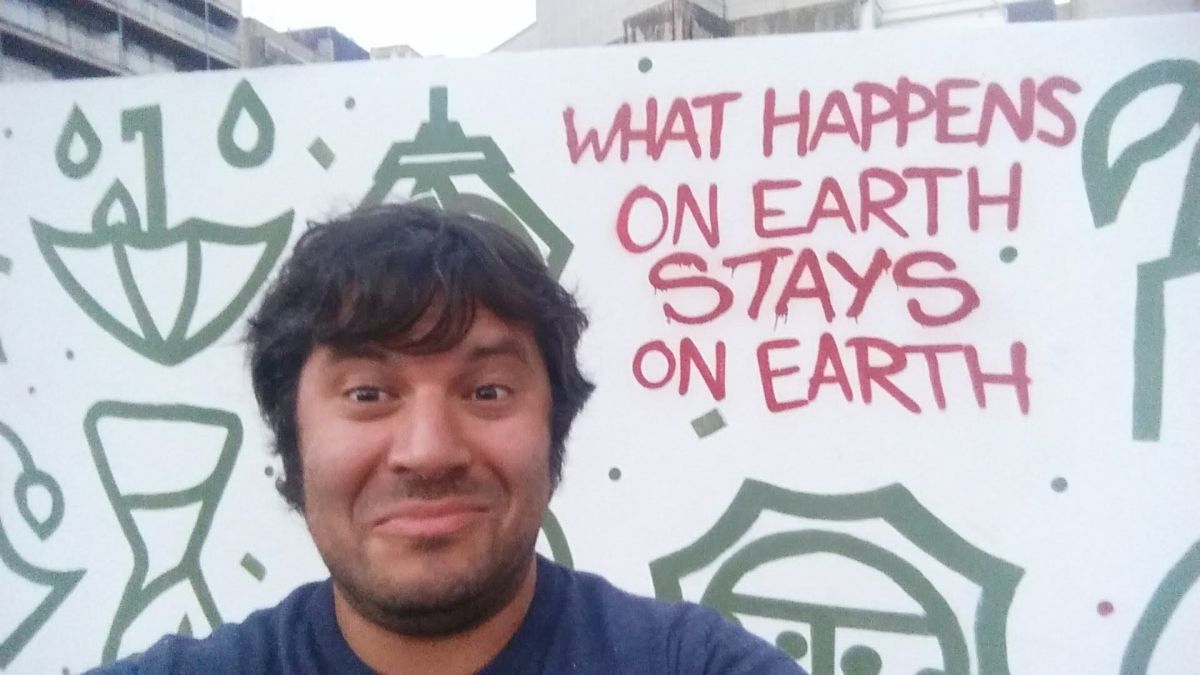
I hope you’ll continue to join me on my journey as I turn my blog into my career.  As my cover photo says, “what happens on Earth stays on Earth”, so I intend to make my mark.  By donating $20 now, you will get your first year’s subscription free.  Soon, the starting rate will go up to $36.

So I may not need roots that stick me to the ground and restrict my movement.  Some Zionist thinkers might not like this- that I choose not to give up my other identities, my Diasporic features.  But I’d rather be like Israeli poetess and fellow olah Leah Goldberg who speaks of the pain and joy of having two homelands.  I’m grateful to my friend Leora for sending me that poem when I needed it.

By understanding my varied roots around the world, I better understand myself, my people, my countries.  Israel itself.  An ongoing process and one in which I feel I’ve made great progress.

What does it mean to be Israeli?  That’s the title of this blog.  For me, after going several months without seeing another Israeli, Reut embodies what it means to be one.  In the best way.  It’s someone who after a short conversation, helps you find a hotel.  When you realize there is none, invites you to stay.  Who feeds you, who hugs you, who makes a bed for you.  And invites you out to hang with her friends the next day.

Roots can be tangled, messy.  But a home- you need one.  To venture out from, to explore from, to come back to at the end of the day or after a long and exciting trip.

The world is my oyster.  Who doesn’t like to taste a little treyf?  But most of the time, I don’t eat shellfish.  Which is why more and more, I feel Israel is my home.

Let’s talk about occupation

I want to share an experience I had in Tortosa, Catalonia.  Some call it Spain, for now I’ll stick with Tortosa 😉 .

Tortosa is a city that used to have a sizable Jewish population.  Before the Inquisition and related persecutions, Tortosa had a “call”.  That’s pronounced “caly” (for lack of a better way to write it in English)- and it means “Jewish quarter”.

I decided I wanted to go for a hike.  Tortosa is surrounded by gorgeous mountains, take a look:

20181018_14195620181018_142125

I love nature, but I found myself increasingly drawn to the signs around me that said “call”.  They’re everywhere.  Something I love about Catalonia is that quite a number of cities make preserving their Jewish heritage a priority.  Unlike the mostly derelict synagogues of my great-grandmother’s Romania, Catalans seem generally proud of their Jewish heritage.  Because quite a number of them are Jews themselves- or were hundreds of years ago.  And they know it.

I wandered the call, finding where the synagogue once stood, the kosher butcher shop, even a plaza named after a rabbi, Menahem Ben Saruq.

I found myself humming Jewish tunes, including one of my own creation, and being stared at by some Moroccan men.  Almost the entire neighborhood now is filled with Moroccan Muslim immigrants.

I then headed to the town archives.  I love, love, love archives.  And I want to give a huge shout-out to archivists everywhere.  You keep heritage alive.  Science is amazing and can heal and grow our planet- but without humanities and a sense of morality, it is useless.  Ben Carson is a great example of why science is not a religion, it does not have all the answers any more than any other field of study.  Scientists need ethical systems just as much as humanists need biology and medicine.

The best thing about town archives, other than the ancient documents they contain, is that they are free!  So here’s my travel tip: if you find yourself itching to see unique, cool texts and really learn about where you’re traveling, head to an archive.  If it’s a rainy day (as it was for me), even better.  I walked around Tortosa with a piece of generously donated cardboard over my head until I could find a 9 buck Mickey Mouse umbrella. 🙂  Archives are my refuge.  And unlike museums, you won’t be shelling out tons of cash to wait in line and crowds.  Archives are often quite empty- sad for the state of humanity, but great for someone like me who likes a little peace and quiet.  All you need to do is fill out a form, show your passport, and next thing you know you’re looking at a hand-written 900 year old document.

That’s where I found myself.  The archivist brought me the “Carta de Poblament”.  It’s a Catalan document that the Count of Barcelona had offered the town during the medieval Christian conquest of Spain.  It basically offers new settlers various land privileges and natural resources for settling the territory.  Until then, it had had Jews, Christians, and Muslims.  But with the eventual imposition of the Inquisition, both Jews and Muslims had to convert, leave, or face torture and death.  Their empty houses became the Christian settlers’ homes we see today.  Occasionally, as in Granada, you can still see where the mezuzah was once hanging.

20181012_1344151

I then looked at the next documents I had requested.  I wanted to see Jewish documents.  And in some cases, you can still find them in Catalonia.  I once visited the Girona Jewish archive (the city has a particularly well-preserved call) and got to see documents in Judeo-Catalan!  Catalan written in Hebrew letters- and in some cases, with Hebrew phrases.  For a Jewish speaker of Catalan like me, there is nothing cooler.

The first document was in medieval Catalan (did I say archives were cool??) and was about the Jewish community of the city.  The next document was from 1323 and detailed how the local rulers had imposed a tax on the Jewish community to repair a broken wall.  I’m not sure exactly what happened, but Christian rulers (and Muslim ones) often imposed discriminatory taxes on Jews either as “protection money” or simply to raise cash.

The third document is the one that stirred my soul.  It was called “Població de convertits”.  A list of the Jews who had converted to Christianity.  Often under penalty of death.  From the early 1400s.  I have to say that seeing the hand-scribed names really moved me.  I felt deep sadness as my finger scrolled through the names of Jewish souls lost to an ever-encroaching Christian hegemony.  I wish I could say this was only a Christian problem, but it’s not.  Even the relatively tolerant Muslims of Al-Andalus engaged in pogroms, massacring the Jews of Granada in 1066.  A thousand years before the State of Israel, for people who think Muslim anti-Semitism is a recent phenomenon, purely a product of colonialism.

As I flipped through the pages, I wanted to find a specifically Jewish name.  It’s almost as if part of me couldn’t actually believe this document was real.  That maybe I had been given the wrong one.  Persecutions of Jews are often invalidated, ignored.  This must be just history books, it doesn’t feel totally real.  I couldn’t believe I was holding an ancient text of suffering, of my people, for free in a municipal library.

And there it was- Abram.  Abram and his son converted to Christianity.  I paused looking at the name.  I thought about how awful it must have been to be a Jew at that time.  What must have been going through his head and he decided between expulsion, death, and embracing a faith that so hated his identity.

And there it was, his conversion.  I felt sorry for him- and kind of angry.  How could he give up on our tradition so easily?  I’m sure it wasn’t easy.  But I felt torn.  And I felt furious at the authorities who forced him to give up who he was.  His soul, and those of his ancestors, are forever lost to the Jewish people.  Like so many others.  So when quite a number of Latinos or Spaniards I’ve met say that Jews are “racist” or “closed off” for only marrying “their own”, this document is my bold counterargument.  We only exist because we preserve ourselves.  Your people have been nothing but obstacles in our way for hundreds of years and I won’t apologize for keeping my identity alive.  I’m grateful to the non-Jews I’ve met here in Catalonia and Spain who are working to keep our heritage visible.  Thanks to them I can connect to my past- and they connect to me, as you’ll see in my recent post about a gay Valencian man I met with a Hebrew tattoo.  Who changed my life.

Before I left the archive, I thought if there was something creative I could do to bridge the past.  To make my Jewish ancestors proud.  To connect to Abram and to show the vitality to Judaism to this day, despite all of the hatred placed in our way.

When I left Israel for my travels two months ago, I could barely utter a Hebrew (or Arabic) word.  I was so tired of the region, the hatred, the intense pressure to assimilate into Israeli society.  I had chosen a name, Matah, when I made aliyah.  It means orchard.  It sounds like Matt, but is different- it’s about planting roots.  The name of this blog.

In Europe, I’ve been going by Matt.  Occasionally, Mateo.  But this day, I was going to reconnect.  I took a piece of paper, and added a nice touch to the 600 year old remnant of my civilization:

20181018_170003

Right next to Abram’s name, the second line from the top, I wrote my names.

מטע אדלר

Matt Adler

Jew. Jueu. יהודי.

I think Abram would have been proud.  I certainly was.  Half a millennia since the expulsion of Jews from this land, I was here, a proud Israeli visiting from the land of our ancestors.  Living with self-determination after two millennia.  Something Abram could have never even imagined.  And here I was alive in his home of Tortosa.

It’s a reminder that the impossible is sometimes possible.  History changes.  And each one of us can make a difference.

As I left the archives (still with the cardboard box over my head- one of the funnier moments of my trip until my feet were soaked in rainwater), I headed to the cathedral.  There I found a 1300-year-old Jewish gravestone in Hebrew, Latin, and Greek.  With a Menorah and, interestingly, a *5* pointed star:

20181018_174936

What’s so amazing is I could mouth out some of the words.  “Kever”- grave.  “Shalom”- peace”.  And “livrachah”- for a blessing.  The last word something we say to this day as we remember loved ones in synagogue.  A stunning reminder that even when the most hateful among Christians and Muslims stole our land, expelled us, and killed us- we held on to the one thing that kept us alive: words.  Evidence of our continuous presence on this continent, one that has tortured us.  But where we have ultimately persevered in existing.  Even if our current existence there is tenuous.  How many people can see a 6th century tombstone and recognize the words from today’s liturgy?    We’re a truly special people with an incredible historical memory.

As I headed home, I felt hungry.  I stopped into a kebab place.  As with many stores here, it was run by Muslim immigrants.  In this case, from Pakistan.  I have had some difficult experiences with Muslims in Europe.  I was curious before going on this trip what it would be like- both figuring that Europe was kind of a neutral space for potential dialogue and aware that there were many reports of anti-Semitism.  I was also keenly aware that I had to be careful in saying where I was from.  While an American Jew can hide behind their red, white, and blue passport, when you say you’re Israeli, people know you’re a Jew (even if you’re not!).

I’ll start by saying I’ve had some incredible experiences with Muslims in Europe.  I went clubbing with a queer Jordanian girl, who had never been to a gay club.  And she knew I was from Tel Aviv- and we’re still in touch.  Our sexy curves swerving on the dance floors of Budapest.  I also met a Syrian refugee there, who lifted my spirits as we chatted in Damascene Arabic late at night over shwarma.  And who I told I was from Tel Aviv.  And had a great time.

I’ll also say I’ve had a difficult time here.  More often than not, I don’t reveal I’m Jewish or Israeli to Muslims here.  By the decoration of their stores and their clothes, I can tell they are quite often devout.  And just the other day, a woman 10 minutes down the road from where I stayed in Belgium was threatened at gunpoint by a “bearded man” for being Jewish.  I wish I could say this was the only incident of Muslim anti-Semitism here, but it’s not.  Just a few years ago, the Belgian Jewish Museum I strolled by was attacked by Islamic terrorists, killing several civilians.  Anti-Semitism is on the rise in Europe (including from neo-Nazis), and many Muslims’ pointed questions about where I was from didn’t make it any easier.  More than a few times, they didn’t believe me when I said I was American- I didn’t “look” American.  Sometimes they think I’m Arab, other times they ask me what my religion is.  Repeatedly.  Which is incredibly uncomfortable and invasive.

Just the other day, an Algerian immigrant told me Israel and America *started* the Syrian Civil War and he didn’t believe Iran or Russia was killing civilians.  Needless to say, I’m glad I didn’t tell him I was Israeli in his kebab shop at 11pm.

I’ll add that I find it doubtful that many of these immigrants know the Jewish history of the land they live on today.  Despite the many signs covering their neighborhood explaining it.  Quite a number of Christian Europeans don’t either.  It struck me as bizarre and sad to see hundreds of Moroccan men walking around the Jewish quarter of Girona.  Seeing them wasn’t bizarre- what was more bizarre was the fear I felt in even singing a Jewish song there.  I couldn’t even get out the melody as two men stared.  Maybe they didn’t know what I was singing- but if they did, would I even feel safe?  Do they care that they live on this land bathed in the stains of our blood?  In fact, both of our blood?

It’s times like these where I feel distant from Muslims, from Arabs.  I’m someone who has invested a lot of time and energy in dialogue and exploring this civilization, as you can see from my previous blogs.  Sometimes it is fruitful and lot of times, it is painful.  We’re like two conjoined siblings who wish they could get away from each other, but can’t escape our shared past- and present.  I sometimes wonder whether learning Arabic was a waste of time, even as I miss the sounds of the language, the beats of its music, even fighting for the rights of Arab-Israelis and my Palestinian neighbors.  Some of whom would rather see me dead.  Who some extremist Jews wouldn’t mind dead.  It’s an odd yin-yang of hope, fear, love, and hatred.

So it was timely that my friend Muhammad called.  Muhammad is a 20-something kid from Rahat, a Bedouin city in southern Israel.  I met Muhammad while asking for directions in his town- I was trying to find a restaurant.  A delicious, delicious restaurant.  Bedouin food is quite different from other Arab food- if you’re in Israel, go to Mansaf restaurant at the entrance to Rahat.  Your life will be changed and your taste buds will thank you.  As will the friendly people there who wanted to take selfies with me.

Muhammad and I have kept in touch over the past 6 months or so.  We even met up again in person.  I knew he was studying for his college entrance exams- he wanted to study accounting.  A few months ago, he got in!  I’m so proud of him.  He just moved to Ramat Gan and starts school this week.  Love you man!

To say this is a culture shock and a brave move is a deep understatement.  Rahat is extremely traditional and entirely Bedouin.  Despite living in the same country as Jews, Muhammad has had limited interaction with them.  So moving to Ramat Gan, perhaps one of the cities with the highest percentage of Jews in the country, will be quite a shock.  Some ways good, but a huge change nonetheless.

Muhammad has managed to get an apartment (something that took me months in Tel Aviv) and find two jobs!  On his own.  I helped him along the way- on WhatsApp.  From my AirBnB in Oradea, Romania, from Hungary, from Almería, and from Tortosa.  I’m so proud of him.

Which is why it was a punch to my gut to hear what he had to say on the phone.  Muhammad went for a job interview in Ramat Gan.  He was offered the job, but the boss said: “our establishment has a lot of religious people, so we need to give you another name.”  Muhammad was a name some people just can’t bear to hear as they’re munching on their hummus and falafel.

Heartbroken, he almost decided to change his name.  He asked me what to do.  I first offered my sympathies.  This is one of the saddest things I can hear- that a young, aspiring young man is being told to cut off his identity.  I’m with you Muhammad.

Secondly, I shared some stories of discrimination I had faced as a Jew and a gay man- in America and in Europe.  The Lyft driver who threw me out of his car for being a gay Jew.  The Muslim man and the Belgian Christian who said I was an apartheid occupier, an ethnic cleanser.  The Argentinian who said Jews control the world.  The Algerian who said Israel did.

He was shocked.  And I think somewhat comforted to feel he wasn’t alone.  See while the reasons we were discriminated against were different, in the end they were the same.  People who hate difference.  People who refuse to see nuance or to empathize with others.

I told him that I love him as Muhammad.  As whatever he chooses to call himself.  And nobody has the right to decide that for him.  He has the right to choose to fight racism, to call a lawyer, to speak with an NGO.  And he has the right to put his energy towards finding a better job where people will appreciate him.  And choosing between the two strategies is not always easy.  I know- I never got a dime from Lyft despite a huge public relations campaign, but I was featured in an amicus brief to the Supreme Court for gay rights.  For a case we lost.  I support Muhammad in being himself, however he chooses to find his way forward.

So you have to ask yourself after all this, what’s in a name?  Abram converted to Christianity- and seeing his name hundreds of years later I spotted him as my landsman.  Matah was a sign of hope for me when I made aliyah, then became a grating sound on my ears.  Until I saw Abram and realized how lucky I was in certain ways to be a Jew at this time, in this place.  With a homeland we can call our own.  And Muhammad- how a brave young Muslim Bedouin man is forging his path forward in Ramat Gan.  Weighing his past identity with his present as he pursues a new future and faces racism.  Holding on to his name even as he wrestles with how to live as a minority.  Something I try to help him manage as someone who can draw on the rich reservoir of Jewish history and gay identity.  Minority persistence.

Muhammad gives me hope that despite my experiences in Europe, there are Muslims out there who like me.  As I am.  A gay Israeli American Jew.  I can’t pretend there are masses of them, but even knowing someone like Muhammad is out there, striving for more, caring about me, relying on me- that gives me a bit of hope.  And warms my soul.

There is a place on this planet where Jews and Arabs live together.  It’s not Spain of 500 years ago.  It’s Israel.  For all its problems, Israel is a place where Arabs know Jews as people.  Not caricatures or cartoons or characters on a soap opera.  Nor memories of 70 years ago, when they used to inhabit the same quarters in Morocco and Damascus.  No, in Israel we live together.  Not always in harmony, but knowing each other.  In a way that, perhaps better than anywhere else in the world, allows me to find people like Muhammad who I can breathe my breathy “habibis” and my deep s “sadeeqs” with.  Where I feel my Arabic is sometimes quite worthwhile.

In the end, what’s in a name?  Occupation is the word you’ll hear most in the news about Israel.  And I’m not going to evade and suggest that Palestinians are not real (that’s a thing), that they aren’t facing human rights abuses (they are), or that some of them weren’t expelled from their lands (some were).  What I will say is that occupation is complex.  As I travel around Europe, I notice all the Jewish lands occupied.  The Jewish bodies and souls emptied.  The synagogues turned into casinos and strip clubs and Italian restaurants.  The Muslim immigrants occupying our former quarters- either oblivious to our former past or some outright hostile to our current existence.

At a time when Catalans feel Spain occupies them (and Spain denies their difference), just how objectively clear is this word?  The far left would have you believe things are black and white, that Israel is an occupier, Palestinians are natives.  But rarely in life are things so clear.  When you visit Peki’in and meet Jews who have been there continuously since the Second Temple.  When you meet Arabs from Ramle who migrated from Libya a hundred years ago.  It’s not to suggest the current situation is good- but it is to suggest it is not entirely one-sided and it does not present simple solutions.

In the end, I also think about this word.  As I travel, one of the great questions on my mind is my own occupation.  How I occupy my time, what I like to do, what I want to do going forward.

Perhaps it’s telling that I recently found this cute sign in Catalan that says: “what do you want to be when you grow up?”

20181018_125345

And I’ve come to what I feel is the next step.  As I write this blog, it strikes me that when I left Israel, I wasn’t sure if I’d continue writing it.  Yet I found myself over and over again enjoying the therapy of sharing my experiences, of writing things down so for years on end I’ll be able to remember my adventures.  To share my thoughts, to bring a little understanding to the world, and hopefully to engage you with exciting, unexpected stories from cultures and languages you want to explore.

Which brings me to today.  I’ve written about 140 blog posts, hundreds of thousands of words.  I’ve received the most wonderful, heart-warming comments from readers in San Francisco, Saudi Arabia, Barcelona, and Bethlehem.

And I’ve shared it for free, out of love and a desire to make the world better.

This is how I occupy myself.  I love exploring and want to keep sharing meaningful stories and thoughts with you.

The way I do that is by asking you to contribute to making it possible.  Thousands of miles crossed doesn’t happen for free.  I’ve invested so much of my own time and money, and to keep things going, to be a member of my community, you now have the opportunity to contribute.

Soon, I’ll be making my blog a subscription site.  The format is being determined, but in one fashion or another, you’re going to have to pay to access this well of hope.  It’s fair and I can’t wait to connect with you on an even deeper level as we use this blog to connect open-minded people around the world.

If you’d like to join now, you have a chance to subscribe at a one-time, more affordable rate.  If you go to my GoFundMe page and contribute $20 or more, you will get your first year subscription free.  Everyone who has donated up until now will be grandfathered in and given a free subscription as well.  If you wait until I transition the site, the price will start at $36.

I want to keep you along for the journey.  I want to show you amazing archives and diverse people.  The unexpected twists and turns.  In 8 languages.  With a queer angle, an open-minded lens.  Proud of Judaism and Israel and willing to engage in nuance.  To make my communities better, kinder.  Understood and understanding.

I invite you to join me.  Or you can always find another gay Jewish blogger who speaks Hebrew, Arabic, and Yiddish and read his blog instead 😉

Let’s explore together. 🙂

The single best moment of my entire trip

Today, I visited Vila Joiosa, a village in Valencia, Spain.  I went there because they speak Valencian (or as most people call it, Catalan).  I studied Catalan in America at Georgetown University.  I fought my way into the class, which had nothing to do with my Master’s program, because I love Catalan.  I did my undergraduate thesis in Spanish on the Madrid and Barcelona educational systems’ approaches to immigration.  And in Barcelona, I fell in love with Catalan.  A beautiful Romance language filled with x’s and mysterious accent marks.  To me, it looked like a sophisticated, intriguing, sexy Spanish.

So nearly 10 years after my undergraduate education, I found myself at Georgetown studying communication.  And they have a wonderful Catalan program funded by the Ramon Llull Foundation, to promote their culture and language abroad.  And the professor generously let me into the class 😉

I’ve been visiting Alicante, a major city in the province of Valencia.  What’s so striking about Alicante is that it is in the heart of an area that has spoken Catalan for generations (some locals distinguish it as Valencian, but they are essentially varieties of the same language, whatever you wish to call it).  Yet today, almost nobody speaks the language.  The street signs are in Valencian, but you hear nothing but Spanish on the streets.  As if the words are a formality, a reminder of the past, but more of a museum than a living heritage.

So I went searching online to find a village that spoke Valencian, to this day.  I love Valencian Catalan.  I love dialects and accents.  And when I lived in America, I used to watch Valencian-language public TV.  It’s a beautiful variety of Catalan.  And despite what some Catalanists claim, many of its differences can be traced to historical settlement patterns, not just hispanification of the language.  Indeed, I learned today that parts of Valencia use the same unique definite articles as the Balearic Islands.  The only place in the former Roman Empire to keep this unique variety of Latin grammar alive.  Just like one of my favorite bands, Antònia Font.

So it was with great sadness when I saw Spanish nationalists shut down the Valencian-language TV station a few years ago and also stopped broadcasts of TV3 from Barcelona.  I love TV3- I was interviewed on it about my connection to Judaism and Catalan and my gay identity.  You can watch it here and here and test how much Catalan you can understand 😉 .

Every year, I’d check Wikipedia to see whether Valencian activists had succeeded in getting the station up and running again.  Desperately wanting to hear the beautiful Valencian dialect from far away- my only way to engage with it.

Well the station is back up and running.  And it’s thanks to people like City Councilor Josep Castiñeira of Vila Joiosa that it survived.  Along with the Valencian dialect of Catalan.

Vila Joiosa means “joyful town”, and today I had a most joyous experience there.

Walking around town, I noticed a bookstore.  Its name was in Catalan: “Vila Llibres”.  I got excited- this was just why I came to this seaside village.

Upon entering, I noticed a sign that says “here, we’ll serve you in Valencian”.  Whew!  Unfortunately some Spaniards can get prickly when you address them in a minority language, but here I knew I was safe to speak Valencian.

I did get a bit nervous at first.  I noticed a rainbow flag.  As a gay person, you might think this would make me feel at ease.  But in fact, a large portion of the European left, who is generally pro-gay rights has become anti-Semitic.  Quite a number of them, as Josep pointed out later, are quite content to be interviewed on Russian and Iranian TV, but can’t fathom the existence of Israel.  As if our state is somehow less legitimate than the haphazard mess of Middle Eastern states randomly carved out by colonialism.  If you believe your country should exist but Israel shouldn’t (I’ll give a pass to equal opportunity anarchists), you’re an anti-Semite and I don’t like you.

So when I saw this was essentially a left-wing Valencian nationalist bookstore, I got nervous.  Indeed, on the tram on the way to Vila Joiosa, I saw large graffiti calling Israel a murderous state.  Needless to say, there was no accompanying graffiti suggesting Saudi Arabia, Syria, or Spain were similarly murderous despite both past and current colonialism, murder of LGBT people and minorities, and ethnic cleansing (including of Jews).

My conversation with Josep, the bookstore owner, started about Valencian.  I told him I was an American who had studied Catalan and I was excited to see his bookstore.  Stunned that I spoke Catalan without an accent, he welcomed me in and showed me a map of Catalan dialects.  I stood in wonder as he taught me dialectal differences.  I can’t imagine a more exciting experience than chatting in Valencian while learning about the amazing map of Catalan varieties.  Phonetics, grammar, cultural diversity- this is what I love.

20181015_174947

Turns out, it wouldn’t be the only thing I loved about Josep.

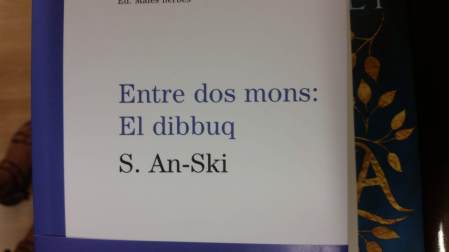
I asked about buying a book specifically written the way Valencians speak Catalan.  He pointed me to some, and I went exploring.  Then I noticed a book about the dybbuk, the mythical Jewish spirit creature, in Catalan!  As I brought the book to his attention, he said it wasn’t specifically in the Valencian dialect.  And then I came out as a Jew- not an easy thing here if you’ve read my previous blogs, including from here in Alicante.

20181015_1757441

I told him how cool it was to see a Jewish book in Catalan.  And as I spoke with him, I started to notice Jewish books everywhere.  About Jewish history and culture.  I noticed a little sign that even said “shalom”- something I was so used to that I hardly recognized how unique it was in Valencia!

Josep then did the most amazing thing.  He pulled up his sleeve to show me a tattoo that said: “leshanah haba’ah beyerushalayim”.  Next year in Jerusalem.  A phrase we sing at the end of our Passover Seders dreaming of returning to our Holy Land.  A phrase we’ve sung for thousands of years.  Zionism is not a new concept, it is built into our very prayers.  Now is no longer a dream, but a delicate reality we strive to preserve for ourselves and future generations.

I was in the most glorious shock.  Turns out Josep, in his own words, is a Zionist.  And like me, is gay.  And left wing.  And a progressive Valencian nationalist.  In fact, he is a city councilor for the Compromís political party.

After a trip filled with so much anti-Semitism that I often feel afraid to reveal my Jewish Israeli identity here, I can’t tell you how relieved and thrilled I was.  To feel accepted.  Not only because, as some right-wing Europeans feel, that they like Israel because they hate Arabs.  Which puts me in an awkward position as who believes in human rights for all, including Israel’s Arab citizens and Palestinian neighbors.  Something I fight for- as an Israeli.  Even when significant elements of those societies hate me for being gay and Jewish.  It’s simply my value system, regardless of whether all the people I fight for support my own human rights.  Though some of them do.  What’s great about Josep is that we share progressive values.  And support Israel for this reason, and promote the people within it, like me, who are working to make it more and more a reality.

Josep is a hero.  Several years ago, I remember seeing headlines that Valencians were boycotting American Jewish singer Matisyahu purportedly because of Israel.  Where he doesn’t even live.  It’s pure anti-Semitism and it left me feeling distant from this culture that I spent so much time and love connecting to from across an ocean.  It’s beyond hypocritical for Spaniards to boycott Israel when their entire country is built on the bloodshed and expulsion of Jews and Muslims.  And it’s classic anti-Semitism when this hypocrisy is used to target someone who isn’t even Israeli!

Josep told me that he worked with his allies in Compromís to counter this boycott.  Even educating ignorant people in his own party.  He is against the BDS movement which seeks to destroy the State of Israel.  Not alter policies, not debate nuance, but to eliminate an entire country because it is Jewish.  A group of people so delusional that they have no problem traveling to China, meeting Russian academics, or enjoying the fruits of their own colonialism.  But somehow Israel is worthy of the utmost and disproportional criticism.  A 2,000 year old hatred rooted in the New Testament itself is hard to get out of your bones.  Fortunately some Christians today, like Josep’s priest friend in Vila Joiosa who loves Israel, are working as allies of our community to rid their culture of this hatred.

While I was across the ocean learning Catalan and embracing Valencian culture, Josep was here defending my heritage.  We honor each other.  And it is through the grace of our spirit that we met today.  Recently, I’ve felt I don’t believe in God.  And I still feel that the way God is portrayed in religious texts is erroneous and even dangerous.  But perhaps for the first time in months, I felt a connection to my inner God.  Because it’s by following my inner compass that I made my way to Josep’s bookstore today.  And made a new friend, hopefully for life.

Josep made me feel accepted.  He warmed my heart and put a huge smile on my face.  And so I took a piece of paper and wrote him a poem.  In Hebrew and in Catalan.  Here it is:


Josep and I are bibliophiles.  Lovers of the written word.  So perhaps it’s no surprise given our many shared passions that we really clicked.  People who love kindness, who seek to learn, who reject black-and-white thinking, that’s my kind of people.  That’s who Josep is, that’s who I am, that’s my life aspiration.  The fuel that keeps me going and pointed in the right direction.

As I read my poem out loud, I could feel his smile.  I live for moments like these.  Faced with so many challenges, these experiences give me a reason to live.

I want to feel accepted.  I’m an unorthodox thinker, but at my heart I’m basically a moderate left libertarian.  Unfortunately, some of the people who claim to carry this banner are anti-Semites.  Jeremy Corbyn, for instance.

It has made me feel isolated from my own natural community.  People who believe in human rights, individual freedom, less imposition of the state, economic fairness, LGBT rights, and compassion.  Something the extremes of our community have twisted so much they’ve ended up allied with authoritarians like Vladimir Putin and Hugo Chavez.

What’s so great about Josep is that with him, I can be myself.  While right-wing Jews and Zionists often demand I put my gayness aside and the far left demands I put my Jewish identity aside, Josep lets me be both.  A gay Jewish progressive.  And a lover of Catalan, unfortunately a language community where some speakers are anti-Semitic as well.  And Josep stands as a brave counterexample to their ignorance.  Proudly carrying the banner of a long Catalan philosemitic tradition.

Like most people, I just want to feel accepted.  And people like Josep make me more convinced than ever about how important it is for Jews to engage open-minded people like him.  To support his efforts against anti-Semitism and to empower his own fight for cultural rights.  So that his village won’t end up like Alicante.  A place with Valencian signs but no Valencian speech.

The Spanish state has waged relentless war on cultural minorities.  First, Jews and Muslims during the Inquisition.  But later groups like Catalans, Valencians, Basques, and Galicians.  Certainly nationalism is a delicate question.  If you read my blog, more often than not I’m against it.  Because in its most extreme forms it leads to division and violation of human rights.

What I’ll say, since I am an unorthodox thinker, is that sometimes nationalism is necessary.  As a minority group in the age of globalization, I have yet to find a better solution to preserving our identity than to have our own state.  It’s imperfect, it can lead to abusing other minorities when left unchecked, but it’s the only solution I’ve seen work.

I’m not interested in Jewish museums nor is Josep interested in a museum of Valencian history.  Indeed, when they start making museums about you, like the Museum of the American Indian in Washington (which I love), you better start worrying.  Because you’ve become mundane and weak enough that it’s OK to stop persecuting you and just remember you.  As if you’re a gentle reminder of the past.  We can weep together, but deny you the right to live differently.

Josep and I, while lovers of learning and certainly of museums, that’s not what we want.  We’re interested in being living communities.  It might be inconvenient for your ideology to recognize that nationalism is the only way for us to continue to be who we are.  Indeed, it’s somewhat inconvenient for my own ideology at times.

But it’s a solid fact.  And until you can show me a better way to ensure a Jewish and Valencian future, a little nationalism is what keeps us alive.  As the socialist hymn goes, I want bread and roses.  I don’t just want bread to survive, I want roses.  The beauty, the higher-level fulfillment of cultural identity and passing down my heritage.  As a part of my existence.  Not to go the way of the Shakers, but to be imperfect but real.

If you’re Spanish or American or Chinese or Russian or Arab, you’re not worried for the survival of your culture.  You’re global superpowers with hundreds of millions of adherents.  But Catalans and Jews and Basques and Tibetans- we’re not so lucky.  And we’re not content to rely on your goodwill to survive.  Because we’ve seen that even though there have been periods where you’ve granted us tolerance, there are others where you extinguish us.  And we want the self-determination to protect ourselves when you decide to scapegoat us.  We want self-empowerment.

It’s messy, but it’s sometimes necessary.  Of course, we must be mindful that our own self-empowerment doesn’t turn into the same hatred we’ve experienced.  A delicate balancing act, but one which I’m willing to engage in to ensure my people’s future.

All of my life decisions led to this sweet moment today.  My decision to study Spanish- which led to my decision to study Catalan.  My decision to pursue an active progressive Jewish life in America and Israel.  My decision to move to Israel, and then travel the world exploring myself and discovering new aspects of Jewish identity.  My decision to come out of the closet as gay.

None of today would have happened without me making these powerful life choices.  Nor without Josep making similarly brave decisions that led him to connect with me.  Standing up for his beliefs, for my people, for his own sense of self, even when it was inconvenient or led to threats.  He recently was attacked by fascists, as vicious in their black-and-white prejudice as the far left.  Like me, he remains squeezed between extremes but pursues his identity with vigor.  And I am grateful for his resilient pursuit of purpose.

I have never, ever recommended a specific restaurant or store on this blog as far as I can remember.  I’m not Trip Advisor, I’m here to share my experiences, not plug businesses- nor have I accepted ad revenue from them.  But I’m going to recommend Josep’s bookstore, because it is an oasis of wisdom and kindness.  Whether you speak Catalan or not, go visit.  Tell him I sent you.  And enjoy wonderful conversation and buy something to support such a kind heart who supports us.

At a time when the world is increasingly polarized and anti-Semitic, I have never been more convinced of the need to engage open-minded people like Josep.  I often feel like giving up on the Left, but there are people like him who bravely stand with us.  Or are curious to learn.  This is why I’ve started my new initiative Nuance Israel to empower them.  If you’ve liked this blog and my other writing, contribute to my new project to make my ideas a reality.  To bring together moderate, open-minded people to support a textured engagement with Israel and the Jewish people.  To put a stop to anti-Semitic boycotts which seek to shut down conversation and destroy my country.  Engagement is the way forward for a progressive Israel and to defeat anti-Semitism abroad.

On the bus back to Alicante, some Arab kids in front of me were listening to loud YouTube videos of Arabic music.  I told them: “ana kamaan ba7ibb al-musiqaa al-3arabiyeh, bas biddi naam.  Min fadlak.”

I also love Arabic music, but I wanna sleep.  Please 🙂

They smiled and turned the volume down.

I can see multilingual Maimonides and the other greats of Spanish Jewish history smiling down on me.

A day in Catalan, Spanish, Arabic, and Hebrew.  A moment of connection to a great Iberian past.  That Josep and I brought to life again today.

Vila Joiosa, a joyful village indeed.

The wonderful, the ignorant, and the outright anti-Semitic

I’m writing you from Spain.  The past week, I stayed in Almería, a small city in the southeast corner of the country.  This is my fourth visit to Spain.  When I was 13, I came with my school.  When I was 21, I did research here for my thesis (including a fair bit of research on Spanish beaches 😉 ).  This past year, I realized my dream of re-visiting Catalonia after having learned Catalan.  And now, I’m chilling in the south of Spain.

Spain has always been an important place for me.  Spanish is the first foreign language I learned and Spain is the first country I visited without my abusive family.  At a time in my life when I was suffocating, Spain and its wonderful, warm people gave me room to breathe.  And have fun.

I fell in love.  I majored in Spanish in college.  By accident.  I was supposed to major in sociology but my university closed the department midway through my studies (yes, that’s a thing).  And I so loved Spanish that just by virtue of my desire to learn it, I had already taken enough coursework to put together a major.  Follow your heart, not the curriculum.

Every language is a source of richness.  I speak a bunch, including minority languages like Catalan and Yiddish (and have studied Irish and Basque).  Sometimes people shit on these languages for not “being useful”.  As far as I’m concerned, the way you feel about a language (or accent) is mostly about what you feel about its speakers.  Every language, like every culture, has something to offer, to make you grow, if you choose to see it that way.  Perhaps that’s why subconsciously I chose to wear a Catalan t-shirt at the Alhambra on Spain’s National Day.  An unintentional but loud statement in Andalucía, where dissing Catalans is as common as eating Gazpacho.

What enchants me about Spanish in particular is how I fit in.  Most of the time.  Because of my olive skin and Semitic features (Spaniards are also very Mediterranean-looking and have a lot of Jewish blood), I often am seen as Spanish.  Or Latino in America.  Sometimes people overlook Mediterranean/Middle Eastern people, but we look different than the Swedish people in Minnesota or the Irish Americans in Boston.  We look ethnic.  In Belgium, people think I’m Arab (including Arabs).  And I’ve actually had people tell me I don’t look American.  Not the nicest thing, but maybe there’s some truth to it.  Most people in Abercrombie ads don’t look like me.

But in Spain, people think I’m one of them- or at least a native Spanish speaker.  Partially because I’ve got a great accent, but people over the past week thought I was anything from Catalan to Venezuelan to Chilean.  In America, someone once called me a “Spic” on the Metro.  I’ve had multiple cases where people I’ve already known discover I’m not Hispanic, tell me how surprised they are, and suddenly want to be friends with me.  Here, I feel a little more at home.

In Israel too I often felt that physically I more fit in.  My appearance, indeed my DNA (I’ve run tests that show my makeup is closest to Lebanese, Greeks, Sicilians, and Palestinians), is from there.  Trust me, nobody in Hungary mistook me for an ethnic Hungarian.  Even though my great-grandparents were from there.  Israeli clothing models, politicians, rabbis, studs at the beach look a lot more like me than Channing Tatum.  But don’t get me wrong, I do like Channing Tatum 😉 .

In Spain, I’ve met some incredible people.  I met a Spanish man who told me how proud me was of his town’s judería, or Jewish quarter.  I met a Russian guy married to a Taiwanese woman who owned a bubble tea store.  Who spent 10 minutes looking up directions for me to a Sephardic heritage site.  I told an Afghan baklava seller I was from Israel- and spoke some Farsi with him.  His eyes lit up. 🙂  I ate amazing Moroccan bastilla and chatted with the owners in Arabic.  I even met a very Catholic young man marching in a Semana-Santa-style procession who directed me towards the local Jewish museum.

There’s also a lot of ignorance.  Not necessarily outright prejudice, but for sure ignorance.  A lot of people have no idea where their town’s Jewish quarter is- even when the local municipality has developed it as a tourist attraction.  And it’s been there for over a thousand years.  This particularly struck me yesterday on El Día de la Hispanidad, the day “celebrating” Columbus’s “discovery” of the “New” World.  The same year Spain kicked out its Jews.

On this day, I saw a massive Catholic procession which (although it is not actually connected) looks like a much more elaborate and classy KKK march.  Even Spaniards joked with me about it.  It really does look similar, but it is not a hate parade.  I will say it momentarily jolted me.

Spain is known for being the most (or one of the most) anti-Semitic countries in Europe according to the Anti-Defamation League’s polling.  Not surprising given the legacy of the Inquisition, although neighboring Portugal had that too, and moreso than Spain, is undergoing a kind of Jewish renaissance, including a burgeoning philo-Semitism.  Strong ties with both Israel and the Jewish community make it a much more comfortable place to be a Jew, right next door.

Spanish municipalities, particularly those governed by left wing parties, have tried over and over again to boycott Israel.  Something I find ironic, at best, in a country covered with the blood of my ancestors.  Where I’ve seen synagogues turned into office buildings, where thousands of people fill the streets celebrating Christopher Columbus.  A man by all accounts a genocidal maniac.  Incidentally likely the descendant of Jews forced to convert to Catholicism by Spain.  Hired by the royal family celebrated during this week’s holiday.  The family who ethnically cleansed my people from this land.

To return to the issue of these Catholic processions, I’d like to share my experience in Alicante, another city in Spain.  In the province of Valencia.

I was walking down the street and asked someone to explain the meaning of everything.  I’m a curious guy so I listened patiently as someone explained about the various teams that put together the saints displays.  Like I mentioned, some Spaniards like to joke about how it looks like a Klan rally (long robes, candles, crosses…).  I agreed it was a bit of a culture shock, and the rather nice Spaniards I spoke with said: “yeah, it has nothing to do with violence.”

But actually, that’s wrong.  Catholicism in Spain (frankly, Catholicism for most of its existence) has until recently been about violence.  Towards Jews, towards Muslims, towards apostates.  And while today, religious processions are mostly a cute cultural custom (it’s cool to watch, the music is neat too).  Not too long ago, they were a way for the church to impose its will on the people.  Including countless Jews it forced to convert or abandon this land under penalty of death.

After a relaxing bus ride up the coast to get here (the scenery in Spain is spectacular), I went out tonight.  It was a Saturday night and I wanted to talk to people.  Traveling alone can be so rewarding, I’m learning so much about myself.  And sometimes it’s nice to take a break and be with people.

I met an interesting mix of people just by chatting on the street.  Spaniards are known for being friendly and they live up to their reputation.  There are few better places I’ve visited for someone traveling alone.  Everyone is ready to chat.

I spent the night with a mix of Spaniards, Americans, Ukrainians, and one Argentinian man.

When I said I was from Israel, everyone was cool.  In fact, the Spanish guy knows his family has Jewish roots and he wants me to bring him to a synagogue.  And if you saw his cute punim, you could see he wasn’t lying.  He’d fit right in on a kibbutz.

The only person with a problem was the Argentine.  He said to me- to my face- “how do you feel as a Jew, controlling the world’s economy?”

I wish I could say I was surprised, but there was something in his silence when I said I was from Israel that told me he’d be an anti-Semite.  Perhaps a defense mechanism I’ve developed after dealing with so much bigotry.

I told him point blank: “that’s an anti-Semitic question based on stereotypes.”

He didn’t accept it.  When I tried to explain (as if you can reason with someone this insane) that actually Israel has a lot of poor people with one of the widest wealth gaps in the OECD, he pushed back:

“The Jews in Argentina control everything.”

I gave him a deep stare, told him I actually spent two weeks helping poor Jews in Argentina after the economic crisis, and reiterated that he was being anti-Semitic.  And to my great credit, he asked for the check and left.  Two hours later, he came back with free wristbands to go to a nightclub- for everyone in the group but me.  He said: “you don’t get one.”

Message understood.

I still love Spanish.  I love every language I learn.  Every culture has richness to share.

But I don’t fit in here.  For a visit, sure.  I suppose on some level I always thought I could be Spanish or in the words of my former coworkers at a Hispanic advocacy group, an “honorary Latino”.  Before moving to Israel, I spent most of my college years and professional career working for Latino and immigrant rights.  And I’m proud of it.  It reflects my values as a Jew and as a human being and a lover of Spanish-speaking cultures.

In the end, though, it’s not mine.  At least it can’t replace my Jewish identity, though at times I wished it would.  It felt easier- what an amazing global community to be a part of.  There’s a reason everyone’s listening to reggaeton these days- it’s infectious.  For all the wars and coups and discrimination and poverty and dictatorships, being Latino is fun.  I love French and I speak it when I want a sense of calm.  But let’s face it- when people want to get down, they put on salsa, not French folk music.  Although I listen to that too 🙂 .

I wish I could say my experience with the Argentinean man was unique, but it’s not.  In fact, when I visited Argentina, I saw authentic Nazi war medals being sold at the local fruit market.  My middle school Spanish teacher taught us that in her country of Guatemala, to call someone a Jew was to call them a “burro”, an “ass”.  As she laughed.  At a gay club in Spain, men excitedly guessed where I was from and when I finally said “Israel”, two of them fell silent and turned away.  One Spanish woman compared me to an Islamic terrorist because I don’t eat pork.  In Granada, I asked the tourist info booth why the Jewish museum was closed on Friday morning, even though it was listed as being open until 2pm that day.  And the woman sassily snapped: “you have to respect, it’s the Sabbath, that’s why they’re closed, it’s their norms.”  As if I couldn’t possibly know- or be Jewish.  I explained I was Jewish and that Friday morning is not the Sabbath- they chose to list the museum as open then.  The woman couldn’t care less as she ignored me and moved on to her next task.  Her much nicer colleague grimaced.  And tried to help me.  When I worked for a Latino advocacy group in Washington, they refused to give me Yom Kippur off in exchange for Christmas.  I appealed to the president of the group.  And got my vacation back almost a year later.

It’s not because all Latinos or Spaniards are anti-Semitic.  There are people here, as in all cultures, who are curious about Judaism.  Some who love it.  And some who are indifferent or ignorant but not hostile.  Some Latinos are Jews.

I’ve also experienced a deep strain of anti-Semitism in Spanish-speaking cultures.  No doubt a product of hundreds of years of Catholic-church-sponsored hate and Inquisitions.  Today, sometimes repackaged by far-left parties as anti-Israel fanaticism.  A kind of new religion in which Jews remain all-powerful and in need of constant reprimand.

In the end, I’ll always be a Spanish speaker.  It flows off my tongue better than any other, maybe even more than Hebrew.  The language is filled with warmth.  The people such friendliness.  The culture such a diverse and interesting history.  One in which Jews have always played a part.  Our blood flows through the veins of its people, our ruins dot the town squares.  Like the former synagogue in Guadix I visited that’s now an unemployment office.

Tonight, my best conversation was with an Algerian man.  Feeling distraught about the Argentinian anti-Semite as well as some homophobic comments I heard, I wanted a taste of home.  Shwarma.

I talked to the man in Arabic, and he was surprised.  “Where are you from?”

“Tel Aviv.”

“Tel Aviv?  Palestine?”

“Israel.  Palestine.  The Land.”

“Oh, you’re Palestinian?”

“No, I’m Jewish.  I’m Israeli.”

“But you speak Arabic!”

“I do, I love it.  It’s a beautiful language.  And I like Algerian Rai music and I have Algerian Jewish friends in Israel.”

“Wow!!  Rai?!?  And your friends- do they still eat couscous?”

“Yes they do.  Every Shabbat.”

Perhaps the world expects me to have more fun with a bunch of young Spaniards and expats at a bar.  Telling me how progressive and open they are, while spewing bile about Jews and gays after a few drinks.  Perhaps belying what they really think.

But my favorite conversation tonight was with an Algerian falafel man.  Because I’m the first Israeli he’s ever met.  And my language, my heart, brought him a smile from ear to ear.

So in the end, I’m not Latino, I’m not Spanish, and I don’t really want to be.  But I am a Spanish-speaker, an Arabic-speaker, and most importantly, a person who uses language to warm hearts.

Expel us, boycott us, ridicule us in a bar.  But Judaism is as Spanish as paella.

Queen Isabella could have never imagined me staring down an anti-Semite on the streets of Alicante 500 years later.  And winning.  Let alone a Jew and a Muslim speaking in Arabic.

Confuse me for a Latino, I don’t care.  Once it would’ve made me scared that you won’t like me.  Or I’d defiantly wear my honorary Latino badge, proud to be different.  Now, I just feel I’m a human being.  I’m a Jew- who I am and what society makes me.  And I’m happy to explore all cultures and stand with kind-hearted people no matter who they are.  I’ve learned to love my olive skin more.  And I’m grateful to have places like Spain where I look normal.

Libi bamizrach.  My heart is in the East, I’m in the far West.  And the person who brought me there was an Algerian shwarma man.

Yehuda Halevi would be proud.

==

20181012_134415.jpg

This picture is of a door in Granada’s Jewish quarter where you can still, 500 years later, see the marks of a mezuzah.  We’re everywhere.  Scatter us like seeds, but we sprout back up wherever we’re planted.

The funny, silly, and strange side of traveling

Oftentimes, I use my blog therapeutically.  It’s first and foremost a place to express myself, my observations, some of my deepest feelings.  It’s also a place to share and to give you insight into my world and how I see it.  And I often get inspirational comments from readers, which brings everything full circle and truly makes blogging a rewarding experience.  Thank you for being a part of it.

I’d like to use this blog to talk about some sillier or more mundane parts of travel.  Because that’s a part of my experience too.

Let’s start with “bris”.  Here in Spain, I see almost everywhere, in huge letters, the word “bris”.  Graffitied on walls, like street art or a gang sign.

But what you need to know, if you haven’t already caught why this is funny for me, is that “bris” is the Hebrew word for circumcision.  So everywhere I turn in southern Spain, I see beautifully graffitied, street-smart bold letters proclaiming “cut penis”.  It’s a joke lost on the entirely un-Jewish populace, but they say Spaniards have a lot of Jewish DNA from the forced conversions of the Inquisition.  So maybe even though they haven’t had a bris, once upon a time, their ancestors did. 🙂

Here’s a strange observation from Europe.  Europeans can have some pretty strong stereotypes about Americans.  Mostly based on Hollywood- often without ever having visited.

I often think in some ways Europeans are truly superior to Americans when it comes to certain policies.  Like healthcare.

One thing they are rather behind on is water.  Something you’ll never hear about in a foreign policy magazine 🙂 .  Almost everywhere you go in Europe, you have to buy bottled water.  In restaurants, tap water is usually not an option, even though it is almost always safe.  What a waste of plastic!

Now I’ll share a bit of a funny story.  In Israel, water, despite being a precious commodity in a desert country, has to be given to anyone in any establishment for free.  Even if you’re not patronizing it or buying anything.  It’s great.  America, while not quite on that level, is a big fan of tap water.

So I was quite surprised when I visited the Jewish Museum of Budapest.  I had paid to get some genealogical research done and while I was waiting, I went to fill up my water bottle at the cooler.

The researcher said: “you didn’t ask.”

I responded: “oh, OK…can I have some water?”

And her reply: “yes, in our country you ask first.”

Whew!  Next time you’re in Budapest, think twice before pressing the water tap!

Another funny thing.  In Brussels, you can ride public transit without buying a ticket- but at the risk a conductor will ask for it, and fine you accordingly.  The Belgians developed a rather clever app.  It lets you check online for the last time someone spotted an inspector on a particular route.  So when I got on the bus- unable to find a local ticket vending machine- my new Spanish-Jewish friend said: “don’t worry, they haven’t checked on this line for 20 minutes.”  I thought Israelis were lawless, but Belgians have their own little ways of rebelling 🙂

Slovenia is known for its dairy products.  I was staying in a suburb of Ljubljana, an outlying neighborhood.  I walked towards a mountain.

On the way, I spotted the most curious device.  It was a vending machine- the type you’d usually see filled with Kit Kats, Twix, and cookies.  But with fresh dairy products from the local farm- which you could see right next to it.

So, feeling thirsty, I bought some milk.  And feeling hungry, I got some yogurt.  B9, A12.

That’s how you do breakfast in Slovenia!

Speaking of vending machines, I’ve seen some interesting ones.  In several countries, including Spain, I’ve seen condom vending machines!  On the street.  Even some that sold lube.

The other day, walking around in Spain, I noticed the vending machine as I saw old women walking by.  Who, if they noticed it all, seemed to care far less about it than about the latest gossip in the neighborhood.

In a place where 50 years ago, the public schools were Catholic.  With crosses hanging in every room.

Belgium is known for a few things.  Chocolate, fries (don’t call them French!), and beer.  Mostly, carbohydrates.  But what you may not know is Belgium is the home to the best rugelach I’ve ever eaten.  Rugelach, for those who don’t know, is a Jewish pastry.  In Israel, the form it takes is kind of like a fluffy sweet croissant with some sort of filling- fruit, chocolate, etc.

In Belgium, I was in Antwerp, in the diamond district.  The Jewish part of town.  Even the shopping area is called “Meir”, a Jewish name.  Golda’s surname.

I was hungry and knew there was Jewish food.  Unlike in Eastern Europe where the food was quite familiar, but the dead Jews outnumbered the living ones, in Belgium, there is still a living community.  With amazing bakeries.

I bought three cinnamon rugelach.  On the outside, they look the same as they do in Israel.  But on the inside- it tasted like French Toast.  Gooey, sticky, delightful.  Warm, lip-smacking good.

So good that after four steps away from the shop, I made hard turn back and bought three more.

Belgium- home of waffles and delightful food that will clog your system for days.  Including the world’s best rugelach!  And a lot of cell phones whose ringtones are the Islamic call to prayer, where for a moment I felt time-warped back to Yaffo.

Romania.  Aaaaaaaah Romania Romania Romaaaaania Romania!  Romania is a silly place.  One of the things I love about Romania are the Gypsies (more properly termed, “Roma”).

Frankly, in Romania I kind of look like one.  I started to appreciate this highly stigmatized group after a cute Roma kid kept winking at me on a bus.  Romania’s public transit doesn’t seem to have improved much since communism- it mostly relies on really bumpy van rides that take twice as long as a car.  But are still shorter than the even slower train.  Romania is a good place for a scenic ride…

So this kid winking and smiling at me made my ride a bit better.  I started to learn that it was pretty easy to spot Roma.  Not just physically (although yes, both their skin color and facial features are a lot more like my Semitic ones than those of the typical Transylvanian).  Also, they wear the most interesting clothes.  As if they are out of a Western movie.

Roma men tend to wear cowboy boots and cowboy hats!  The women dress in colorful skirts.

I hardly expected to see men in Romania who reminded me of Chicanos in the Southwest, but that’s exactly what they look like.  Caramel skin, nice leather shoes.  And some of them I hear make great salsa.  I wish- I can’t say Mexican is my favorite food, but I miss a good quesadilla once in a while.

Which they make in San José, Spain, a seaside resort.  In a restaurant next to which lies a bakery.  From which I heard the word “Maramureș” shouted out loud.

Maramureș is a region of northern Romania.  And one of the cooks is from there.

Europe is a large, diverse place.  But it’s one where these days, you’re as likely to hear Romanian in Andalusia as you are in Bucharest.  A place where I had some of the best sushi of my life in Slovenia- with a chef straight from Osaka.  A place where I found my favorite Indonesian instant noodles in an Asian grocery store in the Flemish city of Antwerp.  Where right down the street, you can find the best rugelach in the world.

Europe- once a continent, now a global village.

To explore is to see things for yourself.

You’re welcome, Belgium

My trip to Benelux, as I like to call it, has been interesting.  The series of low-lying small countries- Belgium, the Netherlands, and Luxembourg- has long been a destination I wanted to visit.

I like small countries.  They have unique character and frankly they’re cute!  Not so overwhelming and often overlooked- just the way I like things sometimes.  People tend to be more appreciative too when you visit places a bit off the beaten path.  Brussels isn’t a village in Latvia, but it’s certainly not Rome or Paris either.  It’s cute- not too big, not too showy, interesting.  And for me, a French-speaker and a lover of languages, this is a fascinating part of the world.  With languages bumping up side-by-side- Belgium a truly multilingual country.  With all the good and challenges that poses for its society.

While unfortunately I didn’t make it to the Netherlands, I did visit Belgium and Luxembourg.

The good thing about small countries is you can see a lot in a short amount of time.  And things do tend to change a bit from place to place.

After flying into Charleroi Airport and staying over in Jumet, I visited Namur and the Ardennes.  The Ardennes is the site of tons of World War history- from both wars.  With tremendous casualties, including many Americans who died to liberate this part of the world from fascism.

The Ardennes are green and peaceful.  Some pockets of poverty.  And some gorgeous medieval villages like Dinant and Bouvignes.  Take a look:


While I didn’t plan on coming to the Ardennes for its military history, it kind of found me.

When you go to the cute village of Bastogne, you can see the war everywhere.  There are graveyards for soldiers, American tanks, a museum.  And mostly Western tourists coming to see it- sometimes to meet their departed relatives.

I knew my great uncle Barney Marcus was killed here in the war- he was an American soldier.  But I didn’t know where- it could’ve been Asia or Europe.  And I didn’t know exactly when.

Without wanting to go into the war traumas or history (I think seeing the destroyed Jewish communities of Eastern Europe was enough), I didn’t visit much.  But I did take a picture with an American tank.  And I noticed that one older woman, initially standoffish, was quite warm to me in French when I said I was American.  I could feel her gratitude.  For something I didn’t even think of when planning this trip.  But nonetheless, it felt good.  After experiencing so much stigma in Eastern Europe, it was nice to see some people who liked me for who I was.  And to think about good things my country has done.  Like liberating this part of the world from fascism- twice.

20180926_151940

I also made time to visit Luxembourg.  While so many Debbie Downers asked me over and over why I would go there, my answer is simple: it’s there.  It’s a tiny country, with something different, right at my doorstep.  It’s cute, quadrilingual (Luxembourgish is a language!), and I find it interesting.

From Bastogne, I hopped on a bus.  Now I’m going to sound pretty hipster when I say I didn’t even go to Luxembourg City.  I passed through towns and villages on the way to Ettelbruck, an even smaller city in a teeny tiny country.

My image of Luxembourg was wealth.  It is one of the richest places on the planet.

And I saw some of it- the native Luxembourgers (is that a word?) were readily recognizable, driving Mercedes and BMW’s.  Not all of them, but a lot.

What was shocking was that Ettelbruck is anything but wealthy.  The rest of the town is a melting pot of Portuguese, Chinese, Africans, Cape Verdeans- name a culture.  There to work, to somehow survive in the face of eye popping prices, to make a better life.  Ettelbruck isn’t scenic, but I did learn a lot.

What I learned is there’s a lot of racism here.  Europe, in general, feels really racist.  Not everyone, but it’s a deep feeling.

As someone with caramel, olive skin and Semitic features- I stand out.  To the people (usually on the far left) who claim all Jews are white- tell that to the Luxembourgers who looked at me like I was there to clean their houses.

Because of my appearance (and sometimes because I go to decidedly non-touristic spots), I often am approached with fear and suspicion.

I should say, by all those who aren’t themselves outsiders.

On multiple occasions, Arabs have approached me in Arabic here.  Confirming my thought that the white people around me also thought I was Arab.

In fact, one night, after a particularly miserable AirBnB I had to escape (like the wolf in the forest I had to run away from- that’s another story), I ended up at an expensive hotel in Bastogne.  The Arab employee comes up and starts speaking to me in Arabic.  I said I was American…needless to say that despite my bravery and pride, this was not the moment to say I was Israeli.  Just this week, a Jew was attacked in Germany.  Sometimes it’s neo-Nazis, and a lot of the times it’s Muslim extremists.  Europe isn’t as safe as I thought it would be.

The Arab man, from Tunisia (a cool accent I hadn’t heard much before outside of Jewish Tunisian music), immediately directed me to a Halal restaurant.  Assuming I was Muslim.  Not about to say “I respect everyone but actually I’m a secular Godless Jew”, I simply went to the shwarma restaurant.

There I met a Kurdish man, a Syrian refugee, and a Libyan guy.  We had a nice chat- again, they all pretty much assumed I was Muslim (whatever, I don’t really care, and the food was great).  At the end of the meal, they gave me a free dessert, namoura.  It was delightful.  Also, the Kurdish man gave me PKK literature.  That was a first.  Despite having lived in the Middle East, I have never been so generously offered terrorist literature after dinner.  I smiled, accepted the brochure, took a few pictures, and threw it in the trash in my hotel.  The last thing I need is more airport scrutiny.  I’ll take the flight over the flier.

To return a moment to Luxembourg, something really stunned me.  I found a synagogue!  Obviously, like most of Europe, an empty abandoned one.

It was an unexpected, somewhat invasive surprise.  I was hoping to get a break from seeing the ruins of my people (see my blogs about Eastern Europe), but here we were again.  The 47 families of Ettelbruck turned into ash.  According to the sign, by “villains”.  As if this were a murder mystery and we didn’t know that Nazis and their Luxembourger collaborators killed them.


It’s a reminder that our blood lies spilled over this entire continent, over centuries.  It’s depressing, although I’m glad something of our civilization here remains, in spite of so much continuing hatred.

While I tried to engage with some Luxembourgers (interestingly, Yiddish proves quite useful in talking to them), they mostly shied away or even laughed at me when I said I was Jewish.

Meanwhile, the Cape Verdean women loved talking to me.  We shared the Portuguese language- a reminder that my tribes include the languages I speak.  The foreign workers in Luxembourg, almost to a fault, were welcoming and kind to me.  Perhaps seeing me, on some level, as one of their own.  Or at a minimum, to not look down on others in need of directions or a laugh.  Poor people, at the risk of sounding tokenizing, tend to be a lot warmer than rich people.  In almost every place I visit.  I suppose it doesn’t cost anything to be nice.  And when you don’t have much, hopefully you have a bit more empathy for others in need.

One of the reasons I came to Belgium was that there are living Jews.  Unlike the communities in Eastern Europe where the headstones outnumber the heads, Belgium still manages to keep Jewish life alive.  Though not with ease, in particular because of rising anti-Semitism from many directions, including (though not exclusively) its Arab immigrants.

I had the pleasure of visiting Moishe House Brussels.  For those who don’t know this international institution, it’s a pluralistic, secular-minded communal house that Jews live in around the world.  I used to go in Washington and it’s great to have a place to meet other young Jews.  Which is exactly what I needed after a long dry spell the past few weeks.

It was so nice to talk to people who understood me.  Not because I love every Jew any more than you could say you love everyone in any group.  But because in the deepest sense, all Jews share something.  Especially those who take the time to cultivate it.  We share 4,000+ years of history, of food, of persecution, of cohesiveness.  Of survival.  Of humor.  Things you can’t just understand by taking a course or going to a Bar Mitzvah.  It’s in our shared experience.

And what was also awesome was that a few non-Jews joined us.  An Italian-Belgian guy, even an Azerbaijani woman studying Israel for her PhD!  Even the Jews were diverse- Spanish, Argentinian, Croatian, Algerian, Belgian, and me- Israeli.

It was so nice to make some new friends and to do Shabbat.  Not to pray, but to eat together.  That’s what nourished me.  The conversation, the togetherness.  The warmth.

One person who I particularly connected with was named Forster.  I don’t have his whole story yet- we’re hopefully hanging out again tomorrow.  Besides a shared sense of humor, a love of animals, and a strong passion for secular Jewish culture, I was moved to hear that he grew up on his family’s Holocaust survival stories.  I know my family was murdered in the Holocaust, but since I never knew them and they were across an ocean, it’s more of a puzzle I’m piecing together.  And one thing I notice about European Jews is that, with the exception of some Sephardic Jews who made their way here after the war, almost all are descendants of Holocaust survivors.  Or are survivors themselves.

After Brussels, I visited Antwerp.  While the Brussels Jewish community is quite secular (which is cool, and somewhat hard to find outside Israel these days), the Antwerp community is hard core Hasidic.

For those of you who’ve followed my blog, you know that the last time I stepped foot in Israel, I was pretty pissed off at this community.  A community, while diverse, whose leaders use religion to prevent me from building a family.  From adopting, from using surrogacy, from getting married.  Because I’m gay and the Torah blah blah.  Utter bullshit.  Even though I spent a lot of time in Bnei Brak, Mea Shearim, Modi’in Illit, and other Haredi areas, I stopped going once I saw how hated I really was.

Something about this trip changed that.  Not because I think Haredi parties are any different now than a month ago.  But perhaps because living in the Diaspora makes it a little warmer between us.

When the government isn’t tied to religion, we don’t have to fight about it as much.  And when our non-Jewish neighbors are so fixated on persecuting us for no apparent reason, it acts as a glue to bring us together.  I can’t say I enjoy persecution, but it feels kind of nice.

As I imagined the ruined Hasidic communities of Romania and Hungary, it felt nice to see living Hasidic Jews.  Speaking Yiddish, Hebrew, English, Flemish- name a language.  It’s a Diaspora chulent.  And it tastes good.  Almost as good as *the* best cinnamon rugelach I have ever eaten in my life from Heimishe Bakery.  Go!

I had a nice chat with the owners and a Hasidic man.  I wished them a gut yontif- it was Simchat Torah that night.  The day of celebrating our book.  I’m not always a fan of this book, but it’s definitely ours.  And it felt a bit like home to be among my people.  Alive.  It put a smile on my face when the baker told me she was from Israel.  With a broad smile of her own.  In this little shop, I didn’t have to lie.

As I pondered what to do tomorrow, I thought about how I will meet with Forster.  I want to know his family’s story- if he feels up to sharing it.  And it got me thinking about my own.

I’ve often told people on this trip that I’m the first member of my family back in this part of the world since the 1880s.  When we were kicked out.

But it’s not true.

As I discovered tonight, Barney Marcus, my great uncle, died liberating Europe.

Barney Marcus was drafted at age 22 from Pittsburgh, Pennsylvania.  With World War II raging, he enlisted in the 314th Regiment of the 79th Infantry Division.

Barney was a proud Jew.  He served as the secretary of the Phi Lambda Nu fraternity- an all-Jewish fraternity started in Pennsylvania when non-Jews didn’t accept us in their ranks.

His frat brothers held a going away party for him before he was drafted.

Barney’s regiment wasn’t any old regiment.  It freed Europe from fascism in the Battle of Normandy.  You can read the incredible story here and see a rough map of his experience:

Screen Shot 2018-10-03 at 2.29.11 AM.png

His brothers in arms pushed the Germans out to clear the way for Allied Troops to free France, to free Belgium, to ultimately conquer Germany and put its demons to rest.

Unfortunately, Barney never made it to Germany.  He was gunned down by Germans and their sycophants in La Haye-du-Puits, France.  Not only that, he was awarded a Purple Heart and Silver Star posthumously for dying while trying to save a wounded friend.  His particular regiment was cited for “outstanding performance of duty” on July 7, 1944.  The very day he died.  Fighting his way through “artillery and mortar fire and across dense mine fields”.  I’m not bashful at all to say that his regiment took German soldiers prisoner- he came to Europe a soldier and died a victor.  An American, a Jew, a freedom fighter, and a Nazi crusher.

Barney’s regiment went on to liberate eastern France, close to the border with Luxembourg, then conquered Germany near Cologne, and ultimately ended up managing post-war chaos in Sudetenland, where German Nazi aggression started this war.  Including some displaced persons camps, perhaps with Jews in them.

I’ve noticed in my travels here that a lot of Western Europeans have forgotten.  A cab driver, when I asked him about the local history in the Ardennes, said the young people don’t want to learn it anymore.  Maybe some do, but when I hear anti-American sentiment or prejudices in this part of the world, it rubs me raw when I know that my family shed blood to keep here free.

As hard as all this genealogy has been, I think it’s been worth it.  I wish I had known my great uncle, Barney Marcus.  Because he sounds like someone pretty cool.  Someone proud of his Jewishness, a brave American, someone who sacrificed his very future to save another life.  Someone I am proud to call my own.

Europe- Jewish and non-Jewish- you’re welcome.  Barney and I have sacrificed for you to exist.  Like the library I visited today in Leuven, rebuilt twice by the Americans for the people of Belgium.

Jews here have a longer historical memory- though I can’t pretend I haven’t experienced some anti-Americanism from them too (or perhaps playful jealousy fed by delusional interpretations of Hollywood as reality).  But the non-Jews here, although there are some truly admirable ones like Alexis who actually lives in a Moishe House and worked for Jewish radio, they have forgotten.

They have forgotten that Belgium (not to mention France) exists because of the United States- twice.  That Jewish soldiers liberated their countries even as not a small number of their citizens helped deport our Jewish relatives.

Every city on this continent has a “Jew Street”, abandoned synagogue, or largely empty Jewish quarter.  And I’m tired of hearing people say they know nothing about it.

Or in the case of Germans I met, that I should visit Chemnitz, the site of recent neo-Nazi rallies, to realize that the people really are great and they’re just protest voters.

Enough.  Europe- anti-Semitism is your problem, not the Jewish people’s.  Just like racism is not black people’s responsibility to resolve.

I’m willing to pitch in and help educate- and even to learn from you.  Which is why I’m starting a new project, Nuance Israel, to bring together Jews and non-Jews, in Israel and abroad, to learn together.  To build connections between kind, open-minded people.  To help European non-Jews understand their Jewish neighbors- and Israelis.  For Israelis to understand their roots- and the importance of diversity.  For people across cultures to build a new tribe- a mindset of openness, tolerance, and moderation.  Join me.

In the end, I’m done hiding who I am.  Yes, I’m from Washington, D.C., but that’s not where I live now.  I’m Israeli.  And American.  And Jewish.  And gay.  And empathetic.  And a lot of things.  And I’m not a liar.

If you- whether you’re Moroccan or Belgian or whatever- can’t handle that, then too bad.  My family is part of the reason this continent isn’t called Germany.  And I’m tired of your worn-out excuses for why America or Israel are so terrible.

Your social safety net was set up by the Marshall Plan and your economies thrive in part because American tax dollars provide most of your defense.

I’m not suggesting America (or Israel) is perfect- it’s not.  We’re not a shining beacon of light for the rest of the world to emulate- we’re just another country.  But one that does some good.  And has things to learn from you too.

I thought about making a spontaneous trip to La Haye-du-Puits tomorrow to see where my uncle sacrificed himself for freedom.  For Europe, for its Jews, for tomorrow.  On some level, for me.  Thank you, Barney.  Today you gave me a little ray of hope- a connection to someone I’m proud to call my own.

Maybe one day I’ll visit- I’ve long been searching for specific places in Europe my family stepped foot on.  I have some I might visit one day, but I don’t know that I’ve reached them yet.

What I do know is tomorrow I’m hanging with Forster.  A living Jew.  A new friend.  Someone whose own destiny is tied up with my own.

Because even though we’ve barely met, I know we’re both survivors.  That when his family, wherever they were, were resisting Nazi fascism and anti-Semitism, holding on for dear life in the face of deep inhumanity.  My great uncle was working to set them free.  Because wherever we are, we don’t give up.

Which is why in the face of the deep inhumanity I’ve faced, especially from within my family, I choose life.  Am yisrael chai, the people Israel lives.

And if you don’t like it, I’m afraid you’ll never succeed in extinguishing our flame.  It burns as bright as the bombs my great uncle dashed between to set your country free.

Nuance Israel

Dear friends and readers-

Over the past year and a half, you’ve grown accustomed to seeing this space being used to tell stories.  You’ve seen me traveling Israel and Europe.  To places many people never visit- the Bedouin village of Al-Aramsha, Hasidic Bnei Brak, Modi’in Illit, Taibeh, Kiryat Gat, and almost every single Druze village.  And in Europe, places like Salerno, Italy; Debrecen, Hungary; and Sibiu, Romania.  Off the beaten path and exciting.

If you follow my blog, you know how much I like to talk to people.  About being Jewish, American, Israeli, gay.  In different languages and in different cultures.  And learning about the people I meet.

Sometimes, it goes great and sometimes it’s really hard.  On this blog, I’ve shared 137 posts and counting.  192,085 words.  Completely free of cost for you to explore.  Filled with my passion for life and learning and growth.  I have spent thousands of dollars and hours on this project- and it is so worth it.  I’m proud to have connected with 70,000 readers from Libya to Poland, Taiwan to Pakistan.  I even have 22 readers in Saudi Arabia!

Every story I hear from readers inspires me too.  The Libyan woman learning Hebrew on her own.  The Lebanese gay guy in Germany who loves Israel.  The Kurdish Muslim who wanted to serve in the IDF!  Where physical borders exist, technology sometimes helps us break down barriers and warm hearts.  In all directions.

My new project, Nuance Israel, is all about this.  I want to create travel, language, and cultural exchange programs to build human connections between Jews and non-Jews in Israel and around the world.  To show that Israel is not black-and-white.  My country is good, bad, and mundane.  It has beautiful texture, like life itself.  Together, we can grapple with the challenges and grow.

I’d be so grateful if you take the time to learn about my new venture and to consider making a donation.  If you’ve loved my blog, it’s more than fair to ask for a little help to keep things going 😉  Your donation will help me build infrastructure- a website, staff, volunteers, grant writing.  To be able to set up language classes, exchange programs, and more.  It’ll give me the time to start this important work.  Even $5 can help.

With your help, we can bring some nuance to the world’s understanding of Israel and promote the value of understanding in Israel itself.  At a time of increasing polarization, let’s cross boundaries, not each other.

Thank you for your support.  Join me in my next adventure 😉

-Matt

The European left: mostly anti-Semites or all anti-Semites?

It’s been odd.  Through my travels lately, I’ve encountered a number of European leftists and every single one has been a rabid anti-Semite.  A small sample size, but telling perhaps also in the fact that they expressed it in the exact same way.

I’m someone who’s often skeptical of the news.  News reports tends to focus on the most sensational stories- and to skew them in a way that gins up your fear or anger to get ratings.  It’s a business.

I have a few reasons I write this blog.  Foremost, because I enjoy it and it feels therapeutic.  I like sharing my stories- having a written record of my journey.  And I also like sharing my observations and ideas with friends around the world.  Especially when I can offer nuance or perspectives overlooked by mainstream media.

While the news often gets it wrong or only gets part of the story, European leftist anti-Semitism is quite a real thing.

If you read the Jewish news, this problem is hardly a new one.  Literally just Google it.  While I occasionally experienced it in America, perhaps because America has a much less intense history of anti-Semitism and a lot more living Jews, it never hit me as hard as here.

On the plane from Slovenia to Brussels, I was seated next to a Flemish Belgian man, Tom.  Tom was rather grumpy at the beginning of the flight, but I tend to give people the benefit of the doubt on a crowded airplane, and he did get chattier later in the flight.

To his right was Dina, a really open-minded, curious Slovenian woman.  Dina, if you’re reading this, you made my flight!  Keep exploring, I admire your curiosity and kindness 🙂

I joined in their conversation.

Tom works at an arts NGO in Brussels.  On his own initiative, maybe because he peeked at my phone playing Hebrew songs, he brought up the Jewish community in Antwerp.  Almost completely out of nowhere.

I said I was Jewish and I speak Yiddish, just like the remaining Hasidim there.  One of the very communities to still do so in Europe.  When just 70 years ago, millions of people were using the language every day.

He then proceeded to tell me how tight-knit the community was.  Which was at first a maybe neutral observation.  Which then devolved into him telling me (and Dina) how they were so “isolated”.  It didn’t take long before he was telling me about the “powerful, elite Jewish lobby in Amsterdam” that practically controls Dutch politics.  To give you an idea of how absurd this is, Jews are .2% of the Dutch population.  Who continue to suffer anti-Semitic attacks.  In a country with relatively low levels of anti-Semitism and a decent relationship with Israel, but sometimes one that ventures into the obsessive and preachy.  Hardly characteristic of a government run by a cabal of Jews, but then again age-old anti-Semitic stereotypes are as hard to counter as they are to prove.

While Dina at every turn asked interesting questions and thanked me for sharing about my country, Tom was frankly a dick.  He said Israel was an apartheid country- something I would never say to anyone on a plane, no matter how rough their government is.  It’s aggressive and mean.

I asked why he thought this and he said: “because Arabs don’t have equal rights.”  A rather broad standard for apartheid seeing as how every country in the world has societal groups that are discriminated against.  From gays to Roma to refugees to Jews to Latinos to Muslim immigrants to Catalans to Tibetans and on and on.  While I’d agree Arabs don’t have equal rights in Israel, neither are they excluded nearly on the level of apartheid South Africa.  I don’t think there were many black members of government there, while 15+ members of the Israeli Knesset are Arabs.  My doctor in Israel is Arab.  Arabs go to university side-by-side with Jews.  This isn’t an attempt to whitewash racism- it’s real and I’ve seen it, I’ve heard it, I’ve even experienced it.  It’s just to say that to equate Israel with a country that did nothing but brutalize its black population in constantly legally-sanctioned segregation is to both insult the victims of apartheid and to deeply insult Israel.  Not to mention the fact that the actual racism in Israel goes unaddressed because you’re completely mischaracterizing it.  But your objective is not fixing problems, it’s creating them.

I asked Tom, much like I asked the British anti-Semites I met last week, why he would say such things about Israel but not about China, which brutally occupies Tibet and Uyghur territories, including banning their languages and religious customs.  He said something utterly bizarre and word-for-word what Alice the British anti-Semite said: “because Israel is a democracy.”

Well that’s odd.  How can a country be both a democracy and an apartheid state at the same time?  That’s logically impossible.

But for the mental gymnasts on Europe’s far left, it makes total sense.

The one thing I found strangely in common between both groups of anti-Semites was they had to tell me how they were not anti-Semitic.  Specifically in both cases, by pointing out how they “call out” anti-Semitic BDS supporters.  People who boycott Israel.  In Alice’s case, like her.  And in Tom’s case, I can imagine he supports it too.  Even as he claims there is no such thing as left-wing anti-Semitism while embodying it himself.

They told me specific stories of how awesome they were at calling out anti-Semites in their own movement.  As if somehow I’d be thrilled or want to thank them for being so great at noticing the blatantly obvious anti-Semitism in a movement that only targets one country in a whole world of nations that abuse human rights.  In their world view, they can’t totally hate Jews because we’re a minority and minorities are always right.  But we’re a minority that stubbornly resists their gospel, so they have to hate us.

You see, they have a religion and it’s called leftism.  In reality, it’s authoritarian nationalism simply with a different flavor that on the right.  Orthodox thinking, you or me, inside or outside, right or wrong.  Non stop.  And the idea that all countries should follow their model.  Alice couldn’t stop ranting about how international law was “objective truth” and Tom told me how if we only “secularized” the Middle East and “got over our problems” we could have a one state solution.  If only we just behaved like those civilized Christians.  Pardon me, Europeans.

You see this idea is not new at all.  Europeans scouring the globe for people to “teach”.  For people who need to be just like them.  You see, before colonialism, Europeans had hundreds of years of practice as this condescending attitude at home and it’s called anti-Semitism.

Anti-Semitism is a colonial movement.  A movement to force the Jewish people to abandon our faith, our traditions, our difference.  And it’s been around for as long as Christianity has existed.  Morphing into purportedly secular forms in the past 200 years, but with the same exact premise.

You can see this in how Tom described the Jews in Antwerp.  While Jews in Brussels are mostly secular, Jews in Antwerp are mostly Hasidic.  He said it was bad politics for a centrist party there to have invited a Jew to be a candidate for local elections (who was later forced out).  Because the Hasidic man, per his interpretation of Jewish tradition, cannot shake hands with a woman.  While I personally do not follow this school of thought, this is actually a very common practice in forms of Judaism and Islam, so it’s not as if an alien is visiting Earth.  It’s a thing- like it or not, it’s a practice and a real pluralist can disagree with the behavior and not condemn the person as a bad human being.  Or that he is not worthy of participating in public life.

But European leftists are not pluralists, they are fascists with cute hipster clothes and law degrees.  After I tried explaining the nuances of Jewish law and the complexity that comes with every culture having practices that fall outside other culture’s norms.  He said to me: “you cannot have this man in politics.  We have tolerance here.”  Perhaps the most Orwellian sentence I’ve ever heard.

But the reality is there’s nothing tolerant about this ideology.  If it likes gay people, it’s only because we fit into their worldview, not because they are generally empathetic people.  If they like Jews or Israelis, its only the ones who are “against the occupation”- and to a degree that satisfies them that they have passed their ideological litmus test.  They say they like refugees- Alice even worked with them.  In her case, she tried to claim that refugees being denied entry to her country were somehow not being racially discriminated against (even though we all know that is bullshit).  And that was somehow radically different than Israel discriminating against a Palestinian on the basis of being a different race and religion.  In Tom’s warped view, he actually claimed anti-Semitism wasn’t a real problem, in fact it was all anti-Islam now.  While he derided Muslim immigrants for their backwards homophobia and general troublemaking.

In other words, this isn’t about equality.  It’s about nationalism.  Refugees being discriminated against based on race and religion is not “the same” as Palestinians being oppressed because the former have no claim to nationhood.  Europe has the right to screen and reject desperate refugees fleeing war, but in Tom’s view, Israel doesn’t even have the right to borders.

You see in these twisted views, Jews are acceptable fodder for molding and scolding.  Not only Jews, as many Muslim immigrants here have discovered.  But first and foremost Jews.

While to an American progressive’s eye, Europe seems more advanced (and it some ways, like healthcare, it is), it’s actually just a battle of one orthodoxy versus another.  With the helpless middle (yes, there are open-minded Europeans like Dina) struggling to get some space in the debate.

The far right hates Jews for being socialists, for fomenting “revolutions”, for being impure infiltrators undermining their traditional culture.  Just look at the Hungarian campaign against George Soros.

The far left hates Jews because we are capitalists, we are money grubbers, we illiberal oppressors of blameless Palestinians.  We are black hats and side curls and oy oy oys.  And far too traditional in a world where everyone should “get over” those old identities of yore.

The thing is they hate us for the exact same reason: because we are not them.

And try as some Jews might- and have- we never will.

You see all we can do is hope to be like them, only to be rejected yet again, exactly how German Jews who prayed in German, fought for Germany, and embraced their country were ultimately burned at the stake.  We can try and try and try and we’ll never been Dutch or British or whatever enough for them.  Because we’re Jews.

It reminds me of another shell I used to have in the Diaspora that I successfully lost in Israel: my defense against anti-Semites.  Explaining and defending myself as a Jew.  Israel, for all the traumas it brought me, did help me get rid of this sense of inferiority.  And I don’t intend to let it come back.

My concern for humanity comes from a sense of fairness and pluralism.  Which is why it doesn’t matter to me if someone is Tibetan or Palestinian, Jewish or a Muslim refugee.  We are human beings and we deserve good.  So whether the Security Council recognizes us as such is really irrelevant.  Because it doesn’t take a piece of paper to try to treat all kinds of people with kindness.

This kind of thinking doesn’t work with people who want to blame the world’s, let alone the Middle East’s, problems on just one group of people and one alone.  An easy fix for an impossible problem.

Before telling me that his “easy solution” to the Israeli-Palestinian conflict was for both sides to secularize and join together in one state, Tom asked me what my solution was.

Perhaps to his small-minded surprise, I said: “I don’t have one.”

He almost didn’t know how to respond.

Perhaps living in a bureaucratic city, much like my hometown of Washington, where everyone pretends to have iron-clad answers for every problem, he can’t handle the uncertain.  But I don’t view the world this way.

Not because I sit indifferent saying we shouldn’t do anything.  Just that I’ve gained the humility to understand that things aren’t so simple.  And even if we try our best, we might not succeed.

Tom in particular asked if I had started praying more since moving to Israel.  A pretty obvious and disgusting way of asking me just how stupid I was.  Did I really take the bait and become one of “those Jews”.

I said no, I actually pray less.  I’m spiritual and pretty secular now.

The reality is while I don’t pray, I’ll offer one now.  I hope people like Tom lose each and every election.  Just like their far-right friends who have the same narrow-minded us vs. the world attitude.

Because Europe doesn’t need them.  There are good people here.  I’ve met incredibly hospitable African immigrants from Rwanda, Syrian refugees, Roma, and Francophone Belgians.  And people like Dina, not a minority, but simply empathetic and curious.  Oftentimes the nicest people here are the ones most overlooked.  Perhaps why they’re a little nicer, a little more open when I talk to them.  Because I actually care about them.  Unlike their wealthy snooty neighbor Tom who’d rather talk about them.

If you ask Tom where to go in Belgium, he’ll tell you about all the fabulously wealthy areas, the Flemish cities which attract millions of tourists.  But I’m writing you from Wallonia, the Belgian underdog, where there’s less money but a lot of heart.  And I saw millions of stars tonight surrounding by cute sleeping cows next to a forest.  I didn’t pay thousands of dollars in rent and I got the best free view in the world.

Life is about priorities.  And I’d rather spend my time with people who respect me even if they don’t make the front page of a tourist brochure.  Or perhaps, precisely because they don’t.

While Tom told me, quite cruelly, that he doesn’t think Israel will exist in 50 years, the reality is Belgium might not either.  If one of the richest countries in the world can’t cross its linguistic divide and come together, you’d think someone from there would understand how hard this is to do in the Middle East, where the conflict runs thousands of years deep.

But then again, that’s like asking a Belgian to say “French fries”.

==

Here are some pictures from Wallonia.  The place every tourist book tells you not to visit because “eew they’re not as rich”.  See for yourself, it’s pretty sweet.  And has some of the friendliest people I’ve met in Europe.  Another reason not to listen to the Toms of the world and go see things with your own eyes.