Talking gay with a Breslover Hasid

Today, as you might have seen in the news, was a tense one for Israel.  Hamas organized 50,000 Palestinians in Gaza to charge the border fence with Israel, in some cases burning tires, hurling rocks, and even setting Israeli farmland on fire with kites laden with fuel.  The army even stopped men planting a bomb.  Peaceful protests these were not.  They were specifically timed to counter the American Embassy dedication in Jerusalem.  No doubt taking advantage of Gazans’ misery and poverty, Hamas chose to direct their attention towards Israel as the source of their problems.  While I couldn’t and wouldn’t argue that Israel bears no responsibility for the problems in Gaza, so does Hamas and so does the Palestinian Authority (which is in a feud with Hamas), and so does Egypt which also closes its border to Palestinians.  Yet not a single Gazan is charging the Egyptian border.  While Hamas feeds people fantastical notions that they will redeem and liberate Palestine (i.e. present-day Israel)- a Palestine that hasn’t existed for 70 years.  Its traces here and there but mostly gone.  Memory.  Sad and true.  And complex- because they might still be there if Arabs had agreed to a two-state solution in 1948.  And definite gray space because some Arabs were kicked out against their will, even after agreeing to live as Israelis.  My heart goes out to my friends living in the villages near Gaza, including my friend at Nahal Oz, just on the border, trying to study for exams with the stench of burning tires surrounding her.  I try to mourn the loss of all human life, even those humans who angered me and tried to harm me.  I empathize with the families of those Palestinians whose lives were lost today- and hope this sad moment inspires more to seek peace and not violence.  So we can all live in safety and tranquility.

In the face of this tense day, I wasn’t sure where to travel.  I kind of wanted to go to Jerusalem to see the opening of the new American embassy.  As an American-Israeli, it gave me great pride to see my other homeland offering such strength to my country.  Jerusalem is the capital of Israel and has been in the prayers of Jews for thousands of years.  It is also holy to Muslims and Christians.  The new embassy is in the western part of the city, Israeli territory since 1948 and not a part of the contested West Bank or East Jerusalem, site of a probably Palestinian capital in a future peace agreement.  I’m not a fan of Donald Trump on so, so many issues and I did not vote for him.  But I’m grateful to him for his courage on this issue because, whatever his motivations- he is right.  We can’t have honest peace negotiations until we recognize that Israel is here- and here to stay.  Hopefully alongside a brighter and freer future for Palestinians.

It was late in the afternoon so I couldn’t make it to Jerusalem.  Instead, I took the bus to possibly the least touristy place in Israel- Modiin Illit.  The city is almost entirely Haredi, or ultra-Orthodox, and is located east of the Green Line that demarcates the boundary between pre-1967 Israel and the West Bank/Judea and Samaria.

Other than checking with a friend to see if it was safe to visit and reading the Wikipedia article, I had no idea what to expect.  Turns out, it’s really cool.  First off, the Haredim who live are almost entirely Litvaks, or Lithuanian Jews- like me!  Religiously speaking, they are ultra-Orthodox but different from Hasidim in that they focus more on intellectual learning rather than feeling.  Part of my ancestry is Lithuanian so it was kind of like a belated coming home.  We both made our way to Israel to reunite 🙂

I’ve spent time in Haredi communities here before, including Bnei Brak (many times) and briefly in Mea Shearim and Tsfat.  What was so unique about this community was how green and calm and almost suburban it was.  The bus driver was Haredi.  The people driving cars were Haredi.  There were huge green parks, well-kept and clean.  The air was fresh.  While the housing was clearly dense due to the large families, there was never a sense of congestion or pressure.  It was quite tranquil on an otherwise tense day in my country.

I stopped into a bakery to get some food.  While the friendly young man made me a sandwich, a goofy (and really cute) guy was making silly noises.  “Artikim 10 shekel, leShabbaaaaAAAT!”  Making fun of some guy who sells 10 shekel popsicles on Fridays.  He had all these silly voices and everyone was just laughing.  I joked with the employees that he should do PR for the restaurant.  Incidentally, one of the employees told me he put their bakery on Google Maps- which, to his delight, is exactly how I found it.

When I told one of the guys I was American, to my great surprise he said: “what are you doing here?  Why wouldn’t you stay in America?”  This is a response I’ve gotten from many, many (mostly secular) Israelis.  A kind of envy of America’s wealth and opportunity.  At no point had I heard this from an Orthodox Jew here, who view this as the Promised Land.  An obvious choice for a Jew.

He was quite serious about it- he wanted me to find him a job as a mashgiach, or a Kosher certifier.  I told him I didn’t know of anything, but that I’d look into giving him my passport.  We laughed.

As I headed out, I noticed a sign: “Matityahu”.  This was really cool for me to see because my name in English- Matthew- that’s from Matityahu in Hebrew.  So all of a sudden I started seeing signs with my name everywhere- in Hebrew!  Turns out there is a village next to Modiin Illit by my very name.

I walked up the hill and found it to be stunning.  Apparently a lot of Americans live there, so if I can’t be in Jerusalem for the opening, at least I could be with my kin 😉

I noticed a very attractive 20-something Orthodox guy.  A woman was taking pictures of her daughters, he said he was jealous because nobody took pictures of him!  I laughed and said I’d take one.  And I did.  And it turned out really cute and he agreed.

Because this is Israel, we then talked for about two hours.  He grew up Orthodox and now identifies as a Breslover Hasid.  He went through periods of intense doubt approaching atheism and has many secular friends.  He says at this point, more than Orthodox.  He serves in the army.  And he’s trying to open his own business.

One of the things that alarmed me about Israelis at first, but now I love as one, is that we get down to the point.  No lame chit-chat- tell me who you are, what you’re about, what you believe, what you want.  You get to the meat of a person very quickly and can figure out how to relate to them and connect.

In this case, Shmuel (pseudonym) and I talked about everything.  I came out as a gay Reform Jew (not a trivial thing in the middle of an Orthodox settlement alone).  He said he had never met an openly gay person before, but didn’t show the slightest bit of phobia or aggression.  Mostly curiosity.  As a Haredi Jew, he had ideological issues with both Reform Judaism and homosexuality- but was utterly open to hearing what I had to say about them.  And I really felt listened to- and I listened to him.  There wasn’t the slightest bit of disrespect nor hatred.  We laughed, we debated, we walked- it was nice.  He looks good in a kippah, it’s a shame he’s not gay 😉

We talked about his shidduch dates (he’s too busy for them, plus he has the army, and he doesn’t want to feel pressured).  We talked marijuana (he smokes but says a lot of people don’t approve).  He reads a lot of modern literature about business and how to grow your intellect.  The most important thing for him in a partner is someone who wants to grow, something I found really admirable.

He gave me a ride to the gate so I could catch the bus.  I encouraged him to read Orthodox rabbis’ opinions on homosexuality because there are some that are increasingly accepting.  He said he didn’t know about it but he’d check it out.  Without any resistance to my suggestion.

Shmuel has had trouble praying.  He goes to synagogue but he just can’t read the words, it feels forced to him and he wants it to feel real again when he’s ready.  I offered him a suggestion: “praying isn’t just what you do in a synagogue.  Praying is what we’re doing now.  Two Jews, two people from very different backgrounds talking together, learning from each other, growing together.  Realizing we have a lot more in common than we thought.  And choosing to listen and debate rather than rip apart each other’s differences.”

He nodded and then he asked: “I forgot to ask, what’s your name?”

I said: “Matt in English, Matah in Hebrew”.

“Pleasure to meet you”

“You too man!”

On a day when the world sat fixated on CNN sated with blood and terror, a Hasidic Jewish settler and a gay Reform Tel Avivi had a really nice chat.

Now you know the news they don’t report.  Don’t give up hope 😉

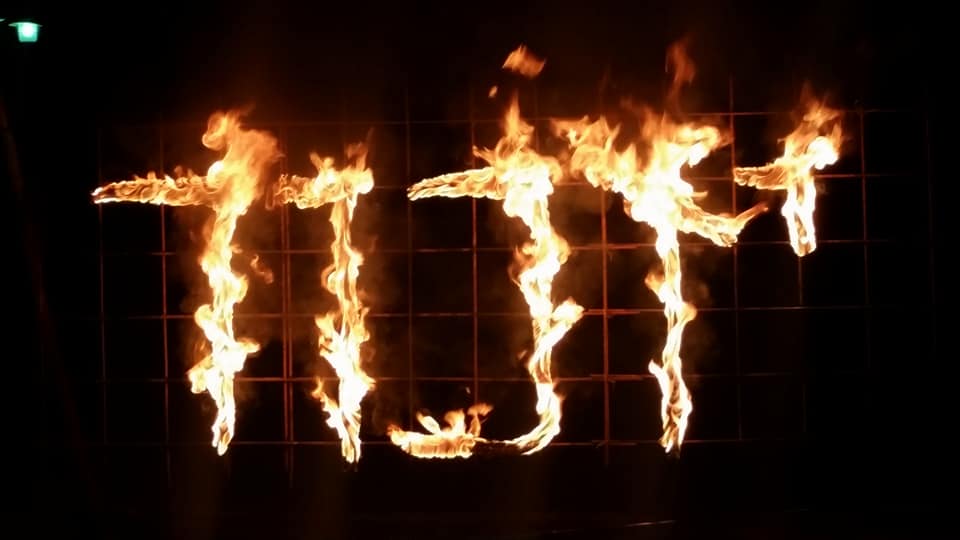
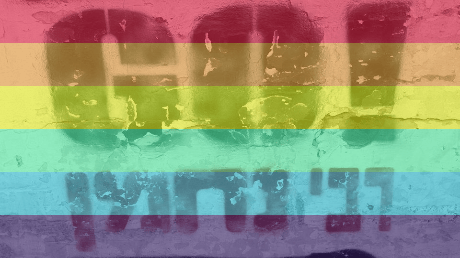
p.s.- my cover photo is of Breslover graffiti I found in Bnei Brak.  The rainbow filter is my addition 😉

Gay-friendly Arab, homophobic secular Jew

Recently I was up in Haifa and I met Ahmed, a young Muslim man from Nazareth.  He’s open to marrying a Jew, a Christian, or a Muslim.  When I asked him to keep his eyes peeled for a partner for me, he laughed and said he didn’t know anyone.  And when I said: “that you know of.  Maybe they’re afraid to share it”- he said “maybe you’re right.”  Without hesitation, just an honest recognition that his preconceptions were faulty and he was willing to listen and learn from others’ experiences.  And in the end, he said he’d let me know if he met someone for me.

Sometimes here it can be excruciatingly hard to differentiate between group dynamics and individuals.  The fact remains, despite Ahmed’s kindness, that it is much more dangerous to be gay in a Muslim village here than in largely-Jewish Haifa or Tel Aviv.  Or even Jerusalem, whose Judaism trends more conservative, but only rarely violent against LGBTQ people.  And while these generalizations are important in protecting yourself or at least being aware before entering a place, generalizations they are.

Because individual psychology matters.  And bigotry exists in all quarters- so does hope.  I personally know straight Arabs from Kfar Qasem, the birthplace of the Israeli Islamist movement, who help gay Arabs in their community come out.  In my heavily conservative South Tel Aviv neighborhood, I’ve met neighbors with ultra-Orthodox Shas rabbis pictures all around their houses.  Who then set me up with guys on Shabbat.  On the other hand, in the middle of the day yesterday I walked by two men who laughed out loud at me as I walked by.  At my clothes, my sunglasses, my hair- my “purple shirt”- that’s what they said when I asked.  Was it at me being gay or my difference?  How easy it is to separate the two?  All I know is they couldn’t stop laughing and it hurt.  Just like the teenagers shouting homophobic things late at night while I walked home alone.  I didn’t feel so safe.

Last night, I went to a hippie Shabbat.  I love certain things about my neighborhood and how it can surprise you.  And I love traveling to Arab and Druze villages, where people also have surprised me- like the bi-curious Druze boy.  Sometimes, I just want to be in a place where I can be queer and gay and laugh out loud and not have to be worried about being judged, being exemplary, being offensive.  I can just be me, an individual who is queer and creative and funny and thoroughly myself.

When I say hippie Shabbat, I really mean it.  Dreadlocks, incense, candles, namastes- and Jewish prayers.  It’s really cool and I have never seen anything like this outside of Israel.  Everyone is young, aside from a few 40 or 50 year olds who totally blend in.  Nobody cares.  In America, Judaism often felt so formalized to me.  So ritualized and rigid.  Perhaps if trying to maintain a tradition in the face of a society gobbling it up, it’s necessary to maintain some things for the sake of continuity.  Or because Americans themselves are more formal, it’d seem out of place for a synagogue to sit in a circle and chant Jewish mantras.  There are a few places in American Judaism I’ve seen that are somewhat similar- and they trend older.  Mostly people in their 60s and beyond who still have that renewal, hippie vibe.  But what I saw last night- people meditating and chanting and dancing and veganing all while people’s kids were crying and screaming and cell phones were going off- that was thoroughly Israeli.  And somehow, rather Zen.

A friend of mine brought a guy she was starting to see to the event.  I met him- a secular, pretty vanilla guy from the center of the country.  He had a kind of gentleness to him, a soft speech, a very bland body frame.  His family was American and made aliyah when he was a child.  Young, educated, open enough to try a hippie Shabbat.  We chatted for a bit- he was excited to hear I was American too- he prefers American culture.  Apparently for the politeness which I now find somewhat superficial.

As we were talking, for some reason drag shows came up.  He said: “I don’t have a problem with it, but…” which is always a solid sign that someone does have a problem with it.  He didn’t like that men dressed as women because it’s not “manly”.  And he claimed that that’s because the Torah prohibits it.  While the Torah does indeed prohibit cross-dressing, I’ve never- never- heard a secular person use this argument.  He felt it was disingenuous for a man to dress as a woman on the street because it could deceive someone.  My friend and I patiently- perhaps too patiently- explained to him why this is bullshit- and he just repeated the same argument.  With an odd gentleness of speech for someone spewing hatred.

He then also said he was opposed to same-sex couples, also because that’s written in the Torah.  I explained it’s not- what’s written in the Torah is about same-sex sex, not marriage, and even that interpretation is challenged by Conservative and Reform Jews like me.  Many of whom believe the prohibition was in relation to pagan cults where there was same-sex rape.  And who also believe rules evolve with time.  We don’t stone people anymore either.  It’s also worth noting the Torah does not even mention lesbians, let alone prohibit their relations, sexual or matrimonial.

When presented with these facts- along with the idea that it’s perhaps a bit hypocritical for him to use the Torah to bash gays when he doesn’t even keep Shabbat.  A commandment mentioned repeatedly throughout our Bible.  His answer: “a prohibition is a prohibition.  Where does the same-sex prohibition come from?  Who said it?”

At this point, the conversation was futile.  He doesn’t like gay couples or cross-dressing yet can’t even point to the Bible verse that deals with it.  Nor does he observe anything else in Judaism other than fasting on Yom Kippur.  And yet this secular guy found it convenient to bash my identity based on something he doesn’t even know.  While I have Orthodox friends who study in yeshiva and accept me as I am.  I felt angry, deflated, and sad.  Perhaps proud at how calm I remained despite such provocation in a place I thought was safe.  And angry that I wasn’t showing more anger.

I don’t know if this guy realized I was gay from the outset.  And it doesn’t really matter.  Though by the end, I made it clear.  The point is anyone could be gay- why would you speak with such cruel audacity?  It shouldn’t matter who I am, just that I deserve to be talked to with respect.

I grew up in a deeply homophobic family.  And in many cases, society.  Which can make it hard to find that adequate middle ground where I’m standing up for myself and neither being overly accommodating nor aggressive.  I hope this man takes this experience and uses it to grow and treat others with more kindness than he treated me.  In the one place I thought I would be safe on Shabbat.

In addition to trying to find that healthy space where I’m proud and assertive, understanding and protective- I had another thought.  Nowhere is totally safe.  Even a normal-looking secular guy with a soft voice can use that voice to voice hatred.  And an Arab Muslim from Nazareth can show me great kindness and more willingness to learn than the Jew at hippie Shabbat.  I’ve met Hasidim who chewed me out for being Reform and others who simply accepted me.  I’ve met Arabs who were deeply homophobic and others who were gay themselves.  And afraid their families would kill them.  And others, who help Arabs come out.

Point is this- there is a reason why we Israelis have to generalize about people.  For all the pie in the sky rhetoric I hear from some Americans, the truth is some places- some groups of people- are less safe.  It’s a fact.  A pride flag in Hebron- either the Palestinian or the Jewish side- is not likely to be well-received.  A whopping 4% of Palestinians accept gay people.  And I’ve met some who do.  More Arabs in Israel are open-minded, but it’s still pretty taboo.  And while secular Jews can be ruthless homophobes, it’s usually easier to be gay in that segment of society.

At the same time, I think it’s important to remember we are individuals.  Generalizing serves a purpose- often to protect ourselves- and it doesn’t always match up with the facts.  As a gay Jew, I felt safer in a baklava shop with Ahmed than I did with a secular Jew at a hippie Shabbat.  A sentence I couldn’t have imagined myself saying a year ago.  And here I am.  Because having in-person experiences with different types of people- that’s what helps me stay rooted and realize that generalizing has its limits.  That when it comes to gays, for every society we expect to be safe, there are holes of darkness.  And for every community filled with fear, there are rays of hope.

My cover photo is a rainbow-colored mural in the Bedouin Muslim village of Jisr Al-Zarqa: “hope, culture, creativity”.  That’s what I believe in.

Here are some other photos that fill me with hope, I encourage you to read the captions:

May you go in peace, wherever you go 🙂

A good guy from Nazareth

Today was Lebanon’s first elections in 9 years.  One of the reasons I learned Arabic as a teenager was because I grew up with a Lebanese friend, Jad.  I’ve written about him before.  He passed away too young.

I often feel his spirit here in Israel.  When I was in high school, I would go over to his family’s house and eat their pistachio candies.  Like a madman.  When I started learning Arabic at the Jewish Community Center in high school, he and his mom would help teach me.  I still remember her telling me the difference between jiddan and katheeran.  And I remember him laughing his ass off when I first tried to say khalass.  I say it better now, man 😉

Jad’s family is unique- half Syrian, half Lebanese.  Half Muslim, half Christian.  With many Jewish friends in the U.S.  I even remember his mom telling me once that sometimes when she sees Israelis, she can’t tell them apart from Lebanese people.  And she’s right, as I discovered when I hit on a guy here who looked like David Goldstein but turned out to be Muhammad Abbas.

At a time when the world seems increasingly polarized between religions and political parties, Jad’s example reminds me that for every depressing news story, there’s a complex and welcoming person not making the front pages.  An example I strive to recall living in the beautiful, complicated pressure cooker I call home.

For those of you who don’t know, because I’m an Israeli citizen, I can’t go to Lebanon.  Israeli and Lebanese law forbids it.  Even though there is no other Arab city I’d rather visit than Beirut, I can’t right now.  And may never be able to.  Which is so, so sad.

The closest I can get is northern Israel.  Where the food smells like Jad’s kitchen and the Arabic sounds like his parents’ friends chatting on the back veranda.

So I headed north.

You see Lebanese elections aren’t a trivial matter for us.  While I can’t recall a single American who gave a shit about Mexico’s elections (though they should), Lebanese elections matter a lot for Israel.  Because we’re teetering on the brink of a potential war between a Sunni-Israeli-American axis versus Iran, Syria, and Hezbollah.  The latter an actual Lebanese political party determined to wipe Israel off the face of the planet.

So this is no suburban mayoral election in Kansas.  This matters.  In a way few Americans can understand.  Right now, there’s a coalition government between Hezbollah and the more Sunni/Christian/western-oriented parties.  If there are some strange surprises in the results, who knows what will happen in the region.  All we need is a spark and…kaboom.

It’s hard to live with that over your head, yet Israelis- both Arab and Jewish- are amazing at it.  While I see my American friends agonizing on Facebook over what color to paint their apartments or how to answer an email, my Israeli friends are traveling to Thailand, are partying, are holding Jewish-Arab dialogue groups, and strive to squeeze every last bit of juice out of life.  Perhaps when you have a sense of your own fragility and our inability to control certain things (i.e. foreign elections or terrorists or the weather), you can choose to just let go and live.  And stop worrying about inconsequential shit and start living in the reality that is not knowing what tomorrow will bring.  To your benefit.

So I intended to head towards the Lebanese border- maybe Rosh Hanikra or the Christian village of Fassouta- but the weather was cloudy.  So I figured, with a bit of Jad’s inspiration, that the view could wait.  And instead, I was able to meet up with a friend for dinner at an Ethiopian Jewish restaurant in Haifa.  Which was delightful- Hanevi’im 20 down the stairs, you won’t regret it.

Afterwards, we ate *the* most delicious knafeh I’ve had in my life.  And I’ve been to dozens of Arab villages all over the country.  It was personalized and freshly baked for us like a pizza.  I’ve never eaten something so delicious.

I wanted to speak some Arabic today.  In the back of my head, I wanted to hear what people thought about the Lebanese elections.  But honestly I’m just as happy to speak the language with good people.

The guy behind the counter was more than happy to chat.  He was excited to hear my Syrian accent and puzzled as to how I got it.  Ahmed told me he’s from Nazareth.  I told him about my visit there and asked if there were Christian and Muslim neighborhoods (it’s a mixed city).  His answer was telling: “we’re not racist.  We all live together, Muslims and Christians and I like Jews too.  We all have one God.”

I joked “well except for Hindus, they have many.”  He laughed 🙂

He told me: “some Muslims and Christians even marry each other.”

I was surprised.  There’s very little marriage across religious lines in Israel- in any direction.  And truth be told there are tensions in Nazareth.  I wondered if it was accepted.  He said not necessarily, but it happens.  And he said it with a smile because he says he sees no problem with it.

I told him I’m gay, and was recently in a Druze village, and maybe I’d date a Druze guy.  I paused for a second and added: “or I dunno, maybe a Christian or Muslim one.  Do you know someone?”

He laughed and said he didn’t.  And I added: “that you know of.  Maybe they’re afraid to say it.”  And, to my great delight, he nodded and said: “you might be right.”

And that he’d keep his eyes peeled for me.

I have no idea what’s going on in Lebanon right now.  Looks like half the populace didn’t even vote because their politicians are just as dumb as ours or America’s or anywhere else.

What I do know is Jad’s spirit is not across the border, it’s not in the news, and it’s not at a ballot box.

It’s in the smile Ahmed and I shared.  The love of humanity and the willingness to learn and to overcome the fear instilled in us by fanatics.

If you want to boil down my country- and our neighbors- into a bunch of statistics or boycotts or black-and-white thinking- go ahead.  Live in a world full of judgment so far from reality and you will both suffer and create suffering.

I prefer to meet people like Ahmed.  Just an American-Israeli gay Jew hanging out in Hebrew and Arabic with an open-minded Muslim guy from Nazareth.  Over the best dessert I’ve ever eaten.

Some people say Jesus was a great guy from Nazareth.  But the one I know is named Ahmed.

p.s.- my cover photo is of street art reminding us about the train that used to run from Beirut to Haifa.  May I live to ride such a train again.

The North: where my Arabic can breathe

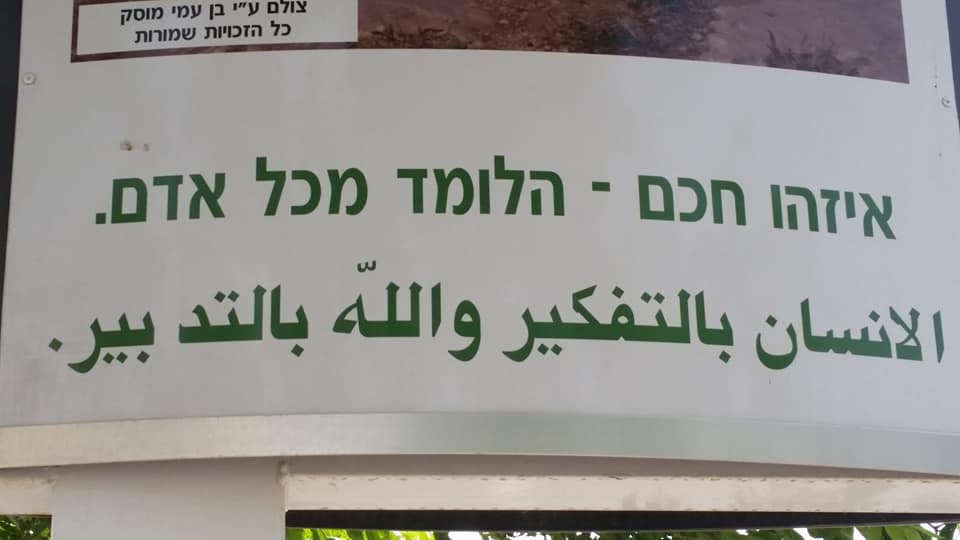
Who is wise?  He who learns from everyone.

That’s what my cover photo says.  That’s what Rabbi Ben Zuma said 2,000 years ago.

Did I find this in Bnei Brak or Jerusalem?  No.  I found it in a Druze village- Yanuh- with a Jewish population of 0.  An absolutely gorgeous place with stunning greenery all around.  Super friendly people.  And- at least when I was there- not a single tourist.  Due to my clothing and my fabulous blue sunglasses, everyone knew I was from out of town.

And when I opened my mouth to speak Arabic, the smiles were constant.  The laughter, the joy, the jokes- jokes with me.  Because I can speak to them in their native tongue.  I am a polyglot- I speak 8 languages fluently or proficiently.  I have an “ear” for language, undoubtedly, but I also use them.  A lot.  I don’t memorize vocabulary on my phone- I hang out in Druze villages.  I talk to cab drivers in Arabic.  The other day I got my friend a discount on strawberries at the market in my Jewish neighborhood because the Arab vendor was so excited that I spoke Arabic.

Why would Arabic speakers here be so excited to hear me speak it?  I can think of a few reasons.  For me, it honestly just feels natural.  I love speaking Arabic.  And unfortunately due to the extremists trying to tear down the border fence in Gaza to “liberate” my neighborhood, I’ve felt further and further from the language.  When certain Palestinians decide to fly burning kites over the border fence to set my country’s farms on fire, I have a hard time connecting to the language they speak.

Which reminded me- not only Palestinians speak Arabic.  A lot of times, the news media and even leftist Israelis who choose to learn the language are exclusively focused on Palestinians.  It’s not a bad thing to want to dialogue with them- the more people learning languages the better.  In all societies, especially here.

It’s just that Palestinians are not our only neighbors.  Certainly not our only neighbors who speak Arabic.  About 20% of the Israeli population- citizens- speaks Arabic as a first language.  And lucky for me, the Arabic-speakers up north, in the Galilee and Golan, speak the dialects closest to mine.  Syrian.

Why do I speak Syrian Arabic?  Besides the fact that it, perhaps alongside Lebanese, is in my opinion the most beautiful Arabic dialect, it was a bit due to circumstance.  At my university, I studied Fusha, Modern Standard Arabic (more of a literary language).  Only after 3 years did I have the chance to learn 3ammiyya, or spoken Arabic.  I had the choice of Egyptian or Syrian, and I chose the latter because it was mutually intelligible with Palestinian.  And I also care about dialogue.  My professor was from Damascus.  He was homophobic and somewhat anti-Semitic, but his Arabic was astounding and I learned so much.

Since then, Syria was plunged into civil war and I never got the chance to visit.  Though, along with Lebanon, it would be my dream to do so.  Inshallah- God Willing.  In the meantime, the closest thing I can get to speaking my Damascus Arabic is to simply hop on a bus up north.  Or speak with my Syrian refugee friends, which I do each week.

The Druze, in particular, migrated to northern Israel over the past 800 years.  From Aleppo, Lebanon, and beyond.  Of course the Druze in the Golan Heights were living in Syria just 50 years ago, so their Arabic is very close to mine too.

And to a person- everyone is excited to hear me speaking their language.  And their dialect.  Not Palestinian Arabic- Syrian Arabic.  Quite often people actually ask me if I’m Lebanese or Syrian.  The most flattering thing I’ve ever heard.

Today the coolest thing happened.  I was visiting Isfiya, a Druze village with significant Christian and Muslim minorities.  After visiting a Bedouin shop and some churches (the Christian dialects up here are also super close to my own and fun to hear), I had dinner at a Druze grocery store.  Yes, because the grocery store also doubled as a roadside food stand with kebabs.  I love my country.

While my kebabs were roasting, I popped over to the cellphone shop.  I want to buy a portable phone charger so I can travel at ease and get some extra juice when I need it.  I initially approached the young man in Hebrew.  And then, just like every Arab and Druze person does here millions of times a day, I slipped into Arabic.  Five Arabic words here, one Hebrew word there- it’s the most beautiful and fun thing.  Kind of an Arabic Yiddish with amazing wordplay.  A young kid said to me today: “ani rotzeh sheanja7“.  I want to win.  The italics Hebrew, the bold Arabic, and it flowed perfectly as we giggled at the combination.  It’s fun when you can enjoy the best of each other’s cultures.  To the point where they’re hummus and tehina.  You can’t fully separate them and they’re delicious together.

I’m at the phone store and my Arabic starts flowing and a Druze man, no more than 20 years old, lets out an “Allahu Akbar!” to shake the ground.  In such shock and delight at seeing a Jewish American-Israeli speaking his language, he simply praised God.

I had this deep inner sense of joy and satisfaction.  I felt so, so complemented.  It was funny.  It was sweet.  It was sincere.  And it was a beautiful way to take a phrase that radical Islamic terrorists use to blow people like me up- and instead use it to bring us together in unity.  In a cellphone store.  It tickled me.

This kind of reaction happens to me a lot, especially up north.  When I tell some of my Israeli Jewish friends about the villages I’ve visited- a good number of them have never even been.  Or in some cases, even heard of them.  Or even think they’re worth visiting.  It’s not universal- I’ve hitchhiked with Jews who were visiting these villages.  But it’s an extreme, extreme minority.  Jews here do not speak Arabic.  Other than older generations of Jews from Middle Eastern countries and a few dedicated young people who paid attention in school (or the army), Jews don’t care to learn Arabic here.

It makes me sad.  On a few levels.  One, because I understand why.  There is a 70 year old trauma-inducing conflict here, separate educational systems for Jews and Arabic-speakers, and largely separate residential patterns.  And while there are people in both societies who want to mix, overall there is a desire to retain communal identities.  Which can make it hard to learn each other’s languages.  Especially Arabic, whose spoken varieties aren’t standardized and really require in-person experiences.

And yet, only about 10% of Jews here speak Arabic but 77% of Arab Israelis speak Hebrew.  About 29% of Arabs here can’t read Hebrew- which is an issue for employment, social cohesion, and communication.  But let’s just say Arab citizens of Israel are way, way more invested in learning Hebrew than vice-versa.  Which is a national shanda.  That’s Yiddish for scandal.

While this may be par for the course for majority-minority relations (after all, how many non-Latino Americans speak Spanish?  Answer: about 10%, the same as Jewish Israelis with Arabic), it’s not acceptable.  While I value the smiles I get from young Druze and Christian Arabs and even Muslim kids (in those villages I feel are safe enough to visit- which is not all of them), I don’t want to be an oddity.  I want more of my countrymen to stop whining and pick up a book.  Take a class.  Visit your neighboring village.

Arabic speakers in Israel are almost universally happy to help.  And eager to see you give a shit.  I don’t really care how many times you voted for Meretz or how you do a once-a-year interfaith Seder.  Stop being a lazy (fill in the blank with something that will motivate you) and get to work!  If you spent half as much time learning Arabic as you did complaining about your salad dressing, you’d be fluent.  Arabic takes practice but it’s so much fun!  It will take you on new adventures- musically, socially, geographically, historically, and beyond.  It’s a true civilization.

And the good news is that even when some people who speak the language are becoming increasingly extremist, you can find great places in Israel to practice the language safely.  Basically, any Druze or Christian village, most Bedouin towns, and even some other Muslim villages like Abu Ghosh.  Or beyond, when the conditions are right.  I’ve traveled in some deeply conservative Muslim villages and had some close calls- so I can understand if you don’t want to start there.  The vast majority of people I’ve met in all places were cool.  It is true that it just takes one nutjob to end your life.  So do some research if you want to go far off the beaten path.

In the end, the North of Israel is the best.  It’s the place where I dabke dance on the street with Druze kids, where I counsel a bi-curious young man in Arabic, where I get private tours of churches followed by tons of homemade pastries.  It’s a land of generosity, of green hills, of smiles.

When I leave a Druze village, a place where my Judaism and my Israeliness and my Arabic-speaking identity are all validated, I hate getting on the bus.  Tel Aviv is a vibrant, energetic, queer-friendly coastal city.  With a beach.  There are things here that are unique and maybe it made sense for me to start here.

As I spend more time in other parts of the country, especially the North, I wonder if Tel Aviv will really be home for me.  Maybe I’ll split my time (perhaps people up north will want to trade apartments once in a while 😉 ).  Maybe I’ll live here but keep traveling a lot.  Maybe I’ll just move up north.

What I do know is this: Tel Aviv smells terrible.  And when I hop off the bus, the stench is overwhelming, the noise is loud, the nature is nonexistent.  Yes, there are exceptions.  There are beautiful areas near me just south of the city.

But would I rather have a late night pizza place or make some at home and sit in a forest and stare at the stars in awe?

Where my Arabic and my soul can breathe.

A Burmese refugee, Libyan Jews, and me

Big moments happen in small ways.  Tonight I was at my favorite sushi restaurant.  You wouldn’t expect to find it in my neighborhood, a place where the Mizrachi music blasts and the streets have a special smell.  Yet my neck of the woods is full of surprises.

As an oleh, an immigrant, who came alone- life can be hard here.  I have no family support network- and this is a country built on family, much moreso than America.  People don’t just see family twice a year on holidays here.  They often live right down the street.  The good part is people are willing, often eager, to take me in.  In America, I felt even lonelier.  Having no family- I cut them off due to their abusive behavior– I had to find places to spend holidays and Shabbat and even dinners.  I found myself growing closer and closer to certain restaurants there because I didn’t want to eat alone.  And some, like my favorite Thai digs in D.C., really loved me and even gave me gifts on my birthday.  When you have no family, you build it yourself.

The downside to not having family here, in such a family-centric society, is you really feel it.  Saturday, Shabbat, is not just a day to relax- it’s a family day.  With family meals.  And if you’re not invited to one, it often feels solitary.

Today, I spent my day exploring the Libyan Jewish Heritage Center in Or Yehuda.  Absolutely free and full of fascinating history, I had a blast.  A Libyan man there gave me a personal tour of the entire place- in Hebrew and Arabic.  Missing the North, where I had just enjoyed speaking so much Arabic, it was great to speak it in my own backyard.  With a Jew 🙂 .

Moshe made aliyah, immigrated to Israel, when he was 7.  He was born in Tripoli, Libya.  Heir to a 2,000 year old Jewish tradition that predates Islam.  Like many Jews in North Africa, Libyan Jews were subjected to Muslim pogroms, or massacres, in the 1920s-40s.  I also learned today that almost 3,000 were even sent to Bergen-Belsen and gassed by the Nazis in the Holocaust.  I had no idea.  We usually associate Holocaust with Ashkenazi Jews (and some Sephardim, like in Greece).  I knew of some persecutions in North Africa, but not much.  But the Holocaust artifacts- even someone’s suitcase from a concentration camp- really took me by surprise.

Moshe walked me through everything, with such patience and kindness.  I had the whole museum to myself- which I hope you’ll fix by going and visiting.  If you don’t, it’s very much your loss.  I saw Jews’ Libyan passports, a Libyan Zionist youth group T-shirt, Arabic-language legal contracts, 500 year old Torah scrolls, and so much more.  A Passover haggadah in Hebrew, Judeo-Arabic, and French.  I got to hear Libyan Jewish music and hear stories of heroism by Libyan-Israeli soldiers in the IDF.  Even a 1950s teudat oleh.  A true treasure.

Libyan Jews lost all their property when they had to flee to Israel.  Now Jewish cemeteries there have been bulldozed, built over.  Jewish homes occupied by Muslims.  Despite the fact that Moshe said Muslim women would look after him and bring him home to his mom.  The relations were not always bad.  Yet not a single Jewish community remains.  So if you want to know why Jews feel like we need a state of our own, just take a look at Libya.  When we are subjected to the whims of non-Jews, it always- always ends badly.  Maybe not during every epoch- but the sad truth is the finale remains the same.  A minority without a home base can’t really protect itself.

After a delicious Bukharan Jewish meal near the museum, I did a little shopping for my apartment and headed home.

WhatsApp Image 2018-05-03 at 1.13.04 AM

At home, I did a little tidying and started to feel tired.  Physically tired, perhaps- I didn’t sleep well last night.  Coming back to loud and chaotic Tel Aviv after some days in the quiet, peaceful North was hard.  And to boot, it was friggin hot.  But also emotionally tired.  Tired of being alone in this gorgeous land, where I make friends here and there but I just don’t have a home base (though perhaps I’m building many).  I don’t have my own “Israel” to come home to.  But I’d sure like one so anyone looking for a third of paradise, hit me up (that’s a Jewish joke- but it’s not a joke 😉

I realized that my neighborhood sushi joint- that’s where I feel at home.  Any time I need someone to eat with, when it’s just too tiring to make plans, I go there.  And I love the people there.  The Filipinos who run it, the Mizrachi girl who says “be’ezrat hashem” (God willing) every time I tell her about a cute guy, and the adorable Filipino-Burmese-Israeli kids who like to play with me in Hebrew.  One even made me origami 🙂

When I go to this restaurant, I never feel awkward.  In the States, sometimes I felt “weird” or “imposing” or even desperate if I’d go to the same restaurant “too often”.  Here, even if it’s only been a day or two, my friends ask me “where have you been?”

Notice I said friends.  Because we don’t just talk about the weather or football or our plans for the weekend.  We talk about homosexuality, family, children, Tagalog, Burmese, Israeli culture.  We share jokes and we laugh.  I play tic-tac-toe with the kids- and I usually lose. 🙂

The past few weeks, a Burmese relative of one of the employees has been filling in for someone.  My knowledge about Burma basically extends to a delicious restaurant in suburban Maryland, an episode of Anthony Bourdain, and the famed human rights activist whose name I can never pronounce.

What I know about Burma is that it was- and in some ways still is- “al hapanim”- a disaster.  Run by an isolated military dictatorship, many Burmese fled.  A brief glance at Wikipedia reveals child soldiers, slave labor, and ethnic cleansing.

As they shut down the shop at midnight (because I’m lucky enough to be able to walk to a sushi joint open till then), I talked to the Burmese man.  He’s been in Israel for over 20 years.  He has some sort of official refugee status.  It affords him a legal visa, but not citizenship.  He said he might be able to get it through an expensive process, but his coworker indicated he couldn’t.  It wasn’t clear.  He said he could go to America, where he has relatives, but he prefers life here.

It wasn’t even entirely clear how much, if at all, he could travel outside the country.  And this is a country that has lived through several wars just since the time he arrived.

He pulled out his Burmese passport.  I’ve never seen such a thing.  It was worn and full of Israeli visas (which frequently have to be renewed- for some workers every 3 months).  We had a huge laugh together when we saw his picture in the front.  He was young.  Maybe 20 years old in the photo.  Today he’s over 50 and while he has a deep vibrancy and a full laugh, you can see the wear that working hard jobs has taken on him.

To see an expired Burmese passport, from a Burmese refugee, to talk with him in Hebrew- and laugh.  In my neighborhood.  That’s a new feeling.  The same day I saw Libyan passports of Jews who fled for their lives.  I felt gratitude for the fact that I got immediate citizenship and guilt that he still doesn’t have it.  Joy at making a new friend.  And pride that he prefers Israel over America and all other countries.  Deep empathy- it must have been excruciating for him to leave his homeland and to be so far away.  I asked him- he misses it.  Yet he keeps laughing and smiling.  A true survivor and thriver.

Libyan Jews, me, and my Burmese friend.  We all fled our own traumas.  Islamic extremism, a deeply abusive family and anti-Semitism, and a ruthless dictatorship.  And we’ve all managed to make Israel our own.  Our home.  We faced and face our own challenges.  I hope Libyan Jews here manage to remember and preserve their heritage even as they contribute to our beautiful nation.  That Libya will repent and repay the Jews for ethnically cleansing us.  I hope I continue to find stability, love, and happiness – family – in my new country.  A place where I feel increasingly healed and have more healing to do.

And for my Burmese friend- I wish you nothing but love.  May you continue to grow here.  May you get the legal status you need or want to feel safe.  May you feel welcome.  Even if you’re far from your Burmese family, I hope you feel embraced by your Israeli one.

Count me in as a member.

My Yemenite-West Bank-Nepali-Darfuri-Mizrachi kind of day

This morning, I knew I wanted to go on trip.  After my doctor’s appointment, I wasn’t sure where to go.  So I noticed the nearby bus stop went to Rosh Ha’ayin and I hopped on a bus.

I’ve long been fascinated with the city, which was founded largely by Yemenite Jews.  They have a heritage center there, which I’d love to visit another time- it was about to close when I arrived.

Not sure what to do, I simply walked upwards.  I noticed that I was very, very close to the Green Line, the line that separates pre-1967 Israel from the West Bank/Judea and Samaria.  I caught some absolutely gorgeous views of the hills on the other side- just stunning.  The nature was stunning and also the mystery of what’s over there intrigues me.  Yes the hatred and also the forbidden nature of it.  It’s so, so close and it’s legally quite far.  The anger and animosity that forbids me from visiting is overwhelmingly sad.  Also because I know it’s not a simple thing to fix.  There are reasons why Israel needs a security fence and there are reasons why Palestinians are angry about it.

Rather than get into the politics, I want to share an odd observation.  The fence itself in this particular place- it was pretty.  It struck me.  Fences anywhere usually aren’t so pretty.  I’ve seen our border fence with Syria.  It’s pretty much just a fence.  I’ve seen from afar the concrete parts of Israel’s security fence in Jerusalem and they look pretty concrete-y and gray.  For whatever reason, the part of the Green Line that is a wall here is oddly…attractive.  Its yellow stones strangely complemented the gorgeous hills I viewed on the other side.  While not being able to go there frustrated me, I felt oddly at peace.  This is what it is now.  To protect me, this wall needs to be here.  And I hope one day we’ll be in a place where me and the Palestinians on the other side can live next to each other with normality.  We’re pretty different in a lot of ways, but maybe one day I’ll find a friend there.  In the meantime, I’ll enjoy the view and the hope.

After almost making it to a Yemenite restaurant in Rosh Ha’ayin before a downpour, I decided to take a bus to a mall in Petach Tikvah.  I was in need of a new backpack and since it was raining (torrentially- 9 children were killed in flash floods, z”l), I headed indoors.

I had never been to Petach Tikvah and, to its credit, I have not yet explored there.  I’m sure I will.  The view from the bus wasn’t fantastic- it’s a kind of concrete jungle that reminds me a lot of Northern Virginia.  And like Northern Virginia has the beauty of Old Town Alexandria and the ethnic food of Annandale, I imagine Petach Tikvah has its charm too.  It just wasn’t where my bus was driving.

I got off and went into what has to be the largest, cleanest mall I’ve seen in Israel.  Orderly, calm, and at least when I was there, relatively quiet.  A kind of reminder of what America was like sometimes, just in Hebrew 😉 .  I got a new backpack- I’ve traveled so much that the bottom of my backpack has come unsewn.  I have a great relationship with my backpack- one of my steadiest- and I’ll miss it.  I started to say kaddish for it and haven’t quite yet let it go.  But I do have a new friend to carry with me and it looks snazzy and sturdy.  May it bring me to great adventures and fun.

Leaving Petach Tikvah, I thought to drop my stuff off and go to Bnei Brak for gefilte fish.  I called my friend Yisrael to get the address for his restaurant.  Then, my monit sherut cab dropped me off by Neve Sha’anan, a neighborhood of mostly refugees and non-Jewish foreign workers.  Instead of going to eat gefilte fish, I went to my favorite Nepali restaurant here, ordered chicken momos (a whole plate for 20 shekels!), and chatted with a bunch of friendly Nepali guys.  And debated American politics with the Tibetan chef.  There were moments of discomfort when I explained how I immigrated here and have dual citizenship- something most of them could only dream of.  The tension of feeling bad for them and the tension of feeling like there’s not always an easy solution to these kinds of things.  Because I want them to have equal rights and I also think that in order to have the only Jewish state on the planet, how do we draw a line in a humane way that allows us to continue that miracle?  Not so easy.  On the upside, one of the guys, Diwass, happily agreed to exchange his Nepali for my Hebrew, so we traded numbers 🙂 .  Always good to stay grounded in a place where the “what if-ing” could occupy your whole life.

On my way home, I realized I wanted some produce.  There’s a beautiful new store opened by a Darfuri guy from Sudan.  He recognized me from my last visit and we talked fruits and veggies in Arabic.  I asked him about his former city in Darfur, Kutum.  I told him I’d look it up and learn about it.  We talked about the languages of Darfur and my work and me being a dual American-Israeli citizen.

We wished each other ma3 asalaameh and I walked home.  One of the (many) Mizrachi synagogues on my neighborhood had a huge gathering of people on its porch.  Because in Israel, we treat each other as family more than strangers, I went up to a guy and asked him: “what’s going on here?”  And he said: “It’s a hazkarah.”  Or what Ashkenazi Jews might know as a yahrtzeit, the anniversary of one’s death.  I said: “but everyone is so happy!”  His response is one of the most beautiful I’ve ever heard: “it’s been a year.”  He smiled and we went our separate ways.

Why is this man’s response one of the most beautiful things I’ve ever heard?  Because it represents the absolute best of this country and of Judaism.  But a Judaism so concentrated and radically accepting of the present that I’ve never seen such a thing in another country.  We were sad a year ago.  Someone passed.  And now, we come together in a spirit of joy.  Not the joy of pretending it didn’t happen, but the joy that we’re here together.  To remember someone we loved and to thank God for being alive.

Want to know why I live in this Land?  A land threatened by terrorists and missiles and theocrats from every side and all across the region?  A place where your bags are searched in every mall and theater and where soldiers carry guns on the train?  A place where the landlords and real estate agents won’t hesitate twice before screwing you?  A place where the salaries are lower than America?  A place where I sometimes miss the cleanliness and rules and museums and delicious Asian food of America?

Because we know how to live life to the fullest.  And we have the amazing landscapes and people and cultures and kindness to do so.  In America, I often felt distant from my neighbors.  You don’t invite yourself to someone’s home- you ask them for permission.  And don’t want to “impose”.  Here, there’s a deep appreciation for the value of every second you have on this planet.  And there’s an incredible generosity of spirit that allows me to sit with Nepalese workers and Darfuri refugees and my Syrian Jewish neighbors for hours on end.  With no “transactional” expectations of our relationship.  Just because we’re human beings.  And friends.

The other day, when I told my American friend how in Israel you can go from a Bedouin town to a Hasidic synagogue to a gay club in just one day, he said: “but how many people actually do that?”

I’m not sure.  More should.  The point is here you can.  And I definitely do.  So if you’re getting bored on your commute from Rockville to Washington or Evanston to Chicago or Westchester to New York, open up Skyscanner.  Find yourself reaching for your wallet to buy a ticket.  And click “yes”.

Because you might just find yourself having a Yemenite-West Bank-Nepali-Darfuri-Mizrachi Jewish kind of day.

Or as I call it: “Thursday” 😉

p.s.- my cover photo is of Libyan soup I had yesterday.  Because no image could possibly capture such a mix of cultures better than a delicious stew 😉

Why reading the news is a waste of time here

Ok, first things first- yes, sometimes you do need to read the news.  I, for instance, when planning my trips, search the name of the town I’m visiting to check for safety.  When I heard air raid sirens in my apartment, I lit up my WhatsApp but I also checked news sites.  News has a purpose when used effectively.

And most people do not use it effectively.  For many years (and once in a while now), I just get caught up in the news.  Reading- whether on Facebook or on the news sites themselves- just depresses me.  I get that the media needs to make money so they focus on the most dramatic and often sad or offensive things.  Today, I glanced through articles about anti-Semites boycotting Israel, anti-Semites attacking Germans wearing yarmulkes, Jeremy Corbyn being anti-Semitic, Natalie Portman’s mess, and the likelihood of war with Iran and Syria.  I literally just cried.

It’s not because the words being written are untrue (although sometimes they are), it’s because they are true.  And they suck.  And they’re selective.

Because I’ll tell you what I did the past few days and was not in the news.  I took a bus from my low-income stereotyped neighborhood to three beautiful rural communities just around the bend.  I met an archivist who sat with me for an hour and a half to explain to me the history of his town.  I hiked through a forest in northern Israel to the Druze village of Daliat Al-Karmel.  When I asked some Druze women for directions, they sat me down, plied me with tea and coffee and salads and sweets.  They gave me a huge container of leftovers.  Drove me to the village and added me on Facebook and WhatsApp.  Today, I went to Zichron Yaakov, discovered a beautiful hidden trail, hitchhiked down the mountain to Maagan Michael’s gorgeous Caribbean-like empty beach.  Then, I walked on the sand to Jisr Al-Zarqa, a Bedouin village, where I was the only tourist visible.  I got to hear some pretty cool Bedouin Arabic, talked with a guy about Arabic music, and spent a peaceful bus ride hanging with some friendly Bedouin women.

In the course of about three days, I had been to national parks, a kibbutz, a moshav, a suburb of Tel Aviv, a Druze village, and a Bedouin Muslim one.  The main reason I write this blog is for me- it’s a record of my journeys, it’s therapeutic, and it’s fun.  I like writing, I enjoy it.  The other reason is because these kinds of stories- real and authentic- don’t make their way into the news.  The nuanced, the complicated, the fun, the moving, the heart-warming, the sad.  The full spectrum of the human experience.  Instead of reading like a laundry list of everything bad in the world, I prefer to share something a bit more real.

Because the sad stuff- the anger, the extremism both left and right, the aggression- those all exist.  And sometimes I touch on them.  And I feel that the media, perhaps in the quest for eyeballs and ad dollars, only focuses on the negative.  The things that make you click even though you (and I) don’t want to.  We’re hooked.

Living in a country plagued by terrorism and war, I’ve learned something from my fellow Israelis.  And I want to remind them of it- and teach my friends abroad.  Faced with crazy shit, you have two options.  One is to live in chaos.  Either a constant state of panic or burying your head in the sand and pretending nothing is happening.  The other option is to live in the here and now.  To be present, to enjoy what you can, to be grounded and live your life with gratitude for every moment you have.

That second path is the one I choose and strive for.  It’s the one many Israelis, both Arab and Jewish, manage to pursue much, much better than Americans during these difficult times.  Perhaps because we’re a more communal society.  Perhaps because we’ve been dealing with trauma for longer and know how to better cope with it.  Either way, my gift to Americans reading this blog right now is that spirit of embracing the present.  It’s not to completely detach yourself from worries nor to pretend that shit isn’t going down.  Sometimes, it is.

It’s just that on a day when everyone was talking about Natalie Portman and Iran, a Druze kid was practicing English with me.  I was taking selfies with cows.  I was taking selfies with sheep!  I was listening to the waves of the ocean as I walked towards a Bedouin village.

We all have choices about how we spend our time and energy.  We all have a right to our feelings and we make choices about how we live our lives.

I have opinions about all the “news” items I shared.  And I have a right to them, and maybe I’ll share them- and maybe I won’t.  Because maybe, like tonight, I’ll be too busy meeting other young people in my neighborhood at our first block party.  Organized by a friend I met in a sushi joint around the corner.

Shoot this, boycott that, yell this, scream that.  I don’t really care.  Because the music is blaring so loud around me that I just hope one day you’ll open your ears to listen.

Independence from black-and-white thinking

Today concluded my first Independence Day as an Israeli.  And the first one I’ve celebrated on my homeland’s soil.  It was an independence day for me, a chance to declare my freedom from my own oppressors.  To celebrate my progress.  It was a day to rejoice.

Rejoice I did- I danced to Mizrachi music in the streets, I hung out with friends, I wore my Israeli flag as a cape, I got congratulated for becoming Israeli many, many times.  There were goofy people dressed up as Israel’s founding mothers and fathers.  There was fun.  We deserve a day to just have fun and be proud of our accomplishments.  In 70 years, we’ve managed to do more than some countries do in 200- and under the near constant threat of destruction.  Just today, I was grocery shopping and read a newspaper article while in line.  About Iran wanting to attack us from Syria.  Welcome to life in Israel, where every day we’re alive is a victory.

At some points, I felt I should be happy but wasn’t quite as happy as I thought.  Maybe it was when the tour guide at Independence Hall said: “we’re all Jews here, so feel free to interrupt.”  I totally get the sense of humor and I had to wonder how the Filipina woman and her child behind me felt.  Or perhaps a Druze man sitting in the back.  I think growing up in the Diaspora made me more sensitive to including others- we have some work to do here.  Because most of us are Jews- and not all of us are.  And we all deserve a seat at the table.

It got me thinking.  I really wanted this day to just be about celebrating Israel.  All year long we talk politics and people around the world hammer us for problems both real and imagined.  It can be hard to tell whether some foreigners are criticizing us out of a desire to make this a better place or because they single us out and want us to fail.  Trust me- I’ve met both kinds of people.

So I wanted to just enjoy.  And at some point, I realized nothing is 100% happy or sad in life.  In the Passover Seder, we dip our fingers in our joyful wine 10 times- once for each plague.  We put that wine or grape juice on our plates to symbolize our empathy for innocent Egyptians who suffered on our way to liberation.  No Jewish holiday is black-and-white, we’re a people who knows how to meld the bitter and sweet to the extent that it can be hard to even untwine the two.

The most obvious elephant in the room on Yom Ha’atzmaut, our Independence Day, is the Palestinians.  We are neighbors and the people right across the border have no independence day.  The reasons are complex- and it would be incorrect and even prejudiced to suggest that all of the blame falls on one side of the fence.  And it’s sad that while I’m celebrating today, some Palestinians are mourning what they see as a catastrophe.  The creation of my state.  While they still don’t have one.

I can empathize with why this day is hard for Palestinians (and Arab-Israelis/Arab citizens of Israel).  For someone whose village was destroyed in 1948, sometimes purposefully sometimes not, this day must be rough.  And the wound is still unhealed as our region has been in a near constant state of war for the past 70 years.  With bloodshed all around, including 37 soldiers from my neighborhood alone.

I also wish my neighbors across the border would try to understand why we’re celebrating.  I’ll tell you personally- I’m not celebrating the destruction of any village.  I’m celebrating the fact that I feel free here as a Jew.  Even in America, I’d feel scared or embarrassed to walk around with a big Israeli flag on my back.  In America, I felt self-conscious as a Jew.  Laughed at, picked on, discriminated against.  I felt my Judaism belonged in synagogue or a community center, not on the streets.  The idea of praying in public or being visibly Jewish was scary and anathema to what I felt we were supposed to do to be “respectable” and “cool”.

In Israel, we also have Jews who survived the Holocaust, with no family members, only to build new families here.  Some of whom then lost their children to terrorism or war.  We have Jews here from Egypt whose government stole their property, robbed them of citizenship, and kicked them out.  Just for being Jews.  And now they’ve managed to build themselves a new life and home here.  The place that would offer them refuge, no questions asked.  A miracle.

You can go through this story with just about any Jew here.  This is the only place on the planet where I feel safe being a Jew.  An out-of-the-closet Jew.  For 2,000 years we’ve been at the mercy of whatever ruler we lived under.  And all too often, turned into scapegoats like Roma/Gypsies or African-Americans- and suffered the violent consequences.  Here, we are empowered to choose our own fate for the first time in millennia.  And we’re not going to give it up.  Our greatest threat is our greatest strategic advantage- we have no other place to go.

As Israelis like to say, living here is “lo pashut”- it’s not simple.  And they’re right.  When I saw a person dressed up as Ben Gurion today, I was laughing and also thinking back to when he derided Yiddish.  When I celebrated by dancing to Mizrachi music in my neighborhood last night, one of the women said: “I want to go to America, it’s terrible here.  Well, it’s not the Jews who are terrible…”.  I empathize with her- there are a lot of reasons why a Mizrachi Jew might be prejudiced against refugees or Arabs, as I’ve written about.  And I also hate it.

I am proud to be Israeli.  I love my country and its people.  I’m blessed to be a Jew and I think we have contributed so much to the world and this region.

I’m also sad that many of my Palestinian neighbors live in deep poverty, are ruled by the corrupt Palestinian Authority and Hamas, and are subject to a largely unaccountable and undemocratic Israeli control over their lives.

And I’m sad that Arab-Israelis are basically caught between the two worlds because to a degree they identify with both.

I’m sad that refugees are discriminated against and might be deported.  And I’m sad that their neighbors- my neighbors- have been utterly neglected by the government for 70 years, fomenting their anger.

I’m sad that as a Reform Jew I have no religious rights here.  I have more rights in the States.  I’m sad that as a gay person, I can’t adopt children.  And I’m grateful to live in the only place in the Middle East where being gay is not only legal, it is accepted by a large part of the population.  According to one poll, 40%+ of Israelis say we should accept homosexuality.  The next closest Arab country is Lebanon at 18%.  Palestinians come in at 3%.  Those numbers also obscure a lot of gray space (including among Palestinians).  My city, Tel Aviv, is one of the gayest places on the planet and has a city-funded LGBTQ center.  Almost 80% of Israelis support gay marriage or civil unions.

In the end, living here is complex.  I’ve learned to become a more empathetic and textured thinker by living here.  If you want to come here and try to break things down into good and evil, right and wrong, black and white- you’re coming to the wrong place.  Like the Bedouin man married to a Jew who converted to Islam and are raising their kids in a Jewish school.  We are awesome and diverse and not easy to fit into a box.  So put down your placards and get to know us before boycotting us or telling us we’re all fascists.  While you sit on Native American land or, in the case of Europeans and some Arabs- on our Jewish property.  Life is not so simple when you start to empathize with everyone.

And it makes it much richer.  So on the 70th anniversary of Israel’s founding, let’s declare our independence from black-and-white thinking.  When you start to live in the gray space, you start to realize it’s not gray at all.  It’s the many, many colors of the rainbow.  Each with is unique shade.  Sometimes too bright to stare at, and often too beautiful to gaze away.

In a note to my American friends struggling with a difficult time in history, join me in embracing the complexity.  Get to know your Appalachian neighbors, gun owners, evangelicals- people you don’t agree with.  Not to convince each other or approve of toxic behavior.  Rather, simply to understand what might cause someone to think that way.

Embracing complexity can bring with it a lot of emotions- sadness, fear, joy, anger, hope.  It is eye-opening and sometimes even overwhelming to see the full spectrum of humanity.  The easy solutions don’t look so easy and sometimes, I feel as helpless as I do empowered.  At that point, I invite you to learn from Israelis.  Because what Israelis are astoundingly good at is just letting go.  Give yourself a chance to celebrate- anything.  Because all people- no matter the race, religion, or country- we all deserve time to celebrate.

Happy birthday Israel.  May year 71 bring us, our friends, and our neighbors peace, prosperity, hope, and strength.

I love you Israel.  When I criticize you, it’s because I want to make you better.  I’m glad to be home in your arms.

Am Yisrael Chai.

30704776_10101754173733602_4239613470407884629_n

This Independence Day, I belong in Hatikvah – שכונת התקווה מעל כולם

Today was Yom Ha’atzmaut.  Israeli Independence Day.  My country, my home turned 70 today- every day and every year a true miracle.  We’ve got our problems and we manage to survive and learn and grow.  And should continue to do so.

This morning, not really knowing what to expect (are stores open?  are restaurants open?  are museums open?  are buses running?), I ended up going for a stroll.

Lately, I’ve been learning more about the areas south of my neighborhood.  Yesterday I discovered Ariel Sharon Park, which is a former waste site turned into a gorgeous park reminiscent of a rural farm or orchard.  Stunning and hard to believe it’s in Tel Aviv.

park ariel

Today I was walking down Etzel Street, the main street in Hatikvah, when I bumped into a woman I had met earlier when we laughed at a guy screaming on the phone.  I asked her what was to the left at the end of the street.  She said it was her neighborhood, Ha’argazim.  I asked if there were restaurants and such there and she walked with me to show me.  On the way, she made some racist comments about Eritreans.  I explained I was against expelling refugees, but basically decided to leave the conversation be because I don’t want to lecture people and in Israel, you have to let some things slide.  Also, she’s from this neighborhood and it’s a seriously neglected part of town.

We bid each other a chag sameach, a happy holiday, and went our separate ways.  One particular quote of hers stood out: “they care more about the Eritreans than they do about the people who live here.”

I thought more and more- what if she’s right?  We’ve been so focused on our activism- have we forgotten the people who’ve lived here for 70 years?  Who are neglected by the city and the State?  And most certainly the wealthy North Tel Aviv “liberals” who never venture down to these neighborhoods?

As I strolled through Ha’argazim, I couldn’t help but agree with her.  The houses are shacks.  Literally shacks.  With piles of trash all around the neighborhood, never cleaned up by the city.  In America, it’d be called a shantytown.  Somehow they manage to give the houses some charm.  And that doesn’t excuse the utter indifference the residents have to face.  Any more than their poverty excuses racism.

It was important for me to see where this woman lived.  It was somehow poorer, dirtier, and smellier than my own part of town- which has its own special stench.  I would never agree with or justify her bigotry- and I also feel I have greater empathy for her now that I know her situation.  I feel her anger is misdirected at the refugees, but the anger itself- boy is that justified.  These pictures should outrage anyone in Tel Aviv.  Likud, Labor- no government has helped these people and it’s a stain on our society’s values.  And I want to be a part of fixing it.

Since Israel can sometimes surprise you, I wandered my way into a beautiful park nearby- Begin Park.  There, there are two lakes, one of which has water skiing where you are pulled via cable above your head.  There is a petting zoo.  And it’s just calm and green and wonderful.  There are even roosters that crow!  And people practicing acrobatics from trees!

This park is what Israel looks like when people care.  I hope one day Ha’argazim and all of South Tel Aviv will benefit from such consideration.  And I’m excited to try water skiing right by my house!  Who knew?!

Eventually, I made my way up North to Kikar Rabin, Rabin Square for the “premier” celebration tonight.  I was supposed to meet a friend of a friend.  Who knew I was going alone.  The friend cancelled part of the plans- fine that happens.  Then, he was supposed to come at 9:30.  No show.  Then, he says he’s coming at 10:30.  Already feeling deeply left out- I was alone standing in a see of families (and I have none)- I empowered myself to leave.  And good thing I did- I didn’t get a message from the other guy until 10:45 saying he was “on his way”.  Would’ve been miserable.

Being in Israel- being anywhere- by yourself is hard.  Israel is such a family-oriented society- which is part of why I want to find a partner here.  And part of why I love how willing people are to take you in as their own.

So a note to Sabras.  One of the great things about being Israeli is our flexibility.  When you cancel plans, you figure the other person can figure something else out.  That’s often true- but remember that olim, in particular ones who come here alone, we don’t always have a back-up plan.  We don’t have friends upon friends to call.  So don’t blow us off.  Take it seriously when we’re waiting for you.  You don’t have to make the plans in the first place and half the time we expect you to cancel anyways- it’s OK.  But when it’s a holiday, especially one with family, please don’t leave us hanging alone.  It’s inconsiderate at best and mean at worst.

Sick of standing alone, I hopped into a cab and headed to my neighborhood.  Tired of the yuppie North Tel Aviv vibe, the utterly boring concert, and the loneliness, I felt my neighborhood would have the answer.

And boy was I right.  As soon as I got out, I noticed a store selling Israeli flags.  I had never gone in, but they were blasting Mizrachi music, so I popped in.  I was wrapped in an Israeli flag.

Without even two words of introduction, we pumped up the music and danced.  Me and the three young women.  One of whom put bunny ears on me.  People walking by smiled and joined in.  A confused old lady kept coming in and out, so I gently helped her walk towards her house.  We exchanged phone numbers- one of the women, Sivan, lives right down the street from me!  And she has a cute guy she’s going to try to set me up with 😉

Once when I was at a Reform Movement event in Israel, a decidedly “liberal” environment, someone laughed when I said I lived by Shuk Hatikvah and grew up in Washington, D.C.  He was amused by the “contrast” between living in “amazing” D.C. and (fill in the blank) Hatikvah.  People giggled.

My response: “you obviously haven’t spent much time in D.C.”  That’s true on many levels- one, because D.C. is a much, much more violent place than my neighborhood.  And while it has its pluses, it’s an utterly sterile “networky” work-obsessed city that’s not that fun.  I’m happier here than I think I’d ever be in D.C.

So on Israel’s 70th, I have a few thoughts.  Refugees and low-income Mizrachim- we can and should care for them both.  Not just theoretically or with slogans, but with real kindness and action.  Someone’s prejudice shouldn’t preclude us from caring for their well-being.  And it might even soften some hearts.

To my fellow progressives, liberals, left-wingers, etc.  Walk the fucking walk.  Compassion and kindness, which I view as fundamental values of our movement, shouldn’t just be extended to people we agree with.  Lehefech, to the contrary, the real test of our values is when they need to be applied to those who disagree with us.

Want to laugh at Shchunat Hatikvah?  Think America or Ramat Aviv or your well-kept kibbutz is better than my neighborhood?

Alek!  Yeah right!  My neighborhood has something your high-tech stock options can’t buy: soul.

My neighborhood sometimes smells like crap, but at least it isn’t full of it.

This Yom Ha’atzmaut, I got the greatest gift of all: I know I live where I belong.  May you find your own sense of belonging wherever you call home.  Chag sameach 😉

Yom Hazikaron Shidduch – שידוך יום הזכרון

Ok- for those who don’t know what a shidduch is, it’s when a matchmaker (or a friend these days) “sets you up” with a potential partner.  Or a “connection”.  There are even professionals who get paid to do this.  It’s a very, very Jewish concept that some other similarly “ethnic” cultures embrace.

Tonight, April 17, began Yom Hazikaron.  It is a day to honor fallen soldiers and victims of terrorism here.  About 30,000 people since the founding of the State 70 years ago.  An astoundingly high number when you consider just how small of a country Israel is- and was at its founding.  With a population of just 806,000 in 1948 to 8.8 million today, 30,000 lives lost is a lot.  More than an American or European can possibly understand in recent history.

Having never observed this holiday in Israel, I decided to go to the community center by my house- Beit Dani.  The center itself is named after a fallen soldier Daniel whose family lit a flame in his honor tonight.  There were several hundred people gathered.  With a solemnity I haven’t seen in Israel- not even on Yom Kippur.

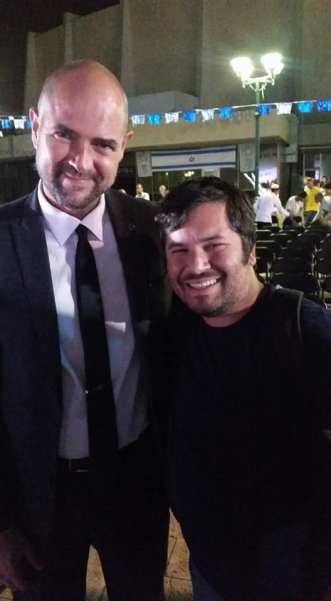
A choir sang sad songs.  Flames were lit by families of the deceased.  A Member of the Knesset, incidentally an openly gay one which was kind of cool, read a moving speech.  His name is Amir Ohana and he’s the first LGBT parliamentarian of the Likud.  I’m not usually a fan of his party, but I admire his courage in being himself and today isn’t really about politics.  It’s about memory.  He was really nice and we took a cute selfie.

ohana

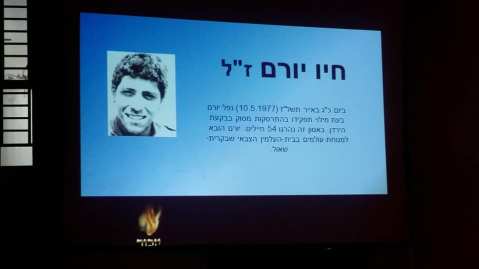
I walked over to the other side of the event where a screen showed a slideshow of all 37 young people whose lives were lost- from my neighborhood alone.  You simply can’t understand the magnitude.  It has only 11,480 residents, like a small town in America.  Everyone either lost someone in their family or knows someone who did.  It’s a moving and sad experience to watch the names and pictures of these young people scroll down.  Over and over.

I noticed a middle-aged woman alone- tears welling up.  She asked how I knew how to zoom in on my camera.  I showed her and then told her, being a good Israeli, that I’d just take the picture for her.

The picture she needed was of her brother.  Yoram Hayu.  Killed in 1977 in a helicopter crash at the age of 18.  He started the army a year early because he was that motivated.  While he grew up in Hatikvah, he also was a kibbutznik- perhaps during his army service.  He was Smadar’s older brother, apparently a hit with the ladies, and now he was gone.

chayal

Smadar, the woman, she’s from my neighborhood.  She was at the ceremony alone, with her mom at home.  This was the first time she had been to the memorial ceremony in our community.  Since 1977 when her brother was killed.  She had been to other events, but not right here where they grew up together.  She was visibly moved and sad.

In America, when you see a stranger who’s sad you probably just say you’re sorry.  People are protective of boundaries and also more distant.

Here, seeing Smadar alone and sad, I simply hugged her.  And she held me, we swayed, we shared in the sadness and I tried to bring her some comfort.  Because a greeting card doesn’t say I love you.  That’s how Israelis do.

I told her that I was grateful to her brother and all the soldiers who made it possible for me to live here.  She stopped me: “don’t say thank you.  You don’t need to.  It was an obligation- his service.  It’s our obligation as Israelis.  If you want to honor his memory, live your life to the fullest.  Enjoy and appreciate every moment you breathe.”

It was so affirming.  So brave.  She asked me about my aliyah and my life.  Of course, she asked me if I was married.  When I said no, she said she’d look for someone.  And I said: “I’m gay, it needs to be a guy.”  She said: “hmm, that can be tricky in Hatikvah, but I have a hairstylist who’s gay and has a partner- I’ll ask him for names.”  Then, she told me she’d ask her friend if I could go to his Independence Day barbecue.

As the evening drew to a close, I told her: “only in Israel can you make a shidduch on Yom Hazikaron!”  We laughed and laughed.  It’s really true- we’re a people more than any other that knows how to draw out the honey from the wound.  And make the best of life.  With Syria and Iran threatening us, with slides of fallen soldiers still scrolling behind us, Smadar and I smiled as we said goodbye.  Her second shidduch may be finding me a nice guy.

But her first one was becoming my friend.