Dugri: Lost in Translation

There has always been a yawning communication gap between Israelis and Americans- and between Israelis and the world.  Every country and culture has a unique communication style, and in my case, this often leads to challenging interactions with Sabras.  Sabras are Jews who were born and raised in Israel, whereas I’m an oleh- I chose to live here.

The sabra communication style most well known is “dugri”.  Dugri, from an Arabic word (itself of Turkish origin), means “straight talk”.  The word in Arabic means “straight” (like when giving directions), “fair” (like an arbiter not choosing sides), or “honest” (truthful words).  In Hebrew, the word means “direct”- but not in the sense of “honest” in Arabic (which is focused on presenting correct objective facts), but rather directly expressing your subjective emotions and opinions, regardless of how they are perceived.

In Israel, this means less pleasantries, less consideration, less politeness, more tough love, more controversial statements, and more blunt judgments.

There are ideological roots to this communication style that have been well-researched.  I highly encourage reading Professor Tamar Katriel’s study, which I’m still working through.  Going back to the early Zionist pioneer days, ideological olim wanted to rid themselves of what they perceived as a “Diaspora mentality” of formality, nuance, and passivity.  Again- this is their perception, not necessarily the facts.  The answer, especially for their sabra children, was to be found in a new, astoundingly direct and informal communication style, itself ironically rooted in German enlightenment philosophy.  I can empathize that building a new national identity was hard and I also think their attitude towards the Diaspora was pretty hateful.

This style, before I deconstruct the hell out of it, has its advantages.  For instance, I’m a very informal person so I like that dugriyut- or speaking dugri- allows me to speculate, to dream, to ponder.  I don’t have to cross my i’s and dot my t’s- I can just roll with it.  It fosters creativity in me.  I also like that I don’t have to think through every word I say for fear of literally losing friendships.  Here, an occasional offensive comment is not going to lose you anything.  When used properly, speaking dugri can reduce some of the feeling of “walking on broken glass” we face in America when communicating.  Also, hearing people’s deep-seated personal prejudices, while valued in Israeli society, for me actually serves as a defense mechanism so I can avoid someone who is actually toxic.  I rarely have to guess what people here think.

Now the flip side.  First things first- I’m a proud Israeli and I’m an American.  My family has lived in the Diaspora for 2,000 years and while I’m glad to be back, I’m not ready to give up the wisdom gained over centuries.  I’m a firm believer that it is not only possible, it is desirable to have more than one culture.  This is an issue Israel has struggled with from the beginning– as do many countries.  I understand- and will continue to learn about- dugri communication but that doesn’t mean I’m going to “negate” my other cultures.

In Hebrew, the ministry that deals with olim is called the “Ministry of Absorption”.  I can’t even imagine a more Orwellian phrase, but let’s work with it.  Yes, to a degree, I came to be absorbed into Israeli society.  But a funny thing happens when your body absorbs something- it changes your composition.  And so much in the same way, I intend not just to be changed, but to change this place.

So what does this mean for dugri talk?  First off, we need to see some of the negative aspects this style can present.  For example, when sabras interact with foreign cultures, including Americans, they often struggle to perceive cultural differences.  Just this week alone, on three separate occasions, Jews here made (what I consider) offensive remarks to me about Americans being “fake” etc.  This is a common sabra complaint- Americans are polite, but insincere when they compliment you.  All the while, I’m sitting there talking with them as an American with ten times better Hebrew than their rrrrresh infected mouths can mumble in my language.

This is endemic of the problem.  Because Israelis are sparse- but quite genuine- with their compliments (as befits dugri talk), anything other than that is seen as insincere.  What they don’t realize is that it’s simply a cultural difference.  When Israelis move abroad and don’t know how to say “please” or “thank you”- or try to say something unacceptably blunt- they lose friends and often struggle to make non-Israeli friends.  This is well-documented by a study done among Israeli migrants to Canada.  Boy if they think Americans are polite, wait till they meet Canadians haha.

The truth is there are fake people and genuine people in every society.  For me, for instance, I encounter some Israeli communication as incredibly insincere- even though it’s just likely just a cultural difference.  For instance, especially in Tel Aviv, when people promote upcoming events (or compliment someone for leading an event), a whole litany of “mehamems” and “madhims” and “nehedars” and “merageshs” come out.  Basically, just a list of how everything is the most amazing awesome best coolest most wonderful thing ever.  It’s enough to make me, as an American, nauseous because it sounds like they’re lying.  But what I’ve come to realize is that there’s probably a cultural component to it.  Rather than calling all sabras fake, I chose to read hours of academic articles and confront the issue meaningfully.

For me, besides the nuisance of Israelis telling me my country (and implicitly perhaps me and my friends there too?) is fake, I have to wonder if there’s a broader cultural problem at work.

Israelis, unlike almost any civilized society I’ve lived in or visited, have completely separate school systems based not only on race/religion, but also what type of religiosity.  There are Arab schools, secular Jewish schools, Modern Orthodox schools, and Haredi schools.  These schools operate completely separately in state-sanctioned (and largely publicly supported) segregation.  There are social reasons for this- I’m not pretending it came out of nowhere.  But the end result is that Israelis rarely if ever interact meaningfully with people from drastically different backgrounds.  And they don’t learn how to understand intercultural communication.  Nor the value that sometimes, just because you think a thought doesn’t mean it’s best to say it out loud.

In 6 months in Israel, I have become a regular in Bnei Brak speaking Yiddish, I have visited half a dozen Arab villages in Arabic, I hung out with Samaritans, I watched Karaites pray, I talked with Armenians (in Arabic!), I blasted Eritrean music with refugees at a juice bar, I tutored a Darfur survivor in English.  And on and on and on.  I know this country much, much better than most of the sabras who’ve lived here their whole lives.  And it’s not because they’re bad people.  I have learned much from my sabra friends.  And they have much to learn from me about their own country.  This is one of the most diverse and exciting places on the planet.  A place I enjoy even more because of my diverse American upbringing.

Now it’s time for me to dish out some dugri talk (see I do like it sometimes!).  Sabras- you’re mostly racist or at best, unappreciative of the diversity that surrounds you.  Your difficulty in communicating across the cultures in your own country reinforces your prejudices- including towards olim.  I’ve lived all over the world, including spending lots of time in the Deep South in the U.S., and this is by far- by far- the most openly hateful society I’ve lived in.  Not just in terms of race, but also in terms of prejudice between different sectors of society (Secular vs. Orthodox, Ashkenazi vs. Mizrachi, etc.).  There are some of the most incredibly kind and hospitable people here too.  It’s just that the level of judgmental speech and behavior is mind boggling and frankly makes me appreciate my American upbringing- and question whether I want to raise my kids here.

In particular, there are times when the secular Ashkenazi liberal elite here sounds like a bunch of American tea partiers who long for the 1950s.  An era in which the government was basically run by a bunch of white men (them), when Holocaust survivors were told they went like “sheep to the slaughter”, when Arabs were under military rule, and Mizrachi Jews lived in impoverished camps.  But at least in the “good old days”, the government was more secular i.e. more like them.  Perhaps not coincidentally it is this same demographic that coined “dugri talk” generations ago.  Language is power.

The key is that every culture has its communication style.  It was hard for me to write a blog that was in English but appropriately non-judgmental for an American and appropriately dugri for an Israeli.  And I’m still learning about Israel even though I speak the language fluently.  I will always be learning.  I recommend all olim- indeed all tourists- learn about Israeli dugri talk.  And sabras- if you care at all about the millions of people living here born in other countries (or your own ability to travel abroad without offending people)- learn about yourselves.  You don’t have to give up your directness but you do need to learn how other cultures work.  Because it’s not that all Americans are fake.  It’s that you’re not self-aware.

Do your homework.  That’s my dugri talk for the day 🙂

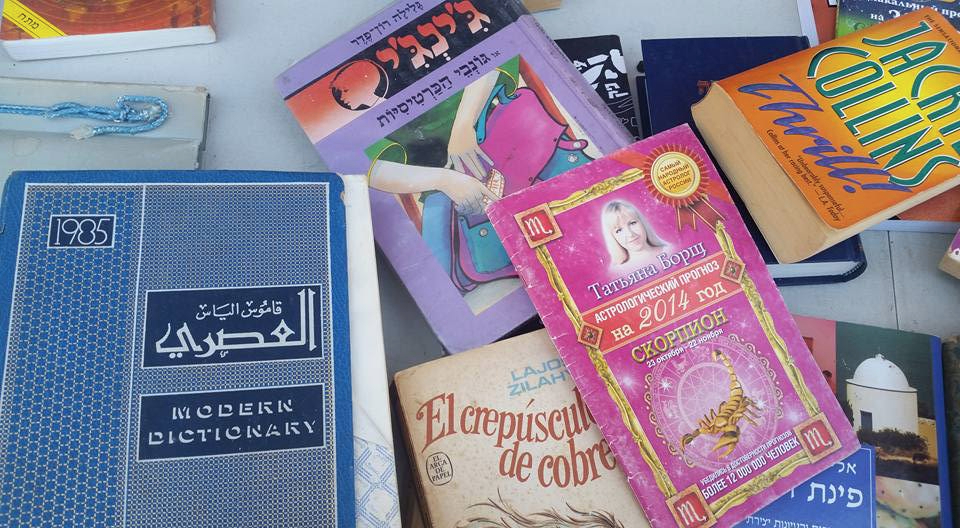
p.s.- my cover photo is a paper I used to teach a Swahili-speaking Tanzanian in Holon about Hebrew vowels…via Arabic because she’s an Arabic teacher.  Intercultural communication isn’t a hobby- it’s a lifestyle.  Open your eyes and join the miracle 🙂
The Satmar part of town

I’d like to tell you a story about nothing.  It’s kind of refreshing in a place where shit is constantly hitting the fan (although much less than someone from abroad might think).  As I write this blog piece, an Israeli plane bombed some military facility in Syria and air raid sirens went off in southern Israel.  I heard some loud noise in my neighborhood and so I checked the news and found out about these events- I have no idea what the connection is but it can be scary here sometimes.

And then life continues.

So right, the other day I went to Bnei Brak.  At this point, we can say that Bnei Brak- and Hasidic Judaism– is a part of my identity.  I don’t just go as a “tourist”- I go because it’s part of my heritage and my people and it’s absolutely fascinating to see a living, breathing Yiddish community.

After eating delightful gefilte fish and kugel and buying loads of Hasidic music, I headed to the Satmar part of town.  The Satmar part of town?  Yes.  In Bnei Brak, each Hasidic group has a yeshiva where people study and it’s kind of their neighborhood.  In a small way, it’s a way of bringing back their former towns in Europe destroyed in the Holocaust.  Because the way you get around Bnei Brak is to say: “where is Vizhnitz?  Where is Belz?  Where is Satmar?”  These are all Hasidic groups- all named after the towns in Eastern Europe where they were founded.  And there’s an eerie and beautiful ring to being able to ask where they are- still- as if you’re heading to the village itself.

So why did I go to the Satmar part of town?  First of all, what is Satmar?  Satmar Hasidim are one of the largest Hasidic groups in the world, with members in multiple countries.  This still makes them a small minority of Jews, but they are influential and growing.  While most Hasidim are not Zionists, they are very much in favor of the Jewish people, love the Land of Israel, and have varying degrees of affinity for the Jewish state itself.

For instance, there are Haredi parties in the Knesset- the Israeli parliament.  These parties are dominated by Hasidim and participate in the lively (and often chaotic) Israeli political process.  Secular Israelis often bemoan these parties’ political influence and that their voters sometimes get government stipends to learn Torah.  I’m not interested in the politics here, just setting the stage.

On the contrary, Satmar are much more insistent on maintaining separation from the Israeli government.  To the surprise of some reading this blog, Satmar Hasidim do not accept any stipends from the Israeli government and do not even vote in national elections.  Say what you will about their politics, at least they’re consistent.  To those secular Israelis bemoaning Haredi “leeches” stealing our tax dollars- that simply doesn’t apply to Satmar.  You might wish they were Zionist, but they aren’t hypocrites.

Anyways, I don’t want to get sidetracked into messy political and ideological debates.  I’m clearly not a Satmar Hasid- I’m a queer Reform Jew- but I find the community interesting, especially since they are often a target for secular disdain.

One of the cool things about Satmar Hasidim is their love of Yiddish.  Most Hasidim in the U.S. both speak and read/write Yiddish.  I’ve discovered that most Hasidim in Israel speak Yiddish as a native tongue but write in “loshn koydesh”- or what we call Hebrew.  That in and of itself is a fascinating linguistic dichotomy worth a separate blog entry.

But Satmar, they speak and read and write and live and breathe Yiddish.  So, wanting some books in Yiddish, I headed to their part of town.  I found a bookstore (one of the cool things about Bnei Brak is the plethora of Jewish bookstores) and immediately noticed there were more Yiddish books than elsewhere in Bnei Brak.  I then asked the shop owner (in Yiddish) where I could buy a Yiddish newspaper.  Seeing I was wearing jeans and a sweatshirt, he knew I wasn’t Hasidic even though I wore a yarmulke.  So he told me I could talk to him in Hebrew.  But when I told him “ober ikh hob lib yiddish” – but I loooove Yiddish – he grinned from ear to ear. And told me to go to the grocery store around the corner.

At the grocery store, I talked to a bunch of people to get help finding a paper.  Because the new papers come in on Friday morning before shabbes, there weren’t any left.  Although there were some interesting looking magazines.  Because I’m a creative person and an Israeli, I then asked if they had last week’s papers.  And sure enough, there were some.  I got a copy of Der Blatt, a Satmar newspaper printed in the U.S. and read around the world.

The two guys behind the counter shmoozed with me.  It was so fun!  One of them, when I couldn’t find the word in Yiddish, would revert to Hebrew.  But the other guy- he was a real mensch.  He would answer me- in Yiddish.  THIS is how you know a language is strong.  When the speakers stick to their guns- either out of ideology or monolingualism- those are the people to talk to.  Because that’s ultimately how I learn best.

They were really impressed that I came to buy a Yiddish newspaper to practice the mamaloshn- the smiles, the kind words- they were real.  Before leaving, I thanked the guy who answered me in Yiddish, saying I appreciated him helping me learn.  He gave me a wink and I was on my way.

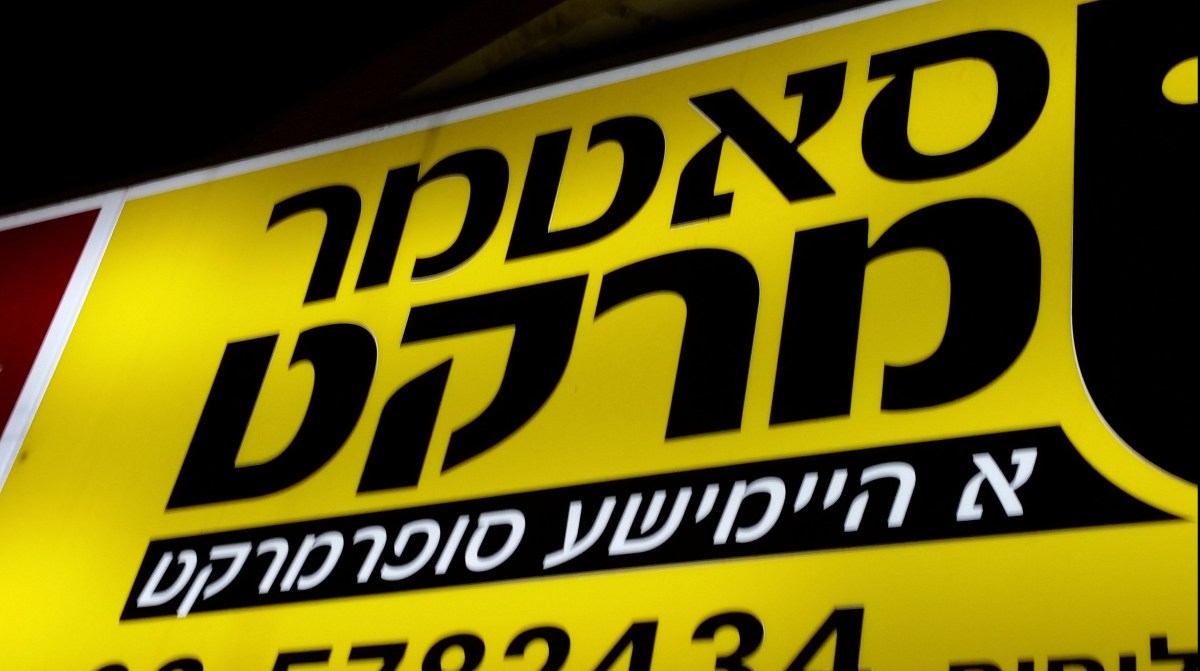
On my way out, I noticed a sign (in the cover photo): “Satmar Market: a homey supermarket”.  For my fellow linguists, there’s something interesting here.  While Satmar Hasidim stick to Yiddish out of a desire not to use Hebrew (the holy tongue for prayer), the sign is actually bilingual.  The words “market” and “supermarket” are written like you would in Hebrew and the other words in Yiddish spelling.  Guess things are a bit more complex than meets the eye.  I love it.

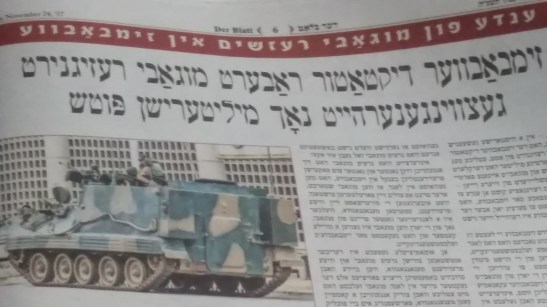
A few days later, I sat and started reading the paper.  And I noticed the most fascinating headline.  On the front page was an article about the Zimbabwean dictator Robert Mugabe being deposed.  Based on my own preconceptions about Satmar- their opposition to the Israeli government, their intense and strict Judaism, and their focus on study- I expected a bunch of articles about Torah.

20171205_020630

But lo and behold, in a residential neighborhood of Bnei Brak, people are reading in Yiddish about Zimbabwe.  And Saudi Arabia.  And tax reform.  And the Warsaw Ghetto.  Just in this week’s edition.

So what’s my story?  I have absolutely no story.  During a stressful week, I took a bus to Bnei Brak, ate delicious food, bought good music, and found an interesting newspaper in the language my ancestors spoke for 1,000 years.  I felt at ease, I hopped on a bus, and met a gay Reform friend for ice cream in Tel Aviv.

Want to live in a bubble where you know more about trekking in Cambodia than about your Hasidic neighbors?  Your loss.  There’s a fascinating civilization down the road begging to be discovered.  Begging for you to rediscover it inside you.

It’s not about agreeing on everything- or much at all.  It’s just about being a curious, open-minded human being and finding sparks of light to illuminate your path- wherever you might find them.

Yiddish lives

One might be surprised to hear this, but Yiddish lives in Israel- and not just among Hasidim.  Yiddish is the traditional language of Ashkenazi Jews like me.  Before someone says something stupid, let me clarify something- Yiddish is NOT a “mixture of German and Hebrew”.  It is also not only a Hasidic language- it has existed for at least a thousand years as a distinct language, whereas Hasidism has been around for about 400.  On the eve of the Holocaust, 13 million Jews- socialists, communists, Zionists, anti-Zionists, Hasidim, secularists- spoke the language.

Yiddish is an archaeology of the Jewish people and linguistic proof of our ties to the Land of Israel.  About 2000 years ago, Romans expelled Jews from Israel and destroyed the Temple in Jerusalem.  The Jews who weren’t executed were expelled or enslaved.  Many eventually made their way to other parts of the Roman Empire, where their Aramaic and Hebrew vocabulary became enriched with Latin words.  For instance, a famous Yiddish word (still said today even in Jewish American English) is “bentsch”.  To bentsch is to say the special prayer after eating a meal, coming from the Yiddish word “bentschn”.  This word comes from the Latin root “benedicere” meaning “to bless” like “bendecir” in Spanish.

As was the custom of European Christians for the 2,000 years of Jewish existence on their continent, time after time Jews were expelled as we were scapegoated for various social problems.  Other minorities today can probably relate.  And so with each expulsion and migration, Yiddish was enriched with new vocabulary- Italian, French, and eventually Germanic languages.  To be clear- at the time Jews started settling in present-day German speaking areas like Switzerland, Germany, and Austria, there was no such thing as the German language.  There were a variety of Germanic dialects (some of which are still spoken), but no unified language.

Yiddish borrowed heavily from their neighbors’ lexicon, although in some cases developing new meanings particular to their community.  For instance, while in German “shul” means “school”, in Yiddish, it can mean “synagogue”.  Hebrew and Aramaic also interplayed with the Germanic words.  For instance, “froynd” in Yiddish is a “casual friend” or “acquaintance”, similar to the Modern German meaning.  But in Yiddish, there is another level of friendship- a “chaver” (or “chaverteh” for a woman- that’s a Hebrew word with an Aramaic suffix).  That’s a real close friend.  And it says something about the value still placed on Hebrew (known often as “loshn koydesh- holy tongue”) even in the Diaspora.

As German-speaking peoples decided to butcher Jews during the Crusades and expel them from their cities, Jews went eastward.  Believe it or not, initially Polish and Lithuanian rulers (these countries today are more well known among Jews as places we were massacred) welcomed Jews.  Jews became merchants and built communities in Poland- and then all across Eastern Europe, down to Romania and Ukraine.  Name a country in Eastern Europe and we made our way there.

Of course the Slavic vocabulary lent a new angle to the language.  While the Jews that remained in Germany, Holland, and France continued speaking Yiddish- a new dialect developed: Eastern Yiddish.  Bubbe, Zayde, Tate, Mame- grandma, grandpa, mom, and dad- are all derived from Slavic roots.  The first two are to this day used by many American Jews to talk to their grandparents.

Meanwhile, Hebrew and Aramaic maintained a strong presence- perhaps also due to the fact that these languages were used extensively in prayer and in study.  They maintained such a strong presence that when Zionists aimed to revive Hebrew as the main spoken language of Jews, they looked to Yiddish for both Hebraic words and for Yiddish expressions to translate.  The modern Hebrew words B’seder, mamash, b’tachlis, chutzpah, and so many more are of Yiddish origin.  Which is to say- they are Hebrew (“holy tongue”) words that made their way into specific usages in Yiddish- and these usages were copied into Modern Hebrew in a way they didn’t necessarily exist in the Torah or other Jewish languages.

Speaking of translated phrases, did you know the Hebrew greeting “mah nishma?” is literally a translation of the Yiddish phrase “vos hert zach?”, meaning “what is heard?”  Even the famous “mah pitom?” is a translation (calque) from Yiddish.  If you speak Modern Hebrew, you speak more Yiddish than you thought!

Which brings us back to the language.  After the Nazi Germans and their anti-Semitic collaborators murdered 6 million Jews, most of them Yiddish speaking, the language was devastated.  Ashkenazi Eastern European civilization was brutally brought to an end after 2,000 years of life on the continent.  The language itself was feared extinct as the only remaining centers- the U.S. and Israel- were encouraging linguistic assimilation into English and Hebrew respectively.

In particular, in Israel, the government actually forbade non-Hebrew newspapers and theater performances.  Feeling Yiddish (and languages such as Ladino and Judeo-Arabic) was a threat, there was an actual “brigade” of volunteers who would go around shutting down Yiddish events.  I can’t think of something more horrifying to experience than for a Holocaust survivor to have a fellow Jew attack them for speaking the mamaloshn- their mother tongue.

Over the years, the remnants of Yiddish faded both in America and in Israel as Jews were told (either by Christians in America or fellow Jews in Israel) that their language was “lame”, “ignorant”, “backwards”, and (in Israel) “Diasporic”.  For all of Israel’s renewed interest in multilingualism and greater tolerance for diversity, I experienced this attitude myself when I posted my English blog in an LGBT Israeli group (with a description in Hebrew) and someone berated me saying I needed to write my blog in “the holy tongue”.

In particular, people have called Yiddish a “dialect” or “jargon” over the years.  This goes back hundreds of years in Europe- it was a deliberate effort by ruling Christians to demean Jews by insulting their language.  And sadly, some Jews internalize(d) this thought even though Yiddish published its first dictionary before German and tens of thousands of books, 12,000 of which are preserved digitally here.  Yiddish is a language with many influences, just like English.  It is a storied and beautiful language.  As a famous Yiddish linguist Max Weinreich said: “a language is a dialect with an army and a navy”.

When my ancestors moved to America in the late 1800s and early 1900s to escape anti-Semitic violence in Eastern Europe, they spoke Yiddish (one of them also spoke Romanian!).  I even found the Census records to prove it.  With each subsequent generation, a bit more of the language was lost, but it is still present today in my dialect of English, where words like “schlep”, “shlemiel”, “shmear”, and “oy gevalt” are omnipresent.  And sometimes need to be explained to non-Jews!

Yiddish has always acted as a storage device for Jewish culture.  There are certain things that just can’t be expressed in other languages.  And while Germans can understand much of it- there’s a lot they can’t.  And Jews can change their register (by adding more Hebrew and Aramaic, e.g.) to make it harder for them to understand- which is the point.  It was a clever way for Jews to understand their neighbors but speak more secretively if needed to protect the community.

Yiddish, as we saw, also stored a lot of Hebrew.  In some ways it kept the language alive over the course of 2,000 years.  I dare anyone who says Jews aren’t tied to this land to explain to me why Lithuanian Jews were speaking a language 20% made of Hebrew words.

In the end, Yiddish shows that Judaism is not just a religion, it is also a culture- a people.  It’s not coincidental that a few hundred years ago, a Jew in Poland could communicate better with a Dutch Jew than with a non-Jewish Pole.  Jews’ primary relationship was with other Jews.  There is no such thing as Presbyterian cuisine, literature, and language- because that’s a religion.  The word religion is a foreign concept to Judaism- we are a tribe.  You cannot fully separate the culture and the spiritual nature of our people- although many a secularist (and Haredi) have tried.  They are inextricably tied together just like natives living in the Amazon.  Where one starts and one ends is unclear- and there’s no need to clarify it.

Growing up speaking Jewish American English, I was always exposed to Yiddish.  All of my grandparents spoke it or understood it to varying degrees.  And it peppered my conversations.  It’s a very expressive and fun language with a soft side to it.  Despite some of the efforts of Hebrew purists to rid the language of Yiddish, I actually see a lot of it reflected in Israeli culture and language.  It feels comfortable.

A few years ago, I found a private tutor to start learning the language in earnest.  I then was blessed with the opportunity to go to the Workmen’s Circle “Yiddishland” program in New York.  There I learned not only the language, but also the culture- the music, the traditional dancing, so much.

When I made aliyah and moved to Israel, I wasn’t sure how much yiddishkayt- Yiddishness- I would find.  I’ve been pleasantly surprised at how vigorously Hasidic communities here are preserving the language- my cover photo is a bunch of newly printed Yiddish books for children in Bnei Brak.  With Hasidic Jews’ high birthrate, the language is about to make the comeback of a lifetime.  At the same time, I personally wanted to find a more progressive setting for my Yiddish too.

I’ve been pleased to connected with organizations in Tel Aviv like Yung Yidish (a library and concert venue in the Central Bus Station), Arbeiter Ring, Yiddishpiel Theater, and so much more.  I even got the chance to see a Yiddish musical based on the Barry Sisters last night!  The subtitles (which I was proud that I only needed occasionally) were in Hebrew and Russian.  Not a small number of Russians here also speak the mamaloshn- tribute to how international and cosmopolitan this language is.

To conclude, I’d like to share a story about how Yiddish lebt- how Yiddish lives.  I went to the library here to try to find Yiddish books.  I was disappointed when the librarian said their branch had none.  Feeling despondent about the future of the language, I asked what other languages they had.  She mentioned French, which I also speak.

I headed back to the French section only to find something curious.  A French book- almost a hundred years old- by famed Yiddish writer Sholem Asch!  In other words, a Yiddish book…translated into French!  I shared my excitement with the librarian, who was astonished.  I may very well have been the only person to discover this.

This is how Hebrew survived in Yiddish- and how Yiddish now survives in Israel.  Little fragments of a prior world integrated into a new form.  An immaculate metaphor for Judaism itself.  And I’m telling you- don’t count Yiddish out.  Because those sparks of Yiddishkayt are being rekindled- in Bnei Brak, in Mea Shearim, and right here in the most secular place of all- my home, Tel Aviv.

The most diverse Israeli day ever

Today, I did too many things to write a story.  So I’m going to list them:

-I spent a train ride talking in French with an Orthodox Jew of Moroccan origins who immigrated from France.

-I hung out in an underground pool with arches built in 789 by the Abbasid Caliphate in a boat.  And then I wrote an Arabic poem while inside!

-I met Peruvian (Jews?) and talked in Spanish about my friend Claudia who did Peace Corps in Peru.

-I visited a church from the 1200’s with a super hot Arab security guard whose smile and kindness melted my heart.  Can you say “return visit”?

-I bought a CD of Iraqi music in Arabic sung by an Iraqi-Israeli Jew back in the day who was born in Iraq- for 10 shekels!

-I talked about Ethiopian music and Sigd in a store covered in Amharic and Hebrew signs.

-I watched Karaite Jews pray Ma’ariv evening prayers.  Most of them are of Egyptian origin, so I chatted with them in Syrian and they responded in Egyptian Arabic.

-I made friends with an Israeli soldier when our trains got messed up and delayed and we had to switch lines.

-I did dinner in a mixture of Hebrew, English, and French with a Sabra and a French non-Jewish PhD student…whose family is from Guadeloupe!   We talked about our shared love of Zouk.

-I danced dabke for easily three hours with young Arab students.  A German exchange student came and I helped a talented dancer in a hijab translate dabke instructions into English (and a little Yiddish, which he can largely understand!).

-I then hung out with said wonderful German exchange student for another three hours walking around Tel Aviv and talking about life here.  He is one of the most open-minded, non-judgmental, kind people I’ve met here.  He’s not Jewish and I couldn’t imagine that a non-Jewish German would make my night…in Tel Aviv!

-Thinking no more cultural richness was possible, I hopped into a cab.  The Israeli man turned on the music (without lyrics) and asked me to guess where it was from.  Within 5 seconds I said “Thailand!”  I love Thai music and used to buy it at the Thai grocery store back home.  He was shocked.  His wife is Thai and he lives in Thailand with his children, only coming back to Israel to care for his parents.  He speaks fluent Thai- as do his biracial children.  He was mightily impressed that my favorite Thai dish is Pad See Ew- he says everyone says Pad Thai!

This is what I have to say- today I spoke English, Hebrew, Arabic, Spanish, French, and Yiddish.  Just last week I also spoke Catalan, Portuguese, and Farsi (with both Persians and Bukharans).  If you have the curiosity, the passion, and the will- you can experience more cultures here than you can count.  I live in a neighborhood where I regularly meet Iraqis and Moroccans and Syrians (Jews) and Burmese and Sudanese and Eritreans (non-Jews)- I even had someone tell me her friend is half Ghanaian half Filipina.

When people find out I’m a polyglot, they often tell me “what do you do with your languages?”  Sometimes it feels accusatory- “why aren’t you making a ton of money off of them?  Why aren’t you working for the government or the military or the CIA?”

You know what?  What I do with my languages is what I did today.  I explored ancient civilizations, made new friends, learned about other cultures, danced, sang, wrote poetry, and built bridges of peace.  I felt happy 🙂

If you can show me something more valuable or enriching than that, be my guest.

In the meantime, I’m just happy to live in one of the most diverse countries on the planet.  Where the combination of things I did today is only possible here.  One person today said to me “but honestly what is there to see in Ramle?”- one of today’s destinations.

The answer: “everything, if you’d just open your mind.”

Something my fellow Reform Jews don’t want to hear

This past Thursday, a group of Reform Jewish leaders from the U.S. and Israel tried to hold services in a plaza above the Kotel (Western Wall).  In an atrocious display of aggression, security guards roughed up the rabbis to try to prevent their prayers.  Sadly, Israel suffers from a deep lack of religious pluralism, where progressive Jews aren’t given any legal stake in the Jewish State.  Frankly, even a number of Modern Orthodox rabbis (including in the U.S.) have felt the consequences of this exclusion as the Rabbinate veers further and further rightward.  It’s hard to see how excessive state involvement in religion is good for our people- including our religion itself!

And yet.  I find something utterly audacious and disrespectful about the way the Reform Movement, of which I have been a part since birth, is handling this situation.  Prime Minister Netanyahu, who is not my favorite politician, is nonetheless the democratically elected leader of Israel.  In a democracy, leaders are selected on the basis of citizens’ votes.  It’s quite simple.  In the U.S., rather than a parliamentary system, we have Congress- but the principle is the same.

Reform Jews in the U.S. skew very liberal.  I myself am a progressive and a die-hard American-Israeli Reform Jew.  Name a Reform program, and I’ve done it.  Hebrew school, Confirmation, NFTY, my Temple youth group, serving on various boards, leading teen services, serving as president of my college’s Reform Chavurah, hosting the national Kesher convention, traveling with Reform students to Argentina, working at the Israeli Reform Movement’s summer camp, participating in the young professionals group at my Temple in D.C.  And on and on and on and on.  The movement’s values shape the way I see the world.

One of the movement’s points of activism is campaign finance reform.  I wholeheartedly support this endeavor.  The American political system is rife with corruption and the fact that corporations can essentially buy elections (and politicians) to me undermines the very nature of democracy.  You can read the movement’s positions here.

Yet when it comes to Israeli politics, Reform Jewish leaders in America confront the Israeli government as if they were citizens.  While I clearly believe all Jews have a stake in Israel no matter where they live, there is a substantive difference between someone who lives here and someone who doesn’t.  As an Israeli, you pay taxes, you serve in the army, you face the brunt of the government’s decisions, you take the risk of hopping on the bus every day knowing it could frankly be your last.  That is not how American Reform Jews live.  Which is fine, and their right.

But that changes the nature of the conversation.  When Prime Minister Netanyahu and members of his coalition have insulted Reform Jews, progressives abroad were rightly outraged.  But what I found astonishing was that for many bigwigs in the progressive Jewish world, the reaction was to say they’ll use the “power of the purse“.  In other words, to either stop donating to Israeli causes or to shift their donations in different directions.  All of which is their right.

But what astonishes me is how tone deaf this argument is.  For a movement that fights day and night to protect American democracy and to get money out of politics, how do they think it sounds to the average Israeli when Americans say their going to use their dollars to influence the government?  Israelis are already fairly unfamiliar with Reform Judaism, viewing it as an American import (right or wrong), so it doesn’t exactly bolster our case to hear a bunch of rich American Jews threatening the Israeli government.

I have to reiterate- I favor a pluralistic solution at the Western Wall.  I am horrified by people attacking fellow Jews simply because they practice Judaism differently.  My movement deserves a place in Israel, just like every other faith.

I just don’t think that a bunch of unelected Reform leaders coming from America on their annual visit have a right to speak for me as an Israeli Reform Jew.  I know our movement prides itself on democratic values- so why on earth don’t Reform Jews get to vote for our leadership?  Rick Jacobs, the current president, may be an awesome guy- I have no reason to believe otherwise.  But as they say in the famous Monty Python and Holy Grail scene: “I didn’t vote for you.”

I work in public relations for a living so I know the value of a good protest to raise awareness of your cause.  And I think that at least in part motivated this recent activism.  And the absolute idiots who run the Western Wall Foundation gave the protestors a ton of free publicity by harassing them in front of a bunch of cameras.

The Reform leadership seems to think that this news will galvanize American progressive Jews to take action.  I think they’re wrong.  While among the core Reform and Conservative Jews, this may be true, the other 90% who show up twice a year for services are more likely to simply feel alienated from Israel.  And decide not to visit.  And maybe even decide to distance themselves from Judaism itself.

That is a huge problem.  For Israel itself (not just the current government) and for Reform Judaism both in America and especially in Israel.  In Israel, we’re facing the fight of our lives to grow the movement.  Rather than spending money on public relations and paying for American rabbis’ plane tickets- how about you give those dollars to our movement in Israel?  Help us build more schools, more young adult events, and more communities.  And send more people to visit, not give them a reason not to.

In the end, Israel, for all its faults, is a democracy.  And in a democracy, it’s not money that votes.  It’s people.  The Prime Minister, be it the current meshuggenah or another meshuggenah, calculates one simple thing: votes.  When building a coalition, which party has how many seats based on how many votes.  If American Jews are really serious about changing the political calculus in Israel- and helping Reform Judaism thrive here- they should pack their bags.  That’s probably not a popular thing to say- I’m sure I’ll get push back from a bunch of friends.  Of course you don’t have to make aliyah, but can you imagine how different the Knesset would look if a million Reform and Conservative Jews made Israel their home?  At the end of the day, 22% of Israelis are Orthodox (though please, let’s move beyond stereotypes and realize there are bridges to be built here too).  And 3% are Reform.

Do I foresee all my American friends packing their bags and making aliyah right now?  No.  Although if you do, you’d be most welcome and I think you’d find Judaism and life here rewarding.  We have a growing and energetic Reform Movement as well.  In the meantime, let’s do this.  Let’s democratize the Reform Movement so all of our voices are heard.  Let’s allocate more resources to the Israeli Reform Movement so we have a larger and legitimate voice in the political system and society.  And let’s avoid too many public confrontations that force American Jews to choose between their love of Judaism and their love of Israel.

This isn’t a one-sided issue- to my Orthodox friends reading this blog, I hope you understand the agony my movement is going through because we are being publicly humiliated by the Israeli government.  Please help us and raise awareness in your communities.  Israel will cease to exist if the sinat chinam, the baseless hatred, between all of our communities continues.

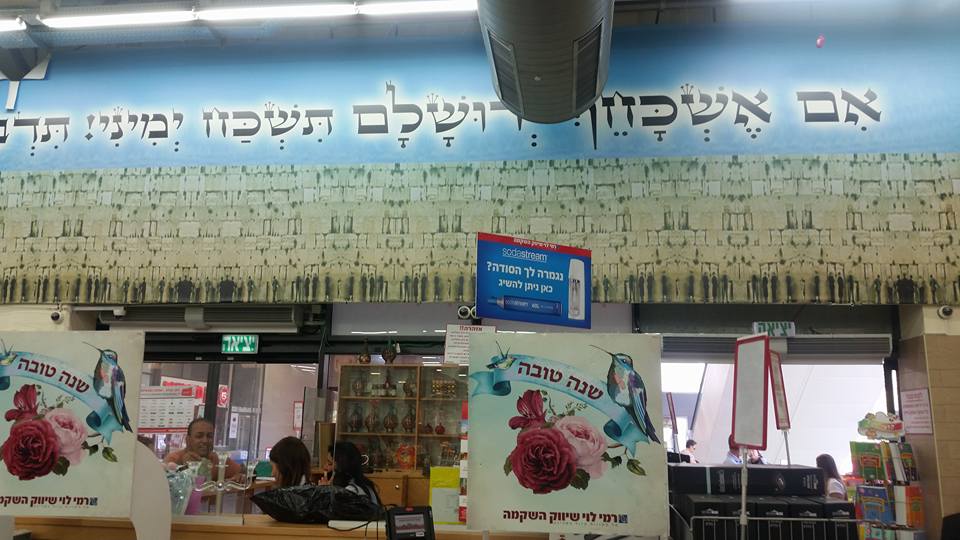
May we come to find a day when the Western Wall, the holiest site in Judaism, is not a place of conflict or control.  But rather, a place of joy, a place of holiness, and a place of wholeness.  As my cover photo in an Ariel grocery store says: “If I forget thee oh Jerusalem, let my right hand forget its cunning.”  Indeed- in loving our holy city, let’s just not forget our shared humanity in the process.  Amen.

The hardest part of making aliyah

When I moved to Israel, I anticipated many challenges.  Israeli culture is very different from even American Jewish culture.  The directness, the sometimes harshness of people’s words can really catch an American off guard.  As can the practically non-existent social boundaries.  I knew I’d have to make adjustments to my career and make new friends.  I’d also sorely miss some of my favorite foods and cultures that are omnipresent in the diverse area I grew up in.  I’d be far from my existing support network and would have to build a new one- practically from scratch.  All this in a country I hadn’t visited for 12 years.

But the single hardest part of my journey, by far, was finding a home.  Not a metaphorical home, but an actual house.

Before arriving, I had reserved an AirBnB for a month to give me time to search for an apartment.  Little did I know that even though the woman advertised having air conditioning, she claimed that she was “allergic” to the machine so she wouldn’t turn it on.  As my Sabra friends told me, she was allergic to the electricity bill.  So there I was, a freshly minted Israeli arriving after 15 hours of travel (with only 1 hour of sleep on the plane) and a bedroom at 87 degrees Fahrenheit.  The final straw for this apartment was when I got food poisoning at four in the morning and rather than offering some words of consolation, the host complained about me waking her up.

After having received a refund for the remaining three weeks from AirBnB, I scrambled to find a place.  Still hung up on jet lag, I managed to find a generous lesbian couple who had also made aliyah from the States a year ago.  I slept in their office for a while while I searched for an apartment.  But as I think we all discovered, having three people, a dog, and multiple cats in a small apartment just doesn’t work.  And from the beginning, this was going to be a temporary place.

So I ran around trying to find a new place.  I found a sublet in the middle of the city.  I had a roommate- not ideal, but fine for a temporary stay.  My landlord, on the other hand, stole money from me that required endless hours of mediation and legal threats to be returned.  It’s not worth going into a ton of detail, but let’s just say that that’s one among many examples.

Needless to say, I was tired of hopping around apartments.  I wanted my own place- no roommates, no pets, no thieving landlords.  With a long term lease.  A home.

This is when I really discovered why Israelis protested en masse in 2011.  In particular in Tel Aviv, there is a massive housing shortage.  Most Israelis want to live in the Center of the country but the building hasn’t kept up.  As a result, demand is high and so are the prices.  Although prices are significantly lower in Tel Aviv than in places like Washington, D.C., San Francisco, and New York (which Israelis should realize- this is not a uniquely Israeli problem), there is a unique competitiveness to the market here.  When you show up to view an apartment, there are often multiple people viewing at the same time.  I can’t think of anything more awkward.  Everyone is trying to woo the all-powerful landlord while somehow pretending to like each other.  It’s super uncomfortable.

Then, the landlord will tell you there’s an extensive waiting list.  And to be honest, there usually is (although of course some lie).  The landlord can ask you any friggin question he wants.  In the U.S., there are extensive rental protections.  Where I lived in Maryland before aliyah, there was even a free service offered by the local government to investigate unscrupulous landlords.  Of course there were still bad apples, but at least there was legal recourse.

Here, the legal system is basically a load of crap.  When it comes to housing, the landlords know they run the show.  I was asked invasive questions about my salary, my family’s salary, my job, my religion, my national origin, my sexuality, my politics, and more.  What Israelis need to understand is that while this is par for the course in Tel Aviv, it is illegal in the U.S. and most civilized countries.  If you have the money and pass a background check, you can legally rent wherever you want in the U.S.

Could I have chosen not to answer these questions?  Sure.  But why would the landlord choose me, then, when she can simply pick someone else from a list of 30 people?  One guy, after grilling me for 30 minutes, ended by saying “you seem like a nice guy, but I have a whole list of people who work for the army and get great bonuses and benefits, so I’m just not sure we’ll choose you.”  With a smile.

I had landlords ask me to pay 6 months rent- up front.  I had landlords ask me to pay rent- in cash.  Leaving me with no paper trail of having paid the rent at all in an almost non-existent legal system.  I was offered one apartment that I’m pretty sure was tied to some sort of mafia.  I was told over and over again that the apartments were quiet- only to find construction projects (both existing and planned- there is a database) all around.

Trying to fix this situation, a new law was passed in the Knesset this past year to provide more rental protections.  What I then encountered were multiple landlords (illegally) inserting clauses into the leases stating that the new law did not apply.  Of course a lease doesn’t supplant the law of the land, but it certainly spoke to what kind of landlord they’d be.  One woman, when I asked her to revise the lease, said “but I’d never hurt anyone!”  And she refused to change it.

At the end of my rope and having seen literally dozens of apartments in person, I turned to the hated real estate agents here.  Real estate agents in Israel are nothing like real estate agents in the U.S.  Here, I don’t hate Arabs, I don’t hate Haredim (these are the usual targets).  No, who I absolutely detest in this country are real estate agents.

I had real estate agents (who I told I wanted a quiet place) try to sell me on illegal apartments inside a carpentry factory.  I had real estate agents tell me a place was too small for me only to call me frantically the next day and say we should go see it because it’s great.

I had a particular apartment I was ready to sign on.  I had had my lawyer review the lease in Hebrew twice.  I had prepared my checks (you have to pre-sign a year’s worth of checks here).  I had prepared my 5000 shekel deposit and my 4000 shekel pre-payment of the last month’s rent in addition to the 4000 shekels for the first month.  In addition to all that, I’d have to pay several thousand shekels to the real estate agent.  But two hours before the lease was supposed to be signed (the day before moving day), the real estate agent told me the landlord wanted to add a clause.  A clause that stated that if I left early, I needed to find a replacement (no problem, this was already in the lease), but also to give up 4000 additional shekels.

Of course I didn’t sign.  Adding a last minute clause is already a huge red flag.  Adding one that would rob me of 4000 shekels if, God forbid, I had a life emergency and needed to find a new renter- now that’s depraved.  The real estate agent yelled at me, a lot.  I told her I had to go.  And she called- I counted- 6 times in 10 minutes and texted over and over.  I wish I could say this was the only time, but I was also berated over the phone by at least two other real estate agents who felt this was somehow acceptable behavior.

The worst part of all of this is that based on the comments I heard from landlords and real estate agents alike, I knew I was being taken advantage of because I was an oleh chadash, a new Israeli.  Even though I have fluent Hebrew.  Nothing about this process is more revolting than that.  I made the sacrifice to make Israel my new home and to see fellow Jews manipulating me made me sick to my stomach.  And exhausted.

Tired of all the games, I decided that I’d look in South Tel Aviv.  It’s cheaper and more importantly, less competitive to find a place.  And when I say South Tel Aviv, I don’t mean the hipsters of Florentin- it’s also a mess to find an apartment there.  And I don’t mean Yafo- it’s in such high demand (and gentrification) that I found it quite hard too.

No, I live where the music is Mizrachi.  Which I love.  Where the streets are filled with diverse refugees from all over the world.  Where there are real, honest-to-God neighborhoods, not some sort of revolving door of young people trying to pay astronomically high rent.  Is my community super queer-friendly and packed with Reform synagogues?  No- although I haven’t gotten to know my neighbors yet and I know Israel can always surprise you.  I do know there are Shas posters nearby, which I find both amusing and frightening.  I’m thrilled that the food is cheap and absolutely delicious.  I even found a sushi place- and the maki rolls cost 9 shekels!  Try finding that in Dizengoff Center!

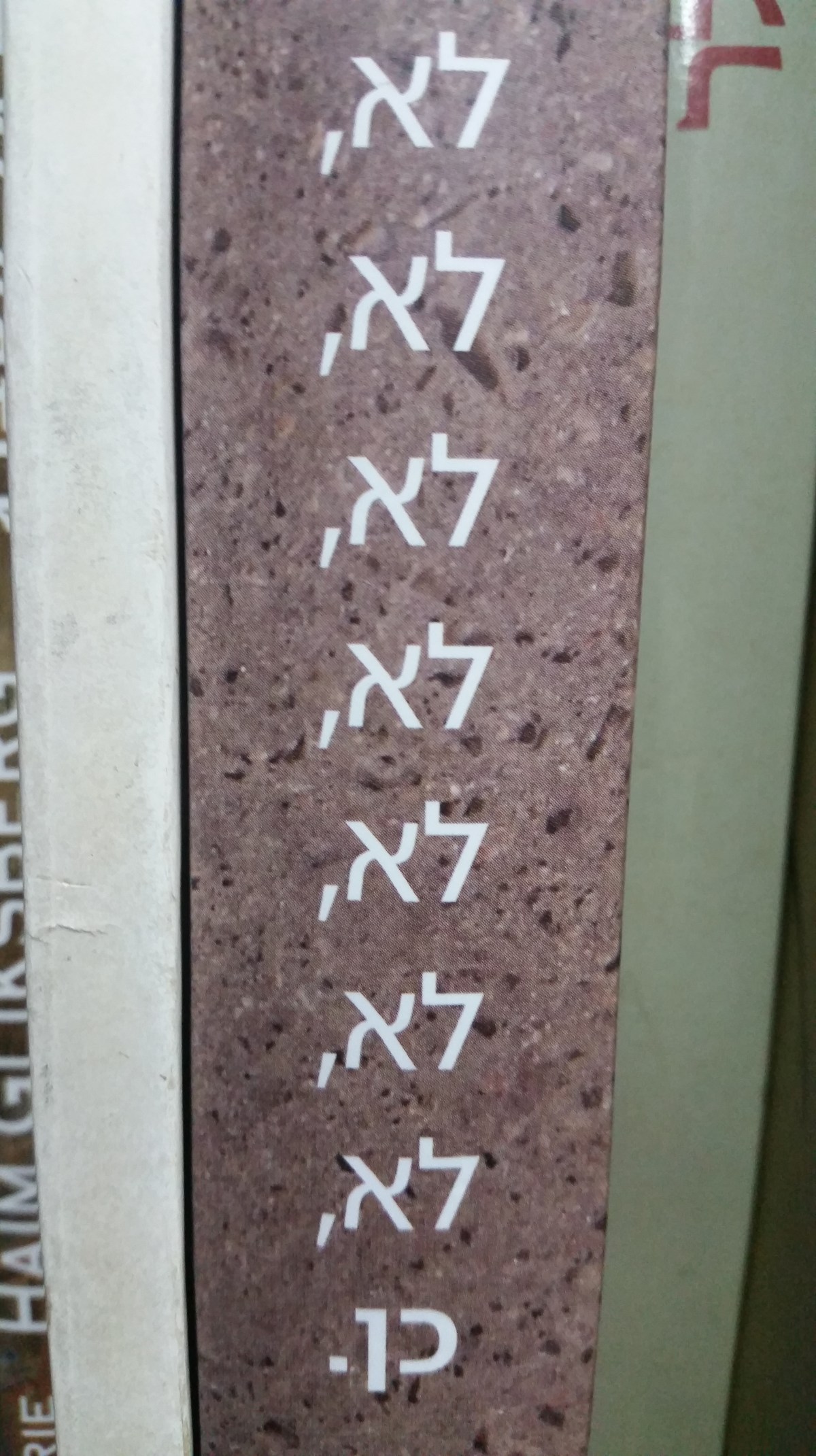
In the end, I come back to my name, Matah מטע.  It means orchard and I chose it because I’m planting roots to bear fruits, to blossom.  And what I realized is this- I was tired of the “no, no, no, no” I was hearing and wanted to get to the “yes”, like in my cover photo.  More than being in a central location packed with young people, what I needed was a home.  And what I started to realize is that having gone through so much in the States, this wasn’t really a new home so much as a first home.  I needed some soil so I could ease my bark into the ground and find some stability.  After four months here, I just needed a quiet, safe place to come home to at night and sleep.

And that is what I found.  I’m grateful for the help of friends and my lawyer, who supported me emotionally and with advice.  Was it easy?  Absolutely not.  If you’re making aliyah because you think it’s a piece of cake, you should immigrate to Ireland.  Or Belgium.  Or Japan.  Because Israel can be really friggin tough.  Not always for the reasons Sabras think, but it is hard.  I have to admit my faith and my hope were tested repeatedly while finding a home.  And I hope I can find some peace of mind by reconnecting to the Israelis who give me spirit, rather than the people who drained me of it.

On my way home Friday, I heard a song wafting through the air in my new neighborhood.  I recognized the melody.  And as I got closer, I sang along: “lecha dodi likrat kalah, pnei shabbat nekablah.”  The traditional Jewish song for welcoming Shabbat, the Sabbath bride.

I couldn’t help but think that for all the challenges I’ve been through- and the unknown ones that may lie ahead- that I made the right choice.  Because rather than hearing the boom boom boom of the middle of Tel Aviv, I’m hearing the songs of my people.  Prayers I’ve said since childhood.

There may not be a lot of Reform synagogues in South Tel Aviv, but you don’t always need one when your prayers fill the air of the market and you’re singing along.  With your new key in hand.  When you move to a new home, you’re praying with your feet.

The biggest threat to Israel

There are many threats to Israel- terrorism, nuclear weapons, earthquakes, poverty, diminishing water resources.  You name it.  But for me, the biggest threat facing Israel is one word: invalidation.

First, let’s start with what the word validation means.  Validation does not mean agreement and it doesn’t mean love.  Validation means showing empathy and understanding where someone else is coming from.  How the conditions of their life have informed their views and even if you see the world differently, you can get a glimpse of why they are the way they are.  Even if, in the end, they may be too difficult for you to be friends with.  It’s a difficult skill and an extremely useful one for living an effective life.

Validation is useful for building healthy relationships.  And its opposite, invalidation, is how you destroy them.  All of us invalidate sometimes- we judge, we mock, we belittle.  Maybe other than Buddha himself, I don’t think there’s a single human being who never judges.  However, there are degrees of invalidation.  Invalidation is when we say harmful, hurtful things to (or about) people.  She’s ugly.  I’m fat.  My neighbor’s a dumb ars.  That Orthodox woman is frumpy.  That gay guy must be a pill-popping slut.  That Haredi man is a fanatical homophobe.  That Arab is only good for making falafel- he probably wants to throw us into the sea.

Israelis have a serious problem when it comes to judging both themselves and others.  Judging has been a part of Jewish culture since the Torah- the Bible isn’t exactly Zen Buddhism.  But I remain fairly convinced that the sometimes mind-numbingly intense judgments that I hear here are also a product of trauma.  When someone is traumatized or experiences intense pain, unless and until that person heals, it is common for people to pass that trauma onto others.  That is why it is so common to see families- generation after generation- experiencing abuse.  It’s also why I distanced myself from toxic relatives and broke a chain of toxicity to build a better life.

If you think of the Jews who’ve come to this land, it hasn’t usually been for happy reasons.  Ashkenazim escaping pogroms.  More Ashkenazim escaping the Holocaust.  Holocaust survivors escaping post-war pogroms (yes, you read that right- Europeans continued butchering Holocaust survivors after the war).  A huge percentage of Ashkenazim here are descendants of Holocaust survivors- including almost every Hasidic Jew.

Mizrachim escaped their own pogroms from Morocco to Yemen- only to find their property confiscated by Arab governments.  And then, upon arriving in Israel, they were put into impoverished refugee camps.  Russian Jews fled the Soviet Union (where their religion was banned) and its chaotic aftermath.  The U.S.S.R. was a government so antisemitic it literally has its own Wikipedia article about how antisemitic it was.  Persian Jews fled the Ayatollah, French Jews fled (and still flee) antisemitic terror and discrimination, and even today there are American Jews like me escaping rising antisemitism and white supremacy in the United States.  The list goes on and on and on and on.  And it has a 2,000 year old antisemitic backstory.

And when these Jews arrived in Israel, while many were grateful for a safe haven, their cultures were often decimated in the name of Jewish cohesion in the nascent state.  Ashkenazim were told to stop speaking Yiddish (police even raided Yiddish theaters- an unforgivable thought when you think that the spectators were likely Holocaust survivors).  I even remember a survivor telling me that when she arrived to Israel from Poland after the Holocaust, Sabras would call her and her mom “sabonim”- “soap”.  That was to make fun of the “weak” Diaspora Jews who the Nazis reportedly turned into bars of soap.  Mizrachim were also pressured to give up their languages, their music, their culture- which to many Sabras seemed a bit too much like the (Arab) enemy.  To this day, they continue to have significantly lower average incomes than Ashkenazim.  And every single Israeli Prime Minister has been Ashkenazi, unless you count some recently discovered Sephardic genes in Bibi’s DNA.

With these examples, we’re literally just scratching the surface with Jews.  And it’s worth saying that the Arab population here has suffered its own traumas- of wars, of discrimination, of terrorism (yes, Israeli Arabs are also attacked by terrorists), of families divided across borders, and more.

Add to this 70 years of on-and-off warfare, and you can understand why Israel has three times the rate of PTSD as the United States.

So when a fellow Israeli is harsh to me.  When they say something mean and judgmental- about me, about another community, about themselves- I understand.  I don’t by any means justify it- I think it’s harmful and if we’re going to thrive as a society, this must change.  And sometimes I frankly have to protect myself by distancing myself from their toxicity.  And I get it.  Israelis have been through a lot.  And not everyone is healing.  It took me a while to get to this understanding- but this is the ultimate validation.  I don’t personally agree with being racist or hateful- I just know that if someone got to that point, there’s something causing it and I hope they choose a different path.

Many Israelis complain to me about American “politeness”.  They think Americans are fake- when they smile, when they say thank you, when they do a whole variety of quotidian acts that make up American culture.  On the one hand, I get it- there are times when Americans can be exceedingly formal.  It can be hard to gauge if someone really likes you- or what they think.

At the same time, I remember what one Israeli friend said to me: “I don’t like that in America they’re all the time worried about whether they’re hurting you.”  To this I say- you’re not talking about politeness anymore.  You’re talking about consideration.  You’re talking about kindness.  You’re talking about someone caring how you feel- and trying to respect your boundaries.  In a way that you never got growing up in a society filled with people whose boundaries have been crossed over and over again against their will.  Who have endured but in many cases, not healed.  And who all too often pass their hurt along to others.

To this I say- enough.  All Israelis, in fact all people, deserve the right to heal from their traumas.  And to not have new pain heaped upon them.  As a society, we can still keep our bluntness and our assertiveness without the spite and without the cruelty.  Find one way to heal yourself this week- and find one way to encourage a friend.  I’m not a psychiatrist or a PTSD expert, nor do I have the power to stop violence.  But I think that if we each find a way to bring some healing into our society, it will do us all a lot of good.

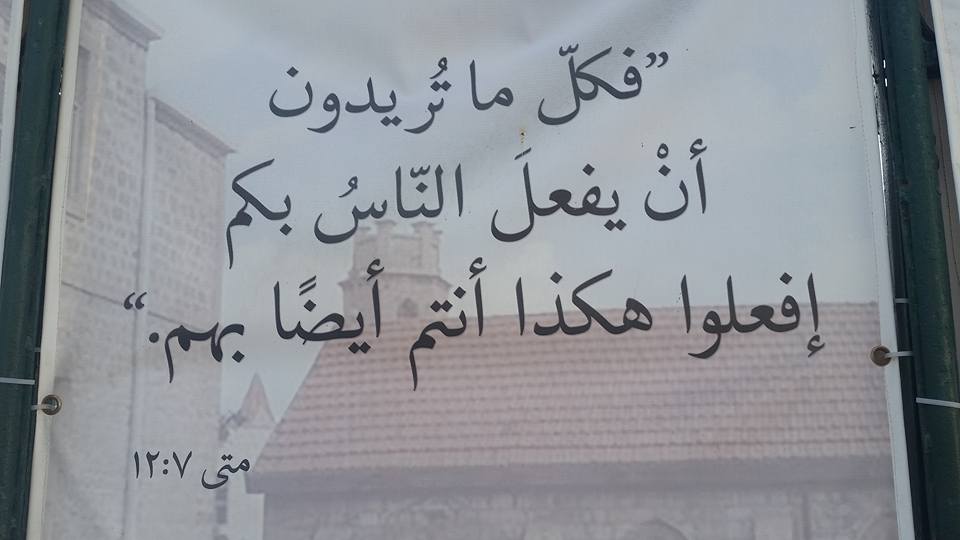
To borrow a bit from our Christian neighbors, my cover photo is from an Arab church in Haifa.  It says: “Do unto others as you would have them do unto you“.  Amen.

Haredim speaking Arabic, dabke, and air raid sirens

Yesterday, I was sitting on a bus.  In front of me, there are two Haredim, a man in a black hat and his wife.  But they weren’t speaking Yiddish- they were speaking Arabic!

I listened closely to make sure it wasn’t just Hebrew with a Mizrachi accent, but no, sure enough it was Arabic.  I then, in a first for me, spoke to Haredim in Arabic.  Turns out the man had been born in Egypt and moved to Israel at a very young age.  And his wife Miriam- now this is interesting- is Jordanian.  And, in her words, Arab.  Very, very few Mizrachim would identify as Arab- especially today, but even historically- many were simply Jews who lived in relative peace among their Muslim and Christian neighbors.  The chaos of the modern era changed that, before nationalism, including pan-Arab nationalism (or modern Zionism) existed.

Therefore, given that a Mizrachi Jew, even who speaks some variety of Arabic or Judeo-Arabic, would likely not identify as an Arab, I wondered about this woman.  Just a few days before, I had been reading about Jordan and while it has a rich ancient Jewish history, it hasn’t had a stable Jewish community for quite a long time.

Which got me thinking- I believe Miriam is a convert.  In her own words, she is proud of being Arab and thinks there are good Arabs, Jews- good everyone everywhere.  But she thinks Jews are nicer than Arabs.  I responded that I wasn’t so sure based on my interactions with real estate agents here!  We laughed.

Before I got off the bus, we passed by what I presume was a left-wing demonstration.  Yesterday was the anniversary of the assassination of Yitzhak Rabin, the former Prime Minister of Israel.  He had tried to forge a peace agreement with the Palestinians and was murdered by a fanatical right-wing Jew.  The protestors blocked the intersection and started slapping the bus.  I was kind of concerned, but mostly I was pissed off that these people were keeping me from my destination.  I’m all for peace demonstrations, but I’m not sure what you accomplish by scaring a bunch of innocent people on a bus.  I once thought only right-wing people could be fanatical, but I’ve found that people of any political stripe can be utterly intolerant and invalidating.

Annoyed by the demonstrators and extremely excited about the Haredi Arabic conversation I just had, I hopped off the bus and headed north to a dabke workshop.  Dabke is a traditional Levantine dance popular among Palestinians, Jordanians, Lebanese, Syrians, Kurds, and Iraqis.  For years, I’ve loved this dance.  It just looks so fun!  I’ve watched YouTube clips and listened to the music on my iPod.  In Arabic class in college, we got a brief introduction to it, but I never really had the chance to dance it.

Until last night.  I found an amazing workshop and danced my pants off.  It was so much fun and the people there were at least as fun as the dance.  Being the only Jew- the only non-Arab- in the room, I aroused a lot of curiosity.  And frankly, mostly a bunch of friendliness.  People gave me their numbers, invited me to hang out with them, asked me about America and even Israeli folk dancing (which I also do).  I even met two separate women who wanted to practice Spanish with me!  And the whole session- before you ask if you can join me- is in Arabic.  This is their space, as it should be, and they were generous enough to allow me to enter it and enjoy their culture.  So unless you’ve got some pretty strong Arabic, you’re going to have to take a language class before you take the dance class 🙂 .

If you want to take a look, this is what our dance looked like last night!  (I’m the guy in the blue shorts and teal shirt).  So much fun!

I returned home feeling buoyant.  As I got ready for bed, I started hearing a loud noise.  This was my first night in a new apartment, so I thought it might be the sirens from the hospital nearby.  And then I heard what sounded like airplanes.  Getting louder and louder.

My first thought was that my landlord ripped me off by giving me an affordable apartment that constantly has flyovers from Ben Gurion Airport.  What a jerk!

But then I realized- the sirens kept going.  This isn’t an ambulance.  This isn’t a plane.  This is an air raid siren.

Having absolutely no idea what to do in this situation (luckily I never experienced it in America), I googled it.  And thank God somebody took the time to write it.  Go to the ground floor, avoid windows and doors, and pray.  And at 3:30am, that’s exactly what I did.  Alone and in the dark.

I was scared absolutely shitless.  I prayed and prayed and messaged a couple friends who were equally confused.  After a while (which seemed like a very long while), the news published that it was a false alarm.  But I’ll tell you, it didn’t sound so false when I heard plane (projectile?) after plane (missile?) overhead over and over again.  I envisioned my building collapsing to the ground.  Would I survive?

Thank God I did and thank God everyone is OK.  I’ve truly never experienced something like that in my life before.  And I hope you don’t either- it’s scary.  And having read that earlier today, the terrorist group Islamic Jihad was threatening revenge because Israel destroyed one of their weapons smuggling tunnels.  And that there was an armed confrontation between Israel and Syria in the north.  That basically it wouldn’t have been a shock if the air raid sirens had been accurate.

Being someone who has already suffered trauma in my life, it was hard to get to sleep- it pushed a whole bunch of triggers.  Finally I was able to lie down and get some rest.

I wrote to my friends on Facebook last night that if you don’t have the dedication and faith to keep you here, you simply won’t make it.

Everyone has a stake in this society and we must work together to make it the best place on the planet- which I think it is and has the potential to be.

I understand the rage that people can feel here- when you’re scared, when you’re scarred, you just want to lash out.  There are productive ways to do this and harmful ones and I hope we can strive to do the former more than the latter.

To anyone outside of Israel who has any doubt as to what terrorism does to the Israeli psyche, I invite you to crash at my place next time there’s an air raid siren.  All the Ambien in the world won’t help you sleep and it will haunt you after you wake.

And to the “peace” activists who slapped my bus- I get you.  You’re horrified, you’ve been hurt by someone, somewhere in this Holy Land.  But get a therapist.  Do some yoga.  Pray.  Take some anti-anxiety medications.   Whatever works for you.  But stop taking out your anger on your fellow man.

Be like the hundreds of young people I saw engaging in dialogue in Kikar Rabin yesterday.  Be like the Haredi man who married a Jordanian (convert?) and speaks Arabic.  Be like me and go dance Palestinian dabke with new Arab friends.

Or be like my Arab friend Lena who I met last night.  When I told her I was an American Jew who now lived in Tel Aviv, her answer was simple and touching:

“You are welcome here.”

That, my friends, is how you make peace.  One heart at a time.  A quiet and beautiful answer to the screeching of a siren.

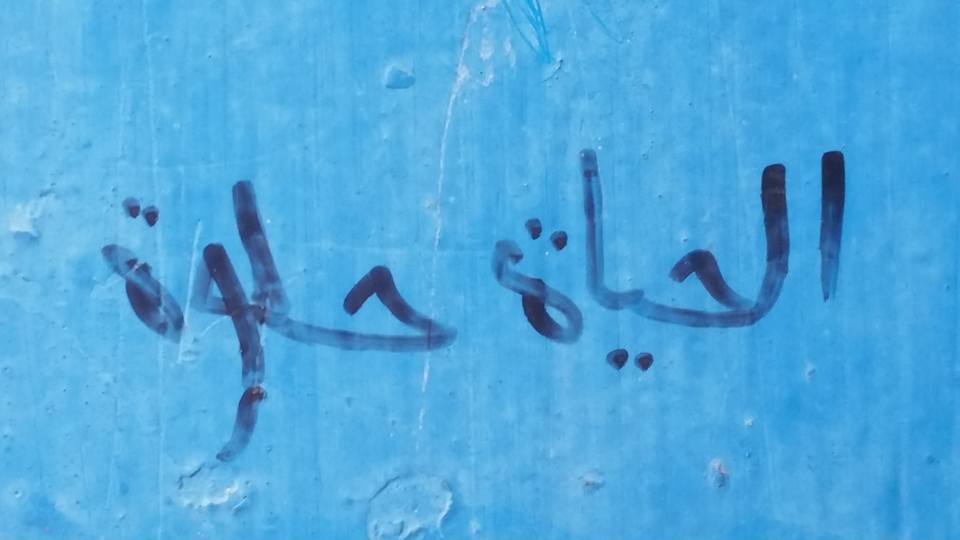
As my cover photo says in Arabic: “life is sweet”.  Damn straight it is.  Because I’m alive.

My first Haredi hug

Tonight started bad and ended amazing, so read to the end.

I had my first Yiddish lesson in Israel tonight.  I already speak pretty good Yiddish but I wanted to learn more and I specifically want to get accustomed to the Hasidic accent, which is distinct.  I love visiting Bnei Brak, a Haredi community next to Tel Aviv.

I headed there for a lesson with a young Hasidic man, perhaps not above the age of 25.  The lesson started off great as we got to know each other.  Yosef’s family is made up entirely of Holocaust survivors.  One of his grandparents actually grew up in the town of Auschwitz before escaping to Russia and then being forced by the Soviets to move to Siberia.  Eventually they made their way to the U.K. and U.S. after the war and subsequently to Israel.

We spoke about 70% in Yiddish, 20% in Hebrew, and 10% in English over the course of two hours.  We got to a point in the lesson where we were talking about music and I told him how I wrote a piyyut (liturgical poem) combining Hasidic words and melody with my own Arabic words.  He was impressed.  Then he asked me what kind of synagogue I go to.  And, being the Israeli that I am, I told him it was Reform.  Because hell if I’m not going to be myself in the country I worked so hard to come to- and now build.

His first response: “I would never go to a Reform synagogue if you invited me.”  Like a bullet through my heart.  I’ve worked so hard to protect my Judaism- from toxic relatives, from anti-Semites, even from Israelis antagonistic to religion.  And here I was, the bravest Reform Jew I know, in the middle of Haredi city of 200,000 people, and the teacher (who I’m paying) is insulting my community.  He proceeded to say all sorts of ignorant things.  I tried to appeal to Jewish unity and desire for mutual respect, but it just didn’t really work.  In his words, he practices “authentic Judaism” and I practice something “worse” than secular Jews.

You could probably draw a straight line from his grandparents’ Holocaust trauma to his rigid and judgmental attitudes, and I do empathize, but in the end I was pissed off.  And in the end, we all make decisions about how to live our lives, just like I have.  I did calmly explain to him how he hurt me and he apologized, but I’m just not sure I’d feel comfortable working with him anymore.

Feeling angry at Haredim, I started blasting music into my earphones and walking around Bnei Brak.  This jerk of a teacher- he takes my tax dollars to sit around studying Torah and then has the audacity to lecture me about how I practice my faith!

I felt distant from Judaism and hurt, so I stopped into a Haredi bookstore hoping to find some solace.  I love books and music and they really can heal.  I picked up a Hasidic Yiddish children’s book (they’re publishing new ones all the time!) and a CD.  It felt fine, but it didn’t really heal this kind of a wound.  Although I got a major kick out of seeing 15 black hats turn towards me in shock as I asked the cashier where the CD’s were…in Yiddish.

I then got to the restaurant I was looking for.  Home-cooked Ashkenazi food.  Just what I wanted.  The guy behind the counter, Yisroel, had a nice smile and a kind voice.  He gave me extra food (for free) as we chatted.  We talked about what it was like in Tel Aviv.  He was surprised to hear from me that there are a lot of Jewish things in the city including biblical graffiti and the guy playing hinei mah tov on an electric guitar in Kerem Hateimanim last week.

His friend then walked in the restaurant and then started singing a niggun – a word-less melody – and then Yisroel, a Hasidic guy eating pasta, and I joined in.  It was a surreal moment that happens nowhere else in the world.

They asked me why I was in Bnei Brak and I told them I had a Yiddish lesson that didn’t go so well.  They asked why and I explained that the teacher was really judgmental.  Yisroel asked me if the teacher was Haredi, like him.  And I said yes.  I could see the look of embarrassment on their faces.  He said he could understand why I wouldn’t want to work with him and started asking around the restaurant to find me a new teacher.

Feeling lifted by Yisroel’s kindness, I told him this: “after my teacher hurt me, I could’ve just gone back to Tel Aviv and felt like all Haredim are mean.  I could’ve chosen to close my heart.  But instead, I decided to wander around and find someone to warm my heart, to show me that there are good people in this community too.”

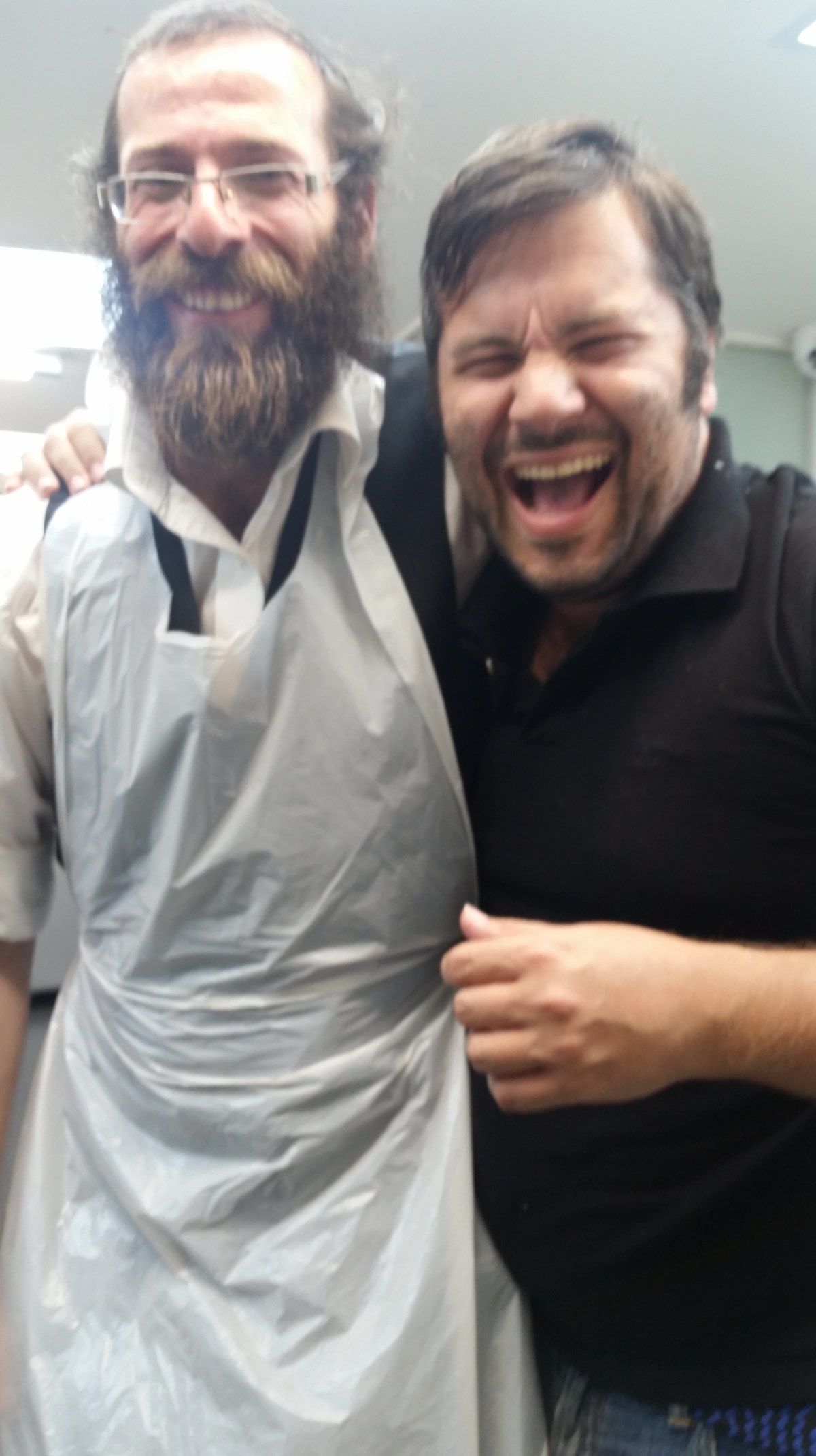
Without skipping a beat, he grabs me by the neck and gives me the warmest, tightest, most generous hug I’ve received in my entire time in Israel.  It was so filled with love I was almost taken aback, especially given the way some of my relatives used touch to hurt me.  This man, who despite having to take the bus home to Ashdod, was keeping the restaurant open past 11pm just to keep me happy.  Yisroel may be the kindest person I’ve met in Israel.  And he is my first Israeli Haredi friend.

Lest you venture into the “oh but these must be less religious Hasidim” territory, you’re wrong.  Yisroel is a Ger Hasid and his friend is a Bobover.  They explained to me they don’t watch movies and they showed me they don’t have smartphones.  And they told me why.  And even though I practice Judaism differently, I listened respectfully and learned about their beliefs.  Like a human being.

What brought me back from tonight’s pain was love.  Every Shabbat in synagogue we pray the “ve’ahavta” – a prayer that starts “and you shall love…”.  Tonight, a young Jew in jeans and a t-shirt and a Hasidic man in Bnei Brak embodied that verse.  Because love wins.

Will I keep learning Yiddish?  You bet!  Because I want to know my Hasidic neighbors like Yisroel and it’s my heritage too, despite my teacher’s claims that he is the arbiter of Jewish identity.

It is said that Israel is the land of milk and honey.  Wrong.  Israel is the land of maror and honey.  Maror is the horseradish we eat on Passover.  The bitter people here are some of the bitterest you’ll meet.  And there’s years of trauma behind that but it doesn’t change their toxicity- or your need to sometimes avoid them.  But the honey- oh man.  The honey here is the sweetest you’ll taste anywhere.  The people here who love God by loving their fellow man- they are unparalleled the world over.

It can be so hard to remember that each person truly represents themselves first and foremost.  It’s tempting to paint with a broad brush to protect yourself.  To think that rather than an individual, an entire community hurt you- or will hurt you again.  But in the end, if you go too far down this road, you won’t be protecting yourself, you’ll be hurting yourself.  By denying yourself the chance to know some truly amazing friends.

Yisroel, perhaps aptly named, is now part of my chevreh, my “peeps”.  He’s someone who brought me back to life tonight.  So if you’re someone who likes to trash talk Haredim- I’m sure there’s a reason why.  Maybe someone hurt you like I got hurt tonight.  Or maybe someone taught you fear and prejudice.  But I will not tolerate that hatred in my life and you’d better believe I’ll call you out on it.  Because my tribe just got thickened and got its first Haredi member.  And as far as I’m concerned, if you’re messing with him, you’re messing with me.  Am yisrael chai.  The People Israel lives.

As for my teacher- I have this drash, this spiritual note to offer.  On my way to Bnei Brak I was listening to a Hasidic niggun on my phone, a melody from Vizhnitz.  I recognized the tune but couldn’t place it.  It reminded me of a secular Yiddish song I knew.  Hours later, with the help of a French Jewish friend I met at Yiddish camp last summer, we discovered it was a 1960’s song by the legendary Barry Sisters.  This kind of cultural overlap was once common when Jews truly lived together.  Folks songs, Klezmer music, pop songs, Hasidic niggunim- there was a beautiful interplay at work.  My hope is that this fluidity can be revived and we can enjoy the best of each of our communities while respecting our right to live differently.

Yisroel’s Bobover friend, impressed by my Hebrew, looked at my outfit and my flipflops and said “you look like a Sabra“.  Perhaps, as we say in Yiddish, it’s bashert that I got my official Israeli ID card today.  Because I’ve arrived.  And I’m doing mitzvahs every step I take.

Reform is a verb

I grew up as a Reform Jew active in every possible aspect of the movement.  When I made aliyah, I was certain to connect with Reform communities- I would never live in a city without one.

Another reason I chose to live in Tel Aviv was because of the queer community.  It is a city that is arguably gayer than anywhere I’ve ever lived- and I’ve lived in Washington, D.C., Fort Lauderdale, Madrid, and Barcelona.

Oftentimes, I felt like my sexual identity and my Jewish identity had to be separate.  When I was in one community, I was almost always still a minority due to my other identity.  While Reform Jews are largely accepting of LGBT people (in particular the NFTY youth group), I faced sometimes intense homophobia in my community.  I once had a Reform clergy person tell me bisexual people don’t exist and a Hebrew school teacher who giggled about which person was the “real man” in a gay relationship.  I even had another Hebrew school teacher posit that there was something strange that caused more Jews to be gay than non-Jews.  When visiting a Reform synagogue in another city, a 30-something rabbi told me all about how he likes gays to help with his fashion because that’s what we’re good at.  Not to mention my toxic relatives.  And all of this isn’t even including those among the more conservative elements of the Jewish community who twist texts to guilt and harm people like me.

And in the gay community, I also at times faced anti-Semitism or felt excluded.  I remember going on several dates with a non-Jew and everything seemed to be going well and then suddenly he broke off the relationship because I didn’t eat pork.  At the time I didn’t really care if he ate pork, so it seemed rather odd and when I pressed him on it, it was clear there was an anti-Jewish sentiment behind it.  One guy implied he couldn’t date me because I was “really Jewish”.  A non-Jewish ex-partner’s father – to my face – defended the KKK as an organization supporting Confederate soldiers, not racism and anti-Semitism.  His son, my ex’s brother, dressed up as a Hasidic Jew for a college Halloween party- peyos and all.  In addition to the more recent political anti-Semitism in the LGBTQ community, I think it’s just hard to be a minority within a minority.  Oftentimes LGBT events are scheduled without regards to Jewish holidays and people don’t necessarily know about Jewish culture.  It’s not necessarily malicious, but it does make it hard.  And sometimes, I felt like the gay community really prized white “straight-acting” gay men above other members of the community, including physically.  Above blacks, Latinos, bisexuals, trans, and- in my experience- Jews.  While I strongly believe that most LGBT people in the U.S. are not anti-Semitic, I can’t deny that at times I felt uncomfortable or out of place in the community.

Which brings us to tonight.  Tonight, as usual, I went to Reform Shabbat services which were lovely.  We had a communal dinner and then I went home.  When I got home I realized it was only 9:15pm and I was bored as hell.  It can be hard to make plans for Shabbat when you’re new to Israel and don’t know a lot of people.  And it can feel lonely.

I found a friend going to a gay pop music party.  I usually just chill with friends and eat on Shabbat and walk around.  But having no great alternative tonight and having the itch to get out of the house, I made a move and I went.

What a great decision.  First of all, it was my first Tel Aviv gay party.  And it was fun.  The music was also great.  Hearing a bit of American pop music was a nice escape from the stress (even the interesting stress) of everyday life here.  Also there were some cute guys- not the super muscle-y ones you see on the beach, more like cute nice Jewish boys.  It felt comfortable.  Also, pretty much everyone was Jewish- a completely unique experience.  I really felt this when the music switched from Britney Spears to Israeli pop.  Even to the first Israeli singer I ever got a CD from at age 13- Sarit Hadad.  That felt powerful.

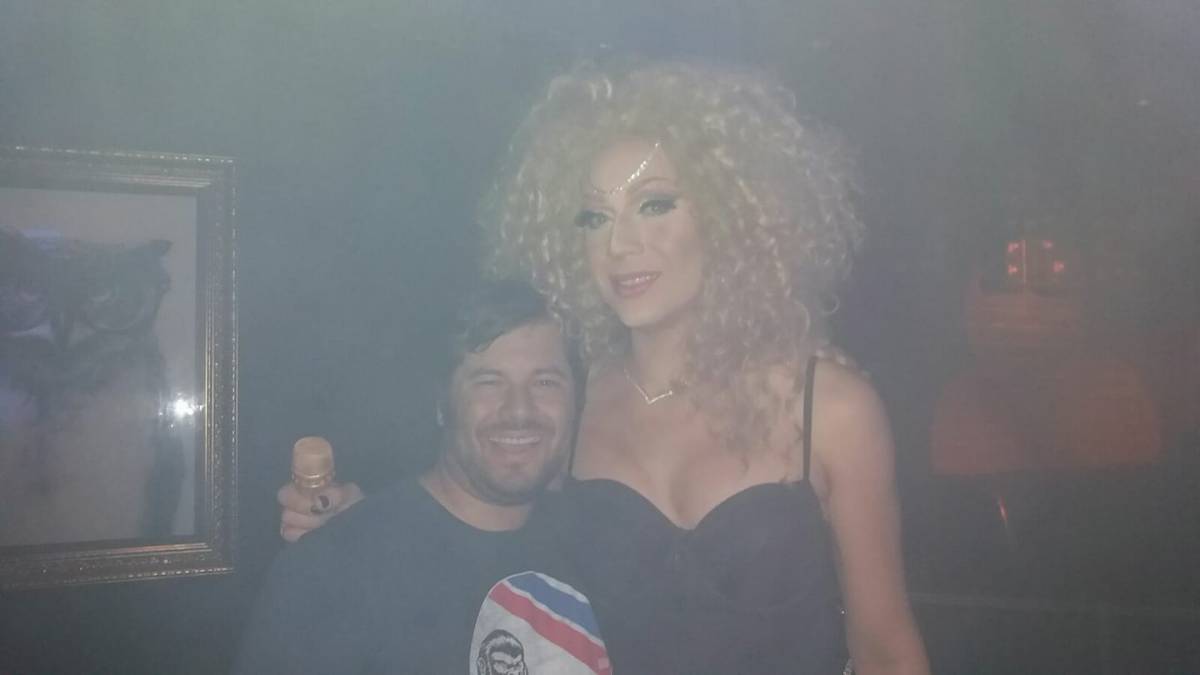
For Sabras – Israelis who grew up here – there is absolutely nothing novel about what I just said (which in and of itself is kind of cool).  But I’d like to remind them of something.  There is nowhere else in the world where a queer Jew can hear Hebrew on the dance floor all around him.  There is nowhere else in the world where every weekend there are gay dance parties and most of the people in the room are Jewish.  There is nowhere else in the world where when you take a picture with a drag queen (my cover photo) you say to them “todah”.

Only in Israel – only in Tel Aviv – do I feel my queer and Jewish identities meld.  Not at a conference, not at an event, but rather in my day-to-day life.  I don’t have to compromise on either important aspect of my self to live here.  And that is a gift – one that I hope I can inspire my Sabra friends to recognize and my American Jewish friends to respect.

There are some beautiful things about being a minority.  The solidarity, the awareness, the empathy you can develop for others.  The secret codes we use to find each other and protect our culture.  But honestly, a lot of the time it sucks.  And being a double minority makes it that much harder to feel at ease.

On a Friday night, I’m almost always at Reform services.  And oftentimes at a dinner afterwards, sometimes even with Orthodox friends.  Frankly, I feel more at ease at a Modern Orthodox Shabbat meal than with a lot of secular Jews.  I love zemiros and I love the many hours of chatter and fun.  As I see myself, I’m an “all-Israel Jew”.  I like to find the beauty in every community of the People Israel (and even the non-Jewish communities of the State of Israel).

And tonight I added a new community.  The queer Tel Avivi community is also my community- and also a part of my spirituality.  It’s a place I feel affirmed in every way and it’s a fun way to blow off steam after a long week.

I’m a Reform Jew because reform is a verb.  When Judaism or any religion becomes too static, its vitality withers.  Today I reformed my Judaism.  And I realized that while some Shabbats I’ll want to do long meals with singing and just be in the moment, sometimes, after a good hearty sing at services, I might just want to slip out at one in the morning and dance my heart out till the sun comes out.

That’s my Judaism too.