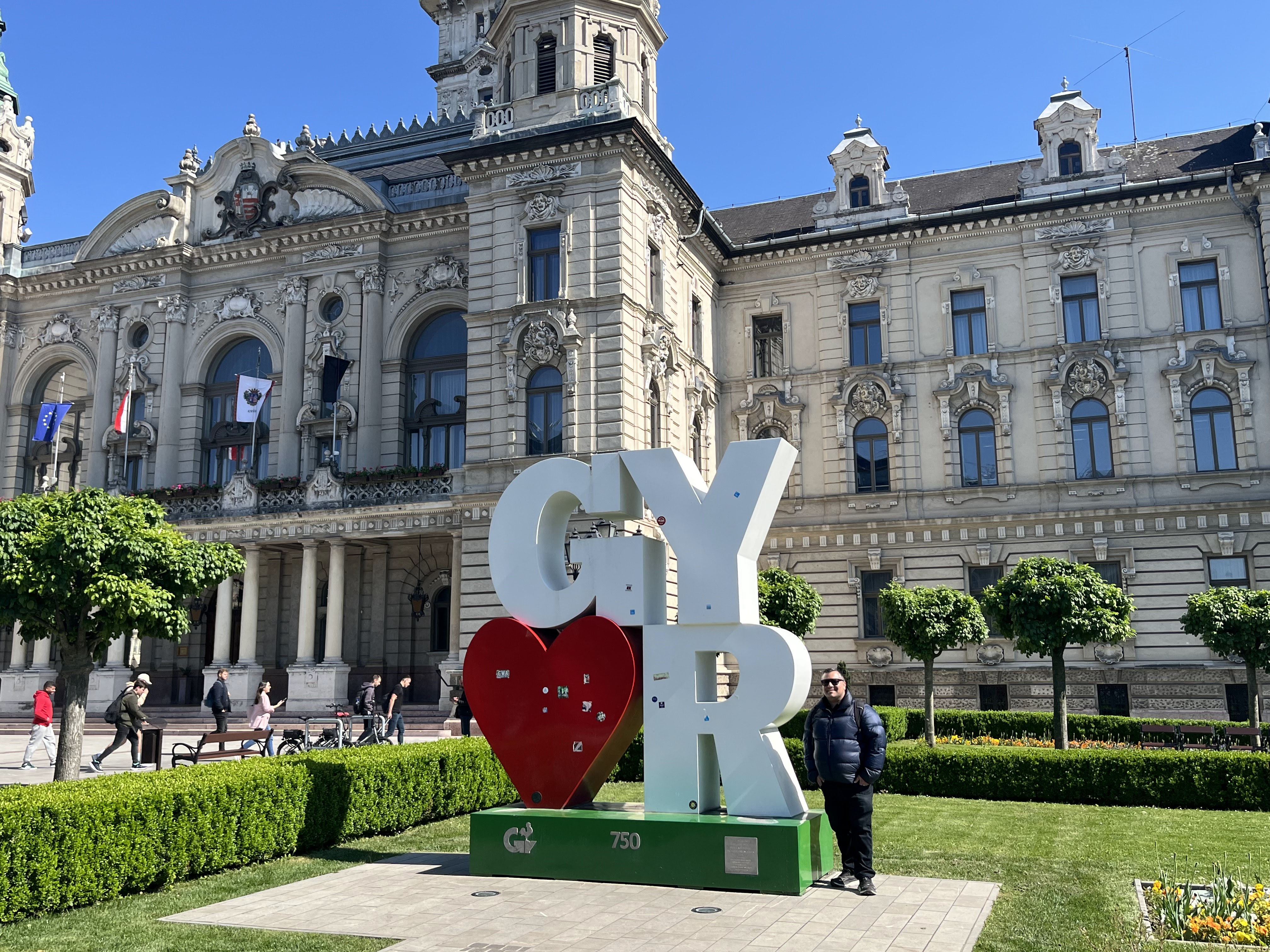
Győr Hungary and its beautiful synagogue

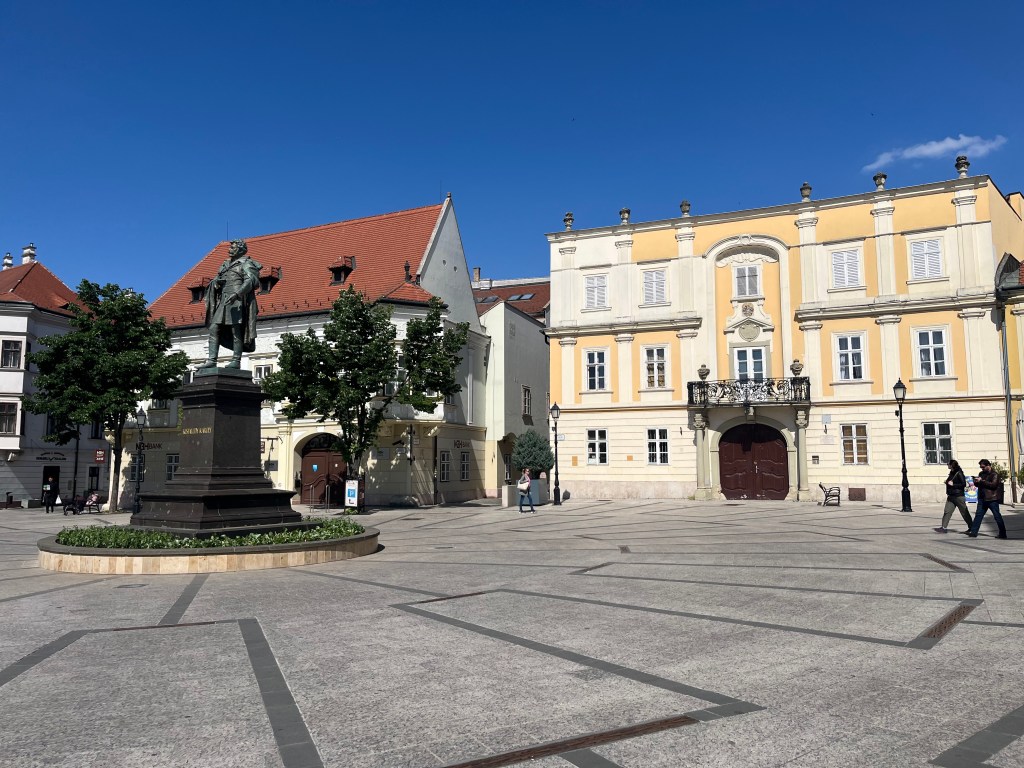
Győr is not a place many tourists visit compared to Vienna, Budapest, and Bratislava. It is smaller and there aren’t as many great “sights”. That’s what attracted me to it. Everyone enjoys a beautiful castle or cathedral- myself included. But I also like seeing how people live their daily lives and escaping some of the tourist crowds I found myself in during other parts of my trip to Central Europe.

After hopping on a quick train from Vienna, where I had explored the past and present of the local Jewish community, I headed to Hungary for the day. A few things caught my eye when I arrived to Győr. First of all, there were no organized tour groups. Second, the town was clean and safe. Third, the baked goods and goulash were delicious. And fourth, it was a relaxed, affordable city with a slow pace of life.

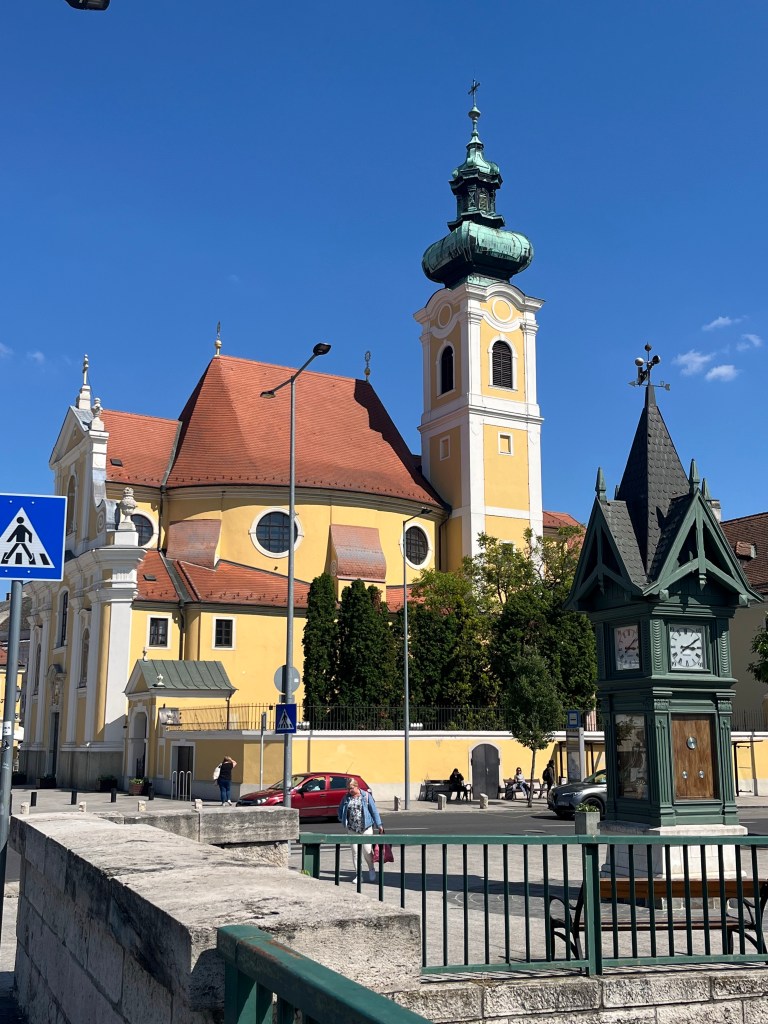
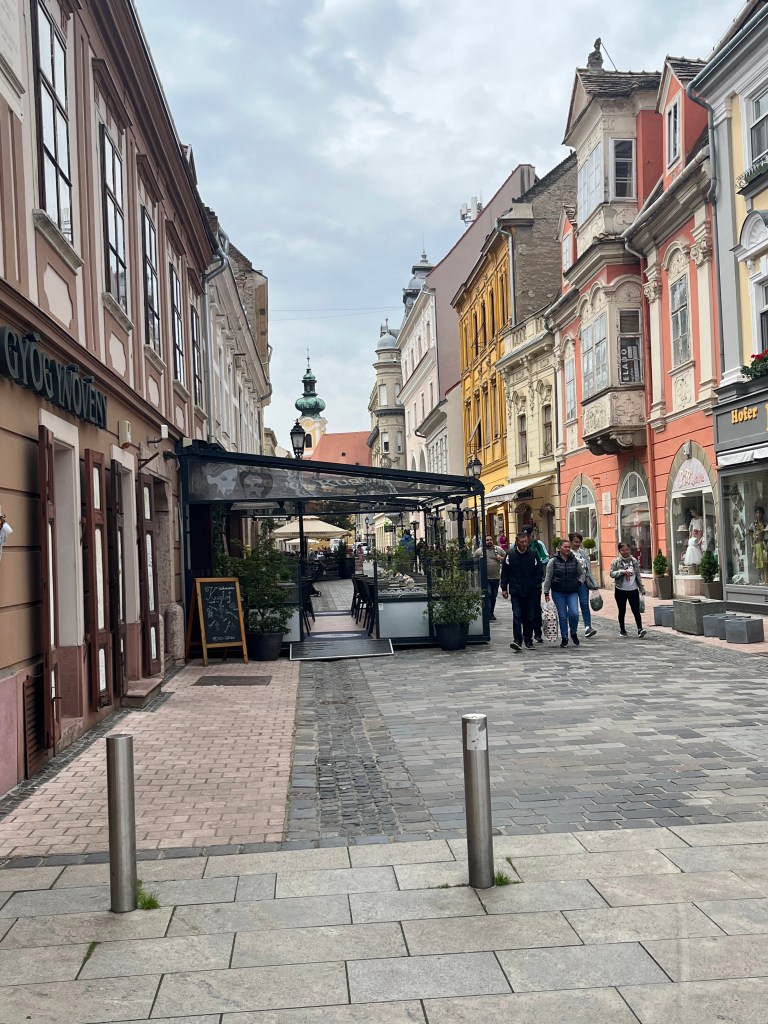
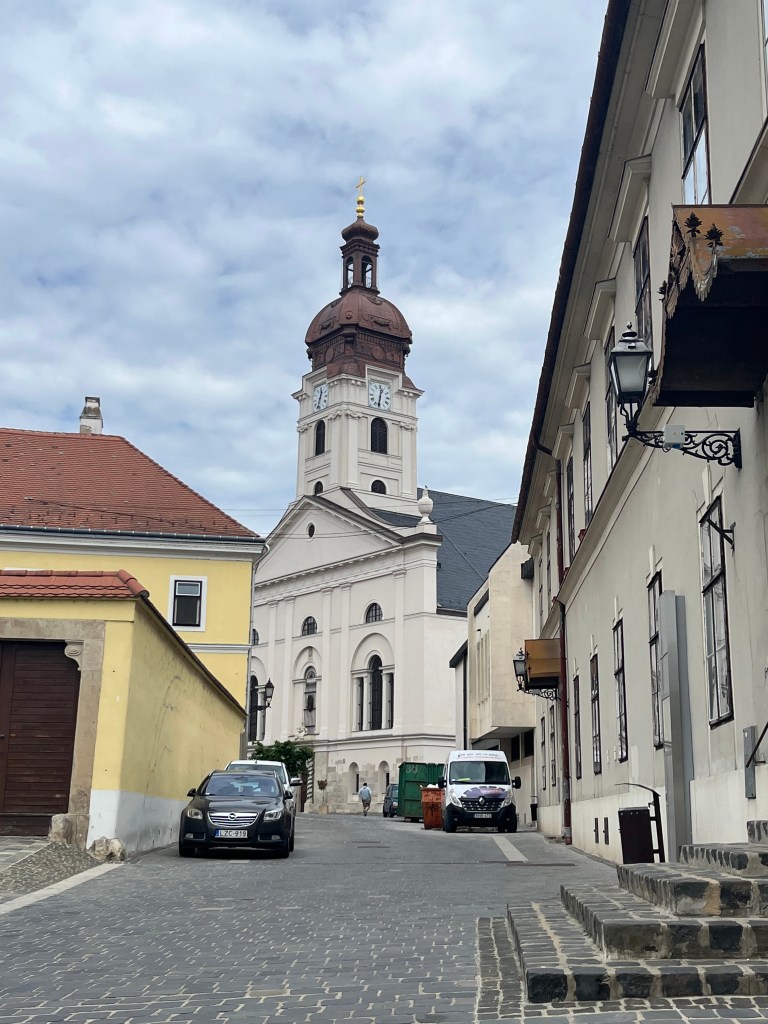
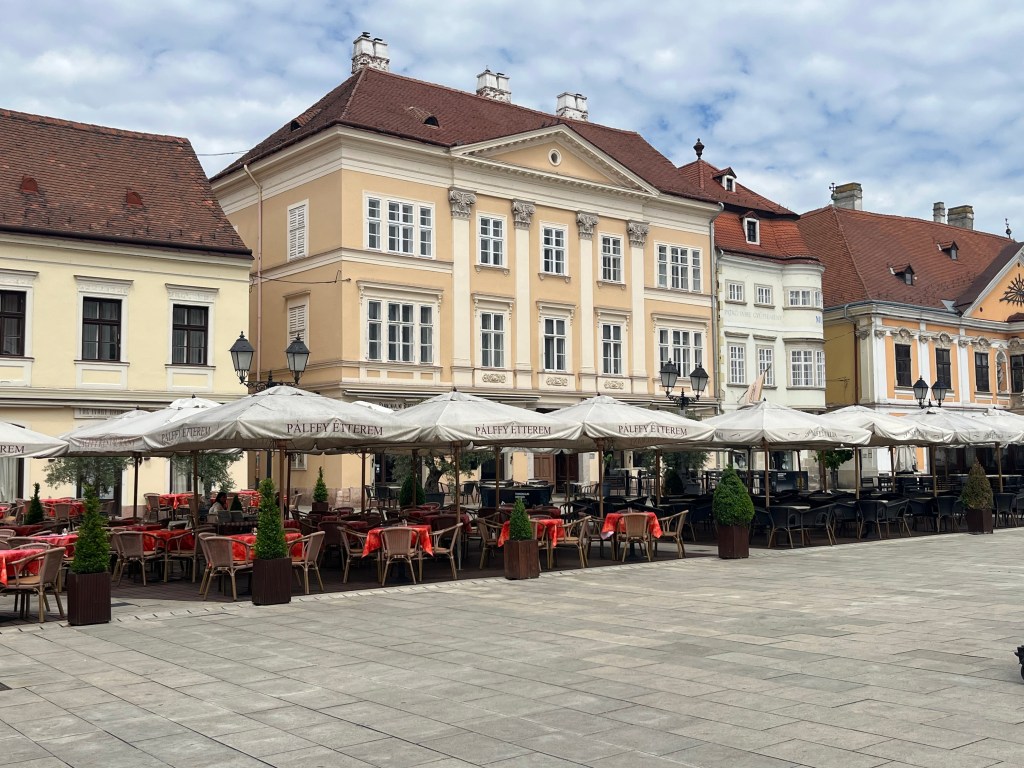
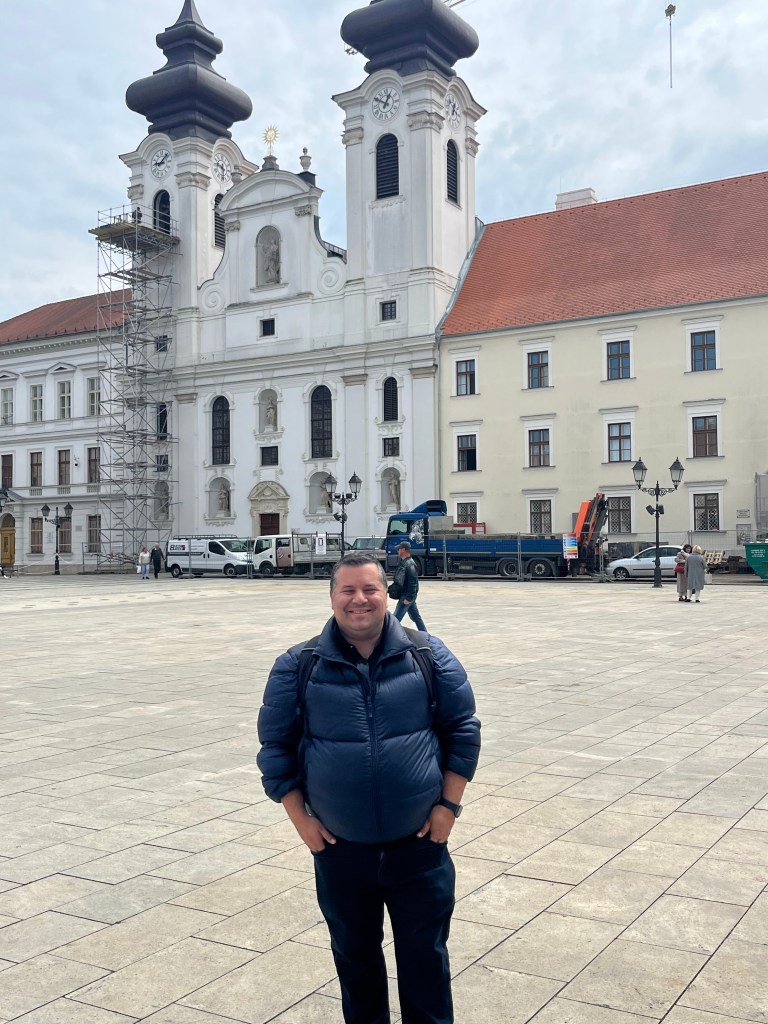
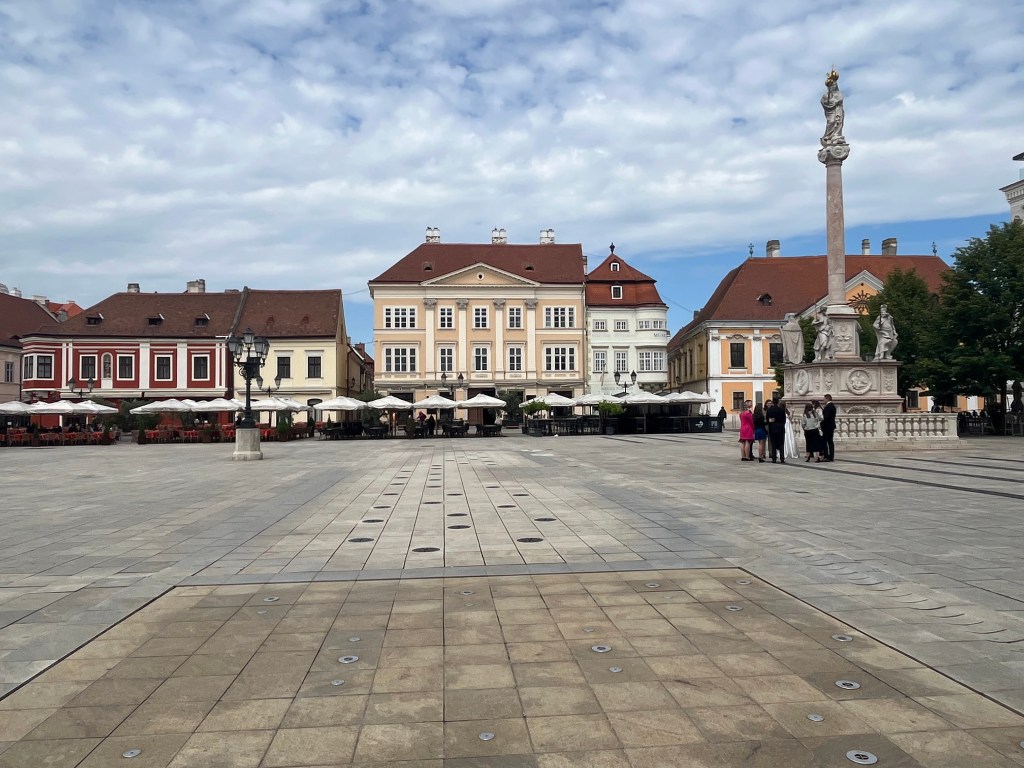
The old town streets and churches were beautiful and had a lot of charm.

After a bowl of delicious goulash (I later learned that there are different styles of goulash depending on where in Hungary or Central Europe you are!), I headed to the main reason I wanted to visit Győr – its magnificent Old Synagogue.

Along the way, I stopped at a used bookstore and asked if they had any Jewish books. I found a bilingual Hungarian-Hebrew copy of Talmud commentary from 1937. You could still see the former owner’s notes inside – it was incredible. I felt connected to this history – my history – because I’m part Hungarian as well. I wonder what became of the owner of this book or their family. 1937 was an ominous year and the ones that followed were only worse for the Jewish community – of Hungary and of Europe as a whole. I felt I had saved a book and I plan to learn more about this treasure, a testament to my people’s history.

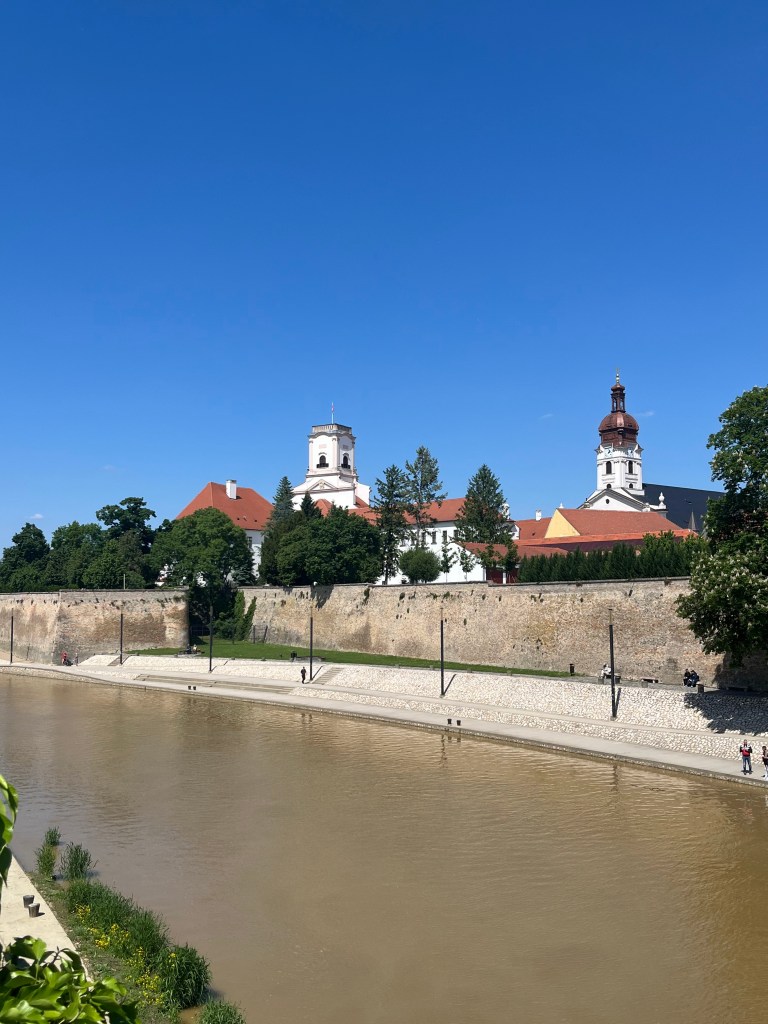
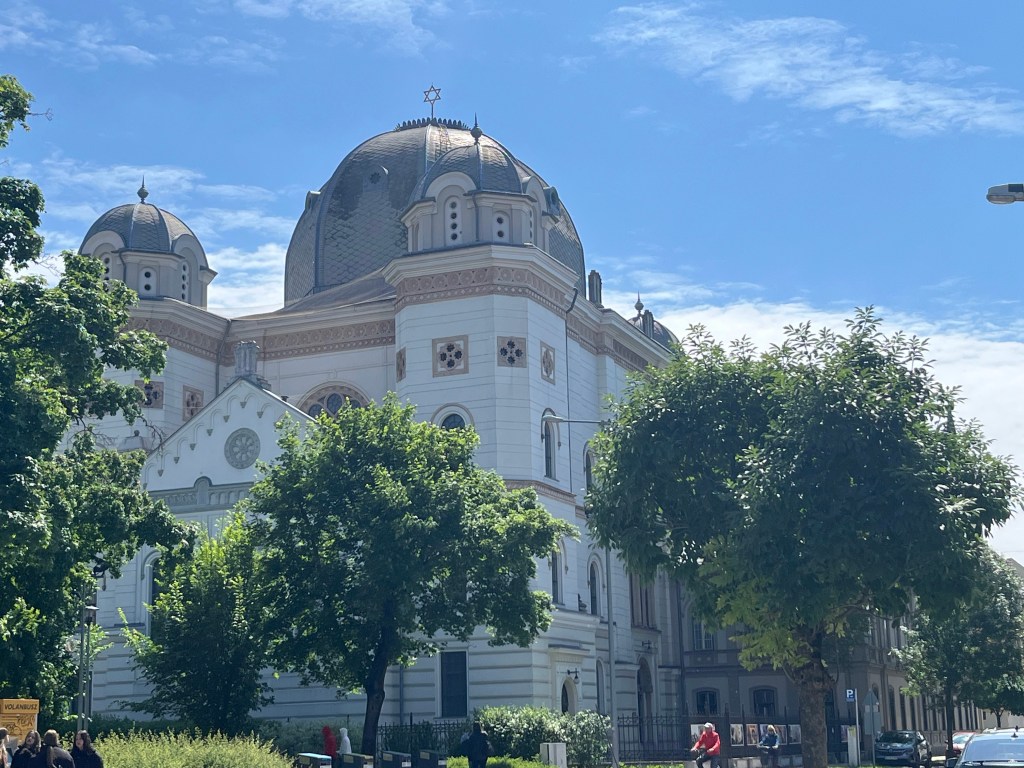
I finally made it to the Old Synagogue. It is a beautiful, beautiful building that dominates the part of the city across the river. Once home to a thriving Jewish community of almost 5,000 (8% of the population in 1941), few members survived the deportations to Auschwitz during the Holocaust. I encourage you to read more about the history of the community here.

Before going inside, I bought a ticket – it’s now considered a museum. Sadly, the community does not appear to be large enough to have a regular, active presence there from what I could tell. It’s largely used as a historic site and a music school.

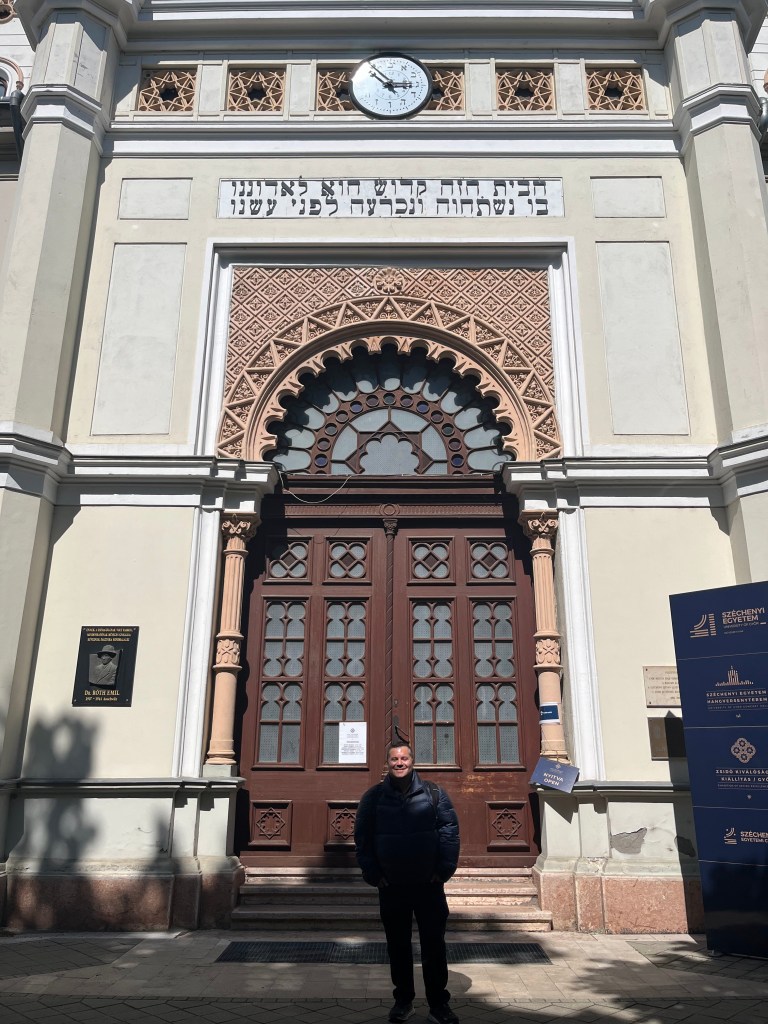
In fact, when I entered the synagogue, I heard a piano playing the most beautiful music. While it is sad that it is no longer an active synagogue, I am happy that it is being used to promote the arts, something that hopefully brings us some shared humanity during dark times. I met some of the music students who were kind enough to take a picture of me at the door to the synagogue.

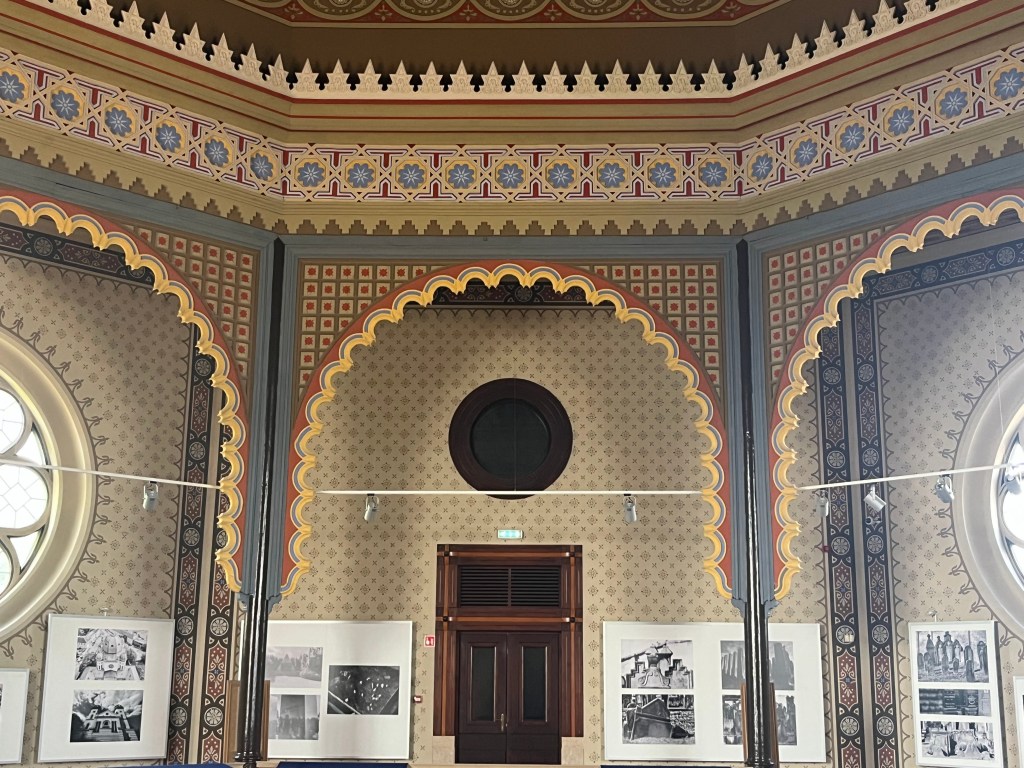
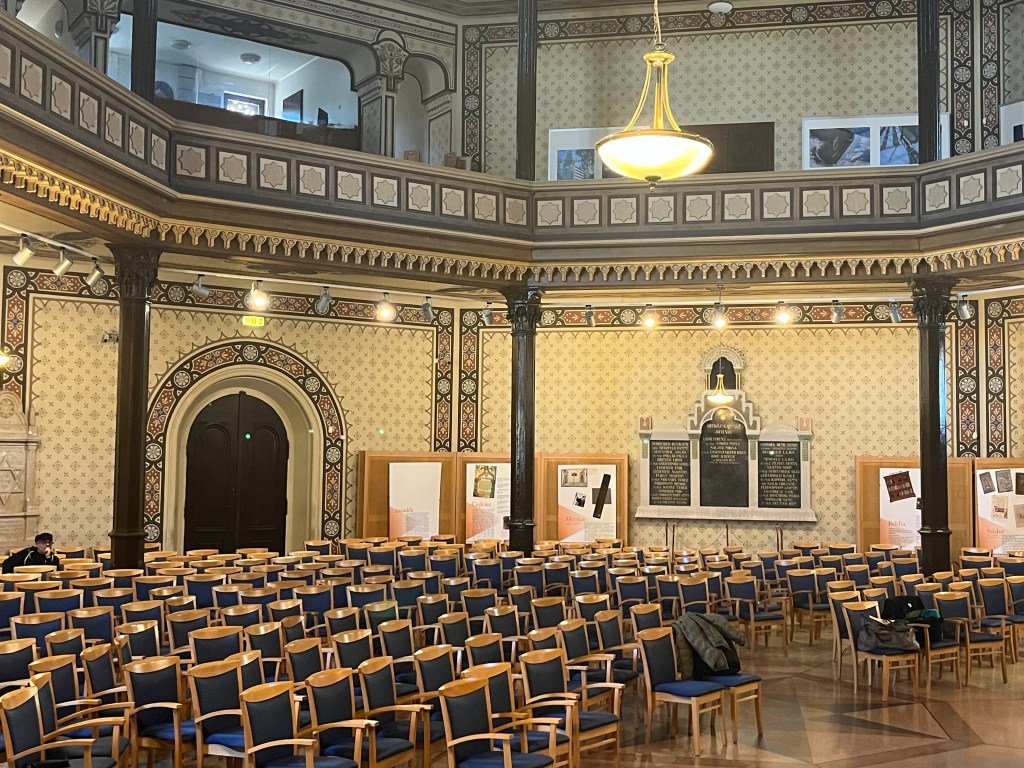
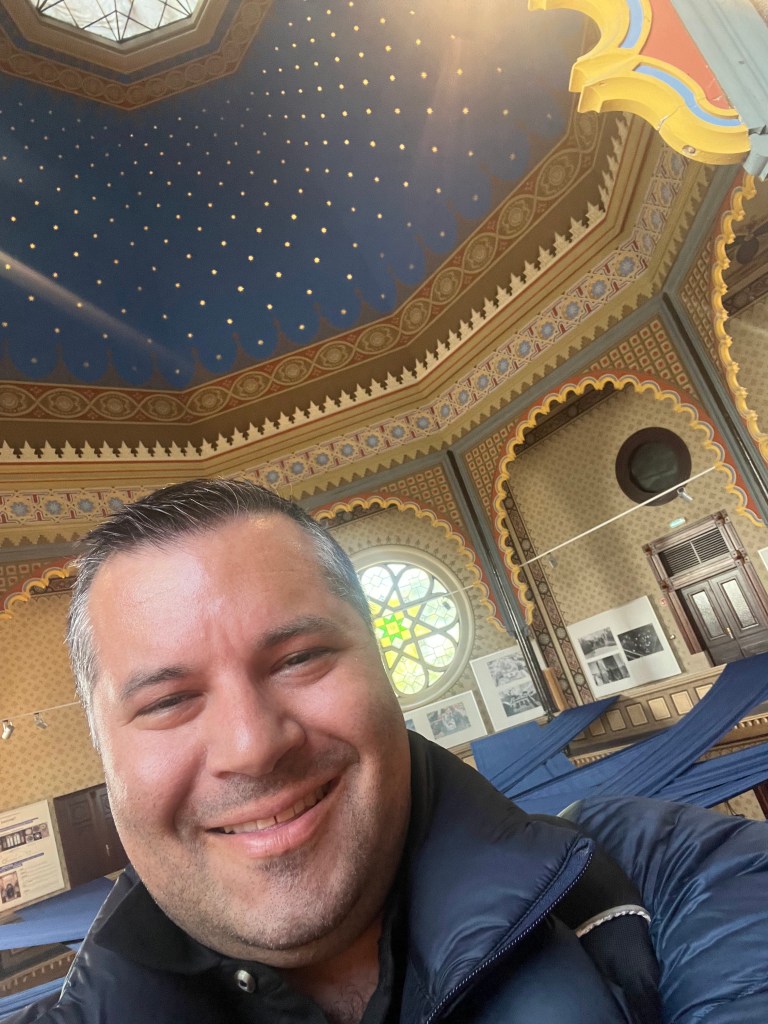
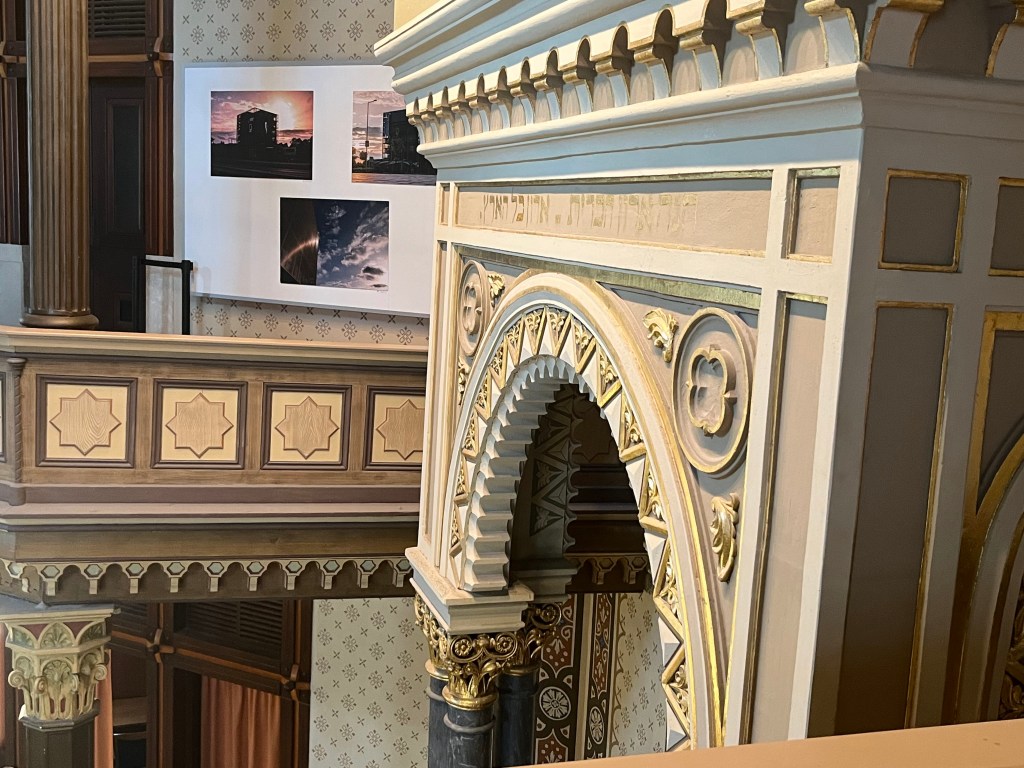
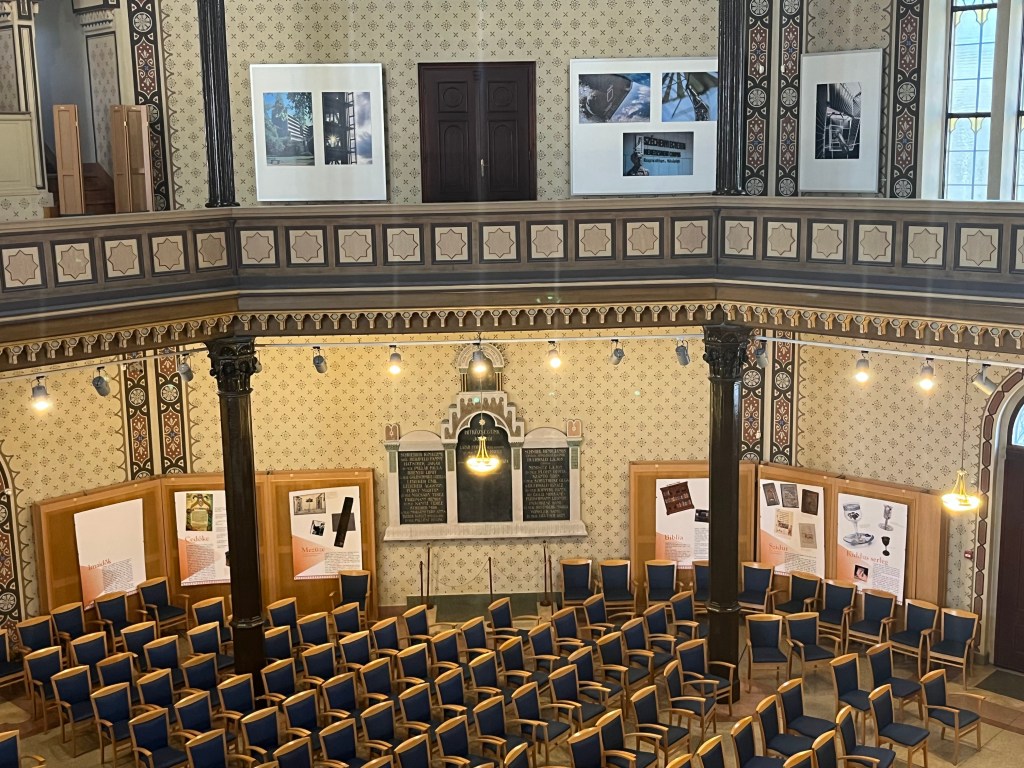
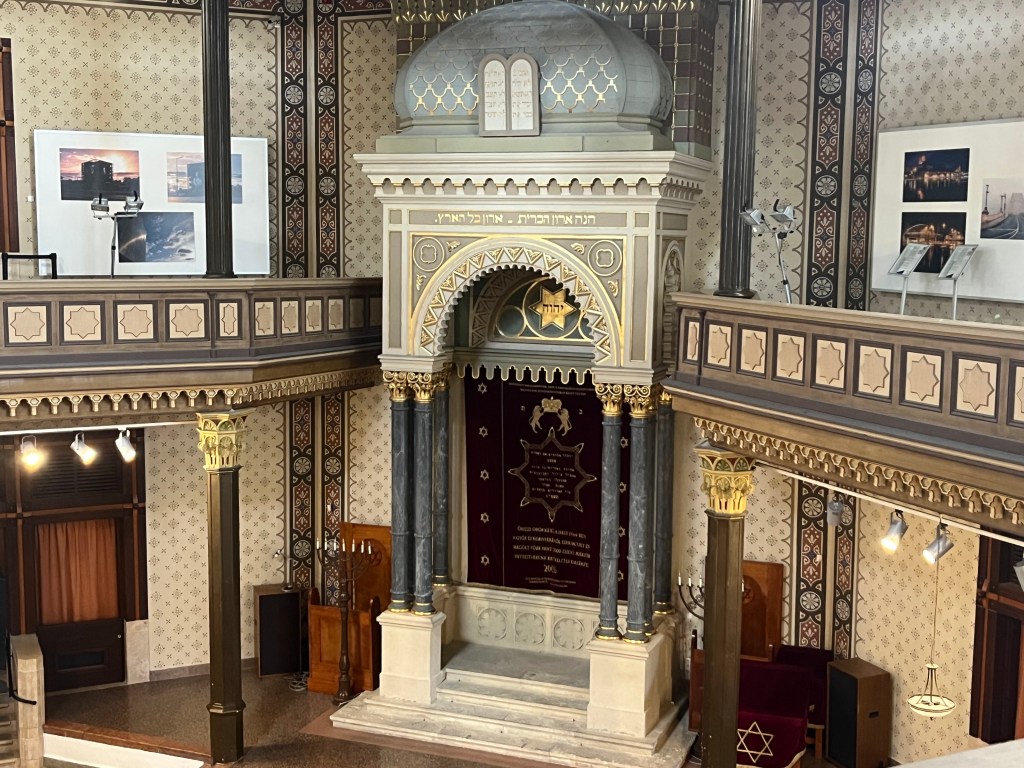
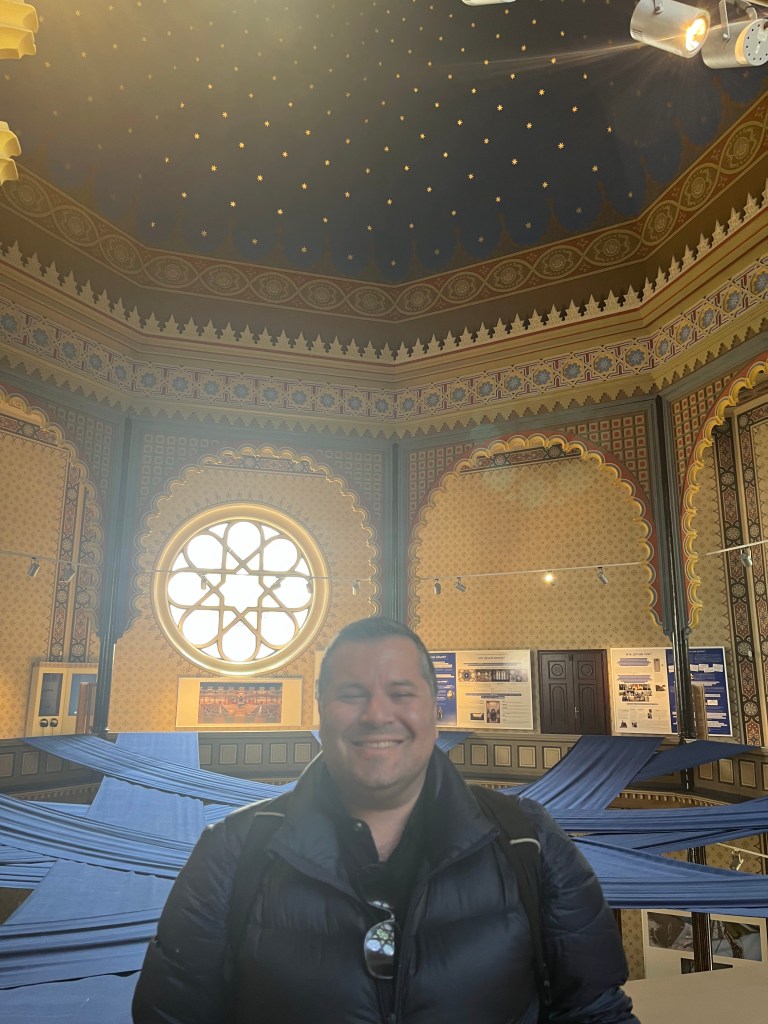
Now comes the real treat. The inside of the synagogue is absolutely stunning. The architecture was inspiring. You can almost hear the cantor’s booming voice filling the room. The aron hakodesh, or ark where the Torah is placed, is almost Ottoman in style and gleamed as the lights shone down on the pianist and his teacher.

Here are some pictures:

Other than the pianist and his teacher, who I smiled at and gave a thumbs up to (the music was gorgeous), I had almost the whole place to myself. What a treat.

I wish I was there with the Jews of Győr. Perhaps cousins of mine, fellow Hungarians who are no more. But I couldn’t be more grateful for the opportunity to explore my heritage in this beautiful city.

Hungary gets a bad rap for political reasons. And I think it’s blatantly unfair to judge a whole country because you may disagree with some of its leadership’s policies.

The fact is as a Jew, I felt safer in Hungary than I do in Washington, D.C. So for all of Hungary’s problems, I wish people would see the country with some more nuance and go visit to see it for themselves.

Because I, for one, love Győr. And I’m glad I made this detour from the more well-worn tourist path to explore a place of deep significance for my people and my Hungarian Jewish heritage.

The Holocaust postcard I found in Salzburg

After witnessing a virulent anti-Israel rally, I was about to give up on Salzburg, a beautiful city in Austria. Then, I wandered into an old used book store and I found the most stunning thing.

I asked the book store owner in Yiddish (because Yiddish and German are similar and it’s super useful when traveling in areas where folks don’t speak fluent English!) if he had any Jewish books.

He said he didn’t think he had any, but that if there were any, they’d be downstairs in the history section.

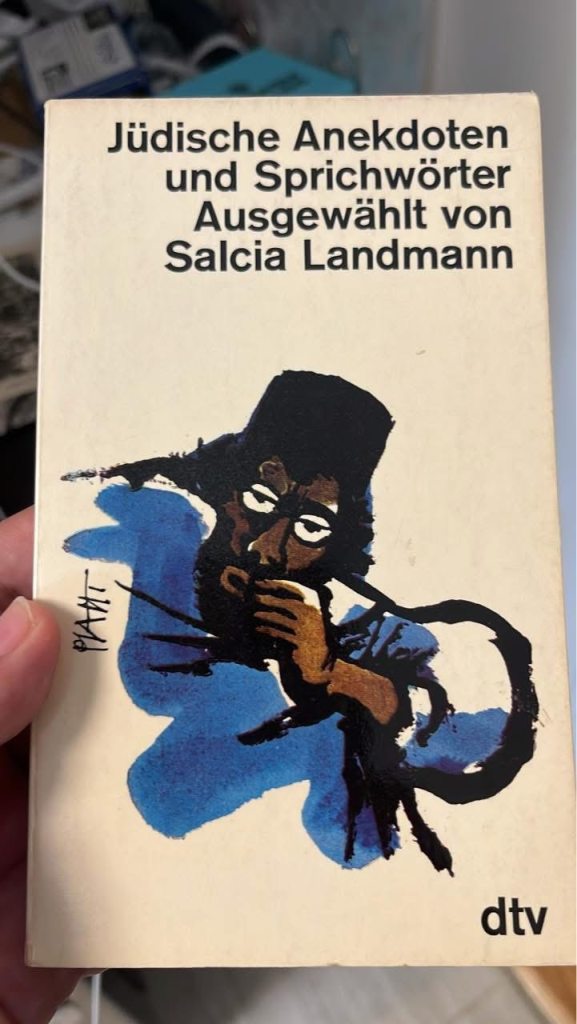
I picked up a Jewish book published in Germany in the 1960s:

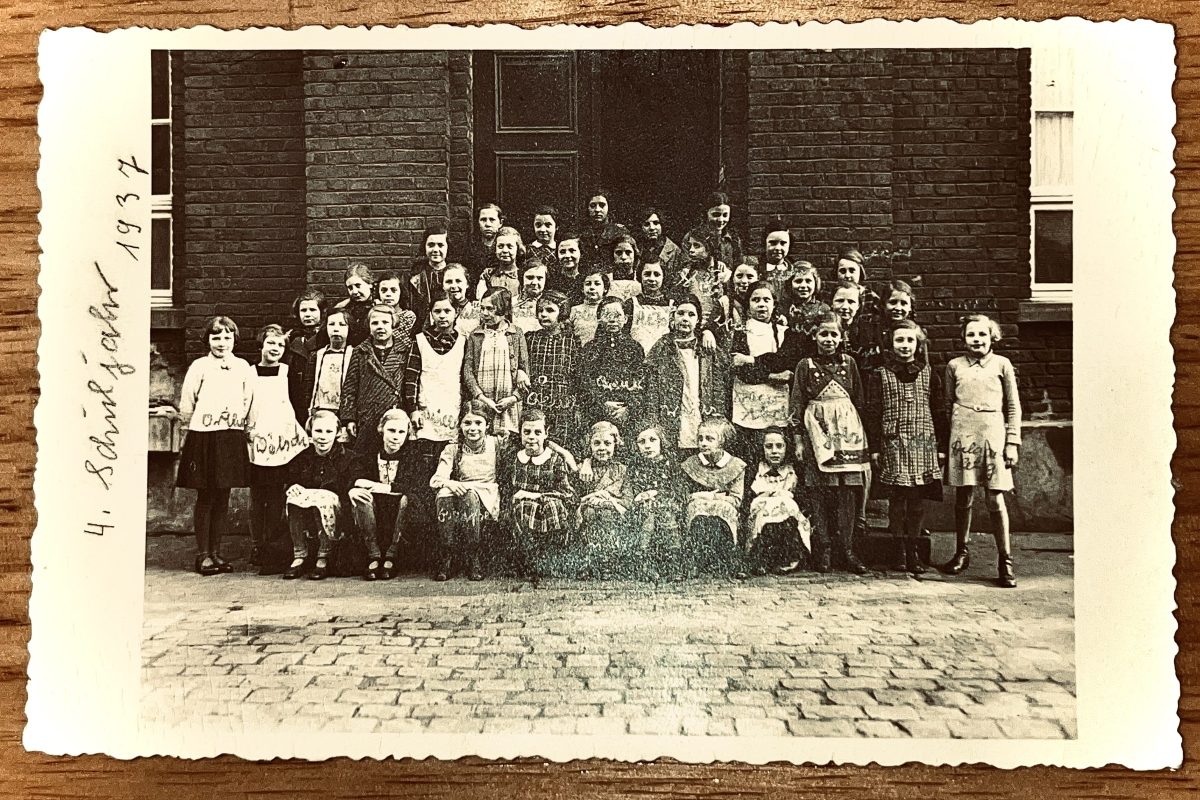
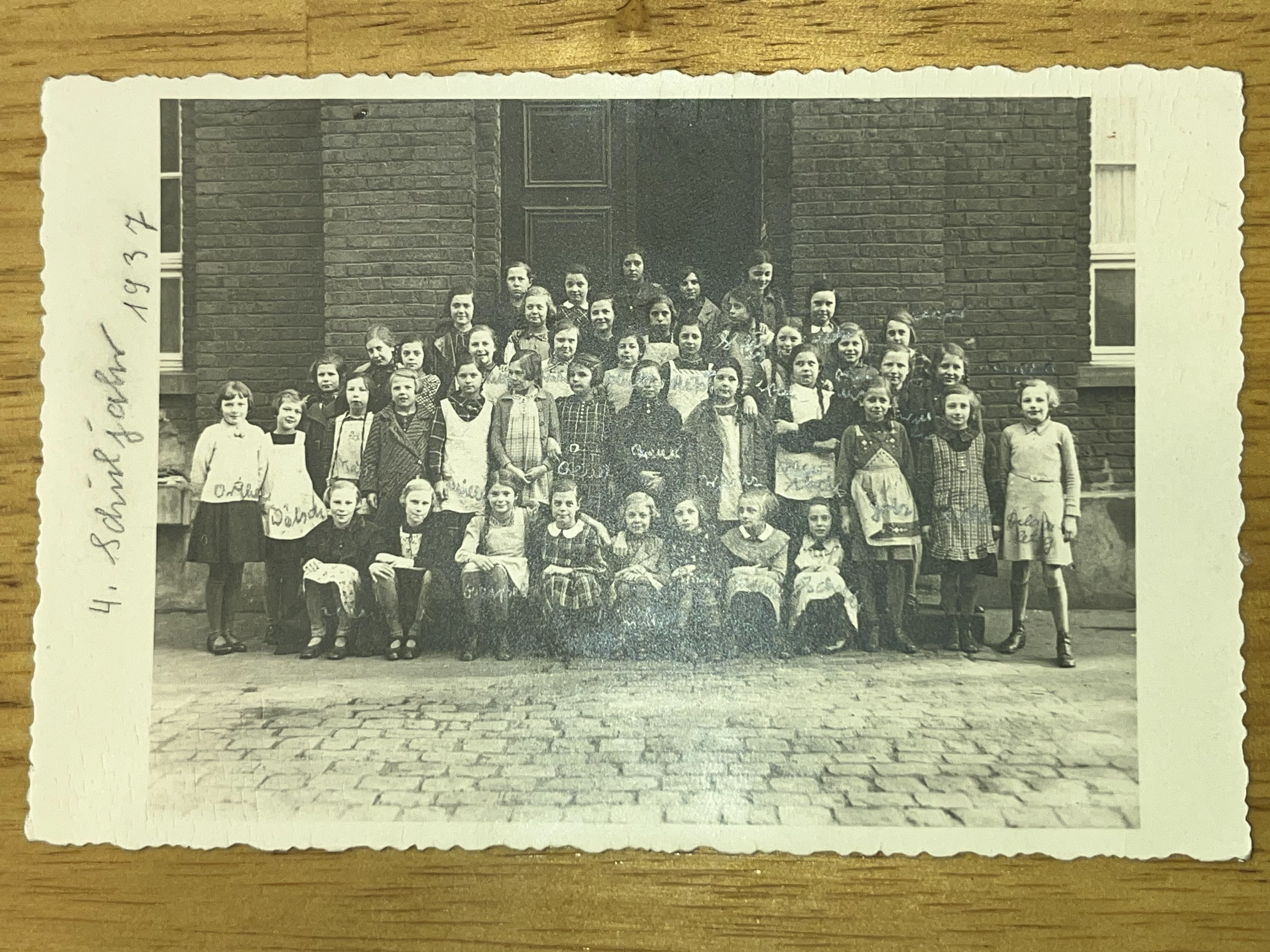
Then as soon as I opened the book, the most surprising and magical thing happened. A postcard of fourth-grade girls from 1937 – in the midst of the Holocaust – fell out of the book!

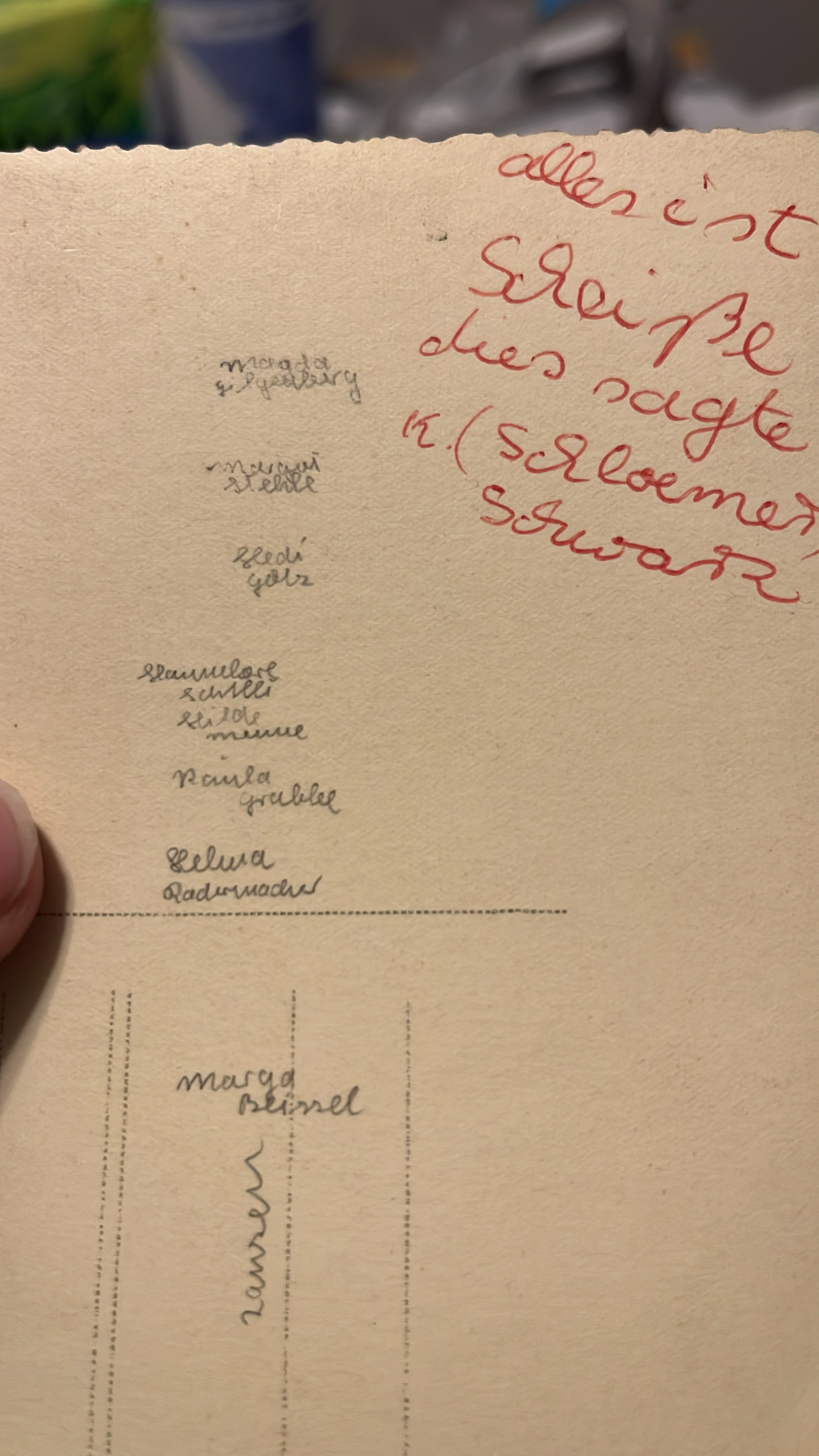
On it, there are some names written in cursive on the front. And on the back, even more names, some hard to decipher and written in pencil.

On the back of the card, someone presumably named “K. Schloemer Schwartz” wrote “everything is shit”. And if these girls, pictured below, were in fact Jewish and living in Austria or Germany during the Holocaust, you can understand why K. Schloemer Schwartz would think the world was shit. Probably very few, if any, survived.

To say this was “bashert” – or “meant to be” – is an understatement. This book could have sat in this bookstore for years untouched and unexamined. It could’ve been thrown out, along with this intriguing postcard. I felt honored that it had found me.

Since finding the postcard, I’ve shared it with U.S. Holocaust Memorial Museum and the National Library of Israel. I want to make sure this postcard can make its way to any of these survivors or their descendants. If you have any contacts at other institutions like Yad Vashem or Jewish genealogical resources, please don’t hesitate to comment below or contact me with any information.

Until then, the card remains a mystery. A mystery I intend to solve and that I’m happy ended up in my hands.

These innocent girls, now perhaps in their 90s if they’re alive, deserve to touch this piece of their past.

At a time of increasing antisemitism yet again, when it seems like the world has lost all sense of sanity and has forgotten the lessons of the Holocaust, this postcard is a reminder of Jewish humanity. It’s a reminder that our lives mattered then and they matter now – even if so many in the broader society demonize us for no reason.

We survived evil many times in our history and we will overcome it yet again.

May the memories of these young girls I discovered in Salzburg be for a blessing. And I hope, with your help, to find their families to offer a bit of comfort.

Am yisrael chai – the Jewish people lives. Now and forever.

A Haggadah of Hope

It’s not hard to be disenchanted with Israeli politics these days. While most of the world has been focused on Benjamin Netanyahu’s anti-democratic “judicial reform”, his same government has also been engaging in racist incitement and encouraging violence against Palestinians. The pogrom in Huwara is only possible because of a government that cares nothing for the lives of its Palestinian neighbors and who views its own Arab citizens as a threat. With a new militia promised to radical racist cabinet member Itamar Ben-Gvir, we may only be steps away from even more confrontation and death.

In such dark moments, we must not find the light – we must be it. For me, that means digging through my books. It means finding some knowledge, some history, some inspiration for how we can overcome such horrible things.

I found just the book!

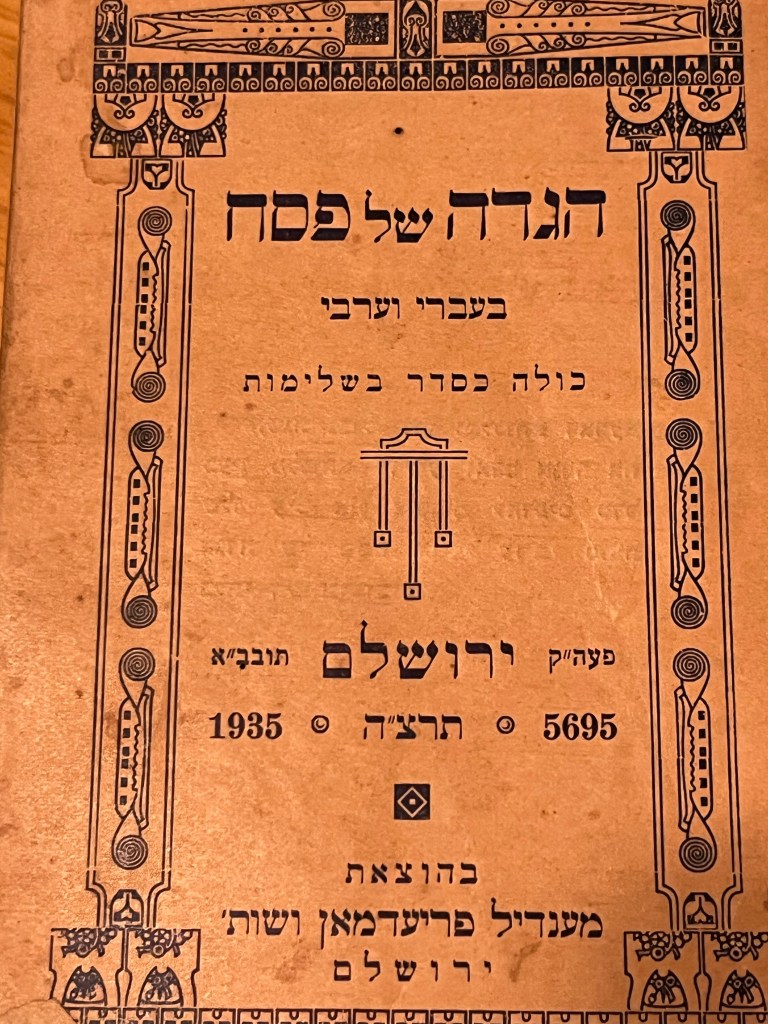
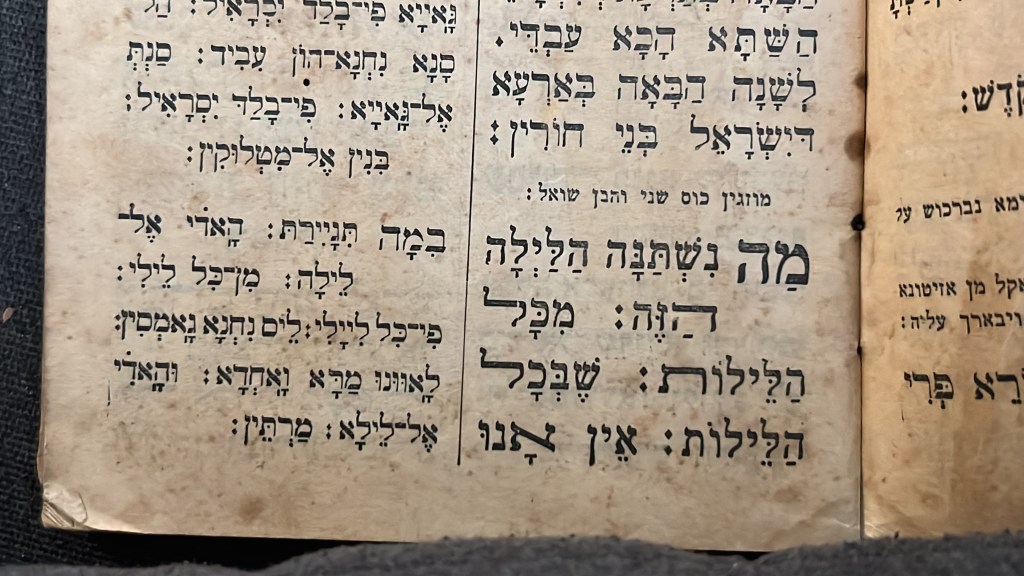
Digging through my bookshelves, I found a 1935 Haggadah, or Passover prayer book, from Jerusalem. But it was not any old Haggadah, it was a bilingual Hebrew-Arabic book – with the Arabic written in Hebrew characters.

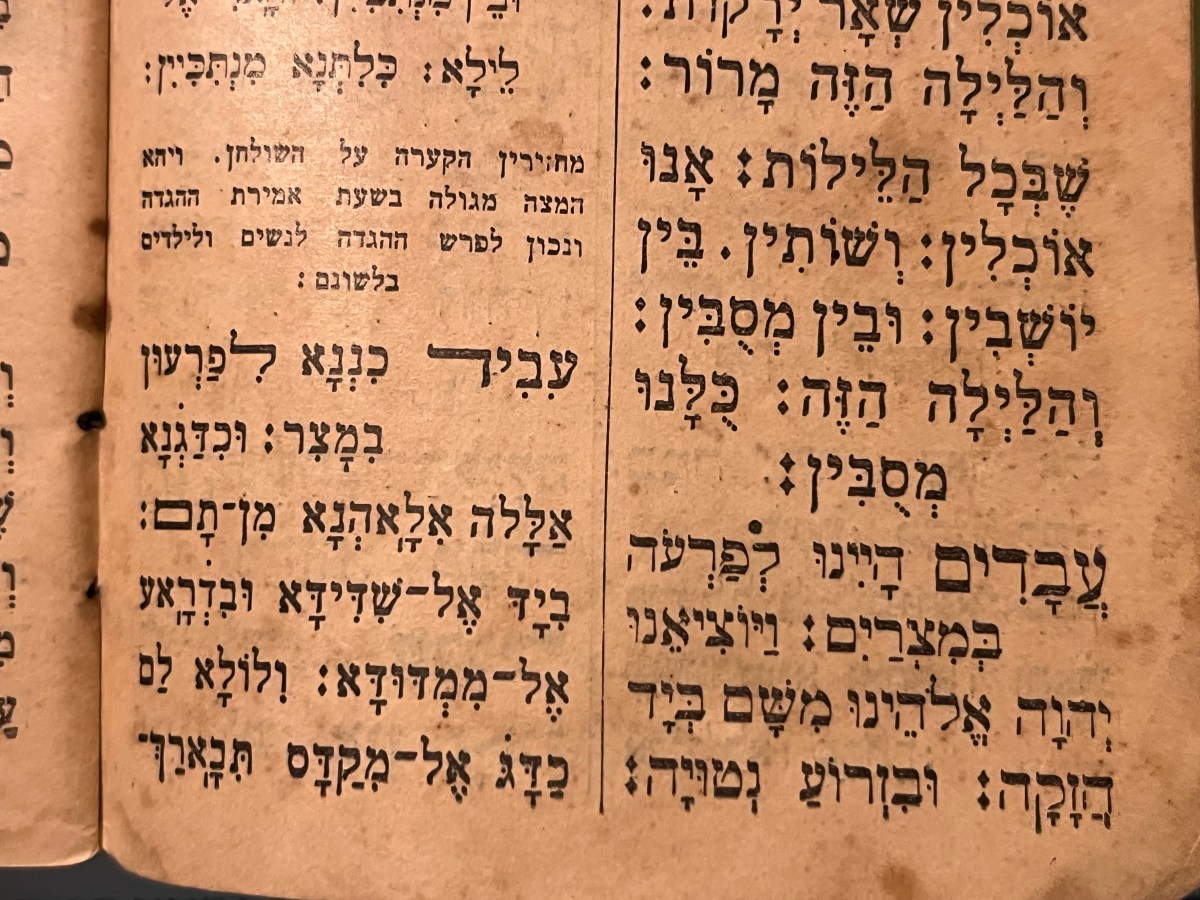
It remains a mystery to me as to why this Haggadah was published in both languages! Not because there is no reason for it to be – but rather many! First things first – this was published by an Ashkenazi printer – Mendl Friedman. So the printer was unlikely to be a native Arabic speaker, like some of the Jews who had been living in Jerusalem for centuries before the establishment of the State of Israel in 1948. Also, the Arabic inside the the Haggadah seems to be Levantine, though it’s a bit unclear at times and there seem to be a few inconsistencies. For example, in the Four Questions, the writer may have made a grammatical error (or I’m a bit rusty!), by first translating the Hebrew “leylot” (nights) as “leyli” (night as an adjective) instead of “liyali” (nights) before later switching back to “liyali”:

These inconsistencies make me think it was probably not a native speaker doing the translation, although I can’t be sure. In any case, we may never know whether this was an attempt to write in Judeo-Arabic, an attempt by Ashkenazi Jews to fit in their local environment, or the off chance that a Zionist organization wanted to promote integration into the local Palestinian culture (as some of them initially supported). Although the latter seems unlikely since the most pro-Arab Zionist movements tended to be extremely secular and were not likely to be publishing a religious text. If anyone reading this blog has insight into the who, what, when, where, why of this book, please share it with me.

So what does this have to do with today? In short, I am inspired by the publisher’s attempt to integrate Jewish and Arab cultures by way of language. Without knowing the intended audience, I can still say that publishing a sacred Jewish text in Arabic is a statement – especially in the conflict-ridden years leading up to Israel’s founding. I am moved by it and hope we will find many more ways to connect across cultures using language and our sacred texts as a point of commonality rather than conflict.

This Passover, Benjamin Netanyahu will probably be spouting off racist bullshit with his equally crazy family in a comfortable home rather than a jail cell where he belongs. However, we can be comforted by the past and inspired to act in the future. Jews and Arabs have not always been at each other’s throats. In 1935 an Ashkenazi Jew published a Passover Haggadah in Hebrew and Arabic. He probably couldn’t have imagined it would end up in a gay American-Israeli Jew’s hands, but that is the magic of history in action.

May this holiday bring more joy to the world. May it bring freedom. May it give us the courage to confront our modern-day autocratic Pharoahs in America, Israel, Russia, Turkey, Hungary, China, and more. For these Pharoahs sit in temporary comfort – justice will come. Avadim hayyinu – we were once slaves, and we will not stop fighting until we are all free. Chag pesach sameach, Happy Passover, and Ramadan Karim.

The Hebrew letters you can’t read

What’s in a word?  When we think about linguistic changes over time, we usually think about words and accents.  How did the Ancient Greeks pronounce Homer’s Iliad? Why does the word “mashber” in Biblical Hebrew mean precipice or edge, but today means “crisis”?

One thing you might not think of is how our script changes.  After all, even if English words are different today than 400 years ago, they’re still written in Latin letters.  Even if you’d be surprised at how some of them have changed.

But some languages have had their scripts completely change alphabets over time.  For one thousand years, Turkish was written in Arabic characters. For only the past hundred years has it been written in Latin letters.  Which means a Turkish person today who does not read Arabic characters cannot read his own history.  She has to rely on a translator to re-write old texts in the modern alphabet. It’s a pretty strange thought.  Think in reverse- what if the original Shakespeare had been written in Arabic characters? And you had to rely on someone to connect you to your own history.

It’s a question that is very relevant for Jewish studies.  First things first, Ancient Hebrew wasn’t written in today’s aleph bet.  It was written in letters that look something like a cross between Japanese and hieroglyphics.  Take a look:

image1

Today’s Modern Hebrew alphabet is descended from our sister language, Aramaic.  Aramaic is the language of the Talmud, of the Kaddish prayer, and of not a small number of Kurdish Jews in Jerusalem and Christians in the Galilee village of Jish.  This same Aramaic alphabet has been used for a lot of Jewish languages, including Yiddish, the native tongue of millions of Ashkenazi Jews across time.  Take a look at this 19th century bilingual Yiddish-Hebrew machzor, or High Holiday prayerbook, from our collection.  Or the 11,000 Yiddish books digitized online- for free- at our friends the Yiddish Book Center.  Or pick up a copy of Der Blatt in Bnei Brak.  Or visit Beit Shalom Aleichem’s library in Tel Aviv.  You’ll see those Aramaic letters everywhere.  Telling the story of the Jewish people.

What’s interesting is that even these letters have changed over time. One of these different forms is called Ktav Rashi, or Rashi script.  This alternate way of writing is named for the famous medieval rabbi.

What’s really inspiring about Jewish history is that what happens one corner of the globe inevitably ends up in another.

Rashi script (and its sister Yiddish script called vaybertaytsh), although named for a famous Ashkenazi rabbi, is actually of Sephardic origin.  Jews originally from Spain and Portugal, expelled and persecuted by the Inquisition, sometimes successfully escaped to other countries. They brought with them an amalgam of different Romance languages- medieval Catalan, Castilian Spanish, Portuguese, and more.  Often containing Arabic and Hebrew influences.

These Jews, often from distinct parts of Spain and Portugal with different languages, eventually melded their tongues into a new one: Judeo-Spanish.  Sometimes popularly called Ladino, but most scholars prefer the former term, so we’re going to use it. This tongue developed in a variety of new countries, such as present-day Turkey, Greece, Serbia, and more.

Judeo-Spanish then came to take on local influences in terms of vocabulary and pronunciation.  Making it as mixed and rich a language as Yiddish or another hodgepodge tongue you’re reading right now: English.

This language was written in the same Aramaic alphabet we use today in Israel and in synagogues around the world.  But with a twist: it was written in a form of the Rashi script. Take a look below at our copy of Istanbul’s Sephardic newspaper “El Tiempo” from January 2, 1896.  To this day, even in Modern Spanish, this remains a popular title for newspapers.  In Washington, D.C., you’ll find newsstands with “El Tiempo Latino”.

Here’s the news out of 19th century Istanbul*:

unnamed

If you’re a Hebrew speaker, you’ll notice something curious.  The title of the periodical and the headlines are written in the Modern Hebrew block alphabet we see today.  But the content is all written in a strange font, unfamiliar to the modern eye: the Rashi script!

There are words here and there you can catch.  But if you haven’t learned the script before, there are letters you won’t even recognize!  At best, you might find yourself staring in wonder as the somewhat familiar letters begin to entrance your mind and confuse you into curiosity.

This script has a version for handwriting too.  It’s called Solitreo, an ancestor of the Hebrew cursive you’ll see in Israeli classrooms today.

What does all of this mean?

In short, even if you spoke Modern Hebrew and fluent Judeo-Spanish but didn’t know this alphabet, you might not be able to read it!  Even though your Sephardic grandparents probably could. What’s more, Judeo-Spanish underwent yet another change as today it is mostly written in Latin characters!

When we learn about our heritage, who is teaching us?  Are we able to read the original texts ourselves and come to our own conclusions?  Or do we need someone to interpret them for us?

What does it mean that these texts, unless expensively re-printed in Modern Hebrew letters, are out of reach for most of today’s Jews or people who study our heritage?

You could ask the same question of our Turkish neighbors who can’t access the majority of their history in their current alphabet.

One solution is to re-print the texts.  A time-consuming one and while a good idea, can be above the budget of many institutions.  Especially for a minority language. Which limits how many texts can be made accessible to the modern reader.

Another solution is for people studying Judeo-Spanish (or any Jewish text written in Rashi characters) to learn the new script!

David Bunis, a professor at the University of Washington, is doing just that.  Here’s his take on why he’s teaching his Judeo-Spanish students the Solitreo and Rashi scripts.

While re-printing texts is great because it makes them more accessible to others, being able to read them in the original makes you the source of information.  And empowers you to read history anywhere. You are the judge, you are the interpreter. And your capacity to read is only limited by your time and effort, not by the letters you know.

No matter what, it’s great to learn about your heritage or different cultures around the world.  Preserving Jewish heritage for Jews, for Israelis, and for all our friends around the world.  To learn the lessons of the past and apply them to our present and build a better future.

Maybe you don’t have time to learn Rashi script or Solitreo, although if you’d like to give it a shot, try this free resource online.  It claims it can have you reading in 10 minutes!  Then you can peruse our catalog and find more news from Istanbul and across the Sephardic world to learn about.  Or old Yiddish prayers written by and for women.  Or maybe you want to pump up some Judeo-Spanish music in your car as you brave the traffic to work.

But no matter what you do, access this beautiful heritage.  The more you learn about it, the richer you are. And you don’t have to spend a cent to put it in your mental grocery cart.

*Image credit: National Library of Israel and Tel Aviv University

Goodbye Eastern Europe

This may end up being a shorter blog because I have a flight to catch tomorrow, but I felt it was important to put a few things down in writing before I forget.

I’ve spent the last three weeks in the East.  Romania, Hungary, and Slovenia.  Countries rarely on the tourist radar of Americans, slightly more on the radar of Israelis.  But hardly London or Paris.

I’ve learned a lot.  I’ve seen gorgeous mountains, I’ve learned about wild stray dogs firsthand, I’ve eaten delicious food, I’ve experienced European anti-Semitism from the Left and Right.  I’ve seen green forests, beautiful libraries, and enjoyed the rather reasonable prices.  Especially compared to the aggressive gougefest that is Tel Aviv.

These places are, on the whole, more polite and less aggressive than Israel.  It was nice to have to re-conform to the ideas of consideration and rules.  Even when it struck me as bizarre at first, like when a Romanian guy stood silently waiting for the crosswalk to say “go” at 11pm with no cars coming.  I actually laughed out loud at that one- he said it was because “it’s important to be fair.”  If only Israelis could just take one iota of that respect and apply it to their lives, the world would be a better place.  Even if it feels sometimes a big exaggerated here.

If I had to make a few broad generalizations, here they are.  Hungarians are super rude and xenophobic.  I’ve never been stared at so much (perhaps outside of Israel).  My caramel skin perhaps?  My Jewish complexion?  I’m not sure.  But there is a deep aggression to a lot of people in Budapest.  Maybe they’re still weary of communism or hate tourists, but I’ve never, not even in Israel, had so many people chuck my change or plastic bags at me in stores.  For absolutely no reason.

Overall, all three countries are rather xenophobic.  Anti-Semitism is definitely still present, despite the paucity of Jews, showing just how utterly illogical the whole concept is.  And a great deal of the energy that has historically been used against Jews is now being used against other minorities such as Roma and Syrian refugees.  There is a lot of angry graffiti to be found- occasionally countered by progressive forces.  Though some of those forces have said pretty nasty things to me about Israel.  It’s not easy to be a gay, open-minded Jew in this part of the world, squeezed in all directions.

The nature here is absolutely stunning.  Perhaps because this part of the world industrialized later and isn’t as densely populated as Western Europe, the mountains and forests are so much prettier.  If you like raw green space, Eastern Europe has a lot of it.  Especially Slovenia, the 2nd greenest country on the planet.  The public transit isn’t great, so if you really want mountain time, find some hostels or lodging deep in the hills and enjoy.  I had a lot of stomach-turning van rides in Romania- this region is not for the feint of heart.  But once you get a sense of it, the surroundings are quite gorgeous  And the stars are brighter than almost anywhere.

Slovenians, while perhaps just as xenophobic as Romanians and Hungarians as a whole (it should be noted I met people in all places who resisted this mentality, but it is a phenomenon), are much friendlier than Hungarians.  Again, generalizations, but I had a lot of interactions with people.  Because I’m friendly and because my phone had next to no data here, so I was always asking for directions.  The average Hungarian looked distraught and irritated to answer my questions.  While Slovenians almost always were happy to guide me.  Before someone blames this on communism, Slovenians also lived under communism and somehow turned out gentler, so who knows.  Maybe it’s just a long-standing part of the culture of a product of Slovenia’s greater economic success.  But it is a thing.

Romanians are by far the most religious of the three countries, with new churches being built everywhere despite some fairly grinding rural poverty.  I can’t help but think what an intense waste of money this is at a time when people are suffering and millions of Romanians go abroad in search of work.  Everyone’s entitled to their beliefs, but should the government really be funding religious institutions at this rate when people can’t earn a living?  There are Romanians who agree with me, but they are an embattled minority.

Slovenians are the least religious and, perhaps not surprisingly, the most gay friendly.  Or at least tolerant of our existence.  While there are neo-Nazis here (I saw my first Nazi salute during a tour), gay rights legislation is fairly advanced and I never felt threatened.  I can’t say that anything in Slovenia remotely approaches the tolerance of a major city in Western Europe, but for this region, it’s quite chill.  Romanians, as a whole, are pretty conservative and you feel it.  Some of the major urban student centers like Cluj are more open, but I feel they are perhaps the exception more than the rule.  It must be quite hard to be gay and grow up in this part of the world.

Jews.  Jews in this part of the world are more likely to be dead than alive.  While a few brave non-Jewish souls, sometimes in partnership with the few living Jews, take care of our few remaining historical relics, this is overall a graveyard for my people.  While you can see aspects of our culture (or shared culture) everywhere- from the folk music to the food- the Jewish graveyards and empty synagogues far outnumber living communities.  I’m frankly tired of seeing our ruins and want to see some living members of my tribe.  It is certainly interesting and moving to see sometimes (though sad to see that only Jewish cemeteries have to be walled off to prevent desecration), but I prefer my Jews alive, thank you very much.  I will say that I wish more Israelis (and American Jews) visited this part of the world, because it is an important part of our heritage- 2,000 years old- that explains a lot of our behavior and our traditions.  The food here tastes a lot like home.

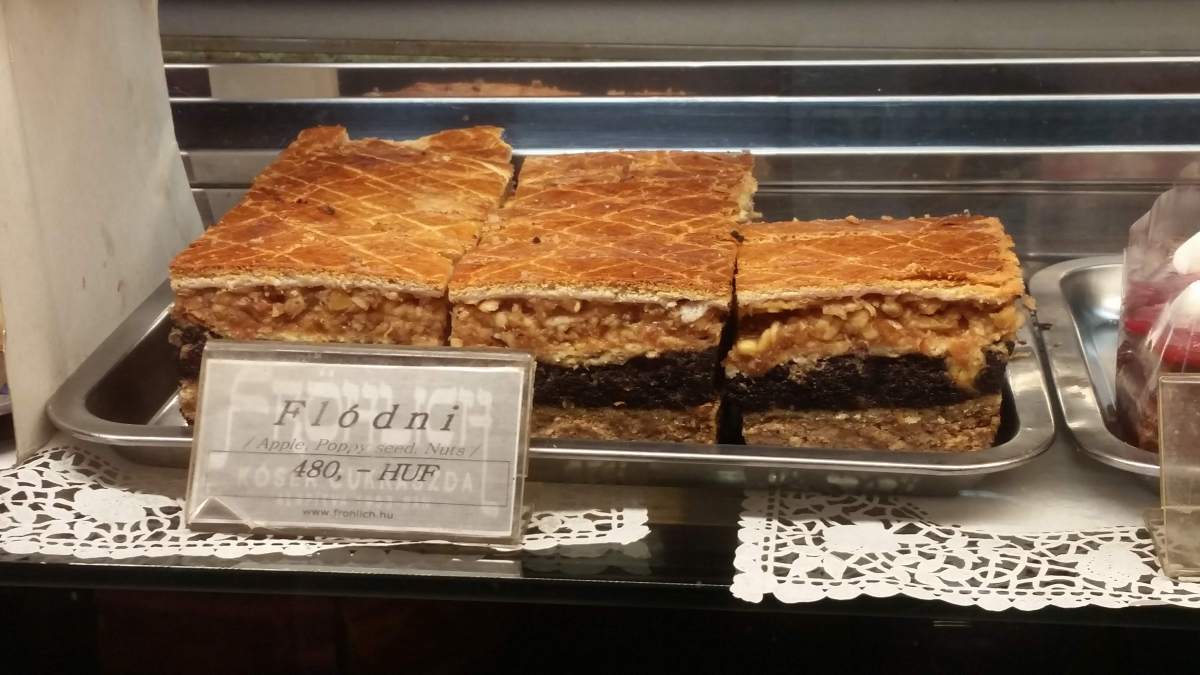
The living Jews I met here are pretty cool overall.  I really admire them keeping our culture alive in the belly of the beast.  In a place that gave birth to so much of our civilization today.  And I learned a lot about my own heritage.  Whether it was the delicious flodni dessert that tastes like charoset, the intensely personal Holocaust survivor stories, or the surprisingly old history of Reform Judaism in this part of the world, a lot of my previous understandings changed.  Even of Israelis themselves- I understand a bit more why they are they way they are.   I am more knowledgeable about my ancestry and my origins than I was before, and I’m proud to have reconnected to places important in my identity.  And through meaningful conversations I had with both Jews and non-Jews, hopefully contributed something to this place’s future.

I met some really interesting people here- whether it was Syrian refugees, a Jordan queer girl, or a Polish guy deeply interested in visiting Israel and learning about Jews.  I met some ambivalent people- young Germans who preached tolerance and reconciliation after the Holocaust.  Who seemed genuinely interested in my identity as a Jew and Israeli.  Who then made the odd suggestion that I *must* visit Chemnitz, the East German city now erupting in neo-Nazi riots, to see that these are just frustrated protest voters who wouldn’t actually hurt me.  A serious twist of tolerance shifting into victim blaming that I’m still digesting and may write about further later.  It’s not my job to see the wonders of this city- it’s the responsibility of Germans to make it safe for me to visit.  “Never again” doesn’t mean it’s my job to do their work in building a more tolerant society.  I’m curious to visit Germany one day, but I’ll only go to places I feel safe.  As most tourists would do in any country.

And Slovenians.  Most Slovenians I met were quite friendly and had little if anything bad to say about Israel or the U.S.  And a few were pretty rotten.  There’s this one place up in the mountains where you can take a stunning cable car ride.  I visited it and met some young people who worked there, one of whom gave me a ride to the local village.

Both she and her colleague, at completely different points in time and in different conversations, took pains to tell me how Israelis steal from their resort.  That they’re too demanding and rude.  As if I’m some sort of ambassador for the Israeli tourist hordes.

It was quite odd.  Because the way they phrased it, they said: “what are people like there?”  As if a few dozen poorly behaved tourists represented a country of 8 million people.  Admittedly a rather impolite country, but one that is hardly so barbaric as to be the only one to produce bad tourists.  I saw more than a few clueless tourists from around the world, especially in Budapest where it seems all people do is take selfies.

Perhaps Israelis are more aggressive, and I tried to show some nuance, but I got tired of it.  At first, I thought I was being too hard on them.  Maybe their stories of missing forks and bedsheets were true.  Although I have to say if you have the money to travel to Slovenia, you’re probably not that desperate for a new fork.

But I soon understood that it was anti-Semitism.  For in the same conversation, the cute, blond-haired, blue-eyed guy who I resisted sleeping with (I’m pretty sure he was gay- what a cute smile!) kept saying how lazy and irritating Albanians and Bosnians were.  Those southern immigrants were just too stupid to be as successful as Slovenians.  A trope I heard a lot, not much different than how some white Americans talk about blacks or Latinos.

The oddest thing about it all is that when I pointed out that maybe some people have mistaken stereotypes about Slovenians too, the hot guy said: “no, we are polite.”  Just after he asked me to defend rude Israelis and made racist comments against (often Muslim) immigrants in his country.

Here’s one thing I’ll give Israelis credit for: if they’re racist, they tell you so.  I do feel that Israelis on a whole are a pretty racist bunch.  More than the average American and more than a lot of countries.  But this trip goes to show they’re perhaps not as unique as we think.

That perhaps we’re simply, on some level, holding on to the cultural norms of the part of the world where a lot of us come from.  A place where Slavs bemoan gypsies, where a Romanian used the word n*gger in the car with me, a place where the brown and the black are derided alongside the Jew.

So if Israelis are too racist, at least it’s not shrouded in a bunch of bullshit.  Because there’s nothing polite about prejudice.  Not against Israelis, not against immigrants, not against refugees.  You can have your neatly queued lines and your politely folded napkins, but that doesn’t make you polite, that makes you neat.

I hardly begrudge this neatness- it’s quite nice after the sometimes overwhelmingly crude Israeli norms that make you feel like your feelings don’t matter at all.  A gentle, if prejudiced, silence is sometimes better than shouting for no good reason.

But perhaps next time a Slovenian complains about the Jews stealing his forks and napkins, I’ll ask him to return our synagogues held by his government.  The decrepit cemeteries holding our dead, turned into casinos and nightclubs.  And the Jewish homes and gardens turned into restaurants and simply stolen by average citizens.  With not so much as a thank you.  To this day, Romania has paid a paltry amount to Holocaust survivors who used to live on its soil.  Survivors often living in poverty, 70 years after they were stripped of everything.

So I don’t mind your politeness, I kind of like it.  But all I’m asking is if you’re going to criticize my countrymen for taking something that isn’t theirs, then give us back what is ours.  We’re not immigrants, we’re not foreigners, we’ve been living on shared soil for 2,000 years and I’m tired of you treating us like the “other”.

Eastern Europe- I’ve learned a lot here.  Maybe I won’t spend so much time here next visit, whenever or if that might be.  Perhaps next visit I’ll be spending more time with existing Jewish communities or documenting our heritage.  Or maybe teaching the more open-minded among your folk about what it means to be a Jew.  To build a better, shared future.

In the meantime, I’m going to places with more living people who get me.  Living Jews, living gay people, living in better conditions.  Because as much as I needed some space to try new things and understand myself as an individual, not just a member of a collective, I really feel I need a bit of that community now.

I’m a human being above all else.  A living thing.  And living things need sustenance.  The kind of sustenance where even if you barely agree on anything at all, when you see the challah on the Friday night table, you know on some level you’re in this together.

So if I’m a bit tired of tribalism, I suppose I’m not opposed to a little teamwork.

Chag sameach, wishing you a happy Sukkot.  And may this itinerant holiday remind you that the journey is never-ending.  May your journey bring you to health, safety, and satisfaction.

Amen.

A trip to Hungary

Sometimes life truly surprises you.  Having left Romania (see posts), I decided I needed somewhere nearby, more gay-friendly and with more *living* Jews.  So I headed to Hungary, another one of my ancestral homelands.

I am a quarter Hungarian.  My great-grandparents were from Pacza, which today is either Pacsa, Tornyospálca, or the (formerly Hungarian) Slovakian village Pača.  I’m still doing extensive research- finding Jewish genealogy here is a bit like finding a needle in a haystack.  Due to both the time passed (130 years) and the killer job Nazis did in burning our archives, it can be quite hard.  An entire continent uprooted us over ages, so it’s hard to feel rooted here, even as we’re the oldest religion on the continent and our empty houses of worship dot the landscape.  Sometimes turned into trendy cafes or Italian restaurants, without so much as a word of our consent.

Budapest is an interesting place.  Gorgeous scenery, grand buildings, and a surprising calm for a city of its size.  The screaming and chaos of Tel Aviv this is not.  Cute cafes (including one that has cats in it!), affordable prices, and phenomenal safety make it a good place to spend a few days.  Not to mention Hungary’s 1700-year-old Jewish community that I’m a part of.  Before the frickin Huns even arrived.

As a Jew, some things stood out to me.  First off, there are actual Jews here.  Most parts of Romania I visited had almost no Jews left, or a very old (as in gray hair) community.  In a place that was once home to over 700,000 Jews, dating back to Roman times.

Secondly, the people here are really…brusque.  Maybe that’s not the word- I’ll be blunt: they’re assholes.  No, not everyone.  But most people.  There is a deep politeness to Hungarian society.  At first, this was refreshing, having experienced so much rudeness in Tel Aviv.  But you soon start to see that it’s a big facade.  People here have literally thrown my change at me in stores, they stare a lot (until I stare back), a woman I was paying for genealogical research berated me for taking water from a water cooler.  In the office I was paying her to sit in.  To quote: “in our country, you ask for water first.”  Message understood.

While this brusqueness is pretty much thrown at everyone (especially if you’re a foreigner), it has at times manifested itself towards me as a Jew.

I visited a beautiful library the other day.  It was so peaceful- quiet, relaxing, a great place to think and reflect.  The architecture here is marvelous and the tranquility truly, aggressively silent.  There is no neighbor blaring Beyonce at 3am on a Wednesday.  Yes, that has happened to me in Israel.

It’s in fact a branch of the Hungarian National Library.  Hoping to find some books to relax (I love books!), I went exploring.  I found most books were in Magyar, the local language.  But some were in French, German, Romanian, English, and other languages.  I even found a small book on Judaism.

I approached a young man working behind the information desk.

In my best American-polite voice, I asked: “excuse me, sir, do you have any books in Yiddish?  Or on Hungarian Jews?”

His answer: “this is the Hungarian National Library.  We only have books about Hungarians.  In Hungarian.  You can try one of these other libraries to try to find what you’re looking for.”

As he handed me a scrap of paper.

This is Hungary.  A place so reminiscent of the nationalism that plagues the Middle East, it might as well live there.

The fact that the city he lives in was a quarter Jewish just 70 years ago didn’t seem to factor into his commentary.  Or maybe it did.  After all, the Jewish quarter today is a bunch of bars and hipster cafes.  This kind of appropriation and abuse happens a lot with nationalism- it’s just that in America, you don’t often *see* the Native American ruins turned into a nightclub.  Perhaps it would sensitize Americans to how they achieved their great wealth.  Or perhaps they’d end up bland and desensitized like far too many Hungarians.  Despite having nearly cleared their country of Jews (in collaboration with Nazis), an astonishing 41% of the country is anti-Semitic.  The highest number in all of Eastern Europe.  A region famed for hating me.

The other day I heard an American voice.  A woman was taking a picture of a synagogue, I thought she might be Jewish.  “It’s beautiful,” I said.  She said back: “indeed!  Where are you from?”  I said: “I’m originally from Washington, D.C., and going back 130 years I’m Hungarian.”

She laughed: “well yeah, if that’s how we’re counting, I’d be speaking Irish right now.”  Chuckle, chuckle.  Completely unaware that maybe one of my ancestors worshiped in this synagogue.

I said: “my ancestors were kicked out of this country for being Jews.”

A dead silence.  “Oh, ok.”  She then stepped inside, maybe 10% embarrassed, 90% too focused on the lens on her camera.  Never to be seen again.

Feeling decidedly unconnected to most locals, I used the Couch Surfing app to find some internationals to hang with.

I’m really here to get away from the Middle East for now- to get some space.  But to my surprise, I found a young Jordanian woman (let’s call her Amira for privacy’s sake).  Who wanted to go to a gay bar!

Thank God, I really wanted to see some cute guys and connect to that other community I’m a part of- the fun one 🙂 .

A little nervous that politics might come up (it says that I’m Israeli on the app), I didn’t know what to expect.

But instead of a long drawn out conversation about the region’s ongoing PTSD, we ended up sitting down with two queer Macedonian girls.  And dancing with some British people.  And giggling.  And singing.  And frankly having a fantastic time.  It gave me a little hope that especially when we’re away from the mess, we can have a little more fun.

I met a few nice Americans here as well.  It was kind of refreshing to speak English and to share the same culture.  I can’t pretend Israeli culture hasn’t impacted my life- it has.  In a lot of ways, traumatically.  In some ways, kind of cool.  At heart, I’m still pretty American- more than you might expect.  And it was nice sharing that with people on kind of a neat neutral ground here somewhere in between corn bread and challah.

Friday night I went to Reform services.  I do not believe in God.  It’s something I’ve fully realized lately, and my experiences in Israel have convinced me of.  But I really miss community.  And when you’re traveling, Jews are better than anyone else at being nomads.  We’ve been doing it for 2,000 years.  And we find each other everywhere 🙂 .

I went to the services and found myself liking some of the same melodies (for those who don’t know, I’m really, really Jewish- I’ve led Reform services in varying locations since I was 14).  I especially love the old tunes- the ones from this part of the world.

And I found myself unable to mouth the word “God”.  I found some of the words I could kind of reinterpret or recreate with my meaning.  But the God piece- it really angered me.  I don’t believe in God- and the concept makes me furious.  I feel it’s an abusive one- not that all people who believe in it are abusive, but the idea of an invisible being telling us what to do- often to the detriment of our self-worth- really irritates me.  Especially when you see that conflict up close literally killing people.

I excused myself for the latter half of the service and came back for the meal.

The meal was great- a potluck, with some Hungarian surprises.  Hungarians love paprika.  I don’t know why, but they do.  And to be honest, it was found in nearly every dish I ate as a child.  So I guess my family brought it with us across the ocean.

The rabbi taught me all about Hungarian Jewish food.  And her congregant told me all about Hungarian Jews.  Apparently 19 out of 20 Nobel Prize-winning Hungarians were Jewish.  No wonder so many of them can’t stand us 😛 .

The rabbi has a fascinating story.  Her parents hid in the forests near Budapest during the Holocaust.  While her grandfather was deported to Buchenwald, her parents buried a suitcase under a tree each night.  And pretended to go to work each day.  Sleeping in the dirt under the moonlight.  Until the war ended.  And 565,000 out of 800,000 Hungarian Jews were evaporated.  An entire civilization, a race, loving parents with their little children- burnt to a crisp.  To supply a bunch of Germans with BMW’s.  And to satisfy Hungarian blood lust with the active participation of their fascist government.

What was so astonishing was how normal the rabbi was.   How kind, how gentle, how welcoming.  How easy it was to talk with her about one of the hardest things to talk about.

A deep note to my Israeli friends- losing loved ones in the Holocaust is not an excuse to be abusive yourself.  Not to other peoples or to other people.  This rabbi proves that.  If anything, it is a reason to work extra hard not to be that way.  This is an incredibly difficult hurdle- as someone who has been abused for decades myself, I know that.  And in the end, we’re responsible for our behavior, even as we know what has caused it.  And we can choose to pass that abuse on or to break the chain and strive to treat others better than we were treated.  Stop weaponizing the Holocaust to excuse bad behavior and instead, let’s heal.  Evidently, without the help of many countries that caused our pain.

In the end, while I don’t believe in God, I loved the Shabbat dinner.  Not for religious reasons, but for culture.  For history.  For conversation.  Yes, for continuity and change.  A Reform service- a tradition deeply rooted in Central Europe.  Where Neolog synagogues still stand.  And where, despite the best efforts of more than a few miserable neighbors, we still exist.  We are here.  I think I’ll keep seeking out, maybe creating, Jewish culture because I like some of it.  It’s mine, and I’m proud of our survival and our thriving in the midst of sometimes unbelievable pressure.  Perhaps something we share in common.

For ages upon ages, Christian Europeans denied us the right to own land.  To practice everyday professions.  Forced into banking and jobs that goyim didn’t want.  So more people would hate us than the actual governments oppressing them.  To then pay taxes to go to church and learn why we’re awful- and burn us on Christmas Eve as tradition.  No Christmas tree for me, I think.

Jews were stereotyped as “rootless”- a people wandering miserably, punished for killing Jesus.  When in reality, it was Christians themselves who regularly uprooted us.  Stealing our homes, killing us, even enslaving us at times.  Which is how a bunch of people with Mediterranean features and DNA ended up in bitter-cold Poland instead of on a beach on the Dead Sea.

We’re not rootless.  We are from here- me too.  My tradition, my very blood is Middle Eastern, it has stained the soil of Hungary, and I am no guest.  Do not throw plastic bags at me in your grocery stores or tell me your libraries are “just for Hungarians”. And stop complaining about how hard it is for you.  Communism sucked, you’ve been through a lot.  The economy isn’t great.  But I’ve literally met Darfur genocide survivors more cheerful than you.  Have a little perspective.  At least you’re here to complain unlike the rabbi’s grandfather.  Turned to dust.

Now a word to my Palestinian friends.  Through a mutual friend, I had been dialoguing some with a Palestinian woman from Hebron online.  One of the most violent and chaotic focal points where Israeli extremism and Islamic fanaticism meet in utter despair.  Where settlers bemoan the existence of Arabs- and sometimes physically attack them.  And not a small number of practically caged-in Palestinians throw bombs, stab babies, and shoot Jewish civilians.  If you want to really feel bad about humanity, this is a good place to take a peek at the darkness.

This woman, let’s call her Fatima, is religious.  I tried dialoguing and it went well for a while until she starting erupting at me- kind of out of nowhere.  Having seen some of the conditions in the West Bank, I displayed a lot of empathy.  Including sharing about the documentation I’ve done about Palestinian villages destroyed in Israel.  My empathy was several times thrown viciously back in my face.  Which really hurt.  Sometimes she managed to listen and acknowledge.

Fatima shared she was excited to go to Austria to teach Palestinian culture.  I told her my family was Austrian- in fact, all of Hungary once was.  And she said “oh, that’s random, you’re American and Israeli though.”  And I said: “yes, they were kicked out for being Jews- and the ones who remained were mostly massacred in the Holocaust.”

She said: “I hate Hitler and all his ilk.”  The “ilk” part floating softly in the air, its full meaning to this day not entirely clear to me.  Did she mean me?  Did she mean Israel?

Despite a lot of hateful rhetoric she spewed at me without even knowing me- despite me frankly trying to be an ally for a better future for her and her people in ways that gets me into trouble with a lot of Jews.  I told her this: “if you really want to understand why Jews feel we need a state, ask the Austrians what happened to the Jews there.  Why there are barely any Austrian Jews left.  You might not want to learn Jewish history now- that’s OK, maybe you’re not ready.  But you won’t understand a thing about us if you don’t understand why we left the wealthiest continent on the globe to colonize a conflict-ridden strip of desert.”

To the Palestinians desperate for support and solidarity- you deserve humanity and you deserve a better life.  In peace.  And watch out who you ally yourselves with.  Just as I bemoan Bibi becoming friends with anti-Semitic, anti-Muslim nationalists in Europe (that’s a thing), I encourage Palestinians to think twice before cheering our former oppressors.  In some cases, our current ones.  You may think they’re coming to show you solidarity- some of they may be.  And some might be coming to help you just because they hate us.  And if you’re really smart, you’ll realize they helped create the very conflict you live in.  By smashing us for generations and by colonizing you too.  Not a small number of them and their families and friends are just as happy to hate Muslims in Europe as they are to see you and I go head to head to realize their anti-Semitic blood fantasies.  Even if you think they’re on “your team.”  Every time you bring your case against Israel to the E.U., even if you don’t mean to, you’re revitalizing our trauma.  I don’t have a lot of great alternatives, but you might want to think about how you do what you do if you’re really serious about successfully solving things.

I don’t believe in God, I believe in accountability.  Not theoretical after-death accountability from above.  Accountability in the here and now.  That we must take into our hands if it is to happen at all.

As a survivor of abuse, I often wondered to what degree that abuse- widespread in my family across generations- was caused by anti-Semites.  Every individual is responsible for his behavior- and that includes my family members.  No amount of systemic or individual oppression justifies heaping that hurt on someone else.  Over and over.  And that’s why I have worked so amazingly hard to be a better person than the people who abused me.  And why I’ve cut toxic people out of my life, at great cost that has brought me impressive progress.

I do notice a lot of abuse in Jewish families.  And I wonder to what degree this pattern, if it is one, is tied to our less-than-generous neighbors who belittled us and uprooted us for generations.  It has to have had an effect.  I wonder if similar toxins have infected African American and Native American communities for the same reasons.  I’m not sure, but I’ve heard some arguments that it has.

I have skin in the game.  I want to know why I had to suffer for so long- with so many horrendous consequences for my health and well-being.  And while I can hold my family and my fellow Jews accountable (especially Israelis, whose society has turned a lot of abusive behavior into social norms- a scary development), I want to know why so many bigots here in Europe demeaned us.  And I want to call them to account.

I’m grateful for the brave non-Jews here who are allies to us and other minorities.  And I ask you to realize just how bad it can be here.  That it is still one of the most anti-Semitic regions of the world despite being practically Judenrein.  That large percentages of almost every country hate Gypsies, gay people, and increasingly Syrian refugees.  A problem admittedly complex (a number of them have perpetrated violent anti-Semitic attacks), but hardly one that justifies hatred and racism towards suffering people.

While taking a break tonight from genealogical research and writing this blog, I stepped outside for some food.

I found myself in front of a kebab store.  With the famous spinning shwarma machine.  Just the kind of culture I was trying to get some space from, to rest.

I found myself walking and re-walking the block debating whether to buy it.

And feeling so angry at Hungarians (the only other options around) and really hungry, I went in.

Turns out, the owner is a Syrian refugee.  And I told him I’m American and Israeli and we had an awesome conversation.  He told me my Arabic is as sweet as baklava.

As I bid him a warm goodbye, I couldn’t help but think to myself that the best people I’ve met on this trip are not Romanians and they’re not Hungarians.  Even though I am “from” these places- and they do have some fun stuff to offer in addition to the hardships.

The people who made me smile the most were a queer Jordanian girl who had never been to a gay club and a Syrian refugee.

Dear Europe- you may have gotten rid of us Jews.  But like a racist Israeli cab driver once told me: “you killed 6 million Jews and got 50 million Muslims.”

To which I say: “if you won’t show us the kindness we deserve, then I will help every refugee I can.  Because you uprooted us- but you will not uproot them.  My pain- the way I see life- my job is to turn it into honey.  Or at least not bitterness and bile.  So if it helps a Syrian refugee feel a little happier to chat, I’ll do it.  And I support their right to a safe life.  If it causes you a little pain to live with the ‘other’, then I’ll be blunt with you: you’ve earned it.  Grow up.  The grand Hungarian Empire is never coming back.  And it’s your turn to show a little kindness where you showed indifference towards my family.  An indifference I feel I continue to pay for to this day.”

You kicked me out 130 years ago.  I’m the first of my bloodline back.  With an American and Israeli passport- something you could envy.  You can choose to live in misery wailing about the communism that was, quivering about “Muslim invasions” that do not exist outside of your TV screen.  There hasn’t been a Turkish soldier here since the 1600s.  Or you can do something Jews have had to do for a long time in the shadow of your pitchfork: adapt.  If you don’t want to change, at least give me mine with a smile.

p.s.- the picture is of the Great Neolog Synagogue on Dohany Street.  If there’s one reason to come to Hungary besides great affordable food- it’s this.
The incredible yo-yo of being a Jew

Lately, I’ve been traveling in Romania.  It’s my third time here since March- I fell in love with the beautiful scenery, delicious and cheap food, and overall calmer atmosphere than Israel.  A place with far more history than America but with no active warfare like Israel.  And a place where a quarter of me comes from 🙂

Well, here’s the conundrum of being a Jew.  Especially a gay one.  Romania has some pretty awful things too.  Just as I’m trying to get space from Israel (and its creeping fascist state, persecuting minorities), I get a reminder of how stupid people around the world convinced us we needed a state.  Like theirs- faulty, and usually creating more problems than solving them.  But understandably could seem better than being regularly persecuted.

Romania has a storied history of anti-Semitism.  There are brave non-Jews working to preserve our heritage now- I’ve met young people interested in Klezmer, old women doing Israeli folk dancing, people looking after our synagogues.  The ones that haven’t been turned into pizzerias.

It also has a lot of bigots.  On Rosh Hashanah, I was sitting in a restaurant.  I almost went to services, but for the first time in my life, I didn’t.  I don’t believe in God.  I considered going for the community, for the tunes, for maybe a bite of Jewish food.  But when I saw the historic-synagogue-turned-arts-center was fastidiously set up to separate men and women, I felt that an Orthodox Rosh Hashanah was the last thing I wanted to do now.  I talked to some of the non-Jewish staff members, which was nice.  And then I left to eat.

So I’m alone noshing in this restaurant.  And a woman, maybe 40 years old, is playing with her kid.  The kid waves at me and we say hi.  He’s super cute.  The mom starts talking to me in English.  She’s from Bucharest but moved to Cluj some years ago because it is nice and calm.  When she asked where I was from, I said I was both an American and Israeli citizen.

She then says: “I want to go to Gaza.”  I said that wasn’t possible now.  And she says: “I know, I want to go get arrested [to protest].”  I said: “it’s a difficult situation on all sides.  My friend lives on the Israeli side of the border with rockets falling on her house and I’m sure it’s hard for Gazans too.”

I tried to conclude the conversation, but she kept pushing.  While making every effort to smile, she told me: “I want to go to PalestinA”.  With an “A” as if she just needed to emphasize every last consonant.  Like somehow I didn’t pick up on her political message the first time she bluntly interrupted my holiday meal.

I said: “great, you can go.”

Romanian woman: “I want to go to Jerusalem and see the Orthodox Christian sites.”

Me: “you can do that, you should realize that the Christian sites aren’t so protected in Gaza under Islamist rule and that Jerusalem is a part of Israel.”

First things first, I could have gotten into a nuanced conversation about West and East Jerusalem, varying land claims, the suffering on all sides, the Christians caught in the middle of national conflicts, but I knew this woman wasn’t interested in nuance.

Instead, she said the strangest thing.  Besides not knowing Jerusalem was a part of Israel (again, even if you accept the contested nature of the land, most of the world recognizes West Jerusalem as Israeli), she was astounded to hear rockets were falling on Israeli cities.  From Gaza.  She said the news said it only happened the other way around.  She said: “life is suffering.”  And when I tried to suggest there were good things in Israeli and Palestinian society too, she just kept to her message.

Feeling rather fed up with this idiotic woman ruining my first solo Rosh Hashanah meal, I said to her: “life is complicated.  My great-grandmother was born in Bucharest and was kicked out for being Jewish.  The rest of my relatives were murdered in the Holocaust.  And now our synagogues here stand empty or turned into restaurants.  Nothing is simple.”

She made an awkward smile, maybe 10% out of guilt, 90% out of stupidity, and said have a nice night and left the restaurant.

Sometimes this happens when I leave Israel needing some space.  I go leaving disgusted at how the government abuses its citizenry, especially minorities, much like other societies abuse(d) Jews.  Even today, neo-Nazis are rallying in Chemnitz, Germany and physically attacked a Kosher restaurant calling the owner a “Jewish pig”.  In Germany.

And I sometimes find all the reasons that pushed us, as a community, to feel we need a state too.  Because after having been expelled from town after town, butchered senselessly and demeaned, we were tired.  And we felt there was no other solution.

It takes endless gall for a Romanian woman who has never met me, doesn’t know my politics, doesn’t even know it’s a Jewish holiday, to barge in and attack me.  While her own country sucks at the teat of my people’s abandoned houses, synagogues, and property.  The land they’ve ripped from our culture.  And tell me how bad I am.

How is it possible to hate us when you’ve already exterminated 95% of us?  When we’re not here to “oppress” you anymore with our difference?

Because, if I may be frank, Romania can be kind of a shit hole.  A place with gorgeous nature and some incredibly backwards people.  The young people, both due to economic despair and perhaps a desire to make their lives better, go to Italy, Spain, and the UK to work.  Sometimes in undesirable conditions, but to earn a decent living and progress.  Sometimes at great cost.

Meanwhile, the country, losing population and brainpower, stagnates.  68% of Romanians still want to reclaim Moldova, a territory first lost to the Russian Empire in 1812.  There are people who want to ban a Hungarian minority party for “secessionism”.  Some villagers literally burned Gypsies alive.  In my lifetime.

In one of the most open-minded parts of the country, I had a young computer programmer tell me I’m a sinner for being gay.  I had the husband of a reflexology therapist with an eco-house tell me: “niggers don’t work in America.”  Someone who at surface level would have fit in at a hippie commune in Vermont.   I had an Uber driver take me 20 km out of the way to rip me off and have been literally chased by wild dogs.  Who apparently are best dealt with by being neutered, but the corrupt government pays its friends to kill them.  Knowing it won’t get all of them, the problem resurfaces in a few years, along with the funds to wash, rinse, repeat.  Corruption at a stellar level.  The public transport is pretty abysmal, if your stomach can handle the bumpy ride.  And the village people suffer in poverty while the government miraculously has millions of dollars to build ornate new churches.

Textbook awful.  And the Romanian people deserve better- and they bear some responsibility for their country’s problems.  Not all of it- none of us can truly force our governments to change on our own.  If I grew up here, I think I’d be pretty miserable.  I suppose in a perverse way, I can thank the Romanian anti-Semites for inspiring my ancestors to leave this hole.

There are nice things in Romania- you could consider visiting.  I just know that it’s time for me to leave.

I do know that the push and pull of hatred- of anti-Semites towards us, and Israeli Jews towards the communities now reliant on them.  That is a dangerous see-saw and it is hard to escape both empathy and anger towards all sides.

There’s a reason there’s not a lot of Jews left here.  And a reason a lot of gays would probably like to leave (or do).  It can’t be fun to be a minority in hyper-religious, hyper-nationalist pit.  The kind of problem I was just trying to get space from.

It doesn’t speak highly to my hopes for humanity, though I do know some societies manage to balance addressing past woes and healing with more success.  Or so I hope.  Perhaps I’ve just been in this part of the world too long.  Yet I know our problems, whether in Israel or other countries, are not ours alone.  The inflamed nationalism of our times has even reached Sweden, where a party with neo-Nazi roots gained almost a fifth of the vote.  Sweden.  The Home of Abba.

Tonight, feeling kind of lonely, I got an unexpected call.  I was having trouble reaching friends in the States, and suddenly I saw the name “Muhammad” on my phone.  A young Bedouin man, 19 years old, from the Negev.  We had met while I was visiting his village several times and I asked him for directions.  A sweet guy, we’ve kept in touch over WhatsApp over the months.  And now, he’s doing something super brave- starting college in Tel Aviv.  A city he has been in for only one day his whole life.  With a culture completely alien to the one he grew up in- in language, in demeanor, in everything.

He’s having trouble finding an apartment- partially due to racism.  At some point on this call, it finally came up that I was gay.  He had a lot of questions, but in the end seemed somewhere between accepting and resigned.  He said: “I can’t control what others do or how they are, everyone has their own way.”  A kind of understanding that I wish our own Pharaonic Prime Minister could bring himself to feel.

In explaining to Muhammad how to find an apartment, I told him to be honest about who he was.  He said he’d go view apartments, and only after he showed up in person would people find all sorts of excuses for why it wouldn’t work.  Like this is 1950s America.

I told him that back in the States, I’d always include my volunteering in the gay community on my resume.  Because if a company wouldn’t like me for being gay, even though it’s illegal for them to discriminate, I wouldn’t want to work there.  Nor waste my time with their hatred.  And yes, even at liberal non-profits, this tactic has saved me from some deeply homophobic work environments.  Even from a female non-profit executive who also did consulting for gay rights groups.  Who told me to be closeted about my identity if I took the job!

So I said: “tell them you’re Muhammad.  In my opinion, it’s better not to waste your time with someone who won’t accept you the way you are.  It’s sad, but trust me, if they won’t give you the apartment without knowing your name, they’ll figure it out when they meet you.”

So while Romania was good for the first few visits, when I could enjoy the stunning scenery and surface-level conversations, it’s now worn out its welcome.  Because while I could go around this country and hide- or lie- about who I am, I’m tired of it.  I haven’t survived this much and lived this long to feel ashamed of something I am proud of.

I’m a Jew.  I’m gay.  I don’t believe in God (a no-no in this deeply religious country).  And I’m a kind person.  It’s Romania’s loss that I’m leaving- not mine.  Leaving like millions of young people tired of old dogmas and nationalism that has killed millions across the globe.  Take note, Israel- this is your fate if you keep burrowing your hopes in a ground soaked with blood.  There’s no such thing as a fair society where one group is esteemed above all others.  As we well know from our experience in places like Romania.

What I do know from tonight is when I was feeling at my worst.  Lonely, sad, still reeling from being chased by wild dogs and people saying the word “nigger”.  That a Bedouin friend named Muhammad called me on the phone, we talked about gay identity and racism and finding apartments, and I felt better afterwards.  As I started searching for ways to help him.  A simple call that changed my night.

You can keep reading the rags- the Jerusalem Post, Haaretz, Arutz Sheva, even the Washington Post, New York Times, and Fox News.  All with different politics but the same objective- fear and money.

I like when people like Muhammad challenge the way they were taught to think.  Living in a gray space of exploration and growth.

Israel is realizing my deepest fear, the abused spreading its abuse more than striving to heal from it.  Frighteningly reminiscent of the European nationalists it is now allying itself with.  That kicked us out.  That burned our homes.  And our bodies.

Muhammad makes me yearn for the country it could be.

==

The cover photo is of me in the Sighisoara synagogue.  Now empty, its members killed by Romanian and German fascists.  The remnants emigrated to Israel and America or assimilated under the pressure of communism.  The shul was rededicated by Jewish donors and some local non-Jewish allies.  A faded, almost barbarically quiet presence in places we once called home.  A sign of cooperation, and a sign of the times.  To be a Jew, more than anything else, is to know how to live in the bittersweet.


The texture of letting go of “easy answers”

I come from a progressive background.  I grew up being taught to vote Democrat (and when I threatened not to do so as an 18 year old, got a series of heavy-handed lectures).  My DC suburban life was pretty liberal.  I knew Republicans- and they were a smaller minority than any ethnic or religious group I knew.  And decidedly quieter, for they knew the social consequences of being open about their identity.

I can imagine one could say the same thing in reverse about many other places in America.  I not know not a small number of liberal people who grew up in rural or conservative areas and faced bullying for their identity or beliefs.

When I worked for a variety of political and non-profit organizations, the rhetoric was quite clear: progressive=good, conservative=bad.  Even with regards to the moral standing of the person himself, not just the validity of her views.

One of the famous sayings of the labor movement, a movement that successfully improved living conditions for workers across America and the world, is: “which side are you on?”  There is even a catchy folk tune about it.  The idea was, politically speaking, to force people to choose between management (bad) and workers (good).  I can understand the need for rallying cries and I think the underlying ideology is problematic.

When you ask someone to choose between one human being and another, you set up a dynamic where someone will lose.  And while in some cases that might be necessary, it’s pretty black-and-white thinking that I think gets us into some trouble.  And perhaps gratifies our desire to feel right and just more than providing real solutions.  To the extent that solutions can be found- and they aren’t always so readily available.

Living in Israel and traveling the region has taught me some things.  For one, I’ve spent a lot more time with conservative people.  While I did go to college in the Midwest and summer camp in the South, I can’t really say I had deep relationships over many years with conservative Americans.  Here, my neighbors have pictures of ultra-Orthodox rabbis in their house.  As does almost every restaurant.  I do not live in the Tel Aviv of beach high rises.  I live in a place that loves Benjamin Netanyahu- it’s not on your Birthright itinerary.  Although it should be.

I have friends- not in the metaphorical sense- but actual friends, who have my phone number.  Who are Hasidic, who are Sephardic ultra-Orthodox, who are Druze, who are Arab Christians, who are Arab Muslims, who are Modern Orthodox settlers.  The kind of people, in many cases, that I was taught to fear as an American Reform Jew.  Some of whom know I’m gay and/or Reform and are fine with it.  Some of whom don’t know- or don’t know yet- and it doesn’t particularly matter for me.

The point is I feel at home with these friends and I feel at home at queer parties in Tel Aviv.  Or leading Reform services.  Or going to pride parades.  Or vegan hippie Shabbats.  In fact, I sometimes feel more comfortable in my traditional Mizrachi neighborhood than I do at those vegan Shabbats.  But I try to find something to enjoy everywhere.  I also find it amusing to meet some vegans here who are just as “Orthodox” about their diet as any Haredi rabbi is about his Judaism.  Israel is an interesting place full of passion, contradictions, love, and curiosity.  I would never live anywhere else.

Which brings me back to my original point.  Living in Israel has opened my eyes- not only to insights about life here, but also about my former homeland.  America is increasingly polarized.  I see this also with regards to the absolute nonsense all too many progressives are spouting about Israel.  I met a young man the other day who goes to Williams College.  He told me, over some pasta in Tel Aviv, that activists on his campus put up an “Israeli apartheid wall” every year.  And then naively link the Israeli security fence to the American wall on the Mexican border.  Two rather different issues, but with one common thread: seeing the world through an American lens rather than understanding the nuances of other societies.  Like the fact that for all its complexities (including land disputes with Palestinian villages), the fence between Israel and the West Bank drastically reduced suicide bombings.  Saving who knows how many lives.

Israelis loved to tell me when I made aliyah that living here is “lo pashut”- it’s not simple.  Nothing could be more true.  The more you get to know this beautiful land, the more you see the struggle of the soldier, the identity see-saw of being Arab and Israeli, the hardship of checkpoints, the necessity of checkpoints, the suffering of refugees, the suffering of their neighbors who’ve been neglected for years.  The snobbery of wealthy “left-wing” white people, the identity void those people face because their own Yiddish-infused Ashkenazi identity was torn from them.  The anger of Mizrachim towards Arabs.  Because they are perceived as them by those same Ashkenazim who purport to advocate for them.  And because Arabs kicked them out of their countries.  And because the state suppressed their Arab-infused cultures when they arrived.  And because Palestinians mock them for being Arab- without understanding that Mizrachi Jews have lived in the Middle East long before Arabic was even spoken here.

In the end, if you really experience the full breadth of Israel, you understand there are no easy solutions.  Anyone who tells you there are is selling snake oil or perhaps listening to a little bit too much NPR.  Here’s the reality: if Israel simply “pulls out” of the entire West Bank, it will become militarized and extremists will use it as a launching point for terrorist attacks.  Just like what has happened in Gaza since Israel exited 13 years ago.  Many Palestinians simply want to make a living and too many Palestinians aren’t willing to let go of the past and move on.  And instead turn to violence, threatening Israeli lives and their own neighbors’ ability to provide for their families in peace.

There are groups out there that would like you to think there are simple solutions to the conflict here.  Or that there are simply “two sides” when there are as many opinions amongst both Israelis and Palestinians as there are stars in the sky.

IfNotNow is one of those groups.  I actually went to one of their events in the States because I was curious.  I’m open to hearing what pretty much anyone has to say and I think every government or ideology should be open to critique.

The problem with this organization is that its entire mission is framed in the negative.  Besides the fact that I have yet to hear a single positive thing about Israel from this group- which is both a moral and practical issue if you’d like us to hear your message- the message is simplistic.  In their own words, they want to “end American Jewish support for the occupation“.  Regardless of the merit of the argument, the framing is entirely negative.  Rather than advocating for peace or for anything- it’s about what they’re against.  Without defining what “occupation” even means.

This is more than a semantic point.  There are Israelis (and even some Arabs) who don’t see Israel as an occupier.  Or even see Arabs as occupying Jewish land.  Most Palestinians who would argue East Jerusalem is occupied- and many who live there want to hold on to their Israeli ID cards even if there’s a Palestinian state.  There are Arabs within Israel who don’t even identify as Palestinian, let alone want to live in a Palestinian state.  And others who do view their land as occupied- in pre-1967 Israel.  Who have citizenship.  There are Palestinians who similarly believe all of Israel is occupied territory.  Some Israeli Jews view the West Bank as occupied, Gaza as Palestinian-controlled, and want a Palestinian state in those two areas.  And other Jews who disagree to varying degrees.  Many Jews also support land swaps which would allow Jewish settlements to be fully integrated into Israel while giving equivalent land from within Israel to the Palestinians.  Largely Arab villages- many of whom despite their sympathies for Palestinians, don’t actually want to be swapped into a Palestinian state.  Who fear it will become an autocracy like all of its Arab neighbors.

So let’s take another look at the platform of this organization as an example of what’s going wrong with certain streams of progressivism.  On the webpage linked to above, they write: “We do not take a unified stance on BDS, Zionism or the question of statehood. We work together to end American Jewish support for the occupation.”

So in essence, the group is against the occupation- which they won’t define.  They won’t say if they support Israel’s existence, whether it can be a Jewish state, or even if people should boycott the country.  The only thing uniting this group is “ending the occupation”.  What that means- not only do I not know, they don’t know.  I can’t have a rational argument- or even find room for agreement- if I don’t know what somebody believes.  And it seems evident to me that these people are struggling with their Jewish identity, which I can empathize with.  I’m not sure they’re doing it in a way that’s advancing peace.

This past weekend, I spent a lovely Shabbaton with the Israeli Reform Movement’s biennial convention.  Young and old came together to celebrate the growth of, yes, progressive Judaism in Israel.  I enjoy both liberal Judaism and Hasidic Judaism and everything in-between.  They all have their ups and downsides.  Haredim need to work on their homophobia and judgmental attitudes.  And Reform Jews need work on, well, their Haredi-phobia and at times, anti-Mizrachi racism.  Which I did hear quite distinctly from several leaders at the conference.  One of whom decried the “Judaism of the ghettos of Poland and Casablanca.”  Haredim and Reform Jews both have beautiful passion for our religion and people.  And I get something out of all types of Judaism.  I had a great time and made good friends.

As we left the conference to take a shuttle to Tel Aviv, my friend Yarden checked her phone.  We had such a good time, she hadn’t looked for a while.  Turns out, Hamas was shelling her Kibbutz near Gaza- 3 rockets had fallen just that day.  I of course offered to let her crash at my place in Tel Aviv, but she said: “I appreciate it, but I have to get back for class.  I’m used to it at this point.  I was just hoping.  Hoping it had stopped.”  A week after 100 Palestinian Hamas rockets had landed in her area.

I gave her a hug goodbye and told her I’m praying for her and always here if she needs a place to stay.  And I plan on visiting her as well.  I sent her a cute message too after we left.

Do these words alone fix the Middle East crisis?  A crisis brewing in various forms for thousands of years?

No.  But nothing can.  Or at least I’m not sure what can.  Because I’m willing to admit, in a fashion I would’ve struggled to just a few years ago, that I don’t have easy solutions.  I’m not even sure what solutions there are.  And I hope things calm down.

What I did offer my friend- and I try to offer people around me- Arab, Jewish, Christian- whatever.  Is empathy.  Is kindness.  Is a joke.  Is a smile.  Is love.  Is a visit.  Is a cute emoji.

Some people, including my former self, might mock what I just said.  In the face of rockets and “occupation”, of suffering of so many varieties and cultures and religions.  What Matt, Matah, has to offer is kindness?  A joke?  Hah!  Why doesn’t he just go to a rally and stop the occupation!  What a blind superficial hypocrite who’s just trying to blind us to the reality of oppression.

Which side are you on?

To which I say: you’re asking an impossible question.  I’m a proud Israeli Jew.  That’s my side.  And I care what happens to my Arab neighbors.  And I care about refugees.  And I care about my neighbors even if they don’t like them.

In short, I care.  Not about “one side”.  About people.

In the end, there are some things I believe can help make our country greater.  I say greater because it’s already really awesome- in ways you’ll never see on the news.  The relaxing beaches, the Jews and Arabs who are friends, the gorgeous parks, the nightclubs, the life.  The vibrancy of this place and its people that makes New York look like a dull dirty boring rat-infested overpriced city with no beach.  That, OK, has better bagels than here.  But 10% of the soul.

I’d love to see more Jews learn Arabic.  I love to see more Arabs and Palestinians learn Jewish history and recognize our peoplehood.  I like to see more Ashkenazim learning about Mizrachi history- and learning Yiddish to understand their own.  And Mizrachim connecting to their Arabic-infused cultures and languages to realize they share a lot more in common with Arabs than some might like to admit.  Which I get.

Rather than offer easy solutions, I try to embrace that we can’t fix everything and there might not even be solutions to everything.  That can be scary to people who need certainty- I’ve been there before.  Now I’m proud that I am increasingly able to live with that discomfort and treat people with kindness whenever possible.

My wish is that progressives like IfNotNow, even if they continue to advocate in ways I disagree with, can understand where people like me are coming from.  Where my country is coming from.  And to advocate with a little more understanding and love.  And a little less yelling.

Because the one thing every visitor to Israel can agree on is we are already have enough of that.  Even if it’s just the guy selling tomatoes in the shuk.

Catching the bus at the Auschwitz train tracks

I just got back from an amazing trip to Hungary and Romania.

The blessing of living in Israel is that we’re so close to many other countries and it’s cheap to travel there.  My roundtrip flight was $90.  And I got to see my ancestors’ heritage up close- I’m part Hungarian and Romanian!

Two of my great-grandparents were from Hungary and one from Romania.  They immigrated to the U.S. in the late 1800s, about 130 years ago.  Nobody from my family has been back until now.

When I booked my travel, I was excited.  And then I got nervous.  Even a cursory glance at Jewish news will reveal anti-Semitism is alive and well in Europe, including in the East.  Where it has thrived for centuries– one of the reasons my ancestors left.

I almost didn’t go.  I needed a relaxing trip and I was worried that with the Holocaust sites (which there were many), the potential animosity, and even homophobia, it wouldn’t be so fun or safe- emotionally or physically.

In the end, I decided to go.  And I had a life-changing, amazing time.

First off, I went to the least touristy places in both countries.  Debrecen and Satu Mare, in Hungary and Romania respectively, are no Budapest and Bucharest.  They are beautiful and special in their own ways, but there are no people hawking tchotckes and souvenirs.

I kind of liked that, especially for a short trip.  Almost no tourist information was in English and few people spoke it.  Which, surprisingly for a multilingual person like me, made it kind of fun.  Using basic vocabulary, I was able to get around and actually have some nice conversations with people.  On a basic level and it helped me avoid anything precarious.  Although interestingly enough, in just three days, I used French, Portuguese (in both countries), and a bit of Catalan.  If you know Romance languages, you can piece together something intelligible to a Romanian.  Pretty cool 🙂

There’s something relaxing about not knowing what everyone is saying.  Could be perfectly nice stuff, could not be, but not knowing was kind of nice.  I was able to engage meaningfully- I visited Jewish cemeteries, synagogues, and community offices.  Churches, restaurants, a farm, a romantic train through the countryside, and a university.  And I did talk to people- lightly and meaningfully.

And I have an interesting insight- I did not experience a single act of overt anti-Semitism.  And I told everyone I was from Israel.  And had roots in their country.  In fact, the only reaction other than a polite or neutral one was enthusiasm!  One teenage kid with amazing English- he learned from movies and music- said “wow, that’s cool!”  At a time when Jews are being physically assaulted and politically battered in such “liberal bastions” as the Netherlands, Britain, France, and Germany- not one negative comment.  Not from a young person or an old one, an English speaker or not.  I felt relaxed- and surprised.

It’s not because I’m under the illusion that there is no anti-Semitism- there is pretty much everywhere.  Find me a place without prejudice, and I’ll give you a lifetime of goulash.  The Jewish press does an important job in reporting anti-Semitism in Eastern Europe, especially to protect our heritage sites.  Yet I wonder if by mainly reporting the bad stuff, Jews are left with a distorted impression of how these societies really are.  Today.

Because I was given a tour of a Hungarian Jewish cemetery- by a Protestant woman.  Who when I showed her a tombstone of a potential relative who was murdered in the Holocaust (which I did not expect), her face showed deep empathy.  When I told a young Hungarian woman visiting from London (who spontaneously invited me to sit with her at a restaurant- so nice!) that I found that tombstone- she also appreciated the gravity.  And then we went back to laughing with her and her two Brazilian friends about how she should make a YouTube channel of her silly catering stories.

When I told a Romanian guy I was there to exploring my Jewish Romanian roots, he said: “that’s really cool to come explore your heritage”.

Keep in mind these comments were during a time when Israel was in an active conflict with Hamas in Gaza.  In fact, Hamas launched 70 rockets at Israeli cities while I was on the trip- which I didn’t even know until after.  God protect them.  And it was a relief to have a break from the stress of living in Israel.

While more than a few of my “liberal” friends in America and Europe bashed Israel on social media, I didn’t see a single graffiti, hear a single comment, see a single flag- nothing while I was on this trip.  People were warm and welcoming and I had a really meaningful time.

I may write several blogs about the experience because there is so much to say- singing in an empty Satmar synagogue, getting a private tour of a Hungarian-Indian-Italian-Japanese-Egyptian art museum, meeting Romanian Jews, staying on a farm, touring Reform and Orthodox cemeteries, visiting gorgeous churches, and of course eating delicious food.  Food which could sit on a Jewish deli counter in New York and look perfectly in place.  The sliced cucumbers in vinegar, the braided bread, the rugelach-looking pastries.  I may not speak Magyar, but I sure eat the same food.

For now, I want to leave you with an image.  To help you understand that for any continuing problems, the Hungary and Romania of today are not the same as those of old.

Judith, a Jewish community leader in Satu Mare who gave me a tour of the synagogue and cemeteries, was walking me back to where I needed to catch the bus.  The bus to Hungary.

The bus was from a train station.  Not any train station- the train station where Nazis and their Hungarian fascist friends deported 18,000 Satu Mare Jews to their deaths.  Including Judith’s uncle and grandparents.

It’s also where I caught my shuttle.  As the driver called out our names- and asked for our passports- I couldn’t help but feel a bit disturbed.  Who are you to ask for my passport?  I’m from here!  And just 80 years ago, when my ancestors’ names were being called out, when their papers were being inspected- it was to send them to their death.

The difference is that now, thank God, thank those people Jewish and non-Jewish who’ve made things better- the only roll call was to make sure we were in the car and had paid.

When we got to the Hungarian border, the police were pretty tough.  Hungary is known for having a strict border policy right now.  And they took a hard look at my Israeli passport.

I could tell the Romanians in the van were having a laugh at them too- there’s some tension between the two countries.  Although it barely registers on my radar living in the Middle East.

After a long stop, the border police called my name.  Nervously waiting to hear what they had to say (I can’t imagine what my ancestors felt)- he simply handed me my passport and said “have a nice trip”.

Boy how times have changed.  For all the balagan, or mess, politically in Hungary right now, or the continuing prejudice Jews may face- there can be no doubt how much better things are today nor how grateful I feel for being alive in these times.  Where I can hear my name called at the train tracks to Auschwitz to catch a van to my AirBnB.

Anti-Semitism is alive and real in Eastern Europe, even if I didn’t personally experience it one bit.  And people are people.  Here’s the incontrovertible fact- I felt safer being an Israeli and a Jew in the Hungarian-Romanian borderlands than I would at a liberal arts college in the United States.  The former a place I was taught to fear, the latter a place I once called home.

But I suppose home is not just where you sleep.  It’s where you breathe, you love, you learn, you grow, you smile, even cry.  And I have a message: Romania and Hungary, you’re one of my homes again.  My family has been gone for a long time, and you surprised me with your warmth.  Thanks for the chance to visit- I have a feeling I’ll be back.

In the meantime, keep that braided bread ready for me.  I’m excited to see how it tastes on a Friday night compared to my challah.

challah hungary?.jpg

Why I can’t live anywhere in Israel

And it’s not for the reason you think 😉

Last night, after a day of doctor’s appointments (including randomly cancelled ones), I didn’t want to eat dinner alone.  I felt immense gratitude for the Israeli healthcare system- I didn’t pay a dime for my visits.  And also running from doctor’s office to doctor’s office isn’t the most relaxing experience, though I did get a solid hour at the beach in Herzliya, which is stunning.  Can’t say I ever got to watch the sea while hustling between meetings in Washington, D.C.

beach

I have a favorite (well, two favorite) restaurants in Bnei Brak, a Haredi (ultra-Othodox) city outside Tel Aviv.  I knew I wanted to see my friend Yisrael who works at one.  He always warms my heart.  The thing about Yisrael is he’s kind of a mystical Hasid- I keep forgetting the name of his restaurant but every month or two I manage to find my way there.  In the past month, I so wanted to see him that I started calling restaurants in Bnei Brak asking for Yisrael (a futile task- there are a lot of Yisraels in Bnei Brak).  I couldn’t find him!  But I knew he was there.

So last night I wandered.  I went to a shtiebl, a small synagogue (with a whole bunch of rooms).  Outside, they always have ridiculously cheap Jewish books.  Nice Jewish books.  I got an old, beautiful one for 5 shekels that has the Torah in Hebrew with Yiddish commentary.  That’s $1.39.  There’s nothing better in the world.  And nowhere better to be a Jew.

As I perused Hasidic CD’s at the store next door, a young man in a black hat asked me where the shtiebl was.  And I pointed him to the building to my right and said: “you’re here”.  Bnei Brak is not a tourist destination for me, it’s a part of my life.

I was getting hungry so I headed to what I *thought* was Yisrael’s restaurant, only to find a grumpy man.  When I asked for Yisreal’s whereabouts, he asked me: “what do you want, Mashiach?”  The messiah?  Eventually after some prodding, he did know about the restaurant (competition?) and I headed up the street.  As soon as I saw the sign, I knew I had arrived.  Some things you feel your way towards.

Yisrael greeted me with the biggest hug ever.  He is so so warm!  He overloaded my plate with salmon and kugel and pasta and I grabbed a seat.  Yisrael periodically chimes in when I talk with other people.  The people I sat down with were a Yemenite Jew and a 16 year old Litvak, or Lithuanian Jew.  I’m part Lithuanian- we’re probably cousins.  Not a metaphor- we probably are related.

Here’s the shocking thing- the kid doesn’t speak Yiddish.  Well, he understands some but his parents mostly speak it (and English) so he can’t understand.  Interestingly, Eliezer (pseudonym) also knows how to count in Arabic.  Pretty damn well.  He says he learned from undocumented Palestinian workers who live in the city.

Meanwhile, the Yemenite guy- he speaks astoundingly good Yiddish!  As does his father.  From living with Ashkenazi Hasidic friends.  He even understands the nuances of Litvish and southern Yiddish dialects.  We had a lot to talk about.  Including my love for Yemenite language and culture.  I just recently bought Yemenite Judeo-Arabic books and music from a store in Bnei Brak.  So we sat there, me and the Yemenite guy, helping to teach the Lithuanian Jew some Yiddish.  Find me that in another country.

The Yemenite guy had to go back to Jerusalem, so I sat with Eliezer.  Eliezer is a precocious kid.  He goes to yeshiva all day.  He has 10, yes 10, siblings.  And, he says, he likes it.  It’s fun.  When I asked if it’s ever quiet, he laughed and said “maybe around 2am”.

Eliezer was enchanted by something you might not expect.  I needed to charge my phone so I pulled out my brand new portable charger.  He was enamored.  Not because he had never seen one.  Lehefech, to the contrary, he knew it inside and out.  And he doesn’t even have a phone.  He grabs it from me and starts teaching me how to use it.  Things I didn’t even know about it.  So once he had found a new way to charge my phone, he asked me how much it was.  150 shekels.  Oy, I don’t have that kind of money.  And I bet he doesn’t- while his dad is the head of two yeshivas, 11 kids is a lot of mouths to feed.

But Eliezer is not easily deterred.  He wanted to see my smartphone.  I got a bit nervous- not just because generally I don’t like children browsing my cell phone- but also because I couldn’t remember exactly what was on it.  I was wearing a small black yarmulke and they knew I was from Tel Aviv and not Hasidic.  But the last thing I wanted was for little Eliezer to stumble upon a racy WhatsApp chat (yes he opened my WhatsApp) or something he’d find not so “kosher” and it might ruin my vibe in the restaurant.

I showed him pictures of my hiking in Haifa, which he loved.  But what he really wanted was to go to eBay.  Yes, eBay.  The kid who doesn’t have a phone, let alone a smartphone, knew what eBay was and that that would be where he could find a portable charger.  He browsed through the list of chargers with ease.  He knew the megahertz or whatever.  I don’t even know what he was talking about.  He spent a good minute or two looking, but nothing suited him.  He knows he doesn’t have the money now, but he wanted to see what was out there.  A curious kid, like I was.

I told him he could work a little on the side to make some money.  He said he already owed some friends money, including this restaurant.  His dad won’t let him work because the dad wants them to be “super strong” Haredim.  I told him people worked in the Torah, that Haredim work in Bnei Brak, like Yisrael.  He knows- in fact, he said if his father permitted it, he’d consider working.  But as a 16 year old, he doesn’t have much say in the matter and it’s his family.  What’s he supposed to do?

We had a good laugh about many things- he has a great sense of humor.  I told him he’d make a great stand-up comedian, and he smiled.

As the evening drew to a close (11pm on a weeknight- Bnei Brak is not a sleepy suburb), another Hasid asked Yisrael why I made aliyah.  Yisrael, who I met not long after I arrived here almost a year ago, recounted in perfect detail all the reasons I had told him.  9 months ago.  With a depth of emotion and appreciation that warmed my heart.  I know Yisrael is happy I’m here and I’m grateful he’s in my life.  The other Hasid, seeing how I talked and hearing my story said: “atah yehudi cham”.  You’re a warm Jew, a Jew with heart.

Knowing Eliezer owed the restaurant money and grateful for his companionship and his humor, I bought him dinner.  Before I left, Yisrael asked me for my phone number.  He wants to call me from time to time, see how I’m doing.  From his Kosher phone.

Before I left, I told Yisrael I missed him and I’d be back.  He knew.  And he said: “there’ll be two here waiting for you,” as Eliezer winked at me.

I headed back to Tel Aviv with a warm tummy.  Not just because of the delicious kugel, but because the people I spent my night with filled me with warmth and love.

When I was a kid, I was curious about Orthodox Judaism.  I wanted to go to a service.  My family wouldn’t let me because they said Orthodox Jews aren’t feminist.  While my family members abused me– which I don’t find particularly feminist either.

The fact is coming to Israel has allowed me to build a relationship with Hasidic Judaism.  In fact, all kinds of Judaism- Mizrachi, traditional, Israeli Reform, secular, Litvish- everything.  It’s the one place on the planet where we all come together.  And you’ll find a Yemenite speaking Yiddish.

Some people tell me it’s ludicrous for me to spend time with Hasidim.  I’m gay, I’m Reform, I’m progressive- they’d hate me if they knew who I was.  But they’re wrong.  There are times I feel uncomfortable as a gay man in Hasidic communities.  And there are times I feel uncomfortable as a gay man with secular people, and certainly times I feel uncomfortable as a religious person.  There are times I feel uncomfortable as a Jew with Arabs.  Or as an Arabic-speaker with Jews.

Should I live my life in a ghetto where I only go where no prejudice exists?  Where there’s no conflict?  Where everyone agrees with me?

Guess what?  No such place exists.  Anywhere.  Not in Tel Aviv, not in Bnei Brak, not in Ramallah.  The fact is we’re people.  And some places are more comfortable than others, for certain aspects of what I believe and how I am.  And, I get something out of pretty much everywhere I go.

Do I wish the Hasidic community was more gay-friendly?  Yes.  I’d probably spend more time there.  Do I think things are changing and that the community is not monolithic?  Absolutely, as I found earlier this week when I met a gay-friendly Hasid.

And I also believe that the fact that I’m gay isn’t a reason for me not to embrace my Hasidism.  Yeah, I’m kind of Hasidic.  And Haredi.  And Modern Orthodox.  And Reform.  I connect to all sorts of things.  So why should I give up what I love about Hasidic Judaism to satisfy a secular militant in Tel Aviv who believes my identity should be held hostage to their “tolerance”?

The point is we’re all entitled to enjoy what we enjoy.  I like Haredi Bnei Brak.  I like Druze villages.  And Christian ones and Muslim ones and gay pride parades in Tel Aviv.  I like my neighbors with Shas rabbis posted all over their house, who set me up with guys.  Each one of these communities, some more than others, poses challenges for me.  And has something unique to offer.

Lately I’ve been questioning if I want to keep living in Tel Aviv.  Do I want to move North?  I love Haifa and the Galilee and the Golan.  So peaceful, green, co-existency, Arabic-speaking.  That part of me flourishes there.  But what about Tel Aviv?  The convenience, the energy, the international vibe, the interesting cities like Bnei Brak that surround it?  Not to mention its gay life.  And Jerusalem- probably not going to live there, but don’t want to be too far.  Its history and spiritual vibe pulls me in and fills me with wonder.

In the end, what I’ve decided is where you live is not where you pay rent.  That’s an aspect.  Where you live is where you step, where you spend time, where you laugh, where you hike, where you pray.  Where you live is where you bring joy into the world and where you feel filled with wonder.  Even where you cry.

I can’t live anywhere in Israel.  Because I live everywhere.

p.s.- that’s me sticking my tongue out in Kiryat Tivon, the most non-Haredi place in Israel, because I’m going to have a good time wherever I go!