A trip to Hungary

Sometimes life truly surprises you.  Having left Romania (see posts), I decided I needed somewhere nearby, more gay-friendly and with more *living* Jews.  So I headed to Hungary, another one of my ancestral homelands.

I am a quarter Hungarian.  My great-grandparents were from Pacza, which today is either Pacsa, Tornyospálca, or the (formerly Hungarian) Slovakian village Pača.  I’m still doing extensive research- finding Jewish genealogy here is a bit like finding a needle in a haystack.  Due to both the time passed (130 years) and the killer job Nazis did in burning our archives, it can be quite hard.  An entire continent uprooted us over ages, so it’s hard to feel rooted here, even as we’re the oldest religion on the continent and our empty houses of worship dot the landscape.  Sometimes turned into trendy cafes or Italian restaurants, without so much as a word of our consent.

Budapest is an interesting place.  Gorgeous scenery, grand buildings, and a surprising calm for a city of its size.  The screaming and chaos of Tel Aviv this is not.  Cute cafes (including one that has cats in it!), affordable prices, and phenomenal safety make it a good place to spend a few days.  Not to mention Hungary’s 1700-year-old Jewish community that I’m a part of.  Before the frickin Huns even arrived.

As a Jew, some things stood out to me.  First off, there are actual Jews here.  Most parts of Romania I visited had almost no Jews left, or a very old (as in gray hair) community.  In a place that was once home to over 700,000 Jews, dating back to Roman times.

Secondly, the people here are really…brusque.  Maybe that’s not the word- I’ll be blunt: they’re assholes.  No, not everyone.  But most people.  There is a deep politeness to Hungarian society.  At first, this was refreshing, having experienced so much rudeness in Tel Aviv.  But you soon start to see that it’s a big facade.  People here have literally thrown my change at me in stores, they stare a lot (until I stare back), a woman I was paying for genealogical research berated me for taking water from a water cooler.  In the office I was paying her to sit in.  To quote: “in our country, you ask for water first.”  Message understood.

While this brusqueness is pretty much thrown at everyone (especially if you’re a foreigner), it has at times manifested itself towards me as a Jew.

I visited a beautiful library the other day.  It was so peaceful- quiet, relaxing, a great place to think and reflect.  The architecture here is marvelous and the tranquility truly, aggressively silent.  There is no neighbor blaring Beyonce at 3am on a Wednesday.  Yes, that has happened to me in Israel.

It’s in fact a branch of the Hungarian National Library.  Hoping to find some books to relax (I love books!), I went exploring.  I found most books were in Magyar, the local language.  But some were in French, German, Romanian, English, and other languages.  I even found a small book on Judaism.

I approached a young man working behind the information desk.

In my best American-polite voice, I asked: “excuse me, sir, do you have any books in Yiddish?  Or on Hungarian Jews?”

His answer: “this is the Hungarian National Library.  We only have books about Hungarians.  In Hungarian.  You can try one of these other libraries to try to find what you’re looking for.”

As he handed me a scrap of paper.

This is Hungary.  A place so reminiscent of the nationalism that plagues the Middle East, it might as well live there.

The fact that the city he lives in was a quarter Jewish just 70 years ago didn’t seem to factor into his commentary.  Or maybe it did.  After all, the Jewish quarter today is a bunch of bars and hipster cafes.  This kind of appropriation and abuse happens a lot with nationalism- it’s just that in America, you don’t often *see* the Native American ruins turned into a nightclub.  Perhaps it would sensitize Americans to how they achieved their great wealth.  Or perhaps they’d end up bland and desensitized like far too many Hungarians.  Despite having nearly cleared their country of Jews (in collaboration with Nazis), an astonishing 41% of the country is anti-Semitic.  The highest number in all of Eastern Europe.  A region famed for hating me.

The other day I heard an American voice.  A woman was taking a picture of a synagogue, I thought she might be Jewish.  “It’s beautiful,” I said.  She said back: “indeed!  Where are you from?”  I said: “I’m originally from Washington, D.C., and going back 130 years I’m Hungarian.”

She laughed: “well yeah, if that’s how we’re counting, I’d be speaking Irish right now.”  Chuckle, chuckle.  Completely unaware that maybe one of my ancestors worshiped in this synagogue.

I said: “my ancestors were kicked out of this country for being Jews.”

A dead silence.  “Oh, ok.”  She then stepped inside, maybe 10% embarrassed, 90% too focused on the lens on her camera.  Never to be seen again.

Feeling decidedly unconnected to most locals, I used the Couch Surfing app to find some internationals to hang with.

I’m really here to get away from the Middle East for now- to get some space.  But to my surprise, I found a young Jordanian woman (let’s call her Amira for privacy’s sake).  Who wanted to go to a gay bar!

Thank God, I really wanted to see some cute guys and connect to that other community I’m a part of- the fun one 🙂 .

A little nervous that politics might come up (it says that I’m Israeli on the app), I didn’t know what to expect.

But instead of a long drawn out conversation about the region’s ongoing PTSD, we ended up sitting down with two queer Macedonian girls.  And dancing with some British people.  And giggling.  And singing.  And frankly having a fantastic time.  It gave me a little hope that especially when we’re away from the mess, we can have a little more fun.

I met a few nice Americans here as well.  It was kind of refreshing to speak English and to share the same culture.  I can’t pretend Israeli culture hasn’t impacted my life- it has.  In a lot of ways, traumatically.  In some ways, kind of cool.  At heart, I’m still pretty American- more than you might expect.  And it was nice sharing that with people on kind of a neat neutral ground here somewhere in between corn bread and challah.

Friday night I went to Reform services.  I do not believe in God.  It’s something I’ve fully realized lately, and my experiences in Israel have convinced me of.  But I really miss community.  And when you’re traveling, Jews are better than anyone else at being nomads.  We’ve been doing it for 2,000 years.  And we find each other everywhere 🙂 .

I went to the services and found myself liking some of the same melodies (for those who don’t know, I’m really, really Jewish- I’ve led Reform services in varying locations since I was 14).  I especially love the old tunes- the ones from this part of the world.

And I found myself unable to mouth the word “God”.  I found some of the words I could kind of reinterpret or recreate with my meaning.  But the God piece- it really angered me.  I don’t believe in God- and the concept makes me furious.  I feel it’s an abusive one- not that all people who believe in it are abusive, but the idea of an invisible being telling us what to do- often to the detriment of our self-worth- really irritates me.  Especially when you see that conflict up close literally killing people.

I excused myself for the latter half of the service and came back for the meal.

The meal was great- a potluck, with some Hungarian surprises.  Hungarians love paprika.  I don’t know why, but they do.  And to be honest, it was found in nearly every dish I ate as a child.  So I guess my family brought it with us across the ocean.

The rabbi taught me all about Hungarian Jewish food.  And her congregant told me all about Hungarian Jews.  Apparently 19 out of 20 Nobel Prize-winning Hungarians were Jewish.  No wonder so many of them can’t stand us 😛 .

The rabbi has a fascinating story.  Her parents hid in the forests near Budapest during the Holocaust.  While her grandfather was deported to Buchenwald, her parents buried a suitcase under a tree each night.  And pretended to go to work each day.  Sleeping in the dirt under the moonlight.  Until the war ended.  And 565,000 out of 800,000 Hungarian Jews were evaporated.  An entire civilization, a race, loving parents with their little children- burnt to a crisp.  To supply a bunch of Germans with BMW’s.  And to satisfy Hungarian blood lust with the active participation of their fascist government.

What was so astonishing was how normal the rabbi was.   How kind, how gentle, how welcoming.  How easy it was to talk with her about one of the hardest things to talk about.

A deep note to my Israeli friends- losing loved ones in the Holocaust is not an excuse to be abusive yourself.  Not to other peoples or to other people.  This rabbi proves that.  If anything, it is a reason to work extra hard not to be that way.  This is an incredibly difficult hurdle- as someone who has been abused for decades myself, I know that.  And in the end, we’re responsible for our behavior, even as we know what has caused it.  And we can choose to pass that abuse on or to break the chain and strive to treat others better than we were treated.  Stop weaponizing the Holocaust to excuse bad behavior and instead, let’s heal.  Evidently, without the help of many countries that caused our pain.

In the end, while I don’t believe in God, I loved the Shabbat dinner.  Not for religious reasons, but for culture.  For history.  For conversation.  Yes, for continuity and change.  A Reform service- a tradition deeply rooted in Central Europe.  Where Neolog synagogues still stand.  And where, despite the best efforts of more than a few miserable neighbors, we still exist.  We are here.  I think I’ll keep seeking out, maybe creating, Jewish culture because I like some of it.  It’s mine, and I’m proud of our survival and our thriving in the midst of sometimes unbelievable pressure.  Perhaps something we share in common.

For ages upon ages, Christian Europeans denied us the right to own land.  To practice everyday professions.  Forced into banking and jobs that goyim didn’t want.  So more people would hate us than the actual governments oppressing them.  To then pay taxes to go to church and learn why we’re awful- and burn us on Christmas Eve as tradition.  No Christmas tree for me, I think.

Jews were stereotyped as “rootless”- a people wandering miserably, punished for killing Jesus.  When in reality, it was Christians themselves who regularly uprooted us.  Stealing our homes, killing us, even enslaving us at times.  Which is how a bunch of people with Mediterranean features and DNA ended up in bitter-cold Poland instead of on a beach on the Dead Sea.

We’re not rootless.  We are from here- me too.  My tradition, my very blood is Middle Eastern, it has stained the soil of Hungary, and I am no guest.  Do not throw plastic bags at me in your grocery stores or tell me your libraries are “just for Hungarians”. And stop complaining about how hard it is for you.  Communism sucked, you’ve been through a lot.  The economy isn’t great.  But I’ve literally met Darfur genocide survivors more cheerful than you.  Have a little perspective.  At least you’re here to complain unlike the rabbi’s grandfather.  Turned to dust.

Now a word to my Palestinian friends.  Through a mutual friend, I had been dialoguing some with a Palestinian woman from Hebron online.  One of the most violent and chaotic focal points where Israeli extremism and Islamic fanaticism meet in utter despair.  Where settlers bemoan the existence of Arabs- and sometimes physically attack them.  And not a small number of practically caged-in Palestinians throw bombs, stab babies, and shoot Jewish civilians.  If you want to really feel bad about humanity, this is a good place to take a peek at the darkness.

This woman, let’s call her Fatima, is religious.  I tried dialoguing and it went well for a while until she starting erupting at me- kind of out of nowhere.  Having seen some of the conditions in the West Bank, I displayed a lot of empathy.  Including sharing about the documentation I’ve done about Palestinian villages destroyed in Israel.  My empathy was several times thrown viciously back in my face.  Which really hurt.  Sometimes she managed to listen and acknowledge.

Fatima shared she was excited to go to Austria to teach Palestinian culture.  I told her my family was Austrian- in fact, all of Hungary once was.  And she said “oh, that’s random, you’re American and Israeli though.”  And I said: “yes, they were kicked out for being Jews- and the ones who remained were mostly massacred in the Holocaust.”

She said: “I hate Hitler and all his ilk.”  The “ilk” part floating softly in the air, its full meaning to this day not entirely clear to me.  Did she mean me?  Did she mean Israel?

Despite a lot of hateful rhetoric she spewed at me without even knowing me- despite me frankly trying to be an ally for a better future for her and her people in ways that gets me into trouble with a lot of Jews.  I told her this: “if you really want to understand why Jews feel we need a state, ask the Austrians what happened to the Jews there.  Why there are barely any Austrian Jews left.  You might not want to learn Jewish history now- that’s OK, maybe you’re not ready.  But you won’t understand a thing about us if you don’t understand why we left the wealthiest continent on the globe to colonize a conflict-ridden strip of desert.”

To the Palestinians desperate for support and solidarity- you deserve humanity and you deserve a better life.  In peace.  And watch out who you ally yourselves with.  Just as I bemoan Bibi becoming friends with anti-Semitic, anti-Muslim nationalists in Europe (that’s a thing), I encourage Palestinians to think twice before cheering our former oppressors.  In some cases, our current ones.  You may think they’re coming to show you solidarity- some of they may be.  And some might be coming to help you just because they hate us.  And if you’re really smart, you’ll realize they helped create the very conflict you live in.  By smashing us for generations and by colonizing you too.  Not a small number of them and their families and friends are just as happy to hate Muslims in Europe as they are to see you and I go head to head to realize their anti-Semitic blood fantasies.  Even if you think they’re on “your team.”  Every time you bring your case against Israel to the E.U., even if you don’t mean to, you’re revitalizing our trauma.  I don’t have a lot of great alternatives, but you might want to think about how you do what you do if you’re really serious about successfully solving things.

I don’t believe in God, I believe in accountability.  Not theoretical after-death accountability from above.  Accountability in the here and now.  That we must take into our hands if it is to happen at all.

As a survivor of abuse, I often wondered to what degree that abuse- widespread in my family across generations- was caused by anti-Semites.  Every individual is responsible for his behavior- and that includes my family members.  No amount of systemic or individual oppression justifies heaping that hurt on someone else.  Over and over.  And that’s why I have worked so amazingly hard to be a better person than the people who abused me.  And why I’ve cut toxic people out of my life, at great cost that has brought me impressive progress.

I do notice a lot of abuse in Jewish families.  And I wonder to what degree this pattern, if it is one, is tied to our less-than-generous neighbors who belittled us and uprooted us for generations.  It has to have had an effect.  I wonder if similar toxins have infected African American and Native American communities for the same reasons.  I’m not sure, but I’ve heard some arguments that it has.

I have skin in the game.  I want to know why I had to suffer for so long- with so many horrendous consequences for my health and well-being.  And while I can hold my family and my fellow Jews accountable (especially Israelis, whose society has turned a lot of abusive behavior into social norms- a scary development), I want to know why so many bigots here in Europe demeaned us.  And I want to call them to account.

I’m grateful for the brave non-Jews here who are allies to us and other minorities.  And I ask you to realize just how bad it can be here.  That it is still one of the most anti-Semitic regions of the world despite being practically Judenrein.  That large percentages of almost every country hate Gypsies, gay people, and increasingly Syrian refugees.  A problem admittedly complex (a number of them have perpetrated violent anti-Semitic attacks), but hardly one that justifies hatred and racism towards suffering people.

While taking a break tonight from genealogical research and writing this blog, I stepped outside for some food.

I found myself in front of a kebab store.  With the famous spinning shwarma machine.  Just the kind of culture I was trying to get some space from, to rest.

I found myself walking and re-walking the block debating whether to buy it.

And feeling so angry at Hungarians (the only other options around) and really hungry, I went in.

Turns out, the owner is a Syrian refugee.  And I told him I’m American and Israeli and we had an awesome conversation.  He told me my Arabic is as sweet as baklava.

As I bid him a warm goodbye, I couldn’t help but think to myself that the best people I’ve met on this trip are not Romanians and they’re not Hungarians.  Even though I am “from” these places- and they do have some fun stuff to offer in addition to the hardships.

The people who made me smile the most were a queer Jordanian girl who had never been to a gay club and a Syrian refugee.

Dear Europe- you may have gotten rid of us Jews.  But like a racist Israeli cab driver once told me: “you killed 6 million Jews and got 50 million Muslims.”

To which I say: “if you won’t show us the kindness we deserve, then I will help every refugee I can.  Because you uprooted us- but you will not uproot them.  My pain- the way I see life- my job is to turn it into honey.  Or at least not bitterness and bile.  So if it helps a Syrian refugee feel a little happier to chat, I’ll do it.  And I support their right to a safe life.  If it causes you a little pain to live with the ‘other’, then I’ll be blunt with you: you’ve earned it.  Grow up.  The grand Hungarian Empire is never coming back.  And it’s your turn to show a little kindness where you showed indifference towards my family.  An indifference I feel I continue to pay for to this day.”

You kicked me out 130 years ago.  I’m the first of my bloodline back.  With an American and Israeli passport- something you could envy.  You can choose to live in misery wailing about the communism that was, quivering about “Muslim invasions” that do not exist outside of your TV screen.  There hasn’t been a Turkish soldier here since the 1600s.  Or you can do something Jews have had to do for a long time in the shadow of your pitchfork: adapt.  If you don’t want to change, at least give me mine with a smile.

p.s.- the picture is of the Great Neolog Synagogue on Dohany Street.  If there’s one reason to come to Hungary besides great affordable food- it’s this.

The incredible yo-yo of being a Jew

Lately, I’ve been traveling in Romania.  It’s my third time here since March- I fell in love with the beautiful scenery, delicious and cheap food, and overall calmer atmosphere than Israel.  A place with far more history than America but with no active warfare like Israel.  And a place where a quarter of me comes from 🙂

Well, here’s the conundrum of being a Jew.  Especially a gay one.  Romania has some pretty awful things too.  Just as I’m trying to get space from Israel (and its creeping fascist state, persecuting minorities), I get a reminder of how stupid people around the world convinced us we needed a state.  Like theirs- faulty, and usually creating more problems than solving them.  But understandably could seem better than being regularly persecuted.

Romania has a storied history of anti-Semitism.  There are brave non-Jews working to preserve our heritage now- I’ve met young people interested in Klezmer, old women doing Israeli folk dancing, people looking after our synagogues.  The ones that haven’t been turned into pizzerias.

It also has a lot of bigots.  On Rosh Hashanah, I was sitting in a restaurant.  I almost went to services, but for the first time in my life, I didn’t.  I don’t believe in God.  I considered going for the community, for the tunes, for maybe a bite of Jewish food.  But when I saw the historic-synagogue-turned-arts-center was fastidiously set up to separate men and women, I felt that an Orthodox Rosh Hashanah was the last thing I wanted to do now.  I talked to some of the non-Jewish staff members, which was nice.  And then I left to eat.

So I’m alone noshing in this restaurant.  And a woman, maybe 40 years old, is playing with her kid.  The kid waves at me and we say hi.  He’s super cute.  The mom starts talking to me in English.  She’s from Bucharest but moved to Cluj some years ago because it is nice and calm.  When she asked where I was from, I said I was both an American and Israeli citizen.

She then says: “I want to go to Gaza.”  I said that wasn’t possible now.  And she says: “I know, I want to go get arrested [to protest].”  I said: “it’s a difficult situation on all sides.  My friend lives on the Israeli side of the border with rockets falling on her house and I’m sure it’s hard for Gazans too.”

I tried to conclude the conversation, but she kept pushing.  While making every effort to smile, she told me: “I want to go to PalestinA”.  With an “A” as if she just needed to emphasize every last consonant.  Like somehow I didn’t pick up on her political message the first time she bluntly interrupted my holiday meal.

I said: “great, you can go.”

Romanian woman: “I want to go to Jerusalem and see the Orthodox Christian sites.”

Me: “you can do that, you should realize that the Christian sites aren’t so protected in Gaza under Islamist rule and that Jerusalem is a part of Israel.”

First things first, I could have gotten into a nuanced conversation about West and East Jerusalem, varying land claims, the suffering on all sides, the Christians caught in the middle of national conflicts, but I knew this woman wasn’t interested in nuance.

Instead, she said the strangest thing.  Besides not knowing Jerusalem was a part of Israel (again, even if you accept the contested nature of the land, most of the world recognizes West Jerusalem as Israeli), she was astounded to hear rockets were falling on Israeli cities.  From Gaza.  She said the news said it only happened the other way around.  She said: “life is suffering.”  And when I tried to suggest there were good things in Israeli and Palestinian society too, she just kept to her message.

Feeling rather fed up with this idiotic woman ruining my first solo Rosh Hashanah meal, I said to her: “life is complicated.  My great-grandmother was born in Bucharest and was kicked out for being Jewish.  The rest of my relatives were murdered in the Holocaust.  And now our synagogues here stand empty or turned into restaurants.  Nothing is simple.”

She made an awkward smile, maybe 10% out of guilt, 90% out of stupidity, and said have a nice night and left the restaurant.

Sometimes this happens when I leave Israel needing some space.  I go leaving disgusted at how the government abuses its citizenry, especially minorities, much like other societies abuse(d) Jews.  Even today, neo-Nazis are rallying in Chemnitz, Germany and physically attacked a Kosher restaurant calling the owner a “Jewish pig”.  In Germany.

And I sometimes find all the reasons that pushed us, as a community, to feel we need a state too.  Because after having been expelled from town after town, butchered senselessly and demeaned, we were tired.  And we felt there was no other solution.

It takes endless gall for a Romanian woman who has never met me, doesn’t know my politics, doesn’t even know it’s a Jewish holiday, to barge in and attack me.  While her own country sucks at the teat of my people’s abandoned houses, synagogues, and property.  The land they’ve ripped from our culture.  And tell me how bad I am.

How is it possible to hate us when you’ve already exterminated 95% of us?  When we’re not here to “oppress” you anymore with our difference?

Because, if I may be frank, Romania can be kind of a shit hole.  A place with gorgeous nature and some incredibly backwards people.  The young people, both due to economic despair and perhaps a desire to make their lives better, go to Italy, Spain, and the UK to work.  Sometimes in undesirable conditions, but to earn a decent living and progress.  Sometimes at great cost.

Meanwhile, the country, losing population and brainpower, stagnates.  68% of Romanians still want to reclaim Moldova, a territory first lost to the Russian Empire in 1812.  There are people who want to ban a Hungarian minority party for “secessionism”.  Some villagers literally burned Gypsies alive.  In my lifetime.

In one of the most open-minded parts of the country, I had a young computer programmer tell me I’m a sinner for being gay.  I had the husband of a reflexology therapist with an eco-house tell me: “niggers don’t work in America.”  Someone who at surface level would have fit in at a hippie commune in Vermont.   I had an Uber driver take me 20 km out of the way to rip me off and have been literally chased by wild dogs.  Who apparently are best dealt with by being neutered, but the corrupt government pays its friends to kill them.  Knowing it won’t get all of them, the problem resurfaces in a few years, along with the funds to wash, rinse, repeat.  Corruption at a stellar level.  The public transport is pretty abysmal, if your stomach can handle the bumpy ride.  And the village people suffer in poverty while the government miraculously has millions of dollars to build ornate new churches.

Textbook awful.  And the Romanian people deserve better- and they bear some responsibility for their country’s problems.  Not all of it- none of us can truly force our governments to change on our own.  If I grew up here, I think I’d be pretty miserable.  I suppose in a perverse way, I can thank the Romanian anti-Semites for inspiring my ancestors to leave this hole.

There are nice things in Romania- you could consider visiting.  I just know that it’s time for me to leave.

I do know that the push and pull of hatred- of anti-Semites towards us, and Israeli Jews towards the communities now reliant on them.  That is a dangerous see-saw and it is hard to escape both empathy and anger towards all sides.

There’s a reason there’s not a lot of Jews left here.  And a reason a lot of gays would probably like to leave (or do).  It can’t be fun to be a minority in hyper-religious, hyper-nationalist pit.  The kind of problem I was just trying to get space from.

It doesn’t speak highly to my hopes for humanity, though I do know some societies manage to balance addressing past woes and healing with more success.  Or so I hope.  Perhaps I’ve just been in this part of the world too long.  Yet I know our problems, whether in Israel or other countries, are not ours alone.  The inflamed nationalism of our times has even reached Sweden, where a party with neo-Nazi roots gained almost a fifth of the vote.  Sweden.  The Home of Abba.

Tonight, feeling kind of lonely, I got an unexpected call.  I was having trouble reaching friends in the States, and suddenly I saw the name “Muhammad” on my phone.  A young Bedouin man, 19 years old, from the Negev.  We had met while I was visiting his village several times and I asked him for directions.  A sweet guy, we’ve kept in touch over WhatsApp over the months.  And now, he’s doing something super brave- starting college in Tel Aviv.  A city he has been in for only one day his whole life.  With a culture completely alien to the one he grew up in- in language, in demeanor, in everything.

He’s having trouble finding an apartment- partially due to racism.  At some point on this call, it finally came up that I was gay.  He had a lot of questions, but in the end seemed somewhere between accepting and resigned.  He said: “I can’t control what others do or how they are, everyone has their own way.”  A kind of understanding that I wish our own Pharaonic Prime Minister could bring himself to feel.

In explaining to Muhammad how to find an apartment, I told him to be honest about who he was.  He said he’d go view apartments, and only after he showed up in person would people find all sorts of excuses for why it wouldn’t work.  Like this is 1950s America.

I told him that back in the States, I’d always include my volunteering in the gay community on my resume.  Because if a company wouldn’t like me for being gay, even though it’s illegal for them to discriminate, I wouldn’t want to work there.  Nor waste my time with their hatred.  And yes, even at liberal non-profits, this tactic has saved me from some deeply homophobic work environments.  Even from a female non-profit executive who also did consulting for gay rights groups.  Who told me to be closeted about my identity if I took the job!

So I said: “tell them you’re Muhammad.  In my opinion, it’s better not to waste your time with someone who won’t accept you the way you are.  It’s sad, but trust me, if they won’t give you the apartment without knowing your name, they’ll figure it out when they meet you.”

So while Romania was good for the first few visits, when I could enjoy the stunning scenery and surface-level conversations, it’s now worn out its welcome.  Because while I could go around this country and hide- or lie- about who I am, I’m tired of it.  I haven’t survived this much and lived this long to feel ashamed of something I am proud of.

I’m a Jew.  I’m gay.  I don’t believe in God (a no-no in this deeply religious country).  And I’m a kind person.  It’s Romania’s loss that I’m leaving- not mine.  Leaving like millions of young people tired of old dogmas and nationalism that has killed millions across the globe.  Take note, Israel- this is your fate if you keep burrowing your hopes in a ground soaked with blood.  There’s no such thing as a fair society where one group is esteemed above all others.  As we well know from our experience in places like Romania.

What I do know from tonight is when I was feeling at my worst.  Lonely, sad, still reeling from being chased by wild dogs and people saying the word “nigger”.  That a Bedouin friend named Muhammad called me on the phone, we talked about gay identity and racism and finding apartments, and I felt better afterwards.  As I started searching for ways to help him.  A simple call that changed my night.

You can keep reading the rags- the Jerusalem Post, Haaretz, Arutz Sheva, even the Washington Post, New York Times, and Fox News.  All with different politics but the same objective- fear and money.

I like when people like Muhammad challenge the way they were taught to think.  Living in a gray space of exploration and growth.

Israel is realizing my deepest fear, the abused spreading its abuse more than striving to heal from it.  Frighteningly reminiscent of the European nationalists it is now allying itself with.  That kicked us out.  That burned our homes.  And our bodies.

Muhammad makes me yearn for the country it could be.

==

The cover photo is of me in the Sighisoara synagogue.  Now empty, its members killed by Romanian and German fascists.  The remnants emigrated to Israel and America or assimilated under the pressure of communism.  The shul was rededicated by Jewish donors and some local non-Jewish allies.  A faded, almost barbarically quiet presence in places we once called home.  A sign of cooperation, and a sign of the times.  To be a Jew, more than anything else, is to know how to live in the bittersweet.


When life gives you lemons, find another fruit

The old adage is “when life gives you lemons, make lemonade.”  It’s sometimes a sweet sentiment- turn the difficult into the delightful.  The hard into the soft.  Swords into ploughshares.  Yada yada.

My experience living here has taught me this is mostly a bullshit philosophy.  There are some lemons so sour you simply can’t digest them- and shouldn’t try to.  When you bite in, the bitterness overwhelms your mouth and your taste buds go dead.

Like yesterday.  I’m walking in my neighborhood with a friend.  We sit down to eat and the men behind us start rambling on about gays taking over the neighborhood like they do “in London and Paris”.  Without even stopping to consider that I might be gay- or their neighbor.  Also ironic because almost no gay people live in my deeply conservative part of Tel Aviv- frankly if they had more, maybe it’d be a better place.  I wish I could turn their comments into some sophisticated commentary on gentrification, but I could tell from their tone that wasn’t all that was at work.

We then finished up our meal and headed to a bakery.  The man at the bakery indicated he was from Ramle, a city with a large Arab population I’ve visited several times.  I said “shoo akhbaarak?”  How are you?  He responded “fine, you speak Arabic?”  Aiwa, yes I do.

At this point in the conversation with many people, they get excited.  How did you learn Arabic?  Why do you speak with a Syrian accent?  Bravo, you speak great!

But instead, this man’s response was: “you’re not Arab so I think you just be who you (really) are.”

Like a sword through my heart.  A punch to the gut.  Rather than seeing my speech as a gesture of kindness, this man sought to put me in my place.  You’re not one of us, so stop trying to be.  He might as well have slapped me across the face instead because it might have stung less.

I’m not Arab, nor was I suggesting I am.  I happen to love Arabic and have been learning it since I was 17 years old– the only teenager in an Arabic class at my Jewish Community Center.  And then in college and with Syrian refugees on Skype and now in Israel- with Arabs in Israel, Israeli Jews, and Palestinians.  I love the language and am a firm believer that learning languages is a source of richness and communication.  That I have Arab friends now, that I listen to Arabic music, dance dabke, and travel to their villages- I may not *be* Arab but I love Arabs like I love all other people on this planet.  And I’m proud to be a fan and active participant in Arab culture.  A not insignificant statement about our shared humanity in a country where so many people hate each other.  It’s a statement most Arabs have told me they appreciate deeply.  And some, like this man, just choose to hate.

At times like this, I get really sad.  It’s hard to even hear or remember the positive experiences I’ve had when the hatred overwhelms and clouds the heart.  Because it really hurts to be profiled, to be discriminated against, to be hated simply for being who you are.

So I decided to look at the notes on my computer.  I keep a special place where I put positive comments on my blog.  People who’ve written on Facebook about how I’ve helped, healed, and contributed to their understanding and hope.

Here are some (last names redacted for privacy):

Orian: “I really like reading your posts and seeing all the beautiful places you visit in Israel.”

Jordan: “I know you are probably busy, but I just wanted to take a moment and say thank you so much for your beautiful writing. I relate to you so much more than I thought. Your experiences have been healing and have helped me feel like I wasn’t alone.  Your blog has also helped me out of the deep depression I am going through being in the USA in these strange times.”

Irene: “You were awesome with him btw, I wish I had someone to talk and guide me through these issues when I was younger.”

Debbie: “I’ve been in Israel for 30 years this September. It sounds as though you’ve broken barriers and understood this society in ways that other people don’t in a lifetime. Kol Hacavod! I remember my days in Israel as a single person, and how lonely and frustrating it can be. Please pm me if you’d like to be in touch.”

Max: “I love hearing the stories of your adventures in Israel thank you for posting.”

Elias: “As a Swede and an American, who’s studied Arabic for over a decade now, I wholeheartedly agree.”

Richard: “What a lovely, thoughtful article. Thank you so much for sharing your experience. I hope you have many, many more like it.”

David: “As an older, gay Jew who is planning on Aliyah I have much to learn from your writings. So I am very happy I found them.”

Nancy: “I have not heard Arabic music before but listening to this I’ve grown to love it! So, I’m listening to it over and over again in my car!!! Todah, Matt.”

Goldie: “When I hear of Haredi in Jerusalem, I think of the women blowing whistles, screaming and pounding on tables when Reform Jews are trying to pray at the Kotel. Thank you for giving me Yisroel, a better image of a Haredi.”

David: “Very interesting, especially as I gradually became more dugri after making aliyah (many years ago) – but I am more dugri when I am abroad, and more English-polite when I am at home in Israel.”

Jordan: “Great read! It brought context to things I was already feeling as well gave me entirely new insights. I’m a non-Jewish American living here with my Israeli partner, and even though I also lived and traveled extensively abroad before I came here, I still struggle with the communication style here quite a bit. Perhaps it’s time to become more sabra myself. :)”

Louise: “Very interesting from a sociolinguistic perspective. Thanks.”

Diego: “Great post, I had been waiting for another entry, missing your key insights into Israeli society and the mixture of culture and languages.”

Laura: “Matt, your posts are so honest and profound. Thanks for sharing them here.”

Ruth: “Hi Matt. Your blog posts are very moving to me.And I’m very impressed with you being ready to confront the ‘hard stuff’.  I’m an American Jew who saw your post in Jewish Spirit, although I don’t know think I’ve also seen them elsewhere.I just told a Palestinian friend of mine, Kefah who lives in Shu’fat, about your posts. I think they’ll please her.  I sent one of your posts to a Palestinian friend of mine (Palestinian – American, grew up in Jordan and Lebanon, now lives in Cyprus) and she said ‘Wow! Thank you for giving me heart.'”

Ann: “Very interesting. Your field research Matt Adler is invaluable. Kol Hakavod.”

Howard: “Thanks, Matt, for this powerful, and important, article.  You are a treat to know, and learn from.”

Joanne: “You brought me back in time to my grandmother’s Seder 55 years ago thank you so much for the precious remembrance of my very happy memories .”

Trond: “As always, your thoughts and commentary are amazing. Your observations, the conclusions you draw, and how they seem to inform you worldview and actions (if I may be so presumptuous) really give my hope for humanity a boost (and it isn’t high to begin with).”

Marilyn: “I don’t always agree with Matt Adler’s blog posts, but they are always worth reading. This balanced and poignant article deserves your attention!”

These comments give me a much-needed boost.  When people rain down on you, stop eating the lemon!  Maybe instead of struggling to make the lemon taste good by drowning it in sugar, pick up a new fruit.

People like the Arab guy in my neighborhood exist in every society.  There are Jews here who’ve made me feel like an enemy for liking Arabs or refugees.  There are refugees here who, after telling me how racist Israel is, tell me they like Donald Trump because he’s against Muslims.  There are Muslims here who try to convert me and say deeply anti-Semitic garbage.  And Jews who are just fine deporting Arabs or refugees, even to their deaths.  Homophobic Jews and Arabs, Arabophobic Druze, Druzophobic Arabs, LGBTs against refugees.  The list of hatred is not small here- so let’s stop pretending 99% of people in the world are great.  Because frankly, that’s a lie as dangerous as pretending 99% of the world is your enemy.

And if I’m totally honest, the level of hatred in Israel seems much higher to me than many places I’ve lived or traveled.  Every society has its problems, but here it burns with an intensity of a forest fire.  The trees, never consumed by the flames, simply pass on the burn and soon you find yourself surrounded by heat and ash, struggling to breathe.  Running to gasp for a breath of fresh air while your eyes stay alert for the next spark.  Deep rest is not something you’re likely to find here.

Faced with an unrelenting and increasingly powerful flame, I’ve realized I can’t exactly douse it.  I’ve most certainly put out a lot of ignorance and hatred here- the comments above show that I’ve been a source of hope.  And for every moment of joy and spirit I have been able to bring, I’m proud and glad.  And I hope you pass that understanding and kindness on so perhaps together we can keep a little oasis fresh with water.  Withstanding some of the heat, pushing it back sometimes, and keeping the tinder from catching on fire.

The Arab man told me to just “be who you are”.  To stop playing games.  To him and people who think like him I say: “you are being who you are.  Not Arab, not Jewish- callous.  Hard-hearted and mean.”

I’m not pretending to be Arab nor am I pretending to be anything.  I’m being exactly who I am.  A kind, 32-year-old human being who likes cultures, languages, and aims to improve himself and be generous to people around him.

Wherever I go, whatever I do.

My greatest accomplishment in Israel is that I’ve managed to maintain my humanity in a place where so many wish to rip it away.

Keep doctoring your lemons.  I’ll have some mango.

p.s.- that’s my mango, my friend Molly whose family owns my favorite sushi joint in Israel 🙂

What’s God got to do with it?

For those of you who don’t watch the news regularly, Israel has been super stressful.  Between Hamas’s rocket launches, the Syrian refugee crisis brewing on our border, the Syrian civil war which you can hear from Israel’s north, plus earthquakes and the usual backdrop of yelling and frenetic bargaining.  There’s cool stuff here and beautiful nature, but let’s not kid ourselves- between all these problems plus recent homophobic and racist legislation, living in Israel is “lo pashut”.  It ain’t simple.

So many times people come here to “solve the conflict”.  The first question to them should be “what conflict?”  As in which one.  Between secular and Orthodox Jews?  Between Ashkenazim and Mizrachim?  Between LGBTs and the conservative religious establishment?  Between Arabs and Jews in Israel?  Between Israelis and Palestinians?  Between Druze and Muslims and Christians and Jews?  The religious conflicts or the ethnic ones?  The wealthy and the poor?  These are not “stam”, as we say in Hebrew.  They are not just the conflicts of every country.  They are a blend unique to here.  Israel has the widest gap in wealth among developed countries with the exception of the United States.  And a much higher rate of political violence and terrorism than any Western nation.

When I arrived to Israel, I came as a deeply religious Reform Jew.  I would never have called myself deeply religious (although some friends having jokingly called me ReFrum, a pun on the Yiddish word for “pious”), but most of my friends would say I’m pretty Jewish.  I’ve lived and loved Judaism since I was a young kid and discovered its heritage and magic.  And through many tough times, I’ve used that magic to try to pull me through and give me hope.  And many times, it did give me hope and a sense of community when I lacked one at home.

Although it’s taken me experiencing Israel to understand the limitations, even the disadvantages of religion.  Judaism and all faiths.  For religion to me is not something inherently bad (or inherently good).  The way you interpret religious text says at least as much about you as it does about the text itself.  Someone can look at the Bible, Torah, or Quran and come to radically different conclusions, some much more humane than others.

It’s also true that not all conflicts are about religion.  The Soviet Union was an atheist government (Russians today are still disproportionately not religious compared to the rest of the world).  And it still managed to butcher millions of people.  Atheists can manage to be quite violent and extremist- even orthodox in their rejection of faith.  A kind of new religion to supplant their old one.

What I’ve noticed in Israel is that religion is quite often a force for evil.  Not because religion itself has to be evil (although by definition it leaves some people in and some out).  It’s because in practice, it often leads to conflict.  While sociological factors often underlie what appear to be purely religious strife, it would be naive to pretend religious dogma plays no role.

Look at the main faiths here- the monotheists- Judaism, Islam, and Christian.  Each one has elements of humaneness and kindness.  Tzedakah, Sadaqa, charity.  Compassion for the weak, the stranger.  Even at times calls for varying degrees of religious pluralism.  And a repeated emphasis on being morally upright and treating your neighbor with respect.

At the same time, we need to be intellectually honest and recognize each of these faiths’ proclivity for exclusivity and superiority.  In Christianity and Islam, this revolves around recognizing the holiness of the main prophet (Jesus or Muhammad) and pursuing the conversion of all nonbelievers.  Sometimes this was done by sword, other times by incentive, but the final goal, even among the most pacifistic believers, is for everyone to believe in your religion.

In Judaism, the superiority plays out differently.  We are God’s “chosen people”.  Israel, our promised land.  These are birth rights.  For being Jewish.  If you want to join us, you can, but it’s quite hard.  It has always been.  And is increasingly so in Israel where the rabbinate veers far to the right of the Jewish mainstream.

In other words, the superiority argument in Judaism is an exclusive one.  It’s not that we want everyone to be like us- we’re explicitly not an evangelical religion (which I like).  The flip side, however, is that we’re quite an exclusive club.  It’s hard to join and harder to be accepted.  And we have a sense, at least among the religiously inclined, that God chose us, our language, our beliefs above all other peoples.  If you think I’m making this up, simply look at the aleynu prayer or Friday night kiddush.

There are progressive religious Jews who have, to varying degrees, changed the liturgy and how it’s taught to be more inclusive.  That’s cool.  The same could be said with certain Christian sects and a small but emerging community of Muslims.

Overall the same problem continues though.  These progressive-minded communities are, without a doubt, small small minorities in the scheme of world religions.  The vast majority of the world’s religions and religious people are against gay marriage.  Even progressive traditions struggle to incorporate women equally in religious leadership.  While you could say that there are cultural factors at work (understood), it’s also true that on these and other issues, “nonbelievers” far outperform their religious peers.

In the United States, the only religious group that is more supportive of gay marriage than non-theists is Buddhists.  Jews, interestingly, are not far behind, perhaps owing to their decidedly progressive religious tendencies compared to their Israeli brethren, where only 40% of the public believes we should accept homosexuality at all.  It’s worth noting that a large portion of American Jews are not religiously Jewish as well.

When I think of specific examples here, I have too many to choose from.  The Muslims who looked at me in disbelief when I said I had read the Quran (and not converted to Islam).  The Muslims who told me Arabic was the first language and all languages come from it (an absurd claim to make to a polyglot- that’s sacrilegious).  The Muslims who laughed at the idea that Jews had ever lived here.  The Muslims whose Facebook profiles were adorned with Palestinian flags, the Al-Aqsa mosque, and Islamist iconography.  Not to mention the one guy who had written Arabic posts mocking Holocaust Remembrance Day- that was a difficult one for me to confront, but confront it I did.  This Jew speaks Arabic.

Before you indulge yourself in bashing Muslims, let me tell you about the Jews who said the Torah *justifies* expelling refugees, even Arabs.  The Christians who told me not to waste time dialoguing with Muslims because they could give me a more “realistic” picture of what’s going on here.  Or the Christians who said Muslims are animals who breed entire tribes of children to take over the land.  Or the Druze man who cut off all contact with me when I told him I was gay- he threatened that if I didn’t do so, he’d cause me “problems”.  Not sure what those would be, but considering I travel a lot in Druze country, I wasn’t ready to take the risk to my safety.

Are secular or atheist people just as capable of hatred?  Perhaps- depends on the individual, religious or not.  In fact, some atheists can be just as orthodox in their certainty and thinking as any religious extremist.  Herein lies the danger.

It’s just that most of the world’s extremism and orthodox thinking is concentrated in religion and perhaps hardcore nationalism.  Of which there is a potent mix here among so many elements of society in many different directions.  Solving Israeli and Jewish nationalism by way of Palestinian nationalism, for instance, will do nothing but create more conflict and bloodshed.  And I do believe that in the end, most people, religious or not, really do want a good life.  Even if some of their beliefs are getting in the way of that.  Humans are nothing if not complex.  But I do have hope.

The point is religiosity is in the eye of the beholder.  We could argue that the examples I gave of egregious hatred are based on a selective reading of religious texts.  True.  But so is reading texts only looking for acts of kindness.  Conquest is written into the Bible, Torah, and Quran.  It is not a new phenomenon, nor one that religious people need to invent today.  The Crusades, the Islamic conquest of the Middle East and parts of Europe, and Isreal’s expansion into the depths of the West Bank (in some respects, its founding)- these are all rooted in long religious traditions.  We can say distorted, complex, for sure.  But eminently present.

In the end, religion can provide comfort, community, and hope.  It can, and does, mobilize some people for good.  Do I personally think it’s worth all the conflict it contributes to?  Maybe not.  What good is the continuation of Judaism if it becomes nothing more than a series of rituals devoid of ethical meaning?  What does Christianity mean when it is used to force gay youngsters into “conversion therapy”, and often suicide?  Why is Islam ultimately beneficial when it is used to massacre Yezidis, Christians, Jews, and others?  Even other Muslims who don’t agree with them?

It’s not because all religious people are like this.  Or that atheists are saints.  I’m not exactly sure where I fall myself.  I’d say that as I write this, perhaps I just don’t believe in God.  I believe in what uplifts the human spirit.  I believe in kindness.  And I don’t believe in divine retribution nor in the sacrosanct nature of a document so clearly written by humans thousands of years ago.  Which may contain some wisdom, but not exclusive authority nor the right to use it to butcher other human beings.

My overall point is that orthodox thinking, the idea that one set of value is always right- that is a problem.  Even if not all religious people end up overly protective of their sect’s interests (as opposed to those of humanity as a whole), the idea behind it is problematic.  When put into practice, religion more often than not divides people who could share other things in common.

Even though Judaism today in Israel is becoming more and more nationalistic and, with the state’s help, more uniform, it was not always this way.  What’s most perplexing about the degradation of religion in Israel is that Judaism was once the playground of questioners.  Of people who debated and divided and built energy off diversity.  So that whether you believed in the God of Abraham or not, the process itself was unique for its depth of heterodoxy.  And at times, its willingness to make room for dissent.  Moreso than any other religion of its time.

So one of the greatest casualties of religious conflict in Israel is not just the Filipino kids who will never get citizenship.  Nor the Sudanese refugees who will be deported.  Nor the Reform Jews who can’t pray together at the Western Wall.

It’s Judaism itself.  And perhaps, perhaps my belief in it.

The universe is full of possibility and I’m exploring.

It’s hard to be a Gay Jew

For those of you who haven’t been following the news lately, Israel has been a hot mess.  After I came back from vacation from Romania- a peaceful, mountain-filled vacation- I turned off the airplane mode on my phone.  And saw 200 Hamas rockets hit my friend’s Kibbutz near Gaza, that Netanyahu’s government had banned gay surrogacy, and that his friends in the Knesset passed a law downgrading Arabic and non-Jewish citizens.  Also, Israeli police arrested a liberal rabbi for performing a (non-legally-binding) wedding at 5am.  Befitting of some of our more theocratic neighbors- and perhaps more authentically Israeli than we’d care to admit.

In the course of just 48 hours, I felt like my entire identity was under attack.  As a Reform Jew, I can’t get married here with my rabbi.  As a gay person, I now have no affordable legal way to build a family.  And I can’t get legally married.  As an Arabic speaker and lover of Druze and Arab culture, I saw my identity and my friends under attack.  Somehow, the people doing the attacking- Netanyahu and his allies- somehow think they are the victim.  As if it’s 1939 and the entire world is out to get them.  While in the meantime, they are the ones sitting in positions of power, using that power to persecute innocent people.

The word for this phenomenon is “siege mentality”.  The idea, psychologically speaking, is that you feel the entire world is against you, so you act irrationally, refusing to see gray space, and delineate between “us” and “them”.  And boy you’d better hope you’re not a “them” because you become a living target.  For unbridled and illogical hatred.  We’re hardly the only society to experience this and it has a special intensity here.

That’s partially because siege mentality has deep roots.  Often in a combination of trauma (the Jewish people has had a lot of that), nationalistic feelings, and according to many studies, religiosity.  Not the kind of religiosity where you simply enjoy celebrating holidays and connecting with God.  But the kind of religiosity that bleeds exclusivism and at times paranoia.

As a PTSD survivor, I can relate.  On some level, siege mentality is about siege.  When you feel you’re under attack- as our people has been for centuries for no logical reason- you hunker down.  You put up walls to protect yourself.  Mentally mostly, since as a minority you often have no other recourse.  Though, as we see with time, some of these walls become quite visible and physically manifest.

What at one time was a useful skill to be able to protect ourselves has now become a liability.  Not because we have nothing to protect ourselves from- we traded 2,000 years of Christian persecution in Europe for some pretty rough neighbors.  Iran and Syria are hardly puppy dogs.  And you certainly can’t blame all their societies woes on us- though some people find creative anti-Semitic ways to do so.

What is harder to admit for those who engage in siege mentality paranoia is that sometimes they, we, you, me, people- do make mistakes.  That in fact, while the Palestinians have dangerous streaks of extremism, they are not the Nazis.  And not all of them want to kill us- even though some do.  That Arab citizens of Israel are by and large law-abiding citizens whose roots here often go back hundreds of years.  And that for every extremist among them, you can find dozens of productive, kind, responsible citizens.

Which leads me to today.  Today there was a Druze demonstration in Tel Aviv.  I went- anyone who has read my blog before knows I LOVE Druze 🙂 . The Druze are feeling increasingly angry with Prime Minister Netanyahu for relegating them (and other non-Jewish minorities) to a second class status.  Despite, in their case, having served in the military for 70 years- like any Jewish citizen.  Their loyalty to this country is not only being ignored by this government, it is being thrown in the trash.  A shame and a serious error.

The rally was invigorating.  Over 100,000 people crowded Rabin Square- for the first time I heard Arabic on the loudspeaker right in the center of Tel Aviv.  Since I spend a lot of time with Druze, I even bumped into two different Druze friends at the rally.  I stand with you my sisters and brothers- we will win.

Why has our Prime Minister, when facing *real* threats from Iran, Syria, and Hamas, decided to make the Druze our enemies?  Why has this government diminished and attacked Reform Judaism?  Why does this government deny basic human rights to the LGBTQ community and all non-Jewish minorities in this country?  Something, by the way, many Israelis like me are working to fix.  For ourselves and all who we love.

Because Prime Minister Netanyahu is living in a contorted fantasy.  More like a nightmare.  In which someone’s difference becomes a source of anxiety.  Rather than a challenge to overcome and learn from.  To build a better society.

Which leads me to the title of this blog.  I am a gay Jew.  Always have been.  Being one is not so easy- I’ve discussed it here many times before.  In the States, I often felt like the odd Jew out at LGBT events (not to mention that some are starting to ban Jewish pride flags).  And at many Jewish events, I was in the minority as a gay person.  Often while the singles meat market churned around me.  It was lonely at times.  And sometimes, worse.  I once had a guy dump me because I didn’t eat pork…I didn’t need to read between the lines because it wasn’t particularly subtle.

One of the challenges of being a gay Jew is that our identity pulls us in two very different directions.  Judaism, even in its liberal forms, is essentially about preservation.  It is conservative in the sense that it aims to keep our history and traditions alive.  And we know that if we don’t do it, it won’t happen on its own and we will disappear.  To become the next Akkadians or Shakers.

To be gay is not to invent an identity- we’ve been around forever, as ancient cave pictures show.  It is, however, in modern society, to be an innovative force.  Because our identity is crafted on top of the modern landscape and the people who most reliably support our freedom are the most innovative.  The progressives.  The people who are open to change- rather than focusing on conserving sometimes ineffective or outdated norms.

This is an internal conflict that’s hard to resolve.  Because the instinct to preserve and conserve can be quite repulsive to the progressive elements of society.  And our desire to feel accepted and change some aspects of our traditions to include us- that can deeply offend conservative sentiments.

This past week, I saw this play out.  Before going to Kabbalat Shabbat services, I saw a Facebook post in which a man described how a Jerusalem restaurant refused his friend service because he was gay.  Turns out, perhaps not by coincidence, that both Ben Rosen and his gay friend Sammy Kanter, are American rabbinical students at Hebrew Union College.  Fellow Reform Jews.  In Sammy’s case, a fellow gay Reform Jew.  In my experience, my movement, more than any other, strives to balance modernity and tradition and breeds some pretty amazingly self-confident queer people and allies.  We’re not perfect, but we’re the closest thing to a home that I have found as a gay Jew.  Who likes to conserve and innovate and feel welcome.

I contacted them immediately and have been helping them navigate the bizarre and chaotic world of Israeli politics, press, and advocacy.  They both- Ben as an ally an Sam as advocate- really impress me.  I sometimes miss the rambunctious and proud progressive Jewish queer identity that flourishes in America.  While here, I still encounter (even among some friends in my movement) a sense of deep unresolved sexual shame and conservatism.

I will continue helping them pursue justice.  Nobody deserves to be kicked out of a restaurant for who they are.  Anywhere.  In the meantime, please don’t frequent “Ben Yehuda 2” in Jerusalem.  They don’t deserve your business.

How does this tie together?  Sammy, if he were an oleh like me moving to this country, would probably live in Tel Aviv.  There aren’t a heck of a lot of Reform gay Jews in Jerusalem- for good reason.  It’s a deeply conservative city.

So why is he there?  He’s there, for a year, for the same reason I’m in Israel: we love our Judaism.  And for Jews, nowhere is more Jewish than Jerusalem- black hats or not.

So his desire to conserve his Judaism has landed him- and many gay Jews- in conflict with our queer identities.  Because where we wish to conserve and evolve, some people simply want a deep dive into a protective fortress.  An idea that Judaism never changes- even while their own practices demonstrate that it does.  And which has resulted in untold incitement against their queer brothers and sisters.  Including an article this week that called for us to be killed.

How do you bring folks out of that fortress or at least allow it a bit more room to breathe?  So that it can still be protective- and not necessarily the same as mine- and recognize that not everything they see as a threat is in fact dangerous.  That we have a powerful army and while some people wish us harm, not everyone does.  Least of all from within.

I don’t have a solution at hand.  Perhaps I can suggest to my friends on the far right (and occasionally those who live with this mentality on the far left) to find counterexamples.  Whenever I get nervous about a group of people, I try not to discount my fear, and I try to find some examples of people I feel safe with.  So when I just read an article about anti-Semitism in Romania, I recalled a woman there who asked me for klezmer groups because she likes Yiddish.  Doesn’t take away from the scary nature of persistent anti-Semitism.  And it does give me a nuanced perspective.  That makes me feel a little more relieved and better able to protect myself without isolating my mind from the world.

Whether it’s Sammy or the Druze or Arabs or anyone else- I’m not doing this for you.  Although of course I am- Sammy is a wonderful person who I’ve only talked to a few times, but already see his great courage and resilience.  And sense of humor.  And of course my experiences with Druze and other peoples inspire me to reach out and show some love.

But I’m not doing it for you.  And I’m not doing it for me.  Of course I am, because I’m a queer Reform Jewish Arabic speaker who values diversity.  So yeah, I am protecting myself and want a better life for me here where I feel safe and valued and equal.

But then who exactly am I doing this for?

Us.  Sammy, the Druze, me.  Us.  Because we share a bond, we share a love, we share identity, and together, we might not be able to defeat the siege mentality.  But we will certainly give it a shot.  Because sitting at home complaining, while justified and sometimes necessary, will not alone resolve this pain.

So grab my hand, and let’s give this a shot.  Because I don’t go down without a fight and a bit of hope that we won’t go down.

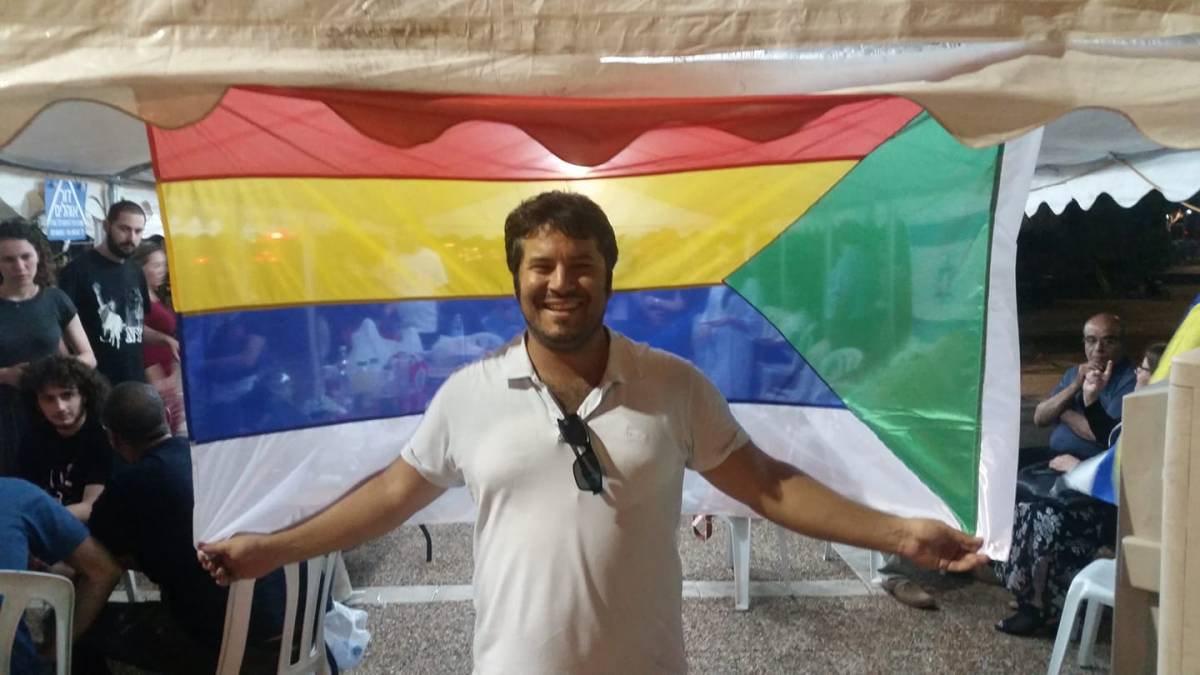
p.s.- the cover photo is of me with a Druze flag.  Which looks a lot like a pride flag.  So that’s awesome 🙂

The Aramaic-speaking gay Iraqi in Tel Aviv

Lately, living in Israel has kind of sucked.  My government has turned into some sort of slimy festering poop mobile, spurting out nothing but shit whenever it opens its mouth.  A law against gay surrogacy, a law against the Arabic language, a law against non-Jewish minorities, arresting a liberal rabbi for performing a marriage, the list is almost endless.  Also, there’s something about pollution in the Mediterranean which I haven’t had the time to read about.  Plus the normal pressures of life here- like Hamas rockets and Iran threatening to obliterate us.  Not to mention thousands of Syrian refugees crowding our border trying to escape their murderous government.  A government that makes ours look like sheep.

When things suck here (yes, they sometimes really do- and if you’re considering moving here, you should be ready for that), I try to think of what I like about this place.  Am I just insane or did I find something here that makes me stand in awe despite all the idiocy that surrounds me?

And a story came to mind.  A few months ago, I went clubbing.  I love to dance and need to more often, but I don’t go clubbing that much.  I’m 32, I don’t have a lot of friends who like to club, and it’s not like I feel up for it every weekend.  It’s energizing and it takes a lot of energy.

But one weekend I went.  In the club, I was very friendly.  It was a gay night and there were tons of cute guys!  I’ve been so busy doing everything here- learning about Israeli culture, making friends, exploring identity, finding housing, getting important healthcare, and sweating a lot- that I haven’t dedicated a lot of time to men.  Although I am single- so if you’re cute and smart and like an adventure, hit me up 😀

But this night I did go out.  And in the club there is this very cute guy.  Very typically Jewish looking- yes we come in all shapes and sizes, but I mean that kind of “I know you’re a Jew from a mile away” look.  Typically Semitic.

I go over to him and start dancing with him.  Turns out he’s from Germany.  Surprise number one.  Because I speak Yiddish, I could communicate with him.  I wondered if he was a German Jew.

But as I got to talking to him, the surprises kept coming.  He’s German, but actually Iraqi.  His family became refugees after the absurd American war in 2003.

What’s particularly strange is why he was in Tel Aviv.  At a gay club.

Iraq and Israel have no diplomatic relations, so I presume he entered on a German passport.

But why did he look so Semitic?  I mean Arabs are Semites, so I spoke to him in Arabic and he said he understood a little.  Huh.  So maybe because he was born in Germany?

No.  He was born in Iraq.  I asked what languages he spoke.  German, some English, and- prepare to be in awe- Aramaic.

Aramaic.  The language of the ancient Middle East, the Talmud, many Jewish prayers, Jesus Christ, yeah.  Aramaic.

I was so turned on.  Intellectually and yeah, the other kind too.

And guess what?

He’s gay!!!!

GAY!!!  An Aramaic-speaking Iraqi Christian German GAYYYYYYY.  The cute guy who looks like a Jew looks like a Jew because we’re from the same neck of the woods.  And boy would I like to be in HIS neck of the woods.

You might be thinking, well duh, he’s at a gay club.  But many straight people in Tel Aviv go to gay parties.  And all of his German friends with him were straight.  In fact he wasn’t even out to them, which is why I’ll use the Aramaic pseudonym Michel when talking about him.

It was simply some sort of Semitic gaydar that allowed me to connect with him.

He loves Tel Aviv and actually came back for Pride.  It’s probably the closest Michel can get to a queer Semitic vibe, as his homeland is plagued with homophobic violence.

For me, this story is nothing but romantic.  Ancient cultures, beautiful languages, the unexpected- combining in one thrilling moment in Tel Aviv.  You couldn’t have written a sexier story if you tried.  Israeli independent film doesn’t even have the imagination to concoct such a scenario.

And there we were.  One gay Aramean Christian, one gay American-Israeli Jew.  But at a certain point, the labels didn’t matter.  He was cute and we liked to dance.

So that night in Tel Aviv reminds me of the unexpected surprises and glorious nuggets of hope that lie in this land.  A land tortured by fanatical power-hungry idiots who unfortunately run it.  And the psychotic neighboring powers who torture us and their own peoples.

For one moment that night, all of that didn’t matter.  Because I was dancing at a gay club in Aramaic.  And the 21 year old Matt who downloaded his first Iraqi Aramaic song a decade ago was smiling ear to ear.

Sometimes I yearn for a calmer life- in America, abroad, traveling, or even elsewhere in Israel.  Who knows where I will roam.  What I know is this kind of night- that’s what makes this place special.

p.s.- the cover photo is a Syriac church in Jerusalem.  If you can’t read it, it’s because it’s in Aramaic 🙂

Tribes gone wild

This blog might sound a bit strange after I just wrote one celebrating my first year in Israel.  The reality of being in Israel, though, is that I find my emotions yo-yo on a daily, often hourly basis.  Things go from very bad to very good to bad again- sometimes minute to minute.  The shifts in mood are palpable- and far more frequent than I experience in any other country I’ve visited.

In the past week, Israel has experienced multiple earthquakes, hundreds of Hamas rocket attacks, Syrian refugees crowding the northern border desperately trying to escape their own government, settlers attacking Israeli soldiers, Haredim attacking young women for being “immodest”, the increasingly psychotic government refusing to give gay men the right to surrogacy.  And trying to pass a law that would allow communities to bar members of the basis of religion, race, sexuality, or any of a number of identities.  It was subsequently watered down, but still pretty bigoted, and now is successfully winding its way through the Knesset.

Through all of this, I’ve tried to speak out, mostly in Hebrew.  One, because that’s what most people speak here- people who follow these events and can influence them.  Also, because there’s a problem.  The far-left in America and Europe has made it nearly impossible for left-wing and centrist Israelis to successfully rally support for their causes or criticism.

Why?  Because there are people who are committed to our destruction.  Who are unceasingly and at times irrationally critical of Israel.  In a way they aren’t of other countries- or sometimes even their own.  One can even view the recent shenanigans of IfNotNow in this light.  A far-left American Jewish group who, in the face of serious global challenges like the Syrian Civil War or Hamas rocket attacks, has instead decided to disrupt Birthright trips for not being left-wing enough.  Ruining the Israel experiences of other young people because the trips aren’t tailored exactly to their tastes like the SweetGreen salads they custom order at lunch for $15.  Excuse my cynicism- I just don’t think that just because someone has come to political conclusions about the situation here (which is their right), that means they get to force an entire organization to adopt their stance.  No one is forcing them to take a free trip to Israel.  If you want to see Palestinian and Arab perspectives, all you have to do is extend your ticket and hop on a bus to Bethlehem.  It’s not complicated and it’s way less confrontational than aggravating a bunch of young people on a trip with an explicit purpose that they simply don’t like.  Stop acting like entitled children.  If you’re really serious about your beliefs, you can buy your own plane tickets.

When people like IfNotNow or groups even more extremist dedicated to destroying Israel harm us, it makes it much harder for those of us on the inside to enact beneficial change.  Because when we speak out about discrimination against gays, Arabs, foreign workers, or refugees- some of these extremists use it as an opportunity to say everyone here is rotten.  Which then gives ammunition to the far right here to silence us- we must be traitors, just like those troublemakers abroad.  It’s not true- but it has resonance in a country under attack with little taste for nuance.

So I’m going to try to offer some criticism of Israel- but understand it’s with the purpose of actually making change.  To help steer this community in a stronger direction.  Not simply to make noise and masturbate my ideology.  I can’t control if you’ll take my words and use them to hurt me.  Just know that I will use every bit of my being to stomp you out and protect us- with the same level of passion that I use to fix what’s wrong here.

So what is wrong here?  A lot.  The earthquakes I can’t do much about- God, stop punishing us, we’ve had enough.  The Hamas rockets- I’m exhausted with our patience.  The world sits silently, mostly unaware as the media ignores our fate.  If Western Liberals showed one tenth of the passion for our lives as they do for immigrant children (which is justified), then the rocket fire would be condemned from wall to wall.  And maybe even pressure Hamas to stop.  Now would be the time to speak up.  For moral reasons.  For Israeli lives.  Frankly, also for Palestinian lives- they’re going to suffer increasing pain as they pay the price for Hamas’s games.  And if you want to get practical, 300,000 American citizens live in Israel.  And we vote.  So if you want our support, show that you give a shit.

Now on to our idiotic government.  I’m not a reactionary far-left voter.  At times in the past, I frequented this space.  I still find some of the ideas important.  And I’d say, while I don’t fit into a box, I’m somewhere left-of-center or centrist in Israeli politics.  And I appreciate some ideas that come from the right- I’m not orthodox in my politics.  Nor in my synagogue, though I have davvened in Bnei Brak.

But this government is leading Israel off a cliff.  The latest Nationality Law seeks to enshrine discrimination in Israel’s Basic Laws- laws that are not exactly a constitution, but are incredibly hard to repeal.  While the law did innocuous things like recognize national holidays, the controversial aspects surrounded a downgrading of the status of Arabic, restrictions on where people can live, and antagonistic attitudes towards Reform and Conservative Jews abroad and at home.  With strong implications for Arabs, LGBTs, and other minority communities.  Until the text was altered, I had to live with the idea that I could be denied residence in a community for being Reform or gay- an almost unthinkable legal reality.  If sadly, the unspoken truth in many places in the world, even democracies.  Enshrining it in law certainly would have given malignant social practice a dangerous boost.

The saddest thing about this law is not the text itself.  Nor is it the future it could portend.  It is that it describes an existing reality.  I’ve traveled extensively in Israel- over 100 different communities in one year.  From every single possible linguistic, ethnic, and religious background.  Places few Israelis visit- Israelis who’ve lived here all their lives in insidious narcissistic bubbles.  Bubbles sometimes created by fear- sometimes even understandable because of that fear.  Bubbles nonetheless.

This is the greatest problem with the law- it makes explicit existing social practice.  Israel is a tribalistic nightmare.  It is filled with rich ancient cultures.  Cultures preserved through insistence on maintaining community and tradition.  In ways unseen in the West, where cultures meld into creative fusions and, if we’re honest, mostly oblivion.  I’ve met rather few Irish-Americans who speak Irish, and not a small number of 3rd generation Latinos who can’t speak Spanish.  The gift of America is its vibrant churn.  Its curse is the evaporation of cultural heritage.

In Israel, that heritage is preserved.  To shocking degrees.  There are Christians in the north who pray in Aramaic- some actually speak it.  Just like the Kurdish Jews in Jerusalem.  And every day Hasidic Jews study 2,000 year old texts in the very same language.  That Jesus spoke.

The problem is that this preservation, this conservation comes at a price: social understanding.  Israel is divided into tribes: secular, traditional, Orthodox, Haredi, Druze, Christian Arab, Muslim Arab.  Left-wing, right-wing, center.  With lines that occasionally are breached, for example by my friends who grew up Orthodox and are now Reform.  But this is by far the exception.  When people plant themselves here, they leave themselves little room to wiggle.  And often little curiosity to explore other pastures.

This is the greatest problem with Israel.  One I recognized half a year ago.  And I have even more evidence for now.  This isn’t a society.  It is a collection of societies.  That mostly don’t talk to each other and are largely content to avoid each other.  From every possible direction, lest someone pretend their tribe doesn’t follow this pattern.  I’ve met Druze who say they keep their Muslim minorities “under control”.  I’ve met Christians who say they keep their Muslim neighbors “in line”- and if there are problems, they’ll “take care of them”.  Muslims have used religion as a wedge against Christians in Nazareth, of all places.  It’s safe to say almost no Muslim villages here would be thrilled to see Jews moving in.  With the exception of welcoming Abu Ghosh, where a woman wanted to know why I didn’t want an apartment there.  Unfortunately, a woman from there was beaten by Jewish girls in Jerusalem for being Arab this week.  When it rains, it pours.   You can extrapolate the same patterns of voluntary segregation among all types of Jews- among themselves and towards Arabs.  Lest you think it’s only right-wing Jews who feel this way, I’ve never ever met an Arab who was allowed to live on a Kibbutz.  And they largely understand they won’t be allowed on a moshav, or village.  I’ve yet to see my wealthy friends in North Tel Aviv show interest in setting up an African refugee community in their neighborhood.

People here are generous- about giving directions, about hosting strangers, about feeding you, about giving advice.  And they are utterly selfish when it comes to defending the interests of their community above the dignity of the individual or, for that matter, the well-being of the nation.

If America is far too individualistic, Israel is far too communal.  With pluses and minuses in both directions.  I’ve noticed that not all societies are so extreme- my travels in the Mediterranean and Eastern Europe have revealed places somewhere in the middle.

Preserving a Jewish majority in Israel is what allows it to be a Jewish state.  The reckless, gung-ho attitude of its early pioneers, the native-born Sabras, is what allowed the state to get on its feet.

But those very pioneers contained a fatal contradiction.  Their disregard for rules, their utter contempt for the Diaspora and all things foreign- it has become limiting.  Because if you look at who can best contribute to the cultural dialogue here that could strengthen bonds and ease tensions- it’s people like me and thousands of olim who’ve chosen to make Israel our home.  People who, at our best, have the sensitivity of having been a minority, as well as the pride of choosing to make this our home.  People who know how to navigate various cultures and come with less preconceptions about different communities.  More often than not, understanding the value of pluralism, or at least the power of listening.  Something sabras struggle to do as they lecture us about how we’re wrong and they know better.  As the country they built rages with fire- fire from the outside, and fire kindled from within.

It’s high time the sabra realized he’s not the only fruit in the field.

p.s.- the cover photo is from a Druze village.  It says: “it’s my fault that I love my sect”.  A kind of Middle Eastern “sorry not sorry”.

Israeli pride

Today was my first Tel Aviv Pride.  Every year, thousands of Israelis and tourists gather to celebrate the LGBTQ community here in Israel.  There are floats and sexy guys and it’s awesome.

For the first time in my life, I got to experience it.

In America, I marched in many pride parades- almost always with Jewish groups.  This time, the parade itself was Israeli, so the idea of a Jewish group marching is obsolete- we are the parade.

The parade itself was actually slightly more sexually conservative than in Washington, D.C., which may amaze my Israeli friends.  And its energy was amazing.  There was such a sense of community.

Rather than marching with organized floats, the parade was Israeli- everyone could join in.  There’s no “order”- it’s just splendid flowing chaos of hot guys (and gals).

I came wearing an Israeli flag and ended up buying a Star of David pride flag along the way.  Because Israel is the only country in the world where it is totally safe- even blessed- to be a gay Jew.  And to be proud of it.  Without worrying if people will throw you out of the parade for liking Israel.  Which is a thing unfortunately abroad.

While Tel Aviv pride was smaller than Washington (although still quite large), it felt special.  First off, it went off smoothly and safely.  Not something to take for granted here.  I want to thank the brave policeman and policewomen who every day keep us safe.  Whether it’s some crazy person within Israel- or a terrorist coming from without- sadly too many people want to harm both Israelis and the LGBT community.  I’m grateful that I live in the *only* country in the Middle East where you can count on the police to protect the pride parade rather than break it up.  I hope one day my queer Arab neighbors fighting for their rights will be able to enjoy the same sense of security.

What was also incredible about today, other than the sunny weather, the post-parade swim at the beach, and the pride Shabbat services I went to, was who I went to pride with.

I first started by making plans with my friend Miriam.  A Spanish Jew who I befriended in D.C., she wisely followed me to Israel 😉  My friend Daniel was also in town from America, so we had a trio.  Then I got a message from Ezequiel, a gay Argentinian-Israeli friend of mine, so he and his Arab friend Ahmed joined us.  This was Ahmed’s (pseudonym) first pride parade- you could tell he was a bit nervous and perhaps somewhat closeted.  And wow am I proud of him for being brave and coming.  Being a gay Arab is not easy- as several friends of mine in their community have shared with me.  One Arab lesbian friend of mine stays in the closet for fear her family will kill her in an honor killing.  There are Arab families who do accept their children and unfortunately a lot who don’t.  Forcing queer Arabs into a difficult identity dance in both (largely Jewish) LGBTQ culture here and their background.  I’m glad Ahmed found a sense of belonging in the parade- you could see him flitting back and forth, often losing track of us as he made new friends.

We were joined by Kate, an Australian soon to be Israeli.  And along the way, we met a Ukrainian girl named Natasha (pseudonym).  Natasha is a lesbian from Haifa of Ukrainian background- this was her first pride.  She’s Jewish and not religious in the slightest.  Sadly, her Catholic girlfriend is still living with a lot of stigma so she wouldn’t attend.  She was alone- and I invited her to join us.

Later on, we were joined by an exceedingly hot Argentinian-Israeli named Ariel and his wife.

Kitzer, or “in short”, there we were: gay (me, Natasha, Ahmed, and Ezequiel) and straight (everyone else).  Australian, Argentinian, Spanish, Israeli, American, Ukrainian, Arab, Jewish and not.  A melting pot of newcomers and veterans (Miriam has marched with me on two continents!).  The beauty of Tel Aviv 2018.

There are people who reduce Israeli queer life, the most vibrant in all of Asia- the biggest continent on Earth- to “pinkwashing”.  This phrase is meant to say that when Israelis talk about their queer pride, they are simply using it to “cover up” the difficult reality facing Palestinians.  That we don’t deserve credit for our advances even if in other areas things aren’t so simple.

This is what I have to say: fuck you.  Do Palestinians face hardships?  Of course.  Some of those caused by Israel and not a small number caused by their own extremists or surrounding Arab nations.  And I pray for a day when they will be able to celebrate their own pride parades- and when their society will accept queer youth.  And when our two societies can live in peace.

Here’s the reality: while it’s true that the Israeli government uses gay rights as a promotional tool (often without giving us the full rights we deserve), our country is hands-down the most progressive one in the Middle East.  While some people want to turn our pride parade into a discussion about conflict, that doesn’t change some incontrovertible facts.  Palestinian society has harbored strong strains of homophobia long before the State of Israel even existed.  Homosexuality is illegal- sometimes punishable by death- in Syria, Egypt, Palestinian Authority/Gaza, Iran, Saudi Arabia, Qatar, Oman, United Arab Emirates, and Yemen.  If you really think this is because of Israel or Jews, it’s conspiratorial and anti-Semitic.  Believe it or not, other societies in the region sometimes have problems that have nothing to do with us.  And noticing that Israeli LGBT people openly serve in the military, enjoy anti-discrimination laws, and even serve as out-of-the-closet elected officials- that’s not pinkwashing- that’s the truth.

Some people are not capable of letting Israelis celebrate a single accomplishment without dragging us down.  We know- I know- that my country, like any other country, has things we need to change.  Guess what?  Your country does too.

While the far-left in Western countries continues to point the finger at us and tries to deny us even one day of enjoyment of our loving society, I’d like to point to an incontrovertible fact.

Today, I marched in pride with a Ukrainian lesbian and an Arab bisexual man- both citizens of Israel.  In their respective societies or homelands, their identity is often punished.  In Ukraine, by far-right thugs and in Arab society, sometimes even by your own family.

Israeli society isn’t perfect and the homophobia here exists as well.  Every society suffers this malignancy.

The main thing I want to point out is that despite the security risks today, the associated costs involved with putting it on, the rockets Hamas continues to rain down on us- Ahmed and Natasha could march in pride.  With me.  In peace and safety.

So rather than telling us how terrible Israel is, try asking yourself: “what have I done today to help people like Natasha and Ahmed?”  Because if you have the privilege of reading this from a nice laptop in a Western democracy, you’re pretty fucking lucky.  Because people like my friends don’t have many places to run.  And they don’t have the luxury of obsessing over every tweet.

They’re exploring their identity- and by the grace of the State of Israel- they can do without fear that this parade will be their first.  And last.

Why I can’t live anywhere in Israel

And it’s not for the reason you think 😉

Last night, after a day of doctor’s appointments (including randomly cancelled ones), I didn’t want to eat dinner alone.  I felt immense gratitude for the Israeli healthcare system- I didn’t pay a dime for my visits.  And also running from doctor’s office to doctor’s office isn’t the most relaxing experience, though I did get a solid hour at the beach in Herzliya, which is stunning.  Can’t say I ever got to watch the sea while hustling between meetings in Washington, D.C.

beach

I have a favorite (well, two favorite) restaurants in Bnei Brak, a Haredi (ultra-Othodox) city outside Tel Aviv.  I knew I wanted to see my friend Yisrael who works at one.  He always warms my heart.  The thing about Yisrael is he’s kind of a mystical Hasid- I keep forgetting the name of his restaurant but every month or two I manage to find my way there.  In the past month, I so wanted to see him that I started calling restaurants in Bnei Brak asking for Yisrael (a futile task- there are a lot of Yisraels in Bnei Brak).  I couldn’t find him!  But I knew he was there.

So last night I wandered.  I went to a shtiebl, a small synagogue (with a whole bunch of rooms).  Outside, they always have ridiculously cheap Jewish books.  Nice Jewish books.  I got an old, beautiful one for 5 shekels that has the Torah in Hebrew with Yiddish commentary.  That’s $1.39.  There’s nothing better in the world.  And nowhere better to be a Jew.

As I perused Hasidic CD’s at the store next door, a young man in a black hat asked me where the shtiebl was.  And I pointed him to the building to my right and said: “you’re here”.  Bnei Brak is not a tourist destination for me, it’s a part of my life.

I was getting hungry so I headed to what I *thought* was Yisrael’s restaurant, only to find a grumpy man.  When I asked for Yisreal’s whereabouts, he asked me: “what do you want, Mashiach?”  The messiah?  Eventually after some prodding, he did know about the restaurant (competition?) and I headed up the street.  As soon as I saw the sign, I knew I had arrived.  Some things you feel your way towards.

Yisrael greeted me with the biggest hug ever.  He is so so warm!  He overloaded my plate with salmon and kugel and pasta and I grabbed a seat.  Yisrael periodically chimes in when I talk with other people.  The people I sat down with were a Yemenite Jew and a 16 year old Litvak, or Lithuanian Jew.  I’m part Lithuanian- we’re probably cousins.  Not a metaphor- we probably are related.

Here’s the shocking thing- the kid doesn’t speak Yiddish.  Well, he understands some but his parents mostly speak it (and English) so he can’t understand.  Interestingly, Eliezer (pseudonym) also knows how to count in Arabic.  Pretty damn well.  He says he learned from undocumented Palestinian workers who live in the city.

Meanwhile, the Yemenite guy- he speaks astoundingly good Yiddish!  As does his father.  From living with Ashkenazi Hasidic friends.  He even understands the nuances of Litvish and southern Yiddish dialects.  We had a lot to talk about.  Including my love for Yemenite language and culture.  I just recently bought Yemenite Judeo-Arabic books and music from a store in Bnei Brak.  So we sat there, me and the Yemenite guy, helping to teach the Lithuanian Jew some Yiddish.  Find me that in another country.

The Yemenite guy had to go back to Jerusalem, so I sat with Eliezer.  Eliezer is a precocious kid.  He goes to yeshiva all day.  He has 10, yes 10, siblings.  And, he says, he likes it.  It’s fun.  When I asked if it’s ever quiet, he laughed and said “maybe around 2am”.

Eliezer was enchanted by something you might not expect.  I needed to charge my phone so I pulled out my brand new portable charger.  He was enamored.  Not because he had never seen one.  Lehefech, to the contrary, he knew it inside and out.  And he doesn’t even have a phone.  He grabs it from me and starts teaching me how to use it.  Things I didn’t even know about it.  So once he had found a new way to charge my phone, he asked me how much it was.  150 shekels.  Oy, I don’t have that kind of money.  And I bet he doesn’t- while his dad is the head of two yeshivas, 11 kids is a lot of mouths to feed.

But Eliezer is not easily deterred.  He wanted to see my smartphone.  I got a bit nervous- not just because generally I don’t like children browsing my cell phone- but also because I couldn’t remember exactly what was on it.  I was wearing a small black yarmulke and they knew I was from Tel Aviv and not Hasidic.  But the last thing I wanted was for little Eliezer to stumble upon a racy WhatsApp chat (yes he opened my WhatsApp) or something he’d find not so “kosher” and it might ruin my vibe in the restaurant.

I showed him pictures of my hiking in Haifa, which he loved.  But what he really wanted was to go to eBay.  Yes, eBay.  The kid who doesn’t have a phone, let alone a smartphone, knew what eBay was and that that would be where he could find a portable charger.  He browsed through the list of chargers with ease.  He knew the megahertz or whatever.  I don’t even know what he was talking about.  He spent a good minute or two looking, but nothing suited him.  He knows he doesn’t have the money now, but he wanted to see what was out there.  A curious kid, like I was.

I told him he could work a little on the side to make some money.  He said he already owed some friends money, including this restaurant.  His dad won’t let him work because the dad wants them to be “super strong” Haredim.  I told him people worked in the Torah, that Haredim work in Bnei Brak, like Yisrael.  He knows- in fact, he said if his father permitted it, he’d consider working.  But as a 16 year old, he doesn’t have much say in the matter and it’s his family.  What’s he supposed to do?

We had a good laugh about many things- he has a great sense of humor.  I told him he’d make a great stand-up comedian, and he smiled.

As the evening drew to a close (11pm on a weeknight- Bnei Brak is not a sleepy suburb), another Hasid asked Yisrael why I made aliyah.  Yisrael, who I met not long after I arrived here almost a year ago, recounted in perfect detail all the reasons I had told him.  9 months ago.  With a depth of emotion and appreciation that warmed my heart.  I know Yisrael is happy I’m here and I’m grateful he’s in my life.  The other Hasid, seeing how I talked and hearing my story said: “atah yehudi cham”.  You’re a warm Jew, a Jew with heart.

Knowing Eliezer owed the restaurant money and grateful for his companionship and his humor, I bought him dinner.  Before I left, Yisrael asked me for my phone number.  He wants to call me from time to time, see how I’m doing.  From his Kosher phone.

Before I left, I told Yisrael I missed him and I’d be back.  He knew.  And he said: “there’ll be two here waiting for you,” as Eliezer winked at me.

I headed back to Tel Aviv with a warm tummy.  Not just because of the delicious kugel, but because the people I spent my night with filled me with warmth and love.

When I was a kid, I was curious about Orthodox Judaism.  I wanted to go to a service.  My family wouldn’t let me because they said Orthodox Jews aren’t feminist.  While my family members abused me– which I don’t find particularly feminist either.

The fact is coming to Israel has allowed me to build a relationship with Hasidic Judaism.  In fact, all kinds of Judaism- Mizrachi, traditional, Israeli Reform, secular, Litvish- everything.  It’s the one place on the planet where we all come together.  And you’ll find a Yemenite speaking Yiddish.

Some people tell me it’s ludicrous for me to spend time with Hasidim.  I’m gay, I’m Reform, I’m progressive- they’d hate me if they knew who I was.  But they’re wrong.  There are times I feel uncomfortable as a gay man in Hasidic communities.  And there are times I feel uncomfortable as a gay man with secular people, and certainly times I feel uncomfortable as a religious person.  There are times I feel uncomfortable as a Jew with Arabs.  Or as an Arabic-speaker with Jews.

Should I live my life in a ghetto where I only go where no prejudice exists?  Where there’s no conflict?  Where everyone agrees with me?

Guess what?  No such place exists.  Anywhere.  Not in Tel Aviv, not in Bnei Brak, not in Ramallah.  The fact is we’re people.  And some places are more comfortable than others, for certain aspects of what I believe and how I am.  And, I get something out of pretty much everywhere I go.

Do I wish the Hasidic community was more gay-friendly?  Yes.  I’d probably spend more time there.  Do I think things are changing and that the community is not monolithic?  Absolutely, as I found earlier this week when I met a gay-friendly Hasid.

And I also believe that the fact that I’m gay isn’t a reason for me not to embrace my Hasidism.  Yeah, I’m kind of Hasidic.  And Haredi.  And Modern Orthodox.  And Reform.  I connect to all sorts of things.  So why should I give up what I love about Hasidic Judaism to satisfy a secular militant in Tel Aviv who believes my identity should be held hostage to their “tolerance”?

The point is we’re all entitled to enjoy what we enjoy.  I like Haredi Bnei Brak.  I like Druze villages.  And Christian ones and Muslim ones and gay pride parades in Tel Aviv.  I like my neighbors with Shas rabbis posted all over their house, who set me up with guys.  Each one of these communities, some more than others, poses challenges for me.  And has something unique to offer.

Lately I’ve been questioning if I want to keep living in Tel Aviv.  Do I want to move North?  I love Haifa and the Galilee and the Golan.  So peaceful, green, co-existency, Arabic-speaking.  That part of me flourishes there.  But what about Tel Aviv?  The convenience, the energy, the international vibe, the interesting cities like Bnei Brak that surround it?  Not to mention its gay life.  And Jerusalem- probably not going to live there, but don’t want to be too far.  Its history and spiritual vibe pulls me in and fills me with wonder.

In the end, what I’ve decided is where you live is not where you pay rent.  That’s an aspect.  Where you live is where you step, where you spend time, where you laugh, where you hike, where you pray.  Where you live is where you bring joy into the world and where you feel filled with wonder.  Even where you cry.

I can’t live anywhere in Israel.  Because I live everywhere.

p.s.- that’s me sticking my tongue out in Kiryat Tivon, the most non-Haredi place in Israel, because I’m going to have a good time wherever I go!

Talking gay with a Breslover Hasid

Today, as you might have seen in the news, was a tense one for Israel.  Hamas organized 50,000 Palestinians in Gaza to charge the border fence with Israel, in some cases burning tires, hurling rocks, and even setting Israeli farmland on fire with kites laden with fuel.  The army even stopped men planting a bomb.  Peaceful protests these were not.  They were specifically timed to counter the American Embassy dedication in Jerusalem.  No doubt taking advantage of Gazans’ misery and poverty, Hamas chose to direct their attention towards Israel as the source of their problems.  While I couldn’t and wouldn’t argue that Israel bears no responsibility for the problems in Gaza, so does Hamas and so does the Palestinian Authority (which is in a feud with Hamas), and so does Egypt which also closes its border to Palestinians.  Yet not a single Gazan is charging the Egyptian border.  While Hamas feeds people fantastical notions that they will redeem and liberate Palestine (i.e. present-day Israel)- a Palestine that hasn’t existed for 70 years.  Its traces here and there but mostly gone.  Memory.  Sad and true.  And complex- because they might still be there if Arabs had agreed to a two-state solution in 1948.  And definite gray space because some Arabs were kicked out against their will, even after agreeing to live as Israelis.  My heart goes out to my friends living in the villages near Gaza, including my friend at Nahal Oz, just on the border, trying to study for exams with the stench of burning tires surrounding her.  I try to mourn the loss of all human life, even those humans who angered me and tried to harm me.  I empathize with the families of those Palestinians whose lives were lost today- and hope this sad moment inspires more to seek peace and not violence.  So we can all live in safety and tranquility.

In the face of this tense day, I wasn’t sure where to travel.  I kind of wanted to go to Jerusalem to see the opening of the new American embassy.  As an American-Israeli, it gave me great pride to see my other homeland offering such strength to my country.  Jerusalem is the capital of Israel and has been in the prayers of Jews for thousands of years.  It is also holy to Muslims and Christians.  The new embassy is in the western part of the city, Israeli territory since 1948 and not a part of the contested West Bank or East Jerusalem, site of a probably Palestinian capital in a future peace agreement.  I’m not a fan of Donald Trump on so, so many issues and I did not vote for him.  But I’m grateful to him for his courage on this issue because, whatever his motivations- he is right.  We can’t have honest peace negotiations until we recognize that Israel is here- and here to stay.  Hopefully alongside a brighter and freer future for Palestinians.

It was late in the afternoon so I couldn’t make it to Jerusalem.  Instead, I took the bus to possibly the least touristy place in Israel- Modiin Illit.  The city is almost entirely Haredi, or ultra-Orthodox, and is located east of the Green Line that demarcates the boundary between pre-1967 Israel and the West Bank/Judea and Samaria.

Other than checking with a friend to see if it was safe to visit and reading the Wikipedia article, I had no idea what to expect.  Turns out, it’s really cool.  First off, the Haredim who live are almost entirely Litvaks, or Lithuanian Jews- like me!  Religiously speaking, they are ultra-Orthodox but different from Hasidim in that they focus more on intellectual learning rather than feeling.  Part of my ancestry is Lithuanian so it was kind of like a belated coming home.  We both made our way to Israel to reunite 🙂

I’ve spent time in Haredi communities here before, including Bnei Brak (many times) and briefly in Mea Shearim and Tsfat.  What was so unique about this community was how green and calm and almost suburban it was.  The bus driver was Haredi.  The people driving cars were Haredi.  There were huge green parks, well-kept and clean.  The air was fresh.  While the housing was clearly dense due to the large families, there was never a sense of congestion or pressure.  It was quite tranquil on an otherwise tense day in my country.

I stopped into a bakery to get some food.  While the friendly young man made me a sandwich, a goofy (and really cute) guy was making silly noises.  “Artikim 10 shekel, leShabbaaaaAAAT!”  Making fun of some guy who sells 10 shekel popsicles on Fridays.  He had all these silly voices and everyone was just laughing.  I joked with the employees that he should do PR for the restaurant.  Incidentally, one of the employees told me he put their bakery on Google Maps- which, to his delight, is exactly how I found it.

When I told one of the guys I was American, to my great surprise he said: “what are you doing here?  Why wouldn’t you stay in America?”  This is a response I’ve gotten from many, many (mostly secular) Israelis.  A kind of envy of America’s wealth and opportunity.  At no point had I heard this from an Orthodox Jew here, who view this as the Promised Land.  An obvious choice for a Jew.

He was quite serious about it- he wanted me to find him a job as a mashgiach, or a Kosher certifier.  I told him I didn’t know of anything, but that I’d look into giving him my passport.  We laughed.

As I headed out, I noticed a sign: “Matityahu”.  This was really cool for me to see because my name in English- Matthew- that’s from Matityahu in Hebrew.  So all of a sudden I started seeing signs with my name everywhere- in Hebrew!  Turns out there is a village next to Modiin Illit by my very name.

I walked up the hill and found it to be stunning.  Apparently a lot of Americans live there, so if I can’t be in Jerusalem for the opening, at least I could be with my kin 😉

I noticed a very attractive 20-something Orthodox guy.  A woman was taking pictures of her daughters, he said he was jealous because nobody took pictures of him!  I laughed and said I’d take one.  And I did.  And it turned out really cute and he agreed.

Because this is Israel, we then talked for about two hours.  He grew up Orthodox and now identifies as a Breslover Hasid.  He went through periods of intense doubt approaching atheism and has many secular friends.  He says at this point, more than Orthodox.  He serves in the army.  And he’s trying to open his own business.

One of the things that alarmed me about Israelis at first, but now I love as one, is that we get down to the point.  No lame chit-chat- tell me who you are, what you’re about, what you believe, what you want.  You get to the meat of a person very quickly and can figure out how to relate to them and connect.

In this case, Shmuel (pseudonym) and I talked about everything.  I came out as a gay Reform Jew (not a trivial thing in the middle of an Orthodox settlement alone).  He said he had never met an openly gay person before, but didn’t show the slightest bit of phobia or aggression.  Mostly curiosity.  As a Haredi Jew, he had ideological issues with both Reform Judaism and homosexuality- but was utterly open to hearing what I had to say about them.  And I really felt listened to- and I listened to him.  There wasn’t the slightest bit of disrespect nor hatred.  We laughed, we debated, we walked- it was nice.  He looks good in a kippah, it’s a shame he’s not gay 😉

We talked about his shidduch dates (he’s too busy for them, plus he has the army, and he doesn’t want to feel pressured).  We talked marijuana (he smokes but says a lot of people don’t approve).  He reads a lot of modern literature about business and how to grow your intellect.  The most important thing for him in a partner is someone who wants to grow, something I found really admirable.

He gave me a ride to the gate so I could catch the bus.  I encouraged him to read Orthodox rabbis’ opinions on homosexuality because there are some that are increasingly accepting.  He said he didn’t know about it but he’d check it out.  Without any resistance to my suggestion.

Shmuel has had trouble praying.  He goes to synagogue but he just can’t read the words, it feels forced to him and he wants it to feel real again when he’s ready.  I offered him a suggestion: “praying isn’t just what you do in a synagogue.  Praying is what we’re doing now.  Two Jews, two people from very different backgrounds talking together, learning from each other, growing together.  Realizing we have a lot more in common than we thought.  And choosing to listen and debate rather than rip apart each other’s differences.”

He nodded and then he asked: “I forgot to ask, what’s your name?”

I said: “Matt in English, Matah in Hebrew”.

“Pleasure to meet you”

“You too man!”

On a day when the world sat fixated on CNN sated with blood and terror, a Hasidic Jewish settler and a gay Reform Tel Avivi had a really nice chat.

Now you know the news they don’t report.  Don’t give up hope 😉

p.s.- my cover photo is of Breslover graffiti I found in Bnei Brak.  The rainbow filter is my addition 😉