Yiddish softens the heart?

Two weeks ago, I approached my friends at FluenTLV about starting a Yiddish table.  FluenTLV is a fabulous event (my favorite in Tel Aviv) where people get together to exchange languages.  I offered to represent the language and they were thrilled.

Last week, the first week we did Yiddish, probably 3 or 4 people came and it went well.  One German guy, a couple Jewish Americans, and an Israeli.  Given how stigmatized my heritage language is in Israel, I was pretty happy.

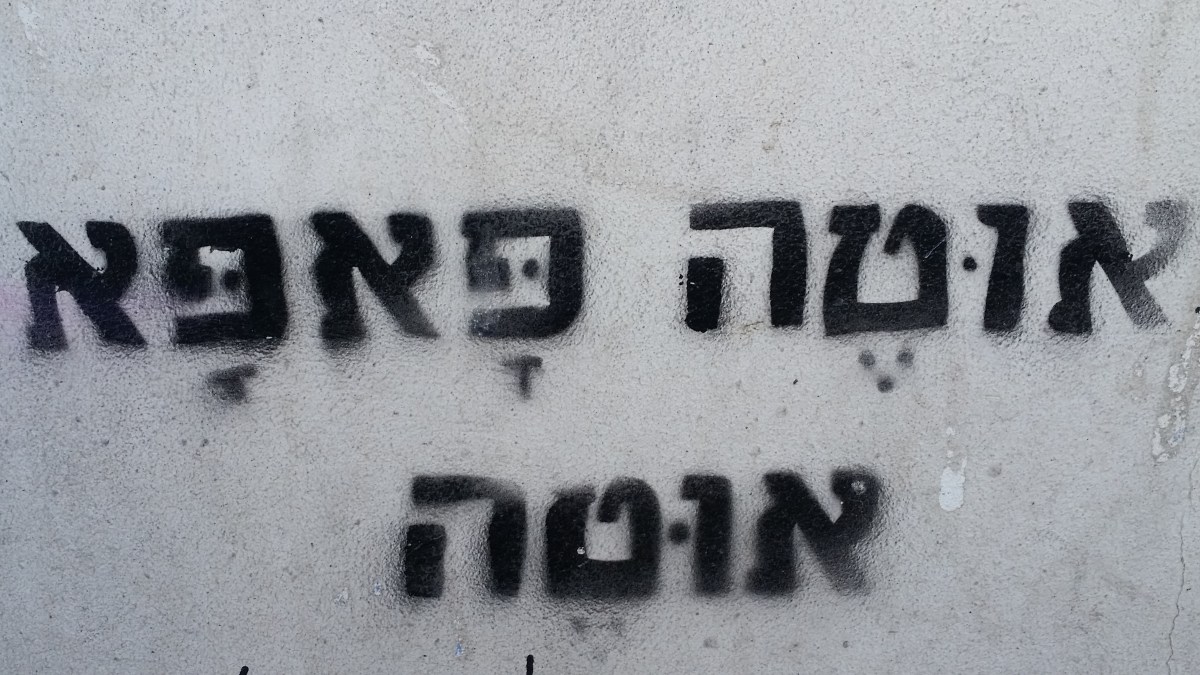
Last night, Yiddish came to life.  At the beginning of the night, an Israeli came in and tried to take one of the three chairs at my tiny table.  I said: “actually that chair is for Yiddish.”  He said “well, nobody is going to come anyways, so I’ll take it.”  I said: “nope, this chair belongs here, you can leave now.”  I asked him if he wanted to learn something and he said “sure, teach me a word.”  I did, he laughed, gave me one of those “everything is OK dude” Israeli high fives and left.  Probably without a further thought about what he had said.

The best part of the evening is that this guy was totally wrong.  Group after group came over to my table.  We didn’t have enough chairs.  When all was said and done, about 15-20 people had visited my table.  A German guy and two Dutch men explained how Yiddish had made its way into their languages!  A Brazilian Jew talked about Yiddish in her family.  I met Israelis whose parents or grandparents spoke the language and remembered some phrases.  Together, we read my copy of “Der Blat”, a Satmar Hasidic newspaper.  And I could see the glow in their eyes when they realized they could understand some of it.

What was also astonishing was how willing people were to learn.  I often find Israeli culture frustrating because of the bravado.  So many people here feel the need to be right trumps all.  Hence often endless debate, even when the facts used are minimal.  I’ve even had Israelis try to correct my English- knowing I’m American.  We often laugh that off, but after a while it wears on you.  It’s tiring having to constantly defend yourself.  Humility is not an Israeli value.

Yet at the Yiddish table, Israelis came to learn from me.  And subsequently shared about themselves.  Their families, their stories, their grandparents’ Yiddish phrases.  For the first time, I actually felt in dialogue with Israeli Jews rather than a lecture.  Or an argument.  There was a softness to our conversation that made me happy.  It warmed my heart and it gave me hope.

In a society where, as I see it, traumatized Jews faced 2,000 years of violent persecution with few options for safety and survival.  Sadly, some of these Jews ended up traumatizing and displacing Palestinian Arabs in a bid for a homeland.  Some of these traumatized Palestinians subsequently re-traumatized the Israelis.  And now we’re stuck in a seemingly endless cycle of violence.

That’s how I see it on regel aches- or “one on leg” as we say in Yiddish.  My Tweet-length version of the conflict here.  The saddest part is the trauma on both sides continues.  Anti-Semitism is not just the Holocaust.  It’s a two-millennia phenomenon that continues to this day from America to France to Iran.  I’ve personally experienced it in the liberal suburbs of Washington, D.C.  When Jews are persecuted, we often have nowhere to go, which is why some people believe in a Jewish state.  I’m not sure it’s the best solution and I completely understand why people feel we need it.  It’s not by accident that there’s a lot of French people in Israel- they’re Jews fleeing violence and bigotry.  Palestinian terrorist attacks on pizza shops and buses and schools only feed this narrative as we feel under attack yet again.  Trauma piled upon trauma.

And for the Palestinians, you have those who are citizens of Israel yet continue to face discrimination, racism, and often poverty.  Whose lands were robbed of them- and are still in the hands of the Israeli state 70 years later.  You have those in the West Bank and Gaza Strip who live in immense poverty, have little right to travel, have few if any civil liberties, and often face violence from the Israeli military.  And even some settlers who burn their trees, deface their houses of worship, and physically assault them.  And you have Palestinian refugees in Lebanon, Syria, Jordan, and elsewhere who can’t even come back to the land they once called home.  Who have no rights in the villages they come from and whose host states often extensively discriminate against them.

Sometimes its enough to just make you cry and cry and weep for humanity.  With no end in sight.  Ya Allah, God please send us all healing.

So in the face of all this sadness, what gives me hope?  Yiddish.  Because tonight, I saw the softer side of Israeli Jews.  When they don’t have to be “tough”- not against Arabs, not against other Jews, not against their own heritage.  Rather, by connecting to their roots- roots violently uprooted both by European anti-Semites and the Israeli state– they felt warmth.

I hope politicians can figure out a solution to this problem.  Given their proclivity for narcissism and greed, I’m not sure what they’ll do.  In the meantime, perhaps part of the solution is culture.  When you feel connected to something bigger- especially something a part of your heritage- it puts things in perspective.  Rather than having to show how “Israeli” you are, you can be the multifaceted Jew beneath the uniform.  The Jew whose family was persecuted by Polish Nazi collaborators, the Jew whose family escaped to Israel, the Jew who lives on Palestinian land, the Jew who wishes to reconnect with his heritage.  A complex one, of persecution and co-existence.  Of perseverance and of trauma.

A little less prickly sabra and a little more soft kneydlach.  Those fluffy yet durable matzah balls that comfort you when you feel sick.

Cover photo by Jonathunder – Own work, GFDL 1.2, https://commons.wikimedia.org/w/index.php?curid=31812266

A Jew, a German, and an Italian walk into a bar

No, this isn’t a punchline.  It’s exactly what I did tonight.

Tonight I was helping people practice their English at an event in Tel Aviv.  I love going there to speak other languages and what I’ve realized is sometimes I want to speak my native tongue.  And teach people about my culture.

It’s so nice to be validated as an American, an American Jew, and an English speaker in a place where these identities regularly lead people to discriminate against me.  To try to take advantage of me.  Or to tell me to leave my identities “in the Diaspora”.

So when I sit at the English table to help people practice, it’s nice to meet folks who are genuinely interested in where I’m from.

Tonight, after having fun at the Arabic table, I walk over to the English table.  A young woman, Mara, is sitting smiling at me.  Nothing reminds me of the world outside Israel more than a welcoming smile.  We start talking and it turns out she’s from Sardinia.  Sardinia is a fascinating island that’s part of Italy with its own unique history and languages.  I’ve learned some about it before, I’m very eager to visit, and I was thrilled to meet my first Sardinian!

We talked all about the language of her island– sometimes so distinct from Modern Italian that other Italians can’t understand.  She said she and her husband will speak in their dialects when they don’t want anyone in Tel Aviv to catch on.  Something a great many American Jews may recall about their grandparents and Yiddish.

Shortly thereafter, another woman joins us.  Corinna is German so I launched into a bit of Yiddish which made her smile 🙂  I love doing this with Germans.  It’s a friendly way to show something we have in common- the languages are distinct but share many words- and it’s also a way of showing pride that my identity survives.

Turns out Corinna is fascinated by Yiddish.  We talked about Germanic words in Yiddish and Yiddish words like meshugga and kosher that are in German.  We even had a good laugh at the word “blitzpost”.  In Yiddish, it means “email”.  In German, it’s a phrase you’d say if your snail mail arrived quickly.  Hence the connection.  But really neat to learn from my new German friend about our shared and different identities.  Really cool 🙂

Sometimes it can be hard to see progress when you’re living in the Middle East or watching the absolute catastrophe going on in my homeland right now where the government is literally shut down.

And sometimes you experience little miracles that make your spirits fly.  Who could’ve imagined, just 72 years after the worst genocide in Jewish history, that a Jew, a German and an Italian would be sitting in Israel speaking English?  At a bar?  Laughing?  Exchanging phone numbers.

And Mara and Corinna aren’t just ordinary Italians and Germans- Mara’s husband works at the Italian Embassy and Corinna interns at the German one.  They literally work for their governments.

From a Jewish perspective, you have to understand that if my grandparents met people from the German or Italian governments in Europe, they would’ve been dead.

And here we are.  Sharing a beautiful moment, a quotidian moment, a peaceful moment.  Making friends with each other.

I’d like to remember this experience for the days when I feel really sad.  There are things I see and experience here that are depressing.  I don’t think many Israelis or Palestinians or Syrians or really many people in the region right now feel optimism.  It just seems to be getting worse by the day.  And given the wars, the terrorism, the displacements, the cutthroat politics- I can understand it.  Trauma here is real- and in every group imaginable.

I would like to share a bit of hope.  If you were to ask someone in 1945, just after the Axis powers murdered 6 million Jews, if they could envision a day in which a Jew, a German, and an Italian would be hanging out in a Jewish homeland- they would say you’re fucking nuts.

And they’d be wrong.  Because that’s what happened tonight.  Because progress sometimes passes under our noses unnoticed.  I feel it is a real blessing to have met Mara and Corinna tonight.  We’ve buried the old Axis and made a new one- one that will hopefully be filled with visits to Sardinia, with learning about the German language, with visiting Yiddish libraries and concerts.

Because the seemingly impossible does happen sometimes.  When you lose hope, open up this blog or find something around you that makes you look in awe.

Don’t give up.

Why social justice isn’t just economic

When it comes to economics, I believe the more equal we can make our society, the better.  Ideally, that’d mean less state and corporate control and more resources in the hands of the people.  And as we work towards that goal, I believe in a strong safety net- universal healthcare, guaranteed housing, access to healthful food, free public transportation, and more.

What I’ve come to realize, particularly due to my stay in Israel, is that economic justice is not enough.

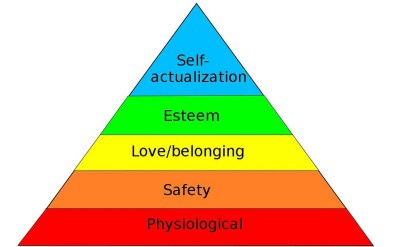
What does that mean?  What I mean is economic justice is crucial- it helps people survive.  If you look at Maslow’s hierarchy of needs, economic justice provides people with the foundation in order to reach higher goals in life.  It provides for your physiological needs (air, water, food, shelter) and safety needs (financial security, health, safety).

If you look at the pyramid below, you’ll notice that more emotional needs, like love and esteem are built upon the foundation of the needs addressed by economic justice:maslow.jpg

In other words, you need economic justice to give people the opportunity to build their self confidence, to be able to focus on their love life, and to realize their dreams.

And yet, what’s also clear is that economic justice alone will not help someone achieve these higher needs in life.  Having a good salary certainly can make me feel happy and secure, but it won’t in and of itself make me feel loved.

Which is where we come to culture.  First, let’s define culture.  Culture, as I see it, is art, music, language, food, religion, customs, clothing, and so much more.  In short, it is a series of practices that gives life meaning.  It helps us feel rooted.  It doesn’t mean that culture stays stagnant- it always changes.  Yet if we don’t have some reference point for how we interact with the world, our self-esteem suffers and we can feel devalued.  Especially when the surrounding society demands we abandon our culture.

Incidentally, when I did a Google search on the psychological benefits of culture, an Israeli researcher appeared.  Dr. Carmit Tadmor studies the role of multiculturalism as it relates to conflicts in Israeli society.  Both she and the American Dr. Francois Grosjean, whose article helped me find her, argue that biculturalism is a benefit.  That people with more than one culture tend to be more creative, more flexible, more able to wrestle with ambiguity, and more professionally successful.  And quite important for Israel- they are more willing to acknowledge different perspectives and consider their merit.

Considering all the benefits of culture, one can imagine the great harm involved in destroying it.  If access to your culture (and the ability to add new ones) gives people confidence and creativity, stripping people of their culture causes psychological harm.  When a Yemenite child is forced by his Kibbutz to cut off his peyos, his sidelocks, one does not need a great deal of imagination to fathom the psychological harm.  Or, in the case of America, when newspapers advertised jobs saying “No Irish Need Apply“.

This last example is particularly illustrative.  Professor Richard J. Jensen at University of Illinois-Chicago published a book entitled “No Irish Need Apply: A Myth of Victimization”.  He claims discrimination against Irish-Americans was exaggerated.  I’m pretty much always suspicious of someone who uses the phrase “myth of victimization” because it’s used to tell people their pain isn’t real.  To invalidate them.  Perhaps to invalidate themselves.

This attitude, unfortunately, is quite common in the U.S.  I once met a man of Irish ancestry- actually proud of his ancestry but not engaging with directly.  That is to say, he read books, he visited the country, but on a day-to-day basis, the food was cheese dip, the language was English, the music was Sweet Home Alabama- and that’s about it.  When I once asked him about his prejudices towards immigrants- why Latinos, for instance, couldn’t continue to speak Spanish- his answer was telling.

“When my grandparents came to America, they spoke Irish Gaelic.  But they never taught it to us because they were in America.  And here we speak English.  And I’m glad they never taught it to us because that’s not what you’re supposed to do here.”

In other words, he justifies his current prejudice towards immigrants who strive to maintain their culture by citing his own family’s pain- and even justifying that pain.  Invalidating the suffering his family endured.  That continues to leave his family rather rootless today.  And voting for politicians to expel his immigrant neighbors who suffer the same fate his family did.

Which brings us back to Prof. Jensen’s book.  As an American Jew and a Washingtonian, what I discovered made me so proud.  A 14 year old girl, Rebecca Fried, a student at D.C.’s Sidwell Friends School, wrote a thesis disproving Prof. Jensen’s claims.  It started with a simple Google search and she found tons of examples of discrimination, including racist job postings.  Prof. Jensen’s work was a sham- as other professors then began to discover he had an anti-Irish and anti-Catholic ideology.  It’s also sad because his last name is Scandinavian- he clearly has immigrant roots himself that maybe his own family was torn away from.  That he continues to inflict on others.

What makes me particularly proud about this?  First off, she’s a fellow Washingtonian.  We come from one of the most diverse metropolitan areas in the world and it definitely helped me become the multicultural person I am today.  It’s basically impossible for you to live in the D.C. area and not interact with people of different backgrounds and like Dr. Tadmor’s research indicates, this changes your mentality for the better.

Secondly, I’m going to make an assumption – hopefully correct – that Rebecca Fried, daughter of lawyer Michael Fried – is probably Jewish or at least of Jewish ancestry.  The name is so so American Jewish that I’d be surprised if she wasn’t somehow connected to our tradition.  Although America always finds ways to surprise you 🙂

Working off this assumption, a 14 year old girl of Jewish ancestry helped Irish Americans reclaim their cultural identity.  And unravel a hateful argument against them.

Why does this not surprise me?  Because American Jews- perhaps all Jews outside Israel- understand what it means to be a minority.  And- most importantly- if we continue to identify as Jewish in any way we are in fact maintaining our culture.  All American Jews are bicultural.  And therefore we enjoy the benefits of this identity- and understand the challenges.  While we faced (and continue to face) pressure to assimilate in the U.S., our resilience helps explain why American Jews “earn like Episcopalians and vote like Puerto Ricans.”  Which is to say that because we’ve maintained our culture, even though our economics should push us to vote Republican, we voted 71% Democrat in 2016.

Not to say people of different parties can’t be empathetic to immigrants, but in the current climate I think it’s fair to say Democrats are more open to multiculturalism.

I believe our biculturality helps explain why American Jews tend to be more empathetic to refugees and more open to diversity when compared with their Sabra counterparts in Israel.

When Jews came to Israel, they had their cultures ripped from their bosom by the Sabras who already lived here.  Yiddish, Judeo-Iraqi, Ladino- thousands of years of Jewish history were thrown out the window.  Kids were shamed for speaking Jewish languages!  Within just a few generations, many of these languages had become extinct or endangered.  Not because of anti-Semitism in another country, but rather because of other Jews who denied them the right to maintain their culture.  Because of bullies deeply insecure about their own cultural identity.

So how does this relate to social justice?  First off, we started by talking about economic justice.  The Israeli state- especially in its early years- did actually have quite a focus on economic justice.  The social safety net that developed far outpaced anything we have in America.  The government was pretty socialist- this is the origin of the Kibbutz- a commune.  There was (and is) a communist party in Israel- in the Knesset.

And yet there was a blind spot.  Racism.  Culture.  The government may have thought that if it simply erased Diaspora Judaism- the “icky” Moroccan superstitions, the “grating” noise of Yiddish- that it could entice people with money.  With jobs, with education, with healthcare.  To switch their identities.  Not to have both- for example- Moroccan and Israeli identities.  But rather “Israel #1 only amazing awesome nothing better”- that’s it.

Well guess what?  That has never worked in history.  Because what happens when you strip someone of their identity?  Let’s say they have their physiological and safety needs taken care of (not always the case here, but roll with me)- what’s missing?

What’s missing is culture.  Something to root you, to comfort you, to enrich your life.  Because Sabra culture is not a culture- by design.  Sabras when creating the State of Israel wanted to be the “anti-culture”.  That by negating their roots, they were making something new.  True- but the issue is you can’t create something out of nothing.  Your mentality, your traditions, no matter how much you hate them, impact the way you see the world.  And simply by telling yourself that that’s not OK turns you into a monster.  Into someone who hates both herself and- in particular- her neighbors who continue to hold on to the traditions she despises.

I think this explains why in Israel, and in the U.S., the people who tend to be most anti-minority and anti-diversity are the people who had their culture stripped from them.  Who continue to operate in a vacuum of Palestinian falafel they call Israeli and pizza they call American.

The reason Jews have been- and in some cases continue to be- hated in the Diaspora is because of our tenacity.  Our desire to hold on to our evolving traditions even when they’re not the norm.  To celebrate our holidays, to embrace our sense of humor, to learn about our history, to wear a yarmulke, to want to pass these traditions down to the next generation.

Our willingness to remain different while enjoying the best society has to offer, our biculturality, is what makes us queer.  It’s what makes us more complex than economic justice.  Because you can give me bread, but I want roses too.  I want a sense of identity.  And so do Mizrachi Jews and Sudanese refugees and Latinos and Black Americans and religious Jews and Yiddish-speaking Ashkenazim.  As do many people alienated from their cultures- take this opportunity to learn!

In short, the right to a cultural identity not only makes you a happier person, it makes you more empathetic to others, it makes society more progressive, and it makes for less bitter people for the state to rally to hate others.

This new secular year, let’s make it our mission to realize that economic justice is crucial and not enough.  Our cultural identity changes the way we see the world and when we have the right to exercise it, it can help us be better people and make our society one worth living in.

May it be so.

A bisl Hassidus a bisl queerus – a gay Hasidic day

In a playful way, my title means “A little Hasidism a little queerness”.  And that’s exactly what I did today.

My day started with a trip to Bnei Brak.  A Haredi city of about 200,000 people just a bus ride away from my house in Tel Aviv.  I’ve been many times and now know my way around, which is pretty cool.

I started my day by buying a 5 shekel siddur (prayer book) from Gur Hasidim.  In Bnei Brak I’ve seen on multiple occasions dozens of beautiful books left outside with nothing but a collection tin where you put in some very token amount of money and get delightful books.  I happened to choose an old little siddur because I thought it was neat.  For the same price (about $1.50) I could gotten an almost mint-condition book of the Talmud or the writings of Rabbi Elimelech.  Jews are truly people of the book 🙂  And I’m adding some amazing volumes to an already killer library.

I needed some change so I walked across the street and talked to Shlomo.  Shlomo was excited that I was American.  He was born in Israel and used to live in New York where he was a mashgiach– a kosher certifier.  I learned from him about how he apprenticed and then got into the profession.  He had been to my hometown of DC several times which is awesome.  I asked him what he really misses about America and he said: “sesame chicken- I can’t find it good and cheap anywhere in Israel!”  Amen brother!

I then popped into the Ponevezh yeshiva.  What I didn’t realize until writing this article is that Ponevezh is actually a Litvish yeshiva.  In other words, they are Haredi (ultra-Orthodox) but not Hasidic.  In fact, back in the day the groups were intense rivals, but now there’s more overlap.

There I found something interesting amongst all the religious books and pamphlets- an ad for American e-cigarettes haha.

I then headed to the Breslov yeshiva around the corner.  I asked a man if I could take photos and, as is often the case in Israel, he said sure and then invited me in to learn with him.  For those who need some context- I have studied Torah as a Reform Jew.  I have never studied Torah in a Hasidic yeshiva.  Such a thing doesn’t exist in Washington, D.C. and even if it did, most people from my background probably wouldn’t step inside.  So basically, I’m brave and I strive to be open-minded.

Shlomo (a different Shlomo from Shlomo #1) sat with me and we studied Gemara.  Basically a foundational text of rabbinic commentary and part of the Talmud.

This is far outside the wheelhouse of even the most educated Reform Jews unless you’re studying to become a rabbi.  I’ve grown up in the movement and participated in almost every program imaginable and I can’t say I’ve ever taken an in-depth look at this aspect of Judaism.  We tend to focus on other very important aspects like social justice and the personal spiritual experience.  I do wonder if we lose something by not engaging some with these texts too.

Shlomo was a funny guy.  First off, he asked about my Jewish background.  Keep in mind I’m in the middle of a Hasidic yeshiva in Bnei Brak with hundreds of men around me I don’t know.  The image of Hasidim in the media here is anything but positive.  Violence and extremism are pretty much all secular Israelis know about their Hasidic neighbors.

So how did I answer his question?  I said: “I come from a somewhat traditional Reform home.”  BOOM.  Please re-read that absolutely everyone who tells me that if only Hasidim in Bnei Brak knew more about me, they wouldn’t accept me.  For sure I’ve had difficult experiences here and heard negative remarks about Reform Jews.  And I’ve also had moments like today when this guy didn’t bat an eye.  In fact, his follow up question was hilarious.  Trying to connect with me via the ancient tradition of Jewish geography, he asked if I knew his cousin in Monsey, NY!  This carries an extra level of funniness because Monsey Jews are very Hasidic and I can’t imagine many Reform Jews have ever stepped foot there.  But I appreciated his effort to connect with me- even after I said I was Reform.

As we’re studying Gemara, an old man came up and asked for money.  I forget exactly how it came up, but at some point he said about me in Yiddish, “he’s not a Vizhnitz Hasid!”  To which I responded in Yiddish: “that’s right, I’m not a Vizhnitz Hasid, but here take some change!”  He nearly fell on the floor in shock.  His smile grew and he starts telling everyone that I speak Yiddish with a look of intense naches- of pride 🙂  You have to keep in mind everyone there knows I’m not from the community- I’m wearing jeans and a green sweatshirt.  We had a good laugh together and shmoozed a bisl.

He then puts his hand on my head and blesses me.  Wow.  It gives me shivers and made me feel so loved.  I don’t know the last time someone blessed me.

Walking around Bnei Brak, I got hungry.  I stopped for some cookies and found a delicious bakery that even had shockingly good whole wheat cookies.

Still hungry, I continue walking and even helped some cute kids cross the street.  Each one wanted me to tell him that he did a good job crossing 🙂

Then something bashert happened.  Bashert is a word Hebrew wished it had.  In Yiddish (and Jewish English) it means something predestined, meant to be.  Either a person you fall in love with or connect with.  Or an event.

Some of you might remember Yisrael.  He’s my friend who gave me my first Haredi hug.  By chance, I happened upon his restaurant.  The past few times I was in Bnei Brak I tried to find it but I forgot where it was.  And this time my tummy- and perhaps a greater force- led me to him.

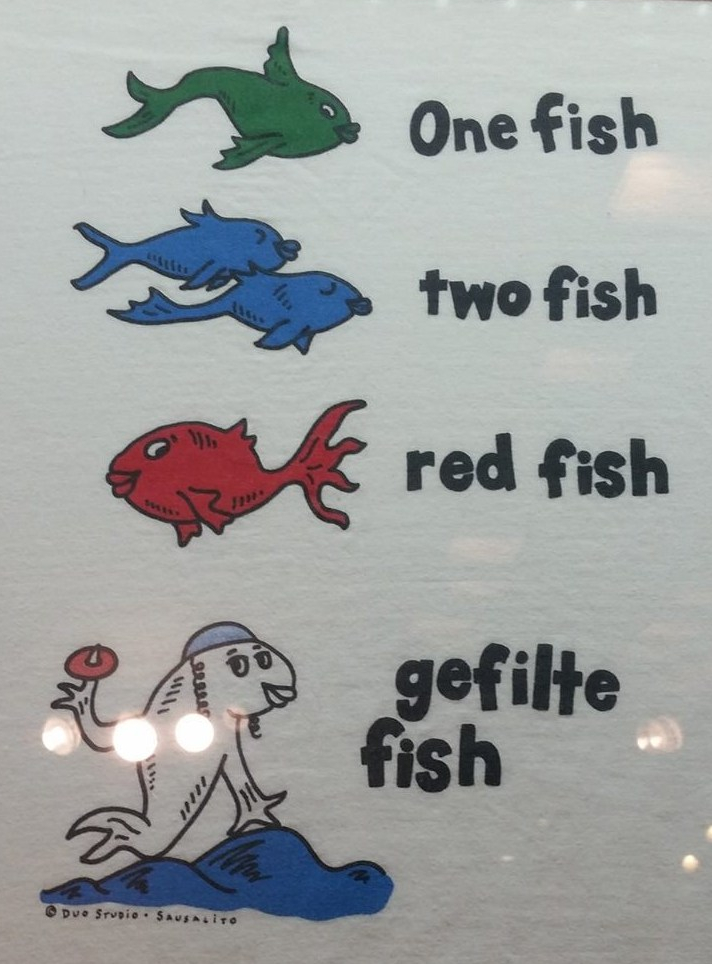
He instantly recognized me, even though it had been months.  He gave me a huge hug, told me I looked great, and asked me how I was doing.  We caught up, he of course gave me extra food for free, and I sat down to delicious gefilte fish and kugel.  Heimish, delicious Jewish food.

While I was sitting, I heard an interesting- and incredibly respectful- debate between a Chabad guy who claimed the Lubavitch rabbi was the messiah and the other Hasidim who disagreed.  This was absolutely fascinating.  And what is more- no blood was shed.  No blows were thrown.  In fact, Yisrael ended the debate by calling the rabbi a tzadik, or saint, and everyone went back to eating and asking me about America (they love to practice their English with me).

Hardly a story you’ll read in Haaretz or see on CNN, but it was real.  And it’s how many people live their lives here.

Heading out the door, I thought to myself that sometimes I wish I could be a part of this community.  Due to my queerness and my Reform identity and progressive values, I don’t know to what degree I could find acceptance as my full self.  It can make exploring Bnei Brak hard at times.

And yet it’s precisely because of these identities that I’m intrigued by this community.  And truth be told- I’m a part of it.  Just in a way that works for me.  Where I can participate in a way where I am learning the best this place has to offer and staying true to who I am.

Due to the Holocaust, Soviet anti-Semitism, American pressure to assimilate, and the Israeli government’s repression of Jewish cultures, my heritage suffered greatly the past 100 years.  An entire civilization, Ashkenazi Judaism, was nearly wiped out.  Yiddish almost forgotten.

When I made aliyah to Israel, I hoped to reconnect with my roots.  Sadly, this state doesn’t believe in Jewish culture.  Whatever remnants of my roots that are here exist in spite of a state that has shamed people for being Jewishly different.

The one group that more than any other has held on to their yiddishkayt- their Jewish roots- is Hasidim.  These Jews continue to speak the language of my ancestors for the past 2,000 years- Yiddish.  A language I now speak as well.  They maintain customs and wear clothing that are anathema to the society that surrounds them- to the state that wishes they’d just forget the Diaspora.

As I headed to a bar to meet a bunch of LGBTQ olim like me in Tel Aviv, I couldn’t help but think of what we have in common.  To hold onto your identity is a daily challenge.  When people around you ridicule you for your difference, for standing out, for being “out of the norm”- you have to find ways to cope.  So perhaps to the chagrin of some homophobic Haredim (not all) and some anti-religious gay people (not all)- we’re dealing with a much more similar problem than they’d like to believe.

Recently I saw a post in a Facebook group about Ramat Gan, a suburb that is squished between Tel Aviv and Bnei Brak.  There are political and religious tensions there between secular and Haredi Jews.  One particularly harsh post by a secular gay guy said: “Ramat Gan- we need to choose between Bnei Brak or Tel Aviv.”

That’s how he chooses to live his life.  Black and white.  Yes or no.  Secular or Orthodox.  Tel Aviv or Bnei Brak.

I have no doubt something caused this mentality and I hope he finds healing.

Because given the choice between Bnei Brak and Tel Aviv- I choose both.

The Bnei Brak of free Gemara lessons, kugel, sesame chicken fans, e-cigarettes, and whole wheat cookies.  The Tel Aviv of queer olim parties, hot guys on the beach, Reform synagogues, and Arab college students.

In short- gam vegam.  Both this and that.


Bedouin Yiddish

Yes, you read that right.  We’ll get to it- read the whole way through 🙂

Today I went South.  I’ve explored a lot of Israel’s Center and North- with plenty more to discover.  And I’ve ventured a little south since making Aliyah to Ashdod.  Now was the time to learn about another region.

I hopped on the train and headed to Be’er Sheva.  It is a city actually mentioned in the Torah and there is a well there that according to tradition was dug by Abraham himself.  I wanted to visit but it’s one of the very few places in Israel you need to call in advance!

I visited the city market which was cool.  An amazing diversity of cultures that reminded me a lot of my neighborhood in Tel Aviv.  Just with less traffic and yelling 🙂

I went into an electronics store and asked in Arabic where I could buy Bedouin music.  For those who are wondering, Bedouin are substantially different in culture, language, and religiosity from many other Arabs in Israel.  Therefore, their music is different as well.

The young man made me a deal and custom burned me a CD with MP3’s of dahiyye music.  It’s basically happy Bedouin dance music- take a look.  Somewhat reminiscent of the dabke I’ve learned- but in the words of the Bedouin man: “that’s fellahi music”.  Fellahin were the villagers and farmers of the region- as opposed to the nomadic Bedouin.  Most Arabs in Israel today are descendants of Fellahin and have distinct dialects from the Bedouin, who speak a bit more like Fusha, the standard Arabic which was likely modeled after them.

I was then peppered with questions about why I wasn’t married.  Lest you think this is only a Bedouin phenomenon, it has been a frequent first question amongst Jews, other Arabs, even Samaritans here.  It is extremely difficult for me- as a queer person, as an American (where this is considered invasive), and a survivor of partner abuse.

Eventually I shrugged it off by saying I was new to the country and needed time to settle in.  Having gotten my Bedouin music, I decided to keep exploring.

I then came upon a bona fide music shack.  A shack because it looks like one.  And bona fide because this man knew his music.  No CD burning here.  He had hundreds of CDs.

I felt much more at ease here- Ahmed, also Bedouin, was gentle and friendly.  And never asked me about my marital status.  We bonded over Arabic music as he showed me tons of options.  Eventually I bought an Israeli Bedouin CD (with songs from both the North and the South), Syrian dialect music (that’s the one I speak!), and another Bedouin CD from a town near Be’er Sheva.  I personally find it miraculous to find Syrian-dialect music in a Bedouin shop in Be’er Sheva.  First off, most Arabic music is not recorded in Syrian, even when the artists are from there.  Egyptian tends to dominate.  In addition, ten years ago when I took my Syrian dialect class, I could never have imagined this scenario.  And I love it.  When the stars align, language and culture bring me closer to good people like Ahmed.

Be’er Sheva’s Jewish community is also very diverse.  Walking around, I found several Indian and Ethiopian Jewish stores.  There were tons of Russian signs.  I even found a sign publicizing a concert at a Tunisian synagogue from the famed isle of Djerba.  Around the corner from the beautiful mural in my cover photo- showing how the ancient and modern co-exist and feed off each other in this beautiful land.

I toured a bit of the Old City, which I hope to return to- in particular to see the Grand Mosque/Museum of Islamic and Near Eastern Cultures.  Like nearly everything in Israel, this place is not without its controversy.  An Ottoman-era building, the mosque is no longer used for prayer, although local Muslims would like to do so.  Instead, the city of Be’er Sheva wanted to turn it into a general museum.  The Israeli Supreme Court, perhaps weaving between the two, decided it could be a museum but it had to be dedicated to Islamic history.  I’m looking forward to visiting, being a fan of Islamic art and history, and would be happy to see it peacefully resume its role as a house of prayer.

Having the desire to see more Bedouin culture, I hopped on a bus and went to Rahat.  An entirely Bedouin city, it is a fantastic place to go to experience their culture.  Since it was already dark and my transportation options were dwindling to go back home (this can be a stressful part of spontaneous travel), I focused on my goal: food.  Before I sat down to eat, though, I met a wonderful young man named Mohammed who is studying English.  I had asked him for directions, one thing led to another, and we decided to stay in touch and exchange languages.  In particular, I’m dying to learn his Bedouin dialect.  And I can help him with English 🙂

I sat down to eat a feast.  This is not an exaggeration.  For 25 shekels, approximately $7.30, I got to eat this:

26230280_10101661718958712_5056984918498805516_n

The picture doesn’t really do it justice- it’s huge.  I didn’t finish half the rice (chicken is buried in it)- and I was very hungry.  The bread is delightful- kind of like Druze pita i.e. nothing like the pita you’d find in a grocery store.  The full bowl of soup that came with it was tomato-ey, a little spicy, and delicious.  The rice kind of tasted like Biryani, for any of my fellow South Asian food fans.  And it was covered in peanuts, peas, veggies, and delicious sauce.  My doggy bag was enormous.

The people there were so kind.  I have to paint this picture for you- there are 0 Jews anywhere.  I can’t imagine many Jews come to Rahat to dine in one of the Arab restaurants that often sit at the footsteps of their villages for Jews to eat at without going “too far in”.  I could be wrong, maybe some come.  All I can say for sure is that when I was there, I was the only one around.  And a totally novel figure.

People were so curious to talk to me.  I was asked a million questions (fortunately nothing about marriage).  All of them kind and welcoming.  We mostly spoke in Arabic.  I asked them to teach me some Bedouin- they said I spoke fellahi! 🙂  We used a few Hebrew words but they truly loved to practice their English 🙂  People knew I was American, Jewish, and Israeli.  And I have to say, and this repeatedly shocks me, being American has been a huge plus to my travels in the Middle East.  Despite the fact that the American government has a very long history of bullying other countries, so many people here still love America.  Jews, Arabs- doesn’t matter.  It’s fascinating and frankly really encouraging.  It’s also a great way to disarm the people who are, in fact, suspicious of you, because I can play the innocent stranger.  To be fair, I pretty much am one 🙂

Before my sated self headed to the bus (and then an exceedingly long train ride because I missed the more direct train- note to self for next trip), a man grabs my phone and insists we take a selfie.  Apparently some concepts are universal:

26230795_10101661718878872_1056055190934410030_n

As I headed to the bus, a man asked me what languages I spoke.  One of them is Yiddish.  And in a moment that you couldn’t even dream of in the wildest of scenarios, the Bedouin man tells me there’s a guy in their town…who speaks Yiddish.  In shock and amazement, I asked why.  He said that the man, back in the day when Yiddish was more widely spoken here, learned it just as he did every common tongue in the area.  My grin, inside and out, could not have been bigger.

In pure cultural ecstasy, I headed home on a very slow train.  With a lot of time to digest a rich and exciting day.

Intercultural exploration and communication can be very challenging.  One does not come out of the womb with the skills necessary to make it happen- even if you may have some characteristics that help.  I’ve spent my whole life communicating across cultures.  From the my early years in Japan to my schooling in Maryland with so many immigrant friends to my work for refugee rights to the dozen or so languages I’ve studied (8 or 9 of which I can currently speak).  None of this happened by osmosis nor just because I have “an ear” for it.  I do have an ear for it- but just like a concert violinist doesn’t magically pick up a bow and play a concerto, I have honed these skills over years of practice and joy.

Today is the kind of day I’m proud to call myself a cultural explorer.  One who learns, who tries new things, who makes people smile, who grows, who creates, who makes the world a better place.

If you’re looking for new adventure, the world is your backyard.  And your backyard just may have a Bedouin Yiddish speaker.

Russian Jews 101

Depending on how you count, there are about 900,000-1.5 million Russians in Israel.  I’ve explored many cultures in Israel and this one is next on the list.  I was initially hesitant to explore Russian culture in Israel.  First of all, I felt it was not particularly Jewish or Middle Eastern (we’ll explore how I’ve changed my mind).  Second of all, I felt Russian was a language of oppression.  I remember stories told in my family of ancestors who fled from there (because- and this is a crucial point- I’m also a Russian Jew just several generations back).  Ancestors who felt the Russian language, Russian rule, and Russian anti-Semitism was forced on them.  Because it often was.  Most Russian Jews, several generations back, were Yiddish speakers- just like in the U.S.

So on some level I felt guilt about learning Russian.  I knew that in fact Russian had become one of the most widely spoken languages amongst Jews – I grew up with many Russian Jewish friends.  As a teen, I learned a bunch of their slang and unique sense of humor.  My suburb of Washington accepted thousands of post-Soviet refugees.  I also felt that Russian was a harsh language, a language of stern people with no smiles.  And one with not so great cuisine.

These stereotypes are rooted in fact or personal experience.  Russia has an exceedingly bad record when it comes to anti-Semitism, which is why many more Russian Jews live outside Russia than in.  I also can’t help but wonder if the Cold War – which technically was still going on when I was a young child (I remember maps with the Soviet Union) – influences the way I perceive Russia.  To this day, the U.S. and Russia are embroiled in conflict and it is actually one of the few countries where it is easier for me to travel on an Israeli passport than an American one.

So the conundrum of me learning Russian is this- the 1.5 million Israelis (largely Jewish or married to Jews, though some not) who speak it are the ones who also fled these problems.  In other words, if I want to explore this culture (which is so rich- for many years I enjoyed exploring Russian art in D.C.), I need to learn the language that many of our persecutors spoke.  And that many Russian Jews today speak as well.  It’s the language of anti-Semites, it’s a language of Communist Jews (who were quite prominent), it’s the language of Tolstoy, it’s the language that influenced so much Yiddish and even Israeli folk songs.  And it’s the language of millions of people I don’t know yet- and who maybe aren’t all as prejudiced today as I’ve been taught.

In other words, complex.  So how did I get to a point where I want to learn Russian – and about Russian culture (here and in the Motherland)?

Oddly enough, Greek.  Over Christmas, I went to Cyprus.  I’ve long been a fan of Greek language, music, history, and food.  So I started learning the language.  And interestingly enough, once you can read Greek, you’re well on your way to reading Russian.  You can thank Saint Cyril for that 🙂 .  So when I got back to Israel and I noticed several identical letters in Russian on signs (because Russian is everywhere here), I started learning the alphabet.

Once I’m hooked on a language, everything else falls into place.  I’ve started listening to Russian music, buying Russian books (there are a lot of them in Israel!), and ultimately meeting Russians 🙂  And it turns out, some of them smile, some of them are Jews, some of them are really cute!, some of them like to dance (like the woman in the bookstore who put on a CD for me and started wiggling!).  In other words, the stern babushka who scolds and never smiles- I’m sure someone is like that, but like most images, this is merely a snapshot and not daily reality.

Which gets us to the word Russian.  In Israel, what exactly does that mean?  Well, it’s a bit complex (which will also bring us to the food question!).  As Israeli Sabras are not known for their nuance, “Russian” here tends to mean anyone who speaks Russian or whose family came from a post-Soviet republic.  Well, guess what?  That’s Belorussians, Lithuanians, Georgians, Bukharians (Central Asia), Latvians, Ukrainians- and so many more.  In some cases, Jews who have completely different cultures and delightfully delicious cuisines.  In some cases, Jews who only speak Russian as a second language.  In some cases, people who the Israeli government doesn’t even consider Jewish.  And in some cases, people who the Russian government wouldn’t consider ethnically Russian.  In short, the word “Russian” in Israel doesn’t tell you much.  Which is why it’s important to learn about this community in more depth.

Much like Russian Israelis are actually an incredibly diverse array of cultures, so too is Russia.  There are 25 *official* languages in Russia.  Most people are Orthodox Christians or secular.  And there are also about 10-14 million Muslims.  700,000 Buddhists.  And 1.7 million are pagans or shamans!  The latter a word I might associate with Native Americans more than Russians.

And importantly for me- there are a ton of direct flights to Russia from Tel Aviv.  I hope to take one one day, perhaps with a new Russian-Israeli friend.

My ancestors who came to America from today’s Lithuania and Latvia/Belarus- they were listed often as Russian because it was part of the Russian Empire.  Their relationship with the predominant culture and language were complex- sometimes a source of incredible hardship and also a source of richness.

What I’ve come to realize about Russian Jews in Israel (and I define the term broadly unlike the bureaucrats in the Chief Rabbinate) is that when I’m learning about their culture, I’m not learning about China or India or Bolivia.  All places I love where my ancestors probably never stepped foot.  When someone recently asked me if I was Russian, I paused for a second and said “yes”!  Because I am.  It’s just that my family had the good fortune of escaping to America.  But we are from the same place.  When I speak to a Russian Jew here, I’m speaking to a long lost cousin.

When I arrived to Israel and discovered the dearth of Jewish food I was raised on, I scrambled to find whitefish salad.  In a land filled with falafel stands being eaten by people whose grandparents largely didn’t know what the food was, I couldn’t find a bona fide Jewish spread!  Someone suggested I go to a Russian grocery store.  I did- and the woman behind the counter smiled.  She was Russian and her Polish grandma would prepare such a salad.  She walked around the counter and brought it to me.

It looked like whitefish salad, with the same texture, yet it had a bit of a tang to it.  Interesting- not quite what I was hoping for, but a good find.  Similar, yet not quite the same.

This is how I feel about Russian Jews.  We come from the same place, our foods are similar, our cultures are similar.  And we’ve spent some time apart- them in the Soviet Union, me in America.  And now we’re back together here in Israel.  Getting to know each other.  Sometimes over whitefish, sometimes over kebabs, sometimes at a Yiddish musical in Tel Aviv reminiscing about our shared civilization.

Perhaps to the chagrin of Israel’s founders, many of whom fled Russia and their Russian identities, coming to Israel is reconnecting me with mine.  And who knows the amazing places it’ll take me spiritually, culturally, and physically.

My cover photo is of a 1986 book- from the year I was born – “A Dictionary of Cybernetics and Applied Mathematics”.  Published in Communist Russia at a time when our countries were still at odds, it’s a bilingual book to help Russians learn English vocabulary.  I bought it (for 3 shekels!) because of what it represents.  Sometimes, changes are happening that you could never imagine.  And someone, somewhere, is learning about you in a place you’d least expect.  That conflict is neither interminable nor inevitable.

And that one day, an American Jew would renew his hope via an old book in a Tel Aviv bus station because he’s starting to learn the Russian his ancestors spoke.  And that his neighbors speak now.

To recall a phrase an old Russian friend from the U.S. taught me: Отлично.  Awesome 🙂

A New Year’s Resolution for Israel

Today is the secular new year.  In Israel, fittingly but quite strange for me, they say “shanah tovah”, the typical Jewish greeting for Rosh Hashanah- the Jewish New Year.  It’s a fun night of celebration and also a chance to think of what’s ahead.

For me, this week marks my 6 month anniversary of arriving in Israel.  I’ve learned so much in such a little amount of time.  I’ve visited over 35 cities.  I’ve been to Hasidic dance parties, Mizrachi concerts, dabke dancing, Israeli folk dancing, Yiddish theater, a Russian puppet show, and a Yemenite concert.  I’ve eaten Bukharian, Moroccan, Persian, Ashkenazi, Romanian, Druze, Arab, Kavkazi, Georgian, Indian, Iraqi, Lebanese, Eritrean, Filipino, and so many other types of food.  I’ve davvened with Haredim, Reform Jews, Chabad, and hippie vegan Jews.  I visited a Druze shrine and a Karaite synagogue.  I got to watch Islamic prayer up close and personal in a mosque and I went to an LGBT Orthodox Torah study group.

Not bad for the half year mark!  I’m quite proud of all my accomplishments- moving across the ocean alone, making friends, finding an apartment, adjusting to a new culture, and using all nine of my languages and starting to add Greek!

There has been a lot of stress along the way.  Israel is an extraordinarily hard place to live- or so say Sabras who grew up here.  And while sometimes they exaggerate because whining here is kind of a national sport (and they don’t know much about the challenges faced by people elsewhere), the truth is in many ways they’re right.  And it’s all the more difficult for someone like me who moved here at 31 without an extensive support network.

What’s hardest about life in Israel is also the source of my New Year’s resolution.  The hardest part of life in Israel is the people.  More specifically, the intense and mean-spirited prejudice I experience on almost a daily basis.  Towards me as an American and towards other cultures- especially within Israel.  Don’t get me wrong- there are some fantastic people here, who mostly join me in complaining about the awful ones.  But boy- there is a mean streak to Israeli culture that I haven’t seen elsewhere in the world.  It’s not because I haven’t seen prejudice elsewhere- I’ve experienced it in places like Spain (anti-Semitism), Argentina (homophobia), and the U.S. (all of the above).

The difference in Israel is the intensity and the degree to which many people here celebrate judging others.  I’m someone who deeply values multiculturalism.  I’m well aware that there are limits to it and questions about how far it should extend.  But the basic principle of respecting- at times embracing- parts of every culture to me is second nature and a fundamental way I live in the world.  The good news is Israel is chock full of interesting cultures.  Sadly, that most Israelis know nothing about- and don’t care to appreciate.  While some Israelis are curious about Berlin or America, few are particularly curious about their neighbors who look or talk differently from them.  Let alone their own roots.

The truth is when the State of Israel was being built, its founders despised (and that is not too strong a word) multiculturalism.  Yiddish, Ladino, Judeo-Arabic- these languages were vigorously and shamefully repressed by the state.  Kids grew up with shame about their roots.  And sadly some 2,000 year old beautiful Jewish cultures are going extinct as a result.

The un-rootedness of many Sabras fosters insecurity and prejudice towards those who maintain their heritage.  Just ask many a Sabra what they think of French Jews or Russians who continue to speak their languages here.

There has been somewhat of a resurgence in interest in cultural diversity, but it needs to be nourished.  And that’s where I- and you- come in.  There are Israelis like me who are proud of our origins.  There are Israelis- I’ve met them- who realize you can speak fluent Hebrew and still maintain (or re-learn) your French or Russian or Arabic or Romanian.  There are many who don’t realize that because they’ve been trained to revile the Diaspora.  And that’s very sad.

But in the end, I believe in multiculturalism and I’m convinced there are some people here who are ready to join me in this movement.  I want to celebrate the incredible cultural richness here- of Jews, of Arabs, of refugees, of everyone.  It is a gift that must be cherished to be protected.

It is no longer acceptable to me that when I tell my Sabra friends that I met Aramaic-speaking Christians or Samaritans who speak Ancient Hebrew or Eritreans with an awesome juice bar that their reaction is: “wow I didn’t know that was there- you’ve seen more here in 6 months than I’ve seen in a lifetime!”

Bullshit.  Time to get off your hummus-filled tuchus and get to know the richness of your country.  No- not the high-tech.  The cultural treasures right underneath your nose waiting to be discovered.

It’s time to leave behind the old-fashioned Zionist concept of the “effeminate”, “decadent”, “overly pious”, “cosmopolitan”, “weak” Diaspora Jew.  It’s 2018, time for a change.  It’s time to realize the “Diaspora” is The World.  And lucky for us, a whole bunch of people from all over the world have made this country their home.

Now it’s time to realize that if we understand where we came from, our cultures, our heritage- it doesn’t negate our Israeli identity.  It thoroughly enriches it.  Just like my delicious cover photo of Pringles, Russian sweets, Korean seaweed, and Israeli Bissli that co-exist at my neighborhood store.  Pluralism that begins with culture can increase respect between all sectors of society.  And instead of Jew hating Arab hating Zionist Orthodox hating Haredi hating Secular hating Mizrachi hating Ashkenazi- maybe, just maybe, we build just a little bit more understanding and a lot less hate.

Ken yehi ratzon – may it be God’s will.  Inshallah.  Ojalá.  Mirtsashem.

Let’s do this y’all. 🙂

Yiddish and Farsi: Kissing Cousins

About two years ago, I decided to take some Farsi lessons.  Having grown up with Persian friends and gone to their plethora of grocery stores and restaurants, I always had a curiosity for the culture.  I also frankly just think the language sounds musical and peaceful.

I found a private tutor but, for a variety of reasons, stopped after a couple months.  The language lay dormant in me (other than talking to lots of cab drivers and some friends).  I kept listening to the infectious music though.

Now that I’m in Israel, I pulled out the textbook I had bought in the States (anticipating I was continuing with the teacher).  I wanted to refresh the language- I have a lot of opportunities to speak it here.  There’s an entire market near my house where store after store is owned by Persians and I like chatting with them.

In my book, I came across something interesting.  The Farsi word for “homework” is “mashgh” spelled مشق.

To me, the root looked Arabic- and I was right.  A high percentage of Farsi words are of Arabic origin, which has helped me learn the language.  Although the language itself is categorized as Indo-European, meaning it is more closely related grammatically to German or English than to Arabic.  As an example, the word “isn’t” in Farsi is “nist”, eerily similar to the German (and Yiddish!) “nisht”.

Back to the word.  So I looked up words from the same root in Arabic and found مشقة.  “Mashaqqah” means “hardship”.  Hmm…this word sounded very familiar to me.

But you’ll be surprised to hear that the word it reminded of was in Yiddish.  “Máshke” משקה is the Yiddish word for drink, but more specifically often used for alcohol.  I know it because I once learned a Yiddish folksong about it!

Lo and behold, this Yiddish word comes from a Hebrew word.  “Mashkéh”, spelled the same way as the Yiddish word, more generally means beverage.  Its plural form even adorns the liquor store near my apartment.

Do all these words come from the same root?  I’m not actually entirely sure, though it seems so.  When words move from one language to the other, pronunciation can change and letters once essential in the original language may disappear.  For example, “Mashaqqah” has two “qafs” (q), whereas in Farsi, mashgh, does not.  I’m not sure why, but that’s how it is with many Arabic words as they migrate into other languages.

And so to from Hebrew to Yiddish (and in some cases back to Hebrew).  The Hebrew word “tachlith” תכלית migrated into Yiddish as “tachlis” (same spelling) and back into Modern Hebrew as “tachles” but spelled how you pronounce it in Yiddish תכל’ס.

So here’s what I find amazing.  First, that my learning of languages helped me explore this fascinating adventure.  Second, that I may have found a word (besides Shalom/Salaam) that in various forms appears in Yiddish, Hebrew, Arabic, and Farsi.  And third, that we are all are far more connected than you might think.

Because while many know Arabic and Hebrew are closely related (about 60% from the same roots), so too are Yiddish and Farsi.  Meaning there are two Jewish and two predominantly Muslim languages that are related!

How so?  First, both Yiddish and Farsi are unique- they are Indo-European languages with strong Semitic overlays.  For Yiddish, that means tons of words from Hebrew and Aramaic.  And for Farsi, that means Arabic influence.

For instance, the English word “is” is “hast” in Farsi and “iz” in Yiddish- all three of which are related.  None of which are close to the non-existent present tense “to be” in Arabic and Hebrew.

Not only that, but the ways in which Semitic words are incorporated into the languages are often identical.  For instance, when making compound verbs, the noun comes from the Semitic language and the verb comes from the Indo-European root to make a new verb.

For instance, in Yiddish “khasene hobn” חתונה האבן means “to get married”.  Khasene, pronounced in Modern Hebrew “chatunah” means wedding.  And it is paired with the Germanic element “hobn” meaning “to have”.  To have a wedding, there you go.

Now in Farsi, the same thing happens.  The verb “harf zadan” حرف زدن means “to speak”.  The first word, harf, is from the Arabic word for “letter”.  The second word, the verb of the verb, is the Persian word “to slap”.  To slap a letter?  To speak!  There you go.

Similar processes happen with regards to phonetics, to pronunciation.  Words from the Semitic languages often are pronounced differently in Yiddish and Farsi than how they’d be pronounced in Hebrew and Arabic- even when they’re written identically.  Shalom in Yiddish is sholem (or shulem) and salaam in Arabic is salam in Farsi.

Understanding how this process happens in Farsi later made it easier for me to learn Yiddish.  That’s right- Farsi helped me learn Yiddish.  And having the foundation in Hebrew and Arabic made it easier for me to learn both languages.

Bottom line?  While Farsi and Yiddish seem worlds apart, they are perhaps more closely related to each other in some ways than to other languages you might expect.  They share unique characteristics, and do so in style 🙂 .  While the world sees Iran and Israel as enemies and while in Israel, Mizrachim and Ashkenazim never miss an opportunity to demean each other’s cultures- the truth is we’re all related.

Don’t take my word for it- pick up a dictionary, find a teacher, and unlock the secrets that language has to teach you.  Even about yourself.

The Satmar part of town

I’d like to tell you a story about nothing.  It’s kind of refreshing in a place where shit is constantly hitting the fan (although much less than someone from abroad might think).  As I write this blog piece, an Israeli plane bombed some military facility in Syria and air raid sirens went off in southern Israel.  I heard some loud noise in my neighborhood and so I checked the news and found out about these events- I have no idea what the connection is but it can be scary here sometimes.

And then life continues.

So right, the other day I went to Bnei Brak.  At this point, we can say that Bnei Brak- and Hasidic Judaism– is a part of my identity.  I don’t just go as a “tourist”- I go because it’s part of my heritage and my people and it’s absolutely fascinating to see a living, breathing Yiddish community.

After eating delightful gefilte fish and kugel and buying loads of Hasidic music, I headed to the Satmar part of town.  The Satmar part of town?  Yes.  In Bnei Brak, each Hasidic group has a yeshiva where people study and it’s kind of their neighborhood.  In a small way, it’s a way of bringing back their former towns in Europe destroyed in the Holocaust.  Because the way you get around Bnei Brak is to say: “where is Vizhnitz?  Where is Belz?  Where is Satmar?”  These are all Hasidic groups- all named after the towns in Eastern Europe where they were founded.  And there’s an eerie and beautiful ring to being able to ask where they are- still- as if you’re heading to the village itself.

So why did I go to the Satmar part of town?  First of all, what is Satmar?  Satmar Hasidim are one of the largest Hasidic groups in the world, with members in multiple countries.  This still makes them a small minority of Jews, but they are influential and growing.  While most Hasidim are not Zionists, they are very much in favor of the Jewish people, love the Land of Israel, and have varying degrees of affinity for the Jewish state itself.

For instance, there are Haredi parties in the Knesset- the Israeli parliament.  These parties are dominated by Hasidim and participate in the lively (and often chaotic) Israeli political process.  Secular Israelis often bemoan these parties’ political influence and that their voters sometimes get government stipends to learn Torah.  I’m not interested in the politics here, just setting the stage.

On the contrary, Satmar are much more insistent on maintaining separation from the Israeli government.  To the surprise of some reading this blog, Satmar Hasidim do not accept any stipends from the Israeli government and do not even vote in national elections.  Say what you will about their politics, at least they’re consistent.  To those secular Israelis bemoaning Haredi “leeches” stealing our tax dollars- that simply doesn’t apply to Satmar.  You might wish they were Zionist, but they aren’t hypocrites.

Anyways, I don’t want to get sidetracked into messy political and ideological debates.  I’m clearly not a Satmar Hasid- I’m a queer Reform Jew- but I find the community interesting, especially since they are often a target for secular disdain.

One of the cool things about Satmar Hasidim is their love of Yiddish.  Most Hasidim in the U.S. both speak and read/write Yiddish.  I’ve discovered that most Hasidim in Israel speak Yiddish as a native tongue but write in “loshn koydesh”- or what we call Hebrew.  That in and of itself is a fascinating linguistic dichotomy worth a separate blog entry.

But Satmar, they speak and read and write and live and breathe Yiddish.  So, wanting some books in Yiddish, I headed to their part of town.  I found a bookstore (one of the cool things about Bnei Brak is the plethora of Jewish bookstores) and immediately noticed there were more Yiddish books than elsewhere in Bnei Brak.  I then asked the shop owner (in Yiddish) where I could buy a Yiddish newspaper.  Seeing I was wearing jeans and a sweatshirt, he knew I wasn’t Hasidic even though I wore a yarmulke.  So he told me I could talk to him in Hebrew.  But when I told him “ober ikh hob lib yiddish” – but I loooove Yiddish – he grinned from ear to ear. And told me to go to the grocery store around the corner.

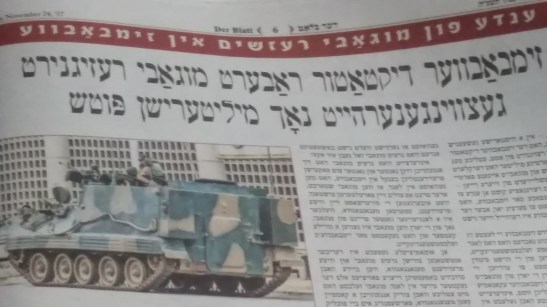
At the grocery store, I talked to a bunch of people to get help finding a paper.  Because the new papers come in on Friday morning before shabbes, there weren’t any left.  Although there were some interesting looking magazines.  Because I’m a creative person and an Israeli, I then asked if they had last week’s papers.  And sure enough, there were some.  I got a copy of Der Blatt, a Satmar newspaper printed in the U.S. and read around the world.

The two guys behind the counter shmoozed with me.  It was so fun!  One of them, when I couldn’t find the word in Yiddish, would revert to Hebrew.  But the other guy- he was a real mensch.  He would answer me- in Yiddish.  THIS is how you know a language is strong.  When the speakers stick to their guns- either out of ideology or monolingualism- those are the people to talk to.  Because that’s ultimately how I learn best.

They were really impressed that I came to buy a Yiddish newspaper to practice the mamaloshn- the smiles, the kind words- they were real.  Before leaving, I thanked the guy who answered me in Yiddish, saying I appreciated him helping me learn.  He gave me a wink and I was on my way.

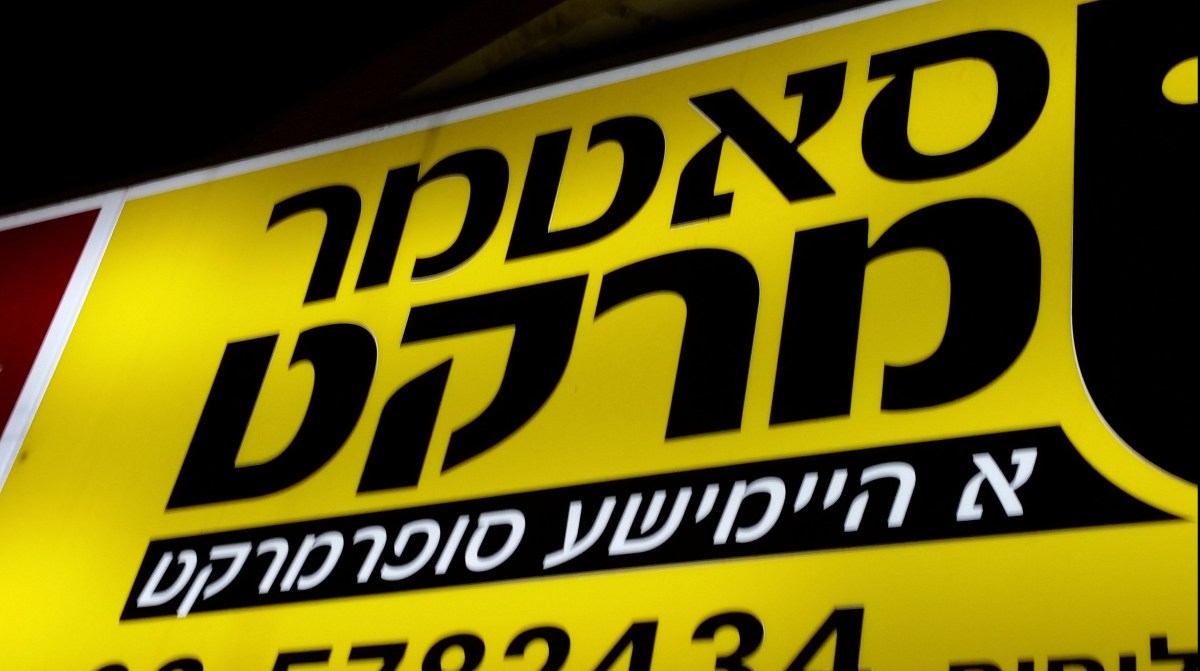
On my way out, I noticed a sign (in the cover photo): “Satmar Market: a homey supermarket”.  For my fellow linguists, there’s something interesting here.  While Satmar Hasidim stick to Yiddish out of a desire not to use Hebrew (the holy tongue for prayer), the sign is actually bilingual.  The words “market” and “supermarket” are written like you would in Hebrew and the other words in Yiddish spelling.  Guess things are a bit more complex than meets the eye.  I love it.

A few days later, I sat and started reading the paper.  And I noticed the most fascinating headline.  On the front page was an article about the Zimbabwean dictator Robert Mugabe being deposed.  Based on my own preconceptions about Satmar- their opposition to the Israeli government, their intense and strict Judaism, and their focus on study- I expected a bunch of articles about Torah.

20171205_020630

But lo and behold, in a residential neighborhood of Bnei Brak, people are reading in Yiddish about Zimbabwe.  And Saudi Arabia.  And tax reform.  And the Warsaw Ghetto.  Just in this week’s edition.

So what’s my story?  I have absolutely no story.  During a stressful week, I took a bus to Bnei Brak, ate delicious food, bought good music, and found an interesting newspaper in the language my ancestors spoke for 1,000 years.  I felt at ease, I hopped on a bus, and met a gay Reform friend for ice cream in Tel Aviv.

Want to live in a bubble where you know more about trekking in Cambodia than about your Hasidic neighbors?  Your loss.  There’s a fascinating civilization down the road begging to be discovered.  Begging for you to rediscover it inside you.

It’s not about agreeing on everything- or much at all.  It’s just about being a curious, open-minded human being and finding sparks of light to illuminate your path- wherever you might find them.

How to fall in love with a language

Hey everyone!  So I’m a polyglot- a multilingual guy.  I speak English, Spanish, Hebrew, Arabic, Portuguese, French, Catalan, Yiddish- all well enough to hold multi-hour conversations and I can read and write.  I’m not putzing around- I wrote my 50 page senior thesis in Spanish and have been interviewed on Catalan TV, and have similar examples for all my languages.  In addition, I speak intermediate Farsi which I’m refreshing here in Israel and have taken some initial courses in Basque, Hindi, Chinese, Japanese, Irish, and Greek.

I learn quickly.  Although I’ve taken some group classes, I much prefer private tutors (I also am one if you’re looking to learn!).  I can go at my pace, with my questions, and don’t have to slow down my learning.  To give you an idea, my entire coursework in Modern Hebrew consisted of about 150 hours of private lessons and two college classes (90 hours total).  So, all in all, I formally studied Hebrew for 240 hours and I never did ulpan.

Before making aliyah, I had only been to Israel twice- once on Birthright and a second time as a camp counselor for the Israeli Reform Movement.  I have no Israeli relatives and grew up in an English-speaking household- none of my relatives have ever even been to Israel.

And I speak the language fluently enough that the times where I don’t understand something, Sabras yell at me because they think I’m being obstinate.  They assume I’m one of them or have lived here for many years rather than five months.

So how did I learn the language?  And how did I learn my other languages?

I get this question a lot.  Sometimes, it’s frustrating to talk about.  I really just enjoy learning and using my languages without explaining myself or being asked to do party tricks like “how do you say ____ in _____?”  Sometimes this is even followed up with attempts to correct me- even when they barely (if at all) speak the language in question.  I once had an American Jew correct me on my “Palestinian Arabic”…only for me to tell him that I was speaking Syrian.   The point is I never wanted to participate in this game show in the first place.  I’m not here to entertain you- I’m a human being.

Then there are the real assholes who want to know why I’d learn a minority language like Catalan or Yiddish.  I think in this case it’s fair to say the issue is not with the language- it’s with the people who speak it.  And the people asking me this question don’t much care for them.  I’ve even had people tell me (after they ask me to list my 8 languages) that I need to broaden my horizons and learn Chinese or Russian.  Without even acknowledging the eight I speak- or that they only speak two.

Then there are the people who want to know why I’ve studied languages (a strange question- kind of like asking someone why they studied the violin).  I usually just say because I love them and because they enrich my life.  But for some people, that’s not an acceptable answer.  They want to know why I don’t work for the CIA or FBI or army or somewhere else they wish I worked.

All of us have talents- one of mine is languages.  But let’s just try to respect each other’s gifts rather than finding a way to “take people down a notch” or tell them how to live their lives.  It makes you look small, not me.

So here’s the truth: I love languages because they make me happy.  As my Catalan teacher once told me: “cada llengua és una riquesa” – every language is a source of richness.  When I learn a new language, I embrace new music, food, culture, history, sociology, and- perhaps most importantly- friends.  I also learn about myself and my identity.  I can’t tell you how much richer my Judaism is because I can read about it in French and Spanish and Arabic and Yiddish etc etc.  And I can learn from the experiences of other minority communities like Catalans and Quebecois.

I overcome my own (and other people’s) prejudices and I add a whole new dimension to my identity.  When you speak to someone in their language, their heart opens up.  It’s a completely different experience.  So again, fellow Jewish Israelis, stop resting on your (Hebrew) laurels and learn Arabic and you’ll see that your relationship with your Arab neighbors will change.  For the better.  It’s respect, it’s honor, it’s love, it’s kindness- it’s great.

So here’s the real key to learning languages: fall in love with them.  When you love something, you do it all the time.  Every chance I get to speak any of my languages- I take it.  Could be my Bedouin cab driver, a French Jewish tourist, Israeli friends back in the U.S., my Syrian Jewish neighbors, the Christian Arab photographer I met up north, a bunch of Latino Jews I met at a pub- you name it.  I love love love my languages so when I’m not in a classroom, I’m finding tons of ways to practice- while smiling and having a good time and always learning.

The best way to be great at something is to enjoy it.  Personally, I’m not a big fan of gyms.  So I don’t really go now.  But I love to dance- and it’s also great healthy movement.  So I do more of it and soon enough, you find yourself in a positive feedback loop and taking care of your body.  That’s how I feel with language- the more I speak, the better I get, the more fun I have, the more I want to learn.

Do I “have an ear for language”?  Probably- when I’m really “in the zone” speaking Arabic up north, Arabs ask me if I’m Lebanese or Syrian.  And I only took six semesters of Arabic.  BUT.  But speaking a language is not just some innate gene.  Just like a musician, even if they have a “knack” for music, must study and practice, so too must someone learning a language.  It’s just that I happen to like learning and practicing so it has become an essential part of my life- thank God!

So long story short- you want to learn a new language?  You want to explore new cultures and really connect with people as equals?  Awesome!  Find the things that attract you to that language and learn.  Pick up a history book (even in your own language).  Scroll through music on Youtube- even if you don’t understand.  Find something that animates you and run with it.

And seriously- stop asking me if you can learn a language on DuoLingo, it is an app not a teacher.  I suppose if you want to learn some new vocabulary words to supplement your study it could be helpful, but otherwise stop kidding yourself.  If you don’t think you can learn to play the cello on a free mobile app, then the same goes for languages.  DuoLingo is a tool- not a human being.  Human beings speak languages and if people aren’t somehow a part of your language learning, then you won’t learn.  You’ll make mistakes (as I have- and continue to do and laugh at and learn from).  The point is not to get everything “perfect”- the point is to communicate!

As Pablo Neruda said: “Conocer el amor de los que amamos es el fuego que alimenta la vida.”  To know the love of those we love is the fire that fuels life.

Love your language.  Love the people that speak it.  And let them love you.  And soon enough, you’ll find yourself like I did- speaking Catalan, Spanish, English, and Hebrew to a Russian Israeli Jew.  In a cafe at Orthodox college.  Aren’t you curious? 🙂