When Jews defend themselves

Yom Hazikaron is around the corner.  It’ll be my first time honoring this day here in Israel.  Once a year, Israelis gather and remember their loved ones who died in battle or were murdered by terrorists.  I am not sure what to expect other than a lot of sadness.  Memorial Day in the U.S. often felt distant, like a day to have picnics.  I think in Israel, both because of the scope of the killing here and its immediacy, it’ll feel quite different.

Soon after I made aliyah, I made friends with a young man named Adam.  18 years old, training to be a combat soldier, graduating from high school this year.  His family owns a Kavkazi restaurant in Ramat Gan, where I “met” his cousin Ruslan, who was killed by a roadside bomb two decades ago- at the age of 21.  I met him because I happened to be in the restaurant on the anniversary of his death.  The dumplings were delicious.  Welcome to Israel.

When I think of young men and women like Ruslan, it makes me sad.  He’d be about 42 today, maybe married with children, working, building a life for himself.  And instead he’s turning to dust in the ground.  Like over 23,000 other Israelis.  With more added each and every year.

The sadness is hardly limited to our borders.  Just north of us in Syria, thousands upon thousands of people are being killed while the world sits in silence.  Where are the mass demonstrations?  Of anyone?  Of Palestinians?  Of Western liberals?  Of Israelis?  Of European activists?  Of Muslims?  Where?  Where is everyone?  People love to kick and scream about Israel, but I just don’t hear their voices when hundreds of thousands of innocent Syrians are being gassed to their deaths.

Palestinians, Lebanese, Syrians, Egyptians, Jordanians- everyone here has their own sadness.  My own country, Israel, has sometimes caused that sadness.  And our sadness has sometimes been caused by them.  I mourn the loss of every life and support people’s remembrance of their loved ones.

This is our day to do it here and we deserve it.

One particular person stood out as I wrote this blog.  And it was not a soldier.  It was Mireille Knoll.  Mireille was an 85-year-old Holocaust survivor living in Paris.  Having survived Nazi genocide, she lived a long and beautiful life in France.  Until two Muslim men walked into her apartment this year and stabbed her 11 times while yelling “allahu akbar”.  That’s not what I said, that’s what one of the actual suspects said.  Along with neighbors.  The same suspect shared that his accomplice said: “She’s a Jew. She must have money.”

I wish I could pretend this was the only anti-Semitism in France or America or any of a number of countries this year, but that’s not true.  In America, we have a rise in neo-Nazism and in anti-Semitic behavior on the left.  Including a large swath of the Boycott, Divestment, Sanctions Movement (BDS), which encourages people to target Israel, and only Israel, for economic boycott.  Not targeted boycotts, not against certain politicians or policies, but against my entire country.  Some of the activists, which include some Jews, are simply trying to push my country in a more progressive direction, even if some (though maybe not all) of their tactics are misguided.   And others among them are flat-out anti-Semites- and this is based not only on news reports, but on actual comments I’ve heard from them.  Rothschild conspiracies and beyond.  To criticize Israel is not necessarily anti-Semitic- Israelis do it on a daily basis.  When you single out Israel among all nations for a never-ending stream of hatred while never mentioning even more drastic human rights abuses elsewhere- you’re a bigot.

I have a friend- and I don’t use the word lightly, he’s an actual friend- who shared with me an insight lately.  Eric is an American Christian and he said: “I have Jewish friends at home who’ve barely, if at all, been to Israel, but want to volunteer for the army there.  I have no idea why they’d do that.”  Because he loves culture and diversity, he added: “I know it’d be difficult, I just wish the Jewish Diaspora was stronger- I wish their communities could go back- to India, to Afghanistan, and beyond.”

He is well-intentioned- I know him.  And I need to address these questions.  First off, I think Israeli Jews whose families came from places like Morocco and Iran- whose families were kicked out of there- also wish they had a connection with those places.  Due to the anti-Semitism of those governments, who stole their property and citizenship, it’s not so easy.  I know Eric knows this, but nobody in Israel particularly wants to go back to a Muslim-majority country that kicked them out and where not a small number of people would still be happy to see them killed.  One friend’s Syrian-Israeli family knows that their historic house has been turned into a luxury hotel.  One day, God willing, if there’s peace, I’m sure Israeli Jews would love to visit and reconnect with their heritage.  In the meantime, it’s the sin of the Muslim world that we can’t do that.  I know Eric understands this and it was more of a wish.  It’s just that he’s pining for something we’ve already had to move past.  None of my relatives are left in Poland.  If we could’ve lived peacefully in the Diaspora, we would’ve done it.  We tried for 2,000 years and our neighbors never succeeded in securing our lives.

Now, to the second part.  Why would an American Jew- even one with little or no direct connection to Israel- want to volunteer for the IDF, our military?  A good question given this holiday.  I personally am somewhat of a pacifist, so I don’t think I’d volunteer for any military.  And I totally understand the volunteers.  Jews- despite our relative economic and political success- are a small and sometimes belittled minority even in America.  Jewish characters in the media are portrayed as effeminate.  The women- overbearing.  Few as sexy or powerful.  We’re only accepted in so far as we don’t act “too Jewish” and aren’t visibly identified as such.

There are many good things about Jewish life in America and about America in general.  And there is one basic thing that Jews have the right to do only in Israel: defend ourselves.  Christians and Muslims alike didn’t give us this right.  Only after 2,000 years can we protect ourselves and not be at the mercy of whatever people or ruler has control over us.  Which gets to Eric’s comment about returning to the Diaspora.  It’s certainly a cultural loss for both us and the friendlier of our former neighbors.  But why would we go back?

Israel made and makes mistakes.  Politically misusing soldiers and sometimes even harming innocent civilians.  Kicking Arabs out of their homes.  The First Lebanon War was in many ways a disaster, even in the eyes of the Israeli public.  And our current quagmire in the West Bank continues to put both Israeli soldiers and Palestinian lives at risk- without an easy solution.

So why would a Diaspora Jew want to be a part of this?  Why would they volunteer for my military?

Mireille Knoll.

That’s why.  Mireille Knoll’s granddaughter Keren Brosh made aliyah from France to Israel, arriving in 1997.  Incidentally, the year Ruslan was killed.  Keren became an IDF intelligence officer, something her grandmother was very proud of.

Mireille Knoll survived the Holocaust only to be murdered by anti-Semites in a self-righteous country that loves to lecture my own about human rights (while taking basically no responsibility for its own colonialist past).  And that bans headscarves and can’t even protect its Jewish citizens’ lives.  Over and over and over again.

Mireille was defenseless.  I pray for her soul’s peace in the High Heavens.  She did nothing wrong, she didn’t deserve to die.  And I’m tired of my people being made into sheep for the slaughter.  We look great as victims, but too many Westerners don’t like to see us with a gun.

So when a Jew grabs a gun and says “enough!”- understand where it comes from.  Understand what it feels like for us to see Keren Brosh strong and protecting our people here while her grandmother was butchered in France.  Even thousands of miles away, we see our people suffering and we remember our history.  We want to help and we want to define our own destiny.  Not by being a sidekick, not by being a punchline, and not by being the overbearing caricature of a Jewish woman that is The Nanny.  Not by being tolerated.  But rather by being free to set our own course, even at great sacrifice.

I’m grateful for the soldiers who’ve sacrificed for me.  I honor the bravery of all victims of terror.  I long for a day when soldiers and security checkpoints won’t be necessary- for anyone who lives here, Israeli, Palestinian, or otherwise.  When the water guns will outnumber the real ones.

In the meantime, I’m not going back to live in the Diaspora.  And I’m glad I have soldiers who put their lives on the line to protect me.

I wish Mireille Knoll had had soldiers to protect her.  So she wouldn’t have been a helpless grandmother stabbed to death for being a Jew.

That’s why I’m Israeli.

The Holocaust

For lack of a better title, that’s what I’m calling this blog.

Today is Yom Hashoah, Holocaust Remembrance Day.  It is my first time spending this remembrance in Israel.

I knew in the back of my head it was coming tonight, but I was surprised with the speed.  I was going shopping in the Shuk and as early as 4pm everything started to shut down.  With no food at home, I scrambled and even convinced the mini-mart to sell me a milk carton as the tarp was being pulled down.

Living alone here, I wasn’t sure quite what to do.  I’ve been to Holocaust remembrance ceremonies in synagogues and Jewish Community Centers in the States, but you don’t get the feeling that the whole country is coming to a stop.  Quite the opposite, the average non-Jewish American wouldn’t even notice.

After deciding to cook some lentils I had lying around from the Eritrean corner store, I got to thinking.

This past year, I started doing genealogy of my family.  It’s not easy- I come from a deeply toxic and abusive family across several generations so to “reconnect” with long-lost relatives is hard.  I don’t know how they were as people and if they gifted me the torture I survived as a child.  What I hope, on some level, is that someone up the family tree was brave and hopeful like me.  Someone who aspired, who made it to America, who overcame obstacles.  Whose courage runs through my blood and brought me to my homeland.  Their very distance from me and my not knowing them allows me to imagine such a scenario.  To enjoy that several of them were Yiddish teachers.  That one was a rabbi.  That they spoke Yiddish and English and Romanian and Hungarian and Russian.    It gives me a little sense of rootedness when I sometimes experience loneliness and a sense of detachment.

It also helps me understand where I come from when Nazi Germans and their Polish, Hungarian, Russian, etc collaborators murdered my family.  Because while some of my Palestinian neighbors want us to just “go home”, it’s not quite so simple.  The truth is the homes we had before the Holocaust no longer exist.  There were 17,000 synagogues in Europe on the eve of the Holocaust and now there are 850.  European Jews numbered 9.5 million in 1933- and today barely 1.4 million- 85 years later.  You cannot find an Ashkenazi Jew who didn’t lose relatives in the Holocaust- whether they know their names or not.

And in Israel, they know their names.  Because about 90% of the State’s initial population was either Holocaust survivors or their relatives.  While the vast majority were Ashkenazi, a number of Sephardic communities were annihilated by the Germans, including the beloved Salonika which is now basically empty of Jews.

Some people do not get the Holocaust.  Many, many, many non-Jews I’ve met, including people I grew up with in the U.S., think the Holocaust is the only major act of anti-Semitism to befall the Jewish people.  I even had a French teacher in the States who genuinely thought no anti-Semitic violence happened before the Holocaust.  Wrong.  The Holocaust is the climax.  It’s the climax of 2,000 years of Christian anti-Semitism, which later morphed into race-based anti-Semitism.  The reason Yiddish has Hebrew, Aramaic, Italian, French, German, Polish, and Russian in it is because we’ve been expelled from all those lands (and others) over and over again.

Something few Americans I know want to acknowledge is their privilege as Christians.  Or as descendants of Christians even if they don’t practice the religion.  My point here, by the way, is not to suggest Christianity is inherently anti-Semitic nor to blame individuals today for the acts of other people.  Rather, I want to suggest that people need to understand the way being not Jewish gives them privilege over Jews everywhere in the world except Israel.

There are the basic things like when public holidays take place to the likelihood that a Jew will be elected President (in America- I’m not holding my breath).  Then there are the country clubs that wouldn’t admit Jews, the universities that had quotas, the lynchings, the job discrimination, the Hollywood surnames that lost their “skys” and “mans” and “bergs”.

I’ve personally been discriminated against- classmates calling me a rich Jew, people telling me Jews were loudmouths, having bomb threats called into the Jewish Community Center, even being thrown out of a taxi by an anti-Semitic driver yelling rants.  Being called “similar to an Islamic extremist” for keeping kosher.  A guy I was dating once even broke up with me after he found out that I didn’t eat pork.  Read between the lines.

It should be said that American anti-Semitism, even with its recent scary rise in cemetery desecrations, is relatively mild compared to other countries like France and Russia, from where Jews continue to flee.  It should be said, though, that there was a 57% increase in American anti-Semitic acts in 2017.  Something I believe American Jews should keep in mind and at least consider taking a glance at the Nefesh B’Nefesh website as an option.

The fact that American Jews, as a whole, have achieved great success- much like our German counterparts prior to Adolf Hitler- is not primarily to your credit, America.  It’s to ours for overcoming the obstacles you often put in our way.  The fact that my family was excluded from institutions didn’t just give you an advantage- it gave us a disadvantage which we bravely overcame.  And still overcome.  Discrimination is never neutral.

As I continued to do genealogy, I mapped out where my ancestors lived in Europe before coming to America starting 130 years ago.  I’m still working on it, but here’s my map so far:

Screen Shot 2018-04-11 at 11.50.07 PM

As I found my relatives’ birthplaces, I came across other databases.  The Nazis, to their credit, were diligent Germans.  The kind who keep good notes.  Who keep the trains running on time and the logs well-written.  There are entire databases, I discovered, of the names of Jews who Germans murdered.  And what I found, to my shock, was people with the same surnames as my relatives from the very same towns- killed by the Nazis.  In some cases, they were the only people in the town with the same surname.  My family.

While for many Israelis, Holocaust remembrance day is very direct- they remember their immediate relatives.  In some cases, they remember themselves in concentration camps.  American Jews, with the exception of post-war refugees, are another generation separated from the pogroms we escaped.  And we don’t necessarily know the names of our lost relatives, even if we realize they must have died.  With the help of the internet and Nazi record-keeping, I can now say I do.  It makes it much more personal and makes me a whole lot angrier.  And sad.

A while back, I met a young German man here studying for a semester.  I took him under my wing, showed him Tel Aviv, talked about Jewish history, and even brought him to a Yiddish Klezmer performance.

I think he was well-intentioned but supremely ignorant.  We talked about the Holocaust, which I welcomed.  I’ve struggled to find non-Jewish Germans willing to dialogue (partially because I don’t know many) and I think we both need it.  The young man asked me: “Why do Israelis keep talking about the Holocaust?  It happened so long ago.  It’s old history.”

My heart sunk.

If this is the kind of German that makes his way to Tel Aviv- which initially gave me hope- I started to wonder what the German back home thought of me.  I know rationally that it’s not wise to judge an entire people based on a few interactions (I’ve had some other problematic ones with Germans here- including one who complained about our holidays and our “weird-looking language”).  And emotionally I just get so angry.

In the end, Europeans, white people, Christians, whatever you want to call them.  The people across the pond who aren’t Jews.  They- not all of them- but they caused our trauma.  And, to a certain extent in recent years, you could say the same of Muslim-majority countries, though historically they treated us better relatively speaking.

So when Europeans – because it was not just Nazis, it was also millions of their collaborators – caused us trauma, it has become a generational problem.  Especially here, when combined with the wars and terrorism that followed.

So when French activists or Swiss protestors lament our aggressiveness or “disproportional force”, it’s hard for me to take them seriously.  Not because they don’t have a point- sometimes the trauma heaped on us has gotten passed on to Palestinians and our Arab neighbors.  But rather, because it’s the pot calling the kettle black.  When Europe is ready to compensate us and restore the property – and, impossibly, the lives – of our people, I’ll be ready to talk.  I just can’t really handle a German lecturing me about disproportionate force.  Who doesn’t even know about the tortured Jewish history of his town.  And if that’s hard for you to hear, good.  Because at least we’re being honest now.  And you have to take our feelings into consideration if we’re going to build something better here.

On our side, we haven’t gotten a moment to breathe.  Israelis, in particular those who have lived here many years, haven’t gotten a respite since the Holocaust.  Nearly non-stop warfare and violence.  We deserve a rest.

We also need to remember that because of all the traumas our people has been through, we must be extra cautious not to harm others.  As I’ve written about before, there have been times when Israelis, in particular in 1948, passed their trauma on to Palestinian civilians.  For the first time in 2,000 years, we have the power to abuse others.  Including refugees.  Few things are black-and-white, we just must remember that with power comes great responsibility.  The kind of responsibility and sensitivity that Europeans rarely showed us.  Such as the Polish politician who called Jews “animals” on social media.  Last week.

On many levels, I identify with Holocaust survivors.  Of course as a Jew and as a human being, but also as a survivor of torture and abuse by my relatives.  I’m an only child and I pulled my way out of that swamp with every last bit of my energy until I made it to the Holy Land.  Where those survivors and this survivor now live together, building a new life of hope, health, and joy.

Israel is an imperfect place, like every other country.  If you want to know why, despite all our very loud and vociferous differences, Jews here feel we need a homeland, all you need to do is count the number of Jews in Poland.  Or to try to find the synagogue where my great-grandfather prayed in Latvia.  Or to find the Jewish community of Pacsa, Hungary where my great-grandfather Adolf Adler lived.

Guess what?  You’re going to be in for a lot of tears.  Because our heritage there was erased.  And it’s because we have a new homeland, a complicated and blessed place, that we are still alive.  Israel struggles with many things- preserving Jewish culture, guarding human rights, and even sometimes pursuing peace.

One thing we’re good at is saving Jewish lives.  Something Europeans never really could figure out.

Have a meaningful Yom Hashoah.  May this remembrance find the existing survivors treated with more dignity.  May it find all victims of genocide treated with respect.  May it find us living in a world where while I remember my people being gassed, I don’t have to think about my neighbors across the border in Syria suffering the same fate.

One Holocaust, many genocides.  Never, ever again.

p.s.- if you’re wondering what the cover photo is, it’s the flag of the German-American Bund.  The American Nazi party.  Because Nazism wasn’t just Hitler.  We all must stand up for what’s right.

*Image by Paloeser

Bedouin Arabic…in Hasidic Bnei Brak

Yes, the title is exactly what you think.

As an appropriate sequel to my blog “Bedouin Yiddish“, in which I discovered a Bedouin man who speaks Yiddish in Rahat, I found Bedouin speaking Arabic in Bnei Brak!

Before we get to that, let’s start at the very beginning.

Today, I was planning on visiting the West Bank.  Area C, where Israelis can visit, is where I’ve made contact with a Palestinian practitioner of non-violence who partners with Israelis (including settlers).  However, feeling rattled after yesterday’s “preview of a terrorist attack“, I decided I wasn’t in the right frame of mind to make the most out of the experience.

Instead, I made my way to Bnei Brak.  I’ve written a lot about this Haredi city of 200,000 people on the doorstep of Tel Aviv.  My first Haredi hug, my first time praying in a Hasidic shtiebl, Satmar Yiddish newspapers, the hot guys, and the time I got a blessing from a Vizhnitz Hasid.

Speaking of Vizhnitz, that’s exactly where I went today.  Kiryat Vizhnitz, named after the town in Europe where the Hasidic dynasty was founded, is a part of Bnei Brak I knew less about.

Knowing that there was a renowned Vizhnitz bakery AND a Yemenite Haredi bookstore, I knew this was my destination for the day.  Quench the thirst of my soul and my stomach!

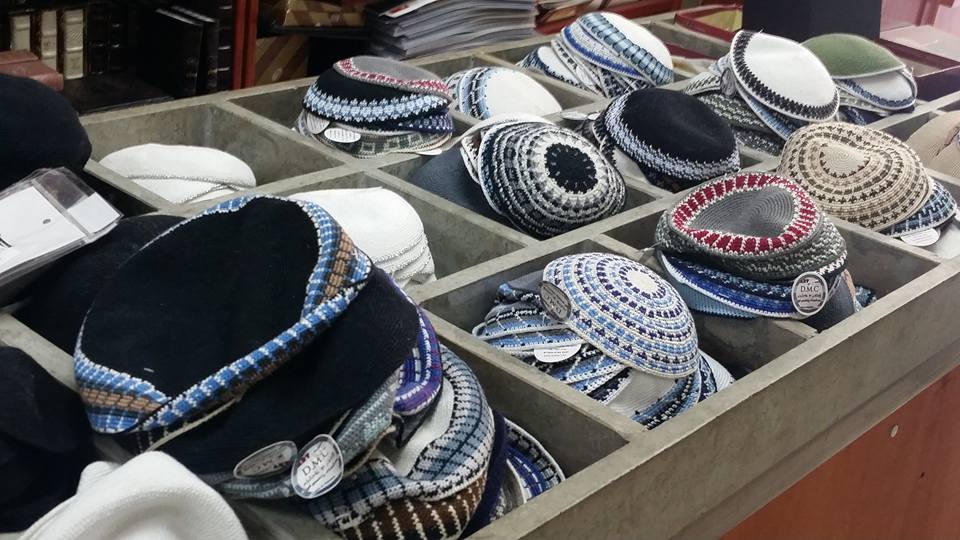
I started at Nosach Teiman, a Yemenite Jewish bookstore and Judaica shop.  The riches of this small store are innumerable.  I bought loads of Yemenite music, a Judeo-Aramaic calendar (!!), prayers written in Judeo-Arabic, and a book of Judeo-Arabic expressions translated into Hebrew.  It does not get any better than this.  Here are some pics:

They even had Yemenite Jewish clothing, make-up, and perfume for sale.  For a community that had to escape by the skin of its teeth from fanatical neighbors who wanted to exterminate them, they’ve sure done an amazing job of preserving their culture upon arriving to Israel.  While unfortunately fewer and fewer Yemenites here speak their unique language, I did hear a few words in the store- which I could mostly understand with my Arabic!

Energized, I headed to the Vizhnitz bakery, sure that I’d also find new adventures on the way.  On my way there, I came across several yeshivas.  The first, a Sephardic one, where I got a free book called “Mishnah Brurah”.  It’s old and beautiful- and free.  Bnei Brak is one of the few places on the planet where you’ll find timeless beautiful books simply sitting outside waiting for you to grab them.  For free or minimal cost.  These are the Jews who truly continue to embody that we are the “People of the Book”.  Looking for Jewish knowledge?  Skip Amazon and head to shuls in Bnei Brak.

Down the street, I saw the Belz Yeshiva.  There’s a famous song about the shtetl, or Jewish village, of Belz that once existed in Eastern Europe.  So to see the town recreated in front of my eyes- its Jewish presence in Europe exterminated- was awe-inspiring.  As Holocaust Remembrance Day approaches in Israel, I couldn’t help but let out a huge smile.  As the famous Yiddish resistance song says: Mir zaynen do.  We are here.  In the face of Nazi persecution, Christian annihilation, Islamic fundamentalism, ever-shifting anti-Semitism on both left and right- we exist.  We survived.  We. are. here.

To see my heritage continue in the face of 2,000 years of European brutality is a miracle.  It fills me with hope, wonder, amazement, and joy.  Our mere presence is a victory in and of itself.

I headed to the bakery with a fulfilled soul and a hungry stomach.

The bakery was delicious.  It was nothing but challahs left and right.  Some huge, some small and all a bit sweet.

While I noshed on my challah, I noticed something interesting- a sign with baking instructions in Arabic.  Bnei Brak is 1000% Jewish.  A mixed city this is not.  A secular person moving here would be considered a mixed population.

Then I noticed a tan-skinned man yelling in Hebrew at a Hasid.  Something about business.  Given how everyone yells in my neighborhood- even when not angry- I didn’t make much of it.  Must just be a Mizrachi guy who does business with Vizhnitz bakers.

Then I heard the most unexpected thing ever: Arabic.  And not Yemenite Judeo-Arabic.  Arabic from here.  I approached the tan men in Arabic.  Their eyes widened with excitement and surprise.  You have to remember I’m wearing a black yarmulke, a kippa, a head covering.  I look, for all intents and purposes, Modern Orthodox.

Turns out, they’re Bedouins.  I told them I had been to Rahat (where I discovered the Yiddish speaker).  They said they lived in a nearby town of Ad-Dhahiriya, whose name at first I confused with Nahariya, a city in the North of Israel.  Only once I google its name right now did I realize…it’s a Palestinian city.  In the West Bank.

We had a great talk about the Bedouin dahiyye music I like (they’re going to teach me the dance next time) and I was proud to hear, as I walked away, them say “wallahi bye7ki 3arabi mnee7”.  Wow he really speaks Arabic well.  My smile inside and out could not be bigger even as I write this now.

While Yemenite Arabic in Israel is struggling, I found Bedouin Palestinians who are keeping Arabic alive in Bnei Brak.  While my trip to the West Bank didn’t happen today, I did end up meeting Palestinians.  And having fun.  And hopefully warming a few hearts, like they did mine.

Still hungry, I grabbed a sweet for the road.  The man at the store turned out to be a fellow polyglot.  He spoke Hebrew, Yiddish, French, and English.  And a straight-up Haredi Jew.  We shared a fantastic short conversation in all languages.  I bet you didn’t expect that in Bnei Brak.  Or the gluten-free falafel I found.  Or the multilingual dictionaries for learning Arabic, Hindi, Chinese, Italian, Spanish, Farsi, and Yiddish (the latter possibly for Mizrachi Jews).  All alongside a side for “kosher” phones that filter out “non-kosher” content.

What I hope you take from this adventure is the unexpected mystery and glory of finding new places and new people.  Bnei Brak is an awe-inspiring place.  With things that will surprise you if you open your mind and heart to the possibilities.

On my way back to Tel Aviv for a Eurovision concert headlined by Dana International, Israel’s first transgender superstar, I felt sad taking my yarmulke off.  I like my black yarmulke.  It suits me.  Not as a decoration and not just as a sign of respect for Bnei Brak.  But because I like that part of me.  That heimish, passionately Jewish, bookish, dancing-down-the-aisles Matt.  The Hasidic part of me.  The Haredi part of me.

And I don’t like feeling that I need to take it off when I come back to Tel Aviv, especially at an event with a lot of gay people.  Who- and I understand why- will be afraid to talk to me because of it.

This is what I hope we can one day overcome- on all sides.  I long for the day when I can be a gay Hasidic Jew- with the flexibility to still pray Reform and to go to gay parties.  And find a gay partner.  I long for the day when secular gay people will accept my passion for Judaism, including Orthodox Judaism, as a part of me.

I shouldn’t have to sacrifice bits of my soul to keep other people happy.  Nobody fits into a box- boxes are boring.  I’m glad I explore different things and my life is much, much richer for it, even with the challenges.

When I go to Bnei Brak now, I’m not just a visitor.  I know this place.  And I like some of it.  I hope it continues to passionately preserve its Judaism and I hope it can find ways to be more inclusive of people like me.  And I don’t know how possible it is to do both.  I would like to try- I suppose I already am.

So next gay party, don’t be surprised if I put on my yarmulke for a bit- just to see how it feels.  And to see how you react.

And next visit to Bnei Brak, don’t be surprised if I linger a bit under your city’s rainbow-colored flag to take a selfie.  Because inside it feels really queer.

Just like speaking Bedouin Arabic in the middle of a Hasidic bakery.

30516213_10101746604043322_7992752775041405545_n

A Preview of a Terrorist Attack

Israel is an exceeding loud country.  I’ve lived in big cities for most of my life and I speak 8 languages, so I’ve traveled.  And nothing- I repeat nothing- comes close to the noise of this place.

I live in South Tel Aviv, perhaps the single loudest part of Israel.  When people greet each other here, standing inches apart, they shout “shaloooooom!” as if they were down the street.  I go to Shuk Hatikvah, my local market, and it is super loud.  I’ve gotten used to it.  People are simply hawking their goods- cucumbers, dates, you name it.

One day, I heard screaming so loud in front of the market that I actually didn’t cross the street.  I was afraid something was “going down”.  And to be fair, if there’s one neighborhood of Tel Aviv where that’s likely to happen, it’s mine.

I paused for about 30 seconds looking anxiously.  The man was selling tomatoes.

Add to this that I live on the flight path to Ben Gurion Airport, with planes flying at all hours of the night.  And the fact that my neighbors blast Mizrachi music every morning (which I actually like to wake up to).  And basically, I’m used to loud noise.  It’s my home.

I’m also now a bit more accustomed to the idea of terrorism.  In America, terrorism is a far fetched concept.  Unless you lived in Lower Manhattan on 9/11, you haven’t really experienced a massive attack.  There have been smaller, very deadly shootings for sure.  Sadly, even last week at Google.  But not on the scale of what Israel has experienced.

According to one source, Palestinian terrorists have killed 3,759 IsraelisHere’s a list of the major attacks since the 1990s.  Adjusting for population, this would be the equivalent of 740,227 Americans.  More than all the American soldiers who died in World War I and World War II combined.  There continue to be terrorist attacks on a regular basis, mostly ignored by the Western media bent on a simplistic black-and-white view of the region.  That does Israelis and Palestinians a disservice.

This is, by the way, not an attempt to downplay the death and sadness experienced by Palestinians.  There’s enough tears to drown both sides here- to the extent that you can really boil this conflict down to two sides.  Which I don’t really agree with.

My point is simply that it can be stressful to be an Israeli.  The other day I was locked in my neighborhood library for 20 minutes while police neutralized a suspicious item outside.  It was scary, which I suppose is the point of terrorism.  It’s not just the killing, it’s that the way it is done is meant to inflict maximum psychological harm.
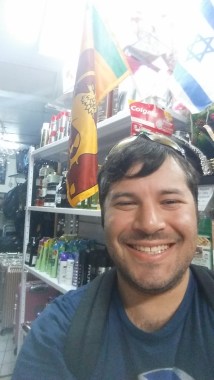
Today, I was relaxing at a neighborhood cafe.  While checking my loads of WhatsApp messages like a good Israeli, I heard the single loudest and most explosive noise I’ve heard in this land.  And it wasn’t just me.  Everyone- I mean everyone- immediately turned towards the sound, eyes wide open, and hearts skipping a beat.  You could just feel it.  Israelis are not easily phased.  You know that a noise isn’t a problem in Israel if no one is looking.  And you know it is if people drop what they’re doing and all start to stare.

Luckily, people started talking within a minute or two and realized someone’s tire on a motorcycle had blown out.  Everyone started smiling and let out a sigh of relief.  Mine was audible.

After recuperating for a moment, I did what people here do- I went on.  I went to the bathroom, I got some water, and I headed to a pizza place where I called a few friends and told the guy working there about my favorite American hip-hop.

And then went home on a very crowded bus where a small fight broke out and there was more screaming.  I guess on some level I was relieved it was the usual Hatikvah screaming.  And not that of people wailing over bodies spilling blood.

I’m grateful to be here writing this blog.  Thousands of Israelis weren’t so lucky over the past 70 years.  That’s right, my country has made it to 70.  The golden years, if it were an elderly Jew retiring in Florida.

I’m proud to be an Israeli.  I’m not always proud of what my government does or how all of our people act- just like I was when I lived in America.  Being proud of your country also means speaking out for what you believe- that’s democracy.

Yom Ha’atzmaut, Israeli Independence Day, is around the corner.  The decorations are up in my neighborhood and around the city.

I have a simple message for my friends abroad, especially my progressive friends in Europe and the U.S.  Empathize with us.  Don’t stop empathizing with Palestinians.  Just also empathize with us.

If you had bombs going off, attacks for 70 years, wars, and such a fear of these things that a loud tire bursting is enough to startle you- then you’d be a lot like us.

We don’t have the luxury of having massive rallies like they did in Barcelona after the 2017 bombings.  Because if we had such rallies every time someone’s child was split into pieces, we’d be doing nothing but rallying every day.

We have lives to live.  Understand that even the most eccentric Israeli behavior- or politics- has reasons behind it.  Whether it’s the right path or not, there is something that causes people to behave the way they do.  The way we do.

I’ve met some Americans here truly open to listening and to exploring all the good and bad of the cultures of this region.  Kudos.  I’ve met other foreigners who come and lecture me about my own people, my own religion, my own history.  Even flat out anti-Semites.

If you’re the latter- start your work at home.  With yourself, with your community, with your own country.  Americans have little to stand on when heaping sometimes aimless anger on Israel.  Every inch of your country was inhabited by Native Americans and you take it for granted that it now belongs to you.  I can personally say I know next to nothing about the Potomac Indians who inhabited the town I was born in.  And I’m at least aware enough to know they exist.

If you don’t think Jews are from here- you’re wrong.  Both we and Palestinians are connected to this land.  And we’re both a lot more connected to here than you are to Boston or Minnesota or California.  Because you’re not from there- you’re from Germany, France, Scotland, or Ireland.

And to the Europeans nodding right now- who do you think caused all of that?  Or even most of the problems in Israel and Palestine?  It’s you guys!  Who stole Jewish land, money, and lives on every inch of your soil for 2000 years. Who colonized the Middle East and stole its resources.  Me and my Palestinian friends are living with the consequences of your imperialism.  So stop munching on your free-range Swedish meatballs with an air of self-righteous “neutrality”.  Because the German Volkswagen you’re driving was built with the blood of my people.  And your British Petroleum is paid for with the blood of 405,000 Iraqi Arab lives.

In the end, none of us are entirely innocent and few are entirely guilty.  The effect of terror, at least on me, is that once the fear fades and my safety returns, the anger builds up.  Which is what I’ve shared with you today.  So try to understand what it must feel like on a national scale- when the explosion really happens.

I feel blessed to be an Israeli, and as I continue to settle in here, I’m not quite sure what it means to be an American going forward.  We’ll have to see.  I do know that I just want peace.

The kind of peace where I can live in my Jewish homeland without thinking that a blown out tire is going to be the last sound I hear.

How to stay sane while living in the Holy Land

Recently, I was talking to an Arab friend in Arabic.  He said there are three groups of people here.  One, Arabs who think this whole land only belongs to them.  Two, Jews who think the same thing about themselves.  And three, Arabs and Jews in the “mushy middle” who want to live together.

I think I agree.

Today, I saw a good demonstration of how this plays out.

After lazing around on the beach on a gorgeous day, I had some extra time on my hands.  Because I live in by far the most fascinating country on the planet, I simply slipped my sandals on (and then off) and walked into a mosque.  The Hassan Bek Mosque is a historic building located in the middle of Tel Aviv.  It was built in 1916 and to this day is an active mosque.

According to what seems to be a pretty well-sourced Wikipedia article, the mosque was built on land that the Muslim governor of Yaffo confiscated from Arab Christians.  Later, it was used for Arab snipers shooting at Jews.  During the 1948 War of Independence, Israel captured the area.  The houses were largely razed and some troops wanted to demolish the mosque itself, which was vetoed by future Prime Minister Menachem Begin.

At various times it was going to be turned into real estate development (stopped by protests) and may have housed a suicide bomber, which led to some Jews throwing firebombs and some Arabs hurling rocks at the Jews from the mosque.  Arabs then threw rocks at Jewish motorists and some Jews threw a pig’s head into the mosque.

In short, a microcosm of the region’s conflict, some of which I didn’t know about until writing this blog.  Depressing and important to be aware of so you know where everyone is coming from.

If you go to the mosque itself, it’s just gorgeous.  You wouldn’t know any of that crap if you just enjoyed the beauty of the building itself.  Here are some pics:

After some peaceful reflection, perusing the beautiful books (including Qurans from Egypt and…Saudi Arabia!), I talked with a man inside.  We chatted in Arabic because I wanted to know what a sign meant.  It said (in Arabic) “Tasu is in danger”.  I knew “is in danger” but didn’t know what the word “Tasu” was.

He explained it was the name of a cemetery in Yaffo (Yafa in Arabic).  A Muslim cemetery which, incidentally I had visited in previous adventures, that is now possibly going to be turned into…a hotel.  When you consider the long history of conquest and re-conquest and desecration this land has known, it’s just so, so sad.  I patiently listened as he explained the situation and I shared my sympathy.  It’s hard to imagine a Jewish cemetery becoming a hotel here- the government is excruciatingly diligent about not building on Jewish graves due to prohibitions in Jewish law.  So much so that even Secular Jews get peeved by it.

The man pointed me to pictures of the neighborhood (called Manshiyya before 1948) on one of the columns.  The pictures were sad and the descriptions in English were pretty brutal.  Here is a slideshow:

This slideshow requires JavaScript.

Occupation, nakba, bombing, demolition, ethnic cleansing- these are their words in English.  The sad part is there is some truth to what they’re saying.  As I’ve written about extensively on this blog, some Zionist militias forcibly expelled Arabs in 1948.  That’s not a theory, it’s a fact.  It’s also true that few things are black and white and the language used on these signs, in English for tourists, was as bombastic as possible.  Their existence perhaps evidence that Israel’s freedom of speech is a bit healthier than some expect.

No mention was made of the Christians whose land the mosque is built on nor the Jews who were shot at from its property.  I understand the anger of the worshipers especially in light of the recent cemetery controversy.  I also wonder if these signs are presented in a way that fosters knowledge of the past for the sake of building a better future.

Feeling sad and angry (both at the interjection of the painful past into my present and at the real estate developers who are about to turn a Muslim cemetery into a hotel), I walked back to the man.  I told him in Arabic: “I’m sorry for what’s happening.  I’ll pray that they don’t turn your cemetery into a hotel.  In the end, we must live together.”  He gave me a big smile and a handshake.

This man knew I was Jewish.  I can’t change the past- not the fact that this neighborhood was destroyed, nor the hateful acts committed on all sides in this place, nor the cemetery issue itself.  Although I plan on speaking out about it now.  What I did was just try to warm someone’s heart.  In a place where I feel quite helpless about convincing politicians, I just tried to be a human and reduce the hate in the world.

Feeling extremely tense, I walked towards Yaffo, where later I’d be celebrating the Moroccan Jewish holiday of Mimouna.  I stopped for some food at an Arab-owned restaurant.

The owner was hot.  Physically, for sure, and also just really nice.  Khalid had a beautiful smile and an infectious and kind personality.  We chatted on and off for hours.

An American woman walked in totally confused.  I helped her order and translate between her and Khalid.

Khalid noticed how I helped her and several other customers with the menu and I made some corrections to the English on their fliers.  He asked me if I would work with him.  I was surprised.  He basically said I had a nice connection with the customers, I knew public relations, and he needed help.

As I considered what had to be one of the kindest and most interesting job offers I’ve ever gotten, the American woman asked me about Gaza, about refugees, about pretty much everything that makes me cry a lot.  When the complexity and the sadness just overwhelm.

So instead of policy solutions (which Americans love), I gave a different answer.  I said: “If you want to live here, you need to know the past.  Insofar as the past helps you make a better future.  If you fixate only on the past, you’ll never see your way out and we’ll be stuck in a never-ending blame game.  We have to also live in the here and now and a better life together.”

Khalid then looked at me while the woman grabbed her purse.  He said: “Don’t pay for your food- we’re business partners.  You have to come work here.  I don’t see religion.  I see that when someone looks me in the eyes, I trust him.”

With a true feeling of gratitude, I headed to Mimouna.

What I wish for the Middle East and for my beloved country of Israel and the Palestinian people is this.  Know our past- and know the past of the other peoples of this land.  And don’t get stuck in the swamp of never-ending hatred, sadness, and guilt.  We don’t have time for it- we only get one life.  Know the past to learn from it and make a better future.  Let’s build it together.  Let’s live in the complicated space that is the Hassan Bek Mosque next to the serene park built on its neighborhood’s ruins next to the gorgeous beach we all enjoy.  Let’s live in the Mimouna party of Moroccan Jews who are my friends and whose families were expelled by Muslims in North Africa.  And who continue to celebrate the customs they once shared with them.

This place is messy.  It needs healing.  Put down the megaphones, put down the guns, and most importantly put down the sense of ultimate righteousness and purity.  Because we’re all a little dirty and wouldn’t it be better if we had someone to scrub our back and clean those hard-to-reach spots?

The first pro-refugee sign in my neighborhood

As some of you may have heard, just last night I was celebrating with refugee friends the defeat of Bibi Netanyahu’s deportation plan.  They would be given refuge in Western countries or in Israel.  Their lives, in short, would be saved.

After many, many sleepless nights and demonstrating and activism and awareness, I was so delighted to finally feel victorious.  To have literally saved lives.  And all in partnership with the refugees themselves, who were ecstatic.

We had this brief moment of love and joy in the streets of Neve Sha’anan where we pumped up the music and paraded with the news.  Refugees learned of the news from us as we walked down the street.  You could see them smiling from ear to ear.

It was, for a brief moment, perhaps the single most positive step the progressive moment had made in either Israel or the U.S. in the past year.  And against great odds.

I came home feeling happy and relieved.  Perhaps one of my best moments in this country.  Only to find that Netanyahu had paused (and later cancelled) the agreement.  Specifically after meeting with “activists” in my part of town.  Including a woman pictured kissing Bibi’s hand.  They wanted every last black person gone.  No deal with the U.N., no “half-assed” measures.  They don’t want to incentivize other “infiltrators” to come.

I can empathize with their frustration- their (our) neighborhood is frankly smelly, neglected, and poor.  And they are taking it out on the wrong people.  The refugees didn’t cause these problems- they’ve been here for years.  In the early years of Tel Aviv, the municipality didn’t even provide social services to Hatikvah.  The hard-scrabble people here did it themselves, which is amazing.  And also has literally nothing to do with African refugees.  This neighborhood, my neighbors, will continue to neglected as most poor people are.   Whether we live amongst Sudanese people or not.  Neighborhood investment can’t come at the expense of human lives- regardless of their race or religion.  It’s wrong.

Now Netanyahu is preparing to reopen the detention center, circumvent the Supreme Court ruling barring deportation, and ship my friends to their deaths.  I’m sad, I’m furious, I’m tired of this back-and-forth game.

It also frankly makes it hard to live in my neighborhood.  I wonder how many of my neighbors support the deportation.  Sometimes I’m afraid to ask.  I’ve been yelled at before walking home from rallies.  I did discover two neighbors who support the refugees, which was reassuring and also a reminder not to stereotype an entire part of the city based on a bunch of wacked-out media personalities and corrupt officials.  Because if I don’t have some counterexamples to the hatred, I just start hating my own Jewish neighbors.

So tonight, fed up with the bullshit, I decided to take a rather brave step.  I live in a neighborhood where there is no- and I repeat no- pro-refugee signage.  No leaflets, no posters, no banners.  You will see those things in other areas of South Tel Aviv, but there are no hipsters on my street.  I am “the American”.  The most common sign in my neighborhood is for a rabbinic study session or pictures of Shas Rabbi Ovadia Yosef.  In my part of town, the Likud is the left wing.  The other voters are often going for Shas.  It’s certainly a complex place, not black-and-white, and it’s also a rather right-wing part of town.  The most right-wing part of Tel Aviv by far.

In this context, I recalled an Arabic word I learned the other day.  Some Sudanese guys from Darfur opened up a brand new produce shop.  Beautiful, clean, friendly.  I bought some fruit and talked to them in Arabic.  Of course, also about the deportation.  They asked if I was a “naashit”.  I couldn’t place the word, but with the help of some explanation and Google Translate, I learned it was “activist”.  And I said “yes!”

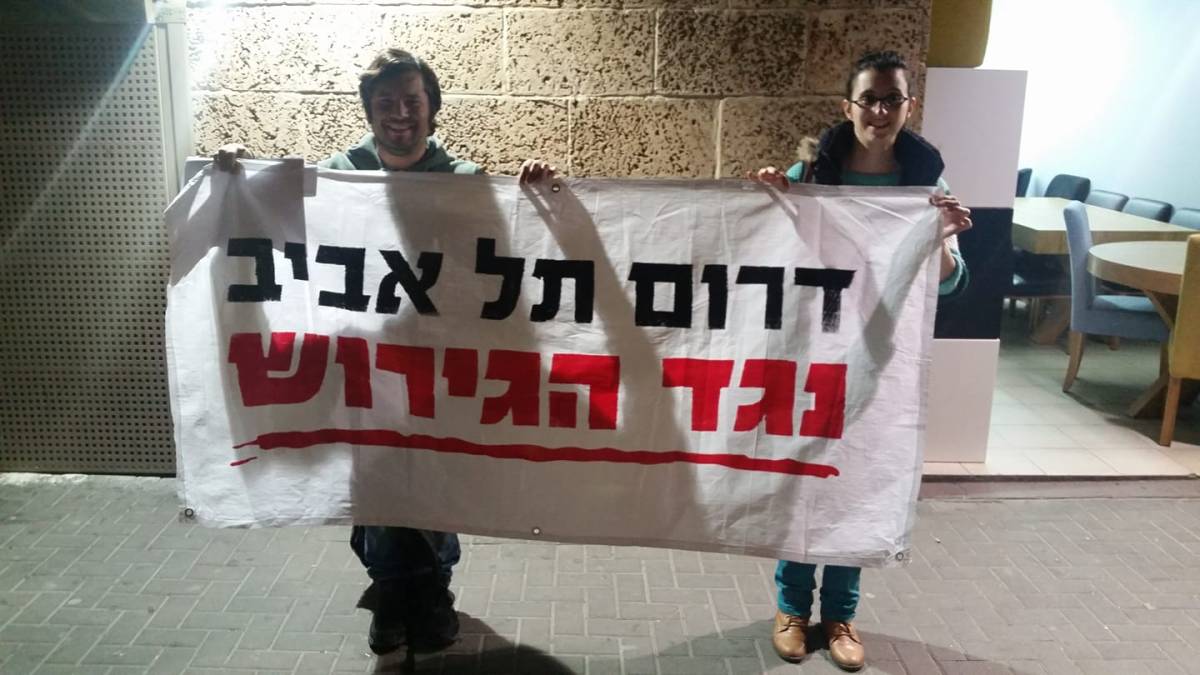
My refugee friends taught me the word activist.  In Arabic.  And tonight, it was time to put it into action closer to home.  Closer than a rally, a Facebook post, or even a blog.  Having no idea how my neighbors will react (I still don’t know while writing this post), I hung a huge- I mean huge- banner that says “South Tel Aviv Against the Deportation”.  Right beneath my windows.

Seeing as how it’s on the rear side of my house, I’m not sure how many people will see it.  But people will- because it’s huge and I can see people’s windows from my own.  So somebody, at least one person, will notice.

And that is a good thing.  Because I’m not just hanging this sign for the refugees.  I’m hanging it for my two neighbors who agree with me.  And perhaps others who are too afraid to speak out due to our own community’s aggression.

I may not be originally from Yad Eliyahu or Shchunat Hatikvah or Israel.  But I am a human being, I’m an Israeli citizen, and I live here now.

The merchants of hatred say they represent my neighborhood and I say “no”.  You represent yourselves.  I am going to speak my voice.  I’m going to stand up as a member of the Hatikvah community, of South Tel Aviv and say “not. in. my. name.”

If you want to send innocent people to their deaths, God help your conscience.  I will not be silent.  And even when I’m not talking, I will still be speaking with every glance you take at my big motherf*cking sign.

Love your neighbor as yourself.  Damn straight- my refugee neighbors deserve all the love they can get.

A Muslim pluralist

One of the great frustrations I’ve faced when dealing with dialogue here is that some people aren’t pluralists.  Being a pluralist, as I see it, is about saying “I have one way of doing things, you have another, let’s co-exist.”  It means legally allowing people to do things you don’t agree with.  It’s not about getting into a war of whose tradition is better, it’s just accepting that we’re all in this together with some right to autonomy.

In the Jewish World, this is a frequent dilemma.  There are Orthodox Jews who see Reform Jews as inadequately Jewish (hence why my movement is not recognized by the Israeli government).  There are secular Jews who think Orthodox Jews are overly superstitious, conservative, and backwards and should just modernize with the times.  While in the U.S. Jewish pluralism is stronger than Israel (perhaps because it’s not tied up with a government), there are still issues in places like Hillel and Hillel and Hillel.

That being said, you can’t even being to compare American pluralism with what goes on in Israel.  Here, there is no separation of Church/Synagogue/Mosque and State.  Which means progressive Jewish movements are put at a disadvantage financially, legally, and politically.  The same could be said for people who feel Jewish and aren’t recognized as such and also people who just aren’t religious at all.  Of any background.

I find that communities here struggle- on all sides- with the idea of letting someone else do something you disagree with.  You’ll find militant vegans protesting Hasidic kapores rituals but not protesting the hamburger joint on their block.  You’ll find Reform Jews railing against Hasidic intolerance, while making fun of their clothes, their language, and their religiosity.  If you replace Hasidic with Hispanic, I doubt my fellow Reform Jews would make fun of their culture.  Of course you also have the more well-known bigotry of Haredim who throw stones at cars and “immodest” women, etc etc.

These circles of intolerance extend to other religions here.  I’ve met Greek Orthodox Christians who claim they came before the Catholics.  I’ve met Catholics who railed against Evangelicals.  I’ve met Evangelicals who told me I’m not being a good Jew.  I’ve met Muslims who said Arabic was the world’s first language, as uttered by God.  And couldn’t believe I didn’t convert to Islam after reading the Quran.  I’ve met Arab Christians who don’t particularly like Muslims.  And Arab Muslims who don’t believe Jews have any connection to this place- and told me this to my face.  And I’ve met Arab Muslims who get ridiculed by other Arab Muslims for being half-Romanian or immodest or even for being Bedouin.

And of course, you have the Palestinians who want to wipe Israeli Jews off “their land”.  And the Israeli Jews who don’t recognize Palestinians even exist.

It’s enough to make your head spin.  Probably like yours is now.

So at times like these, when people here just fill you with sadness and anger, I like to think of strong counterexamples.  At a time when Islam is turning increasingly fundamentalist- or at least its fundamentalist elements are growing in prominence- I met the most unlikely Muslim pluralist.

I visited the Arab village of Tira, which you can read about here.  I briefly mentioned my interaction with Jamila.  Jamila is a high school student.  She works at a toy store.  I had never been to an Arab toy store, so I wanted to see what it looked like.

She was super sweet.  While I came in trying to show my deference to her culture, all she wanted to talk about was Israeli and American culture.  She really wants to visit Tel Aviv more.  She loves American movies.  Hebrew is her favorite subject, Harry Potter- not the Quran- her favorite book.  Nothing wrong with liking the Quran- I personally love parts of it.  Just that Jamila is not who you might expect to say this.

Because Jamila wears a hijab.  A headscarf.  Generally a sign of religious conservatism or perhaps devotion to tradition.  And a bone of serious contention in Western Europe.

When she kept talking about how much she liked Jewish culture here, I asked why.  Her answer contains a grain of truth we all should pay attention to.

She said: “what I really like is that when you go to the beach here, the Jewish women can wear whatever they want.”

Before you launch into a Western-style approbation of hijabs, that’s not what’s going on here.

I asked her: “so you mean you wish you didn’t have to wear a hijab?”  After all, I have met Arab girls here who have told me that.

She said: “no, I wear a hijab because that’s my tradition.  I’m Muslim.  What I like is that they don’t have to.  The Jewish women have the choice.  I like riding my bike, but some people here don’t approve because I’m a woman.”

In other words, Jamila is a pretty awesome example of a pluralist.  She wears a hijab- and would continue to do so- she just likes that Jews here tend to have more choice.  That she could wear a hijab but maybe her sister wouldn’t.  Or would change her mind according to her views over time.

Jamila, surprisingly, is a good example for all of us.  We do not have to agree on many things.  I admire the Hasidic community for keeping Yiddish alive, for preserving certain customs, and for their birthrate to be honest.  I see other things in the community, such as homophobia or gender politics, as quite problematic.  And people ask me: “well Matt, you’re a queer Reform Jew, how could you possibly like Hasidim?  They won’t accept you.”

To which I say: “I’m a pluralist.”  I can like what I like about certain communities and not like what I don’t like.  I can accept that both aspects exist.  And I’m entitled to my feelings on them.  Unlike some of the more militant secularists here, I don’t want Haredim to abandon their traditions because they’re “backwards”.  I do want more of a separation of religion and state.  And there are things I like about their community.  The things I don’t- well, sometimes you have to find other avenues for making your case rather than imposing laws.  And- this is the tough one for many people- sometimes you just acknowledge that it’s there, whether you agree or not.  And that it’s maybe not my role to change everything about how someone else lives.

Like Jamila and her hijab, I don’t want everyone to be like me.  I want people to be free to choose their own path, even when I don’t want to follow it.  It’s important to remember coercion can flow in all directions, left and right.  Muslim and Christian.  Orthodox, Reform, and Secular.  Israeli and Palestinian.  My respect for conservative traditions is not necessarily at the expense of my progressive values.

Lehefech, as we say in Hebrew.  “To the contrary”.  It is because of them.

Gaza, Indian Christians, and Passover

A whole lot more happened today, but that’s what I could fit in a title.

Last night was Passover.  Passover in Tel Aviv was amazing.  It was my first time celebrating it in the Holy Land and I loved it.  As a child, Passover was my favorite holiday (though this year’s Purim in Tel Aviv is giving it a run for its money).  It’s a holiday about freedom and especially growing up with abusive relatives, it always had a special meaning for me.  About my own potential for freedom one day and all the other oppressed people in the world who I would make that journey with.

Here in Tel Aviv, I went to two seders: one Reform and one LGBTQ.  Perhaps one of the few places in the world where you can genuinely “Seder hop”, I walked from one to the other in 10 minutes.

At the first Seder, I met a fellow gay Jew, Oscar, who was Spanish and Swiss and spoke French, Spanish, Gallego, English, and some Hebrew.  Pretty amazing to kind of meet a European me!  We agreed to meet the next day for lunch in my neighborhood, the “other side” of Tel Aviv.

I had planned on walking him through the refugee and foreign worker neighborhood of Neve Sha’anan, which we started to do.  Then we looked at the Central Bus Station, arguably one of the grittier buildings in the world, and he said “ugh, it’s so ugly!  I hate that place.”

I quickly changed our itinerary to show him the hidden beauty of this chaotic space.  Since it was Passover and Shabbat, most things were closed.  The most interesting things were still open.  An entire area of Filipino restaurants, cafes, and grocery stores was open.  Homemade food filled the air with delicious smells.  We sat and got some food, including my first-ever Halo Halo, a delightful dessert drink with a million types of toppings and fruit.  The woman behind the counter, like most Filipinos here, speaks amazing English and opened her Halo Halo machine just for us 🙂

Passing by a store, I noticed something curious.  Inside was a Sri Lankan flag!!!  I know this flag because in Washington, D.C., once a year, they open all the embassies for visitors.  I had been to the Sri Lankan one and eaten this delicious coconut rice with spicy red sauce.  Turns out the woman inside was indeed Sri Lankan!  And she told me the name of this delicious dish was Miris and Hal Bat, a name I’d been searching for for years!

The woman was so kind.  She’s thinking of opening her own Sri Lankan restaurant in Tel Aviv (friends- keep your eyes pealed!).  She grew up Buddhist and then converted to Christianity in Israel.  Her husband is from Darfur and I presume Christian (perhaps explaining her conversion).  He was super nice and we talked about my favorite Sudanese music.

20180331_150222

Heading out, I let Oscar go on his way and I strolled towards Yaffo.  There, I bumped into some lost tourists from Belgium.  One of whom was exceedingly gorgeous.  I gave them a free tour of Florentin and we decided to sit down to coffee.   They have two weeks in Israel so I chatted with them for a couple hours and helped them plan their trip.  We spoke in a mixture of French and English.

After being so kind as to treat me to my tea, they headed to their hostel and I walked home.  On my way home, I saw women…dressed in saris.  While this might not be such a strange sight in Suburban Maryland where I grew up (with a lot of Indian friends), it felt kind of random in Tel Aviv.  I’ve met Indian Jews here, but there aren’t many in Tel Aviv and I haven’t seen many in traditional clothing.

Because it’s not weird to talk to random people here (like it is in much of America), I went up and asked where they were from.  They said they were Indian Christians.  They were in Yaffo celebrating Easter.  I wished them a Hag Sameach, definitely the first time I’ve used that phrase to wish someone a blessed Easter.

Arriving back in my neighborhood, I saw something strange.  A clean store.  For those of you who’ve spent time near Hatikvah, you’ll know that my neighborhood has many virtues.  Delicious ethnic food, cultural diversity, rare Jewish languages, and a certain warmth to the people.  But nobody would say the virtue of my neighborhood is its cleanliness.  When I come back from a trip abroad, it takes me a day or two just to get used to the smell again.

I walked up to the store and saw beautifully arranged fruits and vegetables.  Seeing as how I was hungry and most restaurants were closed for Passover, I decided to buy some produce.

Turns out it’s a brand new store.  Owned by Sudanese Muslims- from Darfur.  It’s probably rare for someone in the U.S. (or pretty much anywhere outside of Darfur) to bump into both a Darfuri Christian and a Darfuri Muslim in the same day, blocks apart.  Unless they happened to be working with refugees.

I was blessed with the chance to speak Arabic with them, for a few reasons.  One, because I love languages and the chance to hear Sudanese Arabic outside of Sudan is pretty rare.  It’s a really neat dialect.  Also, I wanted to share a message.

I told him: “batmanna inno al-pesakh al-jay, ra7 itkoon 3ankoon 7urriyeh.  3eid al-fisi7 huwwe 3eid al-7urriyeh.”  That I hope that next Passover, they will have freedom, because Passover is the Holiday of Freedom.  We talked about how I’m working with other olim here to support refugees.  And you could see his smile grow by the second.  I know where I’ll be shopping more- and it’s a 5 minute walk down the street.

On my way home, I couldn’t help but think about my fantastic Pesach experience.  This was undoubtedly the most diverse Passover I’ve ever had.  And I grew up in a county that has 4 of the 10 most diverse cities in America.  I’m starting to wonder if in some ways, my corner of Tel Aviv is even more diverse.

I’m incredibly grateful for the opportunity to celebrate this Passover in freedom.  Freedom to do it how I want, with whom I want, and where I want.  Freedom is a blessing every day you can enjoy it.

I pray and will work for the freedom of the Darfuri men I met today and all refugees.  Here and around the world.  There are few causes more dear to my heart or so morally clear.  Whether these refugees continue to live in Israel, are blessed with a secure country to return to, or move elsewhere, I pray that they are able to live in safety.  Nobody- nobody- should be sent to their death.  I hope that next year I won’t need to write this blog again because refugees will be given what they need: refuge.

And now to return to the title of this blog.  As you may have noticed in the news, many thousands of Gazans, along with some Palestinians in Israel, the West Bank, and Lebanon are protesting.  Are they doing it to coincide with Passover, due to its message of freedom?  I don’t know, though it would represent perhaps a welcome recognition of our shared existence, even if the timing might serve to stiffen Israelis’ spines rather than inspire empathy.  Even if the cause is just, I’m not sure I would choose Ramadan as a time to protest Islamic anti-Semitism.  Just like if I’m angry at a friend, I wouldn’t yell at him while he’s studying for a stressful test.  Part of communicating is understand when the other person is ready to listen.

I’m not suggesting there’s a particularly ideal time to make the powers that be listen.  I’m just saying that if any part of your goal is to reach the Israeli heart, making a Jewish religious holiday a time for protest is going to backfire.  Especially when I remember as a teenager, a Palestinian terrorist blew up a Passover seder killing 30 people and injuring 140 more.  Even I felt angry about the timing of these protests and I’m rather empathetic to the cause.

I have little doubt that it is miserable to live in Gaza.  Unemployment in Gaza, as of 2016, was 42%.  For youth, 58%.  Child labor is on the rise.  The Hamas government is an abysmal filth pit of extreme religious conservatism.  At various times, it has banned Palestinian women from dancing, from riding behind men on motor scooters, from smoking in public, from getting haircuts from male barbers, from running in marathons.  It even banned New Year’s Eve celebrations in the name of Islam.  It has banned Palestinians from reading certain books, from holding hip-hop concerts, and from going to the water park.  Already feeling geographically penned-in on both the Israeli and Egyptian borders, I have to imagine that Hamas’s extremist steps only escalate the tension that Gazans feel on a daily basis.

What’s the solution?  I’m not honestly sure.  Marching to the border with names of their former villages and demanding to “liberate Palestine” is only going to make most Israelis angry.  And scared.  I’m personally scared for what is happening and what may yet happen.  The loss of life, which has already begun, will likely continue on both sides.

I empathize with the anger of many Gazans.  Their life sounds suffocating and if we’re totally honest, no government in the region is totally innocent here.  People, including children, are suffering.

I also feel that the Palestinians striving for their own freedom need to remember that I, along with my fellow Israelis, have worked hard for our own.  We’re not going anywhere.  You can come back to Salameh, the Arab village I live on top of, and maybe we can build a life together.  That’d be a miracle and maybe it’s not possible due to the hatred all around.

What you cannot do- or at least what I will stop you from doing- is kicking me out.  The Palestine of 1947 doesn’t exist anymore.  Pieces of it, perhaps.  Just like the many Jewish communities around the world destroyed or cleansed by both Muslims and Christians.  Which is why we’re here.  Just this week, a Muslim man in France stabbed an 85 year old Holocaust survivor to death while shouting “Allahu Akbar”.  Stabbed 11 times.

Does this man represent all Muslims?  Of course not- and to suggest so is bigoted.  But the thing it doesn’t need to be all Muslims for Jews to feel scared.  We’re scared.

You’re scared.  You don’t like it when Israeli jets bomb your houses.  To get terrorists, but ultimately killing innocent Gazans along the way.  Inevitable.  And sad.  And how does the average Palestinian, who only knows Israelis in an army uniform, build a relationship with our culture beyond warfare?

And for Israeli Jews, while we’re blessed with having Arab neighbors in our own country (who frankly we should get to know better), the only image we have these days of a Palestinian is of a terrorist.  Or of a more “peaceful” person waving a flag, storming the border fence, claiming to liberate Palestine.  From us.  Presumably, to kick us out.  Back to the world that murdered us over and over and over again.

This blog could continue endlessly.  The torment of people here, on all sides, is so, so sad.  My friend Hekmet teaches me dabke, a Palestinian and Levantine folk dance.  The other day I told him how sad it was to learn about how some Zionist militias destroyed Arab villages.  He told me something that both eased my conscience and gave me hope: “Matt, it is sad.  And it’s also sad that Jews were kicked out of Middle Eastern countries.  In the end, we just have to live together.  We can’t only focus on the past.”

The past matters.  And so does the present.  My sincerest hope is that while knowing our past- as Jews, as refugees, as Israelis, as Arabs, as Palestinians- we can live together in peace.  Because re-litigating or liberating or invalidating or denying on any side will just kill and kill.

I don’t want a war here this summer.  I’ve come to a point where I like living in Israel.  And I want to meet Palestinians who want to build a future of hope together.

If I can take away one message from my Passover today, it’s that it’s possible.  Today I spent my holiday with Muslims, Christians, and Jews.  And I had a blast.

And not the kind that kills innocent people.

My cover photo is me eating Filipino chicken wings.  One day maybe me, refugees, and Palestinians can all eat them together and make a delicious mess 🙂


The day I learned to love Israeli security guards…and police

My experiences with security in Israel have not always been fun.  I’ve been racially profiled as an Arab.  Just last week on a trip up North, an American friend and I got pulled over at night by cops in Karmiel who interrogated me about my smoking habits (I have none) while perusing a bunch of data about me on a computer.  I’ve gotten ridiculed by security guards for being American.  I’ve gotten patted down many times, sometimes a little heavier than might be needed.  And I find it stressful and a constant reminder of the state of warfare in this region to have to get checked at every bus station, every mall, every public place.  It feels invasive and as an American who didn’t grow up here, it just feels overwhelming and harassing.

In the back of my head, I always knew there’s a reason for all of it.  Perhaps some of the excesses like racial profiling aren’t necessary, but that there were real genuine security reasons for this heavy duty security surrounding me.  I grew up reading the news about terrorism here and visiting the country itself.  So as much as I didn’t like it, I learned to adapt and accept it.  And to empathize with the low-income guards digging through my bags.

Today, I learned to love Israeli security guards and even the police.  As a broadly left-wing person, I’m not generally a fan of police nor of state interference in my life.  And sometimes maybe it can save your life.

I was at Beit Ariela, the main library in Tel Aviv.  I specifically go there because it’s one of the quietest, most peaceful places in the city.  In a place where people scream just to say “hello”, Beit Ariela is a tranquil island.  A place where the tiniest whisper will get you American-style death glares.  Where it’s clean and you can really focus and block out the noise and stress.

Today that changed.

Getting ready to take a work call from the States, I headed towards the exit.  Only to find it blocked off.  The entire square in front of my building was filled with police tape, a cop car, and police officers.

In a state of shock, I asked the librarian what was going on.  She said a phrase, later confirmed to me by an Israeli friend: “chafetz chashud”.  A suspicious object.  She tried to explain it to me in broken English because- thank God- I didn’t know the phrase.  Let’s just say you don’t learn that in Hebrew class as a 13 year old in the U.S.

The building was under lock down.  Nobody could enter or exit.  I felt suffocated.  I started to pray, not knowing what else to do.  Oddly, the Israelis around me were fairly unphased.  One woman even complained saying she just needed to get to an appointment.  I was scared shitless.  I couldn’t help but think back to when I heard an air raid siren go off a week after I moved into my apartment.  Life here can go from normal to scary in the course of seconds.

Not knowing what to do, I did perhaps the most Israeli thing of all, and just moved forward as I could.  I called my colleague in the U.S., told her what was going on, and then in the lobby of the library just had my business call.

Midway through the call, we were told all was clear and I took the brave step of going outside.  Brave because as well as these things can be cleared, you never know if there’s a second package waiting for you somewhere.  It’s a common terror technique to plant multiple objects or suicide bombers near each other.  So you get the maximum effect of piling one attack upon the clean-up of another.

Shivering inside and trying to stay functional on the outside, I walked across the street to Sarona Market while talking to my colleague.  I then recalled how when an Israeli friend living in D.C. visited me, she told me there was a terror attack there just two years ago.  Right in front of the Max Brenner store where I was supposed to meet a friend.

While I would never let it actually turn me into a hateful person, I finally understood why some Israelis hate Palestinians.  When you have the fear of death struck into your heart, when you wonder if it’s going to be your final moments, when every car or backpack or bus becomes a potential threat, how are you supposed to be empathic towards others?  I imagine many Israelis, like me, know that it sucks to be a Palestinian.  Occupied by Israeli troops, neglected and discriminated against by other Arab countries, impoverished, and governed by a corrupt Palestinian Authority- it must be hard to even breathe.

And I think most Israelis are just tired of it all.  What other people on the planet- even the most oppressed- slap on a belt of explosives and jump into a crowd of civilians?  Obviously most Palestinians don’t.  And more than a few do.  More than 40% of Palestinians support suicide bombings- more than any other Muslim country.  Until the past couple of years when terrorists started spreading to Western countries and other Muslim countries, I can’t think of another culture where this phenomenon happens so prominently.  I could be wrong.  I just can’t think of anything off hand.

Palestinian leaders have a culture of celebrating violence.  I’m familiar with the danger of cherry picking examples and that every NGO will have its slant, but here are some examples.  I wouldn’t remotely suggest that you couldn’t find incitement (or violence) on the Israeli side, just that it almost never ends with someone strapping a belt on, screaming Allahu Akbar, and exploding in a crowd of innocent people.

I suppose my point is this: I’m one of the most peace-oriented, fluently Arabic-speaking Israelis you’re going to find.  And if today is any indication, if I continue to experience the fear that is Palestinian terrorism, you’re going to find me changing my politics bit by bit.  Resisting at first, and then wondering what we’re supposed to do.  I hope we can find another way and I also deserve the right to live.  Like my Palestinian neighbors.

I hope I can manage to keep my heart open to the peace-loving Palestinians who just want to live side-by-side with me and make this place the best region in the world.  And it’s going to be hard if I’m scared to live my life for fear of being burst into pieces.  And to what degree can each of us, Palestinian or Israeli, influence the situation?  All it takes is a few seriously ill people to sink the ship and ultimately we can’t control what everyone will do on either side.

In conclusion, I’m glad I’m alive.  I hate being searched invasively day-in and day-out and I’m sure Palestinians hate it too in the West Bank.  I hope for the day when we can live like we’re in Minnesota, lie in the grass, have a picnic, and pretend all this killing was just a bad dream.

In the meantime, I’d like to thank the brave security guards and police officers who kept me safe today.  I’m not endorsing state policies nor am I saying the police are perfect.  I’m saying that I find it a miracle that these people can go home after neutralizing a suspicious object and feed their kids, read them a story, and tuck them in to bed.  I am in awe of your courage and your willingness to put your life on the line so I and other Israelis- both Jewish and Arab- can live to see another day.

After I decided to head into the market to meet my friend, I looked at the security guard.  I gently handed him my bag, looked him in the face, and said: “todah rabah chaver, sheyihyeh lecha yom tov.”  Thank you my friend, may you have a good day.

A good day indeed.  Because he’s going home to his family.  And I’m alive writing this blog to you tonight.

When you bump into a high school friend in your neighborhood

For those of you who’ve been reading my blog, you’ll know my neighborhood is a bit off the beaten path for American immigrants to Israel.  It’s off the beaten path for most Israelis.  My particular street is quite quiet, kind of like a Mizrachi kibbutz, but a two minute walk away finds you in the poorest neighborhood of Tel Aviv.  And one of the most interesting.  Filled with Moroccans and Iraqis and Eritreans and Bedouin (still figuring that one out) and Yemenites and Russians.  And me.

The first reason I moved to my neighborhood was financial.  The rest of Tel Aviv was too expensive for me to find a place by myself.  Tired of living with roommates and not willing to spend exorbitant amounts of money, I looked where less people “like me” look.

I happened upon a great apartment and snatched it up.  The price was right, it came mostly furnished, it included most utilities, and I was able to negotiate a good lease.  A lot of hard work went into that- I saw easily 40 different apartments in person before finding this one.  You can read about my process here.

One of the downsides to my neighborhood is it’s far from…everyone.  Well, not everyone.  Certainly not my Iraqi neighbor downstairs who likes to “role play” Abu Mazen in Arabic yelling at Israel (my neighborhood is many things but boring is not one of them).  But it is far from other young professionals- some of whom flat out told me they’d be scared to visit me.  Fortunately, I have many friends who feel otherwise and have come to my park for picnics.  But as we say in Jewish English “it’s a schlep“.

That can make me feel lonely sometimes.  Especially on Shabbat when there is no public transit and people are even less willing to make the trek.  And it also becomes hard for me to visit them.  I’ve spent more than a few Shabbat afternoons alone and bored.

My neighborhood has a lot of amazing things.  It’s amazingly diverse, it has great food, it’s cheaper, it’s authentic.  The owner of the Mizrachi music store around the corner was Zohar Argov‘s producer.  It’s a place where almost all aspects of the conflict in this country come together and somehow things manage to stick together.

At night, better than anywhere in North Tel Aviv, you can truly see the stars.  The moon calls out to you.  It calms me to look towards the heavens after a hectic day, no skyscrapers around, and to just breathe.

Tonight, the most unexpected thing happened: I bumped into a friend.  Feeling kind of lonely, I left my apartment and headed towards “the city”.  “The city” because my neighborhood doesn’t feel like the rest of Tel Aviv.  You wouldn’t know it was the same city if you visited here.

On my way there, I saw a group of young people.  I was a bit surprised.  I knew there were a few in the neighborhood, often living with their families, but rarely in large groups.  As I got closer, a bearded man gave me a huge hug.

I was in shock.  Who was this guy??

After a look at his sheyne punim, I knew: it was Omer!  Holy crap!  Omer is an Israeli friend from Beit Shemesh, a suburb of Jerusalem.  We met in high school because his city was paired with my hometown of Washington, D.C. for an exchange program.  We hung out in D.C., I believe I saw him when I came several years later to visit Beit Shemesh, and then reconnected on Facebook.  Once I made aliyah, we got to see each other again in person.

Omer is an avid board games player.  Turns out, so is someone in my neighborhood who was hosting a board games event!  Delighted to bump into someone who knew me, someone who hugged me- spontaneously- in my neighborhood, I immediately asked him to invite me to the next event.

Living alone in a foreign country can be hard.  And I don’t just live here, I immigrated here.  I’m a citizen.  I have no particular plans to move back to the U.S. although as a dual citizen I legally can.  And since my work happens to be done remotely, I can bounce between countries, which is great.  It’s also true that it feels different to live here as opposed to visiting or being on a program.  Washington, D.C. will always be one of my homes.  And what I’m starting to realize, to whatever extent I choose to stay here short or long term, Israel has become one of my homes too.

A place where I bump into an old friend on an unexpected street who cheers me up.  A place where, just twenty minutes later, I bumped into another friend I met outside a nightclub weeks ago.

A place where for all its insanity and its toughness, I guess I just don’t feel like as much of a stranger as when I stepped off the plane on the Fourth of July almost a year ago.  Hopeful, confused, anxious, and inspired.  Jet-lagged and later coping with food poisoning and being stalked by toxic relatives and being yelled at daily by Sabras for no particular reason and being racially profiled as Arab and waking up to 3 A.M. air raid sirens and all sorts of traumas big and small.

Israel is whack.  That’s how I’d say it in American.  And Israel, I’m just not sure I can entirely live without you.  And if you don’t think that’s the most Israeli way of saying “I love you”, then you’re probably not one of us 🙂

p.s.- my cover photo is a picture of teddy bears from the Arab village of Tira because this is a feel good story 🙂