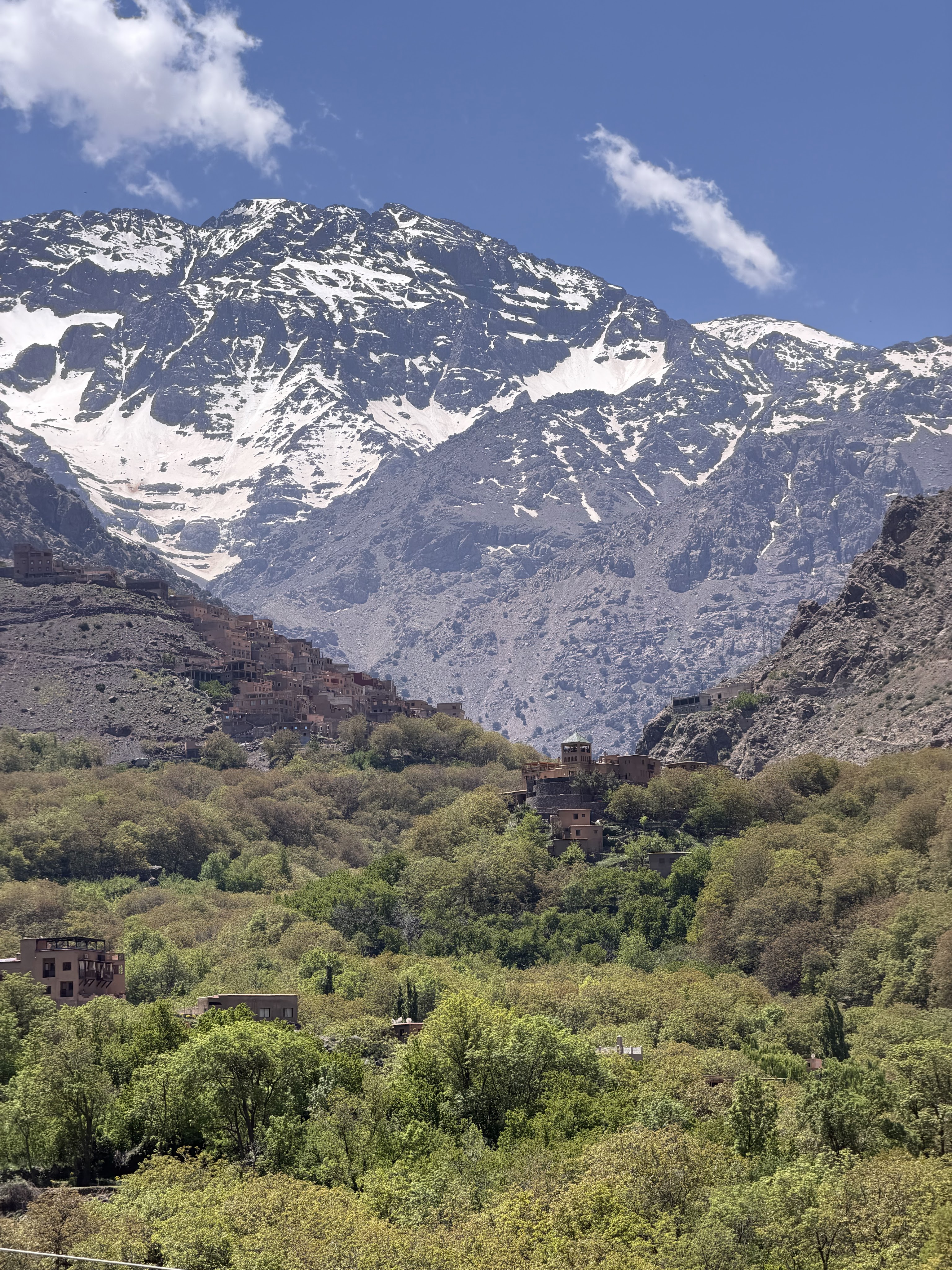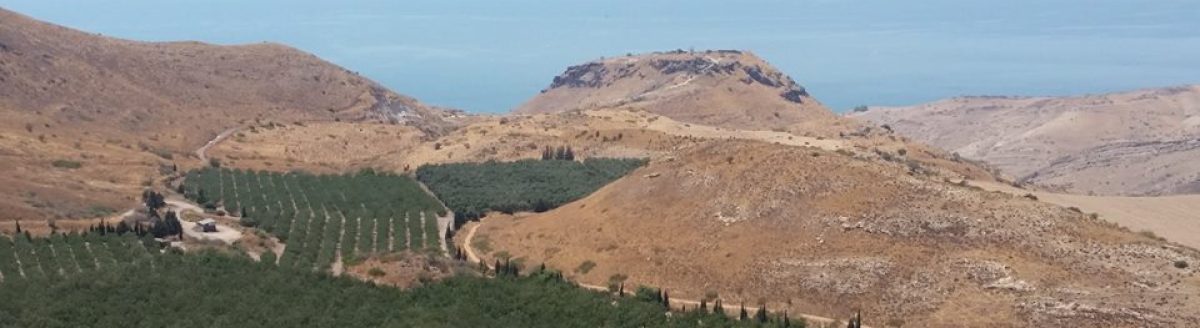
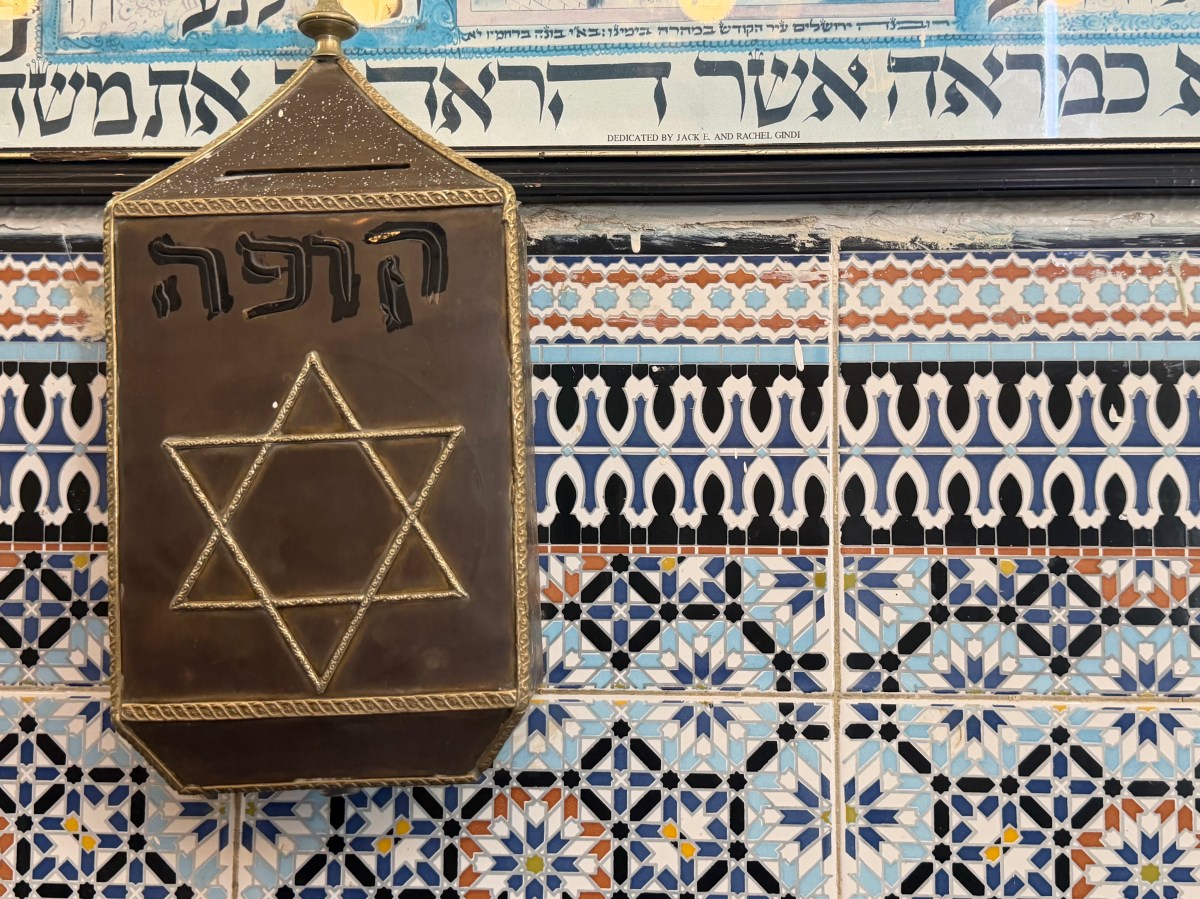
Morocco is an enchanting, chaotic, and peaceful land all at the same time. Its Jewish community dates back over 2,000 years and is the largest in the Arab world. Over one million Jews of Moroccan descent live in Israel, France, Canada, the U.S., Spain, and Latin America.
My first exposure to Moroccan Jewish culture was by way of friends in an exchange program between Bet Shemesh, Israel and Washington, D.C. Before it became a predominantly Haredi (ultra-Orthodox) city, Bet Shemesh was heavily Moroccan. My friends there introduced me to the foods, traditions, and sounds of the community such as Lehakat Sfatayyim, a Moroccan-Israeli band.
Growing up in the U.S., I had limited exposure to Moroccan Jewry since the U.S. Jewish community is predominantly Ashkenazi. I attended various Mimouna celebrations in the U.S. and Israel, though, which has always been a load of fun. It’s a way of ending the bread-free week of Passover with loads of carbs and greetings from neighbors. In Morocco, this traditionally meant Jewish and Muslim neighbors celebrating together.
I love exploring diverse Jewish communities, so I was thrilled to arrive to Morocco to learn more and to use my Arabic and French. I’ll be totally honest – I was equally parts nervous and excited. On my recent travels, especially after October 7th, I had experienced a lot of antisemitism, especially on my fall trip to Italy. Morocco is 99% Muslim and let’s just be honest – the relations between Jews and Muslims hasn’t been great recently, or for that matter in the past 100 years or so.
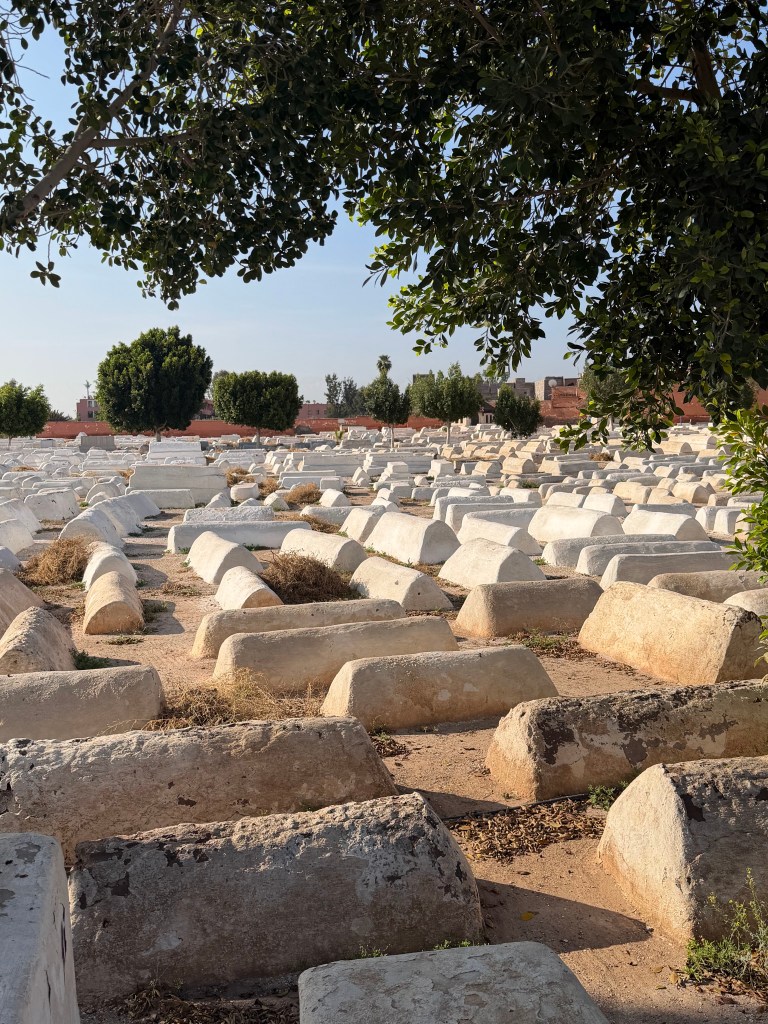
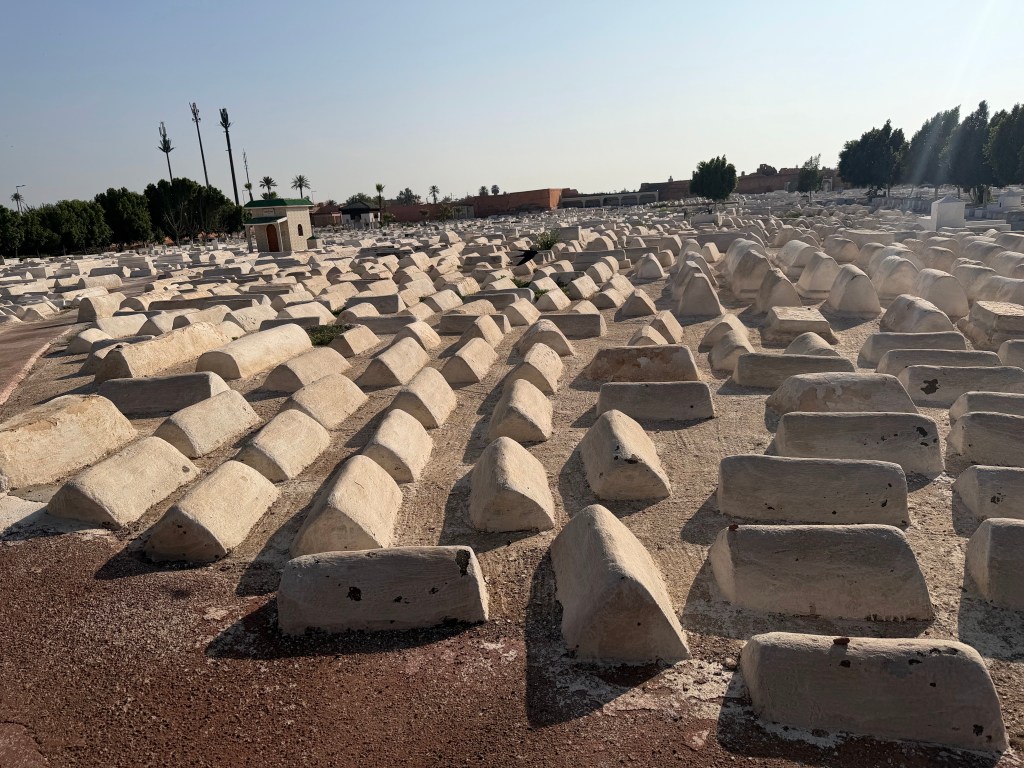
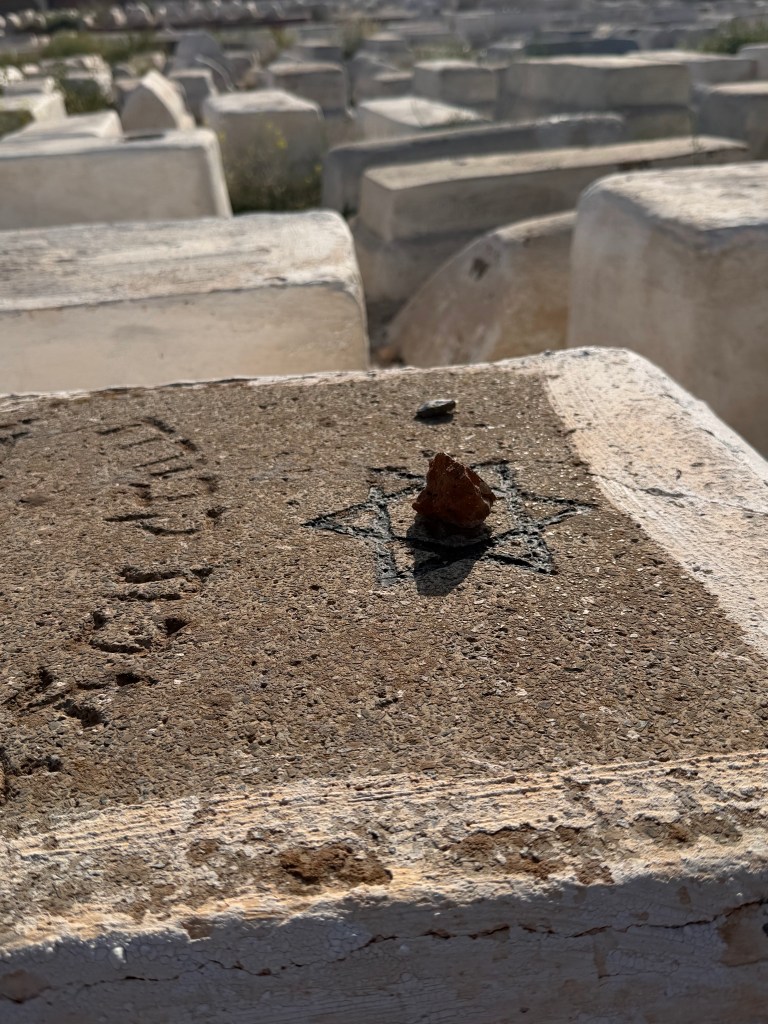
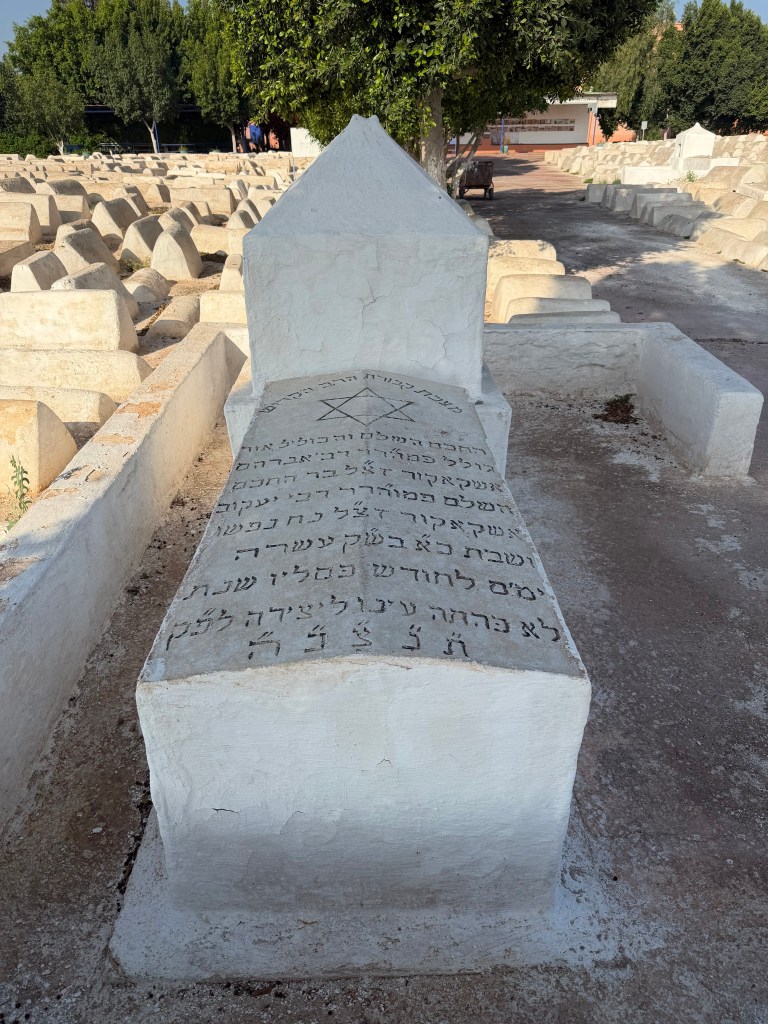
I started in Marrakesh. It’s a fascinating and beautiful city and overwhelms the senses. I stayed in the Mellah, or Jewish Quarter. I started by visiting the absolutely massive Jewish cemetery, filled with 20,000 graves, almost all marked by long white stones. It looks completely different from an Ashkenazi cemetery that I’d be accustomed to. It is the largest Jewish cemetery in the country. I followed the Jewish tradition of putting small stones on some of the graves to honor the dead. Here are some photos from the stunning site:
From there, I practically ran to the Slat Al Azama synagogue, built by Jewish refugees from the Spanish Inquisition and expulsion in 1492. I was so excited to get in and so were some Jewish tourists from Brazil. I got a chance to use my Portuguese with them as we talked about how excited we were to visit the synagogue. Once we got in, the father asked me to explain to him and his son some of the prayers that dotted the synagogue walls. It was amazing to have an instant Jewish connection with someone from so far away in a foreign land.
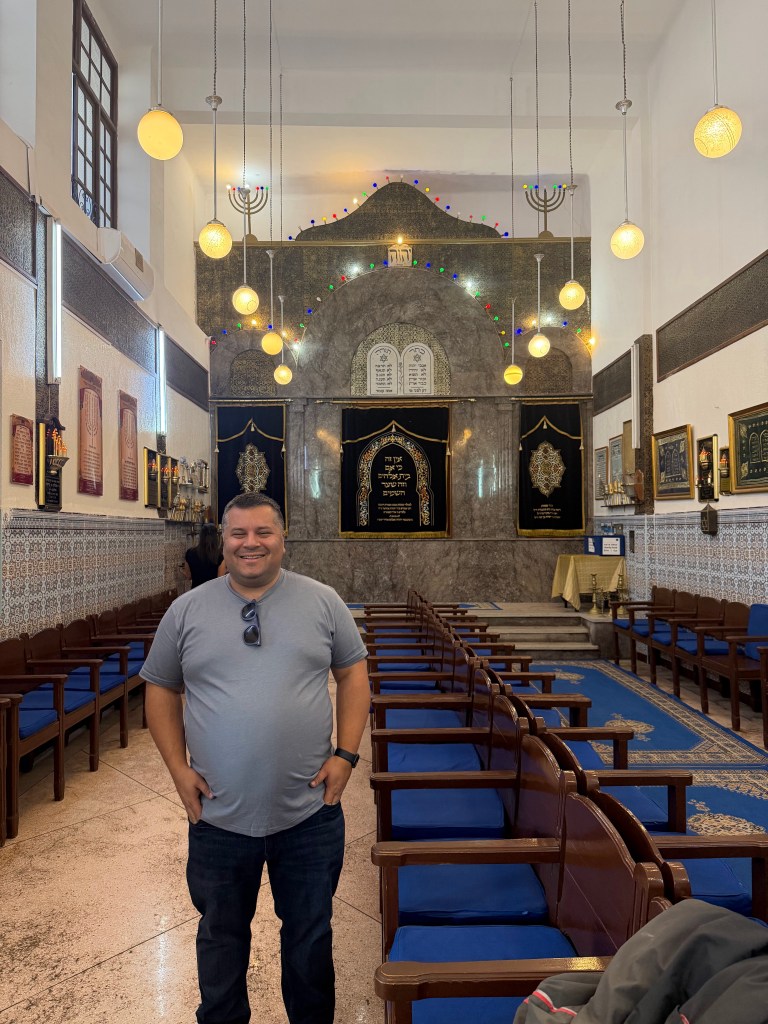
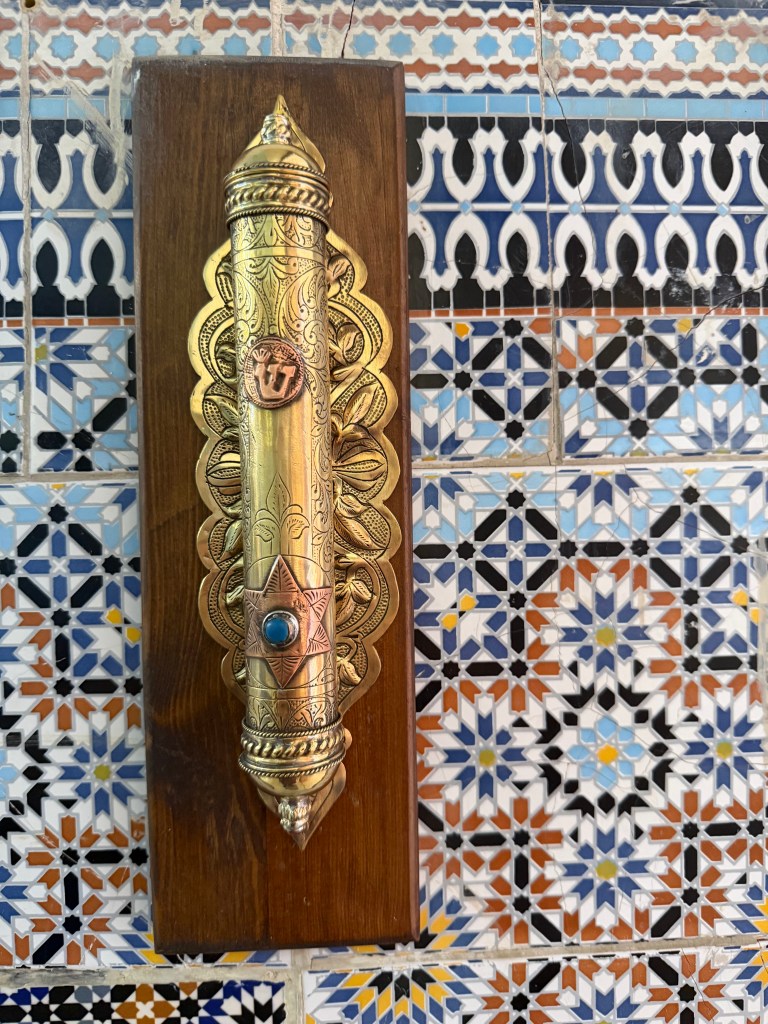
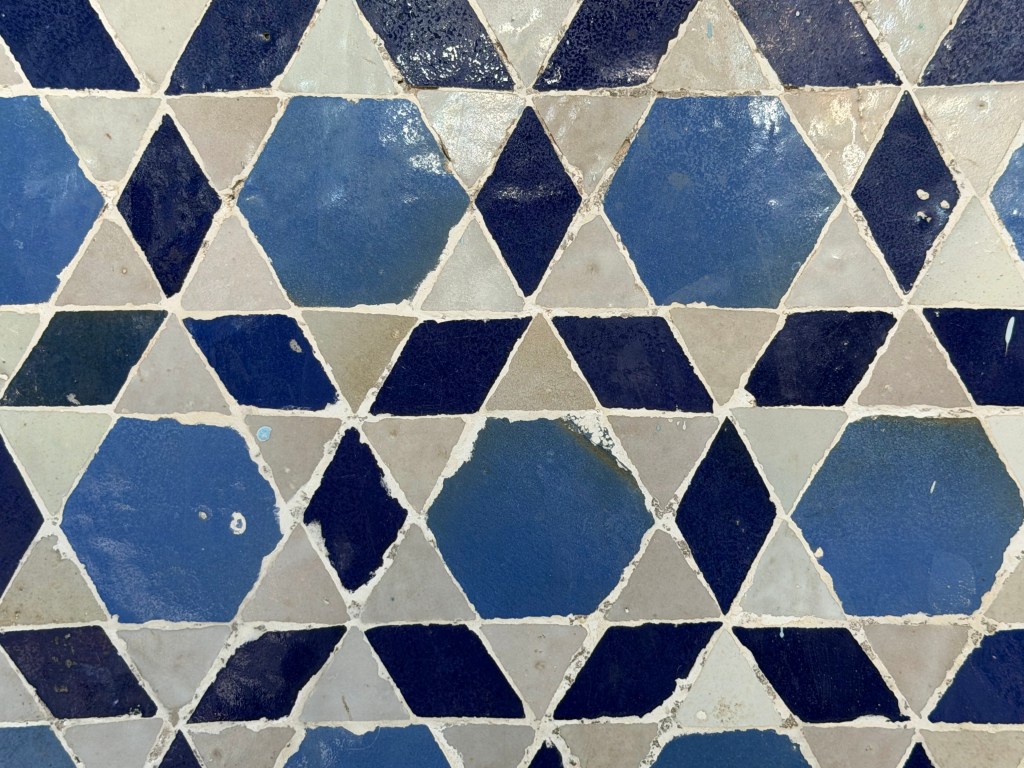
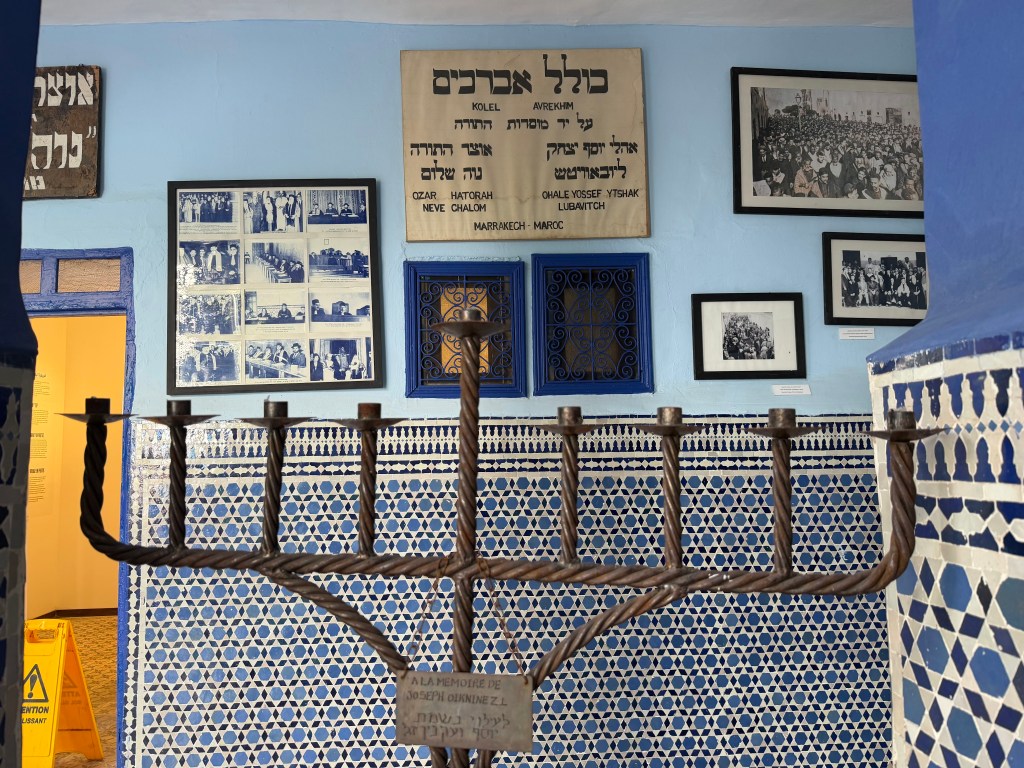
The synagogue itself is absolutely stunning, filled with mosaics, including blue and white Jewish stars all over the courtyard. There is a small but meaningful museum next to the sanctuary as well that documents Moroccan Jewish history. The place is well guarded and I felt safer there than in many European or American synagogues these days.
Here are some photos of the synagogue:
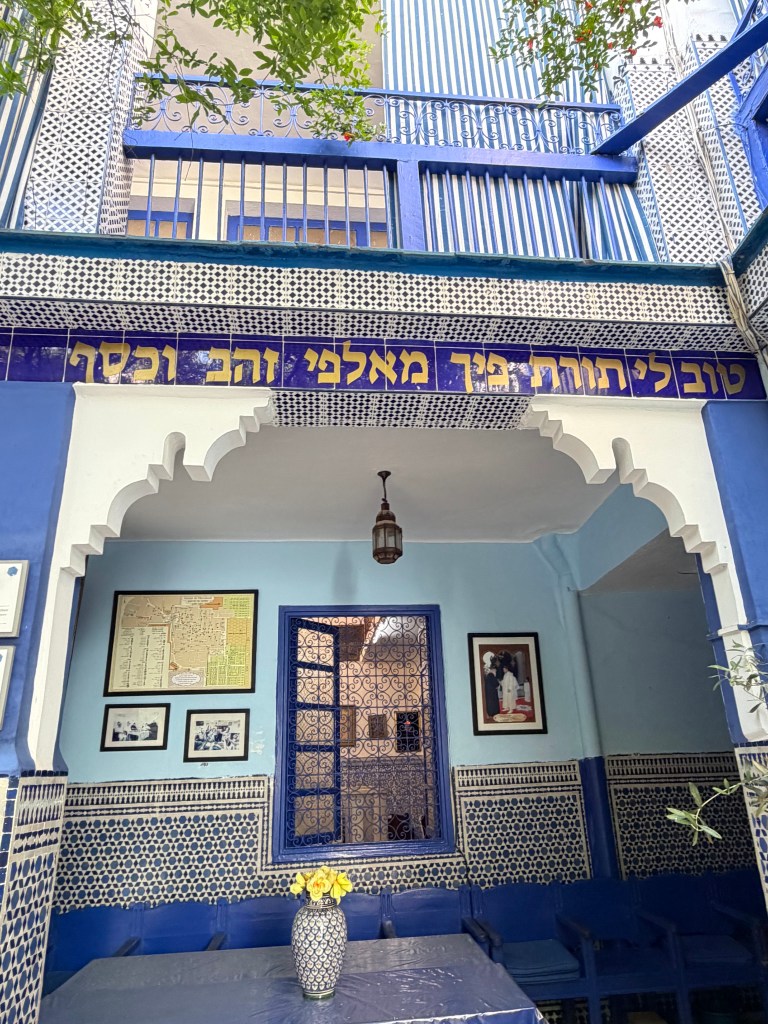
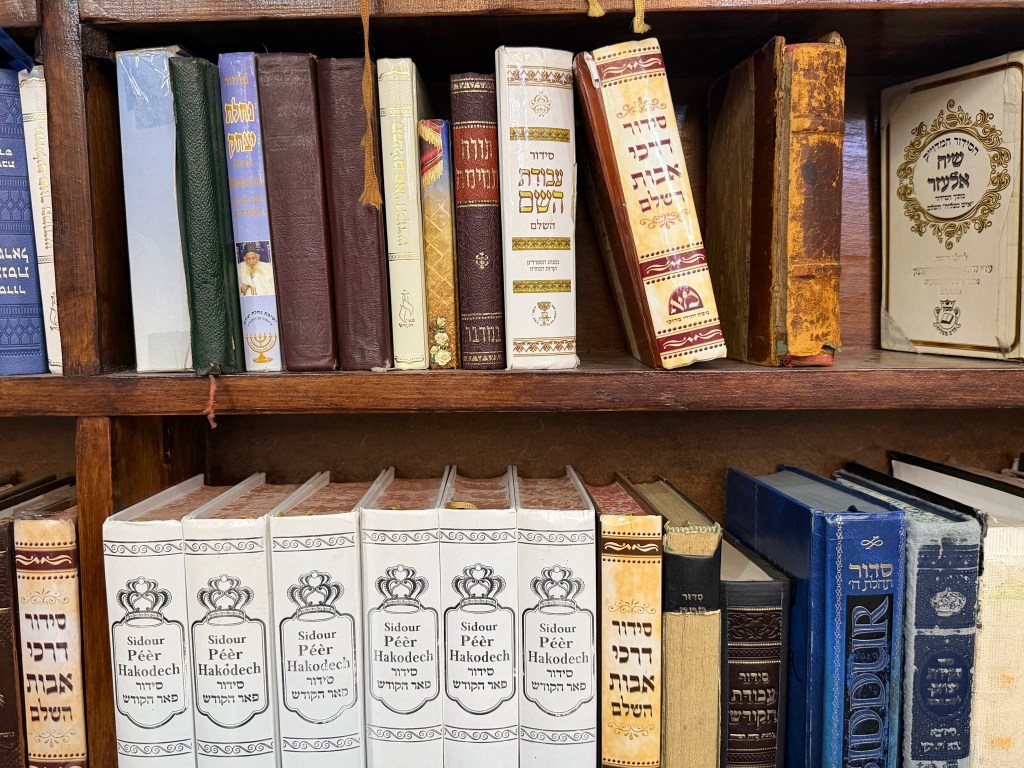
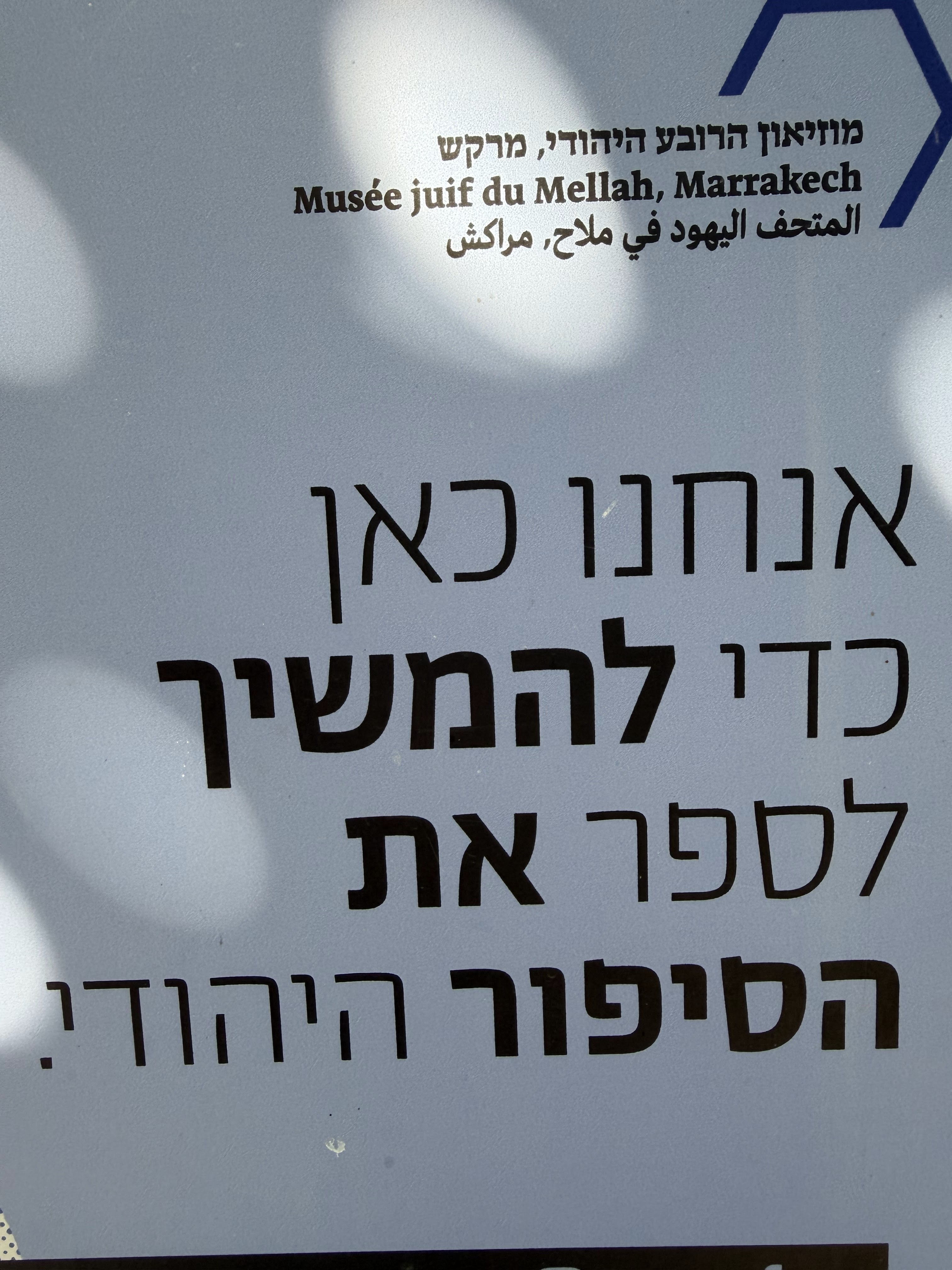
The synagogue had signage in Modern Hebrew, clearly geared towards Israeli tourists (yes, they come to Morocco too and offered many helpful travel tips via several Israeli Facebook groups I’m in). In fact one of the signs said in Hebrew: “we are here to continue to tell the Jewish story”:
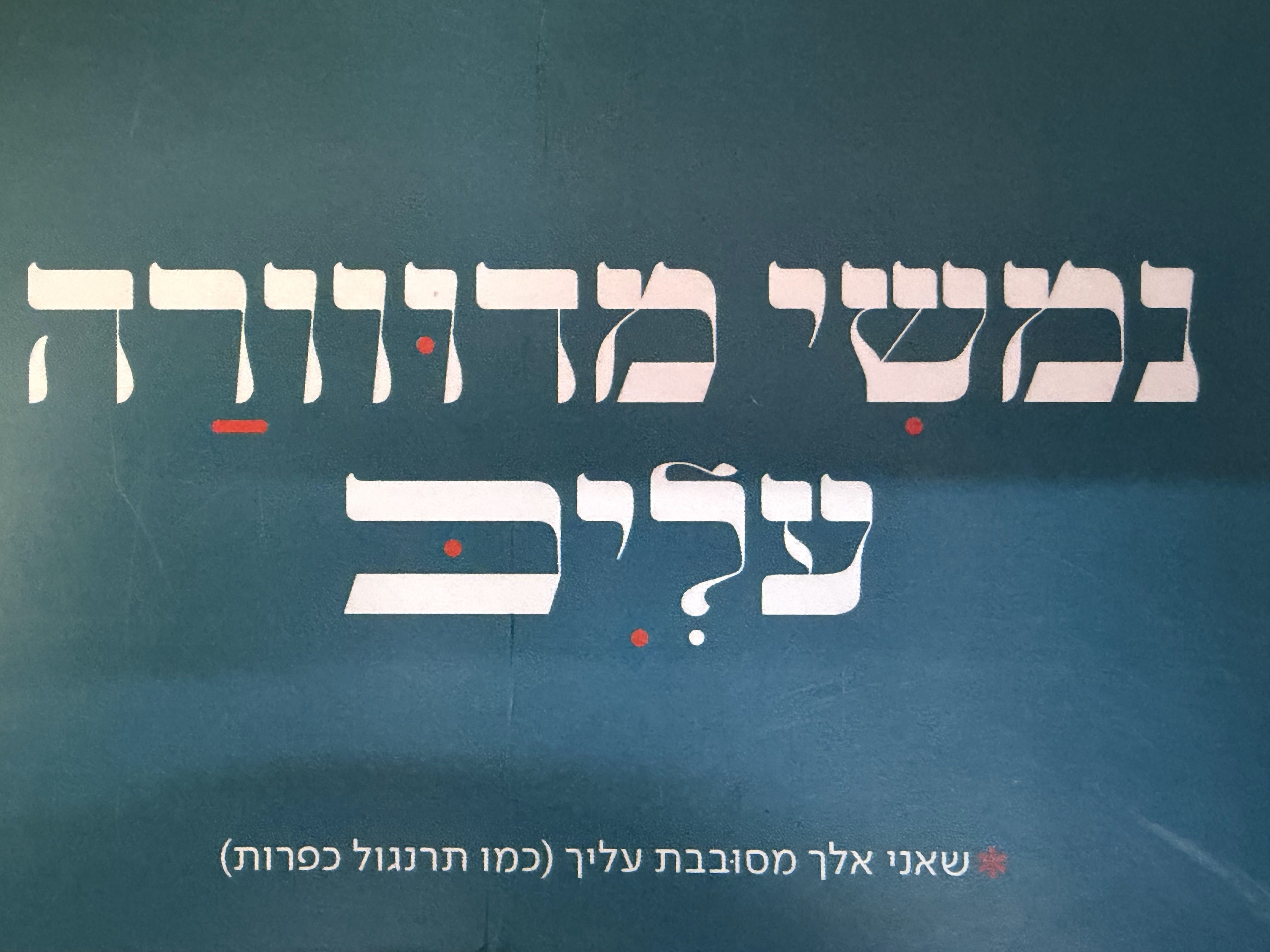
They even had Judeo-Arabic postcards, such as this one which says “I will go around you” (like a kaparot rooster):
What was absolutely stunning to me (in the best way possible) was this bilingual Hebrew-Arabic postcard the museum was selling that listed cities in Israel and Morocco one after the other:
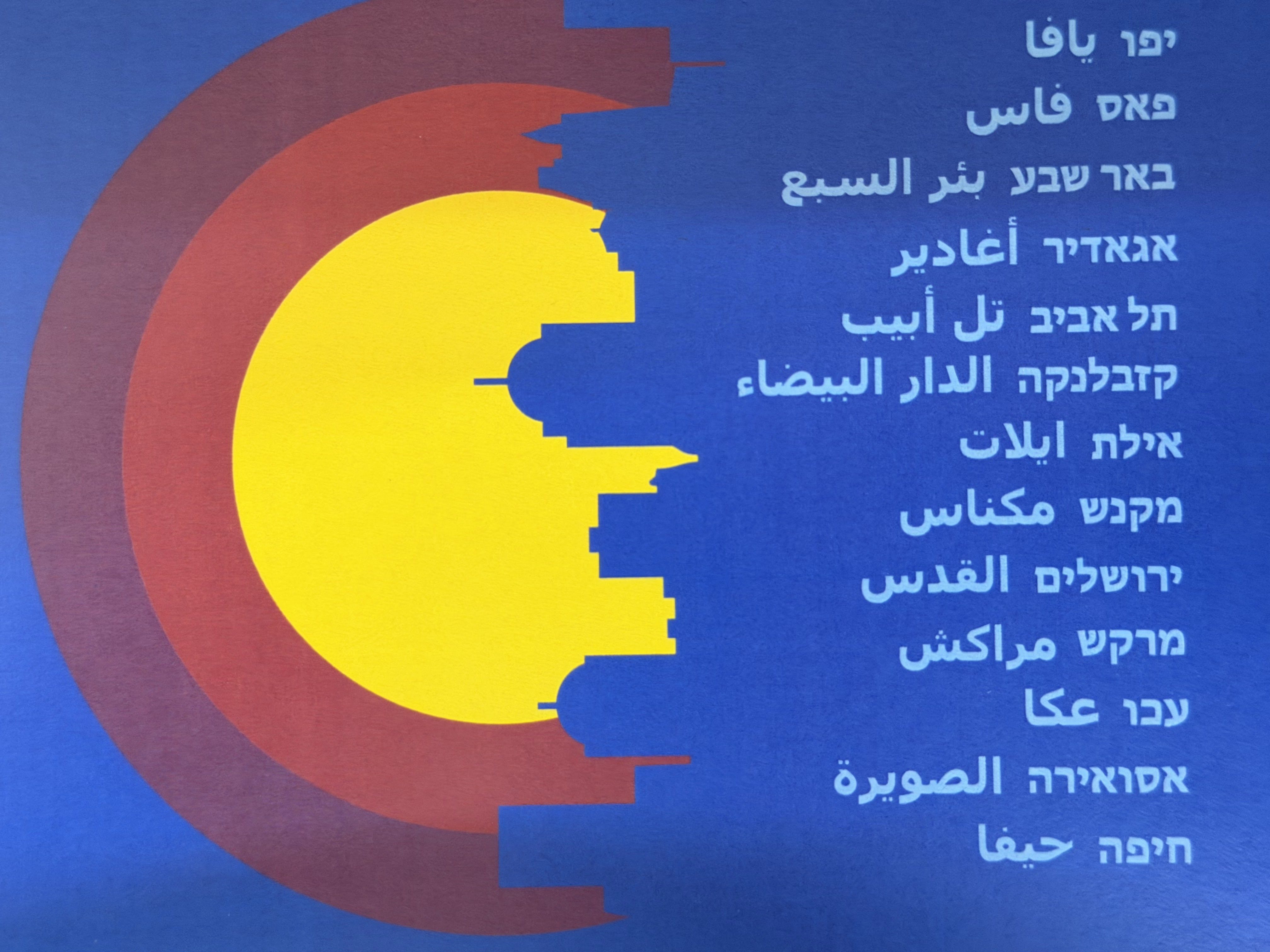
It was a beautiful token of co-existence at a time of great hatred in the world. Keep in mind this museum is an official organization in Morocco. Everything in the country happens with the blessing of the King. It was designed to send a message of acceptance and welcoming Jews, not an accident.
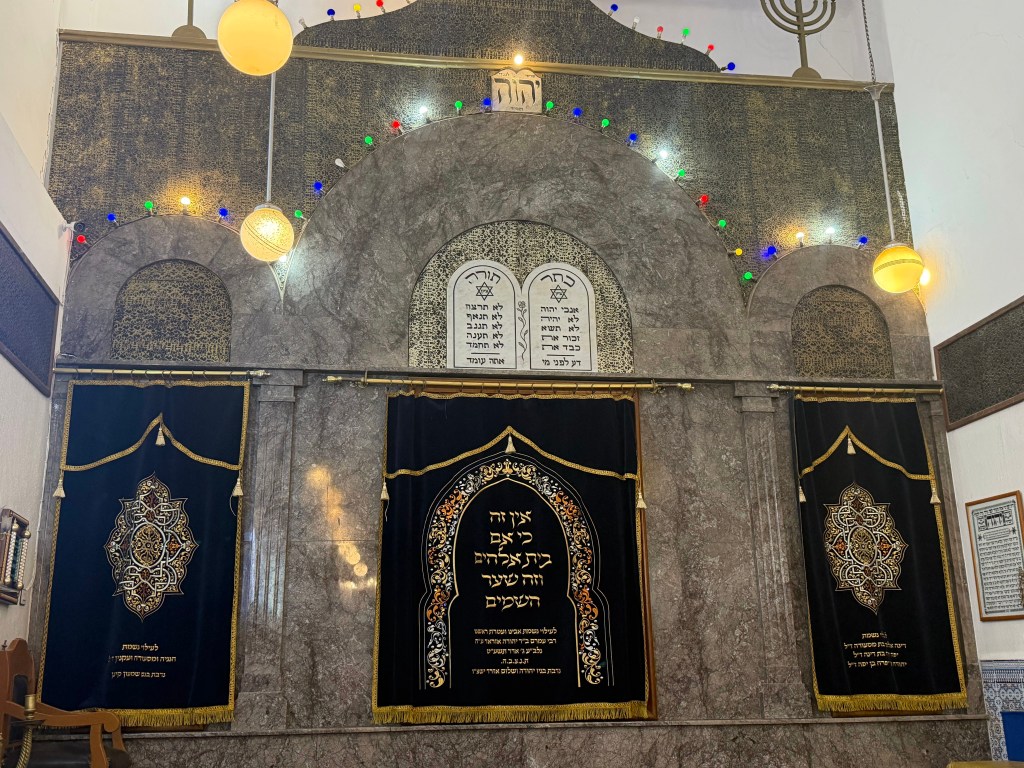
After having visited the synagogue and the cemetery, I decided to go to Friday night Kabbalat Shabbat services. I met the most eclectic group of Jews possible. A Persian-Israeli who spoke fluent Moroccan Arabic. What I think was a gay French-Moroccan Jewish couple with a young child in the Orthodox synagogue. A couple of Moroccan-Israeli bakers from Ashdod. And a Spanish-speaking Sephardic man from Panama!
The synagogue was also beautiful:
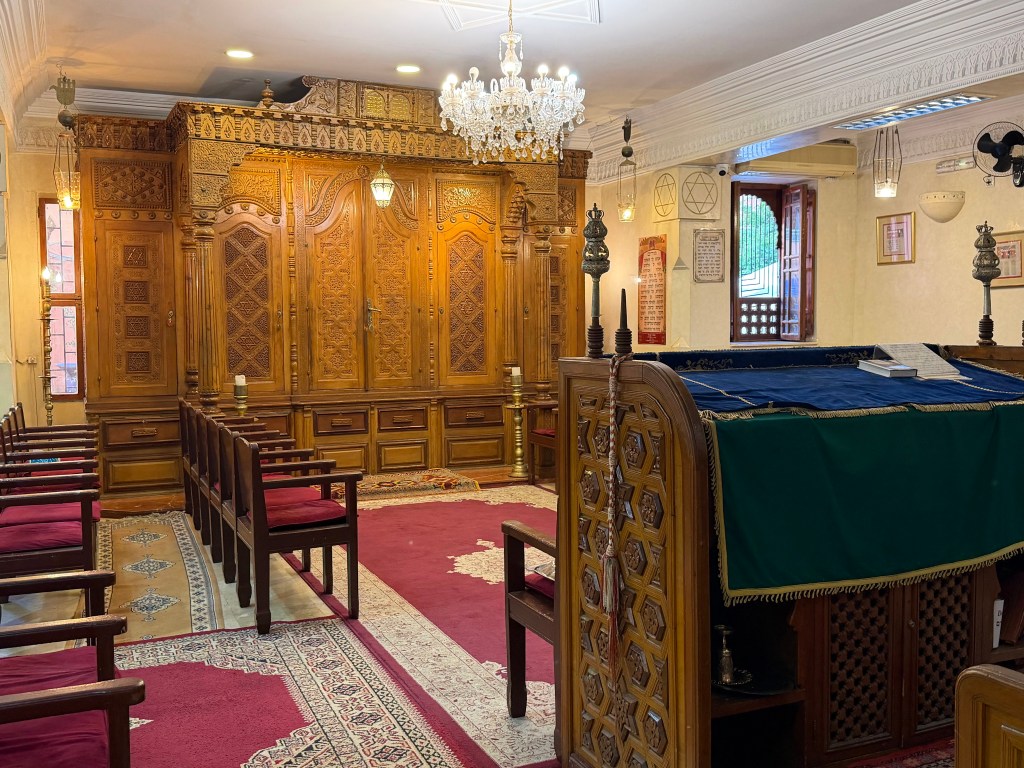
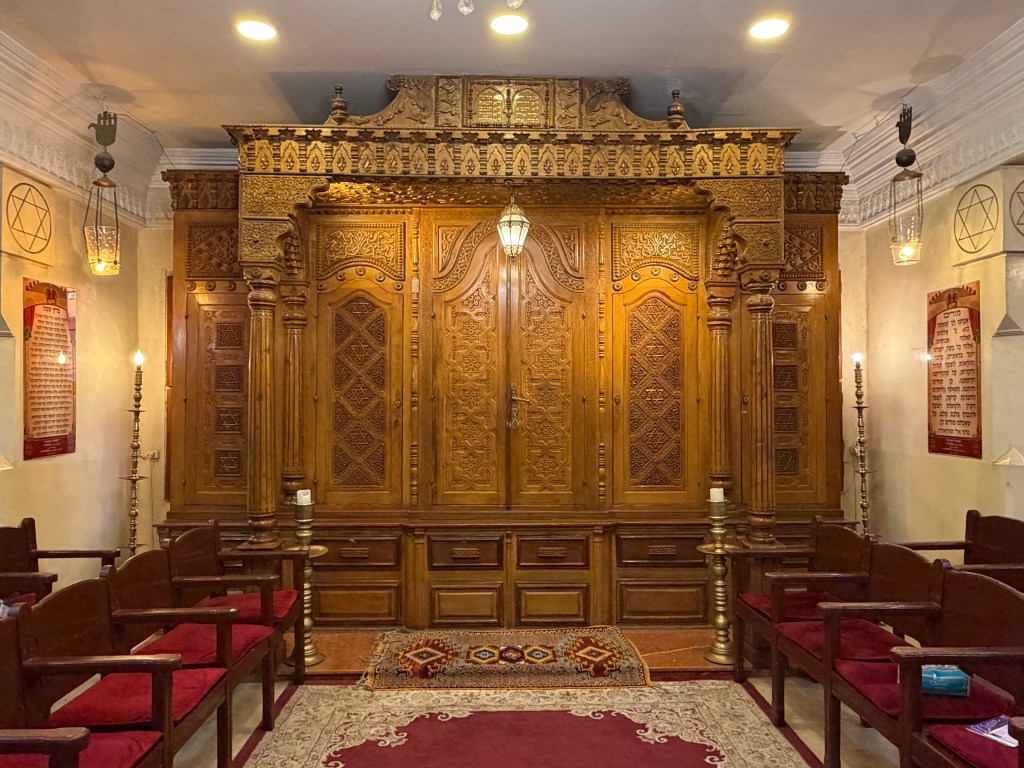
The services were quite an experience. I have gone to a couple Sephardic synagogues before in Israel and each one is unique in its rituals as well as melodies. But of course, I’m much more accustomed to predominantly Ashkenazi rituals in the U.S. I was almost completely lost during the service, both because I didn’t know the melodies (except for one or two!) and because the Hebrew text is also slightly different. The North African melodies were enchanting and I also felt like a bit of a spectator more than an active participant because it was both familiar and new to me. Not a bad thing at all, it just was a unique experience for me, like having one foot in and one foot out. It felt Jewish and so different from what I knew.
What was also striking about the synagogue is that it is currently run by Chabad! Chabad was founded in Lithuania, where some of my ancestors are from. It is a Hasidic movement geared towards outreach to other Jews to perform traditional rituals and mitzvot. It is not remotely something I expected to experience in Morocco, especially on Moroccan terms. What I mean is that if I went to Chabad in most countries, I would be able to follow the service more easily because the rituals are Ashkenazi i.e. Eastern European. However, the Chabad in Morocco follows the local customs and has to be one of the few in the world that is deeply, deeply Sephardic and Mediterranean.
After a few days of exploring Jewish Marrakesh, I took a day trip out to the countryside to see Amazigh (i.e. “Berber” – the less-accepted term) life. The Amazigh are the natives of Morocco and what I didn’t realize is that they have a 2,000+ year history of welcoming and building relationships with Jews!
I met multiple Amazigh people during my trip and got to see the remaining houses in a remote, formerly-Jewish village about an hour and a half outside Marrakesh. I even bought some pretty Judaica from an Amazigh man who told me the objects were from the neighboring village. He also said many Jewish tourists of Moroccan descent come to visit, including from Israel. Yes, he said “Israel”. It’s a word that’s so charged these days, but for many Moroccans I met, it was totally normal to say. To acknowledge. To allow to exist. May more people around the world follow their tolerant and open-minded example.
My Jewish experiences in Morocco were so rich and varied that I couldn’t possibly fit them into one blog post. That says something about the diversity and wonderful heritage of this beautiful country. Keep your eyes peeled for more stories from my adventure. It was a truly life-changing experience.
And next time you want a safe place to visit as a Jew, I can’t help but recommend Morocco over Florence. Travel is an incredible way to dispense with stereotypes and preconceptions.