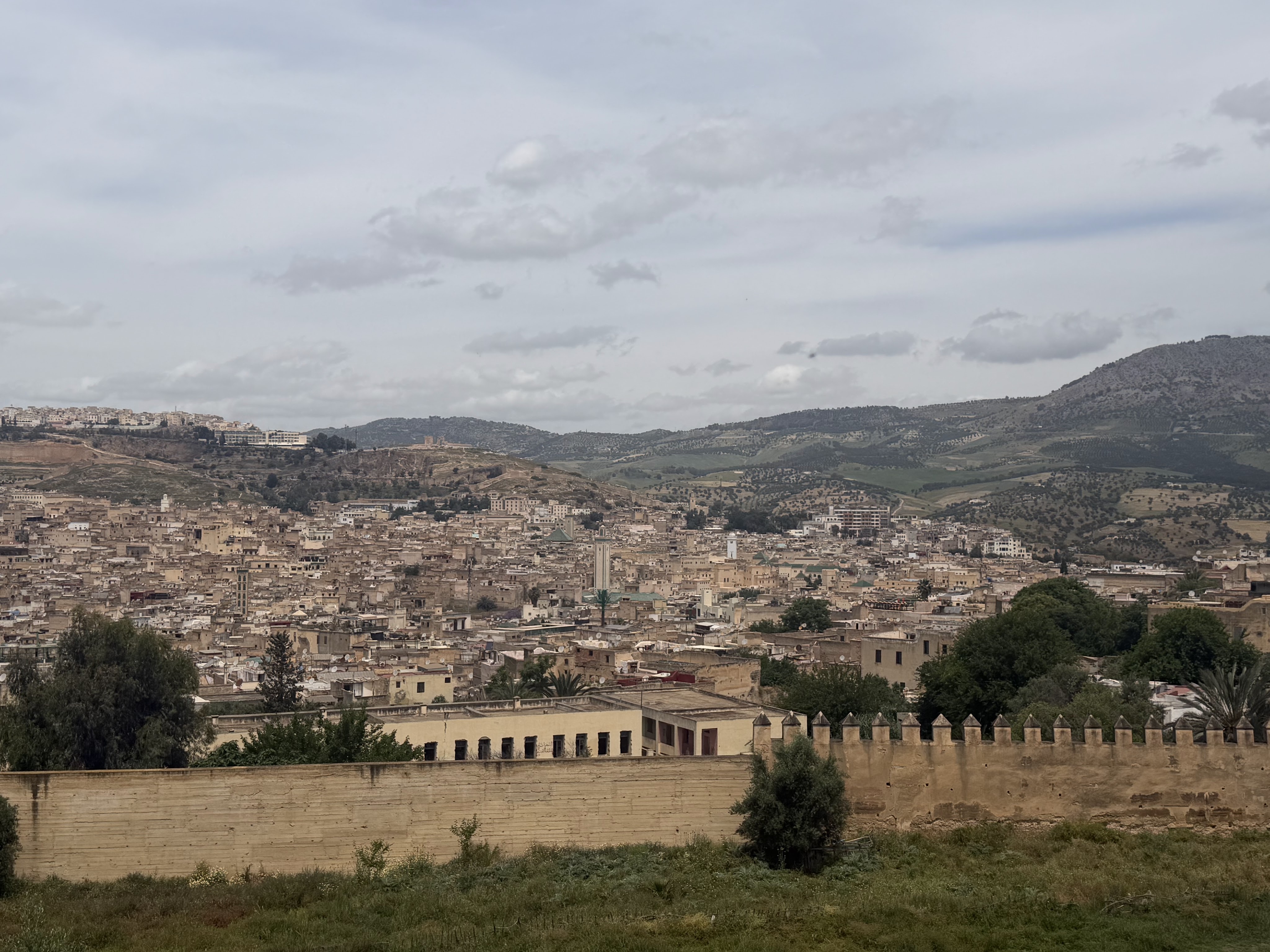
Fes is a wild city. Its medina, or old city, is an overwhelming mix of scents, smells, and screams. Just outside this chaos, however, is a place where things calm down considerably – Fes El Jdid (“New Fes”). I went there on a tour with my guide Abdellatif.
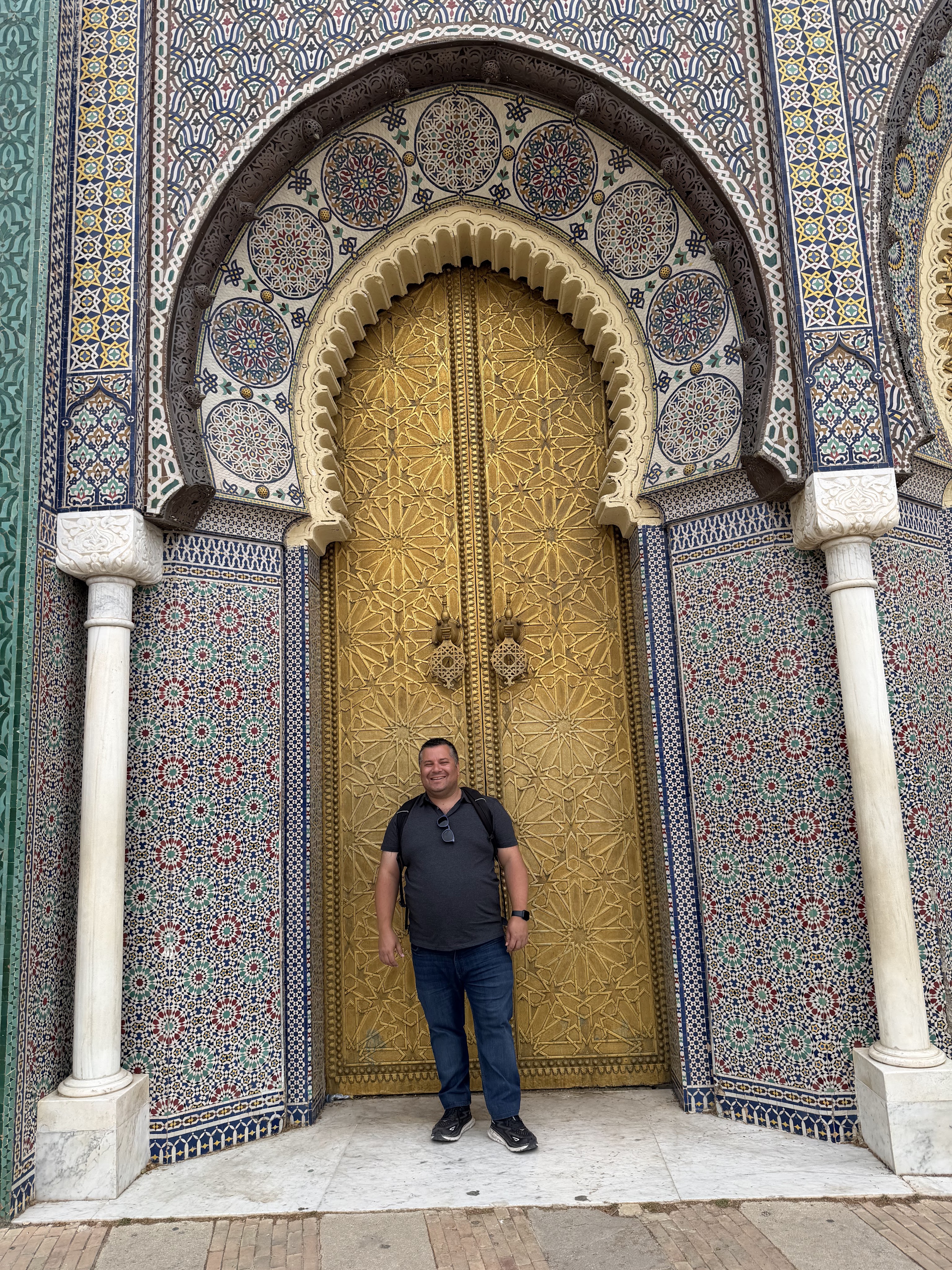
There, you’ll find a beautiful entrance to the royal palace and a pleasant historic vibe.
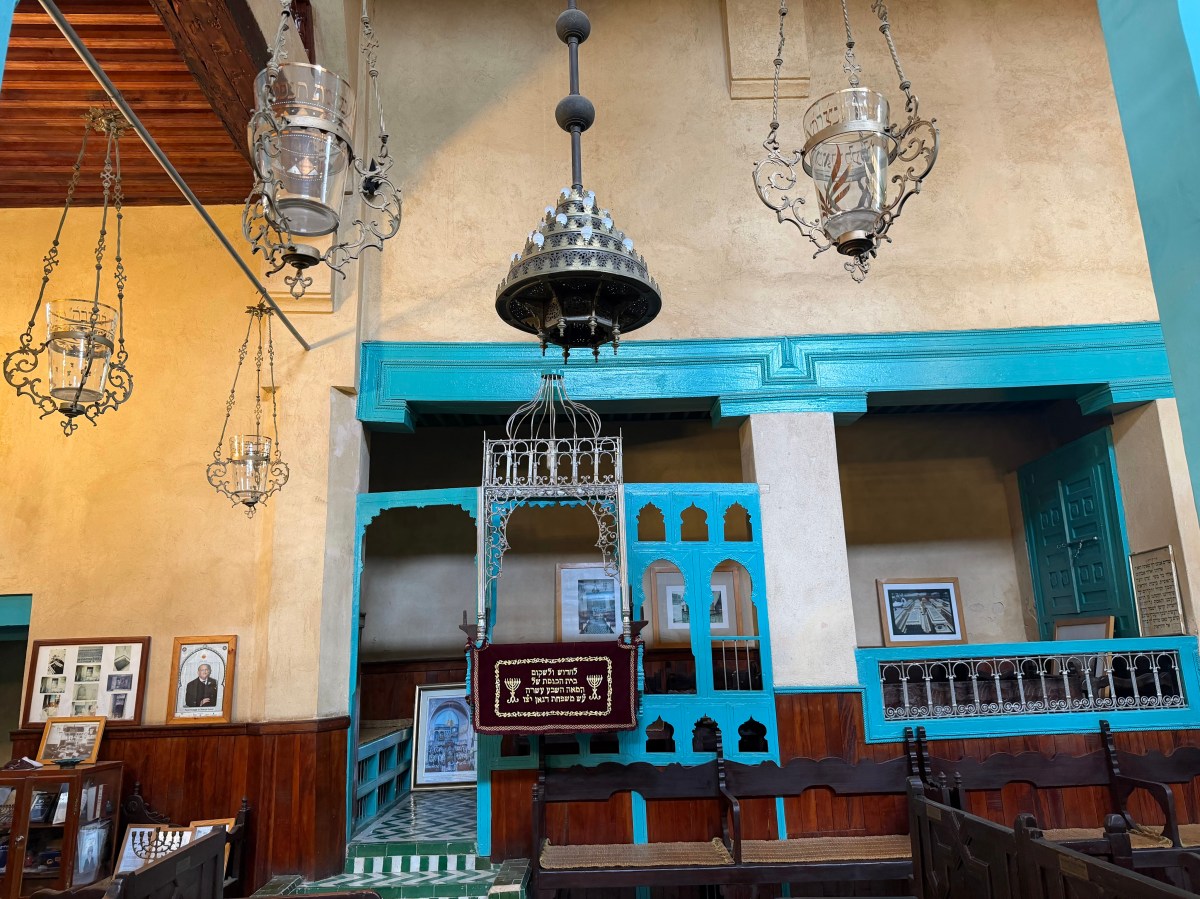
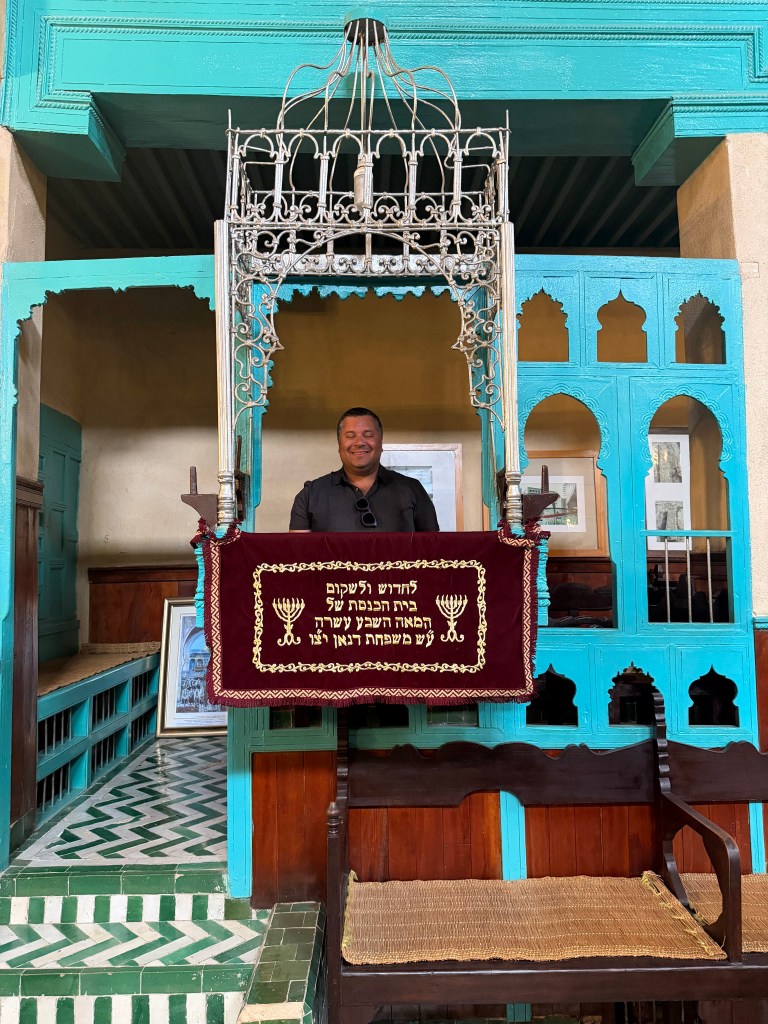
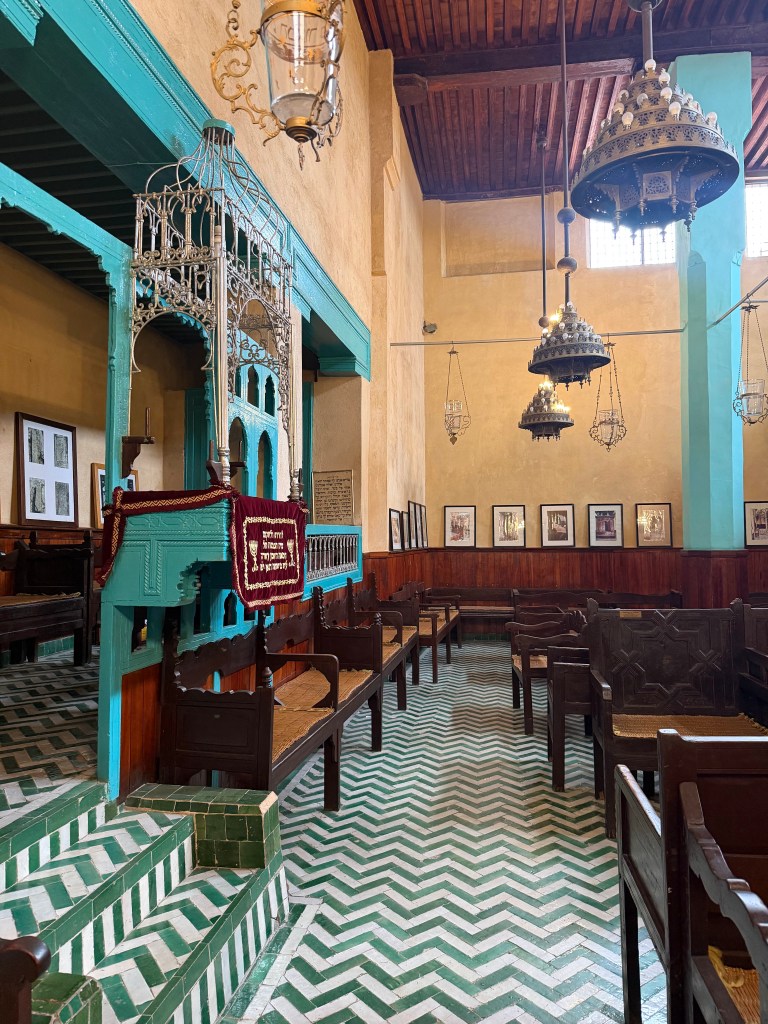
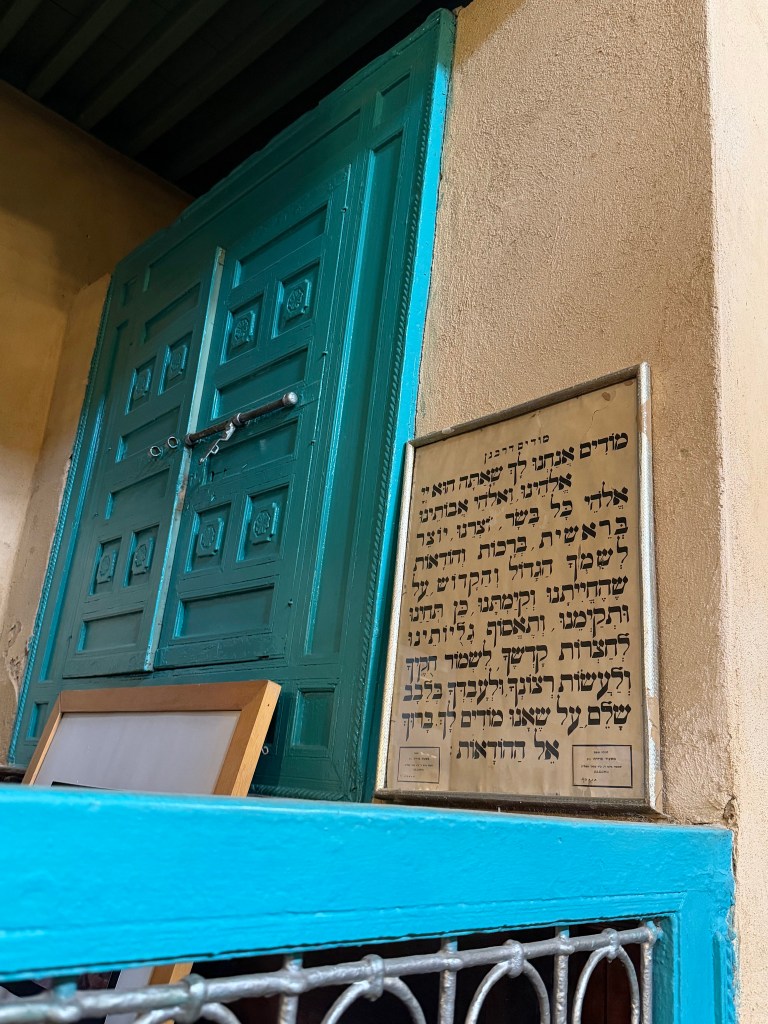
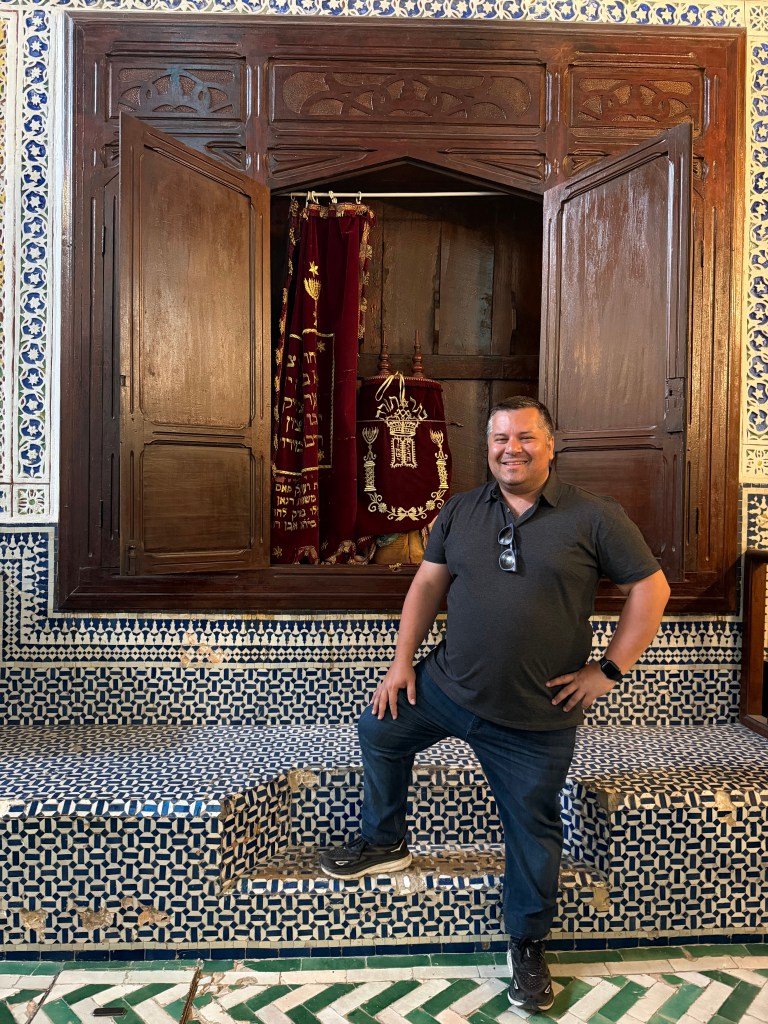
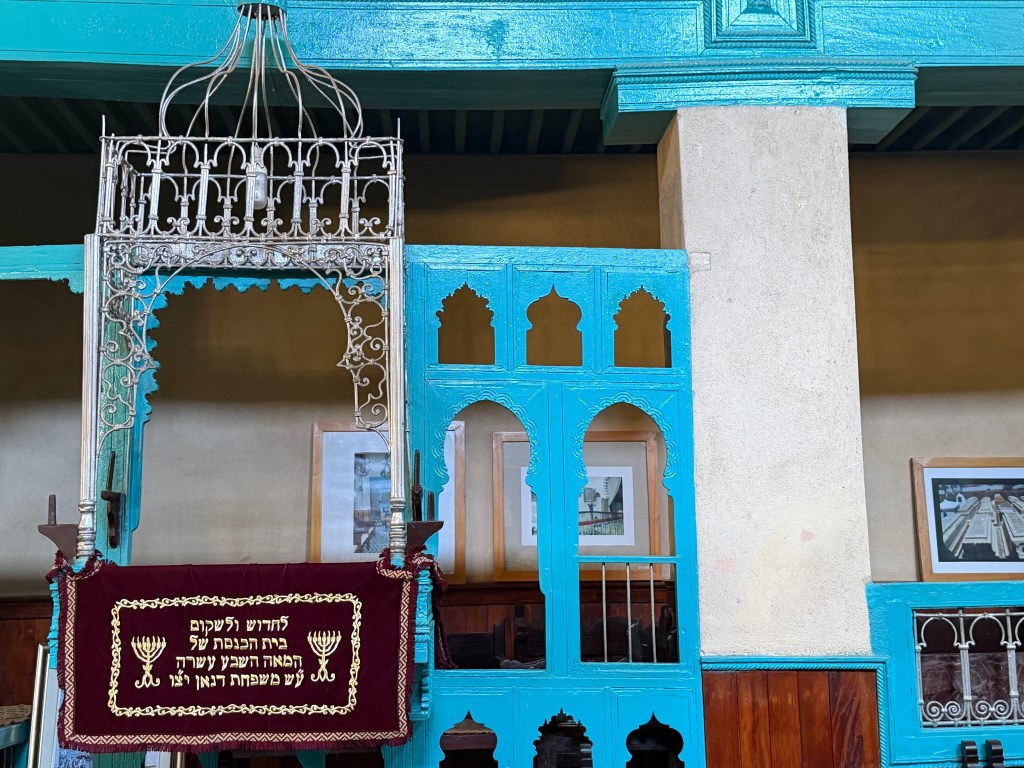
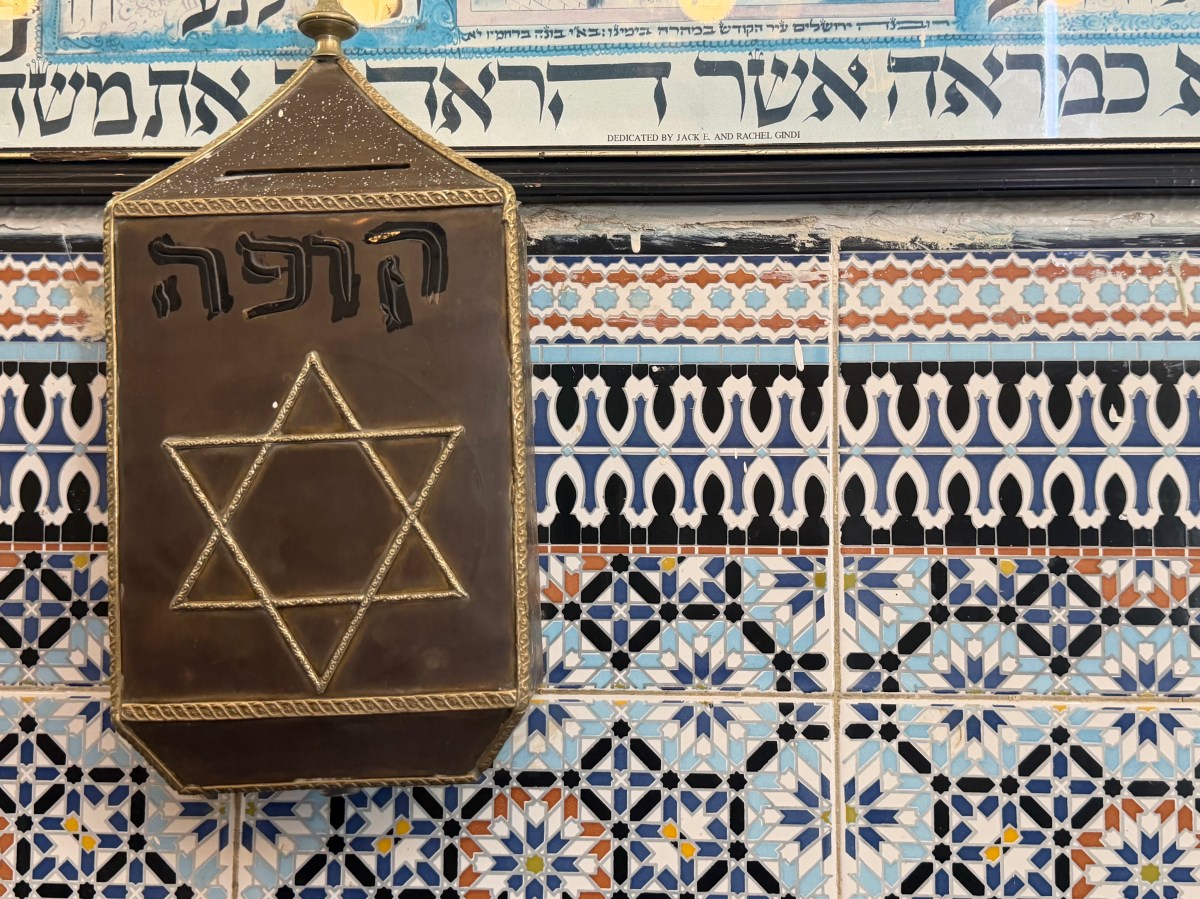
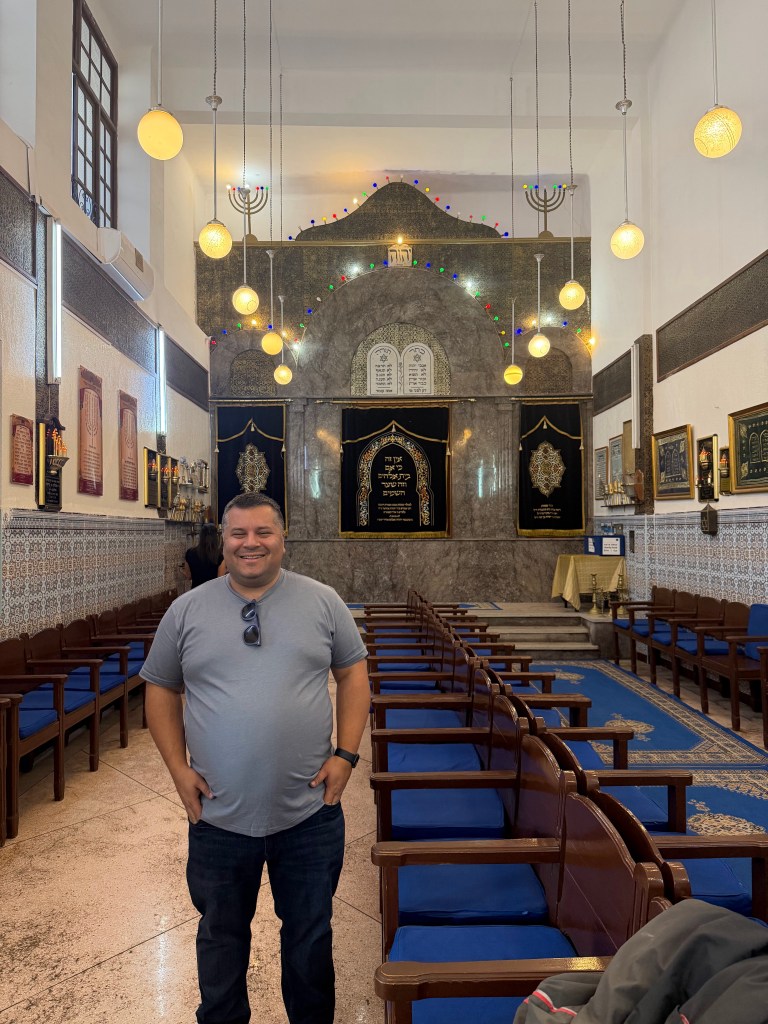
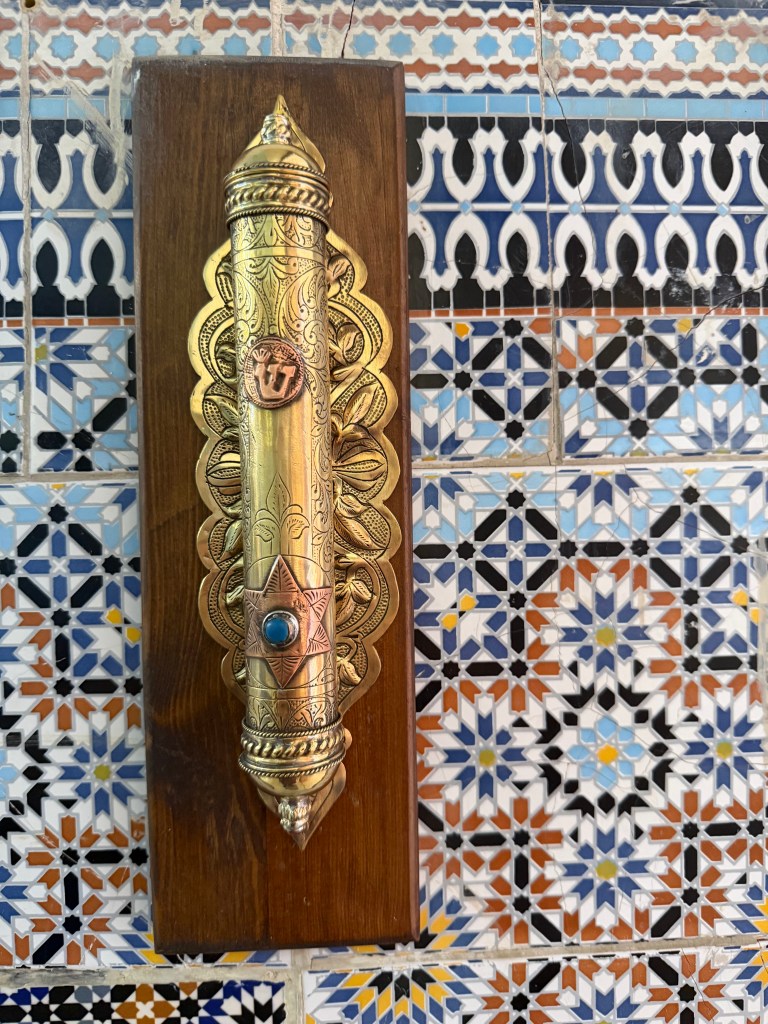
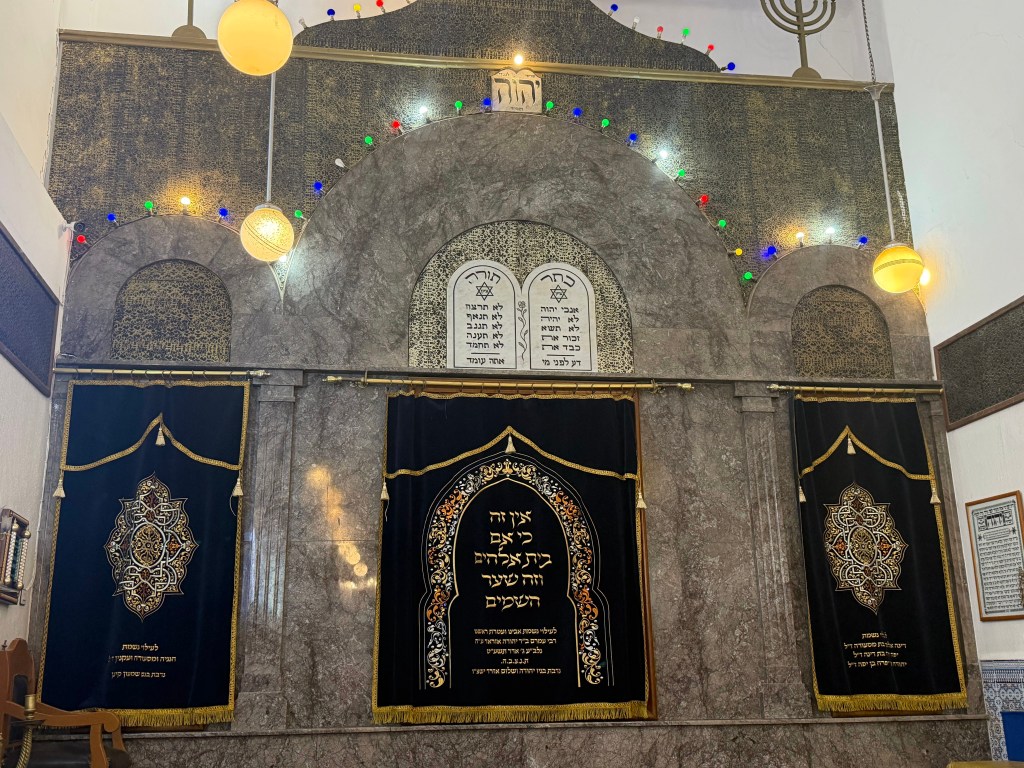
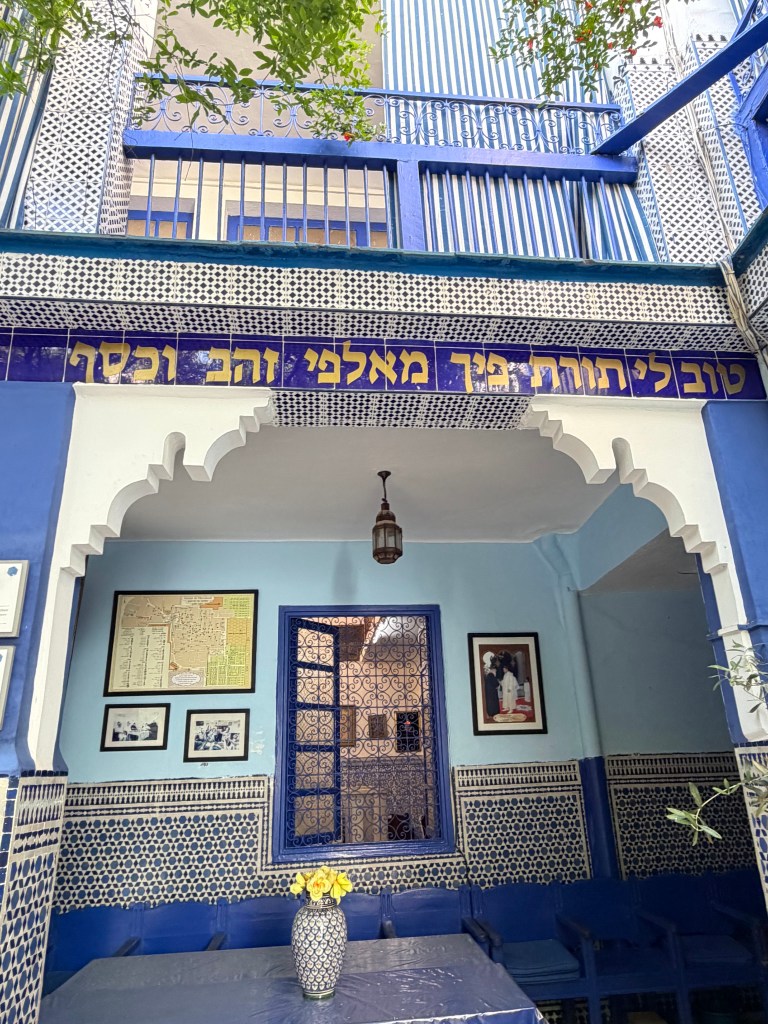
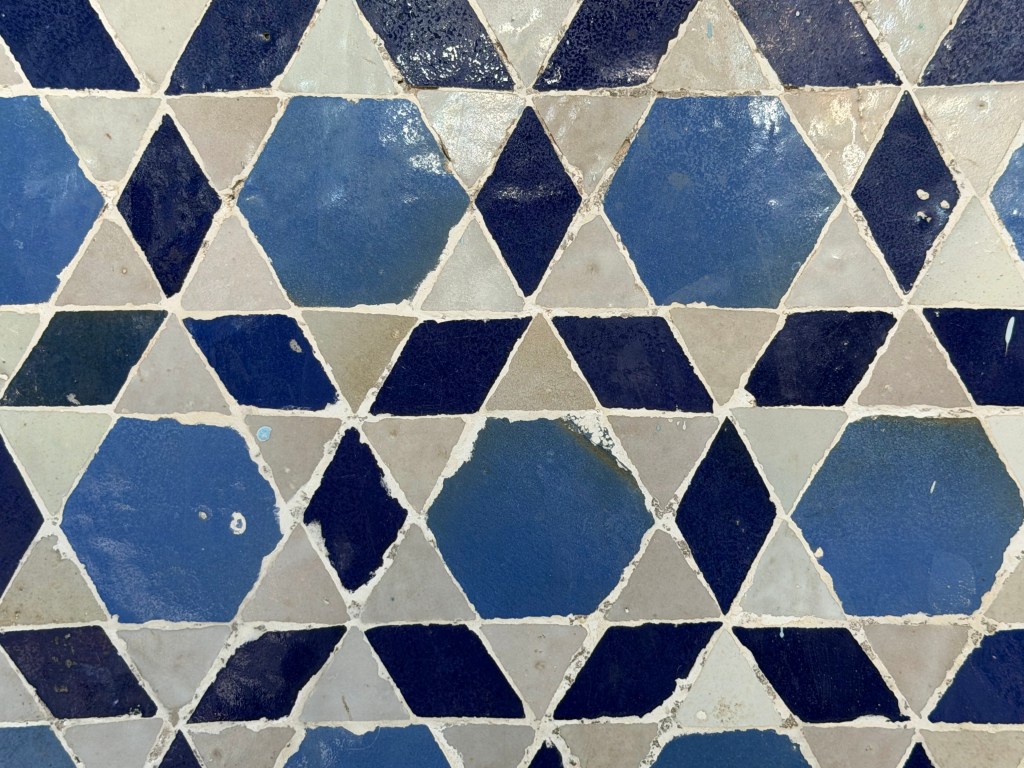
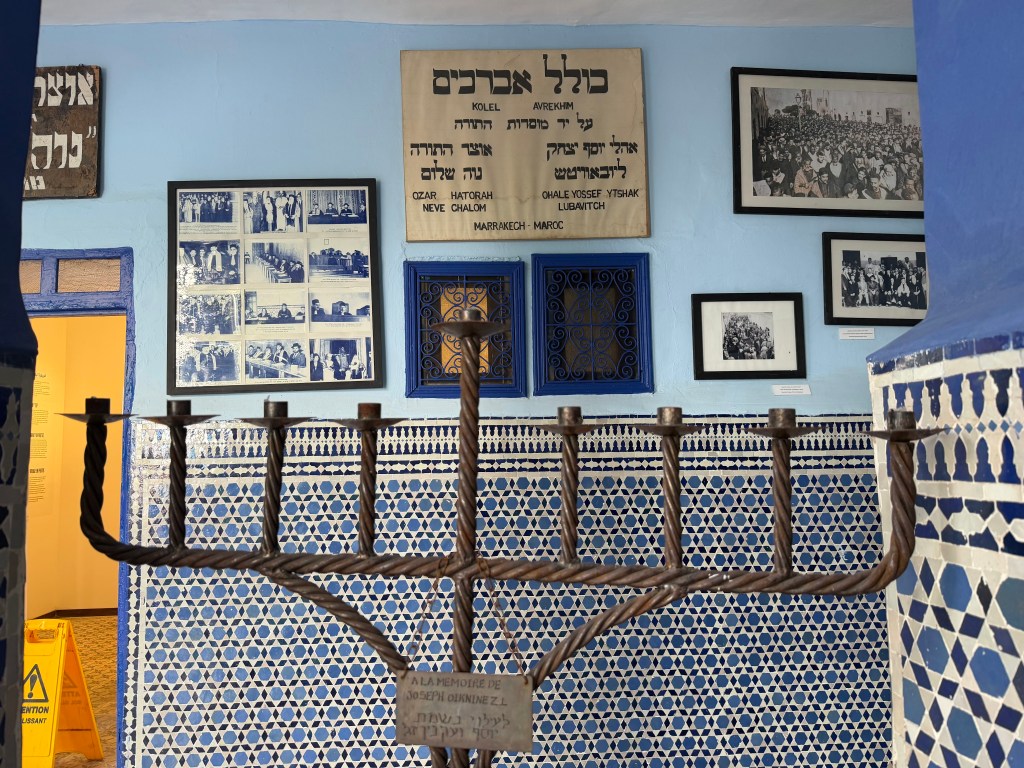
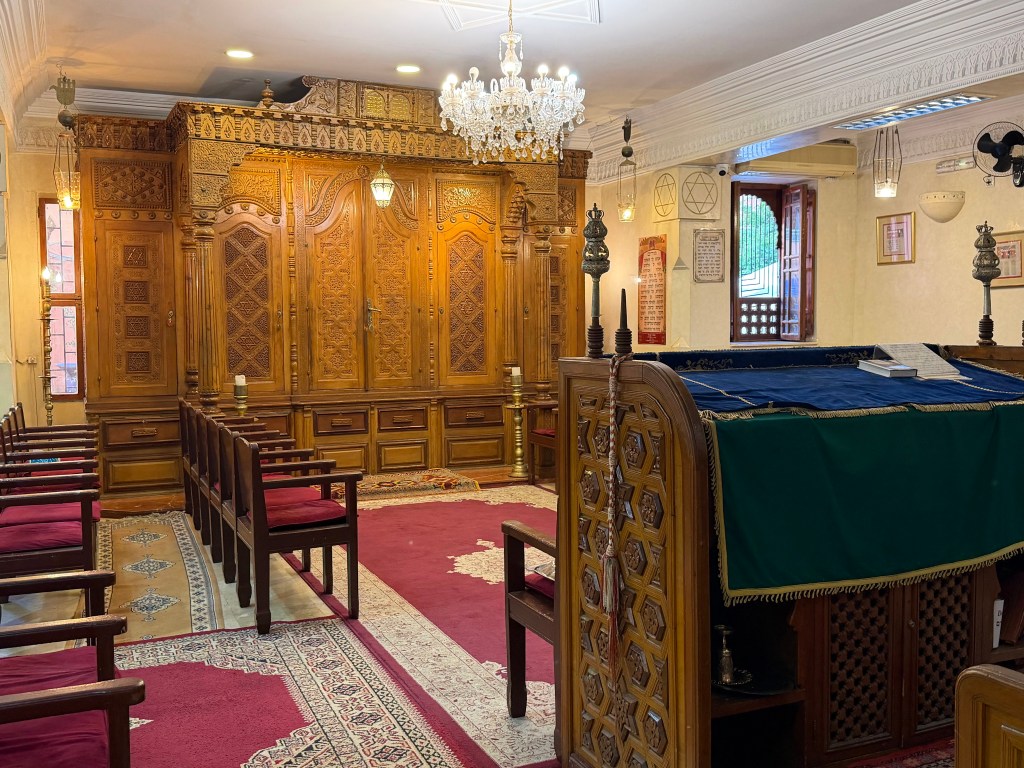
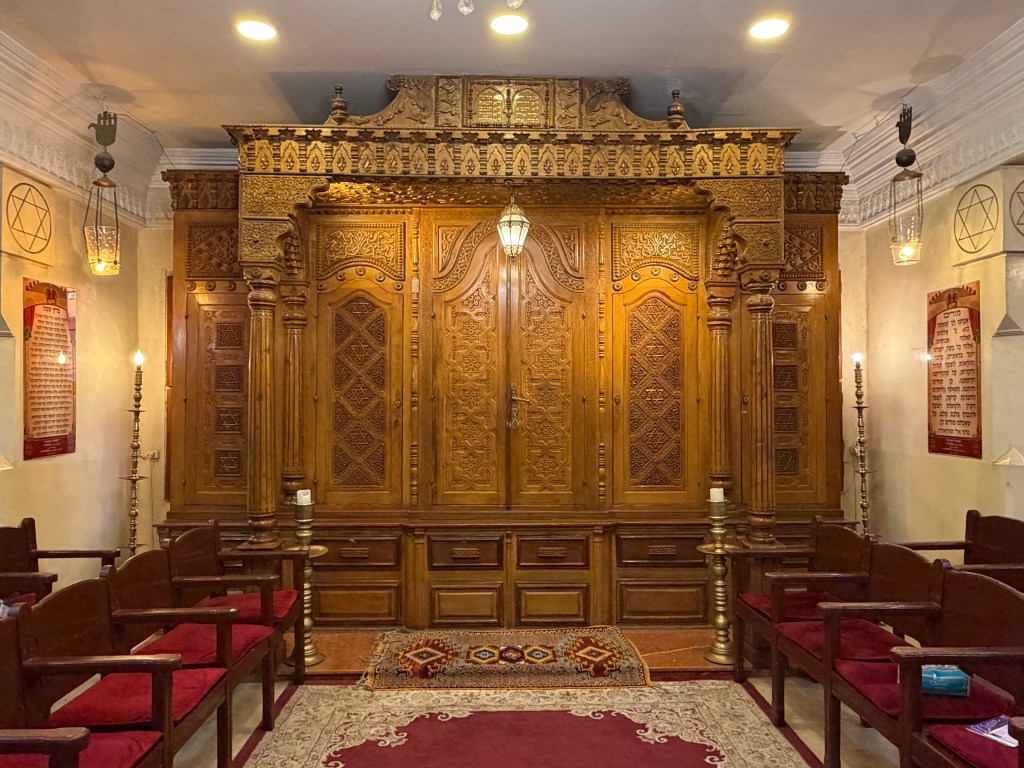
What you’ll also find in Fes El Jdid are synagogues. This area contains the mellah, or old Jewish quarter. One synagogue that I was able to visit was the Ibn Danan Synagogue, dating from the 17th century. It was filled with beautiful blues, teal (my favorite color!), and white. Here are some pictures:
While I was touring the synagogue, the most fascinating thing happened. A Moroccan tour guide walked in with two foreign tourists. I asked the guide in Arabic if he could take a picture of me on the bimah, or pulpit. He was happy to help and then asked what I did for work. I said I was studying to become a rabbi.
He let out a big smile and asked if I would be able to explain the synagogue to his tour group. I was thrilled! It’s for moments like this that I want to become a rabbi.
I spent about 20 minutes walking his European tourists through the structure of the synagogue, the meaning of the Torah, the intriguing mikvah (ritual bath) beneath the floor of the synagogue, and more.
Afterwards, the guide said he had learned a lot himself. He brings tourists to this spot often but he didn’t know much about it. I felt like I had done a mitzvah, a good deed.
The word rabbi means “my teacher”. First and foremost, I see my role as a future rabbi as being someone who brings light into the world. Through education, through engagement, through understanding.
All those years of sitting through both Hebrew school and Arabic classes in college really paid off in this moment. If I hadn’t spoken Arabic, I may not have even asked the guide to take my picture. In fact, I probably wouldn’t have been in Morocco in the first place. And if I hadn’t learned Jewishly for so many years, I couldn’t have explained the synagogue to this tour group and tour guide.
It was this combination of learning about the Jewish and Arab worlds that allowed this moment to happen. And at a time when so many of us are frustrated with conflict, with misunderstandings, with hatred – perhaps it is a sign of hope that a Jew, a Muslim, and a group of Christians could come together and have a thoughtful conversation.
We often look for big solutions to big problems. But if there’s one thing Jewish tradition teaches us, it’s that in small steps we can tackle big problems. According to rabbinic tradition, Nahshon parted the entire Red Sea for the Israelites fleeing slavery in Egypt. Rather than waiting for someone else or even God to act, Nahshon simply took a few steps forward into the water. We can wait for big solutions, or we can be like Nahshon and, one step at a time, move our world forward with acts of kindness.
Fes is indeed sometimes a chaotic city. But it is also the place where I started to find my rabbinic voice by bringing together people of different nationalities, religions, and languages. I’m excited to see what we can accomplish by all chipping in and doing acts of kindness to make the world feel more at peace.
Morocco is an enchanting, chaotic, and peaceful land all at the same time. Its Jewish community dates back over 2,000 years and is the largest in the Arab world. Over one million Jews of Moroccan descent live in Israel, France, Canada, the U.S., Spain, and Latin America.
My first exposure to Moroccan Jewish culture was by way of friends in an exchange program between Bet Shemesh, Israel and Washington, D.C. Before it became a predominantly Haredi (ultra-Orthodox) city, Bet Shemesh was heavily Moroccan. My friends there introduced me to the foods, traditions, and sounds of the community such as Lehakat Sfatayyim, a Moroccan-Israeli band.
Growing up in the U.S., I had limited exposure to Moroccan Jewry since the U.S. Jewish community is predominantly Ashkenazi. I attended various Mimouna celebrations in the U.S. and Israel, though, which has always been a load of fun. It’s a way of ending the bread-free week of Passover with loads of carbs and greetings from neighbors. In Morocco, this traditionally meant Jewish and Muslim neighbors celebrating together.
I love exploring diverse Jewish communities, so I was thrilled to arrive to Morocco to learn more and to use my Arabic and French. I’ll be totally honest – I was equally parts nervous and excited. On my recent travels, especially after October 7th, I had experienced a lot of antisemitism, especially on my fall trip to Italy. Morocco is 99% Muslim and let’s just be honest – the relations between Jews and Muslims hasn’t been great recently, or for that matter in the past 100 years or so.
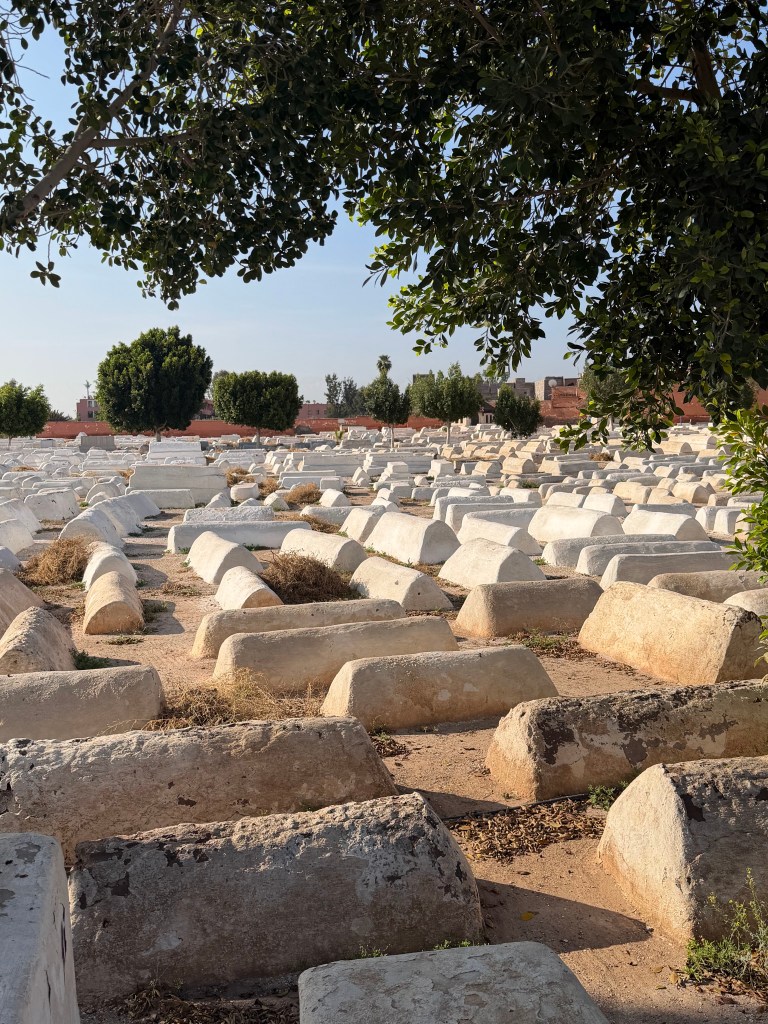
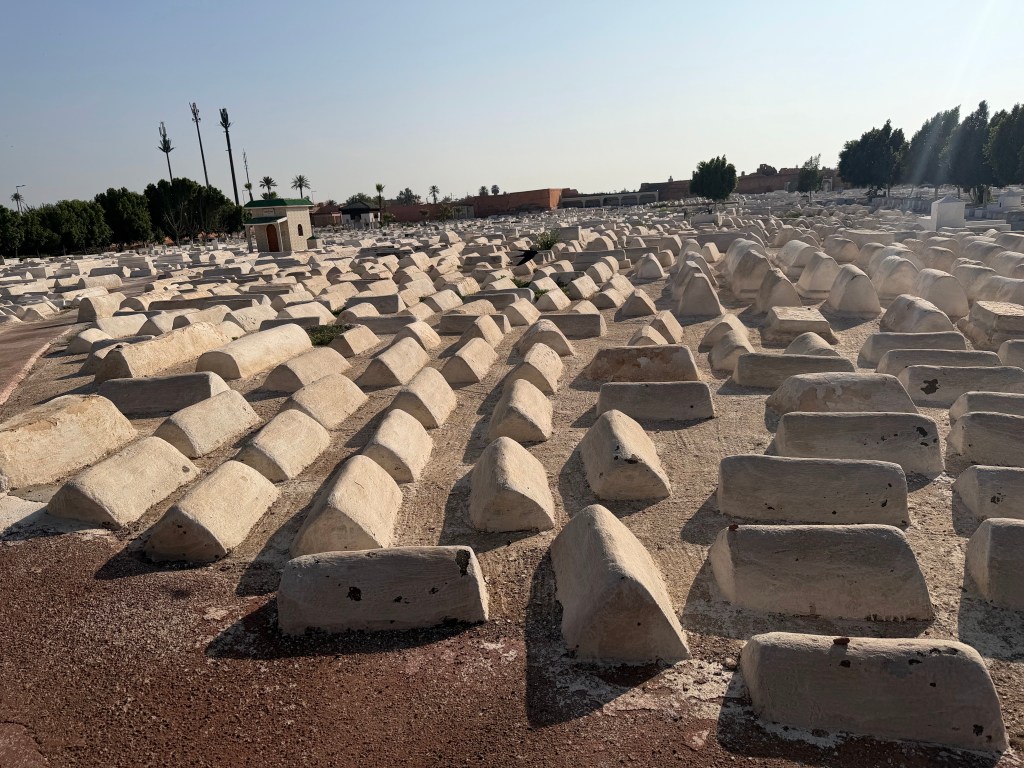
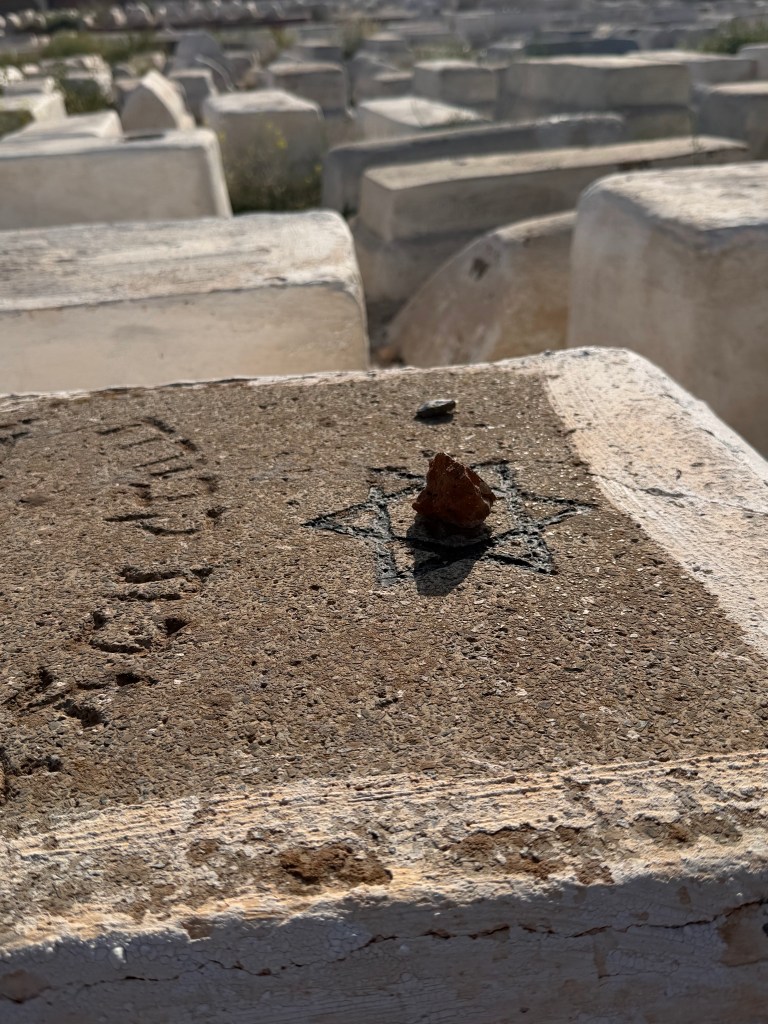
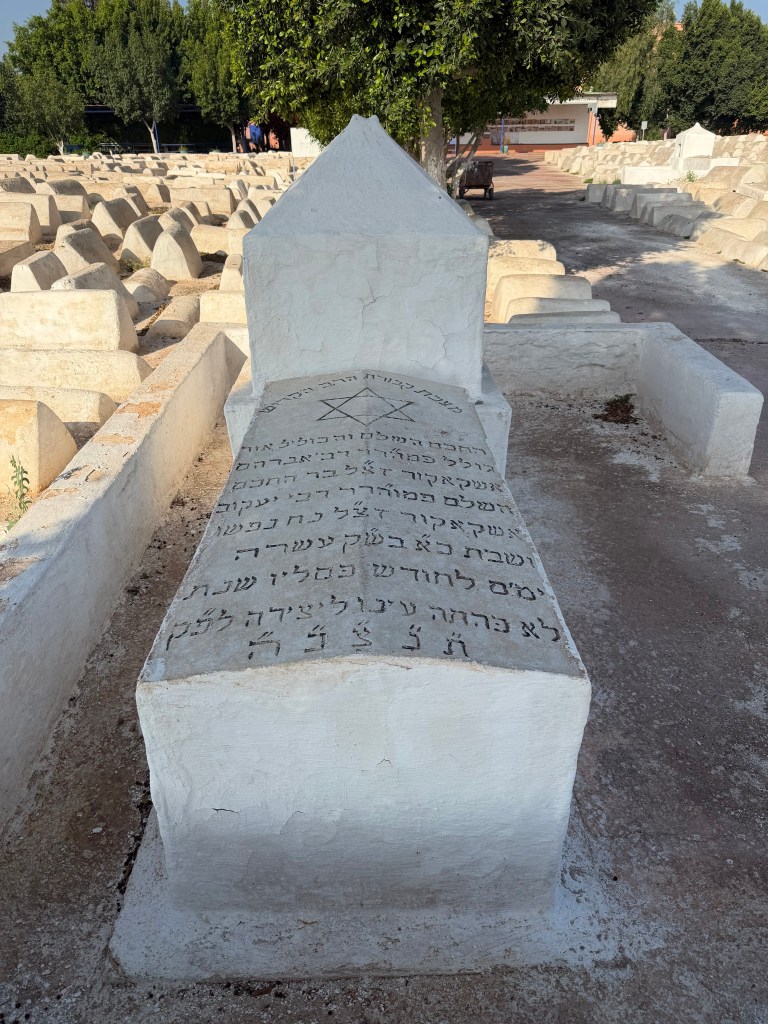
I started in Marrakesh. It’s a fascinating and beautiful city and overwhelms the senses. I stayed in the Mellah, or Jewish Quarter. I started by visiting the absolutely massive Jewish cemetery, filled with 20,000 graves, almost all marked by long white stones. It looks completely different from an Ashkenazi cemetery that I’d be accustomed to. It is the largest Jewish cemetery in the country. I followed the Jewish tradition of putting small stones on some of the graves to honor the dead. Here are some photos from the stunning site:
From there, I practically ran to the Slat Al Azama synagogue, built by Jewish refugees from the Spanish Inquisition and expulsion in 1492. I was so excited to get in and so were some Jewish tourists from Brazil. I got a chance to use my Portuguese with them as we talked about how excited we were to visit the synagogue. Once we got in, the father asked me to explain to him and his son some of the prayers that dotted the synagogue walls. It was amazing to have an instant Jewish connection with someone from so far away in a foreign land.
The synagogue itself is absolutely stunning, filled with mosaics, including blue and white Jewish stars all over the courtyard. There is a small but meaningful museum next to the sanctuary as well that documents Moroccan Jewish history. The place is well guarded and I felt safer there than in many European or American synagogues these days.
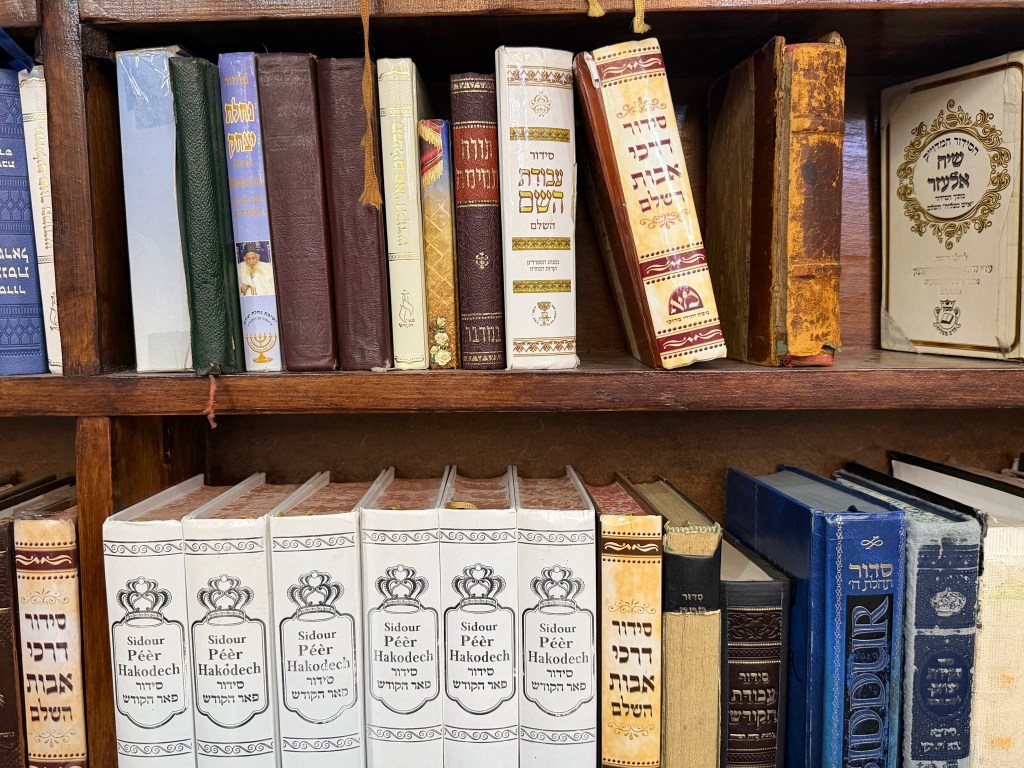
Here are some photos of the synagogue:
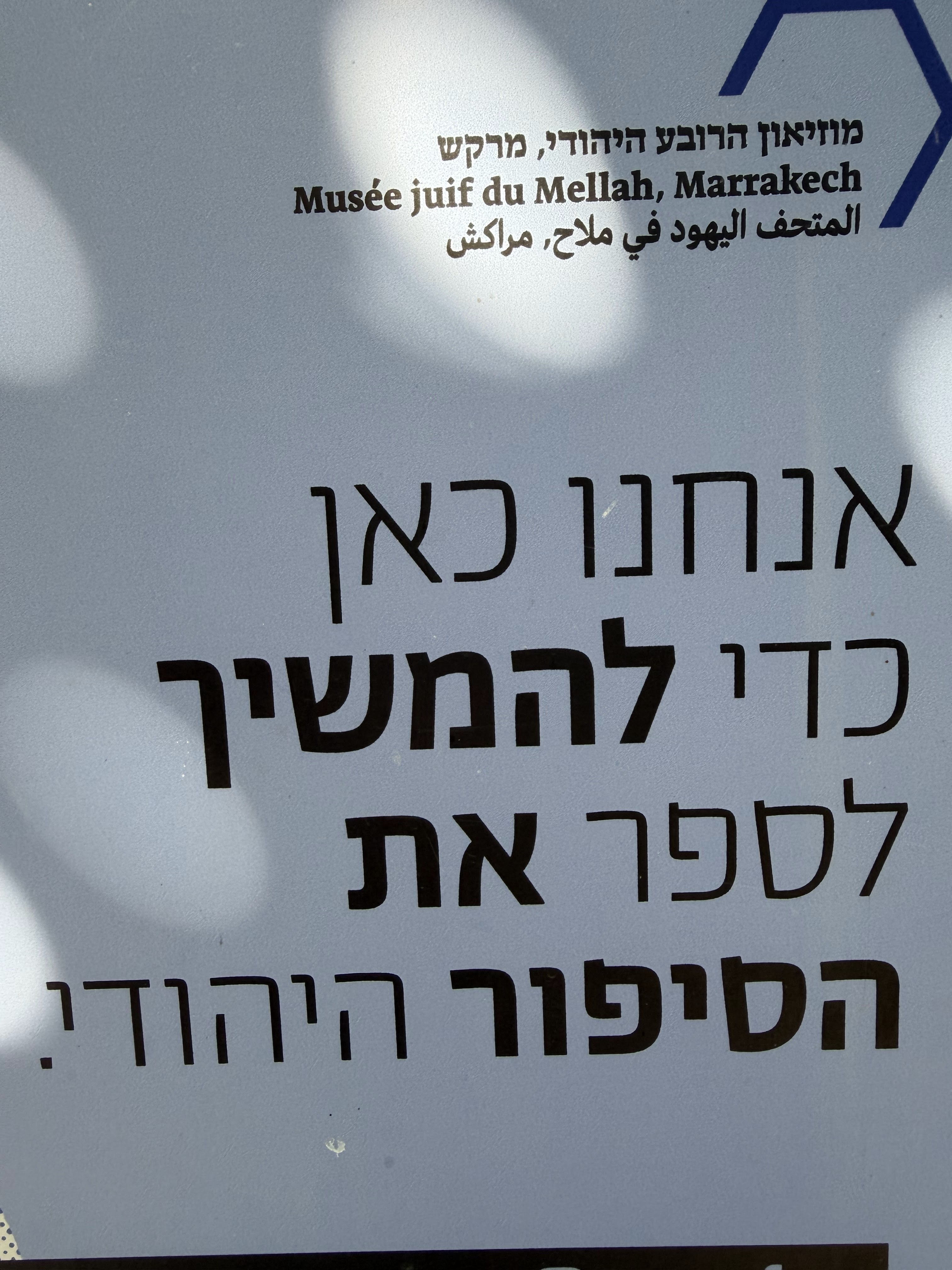
The synagogue had signage in Modern Hebrew, clearly geared towards Israeli tourists (yes, they come to Morocco too and offered many helpful travel tips via several Israeli Facebook groups I’m in). In fact one of the signs said in Hebrew: “we are here to continue to tell the Jewish story”:
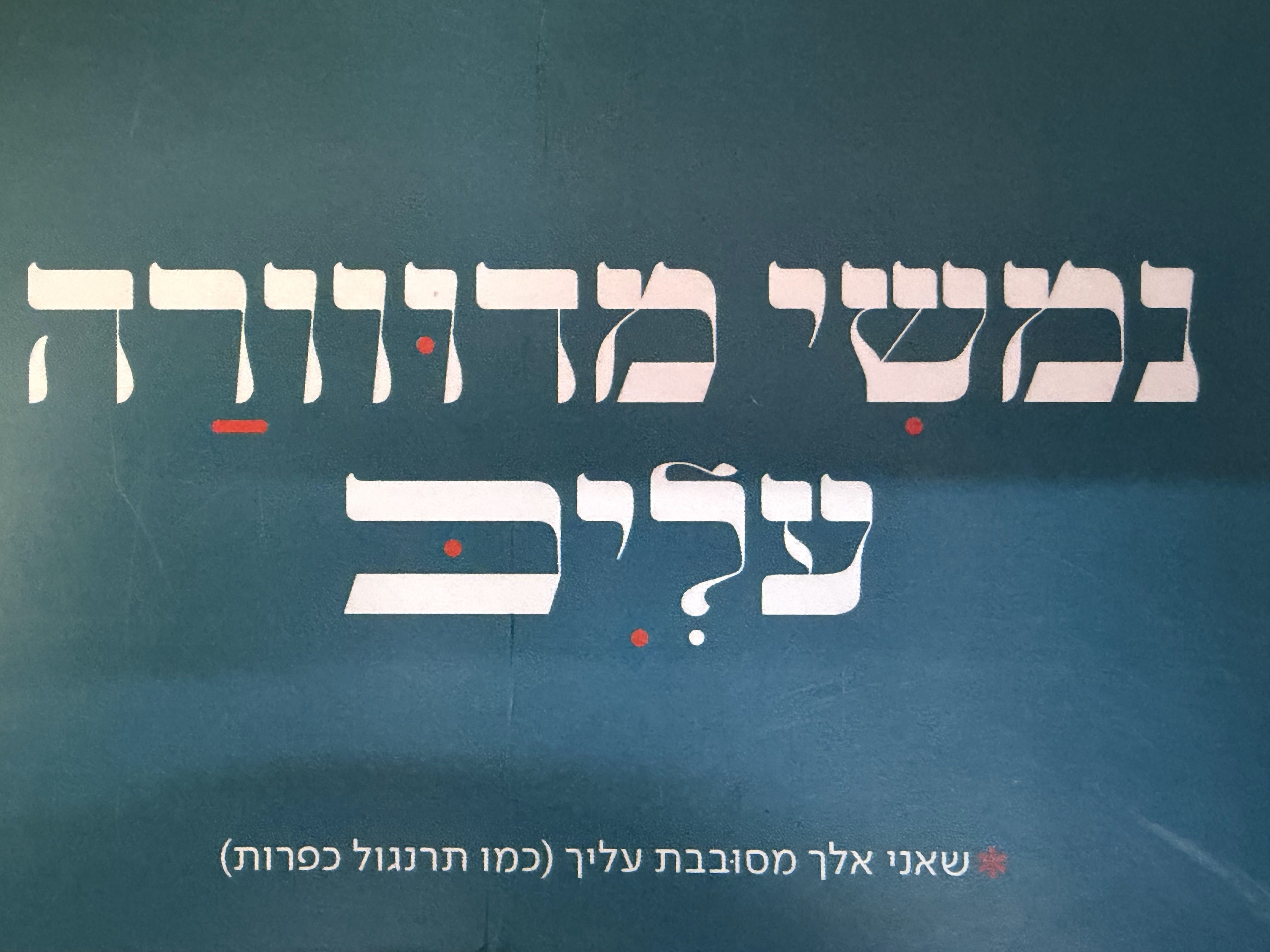
They even had Judeo-Arabic postcards, such as this one which says “I will go around you” (like a kaparot rooster):
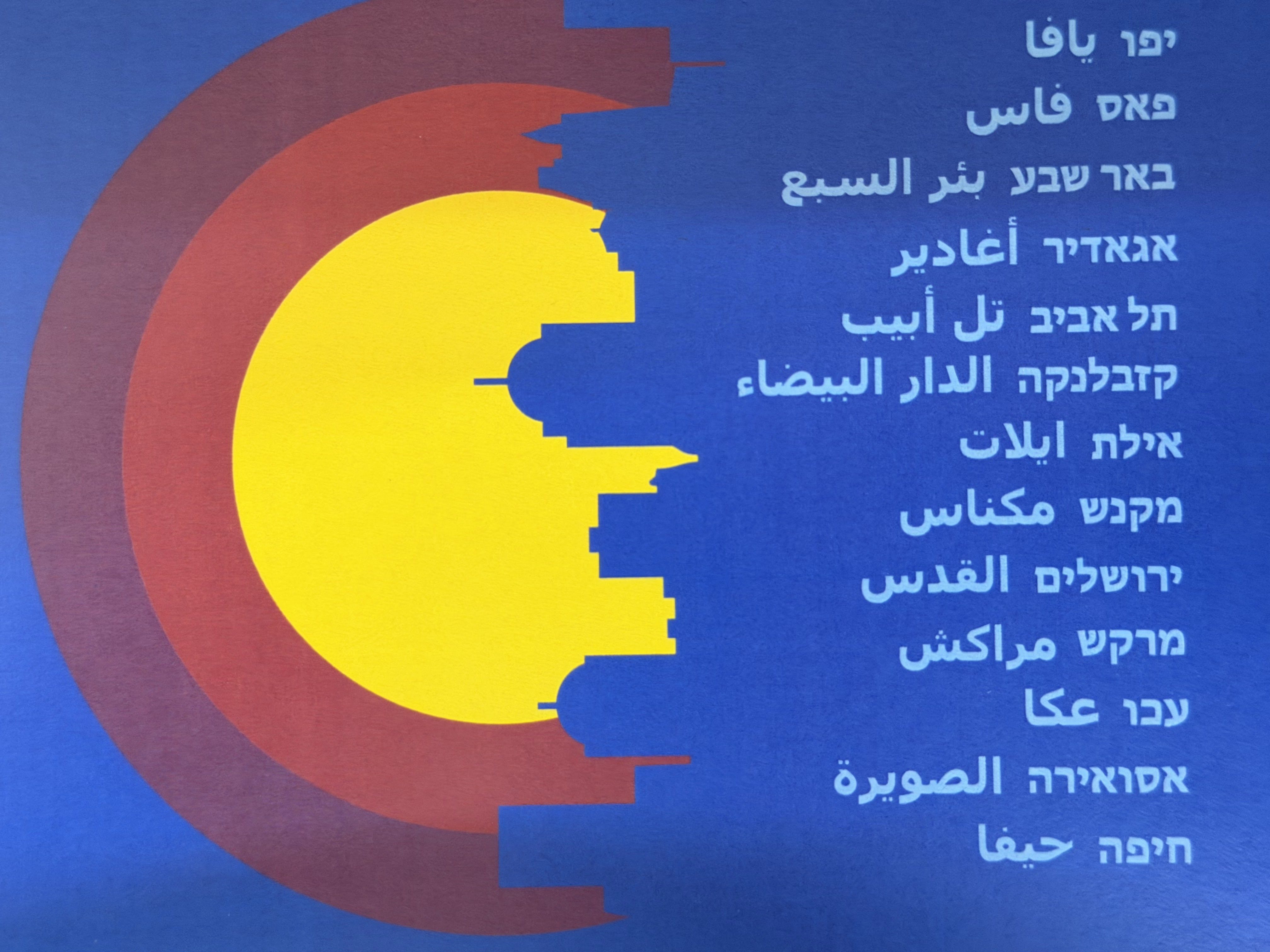
What was absolutely stunning to me (in the best way possible) was this bilingual Hebrew-Arabic postcard the museum was selling that listed cities in Israel and Morocco one after the other:
It was a beautiful token of co-existence at a time of great hatred in the world. Keep in mind this museum is an official organization in Morocco. Everything in the country happens with the blessing of the King. It was designed to send a message of acceptance and welcoming Jews, not an accident.
After having visited the synagogue and the cemetery, I decided to go to Friday night Kabbalat Shabbat services. I met the most eclectic group of Jews possible. A Persian-Israeli who spoke fluent Moroccan Arabic. What I think was a gay French-Moroccan Jewish couple with a young child in the Orthodox synagogue. A couple of Moroccan-Israeli bakers from Ashdod. And a Spanish-speaking Sephardic man from Panama!
The synagogue was also beautiful:
The services were quite an experience. I have gone to a couple Sephardic synagogues before in Israel and each one is unique in its rituals as well as melodies. But of course, I’m much more accustomed to predominantly Ashkenazi rituals in the U.S. I was almost completely lost during the service, both because I didn’t know the melodies (except for one or two!) and because the Hebrew text is also slightly different. The North African melodies were enchanting and I also felt like a bit of a spectator more than an active participant because it was both familiar and new to me. Not a bad thing at all, it just was a unique experience for me, like having one foot in and one foot out. It felt Jewish and so different from what I knew.
What was also striking about the synagogue is that it is currently run by Chabad! Chabad was founded in Lithuania, where some of my ancestors are from. It is a Hasidic movement geared towards outreach to other Jews to perform traditional rituals and mitzvot. It is not remotely something I expected to experience in Morocco, especially on Moroccan terms. What I mean is that if I went to Chabad in most countries, I would be able to follow the service more easily because the rituals are Ashkenazi i.e. Eastern European. However, the Chabad in Morocco follows the local customs and has to be one of the few in the world that is deeply, deeply Sephardic and Mediterranean.
After a few days of exploring Jewish Marrakesh, I took a day trip out to the countryside to see Amazigh (i.e. “Berber” – the less-accepted term) life. The Amazigh are the natives of Morocco and what I didn’t realize is that they have a 2,000+ year history of welcoming and building relationships with Jews!
I met multiple Amazigh people during my trip and got to see the remaining houses in a remote, formerly-Jewish village about an hour and a half outside Marrakesh. I even bought some pretty Judaica from an Amazigh man who told me the objects were from the neighboring village. He also said many Jewish tourists of Moroccan descent come to visit, including from Israel. Yes, he said “Israel”. It’s a word that’s so charged these days, but for many Moroccans I met, it was totally normal to say. To acknowledge. To allow to exist. May more people around the world follow their tolerant and open-minded example.
My Jewish experiences in Morocco were so rich and varied that I couldn’t possibly fit them into one blog post. That says something about the diversity and wonderful heritage of this beautiful country. Keep your eyes peeled for more stories from my adventure. It was a truly life-changing experience.
And next time you want a safe place to visit as a Jew, I can’t help but recommend Morocco over Florence. Travel is an incredible way to dispense with stereotypes and preconceptions.
The answer for many Moroccans is “no”. How could that be? Arabic is an official language of the country. It is taught in schools, used by Muslims of all backgrounds in prayer, and is spoken on the streets. I used Modern Standard Arabic, Syrian Arabic, and French to get around the country even though I didn’t speak the local variety called Darija.
And yet, Morocco has another official language and no, it’s not French despite its widespread use. It’s Amazigh! Amazigh is the native language of Morocco and wide swaths of North Africa. In fact, it has many dialects within the country and across the region, some of which are not very mutually intelligible.
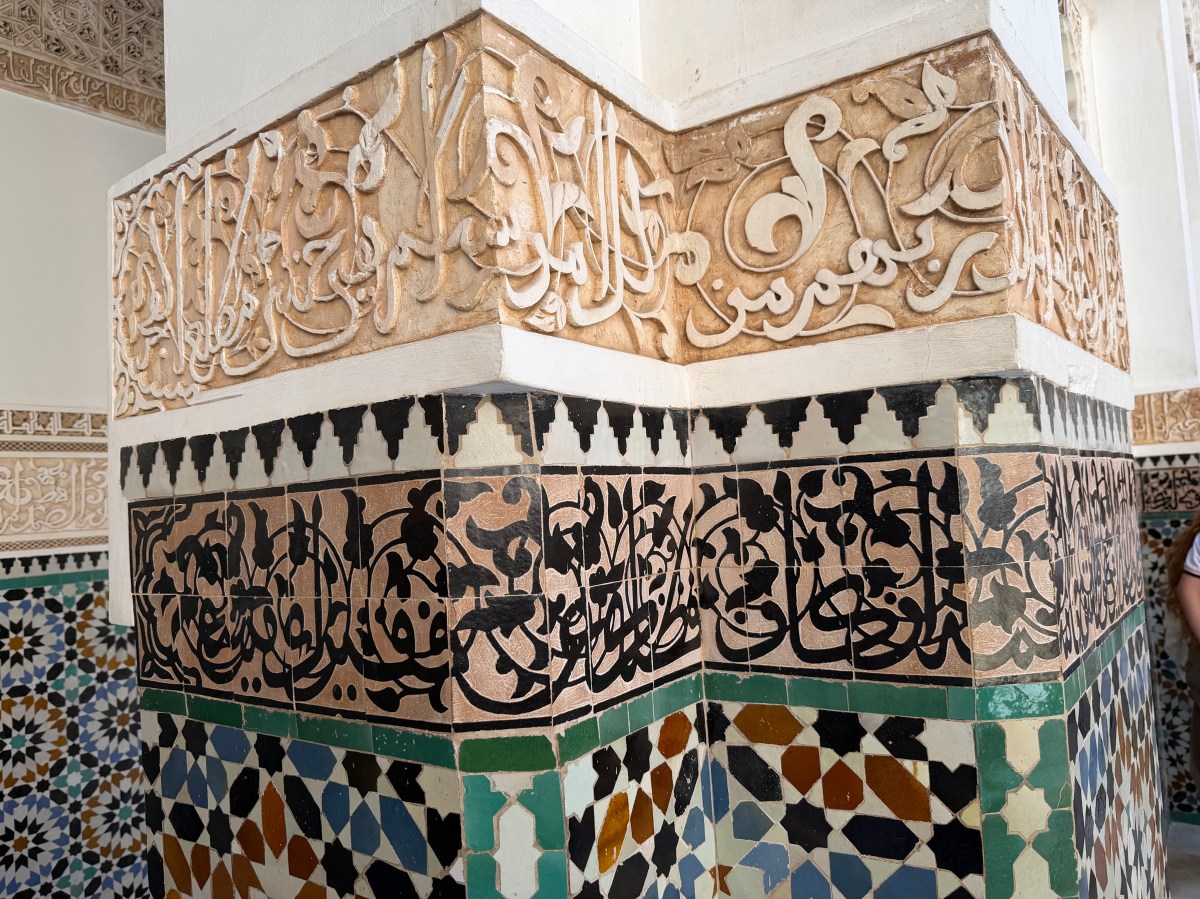
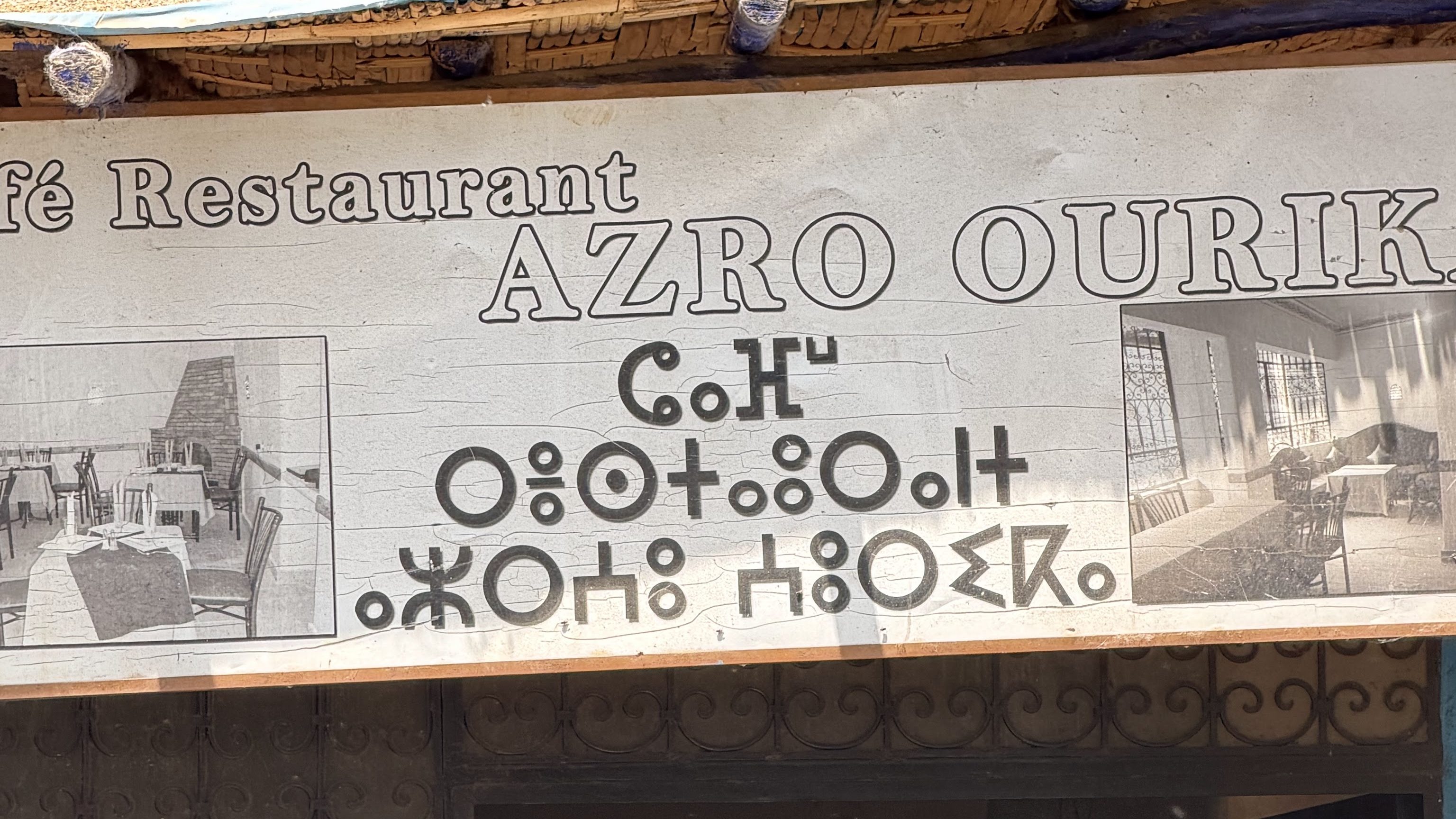
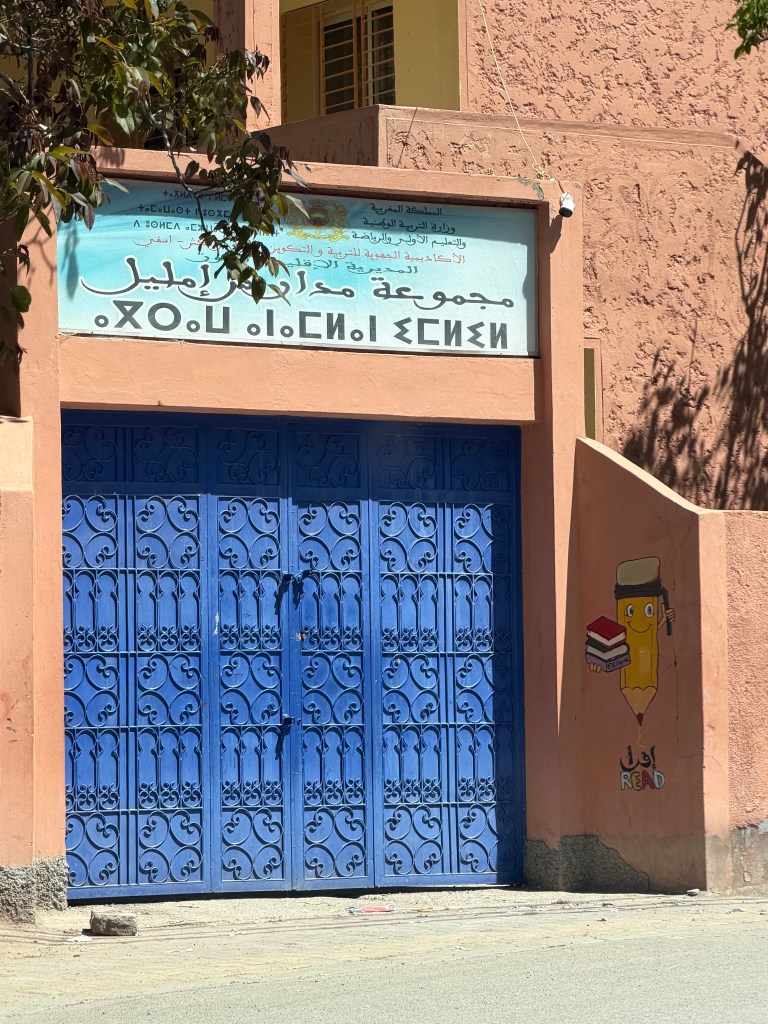
This is what the Amazigh script looks like (though some speakers in North Africa may use Latin-based or Arabic scripts):
It looks nothing like Arabic, sounds nothing like Arabic, and its vocabulary is unrelated to Arabic. In other words, it is the native language of Morocco because it existed there before the arrival of Arabs and Islam in the seventh century. And to this day, it is the mother tongue of 24.8% of Moroccans and is understood by many people as a second language. As far as ancestry, studies range wildly from 35% to 70% of Moroccans having some Amazigh roots.
When I visited Morocco recently, I met Amazigh people both in the major cities and in the countryside, where their numbers are even greater. My first interaction was at the riyadh (traditional bed and breakfast) I stayed at in Marrakesh. One of the staff members was named Muhammad and when I started to speak with him in Arabic, he told me: “I prefer to speak in English and not in Arabic because I am Amazigh.” It hadn’t even occurred to me that someone in Morocco would prefer English over Arabic for reasons of cultural identity, but from then on, I respected his wishes and he taught me a few Amazigh words each day.
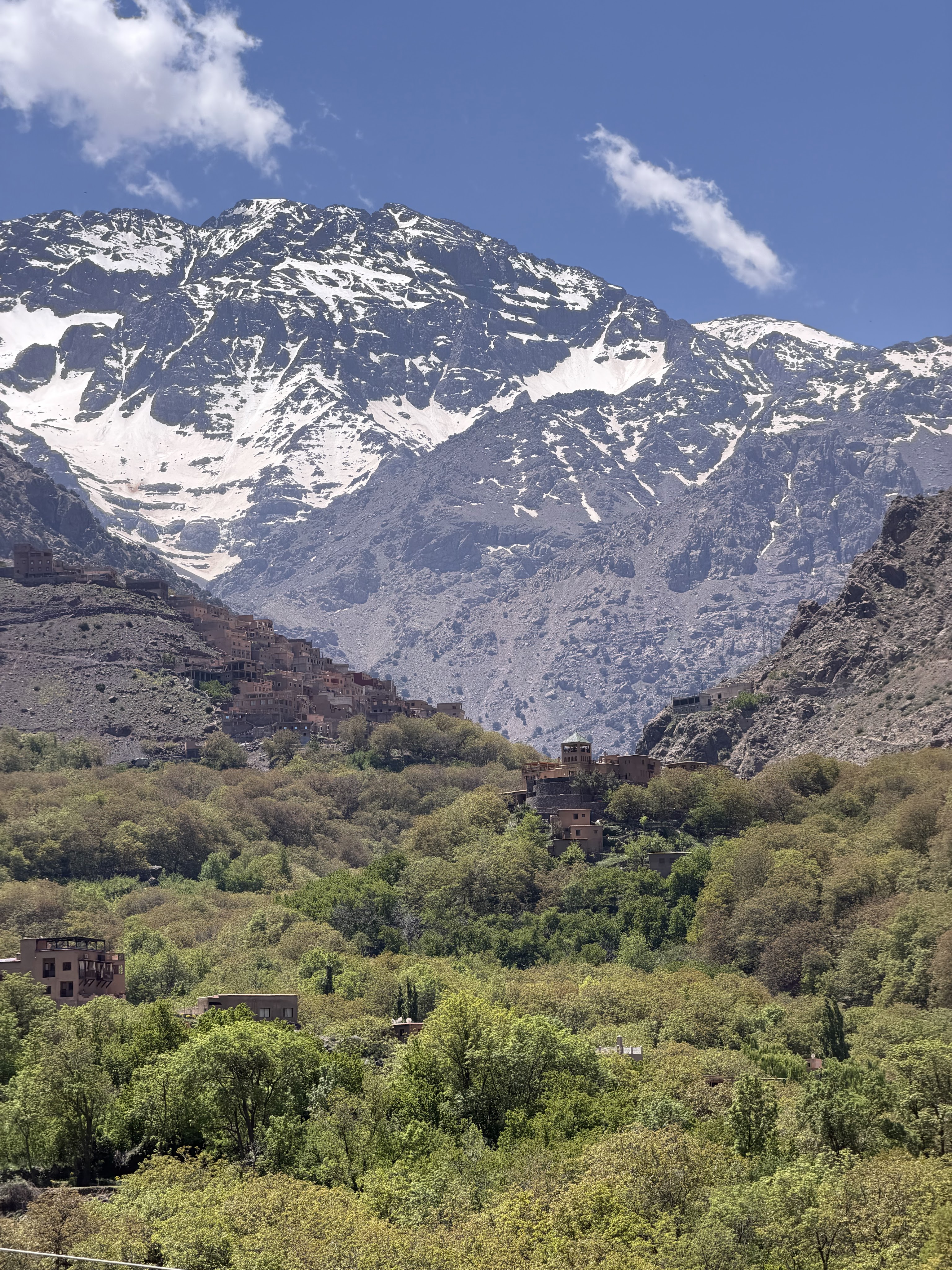
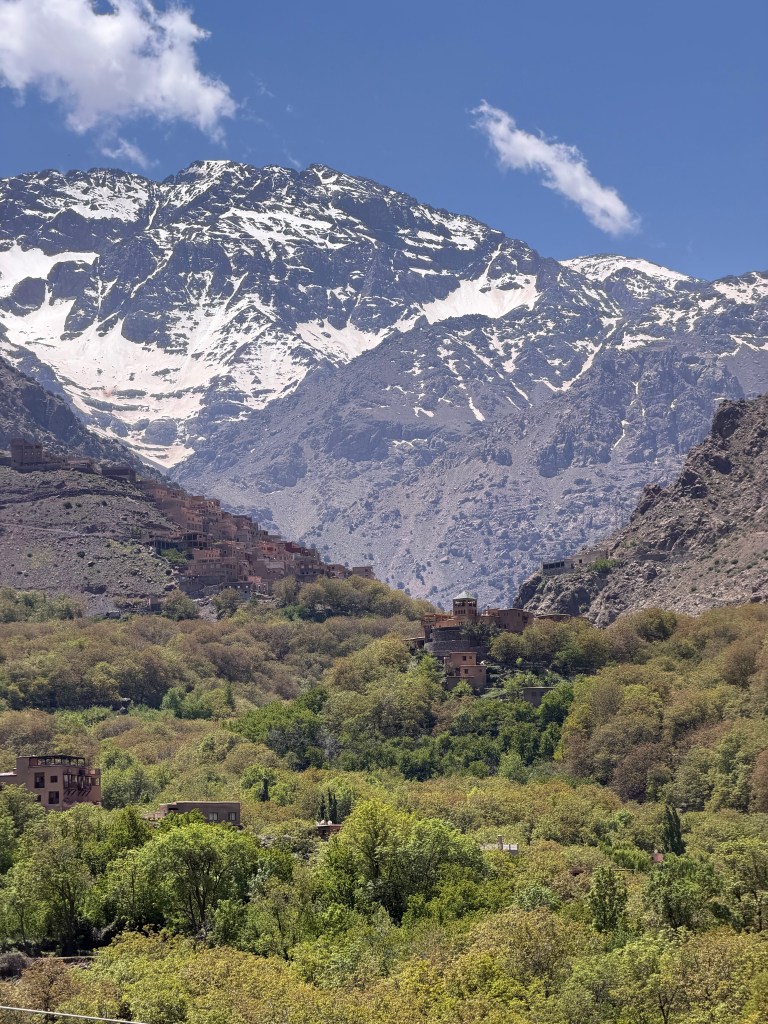
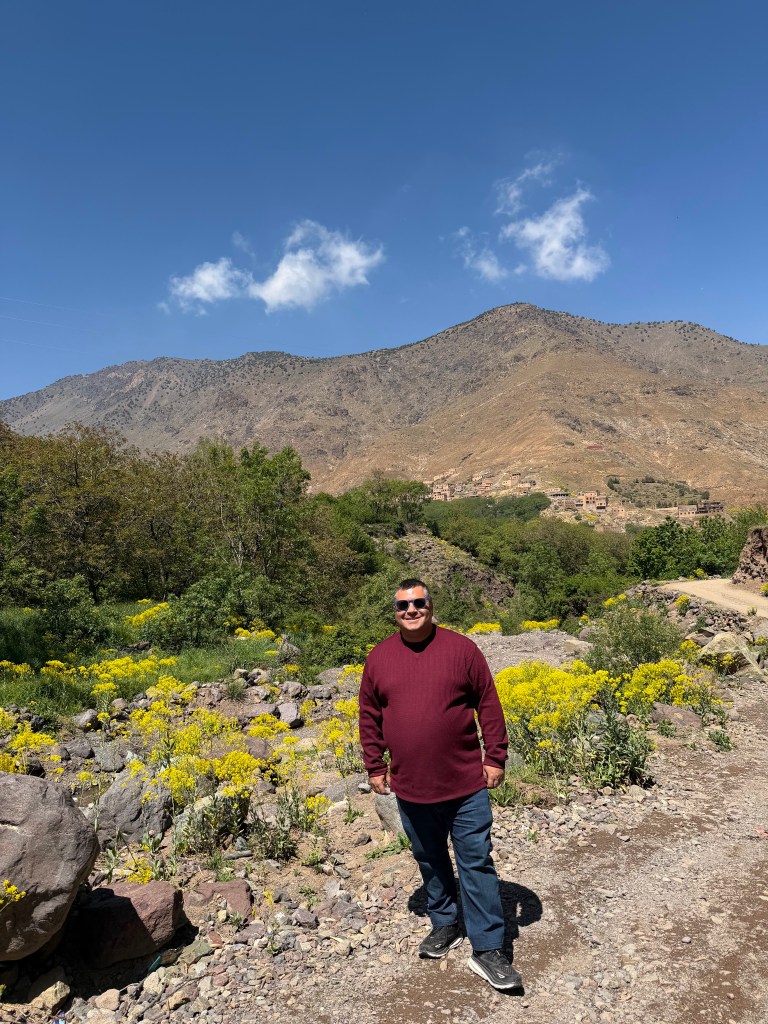
The Marrakesh medina (or “old city”) is fun but deeply chaotic with donkeys and mopeds and people running all over the place. I decided to take a break and head to the countryside for a day trip. I visited Amazigh villages on the way to (and in) Imlil. The mountains are deep green and sometimes snowcapped. The streams are beautiful. And the people are incredibly hospitable.
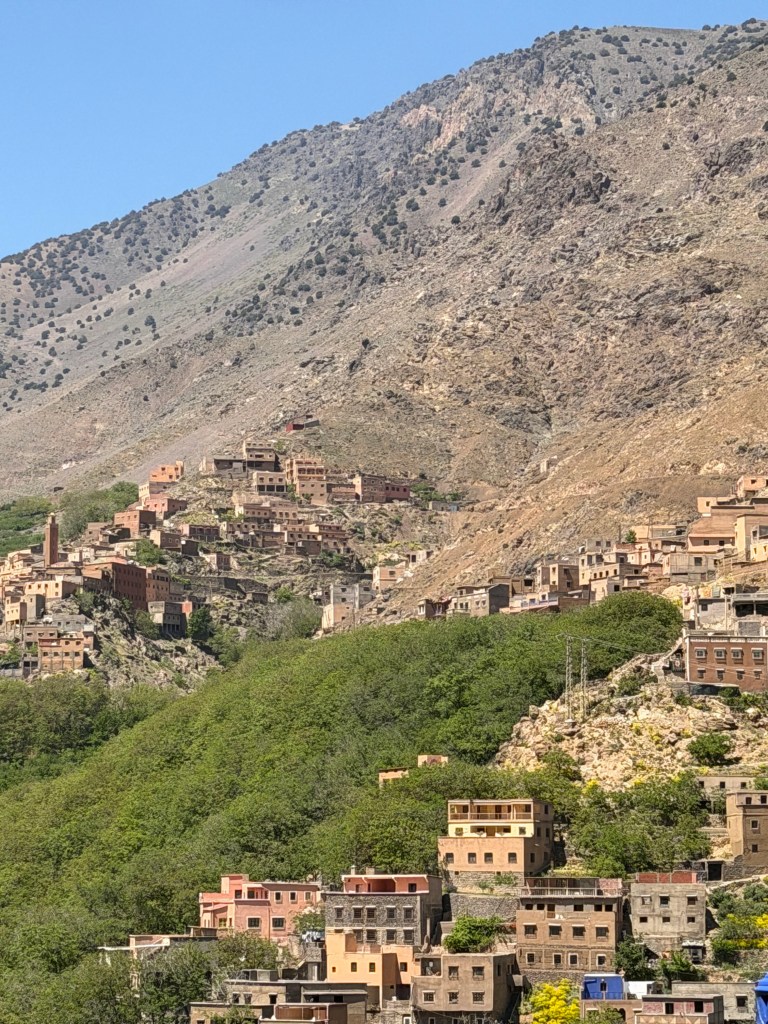
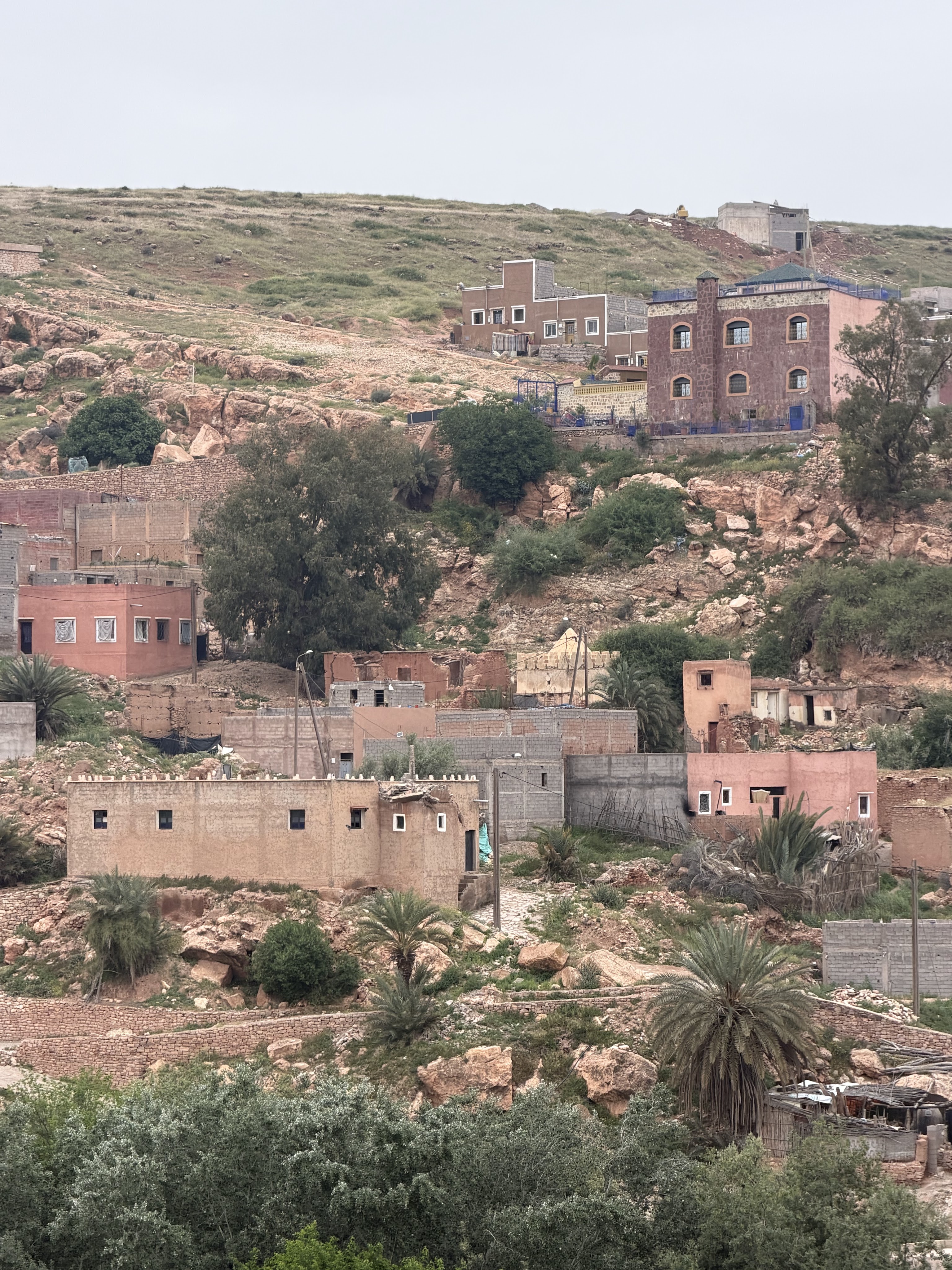
Along the way to Imlil, in the middle of rural Morocco, I spotted a shop in Tanahout with a sign that said the houses on the other side of the hill were the remains of a Jewish village named Azro. My eyes nearly popped out of my head. These are the remains of the village:
While some Jews in Morocco escaped there following the Christian Reconquista of Spain (and the subsequent Inquisition), others had already been living in the country for 2,000+ years. According to the shop owner, this village and its Amazigh Muslim neighbors had very good relations for many, many generations. He even sold some Judaica supposedly from the village (I have no way to verify its origins but I did buy some).
I frankly didn’t know much about Amazigh-Jewish relations before visiting Morocco but apparently they are deep and continue to this day, with descendants of Amazigh Jews coming back to visit frequently from France, Israel, and around the world. I’ll have a lot more to say about Morocco’s Jewish community in an upcoming blog, but I loved getting to know its history on my trip. While I encountered perhaps two or three instances of antisemitism, for the most part I found people incredibly friendly and welcoming when I mentioned I was Jewish. I felt safer as a Jew in Morocco than I have in parts of Europe and even parts of the U.S.
If Amazigh people have been in Morocco for 10,000-12,000 years and Jews for 2500 years and Arabs for 1300 years, what does that make Morocco? I mean even Moroccan Arabic is an eclectic mix of standard Arabic vocabulary, French, Spanish, and yes – Amazigh words. It is deeply incomprehensible when spoken at a normal pace to Arabic-speakers from countries such as Syria, Egypt, and Saudi Arabia.
There is an important word in Arabic that explains what happened (and is happening) in Morocco: استعرب (ista3raba). This word means to “Arabize”. To become Arab by adopting the language and customs of the culture. In other words, while some Moroccans are descendants of Arab tribes that migrated to the country over the centuries, many are Amazigh people who became Arabs. Some perhaps by choice and others due to social pressure and stigma.
This phenomenon is not unique to Morocco and it partially explains part of the wild diversity of Arabic dialects (or perhaps better put, languages) of the Middle East and North Africa. In the Levant, for example, the Arabic is layered over Aramaic and Hebrew influences from the civilizations that existed in the region before the Arab conquest.
The King of Morocco has, in an important step, started to honor this complex cultural diversity rather than suppressing it in contrast with what some leaders in North Africa have done in the past. The 2011 Constitution states that Morocco is: “A sovereign Moslem State, committed to the ideals of openness, moderation, tolerance and dialogue to foster mutual understanding among all civilizations; A Nation whose unity is based on the fully endorsed diversity of its constituents: Arabic, Amazigh, Hassani, Sub-Saharan, African, Andalusian, Jewish and Mediterranean components.” The bold text is my addition to make this point: Morocco is now officially a multicultural country, with Amazigh as a co-official language with Arabic. And its Jewish community is recognized by the ruler of the land as essential to its history and essence.
Morocco is an Arab country. But as my travels there (and Muhammad at my hotel) taught me, it is not only an Arab country. Its layers of Amazigh and Jewish history run deep, and even its Jewish community has used many languages and embraced different identities throughout its history.
In an era where people are looking for black and white answers to complex problems, Morocco is a welcome bit of gray space. It is a place full of diverse and sometimes competing identities that still manage to co-exist better than in many countries around the world.
I’ll have a lot more to say about this fascinating country. Until next post, bslama, ar tufat, lehitra’ot – see you soon!
My journey with Arabic started at the local Jewish Community Center, where I took a class in high school. I then studied the language for four years in college and with Syrian refugees on Skype. My studies were helped by my passion for languages and my love for Hebrew, its very similar sister language.
Why Arabic? It all started when I was sitting in my Lebanese friend Jad Zakhour’s (z”l) car hearing my first sounds of Arabic music. It was those tantalizing sounds, plus the delicious food and warm welcome I always received in his house, that caused me to become curious about this language. After all, Arabs and Jews are cousins. If we’re ever going to make peace with each other, we need to understand each other.
As with many other Jews and Israelis, I felt the pain of October 7th deeply and personally. In addition to the horrific results of the attack, the subsequent war has involved my friends risking their lives by serving in the military, going through countless rocket attacks, and a friend’s nephew being injured in the vile Hezbollah terrorist attack on Druze kids playing soccer in Majdal Shams.
I lost friends over the past couple years who showed their antisemitic (or at best, deeply ignorant) sides to me. I was discriminated against in the LGBTQ+ community, including being screamed at in public for being Israeli. I would walk by my local synagogue only to find antisemitic graffiti daily across the street.
All of this caused me to distance myself from Arabic. Anything that sounded like Hamas, like terrorism, like antisemitism, made me feel disgusted and frankly, scared. This was not an easy thing for me to reject. I had written an entire book about my relationship with Arabic as a gay Jew. Arabic is in my veins, it is part of what motivates me to make the world a better place for everyone. Yet the pain was so raw I just couldn’t do it. I couldn’t even listen to Arabic music for over a year.
Something changed for me recently. Because of the Syrian government’s attacks on its Druze minority, Arabic’s spirit has reawakened in me. Why? I’m not entirely sure. But I think it’s because I remembered – Arabic is not just Hamas. Arabic is not just Hezbollah and the wretched Syrian government. It is also the language of the my friends. It is the language of 20% of Israelis. Yes, it is a language of many Muslims – and also Christians, Alawites, Druze, and Jews! It has been a Jewish language, with specific Jewish dialects, for many hundreds of years across the Middle East. Some of which were spoken by my Iraqi Jewish neighbors in Tel Aviv.
Terrorists don’t get to “own” a language. Neither do antisemites. Arabic can and should be for all, just like any other language. It is a way to communicate, it is a way to build bridges, it is a way to make peace. I don’t know how to make peace in the Middle East, but I do know I’m in the process of making peace with Arabic. And maybe, here as I sit writing and soaking in the sounds of the Arabic music that got me interested in the first place, making that peace internally is the first step to making a more peaceful world for everyone.
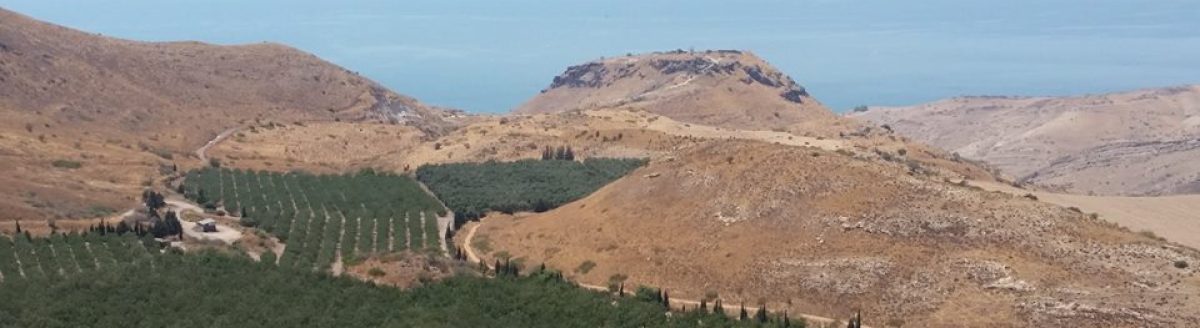
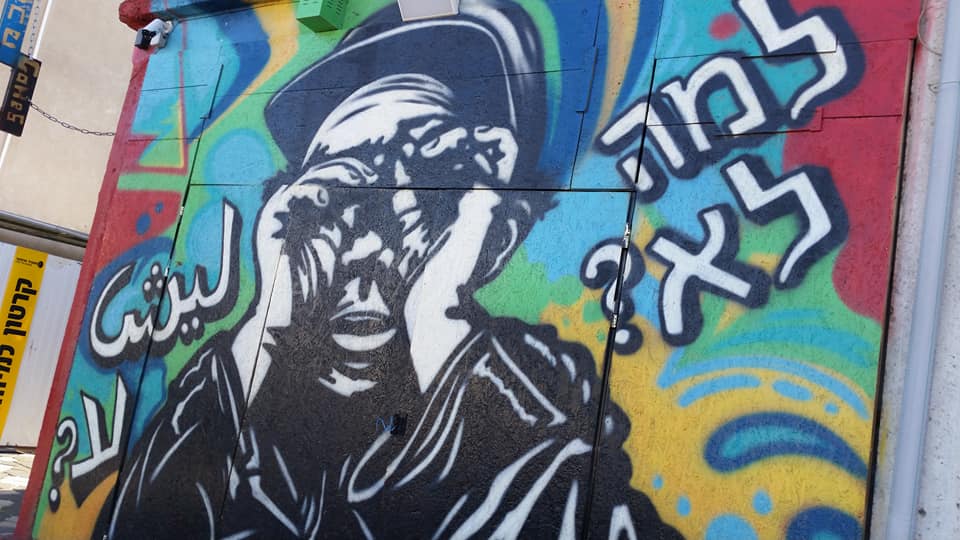
As my blog banner photo from Majdal Shams says in Hebrew and Arabic: “why not?” The time to heal, to build, and to grow is now. Make your internal peace and then maybe one day all sides can reach out their hands to create a safer, more peaceful world. Ken yehi ratzon, inshallah, may it be so.


You must be logged in to post a comment.