It’s hard to be a Gay Jew

For those of you who haven’t been following the news lately, Israel has been a hot mess.  After I came back from vacation from Romania- a peaceful, mountain-filled vacation- I turned off the airplane mode on my phone.  And saw 200 Hamas rockets hit my friend’s Kibbutz near Gaza, that Netanyahu’s government had banned gay surrogacy, and that his friends in the Knesset passed a law downgrading Arabic and non-Jewish citizens.  Also, Israeli police arrested a liberal rabbi for performing a (non-legally-binding) wedding at 5am.  Befitting of some of our more theocratic neighbors- and perhaps more authentically Israeli than we’d care to admit.

In the course of just 48 hours, I felt like my entire identity was under attack.  As a Reform Jew, I can’t get married here with my rabbi.  As a gay person, I now have no affordable legal way to build a family.  And I can’t get legally married.  As an Arabic speaker and lover of Druze and Arab culture, I saw my identity and my friends under attack.  Somehow, the people doing the attacking- Netanyahu and his allies- somehow think they are the victim.  As if it’s 1939 and the entire world is out to get them.  While in the meantime, they are the ones sitting in positions of power, using that power to persecute innocent people.

The word for this phenomenon is “siege mentality”.  The idea, psychologically speaking, is that you feel the entire world is against you, so you act irrationally, refusing to see gray space, and delineate between “us” and “them”.  And boy you’d better hope you’re not a “them” because you become a living target.  For unbridled and illogical hatred.  We’re hardly the only society to experience this and it has a special intensity here.

That’s partially because siege mentality has deep roots.  Often in a combination of trauma (the Jewish people has had a lot of that), nationalistic feelings, and according to many studies, religiosity.  Not the kind of religiosity where you simply enjoy celebrating holidays and connecting with God.  But the kind of religiosity that bleeds exclusivism and at times paranoia.

As a PTSD survivor, I can relate.  On some level, siege mentality is about siege.  When you feel you’re under attack- as our people has been for centuries for no logical reason- you hunker down.  You put up walls to protect yourself.  Mentally mostly, since as a minority you often have no other recourse.  Though, as we see with time, some of these walls become quite visible and physically manifest.

What at one time was a useful skill to be able to protect ourselves has now become a liability.  Not because we have nothing to protect ourselves from- we traded 2,000 years of Christian persecution in Europe for some pretty rough neighbors.  Iran and Syria are hardly puppy dogs.  And you certainly can’t blame all their societies woes on us- though some people find creative anti-Semitic ways to do so.

What is harder to admit for those who engage in siege mentality paranoia is that sometimes they, we, you, me, people- do make mistakes.  That in fact, while the Palestinians have dangerous streaks of extremism, they are not the Nazis.  And not all of them want to kill us- even though some do.  That Arab citizens of Israel are by and large law-abiding citizens whose roots here often go back hundreds of years.  And that for every extremist among them, you can find dozens of productive, kind, responsible citizens.

Which leads me to today.  Today there was a Druze demonstration in Tel Aviv.  I went- anyone who has read my blog before knows I LOVE Druze 🙂 . The Druze are feeling increasingly angry with Prime Minister Netanyahu for relegating them (and other non-Jewish minorities) to a second class status.  Despite, in their case, having served in the military for 70 years- like any Jewish citizen.  Their loyalty to this country is not only being ignored by this government, it is being thrown in the trash.  A shame and a serious error.

The rally was invigorating.  Over 100,000 people crowded Rabin Square- for the first time I heard Arabic on the loudspeaker right in the center of Tel Aviv.  Since I spend a lot of time with Druze, I even bumped into two different Druze friends at the rally.  I stand with you my sisters and brothers- we will win.

Why has our Prime Minister, when facing *real* threats from Iran, Syria, and Hamas, decided to make the Druze our enemies?  Why has this government diminished and attacked Reform Judaism?  Why does this government deny basic human rights to the LGBTQ community and all non-Jewish minorities in this country?  Something, by the way, many Israelis like me are working to fix.  For ourselves and all who we love.

Because Prime Minister Netanyahu is living in a contorted fantasy.  More like a nightmare.  In which someone’s difference becomes a source of anxiety.  Rather than a challenge to overcome and learn from.  To build a better society.

Which leads me to the title of this blog.  I am a gay Jew.  Always have been.  Being one is not so easy- I’ve discussed it here many times before.  In the States, I often felt like the odd Jew out at LGBT events (not to mention that some are starting to ban Jewish pride flags).  And at many Jewish events, I was in the minority as a gay person.  Often while the singles meat market churned around me.  It was lonely at times.  And sometimes, worse.  I once had a guy dump me because I didn’t eat pork…I didn’t need to read between the lines because it wasn’t particularly subtle.

One of the challenges of being a gay Jew is that our identity pulls us in two very different directions.  Judaism, even in its liberal forms, is essentially about preservation.  It is conservative in the sense that it aims to keep our history and traditions alive.  And we know that if we don’t do it, it won’t happen on its own and we will disappear.  To become the next Akkadians or Shakers.

To be gay is not to invent an identity- we’ve been around forever, as ancient cave pictures show.  It is, however, in modern society, to be an innovative force.  Because our identity is crafted on top of the modern landscape and the people who most reliably support our freedom are the most innovative.  The progressives.  The people who are open to change- rather than focusing on conserving sometimes ineffective or outdated norms.

This is an internal conflict that’s hard to resolve.  Because the instinct to preserve and conserve can be quite repulsive to the progressive elements of society.  And our desire to feel accepted and change some aspects of our traditions to include us- that can deeply offend conservative sentiments.

This past week, I saw this play out.  Before going to Kabbalat Shabbat services, I saw a Facebook post in which a man described how a Jerusalem restaurant refused his friend service because he was gay.  Turns out, perhaps not by coincidence, that both Ben Rosen and his gay friend Sammy Kanter, are American rabbinical students at Hebrew Union College.  Fellow Reform Jews.  In Sammy’s case, a fellow gay Reform Jew.  In my experience, my movement, more than any other, strives to balance modernity and tradition and breeds some pretty amazingly self-confident queer people and allies.  We’re not perfect, but we’re the closest thing to a home that I have found as a gay Jew.  Who likes to conserve and innovate and feel welcome.

I contacted them immediately and have been helping them navigate the bizarre and chaotic world of Israeli politics, press, and advocacy.  They both- Ben as an ally an Sam as advocate- really impress me.  I sometimes miss the rambunctious and proud progressive Jewish queer identity that flourishes in America.  While here, I still encounter (even among some friends in my movement) a sense of deep unresolved sexual shame and conservatism.

I will continue helping them pursue justice.  Nobody deserves to be kicked out of a restaurant for who they are.  Anywhere.  In the meantime, please don’t frequent “Ben Yehuda 2” in Jerusalem.  They don’t deserve your business.

How does this tie together?  Sammy, if he were an oleh like me moving to this country, would probably live in Tel Aviv.  There aren’t a heck of a lot of Reform gay Jews in Jerusalem- for good reason.  It’s a deeply conservative city.

So why is he there?  He’s there, for a year, for the same reason I’m in Israel: we love our Judaism.  And for Jews, nowhere is more Jewish than Jerusalem- black hats or not.

So his desire to conserve his Judaism has landed him- and many gay Jews- in conflict with our queer identities.  Because where we wish to conserve and evolve, some people simply want a deep dive into a protective fortress.  An idea that Judaism never changes- even while their own practices demonstrate that it does.  And which has resulted in untold incitement against their queer brothers and sisters.  Including an article this week that called for us to be killed.

How do you bring folks out of that fortress or at least allow it a bit more room to breathe?  So that it can still be protective- and not necessarily the same as mine- and recognize that not everything they see as a threat is in fact dangerous.  That we have a powerful army and while some people wish us harm, not everyone does.  Least of all from within.

I don’t have a solution at hand.  Perhaps I can suggest to my friends on the far right (and occasionally those who live with this mentality on the far left) to find counterexamples.  Whenever I get nervous about a group of people, I try not to discount my fear, and I try to find some examples of people I feel safe with.  So when I just read an article about anti-Semitism in Romania, I recalled a woman there who asked me for klezmer groups because she likes Yiddish.  Doesn’t take away from the scary nature of persistent anti-Semitism.  And it does give me a nuanced perspective.  That makes me feel a little more relieved and better able to protect myself without isolating my mind from the world.

Whether it’s Sammy or the Druze or Arabs or anyone else- I’m not doing this for you.  Although of course I am- Sammy is a wonderful person who I’ve only talked to a few times, but already see his great courage and resilience.  And sense of humor.  And of course my experiences with Druze and other peoples inspire me to reach out and show some love.

But I’m not doing it for you.  And I’m not doing it for me.  Of course I am, because I’m a queer Reform Jewish Arabic speaker who values diversity.  So yeah, I am protecting myself and want a better life for me here where I feel safe and valued and equal.

But then who exactly am I doing this for?

Us.  Sammy, the Druze, me.  Us.  Because we share a bond, we share a love, we share identity, and together, we might not be able to defeat the siege mentality.  But we will certainly give it a shot.  Because sitting at home complaining, while justified and sometimes necessary, will not alone resolve this pain.

So grab my hand, and let’s give this a shot.  Because I don’t go down without a fight and a bit of hope that we won’t go down.

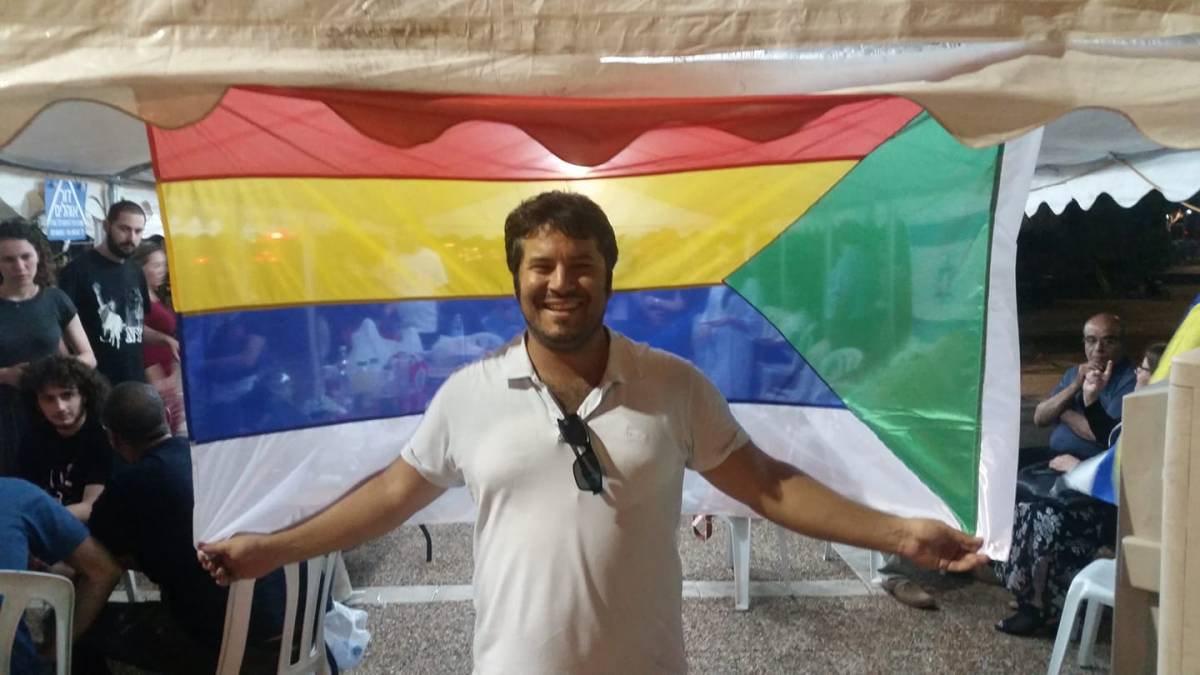
p.s.- the cover photo is of me with a Druze flag.  Which looks a lot like a pride flag.  So that’s awesome 🙂

Israeli lives matter

Today, I took the train south to Sderot.  Sderot is a city in southern Israel, spitting distance from Gaza.  As of November 2007, 6311 Palestinian rockets have fallen on the town.  At that time, 75% of children suffered from PTSD.  By the beginning of June, Palestinian terrorists had set 3,000 separate fires, destroying 2,500 acres of Israeli farmland and parks.  And there have been both rocket and fire kite attacks since.

I wanted to see things with my own eyes.  Knowing that there are still fires- and the risk that I could get caught in one- I went.  I went with the best knowledge available, consulting with locals.  Ultimately embracing what one person said when I asked if there were fires today: “you can’t know”.

Living in Tel Aviv, you don’t feel this at all.  The beach, the nightclubs, the hummus- the buzz.  You’d have no idea radical Islamic terrorists are trying to breach our border- and have launched rockets and flammables at us.  Tel Aviv feels utterly normal, like most of the country.

As I walked from the Sderot train station, nothing seemed strange.  The people seemed normal, there were trees and businesses.  Is it possible I went to the wrong city?  Maybe the fires were elsewhere?  A cabbie told me otherwise, but maybe he was wrong.

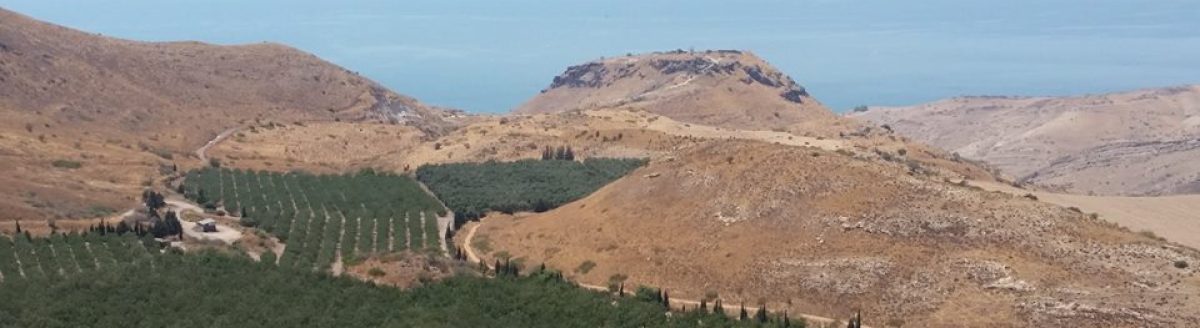
I walked closer to the border.  Sderot is .62 miles from Gaza.  A kibbutz next to it, Nir Am, is 800 meters from Hamas territory.  I physically stood one mile from Gaza today.

I asked around the kibbutz to find where the scorched land was.  Admittedly an odd question, but because Israelis are always willing to help, a man actually gave me a ride to the burnt fields.  Before picking up his daughter from school.

I asked him how it was living there and he said: “I don’t know the right word, it’s not that we’re used to it because you never really can be.  The fires happen.  We survive.”

He told me how he has to explain Palestinian terrorism to his 5 year old.  His two year old doesn’t yet have the words to understand it.

My heart broke.

I dare any of my “enlightened” left-wing friends in America who have more often than not heaped meaningless bile at my country.  I dare them to look that 5 year old in the face and call her an occupier.  That somehow she deserves to have her playground melted, her trees burnt, her childhood robbed.  While you sit pretty on Native American land you know literally nothing about.  But feel utterly entitled to.  While we are actually from here.

I bid the man goodbye and told him my heart is with him.  I could tell he was moved- not many Tel Avivis come visit this part of Israel.  Especially now- though they should.

I headed towards a high point.  He said I could see the burnt fields.  To me, the fields just looked kind of like the Great Plains in America, but with shorter grass.  I didn’t really understand what was so grave.  Until I noticed the color.  The ground was dark- a charcoal black.  And I looked on a map and realized- this wasn’t the Great Plains.  This used to be a forest.

An almost completely leveled forest.  But for a few trees bravely peeking out, embarrassed at their nakedness.  Surrounded by slivers of their former friends.  Burnt to a crisp.  Like an onion on a grill, but with all the water sucked out, and a dry carcass left to rot.

This scene was as far as the eye could see.  I was probably looking at Gaza without realizing it.

What was astonishing was how normal the rest of the kibbutz was.  If you didn’t really know what had happened, you’d think it looked quite pretty.  And it is.  And the people there, quite typical for an Israeli town.

Then you look at the ground.  You notice the dirt is light brown.  Except in certain large patches, where it is pitch black.  I leaned down and grabbed a handful.  There was nothing soil-like about it.  It was soot.  Ash.  The cremated remnants of a forest once planted there.  A place with picnics and fun.  Now destroyed in the name of greed, fanaticism, and violence.

What I also didn’t realize until writing this blog, is that Hamas actually buries tunnels under this kibbutz.  Probably under my feet.  To smuggle weapons and to kill Israelis like me.

Some people on the far-left like Jeremy Corbyn call Hamas his “friends”.  Others think it’s some sort of peaceful liberation movement- that calls to “liberate Palestine” (from me) are somehow equivalent to women’s liberation or gay liberation.  The delusional Chicago Dyke March, which last year kicked Jews out for waving a Star of David pride flag, this year waved dozens of Palestinian flags.  And said “all anti-racist work must inherently be anti-Zionist“, without recognizing the irony of becoming anti-Semites themselves.  And aligning themselves with a nationalistic movement that’s utterly homophobic.

The reality is Hamas is anything but progressive.  In Gaza, it bans women from smoking, Palestinian hip-hop concerts, dog walking (yes), and women’s TV channels.  It’s a professional murder machine.  Its goal is to massacre me.  That’s not a metaphor- it’s its practice.  It spends millions of dollars burrowing under the earth to harm me instead of feeding its own people.  Who lack sufficient electricity, food, and job opportunities.  I hardly believe it’s solely one party’s fault- the Egyptians, the Israeli government, Hamas, and the Palestinian Authority are twisted in a confusing knot.  Not easy to get out of.  But let’s stop pretending the Hamas government is an innocent teen playing with matches.  It’s manipulating its people and putting countless lives in danger.

Recently, I was in Rome.  I visited the Jewish ghetto- the second ghetto established in Europe.  For the purpose of corralling my people.  Every entrance was marked by churches on either side.  Where popes made Jews listen to sermons upon entering and leaving the ghetto.  To try to convert us to his devil worship.  And by devil worship, I don’t mean Catholicism- though the religion has more than a bit of reckoning left to do with its anti-Semitic past.  And still-locked Holocaust archives.  By devil worship I mean torturing religious text in order to demean a near-powerless minority.  Who thrive or die at your whim.

Rome is the oldest Jewish community of Europe.  And Judaism the oldest religion of Italy.  Having survived the Roman Empire who destroyed Jerusalem, countless anti-Semitic popes, Italian fascism, and Nazism- they’re still around.  And have amazing food, history, synagogues, and culture.  A testament to the resilience of my people.  They have a keen sense of who they are- and a pride in being Italian, Jewish, and quite Zionist.  They don’t live with the American Jewish sense of privilege and stability.  They are, numbering just a few thousand and only decades separated from actual fascism, quite aware of the importance of a Jewish homeland.  They don’t take it for granted.  As the golden bricks on the street, indicating Holocaust victims everywhere, make quite clear.  Never again isn’t a cute phrase to say once a year- it’s the Roman Jewish community’s personal story.

As I write this blog, I’m getting tired.  I’ve had a meaningful and exhausting day.  I slept very little last night, and I’m up late writing this blog because I think it’s important.  And it offers me some solace, even as my electricity just went out for some reason.  Meaning no air conditioning on a hot Middle Eastern night.

Life in Israel is unpredictable in some ways.  Although you can always count on warmth and deep kindness, much more frequently than I’ve experienced in American culture.  Quite similar to Italy, Cyprus, Spain, France, Romania, and Hungary where I’ve visited this year.  Begging the question are we the weirdos or are Americans far too individualistic for their own good?  Even today, as I grabbed sushi after my adventure, I met a young man who lived in Sderot.  Who, when I asked him how he felt about the recent situation, said: “I grew up near Hebron, with attacks my whole childhood, the situation here has been good the past few years.  It’s gorgeous here, come back and visit.”  We chatted, smiled, cracked some jokes.  And I ate delicious sushi- some of the best in Israel.  It’s by the train- go visit.

In short, yes my air conditioning just went out.  I could be like the French Jewish tourists who visited my tiny synagogue for Pride and complain about the water temperature at dinner.  Or I could be a human being and say: “mah laasot?  Nistader.”  What can you do?  We’ll roll with it.

Despite the incessant provocations of left-wing “do gooders” boycotting us and ridiculing our country, we’re actually really good at something they lack.  While large swaths of the American Left I once called home repeat over and over again the word “resistance”, I think they need another R word: “resilience”.

From afar I see every tweet and every sad news story turn into a 4 day mourning period (or battle), I see Israelis all the time just living.  Fully.  The guy at the sushi place who, rather than dwelling on rockets and fires, tells me about the gorgeous sites in his town.  The dad who tells his 5 year old about terrorism with a hug.  And the 5 year old who goes to school, maybe scared and also singing.  And the American oleh who visits Sderot by himself and makes a truly meaningful experience out of it.  Joking with the bus driver all the way home.  While fields nearby are burning.

Israelis know how to squeeze every last drop out of life.  Like our delicious juices, we come out sweet despite it all.  A sweetness few places can compare with, especially places that just haven’t suffered so much.  That have it a bit easier than they really understand.  So they don’t put their own issues into perspective.  And live in a constant state of chaos- some of which is perpetuated by their own lack of self-awareness.  Or of the problems facing others.  Like the 50,000 Syrian refugees crowding the Israeli border in fear or the brave Iranians protesting their dictatorship today.  My neighbors.

If there’s something I could wish for America, it’s that you had a few more problems.  Real problems.  Not problems you’re fighting about on behalf of other people, but problems you have to face.  I know- that sounds a bit harsh.  Perhaps it’s my Israeli bluntness.  But having some real toughness in your life can give you the chance to overcome it, to master, to learn to roll with the punches.  So that next time something bad happens, you’re not spending hours on Facebook.  You’re acknowledging it, moving on, and living.  Like my friend who lives in Nahal Oz, walking distance from Gaza, fields burning, studying for her exams and planning a pub night for friends.  It’s harder than seeing a racist tweet and she also turns out happier.  I think it’s no accident that Israelis turn up as some of the happiest people in the world on survey after survey.  Because if you can manage to find joy while your town is on fire, you can pretty much handle everything.

As I left Nir Am, I looked at a desolate field.  Burnt, brown, empty.  And I noticed one little green plant.  Just making its way above the decay.  Blossoming.  A source of new hope.

This plant is like Israel, like the Jewish people.  Every time someone comes to destroy us, a little remnant stubbornly survives, keeps our people going.  Even when those around us decry our “tribalism”, its our very sense of identity that keeps us alive.  Which is why there’s a Jewish state but no Akkadian one.  We live our heritage.

As someone who is a PTSD survivor, like a lot of Sderot and a lot of Israel- I feel at home here.  We are people who know how to survive- and actually turn it into an advantage because we can thrive anywhere we’re planted.

I’m proud of the Israeli Defense Forces for keeping us safe.  And we’re not about to give up our arms to satisfy a bunch of wealthy self-indulgent critics sipping fair-trade coffee in Seattle.  Living in the labyrinth of confusion about why anyone could possibly disagree with the Editorial Board of the New York Times or the latest NPR story.  A fragile and self-reinforcing bubble much in need of a gentle pop.  For the sake of America itself.

If you want to know why I visited Nir Am and Sderot today, it’s because I love my fellow man.  I love my people.  I care about others- I love my friends.  The Jewish people is a story of resilience.  Our anthem is hope.  Join us, help us sing it, so that one day, instead of fiery balloons, maybe our neighbors will play with the normal kind.  At a bilingual fair.  A future of dreams and love.

In the meantime, we’re standing guard.  We won’t be sent to the fire again.


My last day as a Liberal

For those of you who haven’t been reading American news (which would be most of the world- America is 4.3% of the world’s population), it has been a politically charged week.  Immigrant families detained at the border have been separated- children from their parents.  This is incredibly sad– the journey to America was probably scary enough for these kids, and now they’re without their parents.  Even in jail.

What’s also sad is how the American Left, which I once called home, has been reacting to this news.  In opposing the President’s policy, I’ve seen friends on Facebook suggest moving to Canada (and that Canada should build a wall to keep Americans out) and that Trump is “pure evil destroying civilization itself”.  I’ve seen people pouring out rage, scolding others for being silent- saying silence is assent.  I’ve seen many- too many- Holocaust references.  One person wrote “it starts with 2,000 and ends with 6 million”.  Another person called the detention centers “concentration camps”.  I wrote to her that I also opposed the policy and wanted her to consider rephrasing because my family was murdered in concentration camps.  She wrote back “I’m sorry your family suffered that but…” and then quoted me a dictionary definition of concentration camps.

The American Left is sick.  Not sick like disgusting- sick like ill.  Perhaps partially in the face of an equally bombastic President unwilling to consider other points of view, they’ve become a mirror image of his rhetoric.  “Facts have a liberal bias”, “which side are you on?”, “silence is complicity”, “no tolerance for intolerance”.  Trigger-happy accusations of racism and any -ism which actually obscure when those isms are a true danger.  People are afraid- this is a confusing time for America.  Unfortunately, some people in the ideology I once called home are using it as an opportunity to engage in a witch hunt against anyone who disagrees with them.  Which only prolongs the conflict plaguing that land.

I grew up being taught liberal politics- at home and at school and at synagogue.  There are still values I identify with- diversity, gender and sexual empowerment, fairness, and others.  And there are some really problematic ones I’ve come to discover as I’ve embarked on my own journey of visiting communities I knew little about.  And in discovering the multifaceted texture of living in Israel, my home.

Some of the problems are that liberalism, progressivism, left-wing activism- when practiced in an orthodox fashion- promotes diversity, but not diversity of thought.  People who stray from the “path” are labeled as prejudiced and ignorant, in need of education.  Rather than understood as full human beings capable of disagreeing for reasons both based in fact and not.  I know what I’m talking about because I used to think this way.  Like the people in the Democratic party who rail against any elected official who strays from their views.  They are called “DINOs”- Democrats in Name Only.  While I think some politicians modify their views for insincere reasons, I don’t think we should call out every elected official (or private individual) who happens to have a different point of view.  Like a pro-life Democrat, or a pro-gay rights Republican.  Or an independent, like me at the moment, who doesn’t really care for party labels and rooting on Election Day like it’s a national sport.  Although it is kind of fun to watch the votes come in 😉

When I worked in progressive politics (for Obama twice, for several immigrant rights groups, on many Democratic campaigns), I noticed something problematic from the start.  Democrats and Republicans function as teams.  When one of yours is in power, the vast majority of voters and elected officials on your team don’t openly criticize him or her.  Obama, for instance, deported more immigrants than George W. Bush, one of the reasons I left his Administration.  There are complicated reasons for this- I disagreed with the policy and I also think (in retrospect) that governments have an obligation to secure borders and provide safety to those who reside within them.

At the time, even the Latino advocacy group I worked at mostly stayed silent.  While there weren’t the heart-wrenching pictures you’re seeing today on social media, Obama’s policy separated hundreds of thousands of families.  And I didn’t see any superstorm of rage on my social media or accusations of treason.  There are many reasons for this- for advocacy groups, they don’t want to bite the hand that feeds them (both elected officials and liberal foundations).  They want access, and the Administration told them (I recall specific conversations with other non-profit colleagues) that if they openly criticized the President, they’d be invited to fewer White House meetings.  The dynamics and economics of politics and non-profit organizations is a difficult one- people have reasons for acting the way they do.  And I feel it’s deeply hypocritical to only call out behavior you disagree with when the person in power is from the “other team”- in this case, Donald Trump.

The other day I was lucky to be on vacation in Italy.  I was on a train winding through the South when I happened to sit next to an American.  She was an Italian language professor in the States in Italy for a conference- paid for by her university.  Not bad.  We had some friendly chit chat- I often am nervous talking to Americans these days since so many on the progressive end of the spectrum hate Israel.  Often obscured by politeness  but never far beneath the surface.  Who love the beaches of Tel Aviv and then go build their “Israeli apartheid walls” on campus.

The professor’s face looked grave.  “It’s hard to teach in the humanities these days.  We should enjoy it while it lasts.  I don’t know if I’ll be able to come to the conference next year.”  She paused, an empty silence, waiting for my response.  And I let the silence stand.

Here’s some cold dark truth for you: you’re lucky to have a job where someone pays you to go to Italy.  Yes, funding for the humanities I’m sure is down and job opportunities are decreasing- I considered a PhD in Linguistics and the odds aren’t great.  And I live in a country where 50 rockets fell on my friend’s kibbutz while I was on vacation.  Where Iran fired missiles at our northern border a few weeks ago.  Where I live alongside Darfur genocide survivors and Jews expelled from Iraq and Syria.  I have a friend who’s a Burmese refugee who hasn’t been home in 20 years because of his country’s ruthless dictatorship.  I’ve personally lived through air raid sirens, being racially profiled at a checkpoint (which was awful and I think also protects people overall), rocket alerts on my phone, suspicious packages being disarmed in front of me, and I’ve actually watched bombs go off in the Syrian Civil War.  Meters away from where I stood.  A war which, by the way, the American Left practically ignores.  I can’t remember a single picture of my friends rallying for Syrian lives.  Because that doesn’t fit into a simple picture, a black-and-white world vision.  And because, let’s be honest, it’s not in America.  America’s problems come first for America, no matter how small they truly are in comparison with the rest of the world.  Just ask the 350,000 Syrians who can’t read this right now.

Despite the terror that Israelis, that Syrians, that Kurds, that so many people face- on a level Americans can’t even imagine- I don’t see any progressives rallying for us.  When hundreds of rockets fall on my country, I don’t see Facebook light up with support.  In fact, I don’t see anything at all.  The only time it does light up is with sympathy for Palestinians.  Which I think is totally fine- if you also sympathize with us.  With all human beings.  The problem is that’s not what’s happening.  Israeli lives don’t matter to large swaths of the American Left.  That’s how I feel as an Israeli who once called that community home.  Who voted and volunteered for Bernie Sanders, who was a pledged delegate to the Democratic National Convention that nominated Barack Obama.  Perhaps I partially left you, Left, but I think you know you also left me.  If my vote is up for grabs, you’ve got issues.

I understand the appeal of easy answers.  When I was struggling to find my steadiness, ideology helped me feel a sense of sturdiness.  I read with great passion anarchist, socialist, communist- any -ist- readings.  Some of the ideas I think are stimulating and I try to find something to learn from in every community or background.

And there is a dangerous, if comforting, continuity to these ideas.  If we just did A, B, & C, everything would be ok.  If we pulled out of trade deals, if we had open borders, if we passed Obamacare, if we removed all our military bases, if we (as people have suggested in rally signs this week) dismantled our border control.  If we, if we, if we.  Then everything would be great.

This is a lie.  It is a lie to make people feel stronger and I think it ends up inflaming conflict rather than softening people’s hearts and creating shared hope.  I used to feel quite confident in my prescriptions.  And now, I’ve learned to live in the space where I’m not sure there are solutions.  Or the solutions that exist require great empathy for all parties involved because they’re complex and people have reasons for their feelings.

The thing I most see as contributing to a healthy world is understanding.  Including of those who disagree with you.  So that even when you argue, like my Israeli atheist friend who studies with a Hasidic rabbi, you can pat each other on the back and say “see you next week”.  That’s not a fantasy- that’s everyday life for many, many Israelis.  Who sit on top of a gift that America would be wise to learn from.  Israelis, Jewish or Arab, secular or Orthodox, are not shy about their views.  We’re much blunter than Americans- we’re famous for it.  And I’ve noticed that Israelis, on a day-to-day basis, manage to interact with people of very different backgrounds with a lot less conflict than Americans.  And a lot less passive aggressive withdrawal.

Yes, that might sound shocking given what people see on CNN, but Israelis actually mostly get along.  Perhaps because we live with conflict, we know how to manage it better.  And live our lives in deeply fulfilling ways.  Appreciating each breath as a gift.  Without obsessing over every racist tweet or faux pas for days on end.  We might feel sad (or cheer) and move on.  If we took extended mourning periods for every loss or problem, we wouldn’t move.  So instead, we live our lives.  In a way that Americans could really learn from.  From us- we have something that can help you.  It’s not America’s job to wander the world lecturing other countries.  God’s voice is sprinkled all over this planet.

Barack Obama, whose first campaign I worked on, had a positive contribution to the national dialogue: hope.  Whether or not you agree with him (I’ve felt both ways at different times), he brought a certain optimism to the conversation.  He used to say “there’s nothing wrong in America that can’t be fixed with what’s right in America”.  A kind of brightness lacking in the activism I see in today’s progressive thought.

When I look at America from afar, in my homeland of Israel, I feel deep sadness and anger.  A distance.  Sadness because I see society falling apart.  People unable to get along with each other.  A poisoned conversation among people who barely seem to recognize the humanity of someone who thinks differently.  I know there are Americans who feel like I do, it’s just hard to find them when living in the Mediterranean now that I’ve come to this understanding.  I wish you luck in healing that place- you have a friend in me.

I feel anger when I see American leftists bashing my country, comparing every Donald Trump action to the Holocaust, pulling their hair out without even acknowledging drastic problems affecting the rest of the world.  Yes, problems worse than a racist Roseanne Barr tweet.

America- I don’t miss you.  Although your Thai noodles are superior to Israel’s.  This is my home.  And I do want you to find serenity.  A way forward that acknowledges the best in progressive and conservative thought.  Because both (and many other types of thinking) have value and deserve an honest debate.  Rather than, on both extremes, a hate fest worthy of the 1860s.  When Americans killed each other at the other end of a barrel.  Instead of at a polling booth.

The last thing your country- or the world- needs is another group of people peeling apart at the seams.  I don’t have the solution, just try to see each other as humans.  Each interaction throughout your day can bring a bit more hope to the world.  Love, even when it’s hard.

I’m rooting for you America, even if my heart is deep in the East.

p.s.- the cover photo is from a coexistence mural in the Israeli Bedouin village of Jisr Al-Zarqa.  Maybe it’s time to get painting on the other side of the ocean as well 😉

Israeli pride

Today was my first Tel Aviv Pride.  Every year, thousands of Israelis and tourists gather to celebrate the LGBTQ community here in Israel.  There are floats and sexy guys and it’s awesome.

For the first time in my life, I got to experience it.

In America, I marched in many pride parades- almost always with Jewish groups.  This time, the parade itself was Israeli, so the idea of a Jewish group marching is obsolete- we are the parade.

The parade itself was actually slightly more sexually conservative than in Washington, D.C., which may amaze my Israeli friends.  And its energy was amazing.  There was such a sense of community.

Rather than marching with organized floats, the parade was Israeli- everyone could join in.  There’s no “order”- it’s just splendid flowing chaos of hot guys (and gals).

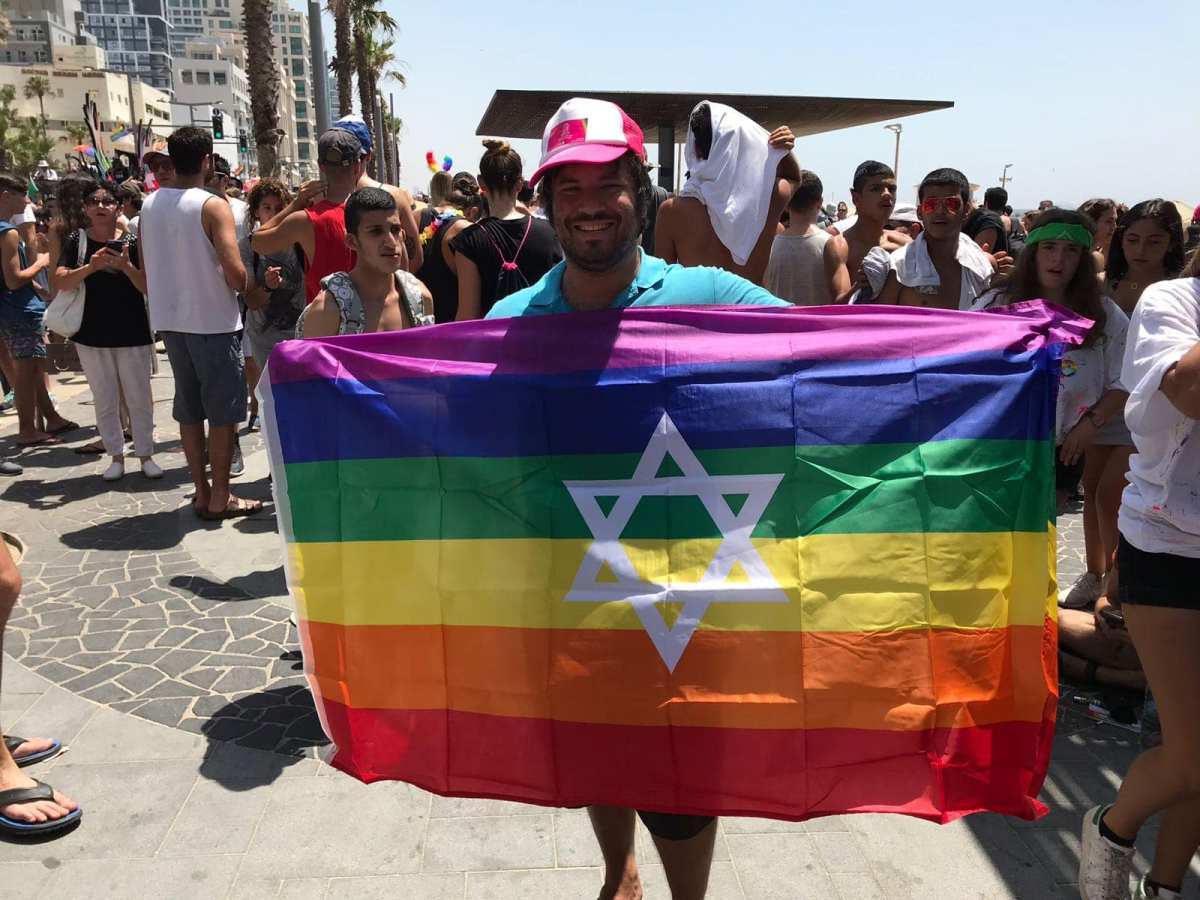
I came wearing an Israeli flag and ended up buying a Star of David pride flag along the way.  Because Israel is the only country in the world where it is totally safe- even blessed- to be a gay Jew.  And to be proud of it.  Without worrying if people will throw you out of the parade for liking Israel.  Which is a thing unfortunately abroad.

While Tel Aviv pride was smaller than Washington (although still quite large), it felt special.  First off, it went off smoothly and safely.  Not something to take for granted here.  I want to thank the brave policeman and policewomen who every day keep us safe.  Whether it’s some crazy person within Israel- or a terrorist coming from without- sadly too many people want to harm both Israelis and the LGBT community.  I’m grateful that I live in the *only* country in the Middle East where you can count on the police to protect the pride parade rather than break it up.  I hope one day my queer Arab neighbors fighting for their rights will be able to enjoy the same sense of security.

What was also incredible about today, other than the sunny weather, the post-parade swim at the beach, and the pride Shabbat services I went to, was who I went to pride with.

I first started by making plans with my friend Miriam.  A Spanish Jew who I befriended in D.C., she wisely followed me to Israel 😉  My friend Daniel was also in town from America, so we had a trio.  Then I got a message from Ezequiel, a gay Argentinian-Israeli friend of mine, so he and his Arab friend Ahmed joined us.  This was Ahmed’s (pseudonym) first pride parade- you could tell he was a bit nervous and perhaps somewhat closeted.  And wow am I proud of him for being brave and coming.  Being a gay Arab is not easy- as several friends of mine in their community have shared with me.  One Arab lesbian friend of mine stays in the closet for fear her family will kill her in an honor killing.  There are Arab families who do accept their children and unfortunately a lot who don’t.  Forcing queer Arabs into a difficult identity dance in both (largely Jewish) LGBTQ culture here and their background.  I’m glad Ahmed found a sense of belonging in the parade- you could see him flitting back and forth, often losing track of us as he made new friends.

We were joined by Kate, an Australian soon to be Israeli.  And along the way, we met a Ukrainian girl named Natasha (pseudonym).  Natasha is a lesbian from Haifa of Ukrainian background- this was her first pride.  She’s Jewish and not religious in the slightest.  Sadly, her Catholic girlfriend is still living with a lot of stigma so she wouldn’t attend.  She was alone- and I invited her to join us.

Later on, we were joined by an exceedingly hot Argentinian-Israeli named Ariel and his wife.

Kitzer, or “in short”, there we were: gay (me, Natasha, Ahmed, and Ezequiel) and straight (everyone else).  Australian, Argentinian, Spanish, Israeli, American, Ukrainian, Arab, Jewish and not.  A melting pot of newcomers and veterans (Miriam has marched with me on two continents!).  The beauty of Tel Aviv 2018.

There are people who reduce Israeli queer life, the most vibrant in all of Asia- the biggest continent on Earth- to “pinkwashing”.  This phrase is meant to say that when Israelis talk about their queer pride, they are simply using it to “cover up” the difficult reality facing Palestinians.  That we don’t deserve credit for our advances even if in other areas things aren’t so simple.

This is what I have to say: fuck you.  Do Palestinians face hardships?  Of course.  Some of those caused by Israel and not a small number caused by their own extremists or surrounding Arab nations.  And I pray for a day when they will be able to celebrate their own pride parades- and when their society will accept queer youth.  And when our two societies can live in peace.

Here’s the reality: while it’s true that the Israeli government uses gay rights as a promotional tool (often without giving us the full rights we deserve), our country is hands-down the most progressive one in the Middle East.  While some people want to turn our pride parade into a discussion about conflict, that doesn’t change some incontrovertible facts.  Palestinian society has harbored strong strains of homophobia long before the State of Israel even existed.  Homosexuality is illegal- sometimes punishable by death- in Syria, Egypt, Palestinian Authority/Gaza, Iran, Saudi Arabia, Qatar, Oman, United Arab Emirates, and Yemen.  If you really think this is because of Israel or Jews, it’s conspiratorial and anti-Semitic.  Believe it or not, other societies in the region sometimes have problems that have nothing to do with us.  And noticing that Israeli LGBT people openly serve in the military, enjoy anti-discrimination laws, and even serve as out-of-the-closet elected officials- that’s not pinkwashing- that’s the truth.

Some people are not capable of letting Israelis celebrate a single accomplishment without dragging us down.  We know- I know- that my country, like any other country, has things we need to change.  Guess what?  Your country does too.

While the far-left in Western countries continues to point the finger at us and tries to deny us even one day of enjoyment of our loving society, I’d like to point to an incontrovertible fact.

Today, I marched in pride with a Ukrainian lesbian and an Arab bisexual man- both citizens of Israel.  In their respective societies or homelands, their identity is often punished.  In Ukraine, by far-right thugs and in Arab society, sometimes even by your own family.

Israeli society isn’t perfect and the homophobia here exists as well.  Every society suffers this malignancy.

The main thing I want to point out is that despite the security risks today, the associated costs involved with putting it on, the rockets Hamas continues to rain down on us- Ahmed and Natasha could march in pride.  With me.  In peace and safety.

So rather than telling us how terrible Israel is, try asking yourself: “what have I done today to help people like Natasha and Ahmed?”  Because if you have the privilege of reading this from a nice laptop in a Western democracy, you’re pretty fucking lucky.  Because people like my friends don’t have many places to run.  And they don’t have the luxury of obsessing over every tweet.

They’re exploring their identity- and by the grace of the State of Israel- they can do without fear that this parade will be their first.  And last.

Catching the bus at the Auschwitz train tracks

I just got back from an amazing trip to Hungary and Romania.

The blessing of living in Israel is that we’re so close to many other countries and it’s cheap to travel there.  My roundtrip flight was $90.  And I got to see my ancestors’ heritage up close- I’m part Hungarian and Romanian!

Two of my great-grandparents were from Hungary and one from Romania.  They immigrated to the U.S. in the late 1800s, about 130 years ago.  Nobody from my family has been back until now.

When I booked my travel, I was excited.  And then I got nervous.  Even a cursory glance at Jewish news will reveal anti-Semitism is alive and well in Europe, including in the East.  Where it has thrived for centuries– one of the reasons my ancestors left.

I almost didn’t go.  I needed a relaxing trip and I was worried that with the Holocaust sites (which there were many), the potential animosity, and even homophobia, it wouldn’t be so fun or safe- emotionally or physically.

In the end, I decided to go.  And I had a life-changing, amazing time.

First off, I went to the least touristy places in both countries.  Debrecen and Satu Mare, in Hungary and Romania respectively, are no Budapest and Bucharest.  They are beautiful and special in their own ways, but there are no people hawking tchotckes and souvenirs.

I kind of liked that, especially for a short trip.  Almost no tourist information was in English and few people spoke it.  Which, surprisingly for a multilingual person like me, made it kind of fun.  Using basic vocabulary, I was able to get around and actually have some nice conversations with people.  On a basic level and it helped me avoid anything precarious.  Although interestingly enough, in just three days, I used French, Portuguese (in both countries), and a bit of Catalan.  If you know Romance languages, you can piece together something intelligible to a Romanian.  Pretty cool 🙂

There’s something relaxing about not knowing what everyone is saying.  Could be perfectly nice stuff, could not be, but not knowing was kind of nice.  I was able to engage meaningfully- I visited Jewish cemeteries, synagogues, and community offices.  Churches, restaurants, a farm, a romantic train through the countryside, and a university.  And I did talk to people- lightly and meaningfully.

And I have an interesting insight- I did not experience a single act of overt anti-Semitism.  And I told everyone I was from Israel.  And had roots in their country.  In fact, the only reaction other than a polite or neutral one was enthusiasm!  One teenage kid with amazing English- he learned from movies and music- said “wow, that’s cool!”  At a time when Jews are being physically assaulted and politically battered in such “liberal bastions” as the Netherlands, Britain, France, and Germany- not one negative comment.  Not from a young person or an old one, an English speaker or not.  I felt relaxed- and surprised.

It’s not because I’m under the illusion that there is no anti-Semitism- there is pretty much everywhere.  Find me a place without prejudice, and I’ll give you a lifetime of goulash.  The Jewish press does an important job in reporting anti-Semitism in Eastern Europe, especially to protect our heritage sites.  Yet I wonder if by mainly reporting the bad stuff, Jews are left with a distorted impression of how these societies really are.  Today.

Because I was given a tour of a Hungarian Jewish cemetery- by a Protestant woman.  Who when I showed her a tombstone of a potential relative who was murdered in the Holocaust (which I did not expect), her face showed deep empathy.  When I told a young Hungarian woman visiting from London (who spontaneously invited me to sit with her at a restaurant- so nice!) that I found that tombstone- she also appreciated the gravity.  And then we went back to laughing with her and her two Brazilian friends about how she should make a YouTube channel of her silly catering stories.

When I told a Romanian guy I was there to exploring my Jewish Romanian roots, he said: “that’s really cool to come explore your heritage”.

Keep in mind these comments were during a time when Israel was in an active conflict with Hamas in Gaza.  In fact, Hamas launched 70 rockets at Israeli cities while I was on the trip- which I didn’t even know until after.  God protect them.  And it was a relief to have a break from the stress of living in Israel.

While more than a few of my “liberal” friends in America and Europe bashed Israel on social media, I didn’t see a single graffiti, hear a single comment, see a single flag- nothing while I was on this trip.  People were warm and welcoming and I had a really meaningful time.

I may write several blogs about the experience because there is so much to say- singing in an empty Satmar synagogue, getting a private tour of a Hungarian-Indian-Italian-Japanese-Egyptian art museum, meeting Romanian Jews, staying on a farm, touring Reform and Orthodox cemeteries, visiting gorgeous churches, and of course eating delicious food.  Food which could sit on a Jewish deli counter in New York and look perfectly in place.  The sliced cucumbers in vinegar, the braided bread, the rugelach-looking pastries.  I may not speak Magyar, but I sure eat the same food.

For now, I want to leave you with an image.  To help you understand that for any continuing problems, the Hungary and Romania of today are not the same as those of old.

Judith, a Jewish community leader in Satu Mare who gave me a tour of the synagogue and cemeteries, was walking me back to where I needed to catch the bus.  The bus to Hungary.

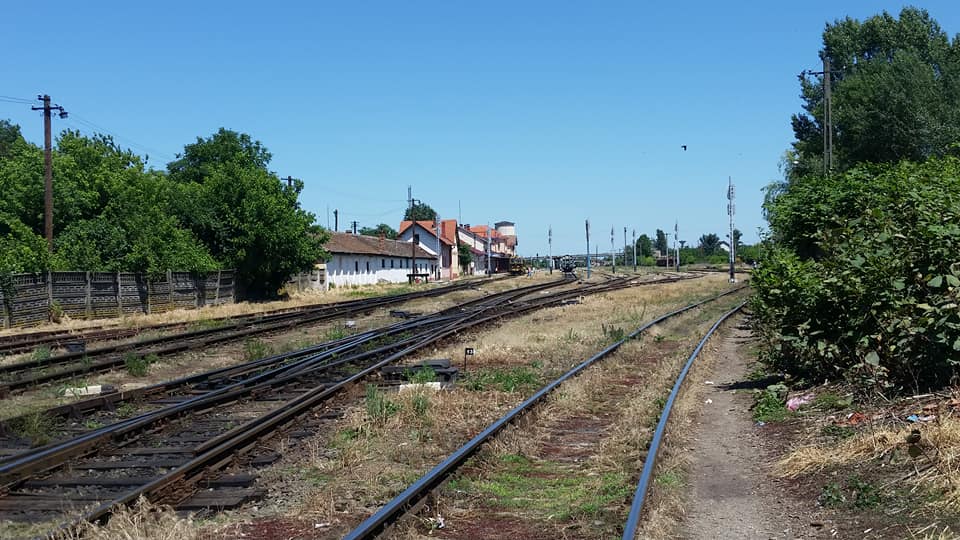
The bus was from a train station.  Not any train station- the train station where Nazis and their Hungarian fascist friends deported 18,000 Satu Mare Jews to their deaths.  Including Judith’s uncle and grandparents.

It’s also where I caught my shuttle.  As the driver called out our names- and asked for our passports- I couldn’t help but feel a bit disturbed.  Who are you to ask for my passport?  I’m from here!  And just 80 years ago, when my ancestors’ names were being called out, when their papers were being inspected- it was to send them to their death.

The difference is that now, thank God, thank those people Jewish and non-Jewish who’ve made things better- the only roll call was to make sure we were in the car and had paid.

When we got to the Hungarian border, the police were pretty tough.  Hungary is known for having a strict border policy right now.  And they took a hard look at my Israeli passport.

I could tell the Romanians in the van were having a laugh at them too- there’s some tension between the two countries.  Although it barely registers on my radar living in the Middle East.

After a long stop, the border police called my name.  Nervously waiting to hear what they had to say (I can’t imagine what my ancestors felt)- he simply handed me my passport and said “have a nice trip”.

Boy how times have changed.  For all the balagan, or mess, politically in Hungary right now, or the continuing prejudice Jews may face- there can be no doubt how much better things are today nor how grateful I feel for being alive in these times.  Where I can hear my name called at the train tracks to Auschwitz to catch a van to my AirBnB.

Anti-Semitism is alive and real in Eastern Europe, even if I didn’t personally experience it one bit.  And people are people.  Here’s the incontrovertible fact- I felt safer being an Israeli and a Jew in the Hungarian-Romanian borderlands than I would at a liberal arts college in the United States.  The former a place I was taught to fear, the latter a place I once called home.

But I suppose home is not just where you sleep.  It’s where you breathe, you love, you learn, you grow, you smile, even cry.  And I have a message: Romania and Hungary, you’re one of my homes again.  My family has been gone for a long time, and you surprised me with your warmth.  Thanks for the chance to visit- I have a feeling I’ll be back.

In the meantime, keep that braided bread ready for me.  I’m excited to see how it tastes on a Friday night compared to my challah.

challah hungary?.jpg

My Haredi, Tibetan, Baptist, Sudanese, Israeli baseball kind of day

As a child of the Washington D.C. area, I grew up in a very “progressive” environment.  In some senses, it was great.  There’s an extraordinary diversity of food, languages, and cultures that I think helped me keep an open mind about the world.  On the flip side, I think a lot of black-and-white thinking predominated.  While progressives- and I’ve spent most of my life being quite an active one- love to rail against right-wing conservatives, they sometimes hold just as harsh judgments.  About Mormons, about evangelicals, about religious people in general.  About country music and rural people and southern accents.

And these days, Israel.  Lately my Facebook feed and the news have looked like some sort of horror movie.  People abroad who I thought actually liked my country have come out of the woodwork with all sorts of hatred and ignorance.  Often in the name of “progressive values”.  There’s the non-Jewish guy who used to come to a Hebrew group in D.C.  We loved him and he said he loved Israel.  And then I saw such hateful and gruesome content on his Facebook that I just had to end it.  I won’t for a second deny the challenges nor the pain of the situation in Gaza- nor will I put the blame exclusively on Israel’s doorstep.  Not when Egypt maintains its own blockade, not when the Palestinian Authority stops paying its people there due to a feud with Hamas, and certainly not when Hamas plants bombs on our border so they can massacre us.  Or in the words of Hamas leader Yahya Sinwar, they will “eat the livers” of those besieging the Strip.  I assume he means us, because I haven’t seen a single protest against Egypt.  Jews love chopped liver, just not the kind that comes from our bodies.  We’ll protect ourselves, thank you.

The point is I was often taught progressivism=good.  Conservativism=bad.  That you could judge someone’s moral character by these two words.  And it’s wrong.

Living in Israel has helped me realize how textured people are.  That I love certain progressive values like economic fairness, LGBTQ rights, women’s empowerment, and protecting the environment.  And that when taken to an extreme, some progressivism becomes just as hateful as the far-right rhetoric it purports to combat.

I live in a rather conservative neighborhood.  By far the most conservative part of Tel Aviv.  A place where Benjamin Netanyahu’s Likud party is the left-wing, and Shas, the Sephardic ultra-Orthodox party, is the right.  And guess what?  I like it.  I have friends here- from Sudanese, Darfuri, and Eritrean refugees to a smattering of progressive young people to Haredi and traditional Mizrachi families.  Who lovingly host me for Shabbat.

Few things in life are black and white.  Even the people who wear those colors 😉

I like some things about conservative thought.  I enjoy the innovation and creativity of Tel Aviv’s street art and gay scene.  And I love seeing people saying Kaddish in a Yemenite accent on my street as they dedicate a new Torah scroll.  Which I eagerly join in on.  Preserving tradition is something I love.  Not for a museum, although there are some great ones here, but for me.  It’s my tradition and I understand why people feel strongly about their- our- heritage.  A Jewish ethno-religious state with religious courts for Jews, Druze, Christians, and Muslims might not sit well with the American Civil Liberties Union.  And I get it.  And Israelis have all sorts of thoughts about how to change it- or keep it the same.  But we’re here, and we’re not particularly thrilled with your lack of support.  We’re going to do what we want.  And I suppose if you don’t like each and every thing we do, we don’t really care.  Which is the reaction you’re going to keep getting if you single us out with no particular compassion.  Where have you been to protect us from Iranian rockets and Hamas terrorists?  Where are your rallies for our lives?  Is liberalism only good to Jews when we’re mild-mannered doctors and lawyers with no claim to independence or a right to self-defense?  I know you like Seinfeld, but what should Jerry do if he’s walking through Brooklyn and is beaten to a pulp by anti-Semites, like some Hasidim the other day?  We’re sick of being your punchline and we’re sick of being punched.  And many more conservatives- conservative Americans- support us than progressives.

In short, I’ve decided to just be me.  I’m not locked into being progressive or conservative, I’m going to live my life ethically and kindly and inclusively.  With respect and faith and pride as a Jew and as a human being.  Willing and eager to find that gray space people often overlook.  And to bring it to light.  Those aren’t liberal or right-wing values- they’re mine.

Which brings me to today.  Today, I was feeling really stressed.  I’m feeling less and less American and I even struggle to speak English sometimes.  I spend almost all my time here in Hebrew and Arabic (or other languages) and English is directly tied to 30 years of trauma I experienced.  I think, I feel better in Hebrew and Arabic oftentimes.  It’s where I feel healed and strong.  And can express myself as who I am today.

Today I wandered Bnei Brak, a Haredi city outside Tel Aviv.  Neighborhoods I had never seen before where it was totally fine for me to be in shorts and a t-shirt.  I found some gorgeous palm trees and a neat sign for a women’s shiur, or religious class.  Which I took home 😉  I then wanted to go to Oranit, a settlement in Judea and Samaria, but the traffic was terrible.  So I popped over to Petach Tikva and Givat Shmuel, an area with a large Modern Orthodox community.

Tired of the tall buildings, I went in search of green.

I ended up in the most curious of places.  Kfar Habaptistim.  The Baptist village.  While in America, old me would have been horrified to go to a Baptist village.  As would many of my “progressive” friends.  New me thought it’d be kind of interesting.

So I walked the windy, beautiful, rural road.  With fields that reminded me of the Midwest.  And then, I saw the most curious thing: a baseball field.

I haven’t seen one of those in a long time.  Baseball isn’t the most Middle Eastern sport.  And I had a rough time playing it as a kid- as it was forced on me by my family and I never fully jibed with the intense masculinity and sometimes homophobia that went along with sports then.  And I was quite good at some.

I walked towards the field and watched as the largely American-Israeli guys and gals played.  With a Baptist female pitcher.

I felt this sense of redemption.  Like God was giving me a little glimpse of what things could’ve looked like if my childhood wasn’t so rough.  And a sense of satisfaction to be able to see it in action in my homeland, my new home.

Hearing the people chatter back and forth in Hebrew and English, seeing the scores posted in both languages.  Seeing the Baptist literature and knowing that it was kind of benign in a country where we’re 80% of the population and nobody can coerce me.  Like the anti-abortion activists with ketchup-covered beheaded baby dolls at my Missouri polling location.  Here, we run things.  So I actually thought seeing the New Testament in Hebrew was kind of cool.

I don’t think I’ll get into baseball now.  I think God was just trying to help me close a chapter.  And help me embrace the one I get to live now.

The one where I ate Nepalese momos with a Tibetan chef after the Baptist village.  Around the corner from my apartment.  Where I played with his three year old kid who speaks Tigre because he studies in school with Eritrean kids.

The one where I was walking home from the momos and stopped by the Darfuri fruit stand and chatted with the owner in Hebrew and Arabic.  He told me about his business ventures and life while I picked up cucumbers.  This is where I do my shopping.  He lives down the street from me.

This isn’t an exotic visit.  It’s not a diversity day.  It’s not a beautiful exhibit or a rally or a trip to Thailand.  It’s where I live.  It’s my home.  It’s my day-to-day beautiful life.

Once, I was American.  That’s where I was born, that’s where I lived for many years.  Some really tough and some moments of real gold slipped in between the familial abuse and the prejudice I faced in society for being both queer and a Jew.  I treasure the Amazigh New Year I went to.  The Asian art museums.  The queer Passover seders.  The vast array of cultures and the pure sense of quiet and calm you feel in a park.

And now, I’m Israeli.  Not a progressive Israeli, not a conservative Israeli, not an American-Israeli (maybe sometimes).  An Israeli.  The kind that hangs with Hasidim, the kind that wakes up to his neighbors’ Mizrachi music, the kind that sings Yemenite music in the shower, the kind that hangs with Druze, the kind that goes to queer Sarit Hadad parties, the kind that leads Reform services, the kind that eats gefilte fish in Bnei Brak on Thursdays.  The kind that helps Arab guys push a dead car, the kind that pushes onto a bus- but gets up and insists that an older person sit down.  The kind that that gestures and yells and talks with passion.  And who puts people up for a night he met on the bus.  That day.

The kind who does Shabbat with an Orthodox Ashkenazi and a secular Mizrachi Jew- a gay couple.  Several times a month.  And who dances dabke with Arab college students.

I don’t do these things to write a blog about it.  Nor do I do them to check off boxes and to feel I’ve fulfilled a diversity quota.

I do these things because they bring me joy.  And I like these people.  They are my friends.  My Hasidic, Druze, Muslim, Christian, Secular, Gay, Straight, blah blah blah friends.  Friends!  These are not people I simply say “please” and “thank you” to at a store.

So perhaps the lesson I’ve learned from Israel is I don’t really care what party you vote for nor how liberal or conservative you are.  I’m not really even convinced that elections are the biggest way we make change.  I care about my neighbor.  If your kindness is limited to only those who agree with you on everything, or those you feel are “in your camp”, you’ll soon find yourself sitting alone at home.  Chanting: “no tolerance for intolerance!”  Like I once did.  But now I see what life has to offer when your heart is ready to see the best in what’s around you.  Even in a Baptist baseball field.

A Burmese refugee, Libyan Jews, and me

Big moments happen in small ways.  Tonight I was at my favorite sushi restaurant.  You wouldn’t expect to find it in my neighborhood, a place where the Mizrachi music blasts and the streets have a special smell.  Yet my neck of the woods is full of surprises.

As an oleh, an immigrant, who came alone- life can be hard here.  I have no family support network- and this is a country built on family, much moreso than America.  People don’t just see family twice a year on holidays here.  They often live right down the street.  The good part is people are willing, often eager, to take me in.  In America, I felt even lonelier.  Having no family- I cut them off due to their abusive behavior– I had to find places to spend holidays and Shabbat and even dinners.  I found myself growing closer and closer to certain restaurants there because I didn’t want to eat alone.  And some, like my favorite Thai digs in D.C., really loved me and even gave me gifts on my birthday.  When you have no family, you build it yourself.

The downside to not having family here, in such a family-centric society, is you really feel it.  Saturday, Shabbat, is not just a day to relax- it’s a family day.  With family meals.  And if you’re not invited to one, it often feels solitary.

Today, I spent my day exploring the Libyan Jewish Heritage Center in Or Yehuda.  Absolutely free and full of fascinating history, I had a blast.  A Libyan man there gave me a personal tour of the entire place- in Hebrew and Arabic.  Missing the North, where I had just enjoyed speaking so much Arabic, it was great to speak it in my own backyard.  With a Jew 🙂 .

Moshe made aliyah, immigrated to Israel, when he was 7.  He was born in Tripoli, Libya.  Heir to a 2,000 year old Jewish tradition that predates Islam.  Like many Jews in North Africa, Libyan Jews were subjected to Muslim pogroms, or massacres, in the 1920s-40s.  I also learned today that almost 3,000 were even sent to Bergen-Belsen and gassed by the Nazis in the Holocaust.  I had no idea.  We usually associate Holocaust with Ashkenazi Jews (and some Sephardim, like in Greece).  I knew of some persecutions in North Africa, but not much.  But the Holocaust artifacts- even someone’s suitcase from a concentration camp- really took me by surprise.

Moshe walked me through everything, with such patience and kindness.  I had the whole museum to myself- which I hope you’ll fix by going and visiting.  If you don’t, it’s very much your loss.  I saw Jews’ Libyan passports, a Libyan Zionist youth group T-shirt, Arabic-language legal contracts, 500 year old Torah scrolls, and so much more.  A Passover haggadah in Hebrew, Judeo-Arabic, and French.  I got to hear Libyan Jewish music and hear stories of heroism by Libyan-Israeli soldiers in the IDF.  Even a 1950s teudat oleh.  A true treasure.

Libyan Jews lost all their property when they had to flee to Israel.  Now Jewish cemeteries there have been bulldozed, built over.  Jewish homes occupied by Muslims.  Despite the fact that Moshe said Muslim women would look after him and bring him home to his mom.  The relations were not always bad.  Yet not a single Jewish community remains.  So if you want to know why Jews feel like we need a state of our own, just take a look at Libya.  When we are subjected to the whims of non-Jews, it always- always ends badly.  Maybe not during every epoch- but the sad truth is the finale remains the same.  A minority without a home base can’t really protect itself.

After a delicious Bukharan Jewish meal near the museum, I did a little shopping for my apartment and headed home.

WhatsApp Image 2018-05-03 at 1.13.04 AM

At home, I did a little tidying and started to feel tired.  Physically tired, perhaps- I didn’t sleep well last night.  Coming back to loud and chaotic Tel Aviv after some days in the quiet, peaceful North was hard.  And to boot, it was friggin hot.  But also emotionally tired.  Tired of being alone in this gorgeous land, where I make friends here and there but I just don’t have a home base (though perhaps I’m building many).  I don’t have my own “Israel” to come home to.  But I’d sure like one so anyone looking for a third of paradise, hit me up (that’s a Jewish joke- but it’s not a joke 😉

I realized that my neighborhood sushi joint- that’s where I feel at home.  Any time I need someone to eat with, when it’s just too tiring to make plans, I go there.  And I love the people there.  The Filipinos who run it, the Mizrachi girl who says “be’ezrat hashem” (God willing) every time I tell her about a cute guy, and the adorable Filipino-Burmese-Israeli kids who like to play with me in Hebrew.  One even made me origami 🙂

When I go to this restaurant, I never feel awkward.  In the States, sometimes I felt “weird” or “imposing” or even desperate if I’d go to the same restaurant “too often”.  Here, even if it’s only been a day or two, my friends ask me “where have you been?”

Notice I said friends.  Because we don’t just talk about the weather or football or our plans for the weekend.  We talk about homosexuality, family, children, Tagalog, Burmese, Israeli culture.  We share jokes and we laugh.  I play tic-tac-toe with the kids- and I usually lose. 🙂

The past few weeks, a Burmese relative of one of the employees has been filling in for someone.  My knowledge about Burma basically extends to a delicious restaurant in suburban Maryland, an episode of Anthony Bourdain, and the famed human rights activist whose name I can never pronounce.

What I know about Burma is that it was- and in some ways still is- “al hapanim”- a disaster.  Run by an isolated military dictatorship, many Burmese fled.  A brief glance at Wikipedia reveals child soldiers, slave labor, and ethnic cleansing.

As they shut down the shop at midnight (because I’m lucky enough to be able to walk to a sushi joint open till then), I talked to the Burmese man.  He’s been in Israel for over 20 years.  He has some sort of official refugee status.  It affords him a legal visa, but not citizenship.  He said he might be able to get it through an expensive process, but his coworker indicated he couldn’t.  It wasn’t clear.  He said he could go to America, where he has relatives, but he prefers life here.

It wasn’t even entirely clear how much, if at all, he could travel outside the country.  And this is a country that has lived through several wars just since the time he arrived.

He pulled out his Burmese passport.  I’ve never seen such a thing.  It was worn and full of Israeli visas (which frequently have to be renewed- for some workers every 3 months).  We had a huge laugh together when we saw his picture in the front.  He was young.  Maybe 20 years old in the photo.  Today he’s over 50 and while he has a deep vibrancy and a full laugh, you can see the wear that working hard jobs has taken on him.

To see an expired Burmese passport, from a Burmese refugee, to talk with him in Hebrew- and laugh.  In my neighborhood.  That’s a new feeling.  The same day I saw Libyan passports of Jews who fled for their lives.  I felt gratitude for the fact that I got immediate citizenship and guilt that he still doesn’t have it.  Joy at making a new friend.  And pride that he prefers Israel over America and all other countries.  Deep empathy- it must have been excruciating for him to leave his homeland and to be so far away.  I asked him- he misses it.  Yet he keeps laughing and smiling.  A true survivor and thriver.

Libyan Jews, me, and my Burmese friend.  We all fled our own traumas.  Islamic extremism, a deeply abusive family and anti-Semitism, and a ruthless dictatorship.  And we’ve all managed to make Israel our own.  Our home.  We faced and face our own challenges.  I hope Libyan Jews here manage to remember and preserve their heritage even as they contribute to our beautiful nation.  That Libya will repent and repay the Jews for ethnically cleansing us.  I hope I continue to find stability, love, and happiness – family – in my new country.  A place where I feel increasingly healed and have more healing to do.

And for my Burmese friend- I wish you nothing but love.  May you continue to grow here.  May you get the legal status you need or want to feel safe.  May you feel welcome.  Even if you’re far from your Burmese family, I hope you feel embraced by your Israeli one.

Count me in as a member.

Why reading the news is a waste of time here

Ok, first things first- yes, sometimes you do need to read the news.  I, for instance, when planning my trips, search the name of the town I’m visiting to check for safety.  When I heard air raid sirens in my apartment, I lit up my WhatsApp but I also checked news sites.  News has a purpose when used effectively.

And most people do not use it effectively.  For many years (and once in a while now), I just get caught up in the news.  Reading- whether on Facebook or on the news sites themselves- just depresses me.  I get that the media needs to make money so they focus on the most dramatic and often sad or offensive things.  Today, I glanced through articles about anti-Semites boycotting Israel, anti-Semites attacking Germans wearing yarmulkes, Jeremy Corbyn being anti-Semitic, Natalie Portman’s mess, and the likelihood of war with Iran and Syria.  I literally just cried.

It’s not because the words being written are untrue (although sometimes they are), it’s because they are true.  And they suck.  And they’re selective.

Because I’ll tell you what I did the past few days and was not in the news.  I took a bus from my low-income stereotyped neighborhood to three beautiful rural communities just around the bend.  I met an archivist who sat with me for an hour and a half to explain to me the history of his town.  I hiked through a forest in northern Israel to the Druze village of Daliat Al-Karmel.  When I asked some Druze women for directions, they sat me down, plied me with tea and coffee and salads and sweets.  They gave me a huge container of leftovers.  Drove me to the village and added me on Facebook and WhatsApp.  Today, I went to Zichron Yaakov, discovered a beautiful hidden trail, hitchhiked down the mountain to Maagan Michael’s gorgeous Caribbean-like empty beach.  Then, I walked on the sand to Jisr Al-Zarqa, a Bedouin village, where I was the only tourist visible.  I got to hear some pretty cool Bedouin Arabic, talked with a guy about Arabic music, and spent a peaceful bus ride hanging with some friendly Bedouin women.

In the course of about three days, I had been to national parks, a kibbutz, a moshav, a suburb of Tel Aviv, a Druze village, and a Bedouin Muslim one.  The main reason I write this blog is for me- it’s a record of my journeys, it’s therapeutic, and it’s fun.  I like writing, I enjoy it.  The other reason is because these kinds of stories- real and authentic- don’t make their way into the news.  The nuanced, the complicated, the fun, the moving, the heart-warming, the sad.  The full spectrum of the human experience.  Instead of reading like a laundry list of everything bad in the world, I prefer to share something a bit more real.

Because the sad stuff- the anger, the extremism both left and right, the aggression- those all exist.  And sometimes I touch on them.  And I feel that the media, perhaps in the quest for eyeballs and ad dollars, only focuses on the negative.  The things that make you click even though you (and I) don’t want to.  We’re hooked.

Living in a country plagued by terrorism and war, I’ve learned something from my fellow Israelis.  And I want to remind them of it- and teach my friends abroad.  Faced with crazy shit, you have two options.  One is to live in chaos.  Either a constant state of panic or burying your head in the sand and pretending nothing is happening.  The other option is to live in the here and now.  To be present, to enjoy what you can, to be grounded and live your life with gratitude for every moment you have.

That second path is the one I choose and strive for.  It’s the one many Israelis, both Arab and Jewish, manage to pursue much, much better than Americans during these difficult times.  Perhaps because we’re a more communal society.  Perhaps because we’ve been dealing with trauma for longer and know how to better cope with it.  Either way, my gift to Americans reading this blog right now is that spirit of embracing the present.  It’s not to completely detach yourself from worries nor to pretend that shit isn’t going down.  Sometimes, it is.

It’s just that on a day when everyone was talking about Natalie Portman and Iran, a Druze kid was practicing English with me.  I was taking selfies with cows.  I was taking selfies with sheep!  I was listening to the waves of the ocean as I walked towards a Bedouin village.

We all have choices about how we spend our time and energy.  We all have a right to our feelings and we make choices about how we live our lives.

I have opinions about all the “news” items I shared.  And I have a right to them, and maybe I’ll share them- and maybe I won’t.  Because maybe, like tonight, I’ll be too busy meeting other young people in my neighborhood at our first block party.  Organized by a friend I met in a sushi joint around the corner.

Shoot this, boycott that, yell this, scream that.  I don’t really care.  Because the music is blaring so loud around me that I just hope one day you’ll open your ears to listen.

When Jews defend themselves

Yom Hazikaron is around the corner.  It’ll be my first time honoring this day here in Israel.  Once a year, Israelis gather and remember their loved ones who died in battle or were murdered by terrorists.  I am not sure what to expect other than a lot of sadness.  Memorial Day in the U.S. often felt distant, like a day to have picnics.  I think in Israel, both because of the scope of the killing here and its immediacy, it’ll feel quite different.

Soon after I made aliyah, I made friends with a young man named Adam.  18 years old, training to be a combat soldier, graduating from high school this year.  His family owns a Kavkazi restaurant in Ramat Gan, where I “met” his cousin Ruslan, who was killed by a roadside bomb two decades ago- at the age of 21.  I met him because I happened to be in the restaurant on the anniversary of his death.  The dumplings were delicious.  Welcome to Israel.

When I think of young men and women like Ruslan, it makes me sad.  He’d be about 42 today, maybe married with children, working, building a life for himself.  And instead he’s turning to dust in the ground.  Like over 23,000 other Israelis.  With more added each and every year.

The sadness is hardly limited to our borders.  Just north of us in Syria, thousands upon thousands of people are being killed while the world sits in silence.  Where are the mass demonstrations?  Of anyone?  Of Palestinians?  Of Western liberals?  Of Israelis?  Of European activists?  Of Muslims?  Where?  Where is everyone?  People love to kick and scream about Israel, but I just don’t hear their voices when hundreds of thousands of innocent Syrians are being gassed to their deaths.

Palestinians, Lebanese, Syrians, Egyptians, Jordanians- everyone here has their own sadness.  My own country, Israel, has sometimes caused that sadness.  And our sadness has sometimes been caused by them.  I mourn the loss of every life and support people’s remembrance of their loved ones.

This is our day to do it here and we deserve it.

One particular person stood out as I wrote this blog.  And it was not a soldier.  It was Mireille Knoll.  Mireille was an 85-year-old Holocaust survivor living in Paris.  Having survived Nazi genocide, she lived a long and beautiful life in France.  Until two Muslim men walked into her apartment this year and stabbed her 11 times while yelling “allahu akbar”.  That’s not what I said, that’s what one of the actual suspects said.  Along with neighbors.  The same suspect shared that his accomplice said: “She’s a Jew. She must have money.”

I wish I could pretend this was the only anti-Semitism in France or America or any of a number of countries this year, but that’s not true.  In America, we have a rise in neo-Nazism and in anti-Semitic behavior on the left.  Including a large swath of the Boycott, Divestment, Sanctions Movement (BDS), which encourages people to target Israel, and only Israel, for economic boycott.  Not targeted boycotts, not against certain politicians or policies, but against my entire country.  Some of the activists, which include some Jews, are simply trying to push my country in a more progressive direction, even if some (though maybe not all) of their tactics are misguided.   And others among them are flat-out anti-Semites- and this is based not only on news reports, but on actual comments I’ve heard from them.  Rothschild conspiracies and beyond.  To criticize Israel is not necessarily anti-Semitic- Israelis do it on a daily basis.  When you single out Israel among all nations for a never-ending stream of hatred while never mentioning even more drastic human rights abuses elsewhere- you’re a bigot.

I have a friend- and I don’t use the word lightly, he’s an actual friend- who shared with me an insight lately.  Eric is an American Christian and he said: “I have Jewish friends at home who’ve barely, if at all, been to Israel, but want to volunteer for the army there.  I have no idea why they’d do that.”  Because he loves culture and diversity, he added: “I know it’d be difficult, I just wish the Jewish Diaspora was stronger- I wish their communities could go back- to India, to Afghanistan, and beyond.”

He is well-intentioned- I know him.  And I need to address these questions.  First off, I think Israeli Jews whose families came from places like Morocco and Iran- whose families were kicked out of there- also wish they had a connection with those places.  Due to the anti-Semitism of those governments, who stole their property and citizenship, it’s not so easy.  I know Eric knows this, but nobody in Israel particularly wants to go back to a Muslim-majority country that kicked them out and where not a small number of people would still be happy to see them killed.  One friend’s Syrian-Israeli family knows that their historic house has been turned into a luxury hotel.  One day, God willing, if there’s peace, I’m sure Israeli Jews would love to visit and reconnect with their heritage.  In the meantime, it’s the sin of the Muslim world that we can’t do that.  I know Eric understands this and it was more of a wish.  It’s just that he’s pining for something we’ve already had to move past.  None of my relatives are left in Poland.  If we could’ve lived peacefully in the Diaspora, we would’ve done it.  We tried for 2,000 years and our neighbors never succeeded in securing our lives.

Now, to the second part.  Why would an American Jew- even one with little or no direct connection to Israel- want to volunteer for the IDF, our military?  A good question given this holiday.  I personally am somewhat of a pacifist, so I don’t think I’d volunteer for any military.  And I totally understand the volunteers.  Jews- despite our relative economic and political success- are a small and sometimes belittled minority even in America.  Jewish characters in the media are portrayed as effeminate.  The women- overbearing.  Few as sexy or powerful.  We’re only accepted in so far as we don’t act “too Jewish” and aren’t visibly identified as such.

There are many good things about Jewish life in America and about America in general.  And there is one basic thing that Jews have the right to do only in Israel: defend ourselves.  Christians and Muslims alike didn’t give us this right.  Only after 2,000 years can we protect ourselves and not be at the mercy of whatever people or ruler has control over us.  Which gets to Eric’s comment about returning to the Diaspora.  It’s certainly a cultural loss for both us and the friendlier of our former neighbors.  But why would we go back?

Israel made and makes mistakes.  Politically misusing soldiers and sometimes even harming innocent civilians.  Kicking Arabs out of their homes.  The First Lebanon War was in many ways a disaster, even in the eyes of the Israeli public.  And our current quagmire in the West Bank continues to put both Israeli soldiers and Palestinian lives at risk- without an easy solution.

So why would a Diaspora Jew want to be a part of this?  Why would they volunteer for my military?

Mireille Knoll.

That’s why.  Mireille Knoll’s granddaughter Keren Brosh made aliyah from France to Israel, arriving in 1997.  Incidentally, the year Ruslan was killed.  Keren became an IDF intelligence officer, something her grandmother was very proud of.

Mireille Knoll survived the Holocaust only to be murdered by anti-Semites in a self-righteous country that loves to lecture my own about human rights (while taking basically no responsibility for its own colonialist past).  And that bans headscarves and can’t even protect its Jewish citizens’ lives.  Over and over and over again.

Mireille was defenseless.  I pray for her soul’s peace in the High Heavens.  She did nothing wrong, she didn’t deserve to die.  And I’m tired of my people being made into sheep for the slaughter.  We look great as victims, but too many Westerners don’t like to see us with a gun.

So when a Jew grabs a gun and says “enough!”- understand where it comes from.  Understand what it feels like for us to see Keren Brosh strong and protecting our people here while her grandmother was butchered in France.  Even thousands of miles away, we see our people suffering and we remember our history.  We want to help and we want to define our own destiny.  Not by being a sidekick, not by being a punchline, and not by being the overbearing caricature of a Jewish woman that is The Nanny.  Not by being tolerated.  But rather by being free to set our own course, even at great sacrifice.

I’m grateful for the soldiers who’ve sacrificed for me.  I honor the bravery of all victims of terror.  I long for a day when soldiers and security checkpoints won’t be necessary- for anyone who lives here, Israeli, Palestinian, or otherwise.  When the water guns will outnumber the real ones.

In the meantime, I’m not going back to live in the Diaspora.  And I’m glad I have soldiers who put their lives on the line to protect me.

I wish Mireille Knoll had had soldiers to protect her.  So she wouldn’t have been a helpless grandmother stabbed to death for being a Jew.

That’s why I’m Israeli.

The Holocaust

For lack of a better title, that’s what I’m calling this blog.

Today is Yom Hashoah, Holocaust Remembrance Day.  It is my first time spending this remembrance in Israel.

I knew in the back of my head it was coming tonight, but I was surprised with the speed.  I was going shopping in the Shuk and as early as 4pm everything started to shut down.  With no food at home, I scrambled and even convinced the mini-mart to sell me a milk carton as the tarp was being pulled down.

Living alone here, I wasn’t sure quite what to do.  I’ve been to Holocaust remembrance ceremonies in synagogues and Jewish Community Centers in the States, but you don’t get the feeling that the whole country is coming to a stop.  Quite the opposite, the average non-Jewish American wouldn’t even notice.

After deciding to cook some lentils I had lying around from the Eritrean corner store, I got to thinking.

This past year, I started doing genealogy of my family.  It’s not easy- I come from a deeply toxic and abusive family across several generations so to “reconnect” with long-lost relatives is hard.  I don’t know how they were as people and if they gifted me the torture I survived as a child.  What I hope, on some level, is that someone up the family tree was brave and hopeful like me.  Someone who aspired, who made it to America, who overcame obstacles.  Whose courage runs through my blood and brought me to my homeland.  Their very distance from me and my not knowing them allows me to imagine such a scenario.  To enjoy that several of them were Yiddish teachers.  That one was a rabbi.  That they spoke Yiddish and English and Romanian and Hungarian and Russian.    It gives me a little sense of rootedness when I sometimes experience loneliness and a sense of detachment.

It also helps me understand where I come from when Nazi Germans and their Polish, Hungarian, Russian, etc collaborators murdered my family.  Because while some of my Palestinian neighbors want us to just “go home”, it’s not quite so simple.  The truth is the homes we had before the Holocaust no longer exist.  There were 17,000 synagogues in Europe on the eve of the Holocaust and now there are 850.  European Jews numbered 9.5 million in 1933- and today barely 1.4 million- 85 years later.  You cannot find an Ashkenazi Jew who didn’t lose relatives in the Holocaust- whether they know their names or not.

And in Israel, they know their names.  Because about 90% of the State’s initial population was either Holocaust survivors or their relatives.  While the vast majority were Ashkenazi, a number of Sephardic communities were annihilated by the Germans, including the beloved Salonika which is now basically empty of Jews.

Some people do not get the Holocaust.  Many, many, many non-Jews I’ve met, including people I grew up with in the U.S., think the Holocaust is the only major act of anti-Semitism to befall the Jewish people.  I even had a French teacher in the States who genuinely thought no anti-Semitic violence happened before the Holocaust.  Wrong.  The Holocaust is the climax.  It’s the climax of 2,000 years of Christian anti-Semitism, which later morphed into race-based anti-Semitism.  The reason Yiddish has Hebrew, Aramaic, Italian, French, German, Polish, and Russian in it is because we’ve been expelled from all those lands (and others) over and over again.

Something few Americans I know want to acknowledge is their privilege as Christians.  Or as descendants of Christians even if they don’t practice the religion.  My point here, by the way, is not to suggest Christianity is inherently anti-Semitic nor to blame individuals today for the acts of other people.  Rather, I want to suggest that people need to understand the way being not Jewish gives them privilege over Jews everywhere in the world except Israel.

There are the basic things like when public holidays take place to the likelihood that a Jew will be elected President (in America- I’m not holding my breath).  Then there are the country clubs that wouldn’t admit Jews, the universities that had quotas, the lynchings, the job discrimination, the Hollywood surnames that lost their “skys” and “mans” and “bergs”.

I’ve personally been discriminated against- classmates calling me a rich Jew, people telling me Jews were loudmouths, having bomb threats called into the Jewish Community Center, even being thrown out of a taxi by an anti-Semitic driver yelling rants.  Being called “similar to an Islamic extremist” for keeping kosher.  A guy I was dating once even broke up with me after he found out that I didn’t eat pork.  Read between the lines.

It should be said that American anti-Semitism, even with its recent scary rise in cemetery desecrations, is relatively mild compared to other countries like France and Russia, from where Jews continue to flee.  It should be said, though, that there was a 57% increase in American anti-Semitic acts in 2017.  Something I believe American Jews should keep in mind and at least consider taking a glance at the Nefesh B’Nefesh website as an option.

The fact that American Jews, as a whole, have achieved great success- much like our German counterparts prior to Adolf Hitler- is not primarily to your credit, America.  It’s to ours for overcoming the obstacles you often put in our way.  The fact that my family was excluded from institutions didn’t just give you an advantage- it gave us a disadvantage which we bravely overcame.  And still overcome.  Discrimination is never neutral.

As I continued to do genealogy, I mapped out where my ancestors lived in Europe before coming to America starting 130 years ago.  I’m still working on it, but here’s my map so far:

Screen Shot 2018-04-11 at 11.50.07 PM

As I found my relatives’ birthplaces, I came across other databases.  The Nazis, to their credit, were diligent Germans.  The kind who keep good notes.  Who keep the trains running on time and the logs well-written.  There are entire databases, I discovered, of the names of Jews who Germans murdered.  And what I found, to my shock, was people with the same surnames as my relatives from the very same towns- killed by the Nazis.  In some cases, they were the only people in the town with the same surname.  My family.

While for many Israelis, Holocaust remembrance day is very direct- they remember their immediate relatives.  In some cases, they remember themselves in concentration camps.  American Jews, with the exception of post-war refugees, are another generation separated from the pogroms we escaped.  And we don’t necessarily know the names of our lost relatives, even if we realize they must have died.  With the help of the internet and Nazi record-keeping, I can now say I do.  It makes it much more personal and makes me a whole lot angrier.  And sad.

A while back, I met a young German man here studying for a semester.  I took him under my wing, showed him Tel Aviv, talked about Jewish history, and even brought him to a Yiddish Klezmer performance.

I think he was well-intentioned but supremely ignorant.  We talked about the Holocaust, which I welcomed.  I’ve struggled to find non-Jewish Germans willing to dialogue (partially because I don’t know many) and I think we both need it.  The young man asked me: “Why do Israelis keep talking about the Holocaust?  It happened so long ago.  It’s old history.”

My heart sunk.

If this is the kind of German that makes his way to Tel Aviv- which initially gave me hope- I started to wonder what the German back home thought of me.  I know rationally that it’s not wise to judge an entire people based on a few interactions (I’ve had some other problematic ones with Germans here- including one who complained about our holidays and our “weird-looking language”).  And emotionally I just get so angry.

In the end, Europeans, white people, Christians, whatever you want to call them.  The people across the pond who aren’t Jews.  They- not all of them- but they caused our trauma.  And, to a certain extent in recent years, you could say the same of Muslim-majority countries, though historically they treated us better relatively speaking.

So when Europeans – because it was not just Nazis, it was also millions of their collaborators – caused us trauma, it has become a generational problem.  Especially here, when combined with the wars and terrorism that followed.

So when French activists or Swiss protestors lament our aggressiveness or “disproportional force”, it’s hard for me to take them seriously.  Not because they don’t have a point- sometimes the trauma heaped on us has gotten passed on to Palestinians and our Arab neighbors.  But rather, because it’s the pot calling the kettle black.  When Europe is ready to compensate us and restore the property – and, impossibly, the lives – of our people, I’ll be ready to talk.  I just can’t really handle a German lecturing me about disproportionate force.  Who doesn’t even know about the tortured Jewish history of his town.  And if that’s hard for you to hear, good.  Because at least we’re being honest now.  And you have to take our feelings into consideration if we’re going to build something better here.

On our side, we haven’t gotten a moment to breathe.  Israelis, in particular those who have lived here many years, haven’t gotten a respite since the Holocaust.  Nearly non-stop warfare and violence.  We deserve a rest.

We also need to remember that because of all the traumas our people has been through, we must be extra cautious not to harm others.  As I’ve written about before, there have been times when Israelis, in particular in 1948, passed their trauma on to Palestinian civilians.  For the first time in 2,000 years, we have the power to abuse others.  Including refugees.  Few things are black-and-white, we just must remember that with power comes great responsibility.  The kind of responsibility and sensitivity that Europeans rarely showed us.  Such as the Polish politician who called Jews “animals” on social media.  Last week.

On many levels, I identify with Holocaust survivors.  Of course as a Jew and as a human being, but also as a survivor of torture and abuse by my relatives.  I’m an only child and I pulled my way out of that swamp with every last bit of my energy until I made it to the Holy Land.  Where those survivors and this survivor now live together, building a new life of hope, health, and joy.

Israel is an imperfect place, like every other country.  If you want to know why, despite all our very loud and vociferous differences, Jews here feel we need a homeland, all you need to do is count the number of Jews in Poland.  Or to try to find the synagogue where my great-grandfather prayed in Latvia.  Or to find the Jewish community of Pacsa, Hungary where my great-grandfather Adolf Adler lived.

Guess what?  You’re going to be in for a lot of tears.  Because our heritage there was erased.  And it’s because we have a new homeland, a complicated and blessed place, that we are still alive.  Israel struggles with many things- preserving Jewish culture, guarding human rights, and even sometimes pursuing peace.

One thing we’re good at is saving Jewish lives.  Something Europeans never really could figure out.

Have a meaningful Yom Hashoah.  May this remembrance find the existing survivors treated with more dignity.  May it find all victims of genocide treated with respect.  May it find us living in a world where while I remember my people being gassed, I don’t have to think about my neighbors across the border in Syria suffering the same fate.

One Holocaust, many genocides.  Never, ever again.

p.s.- if you’re wondering what the cover photo is, it’s the flag of the German-American Bund.  The American Nazi party.  Because Nazism wasn’t just Hitler.  We all must stand up for what’s right.

*Image by Paloeser