Arab by association

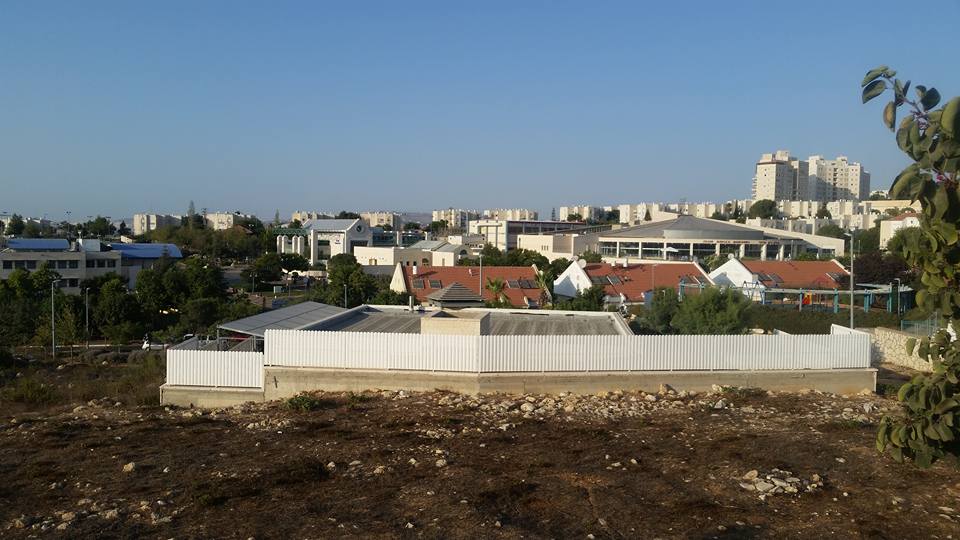
Today, I went to a settlement.  Ariel is a beautiful city of 20,000 a little over an hour by bus from Tel Aviv.  It’s located beyond the Green Line in Samaria (Hebrew: Shomron).  This area is called Shomron because that’s the name of the ancient Jewish capital of the Northern Kingdom of Israel that was in this vicinity.  To most Israelis, this is Israel (larger settlements like this tend to be part of the national consensus).  To international organizations, this area is often known as the West Bank.  And to most Palestinians, it’s part of Palestine.

This is not a typical tourist spot for Reform Jews or part of the Gay Pride Circuit, so I had never been here before (as a queer Reform Jew).  I’m a curious guy and open to new things, so I hopped on a bus.

The most interesting thing about Ariel is that it’s not interesting.  I don’t say that to be mean- there are actually some attractions in the area like stalactite caves and an archeological site of a 3,000 year old Jewish city.  Unfortunately, because this is a small town, none of that was open or easy to get to.

What I mean is that it’s very normal.  I think the image me (and many progressive Jews and non-Jews) have in our mind of a settlement is an Orthodox family of 16 living in a trailer on a hilltop beating up Arabs.  Just to be clear- there’s nothing wrong with an Orthodox family of 16, it’s just that I think many people think about settlements as a caricature, not realizing their diversity.

Ariel is possibly the most (Jewishly) integrated city I’ve been in in Israel.  There are loads of secular people, there are Russians, there are Ashkenazim, there are Mizrachim (blasting some cool Mizrachi music I stopped and listened to).  There’s a Kosher Mexican restaurant and a non-Kosher restaurant with Thai food.  There are men in yarmulkes and women in tattered jeans with purple hair.  There are judo lessons and piano concerts and even a mall.  There are Palestinian workers and there are Arab-Israeli students at the local university.

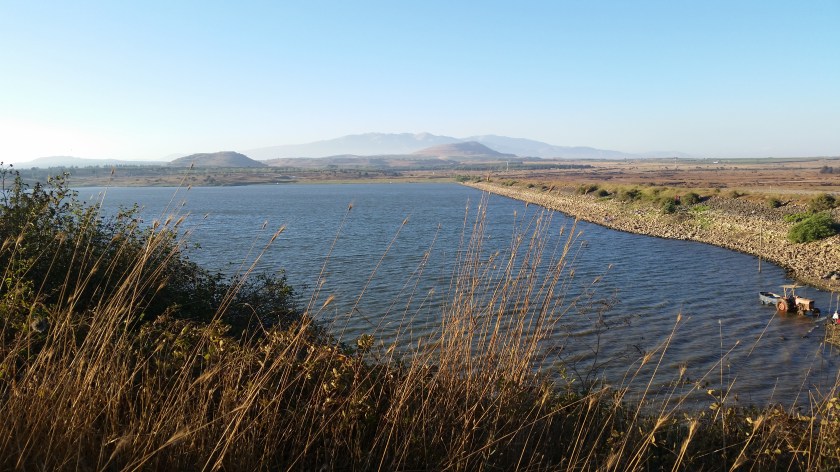
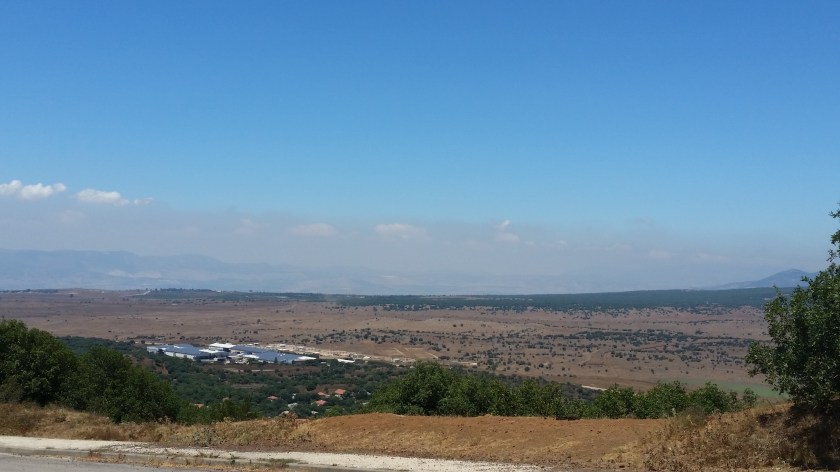
It’s also beautiful:

The truth is, in a lot of ways, Ariel is like any other city.  I think it’d behoove people of all backgrounds, particularly from the progressive world I come from, to understand there are many reasons people might live in a settlement.  For some people, it’s just about affordability.  Other people might like the view.  And for some people, it’s a religious statement.  For religious Jews, this is the land God promised us.  And the West Bank/Shomron was an integral part of Jewish history for thousands of years and is still home to many sacred sites.  I’m not interested in the politics, I just want people to understand that if you can’t put yourself in the shoes of a religious Jew who wants to live in the land of their ancestors, you’re not going to do a great job of figuring out how we can all live together.  Empathy is about understanding where other people come from even if you disagree.  People are complex and come in all shades of good and bad- including settlers.

As I prepared to catch my bus back to Tel Aviv (the West Bank is really, really close- you can see Tel Aviv from Ariel), I started to well up.  I wasn’t sure why at first, but I figured it out.  I snuck over to some bushes and just started balling.  As much as I liked exploring Ariel today, I just couldn’t help but think about the Palestinian villages I could see on the hilltops.  What was life like there?  First-hand- I don’t really know.  If we were elsewhere in Israel, I could just hop on a bus and go find out.  But reality here is a bit starker.  Due to the complicated situation (on both sides), I can’t just hop on a bus and visit a Palestinian village.  I’m not even sure if/where it’s legal to do so.  Or safe.  The situation made me so sad and the tears came down.  I hate seeing the world broken.

I told myself that whenever I’m feeling despondent here, something magical happens to lift my spirits.  And I was right.  As I was waiting for the bus, I saw a familiar face.  Sarah is a Muslim Arab-Israeli I met through a Hebrew-Arabic practice group in Tel Aviv.  What are the odds that my first time visiting a settlement I bump into an Arab friend when I’ve only been here for two months?  There are coincidences and then there’s bashert.

We hopped on the bus and I asked if I could sit next to her (important detail).  We got to talking about Arabic dialects in Israel (I’m trying to figure out which ones to study- I already speak Syrian which is intelligible but want to get more local too).  We spoke in a mixture of Hebrew and Arabic.  She told me about her work at Ariel University (that’s right- she works at a college in a settlement) and her work with promoting Hebrew language studies for Arabs in her town of Kafr Qasim.

Then we pulled up to a checkpoint.  I’m glad there’s security to make sure everyone is safe.  That being said, something fishy happened.  Two guards came on board and walked around, but the only person they asked for ID from was the Muslim Arab woman in a hijab next to me- my friend Sarah.  There wasn’t even the illusion of not profiling her.  Then they looked at me sitting next to her: “Are you with her?”  My answer (as I sat there fairly scared shitless): “We’re friends”.  At that point, the guards requested my ID.  After some skeptical glances, they gave us our IDs back and left the bus.

I asked Sarah if they always asked her for her ID.  She said yes.  She also said that if I hadn’t been sitting next to her, they wouldn’t have asked for mine either.  I said that I knew.  It was kind of a scary experience for me, and I’m sure it’s upsetting for Sarah too even if she has resigned herself to it.  Sarah is a full Israeli citizen born and raised.  I’m not sure why a terrorist would be dumb enough to put on a hijab, but I’ll take at face value that anyone could be a threat and the guards have a stressful job.  That being said, check everyone’s ID, keep people safer, and stop being racist.  It’s a win-win.

I have to say I’m proud of myself.  When I was asked if I was with Sarah, the easy way out would’ve been to say that I don’t know her or barely know her.  But the words that came out of my mouth, under pressure, were “we’re friends”.  If that makes me an Arab by association, so be it.  I’m a human being and damn proud of it.

Sarah got off the bus and I headed back to Tel Aviv.  I couldn’t help but thinking about what an overwhelming day I had.  Full of meaning and also a lot to process.  How I try to find humanity in every community- settlers, Arab-Israelis, Palestinians- everyone.  And how that can be really hard.

Israel is a verb.  It means “wrestles with God”.  It would’ve been easier for me to sit static on the beach today (and frankly I might need that after this trip).  But instead, I moved, I wrestled.  I went by myself to a place where most people I know have never stepped foot.  It was interesting, it was hard, it was brave.  I’m proud of myself.

As I got off the bus, I thanked the driver in Hebrew, assuming he was Jewish.  He responded back “ma3 asalaameh” – that’s Arabic for goodbye.  He winked at me and I smiled back.  Guardian angels come in all shapes and sizes 🙂 .


How an Arab saved my Shabbat

Shabbat shalom!  I don’t typically blog on Shabbat.  I usually go to shul, have a meal, and chill with friends.  But tonight, I had a very unique night.

First, I started off at Reform services.  They were musical and fun.  They start at 6 so that ended pretty early, leaving me with an empty evening alone.

To avoid feeling lonely (aliyah is hard and this has been a hard week), I did something I don’t typically do on Shabbat which was to go to a movie!  It was my first time in a movie theater in Israel, so I said a Shehecheyanu and watched Logan Lucky, a film starring Channing Tatum (mmmm!) about some rednecks in West Virginia robbing a Nascar race.  Dudn’t get more ‘Murrican than that!  Honestly, I probably wouldn’t have seen it in the U.S. (although, Channing Tatum), but here it felt perfect.  I laughed at all sorts of things the audience didn’t get and I relished hearing some southern accents, which you don’t hear much around here.

After I left the theater, my friend invited me to Arisa, a gay Mizrachi music dance party.  I love Mizrachi music (it’s my favorite music in the world) and have been aching for months to go to this event.  My friend was running later than me, so I showed up alone.  The security guard patted me down and then asked me to empty my pockets.  I’ve been to a lot of clubs around the world and I appreciate the need for security, especially in Israel, so I did as I was told.

He then noticed my circular pill case.  Without my permission, he tried to open it.  He was opening it the wrong way so that all the pills would fall out if he succeeded.  I told him to stop and that I would open it for him.  Again, I was already feeling really uncomfortable with this invasiveness, but I understand the need to avoid drugs getting into the club.  I explained to him what the medications were for and the names of the prescriptions.  There is also some writing on the pills, as is typical for prescription medication.  At this point, the guard and his colleague, without my permission, start thumbing through my medications and grabbing the actual pills.  I told them to stop but they ignored me.  Meanwhile, I was having to explain my medical issues in front of other patrons who were waiting behind me.  A female guard even told me that I couldn’t enter the club with my pills.  Eventually they let me in, but I was so angry, embarrassed, and humiliated that I just left.  This is a disgraceful way to treat a customer and to handle someone’s medical needs.  If you can’t distinguish a prescription from ecstasy, you probably shouldn’t work club security.  I plan on contacting them through their Facebook page because I was so insulted.  I won’t complain if you join me 🙂 .

Feeling blue, I headed to Yafo, perhaps my favorite part of Tel Aviv.  My friend got tired so we didn’t end up meeting up.  I was just exhausted.  After a long week, the last thing I needed was some random guy grabbing my very personal medications.

I headed to my favorite baklava shop to see my friend Seger, an Arab from East Jerusalem.  He’s a wonderful, fun-loving guy in his early 20s.  And when I entered the shop, by coincidence, he was blasting Mizrachi music- the same music I was supposed to hear at Arisa.  He gave me free knafeh and we talked in Arabic and caught up.  He showed me his favorite Arab singers and I taught him some English.  I even came out to him and his immediate reaction was to show me on Facebook his gay Arab friend.  I had been nervous about coming out to him, but not a split second passed before I felt comfortable again.  It’s good to feel like you can be your full self.

The night was coming to an end as he closed up shop.  As this is Israel, things went from sour to sweet.  And not just because of the heavily discounted baklava he gave me.

Seger put on Sarit Hadad, whose first CD was my first CD when I was 13, and blasted the music.  We started to dance.  Then, people walking by start dancing.  And before you know it, I’m having my own gay Mizrachi dance party.

I gave Seger a hug and we wished each other Shabbat Shalom.  I told him my night really sucked before I walked into his store and that he made me feel happy.  Since we’re now Facebook friends, he might even be reading this blog.  Thanks man 🙂

Would it have been fun to dance in a room of 500 beautiful Israeli men singing to my favorite Mizrachi songs?  I think so.  And maybe I will find out one day if I’m treated with dignity there.

In the meantime, screw Arisa.  I don’t need to pay 120 shekels to have a gay Mizrachi dance party on Shabbat.  I just need to hang out with an Arab friend at a baklava shop.

You know you’re in Israel when an Arab saves your Shabbat.  Eid Mubarak indeed.

Everything is Better in America

Israelis love, love, love to tell me how much better and easier things are in America.  Aside from several seriously well-informed Sabras who understand the challenges of American healthcare, college education, crime, gun violence, public transportation (or lack thereof), and anti-Semitism, a lot of people here just don’t get it.  On the other hand, a lot of Israelis (including some who say America is better, in an act of serious cognitive dissonance) like to tell me how awful the food is, how naive the people are, and how fake everyone is in the U.S.

In the spirit of shedding light and dispelling myths, here’s my take on what’s better in America and what’s better in Israel.

AMERICA THE BEAUTIFUL

  • America is the most diverse country on the planet.  430 languages are spoken in the U.S.  There are hundreds of Protestant denominations alone- not to mention Catholics, Jews, Orthodox Christians of all varieties, Muslims, Buddhists, Hindus, Jains, Sikhs, Bahai, Rastafarians, Mormons, and Native American religions.  It’s extremely racially diverse- there are twice as many Asians in the U.S. as there are Israelis in the world.  And seven times as many Latinos.
  • Much more so than in Israel, Americans of different backgrounds work, play, pray, and learn together.  On my high school soccer team, white Christian kids were a minority (and somehow almost all of them were blond!).  Just on one team, off the top of my head 13 years later, we had kids from El Salvador, Korea, Iran, Israel (!), Georgia, Bulgaria, Peru, Cameroon, Brazil, Uruguay, Bolivia, Turkey, Russia, and a bunch of Jews.  There were no organized co-existence activities- this was just our normal life!
  • Pluralism.  In the U.S., thanks to the separation of church and state, religion is a personal rather than a legal matter.  This even benefits the Jewish community, where over the course of my life I became friends with Reform, Reconstructionist, Conservative, Modern Orthodox, and even Haredi Jews.  Are there debates between Jews?  For sure.  But the relationships between communities are much deeper in the U.S. than here and there is far, far less vitriol.
  • Ethnic food.  Yes, thanks to the tens of millions of immigrants from around the world, American food is amazing.  I’m really sorry (not sorry) for my Israeli friend who posted about her office in Denver not providing her with suitable vegetables for breakfast (side note- nowhere I’ve been outside of Israel eats vegetables for breakfast).  But the fact is, American food IS international food because we’re an international society.  Don’t come to America expecting your (albeit delicious) Israeli cheeses, yogurts, and tomatoes for breakfast- that’s not what we do.  But we do have immensely better, fresher, and cheaper Thai, Burmese, Indian (southern and northern), Vietnamese, Chinese, Mexican, Salvadoran, Cuban, Laotian, Korean, Nepali, Japanese, etc etc.  Not to mention the best Jewish deli food in the world.  The point is that unlike in Israel, where I grew up, these are not seen as exotic tastes of foreign lands.  They become part of our diet and become American food.  When I spent a summer in Spain, I didn’t miss hamburgers.  I missed Chinese food.

ERETZ YISRAEL YAFFA – THE BEAUTIFUL LAND OF ISRAEL

  • Healthcare – I’ve already written a blog about this which I recommend reading.  Israeli health spending per capita is $2910 and in the U.S. it’s $9403.  The number one reason for bankruptcy in the U.S. is medical expenses.  Just two years ago, I had to spend $20,000 on medical care in one year- in addition to the $500/month I spent on medical and dental insurance.  Israel’s healthcare system is ranked 4th for efficiency- the U.S. is ranked 46th.  My friend Dave is battling a brain tumor and has to raise $68,000 for treatment, something unthinkable in Israel.  Please consider donating (and stop whining about Israel’s healthcare).
  • College education – in the U.S., college education ranges from about $9410-$32,410 a year.  And that doesn’t include thousands more dollars for housing or food.  Some schools like Bates are charging over $60,000.  The better the school, the better the job prospects.  Israeli tuition is about…$3000 a year.  Pretty sweet.
  • Fresh produce – yes I just touted American food, which is amazing.  Truth be told, the fruits and veggies here are better.  Perhaps because Israel is small and doesn’t ship grapes from California to New York, the produce is super fresh and extremely tasty.  Other than farmers markets, fruit in America tastes watery.  In Israel, it is full of flavor, inexpensive, and delicious.
  • Weather – this depends on where you are in the U.S. (I’m looking at you beautiful San Diego), but at least compared to D.C., the weather in Israel is much nicer.  Yes it can get very hot, but there is a beach.  There are beautiful rural places to escape to with nice breezes.  When there is three feet of snow on the ground during a D.C. blizzard, Tel Aviv is 60 degrees Fahrenheit on a February day.
  • Caring for one another – this might surprise Israelis, but I find Israelis to be much more willing to trust one another and to help one another than Americans.  I regularly see people step up and help people who are sick, lost, in need of a place to stay, etc- even if they’ve never met them.  These are things that would usually be met with suspicion in America, but here are totally normal.  If you have nowhere to go on Friday night for Shabbat, just tell someone and you’ll be eating a warm meal before you can remember their name.
  • Judaism – yes, the U.S. is pluralistic with a much bigger Reform community than Israel, but the fact remains that the entire country here is a synagogue.  When I walked down the street today, my friend and I heard a shofar.  There is biblical graffiti everywhere- done by hipsters.  My favorite Israeli dancing songs play on juice bar stereos.  All of my holidays are government holidays.  I can go to the Western Wall in Jerusalem in the morning and a gay Orthodox Torah study in Tel Aviv at night.  There is also unparalleled Jewish cultural diversity (and food!) here- with Jews from dozens of countries represented.  My identity is validated over and over and over again even in ways Sabras don’t recognize.  Here, I am normal.

We won’t even get into the economics of things, because while Israelis decry how much more Americans make, the fact is things are a bit more complicated.  The average Israeli household earns a net income of $56,892 a year.  In the U.S., the figure is $55,775.  For sure, there’s variation by region and industry, and there are different tax burdens.  But the point is- not all Americans are rich (most aren’t) and especially when you consider that significant sectors within Haredi and Arab societies here don’t work, there’s not as much of a gap between Americans and Israelis as some people here think.

In the end, I’m not writing this blog to declare victory or to engage in endless debate.  That feels a waste.  There are beautiful things in America and beautiful things here.  And shitty things in both places.  And I could give many more examples of both.

I chose to be here not because it would be easy, although in some ways it is easier than America.  I made aliyah because it would be meaningful, it would be validating, and it would be inspiring.  In short, because I think it’ll make me happy.  Much like this famous scene from Monty Python, let’s not bicker about who’s right.  Let’s just respect each other’s choices, including mine to become an Israeli.  Because in the end, I’m not asking for your approval or your advice.  I’m here.

A gay Reform Jew goes to Bnei Brak

Today, I went to Bnei Brak and had a good time.

Bnei Brak is an almost entirely Haredi (ultra-Orthodox) city of nearly 200,000 people right on the footsteps of Tel Aviv.  It is the sixth most densely populated city in the world.  Door-to-door, it was a half hour ride.  Culturally, it’s a million miles away from the bikinis, hip-hop street performers, and pride flags of Tel Aviv.  Inhabited by a variety of Hasidic and misnagdic sects, with a smattering of Modern Orthodox, there are a lot of black hats, swaying peyos, and tons and tons of children.

To many of my more secular friends, the idea of a day trip to Bnei Brak is at best a waste of time and at worst, nauseating.  Please allow me to share what I, a gay Reform Jew, actually found to enjoy in this fascinating city:

Delicious Ashkenazi food – I sorely miss American Jewish food, which is almost entirely Ashkenazi.  I love me some jachnoon and falafel, but it is not what I grew up on.  I had delicious matzah ball soup tonight and it hit the spot.  Ashkenazi culture for secular Israelis has become nearly invisible.  This is due to repression from more hard line Zionists in the early years of the state, when Yiddish theaters and newspapers were shut down by protestors, and due to a desire to fit in in Israeli society.  For the majority of American Jews, Ashkenazi-ness is an essential part of our Judaism and I was happy to see people keeping it alive here.

ChocolateRugelach.jpeg

Hot guys – perhaps it’s from growing up in a more religious Jewish community (progressive American Jews as a whole are more religious than left-wing Jews in Israel), but I find a cute non-bearded guy dressed in 17th century Hasidic garb and a kippah…hot!  I love that he’s boldly Jewish, that he loves Torah, and that he has a certain softness to him.  Don’t get me wrong, I love me some strong Zionist men, but seeing a Hasid here reminds me a bit more of the Jews I know from home in the Diaspora.  Which is perhaps why they bug the h*ll out of secular Jews who don’t want much to do with the “old Jew” of the shtetl.

Good music – I love me some Hasidic music.  I bought a compilation of Vizhnitz niggunim sung by artists from Bnei Brak.  I found a really cool music store which has hundreds of different artists, mostly in Hebrew, but some in Yiddish.  Some of the artists were American Hasidim like Lipa Shmelzer who I knew from the U.S.  Quite a number of Mizrachi artists were popular in the store, like Zion Golan and the Revivo Project, which is interesting and shows there’s more cultural fusion going on here than meets the eye.  In general, I noticed more Mizrachi Jews in Bnei Brak than I expected to see and quite a number of shwarma joints, something you’d never find in Williamsburg.

It’s a city – I’ve visited Hasidic Brooklyn (Borough Park, Crown Heights, Williamsburg).  You can read some of my thoughts about that community and my visit there in this blog.  One of the big differences between Hasidim there and in Bnei Brak is that the former is a community intertwined with its neighbors.  There are Jamaicans and hipsters wandering through.  It is a neighborhood, not a city.  Bnei Brak is an entire Haredi city and it is really cool to see.  I saw boys and girls playing together.  Both men and women were friendly and willing to talk to me (and I was wearing jeans and a t-shirt).  I had found it a bit more difficult to get people to open up in New York, especially women (even though I also speak Yiddish).  I couldn’t help but think that maybe if Hitler hadn’t succeeded, there would be cities like this all over Eastern Europe.  And I’m grateful that Bnei Brak is a living testament to our fearlessness and our willpower to survive despite antisemitism.

Are there problems in Bnei Brak?  Sure.  I saw a sign today with pictures of hellfire admonishing women to avoid evil and wear headscarves instead of wigs.  I also saw a sign lamenting secular education.  And there are almost no pictures of women anywhere for reasons of modesty.

20170821_181544

At the same time, I saw tons of Haredi women wearing the wigs despite the signs.  I also saw secular people and foreign workers wearing short sleeves without anyone batting an eye.  I actually saw a Chinese guy completely shirtless in the middle of the street.  And yes, I saw a young woman in a sleeveless shirt and shorts walking down the street with no harassment.

I’m not here to tell you Bnei Brak is a bastion of progressive thought.  Or that there aren’t problems or that there aren’t Haredi people who are radical or violent.  These things exist (and not just among Haredim).  At the same time, I am concerned because I think the rest of the world tends to paint this community with a broad brush.  I am concerned that some of the anger towards Haredim in Israel isn’t about policies (like Shabbat laws, which are a real issue), but rather about longstanding ideological feuds among the Jewish people and, frankly, prejudice.

Just like any other group of people, there are Haredim who are more friendly, who are more open-minded.  And there are others posting signs admonishing women about their hair styles.  And many people who are somewhere in between.  In the end, we are people and when we start generalizing about hundreds of thousands of people, we are bound to foment prejudice rather than understanding.

I went to Bnei Brak today so that I could observe and I could learn.  Because I believe that if my only source of information about people is the news, then I’ve already lost.  Because my day ended not with stones being thrown at me for immodesty, but rather with a Hasidic guy winking at me and walking into a wedding where the band played beautiful Yiddish music.  Music I understood.  Because Israel is a 2,000 year old delayed family reunion.  We’re just getting to know each other.  Step outside your comfort zone and meet your relatives.  If a gay Reform Jew could find something to like in Bnei Brak, I bet you could too.

20170821_183204.jpg

What America can learn from Israel

Tonight, in the span of 5 minutes, I saw what Israel has to teach the world about tolerance and diversity.

Walking back from an outdoor movie in Yafo (which overlapped with the Islamic call to prayer halfway through), I heard a man on a microphone.

The man was talking to a crowd at a restaurant on the roof of a building.  He started to sing.  I figured it was just a guy playing music for tourists.

Then I started to recognize traditional Jewish wedding music, saw a chuppah, and realized it was My Big Fat Jewish Wedding.  People started to dance and shimmy as the music blared.  Definitely the only time I’ve ever walked by a rooftop restaurant and discovered it was a Jewish wedding- on a Wednesday!

Then I headed to a great spot where you can look out at the sea, just meters away.  And there I saw a group of Korean Christian tourists with a guitar singing their songs of praise.  A crowd of secular Jews, Orthodox Jews, and Muslims watched with great interest.  Women in hijabs swayed back and forth as the Koreans sang their hymns.  Everyone applauded at the end while the song leader said “God bless you” to all of us.  It was beautiful.

As I headed over to a dessert shop, I could hear the ululating (in Hebrew “kululu”, in Arabic “zaghrada”) from the Jewish wedding.

The dessert shop is run by Arabs.  For the first time, I tried malabi, a creamy Israeli pudding dessert likely of Turkish origin.  It was de-licious.

As I chowed down, I noticed the shopkeeper, Zidan, was blasting “Shav El Admati” (I return to my land), a famous Zionist Mizrachi music song about Jews returning to Israel.  So this was an Arab man singing at the top of his lungs a Jewish song about returning to Israel.  While I, an oleh chadash (new immigrant), am singing all the words with him because I learned them while pining for Israel in America.

As the song ended, Zidan gave a Haredi (ultra-Orthodox) Jew directions to the nearest Kosher restaurant.  When the man didn’t understand, the gay Reform Jew (me) showed him the restaurant.

All of this happened in a one-block radius in 5 minutes.  It was the best part of my day.

At a time when America is suffering, I can’t help but think that perhaps my former country has something to learn from Israel.  I’ve often spoken of ways Israel can learn from America, but I think it’s time to turn the tables for a moment.

Tolerance and coexistence don’t just happen at big elaborate ceremonies or through proclamations.

They happen in our day-to-day lives, when people least notice or expect it.  Organically, not by way of grandiose announcements or gestures.  If you put yourself out there in your own surroundings, you’d be surprised what you can find.

In some ways, Israelis are much better at this than Americans, probably better than Israelis even realize.  I’d love to see my fellow Israelis appreciate the miracle we’re living in.

At a time when Americans are struggling, understandably, to figure out how to repair their society, my advice from Israel is this: living your values in your day-to-day life is the best way to make change.  Forget the speeches and the rallies- there may be a time and a place for them, but their impact is temporary and can’t sustain long-term change.

Be the Korean Christian singing for Israelis.  Be the Muslim woman swaying to their music.  Be the Haredi guy asking directions from an Arab shopkeeper.  Be the new immigrant exploring new foods and new cultures.

There’s a lot you can’t control in life, but what you can- enjoy the hell out of it.  Look around you, there’s miracles happening everywhere.  Just look.

American Nazis, Syrian refugees, and baklava

Today on many levels was just a normal Israeli day.  I ran around doing errands, dealing with Israeli bureaucracy, hearing my favorite songs blasted from cars on the streets, and walked down the beach to Yafo.

That is exactly what made today so weird.  In America, today was not a normal day.  As I could tell from post upon post from my friends in the States, something big was happening.  Neo-nazis and the Ku Klux Klan (KKK) held a rally in Charlottesville, VA, a beautiful, musical college town which I have fond memories of.  I’ve been there twice, heard great live bluegrass music, and hiked in the nearby mountains.

One of the Nazis literally drove their car over a counter-protestor, killing the woman.

On the one hand, this was shocking.  I lived in the U.S. almost my whole life and I’ve never heard of a massive Nazi rally, even in the most conservative parts of the country.  Estimates are that 1,000 people came.  For something that’s supposed to be fringe, that’s a shockingly large number of people to come to a random town in rural Virginia.  For any Israelis shaking their heads saying this is “overblown” (מוגזם), you are naïve and literally know nothing about America other than Britney Spears and Times Square in New York.  You complain all the time how Americans are so “polite” and never say what they think.  So if that’s true that we keep our opinions to ourselves, then 1,000 Nazis showing up at a public rally (not approved by the police) is a very big deal.  Get your heads out of the sand and realize that if this phenomenon grows in the U.S., it’s going to affect Israel and the rest of the world big time.

While this rally was shocking, it was not surprising.  I’ve experienced a lot of bigotry in the United States.  I went to a sleep away camp in North Carolina for many years and I actually met a camper who told me he was in the KKK youth group.  I told him I was Jewish and he said “I don’t mind the Jews as much, I just hate those n*ggers”.  While riding the Metro in D.C. I’ve been called a spic.  At my progressive liberal arts college, Wash U, my roommates once had to defend me from a fellow student who was homophobic and trying to attack me- in my dorm.  At the same school, I wanted to go with another gay guy to a dance and the people there told me “it’d be better if you didn’t, they won’t like it.”  At my diverse suburban high school, a girl once told me “you’re cool, you’re not like the other Jews who are all loudmouths and stingy.”  I was holding hands with a guy once in the D.C. area and a man followed us yelling “faggot” until we snuck into a restaurant.  As recently as a year ago, I was literally thrown out of a taxi cab by an evangelical pastor for being a gay Jew.  To this day, I still find it hard to wear the rainbow yarmulke I wore on my head in that car.   And that makes me sad.

The examples I gave above- I could give many dozens more.  I think every minority in America can.

That’s because Nazism and bigotry are not new to America.  There was a pretty strong Nazi Party in America in the lead-up to World War II, to such an extent that many believe it caused Franklin Roosevelt to reject Jewish refugees who were later sent to death camps.  Of course the Ku Klux Klan has been murdering minorities for 150 years- African Americans, Jews, Catholics, Latinos, you name it.

My point is this- while in some ways we’re witnessing a new and scary phenomenon, in other ways, it is a revival of long-standing American social movements.  What this means is this is not about any one person alone, it is about a movement.  You can’t extinguish a movement with an impeachment or an election.  You have to solve deep-rooted societal issues (I think many of which are economic and addressed by neither political party) and ultimately extinguish the hatred.

To my friends in the U.S.- my heart is with you.  Remember that with all the anger, it can be easy to misdirect it towards people who might otherwise be open to your message.  Practice self-care and keep an open heart as you try to build a better society.  Focus on what you can control and accept that there are things you can’t.

I found it strange today.  I couldn’t figure out why I was so upset.  I knew I was upset about what was going on in America- that I was worried for my friends.  But things were great here.  The sun was shining, I was eating a delicious chicken shnitzel, and I felt safe.  Everywhere around me were Jewish songs, Jewish signs, Jewish policemen, Jewish everything.  While Nazis marched in America, I couldn’t have felt safer.

I felt all sorts of conflicting feelings.  The pride for having predicted this would happen.  The relief and happiness that come with having made a good choice to make aliyah to escape these problems.  Deep sadness for the state of America.  Fear for my friends’ safety and well-being.  Anxiety for my non-Jewish friends who can’t make aliyah and hoping they’ll find a sense of security.

Overwhelmed with emotion, the 103 degree heat index, and the LOUDNESS of every Tel Aviv street, I raced towards the beach.

The beach at night is perhaps the only (fairly) quiet place in Tel Aviv.  Tel Aviv is a city smaller than D.C but with the energy of three New Yorks.  Sometimes, I just want some friggin’ peace and quiet.

I hopped on the phone with my friend Shadi, a Syrian refugee living in Erbil, Kurdistan in Iraq.  Shadi is my Arabic conversation partner, even going back to when I lived in the States.  Through the organization Natakallam, I pay to practice my Arabic and Shadi earns a living.

Shadi is awesome- he’s Kurdish, so we love talking about our minority experiences.  He’s also extremely open to my Judaism and my gay identity.  Whenever I’m in need of some positive energy and affirmation, I hop on Skype.

Today, I told Shadi all about what was going on in America.  How I felt happy in Israel and how I felt scared for my friends.  How I felt guilty for feeling happy with my life here while my friends suffered.  I compared notes with how his experience was as a refugee.

And then he opened up.  Turns out, Shadi’s mom and dad still live in Qamishli, Syria where he grew up.  Four years ago, he fled to Erbil, a Kurdish city in Iraq, both because of the civil war and because his wife has leukemia.  Apparently, treatment is much less expensive in Iraq.  So as to allow him to focus on helping his wife with chemo, his daughter stayed seven months with his parents in Syria- in the midst of a civil war.  Thankfully his daughter is reunited with him and his wife now and he is learning coding so he can be a computer programmer.  One day he hopes to return to Syria.

Interestingly, Shadi and I both chose to escape bigotry (there is intense persecution of Kurds in Syria) by going to places where our peoples are the majority.  There’s something about living in a place where you’re normal that’s healing and gives you a great sense of security and validation.

I don’t share Shadi’s moving story to try to minimize my own pain or that of my friends in the U.S.  Rather, I share it to put things in perspective.  Things are bad in America right now.  Fortunately not yet to the extent that they are in Syria, which makes me count my blessings and helped calm my anxiety.

Yet things in America will get worse.  Several years ago, when I told my friends Donald Trump would become President, they thought I was nuts.  Putting aside the question of whether you support him or not, my prediction was correct.  All the babbling idiots on CNN and MSNBC and the pompous writers in the Washington Post didn’t see it coming because they live in a bubble.

Now they ponder how the courts or the elections or this and that will help.  It won’t.  Time to accept reality- American democracy is unraveling.  Either it will be stitched back together by an engaged and powerful citizen movement.  Or it will die.

To my American friends- I’m praying for you.  Even as I write this.  I love you and I want you to be safe.  You have to decide how to move forward.  Want to stay and fight for a better America?  Absolutely your right and your choice and I applaud you.  Want to get the hell out and build a life elsewhere like I did?  I totally support you.  Just understand what’s going on so you can make an informed decision.  I think there is a substantial possibility that the U.S. is headed for a civil war or intense civil strife.  I hope to G-d almighty I’m wrong, but just be prepared that this is a real possibility and plan accordingly.  If there’s any way I can help, in particular for those considering aliyah, I’m here.

To my Israeli friends- wake up and smell the coffee.  I’ve talked to several sabras (native-born Israelis) today and nobody seemed to get why this was a big deal.  Even on the website of Yediot Achronot there was no mention on the front page, although there was an article about a woman who became a Jewish food guru.  What happens in America affects us- our foreign aid, our diplomatic support, aliyah (I’d bet there was a spike in applications today), etc.  An America where Nazis are gaining power is bad for Israel and bad for American Jews.  Start paying attention and realize that listening to Rihanna and having a cousin in L.A. doesn’t mean you understand America.  Read JTA, Huffington Post, even the radical left-wing Socialist Worker and the right-wing Washington Times.  You could even go further off the deep end and look for extreme right-wing blogs, but I won’t recommend that on my blog 🙂  The point is be informed because this affects our friends, ourselves, and the world.  I’m always happy to suggest resources or chat.

After my conversation with Shadi I made my way to Yafo, enjoying the summer breeze as it hit my face.  I made my way to my favorite baklava spot, hung out with my friend Sager who works there, and bit into a delicious slice of heaven.  I could’ve sat for two hours telling him all about America, but I just relaxed and soaked in the fun.  The tension in my body faded and I felt safe.

Something I hope my friends in America will feel soon too.

Hebrew, Yiddish, and Arabic in “occupied” Akko?

Thursday I had a fun, frustrating, and complex experience in Akko.

Akko is a 4000+ year old city continuously inhabited since the Bronze Age.  It has been home to Canaanites, Phoenicians, Jews, Greeks, Byzantines, Arabs (Christian and Muslim), Crusaders, Ottomans, Brits, and most recently, Israelis of all stripes.  It also has a Druze and Baha’i population, being home to the resting place of the founder of the Baha’i religion.  So basically it’s diverse and historic as f*ck.

My initial intent was to write about my experience on a boat.  I was exploring the historic city and noticed something curious- almost everywhere around me, people were either Arab or ultra-Orthodox (Haredi).  From now on, I’ll use the term Haredi since that’s preferred by people in that community.

It was interesting to see women in hijabs flowing by men in black hats.  Very Jerusalem-esque, but at least in this part of town, absent any other secular or traditional Jewish communities that you’d find in the capital.

Honestly, I didn’t feel particularly uncomfortable.  You might expect a gay Reform Jew to head for the hills at this point, but frankly I found it more interesting than threatening.

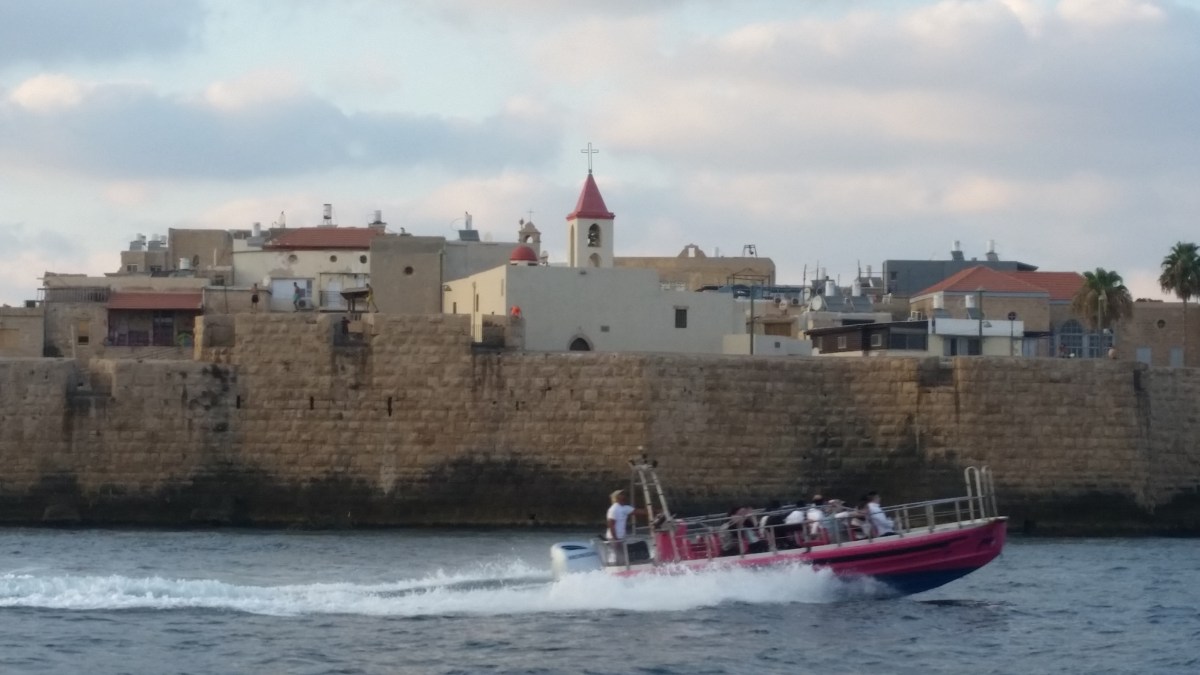
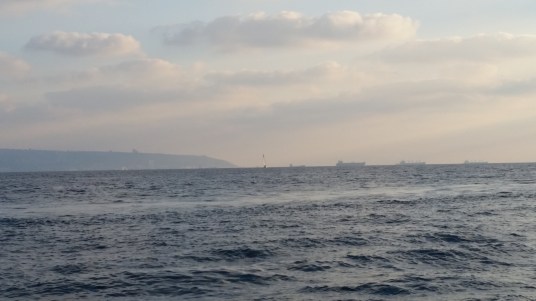
Then, I found a boat.  It was a 10 shekel ($3) boat tour.  The boat was being driven by an Arab man and was blaring Hasidic pop music (which I happen to like).  On board were two Haredi families…and me!  The scenery was exquisite.  Here are some pictures from the ride:

20170810_18395120170810_18524520170810_184855

I started talking with Haredi family #1 in Hebrew.  They were super sweet and congratulated me on my aliyah.  They live in Bnei Brak, a Haredi city right next to Tel Aviv.  When I said I lived in Tel Aviv, they said “oh we’re neighbors!”.  They also helped me find a legit Ashkenazi restaurant in their city so I can get my fill of the foods I grew up on.  He even said I could just come to their house some time for a home cooked meal!  Falafel is great, but I miss my whitefish salad and kugel.

Then I overheard Haredi family #2 but they weren’t speaking Hebrew- their girls were laughing and taking selfies…in Yiddish!  Whoa!!  This got me very excited!  I started talking to them in Yiddish and it turns out they’re Vizhnitzer Hasidim from Borough Park in Brooklyn and were in town for a wedding.

They were polite but a little less warm than the other family.  I think it’s because they thought I might be ex-Hasidic (seeing as so few non-Hasidic American Jews speak Yiddish anymore).  The father kept asking me for my Hasidic lineage, to which I kept replying that I don’t have any (that I know of).  At first, I was kind of annoyed for having to repeat this over and over again.  Then, I realized he was playing the timeless game of Jewish geography.  Turns out, he knows some Adlers and was trying to see if we were related.

Before I got off the boat, I made some chit chat with the Arab driver in Arabic.  But he was too busy taking pictures of the other boats (should you be doing while driving?) for anything too in-depth.  But a friendly guy.

So there I was, on a boat, speaking Hebrew, Arabic, and Yiddish.  The progressive gay Jew hanging out with Haredim and Arabs.  While to a number of secular Israelis and even some Modern Orthodox Jews, a city teeming with Arabs and Haredim is their worst nightmare for Israel’s demographic future, I actually found the experience fascinating and rather benign.  I’m not saying there aren’t legitimate concerns for Israel’s future, but in the end we’re all people.  Among groups that, at least if all you do is read The New York Times, you’d think would be ripping each other’s throats out, there was a pretty basic coexistence that was refreshing.

Then, I made the mistake of the internet.  On my way home from Akko (Israel has a pretty clean, efficient, and cheap inter-city train system, something America might get around to one day), I opened Youtube to find dabke music from Akko.  Dabke is an Arab folk dance found in Lebanese, Syrian, Palestinian, and Jordanian culture.  It sometimes has nationalist overtones.  Overall, it is fun.

There are videos of dabke in Akko on Youtube, but several of them had (in my opinion) inflammatory titles like “Dabke in occupied Palestinian Akko”.  There was even a video from neighboring Haifa, which has a recorded Jewish history going back to 200 C.E., about 450 years before Arabs conquered the area.  The Haifa video was entitled “Palestinian dabke in ‘Haifa’ in the heart of Israel”.  I’m not sure exactly why Haifa was in quotes, but if the angry back and forth in the comments section was an indication, the title was meant to be provocative.  Side note: never read the comments section of anything ever.

I then read an article that said an Arab man in Akko claimed Jews were pushing his people out so they would go live in Europe instead of Akko.  He said Jews were given preference for new housing.  The first sentence seems specious because if Jews are trying to push Arabs out of Akko, they’re not doing a very good job because there are a lot of Arabs everywhere.  Unlike in everywhere else I’ve seen in Israel, I even saw signs with Arabic on top and Hebrew on the bottom.  That being said, it’s true that during Israel’s War of Independence, many Arab communities including Akko were displaced- sometimes voluntarily and sometimes under pressure from Israeli troops.  It’s also true that there has been discriminatory housing policy, so even if this man was exaggerating, there may be truth to what he is saying.

Then, for things to get more depressing, apparently there used to be a larger Jewish population in Old Akko, going back a long time.  However, due to demographic changes they moved to other parts of the city.  Then, apparently the Islamic Movement, an Islamist organization, removed the signs to historic synagogues and replaced them with quotes from the Quran.  If this is true, this is truly depressing.

I began to feel deflated.  Was the coexistence I was seeing everywhere just a facade?  Do Israeli Arabs really just see me as an occupier like the videos on Youtube indicated?  Do they know nothing about Jewish history in this land (or elsewhere)?  Were Jews really pushing Arabs out of Akko or discriminating against Arabs in housing?

These are all complex questions that deserve sophisticated and well-researched answers.  I don’t have the expertise at this moment to answer them all right now.  I do believe people are entitled to different narratives so long as they respect each other and empathize.

What I can say is this: Arab identity in Israel is diverse.  Half of Arab citizens of Israel recognize the right to a Jewish state.  Half don’t.  26% identify as Palestinian, 36% percent as Palestinians in Israel, and the plurality (37%) as Israeli-Arabs.  Another survey found 64% believe Israel is a good place to live and 43% favor their Israeli-Arab identity over a Palestinian one.  Perhaps surprising to the Western ear is that 24% of Arab Muslims in Israel vote for Zionist parties.

Do some of those numbers sound contradictory or confusing?  Welcome to the complexity that is Arab-Israeli identity.  There are anti-Semites, there are Islamists, there are people who volunteer to serve in Israel’s military, there are Zionists, there are secularists, there are communists, there are feminists, there are nationalists, there are pragmatists.  And some people fit into multiple categories.

So in the end, is the coexistence I saw on that boat a facade?  Are my conversations with Arab-Israelis merely window dressing to deeper prejudices?

Sure, I think that there are some prejudices here that are merely beneath the surface.  When you read about Arabs throwing rocks at Jewish worshipers in Jerusalem or that between 32-48% of Jewish citizens would favor expelling or “encouraging emigration” of their Arab neighbors, you know there is prejudice here.

Was that Haredi man who invited me to his house really just a bigot against secular or Reform Jews?  Was the Yiddish-speaking family that joked around with the Arab driver just faking it?  Are my secular friends reading this blog rolling their eyes and thanking God they weren’t on that boat with me?

Perhaps- we’ll never know.  But rather than stew in cynicism, I’d like to enjoy the moment I had in Akko.  A moment where people pretty much got along.  A gay Reform Jew, two Haredi families, and an Arab boat driver.  Hebrew, Yiddish, and Arabic in Akko.

Anti-Semites who visit Israel

Tonight, I went to an English-Hebrew practice group.  Not because I particularly need to practice my Hebrew, since I’m surrounded by it all day and I speak it at every opportunity.  But because I wanted to make friends.

There was an interesting cast of characters, including a guy who claimed for 20 minutes he was a porn producer, only to say later he was not.  I spoke some Hebrew, others spoke English, all was fine.

Then I met an exceedingly handsome French guy whose Hebrew accent was to die for.  Even after he revealed he had a girlfriend, I couldn’t stop looking at his beautiful skin and face and smile.  Oulala!

Let’s call him Pierre.  Pierre has a very cushy job at a pharmaceutical company who has asked him to work in Israel for four months before moving him to London.  Not a bad life.  Pierre is actually not Jewish!  This surprised me, because actually there are a ton of French Jews here, many of whom are escaping rabid anti-Semitism in France.  He asked some thoughtful questions about Israeli politics, religious identity, and had an impressive command of Hebrew for someone who’s been here for a few weeks.

I decided he might make a good friend, so we walked for a while together after the event.  Sadly, it didn’t take long for the garbage to come out.  Perhaps feeling liberated from being away from a larger group, he started to tell me all. about. the. settlements.  Please don’t get me wrong- talking about the Jewish presence in the West Bank is a very legitimate political issue and one that is far more complex than the Western media makes it out to be.  I can understand why there are people critical of the settlements (their word) and- just as critically- I can understand why Jews choose to make their home in Judea and Samaria (their words).  There are genuine concerns about human rights violations and there are very real religious and historical reasons why Jews want to live in these places.  I’ll save the political debate for a future blog- the point is I try to have empathy towards different types of people.

Pierre was not so interested in empathy, but more in lecturing me.  The truth is I found it shocking, but not too shocking.  I’ve had many non-Jews, especially those visiting Israel, jump into long-winded speeches about their political beliefs.  Before really even knowing much about me or frankly, Israel.  Unfortunately, so many people around the world view this place solely through the prism of news articles and not through their own personal experiences and relationships here- both with Israelis (Jewish and Arab) and Palestinians.

I often feel like the world expects Israelis and Palestinians to entertain them, like a circus.  One person dies here (doesn’t matter the religion or nationality), and the BBC cameras race to the scene.  It’s front page news.

Yet when a black kid is shot on the streets of D.C. or when hundreds of thousands of Syrians are butchered or when Tibetans are colonized by the Chinese government, the world barely blinks.  The conflicts go on, untended and unresolved.

It’s not that I’m arguing we shouldn’t pay attention to what happens here- we should.  It’s just that the amount of attention that the world puts on this tiny little place is absolutely out of proportion and exacerbates the problem rather than solving it.

In the end, non-Jews who visit here from Western countries should treat this place with respect- including the Jews who live here.  If you want to understand why Jews return to their homeland, you need to learn something about Jewish history.  Plenty of American Christians know what Chanukah is (vaguely), but most couldn’t tell you about the pogroms that brought my ancestors to the U.S.  Or Martin Luther’s antisemitism.  Or the laws that prohibited Jews from owning land in Europe.  Or forced conversions of Jews to Islam in Iran.  Or the myriad blood libels, burnings, discriminatory clothing, or expulsions you can read about here.  And before my American friends chime in with “oh well this is foreign to the U.S.”, you can read this.

My point is this- before you rush to judge another culture (because yes, Jews are both a culture/people and a religion), learn something about it and show some humility.  When I met Pierre, I didn’t rush to ask him to condemn France’s myriad expulsions and massacres of Jews over the course of 2,000 years.  Nor did I ask him to condemn the extensive French collaboration with Adolf Hitler (as an aside, I had a highly educated French teacher who thought the first time French people did something antisemitic was the Holocaust).

Why?  Because I don’t even know him!  If I met a Chinese person, would I launch into a tirade about Tibet?  Is that socially acceptable?  Is that kind?

No.  Because everyone is a human being first and foremost.  If you really want to get to know Israel, you have to get to know Israelis.  Just like anywhere else on the planet.  You have to accept that things aren’t always black and white and that there are reasons why things are the way they are- even if you don’t always agree.  Empathy isn’t about morally approving of everything another person or another culture does- it’s simply understanding where it comes from and acknowledging that all behavior is caused.

There’s a reason why if I hear a Jewish Israeli criticizing settlements it bothers me less than if a French Christian does it.  There are historical reasons for that.  Jews have had to band together over the course of two millennia to survive oppression without a state.  Now that we have a state, we still find our situation fragile as we’ve endured war after war for our existence.  This is a place with eons of trauma that we’re trying to heal from- even as we try to make peace with our neighbors, who have their own issues they’re sorting out.

Let’s say you have a zany uncle.  You laugh about your uncle with your mom, with your cousin, even with your aunt.  But the second some random person at a gas station laughs at him, your back straightens and you’re ready to defend him.  Because you’re family.

For Jews and especially for Israelis, we are a family.  If I’m gay and I use the word queer, it feels safe.  If a straight person uses it, I start to worry that it might be an insult.  I think the same concept applies.

You don’t have to dance around things all the time- let’s talk.  But you do have to be sensitive to my people’s historical experience if you want to talk with me.  Try to understand where we’re coming from.  The fact that you have a Jewish friend and like challah does not mean you understand my history and my identity.  I’d in particular recommend the book “A Short History of The Jewish People” as a great place to start learning.

A while after my conversation with Pierre, I looked at his Facebook profile.  Hoping to find some sign of nuance or interest in Judaism that would abate my anger, I instead found a homophobic quote, a picture of Hitler, and an article posted that mocked Jews who were concerned about antisemitism.  I blocked him.

All goes to show that yes, you can ask good questions about Israeli identity, you can speak some Hebrew, you can be intellectually curious about Judaism, and even visit Israel.  And be an anti-Semite.


Bombs during dinner

This weekend, I went to one of the most beautiful places on the planet, the Golan Heights.  Please don’t bother reading the Wikipedia article, it’s a bunch of political nonsense and needs to be edited.

In short, the Golan Heights is the northernmost part of Israel.  Once it was a part of Syria, but after Syria invaded Israel in 1967 and lost the war, Israel pushed back the Syrian soldiers and gained the Golan.  The Golan is important strategically because it is high ground and for the first two decades of Israeli history, the Syrian Army used that advantage to pummel Israeli villages below in the Galilee.

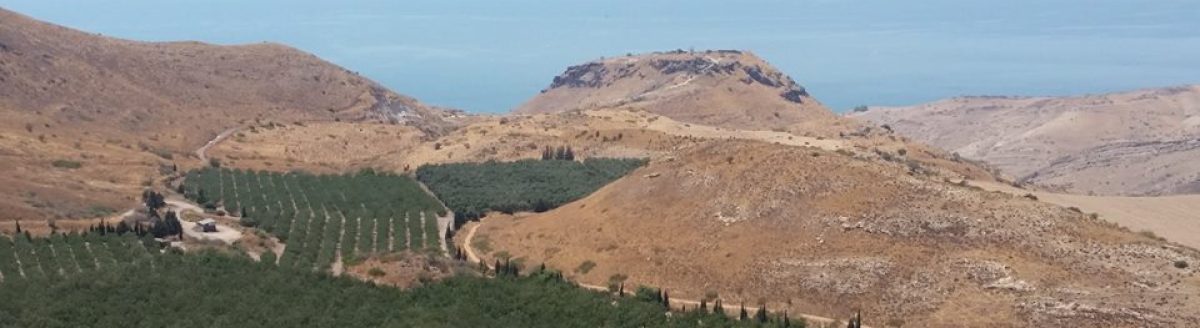
Now, the Golan is home to both Jews and Arabs, with a slight Jewish majority.  Arab communities include Druze, Muslims, and Alawites.  The Arabs often identify as Syrian, although a number of them have adopted Israeli citizenship.  It’s a very rural area and extremely green and beautiful.  It’s kind of reminiscent of a Middle Eastern Vermont or Switzerland.  Before I get into my story, here are some pictures to give you an idea (I visited the picturesque Galilee along the way so I’ll throw in a few from there too):

20170804_18335220170804_14395820170805_14041720170805_125759

Friday afternoon, my friends and I went for a hike in the Galilee.  A park ranger told my friend Jordan to get out of the creek and then told me I was wondering too far away.  As with almost all tense situations in Israel, the awkwardness immediately dissipated when I started to talk to the guy.  Turns out Muhammad is a Muslim Arab from the Golan, meaning his roots are in Syria.  I spoke with him in Arabic and he started to open up to me.  Turns out, Arabs in the Golan are afforded the very unique opportunity to go to college in Syria (this is astonishing because Syria and Israel are technically in a state of war and Syria doesn’t even recognize Israel.  But as with all things in the Middle East, you find loopholes).  He studied medicine in Damascus for a year, but then had to flee because of the civil war.  He decided he didn’t like medicine (despite his parents’ wishes that he become a doctor- does this sound similar, Jewish friends?) and became a park ranger and enjoys being in the peace of the outdoors.  He definitely had some delusional ideas about how great life is in Syria for its meager remaining Jewish community (after all, there is a reason almost all of them have left).  That being said, he was also clearly a very open-minded and tolerant person open to people of all backgrounds.  He is a person forging his own path (pun intended), something I can identify with.

After our hike, we went to a kibbutz to spend the night.  To say this place was magical is an understatement.  It’s the most romantic, scenic, and peaceful place I’ve ever been.  And I’ve been to the Alps.  It is a rural, progressive Jewish lifestyle, something that is almost non-existent in the United States.  Not only is most of rural America conservative (whereas kibbutzim have socialist origins and still lean left), but also Jews as a minority need to be around lots of other Jews in order to make for a rich communal life.  This partially explains the high concentration of Jews in New York, Boston, DC, Chicago, Miami, LA, San Francisco, Atlanta, etc.  The same could be said for gay people, which is a big reason why I, as a gay Jew, have stuck to major urban areas in the U.S.

This is not the case in Israel.  You can enjoy a progressive rural lifestyle and feel at home.  No rednecks here 🙂

I have a deep love for nature and tranquility so I found the experience awe-inspiring and thoroughly relaxing.  I wandered around the kibbutz and nearby and just felt at peace.  I have a strong inclination to raise my family in a place like this in the future- somewhere safe, Jewish, open-minded, and surrounded by God’s beautiful plants and animals.

After singing “Lecha dodi” by a lake as the sun set over the mountains much like the first kabbalists in Tsfat, I came back to the house for Shabbat dinner.  As we laughed and relaxed around the table, we heard a boom.  And then another boom.  And many more.  We realized that those were bombs being dropped in Syria’s civil war.  The border is just a few kilometers away.  It was a somber reminder of the violence raging oh so close by.  It’s one thing to hear about the civil war and quite another to simply hear it.  I prayed to God for the safety of my brothers and sisters just across the border.

We then had a lovely dinner and I wandered around alone afterwards exploring the kibbutz, praying, dancing, just unwinding.  I looked up at the moon and talked out loud to God.  “God, thank you for this beautiful Kibbutz.  God thank you for Shabbat and for the beauty of nature.  God thank you for the opportunity to visit the Golan Heights.  God, thank you for the gift of being an Israeli.  For the gift of living in this place, for bringing me here.  Where despite the news and despite the booms off in the distance, I feel safer than I ever have in my life.  Help me to grow stronger and heal and to make your name great.  To strengthen your people and to bring peace.  Amen.”

I went inside, talked to a really hot Lebanese guy Ameer on Tinder across the (other) border, and got the best night’s sleep I’ve had in Israel yet.

That’s life in Israel- radically accepting that there are some things you can’t change (war and borders), and then thoroughly enjoying all the amazing things in front of you (trees, lakes, mountains, Judaism, good food, friends, and more).  Never taking life for granted and, while things can be sad or scary, rather than being paralyzed, just enjoying the hell out of the blessings you’ve got.

It was a little scary and sad to hear those booms in the distance.  At the same time, I can honestly say that I actually felt safer at this kibbutz than in America.  Here, I feel my identity is validated, that I’m a part of a big national family, and that I’m enjoying life to the fullest.  It’s worth the risks because life here is so much better for me.

And who knows, one day maybe Ameer and I will be able to cross the border and pick up where we left off last night 😉

Sexy Jews

No, that’s not an oxymoron.  That’s a fact.

Tel Aviv is filled with a whole lot of sexy Jews.  Sexy men and sexy women.  Gay and straight and lesbian and bi.  Toned muscle, pecs, six-pacs.  Joggers, yogis, boxers, dancers, volleyball players.  Shirtless, sweating, smiling, swimming, sunbathing.  Hot. As. F*ck.

Many of them wear Star of David necklaces or sometimes yarmulkes.  And they speak the language of the Torah as their bodies gleam effortlessly in the sun.

It is a true paradise.

In the U.S., Jews are often portrayed on TV and in films as sex-less geeks.  Men are often portrayed as effeminate and too “bookish” to be sexy (think Ross on Friends) and women are often portrayed as overbearing and unbearable (think Fran on The Nanny).  We are good at being lawyers, doctors, professors- but we almost never thought of as sex symbols.  And even if there are Jewish sex symbols, such as Zac Efron, they are almost never talked about in connection with their Judaism.

That’s not because American Jews aren’t sexy- there are a lot who are!  It’s because the society we live in has told us we’re not and I think we’ve internalized it to a degree, as can be seen in items like the semi-satirical “Nice Jewish Guys” calendar.

Here, that doesn’t exist because we built this society.  The other day, I went to a gay beach in Tel Aviv.  So in other words, other than a few tourists, a gay Jewish beach.  The world’s only gay Jewish beach.  And it was amazing.  Besides the loads of hot guys, I just felt like I could be myself.  I didn’t feel self-conscious speaking Hebrew among gay people or speaking Yiddish to my Israeli friend who came along.  And I didn’t feel self-conscious about looking at the hot guys in a Jewish environment.

Since arriving 3 weeks ago, I’ve been to a gay rights rally, visited a gay art exhibition (including the cover photo for this blog), made friends with a lesbian rabbi, participated in an Orthodox LGBT Torah study group, started living with a lesbian couple, and so much more.  I can’t even think of them as separate items anymore because I don’t have to go out of my way to do them- they are just a part of my life.  As they should be.

For most of my life, my Judaism and my sexuality have felt like two separate worlds.  Identities that aren’t supposed to touch.  Here, in Tel Aviv, they are so intertwined that it finally feels natural.

I’m gay, I’m Jewish, and I’m sexy.  Wanna go for a jog?