The North: where my Arabic can breathe

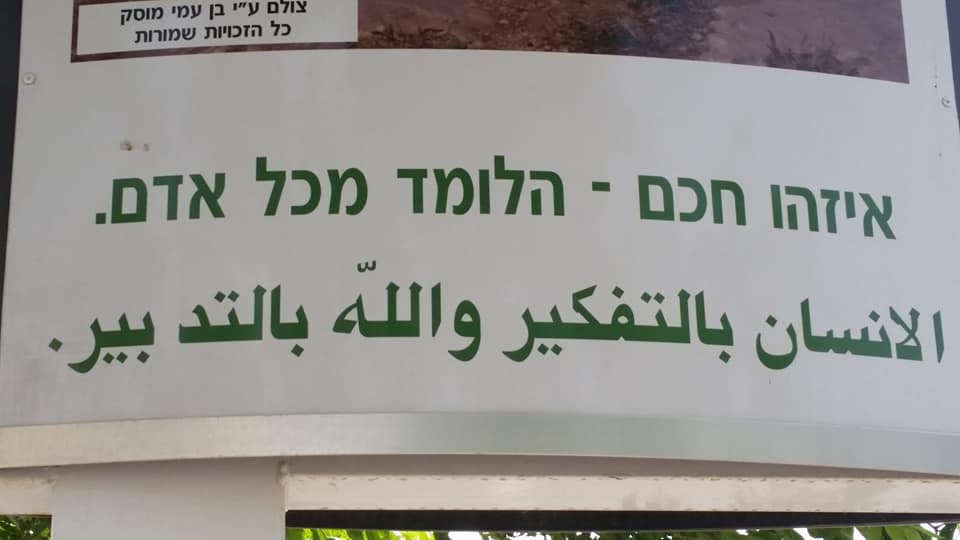
Who is wise?  He who learns from everyone.

That’s what my cover photo says.  That’s what Rabbi Ben Zuma said 2,000 years ago.

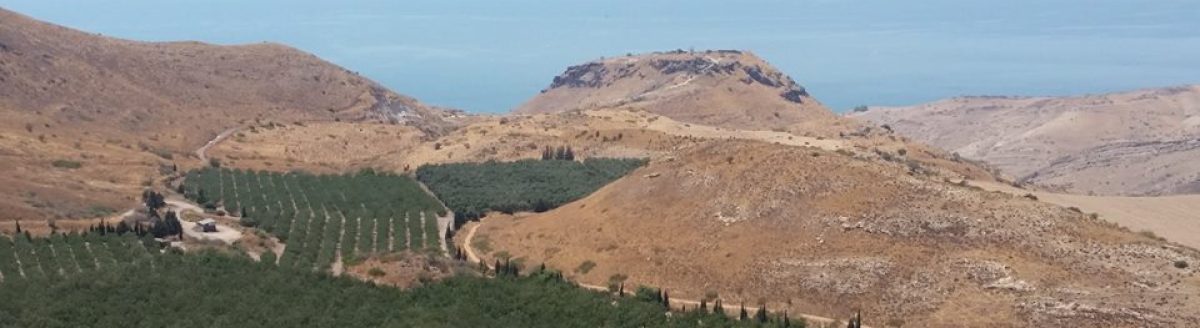
Did I find this in Bnei Brak or Jerusalem?  No.  I found it in a Druze village- Yanuh- with a Jewish population of 0.  An absolutely gorgeous place with stunning greenery all around.  Super friendly people.  And- at least when I was there- not a single tourist.  Due to my clothing and my fabulous blue sunglasses, everyone knew I was from out of town.

And when I opened my mouth to speak Arabic, the smiles were constant.  The laughter, the joy, the jokes- jokes with me.  Because I can speak to them in their native tongue.  I am a polyglot- I speak 8 languages fluently or proficiently.  I have an “ear” for language, undoubtedly, but I also use them.  A lot.  I don’t memorize vocabulary on my phone- I hang out in Druze villages.  I talk to cab drivers in Arabic.  The other day I got my friend a discount on strawberries at the market in my Jewish neighborhood because the Arab vendor was so excited that I spoke Arabic.

Why would Arabic speakers here be so excited to hear me speak it?  I can think of a few reasons.  For me, it honestly just feels natural.  I love speaking Arabic.  And unfortunately due to the extremists trying to tear down the border fence in Gaza to “liberate” my neighborhood, I’ve felt further and further from the language.  When certain Palestinians decide to fly burning kites over the border fence to set my country’s farms on fire, I have a hard time connecting to the language they speak.

Which reminded me- not only Palestinians speak Arabic.  A lot of times, the news media and even leftist Israelis who choose to learn the language are exclusively focused on Palestinians.  It’s not a bad thing to want to dialogue with them- the more people learning languages the better.  In all societies, especially here.

It’s just that Palestinians are not our only neighbors.  Certainly not our only neighbors who speak Arabic.  About 20% of the Israeli population- citizens- speaks Arabic as a first language.  And lucky for me, the Arabic-speakers up north, in the Galilee and Golan, speak the dialects closest to mine.  Syrian.

Why do I speak Syrian Arabic?  Besides the fact that it, perhaps alongside Lebanese, is in my opinion the most beautiful Arabic dialect, it was a bit due to circumstance.  At my university, I studied Fusha, Modern Standard Arabic (more of a literary language).  Only after 3 years did I have the chance to learn 3ammiyya, or spoken Arabic.  I had the choice of Egyptian or Syrian, and I chose the latter because it was mutually intelligible with Palestinian.  And I also care about dialogue.  My professor was from Damascus.  He was homophobic and somewhat anti-Semitic, but his Arabic was astounding and I learned so much.

Since then, Syria was plunged into civil war and I never got the chance to visit.  Though, along with Lebanon, it would be my dream to do so.  Inshallah- God Willing.  In the meantime, the closest thing I can get to speaking my Damascus Arabic is to simply hop on a bus up north.  Or speak with my Syrian refugee friends, which I do each week.

The Druze, in particular, migrated to northern Israel over the past 800 years.  From Aleppo, Lebanon, and beyond.  Of course the Druze in the Golan Heights were living in Syria just 50 years ago, so their Arabic is very close to mine too.

And to a person- everyone is excited to hear me speaking their language.  And their dialect.  Not Palestinian Arabic- Syrian Arabic.  Quite often people actually ask me if I’m Lebanese or Syrian.  The most flattering thing I’ve ever heard.

Today the coolest thing happened.  I was visiting Isfiya, a Druze village with significant Christian and Muslim minorities.  After visiting a Bedouin shop and some churches (the Christian dialects up here are also super close to my own and fun to hear), I had dinner at a Druze grocery store.  Yes, because the grocery store also doubled as a roadside food stand with kebabs.  I love my country.

While my kebabs were roasting, I popped over to the cellphone shop.  I want to buy a portable phone charger so I can travel at ease and get some extra juice when I need it.  I initially approached the young man in Hebrew.  And then, just like every Arab and Druze person does here millions of times a day, I slipped into Arabic.  Five Arabic words here, one Hebrew word there- it’s the most beautiful and fun thing.  Kind of an Arabic Yiddish with amazing wordplay.  A young kid said to me today: “ani rotzeh sheanja7“.  I want to win.  The italics Hebrew, the bold Arabic, and it flowed perfectly as we giggled at the combination.  It’s fun when you can enjoy the best of each other’s cultures.  To the point where they’re hummus and tehina.  You can’t fully separate them and they’re delicious together.

I’m at the phone store and my Arabic starts flowing and a Druze man, no more than 20 years old, lets out an “Allahu Akbar!” to shake the ground.  In such shock and delight at seeing a Jewish American-Israeli speaking his language, he simply praised God.

I had this deep inner sense of joy and satisfaction.  I felt so, so complemented.  It was funny.  It was sweet.  It was sincere.  And it was a beautiful way to take a phrase that radical Islamic terrorists use to blow people like me up- and instead use it to bring us together in unity.  In a cellphone store.  It tickled me.

This kind of reaction happens to me a lot, especially up north.  When I tell some of my Israeli Jewish friends about the villages I’ve visited- a good number of them have never even been.  Or in some cases, even heard of them.  Or even think they’re worth visiting.  It’s not universal- I’ve hitchhiked with Jews who were visiting these villages.  But it’s an extreme, extreme minority.  Jews here do not speak Arabic.  Other than older generations of Jews from Middle Eastern countries and a few dedicated young people who paid attention in school (or the army), Jews don’t care to learn Arabic here.

It makes me sad.  On a few levels.  One, because I understand why.  There is a 70 year old trauma-inducing conflict here, separate educational systems for Jews and Arabic-speakers, and largely separate residential patterns.  And while there are people in both societies who want to mix, overall there is a desire to retain communal identities.  Which can make it hard to learn each other’s languages.  Especially Arabic, whose spoken varieties aren’t standardized and really require in-person experiences.

And yet, only about 10% of Jews here speak Arabic but 77% of Arab Israelis speak Hebrew.  About 29% of Arabs here can’t read Hebrew- which is an issue for employment, social cohesion, and communication.  But let’s just say Arab citizens of Israel are way, way more invested in learning Hebrew than vice-versa.  Which is a national shanda.  That’s Yiddish for scandal.

While this may be par for the course for majority-minority relations (after all, how many non-Latino Americans speak Spanish?  Answer: about 10%, the same as Jewish Israelis with Arabic), it’s not acceptable.  While I value the smiles I get from young Druze and Christian Arabs and even Muslim kids (in those villages I feel are safe enough to visit- which is not all of them), I don’t want to be an oddity.  I want more of my countrymen to stop whining and pick up a book.  Take a class.  Visit your neighboring village.

Arabic speakers in Israel are almost universally happy to help.  And eager to see you give a shit.  I don’t really care how many times you voted for Meretz or how you do a once-a-year interfaith Seder.  Stop being a lazy (fill in the blank with something that will motivate you) and get to work!  If you spent half as much time learning Arabic as you did complaining about your salad dressing, you’d be fluent.  Arabic takes practice but it’s so much fun!  It will take you on new adventures- musically, socially, geographically, historically, and beyond.  It’s a true civilization.

And the good news is that even when some people who speak the language are becoming increasingly extremist, you can find great places in Israel to practice the language safely.  Basically, any Druze or Christian village, most Bedouin towns, and even some other Muslim villages like Abu Ghosh.  Or beyond, when the conditions are right.  I’ve traveled in some deeply conservative Muslim villages and had some close calls- so I can understand if you don’t want to start there.  The vast majority of people I’ve met in all places were cool.  It is true that it just takes one nutjob to end your life.  So do some research if you want to go far off the beaten path.

In the end, the North of Israel is the best.  It’s the place where I dabke dance on the street with Druze kids, where I counsel a bi-curious young man in Arabic, where I get private tours of churches followed by tons of homemade pastries.  It’s a land of generosity, of green hills, of smiles.

When I leave a Druze village, a place where my Judaism and my Israeliness and my Arabic-speaking identity are all validated, I hate getting on the bus.  Tel Aviv is a vibrant, energetic, queer-friendly coastal city.  With a beach.  There are things here that are unique and maybe it made sense for me to start here.

As I spend more time in other parts of the country, especially the North, I wonder if Tel Aviv will really be home for me.  Maybe I’ll split my time (perhaps people up north will want to trade apartments once in a while 😉 ).  Maybe I’ll live here but keep traveling a lot.  Maybe I’ll just move up north.

What I do know is this: Tel Aviv smells terrible.  And when I hop off the bus, the stench is overwhelming, the noise is loud, the nature is nonexistent.  Yes, there are exceptions.  There are beautiful areas near me just south of the city.

But would I rather have a late night pizza place or make some at home and sit in a forest and stare at the stars in awe?

Where my Arabic and my soul can breathe.

A Burmese refugee, Libyan Jews, and me

Big moments happen in small ways.  Tonight I was at my favorite sushi restaurant.  You wouldn’t expect to find it in my neighborhood, a place where the Mizrachi music blasts and the streets have a special smell.  Yet my neck of the woods is full of surprises.

As an oleh, an immigrant, who came alone- life can be hard here.  I have no family support network- and this is a country built on family, much moreso than America.  People don’t just see family twice a year on holidays here.  They often live right down the street.  The good part is people are willing, often eager, to take me in.  In America, I felt even lonelier.  Having no family- I cut them off due to their abusive behavior– I had to find places to spend holidays and Shabbat and even dinners.  I found myself growing closer and closer to certain restaurants there because I didn’t want to eat alone.  And some, like my favorite Thai digs in D.C., really loved me and even gave me gifts on my birthday.  When you have no family, you build it yourself.

The downside to not having family here, in such a family-centric society, is you really feel it.  Saturday, Shabbat, is not just a day to relax- it’s a family day.  With family meals.  And if you’re not invited to one, it often feels solitary.

Today, I spent my day exploring the Libyan Jewish Heritage Center in Or Yehuda.  Absolutely free and full of fascinating history, I had a blast.  A Libyan man there gave me a personal tour of the entire place- in Hebrew and Arabic.  Missing the North, where I had just enjoyed speaking so much Arabic, it was great to speak it in my own backyard.  With a Jew 🙂 .

Moshe made aliyah, immigrated to Israel, when he was 7.  He was born in Tripoli, Libya.  Heir to a 2,000 year old Jewish tradition that predates Islam.  Like many Jews in North Africa, Libyan Jews were subjected to Muslim pogroms, or massacres, in the 1920s-40s.  I also learned today that almost 3,000 were even sent to Bergen-Belsen and gassed by the Nazis in the Holocaust.  I had no idea.  We usually associate Holocaust with Ashkenazi Jews (and some Sephardim, like in Greece).  I knew of some persecutions in North Africa, but not much.  But the Holocaust artifacts- even someone’s suitcase from a concentration camp- really took me by surprise.

Moshe walked me through everything, with such patience and kindness.  I had the whole museum to myself- which I hope you’ll fix by going and visiting.  If you don’t, it’s very much your loss.  I saw Jews’ Libyan passports, a Libyan Zionist youth group T-shirt, Arabic-language legal contracts, 500 year old Torah scrolls, and so much more.  A Passover haggadah in Hebrew, Judeo-Arabic, and French.  I got to hear Libyan Jewish music and hear stories of heroism by Libyan-Israeli soldiers in the IDF.  Even a 1950s teudat oleh.  A true treasure.

Libyan Jews lost all their property when they had to flee to Israel.  Now Jewish cemeteries there have been bulldozed, built over.  Jewish homes occupied by Muslims.  Despite the fact that Moshe said Muslim women would look after him and bring him home to his mom.  The relations were not always bad.  Yet not a single Jewish community remains.  So if you want to know why Jews feel like we need a state of our own, just take a look at Libya.  When we are subjected to the whims of non-Jews, it always- always ends badly.  Maybe not during every epoch- but the sad truth is the finale remains the same.  A minority without a home base can’t really protect itself.

After a delicious Bukharan Jewish meal near the museum, I did a little shopping for my apartment and headed home.

WhatsApp Image 2018-05-03 at 1.13.04 AM

At home, I did a little tidying and started to feel tired.  Physically tired, perhaps- I didn’t sleep well last night.  Coming back to loud and chaotic Tel Aviv after some days in the quiet, peaceful North was hard.  And to boot, it was friggin hot.  But also emotionally tired.  Tired of being alone in this gorgeous land, where I make friends here and there but I just don’t have a home base (though perhaps I’m building many).  I don’t have my own “Israel” to come home to.  But I’d sure like one so anyone looking for a third of paradise, hit me up (that’s a Jewish joke- but it’s not a joke 😉

I realized that my neighborhood sushi joint- that’s where I feel at home.  Any time I need someone to eat with, when it’s just too tiring to make plans, I go there.  And I love the people there.  The Filipinos who run it, the Mizrachi girl who says “be’ezrat hashem” (God willing) every time I tell her about a cute guy, and the adorable Filipino-Burmese-Israeli kids who like to play with me in Hebrew.  One even made me origami 🙂

When I go to this restaurant, I never feel awkward.  In the States, sometimes I felt “weird” or “imposing” or even desperate if I’d go to the same restaurant “too often”.  Here, even if it’s only been a day or two, my friends ask me “where have you been?”

Notice I said friends.  Because we don’t just talk about the weather or football or our plans for the weekend.  We talk about homosexuality, family, children, Tagalog, Burmese, Israeli culture.  We share jokes and we laugh.  I play tic-tac-toe with the kids- and I usually lose. 🙂

The past few weeks, a Burmese relative of one of the employees has been filling in for someone.  My knowledge about Burma basically extends to a delicious restaurant in suburban Maryland, an episode of Anthony Bourdain, and the famed human rights activist whose name I can never pronounce.

What I know about Burma is that it was- and in some ways still is- “al hapanim”- a disaster.  Run by an isolated military dictatorship, many Burmese fled.  A brief glance at Wikipedia reveals child soldiers, slave labor, and ethnic cleansing.

As they shut down the shop at midnight (because I’m lucky enough to be able to walk to a sushi joint open till then), I talked to the Burmese man.  He’s been in Israel for over 20 years.  He has some sort of official refugee status.  It affords him a legal visa, but not citizenship.  He said he might be able to get it through an expensive process, but his coworker indicated he couldn’t.  It wasn’t clear.  He said he could go to America, where he has relatives, but he prefers life here.

It wasn’t even entirely clear how much, if at all, he could travel outside the country.  And this is a country that has lived through several wars just since the time he arrived.

He pulled out his Burmese passport.  I’ve never seen such a thing.  It was worn and full of Israeli visas (which frequently have to be renewed- for some workers every 3 months).  We had a huge laugh together when we saw his picture in the front.  He was young.  Maybe 20 years old in the photo.  Today he’s over 50 and while he has a deep vibrancy and a full laugh, you can see the wear that working hard jobs has taken on him.

To see an expired Burmese passport, from a Burmese refugee, to talk with him in Hebrew- and laugh.  In my neighborhood.  That’s a new feeling.  The same day I saw Libyan passports of Jews who fled for their lives.  I felt gratitude for the fact that I got immediate citizenship and guilt that he still doesn’t have it.  Joy at making a new friend.  And pride that he prefers Israel over America and all other countries.  Deep empathy- it must have been excruciating for him to leave his homeland and to be so far away.  I asked him- he misses it.  Yet he keeps laughing and smiling.  A true survivor and thriver.

Libyan Jews, me, and my Burmese friend.  We all fled our own traumas.  Islamic extremism, a deeply abusive family and anti-Semitism, and a ruthless dictatorship.  And we’ve all managed to make Israel our own.  Our home.  We faced and face our own challenges.  I hope Libyan Jews here manage to remember and preserve their heritage even as they contribute to our beautiful nation.  That Libya will repent and repay the Jews for ethnically cleansing us.  I hope I continue to find stability, love, and happiness – family – in my new country.  A place where I feel increasingly healed and have more healing to do.

And for my Burmese friend- I wish you nothing but love.  May you continue to grow here.  May you get the legal status you need or want to feel safe.  May you feel welcome.  Even if you’re far from your Burmese family, I hope you feel embraced by your Israeli one.

Count me in as a member.

My Yemenite-West Bank-Nepali-Darfuri-Mizrachi kind of day

This morning, I knew I wanted to go on trip.  After my doctor’s appointment, I wasn’t sure where to go.  So I noticed the nearby bus stop went to Rosh Ha’ayin and I hopped on a bus.

I’ve long been fascinated with the city, which was founded largely by Yemenite Jews.  They have a heritage center there, which I’d love to visit another time- it was about to close when I arrived.

Not sure what to do, I simply walked upwards.  I noticed that I was very, very close to the Green Line, the line that separates pre-1967 Israel from the West Bank/Judea and Samaria.  I caught some absolutely gorgeous views of the hills on the other side- just stunning.  The nature was stunning and also the mystery of what’s over there intrigues me.  Yes the hatred and also the forbidden nature of it.  It’s so, so close and it’s legally quite far.  The anger and animosity that forbids me from visiting is overwhelmingly sad.  Also because I know it’s not a simple thing to fix.  There are reasons why Israel needs a security fence and there are reasons why Palestinians are angry about it.

Rather than get into the politics, I want to share an odd observation.  The fence itself in this particular place- it was pretty.  It struck me.  Fences anywhere usually aren’t so pretty.  I’ve seen our border fence with Syria.  It’s pretty much just a fence.  I’ve seen from afar the concrete parts of Israel’s security fence in Jerusalem and they look pretty concrete-y and gray.  For whatever reason, the part of the Green Line that is a wall here is oddly…attractive.  Its yellow stones strangely complemented the gorgeous hills I viewed on the other side.  While not being able to go there frustrated me, I felt oddly at peace.  This is what it is now.  To protect me, this wall needs to be here.  And I hope one day we’ll be in a place where me and the Palestinians on the other side can live next to each other with normality.  We’re pretty different in a lot of ways, but maybe one day I’ll find a friend there.  In the meantime, I’ll enjoy the view and the hope.

After almost making it to a Yemenite restaurant in Rosh Ha’ayin before a downpour, I decided to take a bus to a mall in Petach Tikvah.  I was in need of a new backpack and since it was raining (torrentially- 9 children were killed in flash floods, z”l), I headed indoors.

I had never been to Petach Tikvah and, to its credit, I have not yet explored there.  I’m sure I will.  The view from the bus wasn’t fantastic- it’s a kind of concrete jungle that reminds me a lot of Northern Virginia.  And like Northern Virginia has the beauty of Old Town Alexandria and the ethnic food of Annandale, I imagine Petach Tikvah has its charm too.  It just wasn’t where my bus was driving.

I got off and went into what has to be the largest, cleanest mall I’ve seen in Israel.  Orderly, calm, and at least when I was there, relatively quiet.  A kind of reminder of what America was like sometimes, just in Hebrew 😉 .  I got a new backpack- I’ve traveled so much that the bottom of my backpack has come unsewn.  I have a great relationship with my backpack- one of my steadiest- and I’ll miss it.  I started to say kaddish for it and haven’t quite yet let it go.  But I do have a new friend to carry with me and it looks snazzy and sturdy.  May it bring me to great adventures and fun.

Leaving Petach Tikvah, I thought to drop my stuff off and go to Bnei Brak for gefilte fish.  I called my friend Yisrael to get the address for his restaurant.  Then, my monit sherut cab dropped me off by Neve Sha’anan, a neighborhood of mostly refugees and non-Jewish foreign workers.  Instead of going to eat gefilte fish, I went to my favorite Nepali restaurant here, ordered chicken momos (a whole plate for 20 shekels!), and chatted with a bunch of friendly Nepali guys.  And debated American politics with the Tibetan chef.  There were moments of discomfort when I explained how I immigrated here and have dual citizenship- something most of them could only dream of.  The tension of feeling bad for them and the tension of feeling like there’s not always an easy solution to these kinds of things.  Because I want them to have equal rights and I also think that in order to have the only Jewish state on the planet, how do we draw a line in a humane way that allows us to continue that miracle?  Not so easy.  On the upside, one of the guys, Diwass, happily agreed to exchange his Nepali for my Hebrew, so we traded numbers 🙂 .  Always good to stay grounded in a place where the “what if-ing” could occupy your whole life.

On my way home, I realized I wanted some produce.  There’s a beautiful new store opened by a Darfuri guy from Sudan.  He recognized me from my last visit and we talked fruits and veggies in Arabic.  I asked him about his former city in Darfur, Kutum.  I told him I’d look it up and learn about it.  We talked about the languages of Darfur and my work and me being a dual American-Israeli citizen.

We wished each other ma3 asalaameh and I walked home.  One of the (many) Mizrachi synagogues on my neighborhood had a huge gathering of people on its porch.  Because in Israel, we treat each other as family more than strangers, I went up to a guy and asked him: “what’s going on here?”  And he said: “It’s a hazkarah.”  Or what Ashkenazi Jews might know as a yahrtzeit, the anniversary of one’s death.  I said: “but everyone is so happy!”  His response is one of the most beautiful I’ve ever heard: “it’s been a year.”  He smiled and we went our separate ways.

Why is this man’s response one of the most beautiful things I’ve ever heard?  Because it represents the absolute best of this country and of Judaism.  But a Judaism so concentrated and radically accepting of the present that I’ve never seen such a thing in another country.  We were sad a year ago.  Someone passed.  And now, we come together in a spirit of joy.  Not the joy of pretending it didn’t happen, but the joy that we’re here together.  To remember someone we loved and to thank God for being alive.

Want to know why I live in this Land?  A land threatened by terrorists and missiles and theocrats from every side and all across the region?  A place where your bags are searched in every mall and theater and where soldiers carry guns on the train?  A place where the landlords and real estate agents won’t hesitate twice before screwing you?  A place where the salaries are lower than America?  A place where I sometimes miss the cleanliness and rules and museums and delicious Asian food of America?

Because we know how to live life to the fullest.  And we have the amazing landscapes and people and cultures and kindness to do so.  In America, I often felt distant from my neighbors.  You don’t invite yourself to someone’s home- you ask them for permission.  And don’t want to “impose”.  Here, there’s a deep appreciation for the value of every second you have on this planet.  And there’s an incredible generosity of spirit that allows me to sit with Nepalese workers and Darfuri refugees and my Syrian Jewish neighbors for hours on end.  With no “transactional” expectations of our relationship.  Just because we’re human beings.  And friends.

The other day, when I told my American friend how in Israel you can go from a Bedouin town to a Hasidic synagogue to a gay club in just one day, he said: “but how many people actually do that?”

I’m not sure.  More should.  The point is here you can.  And I definitely do.  So if you’re getting bored on your commute from Rockville to Washington or Evanston to Chicago or Westchester to New York, open up Skyscanner.  Find yourself reaching for your wallet to buy a ticket.  And click “yes”.

Because you might just find yourself having a Yemenite-West Bank-Nepali-Darfuri-Mizrachi Jewish kind of day.

Or as I call it: “Thursday” 😉

p.s.- my cover photo is of Libyan soup I had yesterday.  Because no image could possibly capture such a mix of cultures better than a delicious stew 😉

Why reading the news is a waste of time here

Ok, first things first- yes, sometimes you do need to read the news.  I, for instance, when planning my trips, search the name of the town I’m visiting to check for safety.  When I heard air raid sirens in my apartment, I lit up my WhatsApp but I also checked news sites.  News has a purpose when used effectively.

And most people do not use it effectively.  For many years (and once in a while now), I just get caught up in the news.  Reading- whether on Facebook or on the news sites themselves- just depresses me.  I get that the media needs to make money so they focus on the most dramatic and often sad or offensive things.  Today, I glanced through articles about anti-Semites boycotting Israel, anti-Semites attacking Germans wearing yarmulkes, Jeremy Corbyn being anti-Semitic, Natalie Portman’s mess, and the likelihood of war with Iran and Syria.  I literally just cried.

It’s not because the words being written are untrue (although sometimes they are), it’s because they are true.  And they suck.  And they’re selective.

Because I’ll tell you what I did the past few days and was not in the news.  I took a bus from my low-income stereotyped neighborhood to three beautiful rural communities just around the bend.  I met an archivist who sat with me for an hour and a half to explain to me the history of his town.  I hiked through a forest in northern Israel to the Druze village of Daliat Al-Karmel.  When I asked some Druze women for directions, they sat me down, plied me with tea and coffee and salads and sweets.  They gave me a huge container of leftovers.  Drove me to the village and added me on Facebook and WhatsApp.  Today, I went to Zichron Yaakov, discovered a beautiful hidden trail, hitchhiked down the mountain to Maagan Michael’s gorgeous Caribbean-like empty beach.  Then, I walked on the sand to Jisr Al-Zarqa, a Bedouin village, where I was the only tourist visible.  I got to hear some pretty cool Bedouin Arabic, talked with a guy about Arabic music, and spent a peaceful bus ride hanging with some friendly Bedouin women.

In the course of about three days, I had been to national parks, a kibbutz, a moshav, a suburb of Tel Aviv, a Druze village, and a Bedouin Muslim one.  The main reason I write this blog is for me- it’s a record of my journeys, it’s therapeutic, and it’s fun.  I like writing, I enjoy it.  The other reason is because these kinds of stories- real and authentic- don’t make their way into the news.  The nuanced, the complicated, the fun, the moving, the heart-warming, the sad.  The full spectrum of the human experience.  Instead of reading like a laundry list of everything bad in the world, I prefer to share something a bit more real.

Because the sad stuff- the anger, the extremism both left and right, the aggression- those all exist.  And sometimes I touch on them.  And I feel that the media, perhaps in the quest for eyeballs and ad dollars, only focuses on the negative.  The things that make you click even though you (and I) don’t want to.  We’re hooked.

Living in a country plagued by terrorism and war, I’ve learned something from my fellow Israelis.  And I want to remind them of it- and teach my friends abroad.  Faced with crazy shit, you have two options.  One is to live in chaos.  Either a constant state of panic or burying your head in the sand and pretending nothing is happening.  The other option is to live in the here and now.  To be present, to enjoy what you can, to be grounded and live your life with gratitude for every moment you have.

That second path is the one I choose and strive for.  It’s the one many Israelis, both Arab and Jewish, manage to pursue much, much better than Americans during these difficult times.  Perhaps because we’re a more communal society.  Perhaps because we’ve been dealing with trauma for longer and know how to better cope with it.  Either way, my gift to Americans reading this blog right now is that spirit of embracing the present.  It’s not to completely detach yourself from worries nor to pretend that shit isn’t going down.  Sometimes, it is.

It’s just that on a day when everyone was talking about Natalie Portman and Iran, a Druze kid was practicing English with me.  I was taking selfies with cows.  I was taking selfies with sheep!  I was listening to the waves of the ocean as I walked towards a Bedouin village.

We all have choices about how we spend our time and energy.  We all have a right to our feelings and we make choices about how we live our lives.

I have opinions about all the “news” items I shared.  And I have a right to them, and maybe I’ll share them- and maybe I won’t.  Because maybe, like tonight, I’ll be too busy meeting other young people in my neighborhood at our first block party.  Organized by a friend I met in a sushi joint around the corner.

Shoot this, boycott that, yell this, scream that.  I don’t really care.  Because the music is blaring so loud around me that I just hope one day you’ll open your ears to listen.

What do you call people in Israel who speak Arabic?

No, there’s no racist punchline 😉

This is a question I get a lot.  Sometimes “well meaning” American progressives come here and start calling every Arab they meet a “Palestinian”.  Perhaps out of a desire to validate their identity, but without considering that it’s a bit more complicated than that.

For starters, there are Palestinians who live in the West Bank and Gaza Strip.  There are also Palestinians in other countries like Lebanon, Syria, Jordan, and elsewhere.  Those in the West Bank are largely governed by the Palestinian Authority and those in Gaza by Hamas.  Israel exerts partial military control within the West Bank/Judea and Samaria and at border crossings.  Gaza is entirely independently governed by Hamas and entry to Israel or Egypt is strictly controlled by the respective governments.  All of those people are pretty clearly Palestinian.  Maybe a few Samaritans in Hebron would identify otherwise- not entirely sure.  But almost to a T, regardless of religion (almost all Palestinians there are Muslim, there is a small Christian minority), these people are Palestinian.

Now, moving westward from the West Bank, there is East Jerusalem.  East Jerusalem came under Israeli control after the Six Day War in 1967.  Because of the sacredness of this city for Jews, Israel treats it differently for legal purposes.  While West Jerusalem was already part of Israel in 1948, East Jerusalem, which was primarily Arab, became officially annexed to the city in 1967.  Meaning, its Arab population has Israeli residency cards.  This allows them greater job opportunities, freedom of travel both within Israel and abroad, and more contact with Jewish Israelis.  There is still discrimination and it’s not on a level that you can compare with the West Bank, for example.  The vast majority of East Jerusalem Arabs would probably identify as Palestinian.  I’ve noticed this anecdotally through my travels there and I believe polls would back this up.  That being said, since East Jerusalem Arabs are eligible to work in Israel, some actually end up working for the government and even volunteering for national service.  Or the Israeli military.  So I think the layers of identity for them would be a bit less straightforward than someone in Ramallah.

Now, on to pre-1967 Israel.  There are several groups of Arabic-speakers in Israel.  First, there are Jews.  Jews have lived in predominantly Arab countries for two millennia.  They lived there, by and large, before the Arabs even arrived.  They then mixed their Hebrew and Aramaic with Arabic to create their own unique Judeo-Arabic languages.  From Morocco to Iraq to Yemen.  Often written in the Hebrew alphabet, like Yiddish.  Sometimes intelligible to their Muslim and Christian neighbors- and sometimes not.  In recent decades, the number of Judeo-Arabic speakers has declined.  And there still are many Jews in Israel who speak Arabic.  Not just those who learn it at school.  But also those, like my Syrian and Iraqi neighbors, who grew up with the language.  The vast, vast, vast majority of these Jews do not identify as Arab.  While some of that is tied to the stigma of being Arab, discrimination against Mizrachim, and the conflict with the Palestinians, there are other factors at work too.  First, there is the fact that Arabs committed massacres against their indigenous Jewish communities in the 1950s and 1960s, which forced Jews to come to Israel.  Most Jews lost their Iraqi, Egyptian, Yemeni citizenship and all their property.  It’d be hard for them not to come to Israel angry and wanting some distance from the people who were supposed to protect them.  Only to find their new Arab neighbors here blowing themselves up in pizzerias.  The other factor is that the Middle East wasn’t always Arab.  Arabs are from Arabia and conquered the region to spread Islam.  Jews have been living in Iraq, for example, since the Babylonian Exile, 600 years before Christianity.  Over a thousand years before Islam.  So to call an Iraqi Jew Arab- that could be a real invalidation of their identity and history.  A small minority of Mizrachim do identify as Arab Jews, often as a way of contrasting with the European elite.  But I would strongly recommend not calling Mizrachi Arabic-speakers Arab and certainly not Palestinian.

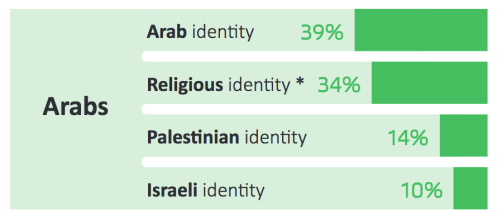
Notice we haven’t even gotten to the Christians, Muslims, and Druze.  In general, Arabs who are citizens of Israel do not define themselves as Palestinians.  Here is some polling data:

Screen Shot 2018-04-21 at 10.49.38 PM

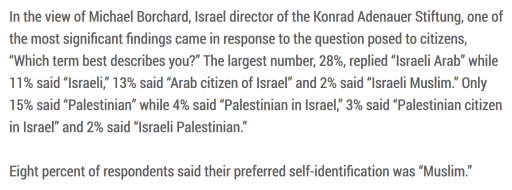
Here’s another poll with similar but sometimes contradictory data (perhaps depending on the phrasing of the question- also the first poll doesn’t include East Jerusalem):

Screen Shot 2018-04-21 at 10.56.02 PM.png

What overlaps is that about 15-20% of Arabs who have Israeli residency identify as Palestinian.  Sometimes hyphenated or attached to the word “Israeli”.  A larger portion identify as some variation of Arab, again sometimes hyphenated as Arab-Israeli or Arab citizen of Israel.  And a significant number just identify as Israeli.  For what it’s worth, there are also Arabs here who primarily identify by their religion, not their language or ethnicity.  Food for thought for people who are looking for a simple black-and-white breakdown.

Druze, Christians, Circassian Muslims, and Bedouin Muslims tend to identify more with Israel and less with Palestinian identity.  There is also a strong contingent of Christians who feel strongly about their Arab or Palestinian identity.  And other Arabic-speaking Christians who don’t even identify as Arab.  Many Druze, contrary to Israeli popular belief, feel they are both Druze and Arab.  I believe I got that info from a Pew survey, but am having trouble tracking it down (feel free to send it!).  Very, very, very few Druze would call themselves Palestinian (though a few do like Maher Halabi).  And many would be quite offended at the statement.  And they are native Arabic speakers.

Among these groups, Druze and Circassians crafted agreements with the Israeli government for their sons to be drafted into the military.  By agreement.  An increasing number of Bedouins and Christians- and even Arab Muslims- are choosing to volunteer or do national service, even though they are not legally obligated.  There are even Arab Christian priests encouraging it.

It’s worth noting the Druze mentioned here are the ones in pre-1967 Israel.  The ones in the Golan Heights were formerly citizens of Syria- and some now are taking Israeli citizenship in light of the brutal civil war.  They are not obligated to serve in the military and would almost certainly identify themselves as Syrian rather than Palestinian.  My friend’s dad says he’s a “Syrian now living in Israel”.  And I imagine people in his community have a variety of ways of describing their multifaceted identities.

If you’d assume that Israeli Muslims would be the most likely to identify as Arab or Palestinian and less so as Israeli, you’d be correct.  With some very important qualifications.  As mentioned, Bedouins and Circassians- both Muslims, are much less likely to identify as Palestinian in any form.  In the Bedouins’ case, Islam is generally much more important than nationalism and they’ve often been discriminated against by their sedentary Arab neighbors.  Circassians are quite fully integrated into the society and while many speak Arabic as a second language, they tend to be much more Israeli.

It’s also worth noting that if someone identifies as Arab or Palestinian here, there is a difference.  When someone says “Arab-Israeli” or “Arab citizen of Israel”, there are a few potential reasons why.  First off, there are Arab nationalists here who are against Palestinian identity.  Pan-Arab nationalism, which believes in an Arab identity stretching from Morocco to Saudi Arabia, is less a fan of state-based nationalism (e.g. Syrian, Palestinian, Egyptian nationalism).  There is the concept of bilad al-sham- the Levant.  Some Arabs here prefer to think of themselves as part of the greater Arab culture rather than the particularistic Palestinian identity.  Palestinian identity- like every other country in the region- is a modern concept.  Not because the people didn’t exist here (before anyone goes there), but rather because this area didn’t have borders before colonialism. Which is why the Arabic spoken in northern Israel is almost identical to Syrian or Lebanese and the Bedouin Arabic in the Negev has a Saudi or Jordanian tint to it.

Another reason why people here might prefer Arab over Palestinian is because there is pressure here to dissociate themselves from the conflict.  Someone might even choose one label in one context and another in another.  Identity can be relative.

A final, and important reason, is that some Arabs here just don’t identify with Palestinian nationalism.  And not because, in the case I described, they are pan-Arab nationalists, but because they simply want to live a good life here.  They don’t like politics.  They don’t like violence.  Some may even feel that if they took on the label Palestinian, it does a disservice to the real suffering of people in the West Bank and Gaza.  That basically if you have Israeli citizenship, things might be rough sometimes, but overall the quality of living is quite good.  And to compare yourself to someone living in abject poverty and misery- that’s not quite so fair.

Sometimes when American and European progressives come here, they try to correct me when I call someone Arab.  “Don’t you mean Palestinian?”  or they’ll just work the word “Palestinian” into their response- even though I just said Arab.  Maybe it’s not their intention, but I feel there’s a kind of “let me educate you” haughtiness.  That somehow if I’m calling someone Arab instead of Palestinian- someone who’s a citizen of Israel- it must be because I’m a hyper nationalist intent on denying their identity.  And thank God for the Western Liberal who can come teach me civilization.

And they’re wrong.  Because I have a basic rule- I identify you the way you want to be identified.  If I meet an Arabic-speaker here in Israel who prefers to be called Palestinian, Palestinian-Israeli, Palestinian citizen of Israel- I will call them that.  Or Arab.  Or Arab-Israeli.  Whatever they choose I validate that.  And I’m not going to impose my New York Times Huffington Post NPR podcast understanding of the Middle East on them.  Because newspapers are printed in black and white.  Which is about the depth that they can offer of a society thousands of years old halfway around the world.

So I encourage you- don’t put me or my Arab/Palestinian/Arab-Israeli/Arab citizens of Israel/Christian/Muslim/Druze/Bedouin friends in a box.  Because boxes are for shoes.  And unless you’re willing to walk in ours, you should probably return them to the store.

What do you call people in Israel who speak Arabic?  Ahmed, Maryam, Ovadia.  Even Matt or Matah.

Or as the cover photo says: friend.


Independence from black-and-white thinking

Today concluded my first Independence Day as an Israeli.  And the first one I’ve celebrated on my homeland’s soil.  It was an independence day for me, a chance to declare my freedom from my own oppressors.  To celebrate my progress.  It was a day to rejoice.

Rejoice I did- I danced to Mizrachi music in the streets, I hung out with friends, I wore my Israeli flag as a cape, I got congratulated for becoming Israeli many, many times.  There were goofy people dressed up as Israel’s founding mothers and fathers.  There was fun.  We deserve a day to just have fun and be proud of our accomplishments.  In 70 years, we’ve managed to do more than some countries do in 200- and under the near constant threat of destruction.  Just today, I was grocery shopping and read a newspaper article while in line.  About Iran wanting to attack us from Syria.  Welcome to life in Israel, where every day we’re alive is a victory.

At some points, I felt I should be happy but wasn’t quite as happy as I thought.  Maybe it was when the tour guide at Independence Hall said: “we’re all Jews here, so feel free to interrupt.”  I totally get the sense of humor and I had to wonder how the Filipina woman and her child behind me felt.  Or perhaps a Druze man sitting in the back.  I think growing up in the Diaspora made me more sensitive to including others- we have some work to do here.  Because most of us are Jews- and not all of us are.  And we all deserve a seat at the table.

It got me thinking.  I really wanted this day to just be about celebrating Israel.  All year long we talk politics and people around the world hammer us for problems both real and imagined.  It can be hard to tell whether some foreigners are criticizing us out of a desire to make this a better place or because they single us out and want us to fail.  Trust me- I’ve met both kinds of people.

So I wanted to just enjoy.  And at some point, I realized nothing is 100% happy or sad in life.  In the Passover Seder, we dip our fingers in our joyful wine 10 times- once for each plague.  We put that wine or grape juice on our plates to symbolize our empathy for innocent Egyptians who suffered on our way to liberation.  No Jewish holiday is black-and-white, we’re a people who knows how to meld the bitter and sweet to the extent that it can be hard to even untwine the two.

The most obvious elephant in the room on Yom Ha’atzmaut, our Independence Day, is the Palestinians.  We are neighbors and the people right across the border have no independence day.  The reasons are complex- and it would be incorrect and even prejudiced to suggest that all of the blame falls on one side of the fence.  And it’s sad that while I’m celebrating today, some Palestinians are mourning what they see as a catastrophe.  The creation of my state.  While they still don’t have one.

I can empathize with why this day is hard for Palestinians (and Arab-Israelis/Arab citizens of Israel).  For someone whose village was destroyed in 1948, sometimes purposefully sometimes not, this day must be rough.  And the wound is still unhealed as our region has been in a near constant state of war for the past 70 years.  With bloodshed all around, including 37 soldiers from my neighborhood alone.

I also wish my neighbors across the border would try to understand why we’re celebrating.  I’ll tell you personally- I’m not celebrating the destruction of any village.  I’m celebrating the fact that I feel free here as a Jew.  Even in America, I’d feel scared or embarrassed to walk around with a big Israeli flag on my back.  In America, I felt self-conscious as a Jew.  Laughed at, picked on, discriminated against.  I felt my Judaism belonged in synagogue or a community center, not on the streets.  The idea of praying in public or being visibly Jewish was scary and anathema to what I felt we were supposed to do to be “respectable” and “cool”.

In Israel, we also have Jews who survived the Holocaust, with no family members, only to build new families here.  Some of whom then lost their children to terrorism or war.  We have Jews here from Egypt whose government stole their property, robbed them of citizenship, and kicked them out.  Just for being Jews.  And now they’ve managed to build themselves a new life and home here.  The place that would offer them refuge, no questions asked.  A miracle.

You can go through this story with just about any Jew here.  This is the only place on the planet where I feel safe being a Jew.  An out-of-the-closet Jew.  For 2,000 years we’ve been at the mercy of whatever ruler we lived under.  And all too often, turned into scapegoats like Roma/Gypsies or African-Americans- and suffered the violent consequences.  Here, we are empowered to choose our own fate for the first time in millennia.  And we’re not going to give it up.  Our greatest threat is our greatest strategic advantage- we have no other place to go.

As Israelis like to say, living here is “lo pashut”- it’s not simple.  And they’re right.  When I saw a person dressed up as Ben Gurion today, I was laughing and also thinking back to when he derided Yiddish.  When I celebrated by dancing to Mizrachi music in my neighborhood last night, one of the women said: “I want to go to America, it’s terrible here.  Well, it’s not the Jews who are terrible…”.  I empathize with her- there are a lot of reasons why a Mizrachi Jew might be prejudiced against refugees or Arabs, as I’ve written about.  And I also hate it.

I am proud to be Israeli.  I love my country and its people.  I’m blessed to be a Jew and I think we have contributed so much to the world and this region.

I’m also sad that many of my Palestinian neighbors live in deep poverty, are ruled by the corrupt Palestinian Authority and Hamas, and are subject to a largely unaccountable and undemocratic Israeli control over their lives.

And I’m sad that Arab-Israelis are basically caught between the two worlds because to a degree they identify with both.

I’m sad that refugees are discriminated against and might be deported.  And I’m sad that their neighbors- my neighbors- have been utterly neglected by the government for 70 years, fomenting their anger.

I’m sad that as a Reform Jew I have no religious rights here.  I have more rights in the States.  I’m sad that as a gay person, I can’t adopt children.  And I’m grateful to live in the only place in the Middle East where being gay is not only legal, it is accepted by a large part of the population.  According to one poll, 40%+ of Israelis say we should accept homosexuality.  The next closest Arab country is Lebanon at 18%.  Palestinians come in at 3%.  Those numbers also obscure a lot of gray space (including among Palestinians).  My city, Tel Aviv, is one of the gayest places on the planet and has a city-funded LGBTQ center.  Almost 80% of Israelis support gay marriage or civil unions.

In the end, living here is complex.  I’ve learned to become a more empathetic and textured thinker by living here.  If you want to come here and try to break things down into good and evil, right and wrong, black and white- you’re coming to the wrong place.  Like the Bedouin man married to a Jew who converted to Islam and are raising their kids in a Jewish school.  We are awesome and diverse and not easy to fit into a box.  So put down your placards and get to know us before boycotting us or telling us we’re all fascists.  While you sit on Native American land or, in the case of Europeans and some Arabs- on our Jewish property.  Life is not so simple when you start to empathize with everyone.

And it makes it much richer.  So on the 70th anniversary of Israel’s founding, let’s declare our independence from black-and-white thinking.  When you start to live in the gray space, you start to realize it’s not gray at all.  It’s the many, many colors of the rainbow.  Each with is unique shade.  Sometimes too bright to stare at, and often too beautiful to gaze away.

In a note to my American friends struggling with a difficult time in history, join me in embracing the complexity.  Get to know your Appalachian neighbors, gun owners, evangelicals- people you don’t agree with.  Not to convince each other or approve of toxic behavior.  Rather, simply to understand what might cause someone to think that way.

Embracing complexity can bring with it a lot of emotions- sadness, fear, joy, anger, hope.  It is eye-opening and sometimes even overwhelming to see the full spectrum of humanity.  The easy solutions don’t look so easy and sometimes, I feel as helpless as I do empowered.  At that point, I invite you to learn from Israelis.  Because what Israelis are astoundingly good at is just letting go.  Give yourself a chance to celebrate- anything.  Because all people- no matter the race, religion, or country- we all deserve time to celebrate.

Happy birthday Israel.  May year 71 bring us, our friends, and our neighbors peace, prosperity, hope, and strength.

I love you Israel.  When I criticize you, it’s because I want to make you better.  I’m glad to be home in your arms.

Am Yisrael Chai.

30704776_10101754173733602_4239613470407884629_n

When Jews defend themselves

Yom Hazikaron is around the corner.  It’ll be my first time honoring this day here in Israel.  Once a year, Israelis gather and remember their loved ones who died in battle or were murdered by terrorists.  I am not sure what to expect other than a lot of sadness.  Memorial Day in the U.S. often felt distant, like a day to have picnics.  I think in Israel, both because of the scope of the killing here and its immediacy, it’ll feel quite different.

Soon after I made aliyah, I made friends with a young man named Adam.  18 years old, training to be a combat soldier, graduating from high school this year.  His family owns a Kavkazi restaurant in Ramat Gan, where I “met” his cousin Ruslan, who was killed by a roadside bomb two decades ago- at the age of 21.  I met him because I happened to be in the restaurant on the anniversary of his death.  The dumplings were delicious.  Welcome to Israel.

When I think of young men and women like Ruslan, it makes me sad.  He’d be about 42 today, maybe married with children, working, building a life for himself.  And instead he’s turning to dust in the ground.  Like over 23,000 other Israelis.  With more added each and every year.

The sadness is hardly limited to our borders.  Just north of us in Syria, thousands upon thousands of people are being killed while the world sits in silence.  Where are the mass demonstrations?  Of anyone?  Of Palestinians?  Of Western liberals?  Of Israelis?  Of European activists?  Of Muslims?  Where?  Where is everyone?  People love to kick and scream about Israel, but I just don’t hear their voices when hundreds of thousands of innocent Syrians are being gassed to their deaths.

Palestinians, Lebanese, Syrians, Egyptians, Jordanians- everyone here has their own sadness.  My own country, Israel, has sometimes caused that sadness.  And our sadness has sometimes been caused by them.  I mourn the loss of every life and support people’s remembrance of their loved ones.

This is our day to do it here and we deserve it.

One particular person stood out as I wrote this blog.  And it was not a soldier.  It was Mireille Knoll.  Mireille was an 85-year-old Holocaust survivor living in Paris.  Having survived Nazi genocide, she lived a long and beautiful life in France.  Until two Muslim men walked into her apartment this year and stabbed her 11 times while yelling “allahu akbar”.  That’s not what I said, that’s what one of the actual suspects said.  Along with neighbors.  The same suspect shared that his accomplice said: “She’s a Jew. She must have money.”

I wish I could pretend this was the only anti-Semitism in France or America or any of a number of countries this year, but that’s not true.  In America, we have a rise in neo-Nazism and in anti-Semitic behavior on the left.  Including a large swath of the Boycott, Divestment, Sanctions Movement (BDS), which encourages people to target Israel, and only Israel, for economic boycott.  Not targeted boycotts, not against certain politicians or policies, but against my entire country.  Some of the activists, which include some Jews, are simply trying to push my country in a more progressive direction, even if some (though maybe not all) of their tactics are misguided.   And others among them are flat-out anti-Semites- and this is based not only on news reports, but on actual comments I’ve heard from them.  Rothschild conspiracies and beyond.  To criticize Israel is not necessarily anti-Semitic- Israelis do it on a daily basis.  When you single out Israel among all nations for a never-ending stream of hatred while never mentioning even more drastic human rights abuses elsewhere- you’re a bigot.

I have a friend- and I don’t use the word lightly, he’s an actual friend- who shared with me an insight lately.  Eric is an American Christian and he said: “I have Jewish friends at home who’ve barely, if at all, been to Israel, but want to volunteer for the army there.  I have no idea why they’d do that.”  Because he loves culture and diversity, he added: “I know it’d be difficult, I just wish the Jewish Diaspora was stronger- I wish their communities could go back- to India, to Afghanistan, and beyond.”

He is well-intentioned- I know him.  And I need to address these questions.  First off, I think Israeli Jews whose families came from places like Morocco and Iran- whose families were kicked out of there- also wish they had a connection with those places.  Due to the anti-Semitism of those governments, who stole their property and citizenship, it’s not so easy.  I know Eric knows this, but nobody in Israel particularly wants to go back to a Muslim-majority country that kicked them out and where not a small number of people would still be happy to see them killed.  One friend’s Syrian-Israeli family knows that their historic house has been turned into a luxury hotel.  One day, God willing, if there’s peace, I’m sure Israeli Jews would love to visit and reconnect with their heritage.  In the meantime, it’s the sin of the Muslim world that we can’t do that.  I know Eric understands this and it was more of a wish.  It’s just that he’s pining for something we’ve already had to move past.  None of my relatives are left in Poland.  If we could’ve lived peacefully in the Diaspora, we would’ve done it.  We tried for 2,000 years and our neighbors never succeeded in securing our lives.

Now, to the second part.  Why would an American Jew- even one with little or no direct connection to Israel- want to volunteer for the IDF, our military?  A good question given this holiday.  I personally am somewhat of a pacifist, so I don’t think I’d volunteer for any military.  And I totally understand the volunteers.  Jews- despite our relative economic and political success- are a small and sometimes belittled minority even in America.  Jewish characters in the media are portrayed as effeminate.  The women- overbearing.  Few as sexy or powerful.  We’re only accepted in so far as we don’t act “too Jewish” and aren’t visibly identified as such.

There are many good things about Jewish life in America and about America in general.  And there is one basic thing that Jews have the right to do only in Israel: defend ourselves.  Christians and Muslims alike didn’t give us this right.  Only after 2,000 years can we protect ourselves and not be at the mercy of whatever people or ruler has control over us.  Which gets to Eric’s comment about returning to the Diaspora.  It’s certainly a cultural loss for both us and the friendlier of our former neighbors.  But why would we go back?

Israel made and makes mistakes.  Politically misusing soldiers and sometimes even harming innocent civilians.  Kicking Arabs out of their homes.  The First Lebanon War was in many ways a disaster, even in the eyes of the Israeli public.  And our current quagmire in the West Bank continues to put both Israeli soldiers and Palestinian lives at risk- without an easy solution.

So why would a Diaspora Jew want to be a part of this?  Why would they volunteer for my military?

Mireille Knoll.

That’s why.  Mireille Knoll’s granddaughter Keren Brosh made aliyah from France to Israel, arriving in 1997.  Incidentally, the year Ruslan was killed.  Keren became an IDF intelligence officer, something her grandmother was very proud of.

Mireille Knoll survived the Holocaust only to be murdered by anti-Semites in a self-righteous country that loves to lecture my own about human rights (while taking basically no responsibility for its own colonialist past).  And that bans headscarves and can’t even protect its Jewish citizens’ lives.  Over and over and over again.

Mireille was defenseless.  I pray for her soul’s peace in the High Heavens.  She did nothing wrong, she didn’t deserve to die.  And I’m tired of my people being made into sheep for the slaughter.  We look great as victims, but too many Westerners don’t like to see us with a gun.

So when a Jew grabs a gun and says “enough!”- understand where it comes from.  Understand what it feels like for us to see Keren Brosh strong and protecting our people here while her grandmother was butchered in France.  Even thousands of miles away, we see our people suffering and we remember our history.  We want to help and we want to define our own destiny.  Not by being a sidekick, not by being a punchline, and not by being the overbearing caricature of a Jewish woman that is The Nanny.  Not by being tolerated.  But rather by being free to set our own course, even at great sacrifice.

I’m grateful for the soldiers who’ve sacrificed for me.  I honor the bravery of all victims of terror.  I long for a day when soldiers and security checkpoints won’t be necessary- for anyone who lives here, Israeli, Palestinian, or otherwise.  When the water guns will outnumber the real ones.

In the meantime, I’m not going back to live in the Diaspora.  And I’m glad I have soldiers who put their lives on the line to protect me.

I wish Mireille Knoll had had soldiers to protect her.  So she wouldn’t have been a helpless grandmother stabbed to death for being a Jew.

That’s why I’m Israeli.

Bedouin Arabic…in Hasidic Bnei Brak

Yes, the title is exactly what you think.

As an appropriate sequel to my blog “Bedouin Yiddish“, in which I discovered a Bedouin man who speaks Yiddish in Rahat, I found Bedouin speaking Arabic in Bnei Brak!

Before we get to that, let’s start at the very beginning.

Today, I was planning on visiting the West Bank.  Area C, where Israelis can visit, is where I’ve made contact with a Palestinian practitioner of non-violence who partners with Israelis (including settlers).  However, feeling rattled after yesterday’s “preview of a terrorist attack“, I decided I wasn’t in the right frame of mind to make the most out of the experience.

Instead, I made my way to Bnei Brak.  I’ve written a lot about this Haredi city of 200,000 people on the doorstep of Tel Aviv.  My first Haredi hug, my first time praying in a Hasidic shtiebl, Satmar Yiddish newspapers, the hot guys, and the time I got a blessing from a Vizhnitz Hasid.

Speaking of Vizhnitz, that’s exactly where I went today.  Kiryat Vizhnitz, named after the town in Europe where the Hasidic dynasty was founded, is a part of Bnei Brak I knew less about.

Knowing that there was a renowned Vizhnitz bakery AND a Yemenite Haredi bookstore, I knew this was my destination for the day.  Quench the thirst of my soul and my stomach!

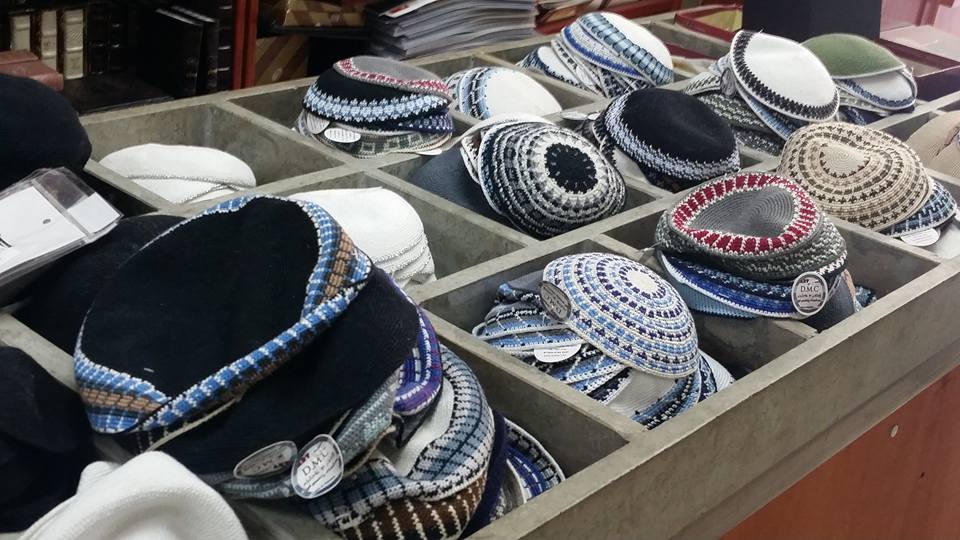
I started at Nosach Teiman, a Yemenite Jewish bookstore and Judaica shop.  The riches of this small store are innumerable.  I bought loads of Yemenite music, a Judeo-Aramaic calendar (!!), prayers written in Judeo-Arabic, and a book of Judeo-Arabic expressions translated into Hebrew.  It does not get any better than this.  Here are some pics:

They even had Yemenite Jewish clothing, make-up, and perfume for sale.  For a community that had to escape by the skin of its teeth from fanatical neighbors who wanted to exterminate them, they’ve sure done an amazing job of preserving their culture upon arriving to Israel.  While unfortunately fewer and fewer Yemenites here speak their unique language, I did hear a few words in the store- which I could mostly understand with my Arabic!

Energized, I headed to the Vizhnitz bakery, sure that I’d also find new adventures on the way.  On my way there, I came across several yeshivas.  The first, a Sephardic one, where I got a free book called “Mishnah Brurah”.  It’s old and beautiful- and free.  Bnei Brak is one of the few places on the planet where you’ll find timeless beautiful books simply sitting outside waiting for you to grab them.  For free or minimal cost.  These are the Jews who truly continue to embody that we are the “People of the Book”.  Looking for Jewish knowledge?  Skip Amazon and head to shuls in Bnei Brak.

Down the street, I saw the Belz Yeshiva.  There’s a famous song about the shtetl, or Jewish village, of Belz that once existed in Eastern Europe.  So to see the town recreated in front of my eyes- its Jewish presence in Europe exterminated- was awe-inspiring.  As Holocaust Remembrance Day approaches in Israel, I couldn’t help but let out a huge smile.  As the famous Yiddish resistance song says: Mir zaynen do.  We are here.  In the face of Nazi persecution, Christian annihilation, Islamic fundamentalism, ever-shifting anti-Semitism on both left and right- we exist.  We survived.  We. are. here.

To see my heritage continue in the face of 2,000 years of European brutality is a miracle.  It fills me with hope, wonder, amazement, and joy.  Our mere presence is a victory in and of itself.

I headed to the bakery with a fulfilled soul and a hungry stomach.

The bakery was delicious.  It was nothing but challahs left and right.  Some huge, some small and all a bit sweet.

While I noshed on my challah, I noticed something interesting- a sign with baking instructions in Arabic.  Bnei Brak is 1000% Jewish.  A mixed city this is not.  A secular person moving here would be considered a mixed population.

Then I noticed a tan-skinned man yelling in Hebrew at a Hasid.  Something about business.  Given how everyone yells in my neighborhood- even when not angry- I didn’t make much of it.  Must just be a Mizrachi guy who does business with Vizhnitz bakers.

Then I heard the most unexpected thing ever: Arabic.  And not Yemenite Judeo-Arabic.  Arabic from here.  I approached the tan men in Arabic.  Their eyes widened with excitement and surprise.  You have to remember I’m wearing a black yarmulke, a kippa, a head covering.  I look, for all intents and purposes, Modern Orthodox.

Turns out, they’re Bedouins.  I told them I had been to Rahat (where I discovered the Yiddish speaker).  They said they lived in a nearby town of Ad-Dhahiriya, whose name at first I confused with Nahariya, a city in the North of Israel.  Only once I google its name right now did I realize…it’s a Palestinian city.  In the West Bank.

We had a great talk about the Bedouin dahiyye music I like (they’re going to teach me the dance next time) and I was proud to hear, as I walked away, them say “wallahi bye7ki 3arabi mnee7”.  Wow he really speaks Arabic well.  My smile inside and out could not be bigger even as I write this now.

While Yemenite Arabic in Israel is struggling, I found Bedouin Palestinians who are keeping Arabic alive in Bnei Brak.  While my trip to the West Bank didn’t happen today, I did end up meeting Palestinians.  And having fun.  And hopefully warming a few hearts, like they did mine.

Still hungry, I grabbed a sweet for the road.  The man at the store turned out to be a fellow polyglot.  He spoke Hebrew, Yiddish, French, and English.  And a straight-up Haredi Jew.  We shared a fantastic short conversation in all languages.  I bet you didn’t expect that in Bnei Brak.  Or the gluten-free falafel I found.  Or the multilingual dictionaries for learning Arabic, Hindi, Chinese, Italian, Spanish, Farsi, and Yiddish (the latter possibly for Mizrachi Jews).  All alongside a side for “kosher” phones that filter out “non-kosher” content.

What I hope you take from this adventure is the unexpected mystery and glory of finding new places and new people.  Bnei Brak is an awe-inspiring place.  With things that will surprise you if you open your mind and heart to the possibilities.

On my way back to Tel Aviv for a Eurovision concert headlined by Dana International, Israel’s first transgender superstar, I felt sad taking my yarmulke off.  I like my black yarmulke.  It suits me.  Not as a decoration and not just as a sign of respect for Bnei Brak.  But because I like that part of me.  That heimish, passionately Jewish, bookish, dancing-down-the-aisles Matt.  The Hasidic part of me.  The Haredi part of me.

And I don’t like feeling that I need to take it off when I come back to Tel Aviv, especially at an event with a lot of gay people.  Who- and I understand why- will be afraid to talk to me because of it.

This is what I hope we can one day overcome- on all sides.  I long for the day when I can be a gay Hasidic Jew- with the flexibility to still pray Reform and to go to gay parties.  And find a gay partner.  I long for the day when secular gay people will accept my passion for Judaism, including Orthodox Judaism, as a part of me.

I shouldn’t have to sacrifice bits of my soul to keep other people happy.  Nobody fits into a box- boxes are boring.  I’m glad I explore different things and my life is much, much richer for it, even with the challenges.

When I go to Bnei Brak now, I’m not just a visitor.  I know this place.  And I like some of it.  I hope it continues to passionately preserve its Judaism and I hope it can find ways to be more inclusive of people like me.  And I don’t know how possible it is to do both.  I would like to try- I suppose I already am.

So next gay party, don’t be surprised if I put on my yarmulke for a bit- just to see how it feels.  And to see how you react.

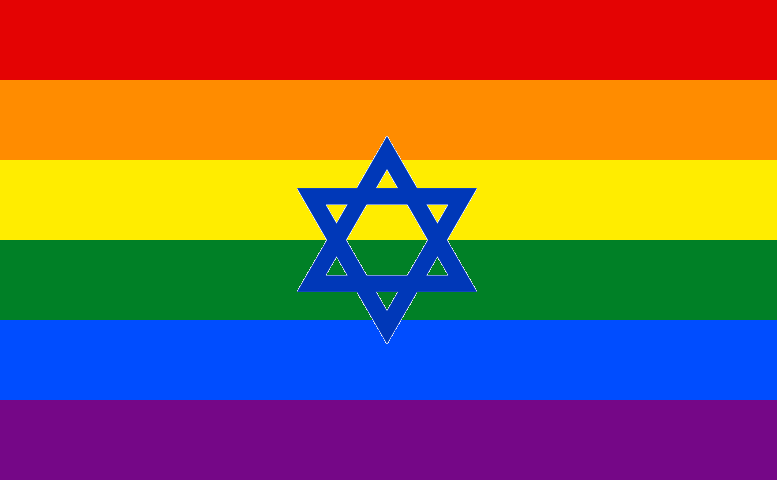
And next visit to Bnei Brak, don’t be surprised if I linger a bit under your city’s rainbow-colored flag to take a selfie.  Because inside it feels really queer.

Just like speaking Bedouin Arabic in the middle of a Hasidic bakery.

30516213_10101746604043322_7992752775041405545_n

A Preview of a Terrorist Attack

Israel is an exceeding loud country.  I’ve lived in big cities for most of my life and I speak 8 languages, so I’ve traveled.  And nothing- I repeat nothing- comes close to the noise of this place.

I live in South Tel Aviv, perhaps the single loudest part of Israel.  When people greet each other here, standing inches apart, they shout “shaloooooom!” as if they were down the street.  I go to Shuk Hatikvah, my local market, and it is super loud.  I’ve gotten used to it.  People are simply hawking their goods- cucumbers, dates, you name it.

One day, I heard screaming so loud in front of the market that I actually didn’t cross the street.  I was afraid something was “going down”.  And to be fair, if there’s one neighborhood of Tel Aviv where that’s likely to happen, it’s mine.

I paused for about 30 seconds looking anxiously.  The man was selling tomatoes.

Add to this that I live on the flight path to Ben Gurion Airport, with planes flying at all hours of the night.  And the fact that my neighbors blast Mizrachi music every morning (which I actually like to wake up to).  And basically, I’m used to loud noise.  It’s my home.

I’m also now a bit more accustomed to the idea of terrorism.  In America, terrorism is a far fetched concept.  Unless you lived in Lower Manhattan on 9/11, you haven’t really experienced a massive attack.  There have been smaller, very deadly shootings for sure.  Sadly, even last week at Google.  But not on the scale of what Israel has experienced.

According to one source, Palestinian terrorists have killed 3,759 IsraelisHere’s a list of the major attacks since the 1990s.  Adjusting for population, this would be the equivalent of 740,227 Americans.  More than all the American soldiers who died in World War I and World War II combined.  There continue to be terrorist attacks on a regular basis, mostly ignored by the Western media bent on a simplistic black-and-white view of the region.  That does Israelis and Palestinians a disservice.

This is, by the way, not an attempt to downplay the death and sadness experienced by Palestinians.  There’s enough tears to drown both sides here- to the extent that you can really boil this conflict down to two sides.  Which I don’t really agree with.

My point is simply that it can be stressful to be an Israeli.  The other day I was locked in my neighborhood library for 20 minutes while police neutralized a suspicious item outside.  It was scary, which I suppose is the point of terrorism.  It’s not just the killing, it’s that the way it is done is meant to inflict maximum psychological harm.

Today, I was relaxing at a neighborhood cafe.  While checking my loads of WhatsApp messages like a good Israeli, I heard the single loudest and most explosive noise I’ve heard in this land.  And it wasn’t just me.  Everyone- I mean everyone- immediately turned towards the sound, eyes wide open, and hearts skipping a beat.  You could just feel it.  Israelis are not easily phased.  You know that a noise isn’t a problem in Israel if no one is looking.  And you know it is if people drop what they’re doing and all start to stare.

Luckily, people started talking within a minute or two and realized someone’s tire on a motorcycle had blown out.  Everyone started smiling and let out a sigh of relief.  Mine was audible.

After recuperating for a moment, I did what people here do- I went on.  I went to the bathroom, I got some water, and I headed to a pizza place where I called a few friends and told the guy working there about my favorite American hip-hop.

And then went home on a very crowded bus where a small fight broke out and there was more screaming.  I guess on some level I was relieved it was the usual Hatikvah screaming.  And not that of people wailing over bodies spilling blood.

I’m grateful to be here writing this blog.  Thousands of Israelis weren’t so lucky over the past 70 years.  That’s right, my country has made it to 70.  The golden years, if it were an elderly Jew retiring in Florida.

I’m proud to be an Israeli.  I’m not always proud of what my government does or how all of our people act- just like I was when I lived in America.  Being proud of your country also means speaking out for what you believe- that’s democracy.

Yom Ha’atzmaut, Israeli Independence Day, is around the corner.  The decorations are up in my neighborhood and around the city.

I have a simple message for my friends abroad, especially my progressive friends in Europe and the U.S.  Empathize with us.  Don’t stop empathizing with Palestinians.  Just also empathize with us.

If you had bombs going off, attacks for 70 years, wars, and such a fear of these things that a loud tire bursting is enough to startle you- then you’d be a lot like us.

We don’t have the luxury of having massive rallies like they did in Barcelona after the 2017 bombings.  Because if we had such rallies every time someone’s child was split into pieces, we’d be doing nothing but rallying every day.

We have lives to live.  Understand that even the most eccentric Israeli behavior- or politics- has reasons behind it.  Whether it’s the right path or not, there is something that causes people to behave the way they do.  The way we do.

I’ve met some Americans here truly open to listening and to exploring all the good and bad of the cultures of this region.  Kudos.  I’ve met other foreigners who come and lecture me about my own people, my own religion, my own history.  Even flat out anti-Semites.

If you’re the latter- start your work at home.  With yourself, with your community, with your own country.  Americans have little to stand on when heaping sometimes aimless anger on Israel.  Every inch of your country was inhabited by Native Americans and you take it for granted that it now belongs to you.  I can personally say I know next to nothing about the Potomac Indians who inhabited the town I was born in.  And I’m at least aware enough to know they exist.

If you don’t think Jews are from here- you’re wrong.  Both we and Palestinians are connected to this land.  And we’re both a lot more connected to here than you are to Boston or Minnesota or California.  Because you’re not from there- you’re from Germany, France, Scotland, or Ireland.

And to the Europeans nodding right now- who do you think caused all of that?  Or even most of the problems in Israel and Palestine?  It’s you guys!  Who stole Jewish land, money, and lives on every inch of your soil for 2000 years. Who colonized the Middle East and stole its resources.  Me and my Palestinian friends are living with the consequences of your imperialism.  So stop munching on your free-range Swedish meatballs with an air of self-righteous “neutrality”.  Because the German Volkswagen you’re driving was built with the blood of my people.  And your British Petroleum is paid for with the blood of 405,000 Iraqi Arab lives.

In the end, none of us are entirely innocent and few are entirely guilty.  The effect of terror, at least on me, is that once the fear fades and my safety returns, the anger builds up.  Which is what I’ve shared with you today.  So try to understand what it must feel like on a national scale- when the explosion really happens.

I feel blessed to be an Israeli, and as I continue to settle in here, I’m not quite sure what it means to be an American going forward.  We’ll have to see.  I do know that I just want peace.

The kind of peace where I can live in my Jewish homeland without thinking that a blown out tire is going to be the last sound I hear.

How to stay sane while living in the Holy Land

Recently, I was talking to an Arab friend in Arabic.  He said there are three groups of people here.  One, Arabs who think this whole land only belongs to them.  Two, Jews who think the same thing about themselves.  And three, Arabs and Jews in the “mushy middle” who want to live together.

I think I agree.

Today, I saw a good demonstration of how this plays out.

After lazing around on the beach on a gorgeous day, I had some extra time on my hands.  Because I live in by far the most fascinating country on the planet, I simply slipped my sandals on (and then off) and walked into a mosque.  The Hassan Bek Mosque is a historic building located in the middle of Tel Aviv.  It was built in 1916 and to this day is an active mosque.

According to what seems to be a pretty well-sourced Wikipedia article, the mosque was built on land that the Muslim governor of Yaffo confiscated from Arab Christians.  Later, it was used for Arab snipers shooting at Jews.  During the 1948 War of Independence, Israel captured the area.  The houses were largely razed and some troops wanted to demolish the mosque itself, which was vetoed by future Prime Minister Menachem Begin.

At various times it was going to be turned into real estate development (stopped by protests) and may have housed a suicide bomber, which led to some Jews throwing firebombs and some Arabs hurling rocks at the Jews from the mosque.  Arabs then threw rocks at Jewish motorists and some Jews threw a pig’s head into the mosque.

In short, a microcosm of the region’s conflict, some of which I didn’t know about until writing this blog.  Depressing and important to be aware of so you know where everyone is coming from.

If you go to the mosque itself, it’s just gorgeous.  You wouldn’t know any of that crap if you just enjoyed the beauty of the building itself.  Here are some pics:

After some peaceful reflection, perusing the beautiful books (including Qurans from Egypt and…Saudi Arabia!), I talked with a man inside.  We chatted in Arabic because I wanted to know what a sign meant.  It said (in Arabic) “Tasu is in danger”.  I knew “is in danger” but didn’t know what the word “Tasu” was.

He explained it was the name of a cemetery in Yaffo (Yafa in Arabic).  A Muslim cemetery which, incidentally I had visited in previous adventures, that is now possibly going to be turned into…a hotel.  When you consider the long history of conquest and re-conquest and desecration this land has known, it’s just so, so sad.  I patiently listened as he explained the situation and I shared my sympathy.  It’s hard to imagine a Jewish cemetery becoming a hotel here- the government is excruciatingly diligent about not building on Jewish graves due to prohibitions in Jewish law.  So much so that even Secular Jews get peeved by it.

The man pointed me to pictures of the neighborhood (called Manshiyya before 1948) on one of the columns.  The pictures were sad and the descriptions in English were pretty brutal.  Here is a slideshow:

This slideshow requires JavaScript.

Occupation, nakba, bombing, demolition, ethnic cleansing- these are their words in English.  The sad part is there is some truth to what they’re saying.  As I’ve written about extensively on this blog, some Zionist militias forcibly expelled Arabs in 1948.  That’s not a theory, it’s a fact.  It’s also true that few things are black and white and the language used on these signs, in English for tourists, was as bombastic as possible.  Their existence perhaps evidence that Israel’s freedom of speech is a bit healthier than some expect.

No mention was made of the Christians whose land the mosque is built on nor the Jews who were shot at from its property.  I understand the anger of the worshipers especially in light of the recent cemetery controversy.  I also wonder if these signs are presented in a way that fosters knowledge of the past for the sake of building a better future.

Feeling sad and angry (both at the interjection of the painful past into my present and at the real estate developers who are about to turn a Muslim cemetery into a hotel), I walked back to the man.  I told him in Arabic: “I’m sorry for what’s happening.  I’ll pray that they don’t turn your cemetery into a hotel.  In the end, we must live together.”  He gave me a big smile and a handshake.

This man knew I was Jewish.  I can’t change the past- not the fact that this neighborhood was destroyed, nor the hateful acts committed on all sides in this place, nor the cemetery issue itself.  Although I plan on speaking out about it now.  What I did was just try to warm someone’s heart.  In a place where I feel quite helpless about convincing politicians, I just tried to be a human and reduce the hate in the world.

Feeling extremely tense, I walked towards Yaffo, where later I’d be celebrating the Moroccan Jewish holiday of Mimouna.  I stopped for some food at an Arab-owned restaurant.

The owner was hot.  Physically, for sure, and also just really nice.  Khalid had a beautiful smile and an infectious and kind personality.  We chatted on and off for hours.

An American woman walked in totally confused.  I helped her order and translate between her and Khalid.

Khalid noticed how I helped her and several other customers with the menu and I made some corrections to the English on their fliers.  He asked me if I would work with him.  I was surprised.  He basically said I had a nice connection with the customers, I knew public relations, and he needed help.

As I considered what had to be one of the kindest and most interesting job offers I’ve ever gotten, the American woman asked me about Gaza, about refugees, about pretty much everything that makes me cry a lot.  When the complexity and the sadness just overwhelm.

So instead of policy solutions (which Americans love), I gave a different answer.  I said: “If you want to live here, you need to know the past.  Insofar as the past helps you make a better future.  If you fixate only on the past, you’ll never see your way out and we’ll be stuck in a never-ending blame game.  We have to also live in the here and now and a better life together.”

Khalid then looked at me while the woman grabbed her purse.  He said: “Don’t pay for your food- we’re business partners.  You have to come work here.  I don’t see religion.  I see that when someone looks me in the eyes, I trust him.”

With a true feeling of gratitude, I headed to Mimouna.

What I wish for the Middle East and for my beloved country of Israel and the Palestinian people is this.  Know our past- and know the past of the other peoples of this land.  And don’t get stuck in the swamp of never-ending hatred, sadness, and guilt.  We don’t have time for it- we only get one life.  Know the past to learn from it and make a better future.  Let’s build it together.  Let’s live in the complicated space that is the Hassan Bek Mosque next to the serene park built on its neighborhood’s ruins next to the gorgeous beach we all enjoy.  Let’s live in the Mimouna party of Moroccan Jews who are my friends and whose families were expelled by Muslims in North Africa.  And who continue to celebrate the customs they once shared with them.

This place is messy.  It needs healing.  Put down the megaphones, put down the guns, and most importantly put down the sense of ultimate righteousness and purity.  Because we’re all a little dirty and wouldn’t it be better if we had someone to scrub our back and clean those hard-to-reach spots?