The Primary Axis is Empathy

Ok so one of the most confusing aspects of living here, perhaps of life itself, is understanding the context for what people say.  And what it reveals about their intentions.

Most of our public discourse is focused on quotes- and not just here in Israel.  “Gotcha” moments dominate our news cycles and rarely do we consider the surrounding environment.  Critical thinking is not a skill valued by the news media these days- nor by many of its consumers.

So rather than talking public policy or the latest headlines, I’d like to delve into a less-discussed aspect of the conflict here- and its implications for politics everywhere: the axis of empathy.

For most people, the Arab-Israeli/Palestinian-Israeli conflict is broken down into pro-Arab/Palestinian and pro-Israel.  To be one is not to be the other- or at least a lot less.

What I’ve come to realize, both through living here, through spending lots of time in Arab villages in Israel and meeting Palestinians, is that this breakdown is a distraction from the real conflict.

It’s not meaningless, but it obscures the most important dividing line.

When I’m abroad- Europe, America- my primary orientation is to be wary of hardcore pro-Palestinian activists and to feel more empathy for Israel.  For two reasons.  One is that generally speaking, if someone is pro-Palestinian and anti-Israel outside of this land, they are an anti-Semite.  And if someone is pro-Israel and pro-Jewish outside of Israel, they are empathetic towards Jews.  And generally, though not always, empathetic in general.  The exception to this rule would be people who are pro-Israel and anti-Jewish or pro-Israel and extremely anti-Arab, to the point of being an extremist.  There are people who are pro-Israel and anti-Jewish- Hungarian Prime Minister Viktor Orban would be a prime example of one.  And there are certainly people who are pro-Israel and hate all Arabs- I met a Dutch guy on CouchSurfing who liked Israel (and gay rights, interestingly enough) because he hated Arab immigrants.  But when it came down to it, he was actually kind of homophobic.  The flowery gay rights rhetoric was merely a convenient tool to oppose (indeed, sometimes homophobic) Arab immigrants in his own country.  Not out of genuine concern.

What is important to note is that this dynamic flips on its head while living here.  In Israel, the least empathetic Jews are unquestioningly pro-Israel and anti-Arab.  And I have more empathy for Arabs here who oppose Israeli government policy than the Algerian man I met in Spain who claimed Israel and America started the Syrian civil war.  And claimed Russia and Iran hadn’t killed anyone.

In other words, the very same sentence in two different contexts can mean two completely different things.  Making identifying toxic people a challenge for someone like me who straddles multiple cultures- often in the same day.

For example, I’ve met Americans and Europeans visiting Israel who only want to visit Palestinian areas and show no interest in Israeli history and narratives.  I once met a German exchange student at Tel Aviv University who came to dance dabke with Arab students- and me.  While I was there out of empathy and a desire to learn more about my neighbors, he was there because he hates Israel and Jews.  But I didn’t catch this at first, which ended up really hurting me.  I figured that because we’re both in the same place and we both have empathy for Arabs, therefore we must both be empathetic people.  The problem is that when we sat in a cafe after dancing, he asked me: “why do Israelis talk so much about the Holocaust?  It’s old history.”  When I tried to explain that in the same city he was sitting, there were actual Holocaust survivors, his response was to defer: “but that happened so long ago”.  In his country.

So here’s the rub.  We’re going to the same event.  We would both probably agree with the sentence: “I’m concerned about the human rights of the Palestinian people”.  But I’m doing it as an Israeli concerned about my neighbors’ well being.  And he’s doing it because he doesn’t like Jews.  My words are out of empathy, and his out of antipathy.

The same can go for Arabs themselves.  Many people throw around the word “Arabs” as if 300 million people were the same.  Yet the experience and positioning of Arabs can be radically different.  When a Moroccan immigrant to Belgium says “Israel is a racist state”, it is without a doubt coming from anti-Semitism.  It is rather unlikely he’d say Morocco is racist for having persecuted its Jewish citizens whose quarters now lie largely empty.  Nor for oppressing its 30% Berber minority.

Yet when an Arab citizen of Israel complains about racist discrimination, it is usually based on first-hand experience.  And unlike the Moroccan in Belgium, who has almost certainly never even been here, the Arab Israeli has felt this in her own life.  So again, the very same sentence, two completely opposite meanings.  In the case of the Moroccan immigrant, anti-Semitism.  And the Arab living here, concern for his well-being and the state of society.  Antipathy and empathy.

Of course there are nuances.  There are Arabs here who care a lot of about racism and injustice, but ask them about gay rights, and sometimes you get a deep silence.  Or in the case of one Palestinian: “I think we should throw them off of buildings like ISIS”.  So the question is whether their concern about racism is because they are concerned about people being hurt, or whether it is only because it affects them.  All other suffering be screwed.  Whether it’s from a place of empathy and solidarity or narcissism.

Which is why I’ve met Americans who care a lot about Palestinians, but know literally nothing about Jewish history.  Whose only experience with Judaism is maybe eating challah at a friend’s house.  But knows nothing about why or how their Jewish friends ended up in Minnesota.  Or why there are more Polish, Romanian, and Iraqi Jews in Israel than in any of those countries.  Whose combined Jewish communities numbered 4,1326,000 before the Holocaust.  Today, standing at 25,000 according to the most generous estimates.  Meanwhile, 4.5 million of their descendants live in Israel, where they found refuge.  While the rest lie buried in foreign soil, millions upon millions in overgrown cemeteries.  That’s if they’re lucky- sometimes our burial grounds are turned into soccer fields.

It’s also important to remember our own positioning.  In other words, when I’m in Israel I feel differently than I do in America or Europe.  Both because of the surrounding environment, my own political interests, and of course, which direction empathy flows.

In other words, when I’m in Israel, again depending on circumstance, but I’m at my most empathetic when I’m able to find concern for Arab Israelis and for Palestinians.  Not an easy thing- it’s not as if these communities don’t have their own extremism.  As I sit in a Palestinian bookstore in East Jerusalem, I am staring at a book entitled: “Victory for us is to see you suffer”.  Whose WiFi code is “JerusalemIsOurs”.  Just miles away from where a Palestinian shot six Israeli civilians two days ago.  Just last month I lived through a terrifying air raid siren in Beersheva, as Hamas rockets rained down on Israeli towns.

I can’t say I felt terribly empathetic to Palestinians then.  Though I imagine life is excruciating for them under Hamas rule and faced with harsh conditions imposed by basically every government in the region- their own, the Palestinian Authority, Israel, and Egypt.  Suffocating.  Palestinian extremists storm the Israeli border, some of whom have been quoted as saying they want to get to the other side to rape and murder.  And in the meantime, ordinary Gazans who just want to put food on the table are caught in the crossfire, as are their Israeli counterparts on the other side.  Some of whom are concerned for their Palestinian neighbors as well.

Basically, what it comes down to is empathy.  When someone is an anti-Semite, I’m going to defend Israel and talk about what’s good with the country.  When someone is anti-Arab, I’m going to share why its complex and we can’t generalize about millions of people.  And because the context for identifying these people is extremely hard to pinpoint, it is not so easy.  Because words that have the potential to sound empathetic coming out of the mouth of an Arab citizen of Israel sound horrifying coming out of a far-left European or a Tunisian living in Paris.

And the same goes for pro-Israel.  When I hear someone passionately defend the Jewish people’s right to a refuge and homeland outside this country, it touches my heart.  And when an Israeli rages about anti-Semitism and how the world hates us, but has never left this country, it’s usually indicative of a deep narcissism.  Because someone who has grown up in the Diaspora or has spent significant time abroad experiencing anti-Semitism has a basis for their anger.  But the man I met who has never left Kiryat Gat is raging about anti-Semitism, it is because he is repeating what he read in the newspaper or what he learned in school.  Because he is a fervent, unquestioning nationalist.

So when I hear an American Jew frustrated with his right-wing relatives who shut his progressive Israel views down, I feel empathy.  But when a British non-Jew tells me that “British Jews are ridiculous, why do they care about Israel without ever having been there?”, I know she’s an anti-Semite.  It’s the positioning.

Therefore, to return to the original point, the positioning of “pro-Israel” and “pro-Palestinian” obscures the most important axis of this conflict.  Indeed, of human society in general.  The axis of empathy.  Of kindness.  Of care.

Because when you re-orient the conflict this way, you see that the potential allies are much different than what the news media and politicians on all sides would prefer for us to see.  That the Muslim girl in Tira who appreciates Jewish women’s freedom to choose their clothing is as much my ally as the Jewish kid in Tel Aviv of Syrian ancestry blasting Arabic music in his coffee shop on Ibn Gvirol.  He doesn’t understand a word- but he told me he wants to learn and he loves the music.

What unites them is not a nationalistic goal, nor is it a sense of fidelity to a tribe.  It is their desire to see humanity in the other.  To show compassion, empathy, and openness.

It’s the tribe I love the most.  It’s the tribe that no matter where I find myself in the world I want to belong to.  That I strive to strengthen and be a good member of.  The empaths.  Like Marko, the young Slovenian cell phone salesman who was excited to discover a Jewish museum in his city.  And as soon as I told him about it, he scribbled the name on a piece of paper.  We shared about our cultures and our personal experiences with discrimination and overcoming it.

He told me at the time, a moment that was quite hard for me after seeing a Nazi salute in his town’s square: “Grab your heritage and explore! Go for it!”

This is what it means to be a person.  At the time I wrote:

“Then it really hit me. What Marko and I shared in common was not a religion, not a nationality, not much in terms of the typical labels we hear each day. On Tinder, in our passport, when people introduce themselves.

What we shared in common is that we’re members of a tribe I’ll call the ’empaths’. People who care about other people. And not just those who fit their worldview. The people who, instead of spewing hatred at a cafe or boxing people in, encourage others. Growing, changing, and living mostly in those colorful shades between black and white.

While national and cultural labels matter- and to some degree protect and connect us- I’ve discovered that the degree of a person’s empathy is the biggest predictor of whether I will like her. That your warmth and kindness is at least as important to me as how you vote for or to whom (or if) you pray.”

This tribe is the most important one in the world.  More than Israel, Jews, Arabs, Americans, left and right.  And it is the hardest to organize.  Because even after you’ve identified them, there are so many forces pulling us apart.  Telling us the colors of our flag matter more than those of our heart.

But if we are to have a future on this planet, it is a must.  It’s necessary to be like the liberal Washingtonian I read about who visited a gun store in Virginia- just to talk to people.  It’s necessary to be like the Arab from East Jerusalem I met who studied Hebrew on his own to get to know his neighbors.  It’s necessary to be like me, an American Israeli Jew who studied Arabic for years and years because it’s the best way to understand Arab people.  To build bridges in the impossibility that is the conflict which embroils us.  Because my deepest hope is for a day when I can hop on a train from Tel Aviv to Damascus.  And maybe stop over for a night of partying in Beirut.  And then sit sipping tea in the Lebanese mountains overlooking the Jewish towns of the Galilee.  As if the past 70 years have been just a bad dream.

It is not easy.  There are times when I am afraid- and sometimes justifiably so.  There are extremists on every side here and abroad.  There are people who’d rather us- all of humanity- sit in silos.  Easy to market to, easier to divide and conquer.  While both “progressive” and right-wing billionaires continue to rake in our resources.  Palestinians and Israelis fight for crumbs, but who really gains?  Why are there 30 Israeli billionaires but the average New Yorker, in one of the most expensive cities on earth, has 17% more purchasing power than a Tel Avivi?  Why is there a Palestinian billionaire while 32% of his countrymen sit in abject poverty, unemployed?

In the end, the people at the top care very little for the people at the bottom.  If I wanted to indulge my most cynical side, I’d say that’s how they got there.  But I’m really not sure.  What I can say that what interests me less are peace declarations, foundations, donations, and projects.  What interests me more is the well being of the average human being.  And while people here- indeed around the world- rally around the ethnic group or religious community or political party they are supposed to defend- who is really winning?

I’m not suggesting billionaires are necessarily bad people, though.  I’m not sure life is so simple.  There are really mean poor people and generous wealthy ones.

But what I am suggesting is it’s not fair.  And that efforts to focus us exclusively on identities at the expense of our shared human empathy are driving us into a hole.  So while liberal billionaire Tom Steyer has been held up as an exemplary clean energy enthusiast, how often do the organizations who receive his donations wonder where he got his money?  Goldman Sachs, Morgan Stanley, and eventually his own investment firm which invested millions in private prison companies.

But let’s join Alexandria Ocasio-Cortez in storming the office of Nancy Pelosi about climate change and rail against Republicans who receive coal money.  While The Latino Victory Fund which supported her partners with Tom Steyer’s SuperPAC.

To what extent this is purposeful, I don’t know.  I do appreciate Ms. Cortez’s critique of money in politics, but I fear the judgmental fire in her belly may scorch us as a society.  Maybe Tom Steyer and other donors’ views are situational.  Some people earn a lot of money to then try to do a lot of good.  People’s motivations are hard to discern.  And I don’t want to support a witch hunt or class warfare, or to suggest people are purely good or evil.

But I do think the result is a game of smoke and mirrors.  Where I should spend my time hating Palestinians or Republicans or Muslims or right-wingers or left-wingers, when in the end most people can’t make ends meet.  Around the world.

So I’ll say this.  If there is a solution to this problem, it’s the empaths.  Whether it’s Alexandria Ocasio-Cortez, Benjamin Netanyahu, the BDS movement, or anyone else dominating the headlines these days, let’s focus our attention elsewhere.  Maybe they can join us later, but in the meantime, instead of gazing up at them, let’s look sideways.  Ahead- at the people in front of us.

Those are our allies.  Our potential friends are the people who don’t buy into this warfare.  They’re the Republican willing to buck the party on gay rights.  They’re the Democrat who who dialogues with her anti-abortion neighbors.  They’re the Tunisian who writes about the Jewish history of his land– in collaboration with a Jewish historian.  And the Israelis like me who empathize with the challenges facing our Arab countrymen and our Palestinian neighbors.  Who rather than tearing up at every Ben Gurion quote and saluting the flag, would prefer to talk with the Arab man who cleans their school.  They’re the American Christian who visits this land to understand both Israelis and Palestinians, rather than coming with a pre-set agenda.  Who is willing to confront anti-Semitism with as much vigor as racism or Islamophobia.  To confront their own prejudices.

Because we all have them.  And if we’re honest, if we’re empathetic, we can acknowledge that.  I, for one, have been learning more about transgender experiences.  I don’t know much- and it’s a deeply stigmatized identity and community I don’t know much about.  But I’m putting myself out there and realizing I have a lack of knowledge.  And that doesn’t make me weak, it’s makes me kind.  Because to acknowledge our own gaps in knowledge is to point us in the direction of what we need to learn.

So in the end, I’m not interested in whether you’re pro-Israel or pro-Palestinian.  I’m not interested in whether you’re pro-life or pro-choice.  I’m not interested whether you’re a Republican or a Democrat, a left winger or right winger.

What I’m not interested in is “or”.  What I’m interested in is “and”.  Because an empath lives in the and.  The ability to see that the identities we are supposed to defend are only part of the story.  That the words we use aren’t as important as what they indicate- given our position.  That the sentiment behind them, the context is much more important than the vocabulary itself.

So give me pro-Israel Europeans and Israeli Jews who rail against racism.  Give me Americans who fight against BDS and anti-Semitism and give me Israelis who fight against an unquestioning Zionism.  Give me Palestinians learning Hebrew and Israeli Jews learning Arabic.

Give me the and.  Because the real way forward, as I see it, is to step outside our silos.  And find the people whose orientation is towards compassion, who are willing to question orthodoxies, and are struggling to live in the gray space at a time when polarization would make it so much easier not to.

Who are willing to give up the simplicity of living enclosed in the safety of a walled-in tribe.  Whether that tribe be NPR listeners, secular North Tel Aviv, a gun show, or a West Bank settlement.

Because where things get a porous is where life gets dangerous.  And when boundaries become frontiers, they can become markers for progress more than barriers separating us from each other.

Don’t tell me what you think, show me how you care.  Don’t tell me where you’re from, show me where you’re going.  Because perhaps what I’ve learned is it’s not so much where you are so much as how you’re oriented.

The bad news about today’s world is that we’re increasingly divided along national, political, and religious lines.  Which can make it incredibly hard for a double minority gay Jew like me to find a safe and welcoming home.  When I look at a map, my heart wishes I could live everywhere and my mind knows that I can’t.  It’s a force that pulls me apart and forces me to choose between the well being of my identities and my curiosity about the world.  Although as I write this article I wonder if perhaps the most important identity of all, someone’s kindness, may lead me in different directions than I’m “supposed” to pursue.  Maybe it already has.

The strain of trying to find a home, a career, a place where you feel safe, fulfilled, and stable is real and intense.  It’s a lot to handle at once and can feel excruciating.  Especially when your primary communities are targets for so much antipathy and hate.  What I’m discovering is there’s a way to view things a bit differently that can help me find a way forward.  Because when you understand the most important (if not only) characteristic of someone you’ll like is their compassion, you realize that exists in every corner of the planet.  And while it requires some sifting, some risk taking, some potential hurt, you can find people everywhere who will treat you with dignity and compassion.

Israeli identity is not so portable.  Tied to this land, there is nowhere else on the planet that feels exactly like this.  Where Jews live in the majority.  Where Hebrew signs dot the skyline, where Hatikvah is blasted at every sports game.  Where Judaism isn’t something to be hidden at home or behind synagogue security guard.  Where it carries both the power and responsibility of running things.  It exists like this nowhere else on the planet, which is why so many Israelis have trouble adapting to life, including Jewish life, elsewhere.  Perhaps this will change- groups like the IAC are trying to help Israelis build a Diaspora identity, as strange as that sounds.  I can understand why it’s necessary for their well being.

Jewish identity, on the other hand, is the most portable identity in the history of mankind.  It changes and mutates everywhere we go, adapting in extraordinary and creative ways to both fulfilling and extremely scary circumstances.  Sometimes it’s snuffed out- it can’t plant its roots everywhere due to the cruelty of some people.  But it does show an incredible adaptivity that few cultures have managed to replicate.

It is challenging to be an Israeli or Jew in much of the world.  But there are some things you can uncover anywhere.  And can bring to any society.  What you can carry with you to every corner of the globe is a desire to help, to understand, to bring hope and kindness.  And to find people willing to share that warmth with you and to join you in the task of building a gentler, more caring human society.

Because when we understand the meaning of the words others say, we realize that it’s the intent behind them that matters most.  That help us sift through the distractions to see the direction their heart points in.

May we all find the words to bring us peace.  In our own lives and in the lives of the people around us, to the extent we can.  This Christmas, this Chanukah, this Kwanzaa, is the season when the sun sets early, the darkness sets in, and the contrasting blackness surrounds us.  Which presents us with the challenge of finding warmth.  And if we manage to kindle a flame, also gives us the chance to make our little bit of light shine even brighter.  Not as bright as the sun, but brighter than if we try to be a lamppost at noontime.  We can’t choose when the sun sets- nor can we choose when it rises to cover us and glow.  When you find yourself in darkness, you can’t expel all of it.   So rather than struggle against its very existence, perhaps the key is to find someone else willing to light a candle with you.  To make some space for warmth.  Until the morning breaks again.
What kind of Jewish State?

Lately, as some of you have noticed, I’ve felt rather down.  Job hunting is stressful- and job hunting in Israel is even more so.  Sending resume after resume, LinkedIn after LinkedIn, call after call.  It’s exhausting.  And knowing that the salaries here are so much lower than the U.S. doesn’t help.  As I’ve written about, Israel is one of the most expensive countries in the world.  Tel Aviv is the 9th most expensive city.  Yet the salaries don’t keep pace.  Out of the 34 OECD countries, Israel is ranked 23rd in purchasing powerAccording to Numbeo.com, an average meal at a low-cost restaurant is $14.78 in Tel Aviv and $20 in New York.  New York rent is also more expensive, although Tel Aviv is actually more expensive than the Big Apple if you want to buy an apartment outside the city center.

In that spirit, let’s compare apples to apples.  While most indices for New York are more expensive than Tel Aviv (although milk is 33% more expensive in Tel Aviv!), you have to remember the salary gap.  The average net salary, after taxes, is $4,505.72 per month in New York and just $2,294.76 in Tel Aviv.  And Tel Aviv is where most of the high paying jobs are in Israel.

All of which is to say that although New York is known for being one of the most expensive cities in the world, a place where most Americans couldn’t dream to live, Tel Aviv is actually worse off economically.  The average Tel Avivi has 14.96% less purchasing power than a New Yorker.

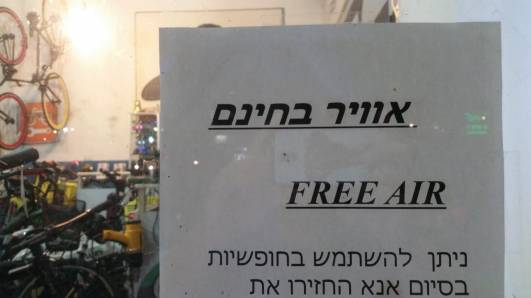
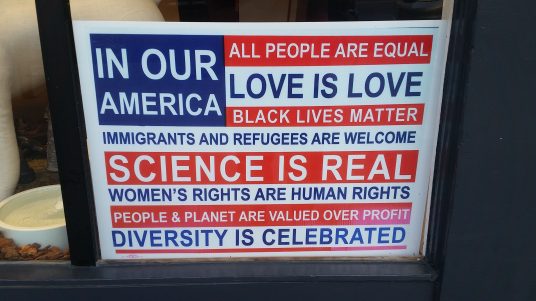
It’s an economic desperation you see on the streets here.  Today alone I noticed two different grown men rummaging in trash bins in the middle of the city.  Looking for food, I presume.  A degrading experience for them, and a deeply sad and disturbing one for me to see.  It makes me read signs like this one, which I saw at a bike store, with a bit of irony:

WhatsApp Image 2018-12-02 at 1.09.17 AM

Of course, these problems are not only happening in Israel.  Around the world, the gap between wealthy and poor has become a pressing issue.  When I was in San Francisco last month, I saw more homeless people than possibly any other city I’ve visited.  Rural Romania, where I spent some time hiking and backpacking, has largely been hollowed out by migration to London and Spain and Italy in search of work.  Village economy has dried up after joining the EU.

The thing is not everyone is suffering here.  In 2018, Israel counted over 30 billionaires.  In dollars.  High-tech firms here are some of the most successful in the world, with some of the highest salaries in Israel.  If you work in the start-up scene, Israel is the place to be and you could probably build a comfortable life here if you choose to make aliyah.

On the other hand, with the cost of living continuing to increase and other industries’ salaries failing to keep pace, Israelis are being left behind.  Including olim like me.  Who came here with a Master’s degree from Georgetown university, 8 fluent languages (including Hebrew), and 10 years of public relations experience.

I have some more meetings in the next few days.  I have been sending out my resume left and right, networking like a maniac.  Those of you who know me personally know I am an extremely proactive person.  Root for me, encourage me, I need it.

I want to share some stories from this journey.

Last week, I went from bookstore to bookstore in Jerusalem.  Calling, showing up in person, filling out forms.  I figured it’d be good to earn some money while searching for a job with a real salary.  No call backs.  I was even told by one bookstore that I was “overqualified”, even after explaining I was just looking for part-time work.  I also spoke to an employee of an Israeli travel company I was trying to network with.  With the hopes of collaborating on my blog, to hopefully earn some revenue and bring them business.  After I sent some English and Hebrew writing samples, the employee wrote to me: “it is hard to impressed by your writing.”  It was like a gut punch.  I know I’m a good writer- and the 50,000 people who read my blog are proof.  As are the wonderful comments you all share with me.  But it’s just demeaning.  How long should I fight for an underpaid job here?

Needing a break from the stress of job hunting- a hunt which at this point is extending to both Israel and the U.S. out of necessity- I headed to a museum.  Knowledge, history, learning- these things always light me up and give me hope.  Seeing the long spectrum of Jewish history and the beauty of art helps put my current struggles into perspective.  And fills the soul with light when people around you are swallowing your hope alive.

When I visited Italy last march, I learned about the unique history of Italian Jews.  A 2,000 year old community, they predate both Sephardic and Ashkenazi Jews and have their own rite.  At the Jewish Museum of Rome (which I highly recommend visiting), I learned there was another place in the world where the Italian rite was used: Israel.

In one of the most miraculous stories I’ve ever heard, Italian Jews transported an entire historic synagogue to Israel in the 1950s.  In a bid to preserve this ancient Jewish heritage- seen as endangered even after the Holocaust- the building made its way to Jerusalem where it is now housed in the U. Nahon Museum of Italian Jewish Art.  It’s a small but absolutely stunning museum.  With ancient and medieval Italian Jewish artifacts, and the synagogue itself.  It is used to this day- and has extremely rare Italian-rite prayer books which I got to hold and read up close.

The museum is a testament to Jewish history and the power and nature of Israel itself.  In the museum, I read from the Sereni Haggadah, a 15th century Italian book illustrated with Ashkenazi motifs and written according to their rites.  I read about how some Italian Jews even spoke and published in Yiddish.  A reminder of how all Jews are connected- that Ashkenazi, Sephardic, and Italian flow into one other.  In the sun-soaked land of Italy, where all three communities have co-existed for centuries.

The synagogue and the museum are a reminder of the power of the Zionist ideal.  Without Israel, who knows what would have happened to these treasures, to the synagogue itself.  While some synagogues in Europe are preserved, the vast majority have been destroyed or lay in decay.  I saw some turned into restaurants and casinos and there is even one that was turned into a strip club.  But more than anything, they are usually locked and empty.  To prevent continuing theft and anti-Semitic attacks, an eerie testament to their largely emptied communities.

Israel was the logical place to send this synagogue.  It’s a place where the history of the Jewish people can sit safely, far out of the reach of anti-Semites.  It’s a place where the National Library of Israel preserves 5 million Jewish books, audio files, and other treasures.  An unmatched collection spanning continents and centuries.  A gold mine I got to explore this past week.  The only library of its kind.  I perused Judeo-Arabic versions of the Torah, Catalan-language books about Jewish history, dialect maps of Yiddish, and a book about the xuetes of Mallorca, Jews forced to convert to Christianity.  Who manage to maintain a separate, often persecuted, identity to this day.  Check out the library’s website and discover a digital collection that can transport you from your home to almost any Jewish community- past or present.  If you’re in Jerusalem, go visit!  There are real gems right under your nose- and it’s free!

While visiting the Italian museum, I met some foreigners, who were intrigued by the exhibit.  Including Jews.  I spoke with a British Jew whose parents are Israeli.  He only speaks a few words of Hebrew, but he connects to his Judaism by studying Italian Jewry.  The museum staffer himself had Mexican parents and we spoke in Spanish about the siddurim.

I also made a point of talking to several sabras, or native-born Israeli Jews.  This segment of the population tends to have the least appreciation of Jewish heritage.  Israeli schools teach a lot of biblical history and a lot about modern Zionism.  But Diaspora communities of 2,000+ years are often relegated to discussions about the Holocaust.  Undoubtedly a painful watershed event for world Jewry that a third of Europeans don’t know about.  But hardly the only thing worth mentioning in two millennia of history.  Marked by both persecutions and amazing perseverance and creation.  It leaves the average sabra deeply ignorant of Jewish communities outside of Israel, something I see reflected in the growing gap between American and Israeli Jewry.  Clearly a gap that has origins on both continents, but which I see little effort to tend to here in Israel.

More than this, it also leaves Israelis ignorant of where they come from.  Here our history dots the landscape.  Ancient Jewish archaeological sites sit in every corner of the country.  Ritual baths, or mikvahs, built two thousand years ago- the kind I have personally used at my synagogue in Washington, D.C.  I have even done a genetic test- and my DNA is closest to Syrians, Lebanese, Greeks, Sicilians, and Palestinians.  Our guttural Semitic language was birthed in this land.  Yet we also were enriched- at times oppressed- by the cultures we have engaged with since our expulsion from here.  And without understanding the intermediate 2,000 years, the average sabra doesn’t really know a lot about how he or she came to be.  And what it means for the Jewish people- or our state- today.

Two sabra women I met had Iraqi parents.  I think being the children of olim, especially ones so ruthlessly expelled from Iraq, made them more open to learning about Diaspora history.  Perhaps just as importantly, they knew about their own rich heritage, so it might have made them more appreciative of other Jewish cultures.  I sensed their awe as they looked at the synagogue, admired its beauty, and stood in wonder at its journey from Italy to the capital of the State of Israel.  A journey Italian Jewish slaves in Rome 2,000 years ago never could have imagined.  Yet worked and prayed for- and whose descendants made a reality.

There was one young sabra in the museum, otherwise the latest generation was nowhere to be seen.  It’s a stark reminder that once you are cut off from your roots, and as you grow new ones, it is hard to inspire people to reconnect.  It’s a phenomenon I struggled with almost a year ago to the day.  My journey to learning Yiddish as an adult proves that reconnecting with the breadth of Jewish history is possible.  And some young Israelis, like the phenomenal Yemenite singers of A-WA, are joining me on that journey.  As they go around the world singing traditional Judeo-Arabic songs to sold-out clubs.  I personally have seen them three times on two continents- go experience the magic of Yemenite song!  They are keeping their chain of tradition alive while innovating along the way.  A fitting testament to two millennia of Yemenite Jewish heritage and to the fact that it has survived at all.  Thanks to Israel, where almost all Yemenite Jews live today after being expelled in the 1950s.

There is a certain push and pull, perhaps even an intertwined irony to having a Jewish state.  The state has saved the lives of hundreds of thousands, maybe even millions of Jews.  Jews whose countries senselessly butchered them or confiscated their property and expelled them.  From the U.S.S.R. to Morocco, from Algeria to Poland, from Germany to Iraq.  While some Jews have come here voluntarily, the vast majority have come under major duress.  I couldn’t help but notice an Italian and Hebrew prayer in the museum this week dedicated to saving Alfred Dreyfus.  The French Jewish army captain ruthlessly persecuted by his countrymen, by anti-Semites just over a hundred years ago.  Reading that prayer in a museum in Israel reminded me of the importance of having the ability to protect ourself.  That while we work with allies wherever we can find them, we have just as much a right to defend our people as anyone else.  Which is why we have put our lives on the line to make sure the State of Israel exists for all of us.

At the same time, it’s clear that nationl-building has come at a price.  As it does in all states.  Where minority cultures, where immigrant cultures, where the “other” is often ruthlessly assimilated until it is almost unrecognizable.  To this day, France won’t sign a European treaty recognizing its minority languages.  Arab governments such as Morocco and Algeria have forcibly assimilated their native Berber populations linguistically and ethnically.  A deep marginalization that continues to this day.  Turkey for years claimed that Kurds were simply “mountain Turks” despite their completely different languages.

For Jews, the curious thing is we did it to ourselves.  While for sure in Diaspora communities, Russians, Americans, French, and others have pushed us to assimilate into their cultures, in Israel, Jews did it to other Jews.  In other words, the sabras already living in Israel identified as the “new” Jews- strong, masculine, assertive.  And the old “effeminate” and “bookish” Jews of the Diaspora arriving here had to be reformed.  Which is why ancient Jewish languages like Yiddish and Iraqi Judeo-Arabic and Ladino were basically thrown out the window.  Hollowed out.  Jews were forced to take on a new, uniform Israeli identity.  To be more sabra and less Shmuly.  In some sense, more Israeli and less Jewish.  At least as how Judaism had been conceived of until then.  An odd statement to digest.

Some of this is the price you pay for building a nation.  Without a certain degree of cohesion, could Israel have successfully resisted Arab invasion after Arab invasion?  Could a Yiddish-speaking commander have successfully (and quickly) communicated with a Moroccan Jew who spoke Arabic?  If Israelis had had the luxury of being the Switzerland of the Middle East (not coincidentally, a country with four official languages), maybe it would have been seen as more feasible.  To allow a bit more room for diversity.  But our nation was not given an easy start.  So practicality took precedence over preservation, and entire Jewish civilizations were wiped out or cannibalized.  A couple weeks ago, I entered a Persian restaurant in Jerusalem (Baba Joon by the Centra Bus Station- the best Persian food I have ever eaten) and the really friendly waiter was clearly proud of his heritage.  But he didn’t know how to say “you’re welcome” in the language his ancestors spoke for 2,500 years.  I taught him, which made him smile.  There are people who want to connect to their heritage here, but it is hard and there are those who resist.  Partially to avoid painful memories of persecution, but partially because they’ve been taught that that “Diaspora stuff” is worthless.  It’s the dustbin of history.

But that’s wrong.  To wander is to be Jewish.  Whether physically, as in the case of Jews across the centuries.  Or intellectually, by visiting the National Library, by learning your ancestors’ language, by going on an unexpected hike or to a new museum.  To explore, to devour knowledge, to take the untrod path- that is Judaism.  We’ve been wandering since Abraham and our legendary trek in the desert.  On our way to the Promised Land.  Just because we have a state now doesn’t mean we should stop our inquiry, our curiosity, our search for the unexpected connections that bind us together and enlighten our selves.

At the end of the day, I stood in line at the grocery store.  Feeling disillusioned, stressed, in need of a smile, I struck up a conversation with the friendly Russian Jewish clerk.  In Slavic-accented Hebrew, she asked me how I was doing and what I was up to.  Our conversation roamed.  We talked about aliyah, the struggles.  She told me how she was Russian but her parents were Polish.  And how she only thought there was sweet gefilte fish until she moved to Israel, unexposed to the salty southern varieties of Ukraine.  A country that in her own words, she inexplicably detests.  Israelis are full of contradictions like all people, but we have a bit more courage to say them out loud.

We laughed as I told her my great-grandparents used to make this food by hand.  Putting entire carp in their bathtub and making the delightful fish balls one by one.

She then asked the best question. “Redstu yiddish?”  Do you speak Yiddish?

And I said “yo!  Ikh ken Yiddish!”  I do speak Yiddish!

And right there, in the line at the grocery store, as an impatient sabra waited behind us, we chatted in mamaloshn, the mother tongue.  A tongue our ancestors have shared for generations.  Filled with warmth and love and the smell of rich chicken broth bathing kneydlakh in the Passover kitchen.  Not to mention a literary tradition that has produced thousands upon thousands of books filled with wisdom, now available for free digitally at the Yiddish Book Center.

In the end, my Yiddish and my Hebrew co-exist, if at times uneasily.  I am no less fluent in one because I speak the other.  In fact, one helps me understand the other, as the languages overlap and have enriched each other throughout Jewish history.

It’s a symbiosis I hope sabras can achieve.  That while building a state does require new models and sacrifice and adaptation, it doesn’t have to completely erase our rich and complicated Jewish past.  To relegate it to nothing but our Shabbat foods, to museums, to archives.

Judaism is alive and kicking.  Despite all the people and peoples who have stood in our way.

The question we face now is what kind of Judaism?  Having built the first Jewish state in 2,000 years, one that continues to require our vigilance to protect, perhaps we need to shift our focus.

Our focus was once state building.  But now the question is what kind of state we want to live in, or have as a safe haven?

Do we want a state where a few people earn millions of shekels in high tech while middle aged men scrounge for food in trash bins?  A state where Jews live disconnected from their own rich heritage, on whose very land Jews mostly spoke Yiddish and Ladino until the 1920s?

Or do we want a state where people can earn a living.  Where, if not rich, people can survive, can build a career.  Can contribute to our people and our economy and connect with the world no matter how wealthy they are.  Where the Russian grocery store clerks who have PhD’s in chemistry can practice the profession of their training.  Instead of giving preference to sabras, who are in some cases far less qualified.

Do we want a state where you can be both Israeli and Moroccan, the kind of hyphenated, hybrid identities that hold so much potential.  That have enriched Jewish history for millennia.  That might even enhance empathy and understanding among Jews of all backgrounds.  And now offer us the rare opportunity to fuse our past to present, without erasing where we’ve been.

My answer is I hope so.  I won’t say yes because most things are out of my control and if there’s one thing I’ve learned from Jewish history and from living in Israel, it’s that things are complicated.

But I believe, at the end of the day, that it’s better to strive for something better than to sit stationary, stewing in malaise.

I don’t know where my journey will take me.  I don’t control the Israeli economy, but I do care about contributing to its society.  And I will do so wherever I find myself, even if for economic reasons I find myself longing for a warm plate of jachnoon from the other side of the Atlantic.

One day, I hope to sit in the Museum of Italian Art in Jerusalem.  To guide tours for hundreds of bright young Israelis eager to learn about their heritage.  To connect them with Jews and non-Jews visiting the same museum from around the world, who value them as Jews and as human beings.  Who see their past and their present as intertwined with their own and worthy of their care.

I hope to sit in that museum with a budget.  A budget the government will dedicate not just to security, not just to elaborate national ceremonies, not just to the hundreds of rabbis it employs.

But also to our culture.  To our institutions.  To the humanities, to our humanity that has persisted over generations.  To educators, to social workers, to artists, to after-school programs, to scholars, and to social innovators.  Not just social media.

So that one day, a well-educated, passionately-Jewish oleh like me can find a well-paid job.  Preserving our heritage, educating for tomorrow, and not just running pay-per-click campaigns from the 9th most expensive city on the planet.

Im tirtzu, if you believe it, it is not a dream.  This is the next frontier.  May we be the pioneers.

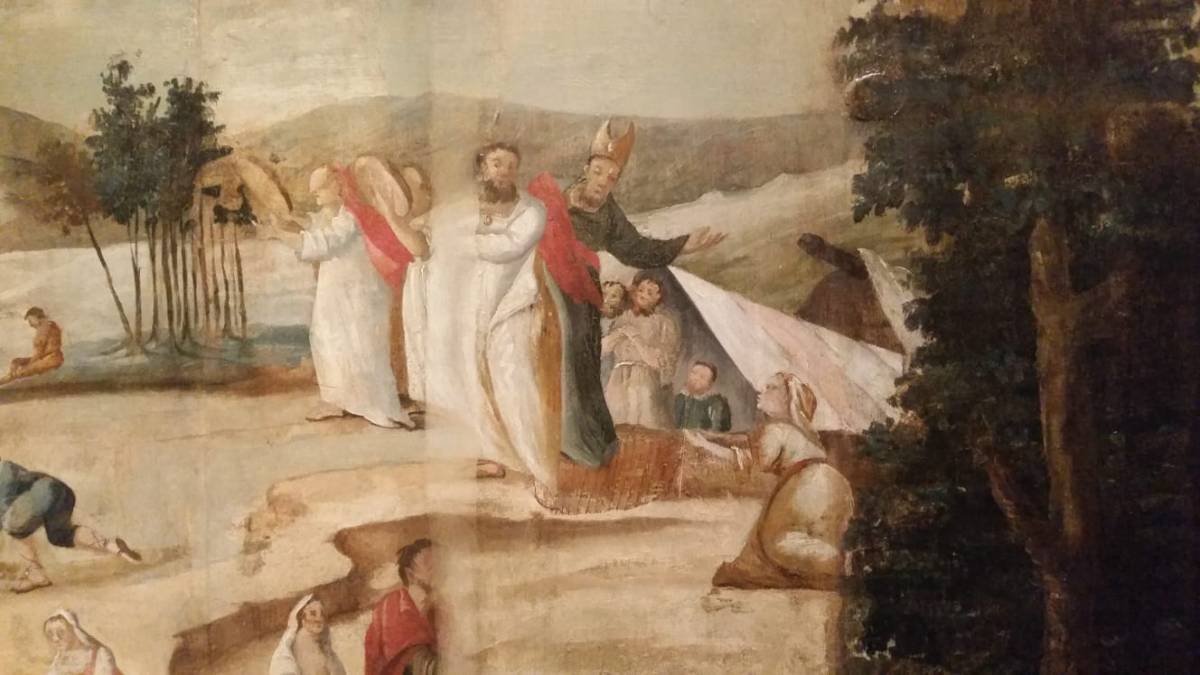
My cover photo is a medieval Italian Jewish painting.  Proof that our creativity extends not only to high tech, but also to high art.

El meu primer blog en català

Per a tots els meus amics i llectors que no saben, tinc una conexió prou forta amb la llengua catalana i el públic que la parla.

Seguint la recomanació del meu amic Felip Querol, qui em va entrevistar fa uns mesos sobre Israel, escriuré el meu primer blog en català.  O diguem, el meu segon, si s’enclueix el que vaig escribir com a estudiant de català a Georgetown University fa 5 anys 😉 .

Felip em va trobar a un grup de Facebook de Catalans a Israel.  Era curiós perquè justament en aquest moment, jo estava visitant Catalunya.  Tenim una paraula en Yiddish per a explicar aquests moments afortunats: “bashert”.  O sigui, “predestinat”.  Meant to be.

Podeu escoltar l’entrevista Començo a parlar a les 11:15 minuts més o menys.

Era una entrevista tan divertida.  Com hi ha molt antisemitisme acutalment a Europa, jo estava una mica nerviós.  Felip volia aprendre sobre Israel com un país diverse i complicat i interessant?  O volia fer polèmica?

Jo estava molt content de que ell volia aprendre.  Parlar com éssers humans sobre la complexitat i la bellesa del meu país.

No va ser el primer cop que vaig experimentar la màgia que és parlar en català sobre el judaisme.  Que és teixir junts dues identitats meves.  L’una enriquint l’altra.  Com si no va passar 500 anys de distancament i anhel.

Fa uns anys, quan encara vivia a Washington, D.C., on vaig creixer, vaig tenir l’oportunitat de ser un Katalonski.  Katalonski, per qui no sap, és un programa fenomenal de TV3 que va explorant el món, tractant de trobar gent com jo qui ha aprés el català.

Vaig tenir l’oportunitat de convidar l’equip d’aquest programa, inclouent-hi el presentador Halldor Mar, a la meva sinagoga.  Ell és un Katalonski com jo- nascut a Islàndia i ara un catalanoparlant radicat a Barcelona.  La meva sinagoga va ser la primera que van visitar mai.  No només això, els meus nous amics catalans van venir a fer danses folklòriques israelianes.  O al menys van tractar de fer-les 😉

Podeu veure l’episodi aquí.  Parlo de per què vaig aprendre la llengua.  Com la meva identitat com a minoria va influir la meva decisió.  Com ser jueu gay funciona- i per què em conecta amb el català.

Si dic la veritat, sempre quan em trobo amb dificultats o desafiaments, tinc ganes de parlar català.  I encara més, parlar amb catalans sobre el judaisme i Israel.

No és per casualitat.  Viure a Israel, viure com jueu és difícil.  Et trobes lluitant contra prejudicis àntics.  Per desgràcia, a Catalunya també, on un grup de ignorants van posar un boicot contra el meu país d’Israel.  Però clar, no contra dotzenes d’altres països molt més violents i agressius.  I sense pensar als israelians progressistes com jo que estan tractant de seguir construint una societat cada cop més oberta, tolerant, i diversa.  De lluitar per la justicia i un millor futur.  És la lluita de tot el món actualment- però els que proposen boicotear el meu país només parlen dels “pecats” dels jueus.  Un prejudici ibèric que no va desaparèixer durant els ‘ùltims 500 anys.

El que si m’anima es veure molts catalans que volen aprendre sobre el judaisme i la diversitat israeliana.  La comunitat gay a Tel Aviv, els jueus iraqís que continuen parlant el seu dialecte àrab àntic als carrers de Or Yehuda, els ciutadans àrabs que parlen al menys tres llengües i tenen representació política al parlament.  Un dret democràtic que per desgràcia no existeix als nostres països veïns.

Llavors quan parlo català i em conecto amb catalans que volen aprendre sobre la meva cultura, em fa content.  I m’anima aprendre encara més sobre ells- la seva cultura, la seva història, la seva llengua tan bonica.  Com em va passar a Vila Joiosa amb el meu nou amic valencià Josep.

I és per això que en aquest moment, quan estic buscant feina, quan vaig veure coets del Hamas, quan tinc la vida una mica estressant, em trobo escribint el meu primer blog en català.

Compto amb els meus amics catalans.  Som minories.  Hem sigut oprimit pel mateix estat espanyol.  Les notres llengües- el yidish, el ladino, el català mateix- han sigut ignorades i menyspreades per l’història.  Perque som “cultures petites”.  Perque segons alguns, només una civilització que té 300 millons de parlants importa.

Però jo sé, com jueu, com israelià, i com catalanoparlant, que no és veritat.  Que, com la meva primera professora de català em va dir: “cada llengua és una riquesa”.

Els èxits dels jueus i dels catalans són innombrables.  Hem pogut sobreviure i preservar les nostres cultures malgrat persecucions i ignorancia de fa segles.  Tenim històries riques i conectades.

Seguim tractant de tobar un equilibri entre la modernitat i la necessitat de preservar les notres identitats antigues.  Una cosa que poca gent al món enten.  Però seguim endavant.

Penso en el meu primer blog en català, el que vaig escribir com estudiant universitari a Georgetown gràcies a la Fundació Ramon Llull.  I potser no sigui per casualitat que aquest blog, que jo hauria pogut escriure sobre qualsevol tema, el vaig escriure sobre el ladino.  La llengua judeo-ibèrica que el meu pobre ha preservat fins avui malgrat la nostra expulsió del país que era el nostre.  El nostre- de vosaltres i de nosaltres.  De la vostra sang amagada i de la meva- les dues provenints del país del qual escric aquest blog.  Un miracle que l’Inquisició no hauria pogut imaginar fa 500 anys.

Quan penso en el català, penso en l’esperança.  En el futur.  En les dificultats acutals.  En la riquesa de ser una minoria que segueix contribuint i vivint i sobrevivint.  Rient malgrat l’ignorancia.  Rient en hebreu, en català.  Rient com som.

Per això, quan es parla del català i del judaisme, no em puc separar.  Perque per a mi, són dos aspectes inseparables de qui sóc.

Enviant una abraçada de Jerusalem.  Als meus germans i a les meves germanes a Catalunya.

Us estimo ❤️

La foto és del mapa del call jueu de Tortosa, una ciutat preciosa que vaig visitar l’ùltim cop que vaig anar a Catalunya.

One Catalan tweet

One of the biggest problems facing Israel is “hasbara”.  It is translated as “public relations”, “propaganda”, or “outreach”.  It comes from the verb “lehasbir”, which means to explain.

The idea is that Israel, like any other nation, needs to make its case on the world stage.  At a time when we find ourselves under rocket fire from Hamas (and the world barely seems to notice), it’s more important than ever.

The problem is Israelis aren’t very good at it.  Israeli mentality is rooted in that of a “start-up nation”.  In order to build this state, people had to be creative and, more importantly, just go for it.  There’s no time to refine rough edges or to polish words.  As I’ve written about before, bluntness is the name of the game.  After having personally experienced deep anti-Semitism in parts of Europe veiled in feigned politeness and verbosity, I understand where the mentality comes from.

The issue is that because Israeli culture is built on straight talk and getting to the point, making a nuanced case for the country doesn’t happen much.  And while talking about (very real) Hamas and Hezbollah fanaticism might work for the Fox News crowd, it just doesn’t touch the heartstrings of centrists and progressives in the same way.  Flexing your muscles is not the only way to get your message across.

This is part of what I do with this blog.  It’s not to say Israel is perfect or that you should always agree with the government.  I can’t say I always agree with any government- so why should I expect something different from other people?

Rather, it’s to show the diversity of Israel to help you understand the many layers of this society and break through stereotypes.  So that the next time you think of Israel, it’s not just rockets falling or political conflict, it’s also the Druze kid I talked about gay identity with in Arabic.   It’s the Haredi black-hat Jew who gave me one of the warmest hugs of my life.  It’s my experience in a Catalan archive reading the 500-year-old names of Jews forced to convert during the Inquisition.  And realizing that sadly, this kind of persecution continues to this day, making Israel the one safe-haven Jews can count on in times of need.  As Pittsburgh, my mom’s hometown, soberly reminded us just one month ago.

When you understand the depth of Jewish experience, when you see layer upon layer of complexity in Israel, you realize just how rich a place this is.  And how foolish it is to think of it in uniform shades of black and white.

And it gives you the courage to reach out to potential friends in new ways.

As some of you know, I have a strong connection to Catalonia.  I speak Catalan, I’ve been interviewed on Catalan TV and radio and newspapers about Judaism and Israel.  It’s a society thirsty to learn about my heritage- and one that inspires me to think differently about my own identity.

Over the past few years since learning Catalan, I’ve connected with thousands of new people interested in my culture.  When traveling in Valencia a few months ago, I even met a gay Zionist bookstore owner with a Hebrew tattoo who has become a dear friend!  I recently posted a 30-second Catalan language video about Israel’s diversity which reached almost 3,000 people in a matter of minutes.  It wasn’t anything complicated and it wasn’t about how terrible our enemies are- it was simply about the diversity of life that I enjoy here.  A diversity their media fails to show.  And it really resonated.

The other day, I was at the National Library of Israel.  If you haven’t yet visited this fascinating institution, do so.  It has over 5 million volumes of books, recordings, and archives.  It is the historical treasure trove of the Jewish people from around the world.  It’s a way for us to preserve our heritage for generations to come.  And most importantly, it’s free!  So instead of standing in line at some tourist attraction, go visit and explore thousands of years of Jewish history in countless languages.

Thinking of my Catalan friends, I decided to try an experiment.  My background is in public relations and social media marketing.  While I sometimes value a break from the endless streams of news feeds and clickbait material, social media does have the power to bring people together.  In ways impossible just a few years ago.

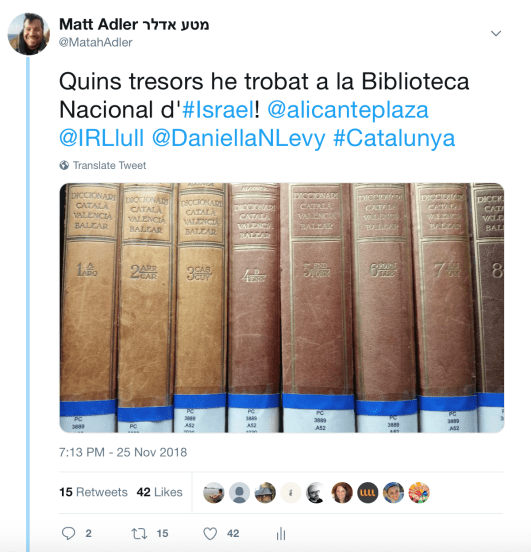
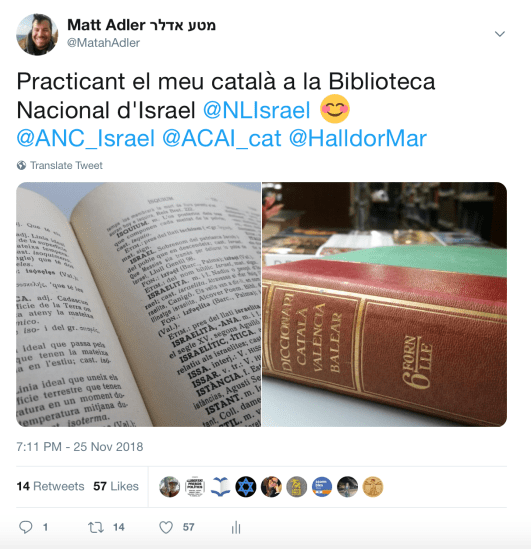
I took some pictures of a multi-volume Catalan dictionary I found at the library.  To the average visitor, it might not seem like much.  But to me, it was an absolute gem.  I poured through its pages, its worn binding drawing me to gently open its doors.

I posted the pictures on Twitter with Catalan-language messages about what I was reading.

And my friends responded.  Within 20 minutes, there were dozens of likes and shares.  All in all, 4,504 people have seen the two tweets, with absolutely no advertising budget.  The National Library responded with a cute short Catalan tweet.

Screen Shot 2018-11-26 at 5.18.07 PMScreen Shot 2018-11-26 at 5.18.21 PM

Why does all of this matter?  Isn’t Catalan just a small, useless language?  Israelis are practical- shouldn’t we just focus on Spanish and Chinese and Russian and English.  Why talk about culture?  We have rockets falling on our heads.  It’s a waste of time, it’s superfluous, let’s talk about the important stuff and “cut to the chase”.

This is the sabra attitude and while it works for creating the first Jewish state in 2,000 years, we sometimes lose out on building relationships with potential friends.  Catalan is not a useless language- I don’t even think there is such a thing.  But for starters, it has over 10 million speakers- more than Hebrew.  Catalonia has a GDP of $255.2 billion.  If you think Israel is a tourist magnet (we had a record-breaking 3.6 million tourists in 2017), the city of Barcelona itself hosted 8.9 million.  And from a strategic angle, Catalonia itself may become an independent country in the years to come and Israel would be wise to find friends wherever we can.

But beyond all of this, Catalans and Jews are minority communities persecuted by global powers.  In fact, the same ones- the Spanish state.  The very country that expelled us 500 years ago- and to this day remains one of the most anti-Semitic countries in the world.  Catalonia once hosted one of the world’s largest Jewish communities.  Its own language’s persistence is a tremendous feat that reminds me of how Jews have continued to survive despite thousands of years of being degraded.  Yiddish itself was once derided as a “jargon”, a useless language, just like Catalan.  We share the challenge and the belief in balancing modernity with preservation.  We have a lot of things that can bring us together.

So while some advocates for Israel continue with a one-dimensional message reaching the same audiences over and over again, I do something different.  Their message also needs to be heard, but it’s not succeeding in reaching important communities and it’s only part of the story.  I talk about what’s hard here, what’s awesome here, what’s benign and interesting.  I don’t demand unquestioned loyalty and I do show why our country matters.  I show the burnt fields of Sderot and I take people across the Mediterranean on a virtual tour of one of our best cultural institutions, the National Library.

Israel, like the Jewish people in general, is one of the most diverse, fascinating communities on the planet.  It’s a place where just this week, I saw an Orthodox man listening to Bollywood music on a train next to a Muslim woman in a hijab.  It’s a place where Assyrian churches pray in Aramaic- and where I hit on a cute Iraqi guy who speaks the language of Jesus in a gay club in Tel Aviv.

I admire our nation’s diplomats who are trying to make the case for our country.  And sometimes, we need to try something new.  It’s true there are people who irrationally hate us and who we’ll never convince to embrace us as fellow human beings.  And it’s also true that there are people who like us, if we choose to reach out with sensitivity, nuance, and heart.

Don’t keep doing the same thing and expect a different result.  I reach out to Catalans and make Arabic-language videos for Syrian refugees (hundreds of whom engage with me) and march in gay rights rallies.  Not because they’re “big cultures”.  It’s because they’re not.  They’re like me.  They’re neglected, they’re minorities, and they matter.

So next time you see a Catalan tweet from the National Library, don’t wonder why it’s useful.  Look around you at the State of Israel, at the Jewish people, and realize we’re proof that there’s no such thing as a small culture.

My cover photo is from the city archives of Tortosa, a beautiful Catalan city with thousands of years of Jewish archives I explored this summer.  Find your adventure 🙂

Goodbye America, for now

It’s appropriate that I write this blog on the eve of America’s midterm elections.  As my country prepares to pivot, so do I.  Tomorrow, I board a flight to say goodbye.  For now?

I find myself feeling a mixture of excitement and anxiety.  Excitement because I think Democrats will take back the House of Representatives.  And if it’s truly a blockbuster night, even the Senate.  I think Donald Trump needs a wake-up call that he can’t govern this country alone.

Anxiety because I worry about the future of the Democratic Party and what it means for this nation.  The extremes of the Democratic Party, as best represented in the Trump-like antics of politicians like Alexandria Ocasio-Cortez.   Someone who on the surface level, I agree with 80% of the time.  But who takes her positions- and most importantly her rhetoric- to extremes.

Ms. Cortez, almost certainly to win her election tomorrow, supports a variety of policies that are fairly standard in Israel and Western Europe.  Socialized medicine, environmental protections, affordable higher education, and civil liberties for LGBT people.

The problem is she takes public policy and turns it into a bombastic crusade in which anyone who disagrees with her is the enemy.  And in which purity Trumps all.

Ms. Cortez compared the threat of climate change to that of Nazi Germany.  She supports impeaching Donald Trump without considering the consequences to her party or the national discourse.  Or the potential counter-reaction of angry armed Americans who will doubtless double down on hunting down minorities.

She criticized Israel for having “massacred” innocent Palestinians in Gaza- without showing any understanding of the fact that many of them were armed Hamas members.  And that while all killing is a travesty and some of the deaths may have been avoidable, it’s not so simple here.  I’d like to see how she’d react as an 18-year-old soldier when people volley rockets and flaming kites at you and your family’s neighborhoods.

The most audacious and Trump-like aspect of this accusation is that Ms. Cortez’s response to criticism was: “I am not the expert…on this issue”.  A bizarre and deeply narcissistic approach to politics.  You are a future lawmaker- if you’re not an expert on an issue, you probably shouldn’t make such wild and factually incorrect claims.  You sound a lot like our Tweeter-in-Chief.  Shooting from the lip.

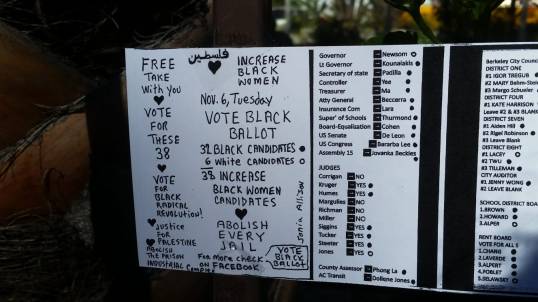
Lest you think this is an isolated incident, I found the most shocking flier walking around Berkeley.  Although if you’re from the area, you won’t be surprised.

WhatsApp Image 2018-11-05 at 4.37.19 PM

At face value, I agree with some of the flier.  I would like to see more black women in politics.  Minorities are perpetually underrepresented and it changes the discourse to have different people in the room making decisions.

On the other hand, this is no better than Donald Trump’s extremist rhetoric.  “Abolish every jail”.  “Black radical revolution”.  “Justice for PALESTINE”- and the word Palestine written in Arabic.  “Black ballot”.

It’s not that each of these words on their own are necessarily bad.  I advocate for Palestinian human rights.  I want black empowerment.  I think the prison industrial complex needs reform.

But the way it’s presented is so fundamentalist.  It’s a “with-me-or-against-me” rhetoric that is dangerous in and of itself.  It is imbued with a fanaticism, a sense of infallibility reminiscent of a Puritan more than a public policy debate.

I don’t believe in abolishing every jail.  Some people are dangerous and need to be behind bars.  Not everyone can be rehabilitated and I want want serial killers and rapists off my streets.  I also don’t think that any ballot should be all about one group.  I don’t vote a “Jewish ballot” or a “gay ballot”- it’s exclusionary it is very phrasing.  And the Palestine piece- it’s telling that there wasn’t a call for peace, nor was there a condemnation of anti-Semitism.  Let alone an acknowledgment that Israel, that the Jewish people are entitled to empowerment too.  Especially days after the worst anti-Semitic attack in U.S. history.  I have never seen an attack so clearly demonstrate the need for a State of Israel or for solidarity with our people.  Yet where are the grandiose words, the empathy for us?

We’re not on the agenda for the far left- and I feel it.  I see poster after poster here in California.  “Hate has no place here”.  “Against hate”.  “Immigrants, Muslims, LGBTs are welcome here”.  But not on one single sign have I seen the word “Jew”.  Out of hundreds I saw, one sign had “you are welcome here” written in Hebrew- a reminder that some people care.  But if I’m honest, I leave California with a deep sense of disappointment and a feeling that most of the left doesn’t feel we are worthy of their solidarity.  I am inspired by the thousands of Jews and non-Jews who came together to #ShowUpForShabbat, but I have yet to see progressive activists put us on their agenda.  We are worthy of our own discussion- not just in terms of Trump, not just in terms of gun control, not just in terms of hate crimes.  All of these are valid issues and related- but they are not the same.  This was an anti-Semitic attack during a period of rising anti-Semitism around the world.  And I expect progressive activists to step outside their comfort zone and learn about us on our own merits- not just when it’s convenient for their ideological agenda.  If the attack makes them reconsider their reflexive support for Palestinians over Israel (as if one should have to choose), then I’m glad it makes them uncomfortable.  Because if you’re upset about Pittsburgh, imagine what Moroccan Jews and Polish Jews feel like about thousands of Pittsburghs and having no home left to go to.  That’s why Israel exists- and you need to face the fact that your society is failing to protect us.  The extremes on both sides.  Which is why a wise Jew will never give up on the state that is our only insurance policy.

Black-and-white thinking results in aggression and a breakdown in communication.  A young Jewish student at Florida State threw chocolate milk at Republican volunteers while invoking the Pittsburgh massacre.  I share her frustration at the rise of the far right and its racist and anti-Semitic elements.  I also will offer some humility in saying its different analyzing this from afar than living here.  I’m American, but I am not here most of the year and it’s different to physically be here.  I think that as a (somewhat) outside observer, I can illuminate things that are hard for you to notice when your surroundings shadow your vision.  And I bow to the fact that we live in different, overlapping existences and I recognize that you bear certain consequences more directly than me.

I will offer this advice- do not behave like the people you hate.  Of all the times people have said nasty things to me (and again- I don’t know what, if anything, the Republicans said to arouse her anger), I have never considered launching my beverage at someone’s face.  It’s not that I thought about it and decided not to- it just never occurred to me.  Everyone has a right to their feelings- but we don’t have a right to attack people.  Even people we disagree with or think are damaging society.  The greatest challenge of being oppressed is not to become the oppressor in fighting back.  I’m a double minority and a survivor of three decades of abuse.  I get it on a gut level- it’s hard.  And I hope this young woman can learn from this experience and realize that she has further poisoned debate rather than showing courage.  We’ve all been impulsive students once, but it’s important to remember our actions have consequences.  And I can’t imagine her behavior has made Jews any safer at a time of deep discomfort about our place in society.

Empathy is about understanding where others come from- not necessarily agreeing with them.  So in that spirit, I’d like to offer this.  I am American-Israeli.  I feel more American in Israel and more Israeli in America.  I am a hybrid.  Some people share my observations, and sometimes people disagree with them.  I address a mostly progressive audience because that’s part of who I am and it’s who I know best.  Its whose actions hurt me the most because I care what they, what you, think.  Many of my observations about extremism apply to the far right as well- it’s just that I don’t have much cachet with them.  I can’t imagine they’re particularly interested in hearing the voice of a queer Jew at this point in history.

There are distinct cultural differences between Israel and America.  Israelis are famously direct, Americans famously polite.  Israelis will message you pretty much non-stop, Americans think you’re in love (or desperate) if you message someone the day after a date.  The words we use, the emotions we feel, the way we convey them- our behavior- is deeply influenced by the culture we live in.  And I live in both.

American friends expecting me to conform to American cultural norms- to always remember them- please consider that I don’t live here.  I’m not an American abroad, I’m not an expat, I’m not on some jaunt or program.  I’m an Israeli, an out-of-the-closet Jew running by completely different norms.  And if I sometimes am too direct for you, consider my reality too.  I shouldn’t (and can’t) always revert to your way of thinking because it’s hard- it’s not fair, it’s not who I am, and it’s not how I live.  If you’re offended by my bluntness, I won’t always say I’m sorry- because sometimes you need to hear some straight talk.  That’s my Israeliness.  But I will say I never intend to hurt you and I care about what you think.  Otherwise I wouldn’t write this blog.

As we sit on the eve of great change- for me personally and for America my country- I want to share my hopes.  I predict Democrats will gain power this week.  Not sure how much, but it will change the discourse and perhaps even bring some balance to the national debate.

The question for my progressive friends is how will you wield this power?  After several years of hearing worn-out tropes from the far right, after being wounded, will you be the adult or the child?  Will you govern with a gavel or a sledgehammer?

I hope you govern wisely.  Yelling at people doesn’t change their opinions.  Some people we can’t dialogue with- but some people are not only open to hearing your thoughts, they could teach you something too.  Protect yourselves, but don’t close off your hearts entirely.  And check in with yourself to see if you’re becoming the domineering person you’re fighting against.

This is something I personally wrestle with, especially in Israel.  A place packed with tension.  Beauty, for sure.  But it’s not for nothing people are angry there- rockets are falling on my friend’s kibbutz this week.  Ideologies, religions collide.  This is not suburban California- it is a country the size of New Jersey with ISIS on its borders.

The best thing I can offer you is to evaluate ideas on their own merit.  Just because Donald Trump likes Israel, doesn’t mean you should hate it.  And just because Alexandria Cortez doesn’t like Donald Trump, doesn’t mean you should join her in hating Israel.

Find the counterexamples.  When I get angry at Arabs or Muslims (I have a lot of reasons- I have a high likelihood of being killed for being gay, American, Israeli, or Jewish in their societies), I find someone who reminds me.  Who reminds me that there is good too.

My friend Muhammad is a Bedouin student who just moved to Ramat Gan.  He’s having a rough time- it’s not a particularly diverse city and he has experienced racism.

He told me he felt Jews only care about their own.  And I got angry.  I reminded him that I’m a Jew and I helped him find an apartment and adjust to life in his new home.  Hours upon hours of expensive long distance calls from abroad.  And that I was proud to do so.

He relented that it was politics, the TV, the blowhards who got him down.  And I told him I understood- if I went by what the TV told me, I’d think all Muslims want to kill me for being a gay Jew.

And that’s where we found our common ground.  We remind each other of our humanity.

He apologized, which of course I accepted.  And I wrote him in Hebrew:

“No worries, bro.  Remember there are Jews like me, and I’ll remember there are Muslims like you.”

His response: “Exactly!” and a kissy emoji.  Which, to remind my American readers of cultural differences, is not a romantic gesture.  Arab men (and a lot of straight Israelis) show a lot of intimacy towards their male friends.  That in an American setting would make you think we’re heading for the sheets.

But we’re not.  We’re friends.  We’re each other’s alarm clock, a reminder of the people who don’t fit our preconceptions.  The people who value us the way we are.

America- that’s what I hope for you November 7th.  No matter what happens, no matter what you advocate for, do it with humanity.  Remember the other, remember the exception.

I hope next time I visit, instead of a “black ballot” or a “white ballot”, I’ll see people talking to each other face to face.  Instead of a voiceless flier slapped on a cold brick wall.

I believe in you.  And I want you to succeed.

What’s right with America

Recently, I took a trip to Berkeley.  Known as a hotbed of far-left activism and anti-Israel hatred, I wanted to see what was up.

While a friend of a friend had suggested there was no such thing as campus anti-Semitism there, I wanted to see what it was like first hand.

Going in with rather low expectations, I found a lot to like there.  Berkeley is a cute town.  I found my way to a delicious little restaurant that sold onigiri, or Japanese rice balls.  As a kid who lived in Japan (and then stayed connected to the culture back in the States), I grew up with this as comfort food.

In the restaurant, I chatted with a nice young man behind the counter.  I made a point of mentioning I was from Tel Aviv- a risky proposition in a city where not a small number of people boycott our existence.

Turns out, he was a Jew!  His father had volunteered on a kibbutz near Tel Aviv years ago.  And he told me he might go on Birthright!  I told him to check out my blog and contact me if he visits- if you’re reading this please message me!  I will hook you up 😉  It was a refreshing reminder of vibrant Jewish life here- a life that both as an American and an Israeli I support.  That I urge the Israeli government to back with full force- not just rhetoric.  Bibi- recognize progressive Judaism in Israel and abroad- as a living community which strengthens our state and our people.  If we’re Jewish enough to be shot by anti-Semites, we’re Jewish enough for the Jewish State.

As I headed to campus, I decided to visit Hillel, the Jewish campus organization.  I met some wonderful young students, who told me about the active Jewish life on campus.  About their trips to Israel- and their desire to return.  And unfortunately, some of the rabid anti-Israel and anti-Semitic students they have to deal with.  As they noshed on some pretty tasty looking shakshuka.

Frankly, I felt lucky to have graduated from college 10 years ago, where anti-Semitism was unheard of at my Hillel and where the scary rhetoric of today’s campus extremists was barely in its infant stages.

One particular story stood out to me.  Speaking with an Israeli, she told me about a non-Jewish student who came to a discussion about the various types of Zionism.  And, apparently innocently and sincerely, asked “but what does Zionism have to go with genocide?”

The Israeli thought she meant the Holocaust.  But apparently the student, having heard all sorts of inflated rhetoric on campus, thought Zionism was a form of genocide.  A blatant lie and a sad reflection on the rhetoric of the anti-Israel movement.  That does a disservice to Jewish and Israeli history, the complexity of the conflict, and to Palestinians themselves as these “activists” push our peoples further and further apart.

I stand in admiration of Israel educators and Jewish students who patiently answer such questions.  I have to say if someone asked me this question in earnest, I’d assume they were simply attacking me.  Because in some cases, they are.  But when you see someone so earnestly manipulated, it breaks the heart.  And I’m so proud of our Jewish activists and non-Jewish allies who are standing up for truth, for nuance, and for engagement in today’s increasingly toxic environment.

One student named Judith particularly stood out to me (hi Judith, if you’re reading!).  She is a Berkeley native so she is used to the screaming, often irrationally hateful activists who populate her campus.  Like the Christian minister I saw on a street corner shouting in a megaphone that “Jesus wasn’t afraid of the Jewish culture.”  As people walked by completely indifferent.

Her bravery and her ability to ignore such people remind me of Israelis.  She is used to it, and she lives her life despite it.  It reminds me of young Jews I met in Belgium who were used to having their synagogues under armed guard.  Where you submit your passports a week in advance to visit.  To get a background check.  A reality unthinkable in European cathedrals, open to the public without even a cursory glance.  It’s a reality American Jews will have to get used to.  After Pittsburgh, you can expect enhanced security at American synagogues.  Where, sadly, I think they will one day resemble the fortress-like congregations that dot the European continent my family once called home.

The age of American Jewish innocence- where we lived in security and prosperity- is evolving.  What was once the safest and most prosperous Diaspora community since medieval Spain is in the midst of a monumental change and I fear for its future.  I will not be surprised to see armed guards outside American synagogues next visit- and it will make me a bit sad.  One Jewish community advocate estimates it could cost $1 billion to secure American synagogues.

We once thought we were exceptional, that our bagels were as American as apple pie.  But as is often the case in Jewish history, if we ever forget who we are, the anti-Semites arise to remind us.  If you are a non-Jewish ally reading this, the hour is late and if you don’t mobilize with us now, American Jewry is at tremendous risk.  Speak up, show your solidarity, stand with us- lest we become the next France.  Where Jews fear to walk around with yarmulkes on and Jewish centers are regularly attacked.  Where Holocaust survivors are burned to death in their homes.  If you think this is alarmist, you don’t know much about Jewish history.  The ethnocentric view places this recent attack only in the context of American hate crimes like heinous attacks on black churches or immigrants.  But if you read Jewish history, you’ll realize this analogy is relevant but incomplete.  Violent anti-Semitism isn’t new- and it didn’t start with Donald Trump.  Although I’d invite him to stop complaining how attacks against us “slow” his political momentum.  We’ve been dealing with this for 2,000 years and counting and across dozens of countries.  I’m not a huge fan of the (seemingly endless) privilege discourse, but as a non-Jew, it’d benefit you to consider the ways you’re fortunate to not be one of us.  And to find ways to help.

As I wandered around Berkeley’s campus, I felt more comfortable than I expected.  There is something about coming in with low expectations that gives you the freedom to be pleasantly surprised.  To have your preconceptions splendidly upended.  Like when I met pro-Israel libertarians with buttons that said “BDS=BS”!  So thankful to have you advocating for us in the belly of the beast 🙂 .

20181102_153142

Yet some expectations are based in reality.  I met a man tabling for a Muslim Student Association volunteer program- run in conjunction with an anti-Semitic professor.  Berkeley is about to host a Marxism conference.  With speakers on Palestinian liberation- likely predicated on the destruction of Israel.  A terrible false dichotomy that speaks more to their black-and-white destructive thinking than any sort of genuine attempt at dialogue or peacemaking.  Signs abounded about the “Trump-Pence Regime” and “resistance.”  As if our President, as narcissistic and callous as he may be, was somehow installed by a putsch.  As opposed to the democratic elections he won.  Someone you oppose becomes an illegitimate enemy of humanity rather than a candidate or ideology you want to defeat.  The former requires nothing but anger.  The latter requires organizing, analysis, and persuasion- real work that requires you to engage with people you disagree with.  You can tell what I think is more productive.

This kind of black-and-white thinking is something I’ve dabbled in, especially in college.  There’s something about this time in your life, free from obligations, where you can experiment with radical ideas.  And on some level it’s healthy.  Some ideas accepted as normal in our society need to be challenged and changed.  I also feel that my at times abusive chilhood pushed me into defensive and judgmental thinking as a way to protect myself and to make sense of inexplicable hatred.

And I’m proud to have worked hard to grow out of this mentality, as befits my age and my process of healing from abuse.  And my engagement with a wide range of cultures and political views.  So that when I meet an American-born Cambodian student whose parents fled the Khmer Rouge, but who is excited about the Marxism conference, I feel a mixture of emotions.  Anger, sadness, and pity.  It takes a lot of mental acrobatics to justify the way she thinks, but all I can say is that I hope she can one day escape the ideological labyrinth in which she wanders.

Because for me, resistance is not about slogans or yelling at people who disagree with you.  It’s about standing for your values while resisting the urge to do evil when it has been done to you.

As I prepared to leave Berkeley, I told Judith that I thought she was brave for having adjusted to life in her town.  As a proud Jew and a lover of Israel, to be surrounded by such political extremism can’t be easy.  And like Jews have done for centuries, she got used to it and lives her life.

And I left her with a warning: “Jews in Europe are now used to armed guards and soldiers protecting their synagogues.  Like fortresses.  They’ve gotten used to it to- it’s necessary and it’s sad.  So be careful- don’t get too used to it.  Because you deserve better.”

She nodded in agreement as she boarded the bus to a fun date with her boyfriend.  The kind of care-free evening that makes America so fun.  And makes Americans so lucky.  With all your problems, remember this is the wealthiest and one of the most stable countries on the planet.  And don’t forget it.  It’s a blessing.  Hamas fired 30 rockets on Southern Israel last week and Catalan political leaders sit in Spanish prison.  Even as you push for change, count your lucky stars and remember there are problems outside this country too.

At night, I headed into San Francisco.  Having seen the good, bad, and neutral of Berkeley (including some amazing burritos made by Asian students), I wanted Shabbat.

Shabbat is not something to take for granted.  It’s only a feeling that happens if you make it happen, especially outside of Israel.  On my travels, I found myself gravitating towards Jews when I wanted that feeling of community.  It wasn’t really about religion in the traditional sense of the word.  It was about being a Jew with people who understood me.  And sharing in our customs, food, and talk.

One organization that has brought this to life for me is Moishe House.  They organize communal houses for Jews across the world, which then hold programs for both Jews and non-Jews.  A pluralistic cultural space, it is a great complement or alternative to synagogue, as it doesn’t require a particular belief and all are welcome.

I’ve written before about how I visited Moishe Houses in Brussels and Barcelona.  And now it was San Francisco’s turn.

The folks at Moishe House Nob Hill put on an amazing Shabbat dinner.  There’s a special feeling when you’re with Jews.  To put it in the words of a man named Ben I met- it’s intangible.  You just feel at home.  You know something links you even if you’ve never met.

When I walked in the house, I was greeted with the smell of chicken shnitzel, of hummus, and I even made my own challah.  For the first time!

Turns out one of the housemates’ friends even read my blog about San Francisco!  It’s an amazing feeling of connection when you see just how small of a people we really are.  And I’m grateful to both Moishe House and its energetic residents for building this safe, vibrant space.

A space where for just one night, I can worry a little less about saying I’m Israeli.  Where I talk about Judaism without worrying about sounding “too Jewish”.  Where I can count on empathy after this week’s Pittsburgh terror attack.  An empathy I sometimes found lacking among non-Jewish folks I met in San Francisco.

It was interesting- I had actually forgotten about the attacks until the dinner.  The dinner was advertised as a Pittsburgh solidarity dinner, a great idea.  It’s just that as an Israeli, I had mourned, been angry, and moved on to the next thing.  A zen-like way of living in the moment that I learned to do more and more in the Jewish State, where hundreds of Pittsburghs have happened.

So where I expected just a Shabbat dinner, I got a lore more.  It was nice to see the tender side of American Jews.  Israelis, so accustomed to terror attacks, move on rather quickly out of necessity.  It was both heartbreaking and moving to see how the attacks affected the young Jews here.  The softness of American Jews is a real treasure- unique in Jewish history for having enjoyed so much freedom and safety.  And it’s something I fear will have to change.  As the country and the world increasingly scapegoats us, American Jewry would be wise to connect more with European Jews and Israel to learn coping skills.  It’s not easy- but the good (and bad) thing is we have a lot of experience dealing with terror.  And we can be there to support each other during this transition.  What I fear may be a new normal.

A curious thing happened at dinner.  A young man requested we do kiddush, the traditional blessing over wine or grape juice.

The Moishe House residents looked around, looking for volunteers.  Having led Reform services my whole life (including in Tel Aviv), I know the blessing by heart.

When I left Tel Aviv two months ago, I could barely utter it.  So disenchanted with both Judaism and Israel itself in such a tense region of the world, I wasn’t even sure if I was a Jew.  Although, as you’ll see with my previous blogs, Europe reminded me I was.

So I found myself with a choice.  Having gone from religious to atheist, to agnostic, to spiritual.  Where did I stand now?

I wasn’t sure.  But I sang.

And I sang with love.

And people joined in.

I hadn’t sung a kiddush in two months.  And it felt great.

As I write this blog, I think I do believe in God.  Maybe not the way others do, but who cares?  It’s my belief, and while I can’t find myself obsessing over details of Jewish law or ignoring the problems of literalism or religious tribalism, I believe.  I don’t know- I believe.  That’s why we use that word.  Because someone with perfect faith is a liar- and a demagogue.  Leaving room for doubt is the most Jewish thing in the world- and allows us to till the fertile gray space our minds can thrive in.

What inspired my faith this Friday?  A lot of things.  The human spirit, the need for connection, nature, change, my accomplishments, gratitude, and just a feeling.  A spiritual connection that complements, even creatively contradicts, my rational thought.  To make me who I am.

And what also inspired it are the great people I’ve met along the way.  Judith, Moishe House, Hillel, Israel educators, the young Jew making Japanese food.  Korean burritos, amazing taco chips, and the people who accept me as the Israeli I am.

This morning, I met a 70-something year old hippie at my hostel.  When she asked where I was from, I was nervous at first.  I’ve had some bad experiences with anti-Semites when I said I was Israeli.

But much to my surprise, like the young man making Japanese food, Lynn was Jewish.  A Reform Jew, like me 🙂 .  I don’t go to services as much now, but the synagogue I don’t go to is definitely Reform 😉 .  Lynn had been to Israel in 2006 and loved it.

We had a great conversation as I made delicious pancakes drenched in the kind of authentic maple syrup you only really find here.  It’s America’s hummus- something I just won’t eat in my other homeland.  It doesn’t taste right.

I gave Lynn my email and told her to come visit.  And I mean it- I hope she comes and I will set her up with whatever she needs.

Because I won’t give up on Jews anywhere.  And no matter who my Prime Minister is, no matter who attacks our people, no matter what- I believe in us.  And I want to be the progressive, open-minded Israeli who gives you pride in the Jewish State.  Who works tirelessly on the other side of the world to make space for people like us.  For a Jewish vision that supports LGBT rights, Arab empowerment, consideration for minorities, inclusion for refugees, and equality for progressive Judaism.  For a strong homeland that welcomes all of us.  Because there are Israelis like me who are your allies.  Forget the headlines and stand with us.  Because together we can strengthen the Israel and Diaspora community that makes us feel at home.  That lives out values we identify with.  And yes, that empathizes with people who disagree with us.

And in the meantime, I ask you to stand with us.  When you’re in Berkeley and people spout irrational, inaccurate hatred against Israel, to fight back.  To educate.  To realize that your fate depends as much on me as mine does on yours.  That Israel is your insurance policy- just as it has been for Moroccan and Polish and Ethiopian Jews forced from their homes for decades upon decades.

I need a strong America for a safe Israel.  And you need a strong Israel when you don’t have a safe America.

The world is changing, and who knows what will happen.  Enjoy this moment- who knows what tomorrow holds.  That’s the Jewish way.  And whether you’re Jewish or not, it can enrich your life to realize this basic fact.

Whatever you want to do, don’t wait.  There are no guarantees.  Dance in the streets, speak your mind, smile, cry, hug.  Like Lynn hugged me before she left- a precious gift for someone traveling alone.  Both on this trip, and in life.

What I’ve discovered is that what makes me feel less alone is finding empathetic people along the way who take you in.  Who make you feel loved and warmed.  Who feel your humanity.  Who share with you.

At a time when empathy is faltering, challenge yourself to show it.  And to find it where it appears to have disappeared.

Because next time I visit America, I want it strong.  This week, try to find a moment to talk to someone different, as hard as it might be.  Because Twitter and Facebook are great, but they won’t smile at a woman on the train.  And a news feed can’t feed a heart’s desire for acceptance.

America is a great country.  I hope its residents embrace the beautiful privilege of living there.  Despite it all, still one of the calmest and most prosperous places on the planet.

We are.  Black white, Jewish Muslim, gay bisexual, Republican Democrat, conservative centrist, straight and working class.  Christian, Native American.  Vegan and wealthy.

The next time your hand reaches for the screen.  Ready to type a comment on Facebook.  To agitate, to vent, to express.  Flip it like a pancake, fingers pointing ahead, thumb towards the sky.

Reach out and meet your neighbor.  Try.  It won’t always go well, but it’s worth it and it’s what we need.

This hand was made for you and me.

WhatsApp Image 2018-11-03 at 9.01.35 PMWhatsApp Image 2018-11-03 at 9.03.23 PM(1)

Evangelical Gay Jewish San Francisco

I’d like to share with you some stories from a recent visit to San Francisco.

After making aliyah a year and a half ago, I came back to the States for the first time.

What I’ve liked most is speaking English.  Everywhere the signs are in my language.  I can pick up on nuance and norms that I just can’t in another language, no matter how fluent I am.

I like the delicious fortune cookies I tasted at a factory in Chinatown and the wonderful Chinese-American woman I met who really wants to go to Israel.  She just wants to travel in general and see “what’s the big deal about the Eiffel Tower”.

I like the Latina saleswoman at T-Mobile who, when I mentioned I was from Israel, was so excited.  She was really proud of me for moving halfway around the world and pursuing my dreams.  And she told me what it was like for her to visit Mexico, how friendly people were.

20181101_172454

I like the rainbow flags that adorn the Castro, a kind of mini gay state.  I even found street art honoring a Jewish victim of AIDS.  Having lived in the Jewish Holy Land, I wanted to visit the gay one.  And it was really interesting.  While a rather small area (I suppose I envisioned it being half the city), it was so colorful, so gay.  Sometimes a bit risqué for my tastes (I saw naked men strolling down the street…), but I enjoyed the occasional sexual pun.  Including the absolutely hilarious tank top that said “can you host?” and the funny Planned Parenthood bag.  If you don’t get the hosting joke, ask a gay friend 😉

The Bay Area is filled with tremendous wildlife.  Scenery out of a movie.  The waves of the Pacific lapping against the shoreline but with an ease that matches the calm of this city.  I’ve never been in such a large city with such a relaxed pace of life.  It’s kind of the Tel Aviv of North America, as one person put it.

I like the personal space, the quiet, the lack of rockets, the feeling of sexual freedom that I wish Israel had more often.  A place so inundated with religion and nationalism that sexual shame, even in “sin city” Tel Aviv, often feels so much stronger than I wish it would be.

Now I’ll tell you what’s wrong with this progressive paradise.

First off, I’ve never seen so many homeless people.  In a city that prides itself (almost to a fault) on being so liberal, it’s hard for me to understand why there are so many people without a roof over their heads.  For sure, it’s not as if the ordinary citizen can fix this problem.  Nor is homelessness an easy problem to fix- mental healthcare, economics, and so many other factors go into it.

But I can’t help but feel confused, at times disturbed, to see so many people walking by on their headsets, talking about the latest computer program or software, while people sit suffering right by their feet.  I’m not expecting people to fix the problem, but it feels quite different from Israel.  We have lots of homeless people too, but both I personally and lots of people around me gave them food and water and money.  I even talked with a homeless man in Tel Aviv who told me all the books he has read recently.  I just haven’t witnessed that kind of spontaneous interaction or generosity here.

This kind of distance or callousness is something I’ve noticed a few times.  The other day, I was in Chinatown.  An elderly Chinese woman had fallen, hitting her head on the sidewalk, with blood spilling everywhere.  Person after person after person just walked by.  Me being both who I am and an Israeli, jumped into help.  I bought her water and brought napkins to help stem the bleeding.  A wonderfully generous African-American woman came over and held the napkins against the woman’s head.  An Asian-American man translated for the woman as he tried to talk to the 911 operator.  It was a kind of generosity-filled melting pot that I love about this country.

The disturbing part was watching the people walk by.  The people on their phones or who didn’t want to get dirty (I personally got blood all over my sandals…yeah, it’s gross and risky, but was I going to let a woman die to keep my feet clean?).  The people who, after helping for a second, just walked away.  The woman still dazed and confused, babbling in incoherent Chinese (not that I’d know the difference).

I stayed with her until she got into the ambulance.  That’s how you behave like a human being.  Your meeting is not more important than a person’s life.

Walking around the Castro, I entered a gay book store.  Boy do I love to see gay book stores, the world needs more of them.  And more book stores in general.  A place I truly feel warm and inspired and at ease.  A place of learning and discovery where you don’t have to “look” for anything- you can just look 😉

A lot of the books were really, really left wing.  I grew up with these kinds of book stores in D.C.  Once they made me excited, now they make me nervous.  I think I’ve grown out of this mindset and I think the mindset here has solidified since I left.  While some of the material is interesting, it’s often steeped in the black-and-white thinking that plagues both extremes in this country.  And usually involves hating Israel.

I noticed some rainbow buttons that said “Proud Queer Muslim” and “Queers Against Islamophobia”.  Frankly, they’re pretty neat.  Just days after the Pittsburgh massacre (one which personally touched me), I wanted to know if they had any against anti-Semitism.

The store clerk said: “oh you know, I don’t think we do.  Somebody must have them.  We don’t have any timely buttons.”  As if anti-Semitism was a new issue.

To his credit, the store owner paused and said he’d look into it.  And steered towards his computer to search.  I hope he finds some and puts them out.  Anti-Semitism isn’t new and I hope we can count on his solidarity.  The moment showed both the deep ignorance that can pervade this country and that sometimes we can puncture it.  I hope I moved things in the right direction.

During my visit here, I’ve had a lot of conversations about Israel.  The difference between an American Jew and an Israeli is we can’t hide our Jewishness.  We’re out-of-the-closet Jews.  And as soon as you say you’re from Israel, the conversation begins.

The cool part is when you get awesome people.  One man, Nick, is someone who I actually befriended in Tel Aviv helping him buy a sandwich.  In town on a business trip, he was struggling to deal with the hectic line, so I stepped in and helped him order.  I sat with him and his coworker and had a great time.  We kept in touch and he invited me to stay with him for several days here in the Bay Area.  Since making aliyah, I often feel Americans are more distant.  This is the country where self realization is priority one, where the individual is the greatest unit of meaning.

But Nick shows that some Americans buck that trend and are capable of the spontaneous generosity I’ve come to love in Israel.  He’s a new American friend, and I’m happy to have met him and am grateful for his kindness.

Curiously enough (or perhaps not!), Nick and I did some genealogy together and discovered he’s a quarter Jewish.  Maybe one day he’ll make aliyah 😉  But in the meantime, I was really happy to help someone discover their roots and connect to our people.  I’m proud to have generous people like him as part of our tribe.

Other people are not so fond of the Jewish State.  At various moments here, I’ve met people who can’t say the word Israel without following it with the word Palestine (as if I wasn’t aware who my neighbors were).  I’ve met people (including Jews!) who said that Israel’s very existence is a fair question.  And that someone who doesn’t believe Israel should exist because of our “illegal occupation” is not an anti-Semite.  Telling Israelis how to live their lives while sitting in the richest city in the United States.  While ironically living in a state whose very name is Spanish and whose territory once was filled with Native Americans.  Who now live in abject poverty like the city’s homeless.

I talked to one person who, knowing full well I was Jewish and mourning the Pittsburgh terror attack, said: “I rarely see the Jewish community condemn actions when it isn’t a Jewish person.”  That we didn’t care about People of Color.  A statement profoundly callous and absurd.  Callous because this is our moment to mourn, not for you to politicize our tragedy, rant about Trump, or talk about other (equally heinous) hate crimes.  But just to let us be sad for one moment and yes, to make it about us.  And absurd because the Jewish community is at the forefront of human rights, civil rights, and immigrants rights in a way few members of these communities do so for us.  I can’t recall an LGBT, African-American, or immigrant march against anti-Semitism.  I suppose I’m a gay person marching against anti-Semitism, but I think my point about the rallies still stands.  I could be wrong, I just literally can’t think of one.  And I’m someone who in both the States and Israel has marched countless times for every minority group under the sun.  And will continue to do so.

I’ve met people (even left-wing Jews) who claim campus anti-Semitism is right wing propaganda.  That it doesn’t really exist.  Who believe this and this and this and this and this and this are “fake news”.

When you meet so much ignorance, it’s sometimes hard to feel safe, let loose, and enjoy yourself.  I’m a person who likes to talk to people, so when people around me are mean, I don’t have much fun.

I did flirt with a really cute guy in a bagel shop, so San Francisco has its good parts too 😉  If there are any sweet, reserved guys out there who like an ambivert who’s outgoing but also likes a long stroll and deep conversation, hit me up 😉

As evening came, I headed back on the BART train to where I was staying.  My Uber app wasn’t working, so I asked a bus driver where the next bus was to my destination.  The wonderful middle-aged Latina woman pulled me aside and showed me exactly what to do.  She, much like the Israelis I love, wouldn’t let me go until she showed me every step of the process.  And got my app running again.
She asked me: “where are you from?”

“Washington, D.C. and now I live in Israel.”

“But you speak Spanish, where are your parents from?”

“Also American.”

“So how do you speak such good Spanish?”

“I used to be a Spanish teacher.”

And in the most Israeli response ever: “used to be?”

It was that loving gnaw of guilt.  I miss it.  And I’m looking forward to feeling it again when I go home to the state I call my own.

The woman sent me on my way: “cuídate m’ijo”.  Take care my son.

I miss Latinos and I miss America.  I used to work for immigrant rights nonprofits and the best part of this country is its incredible diversity.  I miss the people who upend your prejudices and expectations, the random acts of kindness by Americans of every background.  The understated people who help, rather than the self-righteous who think doing you a favor indebts you to them.  If you want help, ask someone who has less.  Who knows what it’s like to struggle.  Because chances are that very lack is the pain that makes them more tender.  Find the heart bursting at the seams- it’s worth more than a wallet overflowing with cash.

On the train back home, tired of anti-Israel bullshit, I noticed the woman sitting next to me reading Fox News.  Just a year and a half ago, that would’ve scared me.  And to be honest, it’s not someone I’d probably talk gay marriage and immigrant rights with.  But I wanted to test a theory.

I pretended I didn’t know where I was going.  I told the woman I was from Israel and asked for directions.

“Israel?!  Israel!  Wow I was there just a few years ago!  What a beautiful place!  I saw…”

And then she named every biblical site imaginable.  And told me how gorgeous the Golan was.  And how she, as a Christian, stood by my country.

My heart is pulled in many directions.  As a gay person, I’m concerned about the rightward tilt of this country.  As someone who cares about women’s rights, immigrants rights, diversity, and equality, I’m concerned by voices who deny these freedoms.  Who justify punishing children stopped at the border.  Children who could be very well related to the wonderful bus driver who helped me tonight.  Fleeing chaos and violence in El Salvador, a country ridden with gangs and whose drug violence is partially fueled by American consumption.  And some of our own failed policies.  Whose own government cares so little for its own people.  Where the gap between rich and poor is extraordinary- and growing.

And as a Jewish Israeli, I’m concerned about the callousness some American progressives show towards my people.  Of course, the same callousness shown by neo-Nazis.  For some reason, Jews don’t deserve the compassion of the far left.  What drives millions of Americans to march for women, for refugees, for black lives- all of which I support- somehow doesn’t materialize for us.  Protesting against Donald Trump is not the same as protesting for Jews.  Maybe you don’t think we’re feeble enough for you to take care of us as you purport to do for other minorities.  But trust me- while we’re not feeble, our existence is at your behest.  As 2% of the population, we don’t live without your tolerance.  And if you’re not willing to fight for it, you’ll find more of your neighbors becoming mine in Israel.  If you don’t get why we spilled our blood to build a Jewish state now, you never will.  Although I’ll keep trying to explain.  And hope one day we’ll find ourselves on this sign too:

20181101_165004

So when it comes down to it, who should I count on?  I’m not just a blogger, I’m a person.  Should I go after the university-educated progressives- even some Jews- who think our very existence is up for debate?  Should I give up on progressives- knowing open-minded people like Nick are out there eager to learn?  Who don’t hate us?  Should I accept the support of evangelicals, who give it so freely?  Who make my train ride enjoyable, a conversation rather than a debate?  Even if it means their victory could put my other identities and values in jeopardy?

I’m not sure.  My instinct is to accept support wherever we can get it because frankly, we don’t have a lot.  If masses of progressive Americans stood with Israel, we wouldn’t need to rely on other groups’ support.  But as a matter of principle, should I reject anyone’s support?  The person who made me feel most loved as an Israeli was an Asian-American Christian, not a Jew and not an NPR listener.

November 6th is Election Day.  I’ll have you know I requested my absentee ballot from Maryland- but it has not yet arrived.  What’s going on Maryland?  I might not be able to vote because you’re not doing your job.  Here’s my request below:

Screen Shot 2018-11-01 at 11.32.01 PM.png

I hope my ballot does arrive but I’ll tell you what I’m thinking anyways.

My ballot is secret- so I won’t share all.  I will tell you this- I’m a registered Democrat and have been almost my whole life.  I’ve voted Democratic 95% of the time, with an occasional Libertarian and Green foray.  I worked on the Obama Campaign in 2008.  Was a Pledged Delegate for him to the Democratic National Convention in Denver.  I served in his Administration at U.S. Citizenship and Immigration Services.

This year is going to be different.  I’m going to vote mostly Democratic.  I can’t look that Salvadoran woman in the face and punch a whole next to a bunch of R’s who’d like to see her deported.  Or her family suffer.  In some cases, even if they’re legal residents.  And I care about my own civil liberties and those of all Americans.  I’m disturbed by the state of healthcare, the arts, public transit, higher education, poverty, and so much more.

And I’m going to choose at least one, reasonable-sounding Republican (I am from Maryland- we have a few of those left) and I’m going to vote for them.  It’s a protest vote and a warning.  Democrats- stop taking me for granted.  I like a lot of what you have to say but your most radical members are starting to sound as black-and-white as the people they purport to oppose.

I care about myself as an American-Israeli Jew.  And if some of the people I met in San Francisco are at all representative of your party’s direction, you can count on my support going elsewhere.

Where, I don’t know.  In the perpetual Jewish conundrum of being squeezed between a rock and a hard place, I’m not sure where home is.  Other than perhaps the other side of the Mediterranean.

But I will say this- I’m an American citizen.  I pay taxes.  I was born here.  And I will continue to vote here, even if next election I have to request a thousand absentee ballots a year in advance to be heard.

And I want you to hear me clearly: I’m a swing voter.  And I’m not afraid to push the lever for a Republican once in a while if I feel the party I once called home doesn’t care about my safety and my well-being.

I’m Israeli and I’m American.  You might not want to rally for my rights, but you should want my vote.  It’s the only weapon I have.  Because just like a Latino voter or an African-American or a gay person- I’m going to ask you a question:

“Why is your party better for the Jewish community and Israel?”

Because in addition to all the other issues I care about, I care about myself.  That’s the basis of democracy.  Those are my interests.

20181030_124011

I miss you America, and I can taste the sweet fortune cookies on my lips.  The delicious dumplings and sushi and Thai food I sorely miss.  The Halloween outfits and pumpkins I never see in the Jewish State.  The interracial couples, the potpourri of cultures, the Chinese-language books in your storefront windows.  Teaching immigrants how to adapt to life here.  Just like my ancestors did, to give me life today.

I want you strong and I hope to be back soon.

In the meantime, give me some hope you’re going to pull through.  Because outside of Israel, the Jewish people has no better home.  And I’m still your son even if my heart beats seven hours ahead.

I don’t want to live torn in two.

My mouth closed in apprehension, afraid of how you’ll react when I say: “I’m Israeli.”

p.s.- my cover photo is me and Harvey Milk, a true gay rights hero.  What a great feeling to see my gay self represented in bright colors on city walls.


Bediavad – in retrospect

Bediavad is one of my favorite Hebrew words.  Possibly because it’s the name of one of my favorite songs– a song I’ve been listening to on my iTunes for over a decade.

It means “in retrospect”.  Looking back.

After traveling in Europe for almost two months, I have some thoughts on Israel I didn’t have when I left.

When I left Israel, I was pretty angry.  After seeing my hopes for gay rights shrivel in the face of self-righteous rabbis, after seeing my government go after refugees and Druze and Arabs for being non-Jewish minorities, after seeing some particularly egregious and abusive behavior, I had had it.  I had had two different landlords try to steal money from me.  Israel sucked.  And it was time to get out.

I expected Europe to be much easier.  And I was wrong.  That’s Israeli humility- acknowledging when things aren’t what you expected.  When a new perspective helps you change course.

20181021_192244.jpg

Europe is a really, really hard place to a Jew.  An ever harder place to be an Israeli.  While it is certainly relaxing to enjoy gorgeous nature, to reconnect with the concept of personal space, and to take the rocket alert apps off your phone, it is not as easy here as I expected.  Take a quick look at my posts from here and you’ll see there is a lot of hardship for Jews here.  A lot of irrational hatred of all things Israel.  Especially by people with fancy degrees, fashionable clothes, hipster attitude- far leftists.  Like the ones yesterday who chastised me for wanting to take a photo of leftist graffiti on their house.  I apologized, I didn’t understand it was their home.  And I said I wouldn’t take a picture.  One woman then told me it was “more radical” to graffiti churches, town hall, and banks.  Their fancy historic home in the Barcelona suburbs didn’t mean they were “rich”, it was the fruits of their hard work, and it was “rude” to desecrate it.  But to do so to other people’s property was totally acceptable- and encouraged.

When I suggested that damaging property is generally a bad thing all around, the woman grabbed my arm, twice.  Completely unprovoked.  After telling her not to after the first time.  She then laughed at me for asking not to be touched.  I doubt she’d feel the same if I violated her space.  As I walked away, they shouted things about me being American.  It’s a good thing I didn’t tell them I was Israeli.  To be an Israeli in Europe is to often live a closeted identity.

The psychology of the far left is the same as the far right in that they are abusive.  The only difference I can tell is the people they hate.  The far right hates gays, immigrants, Muslims, diversity.  The far left hates Israelis, banks, corporations, rich people, and quite often the religious.  And they both hate Jews.  Perhaps the only group they hold in common.  Both groups demand extreme sensitivity to their issues and evade empathy for anyone outside the purview of what they deem as morally acceptable.  It’s a childlike black-and-white thinking perhaps in some ways is meant to protect.  On some level, I understand it- certain groups of people are more likely to be a source of pain than others.

But this thinking alone is ineffective as it immediately renders millions of people off limits and condemned, creating more pain and suffering.  People who boycott Israel have this mentality- lumping together 8 million different people under the category of “wrong”.  While never bothering to consider whether their own countries are worthy of boycotts- or whether boycotting an entire country is ever really fair to the diverse people and perspectives residing within it.  Privilege can be a useful concept in understanding people’s power relative to one another.  But when it becomes weaponized as an entire ethical system, it falls short because nobody is wholly privileged or unprivileged.  And it just creates a lot of guilt instead of progress.  Perhaps not coincidentally, it is often wielded by ultra-wealthy highly educated people who are unwilling to acknowledge or grapple with the benefits they themselves enjoy.

So I’d like to return a moment to the story I shared above about the psychotic left-wing woman grabbing my arm at night in a suburb of Barcelona.  Ranting about how great it is to desecrate other people’s property, complaining about it being done to her, and invading my own space in the process.  This is all true- and important to share.  If you’re a Jew, if frankly you’re any kind of “undesirable” traveling through Europe, you need to be aware that certain types of people are more likely to hate you.  The far left is one of them.

At the same time, I’ve been looking over my writings from when I left Israel for this trip.  It’s clear to me the writings were therapeutic- my blog always is.  Which is why I love it.  And after seeing the depth of anti-Semitism camouflaged as anti-Zionism, I realize it’d be quite easy for someone to weaponize my words against me and my people.  I didn’t understand the intellectual vacuum some people on this continent live within- and how my genuine, heartfelt critiques of Israel could be used against the country as a whole.  Rather than seeing them for what I intended them to be- thoughtful, emotional, personal critiques of a place I love and want to make better.

So in that spirit, first off, I’m going to say that I’m going to try to keep in mind my experiences here when writing about Israel in the future.  Not because I intend to shy away from critiquing my government or society- I think it’s important to do so.  I’m not a voice for conformity or silence in the face of barbarity, nor is outside hatred an excuse to paper over real problems.  What I will say is I’m worried about people taking my words out of context.  I do not under any circumstances want them to be construed as supporting boycotts- which are definitionally anti-Semitic in only targeting the Jewish State.  While dozens of other states do the same or far worse- even in Europe.  Where Jewish cemeteries are regularly desecrated, where synagogues have been turned into casinos, and anti-Semitism is at levels not seen since the Holocaust.  With little public outcry.

If you are only boycotting Israel, you are engaging in anti-Semitism, whether you realize it or not.  And after seeing the psychology of boycotters here in Europe, I understand that better than I did while in Israel.  A stressful place where it can be hard to remember the very real problems occurring outside the country.  The bigotry and hatred that lives in other corners of the planet.  Sometimes shrouded in a soft-spoken “please” and “thank you”, but at its core, sometimes as vicious as anything I’ve seen in the Middle East.

At the same time, I want to take this lesson and apply it to this very post.  I’ve shared with you my experiences with anti-Semitism here in Europe.  It is very difficult to be a Jew or Israeli here and my posts these two months show that.  It’s also important to remember not to deny and not to feed the flames.

In other words, it is equally abusive to deny the existence of hatred as it is to suggest it is the only thing out there.  So I’m concerned about extremist Israeli Jews targeting minorities.  And about Europeans hating, boycotting, and attacking Israelis and Jews.  And I’m inspired by Israeli Jews who show compassion and kindness.  Who care about their neighbors of all backgrounds.  Jews who learn Arabic, who see nuance in spite of conflict.  Who have their own pain to digest.  And I’m inspired by European non-Jews who preserve our heritage and care about us.  I also like people like Greg, the Polish neuroscientist who wants to visit Israel and made my bus ride to Slovenia one of the best conversations of my life.  Like Marko, the Slovenian cell phone salesman who now wants to visit his city’s Jewish museum after chatting with me.  Like Amira, the queer Jordanian girl who went to her first gay club with me, knowing I was Israeli.  I even met a Romanian girl who wants to learn Yiddish!

In the end, I will not claim, as some do, that most people are good people.  And not to fear.  Because there are scary people out there and anti-Semitism dressed as anti-Zionism is very much a real thing.  There is also Arab anti-Semitism here in Europe that has nothing to do with Israeli policy.

I will also not fuel the flames that suggest everyone hates us.  Because not everyone does.  There are non-Jews I’ve met here who are open-minded, who are even actively engaged in keeping our heritage alive.  A heritage sometimes painful for us Jews to connect to, but one that has deeply enlightened me as to my place in the world.  A tough trip at times, but well worth it.

I would wish this same nuance for my friends on the far left.  To see that Israelis are not as simple as black and white.  That we come in all shapes and sizes, with different ideologies and identities.  Some perhaps to be feared or condemned.  And others not.  And a whole lot of people in-between.  Perhaps what I wish more than anything is for Europeans to understand us.  And to understand the Jewish history under their very feet.  Not to necessarily love or hate us, just to actually know something that might prevent them from jumping on us, from thumping us.  To be less like Jeremy Corbyn and more like Josep, the gay Valencian left-winger with a Hebrew tattoo and a nuanced passion for Israel.

As an Israeli, I’m offering you my ideas.  Not to wholly agree or disagree with them, but simply to share my perspective and hope you’ll consider my experiences.  That my stories will give you insight and inspire kindness and understanding.

Because when you live in the middle space, you realize that it’s detrimental to always categorize people.  And that sometimes, to protect yourself, it’s wise to.

An eerie and scary space where reality can be as hard to manage as the rigid ideologies that separate us from it.  In a time of increasing polarization, a space I believe is worth fighting for.

==

My cover photo is a picture I took in Blanes, Catalonia.  A surprising pro-Israel graffiti that says “am yisrael chai”, the people Israel lives.  In a place where no living Jewish community exists.  Our hope sprouts even in the most arid soil 🙂

Let’s talk about occupation

I want to share an experience I had in Tortosa, Catalonia.  Some call it Spain, for now I’ll stick with Tortosa 😉 .

Tortosa is a city that used to have a sizable Jewish population.  Before the Inquisition and related persecutions, Tortosa had a “call”.  That’s pronounced “caly” (for lack of a better way to write it in English)- and it means “Jewish quarter”.

I decided I wanted to go for a hike.  Tortosa is surrounded by gorgeous mountains, take a look:

20181018_14195620181018_142125

I love nature, but I found myself increasingly drawn to the signs around me that said “call”.  They’re everywhere.  Something I love about Catalonia is that quite a number of cities make preserving their Jewish heritage a priority.  Unlike the mostly derelict synagogues of my great-grandmother’s Romania, Catalans seem generally proud of their Jewish heritage.  Because quite a number of them are Jews themselves- or were hundreds of years ago.  And they know it.

I wandered the call, finding where the synagogue once stood, the kosher butcher shop, even a plaza named after a rabbi, Menahem Ben Saruq.

I found myself humming Jewish tunes, including one of my own creation, and being stared at by some Moroccan men.  Almost the entire neighborhood now is filled with Moroccan Muslim immigrants.

I then headed to the town archives.  I love, love, love archives.  And I want to give a huge shout-out to archivists everywhere.  You keep heritage alive.  Science is amazing and can heal and grow our planet- but without humanities and a sense of morality, it is useless.  Ben Carson is a great example of why science is not a religion, it does not have all the answers any more than any other field of study.  Scientists need ethical systems just as much as humanists need biology and medicine.

The best thing about town archives, other than the ancient documents they contain, is that they are free!  So here’s my travel tip: if you find yourself itching to see unique, cool texts and really learn about where you’re traveling, head to an archive.  If it’s a rainy day (as it was for me), even better.  I walked around Tortosa with a piece of generously donated cardboard over my head until I could find a 9 buck Mickey Mouse umbrella. 🙂  Archives are my refuge.  And unlike museums, you won’t be shelling out tons of cash to wait in line and crowds.  Archives are often quite empty- sad for the state of humanity, but great for someone like me who likes a little peace and quiet.  All you need to do is fill out a form, show your passport, and next thing you know you’re looking at a hand-written 900 year old document.

That’s where I found myself.  The archivist brought me the “Carta de Poblament”.  It’s a Catalan document that the Count of Barcelona had offered the town during the medieval Christian conquest of Spain.  It basically offers new settlers various land privileges and natural resources for settling the territory.  Until then, it had had Jews, Christians, and Muslims.  But with the eventual imposition of the Inquisition, both Jews and Muslims had to convert, leave, or face torture and death.  Their empty houses became the Christian settlers’ homes we see today.  Occasionally, as in Granada, you can still see where the mezuzah was once hanging.

20181012_1344151

I then looked at the next documents I had requested.  I wanted to see Jewish documents.  And in some cases, you can still find them in Catalonia.  I once visited the Girona Jewish archive (the city has a particularly well-preserved call) and got to see documents in Judeo-Catalan!  Catalan written in Hebrew letters- and in some cases, with Hebrew phrases.  For a Jewish speaker of Catalan like me, there is nothing cooler.

The first document was in medieval Catalan (did I say archives were cool??) and was about the Jewish community of the city.  The next document was from 1323 and detailed how the local rulers had imposed a tax on the Jewish community to repair a broken wall.  I’m not sure exactly what happened, but Christian rulers (and Muslim ones) often imposed discriminatory taxes on Jews either as “protection money” or simply to raise cash.

The third document is the one that stirred my soul.  It was called “Població de convertits”.  A list of the Jews who had converted to Christianity.  Often under penalty of death.  From the early 1400s.  I have to say that seeing the hand-scribed names really moved me.  I felt deep sadness as my finger scrolled through the names of Jewish souls lost to an ever-encroaching Christian hegemony.  I wish I could say this was only a Christian problem, but it’s not.  Even the relatively tolerant Muslims of Al-Andalus engaged in pogroms, massacring the Jews of Granada in 1066.  A thousand years before the State of Israel, for people who think Muslim anti-Semitism is a recent phenomenon, purely a product of colonialism.

As I flipped through the pages, I wanted to find a specifically Jewish name.  It’s almost as if part of me couldn’t actually believe this document was real.  That maybe I had been given the wrong one.  Persecutions of Jews are often invalidated, ignored.  This must be just history books, it doesn’t feel totally real.  I couldn’t believe I was holding an ancient text of suffering, of my people, for free in a municipal library.

And there it was- Abram.  Abram and his son converted to Christianity.  I paused looking at the name.  I thought about how awful it must have been to be a Jew at that time.  What must have been going through his head and he decided between expulsion, death, and embracing a faith that so hated his identity.

And there it was, his conversion.  I felt sorry for him- and kind of angry.  How could he give up on our tradition so easily?  I’m sure it wasn’t easy.  But I felt torn.  And I felt furious at the authorities who forced him to give up who he was.  His soul, and those of his ancestors, are forever lost to the Jewish people.  Like so many others.  So when quite a number of Latinos or Spaniards I’ve met say that Jews are “racist” or “closed off” for only marrying “their own”, this document is my bold counterargument.  We only exist because we preserve ourselves.  Your people have been nothing but obstacles in our way for hundreds of years and I won’t apologize for keeping my identity alive.  I’m grateful to the non-Jews I’ve met here in Catalonia and Spain who are working to keep our heritage visible.  Thanks to them I can connect to my past- and they connect to me, as you’ll see in my recent post about a gay Valencian man I met with a Hebrew tattoo.  Who changed my life.

Before I left the archive, I thought if there was something creative I could do to bridge the past.  To make my Jewish ancestors proud.  To connect to Abram and to show the vitality to Judaism to this day, despite all of the hatred placed in our way.

When I left Israel for my travels two months ago, I could barely utter a Hebrew (or Arabic) word.  I was so tired of the region, the hatred, the intense pressure to assimilate into Israeli society.  I had chosen a name, Matah, when I made aliyah.  It means orchard.  It sounds like Matt, but is different- it’s about planting roots.  The name of this blog.

In Europe, I’ve been going by Matt.  Occasionally, Mateo.  But this day, I was going to reconnect.  I took a piece of paper, and added a nice touch to the 600 year old remnant of my civilization:

20181018_170003

Right next to Abram’s name, the second line from the top, I wrote my names.

מטע אדלר

Matt Adler

Jew. Jueu. יהודי.

I think Abram would have been proud.  I certainly was.  Half a millennia since the expulsion of Jews from this land, I was here, a proud Israeli visiting from the land of our ancestors.  Living with self-determination after two millennia.  Something Abram could have never even imagined.  And here I was alive in his home of Tortosa.

It’s a reminder that the impossible is sometimes possible.  History changes.  And each one of us can make a difference.

As I left the archives (still with the cardboard box over my head- one of the funnier moments of my trip until my feet were soaked in rainwater), I headed to the cathedral.  There I found a 1300-year-old Jewish gravestone in Hebrew, Latin, and Greek.  With a Menorah and, interestingly, a *5* pointed star:

20181018_174936

What’s so amazing is I could mouth out some of the words.  “Kever”- grave.  “Shalom”- peace”.  And “livrachah”- for a blessing.  The last word something we say to this day as we remember loved ones in synagogue.  A stunning reminder that even when the most hateful among Christians and Muslims stole our land, expelled us, and killed us- we held on to the one thing that kept us alive: words.  Evidence of our continuous presence on this continent, one that has tortured us.  But where we have ultimately persevered in existing.  Even if our current existence there is tenuous.  How many people can see a 6th century tombstone and recognize the words from today’s liturgy?    We’re a truly special people with an incredible historical memory.

As I headed home, I felt hungry.  I stopped into a kebab place.  As with many stores here, it was run by Muslim immigrants.  In this case, from Pakistan.  I have had some difficult experiences with Muslims in Europe.  I was curious before going on this trip what it would be like- both figuring that Europe was kind of a neutral space for potential dialogue and aware that there were many reports of anti-Semitism.  I was also keenly aware that I had to be careful in saying where I was from.  While an American Jew can hide behind their red, white, and blue passport, when you say you’re Israeli, people know you’re a Jew (even if you’re not!).

I’ll start by saying I’ve had some incredible experiences with Muslims in Europe.  I went clubbing with a queer Jordanian girl, who had never been to a gay club.  And she knew I was from Tel Aviv- and we’re still in touch.  Our sexy curves swerving on the dance floors of Budapest.  I also met a Syrian refugee there, who lifted my spirits as we chatted in Damascene Arabic late at night over shwarma.  And who I told I was from Tel Aviv.  And had a great time.

I’ll also say I’ve had a difficult time here.  More often than not, I don’t reveal I’m Jewish or Israeli to Muslims here.  By the decoration of their stores and their clothes, I can tell they are quite often devout.  And just the other day, a woman 10 minutes down the road from where I stayed in Belgium was threatened at gunpoint by a “bearded man” for being Jewish.  I wish I could say this was the only incident of Muslim anti-Semitism here, but it’s not.  Just a few years ago, the Belgian Jewish Museum I strolled by was attacked by Islamic terrorists, killing several civilians.  Anti-Semitism is on the rise in Europe (including from neo-Nazis), and many Muslims’ pointed questions about where I was from didn’t make it any easier.  More than a few times, they didn’t believe me when I said I was American- I didn’t “look” American.  Sometimes they think I’m Arab, other times they ask me what my religion is.  Repeatedly.  Which is incredibly uncomfortable and invasive.

Just the other day, an Algerian immigrant told me Israel and America *started* the Syrian Civil War and he didn’t believe Iran or Russia was killing civilians.  Needless to say, I’m glad I didn’t tell him I was Israeli in his kebab shop at 11pm.

I’ll add that I find it doubtful that many of these immigrants know the Jewish history of the land they live on today.  Despite the many signs covering their neighborhood explaining it.  Quite a number of Christian Europeans don’t either.  It struck me as bizarre and sad to see hundreds of Moroccan men walking around the Jewish quarter of Girona.  Seeing them wasn’t bizarre- what was more bizarre was the fear I felt in even singing a Jewish song there.  I couldn’t even get out the melody as two men stared.  Maybe they didn’t know what I was singing- but if they did, would I even feel safe?  Do they care that they live on this land bathed in the stains of our blood?  In fact, both of our blood?

It’s times like these where I feel distant from Muslims, from Arabs.  I’m someone who has invested a lot of time and energy in dialogue and exploring this civilization, as you can see from my previous blogs.  Sometimes it is fruitful and lot of times, it is painful.  We’re like two conjoined siblings who wish they could get away from each other, but can’t escape our shared past- and present.  I sometimes wonder whether learning Arabic was a waste of time, even as I miss the sounds of the language, the beats of its music, even fighting for the rights of Arab-Israelis and my Palestinian neighbors.  Some of whom would rather see me dead.  Who some extremist Jews wouldn’t mind dead.  It’s an odd yin-yang of hope, fear, love, and hatred.

So it was timely that my friend Muhammad called.  Muhammad is a 20-something kid from Rahat, a Bedouin city in southern Israel.  I met Muhammad while asking for directions in his town- I was trying to find a restaurant.  A delicious, delicious restaurant.  Bedouin food is quite different from other Arab food- if you’re in Israel, go to Mansaf restaurant at the entrance to Rahat.  Your life will be changed and your taste buds will thank you.  As will the friendly people there who wanted to take selfies with me.

Muhammad and I have kept in touch over the past 6 months or so.  We even met up again in person.  I knew he was studying for his college entrance exams- he wanted to study accounting.  A few months ago, he got in!  I’m so proud of him.  He just moved to Ramat Gan and starts school this week.  Love you man!

To say this is a culture shock and a brave move is a deep understatement.  Rahat is extremely traditional and entirely Bedouin.  Despite living in the same country as Jews, Muhammad has had limited interaction with them.  So moving to Ramat Gan, perhaps one of the cities with the highest percentage of Jews in the country, will be quite a shock.  Some ways good, but a huge change nonetheless.

Muhammad has managed to get an apartment (something that took me months in Tel Aviv) and find two jobs!  On his own.  I helped him along the way- on WhatsApp.  From my AirBnB in Oradea, Romania, from Hungary, from Almería, and from Tortosa.  I’m so proud of him.

Which is why it was a punch to my gut to hear what he had to say on the phone.  Muhammad went for a job interview in Ramat Gan.  He was offered the job, but the boss said: “our establishment has a lot of religious people, so we need to give you another name.”  Muhammad was a name some people just can’t bear to hear as they’re munching on their hummus and falafel.

Heartbroken, he almost decided to change his name.  He asked me what to do.  I first offered my sympathies.  This is one of the saddest things I can hear- that a young, aspiring young man is being told to cut off his identity.  I’m with you Muhammad.

Secondly, I shared some stories of discrimination I had faced as a Jew and a gay man- in America and in Europe.  The Lyft driver who threw me out of his car for being a gay Jew.  The Muslim man and the Belgian Christian who said I was an apartheid occupier, an ethnic cleanser.  The Argentinian who said Jews control the world.  The Algerian who said Israel did.

He was shocked.  And I think somewhat comforted to feel he wasn’t alone.  See while the reasons we were discriminated against were different, in the end they were the same.  People who hate difference.  People who refuse to see nuance or to empathize with others.

I told him that I love him as Muhammad.  As whatever he chooses to call himself.  And nobody has the right to decide that for him.  He has the right to choose to fight racism, to call a lawyer, to speak with an NGO.  And he has the right to put his energy towards finding a better job where people will appreciate him.  And choosing between the two strategies is not always easy.  I know- I never got a dime from Lyft despite a huge public relations campaign, but I was featured in an amicus brief to the Supreme Court for gay rights.  For a case we lost.  I support Muhammad in being himself, however he chooses to find his way forward.

So you have to ask yourself after all this, what’s in a name?  Abram converted to Christianity- and seeing his name hundreds of years later I spotted him as my landsman.  Matah was a sign of hope for me when I made aliyah, then became a grating sound on my ears.  Until I saw Abram and realized how lucky I was in certain ways to be a Jew at this time, in this place.  With a homeland we can call our own.  And Muhammad- how a brave young Muslim Bedouin man is forging his path forward in Ramat Gan.  Weighing his past identity with his present as he pursues a new future and faces racism.  Holding on to his name even as he wrestles with how to live as a minority.  Something I try to help him manage as someone who can draw on the rich reservoir of Jewish history and gay identity.  Minority persistence.

Muhammad gives me hope that despite my experiences in Europe, there are Muslims out there who like me.  As I am.  A gay Israeli American Jew.  I can’t pretend there are masses of them, but even knowing someone like Muhammad is out there, striving for more, caring about me, relying on me- that gives me a bit of hope.  And warms my soul.

There is a place on this planet where Jews and Arabs live together.  It’s not Spain of 500 years ago.  It’s Israel.  For all its problems, Israel is a place where Arabs know Jews as people.  Not caricatures or cartoons or characters on a soap opera.  Nor memories of 70 years ago, when they used to inhabit the same quarters in Morocco and Damascus.  No, in Israel we live together.  Not always in harmony, but knowing each other.  In a way that, perhaps better than anywhere else in the world, allows me to find people like Muhammad who I can breathe my breathy “habibis” and my deep s “sadeeqs” with.  Where I feel my Arabic is sometimes quite worthwhile.

In the end, what’s in a name?  Occupation is the word you’ll hear most in the news about Israel.  And I’m not going to evade and suggest that Palestinians are not real (that’s a thing), that they aren’t facing human rights abuses (they are), or that some of them weren’t expelled from their lands (some were).  What I will say is that occupation is complex.  As I travel around Europe, I notice all the Jewish lands occupied.  The Jewish bodies and souls emptied.  The synagogues turned into casinos and strip clubs and Italian restaurants.  The Muslim immigrants occupying our former quarters- either oblivious to our former past or some outright hostile to our current existence.

At a time when Catalans feel Spain occupies them (and Spain denies their difference), just how objectively clear is this word?  The far left would have you believe things are black and white, that Israel is an occupier, Palestinians are natives.  But rarely in life are things so clear.  When you visit Peki’in and meet Jews who have been there continuously since the Second Temple.  When you meet Arabs from Ramle who migrated from Libya a hundred years ago.  It’s not to suggest the current situation is good- but it is to suggest it is not entirely one-sided and it does not present simple solutions.

In the end, I also think about this word.  As I travel, one of the great questions on my mind is my own occupation.  How I occupy my time, what I like to do, what I want to do going forward.

Perhaps it’s telling that I recently found this cute sign in Catalan that says: “what do you want to be when you grow up?”

20181018_125345

And I’ve come to what I feel is the next step.  As I write this blog, it strikes me that when I left Israel, I wasn’t sure if I’d continue writing it.  Yet I found myself over and over again enjoying the therapy of sharing my experiences, of writing things down so for years on end I’ll be able to remember my adventures.  To share my thoughts, to bring a little understanding to the world, and hopefully to engage you with exciting, unexpected stories from cultures and languages you want to explore.

Which brings me to today.  I’ve written about 140 blog posts, hundreds of thousands of words.  I’ve received the most wonderful, heart-warming comments from readers in San Francisco, Saudi Arabia, Barcelona, and Bethlehem.

And I’ve shared it for free, out of love and a desire to make the world better.

This is how I occupy myself.  I love exploring and want to keep sharing meaningful stories and thoughts with you.

The way I do that is by asking you to contribute to making it possible.  Thousands of miles crossed doesn’t happen for free.  I’ve invested so much of my own time and money, and to keep things going, to be a member of my community, you now have the opportunity to contribute.

Soon, I’ll be making my blog a subscription site.  The format is being determined, but in one fashion or another, you’re going to have to pay to access this well of hope.  It’s fair and I can’t wait to connect with you on an even deeper level as we use this blog to connect open-minded people around the world.

If you’d like to join now, you have a chance to subscribe at a one-time, more affordable rate.  If you go to my GoFundMe page and contribute $20 or more, you will get your first year subscription free.  Everyone who has donated up until now will be grandfathered in and given a free subscription as well.  If you wait until I transition the site, the price will start at $36.

I want to keep you along for the journey.  I want to show you amazing archives and diverse people.  The unexpected twists and turns.  In 8 languages.  With a queer angle, an open-minded lens.  Proud of Judaism and Israel and willing to engage in nuance.  To make my communities better, kinder.  Understood and understanding.

I invite you to join me.  Or you can always find another gay Jewish blogger who speaks Hebrew, Arabic, and Yiddish and read his blog instead 😉

Let’s explore together. 🙂

The single best moment of my entire trip

Today, I visited Vila Joiosa, a village in Valencia, Spain.  I went there because they speak Valencian (or as most people call it, Catalan).  I studied Catalan in America at Georgetown University.  I fought my way into the class, which had nothing to do with my Master’s program, because I love Catalan.  I did my undergraduate thesis in Spanish on the Madrid and Barcelona educational systems’ approaches to immigration.  And in Barcelona, I fell in love with Catalan.  A beautiful Romance language filled with x’s and mysterious accent marks.  To me, it looked like a sophisticated, intriguing, sexy Spanish.

So nearly 10 years after my undergraduate education, I found myself at Georgetown studying communication.  And they have a wonderful Catalan program funded by the Ramon Llull Foundation, to promote their culture and language abroad.  And the professor generously let me into the class 😉

I’ve been visiting Alicante, a major city in the province of Valencia.  What’s so striking about Alicante is that it is in the heart of an area that has spoken Catalan for generations (some locals distinguish it as Valencian, but they are essentially varieties of the same language, whatever you wish to call it).  Yet today, almost nobody speaks the language.  The street signs are in Valencian, but you hear nothing but Spanish on the streets.  As if the words are a formality, a reminder of the past, but more of a museum than a living heritage.

So I went searching online to find a village that spoke Valencian, to this day.  I love Valencian Catalan.  I love dialects and accents.  And when I lived in America, I used to watch Valencian-language public TV.  It’s a beautiful variety of Catalan.  And despite what some Catalanists claim, many of its differences can be traced to historical settlement patterns, not just hispanification of the language.  Indeed, I learned today that parts of Valencia use the same unique definite articles as the Balearic Islands.  The only place in the former Roman Empire to keep this unique variety of Latin grammar alive.  Just like one of my favorite bands, Antònia Font.

So it was with great sadness when I saw Spanish nationalists shut down the Valencian-language TV station a few years ago and also stopped broadcasts of TV3 from Barcelona.  I love TV3- I was interviewed on it about my connection to Judaism and Catalan and my gay identity.  You can watch it here and here and test how much Catalan you can understand 😉 .

Every year, I’d check Wikipedia to see whether Valencian activists had succeeded in getting the station up and running again.  Desperately wanting to hear the beautiful Valencian dialect from far away- my only way to engage with it.

Well the station is back up and running.  And it’s thanks to people like City Councilor Josep Castiñeira of Vila Joiosa that it survived.  Along with the Valencian dialect of Catalan.
Vila Joiosa means “joyful town”, and today I had a most joyous experience there.

Walking around town, I noticed a bookstore.  Its name was in Catalan: “Vila Llibres”.  I got excited- this was just why I came to this seaside village.

Upon entering, I noticed a sign that says “here, we’ll serve you in Valencian”.  Whew!  Unfortunately some Spaniards can get prickly when you address them in a minority language, but here I knew I was safe to speak Valencian.

I did get a bit nervous at first.  I noticed a rainbow flag.  As a gay person, you might think this would make me feel at ease.  But in fact, a large portion of the European left, who is generally pro-gay rights has become anti-Semitic.  Quite a number of them, as Josep pointed out later, are quite content to be interviewed on Russian and Iranian TV, but can’t fathom the existence of Israel.  As if our state is somehow less legitimate than the haphazard mess of Middle Eastern states randomly carved out by colonialism.  If you believe your country should exist but Israel shouldn’t (I’ll give a pass to equal opportunity anarchists), you’re an anti-Semite and I don’t like you.

So when I saw this was essentially a left-wing Valencian nationalist bookstore, I got nervous.  Indeed, on the tram on the way to Vila Joiosa, I saw large graffiti calling Israel a murderous state.  Needless to say, there was no accompanying graffiti suggesting Saudi Arabia, Syria, or Spain were similarly murderous despite both past and current colonialism, murder of LGBT people and minorities, and ethnic cleansing (including of Jews).

My conversation with Josep, the bookstore owner, started about Valencian.  I told him I was an American who had studied Catalan and I was excited to see his bookstore.  Stunned that I spoke Catalan without an accent, he welcomed me in and showed me a map of Catalan dialects.  I stood in wonder as he taught me dialectal differences.  I can’t imagine a more exciting experience than chatting in Valencian while learning about the amazing map of Catalan varieties.  Phonetics, grammar, cultural diversity- this is what I love.

20181015_174947

Turns out, it wouldn’t be the only thing I loved about Josep.

I asked about buying a book specifically written the way Valencians speak Catalan.  He pointed me to some, and I went exploring.  Then I noticed a book about the dybbuk, the mythical Jewish spirit creature, in Catalan!  As I brought the book to his attention, he said it wasn’t specifically in the Valencian dialect.  And then I came out as a Jew- not an easy thing here if you’ve read my previous blogs, including from here in Alicante.

20181015_1757441

I told him how cool it was to see a Jewish book in Catalan.  And as I spoke with him, I started to notice Jewish books everywhere.  About Jewish history and culture.  I noticed a little sign that even said “shalom”- something I was so used to that I hardly recognized how unique it was in Valencia!

Josep then did the most amazing thing.  He pulled up his sleeve to show me a tattoo that said: “leshanah haba’ah beyerushalayim”.  Next year in Jerusalem.  A phrase we sing at the end of our Passover Seders dreaming of returning to our Holy Land.  A phrase we’ve sung for thousands of years.  Zionism is not a new concept, it is built into our very prayers.  Now is no longer a dream, but a delicate reality we strive to preserve for ourselves and future generations.

I was in the most glorious shock.  Turns out Josep, in his own words, is a Zionist.  And like me, is gay.  And left wing.  And a progressive Valencian nationalist.  In fact, he is a city councilor for the Compromís political party.

After a trip filled with so much anti-Semitism that I often feel afraid to reveal my Jewish Israeli identity here, I can’t tell you how relieved and thrilled I was.  To feel accepted.  Not only because, as some right-wing Europeans feel, that they like Israel because they hate Arabs.  Which puts me in an awkward position as who believes in human rights for all, including Israel’s Arab citizens and Palestinian neighbors.  Something I fight for- as an Israeli.  Even when significant elements of those societies hate me for being gay and Jewish.  It’s simply my value system, regardless of whether all the people I fight for support my own human rights.  Though some of them do.  What’s great about Josep is that we share progressive values.  And support Israel for this reason, and promote the people within it, like me, who are working to make it more and more a reality.

Josep is a hero.  Several years ago, I remember seeing headlines that Valencians were boycotting American Jewish singer Matisyahu purportedly because of Israel.  Where he doesn’t even live.  It’s pure anti-Semitism and it left me feeling distant from this culture that I spent so much time and love connecting to from across an ocean.  It’s beyond hypocritical for Spaniards to boycott Israel when their entire country is built on the bloodshed and expulsion of Jews and Muslims.  And it’s classic anti-Semitism when this hypocrisy is used to target someone who isn’t even Israeli!

Josep told me that he worked with his allies in Compromís to counter this boycott.  Even educating ignorant people in his own party.  He is against the BDS movement which seeks to destroy the State of Israel.  Not alter policies, not debate nuance, but to eliminate an entire country because it is Jewish.  A group of people so delusional that they have no problem traveling to China, meeting Russian academics, or enjoying the fruits of their own colonialism.  But somehow Israel is worthy of the utmost and disproportional criticism.  A 2,000 year old hatred rooted in the New Testament itself is hard to get out of your bones.  Fortunately some Christians today, like Josep’s priest friend in Vila Joiosa who loves Israel, are working as allies of our community to rid their culture of this hatred.

While I was across the ocean learning Catalan and embracing Valencian culture, Josep was here defending my heritage.  We honor each other.  And it is through the grace of our spirit that we met today.  Recently, I’ve felt I don’t believe in God.  And I still feel that the way God is portrayed in religious texts is erroneous and even dangerous.  But perhaps for the first time in months, I felt a connection to my inner God.  Because it’s by following my inner compass that I made my way to Josep’s bookstore today.  And made a new friend, hopefully for life.

Josep made me feel accepted.  He warmed my heart and put a huge smile on my face.  And so I took a piece of paper and wrote him a poem.  In Hebrew and in Catalan.  Here it is:


Josep and I are bibliophiles.  Lovers of the written word.  So perhaps it’s no surprise given our many shared passions that we really clicked.  People who love kindness, who seek to learn, who reject black-and-white thinking, that’s my kind of people.  That’s who Josep is, that’s who I am, that’s my life aspiration.  The fuel that keeps me going and pointed in the right direction.

As I read my poem out loud, I could feel his smile.  I live for moments like these.  Faced with so many challenges, these experiences give me a reason to live.

I want to feel accepted.  I’m an unorthodox thinker, but at my heart I’m basically a moderate left libertarian.  Unfortunately, some of the people who claim to carry this banner are anti-Semites.  Jeremy Corbyn, for instance.

It has made me feel isolated from my own natural community.  People who believe in human rights, individual freedom, less imposition of the state, economic fairness, LGBT rights, and compassion.  Something the extremes of our community have twisted so much they’ve ended up allied with authoritarians like Vladimir Putin and Hugo Chavez.

What’s so great about Josep is that with him, I can be myself.  While right-wing Jews and Zionists often demand I put my gayness aside and the far left demands I put my Jewish identity aside, Josep lets me be both.  A gay Jewish progressive.  And a lover of Catalan, unfortunately a language community where some speakers are anti-Semitic as well.  And Josep stands as a brave counterexample to their ignorance.  Proudly carrying the banner of a long Catalan philosemitic tradition.

Like most people, I just want to feel accepted.  And people like Josep make me more convinced than ever about how important it is for Jews to engage open-minded people like him.  To support his efforts against anti-Semitism and to empower his own fight for cultural rights.  So that his village won’t end up like Alicante.  A place with Valencian signs but no Valencian speech.

The Spanish state has waged relentless war on cultural minorities.  First, Jews and Muslims during the Inquisition.  But later groups like Catalans, Valencians, Basques, and Galicians.  Certainly nationalism is a delicate question.  If you read my blog, more often than not I’m against it.  Because in its most extreme forms it leads to division and violation of human rights.

What I’ll say, since I am an unorthodox thinker, is that sometimes nationalism is necessary.  As a minority group in the age of globalization, I have yet to find a better solution to preserving our identity than to have our own state.  It’s imperfect, it can lead to abusing other minorities when left unchecked, but it’s the only solution I’ve seen work.

I’m not interested in Jewish museums nor is Josep interested in a museum of Valencian history.  Indeed, when they start making museums about you, like the Museum of the American Indian in Washington (which I love), you better start worrying.  Because you’ve become mundane and weak enough that it’s OK to stop persecuting you and just remember you.  As if you’re a gentle reminder of the past.  We can weep together, but deny you the right to live differently.

Josep and I, while lovers of learning and certainly of museums, that’s not what we want.  We’re interested in being living communities.  It might be inconvenient for your ideology to recognize that nationalism is the only way for us to continue to be who we are.  Indeed, it’s somewhat inconvenient for my own ideology at times.

But it’s a solid fact.  And until you can show me a better way to ensure a Jewish and Valencian future, a little nationalism is what keeps us alive.  As the socialist hymn goes, I want bread and roses.  I don’t just want bread to survive, I want roses.  The beauty, the higher-level fulfillment of cultural identity and passing down my heritage.  As a part of my existence.  Not to go the way of the Shakers, but to be imperfect but real.

If you’re Spanish or American or Chinese or Russian or Arab, you’re not worried for the survival of your culture.  You’re global superpowers with hundreds of millions of adherents.  But Catalans and Jews and Basques and Tibetans- we’re not so lucky.  And we’re not content to rely on your goodwill to survive.  Because we’ve seen that even though there have been periods where you’ve granted us tolerance, there are others where you extinguish us.  And we want the self-determination to protect ourselves when you decide to scapegoat us.  We want self-empowerment.

It’s messy, but it’s sometimes necessary.  Of course, we must be mindful that our own self-empowerment doesn’t turn into the same hatred we’ve experienced.  A delicate balancing act, but one which I’m willing to engage in to ensure my people’s future.

All of my life decisions led to this sweet moment today.  My decision to study Spanish- which led to my decision to study Catalan.  My decision to pursue an active progressive Jewish life in America and Israel.  My decision to move to Israel, and then travel the world exploring myself and discovering new aspects of Jewish identity.  My decision to come out of the closet as gay.

None of today would have happened without me making these powerful life choices.  Nor without Josep making similarly brave decisions that led him to connect with me.  Standing up for his beliefs, for my people, for his own sense of self, even when it was inconvenient or led to threats.  He recently was attacked by fascists, as vicious in their black-and-white prejudice as the far left.  Like me, he remains squeezed between extremes but pursues his identity with vigor.  And I am grateful for his resilient pursuit of purpose.

I have never, ever recommended a specific restaurant or store on this blog as far as I can remember.  I’m not Trip Advisor, I’m here to share my experiences, not plug businesses- nor have I accepted ad revenue from them.  But I’m going to recommend Josep’s bookstore, because it is an oasis of wisdom and kindness.  Whether you speak Catalan or not, go visit.  Tell him I sent you.  And enjoy wonderful conversation and buy something to support such a kind heart who supports us.

At a time when the world is increasingly polarized and anti-Semitic, I have never been more convinced of the need to engage open-minded people like Josep.  I often feel like giving up on the Left, but there are people like him who bravely stand with us.  Or are curious to learn.  This is why I’ve started my new initiative Nuance Israel to empower them.  If you’ve liked this blog and my other writing, contribute to my new project to make my ideas a reality.  To bring together moderate, open-minded people to support a textured engagement with Israel and the Jewish people.  To put a stop to anti-Semitic boycotts which seek to shut down conversation and destroy my country.  Engagement is the way forward for a progressive Israel and to defeat anti-Semitism abroad.

On the bus back to Alicante, some Arab kids in front of me were listening to loud YouTube videos of Arabic music.  I told them: “ana kamaan ba7ibb al-musiqaa al-3arabiyeh, bas biddi naam.  Min fadlak.”

I also love Arabic music, but I wanna sleep.  Please 🙂

They smiled and turned the volume down.

I can see multilingual Maimonides and the other greats of Spanish Jewish history smiling down on me.

A day in Catalan, Spanish, Arabic, and Hebrew.  A moment of connection to a great Iberian past.  That Josep and I brought to life again today.

Vila Joiosa, a joyful village indeed.