A gay Jew goes to Hasidic Brooklyn

Recently, I went to my first gay Jewish wedding. It was a wonderful experience to see friends coming together to build a loving future. And while I’ve been to many wonderful weddings, there was something special about seeing queer Jewish joy in action, in reality. A joy I hope to share someday with someone special.

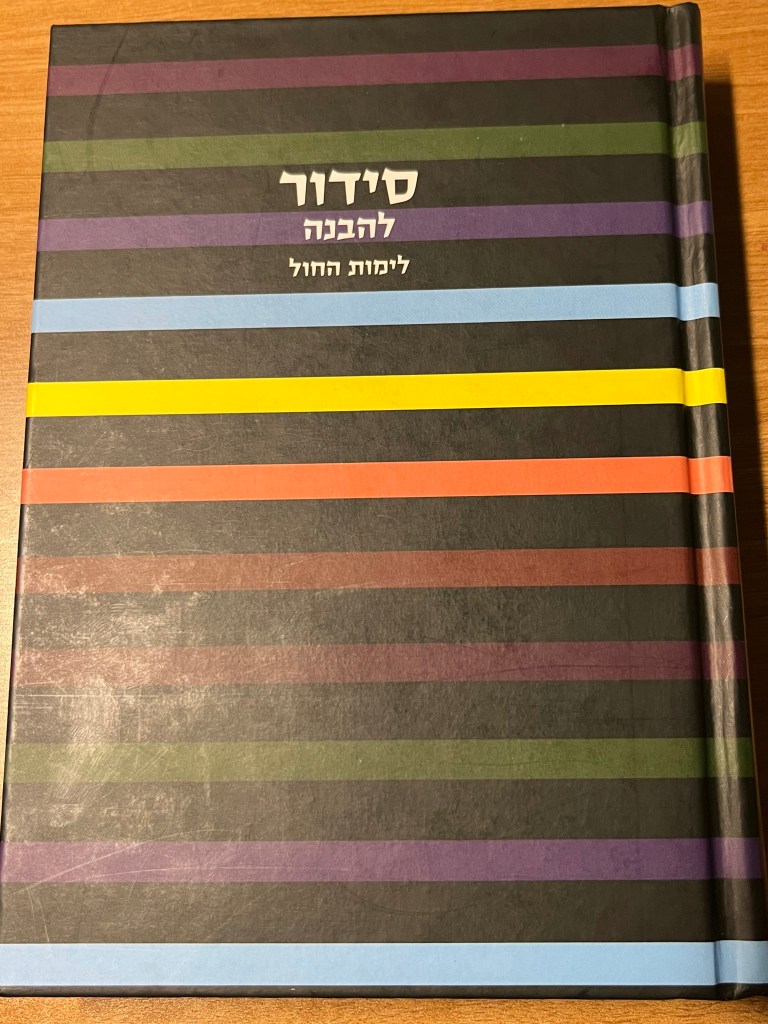
While in New York, I relished the opportunity between wedding festivities to visit Hasidic Brooklyn and practice my Yiddish. After buying a black yarmulke, I visited Hasidic bookstores in Williamsburg and bought some books in Yiddish, including a kids book called “Smart Jews”, a book about the Titanic, and a prayer book with Yiddish translations of the traditional Hebrew.
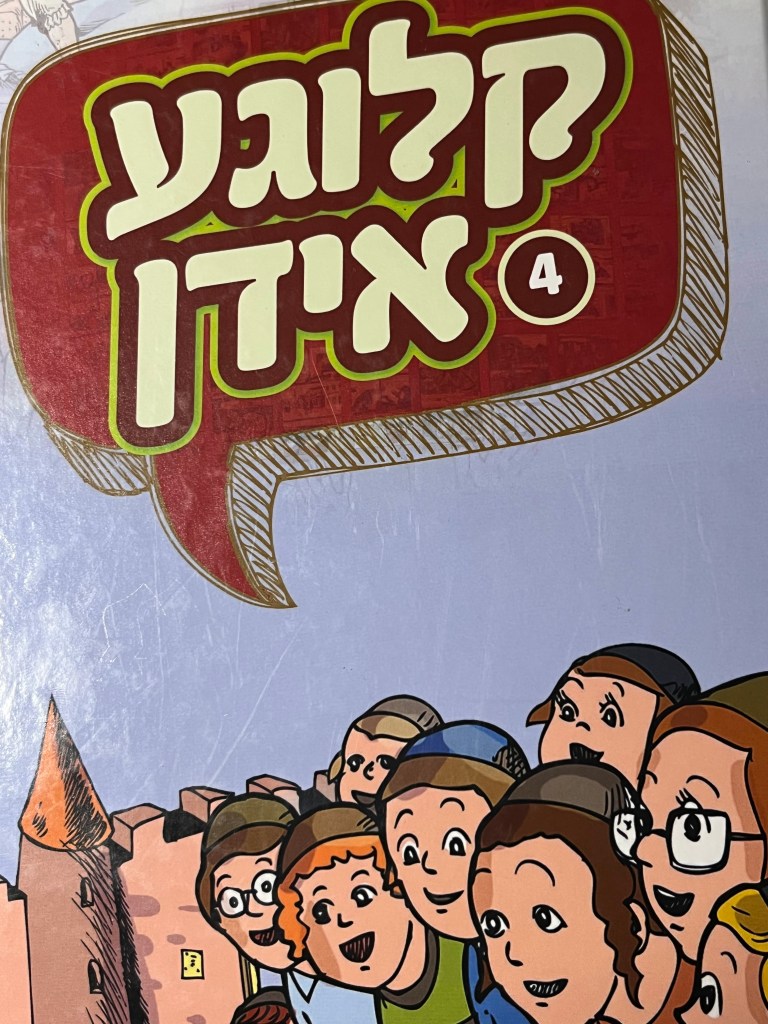
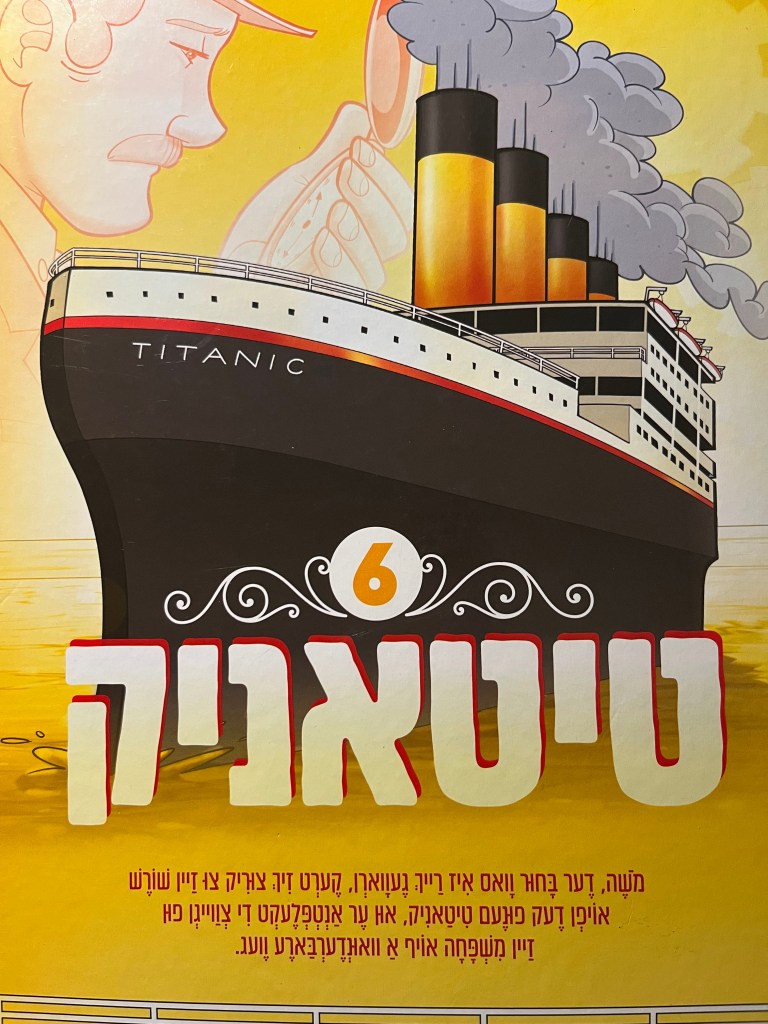
I love speaking Yiddish and I surprised the bookstore employees by speaking it while wearing decidedly non-Hasidic clothes. While some people looked at me with an almost suspicious curiosity, others were incredibly warm and hospitable and thrilled to hear me speaking Yiddish.

Next, I got the good stuff – gefilte fish! Yes, I love gefilte fish. It is a delight and while it’s true that maybe you need to grow up with it to love it, I absolutely adore this dish, especially when made fresh (not in a jar!).

I sat next to a rabbi in the restaurant and he was very welcoming and kind.

Near the restaurant, I walked through Williamsburg and saw a crowd of Hasidic Jews gathered outside an apartment, where a rabbi was preaching in Yiddish as hundreds listened attentively on the street. It was an amazing sight. At a time when we’re being persecuted yet again, this community is preserving our Jewish traditions despite it all. It was like a scene out of a shtetl.

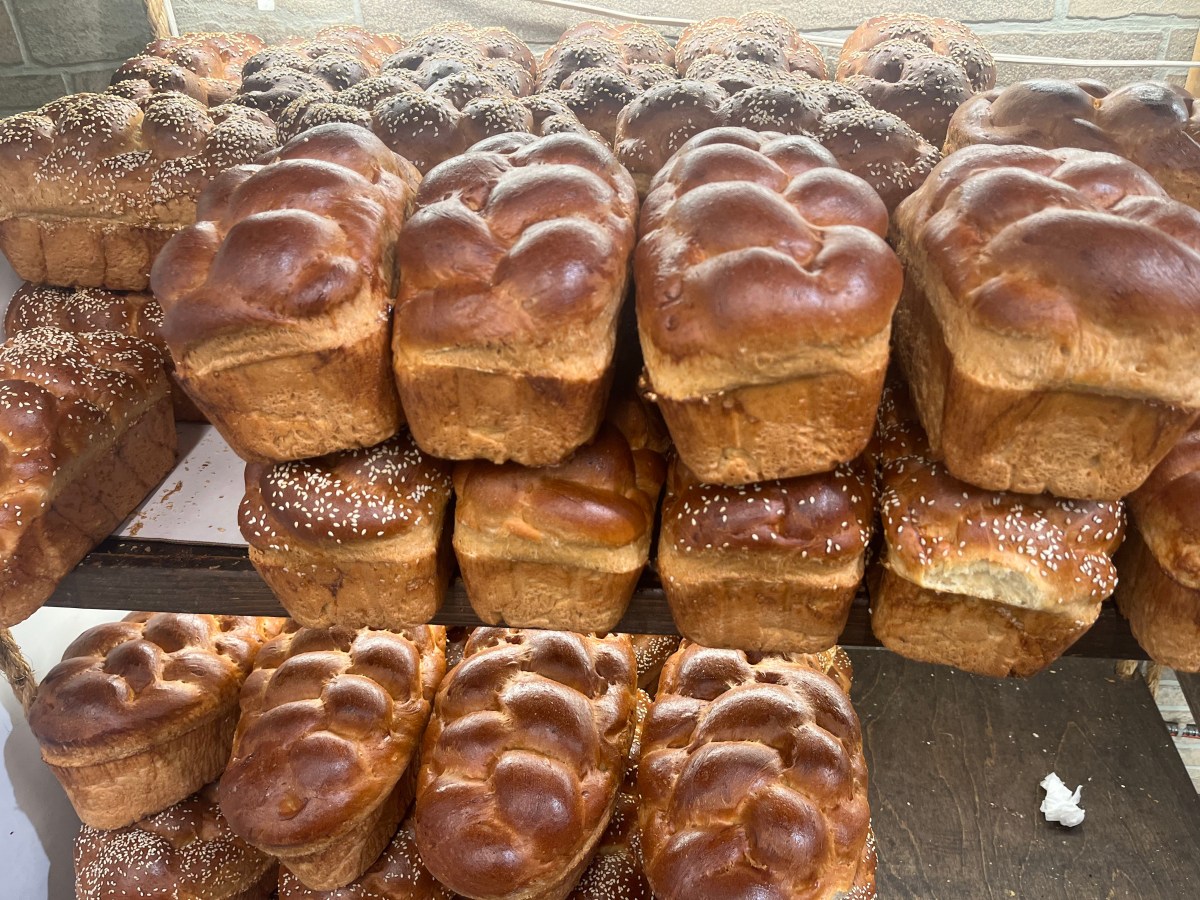
After exploring Hasidic Williamsburg, I made sure to stop at a late night Kosher bakery and get some sweet cheese rugelach, a novel combination that was a true delight. They also had tons of challahs of various sizes, like the ones in this blog post’s cover photo. Even some local hipsters came in for a taste of the bakery’s delicious food.

Over the next two days I met up with other friends in New York, ranging from Yiddishists to a Modern Orthodox college friend on the Upper West Side, and of course got a bagel with whitefish salad. None of this was particularly Hasidic, nor in Brooklyn, but it just shows the incredible diversity of New York Jewish life that I was able to slip in and out of these different communities plus a gay Jewish wedding in the course of a long weekend.

After the wedding, I decided to go to Crown Heights. Williamsburg is heavily Hasidic, but predominantly populated by communities that are a bit more insular in their approach to preserving Jewish tradition. Crown Heights, while also Hasidic, is predominantly a Chabad area. Chabad is a group committed to outreach within the Jewish community, making it a little easier to get to know people even as a semi-outsider.

I visited 770, the house of the former Chabad Rebbe, a deeply revered leader.
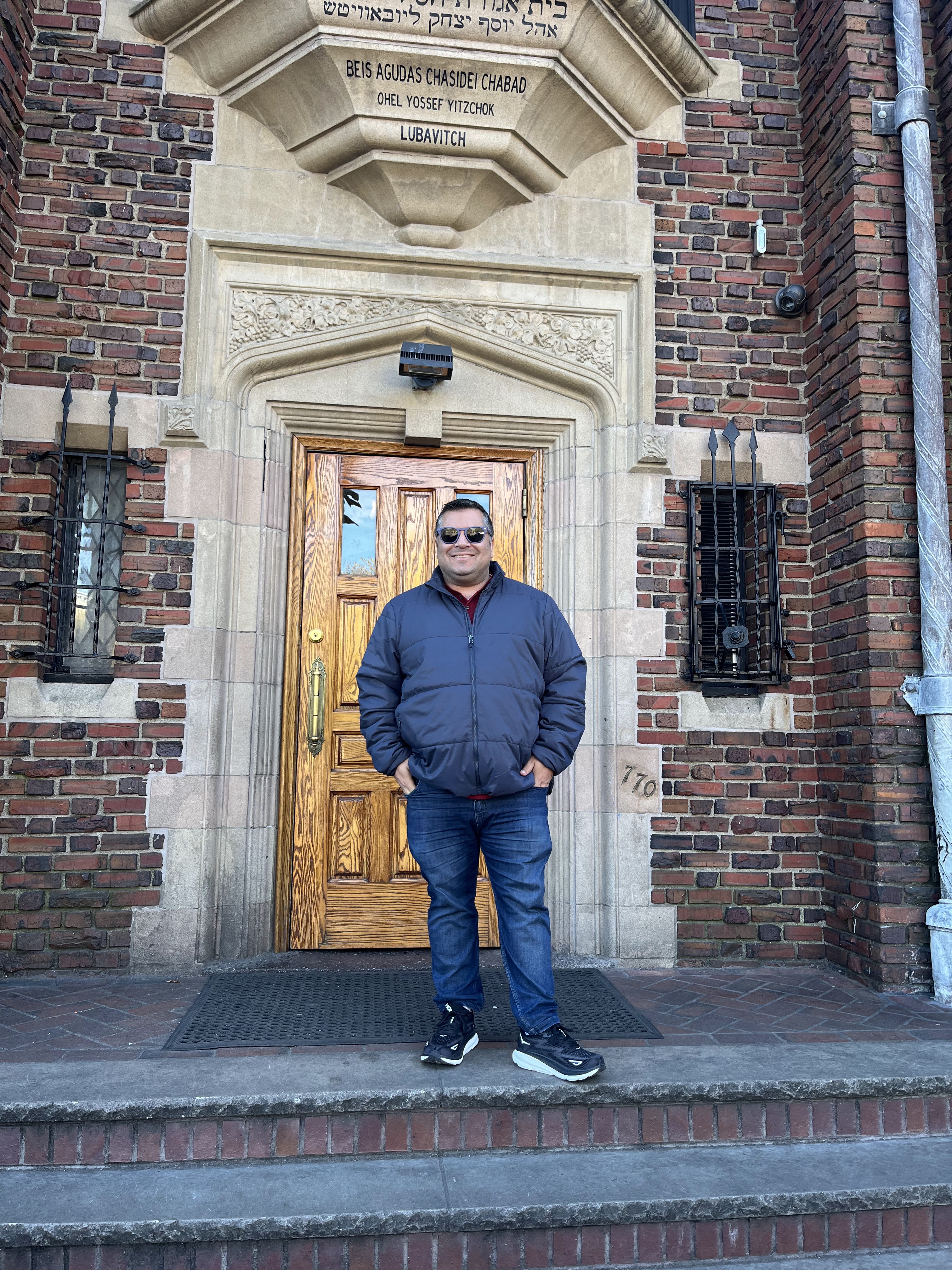
I then decided to do something I had never done when visiting Crown Heights years ago: I went inside the synagogue next door to the Rebbe’s house. I decided to lay tefillin, an ancient Jewish ritual, with the help of a young man. It didn’t matter that every other man in the building was dressed in the traditional black and white suits and I was in jeans and a red shirt. Chabad doesn’t care- they just want you to fulfill mitzvot, commandments from G-d that Jews are instructed to follow. It was a really nice experience.
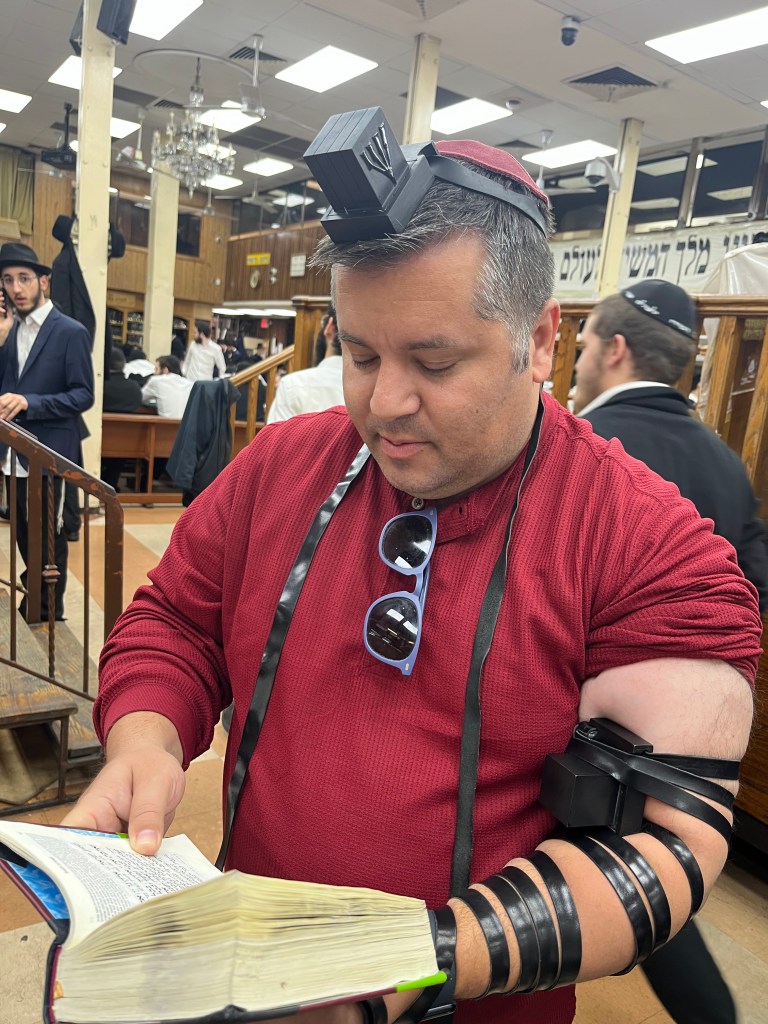
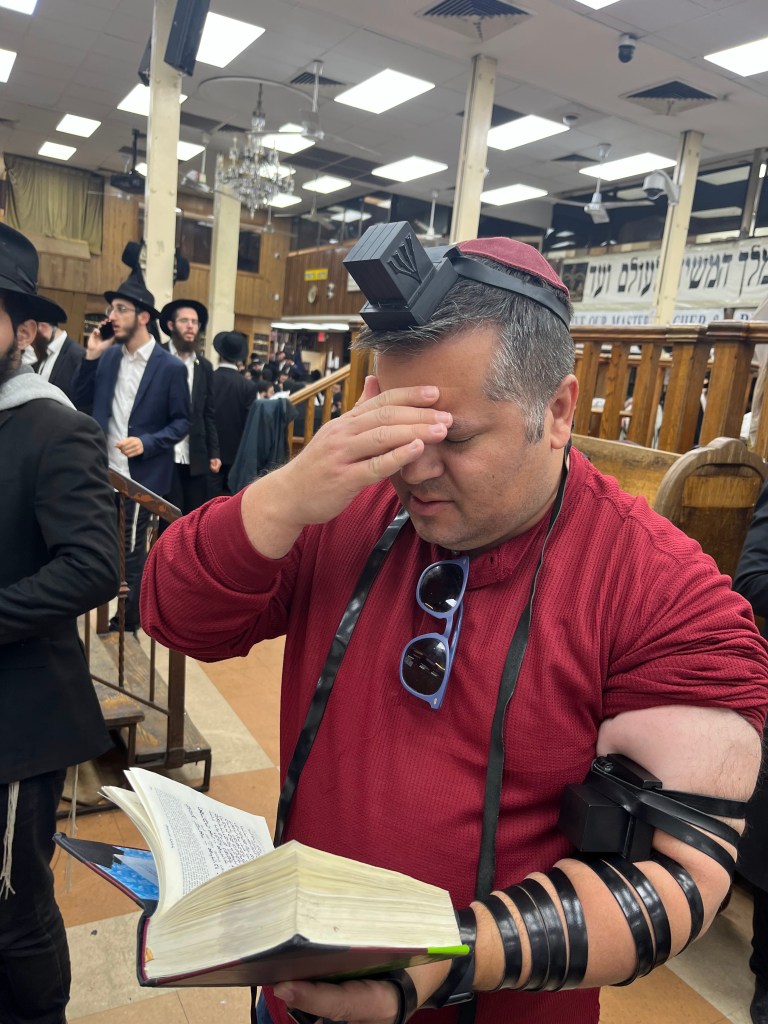
Laying tefillin is a truly embodied ritual that made me feel connected to Jews everywhere and to thousands of years of our history. At a time when it seems we can control so little, it helps me feel grounded and secure in my faith.

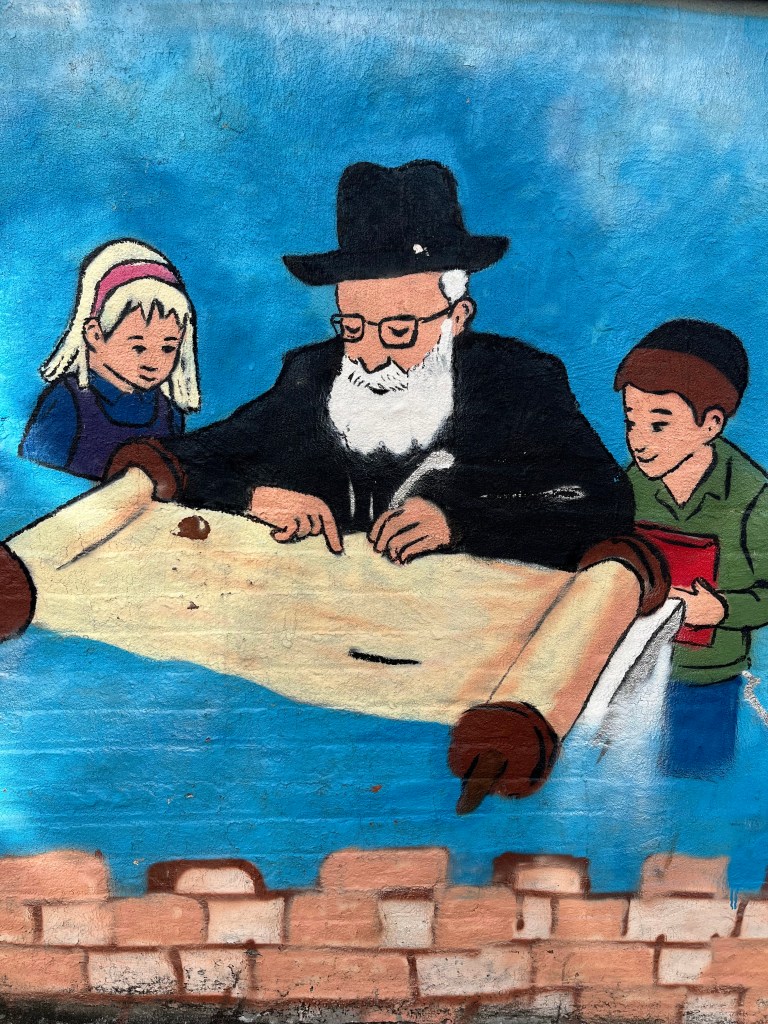
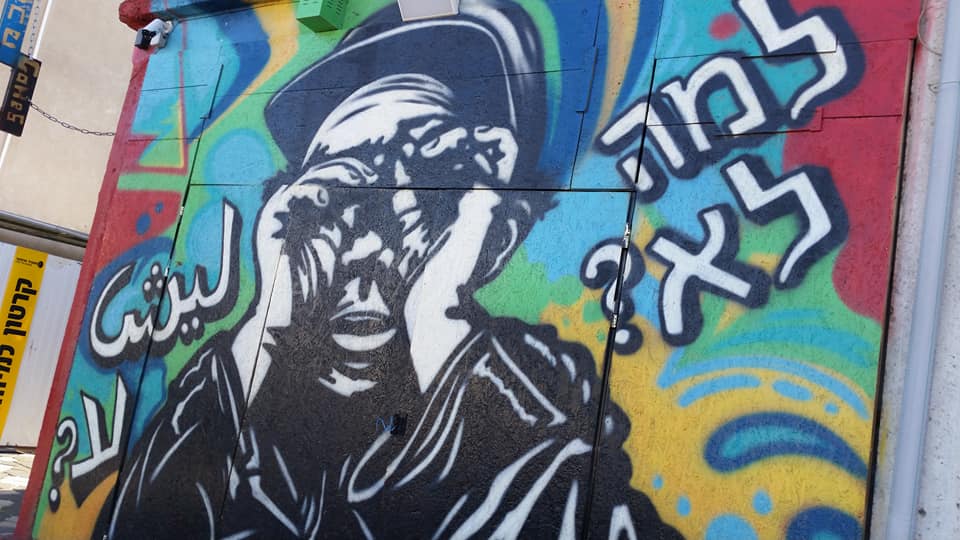
In addition to laying tefillin, I found some interesting Jewish street art in the neighborhood.
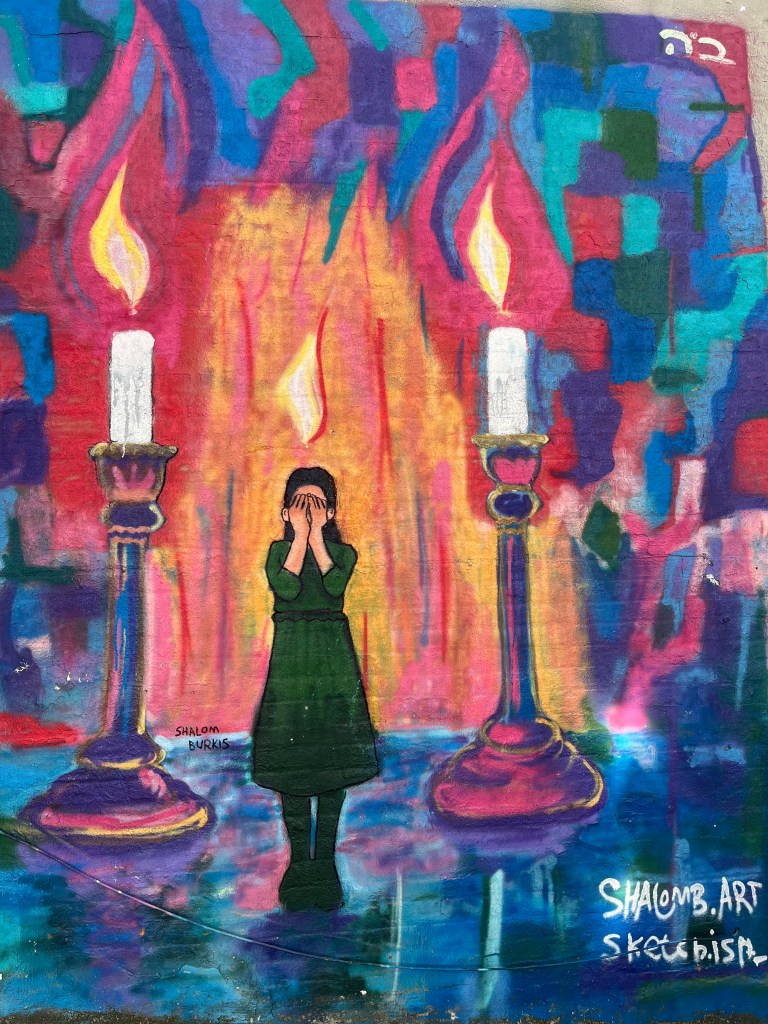
I love seeing murals whenever I travel, and to find Jewish ones was especially heartwarming and exciting.

Lastly, it was not lost on me that I was in New York the last weekend before the fateful election that led to antisemite Zohran Mamdani becoming elected mayor of the city. I’ve already written my thoughts about him here.

The feeling that the community was slipping through our fingers, as Jews, was palpable in Hasidic Brooklyn. I saw election turnout signs like this one that were as clear as day:
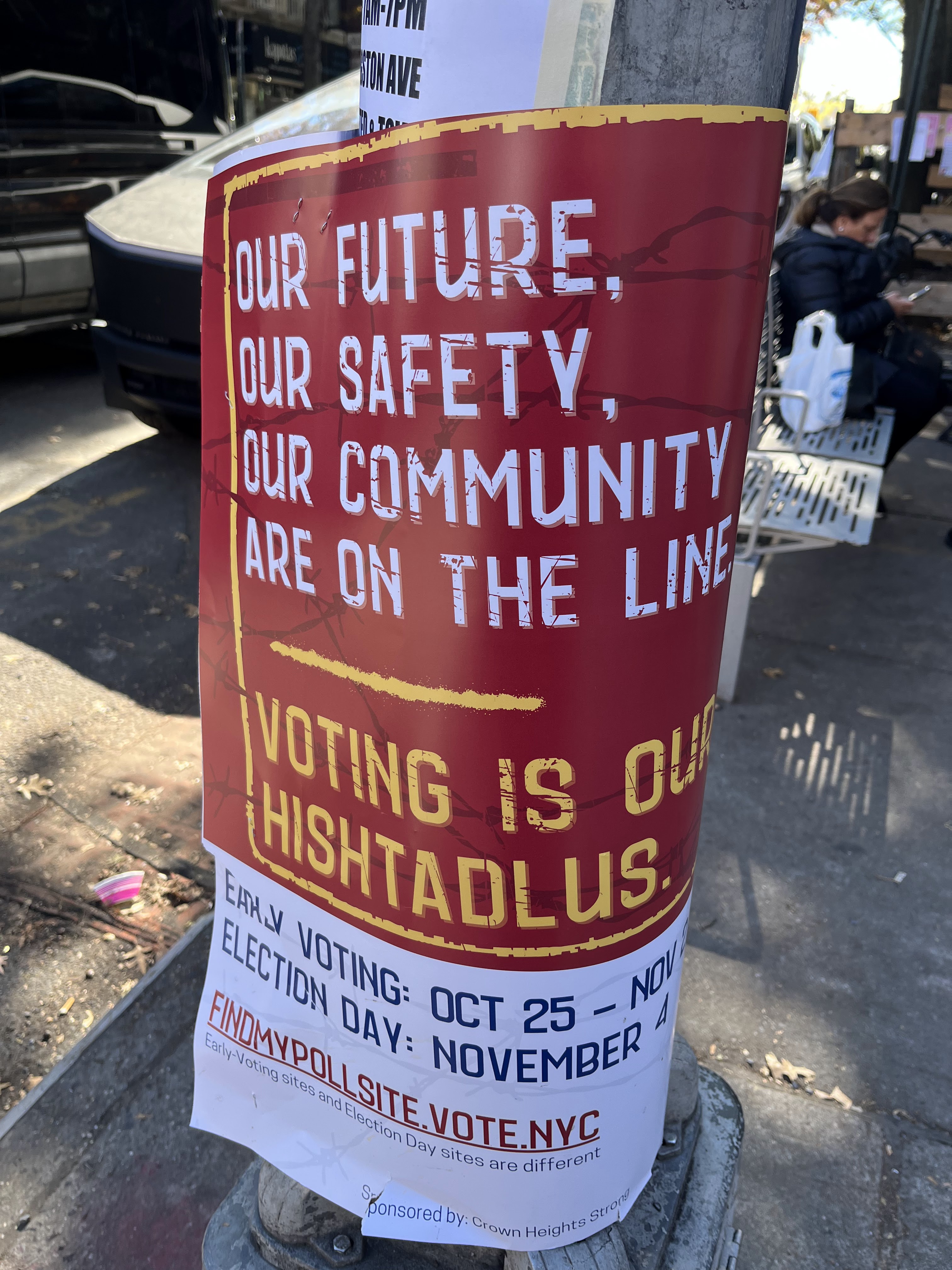
A week later, when election day came, the vast majority of Hasidic Jews voted against Mamdani. But it wasn’t enough to turn the tide of hatred gripping New York City.

Seeing Hasidic Brooklyn was amazing. I highly recommend a visit. Go see this beautiful community before the coming storm. Let us hope and pray that we will weather it together.

Because in the end, the people who hate Jews won’t distinguish between the gay ones or the Hasidic ones, the secular ones or the Modern Orthodox. They will come for us all. Which is why it’s so important we show solidarity with each other. We don’t need to agree on everything. I’m gay, I’m aware of the challenges that would face me living in a Hasidic community. And I’m also aware of prejudice and judgment that Hasidic Jews face in progressive Jewish circles.

Let’s come together in our time of need. So if there’s a storm ahead, let’s grab each other’s hands and dance in the rain and make it through as one strong community. Ken yehi ratzon. May it be so.
The Zionist Response to Zohran Mamdani

The election of Zohran Mamdani has put many Jews, myself included, on edge. You can look up his long history of virulently anti-Israel comments here. His obsession with Israel (and not with other countries’ human rights concerns) is antisemitic. He has no problem marching in the NYC Pakistan Day Parade but boycotts the Israel Day Parade. The double standard is appalling, given that Islam is the official state religion of Pakistan and religious minorities and LGBTQ+ people are legally discriminated against. Yet it is only Israel that Mamdani chooses to boycott. No country is perfect and expecting Israel to be exemplary while excusing Pakistan’s human rights abuses is bigoted.

The purpose of this post, though, is not to rehash what many media outlets, Jewish organizations, and politicians have debated. I find Mamdani’s rhetoric appalling and antisemitic. You may not. But one thing is crystal clear: Mamdani has clearly said he boycotts the world’s only Jewish homeland and that requires a forceful and thoughtful response. Because Israel, for all its imperfections, is the only safe haven for our people and has saved the lives of millions of Jews from around the world fleeing persecution.

This post is about what’s next.

First, let’s define Zionism. Zionism is the national liberation movement of the Jewish people. It is the belief that Jews are a people, an ethnic group with literature, cuisines, customs, languages, and millennia of shared history. There are right-wing Zionists, centrists, and left-wing Zionists who have debated the future of our people and our relations with our non-Jewish neighbors both inside and outside Israel’s borders. But fundamental support for a Jewish safe haven in our ancestral homeland is backed by the vast majority of American Jews – 85% in this poll. You don’t need to agree with all of a particular Israeli government’s policies to believe that Jews need a place to call home.

Now that we’ve defined the problem (Mamdani) and what Zionism is (and isn’t), let’s talk about what a Zionist response to his rise should be.

The Zionist response to antisemitism is to invest in our people, our homeland, and our allies.

Our people. We should proudly support proud Jewish artists, educators, writers, and businesses who contribute to the well-being of our community. For every boycotter like Mamdani, buy another gift from Israel for your friend for Chanukah or from one of my favorite Zionist artists in Alexandria, VA. Check out Modern Tribe as well! Put your money where your mouth is.

Our homeland. In addition to supporting Jewish businesses, find ways to strengthen Israel. Donate to the Spirit of the Galilee, led by my dear friend Rabbi Leora Ezrachi-Vered, a group promoting co-existence between Israelis of all faiths. Support Blend.Ar, led by my friend Chen Kupperman, which organizes Arabic immersion courses in Abu Ghosh to promote thoughtful collaboration between Jews and Arabs. Contribute to Magen David Adom, Israel’s emergency responders who treat (and are treated by) people of all faiths. There are so many other fabulous charities out there that deserve your backing. Don’t hesitate to reach out if you need some advice about how to strengthen Israeli society.

Our allies. Many non-Jews are standing by our side and deserve recognition. If we take some of the energy we feel towards people like Mamdani and put it towards thanking people who have our back, we’ll feel better. For example, I live in Atlanta and the moderate mayor Andre Dickens won re-election Tuesday too. He has visited Israel and vigorously condemned the October 7th attacks. He takes safety seriously for his Jewish constituents. It’s people like him we need to elevate in our national discourse. Thank politicians like him for standing with us and support them with votes and donations. And donate to non-partisan organizations like the American Jewish Committee that build bridges of understanding between Jews and diverse communities.

In the end, the best response to hate is to remember that we may despair and feel like it’s 1933, but today is different. We have a homeland to call our own. We must stand together with our people, our safe haven Israel, and our non-Jewish allies. Haters gonna hate, but we are a strong community full of love and hope and we will come together and win.

A few days before the election, I was uncertain how to react to a near-certain Mamdani victory. A friend told me Delta restarted direct flights from Atlanta to Tel Aviv and I jumped on the site and bought a ticket to Israel. I’ll be back in Israel this spring for a long visit and I’ll be looking for all sorts of ways to support my friends there – Jews, Christians, Muslims, and Druze. Because by building a stronger Israel, I not only help them, I help bring greater safety and security and resilience to Jews in New York and around the world.

Yachad nenatzeach. Together, we will win.

Making Peace With Arabic

My journey with Arabic started at the local Jewish Community Center, where I took a class in high school. I then studied the language for four years in college and with Syrian refugees on Skype. My studies were helped by my passion for languages and my love for Hebrew, its very similar sister language.

Why Arabic? It all started when I was sitting in my Lebanese friend Jad Zakhour’s (z”l) car hearing my first sounds of Arabic music. It was those tantalizing sounds, plus the delicious food and warm welcome I always received in his house, that caused me to become curious about this language. After all, Arabs and Jews are cousins. If we’re ever going to make peace with each other, we need to understand each other.

As with many other Jews and Israelis, I felt the pain of October 7th deeply and personally. In addition to the horrific results of the attack, the subsequent war has involved my friends risking their lives by serving in the military, going through countless rocket attacks, and a friend’s nephew being injured in the vile Hezbollah terrorist attack on Druze kids playing soccer in Majdal Shams.

I lost friends over the past couple years who showed their antisemitic (or at best, deeply ignorant) sides to me. I was discriminated against in the LGBTQ+ community, including being screamed at in public for being Israeli. I would walk by my local synagogue only to find antisemitic graffiti daily across the street.

All of this caused me to distance myself from Arabic. Anything that sounded like Hamas, like terrorism, like antisemitism, made me feel disgusted and frankly, scared. This was not an easy thing for me to reject. I had written an entire book about my relationship with Arabic as a gay Jew. Arabic is in my veins, it is part of what motivates me to make the world a better place for everyone. Yet the pain was so raw I just couldn’t do it. I couldn’t even listen to Arabic music for over a year.

Something changed for me recently. Because of the Syrian government’s attacks on its Druze minority, Arabic’s spirit has reawakened in me. Why? I’m not entirely sure. But I think it’s because I remembered – Arabic is not just Hamas. Arabic is not just Hezbollah and the wretched Syrian government. It is also the language of the my friends. It is the language of 20% of Israelis. Yes, it is a language of many Muslims – and also Christians, Alawites, Druze, and Jews! It has been a Jewish language, with specific Jewish dialects, for many hundreds of years across the Middle East. Some of which were spoken by my Iraqi Jewish neighbors in Tel Aviv.

Terrorists don’t get to “own” a language. Neither do antisemites. Arabic can and should be for all, just like any other language. It is a way to communicate, it is a way to build bridges, it is a way to make peace. I don’t know how to make peace in the Middle East, but I do know I’m in the process of making peace with Arabic. And maybe, here as I sit writing and soaking in the sounds of the Arabic music that got me interested in the first place, making that peace internally is the first step to making a more peaceful world for everyone.

As my blog banner photo from Majdal Shams says in Hebrew and Arabic: “why not?” The time to heal, to build, and to grow is now. Make your internal peace and then maybe one day all sides can reach out their hands to create a safer, more peaceful world. Ken yehi ratzon, inshallah, may it be so.