Making Peace With Arabic

My journey with Arabic started at the local Jewish Community Center, where I took a class in high school. I then studied the language for four years in college and with Syrian refugees on Skype. My studies were helped by my passion for languages and my love for Hebrew, its very similar sister language.

Why Arabic? It all started when I was sitting in my Lebanese friend Jad Zakhour’s (z”l) car hearing my first sounds of Arabic music. It was those tantalizing sounds, plus the delicious food and warm welcome I always received in his house, that caused me to become curious about this language. After all, Arabs and Jews are cousins. If we’re ever going to make peace with each other, we need to understand each other.

As with many other Jews and Israelis, I felt the pain of October 7th deeply and personally. In addition to the horrific results of the attack, the subsequent war has involved my friends risking their lives by serving in the military, going through countless rocket attacks, and a friend’s nephew being injured in the vile Hezbollah terrorist attack on Druze kids playing soccer in Majdal Shams.

I lost friends over the past couple years who showed their antisemitic (or at best, deeply ignorant) sides to me. I was discriminated against in the LGBTQ+ community, including being screamed at in public for being Israeli. I would walk by my local synagogue only to find antisemitic graffiti daily across the street.

All of this caused me to distance myself from Arabic. Anything that sounded like Hamas, like terrorism, like antisemitism, made me feel disgusted and frankly, scared. This was not an easy thing for me to reject. I had written an entire book about my relationship with Arabic as a gay Jew. Arabic is in my veins, it is part of what motivates me to make the world a better place for everyone. Yet the pain was so raw I just couldn’t do it. I couldn’t even listen to Arabic music for over a year.

Something changed for me recently. Because of the Syrian government’s attacks on its Druze minority, Arabic’s spirit has reawakened in me. Why? I’m not entirely sure. But I think it’s because I remembered – Arabic is not just Hamas. Arabic is not just Hezbollah and the wretched Syrian government. It is also the language of the my friends. It is the language of 20% of Israelis. Yes, it is a language of many Muslims – and also Christians, Alawites, Druze, and Jews! It has been a Jewish language, with specific Jewish dialects, for many hundreds of years across the Middle East. Some of which were spoken by my Iraqi Jewish neighbors in Tel Aviv.

Terrorists don’t get to “own” a language. Neither do antisemites. Arabic can and should be for all, just like any other language. It is a way to communicate, it is a way to build bridges, it is a way to make peace. I don’t know how to make peace in the Middle East, but I do know I’m in the process of making peace with Arabic. And maybe, here as I sit writing and soaking in the sounds of the Arabic music that got me interested in the first place, making that peace internally is the first step to making a more peaceful world for everyone.

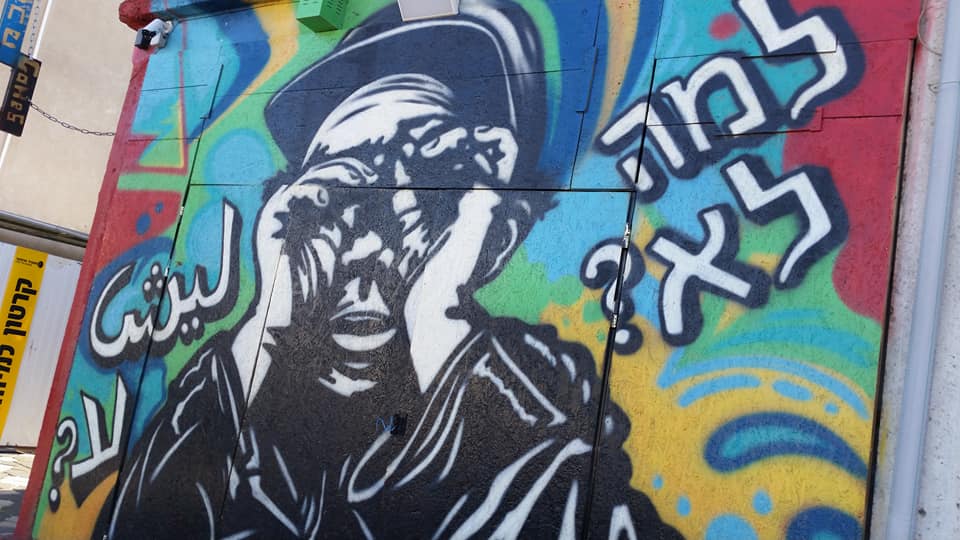
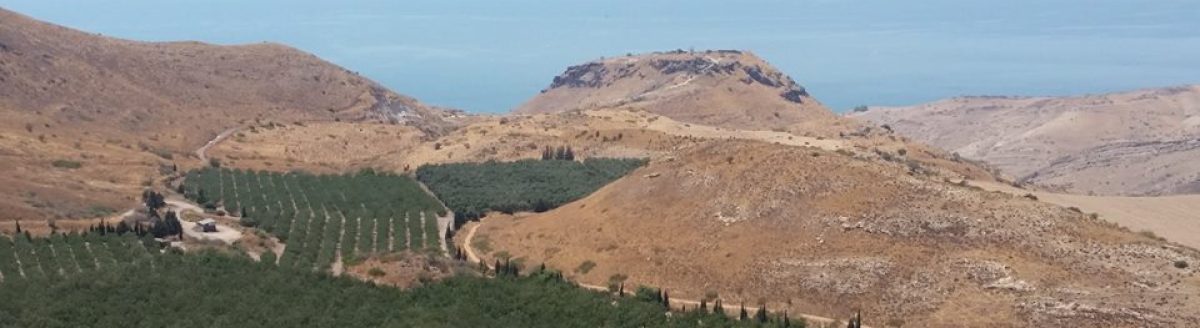
As my blog banner photo from Majdal Shams says in Hebrew and Arabic: “why not?” The time to heal, to build, and to grow is now. Make your internal peace and then maybe one day all sides can reach out their hands to create a safer, more peaceful world. Ken yehi ratzon, inshallah, may it be so.

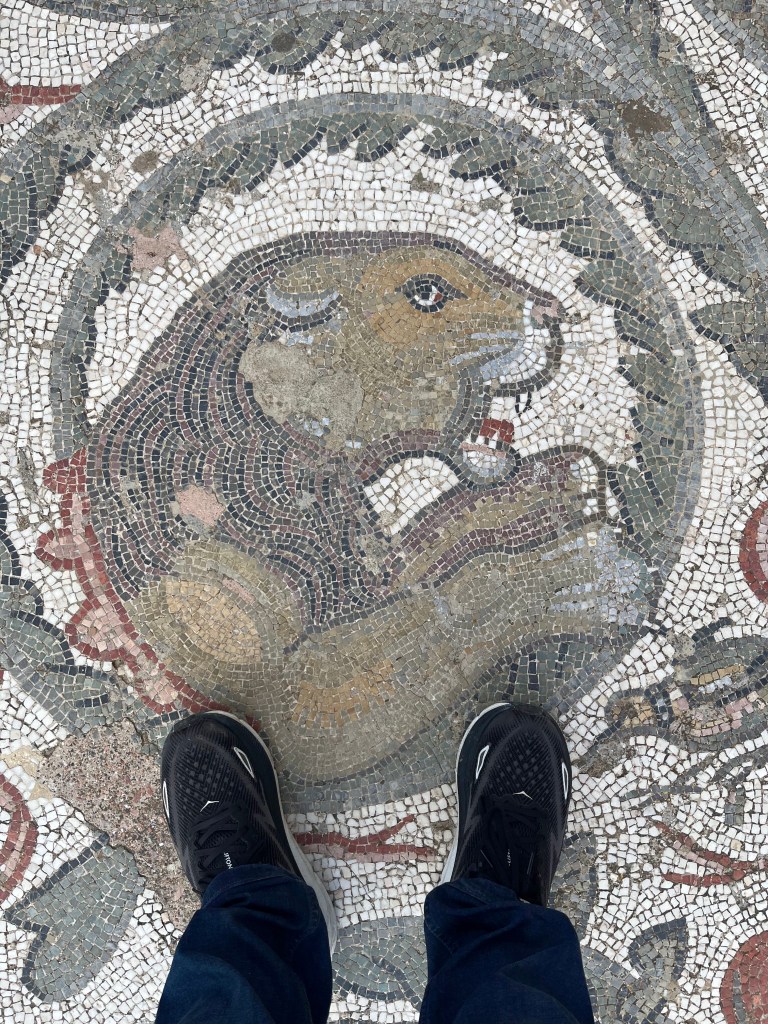
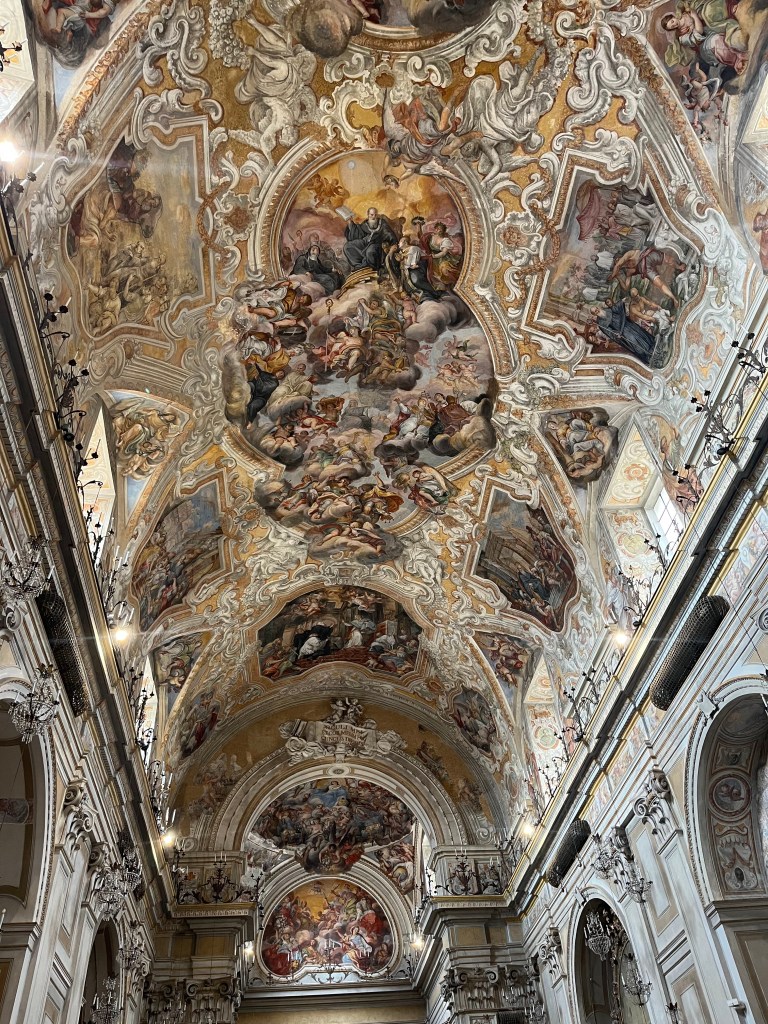
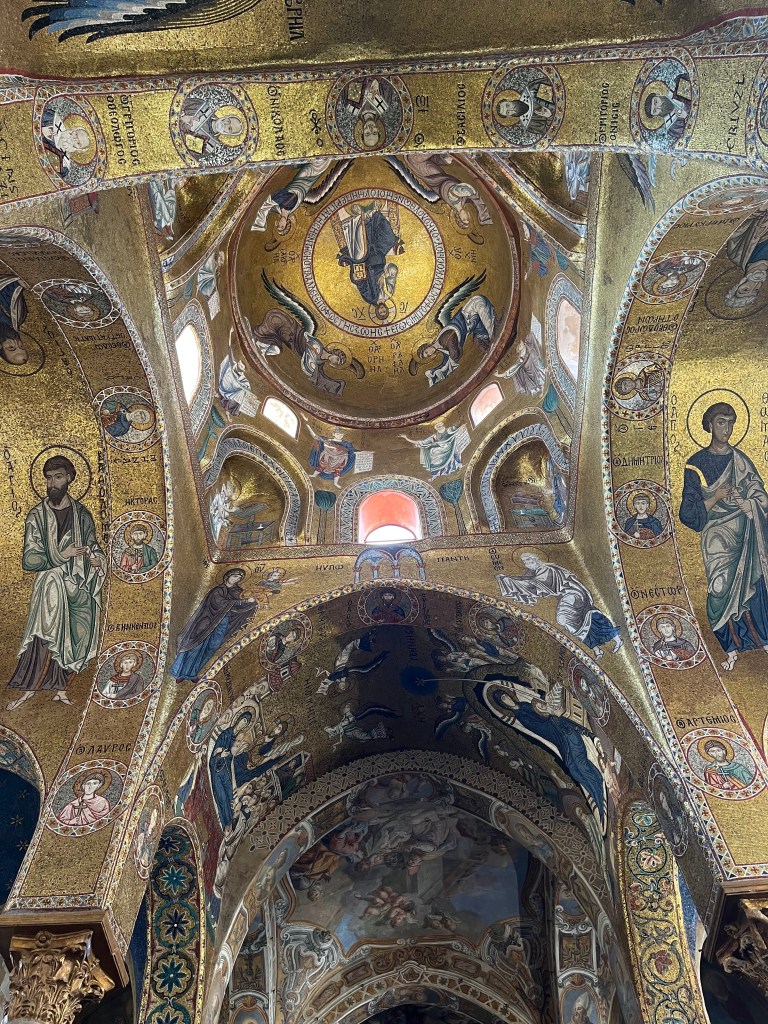
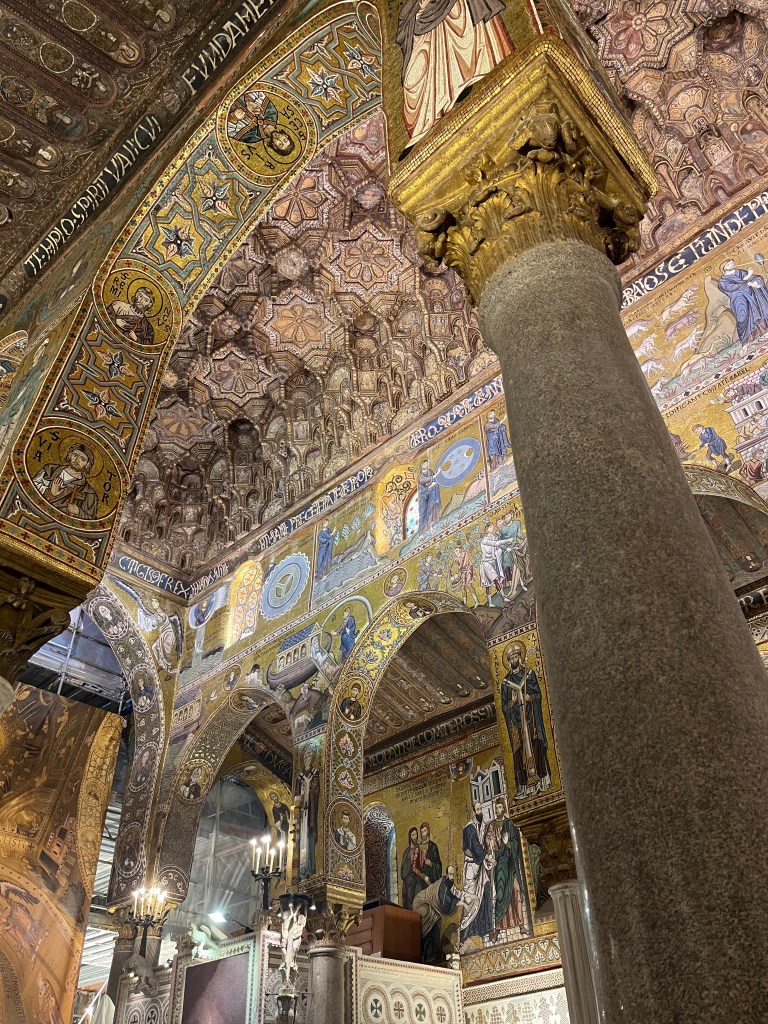
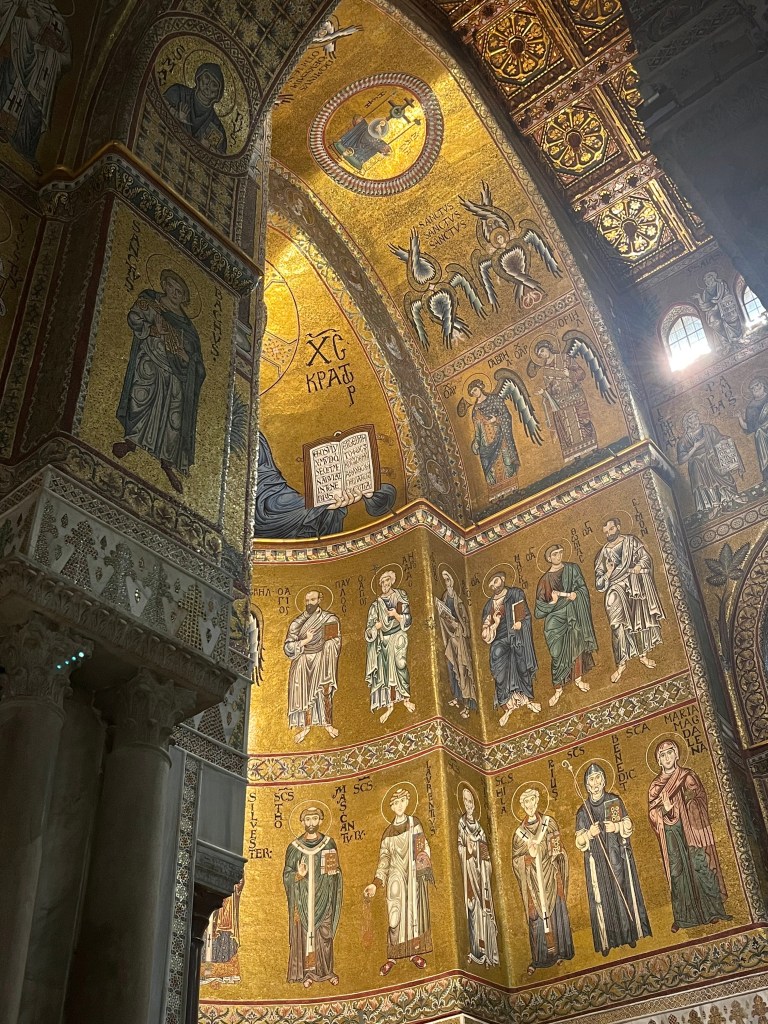
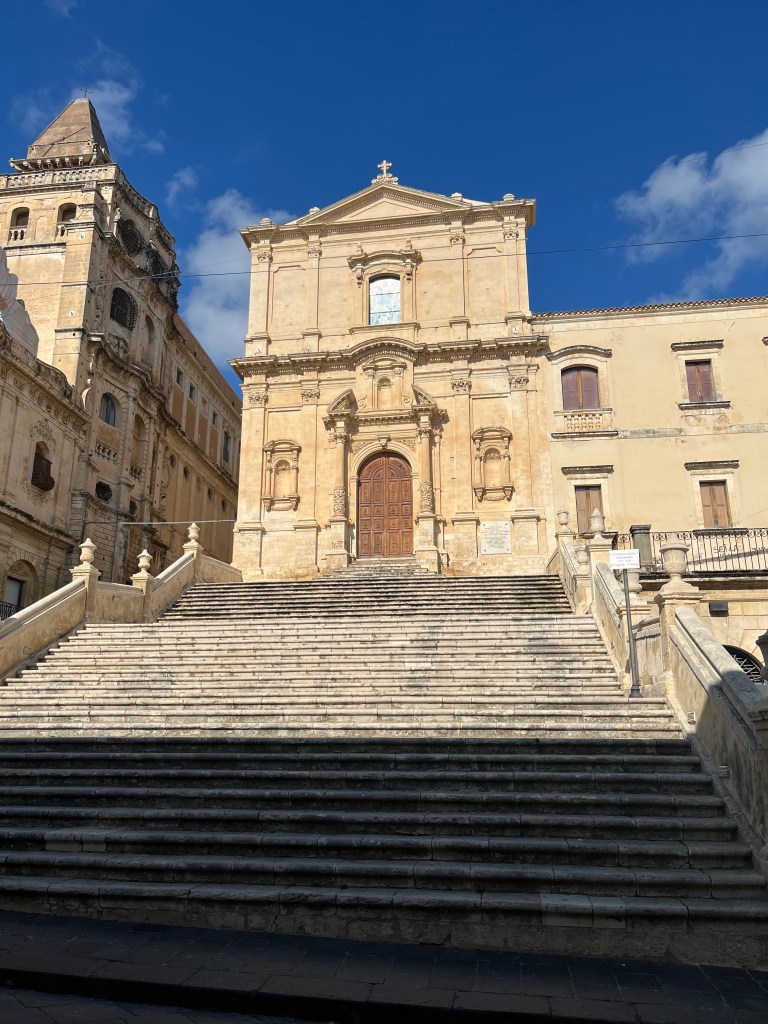
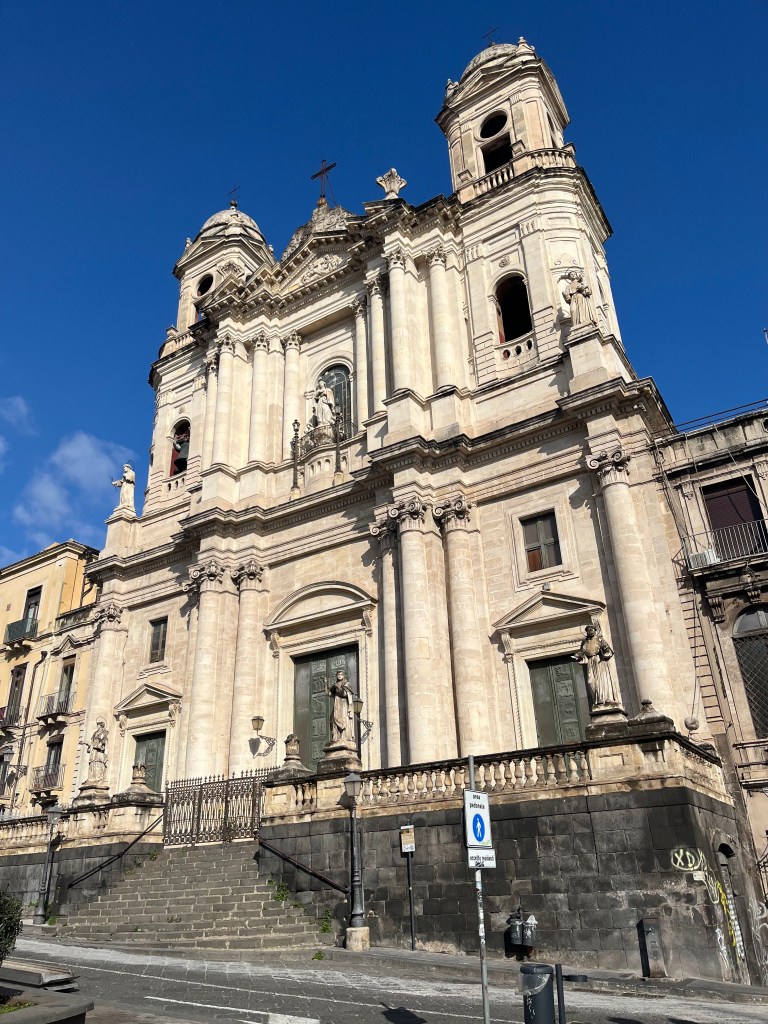
Sicily and Malta: echoes of Israel

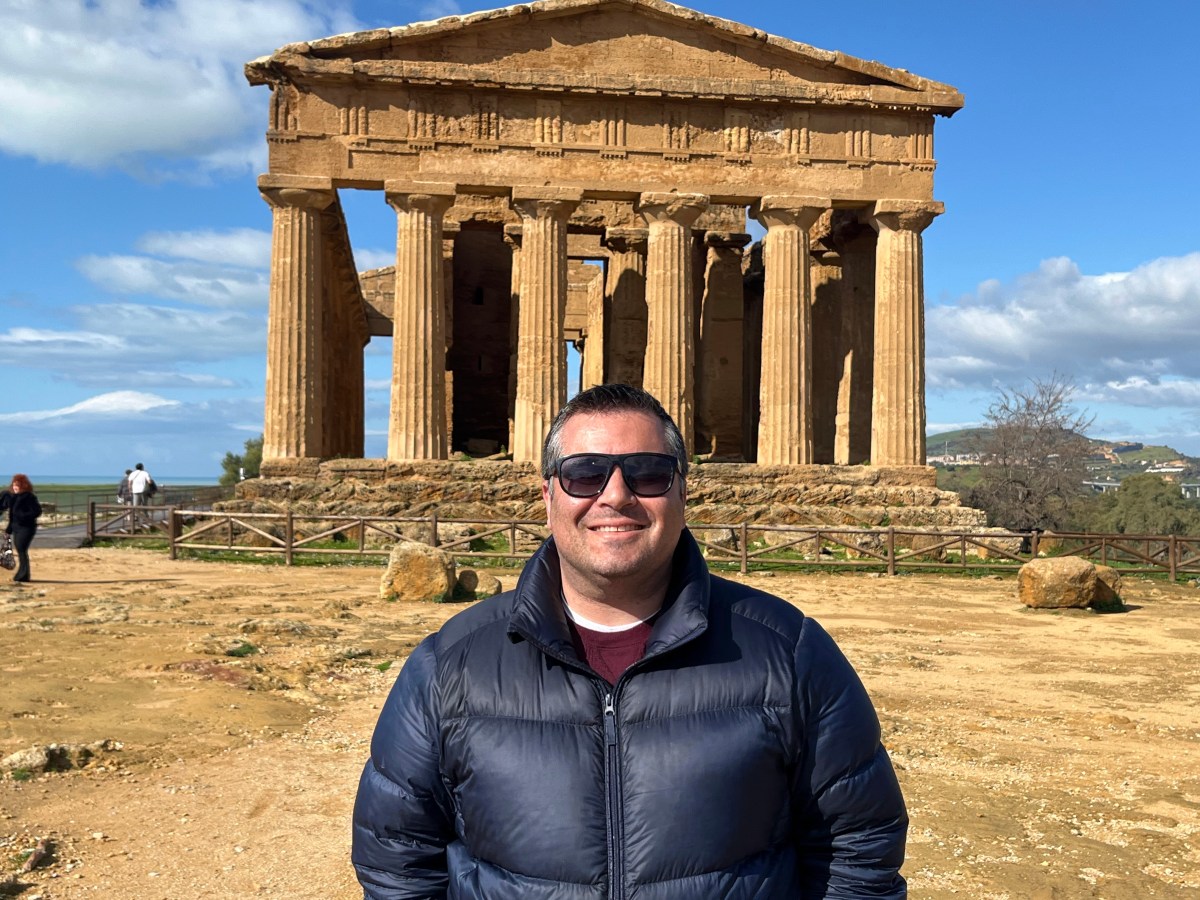
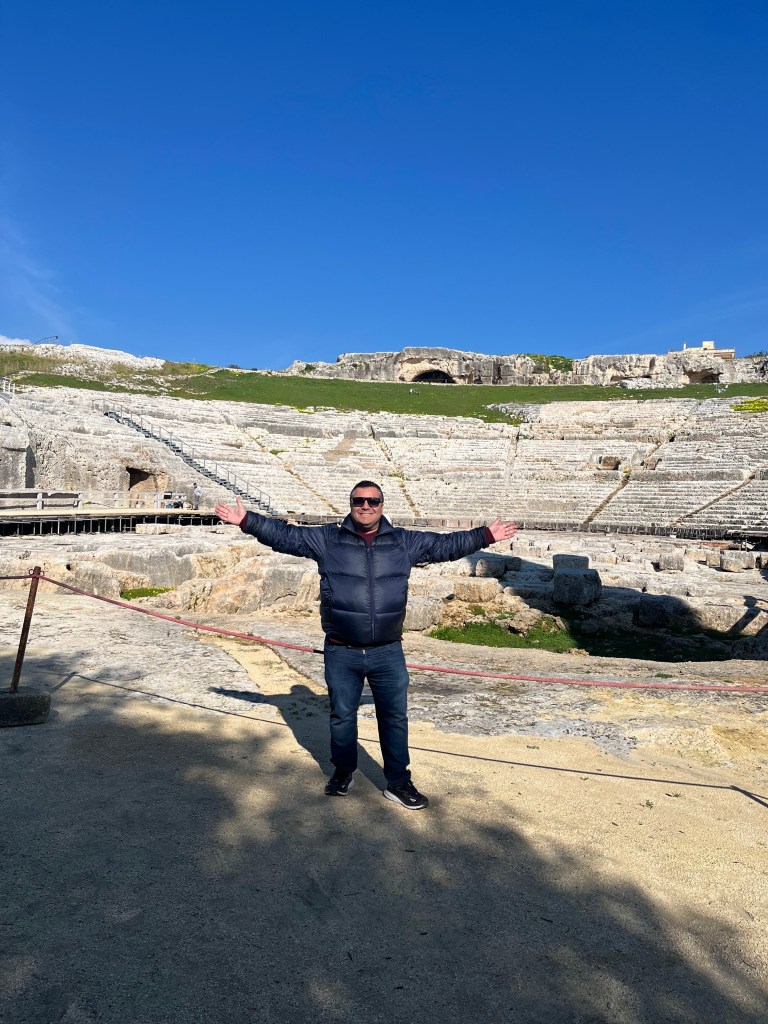
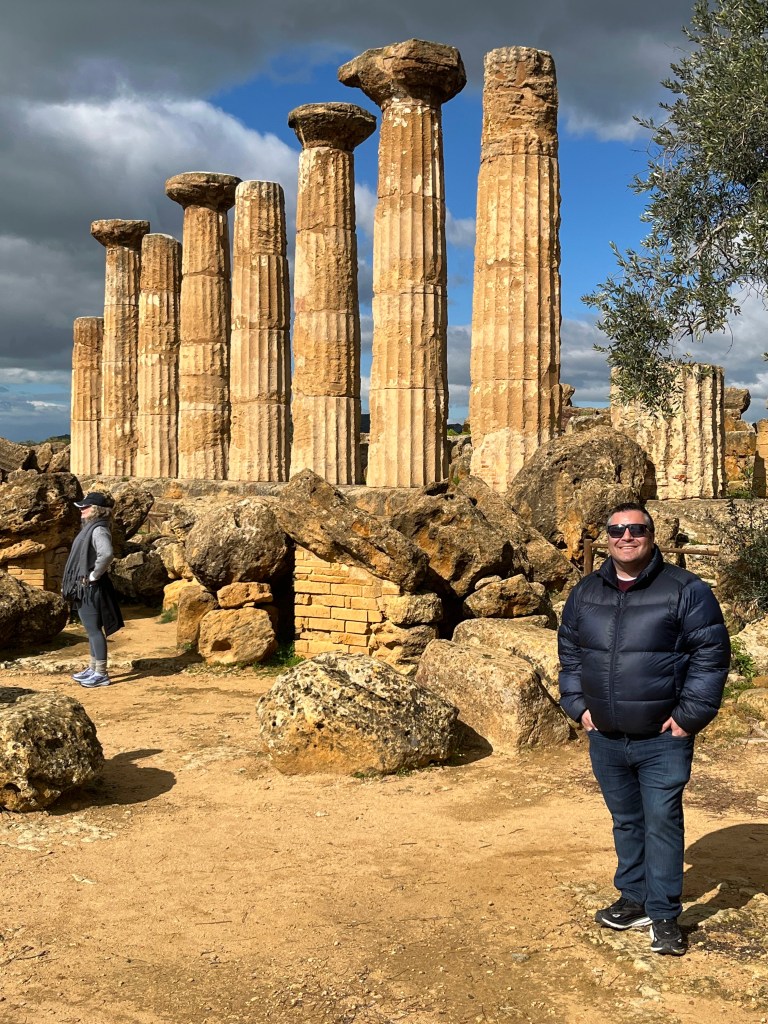
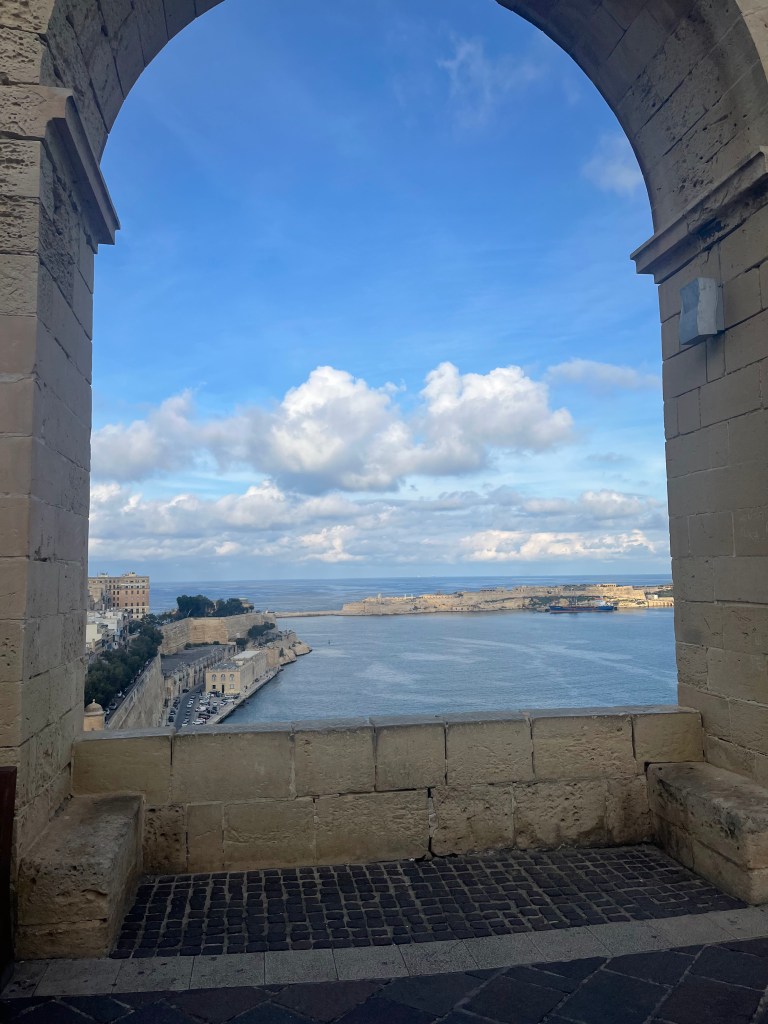
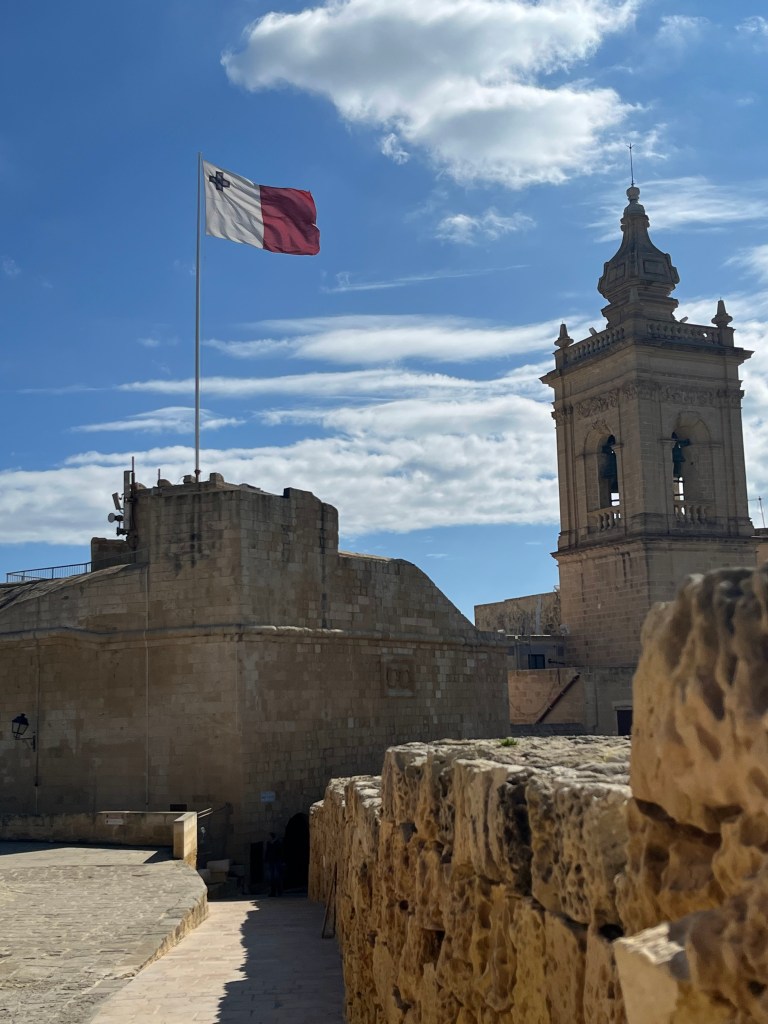
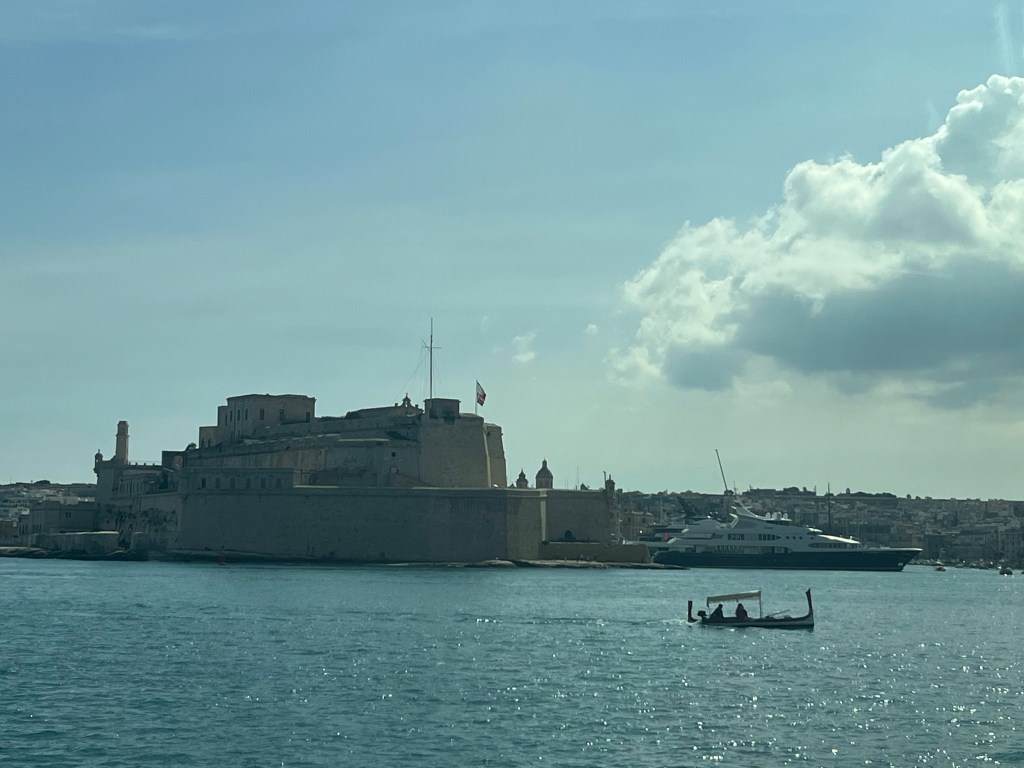
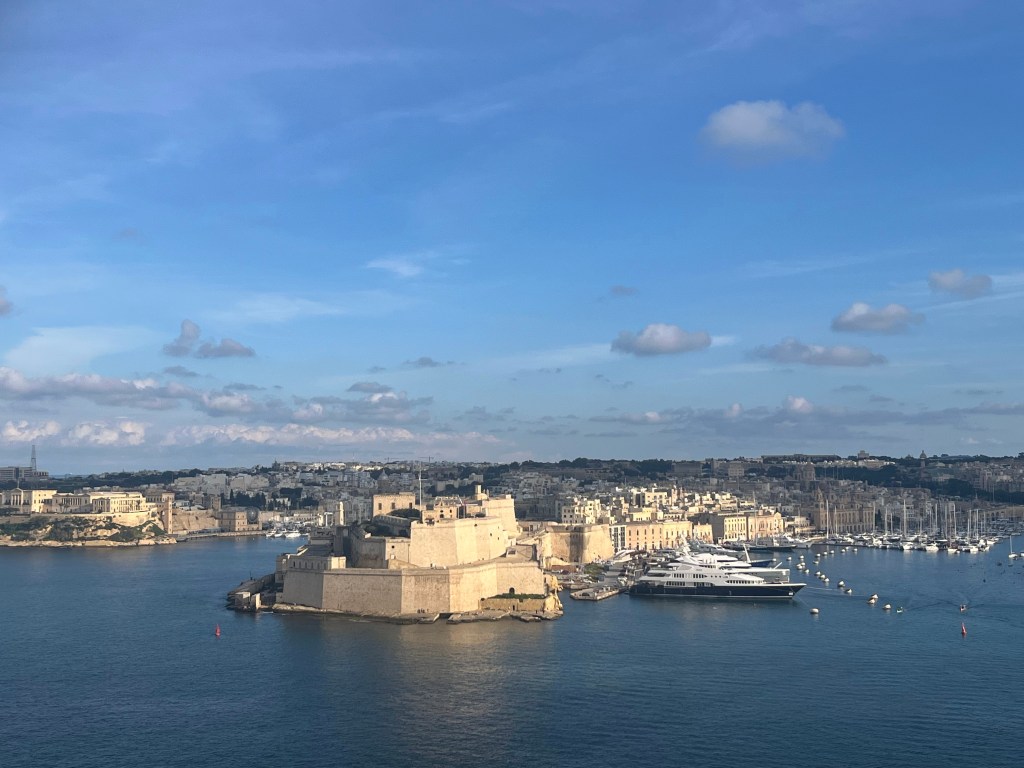
Sicily and Malta are two of the most beautiful places I’ve ever visited. The Mediterranean islands have a lot in common. They’ve been conquered by many civilizations, including the Greeks, the Romans, the Arabs, and countless others.

Each civilization has left its mark on the islands’ history. In Sicily, there are Roman mosaics, Greek theaters, Greek temples, Baroque churches, Arabesque cathedrals, even Middle Eastern-inspired food that is quite different from what you might encounter in northern Italy. I did a street food tour and enjoyed every last bite.

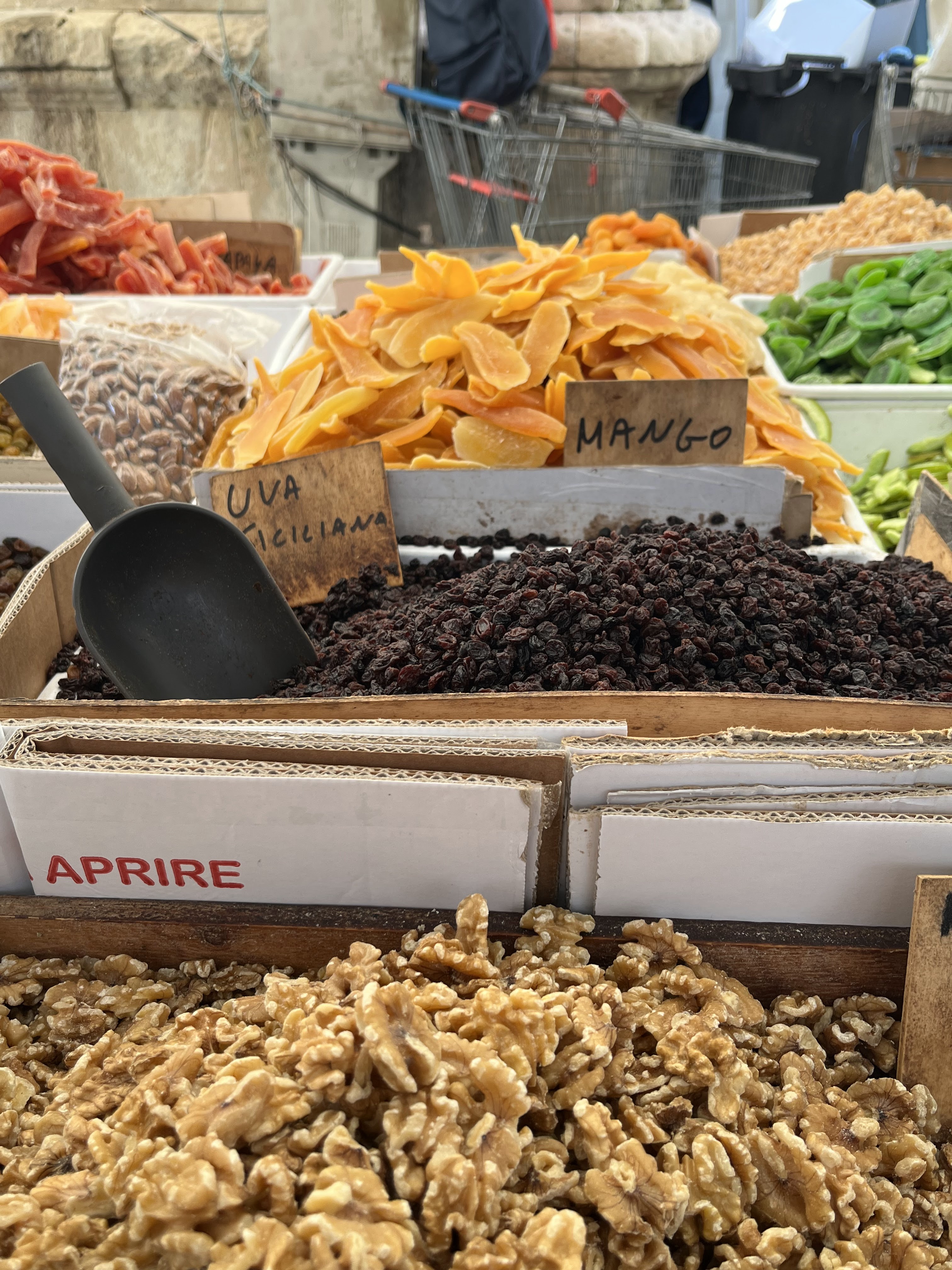
Even the markets in Sicily look almost identical to Israel or any Middle Eastern country. With loud shouting and free samples!

Malta is even more Middle Eastern than Sicily! I speak Arabic and when I wanted to catch a cab from the airport to my hotel, I heard a driver talking to another driver. I understood almost every word. I hopped in the cab and asked the driver if he was speaking Arabic or Maltese, the local language. He said Maltese! I was stunned. This man’s speech sounded so familiar to me that it almost sounded like a Tunisian immigrant to Malta speaking Arabic.

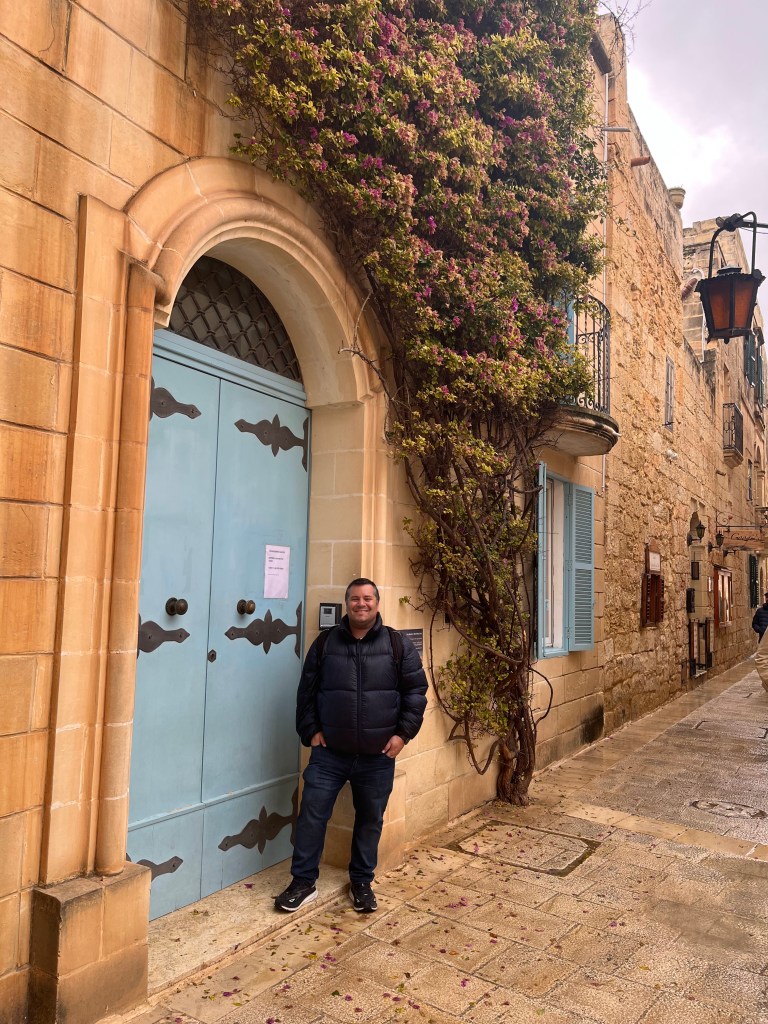
The architecture in Malta, in particular, is very reminiscent of what you’d find in Israel in places like Akko and Jerusalem.

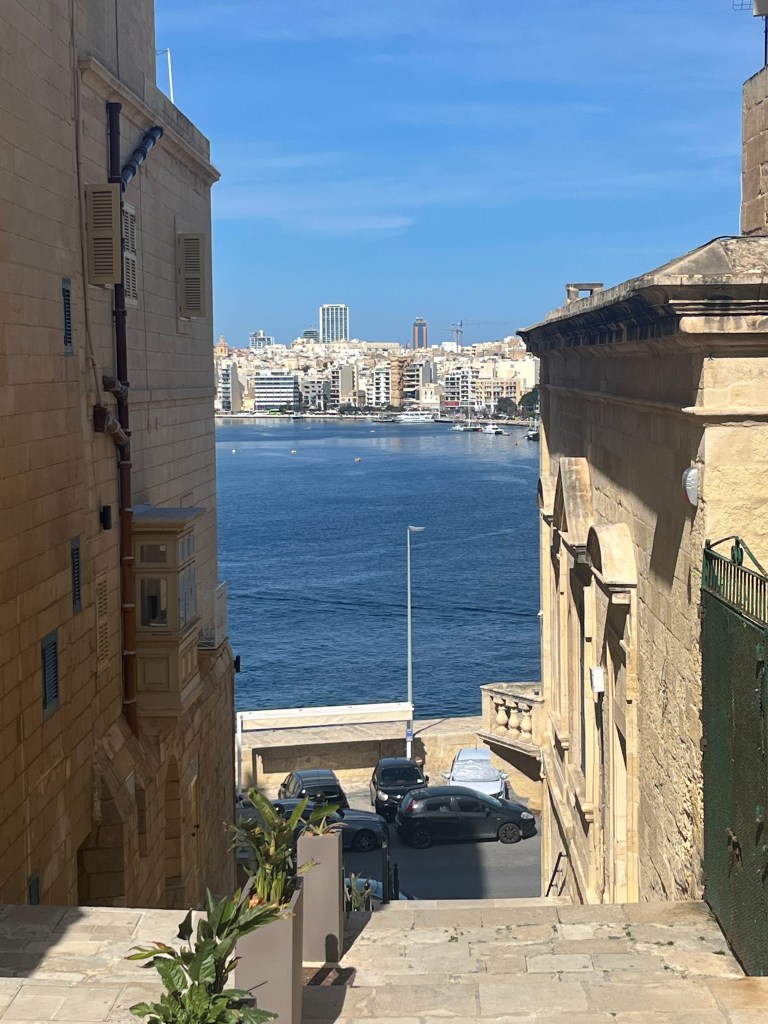
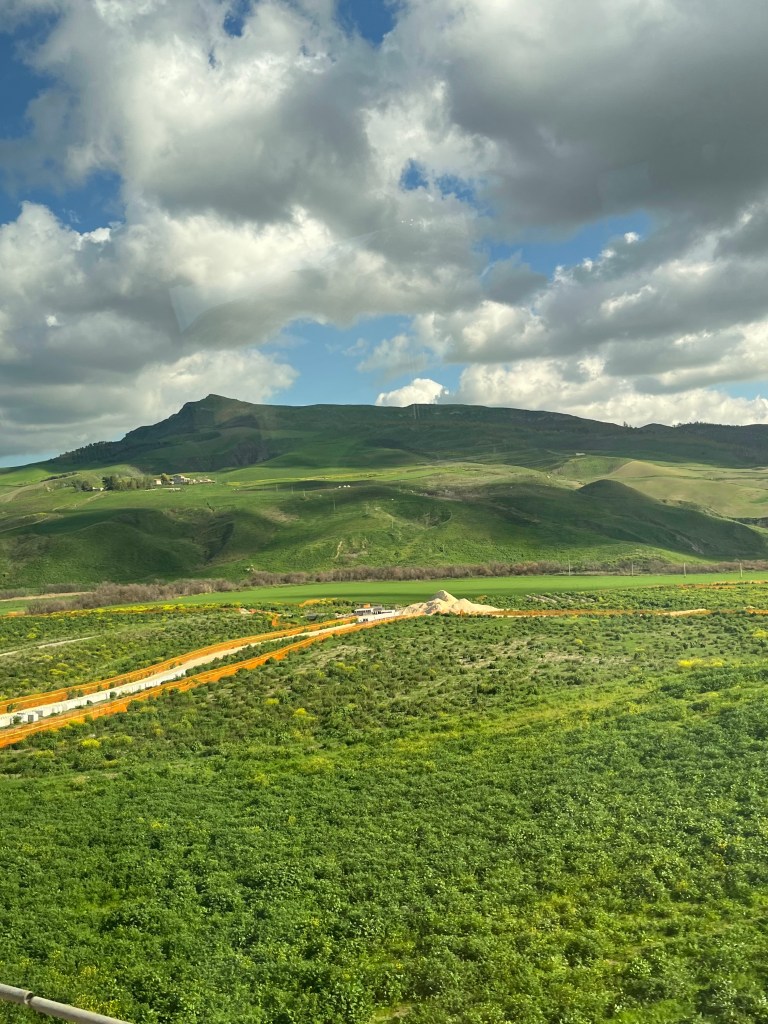
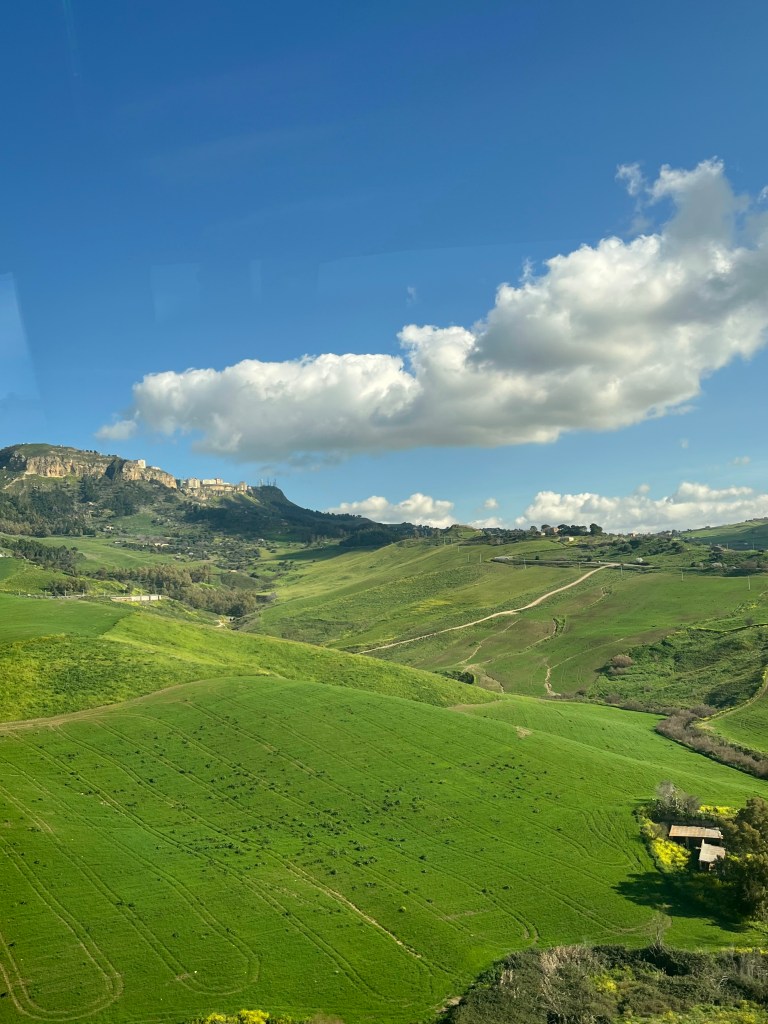
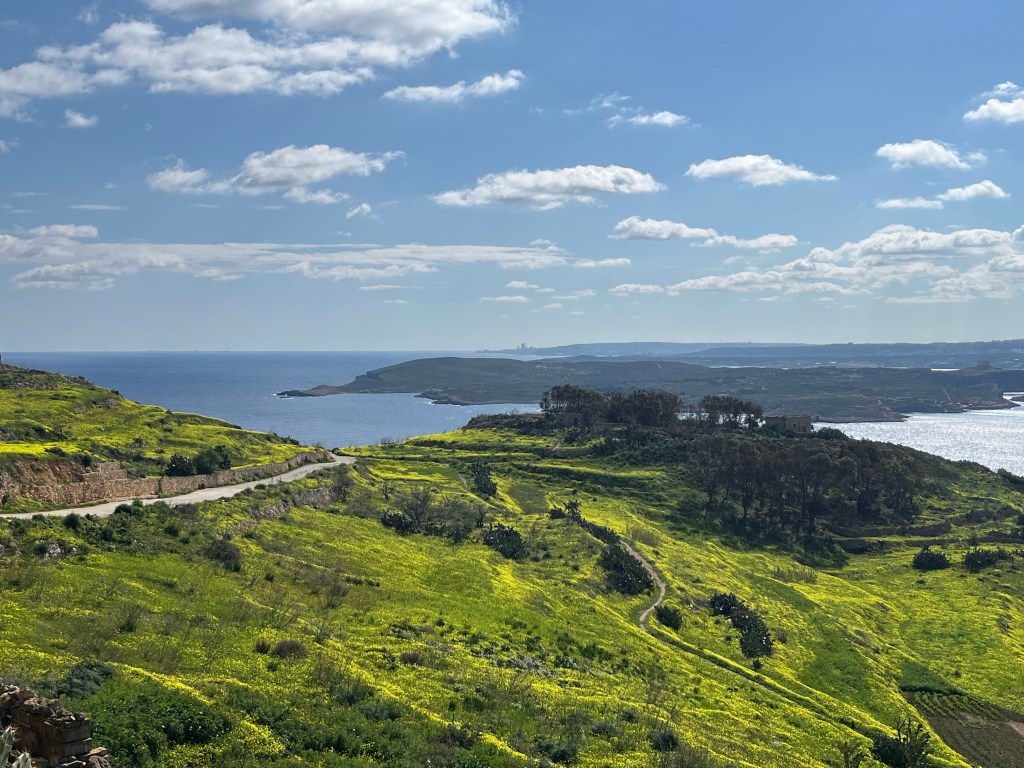
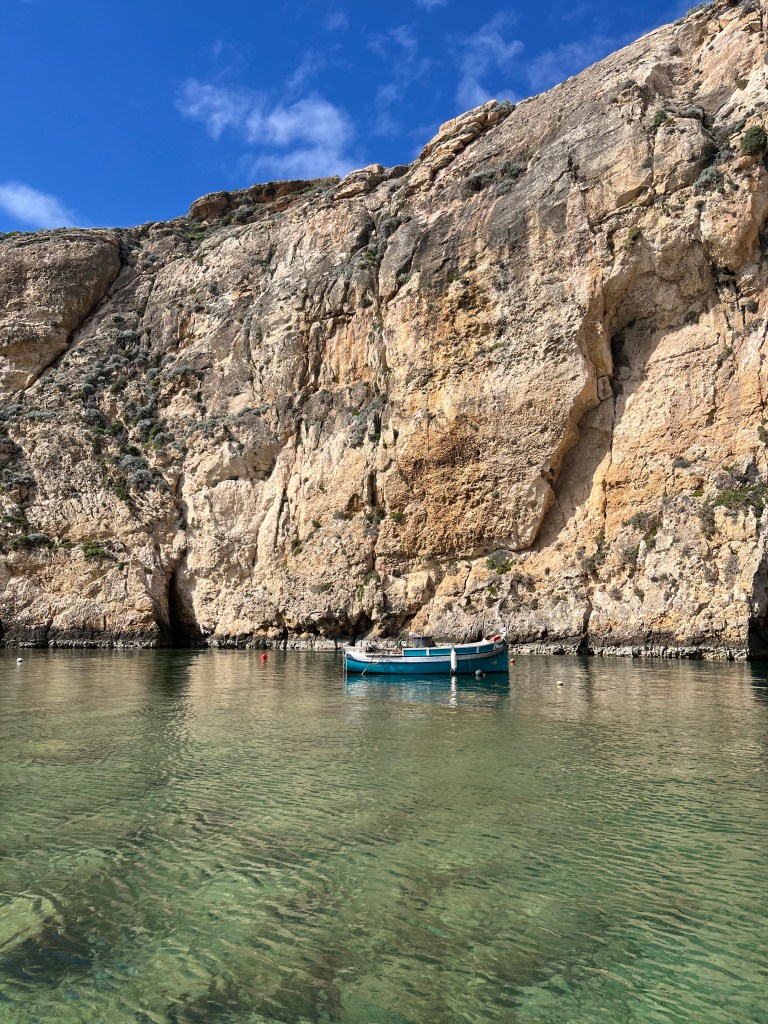
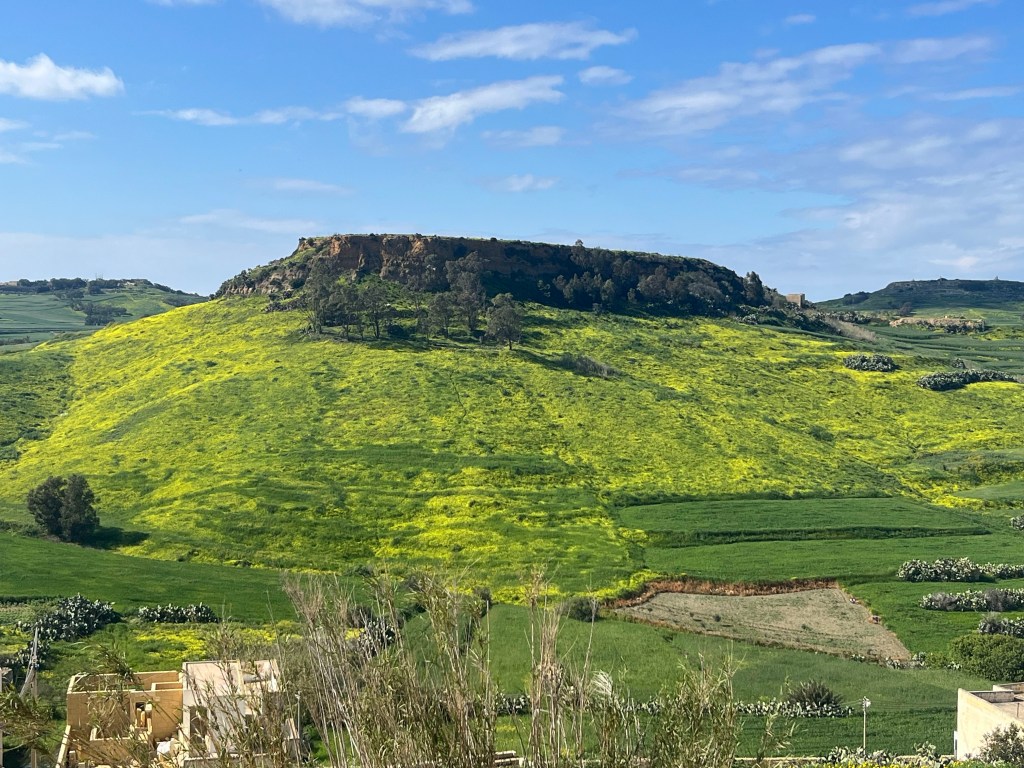
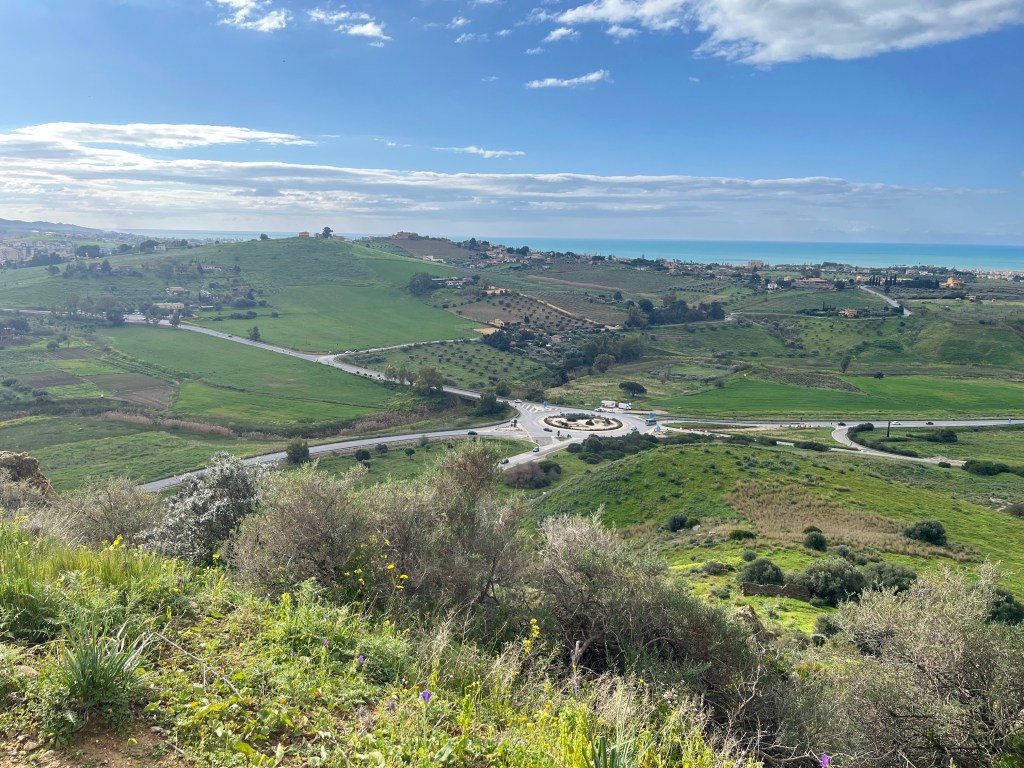
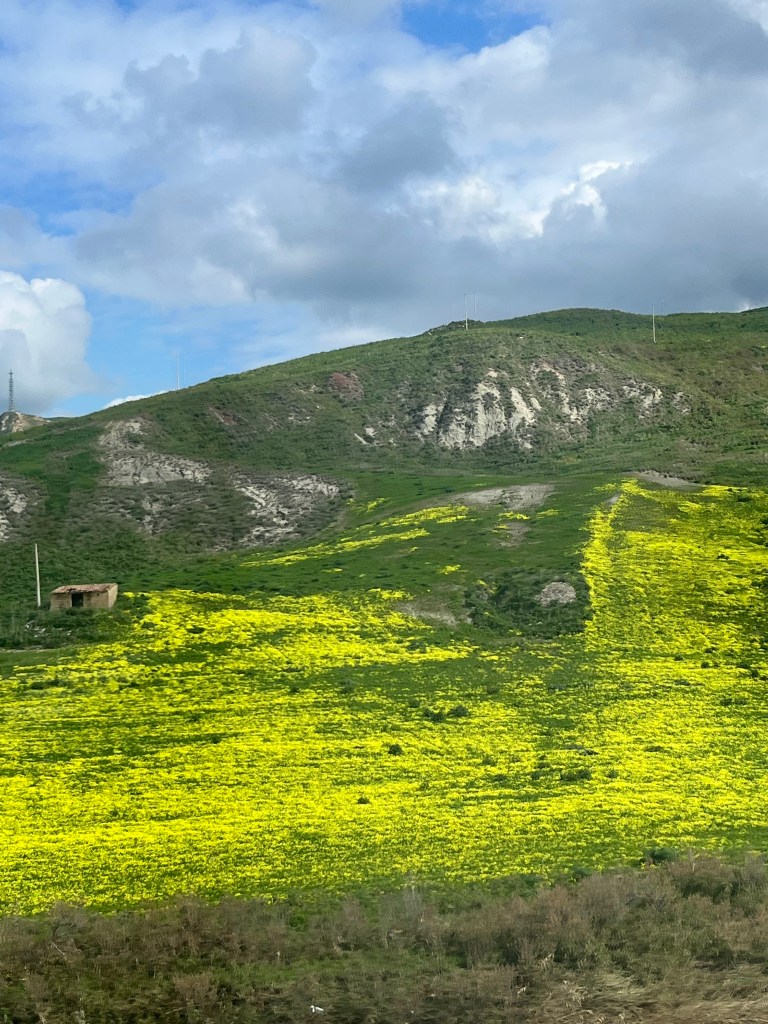
The nature in both countries is stunning. Malta’s blue lagoons and cliffs. Sicily’s incredible countryside, full of green hills, yellow flowers, lemon trees, and of course views of Mt. Etna (which erupted while I was on a bus!).

The Maltese and Sicilian people were incredibly friendly, especially in Malta. Both countries drive like maniacs but the people – the people were the superstars. They were so open. They were so willing to unabashedly share their stories, their lives, their problems with their spouses, their hopes, their dreams, their politics – it felt like being back in Israel but in a place that hasn’t known war in a very long time.

I have a lot to say about my experience in these two incredible countries. The sights to see are countless. The vibes are fabulous. The food delicious.

I couldn’t help but think that maybe one day, when Israel is given a chance to breathe, and when its neighbors accept its existence and all choose the path of peace, that it can be a destination as tranquil as Sicily and Malta. That have lived through ages of conquest and rich cultural heritage. But have come out on the other side stronger yet still welcoming. Whole.

May you have the great privilege that I did to visit these stunning countries. And may my friends in the Middle East one day know the peace of Malta and the peace of Sicily.

Libi bamizrach. My heart is in the east. Soon enough it won’t be enough for me to see buildings that remind me of Akko and Jerusalem. It’ll be time for me to visit the only place where I’m not a tourist. Where I don’t have to look longingly at beautiful architecture and be the “other”. The only place I can truly call my own.

Malta is home to an Inquisitor’s Palace and Sicily, once home to a bustling Jewish community, wiped it out during that very same Inquisition. These places, like many that I’ve visited, are or have been home to incredible Jewish communities. And I honor their resilience over the years.

And I wish for nothing more than for us to no longer need to be resilient. For us to be as tranquil as the Sicilian countryside or the lagoons of Malta. Because we’ve earned it.

Ken yehi ratzon. May it be God’s will.

Jewish, Christian, and Islamic Córdoba

Spain has an incredibly long history of co-existence (and discord) between Jews, Muslims, and Christians.  Few cities offer a more beautiful way of seeing this interaction than Córdoba.

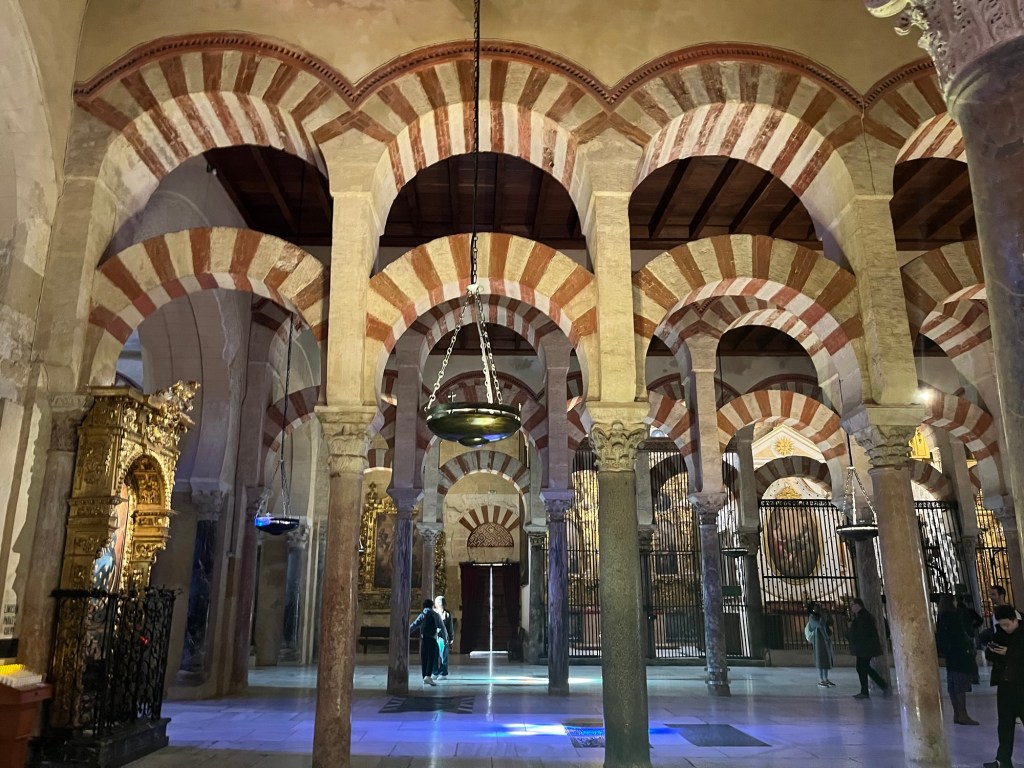
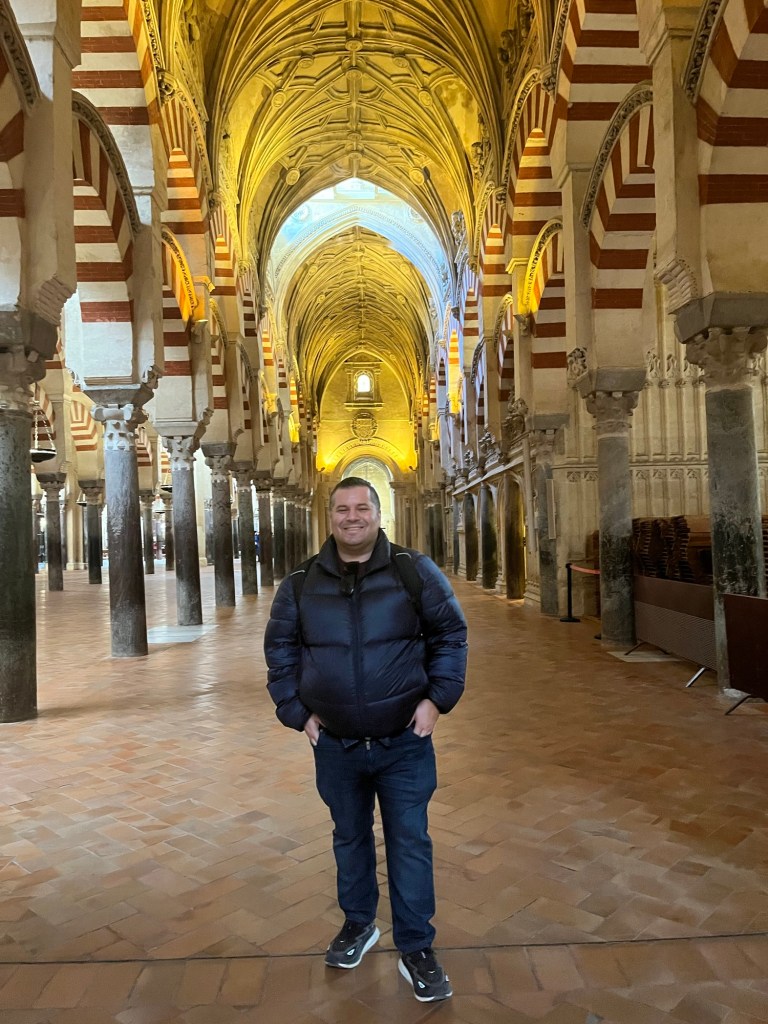
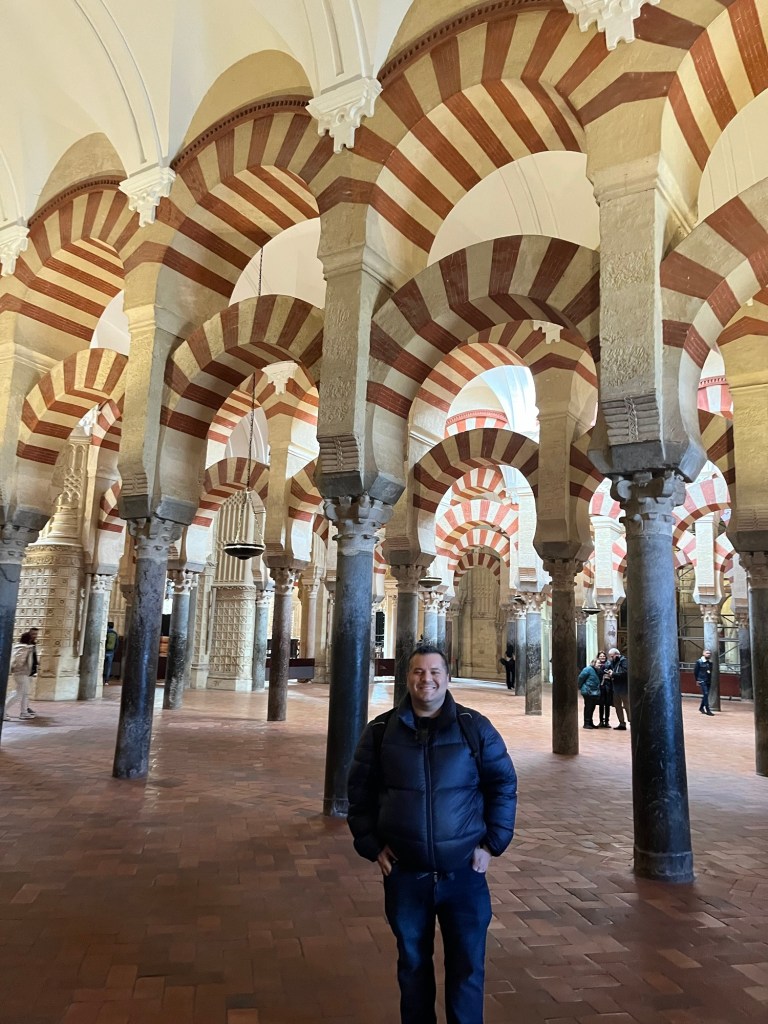
I started my visit off in the Mosque-Cathedral.  Yes, it is a mosque and a cathedral, although actively only a cathedral these days.  Built originally as a basilica by the Visigoths in the 6th century, it was destroyed and then built as a mosque by Muslim conquerors in the 7th century and then dedicated as a cathedral in 1146.  You can see a timeline of the Mosque-Cathedral’s construction here.

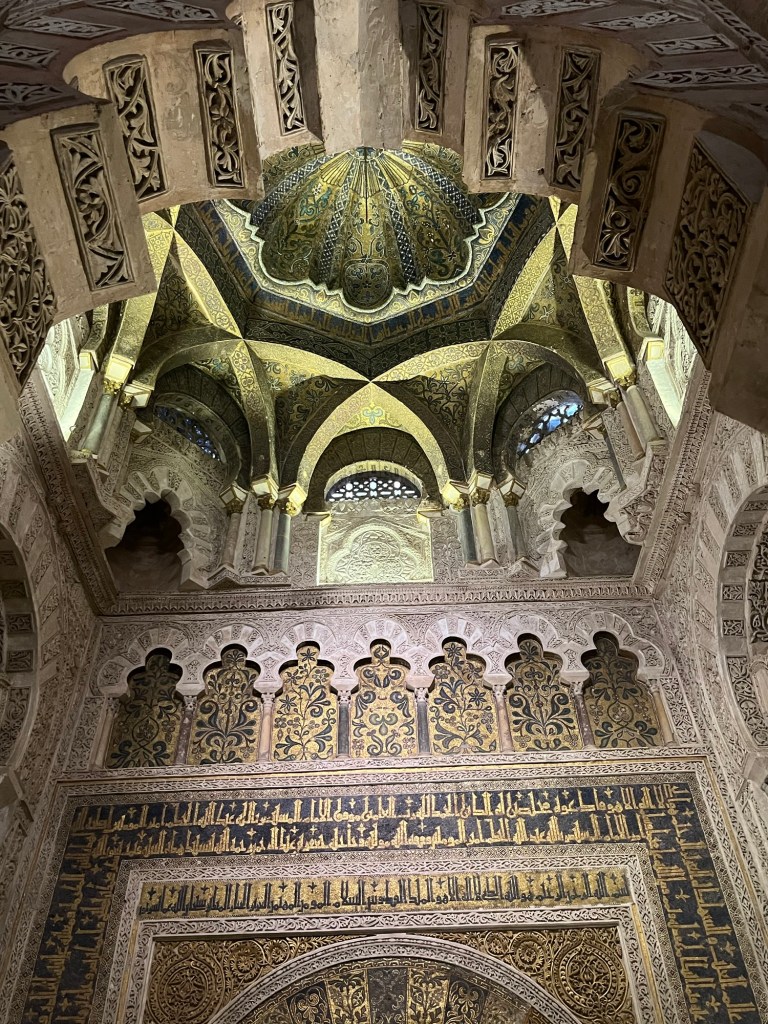
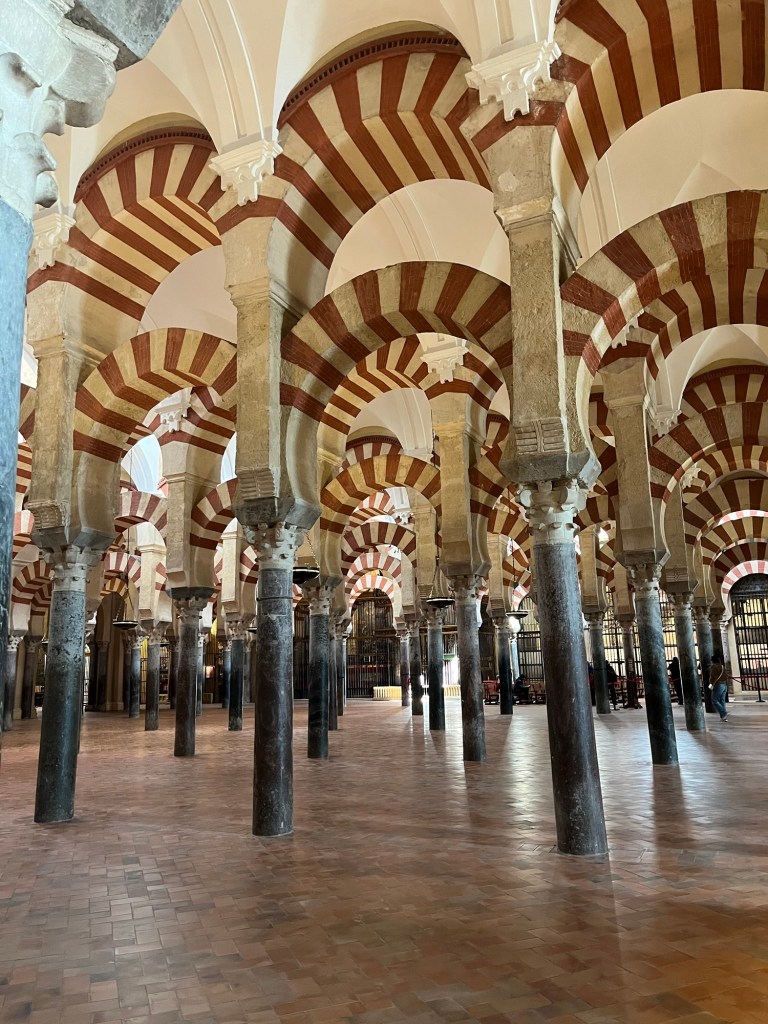
The back-and-forth conquest of the area by Muslims and Christians left its mark on the Mosque-Cathedral.  There are clearly Islamic archways throughout the 23,400 square meter building (that’s about 250,000 square feet!).  There’s even a beautifully restored mihrab, which showed Muslim worshippers the direction of Mecca for prayer.

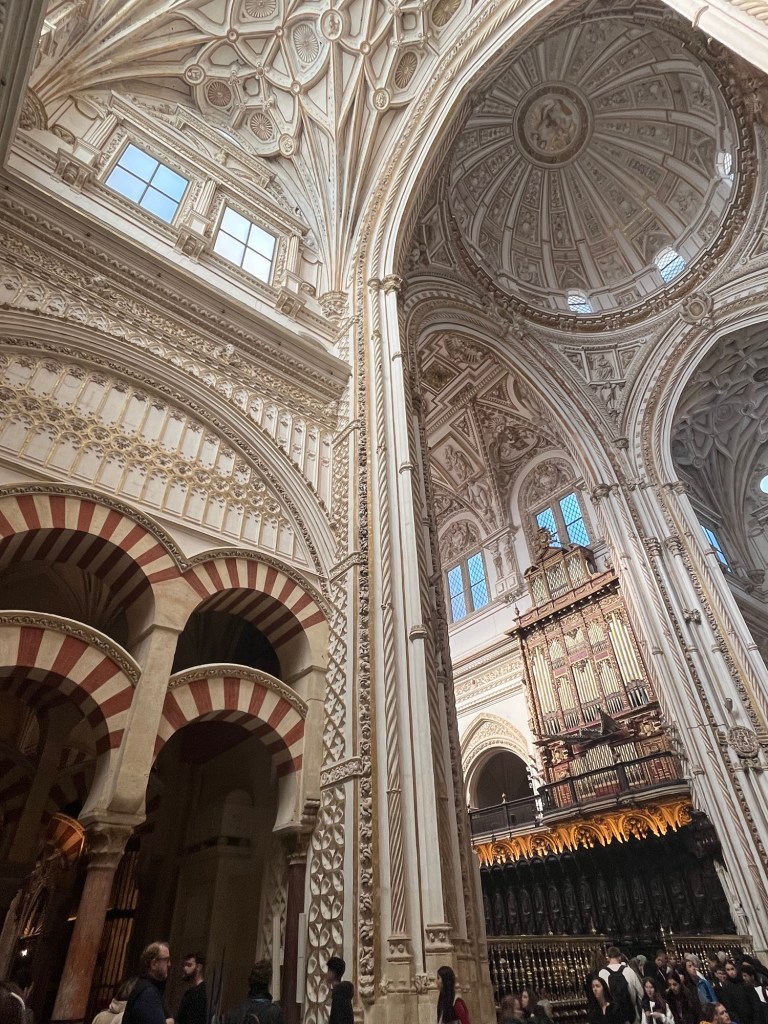
And then smack dab in the middle of the enormous mosque complex, there’s a cathedral!  And from the middle of the cathedral you can still see the Islamic archways that dot the entire campus.  It’s like one civilization couldn’t escape the other.

If you have the chance to go to Córdoba, this building is an absolute marvel and alongside the Alhambra, one of the most impressive pieces of architecture I’ve seen in Spain – indeed, perhaps all of Europe.

After my tour of the Mosque-Cathedral and eating some delicious gelato, I decided to explore the Judería, or Jewish quarter, of Córdoba.  Because Jews also called this place home for many centuries, including the famous Maimonides who was born in Córdoba in 1135.

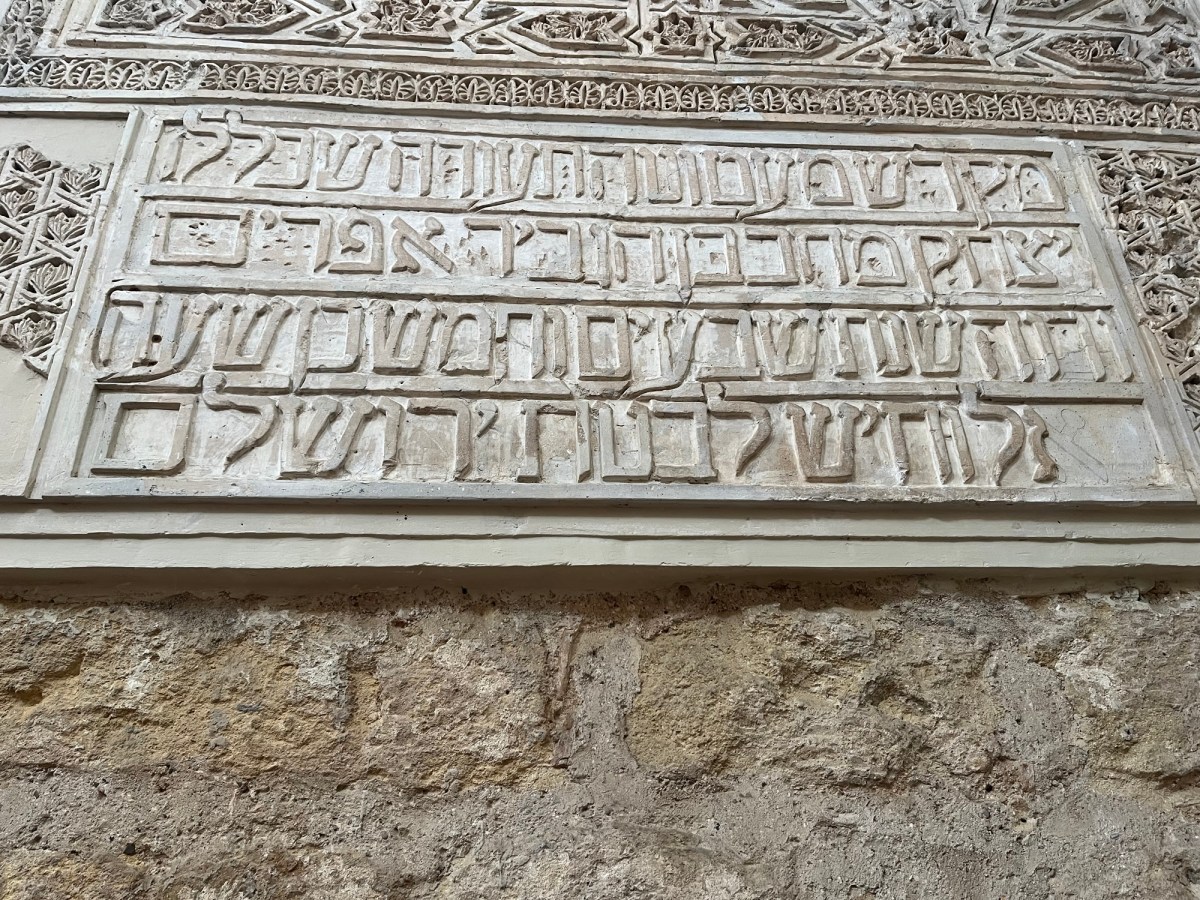
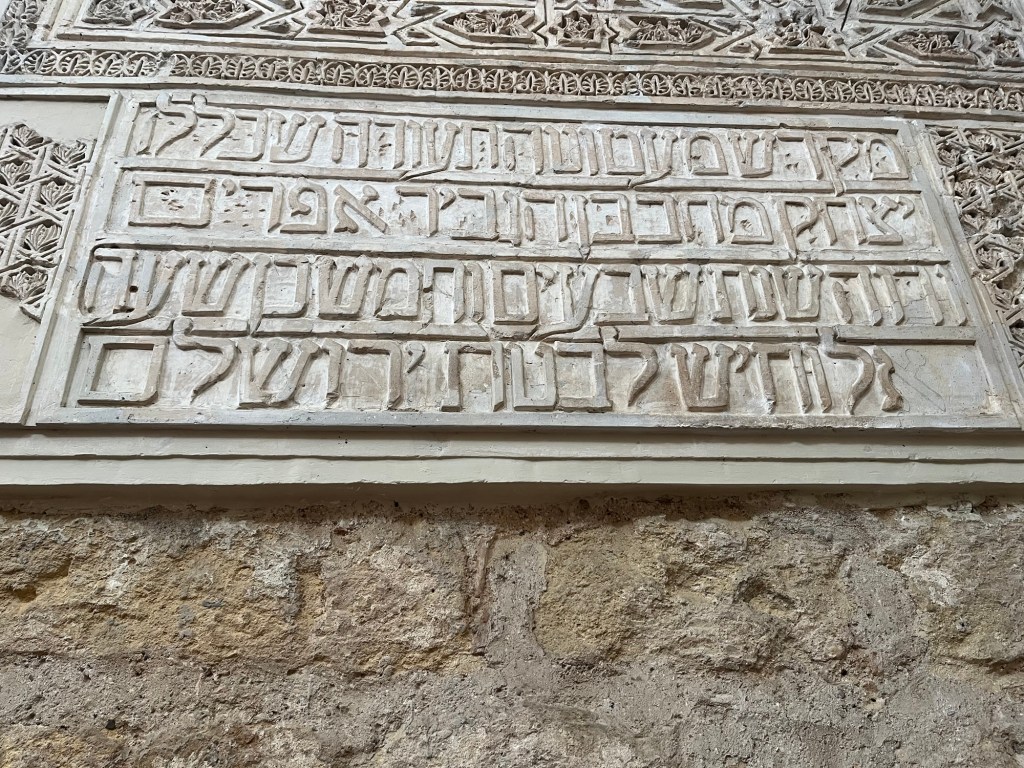
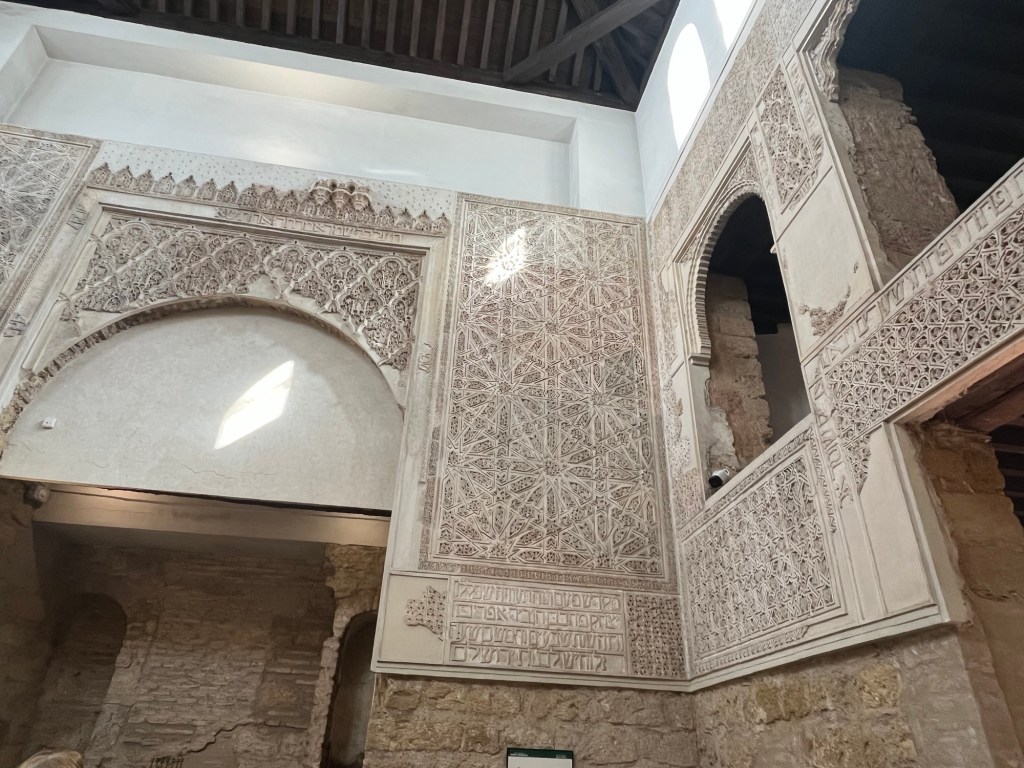
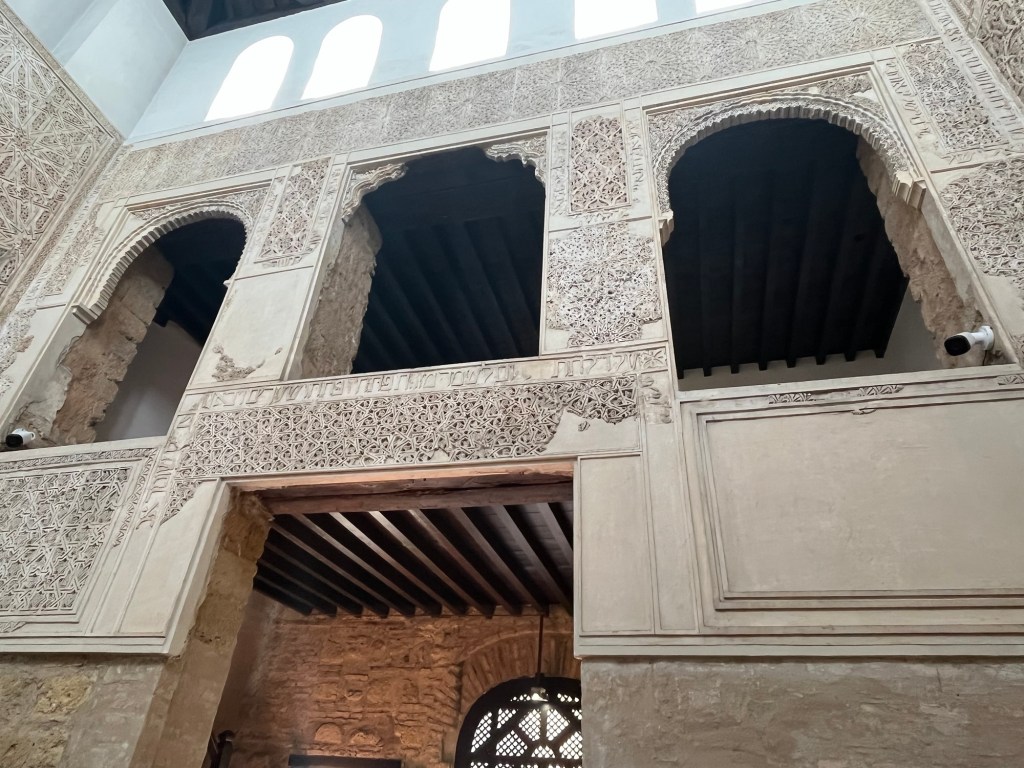
In the Jewish quarter, there is one of three remaining well-preserved medieval synagogues in Spain.  It was built in 1314 and has beautiful Moorish-style architecture and you can still clearly see the Hebrew engraving on the walls.  You can learn more about its history here.

The Hebrew on the walls particularly caught my attention and spiritual energy.  The fact that I could read some of it really moved me.  Jewish history is so often erased.  Our connection to our ancestral homeland of Israel, where Hebrew comes from, is so often denied.  Yet here in Spain, many miles from our home, there stood a synagogue, over 700 years old, with engravings in the same language I pray in.  The same language I use to write to my Israeli friends on WhatsApp. Jewish history is real and the chain of our existence is unbroken by the conquerors of the day.  I’m grateful to Spanish activists like Red de Juderías de España who have preserved Jewish heritage for us to enjoy despite all the pain our people have endured in this country.

I also stopped by Casa de Sefarad, a Jewish history museum housed in a 14th century Jewish home with a lovely and friendly woman at the front desk who was very proud of the city’s connection to Maimonides.  It’s a beautiful museum and worth a visit.

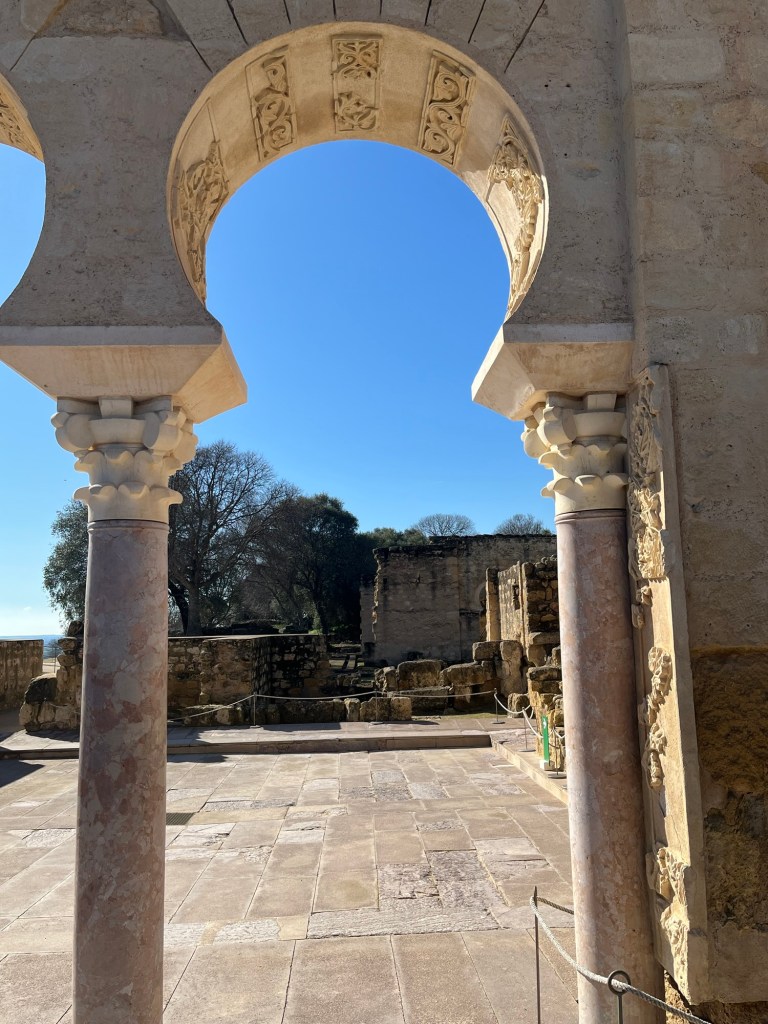
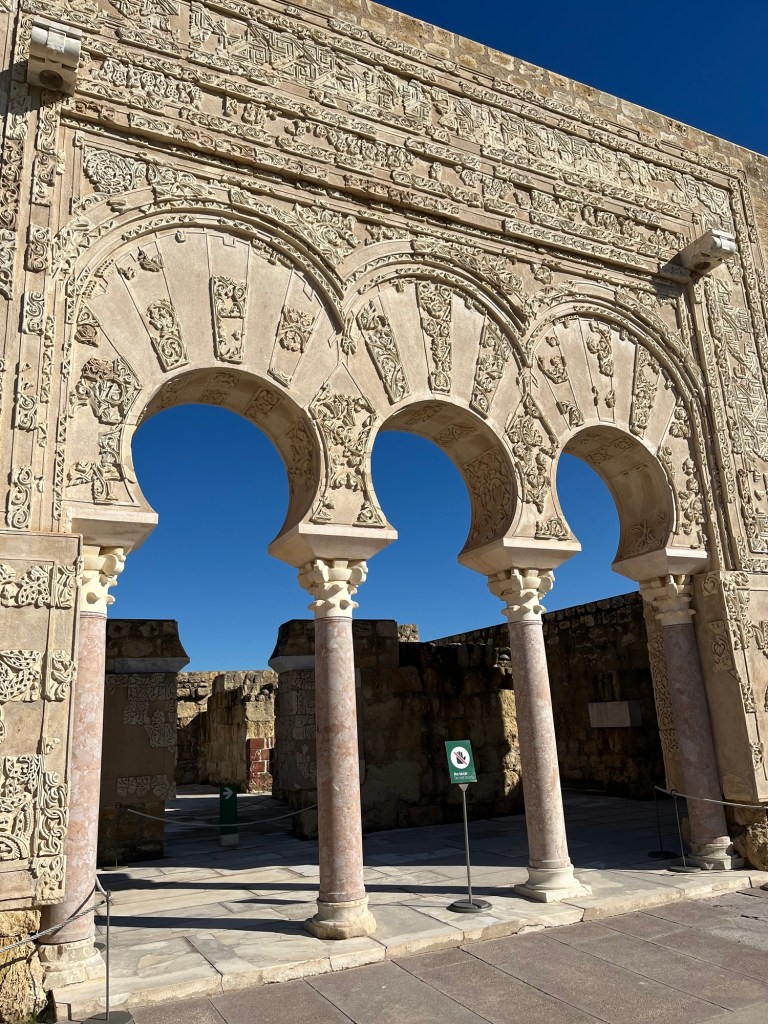
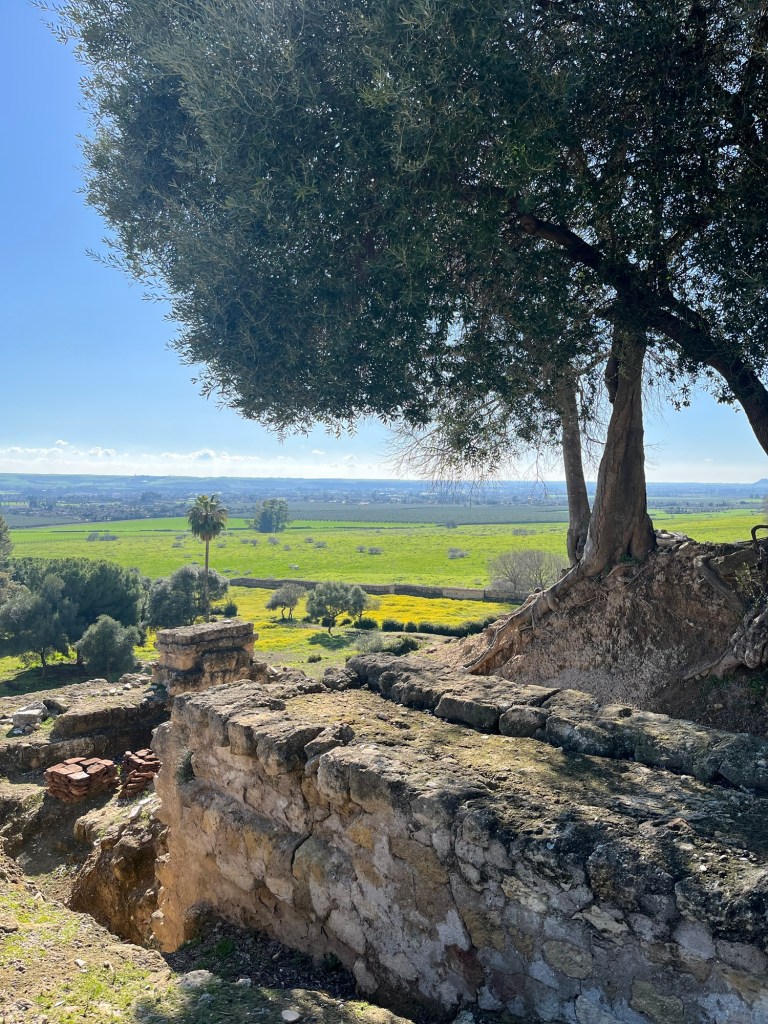
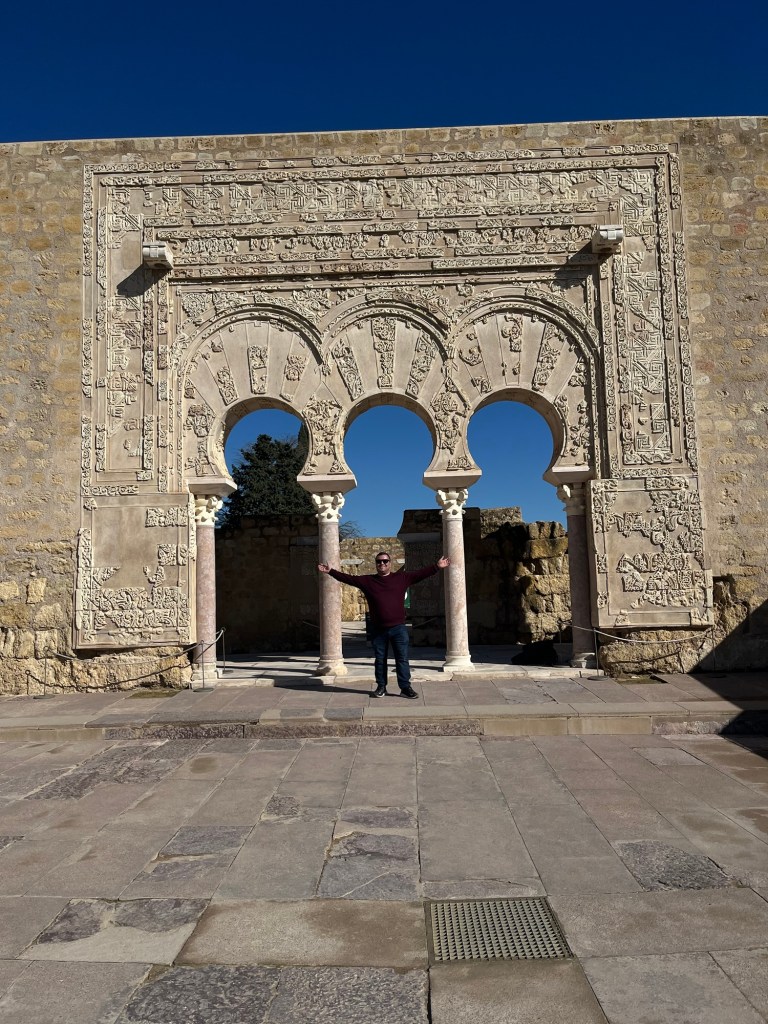
From the Jewish quarter, I decided to go a little outside Córdoba to Islamic ruins known as Medina Azahara.  These ruins date from the mid-10th century and are absolutely stunning.  This former city is now an archeological park and is set in a gorgeous rural area just a 15-minute drive outside of Córdoba.  If you have the chance, you must go.  You can still see archways and columns and elaborate Islamic architecture.  And far fewer crowds than the center of Córdoba.

It’s a place where you can really meditate on the meaning of these three cultures – Jewish, Islamic, and Christian – which have been, and in some cases continue to be, living in contention with each other.  But also influencing each other and at times even co-existing.  Whether it’s the Islamic arches in a Catholic cathedral, the Moorish décor surrounding Hebrew in a synagogue, or the Jewish scholars like Maimonides who crafted wisdom while living amongst these civilizations- one thing is clear.  We are interdependent.  And nothing, perhaps nowhere, shows that better than Córdoba.  So grab a salmorejo (feel free to hold the pork!) and enjoy this marvelous city of three cultures.

The Hebrew letters you can’t read

What’s in a word?  When we think about linguistic changes over time, we usually think about words and accents.  How did the Ancient Greeks pronounce Homer’s Iliad? Why does the word “mashber” in Biblical Hebrew mean precipice or edge, but today means “crisis”?

One thing you might not think of is how our script changes.  After all, even if English words are different today than 400 years ago, they’re still written in Latin letters.  Even if you’d be surprised at how some of them have changed.

But some languages have had their scripts completely change alphabets over time.  For one thousand years, Turkish was written in Arabic characters. For only the past hundred years has it been written in Latin letters.  Which means a Turkish person today who does not read Arabic characters cannot read his own history.  She has to rely on a translator to re-write old texts in the modern alphabet. It’s a pretty strange thought.  Think in reverse- what if the original Shakespeare had been written in Arabic characters? And you had to rely on someone to connect you to your own history.

It’s a question that is very relevant for Jewish studies.  First things first, Ancient Hebrew wasn’t written in today’s aleph bet.  It was written in letters that look something like a cross between Japanese and hieroglyphics.  Take a look:

image1

Today’s Modern Hebrew alphabet is descended from our sister language, Aramaic.  Aramaic is the language of the Talmud, of the Kaddish prayer, and of not a small number of Kurdish Jews in Jerusalem and Christians in the Galilee village of Jish.  This same Aramaic alphabet has been used for a lot of Jewish languages, including Yiddish, the native tongue of millions of Ashkenazi Jews across time.  Take a look at this 19th century bilingual Yiddish-Hebrew machzor, or High Holiday prayerbook, from our collection.  Or the 11,000 Yiddish books digitized online- for free- at our friends the Yiddish Book Center.  Or pick up a copy of Der Blatt in Bnei Brak.  Or visit Beit Shalom Aleichem’s library in Tel Aviv.  You’ll see those Aramaic letters everywhere.  Telling the story of the Jewish people.

What’s interesting is that even these letters have changed over time. One of these different forms is called Ktav Rashi, or Rashi script.  This alternate way of writing is named for the famous medieval rabbi.

What’s really inspiring about Jewish history is that what happens one corner of the globe inevitably ends up in another.

Rashi script (and its sister Yiddish script called vaybertaytsh), although named for a famous Ashkenazi rabbi, is actually of Sephardic origin.  Jews originally from Spain and Portugal, expelled and persecuted by the Inquisition, sometimes successfully escaped to other countries. They brought with them an amalgam of different Romance languages- medieval Catalan, Castilian Spanish, Portuguese, and more.  Often containing Arabic and Hebrew influences.

These Jews, often from distinct parts of Spain and Portugal with different languages, eventually melded their tongues into a new one: Judeo-Spanish.  Sometimes popularly called Ladino, but most scholars prefer the former term, so we’re going to use it. This tongue developed in a variety of new countries, such as present-day Turkey, Greece, Serbia, and more.

Judeo-Spanish then came to take on local influences in terms of vocabulary and pronunciation.  Making it as mixed and rich a language as Yiddish or another hodgepodge tongue you’re reading right now: English.

This language was written in the same Aramaic alphabet we use today in Israel and in synagogues around the world.  But with a twist: it was written in a form of the Rashi script. Take a look below at our copy of Istanbul’s Sephardic newspaper “El Tiempo” from January 2, 1896.  To this day, even in Modern Spanish, this remains a popular title for newspapers.  In Washington, D.C., you’ll find newsstands with “El Tiempo Latino”.

Here’s the news out of 19th century Istanbul*:

unnamed

If you’re a Hebrew speaker, you’ll notice something curious.  The title of the periodical and the headlines are written in the Modern Hebrew block alphabet we see today.  But the content is all written in a strange font, unfamiliar to the modern eye: the Rashi script!

There are words here and there you can catch.  But if you haven’t learned the script before, there are letters you won’t even recognize!  At best, you might find yourself staring in wonder as the somewhat familiar letters begin to entrance your mind and confuse you into curiosity.

This script has a version for handwriting too.  It’s called Solitreo, an ancestor of the Hebrew cursive you’ll see in Israeli classrooms today.

What does all of this mean?

In short, even if you spoke Modern Hebrew and fluent Judeo-Spanish but didn’t know this alphabet, you might not be able to read it!  Even though your Sephardic grandparents probably could. What’s more, Judeo-Spanish underwent yet another change as today it is mostly written in Latin characters!

When we learn about our heritage, who is teaching us?  Are we able to read the original texts ourselves and come to our own conclusions?  Or do we need someone to interpret them for us?

What does it mean that these texts, unless expensively re-printed in Modern Hebrew letters, are out of reach for most of today’s Jews or people who study our heritage?

You could ask the same question of our Turkish neighbors who can’t access the majority of their history in their current alphabet.

One solution is to re-print the texts.  A time-consuming one and while a good idea, can be above the budget of many institutions.  Especially for a minority language. Which limits how many texts can be made accessible to the modern reader.

Another solution is for people studying Judeo-Spanish (or any Jewish text written in Rashi characters) to learn the new script!

David Bunis, a professor at the University of Washington, is doing just that.  Here’s his take on why he’s teaching his Judeo-Spanish students the Solitreo and Rashi scripts.

While re-printing texts is great because it makes them more accessible to others, being able to read them in the original makes you the source of information.  And empowers you to read history anywhere. You are the judge, you are the interpreter. And your capacity to read is only limited by your time and effort, not by the letters you know.

No matter what, it’s great to learn about your heritage or different cultures around the world.  Preserving Jewish heritage for Jews, for Israelis, and for all our friends around the world.  To learn the lessons of the past and apply them to our present and build a better future.

Maybe you don’t have time to learn Rashi script or Solitreo, although if you’d like to give it a shot, try this free resource online.  It claims it can have you reading in 10 minutes!  Then you can peruse our catalog and find more news from Istanbul and across the Sephardic world to learn about.  Or old Yiddish prayers written by and for women.  Or maybe you want to pump up some Judeo-Spanish music in your car as you brave the traffic to work.

But no matter what you do, access this beautiful heritage.  The more you learn about it, the richer you are. And you don’t have to spend a cent to put it in your mental grocery cart.

*Image credit: National Library of Israel and Tel Aviv University

Dual loyalty

Today, the Trump-like Congresswoman from Detroit, Rashida Tlaib, invoked the 2,000 year old anti-Semitic canard of “dual loyalty”.  When discussing Israel advocates who she disagrees with, instead of talking policy or substance, she simply accused her opposition of trying to undermine America.  In the interest of Jews, oh pardon the typo- Israel.

The conversation is frankly exhausting.  Rep. Tlaib has a serious abusive streak.  Immediately after being sworn into office, she became known around the world for calling Donald Trump a “motherfucker”.  Thankfully, a lot of Americans are capable and willing of expressing their political views without resorting to the profanity of an angry 16 year old.  The situation is all the more depressing because Rashida, as the first Palestinian-American in Congress, could’ve done so much more.  Rather than trying to become something other than a literal walking and talking caricature of what people think Palestinians are, she just hopped right in.  I know Palestinians personally who don’t agree with her- her policy or her rhetoric.  And she does an immense disservice to America, to Palestinians, to Jews, to peacemakers, to her own constituents.  Shooting from the hip, making policy via Twitter, shouting profanity.  Sound like someone in the Oval Office?  Well, apparently he’s got a partner in crime now sitting in Congress.  Rashida Trump.

It’s sad.  America- indeed, every country- could use some more wisdom and less yelling right now.  In the face of growing xenophobia, polarization, and economic uncertainty, we need level-headed people to steer the ship.  Because as I see it, moderation is not entirely about what positions you take.  There are people I know who have a whole variety of views- some I agree with, some I don’t.  And my own views have evolved- and evolve- with time.   The one thing I hold in common with the people I love is that we don’t think we have exclusive ownership of eternal truth.  That even if we disagree, we’re willing to hear out other points of view.  That while there are obviously limits, we’re not going to wholesale discredit millions of people simply for thinking differently from us.  Or wearing a different label.  Which is why I have friends who are devout Muslims, West Bank settlers, Palestinian political activists, and Israeli soldiers.  I don’t believe in categorically rejecting an entire group of people because I’m afraid they’re going to hurt me.

This mentality stems from being hurt.  People naturally want to protect themselves.  And if they’ve been taught, or personally experienced, hurt from a particular type of person, sometimes the response is close yourself off.  I can understand to a degree.  It’s not as if I’m going to wave a pride flag around Ramallah.  There are substantive cultural differences- and prejudices and legitimate fears that come with them.

The problem is when this fear ends up cutting you off from entire segments of society.  So that rather than saying I’m afraid of Palestinians who are homophobic, I decide that I simply don’t like Palestinians.  That if I don’t talk to them, if I don’t engage with them, I’ll feel safer.  Except in the end, you miss out on potentially life-changing friendships and relationships.  Not to mention the fact that it’s not entirely effective.  There are obviously homophobic people in other cultures too- and people in Palestinian society who aren’t.  When taken to its extreme, this kind of black-and-white thinking doesn’t end up effectively protecting you.  And it does create a lot more prejudice and hate in the world.

So Rashida Tlaib doesn’t like Jews.  If that wasn’t clear until today, accusing us of dual loyalty sealed the deal.  I don’t know why she has come to this conclusion, but it’s sad and scary.  We need to be vigilant against people who subvert democracy out of a desire to see their inner nightmares fulfilled.  People willing to shout profanity and trample on other people’s dignity will continue to do so if left unchecked.  Now that Ms. Tlaib has accused Jews of dual loyalty, when she sees Jews defending themselves, it will oddly enough reinforce her prejudice.  It’s a demented and deeply disappointing reality that is quite hard to break- and depends mostly on the willpower of the individual to change.  Here’s to hoping Rashida has a long talk with her conscience and thinks about what kind of parent, Congresswoman, and human being she’d like to be.

Which brings me to an archive I recently visited.

The American Society of the Cincinnati is an elite organization made up of descendants of Revolutionary War officers.  One of their members, Larz Anderson, endowed a spectacular, grandiose mansion in Washington, D.C. to be its headquarters.  To say it’s beautiful doesn’t do it justice.  If you want to feel rich for a hot minute and enjoy some stunning artwork, go visit.  It’s long been a favorite off-the-beaten-path place for me to let my mind wander and my eyes feast.

Today, as I did several years ago, I visited the Anderson House library.  As a not-so-minor side note, I encourage you to click that link above.  You can see some of my blogs from before my move to Israel.  And you’ll notice that while many of my values are the same, my political perspective and capacity for nuance has grown tremendously.  So that rather than drifting further towards the self-righteousness of folks like Rep. Tlaib or Rep. Ocasio-Cortez, I decided to pursue the more difficult if more rewarding journey towards nuance and empathy.  While certain systemic factors are out of our control, every individual has a certain capacity to make choices.  And those choices have ramifications for the thousands of people we meet in our life, for our own lives, and for society as a whole.  I’m proud to have overcome the one-dimensional thinking that these extremist political actors savor.

Now, let’s return to the comfort of the archives.

Archives are soothing.  They offer you a chance to explore without paying any money.  Without the sometimes interesting but ultimately tedious travel logistics.  They give you insight into things you don’t know- and things you don’t know you don’t know.  They are just the kind of place to find an unexpected twist to make you think differently.

And I had that pleasure today.

As a Jew growing up in America, I learned a lot about Judaism.  I learned about the Torah, some Talmud, Pirke Avot, tikkun olam, Israel, Ellis Island, Hebrew, holidays, and more.  I can remember lessons on the Holocaust, on tolerance, and of course a lot of Jewish music.

What I didn’t learn was about our own American Jewish history.  Let alone Yiddish, a language I came later to in life, but was actually the mother tongue of almost every great-grandparent of mine.

There’s something odd, indeed disturbing, that I can tell you much, much, much more about Haifa than I can about American Judaism.  By that, I don’t mean Debbie Friedman melodies or marching for Soviet Jewry, although those are undoubtedly part of our rich story too.

What I mean is I can’t tell you much about how our community actually developed here.

And that’s something I learned about today.

How many of you know who David Salisbury Franks was?

Probably not many.  Before today, I can’t say the name was at the tip of my tongue.

But Mr. Franks was a Jewish officer in George Washington’s Continental Army.  And, to the best of my knowledge, the only Jewish member of the Society of the Cincinnati.  Whose building I sat in.

His story is riveting and filled with mystery.  After several hours of reading, it appears there’s no clear narrative on where he was from.  Some sources claim he was born in Philadelphia, others in Boston.  He also had a cousin (although some say the relationship is not clear) with the same name in New York.  Who unlike this David Franks, was a loyalist to the British Crown.  Which as you’ll see, a resemblance that did Mr. Franks no service later in life.

Mr. Franks spent part of his life in Montreal, at the time recently conquered by Britain.  One of the first Jews to settle there, as French colonists had forbidden Jews from moving there.

Mr. Franks is sometimes referred to as a German Jew.  In other places, it seems his family was Sephardic- the descendants of Jews forced out of Portugal by the Catholic Inquisition.  His own surname potentially an anglicization of “de Franco”.  A reminder that Jews have often had to shed parts of our identity to Americanize, whether in 1700s Philadelphia or Hollywood.

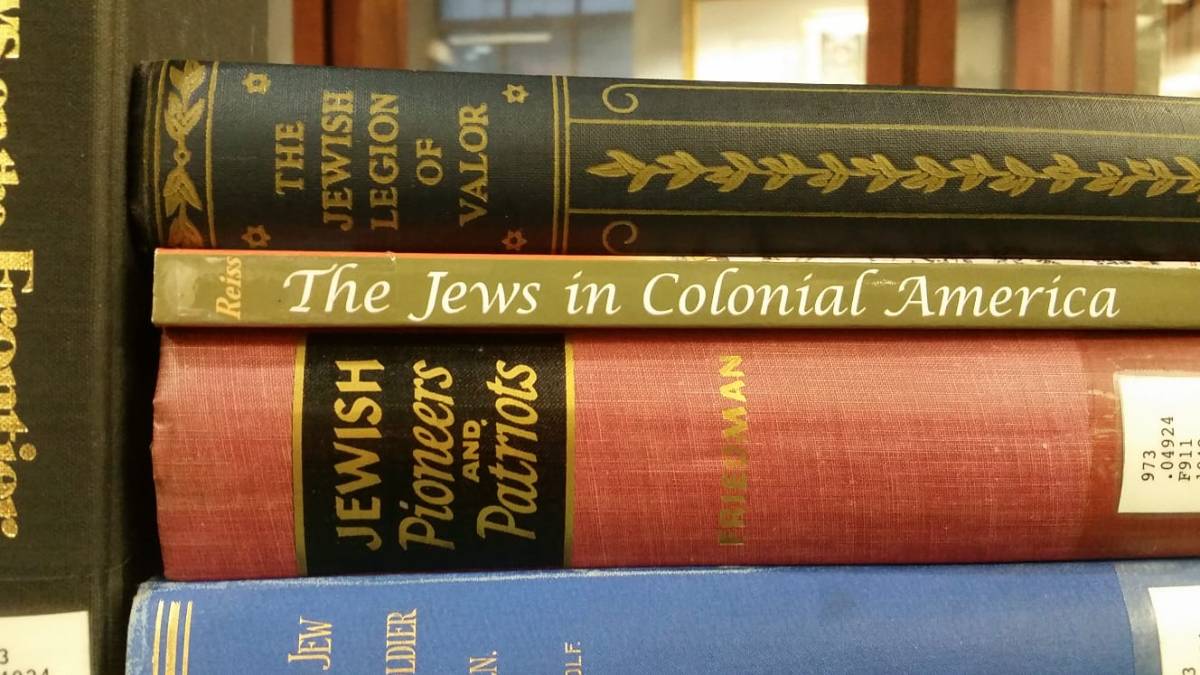
I have to admit his Portuguese connection intrigued me.  Having just been in Portugal, I figured I wouldn’t find much to connect me to the place from America.  But I not only found a connection- I found a Jewish one!  Indeed many early Jews in America were Portuguese.  Just like the Jews who I met in Lisbon who after 400 years of hiding, are returning to our people and our faith.  The twists and turns of history can offer hope in the most unexpected times and places.

Mr. Franks was a proud American.  He was even arrested by British authorities for defending freedom of speech and protest.  He helped finance revolutionary troops.  And he put his own life on the line as a soldier.  And he did it in a Colonial America that, while substantially better than Europe, was at best ambivalent about Jews.  Through the 1680s, even in relatively tolerant Rhode Island, Jews couldn’t become naturalized citizens.  We were largely tolerated, but considered “others”.  Something a bit too different to be “all American”.

There are a ton of fascinating aspects of David’s story.  He was a Sephardic Jew, with potentially German Ashkenazi ancestry.  His family likely kicked out of Portugal by Catholic monarchs, only to be appointed an American diplomat to the Spanish king whose country founded the Inquisition.  He was sent to France to represent the new Republic because he spoke French- because of his family’s move to Montreal.  Significant not only because of the roaming, international nature of Jewish existence (one source of our “dual loyalty” accusation), but also because of the very long relationship between Canadian and American Jewry.  It’s one of the reasons I love going to Montreal.  You might be surprised to see they have the *best* Jewish food tour I’ve ever been on.  Twice.

Mr. Franks served as the Parnas, or synagogue president, of the Sephardic and Portuguese Synagogue of Montreal.  The city’s oldest.  And at the time, a community only ten years old.  A reminder that what starts today may become deeply significant for years to come.  To remember we are still writers of history.  And that if in fact Mr. Franks was part or entirely Ashkenazi, his acceptance as a leader of the (at the time) elitist Sephardic community is a poignant reminder of the human capacity for crossing cultures.  For empathy and heterodox thinking.  The kind we could use more of today.

His story, and rise to prominence, is also part of the American Dream.  It’s the idea that in this country, you can grow and you can achieve regardless of where you come from.  And while it’s a dream that’s not without its detractors nor faults, it is a part of our history.  Which is why so many Jews have made America their home.  At the time of David’s service in the military, Jews weren’t even citizens of European countries.  The idea that he could lead so prominently is evidence that something is a bit different here.  Even if we should remember that our history as American Jews is not just American.  David’s family came from elsewhere- and appears to have maintained trade and familial ties to far-flung places such as Halifax, New York, England, Philadelphia, Montreal, and beyond.  Jews are from everywhere- and nowhere.  Which is precisely how anti-Semites like Rep. Tlaib are so successful in painting us as “rootless cosmopolitans” who can’t be trusted.  Without considering why we’ve had to move so much- precisely because of people like her.

The very mystery around his origins, his family connections, his own biography is part of what makes him interesting.  Perhaps there are scholars more versed in his life than I am, but what’s clear from my research is that there’s at least some confusion.  Even searching in the Mormon genealogical records on FamilySearch.org shows some varying hypotheses of his own lineage.  We know he was here, we know he was a Jew.  The details, at least from my internet searching, seem partially up for debate.

What’s not up for debate is Mr. Franks’s patriotism.

Or is it?

Mr. Franks has the misfortune of being the aide-de-camp of Benedict Arnold, the notorious loyalist traitor.  While several inquiries, including one called by Mr. Franks himself, exonerated David from any responsibility, a lot of Americans weren’t so sure.  Some shunned Mr. Franks and yes, questioned his loyalty.  While George Washington himself had no problem commissioning Mr. Franks afterwards and trusted him, not a small number of people dissociated themselves from the officer.  And left him so socially undesirable he was apparently interred by a friend in hazy circumstances in a Christian cemetery in Philadelphia.  Potentially carrying the body himself.  An undignified end to someone who put his life on the line for his country.

What’s so interesting about this story is how utterly resonant it is today.  And how it shows the deep relevance of knowing American Jewish history at least as well as we know about the Western Wall or Tel Aviv.

Because accusing Jews of dual loyalty is as American as pumpkin pie.  And to this day, just as pernicious as it was centuries ago.  Perhaps even worse.

The saving grace of this country, though, is that some people have a different vision.

The Touro Synagogue of Newport, Rhode Island is the oldest in the United States.

The congregation, nervous on the eve of American independence, wrote to George Washington in the hopes of receiving some reassurance.  Reassurance that their fates were safe here- unlike their European relatives regularly butchered by ignorant masses of anti-Semites.  I’d suggest it’s hard to imagine such a need here- but the past few years have put that to rest.  Anti-Semitism, sadly, is alive and well.  And American Jews should remember that for all the special things that make this country infinitely better for us than most places in the world, we are in the end Jews.  And Jews have always been scapegoated in Western societies when things start looking uncertain.

What’s so remarkable about the letter, besides the deep sincerity and hopefulness of the congregation, is also Mr. Washington’s reply:
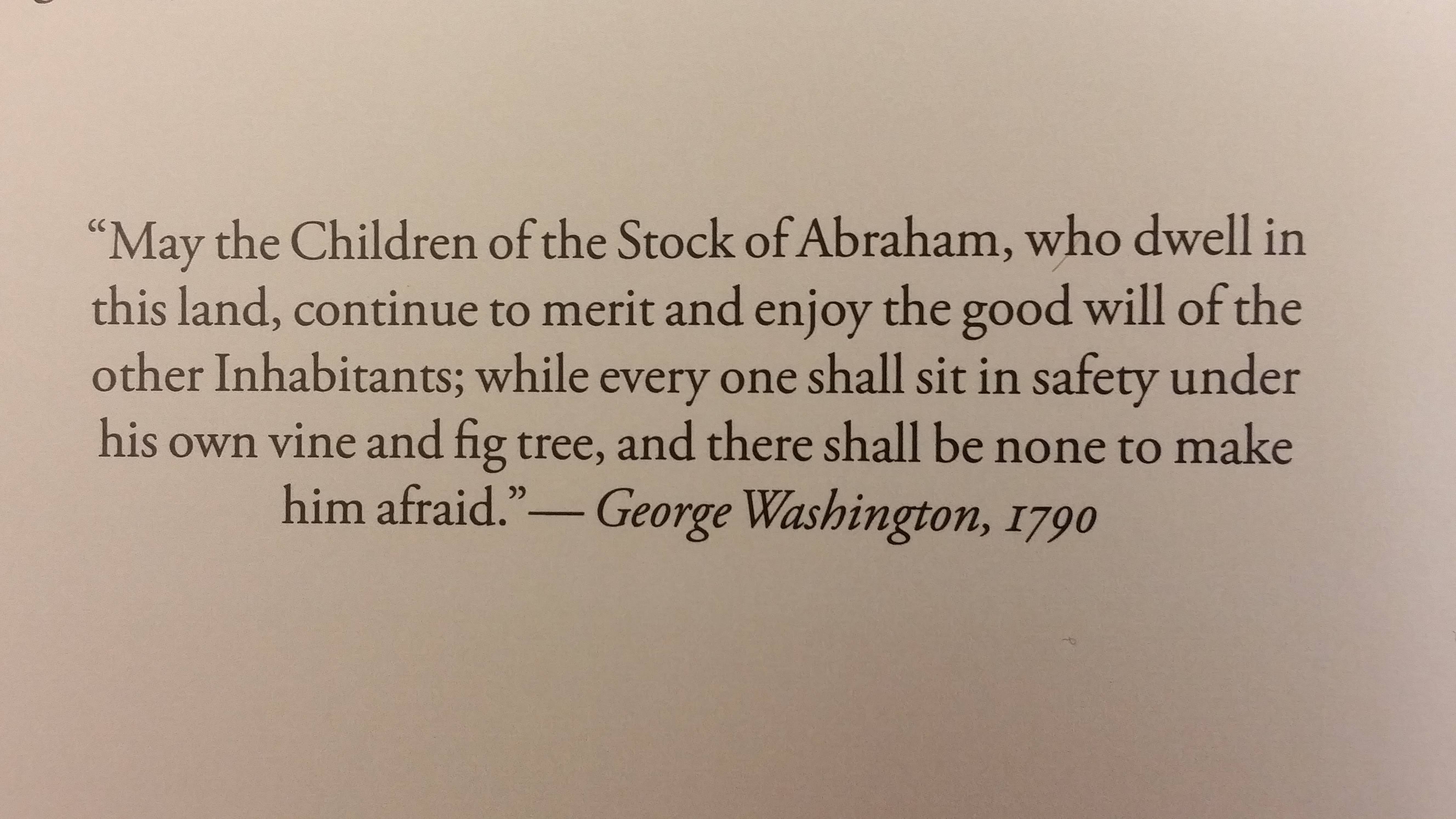
20190107_153526

It’s a stunning, beautiful, and heartfelt sentiment that has driven Jews to these shores ever since.

Because besides the joy of letting my mind expand and wander, what ultimately motivates me to research this era is a desire to understand the present as much as the past.  And to discover if America has the potential to be different than Europe or North Africa, areas rendered largely Jew-free over the past 100 years.

And there is a difference.  The difference is not that there isn’t anti-Semitism.  That has been- and always will be- here.  You can just look up the case of Aaron Lopez in 18th century Rhode Island.  A colony that refused to recognize his very citizenship precisely because he was Jewish.  Or take a look at Linda Sarsour three hundred years later claiming anti-Semitism “isn’t systemic“.

The difference is that from its very founding, America decided that Jews were to be treated as equals under the law.  That while other Western countries have, at various stages, offered opportunity to Jewish communities, this country was founded on the principle of religious freedom, of separation of Church and State, of liberty.  And while it hasn’t always lived up to that promise, George Washington’s decision has impacted our civic life for hundreds of years.  It’s why my family ended up alive in New York and Pittsburgh and Washington, D.C. and not as ashes in German ovens.

The problem is that this tolerance, this willingness to forgo the outdated sectarian hatreds of Europe, is fragile.  We’re seeing this today.  And its fragility is only tempered by people’s willingness to defend difference.

Which is why today’s news about Rashida Tlaib is so scary.  As a Muslim American woman, she has no doubt faced persecution and hardship in her life for who she is.  Yet rather than choosing to become more empathetic in the face of hurt, she has chosen to become like the people who persecuted her.  Heaping senseless anger and mean-spirited words into our nation’s political debate.  And most specifically, on Jews ourselves.  Six million of us that she doesn’t even know.

What’s so sad is that it doesn’t have to be this way.  Rep. Tlaib could choose to build bridges with people of different backgrounds.  She could acknowledge her family’s pain and challenges as Palestinian-Americans.  Like me, she’s a hyphenated American with various cultural connections around the world.  In her words, “dual loyalties”, but as I see it, an enriching confluence of identities.  She could use this similarity as a way to empathize with Jews and yes, even Israel supporters she might disagree with.  Because, in an ironic twist, its bigotry of people like her that propel people like me to believe in the necessity of a Jewish State.  That for all its faults (which all countries have), Israel is a safe-haven for us when people like her fail to treat us as human beings.  Something that has saved millions of Jewish lives from Tehran to Warsaw.  Which is why there are more Moroccan Jews in Beit Shemesh, Israel than in all of Morocco.

So in the spirit of the resilient David Franks, I’m not going to start hating Palestinians just because Rashida Tlaib hates me for being Jewish and Israeli.  That’s because I took the time to meet Palestinians, to become friends with them.  That I realize that even as she spews conspiracy theories and hatred, I know other Palestinians who don’t see the world as she does.  And that even if we have different cultures and sometimes political perspectives, I know my friends and I view each other as human.  Not political props or opportunities to get likes on Facebook.

What’s so sad is that Rashida Tlaib has become like her abusers.  An abuser herself.  Unhinged and attacking foes real and imagined.  Even as she’s supposed to be doing practical things to help her constituents.  Like re-opening the government.  A government whose very archives and museums house so much knowledge that could benefit us today.  And whose halls sit empty as employees go without pay or hope for a solution.  Indeed, perhaps a visit to these archives would be a wise first step for the Congresswoman rather than pontificating on Twitter.

What I loved about my experience today is how it connected me to myself.  I’m an American Jew, a Jewish American, an American and a Jew.  And part of my journey is piecing together who I am, where I am, and why I am.  And who I want to be.

Knowing more about the history of my people in this country helps me understand the richness of our civilization.  And offers insight into how we got here- and where we might be headed.  What’s unique about America, and what might be a bit uncomfortable to recognize.  That perhaps some things aren’t as unique as we hoped.

But either way, I speak from a place of increasing knowledge- and searching for it.

I’m proud of David Salisbury Franks, even if some of his companions were too cowardly to see his bravery.  I’m proud he put his life on the line for an uncertainty- for a hope that his country would treat him as an equal.  A hope his Portuguese ancestors were brutally denied.

I’m proud to be a Jew and I’m proud of Americans like George Washington who stood up for principles of religious freedom.  Principles that have contributed to this country’s development and rich cultural landscape.  And yes, freedom.

A freedom that is imperfect and like Mr. Washington himself, complicated.  A freedom that is far from guaranteed, but a freedom worth pursuing.

With that, I’d like to suggest a redefinition.  The word moderate these days is often used to suggest someone who splits the difference.  Someone who’s not too Democratic or not too Republican.  Someone in the middle.

What I’d like to suggest is moderation is a demeanor.  That while yes, certain patterns of political thinking can suggest black-and-white thinking, the most important indicator of moderation is how you treat others.  Your tolerance for difference.

If there’s one thing David Franks teaches us, it’s that it’s time for moderates to step forward.  It’s time we figure out a way to mobilize before the patients run the ward and we find ourselves spiraling into an inescapable and even deeper chaos.  A chaos that might start with the brutality of anti-Semitism but absolutely never ends with it.

Jews are a bellwether.  Society should be concerned when people start picking on us.  Yes, even other minorities.  Something even sadder.

But Jews- we’re also people.  And as George Washington made clear, we’re entitled to our rights beyond just being symbolic of waves of intolerance for the rest of the populace.

That as he said, we “merit the goodwill of the other inhabitants” and that “none shall make us afraid”.

I, for one, am afraid of people like Ms. Tlaib.  But I am not afraid to stand up for myself.

Jews have been walking the pine forests and city streets of this country since before it was a country.  And I’m not going to bow down before bigotry.

If you want to see our resilience, just go to the archives of the Society of the Cincinnati.  And learn about the brave members of our tribe who helped build one of the most fabulous countries on the planet.

American. Jewish. Israeli. Proud.

I suppose that’s four loyalties, but who’s counting? 😉
The Primary Axis is Empathy

Ok so one of the most confusing aspects of living here, perhaps of life itself, is understanding the context for what people say.  And what it reveals about their intentions.

Most of our public discourse is focused on quotes- and not just here in Israel.  “Gotcha” moments dominate our news cycles and rarely do we consider the surrounding environment.  Critical thinking is not a skill valued by the news media these days- nor by many of its consumers.

So rather than talking public policy or the latest headlines, I’d like to delve into a less-discussed aspect of the conflict here- and its implications for politics everywhere: the axis of empathy.

For most people, the Arab-Israeli/Palestinian-Israeli conflict is broken down into pro-Arab/Palestinian and pro-Israel.  To be one is not to be the other- or at least a lot less.

What I’ve come to realize, both through living here, through spending lots of time in Arab villages in Israel and meeting Palestinians, is that this breakdown is a distraction from the real conflict.

It’s not meaningless, but it obscures the most important dividing line.

When I’m abroad- Europe, America- my primary orientation is to be wary of hardcore pro-Palestinian activists and to feel more empathy for Israel.  For two reasons.  One is that generally speaking, if someone is pro-Palestinian and anti-Israel outside of this land, they are an anti-Semite.  And if someone is pro-Israel and pro-Jewish outside of Israel, they are empathetic towards Jews.  And generally, though not always, empathetic in general.  The exception to this rule would be people who are pro-Israel and anti-Jewish or pro-Israel and extremely anti-Arab, to the point of being an extremist.  There are people who are pro-Israel and anti-Jewish- Hungarian Prime Minister Viktor Orban would be a prime example of one.  And there are certainly people who are pro-Israel and hate all Arabs- I met a Dutch guy on CouchSurfing who liked Israel (and gay rights, interestingly enough) because he hated Arab immigrants.  But when it came down to it, he was actually kind of homophobic.  The flowery gay rights rhetoric was merely a convenient tool to oppose (indeed, sometimes homophobic) Arab immigrants in his own country.  Not out of genuine concern.

What is important to note is that this dynamic flips on its head while living here.  In Israel, the least empathetic Jews are unquestioningly pro-Israel and anti-Arab.  And I have more empathy for Arabs here who oppose Israeli government policy than the Algerian man I met in Spain who claimed Israel and America started the Syrian civil war.  And claimed Russia and Iran hadn’t killed anyone.

In other words, the very same sentence in two different contexts can mean two completely different things.  Making identifying toxic people a challenge for someone like me who straddles multiple cultures- often in the same day.

For example, I’ve met Americans and Europeans visiting Israel who only want to visit Palestinian areas and show no interest in Israeli history and narratives.  I once met a German exchange student at Tel Aviv University who came to dance dabke with Arab students- and me.  While I was there out of empathy and a desire to learn more about my neighbors, he was there because he hates Israel and Jews.  But I didn’t catch this at first, which ended up really hurting me.  I figured that because we’re both in the same place and we both have empathy for Arabs, therefore we must both be empathetic people.  The problem is that when we sat in a cafe after dancing, he asked me: “why do Israelis talk so much about the Holocaust?  It’s old history.”  When I tried to explain that in the same city he was sitting, there were actual Holocaust survivors, his response was to defer: “but that happened so long ago”.  In his country.

So here’s the rub.  We’re going to the same event.  We would both probably agree with the sentence: “I’m concerned about the human rights of the Palestinian people”.  But I’m doing it as an Israeli concerned about my neighbors’ well being.  And he’s doing it because he doesn’t like Jews.  My words are out of empathy, and his out of antipathy.

The same can go for Arabs themselves.  Many people throw around the word “Arabs” as if 300 million people were the same.  Yet the experience and positioning of Arabs can be radically different.  When a Moroccan immigrant to Belgium says “Israel is a racist state”, it is without a doubt coming from anti-Semitism.  It is rather unlikely he’d say Morocco is racist for having persecuted its Jewish citizens whose quarters now lie largely empty.  Nor for oppressing its 30% Berber minority.

Yet when an Arab citizen of Israel complains about racist discrimination, it is usually based on first-hand experience.  And unlike the Moroccan in Belgium, who has almost certainly never even been here, the Arab Israeli has felt this in her own life.  So again, the very same sentence, two completely opposite meanings.  In the case of the Moroccan immigrant, anti-Semitism.  And the Arab living here, concern for his well-being and the state of society.  Antipathy and empathy.

Of course there are nuances.  There are Arabs here who care a lot of about racism and injustice, but ask them about gay rights, and sometimes you get a deep silence.  Or in the case of one Palestinian: “I think we should throw them off of buildings like ISIS”.  So the question is whether their concern about racism is because they are concerned about people being hurt, or whether it is only because it affects them.  All other suffering be screwed.  Whether it’s from a place of empathy and solidarity or narcissism.

Which is why I’ve met Americans who care a lot about Palestinians, but know literally nothing about Jewish history.  Whose only experience with Judaism is maybe eating challah at a friend’s house.  But knows nothing about why or how their Jewish friends ended up in Minnesota.  Or why there are more Polish, Romanian, and Iraqi Jews in Israel than in any of those countries.  Whose combined Jewish communities numbered 4,1326,000 before the Holocaust.  Today, standing at 25,000 according to the most generous estimates.  Meanwhile, 4.5 million of their descendants live in Israel, where they found refuge.  While the rest lie buried in foreign soil, millions upon millions in overgrown cemeteries.  That’s if they’re lucky- sometimes our burial grounds are turned into soccer fields.

It’s also important to remember our own positioning.  In other words, when I’m in Israel I feel differently than I do in America or Europe.  Both because of the surrounding environment, my own political interests, and of course, which direction empathy flows.

In other words, when I’m in Israel, again depending on circumstance, but I’m at my most empathetic when I’m able to find concern for Arab Israelis and for Palestinians.  Not an easy thing- it’s not as if these communities don’t have their own extremism.  As I sit in a Palestinian bookstore in East Jerusalem, I am staring at a book entitled: “Victory for us is to see you suffer”.  Whose WiFi code is “JerusalemIsOurs”.  Just miles away from where a Palestinian shot six Israeli civilians two days ago.  Just last month I lived through a terrifying air raid siren in Beersheva, as Hamas rockets rained down on Israeli towns.

I can’t say I felt terribly empathetic to Palestinians then.  Though I imagine life is excruciating for them under Hamas rule and faced with harsh conditions imposed by basically every government in the region- their own, the Palestinian Authority, Israel, and Egypt.  Suffocating.  Palestinian extremists storm the Israeli border, some of whom have been quoted as saying they want to get to the other side to rape and murder.  And in the meantime, ordinary Gazans who just want to put food on the table are caught in the crossfire, as are their Israeli counterparts on the other side.  Some of whom are concerned for their Palestinian neighbors as well.

Basically, what it comes down to is empathy.  When someone is an anti-Semite, I’m going to defend Israel and talk about what’s good with the country.  When someone is anti-Arab, I’m going to share why its complex and we can’t generalize about millions of people.  And because the context for identifying these people is extremely hard to pinpoint, it is not so easy.  Because words that have the potential to sound empathetic coming out of the mouth of an Arab citizen of Israel sound horrifying coming out of a far-left European or a Tunisian living in Paris.

And the same goes for pro-Israel.  When I hear someone passionately defend the Jewish people’s right to a refuge and homeland outside this country, it touches my heart.  And when an Israeli rages about anti-Semitism and how the world hates us, but has never left this country, it’s usually indicative of a deep narcissism.  Because someone who has grown up in the Diaspora or has spent significant time abroad experiencing anti-Semitism has a basis for their anger.  But the man I met who has never left Kiryat Gat is raging about anti-Semitism, it is because he is repeating what he read in the newspaper or what he learned in school.  Because he is a fervent, unquestioning nationalist.

So when I hear an American Jew frustrated with his right-wing relatives who shut his progressive Israel views down, I feel empathy.  But when a British non-Jew tells me that “British Jews are ridiculous, why do they care about Israel without ever having been there?”, I know she’s an anti-Semite.  It’s the positioning.

Therefore, to return to the original point, the positioning of “pro-Israel” and “pro-Palestinian” obscures the most important axis of this conflict.  Indeed, of human society in general.  The axis of empathy.  Of kindness.  Of care.

Because when you re-orient the conflict this way, you see that the potential allies are much different than what the news media and politicians on all sides would prefer for us to see.  That the Muslim girl in Tira who appreciates Jewish women’s freedom to choose their clothing is as much my ally as the Jewish kid in Tel Aviv of Syrian ancestry blasting Arabic music in his coffee shop on Ibn Gvirol.  He doesn’t understand a word- but he told me he wants to learn and he loves the music.

What unites them is not a nationalistic goal, nor is it a sense of fidelity to a tribe.  It is their desire to see humanity in the other.  To show compassion, empathy, and openness.

It’s the tribe I love the most.  It’s the tribe that no matter where I find myself in the world I want to belong to.  That I strive to strengthen and be a good member of.  The empaths.  Like Marko, the young Slovenian cell phone salesman who was excited to discover a Jewish museum in his city.  And as soon as I told him about it, he scribbled the name on a piece of paper.  We shared about our cultures and our personal experiences with discrimination and overcoming it.

He told me at the time, a moment that was quite hard for me after seeing a Nazi salute in his town’s square: “Grab your heritage and explore! Go for it!”

This is what it means to be a person.  At the time I wrote:

“Then it really hit me. What Marko and I shared in common was not a religion, not a nationality, not much in terms of the typical labels we hear each day. On Tinder, in our passport, when people introduce themselves.

What we shared in common is that we’re members of a tribe I’ll call the ’empaths’. People who care about other people. And not just those who fit their worldview. The people who, instead of spewing hatred at a cafe or boxing people in, encourage others. Growing, changing, and living mostly in those colorful shades between black and white.

While national and cultural labels matter- and to some degree protect and connect us- I’ve discovered that the degree of a person’s empathy is the biggest predictor of whether I will like her. That your warmth and kindness is at least as important to me as how you vote for or to whom (or if) you pray.”

This tribe is the most important one in the world.  More than Israel, Jews, Arabs, Americans, left and right.  And it is the hardest to organize.  Because even after you’ve identified them, there are so many forces pulling us apart.  Telling us the colors of our flag matter more than those of our heart.

But if we are to have a future on this planet, it is a must.  It’s necessary to be like the liberal Washingtonian I read about who visited a gun store in Virginia- just to talk to people.  It’s necessary to be like the Arab from East Jerusalem I met who studied Hebrew on his own to get to know his neighbors.  It’s necessary to be like me, an American Israeli Jew who studied Arabic for years and years because it’s the best way to understand Arab people.  To build bridges in the impossibility that is the conflict which embroils us.  Because my deepest hope is for a day when I can hop on a train from Tel Aviv to Damascus.  And maybe stop over for a night of partying in Beirut.  And then sit sipping tea in the Lebanese mountains overlooking the Jewish towns of the Galilee.  As if the past 70 years have been just a bad dream.

It is not easy.  There are times when I am afraid- and sometimes justifiably so.  There are extremists on every side here and abroad.  There are people who’d rather us- all of humanity- sit in silos.  Easy to market to, easier to divide and conquer.  While both “progressive” and right-wing billionaires continue to rake in our resources.  Palestinians and Israelis fight for crumbs, but who really gains?  Why are there 30 Israeli billionaires but the average New Yorker, in one of the most expensive cities on earth, has 17% more purchasing power than a Tel Avivi?  Why is there a Palestinian billionaire while 32% of his countrymen sit in abject poverty, unemployed?

In the end, the people at the top care very little for the people at the bottom.  If I wanted to indulge my most cynical side, I’d say that’s how they got there.  But I’m really not sure.  What I can say that what interests me less are peace declarations, foundations, donations, and projects.  What interests me more is the well being of the average human being.  And while people here- indeed around the world- rally around the ethnic group or religious community or political party they are supposed to defend- who is really winning?

I’m not suggesting billionaires are necessarily bad people, though.  I’m not sure life is so simple.  There are really mean poor people and generous wealthy ones.

But what I am suggesting is it’s not fair.  And that efforts to focus us exclusively on identities at the expense of our shared human empathy are driving us into a hole.  So while liberal billionaire Tom Steyer has been held up as an exemplary clean energy enthusiast, how often do the organizations who receive his donations wonder where he got his money?  Goldman Sachs, Morgan Stanley, and eventually his own investment firm which invested millions in private prison companies.

But let’s join Alexandria Ocasio-Cortez in storming the office of Nancy Pelosi about climate change and rail against Republicans who receive coal money.  While The Latino Victory Fund which supported her partners with Tom Steyer’s SuperPAC.

To what extent this is purposeful, I don’t know.  I do appreciate Ms. Cortez’s critique of money in politics, but I fear the judgmental fire in her belly may scorch us as a society.  Maybe Tom Steyer and other donors’ views are situational.  Some people earn a lot of money to then try to do a lot of good.  People’s motivations are hard to discern.  And I don’t want to support a witch hunt or class warfare, or to suggest people are purely good or evil.

But I do think the result is a game of smoke and mirrors.  Where I should spend my time hating Palestinians or Republicans or Muslims or right-wingers or left-wingers, when in the end most people can’t make ends meet.  Around the world.

So I’ll say this.  If there is a solution to this problem, it’s the empaths.  Whether it’s Alexandria Ocasio-Cortez, Benjamin Netanyahu, the BDS movement, or anyone else dominating the headlines these days, let’s focus our attention elsewhere.  Maybe they can join us later, but in the meantime, instead of gazing up at them, let’s look sideways.  Ahead- at the people in front of us.

Those are our allies.  Our potential friends are the people who don’t buy into this warfare.  They’re the Republican willing to buck the party on gay rights.  They’re the Democrat who who dialogues with her anti-abortion neighbors.  They’re the Tunisian who writes about the Jewish history of his land– in collaboration with a Jewish historian.  And the Israelis like me who empathize with the challenges facing our Arab countrymen and our Palestinian neighbors.  Who rather than tearing up at every Ben Gurion quote and saluting the flag, would prefer to talk with the Arab man who cleans their school.  They’re the American Christian who visits this land to understand both Israelis and Palestinians, rather than coming with a pre-set agenda.  Who is willing to confront anti-Semitism with as much vigor as racism or Islamophobia.  To confront their own prejudices.

Because we all have them.  And if we’re honest, if we’re empathetic, we can acknowledge that.  I, for one, have been learning more about transgender experiences.  I don’t know much- and it’s a deeply stigmatized identity and community I don’t know much about.  But I’m putting myself out there and realizing I have a lack of knowledge.  And that doesn’t make me weak, it’s makes me kind.  Because to acknowledge our own gaps in knowledge is to point us in the direction of what we need to learn.

So in the end, I’m not interested in whether you’re pro-Israel or pro-Palestinian.  I’m not interested in whether you’re pro-life or pro-choice.  I’m not interested whether you’re a Republican or a Democrat, a left winger or right winger.

What I’m not interested in is “or”.  What I’m interested in is “and”.  Because an empath lives in the and.  The ability to see that the identities we are supposed to defend are only part of the story.  That the words we use aren’t as important as what they indicate- given our position.  That the sentiment behind them, the context is much more important than the vocabulary itself.

So give me pro-Israel Europeans and Israeli Jews who rail against racism.  Give me Americans who fight against BDS and anti-Semitism and give me Israelis who fight against an unquestioning Zionism.  Give me Palestinians learning Hebrew and Israeli Jews learning Arabic.

Give me the and.  Because the real way forward, as I see it, is to step outside our silos.  And find the people whose orientation is towards compassion, who are willing to question orthodoxies, and are struggling to live in the gray space at a time when polarization would make it so much easier not to.

Who are willing to give up the simplicity of living enclosed in the safety of a walled-in tribe.  Whether that tribe be NPR listeners, secular North Tel Aviv, a gun show, or a West Bank settlement.

Because where things get a porous is where life gets dangerous.  And when boundaries become frontiers, they can become markers for progress more than barriers separating us from each other.

Don’t tell me what you think, show me how you care.  Don’t tell me where you’re from, show me where you’re going.  Because perhaps what I’ve learned is it’s not so much where you are so much as how you’re oriented.

The bad news about today’s world is that we’re increasingly divided along national, political, and religious lines.  Which can make it incredibly hard for a double minority gay Jew like me to find a safe and welcoming home.  When I look at a map, my heart wishes I could live everywhere and my mind knows that I can’t.  It’s a force that pulls me apart and forces me to choose between the well being of my identities and my curiosity about the world.  Although as I write this article I wonder if perhaps the most important identity of all, someone’s kindness, may lead me in different directions than I’m “supposed” to pursue.  Maybe it already has.

The strain of trying to find a home, a career, a place where you feel safe, fulfilled, and stable is real and intense.  It’s a lot to handle at once and can feel excruciating.  Especially when your primary communities are targets for so much antipathy and hate.  What I’m discovering is there’s a way to view things a bit differently that can help me find a way forward.  Because when you understand the most important (if not only) characteristic of someone you’ll like is their compassion, you realize that exists in every corner of the planet.  And while it requires some sifting, some risk taking, some potential hurt, you can find people everywhere who will treat you with dignity and compassion.

Israeli identity is not so portable.  Tied to this land, there is nowhere else on the planet that feels exactly like this.  Where Jews live in the majority.  Where Hebrew signs dot the skyline, where Hatikvah is blasted at every sports game.  Where Judaism isn’t something to be hidden at home or behind synagogue security guard.  Where it carries both the power and responsibility of running things.  It exists like this nowhere else on the planet, which is why so many Israelis have trouble adapting to life, including Jewish life, elsewhere.  Perhaps this will change- groups like the IAC are trying to help Israelis build a Diaspora identity, as strange as that sounds.  I can understand why it’s necessary for their well being.

Jewish identity, on the other hand, is the most portable identity in the history of mankind.  It changes and mutates everywhere we go, adapting in extraordinary and creative ways to both fulfilling and extremely scary circumstances.  Sometimes it’s snuffed out- it can’t plant its roots everywhere due to the cruelty of some people.  But it does show an incredible adaptivity that few cultures have managed to replicate.

It is challenging to be an Israeli or Jew in much of the world.  But there are some things you can uncover anywhere.  And can bring to any society.  What you can carry with you to every corner of the globe is a desire to help, to understand, to bring hope and kindness.  And to find people willing to share that warmth with you and to join you in the task of building a gentler, more caring human society.

Because when we understand the meaning of the words others say, we realize that it’s the intent behind them that matters most.  That help us sift through the distractions to see the direction their heart points in.

May we all find the words to bring us peace.  In our own lives and in the lives of the people around us, to the extent we can.  This Christmas, this Chanukah, this Kwanzaa, is the season when the sun sets early, the darkness sets in, and the contrasting blackness surrounds us.  Which presents us with the challenge of finding warmth.  And if we manage to kindle a flame, also gives us the chance to make our little bit of light shine even brighter.  Not as bright as the sun, but brighter than if we try to be a lamppost at noontime.  We can’t choose when the sun sets- nor can we choose when it rises to cover us and glow.  When you find yourself in darkness, you can’t expel all of it.   So rather than struggle against its very existence, perhaps the key is to find someone else willing to light a candle with you.  To make some space for warmth.  Until the morning breaks again.

El meu primer blog en català

Per a tots els meus amics i llectors que no saben, tinc una conexió prou forta amb la llengua catalana i el públic que la parla.

Seguint la recomanació del meu amic Felip Querol, qui em va entrevistar fa uns mesos sobre Israel, escriuré el meu primer blog en català.  O diguem, el meu segon, si s’enclueix el que vaig escribir com a estudiant de català a Georgetown University fa 5 anys 😉 .
Felip em va trobar a un grup de Facebook de Catalans a Israel.  Era curiós perquè justament en aquest moment, jo estava visitant Catalunya.  Tenim una paraula en Yiddish per a explicar aquests moments afortunats: “bashert”.  O sigui, “predestinat”.  Meant to be.

Podeu escoltar l’entrevista Començo a parlar a les 11:15 minuts més o menys.

Era una entrevista tan divertida.  Com hi ha molt antisemitisme acutalment a Europa, jo estava una mica nerviós.  Felip volia aprendre sobre Israel com un país diverse i complicat i interessant?  O volia fer polèmica?

Jo estava molt content de que ell volia aprendre.  Parlar com éssers humans sobre la complexitat i la bellesa del meu país.

No va ser el primer cop que vaig experimentar la màgia que és parlar en català sobre el judaisme.  Que és teixir junts dues identitats meves.  L’una enriquint l’altra.  Com si no va passar 500 anys de distancament i anhel.

Fa uns anys, quan encara vivia a Washington, D.C., on vaig creixer, vaig tenir l’oportunitat de ser un Katalonski.  Katalonski, per qui no sap, és un programa fenomenal de TV3 que va explorant el món, tractant de trobar gent com jo qui ha aprés el català.

Vaig tenir l’oportunitat de convidar l’equip d’aquest programa, inclouent-hi el presentador Halldor Mar, a la meva sinagoga.  Ell és un Katalonski com jo- nascut a Islàndia i ara un catalanoparlant radicat a Barcelona.  La meva sinagoga va ser la primera que van visitar mai.  No només això, els meus nous amics catalans van venir a fer danses folklòriques israelianes.  O al menys van tractar de fer-les 😉
Podeu veure l’episodi aquí.  Parlo de per què vaig aprendre la llengua.  Com la meva identitat com a minoria va influir la meva decisió.  Com ser jueu gay funciona- i per què em conecta amb el català.

Si dic la veritat, sempre quan em trobo amb dificultats o desafiaments, tinc ganes de parlar català.  I encara més, parlar amb catalans sobre el judaisme i Israel.

No és per casualitat.  Viure a Israel, viure com jueu és difícil.  Et trobes lluitant contra prejudicis àntics.  Per desgràcia, a Catalunya també, on un grup de ignorants van posar un boicot contra el meu país d’Israel.  Però clar, no contra dotzenes d’altres països molt més violents i agressius.  I sense pensar als israelians progressistes com jo que estan tractant de seguir construint una societat cada cop més oberta, tolerant, i diversa.  De lluitar per la justicia i un millor futur.  És la lluita de tot el món actualment- però els que proposen boicotear el meu país només parlen dels “pecats” dels jueus.  Un prejudici ibèric que no va desaparèixer durant els ‘ùltims 500 anys.

El que si m’anima es veure molts catalans que volen aprendre sobre el judaisme i la diversitat israeliana.  La comunitat gay a Tel Aviv, els jueus iraqís que continuen parlant el seu dialecte àrab àntic als carrers de Or Yehuda, els ciutadans àrabs que parlen al menys tres llengües i tenen representació política al parlament.  Un dret democràtic que per desgràcia no existeix als nostres països veïns.

Llavors quan parlo català i em conecto amb catalans que volen aprendre sobre la meva cultura, em fa content.  I m’anima aprendre encara més sobre ells- la seva cultura, la seva història, la seva llengua tan bonica.  Com em va passar a Vila Joiosa amb el meu nou amic valencià Josep.

I és per això que en aquest moment, quan estic buscant feina, quan vaig veure coets del Hamas, quan tinc la vida una mica estressant, em trobo escribint el meu primer blog en català.

Compto amb els meus amics catalans.  Som minories.  Hem sigut oprimit pel mateix estat espanyol.  Les notres llengües- el yidish, el ladino, el català mateix- han sigut ignorades i menyspreades per l’història.  Perque som “cultures petites”.  Perque segons alguns, només una civilització que té 300 millons de parlants importa.

Però jo sé, com jueu, com israelià, i com catalanoparlant, que no és veritat.  Que, com la meva primera professora de català em va dir: “cada llengua és una riquesa”.

Els èxits dels jueus i dels catalans són innombrables.  Hem pogut sobreviure i preservar les nostres cultures malgrat persecucions i ignorancia de fa segles.  Tenim històries riques i conectades.

Seguim tractant de tobar un equilibri entre la modernitat i la necessitat de preservar les notres identitats antigues.  Una cosa que poca gent al món enten.  Però seguim endavant.

Penso en el meu primer blog en català, el que vaig escribir com estudiant universitari a Georgetown gràcies a la Fundació Ramon Llull.  I potser no sigui per casualitat que aquest blog, que jo hauria pogut escriure sobre qualsevol tema, el vaig escriure sobre el ladino.  La llengua judeo-ibèrica que el meu pobre ha preservat fins avui malgrat la nostra expulsió del país que era el nostre.  El nostre- de vosaltres i de nosaltres.  De la vostra sang amagada i de la meva- les dues provenints del país del qual escric aquest blog.  Un miracle que l’Inquisició no hauria pogut imaginar fa 500 anys.

Quan penso en el català, penso en l’esperança.  En el futur.  En les dificultats acutals.  En la riquesa de ser una minoria que segueix contribuint i vivint i sobrevivint.  Rient malgrat l’ignorancia.  Rient en hebreu, en català.  Rient com som.

Per això, quan es parla del català i del judaisme, no em puc separar.  Perque per a mi, són dos aspectes inseparables de qui sóc.

Enviant una abraçada de Jerusalem.  Als meus germans i a les meves germanes a Catalunya.

Us estimo ❤️

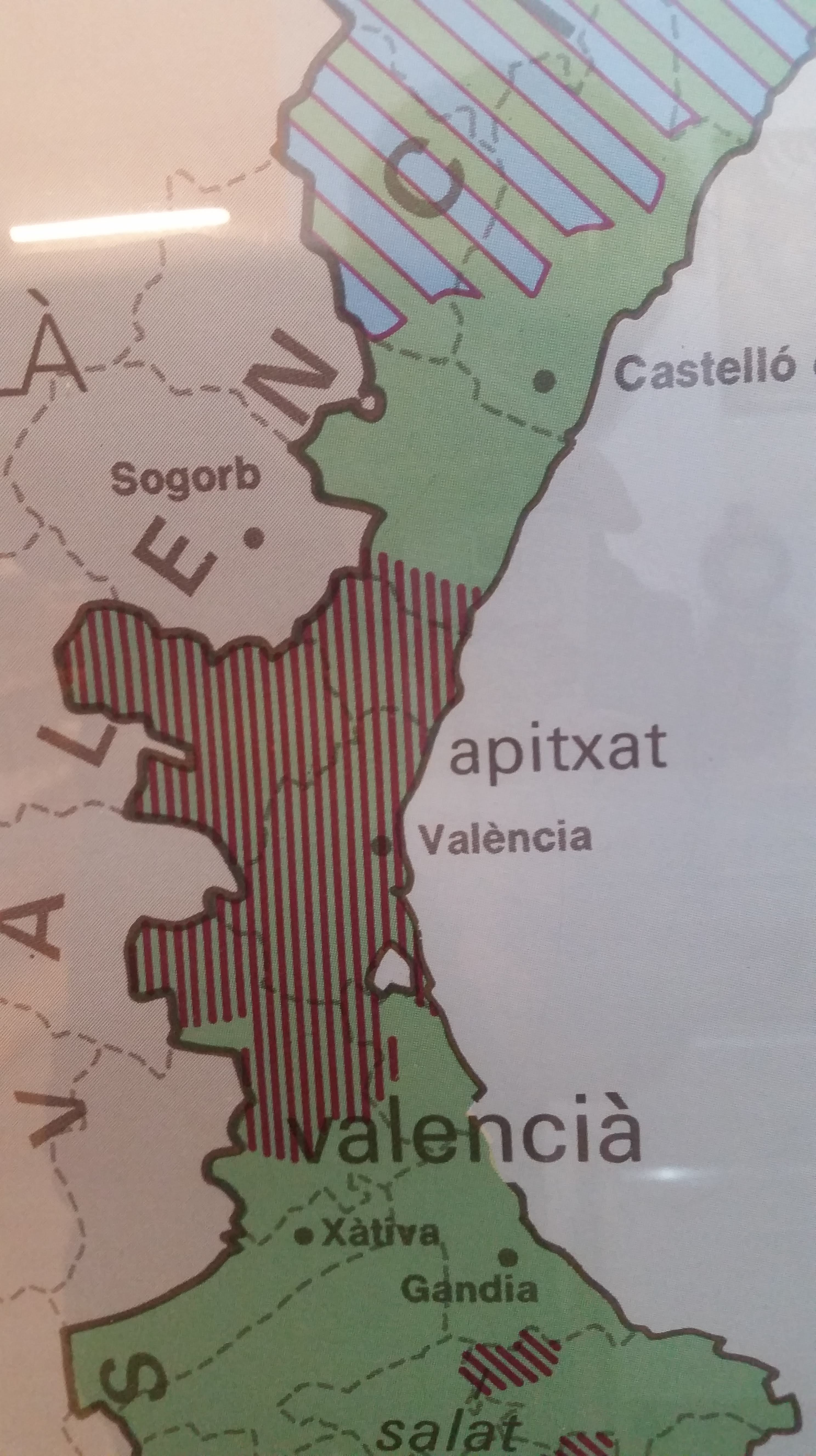
La foto és del mapa del call jueu de Tortosa, una ciutat preciosa que vaig visitar l’ùltim cop que vaig anar a Catalunya.

Let’s talk about occupation

I want to share an experience I had in Tortosa, Catalonia.  Some call it Spain, for now I’ll stick with Tortosa 😉 .

Tortosa is a city that used to have a sizable Jewish population.  Before the Inquisition and related persecutions, Tortosa had a “call”.  That’s pronounced “caly” (for lack of a better way to write it in English)- and it means “Jewish quarter”.

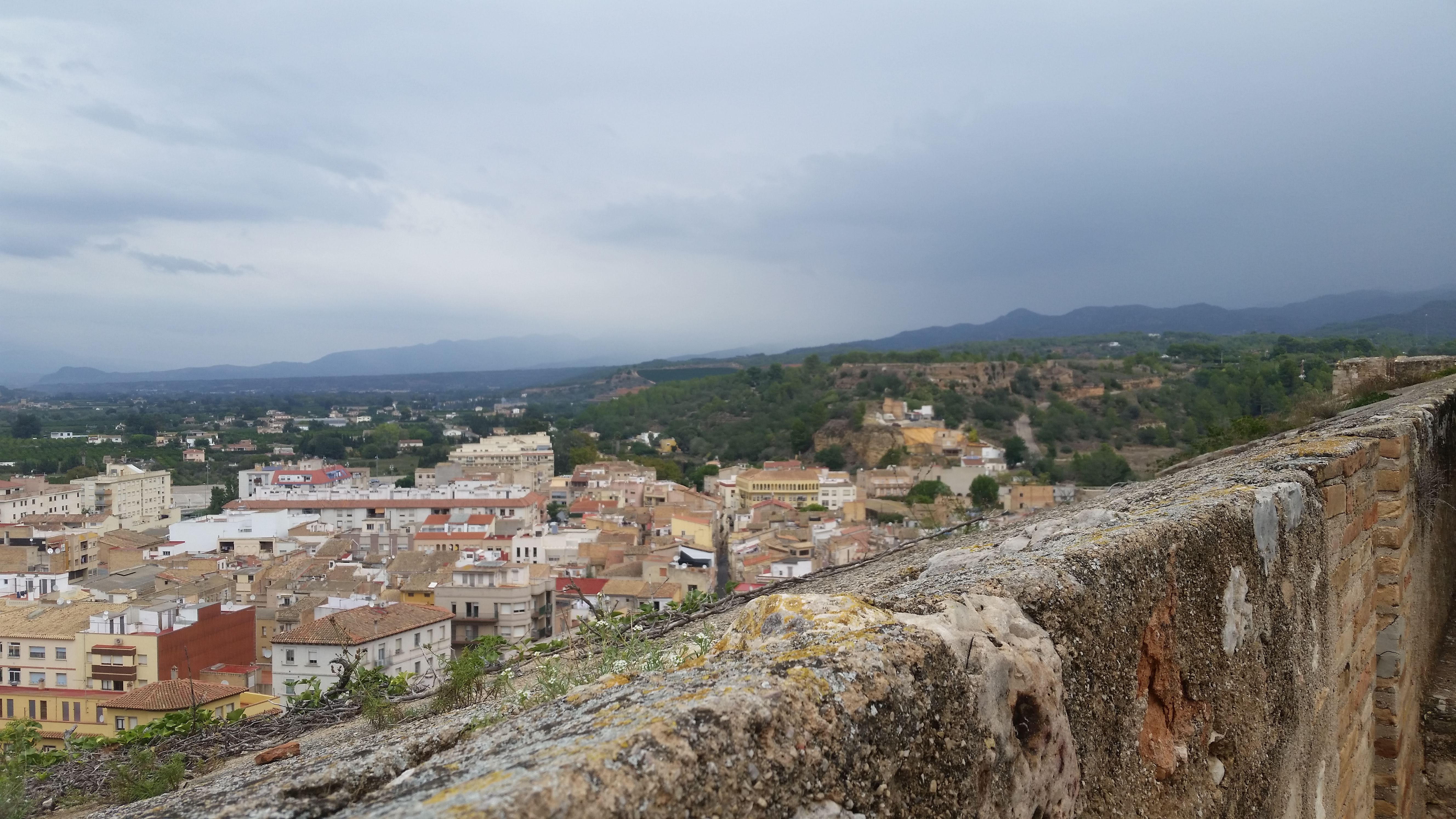
I decided I wanted to go for a hike.  Tortosa is surrounded by gorgeous mountains, take a look:

20181018_14195620181018_142125

I love nature, but I found myself increasingly drawn to the signs around me that said “call”.  They’re everywhere.  Something I love about Catalonia is that quite a number of cities make preserving their Jewish heritage a priority.  Unlike the mostly derelict synagogues of my great-grandmother’s Romania, Catalans seem generally proud of their Jewish heritage.  Because quite a number of them are Jews themselves- or were hundreds of years ago.  And they know it.

I wandered the call, finding where the synagogue once stood, the kosher butcher shop, even a plaza named after a rabbi, Menahem Ben Saruq.

I found myself humming Jewish tunes, including one of my own creation, and being stared at by some Moroccan men.  Almost the entire neighborhood now is filled with Moroccan Muslim immigrants.

I then headed to the town archives.  I love, love, love archives.  And I want to give a huge shout-out to archivists everywhere.  You keep heritage alive.  Science is amazing and can heal and grow our planet- but without humanities and a sense of morality, it is useless.  Ben Carson is a great example of why science is not a religion, it does not have all the answers any more than any other field of study.  Scientists need ethical systems just as much as humanists need biology and medicine.

The best thing about town archives, other than the ancient documents they contain, is that they are free!  So here’s my travel tip: if you find yourself itching to see unique, cool texts and really learn about where you’re traveling, head to an archive.  If it’s a rainy day (as it was for me), even better.  I walked around Tortosa with a piece of generously donated cardboard over my head until I could find a 9 buck Mickey Mouse umbrella. 🙂  Archives are my refuge.  And unlike museums, you won’t be shelling out tons of cash to wait in line and crowds.  Archives are often quite empty- sad for the state of humanity, but great for someone like me who likes a little peace and quiet.  All you need to do is fill out a form, show your passport, and next thing you know you’re looking at a hand-written 900 year old document.

That’s where I found myself.  The archivist brought me the “Carta de Poblament”.  It’s a Catalan document that the Count of Barcelona had offered the town during the medieval Christian conquest of Spain.  It basically offers new settlers various land privileges and natural resources for settling the territory.  Until then, it had had Jews, Christians, and Muslims.  But with the eventual imposition of the Inquisition, both Jews and Muslims had to convert, leave, or face torture and death.  Their empty houses became the Christian settlers’ homes we see today.  Occasionally, as in Granada, you can still see where the mezuzah was once hanging.

20181012_1344151

I then looked at the next documents I had requested.  I wanted to see Jewish documents.  And in some cases, you can still find them in Catalonia.  I once visited the Girona Jewish archive (the city has a particularly well-preserved call) and got to see documents in Judeo-Catalan!  Catalan written in Hebrew letters- and in some cases, with Hebrew phrases.  For a Jewish speaker of Catalan like me, there is nothing cooler.

The first document was in medieval Catalan (did I say archives were cool??) and was about the Jewish community of the city.  The next document was from 1323 and detailed how the local rulers had imposed a tax on the Jewish community to repair a broken wall.  I’m not sure exactly what happened, but Christian rulers (and Muslim ones) often imposed discriminatory taxes on Jews either as “protection money” or simply to raise cash.

The third document is the one that stirred my soul.  It was called “Població de convertits”.  A list of the Jews who had converted to Christianity.  Often under penalty of death.  From the early 1400s.  I have to say that seeing the hand-scribed names really moved me.  I felt deep sadness as my finger scrolled through the names of Jewish souls lost to an ever-encroaching Christian hegemony.  I wish I could say this was only a Christian problem, but it’s not.  Even the relatively tolerant Muslims of Al-Andalus engaged in pogroms, massacring the Jews of Granada in 1066.  A thousand years before the State of Israel, for people who think Muslim anti-Semitism is a recent phenomenon, purely a product of colonialism.

As I flipped through the pages, I wanted to find a specifically Jewish name.  It’s almost as if part of me couldn’t actually believe this document was real.  That maybe I had been given the wrong one.  Persecutions of Jews are often invalidated, ignored.  This must be just history books, it doesn’t feel totally real.  I couldn’t believe I was holding an ancient text of suffering, of my people, for free in a municipal library.

And there it was- Abram.  Abram and his son converted to Christianity.  I paused looking at the name.  I thought about how awful it must have been to be a Jew at that time.  What must have been going through his head and he decided between expulsion, death, and embracing a faith that so hated his identity.

And there it was, his conversion.  I felt sorry for him- and kind of angry.  How could he give up on our tradition so easily?  I’m sure it wasn’t easy.  But I felt torn.  And I felt furious at the authorities who forced him to give up who he was.  His soul, and those of his ancestors, are forever lost to the Jewish people.  Like so many others.  So when quite a number of Latinos or Spaniards I’ve met say that Jews are “racist” or “closed off” for only marrying “their own”, this document is my bold counterargument.  We only exist because we preserve ourselves.  Your people have been nothing but obstacles in our way for hundreds of years and I won’t apologize for keeping my identity alive.  I’m grateful to the non-Jews I’ve met here in Catalonia and Spain who are working to keep our heritage visible.  Thanks to them I can connect to my past- and they connect to me, as you’ll see in my recent post about a gay Valencian man I met with a Hebrew tattoo.  Who changed my life.

Before I left the archive, I thought if there was something creative I could do to bridge the past.  To make my Jewish ancestors proud.  To connect to Abram and to show the vitality to Judaism to this day, despite all of the hatred placed in our way.

When I left Israel for my travels two months ago, I could barely utter a Hebrew (or Arabic) word.  I was so tired of the region, the hatred, the intense pressure to assimilate into Israeli society.  I had chosen a name, Matah, when I made aliyah.  It means orchard.  It sounds like Matt, but is different- it’s about planting roots.  The name of this blog.

In Europe, I’ve been going by Matt.  Occasionally, Mateo.  But this day, I was going to reconnect.  I took a piece of paper, and added a nice touch to the 600 year old remnant of my civilization:

20181018_170003

Right next to Abram’s name, the second line from the top, I wrote my names.

מטע אדלר

Matt Adler

Jew. Jueu. יהודי.

I think Abram would have been proud.  I certainly was.  Half a millennia since the expulsion of Jews from this land, I was here, a proud Israeli visiting from the land of our ancestors.  Living with self-determination after two millennia.  Something Abram could have never even imagined.  And here I was alive in his home of Tortosa.

It’s a reminder that the impossible is sometimes possible.  History changes.  And each one of us can make a difference.

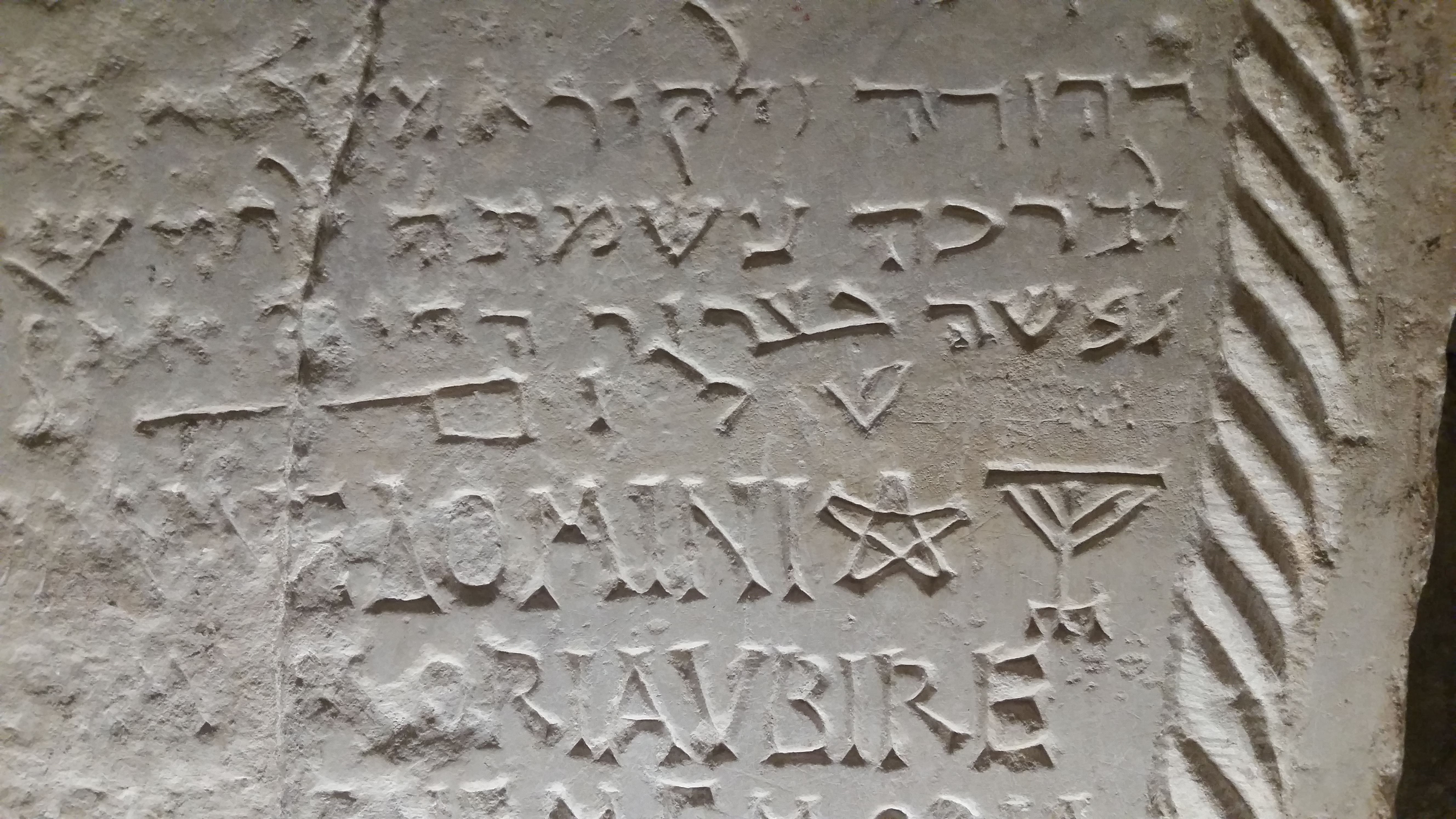
As I left the archives (still with the cardboard box over my head- one of the funnier moments of my trip until my feet were soaked in rainwater), I headed to the cathedral.  There I found a 1300-year-old Jewish gravestone in Hebrew, Latin, and Greek.  With a Menorah and, interestingly, a *5* pointed star:

20181018_174936

What’s so amazing is I could mouth out some of the words.  “Kever”- grave.  “Shalom”- peace”.  And “livrachah”- for a blessing.  The last word something we say to this day as we remember loved ones in synagogue.  A stunning reminder that even when the most hateful among Christians and Muslims stole our land, expelled us, and killed us- we held on to the one thing that kept us alive: words.  Evidence of our continuous presence on this continent, one that has tortured us.  But where we have ultimately persevered in existing.  Even if our current existence there is tenuous.  How many people can see a 6th century tombstone and recognize the words from today’s liturgy?    We’re a truly special people with an incredible historical memory.

As I headed home, I felt hungry.  I stopped into a kebab place.  As with many stores here, it was run by Muslim immigrants.  In this case, from Pakistan.  I have had some difficult experiences with Muslims in Europe.  I was curious before going on this trip what it would be like- both figuring that Europe was kind of a neutral space for potential dialogue and aware that there were many reports of anti-Semitism.  I was also keenly aware that I had to be careful in saying where I was from.  While an American Jew can hide behind their red, white, and blue passport, when you say you’re Israeli, people know you’re a Jew (even if you’re not!).

I’ll start by saying I’ve had some incredible experiences with Muslims in Europe.  I went clubbing with a queer Jordanian girl, who had never been to a gay club.  And she knew I was from Tel Aviv- and we’re still in touch.  Our sexy curves swerving on the dance floors of Budapest.  I also met a Syrian refugee there, who lifted my spirits as we chatted in Damascene Arabic late at night over shwarma.  And who I told I was from Tel Aviv.  And had a great time.

I’ll also say I’ve had a difficult time here.  More often than not, I don’t reveal I’m Jewish or Israeli to Muslims here.  By the decoration of their stores and their clothes, I can tell they are quite often devout.  And just the other day, a woman 10 minutes down the road from where I stayed in Belgium was threatened at gunpoint by a “bearded man” for being Jewish.  I wish I could say this was the only incident of Muslim anti-Semitism here, but it’s not.  Just a few years ago, the Belgian Jewish Museum I strolled by was attacked by Islamic terrorists, killing several civilians.  Anti-Semitism is on the rise in Europe (including from neo-Nazis), and many Muslims’ pointed questions about where I was from didn’t make it any easier.  More than a few times, they didn’t believe me when I said I was American- I didn’t “look” American.  Sometimes they think I’m Arab, other times they ask me what my religion is.  Repeatedly.  Which is incredibly uncomfortable and invasive.

Just the other day, an Algerian immigrant told me Israel and America *started* the Syrian Civil War and he didn’t believe Iran or Russia was killing civilians.  Needless to say, I’m glad I didn’t tell him I was Israeli in his kebab shop at 11pm.

I’ll add that I find it doubtful that many of these immigrants know the Jewish history of the land they live on today.  Despite the many signs covering their neighborhood explaining it.  Quite a number of Christian Europeans don’t either.  It struck me as bizarre and sad to see hundreds of Moroccan men walking around the Jewish quarter of Girona.  Seeing them wasn’t bizarre- what was more bizarre was the fear I felt in even singing a Jewish song there.  I couldn’t even get out the melody as two men stared.  Maybe they didn’t know what I was singing- but if they did, would I even feel safe?  Do they care that they live on this land bathed in the stains of our blood?  In fact, both of our blood?

It’s times like these where I feel distant from Muslims, from Arabs.  I’m someone who has invested a lot of time and energy in dialogue and exploring this civilization, as you can see from my previous blogs.  Sometimes it is fruitful and lot of times, it is painful.  We’re like two conjoined siblings who wish they could get away from each other, but can’t escape our shared past- and present.  I sometimes wonder whether learning Arabic was a waste of time, even as I miss the sounds of the language, the beats of its music, even fighting for the rights of Arab-Israelis and my Palestinian neighbors.  Some of whom would rather see me dead.  Who some extremist Jews wouldn’t mind dead.  It’s an odd yin-yang of hope, fear, love, and hatred.

So it was timely that my friend Muhammad called.  Muhammad is a 20-something kid from Rahat, a Bedouin city in southern Israel.  I met Muhammad while asking for directions in his town- I was trying to find a restaurant.  A delicious, delicious restaurant.  Bedouin food is quite different from other Arab food- if you’re in Israel, go to Mansaf restaurant at the entrance to Rahat.  Your life will be changed and your taste buds will thank you.  As will the friendly people there who wanted to take selfies with me.

Muhammad and I have kept in touch over the past 6 months or so.  We even met up again in person.  I knew he was studying for his college entrance exams- he wanted to study accounting.  A few months ago, he got in!  I’m so proud of him.  He just moved to Ramat Gan and starts school this week.  Love you man!

To say this is a culture shock and a brave move is a deep understatement.  Rahat is extremely traditional and entirely Bedouin.  Despite living in the same country as Jews, Muhammad has had limited interaction with them.  So moving to Ramat Gan, perhaps one of the cities with the highest percentage of Jews in the country, will be quite a shock.  Some ways good, but a huge change nonetheless.

Muhammad has managed to get an apartment (something that took me months in Tel Aviv) and find two jobs!  On his own.  I helped him along the way- on WhatsApp.  From my AirBnB in Oradea, Romania, from Hungary, from Almería, and from Tortosa.  I’m so proud of him.

Which is why it was a punch to my gut to hear what he had to say on the phone.  Muhammad went for a job interview in Ramat Gan.  He was offered the job, but the boss said: “our establishment has a lot of religious people, so we need to give you another name.”  Muhammad was a name some people just can’t bear to hear as they’re munching on their hummus and falafel.

Heartbroken, he almost decided to change his name.  He asked me what to do.  I first offered my sympathies.  This is one of the saddest things I can hear- that a young, aspiring young man is being told to cut off his identity.  I’m with you Muhammad.

Secondly, I shared some stories of discrimination I had faced as a Jew and a gay man- in America and in Europe.  The Lyft driver who threw me out of his car for being a gay Jew.  The Muslim man and the Belgian Christian who said I was an apartheid occupier, an ethnic cleanser.  The Argentinian who said Jews control the world.  The Algerian who said Israel did.

He was shocked.  And I think somewhat comforted to feel he wasn’t alone.  See while the reasons we were discriminated against were different, in the end they were the same.  People who hate difference.  People who refuse to see nuance or to empathize with others.

I told him that I love him as Muhammad.  As whatever he chooses to call himself.  And nobody has the right to decide that for him.  He has the right to choose to fight racism, to call a lawyer, to speak with an NGO.  And he has the right to put his energy towards finding a better job where people will appreciate him.  And choosing between the two strategies is not always easy.  I know- I never got a dime from Lyft despite a huge public relations campaign, but I was featured in an amicus brief to the Supreme Court for gay rights.  For a case we lost.  I support Muhammad in being himself, however he chooses to find his way forward.

So you have to ask yourself after all this, what’s in a name?  Abram converted to Christianity- and seeing his name hundreds of years later I spotted him as my landsman.  Matah was a sign of hope for me when I made aliyah, then became a grating sound on my ears.  Until I saw Abram and realized how lucky I was in certain ways to be a Jew at this time, in this place.  With a homeland we can call our own.  And Muhammad- how a brave young Muslim Bedouin man is forging his path forward in Ramat Gan.  Weighing his past identity with his present as he pursues a new future and faces racism.  Holding on to his name even as he wrestles with how to live as a minority.  Something I try to help him manage as someone who can draw on the rich reservoir of Jewish history and gay identity.  Minority persistence.

Muhammad gives me hope that despite my experiences in Europe, there are Muslims out there who like me.  As I am.  A gay Israeli American Jew.  I can’t pretend there are masses of them, but even knowing someone like Muhammad is out there, striving for more, caring about me, relying on me- that gives me a bit of hope.  And warms my soul.

There is a place on this planet where Jews and Arabs live together.  It’s not Spain of 500 years ago.  It’s Israel.  For all its problems, Israel is a place where Arabs know Jews as people.  Not caricatures or cartoons or characters on a soap opera.  Nor memories of 70 years ago, when they used to inhabit the same quarters in Morocco and Damascus.  No, in Israel we live together.  Not always in harmony, but knowing each other.  In a way that, perhaps better than anywhere else in the world, allows me to find people like Muhammad who I can breathe my breathy “habibis” and my deep s “sadeeqs” with.  Where I feel my Arabic is sometimes quite worthwhile.

In the end, what’s in a name?  Occupation is the word you’ll hear most in the news about Israel.  And I’m not going to evade and suggest that Palestinians are not real (that’s a thing), that they aren’t facing human rights abuses (they are), or that some of them weren’t expelled from their lands (some were).  What I will say is that occupation is complex.  As I travel around Europe, I notice all the Jewish lands occupied.  The Jewish bodies and souls emptied.  The synagogues turned into casinos and strip clubs and Italian restaurants.  The Muslim immigrants occupying our former quarters- either oblivious to our former past or some outright hostile to our current existence.

At a time when Catalans feel Spain occupies them (and Spain denies their difference), just how objectively clear is this word?  The far left would have you believe things are black and white, that Israel is an occupier, Palestinians are natives.  But rarely in life are things so clear.  When you visit Peki’in and meet Jews who have been there continuously since the Second Temple.  When you meet Arabs from Ramle who migrated from Libya a hundred years ago.  It’s not to suggest the current situation is good- but it is to suggest it is not entirely one-sided and it does not present simple solutions.

In the end, I also think about this word.  As I travel, one of the great questions on my mind is my own occupation.  How I occupy my time, what I like to do, what I want to do going forward.

Perhaps it’s telling that I recently found this cute sign in Catalan that says: “what do you want to be when you grow up?”

20181018_125345

And I’ve come to what I feel is the next step.  As I write this blog, it strikes me that when I left Israel, I wasn’t sure if I’d continue writing it.  Yet I found myself over and over again enjoying the therapy of sharing my experiences, of writing things down so for years on end I’ll be able to remember my adventures.  To share my thoughts, to bring a little understanding to the world, and hopefully to engage you with exciting, unexpected stories from cultures and languages you want to explore.

Which brings me to today.  I’ve written about 140 blog posts, hundreds of thousands of words.  I’ve received the most wonderful, heart-warming comments from readers in San Francisco, Saudi Arabia, Barcelona, and Bethlehem.

And I’ve shared it for free, out of love and a desire to make the world better.

This is how I occupy myself.  I love exploring and want to keep sharing meaningful stories and thoughts with you.

The way I do that is by asking you to contribute to making it possible.  Thousands of miles crossed doesn’t happen for free.  I’ve invested so much of my own time and money, and to keep things going, to be a member of my community, you now have the opportunity to contribute.

Soon, I’ll be making my blog a subscription site.  The format is being determined, but in one fashion or another, you’re going to have to pay to access this well of hope.  It’s fair and I can’t wait to connect with you on an even deeper level as we use this blog to connect open-minded people around the world.

If you’d like to join now, you have a chance to subscribe at a one-time, more affordable rate.  If you go to my GoFundMe page and contribute $20 or more, you will get your first year subscription free.  Everyone who has donated up until now will be grandfathered in and given a free subscription as well.  If you wait until I transition the site, the price will start at $36.

I want to keep you along for the journey.  I want to show you amazing archives and diverse people.  The unexpected twists and turns.  In 8 languages.  With a queer angle, an open-minded lens.  Proud of Judaism and Israel and willing to engage in nuance.  To make my communities better, kinder.  Understood and understanding.

I invite you to join me.  Or you can always find another gay Jewish blogger who speaks Hebrew, Arabic, and Yiddish and read his blog instead 😉

Let’s explore together. 🙂

The single best moment of my entire trip

Today, I visited Vila Joiosa, a village in Valencia, Spain.  I went there because they speak Valencian (or as most people call it, Catalan).  I studied Catalan in America at Georgetown University.  I fought my way into the class, which had nothing to do with my Master’s program, because I love Catalan.  I did my undergraduate thesis in Spanish on the Madrid and Barcelona educational systems’ approaches to immigration.  And in Barcelona, I fell in love with Catalan.  A beautiful Romance language filled with x’s and mysterious accent marks.  To me, it looked like a sophisticated, intriguing, sexy Spanish.

So nearly 10 years after my undergraduate education, I found myself at Georgetown studying communication.  And they have a wonderful Catalan program funded by the Ramon Llull Foundation, to promote their culture and language abroad.  And the professor generously let me into the class 😉

I’ve been visiting Alicante, a major city in the province of Valencia.  What’s so striking about Alicante is that it is in the heart of an area that has spoken Catalan for generations (some locals distinguish it as Valencian, but they are essentially varieties of the same language, whatever you wish to call it).  Yet today, almost nobody speaks the language.  The street signs are in Valencian, but you hear nothing but Spanish on the streets.  As if the words are a formality, a reminder of the past, but more of a museum than a living heritage.

So I went searching online to find a village that spoke Valencian, to this day.  I love Valencian Catalan.  I love dialects and accents.  And when I lived in America, I used to watch Valencian-language public TV.  It’s a beautiful variety of Catalan.  And despite what some Catalanists claim, many of its differences can be traced to historical settlement patterns, not just hispanification of the language.  Indeed, I learned today that parts of Valencia use the same unique definite articles as the Balearic Islands.  The only place in the former Roman Empire to keep this unique variety of Latin grammar alive.  Just like one of my favorite bands, Antònia Font.

So it was with great sadness when I saw Spanish nationalists shut down the Valencian-language TV station a few years ago and also stopped broadcasts of TV3 from Barcelona.  I love TV3- I was interviewed on it about my connection to Judaism and Catalan and my gay identity.  You can watch it here and here and test how much Catalan you can understand 😉 .

Every year, I’d check Wikipedia to see whether Valencian activists had succeeded in getting the station up and running again.  Desperately wanting to hear the beautiful Valencian dialect from far away- my only way to engage with it.

Well the station is back up and running.  And it’s thanks to people like City Councilor Josep Castiñeira of Vila Joiosa that it survived.  Along with the Valencian dialect of Catalan.

Vila Joiosa means “joyful town”, and today I had a most joyous experience there.

Walking around town, I noticed a bookstore.  Its name was in Catalan: “Vila Llibres”.  I got excited- this was just why I came to this seaside village.

Upon entering, I noticed a sign that says “here, we’ll serve you in Valencian”.  Whew!  Unfortunately some Spaniards can get prickly when you address them in a minority language, but here I knew I was safe to speak Valencian.

I did get a bit nervous at first.  I noticed a rainbow flag.  As a gay person, you might think this would make me feel at ease.  But in fact, a large portion of the European left, who is generally pro-gay rights has become anti-Semitic.  Quite a number of them, as Josep pointed out later, are quite content to be interviewed on Russian and Iranian TV, but can’t fathom the existence of Israel.  As if our state is somehow less legitimate than the haphazard mess of Middle Eastern states randomly carved out by colonialism.  If you believe your country should exist but Israel shouldn’t (I’ll give a pass to equal opportunity anarchists), you’re an anti-Semite and I don’t like you.

So when I saw this was essentially a left-wing Valencian nationalist bookstore, I got nervous.  Indeed, on the tram on the way to Vila Joiosa, I saw large graffiti calling Israel a murderous state.  Needless to say, there was no accompanying graffiti suggesting Saudi Arabia, Syria, or Spain were similarly murderous despite both past and current colonialism, murder of LGBT people and minorities, and ethnic cleansing (including of Jews).

My conversation with Josep, the bookstore owner, started about Valencian.  I told him I was an American who had studied Catalan and I was excited to see his bookstore.  Stunned that I spoke Catalan without an accent, he welcomed me in and showed me a map of Catalan dialects.  I stood in wonder as he taught me dialectal differences.  I can’t imagine a more exciting experience than chatting in Valencian while learning about the amazing map of Catalan varieties.  Phonetics, grammar, cultural diversity- this is what I love.

20181015_174947

Turns out, it wouldn’t be the only thing I loved about Josep.

I asked about buying a book specifically written the way Valencians speak Catalan.  He pointed me to some, and I went exploring.  Then I noticed a book about the dybbuk, the mythical Jewish spirit creature, in Catalan!  As I brought the book to his attention, he said it wasn’t specifically in the Valencian dialect.  And then I came out as a Jew- not an easy thing here if you’ve read my previous blogs, including from here in Alicante.

20181015_1757441

I told him how cool it was to see a Jewish book in Catalan.  And as I spoke with him, I started to notice Jewish books everywhere.  About Jewish history and culture.  I noticed a little sign that even said “shalom”- something I was so used to that I hardly recognized how unique it was in Valencia!

Josep then did the most amazing thing.  He pulled up his sleeve to show me a tattoo that said: “leshanah haba’ah beyerushalayim”.  Next year in Jerusalem.  A phrase we sing at the end of our Passover Seders dreaming of returning to our Holy Land.  A phrase we’ve sung for thousands of years.  Zionism is not a new concept, it is built into our very prayers.  Now is no longer a dream, but a delicate reality we strive to preserve for ourselves and future generations.

I was in the most glorious shock.  Turns out Josep, in his own words, is a Zionist.  And like me, is gay.  And left wing.  And a progressive Valencian nationalist.  In fact, he is a city councilor for the Compromís political party.

After a trip filled with so much anti-Semitism that I often feel afraid to reveal my Jewish Israeli identity here, I can’t tell you how relieved and thrilled I was.  To feel accepted.  Not only because, as some right-wing Europeans feel, that they like Israel because they hate Arabs.  Which puts me in an awkward position as who believes in human rights for all, including Israel’s Arab citizens and Palestinian neighbors.  Something I fight for- as an Israeli.  Even when significant elements of those societies hate me for being gay and Jewish.  It’s simply my value system, regardless of whether all the people I fight for support my own human rights.  Though some of them do.  What’s great about Josep is that we share progressive values.  And support Israel for this reason, and promote the people within it, like me, who are working to make it more and more a reality.

Josep is a hero.  Several years ago, I remember seeing headlines that Valencians were boycotting American Jewish singer Matisyahu purportedly because of Israel.  Where he doesn’t even live.  It’s pure anti-Semitism and it left me feeling distant from this culture that I spent so much time and love connecting to from across an ocean.  It’s beyond hypocritical for Spaniards to boycott Israel when their entire country is built on the bloodshed and expulsion of Jews and Muslims.  And it’s classic anti-Semitism when this hypocrisy is used to target someone who isn’t even Israeli!

Josep told me that he worked with his allies in Compromís to counter this boycott.  Even educating ignorant people in his own party.  He is against the BDS movement which seeks to destroy the State of Israel.  Not alter policies, not debate nuance, but to eliminate an entire country because it is Jewish.  A group of people so delusional that they have no problem traveling to China, meeting Russian academics, or enjoying the fruits of their own colonialism.  But somehow Israel is worthy of the utmost and disproportional criticism.  A 2,000 year old hatred rooted in the New Testament itself is hard to get out of your bones.  Fortunately some Christians today, like Josep’s priest friend in Vila Joiosa who loves Israel, are working as allies of our community to rid their culture of this hatred.

While I was across the ocean learning Catalan and embracing Valencian culture, Josep was here defending my heritage.  We honor each other.  And it is through the grace of our spirit that we met today.  Recently, I’ve felt I don’t believe in God.  And I still feel that the way God is portrayed in religious texts is erroneous and even dangerous.  But perhaps for the first time in months, I felt a connection to my inner God.  Because it’s by following my inner compass that I made my way to Josep’s bookstore today.  And made a new friend, hopefully for life.

Josep made me feel accepted.  He warmed my heart and put a huge smile on my face.  And so I took a piece of paper and wrote him a poem.  In Hebrew and in Catalan.  Here it is:


Josep and I are bibliophiles.  Lovers of the written word.  So perhaps it’s no surprise given our many shared passions that we really clicked.  People who love kindness, who seek to learn, who reject black-and-white thinking, that’s my kind of people.  That’s who Josep is, that’s who I am, that’s my life aspiration.  The fuel that keeps me going and pointed in the right direction.

As I read my poem out loud, I could feel his smile.  I live for moments like these.  Faced with so many challenges, these experiences give me a reason to live.

I want to feel accepted.  I’m an unorthodox thinker, but at my heart I’m basically a moderate left libertarian.  Unfortunately, some of the people who claim to carry this banner are anti-Semites.  Jeremy Corbyn, for instance.

It has made me feel isolated from my own natural community.  People who believe in human rights, individual freedom, less imposition of the state, economic fairness, LGBT rights, and compassion.  Something the extremes of our community have twisted so much they’ve ended up allied with authoritarians like Vladimir Putin and Hugo Chavez.

What’s so great about Josep is that with him, I can be myself.  While right-wing Jews and Zionists often demand I put my gayness aside and the far left demands I put my Jewish identity aside, Josep lets me be both.  A gay Jewish progressive.  And a lover of Catalan, unfortunately a language community where some speakers are anti-Semitic as well.  And Josep stands as a brave counterexample to their ignorance.  Proudly carrying the banner of a long Catalan philosemitic tradition.

Like most people, I just want to feel accepted.  And people like Josep make me more convinced than ever about how important it is for Jews to engage open-minded people like him.  To support his efforts against anti-Semitism and to empower his own fight for cultural rights.  So that his village won’t end up like Alicante.  A place with Valencian signs but no Valencian speech.

The Spanish state has waged relentless war on cultural minorities.  First, Jews and Muslims during the Inquisition.  But later groups like Catalans, Valencians, Basques, and Galicians.  Certainly nationalism is a delicate question.  If you read my blog, more often than not I’m against it.  Because in its most extreme forms it leads to division and violation of human rights.

What I’ll say, since I am an unorthodox thinker, is that sometimes nationalism is necessary.  As a minority group in the age of globalization, I have yet to find a better solution to preserving our identity than to have our own state.  It’s imperfect, it can lead to abusing other minorities when left unchecked, but it’s the only solution I’ve seen work.

I’m not interested in Jewish museums nor is Josep interested in a museum of Valencian history.  Indeed, when they start making museums about you, like the Museum of the American Indian in Washington (which I love), you better start worrying.  Because you’ve become mundane and weak enough that it’s OK to stop persecuting you and just remember you.  As if you’re a gentle reminder of the past.  We can weep together, but deny you the right to live differently.

Josep and I, while lovers of learning and certainly of museums, that’s not what we want.  We’re interested in being living communities.  It might be inconvenient for your ideology to recognize that nationalism is the only way for us to continue to be who we are.  Indeed, it’s somewhat inconvenient for my own ideology at times.

But it’s a solid fact.  And until you can show me a better way to ensure a Jewish and Valencian future, a little nationalism is what keeps us alive.  As the socialist hymn goes, I want bread and roses.  I don’t just want bread to survive, I want roses.  The beauty, the higher-level fulfillment of cultural identity and passing down my heritage.  As a part of my existence.  Not to go the way of the Shakers, but to be imperfect but real.

If you’re Spanish or American or Chinese or Russian or Arab, you’re not worried for the survival of your culture.  You’re global superpowers with hundreds of millions of adherents.  But Catalans and Jews and Basques and Tibetans- we’re not so lucky.  And we’re not content to rely on your goodwill to survive.  Because we’ve seen that even though there have been periods where you’ve granted us tolerance, there are others where you extinguish us.  And we want the self-determination to protect ourselves when you decide to scapegoat us.  We want self-empowerment.

It’s messy, but it’s sometimes necessary.  Of course, we must be mindful that our own self-empowerment doesn’t turn into the same hatred we’ve experienced.  A delicate balancing act, but one which I’m willing to engage in to ensure my people’s future.

All of my life decisions led to this sweet moment today.  My decision to study Spanish- which led to my decision to study Catalan.  My decision to pursue an active progressive Jewish life in America and Israel.  My decision to move to Israel, and then travel the world exploring myself and discovering new aspects of Jewish identity.  My decision to come out of the closet as gay.

None of today would have happened without me making these powerful life choices.  Nor without Josep making similarly brave decisions that led him to connect with me.  Standing up for his beliefs, for my people, for his own sense of self, even when it was inconvenient or led to threats.  He recently was attacked by fascists, as vicious in their black-and-white prejudice as the far left.  Like me, he remains squeezed between extremes but pursues his identity with vigor.  And I am grateful for his resilient pursuit of purpose.

I have never, ever recommended a specific restaurant or store on this blog as far as I can remember.  I’m not Trip Advisor, I’m here to share my experiences, not plug businesses- nor have I accepted ad revenue from them.  But I’m going to recommend Josep’s bookstore, because it is an oasis of wisdom and kindness.  Whether you speak Catalan or not, go visit.  Tell him I sent you.  And enjoy wonderful conversation and buy something to support such a kind heart who supports us.

At a time when the world is increasingly polarized and anti-Semitic, I have never been more convinced of the need to engage open-minded people like Josep.  I often feel like giving up on the Left, but there are people like him who bravely stand with us.  Or are curious to learn.  This is why I’ve started my new initiative Nuance Israel to empower them.  If you’ve liked this blog and my other writing, contribute to my new project to make my ideas a reality.  To bring together moderate, open-minded people to support a textured engagement with Israel and the Jewish people.  To put a stop to anti-Semitic boycotts which seek to shut down conversation and destroy my country.  Engagement is the way forward for a progressive Israel and to defeat anti-Semitism abroad.

On the bus back to Alicante, some Arab kids in front of me were listening to loud YouTube videos of Arabic music.  I told them: “ana kamaan ba7ibb al-musiqaa al-3arabiyeh, bas biddi naam.  Min fadlak.”

I also love Arabic music, but I wanna sleep.  Please 🙂

They smiled and turned the volume down.

I can see multilingual Maimonides and the other greats of Spanish Jewish history smiling down on me.

A day in Catalan, Spanish, Arabic, and Hebrew.  A moment of connection to a great Iberian past.  That Josep and I brought to life again today.

Vila Joiosa, a joyful village indeed.

The European left: mostly anti-Semites or all anti-Semites?

It’s been odd.  Through my travels lately, I’ve encountered a number of European leftists and every single one has been a rabid anti-Semite.  A small sample size, but telling perhaps also in the fact that they expressed it in the exact same way.

I’m someone who’s often skeptical of the news.  News reports tends to focus on the most sensational stories- and to skew them in a way that gins up your fear or anger to get ratings.  It’s a business.

I have a few reasons I write this blog.  Foremost, because I enjoy it and it feels therapeutic.  I like sharing my stories- having a written record of my journey.  And I also like sharing my observations and ideas with friends around the world.  Especially when I can offer nuance or perspectives overlooked by mainstream media.

While the news often gets it wrong or only gets part of the story, European leftist anti-Semitism is quite a real thing.

If you read the Jewish news, this problem is hardly a new one.  Literally just Google it.  While I occasionally experienced it in America, perhaps because America has a much less intense history of anti-Semitism and a lot more living Jews, it never hit me as hard as here.

On the plane from Slovenia to Brussels, I was seated next to a Flemish Belgian man, Tom.  Tom was rather grumpy at the beginning of the flight, but I tend to give people the benefit of the doubt on a crowded airplane, and he did get chattier later in the flight.

To his right was Dina, a really open-minded, curious Slovenian woman.  Dina, if you’re reading this, you made my flight!  Keep exploring, I admire your curiosity and kindness 🙂

I joined in their conversation.

Tom works at an arts NGO in Brussels.  On his own initiative, maybe because he peeked at my phone playing Hebrew songs, he brought up the Jewish community in Antwerp.  Almost completely out of nowhere.

I said I was Jewish and I speak Yiddish, just like the remaining Hasidim there.  One of the very communities to still do so in Europe.  When just 70 years ago, millions of people were using the language every day.

He then proceeded to tell me how tight-knit the community was.  Which was at first a maybe neutral observation.  Which then devolved into him telling me (and Dina) how they were so “isolated”.  It didn’t take long before he was telling me about the “powerful, elite Jewish lobby in Amsterdam” that practically controls Dutch politics.  To give you an idea of how absurd this is, Jews are .2% of the Dutch population.  Who continue to suffer anti-Semitic attacks.  In a country with relatively low levels of anti-Semitism and a decent relationship with Israel, but sometimes one that ventures into the obsessive and preachy.  Hardly characteristic of a government run by a cabal of Jews, but then again age-old anti-Semitic stereotypes are as hard to counter as they are to prove.

While Dina at every turn asked interesting questions and thanked me for sharing about my country, Tom was frankly a dick.  He said Israel was an apartheid country- something I would never say to anyone on a plane, no matter how rough their government is.  It’s aggressive and mean.

I asked why he thought this and he said: “because Arabs don’t have equal rights.”  A rather broad standard for apartheid seeing as how every country in the world has societal groups that are discriminated against.  From gays to Roma to refugees to Jews to Latinos to Muslim immigrants to Catalans to Tibetans and on and on.  While I’d agree Arabs don’t have equal rights in Israel, neither are they excluded nearly on the level of apartheid South Africa.  I don’t think there were many black members of government there, while 15+ members of the Israeli Knesset are Arabs.  My doctor in Israel is Arab.  Arabs go to university side-by-side with Jews.  This isn’t an attempt to whitewash racism- it’s real and I’ve seen it, I’ve heard it, I’ve even experienced it.  It’s just to say that to equate Israel with a country that did nothing but brutalize its black population in constantly legally-sanctioned segregation is to both insult the victims of apartheid and to deeply insult Israel.  Not to mention the fact that the actual racism in Israel goes unaddressed because you’re completely mischaracterizing it.  But your objective is not fixing problems, it’s creating them.

I asked Tom, much like I asked the British anti-Semites I met last week, why he would say such things about Israel but not about China, which brutally occupies Tibet and Uyghur territories, including banning their languages and religious customs.  He said something utterly bizarre and word-for-word what Alice the British anti-Semite said: “because Israel is a democracy.”

Well that’s odd.  How can a country be both a democracy and an apartheid state at the same time?  That’s logically impossible.

But for the mental gymnasts on Europe’s far left, it makes total sense.

The one thing I found strangely in common between both groups of anti-Semites was they had to tell me how they were not anti-Semitic.  Specifically in both cases, by pointing out how they “call out” anti-Semitic BDS supporters.  People who boycott Israel.  In Alice’s case, like her.  And in Tom’s case, I can imagine he supports it too.  Even as he claims there is no such thing as left-wing anti-Semitism while embodying it himself.

They told me specific stories of how awesome they were at calling out anti-Semites in their own movement.  As if somehow I’d be thrilled or want to thank them for being so great at noticing the blatantly obvious anti-Semitism in a movement that only targets one country in a whole world of nations that abuse human rights.  In their world view, they can’t totally hate Jews because we’re a minority and minorities are always right.  But we’re a minority that stubbornly resists their gospel, so they have to hate us.

You see, they have a religion and it’s called leftism.  In reality, it’s authoritarian nationalism simply with a different flavor that on the right.  Orthodox thinking, you or me, inside or outside, right or wrong.  Non stop.  And the idea that all countries should follow their model.  Alice couldn’t stop ranting about how international law was “objective truth” and Tom told me how if we only “secularized” the Middle East and “got over our problems” we could have a one state solution.  If only we just behaved like those civilized Christians.  Pardon me, Europeans.

You see this idea is not new at all.  Europeans scouring the globe for people to “teach”.  For people who need to be just like them.  You see, before colonialism, Europeans had hundreds of years of practice as this condescending attitude at home and it’s called anti-Semitism.

Anti-Semitism is a colonial movement.  A movement to force the Jewish people to abandon our faith, our traditions, our difference.  And it’s been around for as long as Christianity has existed.  Morphing into purportedly secular forms in the past 200 years, but with the same exact premise.

You can see this in how Tom described the Jews in Antwerp.  While Jews in Brussels are mostly secular, Jews in Antwerp are mostly Hasidic.  He said it was bad politics for a centrist party there to have invited a Jew to be a candidate for local elections (who was later forced out).  Because the Hasidic man, per his interpretation of Jewish tradition, cannot shake hands with a woman.  While I personally do not follow this school of thought, this is actually a very common practice in forms of Judaism and Islam, so it’s not as if an alien is visiting Earth.  It’s a thing- like it or not, it’s a practice and a real pluralist can disagree with the behavior and not condemn the person as a bad human being.  Or that he is not worthy of participating in public life.

But European leftists are not pluralists, they are fascists with cute hipster clothes and law degrees.  After I tried explaining the nuances of Jewish law and the complexity that comes with every culture having practices that fall outside other culture’s norms.  He said to me: “you cannot have this man in politics.  We have tolerance here.”  Perhaps the most Orwellian sentence I’ve ever heard.

But the reality is there’s nothing tolerant about this ideology.  If it likes gay people, it’s only because we fit into their worldview, not because they are generally empathetic people.  If they like Jews or Israelis, its only the ones who are “against the occupation”- and to a degree that satisfies them that they have passed their ideological litmus test.  They say they like refugees- Alice even worked with them.  In her case, she tried to claim that refugees being denied entry to her country were somehow not being racially discriminated against (even though we all know that is bullshit).  And that was somehow radically different than Israel discriminating against a Palestinian on the basis of being a different race and religion.  In Tom’s warped view, he actually claimed anti-Semitism wasn’t a real problem, in fact it was all anti-Islam now.  While he derided Muslim immigrants for their backwards homophobia and general troublemaking.

In other words, this isn’t about equality.  It’s about nationalism.  Refugees being discriminated against based on race and religion is not “the same” as Palestinians being oppressed because the former have no claim to nationhood.  Europe has the right to screen and reject desperate refugees fleeing war, but in Tom’s view, Israel doesn’t even have the right to borders.

You see in these twisted views, Jews are acceptable fodder for molding and scolding.  Not only Jews, as many Muslim immigrants here have discovered.  But first and foremost Jews.

While to an American progressive’s eye, Europe seems more advanced (and it some ways, like healthcare, it is), it’s actually just a battle of one orthodoxy versus another.  With the helpless middle (yes, there are open-minded Europeans like Dina) struggling to get some space in the debate.

The far right hates Jews for being socialists, for fomenting “revolutions”, for being impure infiltrators undermining their traditional culture.  Just look at the Hungarian campaign against George Soros.

The far left hates Jews because we are capitalists, we are money grubbers, we illiberal oppressors of blameless Palestinians.  We are black hats and side curls and oy oy oys.  And far too traditional in a world where everyone should “get over” those old identities of yore.

The thing is they hate us for the exact same reason: because we are not them.

And try as some Jews might- and have- we never will.

You see all we can do is hope to be like them, only to be rejected yet again, exactly how German Jews who prayed in German, fought for Germany, and embraced their country were ultimately burned at the stake.  We can try and try and try and we’ll never been Dutch or British or whatever enough for them.  Because we’re Jews.

It reminds me of another shell I used to have in the Diaspora that I successfully lost in Israel: my defense against anti-Semites.  Explaining and defending myself as a Jew.  Israel, for all the traumas it brought me, did help me get rid of this sense of inferiority.  And I don’t intend to let it come back.

My concern for humanity comes from a sense of fairness and pluralism.  Which is why it doesn’t matter to me if someone is Tibetan or Palestinian, Jewish or a Muslim refugee.  We are human beings and we deserve good.  So whether the Security Council recognizes us as such is really irrelevant.  Because it doesn’t take a piece of paper to try to treat all kinds of people with kindness.

This kind of thinking doesn’t work with people who want to blame the world’s, let alone the Middle East’s, problems on just one group of people and one alone.  An easy fix for an impossible problem.

Before telling me that his “easy solution” to the Israeli-Palestinian conflict was for both sides to secularize and join together in one state, Tom asked me what my solution was.

Perhaps to his small-minded surprise, I said: “I don’t have one.”

He almost didn’t know how to respond.

Perhaps living in a bureaucratic city, much like my hometown of Washington, where everyone pretends to have iron-clad answers for every problem, he can’t handle the uncertain.  But I don’t view the world this way.

Not because I sit indifferent saying we shouldn’t do anything.  Just that I’ve gained the humility to understand that things aren’t so simple.  And even if we try our best, we might not succeed.

Tom in particular asked if I had started praying more since moving to Israel.  A pretty obvious and disgusting way of asking me just how stupid I was.  Did I really take the bait and become one of “those Jews”.

I said no, I actually pray less.  I’m spiritual and pretty secular now.

The reality is while I don’t pray, I’ll offer one now.  I hope people like Tom lose each and every election.  Just like their far-right friends who have the same narrow-minded us vs. the world attitude.

Because Europe doesn’t need them.  There are good people here.  I’ve met incredibly hospitable African immigrants from Rwanda, Syrian refugees, Roma, and Francophone Belgians.  And people like Dina, not a minority, but simply empathetic and curious.  Oftentimes the nicest people here are the ones most overlooked.  Perhaps why they’re a little nicer, a little more open when I talk to them.  Because I actually care about them.  Unlike their wealthy snooty neighbor Tom who’d rather talk about them.

If you ask Tom where to go in Belgium, he’ll tell you about all the fabulously wealthy areas, the Flemish cities which attract millions of tourists.  But I’m writing you from Wallonia, the Belgian underdog, where there’s less money but a lot of heart.  And I saw millions of stars tonight surrounding by cute sleeping cows next to a forest.  I didn’t pay thousands of dollars in rent and I got the best free view in the world.

Life is about priorities.  And I’d rather spend my time with people who respect me even if they don’t make the front page of a tourist brochure.  Or perhaps, precisely because they don’t.

While Tom told me, quite cruelly, that he doesn’t think Israel will exist in 50 years, the reality is Belgium might not either.  If one of the richest countries in the world can’t cross its linguistic divide and come together, you’d think someone from there would understand how hard this is to do in the Middle East, where the conflict runs thousands of years deep.

But then again, that’s like asking a Belgian to say “French fries”.

==

Here are some pictures from Wallonia.  The place every tourist book tells you not to visit because “eew they’re not as rich”.  See for yourself, it’s pretty sweet.  And has some of the friendliest people I’ve met in Europe.  Another reason not to listen to the Toms of the world and go see things with your own eyes.